• About Me
  • Other Writings
  • Interview Clips
  • All About Me: American Racism, American Narcissism, and the Conversation America Can’t Have
  • Video Clips
  • Boy @ The Window Pictures
  • Boy @ The Window Theme Music

Notes from a Boy @ The Window

~

Notes from a Boy @ The Window

Tag Archives: Racism

Honorary Stupidity

09 Saturday Nov 2013

Posted by decollins1969 in 1, culture, Eclectic, Politics, Pop Culture, race, Sports

≈ Leave a comment

Tags

Brandon Marshall, Bullying, Commodities, Cris Carter, ESPN, Fandom, Harassment, Hazing, Hostile Work Environment, Inhumanity, Jonathan Martin, Mark Schlereth, Miami Dolphins, N-Word, NFL, NFL Network, Ostracism, Racism, Richie Incognito, Ricky Williams, Warren Sapp


MLK's "Sincere Ignorance and Conscientious Stupidity saying, November 8, 2013. (http://bitterrealities.wordpress.com )

MLK’s “Sincere Ignorance and Conscientious Stupidity” saying, November 8, 2013. (http://bitterrealities.wordpress.com ).

There are so many things I could say about Richie Incognito and the vocal group of Miami Dolphins and ex-NFL players who’ve been supporting him versus Jonathan Martin over the past six days. That NFL players are Neanderthals. Or that Black players and ex-players like Cris Carter, Warren Sapp and Ricky Williams need their own education on what is and isn’t racism or harassment. Or that ESPN and the NFL Network have pushed this story without bringing a more critical lens to it.

There are two points that emerged this week, though, that bother me more than anything else. The idea that Incognito is more “Black” than Martin. Because Martin doesn’t sound “Black,” doesn’t act out of willful stupidity like “Black” NFL players, because he’s biracial, because he attended Stanford University, because his parents are Ivy League-educated. Last I checked, on and off the field, Martin’s treated as Black, regardless of his “unique” background. And Incognito’s still a White guy, one that threatened his teammate and his family, calling him the N-word on and off the field. Aside from the fact that the idea of a White guy being an “honorary Black” guy is offensive in general (see Maya Angelou’s idiotic praise of neo-conservative President Bill Clinton as “our first Black President” for Exhibit A) there’s this reality. No matter how “Black” Incognito can allegedly act, it’s an act, one which comes out of his Whiteness, and with it, an ultimate sense of cultural superiority.

Richie Incognito, Miami vs Oakland, Oakland, CA, September 16, 2012. (June Rivera via Flickr.com/Wikipedia). Released to public domain.

Richie Incognito, Miami vs Oakland, Oakland, CA, September 16, 2012. (June Rivera via Flickr.com/Wikipedia). Released to public domain.

The other equally disturbing point is that because the NFL locker room is a unique place of hyper-masculinity, that what goes on there isn’t subject to public scrutiny. If that’s the case, why not go back to the days of alcohol in the locker room, where players could shoot up steroids and amphetamines? Or have strippers and groupies in the locker room as well? The NFL locker room, like other work sites, is not a static place, but an evolving one. If it wasn’t, then seventy to eighty percent of the players in it these days wouldn’t be Black, Latino or Samoan. It’s a stupid argument, one exactly like those made by NYPD and LAPD officers, construction workers and White supremacists.

Luckily, there are players and ex-players like Brandon Marshall and Mark Schlereth whose understanding of and sensitivity toward this issue has been exemplary. They are in the minority among the professional athlete and sports world set so far, unfortunately. Martin’s former teammates have unified in their portrayal of him as a villain and traitor and Incognito as the “real nigga” on the football field and in the locker room.

The reason for this should be obvious, at least for those of us with either uncommon sense or with a social justice core. Humanity apparently has no place in the world of sports, especially in football and even more specifically where Black football players are concerned. For owners, front office managers and fans alike, they are merely commodities. Ones that all often criticized for or envied over their salaries and torn down publicly for their sins and crimes. The players and ex-players see themselves as warriors and gladiators, or, in the case of the media savvy, as cut-throat businessmen. None of this allows for any sympathy or empathy for football players who have been genuinely harassed or abused.

Beef cattle on Eefie Hill. North Atlantic in the background, United Kingdom, August 18, 2005. (John Comloquoy via http://geograph.org.uk). Released to public domain via Creative Commons ShareAlike 2.0.

Beef cattle on Eefie Hill. North Atlantic in the background, United Kingdom, August 18, 2005. (John Comloquoy via http://geograph.org.uk). Released to public domain via Creative Commons Share-Alike 2.0.

It has meant that players like Incognito — or in previous generations, Michael Westbrook and Bill Romanowski — have fellow players willing to stand up for their criminal behavior, for in fact creating a hostile work environment. Players who suddenly respond like human beings to a dehumanizing workplace have found and do find themselves shunned by the fraternity. And to quit and air out the dirty laundry? It may well be easier to quit La Cosa Nostra and continue to live than it has been for Martin to quit the Miami Dolphins.

I, for one, don’t expect NFL locker rooms to change as a result of the ongoing investigation of Martin’s harassment allegations, no matter how true they may actually be. But I do suspect that even in the Dolphins’ locker room, there are players who haven’t forgotten their humanity, whose understanding of race and masculinity goes beyond a rap video or the N-word. At the very least, there will be much more to come in the form of dirty laundry, and not just from the Dolphins, either.
On the Insignificance of Saggy Pants & Respectability

20 Friday Sep 2013

Posted by decollins1969 in Boy @ The Window, culture, Eclectic, eclectic music, Movies, music, Politics, Pop Culture, race, Youth

≈ Leave a comment

Tags

Birmingham Church Bombing, Black Elite, Boyz n the Hood (1991), Economic Inequality, Florida A&M University, Hip-Hop Culture, Institutional Racism, John L. Lewis, Jonathan Ferrell, March on Washington, NWA, Police Brutality, Racism, Respectability, Saggy Pants, Thug Life, TLC, Trayvon Martin, Tupac, Violence, White Supremacists


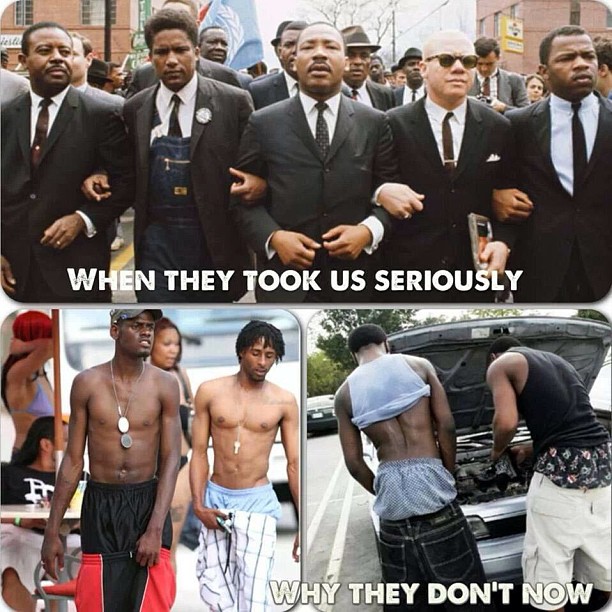
"When They Took Us Seriously/Why They Don't Now" poster, September 20, 2013. (Tim Brinkley/Google +).

“When They Took Us Seriously/Why They Don’t Now” poster, September 20, 2013. (Tim Brinkley/Google +).

In the past month of March on Washington and “I Have A Dream” speech commemorations and Birmingham church bombing dedications, a series of images lamenting rap culture and “thug life” have made their way around the Internet. The one that has stuck with me the most has been the image of the Selma March in 1965 juxtaposed with seemingly random photos of young Black males with saggy pants. The caption reads, “When they took us seriously/Why they don’t now.” Really? White supremacists took respectable Negroes seriously in the ’60s because they marched and wore suits, but don’t take Black males seriously now because of the saggy pants phenomenon? The truth is, they did and didn’t take us seriously then and now, and it has almost nothing to do with pulling our pants up above our boxers.

I have to say, though, that I hate saggy pants. It makes the people wearing them look somewhere between goofballs and idiots. It’s never mattered to me whether White guys or Black guys or college guys or hip-hop divas have worn saggy pants. I didn’t like it when it became a style in the early ’90s, thanks in large measure to NWA and Tupac, TLC and Snoop Dog and a host of other hip-hop/rap artists. I certainly don’t like it now, and would never buy a pair for my ten-year-old son to wear that way. The saggy pants style has been a sad twist on hand-me-downs and poverty as marketable clothes for the hip-hop cool.

But the saggy pants style has never translated for me as embracing a  “thug life” or some devolution of Black culture or American society. It wasn’t life imitating art, ala Boyz n the Hood (1991), Menace II Society (1993) or Clockers (1997). Nor have I ever seen it as something that meant that Whites or the new Black elite could say, “See. These Black folk don’t deserve respect, or health care, or a quality education, or good-paying jobs.” Over the past two decades, I’ve seen it as a style — a bad style, to be sure — but a style that some Blacks (and Whites, Latinos and Asians) have embraced.

Any young Black person who’s striving for higher education, or careers, or their own stereotypical success story in life, will tell you that they don’t wear saggy pants for every time or season. Even those who don’t know learn very quickly that saggy pants aren’t welcome in allegedly more respectable settings. If anything, the prevalence of saggy pants in 2013 has as much to do with the reality that opportunities for education, employment and prosperity remain so out of reach that it really doesn’t matter to many what they wear and where they wear it. There’s no need to code switch if everyone in your world knows the same exact code of cool.

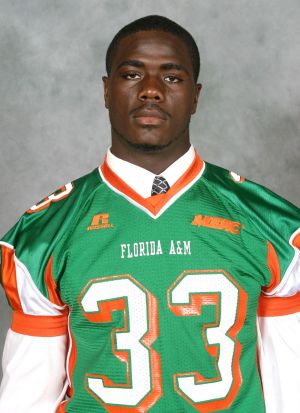
Jonathan Ferrell, Florida A&M football picture, September 20, 2013. (AP/Florida A&M University).

Jonathan Ferrell, Florida A&M football picture, September 20, 2013. (AP/Florida A&M University).

Recent events have made it pretty obvious that it really doesn’t matter what Black males wear. We remain targets for deeply ingrained stereotypes, institutional racism, and pre-emptive White violence. Whether it was Trayvon Martin wearing a hoodie in the rain, or John Lewis wearing a suit in Selma forty-eight years ago, it hasn’t mattered to Whites in fear of the Black boogie man. Florida A&M University graduate and former football player Jonathan Ferrell learned this deadly lesson in North Carolina just a week ago. It doesn’t matter what we wear, at least as far as many Whites and some Black elites are concerned.

Blacks all look the same to them, and looked the same to them in the ’60s. Suits, hoodies or baggy pants, we’re criminals and imbeciles from birth, thugs for life, and a drain on families and American society. This doesn’t mean that any one of us shouldn’t take responsibility for how we act, speak and look in public. I dare say, though, that structural economic issues like unemployment in deeply impoverished Black communities (or crank-infested White ones) won’t be solved with young folk pulling their pants up. We need to stop focusing on the insignificant, because saggy pants and respectability are the trees in this morphing forest of racism and economic inequality.

First Day of High School, Thirty Years Ago

05 Thursday Sep 2013

Posted by decollins1969 in 1, Boy @ The Window, culture, Eclectic, Mount Vernon High School, Mount Vernon New York, Politics, Pop Culture, race, Youth

≈ 1 Comment

Tags

Educational Inequality, Educational Leadership, MVHS, Paternalism, Principal Leadership, Principals, Racism, Richard Capozzola, School-to-Prison Pipeline, Tough-Love, Violence, White Paternalism


Oz (HBO) poster, September 5, 2013. (http://www.brain-dead-blog.blogspot.com).

Oz (HBO) poster, September 5, 2013. (http://www.brain-dead-blog.blogspot.com).

Our/my first day at Mount Vernon High School (New York) was the first Thursday after Labor Day thirty years ago, which means the exact date was September 8, ’83. It was mostly a very good day, except for our third period assembly with then Principal Richard Capozzola. He pronounced at least half of our class dead on arrival not quite two hours into ninth grade. Capozzola said, “There are 1,075 of you here today. Four years from now, only half of you will graduate” from MVHS. It turned out that he was wrong. Only 545 of us were eligible to march by September ’86, and 509 of us ended up doing so in June ’87. Even when accounting for the twenty or so Class of ’87 folks who decided to take their nineteen credits and graduate in ’86 instead of ’87, less than half of our original cohort graduated in years.

In Boy @ The Window and on the five or so occasions I’ve had to talk about the late Richard Capozzola and MVHS, I’ve attributed much of this to “the reality of self-fulfilling prophecies” and “the damage that low expectations can do.”  There isn’t a single word that I’d change in my description of Capozzola and in my thoughts about what he said, thirty years ago or right now. When you run a school as if the students are inmates and security act on your behalf as corrections officers, it is really a surprise when students drop out? When your security measures have the effect of increasing tensions so that more fights break out, shouldn’t it mean that the head school building administrator re-evaluate such measures? Apparently not.

That’s the principal and school that I remember outside of my Humanities days. Where girls ripped off each other’s earrings in the process of slugging each other. When witnessing one or two fights a week in building was a normal part of the process. When White potheads would sneak a smoke in between classes in the courtyard, but no security would intrude.

Mount Vernon High School main entrance, Mount Vernon, NY, November 22, 2006. (Donald Earl Collins).

Mount Vernon High School main entrance, Mount Vernon, NY, November 22, 2006. (Donald Earl Collins).

I have no doubt that trying to curtail this was a difficult job for any principal in ’83. But MVHS wasn’t Ft. Apache, or Jersey City, or South Central LA in this era. No MVHS student had brought a gun to school to shoot someone, at least in my time there. Short of a Swiss army knife, most students used their words to cut each other down, or in threatening to use a knife, maybe, off school grounds, after school.

Over the past couple of  years, I received comments about what I’ve written about my late principal from one of his children, who has repeatedly defended his father as a hero of sorts. He has disagreed, and rather bitterly, about what I’ve written, as if his experience with his father actually negates my experience with him as a principal. As part of my response to Capozzola’s son two years ago, I wrote:

Make no mistake, I for one, didn’t feel one iota safer in my four years at MVHS because of security sweeps, the closing of the courtyard to student use. Not to mention the general feeling I had that people who looked like me — regardless of my grades — weren’t welcome, whether that was intended or not. It’s a bit paternalistic to suggest that a heavy-handed approach to security “saved my life” or led to a national award for educational excellence in 1983 [It was actually a Blue Ribbon School in 1987]. As an educator myself, I know all too well the politics involved in such descriptions of schools like MVHS and with such awards.

Lion eating wildebeest - "animals" was what administrators & White classmates sometimes called MVHS students, but ironically referencing themselves, September 5, 2013. (YouTube).

Lion eating wildebeest – “animals” was what the White administrators & classmates sometimes called MVHS students, but ironically referencing themselves, September 5, 2013. (YouTube).

I’d add to this, though. I don’t really think that Capozzola actually cared about learning or the closing of achievement gap, either, not based on how he treated Humanities. And “tough love and a firm hand?” Really? That’s how you describe a father or an overseer — it should never be how you describe a principal. There was no love in his so-called toughness, and not enough firmness to prevent fights and slights that were a frequent part of my four-year experience at MVHS. And yes, many of MVHS’ students lived in poverty, but there was a sizable number of middle class Black students who attended as well. To forget that would be to, I don’t know, lump MVHS as a monolithic block of Black (and Latino) kids ready to start a riot. How is this different from a stop and frisk policy that targets poor neighborhoods and Black and Latinos between sixteen and thirty?

Which, in the end, is what both the late Capozzola and his son have done, thirty years ago and much more recently than that. To think that I put up with this for four years, at least one year too long. The embedded racial paternalism and institutional bigotry, in their words and deeds — it just takes my breath away.

My First Walk (and Making Plans)

15 Thursday Aug 2013

Posted by decollins1969 in 1, Academia, Boy @ The Window, culture, Eclectic, Hebrew-Israelite, Mount Vernon New York, race, Religion, Youth

≈ Leave a comment

Tags

Affluence, Bronxville, Child Abuse, College, Coping Strategies, Domestic Violence, Eastchester, Economic Inequality, Making Plans, New Rochelle, Pelham, Phyllis, Poverty, Racism, Tuckahoe, Walking


Thirty-one years ago this week was the beginning of an inadvertent coping strategy that would lead me away from 616, out of Mount Vernon, New York, into Pittsburgh, and college, and grad school. (And eventually, to a worn-out right knee, leg exercises and a running regiment that I’ve adhered to for nearly a decade.) It was a walk that was literally my only time away from home and my summer of abuse at the hands of my late idiot ex-stepfather Maurice Washington (or Judah ben Israel). It was a walk in which I began to plan my escape from the madness.

From Boy @ The Window:

“It was August ’82, and I didn’t know if I’d make it to the end of the year.

“If masturbation were the only thing that I discovered that month, I might’ve begun aspiring for some other kind of life. Instead, I decided on another boring August day to do something else novel. I didn’t want to go to Wilson Woods again. We didn’t have any money anyway. I decided to take my siblings on a walk on the wild side, to walk outside our immediate neighborhood. First Darren and I took baby Maurice and Yiscoc in his new stroller out of 616 and walked to Pelham…The four of us walked and strollered down East Lincoln Avenue, across the stone bridge over the Hutchinson River Parkway into Pelham, and turned left on Fifth Avenue to go north. This was uncharted territory for all of us, especially me. I hadn’t been down in the city all year, and my life for most of the summer was spent between Wilson Woods, Pearsall Drive, and 616. North Pelham might as well have been Helena, Montana to me.

‘We don’t know where we’re going,’ Darren said.

‘Yeah, and?,’ I said in response.

‘Okay, but it’s your fault if we get lost, Donald,’ Darren said.

“We didn’t get lost. We walked until we hit Chester Heights, the beginning of the village of Eastchester. It was amazing in that it was much more suburban than Mount Vernon or the part of Pelham that I’d known up until that moment. The homes were luxurious by my standards. Everyone seemed to own a BMW, Volvo, Mercedes-Benz, or Peugeot. There weren’t many sidewalks around, only well-manicured lawns. We had walked into a ritzy community without any warning. But instead of becoming depressed or angry, it made me introspective. ‘Look at these houses!,’ I said to Darren as we walked by one Tudor-style home after another three-story mansion, broken up only by a few cul-de-sacs.

We walked across another bridge, this one with an overhanging meshed metal fence, across the Cross-County Parkway, and ended up in Mount Vernon for a brief moment. We veered right as we walked up a hill and out of Mount Vernon again. After walking through what appeared to be an enchanted forest, we discovered we were in Bronxville. Even at twelve, I knew that Bronxville was just about the richest community in America. And it looked like it, too. I began to think that the world was a cruel place, having rich Whites living so close to us yet their lives were so far apart from ours. Darren, having been around rich Whites through Clear View for nearly eight years, didn’t think too much of it.

“That’s when it hit me. If I wanted to live a better life, to have a nice house and a car and a family, it seemed to me that I needed an education, a college education. I wasn’t going to get there just graduating from high school, especially in Humanities, where the expectations for college were so high that some kids already knew that they were going to law school. I just knew that I couldn’t go through another summer of abuse. So I said to myself, ‘I’ve got to get through the next five years. I’ve got to go to college.’ I knew almost intuitively that my choices were to continue to experience abuse without reaching for something that I thought I could do based on my smarts. Yet it seemed like an impossible task.

“So as we walked through the villages of Bronxville and Tuckahoe, ending up on North Columbus Avenue/Route 22, I began to think about what I wanted to get out of eighth grade. It seemed to me that the most important class for my future was Algebra, since that led to higher forms of math. I knew English and Social Studies would be really easy, but with success in Algebra, I could go into high school with a little more confidence.

First Walk

First Walk

“That’s when we passed by a ranch-style home with a stone facade. I looked and saw someone out in front I hadn’t seen since the end of the school year. It was Phyllis, outside in the front yard with her sister, apparently back from bike riding. She called us over, and the four of us talked. Phyllis asked what we’d been up to over the summer. This was the first Black family I’d seen during our two-hour walk.

“Of course I didn’t go into any detail about what we’d been up to. After all, the one thing that the past year had taught me was not to open up my mouth and say everything that was on my mind! So I let her and her older sister Claudia do most of the talking. They’d gone somewhere, somewhere down South to visit family. It looked like they were having a good time, the time of their lives compared to us.

‘Do you live around here?,’ Phyllis asked.

‘Oh, we’re on a long walk and just happened to be in the neighborhood,’ I said.

‘Okay,’ she said in response.

“In the neighborhood. Sure, if Bronxville, Eastchester, Pelham and 616, all part of our eight-mile trek, was all part of one gigantic neighborhood. After about ten minutes, we continued home. Darren was more excited about seeing Phyllis and her sister than I was.

“Yet it wasn’t that I was unexcited… I finally had a plan, a long-term plan, for dealing with the situation at 616. I knew that there would be a lot of smaller steps that I’d have to take before even getting to college, much less getting a degree…Otherwise I really didn’t have anything else to look forward to, except what I thought would be a very painful life and an extremely early death.”

That walk — and the hundreds of walks (and runs) I went on all through eighth grade and high school –was the difference between becoming a professor and a writer and having died well before the turn of this century. If not literally, then certainly psychologically.

WWMLKD (What Would Martin Luther King Do) – and Say Now?

05 Monday Aug 2013

Posted by decollins1969 in 1, Academia, Boy @ The Window, culture, Eclectic, Movies, Politics, Pop Culture, race, Youth

≈ 1 Comment

Tags

"I Have A Dream" speech, "I've Been To The Mountaintop" speech, "Return of the King" (2006), Aaron McGruder, Activism, Black Elite, Black Gen Xers, Civil Rights, Civil Rights Generation, Civil Rights Leadership, Civil Rights Movement, Elitism, Institutional Racism, March on Washington, Martin Luther King, Memphis Sanitation Worker's Strike, MLK, MLK Assassination, Post-Civil Rights Generation, Racism, Rev. Dr. Martin Luther King, Socioeconomic Status, The Boondocks, WWJD


"Return of the King" screenshot, Aaron McGruder's The Boondocks, originally aired, January 15, 2006. (Wikipedia). Qualifies as fair use due to picture's low resolution and direct subject of this blog post.

“Return of the King” screenshot, Aaron McGruder’s The Boondocks, originally aired, January 15, 2006. (Wikipedia). Qualifies as fair use due to picture’s low resolution and direct subject of this blog post.

Perhaps the most famous episode of Aaron’s McGruder’s award-winning series The Boondocks was his “Return of the King,” which originally aired on the Martin Luther King, Jr. Holiday in ’06. In it, King survived his ’68 assassination and came out of a coma into an early twenty-first century America and Black America in which his style of activism was no longer in vogue.

Instead, in McGruder’s vision, King came to realize how generations of younger Blacks have become lost in their overt materialism, as symbolized by ass-shaking, hip-hop and rap culture, the constant use of “nigga” in public, and the self-aggrandizement of Black televangelists and other purveyors of the cult of prosperity. In response, McGruder’s King said, “I’ve seen what’s around the corner, I’ve seen what’s over the horizon, and I promise you, you niggas have nothing to celebrate! And no, I won’t get there with you. I’m going to Canada!”

McGruder’s attempt to address the generational and socioeconomic divide between the Civil Rights generation and the post-civil rights generations that have followed was a limited one. It certainly represented well the views of a Black elite nurtured at the altar of the Civil Rights Movement. But despite the hilarity and the double-meanings, I don’t think that The Boondocks‘ “Return of the King” episode is even close to a decent representative of what King would’ve been like had he lived to see the fiftieth anniversary of the March on Washington and his “I Have A Dream” speech at the Lincoln Memorial.

Extrapolating from King’s last years:

The best and easiest guess in thinking about what King would’ve said or done in the years between that dreaded first Thursday in April ’68 and today would be to look at what King was doing in the last months of his life. Openly protesting the Vietnam War and the oppression of the poor and of color in the US and abroad. Breaking with other civil rights leaders on the Vietnam War and issue of addressing the collusion between institutional racism, income inequality and anti-union efforts in Memphis, in Chicago and in other places in the US.

Memphis sanitation workers' strike/march under "I Am A Man" picket signs, Memphis, TN, March 29, 1968. (Ernest C. Withers via http://workers.org).

Memphis sanitation workers’ strike/march under “I Am A Man” picket signs, Memphis, TN, March 29, 1968. (Ernest C. Withers via http://workers.org).

Alienating a president in Lyndon Baines Johnson — the most radical supporter of civil rights and anti-poverty efforts of any president ever — was what King did in expanding his words and deeds beyond “I Have A Dream” and “We Shall Overcome” mobilizations to end segregation and overt racial discrimination. Moving beyond the grassroots movement paradigm of respectable Negroes (i.e., traditional church-going, middle and some working-class Blacks) to include Black men and women who weren’t relatively well-educated and in good jobs — like the sanitation workers in Memphis — was where King had already moved himself.

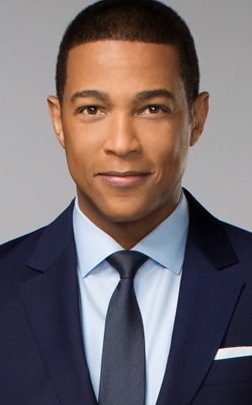
This is the King that would’ve evolved over the previous forty-five or so years had he lived. Based on this actual King, it would be a bit mystifying to hear him give speeches on, grant interviews for or write op-eds in which his main theme would be to eviscerate the American poor, Blacks and Latinos for buying into a material capitalistic hip-hop culture. Or to spend all of his waning moments lamenting the perpetual stereotype of teenage welfare mothers looking for a handout instead of a hand up. Or to devote his remaining energies to blaming Black males for their inability to wear waist-fitting pants and then connecting hip-hop to a criminal culture, a drug culture and general thuggery (That’s Bill Cosby’s and Don Lemon’s jobs, apparently).

Don Lemon, CNN picture, August 5, 2013. (http://cnn.com).

Don Lemon, CNN picture, August 5, 2013. (http://cnn.com).

King would’ve probably withdrawn from public life by now, maybe even to Canada, as McGruder’s version suggests. But not before an additional two or three decades in which he would’ve boldly gone after the military-industrial complex, corporate welfare, government corruption, the War on Drugs and insufficient investment in America’s public schools and infrastructure. King would’ve seen all of them as factors that would have a negative impact on the life chances of the poor, especially poor African Americans.

Assessing blame – or not:

No doubt that King would’ve also found aspects of how Blacks have expressed themselves in pop culture and in the public sphere over the past four and half decades problematic. Yet based on the last years of his life, I think that he would’ve saved much of his ire for the aging Civil Rights generation for resting on their laurels and standing in judgment of younger Blacks, poor Blacks, or anyone else who didn’t follow directly in their now elitist footsteps. As King evolved in the four years, seven months and one week between the March on Washington and his assassination, so had his views of civil rights leadership. Well-meaning but pretentious, with the assumption that fixing the South would clear the way for Blacks of every socioeconomic stripe everywhere.

What’s most important to realize, though, is that King, had he lived, would’ve seen what most Americans regardless of race have seen in their own lives. Decline in wealth and income, a gulf of wealth between them and the top one-percent of income earners, a significant decline of well-paying union jobs replaced by minimum-wage non-union ones, rising unemployment, and expensive housing and healthcare. These are among so many other things that 240 to 270 million of us face on various levels that didn’t exist at the end of King’s life, things that disproportionately affect the poor, especially the poor and of color.

King and the legacy of the Civil Rights Movement:

The movement never evolved to address such issues, King would’ve said. Individuals did. Jesse Jackson, at least in the 1970s and 1980s, did. But the leaders of the Civil Rights Movement as a whole didn’t. They assumed that eliminating all forms of deliberate and overt discrimination in public institutions would bring down barriers for all African Americans. King would’ve said they were incorrect, and knew as much by the time of the Memphis sanitation workers’ strike in February and March ’68.

Unlevel playing field (soccer in this case), August 5, 2013. (http://funatico.com).

Unlevel playing field (soccer in this case), August 5, 2013. (http://funatico.com).

Despite the Civil Rights Act of 1964 and the Voting Rights Act of 1965 (both of which have obviously been weakened by the Reagan Years and this year’s Supreme Court Shelby County v. Holder decision), the life chances for any Black person born into poverty haven’t improve much at all. They remain in segregated communities, despite the movement toward mixed housing. They send their kids to underfunded and overcrowded schools, despite the paternalistic efforts of the so-called education reform movement. Jobs that pay a living wage are few, and conditions that promote neighborhood stability are better but still rare.

To assume that Blacks a half-century removed from the March on Washington and King’s “I Have A Dream” speech would be eternally grateful for the triumphs of the Civil Rights Movement in the wake of subtle yet pervasive discrimination on the basis of both race and socioeconomic status is ludicrous. It would smack of the elitism in which those who benefited most from the movement have displayed over the years. King would’ve realized the same thing, certainly well before the turn of the twenty-first century.

That anyone poor and of color in particular can overcome such barriers to, say, earn a doctorate or write a book is something akin to a miracle. Or to become a professional athlete or a music artist, a bit more common, if stereotypical, for that matter. King would’ve seen this and brought an analysis to the legacy of civil rights that didn’t put the movement and its leaders on a pedestal or proclaim victory where defeat was obvious.

What King would’ve (maybe) done:

King wouldn’t have given speeches in the years after the height of the movement to Black Gen Xers where he would’ve said, “I’ve got mine. Now it’s time to get yours,” or blamed hip-hop culture for so-called Black-on-Black crime. Instead, King would’ve listened, learned, facilitated and spoken without accusing those most vulnerable to discrimination of being the only ones at fault, if he would’ve faulted them at all. In terms of what he would’ve done beyond the attempt to form multiracial coalitions to fight for better conditions, it’s unclear. It would’ve been better than chest-thumping and belly aching, though.

The Things Dumb Racists Say

27 Saturday Jul 2013

Posted by decollins1969 in 1, Academia, Christianity, culture, Eclectic, Movies, Patriotism, Politics, Pop Culture, race, Religion

≈ Leave a comment

Tags

Anthea Butler, Bigotry, Ignorance, Professor Anthea Butler, Racism, Religious Studies, The American President (1995), Trolls, Tumblr, Twitter, UPenn, Willful Ignorance, Zimmerman Trial, Zimmerman Verdict


John Bauer's illustration from Walter Stenström's The boy and the trolls or The Adventure in childrens' anthology Among pixies and trolls (1915), November 1, 2005. (Thuresson via Wikipedia). In public domain.

John Bauer’s illustration from Walter Stenström’s The boy and the trolls or The Adventure, in childrens’ anthology Among Pixies and Trolls (1915), November 1, 2005. (Thuresson via Wikipedia). In public domain.

I loved, I loved, I loved reading and hearing what Anthea Butler had to say in the wake of the Zimmerman not-guilty verdict from two weeks ago (via her piece “The Zimmerman Verdict: America’s Racist God” and MSNBC). I love the courage and strength she’s shown over the past two weeks in standing up to the trolls in social media who’ve literally called her everything except a child of God in expressing the very racism they’ve attempted to deny.

If I’ve been reminded of nothing else in the past fortnight, it’s the fact that the US has a significant reading and writing crisis. In looking at Butler’s The Things People Say Tumblr page, it’s never been clearer to me that the average American can’t write a single sentence without a significant misspelling or grammatical error, and that angry people expressing their bigotry are even more prone to screw up the English language in any form.

UPenn Professor Anthea Butler, circa 2011. (http://www.sas.upenn.edu/religious_studies/faculty/butler).

UPenn Professor Anthea Butler, circa 2011. (http://www.sas.upenn.edu/religious_studies/faculty/butler).

Yet the most ignorant thing I’ve seen beyond the indirect threats, the nasty racist name-calling and the demeaning of academia for making Butler one of their “affirmative action” hires is the sheer ignorance about religion, Christianity and the ways in which this group of (mostly) White trolls has use both to justify their vitriol and racism. On one level, it’s pretty simple. How dare this [pick any expletive and add either the N-word or the C-word] say anything to point out how some Whites use Christianity and God to support their racist world views, right?

But this simplicity belies a greater truth. That not one of Butler’s post-Zimmerman trolls understood their own religion and the walk of Christianity. They haven’t a clue as to the sheer work it would take to earn any doctorate, much less one in religious studies. These folks have no idea that a PhD in religious studies doesn’t require becoming a priest or a pastor, or sounding all high-brow and polite in the face of injustice. (Heck, I’ve met religious studies professors who are agnostic or atheists!).

They are ignorant, and willfully so. My guess is, they are a small sample size of maybe 100 million Americans — mostly, but hardly exclusively White — who wallow in ignorance thinking that this will shield them from the inexorable march toward a majority of color country that the US will be well before mid-twenty-first century. The fact is, Butler’s trolls are so scared of change that they are threatened by a seventeen-year-old wearing a hoodie with cellphone, Skittles and iced tea in hand. As well as by a University of Pennsylvania professor who they see as unqualified (a bit of a contradiction to be threatened by someone they see as insignificant, but that’s racism for ya!).

I might have worded it a bit differently, though (but then again, I’m a different writer, no?). As a Christian for more than twenty-nine years, I don’t see my God as one who represents racist Whites. After all, we are commanded to “treat our neighbors as we would treat ourselves.”

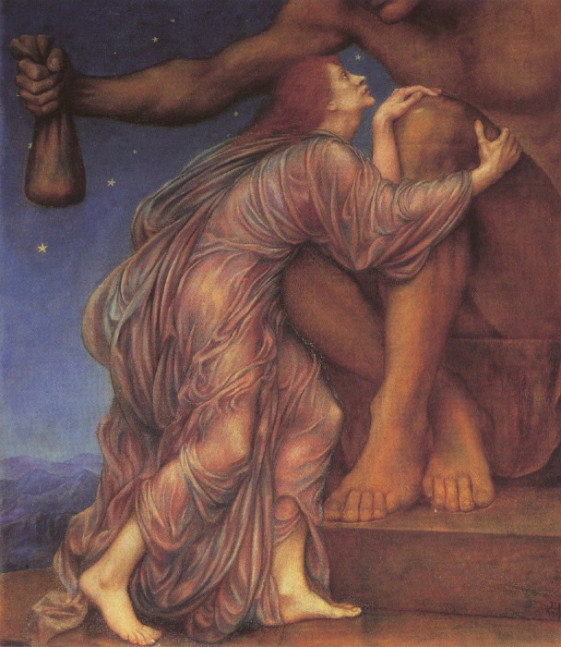
Evelyn de Morgan's The Worship of Mammon (1909), September 7, 2006. (Shell Kinney via Wikipedia). In public domain.

Evelyn de Morgan’s The Worship of Mammon (1909), September 7, 2006. (Shell Kinney via Wikipedia). In public domain.

But since Butler’s trolls obviously do think that they worship God, let me at least say this. If you believe in corporate capitalism and the corrections of the market, then your god is money, and the love of/lust for it. If you believe in the criminality of Blacks and Black male bodies, then your god is White. If you believe it’s okay to voice your displeasure by calling Butler a “n—-r c–t,” then your god is one that subjugates women, especially Black women. These beliefs do not and cannot represent my beliefs in God, in the life of Jesus, heck, in life of anyone who has ever spoken on behalf of social justice and human rights in history.

To misquote The American President (1995):

“Professor Anthea Butler has done nothing to you, trolls….You want a character debate? You better stick with me, ‘cuz Professor Anthea Butler is way out of your league.”

Earth, Wind & Fire’s “Fantasy,” My Reality

18 Thursday Jul 2013

Posted by decollins1969 in 1, Boy @ The Window, culture, earth, wind & fire, Eclectic, eclectic music, Mount Vernon New York, music, New York City, Politics, Pop Culture, race, Youth

≈ Leave a comment

Tags

"Fantasy" (1978), Anger, Anger Management, Bigotry, Fear, Forgiveness, George Zimmerman, Lyrics, Police Brutality, Racism, Reality, Trayvon Martin, Zimmerman Trial


n  Cover of Earth, Wind & Fire's single "Fantasy" (1978), February 29, 2008. (Columbia Records). Qualifies as fair use due to low resolution and subject matter of this blog post.

Cover of Earth, Wind & Fire’s single “Fantasy” (1978), February 29, 2008. (Columbia Records). Qualifies as fair use due to low resolution and subject matter of this blog post.

Below are two excerpts from Boy @ The Window about how I viewed Mount Vernon, New York and my world between the ages of ten and twelve:

“My only links to the great metropolis to the south were WNBC-TV (Channel 4), Warner Wolf – with his famous “Let’s go to the video tape!” line – doing sports on WCBS-TV (Channel 2), and WABC-AM 77 and WBLS-FM 107.5 on the radio. I found the AM station more fun to listen to, but I also liked listening to the sign-off song WBLS played at the end of the evening, Moody’s Mood for Love, with that, ‘There I go, There I go, The-ere I go…’ start. Music had been an important part of my imagination in ’79, with acts like Earth, Wind & Fire, Christopher Cross, Billy Joel and The Commodores. Not to mention Frank Sinatra, Queen, Donna Summer and Michael Jackson’s Off The Wall album. The music also made me feel like I was as much a part of New York as I was a part of Mount Vernon. It left me thinking of the ozone and burnt rubber smell that I noticed as soon as I would walk down into the Subway system in Manhattan…

“Besides the occasional reminder of life outside of my world, of Mount Vernon, I was the center of my own universe. Mount Vernon was but a stage on which my life played out, a place I hoped would stay this way forever. I was an eleven-year-old who thought that my world was the world. I lived my life like Philip Bailey and Maurice White would’ve wanted me to. I came to see ‘victory in a life called fantasy’ as my own life, living as if my imagination and dreams could be made into reality. All I had to do was wish it so.”

(And yes, I know the actual lyrics are about a land called fantasy, but that’s not how I sang it back then).

There have been so many moments since then where my Earth, Wind & Fire visions have collided with the reality that life for me and people who look like me has hardly been a fantasy. I had to get over my idiot ex-stepfather’s abuse in order to even listen to Earth, Wind & Fire again, because he was a fan as well, and I didn’t want us to both like the same music. But even more than that has been the reality that there are people, places and things who’ve (and that have) come through my life and stood in between me and all the things I wanted out of life. Individuals like Joe Trotter or Ken, policies like racial profiling and redlining, institutions like Columbia University or the former Academy for Educational Development.

The Enchanted Garden of Messer Ansaldo (1889), by Marie Spartali Stillman, March 7, 2006. (Charivari via Wikipedia). In public domain.

The Enchanted Garden of Messer Ansaldo (1889), by Marie Spartali Stillman, March 7, 2006. (Charivari via Wikipedia). In public domain.

While some of these instances have been disappointing in the sense of betrayal that I felt, the disillusionment that came with these incidents of discrimination and harassment pushed me ever closer to the person and writer I wanted to be. I don’t know what to make of how I’ve been feeling about the Zimmerman trial and verdict, the response of so-called White liberals and more obviously racist and gleeful White teabaggers over the past five days. I’ve felt badly for Trayvon Martin’s family, Rachel Jeantel and for so many others who’ve been figuratively beaten down by media coverage and stereotypes over the past months.

But I didn’t think I was angry. Not until I went for a run this morning. It’s was a comparatively pedestrian 3.1-mile run after I’d done a five-miler a day and a half before. Earth, Wind & Fire’s “Fantasy” started playing on my iPod as I was running uphill. All it made me think about was all the challenges that I and so many others have had to face because of individual bigotry and fear and institutional racism and indifference. I know that many things in life aren’t fair. What I realized at that moment, though, was that there really are folks in this world who wish evil and unfairness on people like me. That’s their fantasy!

That made me angry again, but not for too long. For I also knew that I had the power to ask for forgiveness, as well as the power to forgive others. It’s a power that no one can take away from me, that enables me to be honest about where I am, and clear-headed about where I want to go. That power, among others, does truly help bring my “mind to everlasting liberty.” Even in the face of the evil, indifference and ignorance that I see every day.

38.990666 -77.026088
← Older posts
Newer posts →

Boy @ The Window: A Memoir

Boy @ The Window: A Memoir

Places to Buy/Download Boy @ The Window

There's a few ways in which you can read excerpts of, borrow and/or purchase and download Boy @ The Window. There's the trade paperback edition of Boy @ The Window, available for purchase via Amazon.com at http://www.amazon.com/Boy-Window-Donald-Earl-Collins/dp/0989256138/

There's also a Kindle edition on Amazon.com. The enhanced edition can be read only with Kindle Fire, an iPad or a full-color tablet. The links to the enhanced edition through Apple's iBookstore and the Barnes & Noble NOOK edition are below. The link to the Amazon Kindle version is also immediately below:

scr2555-proj697-a-kindle-logo-rgb-lg

Boy @ The Window on Amazon.com: http://www.amazon.com/Boy-The-Window-Memoir-ebook/dp/B00CD95FBU/

iBookstore-logo-300x100

Boy @ The Window on Apple's iBookstore: https://itunes.apple.com/us/book/boy-the-window/id643768275?ls=1

Barnes & Noble (bn.com) logo, June 26, 2013. (http://www.logotypes101.com).

Boy @ The Window on Barnes & Noble: http://www.barnesandnoble.com/w/boy-the-window-donald-earl-collins/1115182183?ean=2940016741567

You can also add, read and review Boy @ The Window on Goodreads.com. Just click on the button below:

Boy @ The Window

Twitter Updates

Tweets by decollins1969
  • RSS - Posts
  • RSS - Comments

Archives

  • June 2025
  • April 2023
  • September 2022
  • August 2022
  • July 2022
  • June 2022
  • May 2022
  • April 2022
  • March 2022
  • January 2022
  • December 2021
  • November 2021
  • October 2021
  • September 2021
  • August 2021
  • July 2021
  • June 2021
  • April 2021
  • March 2021
  • February 2021
  • January 2021
  • December 2020
  • November 2020
  • October 2020
  • September 2020
  • August 2020
  • July 2020
  • May 2020
  • April 2020
  • March 2020
  • January 2020
  • December 2019
  • November 2019
  • August 2019
  • July 2019
  • June 2019
  • May 2019
  • April 2019
  • March 2019
  • February 2019
  • January 2019
  • December 2018
  • November 2018
  • October 2018
  • September 2018
  • August 2018
  • July 2018
  • June 2018
  • May 2018
  • March 2018
  • February 2018
  • January 2018
  • December 2017
  • November 2017
  • October 2017
  • September 2017
  • August 2017
  • July 2017
  • June 2017
  • May 2017
  • April 2017
  • March 2017
  • February 2017
  • January 2017
  • December 2016
  • November 2016
  • October 2016
  • September 2016
  • August 2016
  • July 2016
  • June 2016
  • May 2016
  • April 2016
  • March 2016
  • February 2016
  • January 2016
  • December 2015
  • November 2015
  • October 2015
  • September 2015
  • August 2015
  • July 2015
  • June 2015
  • May 2015
  • April 2015
  • March 2015
  • February 2015
  • January 2015
  • December 2014
  • November 2014
  • October 2014
  • September 2014
  • August 2014
  • July 2014
  • June 2014
  • May 2014
  • April 2014
  • March 2014
  • February 2014
  • January 2014
  • December 2013
  • November 2013
  • October 2013
  • September 2013
  • August 2013
  • July 2013
  • June 2013
  • May 2013
  • April 2013
  • March 2013
  • February 2013
  • January 2013
  • December 2012
  • November 2012
  • October 2012
  • September 2012
  • August 2012
  • July 2012
  • June 2012
  • May 2012
  • April 2012
  • March 2012
  • February 2012
  • January 2012
  • December 2011
  • November 2011
  • October 2011
  • September 2011
  • August 2011
  • July 2011
  • June 2011
  • May 2011
  • April 2011
  • March 2011
  • February 2011
  • January 2011
  • December 2010
  • November 2010
  • October 2010
  • September 2010
  • August 2010
  • July 2010
  • June 2010
  • May 2010
  • April 2010
  • March 2010
  • February 2010
  • January 2010
  • December 2009
  • November 2009
  • October 2009
  • September 2009
  • August 2009
  • July 2009
  • June 2009
  • May 2009
  • April 2009
  • March 2009
  • February 2009
  • January 2009
  • December 2008
  • November 2008
  • October 2008
  • September 2008
  • August 2008
  • July 2008
  • June 2008
  • May 2008
  • April 2008
  • March 2008
  • February 2008
  • January 2008
  • December 2007
  • November 2007
  • October 2007
  • September 2007
  • August 2007
  • July 2007
  • June 2007

Recent Comments

MaryPena's avatarMaryPena on My Day of Atonement/Bitter Hat…
decollins1969's avatardecollins1969 on No Good Teaching Deed Goes…
Mary Rose O’Connell's avatarMary Rose O’Connell on No Good Teaching Deed Goes…

NetworkedBlogs on Facebook

NetworkedBlogs
Blog:
Notes From a Boy @ The Window
Topics:
My Life, Culture & Education, Politics & Goofyness
 
Follow my blog

616 616 East Lincoln Avenue A.B. Davis Middle School Abuse Academia Academy for Educational Development AED Afrocentricity American Narcissism Authenticity Bigotry Blackness Boy @ The Window Carnegie Mellon University Child Abuse Class of 1987 CMU Coping Strategies Crush #1 Crush #2 Death Disillusionment Diversity Domestic Violence Economic Inequality Education Family Friendship Friendships Graduate School Hebrew-Israelites High-Stakes Testing Higher Education History Homelessness Humanities Humanities Program Hypocrisy Internalized Racism Jealousy Joe Trotter Joe William Trotter Jr. K-12 Education Love Manhood Maurice Eugene Washington Maurice Washington Misogyny Mother-Son Relationship Mount Vernon High School Mount Vernon New York Mount Vernon public schools Multiculturalism MVHS Narcissism NFL Pitt Pittsburgh Politics of Education Poverty President Barack Obama Race Racial Stereotypes Racism Relationships Self-Awareness Self-Discovery Self-Reflection Sexism Social Justice Teaching and Learning University of Pittsburgh Violence Whiteness Writing

Top Rated

Blog at WordPress.com.

  • Subscribe Subscribed
    • Notes from a Boy @ The Window
    • Join 103 other subscribers
    • Already have a WordPress.com account? Log in now.
    • Notes from a Boy @ The Window
    • Subscribe Subscribed
    • Sign up
    • Log in
    • Report this content
    • View site in Reader
    • Manage subscriptions
    • Collapse this bar
 

Loading Comments...