• About Me
  • Other Writings
  • Interview Clips
  • All About Me: American Racism, American Narcissism, and the Conversation America Can’t Have
  • Video Clips
  • Boy @ The Window Pictures
  • Boy @ The Window Theme Music

Notes from a Boy @ The Window

~

Notes from a Boy @ The Window

Tag Archives: Racism

Where’s Giancarlo Esposito’s “Breaking Bad” Emmy?

31 Sunday Aug 2014

Posted by decollins1969 in 1, culture, Eclectic, Movies, Politics, Pop Culture, race

≈ Leave a comment

Tags

Aaron Paul, Acting, Albuquerque, AMC, Breaking Bad, Bryan Cranston, Crystal Meth, Drug Cartel, Eminem, Emmy Awards, Emmy Nominations, Giancarlo Esposito, Grunge, Gus, Gus Fring, Gustavo Fring, Hip-Hop, Hollywood, Jesse Pinkman, Joel Kinnaman, Macabre, Methamphetamine, Racial Privilege, Racism, Rage, The Killing, TV Series, Walter White, White Entitlement, White Male Angst, White Privilege


Gustavo "Gus" Fring, screen shot from Breaking Bad episode, Season 3, August 30, 2014. (http://geeknation.com). Qualifies as fair use under US copyright laws - lower resolution and relevance to subject matter.

Gustavo “Gus” Fring, screen shot from Breaking Bad episode, Season 3, August 30, 2014. (http://geeknation.com). Qualifies as fair use under US copyright laws – lower resolution and relevance to subject matter.

Last Monday, Breaking Bad, a drama series that finished its final season ten months ago, took away six Primetime Emmy Awards out of its sixteen total nominations. Despite the fact that the producers had stretched the show’s fifth season over two years (2012 and 2013), Breaking Bad‘s Bryan Cranston, Aaron Paul and Anna Gunn all took home Emmys for lead actor and supporting actor/actress in a drama series —  again, in Cranston’s and Paul’s case. And all I kept thinking was, “Where’s Giancarlo Esposito’s Emmy?”

Aaron Paul as Jesse Pinkman in Breaking Bad, Season 5, September 2, 2013. (http://www.businessinsider.com).

Aaron Paul as Jesse Pinkman in Breaking Bad, Season 5, September 2, 2013. (http://www.businessinsider.com).

Giancarlo Esposito, for those of you who still remember, played Gustavo “Gus” Fring, a mastermind of a drug lord and pillar of the Albuquerque, New Mexico community. His character was on for a few episodes at the end of Season 2 of Breaking Bad, and for all of Seasons 3 and 4. His character was so serene yet so single-minded, full of rage like Walter White. Yet Fring’s was a rational, focused, disciplined rage, handed out and practiced, like an usher handing out programs at a Sunday church service. Esposito’s Gus Fring was the character upon which Cranston’s Walter White pivoted, rising and falling like a pirouetting ballerina on a spin top. Without Fring, Walter White and Breaking Bad doesn’t make it past Season 2. The character’s dead or in jail long before he has a chance to truly make his mark.

Joel Kinnaman as Det. Stephen Holder in The Killing (2011-14), Vancouver, BC, Canada March 29, 2012. (http://www1.pictures.zimbio.com/). Qualifies as fair use under copyright laws -- relevance to subject matter.

Joel Kinnaman as Det. Stephen Holder in The Killing (2011-14), Vancouver, BC, Canada March 29, 2012. (http://www1.zimbio.com/).

But I guess the Emmy voters didn’t see how central Gus Fring was to the Walter White story. I mean, why else give multiple Emmys to a five-foot-four-inch version of Eminem in Aaron Paul instead? Yes, Paul as Jesse Pinkman is pretty good at being a conflicted affluent hip-hopster, but his Pinkman isn’t even on par with Joel Kinnaman, the taller Eminem-esque reject-as-cop on the series The Killing (which came to a conclusion earlier this month on Netflix). The idea that Paul and Esposito competed for the same award in 2012 was an insult to the acting profession, like comparing fresh squeezed, no-pulp orange juice to Orange Kool-Aid made with high fructose corn syrup.

Really, in thinking about Cranston’s Walter White and the arch of the character, one cannot do it without a serious consideration of Esposito’s Gus Fring. Without Esposito’s Fring, the show is what the Emmys and Hollywood says it is, a story of a man at fifty, a “brilliant yet foolish has-been-who-really-should’ve-been-somebody high school chemistry teacher.” One who became a desperate crystal meth maker and dealer while going through chemotherapy for Stage 4 or Stage 5 lung cancer. A man who turns bad, first in a dark comedic way, then later, as a just plain macabre and dangerously sad character, leaving a trail of bodies along the way.

That version of Breaking Bad, though, doesn’t become the most watched TV series of all time. The real version, with Esposito’s Fring, gave us the full complexity of Cranston’s Walter White, especially his White male angst. Though not as obvious as the White male angst of ’90s grunge as exhibited in Pearl Jam, Nirvana or Live, Cranston’s Walter White is one that until his cancer had lived a life of quiet but smoldering rage, a rage that found its outlet in making and dealing methamphetamine so pure that Ivory Soap and Nazi Germans would be jealous. Only to be second fiddle to an Afro-Latino who’s in control of a billion-dollar drug ring? If that doesn’t bring issues of White entitlement and White resentment to the fore, then we’re in an alternate universe.

2013 Emmy trophy, January 29, 2014. (http://radiodelta.fm).

2013 Emmy trophy, January 29, 2014. (http://radiodelta.fm).

That’s why Breaking Bad‘s Seasons 2-4 were so worth watching, and the extended Season 5 so anticlimactic. The very reason it was inevitable Cranston’s Walter White would get caught and lose everything is the reason why Esposito’s Fring never did while he was alive. Fring knew that he had to always be in control, to always look as if he was a part of an illusion of suburban White Americana, even though in reality his was a world of constant duality. Fring could never risk being as unabashedly arrogant as Cranston’s Walter White precisely because Fring lacked the protections that came with racial entitlement. As Fring knew, the assumption that Black and Brown skin equated with criminality was ever present, and Fring would never confirm that stereotype, even as he personified it.

Walter White, his resentment about how his career and life turned out, this sense that though he was part of the Whiteness club, he hadn’t reap the material benefits of it, left him hopelessly in search of wealth and respect. But more than that. Cranston’s Walter White couldn’t carry that wealth and respect quietly like Esposito’s Fring, at least once White obtained them both. No, White had to let the world know that he was Heisenberg, that he was in charge. That was one of the reasons why he came to resent Fring in the first place.

To play a character like Gustavo Fring as well as Giancarlo Esposito did, to camouflage as much as he revealed, to juxtapose Fring’s humanity and callous disregard for such was what earned Esposito an Emmy nomination in 2012, at least. To also juxtapose his sense of quiet triumph and control in the midst of the world of Whiteness against Cranston’s Walter White and the White resentment and rage that could explode at any moment? That’s Breaking Bad even in Season 5, even minus Esposito’s Fring being present.

Once again, a person of color’s genius has gone unrewarded, and others received rewards on the backs of our work, while we are to be forgotten by most, after being killed off. It’s such a shame.

“Animals” and “Respectability”

27 Wednesday Aug 2014

Posted by decollins1969 in 1, culture, Patriotism, Politics, Pop Culture, race, Religion, Youth

≈ Leave a comment

Tags

Animals, Authentic Blackness, Authenticity, Eric Garner, Gospel of Prosperity, Institutional Racism, Jamal Harrison Bryant, Masculinity, Michael Brown, Murder, Officer Darren Wilson, Oppression, Police Brutality, Politics of Respectability, Racial Stereotypes, Racism, Respectability, Rev. Al Sharpton, Stereotypes, T.D. Jakes, Thugs, White Privilege, White Violence, Whiteness


Rev. Al Sharpton waiting to speak at Michael Brown funeral, Friendly Temple Missionary Baptist Church, St. Louis, MO, August 25, 2014. (AP Photo/St. Louis Post Dispatch, Robert Cohen, via http://www.wkbn.com).

Rev. Al Sharpton waiting to speak at Michael Brown funeral, Friendly Temple Missionary Baptist Church, St. Louis, MO, August 25, 2014. (AP Photo/St. Louis Post Dispatch, Robert Cohen, via http://www.wkbn.com).

With America’s history of racial oppression, it should come as no surprise that the range of reactions to events like the police killings of Eric Garner and Michael Brown (among many others, male and female, Black and Latino) have been on the side of racial stereotypes and assumptions. On the one hand, police officers, ordinary Whites and some ultraconservative Blacks have used the terms “animals” and “thugs” interchangeably because Garner and Brown were big Black guys, the stereotypical boogeymen, lurking and ready to rape, maim and kill scared-shitless White folk.

On the other hand, the traditional civil rights establishment and its cadre of ministers have equated the lessons of Brown and the Ferguson protests with the need to stop “looting and pillaging” and to stop wearing baggy pants. That’s the fallback position for attempting to explain why the message of police brutality and militarization against communities of color because of racism and classism isn’t getting through to Whites who have mostly been silent on these incidents.

As I’ve written in the past year or two, both of these perspectives suggest that Blacks and Latinos must somehow make ourselves worthy of humanity. That way, even the most racist of Whites could see that we’re not animals or thugs, but human beings worthy of the same human rights and civil liberties that they enjoy. This didn’t work even during the height of the Civil Rights Movement some five decades ago. Medgar Evers, Martin Luther King, Jr., John L. Lewis, Michael Schwerner, Andrew Goodman, and James Chaney, and the Sixteenth Street Baptist Church in Birmingham, Alabama. Wearing suits and ties, marching with White allies, having the backing of the President of the United States. None of that swayed most Whites, as evidenced by changes in American politics since 1968.

Screen shot of CNN newscast coverage of support for Officer Darren Wilson at rally, Ferguson, MO, August 23, 2014. (http://rawstory.com).

Screen shot of CNN newscast coverage of support for Officer Darren Wilson at rally, Ferguson, MO, August 23, 2014. (http://rawstory.com).

The fact is, those Whites and sycophant Blacks who call African Americans and other people of color “animals” and “thugs” know we’re just as human as they are, if not more so. It’s their way of asserting that they’re better than us, precisely because they believe they can get away with seeing, calling and treating Blacks and other people of color as such. Especially since so many of these “animals” and “thugs” advocates have missed the full material benefits of American capitalism. And with America’s long history of allowing Whites to get away with lynchings, murders, rapes, race riots and other forms of violent oppression, why shouldn’t Whites think they’re in the right when they give money to Officer Darren Wilson for “doing his job” in murdering Michael Brown? As I’ve said before, the year doesn’t matter, the clothes don’t matter, our demeanor in public or how perfect our walk doesn’t matter to many — if not most — Whites. That may be our problem as people of color, but it’s definitely their problem as well.

Rev. Al Sharpton, sexual predator Jamal Bryant, megachurch-Gospel-of-Prosperity pastor T.D. Jakes and so many other men who spoke at Michael Brown’s funeral Monday put themselves on the other side of the “animals” and “thugs” coin with their agenda-loaded bloviations. Sharpton especially should know better, given his history of talking out of both sides of his mouth about the limits of the politics of respectability (Tawana Brawley comes to mind). Yes, being able to orchestrate nonviolent protests with proper victims in a way in which the mainstream media cannot dehumanize or engage in stereotypes was how the Civil Rights Movement gained momentum in the first place. But this methodology had its limits then, as it led to some victories that looked more like symbols than actual victories (even Dr. King said as much in his final three years). It definitely has its limitations now.

Foot on my neck and head, symbolic of oppression in terms of view of Black and Brown as "animals," April 18, 2011. (Donald Earl Collins).

Foot on my neck and head, symbolic of oppression in terms of view of Black and Brown as “animals,” April 18, 2011. (Donald Earl Collins).

We have a leadership that has grown corpulent and ossified in its stomach, pockets and spirit when it comes to oppression and how to respond. Their thinking in so many ways isn’t much different than the Whites who post pictures of President Barack Obama eating a banana with his face pasted onto the head and body of a great ape. That’s the full shame of watching a funeral that was more about individual agendas than it was about Michael Brown or his family and friends, or his life and death, or mobilizing a larger effort.

It’s already terrible that we already have a nation of millions trying to hold people of color back, if only in their own minds (to quasi-quote Public Enemy). We can no longer afford to have an aging leadership whom, even when well-meaning, is unable or unwilling to move beyond symbols and pontification to an effort that promotes new tactics and strategies and younger leadership. It’s beyond time for younger generations to take the reins, and not in a respectable way, either.

An “Acting White” Conversation

28 Monday Jul 2014

Posted by decollins1969 in 1, Academia, Boy @ The Window, culture, Eclectic, eclectic music, Mount Vernon High School, Mount Vernon New York, New York City, Pittsburgh, Politics, Pop Culture, race, University of Pittsburgh, Youth

≈ 1 Comment

Tags

"Not Black Enough", 616, 616 East Lincoln Avenue, Acting White, Authentic Blackness, Authenticity, Denial, Internalized Racism, Mother-Son Relationship, My Brother's Keeper Initiative, Nia-Malika Henderson, President Barack Obama, Racial Denial, Racial Stereotypes, Racism, Structural Racism, Whiteness


Two Oreo Cookies, February 6, 2011. (Evan-Amos via Wikipedia).

Two Oreo Cookies, February 6, 2011. (Evan-Amos via Wikipedia).

Two years ago, a conservative woman engaged me in what became an increasingly vitriolic conversation on “acting White,” blind loyalty and political ideology. The below only covers (for the most part) the “acting White” part of the conversation.

 Apologies for commenting here but the Star Trek one [my blog post Why Ferengi Are Jewish & The Maquis Are Latino from 2011] had comments closed. In light of your thoughts on positive or negative stereotypes, how do you feel about the cultural phenomena of “acting white” term in Black community? (in case it needs explaining, that’s a derogatory term – by Black community – for a minority child who studies hard. See http://en.wikipedia.org/wiki/Acting_white)

To which I responded:

Given how my life has evolved over the past four decades, I think I understand what “acting White” means. But the fact is, African Americans have a diversity of opinions on this issue. There are some Blacks, though, who believe in the idea of an authentic Blackness, which I’ve written about as an educator, historian and from a personal perspective over the years. Part of this is generational, and part of this is socioeconomic in nature. And this issue of authenticity has been around since the days of slavery, so it’s not new. What’s new is the increasing push-back from Blacks of various backgrounds about this issue of “acting White.” Bottom line: those who use this phrase tend to be anti-intellectual, distrustful of higher education and as bigoted as any other group in American society toward “others.”

But my visitor to my blog wasn’t done, not by a long shot:

Sorry, Wasn’t too clear in my question. Do you feel that the fact of how widespread it is in the culture (both the use and the lack of disapproval) has any *material* consequences to the socioeconomic outcomes for Blacks as a group in the 1990-2020 period? It’s clear that you disapprove of it, but do you feel it is a problem that **must** be fixed for Blacks to succeed (beyond mere “bigotry is bad” angle)?

In response, I broke down the assumptions embedded in the previous comment:

Is your head in the sand?, July 28, 2014. (http://www.thelifecoach.co.nz/).

Is your head in the sand?, July 28, 2014. (http://www.thelifecoach.co.nz/).

Your assumption here is troubling, as if 40 million African Americans all think alike on this topic. Sure, there’s a slice of Blacks who have a litmus test for “authentic” Blackness, and for them, those who can’t meet this test are considered “acting White.” But no, there’s no agreed upon definition for either in African America. Your premise supposes the sociological or psychological effect of this is a lower socioeconomic status for African Americans. Keep in mind that since the 1970s, more than 50 percent of Blacks have been middle or upper middle class, while the poverty rate for Blacks has varied between 25 and 33 percent over the past 40 years. Your question ignores other factors, including de-industrialization, expanding economic inequality, and structural racism as factors that have far more effect on social mobility than a cultural litmus test that a small slice of Blacks strictly adhere to.

There’s more, much more, and the comments section under About Me from the period August 30-September 3, 2012 has the rest. The assumption that I was protecting the race under a false sense of loyalty. The idea that Blacks who were otherwise equal in intelligence and from equally impoverished backgrounds were doing better than her because of affirmative action and other forms of alleged “reverse racism” (whatever this fiction is). My response was to treat her like one of my ideologically bull-headed student for whom facts and scholarly research matter about as much as ants inside an anthill.

President Barack Obama’s recent comments about the meaning and implications of “acting White”  has made me think about this issue — again. The fact is, there may well be individuals who decide to not go to college or medical school, take certain jobs or listen to Pearl Jam because of their notions of “acting White” and “authentic Blackness.” I know there are — including a friend of mine who committed suicide sixteen years ago after deciding to not go to medical school over this whole issue. But the idea that large groups of Blacks in poverty or as practicing Afrocentrists are avoiding success and education because it may be too White for them? Absolute bullshit! Period. Anything to come up with a simple-minded excuse to cover up structural racism, residential segregation and poverty as the factors for lack of Black social mobility when compared to Whites.

“Acting White,” or at least, being “not Black enough,” comes out of the following (between my experience and thirty years of research):

1. The idea that “acting White” = not cool. That’s all. Not about intellect per se, but more about the constant expression of high intellect in casual situations, or at least, lacking the ability to switch up from high-brow to colloquial language. I’ve been in this situation many times, with neighborhood kids in Mount Vernon, New York, at MVHS, at the University of Pittsburgh and even in my own classroom.

2. “Acting White” = doing things that Blacks have only seen Whites do. In this case, beyond language, it could include forms of dress, having eclectic music tastes, or eating fried chicken with a fork and knife. Or, more seriously, taking a political position that others can easily perceive as being against the interests of African Americans. I can attest to the comments I’ve gotten for embracing “White” music as part of my overall repertoire over the years.

The Fool’s Speech Part II

The Fool’s Speech Part II

3. “Acting White” = not wanting to be around or like other Blacks. In my experience, this applies even more within African American families than it does to Black neighbors, classmates or friends. My Mom wanted me to go to college, but she also wasn’t comfortable with the idea that college would change the way I saw her and the rest of the world. She was especially not happy when I decided to go to graduate school, because it meant that I might no longer be able to relate to her and my brother.

I can honestly say that even with all this, I’ve never met anyone who deliberately practiced self-sabotage in their education or in any other area of their lives to avoid “acting White.” That this is a topic of conversation at all confirms that Americans love living in denial of all things connected to racial inequality. Especially the structural racism from which they draw a benefit — material and/or psychological — every single day. Calling “acting White” a theory is an insult to the scientific method and to all Blacks, including those who’ve used the term over the years.

When In Crime, Blame a Young Black Male

25 Wednesday Jun 2014

Posted by decollins1969 in 1, culture, Eclectic, Politics, Pop Culture, race, Youth

≈ Leave a comment

Tags

Abby Dean, Ashley Tood, Babysitter, Black Criminality, Burglary, Carjacking, Central Park 5, Charles Stuart, Cody Oaks, Ferndale WA, Kidnapping, Mugging, Murder, Racial Hoaxes, Racial Profiling, Racial Stereotypes, Racism, Rape, Susan Smith


Abby Dean screenshot, Ferndale, WA, June 23, 2014. (Fox6News, WITI, Milwaukee, WI).

Abby Dean screenshot, Ferndale, WA, June 23, 2014. (Fox6News, WITI, Milwaukee, WI).

Yesterday morning, I was stuck watching ABC’s Good Morning America segment “4-Year-Old Leads Police to Prime Suspect in Burglary Case,” with the lead, “Real Life Nancy Drew.” The Whatcom County police (Ferndale, WA) interviewed Abby Dean, a four-year-old girl who witnessed two burglars breaking into and robbing her home. The four-year-old’s babysitter had identified “two armed Black men”  — including the next-door neighbor — as the perpetrators of this home invasion. But the brave little Abby Dean apparently went off script and bravely told the truth. “It wasn’t the right skin color,” as one of them had “beach-colored skin. And no one had dark skin,” the toddler said to police. It turned out that the babysitter, the babysitter’s boyfriend and another man had planned the burglary.

Meanwhile, the police handcuffed and questioned Cody Oaks, the next-door neighbor, for hours apparently, and prior to questioning, had a sniper trained on Oaks’ home. “It’s kinda sad ’cause I don’t think she realizes the dangerous position she put me in,” Oaks said.

Cody Oaks, Ferndale, WA, June 23, 2014. (Fox6News, WITI, Milwaukee).

Cody Oaks, Ferndale, WA, June 23, 2014. (Fox6News, WITI, Milwaukee).

Abby Dean’s no more Nancy Drew than I’m Sherlock Holmes. Truth is, the headline should be “Another Example of Overt Racism By Criminals and Police Foiled by Truthful Toddler.” While Dean deserves media coverage — she’s already done more at four than most people do about crimes in their whole lives — the real story is Cody Oaks. This could’ve very easily turned into a botched investigation, which could’ve led to Oaks’ death or serving serious jail time. For a crime in which he played NO role. All because in the minds of so many Whites, young and Black and male equals a violent criminal. That’s what that racist, seventeen-year-old, criminal mastermind babysitter thought, and apparently, so did the local police.

That this isn’t the story from this story shows how well colorblind racism has worked in the average American’s mind. It is obviously okay for Whites — especially White women — to blame Blacks for crimes they didn’t commit, no matter how outrageous. There’s Charles Stuart in Boston, who killed his pregnant wife, shot himself and then tried to blame a mysterious Black man (the boogie man) for his heinous acts in ’89-’90. There’s Susan Smith, the South Carolina woman who drove her car into a lake and drowned her child in that car in ’94. Only to then blame two young Black men for her insane crime, as these imaginary Black males attempted to carjack her. There’s Ashley Todd, the McCain presidential campaign staff who claimed that a Black guy robbed her and carved a backwards “B” on her left cheek in ’08. Only to learn that she mugged and mutilated herself for attention. Let’s not forget the Central Park 5, with whom the city of New York settled a lawsuit for $40 million over their wrongful arrests and convictions.

And people wonder why many of us continue to carry a public anger.


Race and The OJ Simpson Effect at 20

12 Thursday Jun 2014

Posted by decollins1969 in 1, Carnegie Mellon University, culture, Eclectic, Mount Vernon New York, Pittsburgh, Politics, Pop Culture, race, Sports, Work, Youth

≈ 2 Comments

Tags

1994 NBA Finals, Covenant Church of Pittsburgh, Dialogue on Race, Economic Inequality, Game 5, Houston Rockets, Internalized Racism, Men's Retreat, New York Knicks, Newsweek, Nicole Brown Simpson, O.J. Simpson, OJ Simpson, Pharrell Williams, Race Riots, Racial Stereotypes, Racial Stigma, Racism, Ron Goldman, Time Magazine, Trial, White Bronco


O.J. Simpson on the covers of Newsweek and Time Magazine, (the picture on right altered to make Simpson appear darker and caused an outcry), June 27, 1994. (Theo's Little Bot via Wikipedia). Qualifies as fair use due to low resolution of image and relevance to subject matter.

O.J. Simpson on the covers of Newsweek and Time Magazine, (the picture on right altered to make Simpson appear darker and caused an outcry), June 27, 1994. (Theo’s Little Bot via Wikipedia). Qualifies as fair use due to low resolution of image and relevance to subject matter.

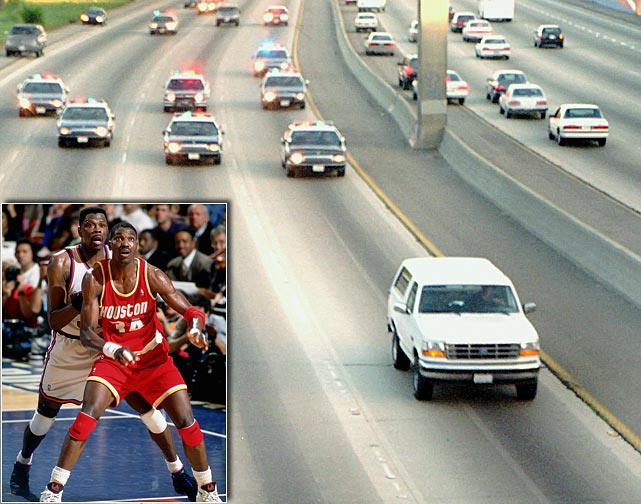
Today’s the twentieth anniversary of the deaths of Nicole Brown Simpson and Ron Goldman, still officially-allegedly murdered by the once great NFL Hall of Fame running back O.J. Simpson. In five days, it’ll be twenty years since the bizarre police chase of Simpson in a white Ford Bronco with his friend Al Cowlings on I-405 in the Los Angeles area. In the process, he took all of us — the media, the sports world, and anyone who cared about race and justice — on a ride that folks are still talking about two decades later. It had an impact on me in terms of how I saw Blacks and Whites and race. I shouldn’t have been, but I was mildly surprised that so many would become so emotionally caught up in a double-homicide case involving what at one time was one of the world’s most recognizable faces.

That week twenty years ago was my absolute commitment to two events. The NBA Finals between my New York Knicks and the Houston Rockets. And a church retreat for the male members (nearly 100 of us, almost all Black — talk about irony!) of Covenant Church of Pittsburgh. It was to be a week of watching my Knicks play at home and three days in the mountains of Western Pennsylvania at a retreat lodge, in a spirit of learning how to be godly men and of adult male bonding. The first full day of the retreat was June 17. After a day of workshops, prayer, praise, and singing (at least for me and the rest of the men’s choir), we all piled into the rec room to watch Game 5 of the Final. Only to see an overhead shot of a slow-moving white Bronco being trailed by an escort of L.A.’s finest instead of Patrick Ewing, John Starks, Doc Rivers, Charles Oakley, and the rest of the cast of characters from my favorite team.

Screen shot of NBA on NBA coverage of 1994 NBA Finals, Game 5, MSG, New York at Bronco chase of OJ Simpson, I-405 in L.A., June 1, 1994. (SI photos via Tumblr).

Screen shot of NBA on NBA coverage of 1994 NBA Finals, Game 5, MSG, New York at Bronco chase of OJ Simpson, I-405 in L.A., June 17, 1994. (SI photos via Tumblr).

The Knicks won, which was great, but I barely saw the game. They were up 3-2, but would lose the last two games in the next six days in Houston, turning Choke City into Clutch City overnight. But that wasn’t what I was thinking about when it first happen. I hoped that the police wouldn’t shoot Simpson before he had a chance to go to trial. The L.A. riots were just two years before. I feared that the issue of race would be front and center, with Simpson’s issues with his now dead White ex-wife.

What I saw within ten days of the Bronco chase was an artificially darkened Simpson on the cover of Time. I watched as the media condemned Simpson well before the trial. As Blacks were becoming angrier about the coverage. As Whites grew more confident about Simpson being convicted, losing his fortune and fame, and possibly getting the death penalty (or at least, life imprisonment). It was amazing how quickly folks took sides on the issue. My mother proclaimed that O.J. was innocent long before the prosecution botched the trial. Some of my grad school colleagues — all White, mind you — made all kinds of assumptions about where I stood on O.J. Simpson. They didn’t like the fact that I was willing to wait until the trial to make up my mind.

Many have benefitted from the O.J. Simpson effect over the last twenty years. From lawyers to journalists, TV stations and authors, many have reaped benefits and have built careers from the O.J. Simpson trial and verdict. Greta Van Susteren, Dan Abrams, Nancy Grace, Court TV (now TruTV), the late Johnnie Cochran, Alan Dershowitz, Christopher Darden and Robert Shapiro, among so many others. Even Mark Fuhrman got a book and a radio talk show (at least for a while) out of the trial. One could argue that Kim Kardashian, daughter of Simpson defense “Dream Team” lawyer Robert Kardashian, has benefited, albeit indirectly (it’s not as if her father’s a regular on her family’s reality shows, right?).

Conservative media in general received the greatest indirect residuals of all from the murders, trial, and acquittal involving Simpson. The events between June 12, ’94 and October 3, ’95 helped intensify an atmosphere of conservatism, a sense that our nation was out of control. With the acquittal, it made sense to millions for cable and talk radio to increase its coverage of news, especially news with a more “fair and balanced” slant.

National dialogue on race cartoon, July 21, 2010. (Bob Englehart/Hartford Courant).

National dialogue on race cartoon, July 21, 2010. (Bob Englehart/Hartford Courant).

Obviously Simpson hasn’t benefited. Our national dialogue on race hasn’t improved, either. Whites still seemingly want Blacks to be stereotypes and to shut up while entertaining them with our lives and our deaths. Some Black elites still make a point of divorcing themselves from other Blacks and from the world that’s race in America, Pharrell Williams most recently so. And with rapidly increasing economic inequality, it’s a wonder that thousands of Whites haven’t come in to Black and Latino neighborhoods to burn down businesses and beat up and lynch those of us unlucky to encounter their mobs, like they typically did this time a century ago.

All because of the multitude of examples of individual Black success, and occasions of Black-on-White (and especially blond)-woman-violence. Things change, but the cancer that is Whiteness and race remain the same, “a shame and a pitiful,” as my father would say.

Whiteness, Symbols and Racial Context

21 Wednesday May 2014

Posted by decollins1969 in 1, culture, Eclectic, Politics, Pop Culture, race, Youth

≈ 2 Comments

Tags

Affirmative Action, Class Privilege, Colorblind Racism, Colorblindness, Entitlement, Individual Racism, Individualism, Institutional Racism, Privilege, Racial Assumptions, Racial Context, Racial Stereotypes, Racism, Structural Racism, Symbolism, Symbols, Whiteness


The Matrix (1999) meme (only, the "What if I told you" part is incorrect) featuring Laurence Fishburne as Morpheus, May 21, 2014. (http://imgflip.com).

The Matrix (1999) meme (only, the “What if I told you” part is incorrect) featuring Laurence Fishburne as Morpheus, May 21, 2014. (http://imgflip.com).

For most Whites, racism’s an individual thing. For most Whites, Racism must be obvious. For most Whites, racial bias can only be a deliberate choice. For most Whites, racism’s not infused in the fabric of American culture, or baked into America’s institutions, or infused in its very political and economic structure. Of course, these “most Whites” are just plain wrong. What scares them on this issue — maybe even more than actually using the words “race” or “racism” — is the possibility that though racism is learned, that it also isn’t a decision. It’s an assumption, or really, many layers of assumptions. Of “rights.” Of entitlement. Of privilege. Of being special. Of being colorblind. Of folks knowing their place, and they as Whites knowing where to place these folks.

As I wrote in another social media context last week, part of the insidious nature of Whiteness — aside from its ability to morph over time — are the issues of symbolism and context. Racism for most is obvious and relies heavily on the most obvious of symbols, like in the case of hooded KKK members burning crosses, or in Donald Sterling‘s case, an elderly rich White guy whose Archie Bunker paternalism can be seen from space.

These incidents are the tip of the proverbial iceberg of race and racism in the US because most people of color exist outside the context that comes with Whiteness. For walking in Whiteness without any acknowledgement of one’s privilege — but with tons of assumptions of privilege — is the psychological and social equivalent of breathing and walking at the same time — one only thinks about it when forced to. If those Black and Brown are on TV in orange jump suits, it fits the narrative and context of Whiteness. If someone like me is a college professor in a predominantly White classroom, however, the context doesn’t fit the Whiteness playbook, and with that systems error, many of my White students manifest so many racial assumptions.

Writer, educator and NBA Hall of Famer Kareem Abdul-Jabbar on ABC's This Week discussing NBA's response to Donald Sterling's racist statements, May 4, 2014. (http://www.politifact.com).

Writer, educator and NBA Hall of Famer Kareem Abdul-Jabbar on ABC’s This Week discussing NBA’s response to Donald Sterling’s racist statements, May 4, 2014. (http://www.politifact.com).

These out-of-context scenarios occur on individual and institutional scales. Like having White co-workers only recognize me in the context of being at work and at a desk, but being scared upon seeing me board an elevator with them five minutes after the end of a work day. Or in spotting me searching for something at a store, only to ask me to help them find something for them, assuming that I work there. Or in assuming that in the context of sports and entertainment, anyone Black or Brown with an IQ higher than 100 with verbal skills is “angry,” or is “too cerebral” to be successful, or has “an attitude problem.”

Then there’s the assumption that no matter one’s grades, test scores or degrees, that wee folk of color achieved all we have because of affirmative action, the symbol of so-called reverse racism in the US (talk about the narcissism and master-race assumptions of intelligence embedded in this line of reasoning!). For most of the history of Whiteness and racism in American history, this was an infrequent prospect. These days, these microaggressions and racist behaviors occur almost every moment of every day. Precisely because there are so many successful Black and Brown folks, at least in the semi-conscious mind of Whites in the midst of their own Whiteness. This despite the reality that these successful Black and Brown folks are only symbols of  the very success that has eluded a broad majority of those of color.

Agent Mr. Smith (played by Hugo Weaving) about to explode, The Matrix (1999), May 21, 2014. (http://www.oocities.org/)

Agent Mr. Smith (played by Hugo Weaving) about to explode, The Matrix (1999), May 21, 2014. (http://www.oocities.org/)

But the context here will rarely be obvious to those awash in Whiteness. Structural inequality and racism, institutional racism, even internalized racism — all confirm the world that most operating in Whiteness can see, precisely because this world is the one in which they are comfortable and virtually unchallenged. Challenging the very structures and institutions upon which Whiteness has been built is like trying to metaphorically deconstruct The Matrix. Most living in Whiteness don’t want to wake up, For waking up would obliterate their world, their very understanding of their existence. And that’s too high a price for recognizing racism and inequality, and their own inadvertent hand in both.

What Can Brown Do For You (Now)?: 60 Years Come & Gone

16 Friday May 2014

Posted by decollins1969 in 1, Academia, Eclectic, Politics, race

≈ Leave a comment

Tags

Affirmative Action, Brown v. Board of Education (1954), Colorblind Racism, Coma, Desegregation, Diversity, DNR, Higher Education, Integration, K-16 Education, Life Support, Public Education, Racial Diversity, Racial Inequality, Racism, Re-segregation, Resegregation, Schuette v. Coalition (2014), Supreme Court, Supreme Court decisions, Whiteness


What can brown do for you?, Brown Squadron,  Relay for Life, 2007. (http://www.behance.net/).

What can brown do for you?, Brown Squadron, Relay for Life, 2007. (http://www.behance.net/).

Tomorrow marks the 60th anniversary of the great Brown v. Board of Education of Topeka, Kansas decision (1954), a Monday that lived in infamy among White supremacists in the South for decades, as the Supreme Court overturned the constitutional basis for Jim Crow segregation by a 9-0 vote. But six decades later, the Brown decision is in a coma and on life support, with a DNR order hanging over it, waiting for a close relative to sign. This after the Supreme Court ruled in Schuette v. Coalition to Defend Affirmative Action (2014) last month that states like Michigan can amend their constitutions via majority vote to ban affirmative action. With this 6-2 decision, the Roberts court effectively ended any serious efforts at racial inclusion and diversity in public institutions, especially public K-16 education.

While deliberate exclusion of people of color, women and other minorities from America’s public institutions remains unconstitutional (and illegal, by the way — see the Civil Rights Act of 1964), this last court decision has now made it possible for public institutions to refrain from making any effort to include anyone other than White males in admissions and hiring policies. Yet there has been a long road to travel for us to reach this point, as it has taken lobbyists, law makers and lawyers roughly forty years to wound, disable and incapacitate Brown.

Bill Schuette, (Michigan’s attorney general), with Jennifer Gratz (of Gratz v. Bollinger decision [2003] and the XIV Foundation, outside Supreme Court, Washington, DC October 2013. (Susan Walsh/AP via New York Times).

Bill Schuette, (Michigan’s attorney general), with Jennifer Gratz (of Gratz v. Bollinger decision [2003] and the XIV Foundation), outside Supreme Court, Washington, DC October 2013. (Susan Walsh/AP via New York Times).

If one were old enough to remember the Swann v. Charlotte-Mecklenburg decision (1971) — the one where the Supreme Court upheld widespread busing as a methodology for public school integration — it would have seemed that the matter was settled, at least legally. After all, in the seventeen years between Brown and Swann, the court had consistently ruled in favor of policies that made racial integration the centerpiece of a strategy to bring equal opportunity to America’s public institutions. And especially during President Lyndon Baines Johnson’s administration and with Congress, between the Civil Rights Act (now weeks away from turning fifty), the Voting Rights Act (1965), the Elementary and Secondary Education Act (1965) and the Higher Education Act (1965), it seemed that segregation was itself about to be dead and buried.

Well, segregation — and the structural and institutional racism that supports it — is alive, as much as the evil undead can be alive and unwell. And the forces and people who never wanted desegregation — or worse, integration — in the first place have worked my entire lifetime for this moment. They simply took the NAACP’s legal strategy to end Plessy with Brown, just so they could strangle it while sleeping, right through the Supreme Court. Including the:

– Milliken v. Bradley decision (1974). Limited desegregation efforts in Detroit to its city limits, making it possible for suburban areas to refuse to partake in school desegregation efforts across the country.

– Bakke v. University of California at Davis decision (1978). Racial quotas for seats at colleges via admission policies found unconstitutional – race can be accounted for as part of admissions decisions, but no actual numbers should be involved.

– Missouri v. Jenkins decision (1995). Forcing the Kansas City school district to spend $200 million per year since 1990 (after 13 years of court battles) for magnet schools and busing was too much (beyond court’s remedial authority) — and forced the lower court to accept a less expensive (and less effective) desegregation plan.

– Grutter v. Bollinger and Gratz v. Bollinger decisions (2003). The split decisions upheld race as one of a plethora of criteria public higher education institutions like the University of Michigan Law School and the University of Michigan (undergraduate division) could use in their admission process, as racial diversity and equity remained a laudable goal. But the court ruled that ranking race and other factors with a numbers system was the equivalent of a quota system, making this formula — but not the policy — unconstitutional.

Flatlining EKG, March 2010. (http://potashinvestingnews.com/).

Flatlining EKG, March 2010. (http://potashinvestingnews.com/).

Now Brown is truly hanging by a thread, and with it, the ideal of racial equality and equality of opportunity for visible minorities. I don’t want to hear about  the Texas state system’s socioeconomic admissions policies or Richard Kahlenberg’s tired argument about getting at racial diversity through the economic. Most poor students can’t afford even public institutions like the University of Texas at Austin, and Kahlenberg’s center-right argument disguises the issue of racial and economic inequality in K-12 public education.

Let’s face it while we’re still fighting — and yes, we need to keep fighting on this front. On this issue, the folks on the side of colorblind racism and segregation have all but won. Brown may well remain the most important Supreme Court decision in the history of the US. With the Schuette decision, though, we might as well find a priest to administer last rites.

← Older posts
Newer posts →

Boy @ The Window: A Memoir

Boy @ The Window: A Memoir

Places to Buy/Download Boy @ The Window

There's a few ways in which you can read excerpts of, borrow and/or purchase and download Boy @ The Window. There's the trade paperback edition of Boy @ The Window, available for purchase via Amazon.com at http://www.amazon.com/Boy-Window-Donald-Earl-Collins/dp/0989256138/

There's also a Kindle edition on Amazon.com. The enhanced edition can be read only with Kindle Fire, an iPad or a full-color tablet. The links to the enhanced edition through Apple's iBookstore and the Barnes & Noble NOOK edition are below. The link to the Amazon Kindle version is also immediately below:

scr2555-proj697-a-kindle-logo-rgb-lg

Boy @ The Window on Amazon.com: http://www.amazon.com/Boy-The-Window-Memoir-ebook/dp/B00CD95FBU/

iBookstore-logo-300x100

Boy @ The Window on Apple's iBookstore: https://itunes.apple.com/us/book/boy-the-window/id643768275?ls=1

Barnes & Noble (bn.com) logo, June 26, 2013. (http://www.logotypes101.com).

Boy @ The Window on Barnes & Noble: http://www.barnesandnoble.com/w/boy-the-window-donald-earl-collins/1115182183?ean=2940016741567

You can also add, read and review Boy @ The Window on Goodreads.com. Just click on the button below:

Boy @ The Window

Twitter Updates

Tweets by decollins1969
  • RSS - Posts
  • RSS - Comments

Archives

  • June 2025
  • April 2023
  • September 2022
  • August 2022
  • July 2022
  • June 2022
  • May 2022
  • April 2022
  • March 2022
  • January 2022
  • December 2021
  • November 2021
  • October 2021
  • September 2021
  • August 2021
  • July 2021
  • June 2021
  • April 2021
  • March 2021
  • February 2021
  • January 2021
  • December 2020
  • November 2020
  • October 2020
  • September 2020
  • August 2020
  • July 2020
  • May 2020
  • April 2020
  • March 2020
  • January 2020
  • December 2019
  • November 2019
  • August 2019
  • July 2019
  • June 2019
  • May 2019
  • April 2019
  • March 2019
  • February 2019
  • January 2019
  • December 2018
  • November 2018
  • October 2018
  • September 2018
  • August 2018
  • July 2018
  • June 2018
  • May 2018
  • March 2018
  • February 2018
  • January 2018
  • December 2017
  • November 2017
  • October 2017
  • September 2017
  • August 2017
  • July 2017
  • June 2017
  • May 2017
  • April 2017
  • March 2017
  • February 2017
  • January 2017
  • December 2016
  • November 2016
  • October 2016
  • September 2016
  • August 2016
  • July 2016
  • June 2016
  • May 2016
  • April 2016
  • March 2016
  • February 2016
  • January 2016
  • December 2015
  • November 2015
  • October 2015
  • September 2015
  • August 2015
  • July 2015
  • June 2015
  • May 2015
  • April 2015
  • March 2015
  • February 2015
  • January 2015
  • December 2014
  • November 2014
  • October 2014
  • September 2014
  • August 2014
  • July 2014
  • June 2014
  • May 2014
  • April 2014
  • March 2014
  • February 2014
  • January 2014
  • December 2013
  • November 2013
  • October 2013
  • September 2013
  • August 2013
  • July 2013
  • June 2013
  • May 2013
  • April 2013
  • March 2013
  • February 2013
  • January 2013
  • December 2012
  • November 2012
  • October 2012
  • September 2012
  • August 2012
  • July 2012
  • June 2012
  • May 2012
  • April 2012
  • March 2012
  • February 2012
  • January 2012
  • December 2011
  • November 2011
  • October 2011
  • September 2011
  • August 2011
  • July 2011
  • June 2011
  • May 2011
  • April 2011
  • March 2011
  • February 2011
  • January 2011
  • December 2010
  • November 2010
  • October 2010
  • September 2010
  • August 2010
  • July 2010
  • June 2010
  • May 2010
  • April 2010
  • March 2010
  • February 2010
  • January 2010
  • December 2009
  • November 2009
  • October 2009
  • September 2009
  • August 2009
  • July 2009
  • June 2009
  • May 2009
  • April 2009
  • March 2009
  • February 2009
  • January 2009
  • December 2008
  • November 2008
  • October 2008
  • September 2008
  • August 2008
  • July 2008
  • June 2008
  • May 2008
  • April 2008
  • March 2008
  • February 2008
  • January 2008
  • December 2007
  • November 2007
  • October 2007
  • September 2007
  • August 2007
  • July 2007
  • June 2007

Recent Comments

MaryPena's avatarMaryPena on My Day of Atonement/Bitter Hat…
decollins1969's avatardecollins1969 on No Good Teaching Deed Goes…
Mary Rose O’Connell's avatarMary Rose O’Connell on No Good Teaching Deed Goes…

NetworkedBlogs on Facebook

NetworkedBlogs
Blog:
Notes From a Boy @ The Window
Topics:
My Life, Culture & Education, Politics & Goofyness
 
Follow my blog

616 616 East Lincoln Avenue A.B. Davis Middle School Abuse Academia Academy for Educational Development AED Afrocentricity American Narcissism Authenticity Bigotry Blackness Boy @ The Window Carnegie Mellon University Child Abuse Class of 1987 CMU Coping Strategies Crush #1 Crush #2 Death Disillusionment Diversity Domestic Violence Economic Inequality Education Family Friendship Friendships Graduate School Hebrew-Israelites High-Stakes Testing Higher Education History Homelessness Humanities Humanities Program Hypocrisy Internalized Racism Jealousy Joe Trotter Joe William Trotter Jr. K-12 Education Love Manhood Maurice Eugene Washington Maurice Washington Misogyny Mother-Son Relationship Mount Vernon High School Mount Vernon New York Mount Vernon public schools Multiculturalism MVHS Narcissism NFL Pitt Pittsburgh Politics of Education Poverty President Barack Obama Race Racial Stereotypes Racism Relationships Self-Awareness Self-Discovery Self-Reflection Sexism Social Justice Teaching and Learning University of Pittsburgh Violence Whiteness Writing

Top Rated

Blog at WordPress.com.

  • Subscribe Subscribed
    • Notes from a Boy @ The Window
    • Join 103 other subscribers
    • Already have a WordPress.com account? Log in now.
    • Notes from a Boy @ The Window
    • Subscribe Subscribed
    • Sign up
    • Log in
    • Report this content
    • View site in Reader
    • Manage subscriptions
    • Collapse this bar
 

Loading Comments...