• About Me
  • Other Writings
  • Interview Clips
  • All About Me: American Racism, American Narcissism, and the Conversation America Can’t Have
  • Video Clips
  • Boy @ The Window Pictures
  • Boy @ The Window Theme Music

Notes from a Boy @ The Window

~

Notes from a Boy @ The Window

Tag Archives: Misogyny

“Grace,” #MeToo, and Our Binary World

20 Saturday Jan 2018

Posted by decollins1969 in 1, Boy @ The Window, culture, Eclectic, Mount Vernon High School, Pittsburgh, Politics, Pop Culture, race

≈ Leave a comment

Tags

#MeToo, Alexander Pope, and Our Binary World, Babe.net, Binary Thinking, Context, Either-Or, Feminism, Gender, Grace, Hypermasculinity, Intersectionality, Jade Martin, Katie Way, Larry Nassar, Maturity, Misogyny, Mrs. Buckley, Privilege, Rohingya Crisis, Sexism, Sexual Assault, The Rape of the Lock (1715), Whiteness


Water buffaloes in mud, January 2017. (http://reddit.com).

Part of me knows that some of you will assume that I shouldn’t be discussing this on my blog at all. I’m a man, a Black man, a middle-aged Black man, so what do I know, really? I haven’t been on a date with anyone other than my wife since 1995. And my own history with hypermasculinity and sexism combined with my exposure to patriarchy and misogyny should disqualify me from making any comments on Babe.net’s “Grace” piece, right?

But I do have a few things to say. That is, after a week of reading tweets, articles, Facebook posts, as well as conversations with my wife and a couple of friends. Most of the divide has been between those adamant that “Grace” was a #MeToo victim of some form of sexual violation and those who believed that her evening with Aziz Ansari was little more than a bad date. This is yet another time in which the American penchant for seeing the world as white or black, or in computer code, as 0s or 1s, can literally blind most from the truth. Both sides are sort of right and sort of wrong. And like an electron (which can be in two places seemingly at once), this isn’t a binary issue. It’s a both-and situation.

Either-or thinking, December 2014. (http://survivingchurch.org).

Ansari was a doggish pig. Period. His intent with “Grace” was purely sexual. He saw her as a piece of meat (or, really, a “piece of ass”). That would explain both Ansari’s words and actions as Katie Way wrote them last week. Does that make his sexist? Of course!

Ansari also tried to persuade “Grace” into full-blown intercourse a couple of times after she had expressed her uncomfortability with moving beyond kissing, oral sex, and other fondling. Coercive behave is also doggish, venturing toward the misogynistic. All of this is true, and is certainly part of how entitlement and patriarchy can work together in sexual relationships.

Context, however, is always important in any situation. Especially one that isn’t as cut and dry as what Way described regarding “Grace” and her Ansari date. So many have harped on the idea that questioning “Grace’s” decision-making in any form is the equivalent of what misogynists do to rape victims. Not true. Not when the power dynamic is limited and diffuse at best. Not when Ansari never used physical coercion or the threat thereof to get the sex he obviously wanted.

And certainly not when “Grace’s” actions didn’t line up with her word. Some have argued about the inability of men to read the subliminal subtext of women when they are saying “No” or “I’m leaning toward no.” And for many men, this may well be the case. For so many women, being too direct may well lead to a verbal or physical confrontation with a misogynistic man. But that negates the context of Way’s piece. “Grace’s” physical responses and cues throughout the sexual encounter either belied her words, or her words were simply unclear.

Truth is, after their first try, Ansari should’ve not only just stopped, which he did. He should’ve also immediately called “Grace” a cab and sent her home. But in even writing this, isn’t this as much a form of ceding power to patriarchy as it would be a sign of sexual maturity, at least on Ansari’s part? 

Truth is, “Grace” should’ve also have been clearer with herself about what she wanted from her date. And should’ve just ended the date, rudely, discreetly, with clearer words and clearer actions, either at the restaurant or after the first sign of being uncomfortable. Because feminism is about taking charge of one’s own womanhood, and not just merely resisting patriarchy and misogyny with mealy-mouthed language.

Truth is, “Grace” had very different expectations of Ansari and that one-and-only date. The kind of expectations that are a bit immature, especially for a women who thinks that “[y]ou guys are all the same. You guys are all the fucking same.” That the main divide among women who’ve commented on “Grace” is age (with the over-under around 35 years old) is telling. Some will say that women (especially younger women) shouldn’t put up with legal yet boorish behavior, either. So don’t!

Truth is, “Grace’s” story via Way’s article is a hit piece, a sort of revenge for Ansari bursting her internalized image of him as one of the few “good guys.” “Grace” got to violate Ansari’s private life because she was enraged that Ansari saw her as little more than a piece of sexual meat. And while Ansari showed himself on this date with “Grace” to be a sexist pig, this isn’t a #MeToo moment.

Unless, of course, we distance ourselves from context, privilege, and intersectionality. Most assume that “Grace” was a 22-year-old White woman. Probably. But even if not, Way’s article about “Grace” is drowning in Whiteness. Especially when considering “Grace’s” relatively lofty expectations that Ansari would be different from other men. Especially when taking the approach that she wanted Ansari to calm her down after the awkwardness of their first sexual try. What made “Grace” think that he was so different? What made her actions as confusing as they were?

A lock of blonde hair (an allusion to Pope’s Rape of the Lock), June 18, 2013. (http://allure.com).

The Sturm und Drang over this hit piece reminds me of when I read Alexander Pope’s mock epic poem The Rape of the Lock in tenth grade. I might not remember much from Mrs. Buckley’s otherwise boring-ass English class in 1984-85, but I do remember the story of how a war started because a baron cut a lock of Belinda’s hair and kept it. It’s also typical of how race riots and lynchings of Black men often occurred, over perceived slights and embarrassing winks.

Speaking of intersectionality, where have all the “Grace” defenders been this week on serious #MeToo issues? Where have they been on Jade Martin for the past week, as a video of her assault at the hands of a Pizza Milano manager in Pittsburgh went viral, an instance of both racism and misogyny? Where have they been on the sentencing phase for Larry Nassar, a man who sexually assault over 100 young women and girls over decades? Where are they on the Rohingya, as the Myanmar security forces have admitted killing and raping women and children while driving them out of the country?

No, for so many privileged, younger, and White American women, a bad sexual encounter with a man whose sexual sexism was obvious is more important that the felony assault of a Black women for wanting to use the bathroom. The last week has shown yet again the racial, ethnic, class, and even age divide that has plagued #MeToo ever since it became more about White women and less about marginalized women and people.

Americans, Frequently Polite, But Almost Never Nice

04 Tuesday Jul 2017

Posted by decollins1969 in 1, Boy @ The Window, Carnegie Mellon University, Christianity, culture, Eclectic, Patriotism, Politics, Pop Culture, race, Religion, Youth

≈ Leave a comment

Tags

4th of July, American Culture, American Narcissism, American Politics, Callousness, Damsel-in-Distress, Economic Inequality, Empty Gestures, Joe Trotter, Military, Misogyny, Nice, Obligatory, Polite, Racism, Sexism, Social Justice


Shaking Hands clipart, July 4, 2017. (http://hiveminer.com).

On this July 4th, I want to challenge the idea that Americans consider themselves a good-natured, warm-hearted, giving people. Or a wonderfully nice people, in other words. This, like so many other accepted clichés about American society, is nearly complete bullshit. Sure, many Americans are polite, or at least try to be. My former dissertation advisor Joe Trotter was very polite. Many of his colleagues and students said as much. But, as my couple dozen blog posts about Trotter can attest, he was hardly a nice person, or warm-hearted, or giving, or caring. Heck, at times, especially in my final year as a student and PhD candidate, Trotter wasn’t even professional or polite.

Polite is when a person doesn’t comment on one’s sudden fall into poverty or homelessness. Polite is holding open a door for someone loaded down with bags of groceries. Polite is an important person availing themselves to meeting with another important person for networking purposes. None of these things are nice, indicative of a good nature, a warm heart, or a giving person. Because, being polite is an obligation, and in American customs and laws, even obligatory. Four cars stopping at all four all-way stop signs at an intersection and going in the order of which one stopped the soonest is both polite and a traffic law. One may smile at another driver as one passes through the intersection, but this is a polite nicety, and not really a sign of a nice American at all.

Here’s where the difference between American politeness and truly being nice hits a brick wall. Our culture, our politics, our religious beliefs, our proclaiming of every holiday as a celebration of military personnel allegedly “fighting for our freedom.” They reflect this obligatory American politeness. As a nation, Americans claim to want to do something about poverty, and want to wish away racism, sexism, and homophobia. Yet in how Americans vote and in the music Americans listen to, there is almost nothing nice about Americans in action.

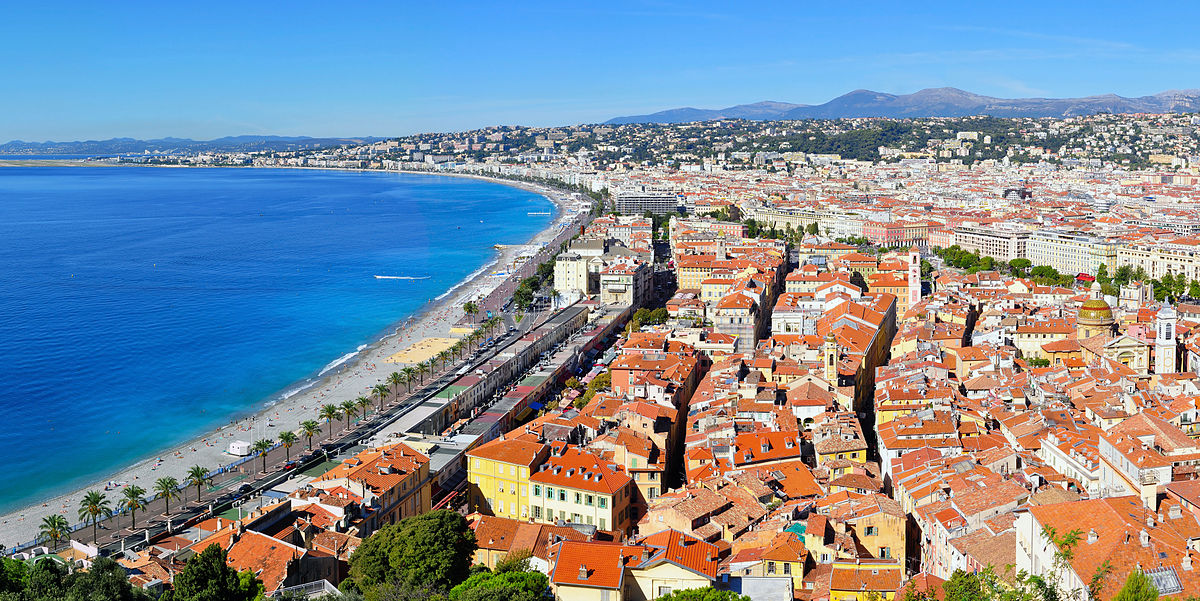
Nice, France is a city on the French Riviera (and not an American practice), September 21, 2011. (Tobi 87 via Wikipedia). Released to public domain via CC-SA-3.0.

This is not just about 45 and the GOP majorities in Congress. In locale after locale, actions like acquitting police officers for murdering Black men and women, reducing the number of abortion clinics, and cutting taxes so the poor and homeless don’t have enough food, shows how un-nice the American people are. American un-niceness exists in the policies drawn up or enacted by those for whom millions voted, from repealing Obamacare to the Muslim Ban. These policies may reflect an American politeness, but they also reflect a cruelty that has all too often been a part of American culture.

As someone who once considered himself “a nice guy,” I recognize that the correct term was always polite. For being “a nice guy” merely meant not revealing my true thoughts toward and about women, all while being polite enough to hold a door open or to try to help a damsel-in-distress. What I was being was a sexist asshole, having not yet challenged my assumptions about women and about myself and my views about women and the rampant sexism and misogyny in American culture.

There are far too many Americans who think that their Christian politeness is so much more than obligatory and vapid gestures that mean little-to-nothing in reality. For this July 4th, the idea of honoring the military with absolutist statements about freedom as so automatic that it sickens me. Especially considering the number of active duty service people and veterans suffering from PTSD, addiction, or whom commit domestic violence. Americans don’t act nice around these ugly issues. Americans don’t volunteer, don’t call 911, and don’t pressure city councils, county commissioners, and state legislatures enough to deal with these issues holistically. It would be nice if more Americans did.

Americans ought to ban being polite. Polite perpetuates racism and economic inequalities. But being nice means doing something about it, protesting, volunteering, speaking truth to power, using America’s alleged freedoms to confront folks in one’s life about their comfortability with various forms of oppression. How nice would that be!

The #45 Mix Tape

28 Sunday May 2017

Posted by decollins1969 in 1, Academia, Boy @ The Window, Christianity, culture, Eclectic, eclectic music, music, Patriotism, Politics, Pop Culture, race, Religion, Youth

≈ Leave a comment

Tags

"White Discussion", #45MixTape, Capone-N-Noreaga, Destruction, Drake, En Vogue, Fleetwood Mac, Greed, Islamophobia, James Blunt, Lies, Live, Madonna, Misogyny, Narcissism, President Donald J. Trump, Racism, Russia, Sarcasm, Sting, Trump Supporters, Xenophobia


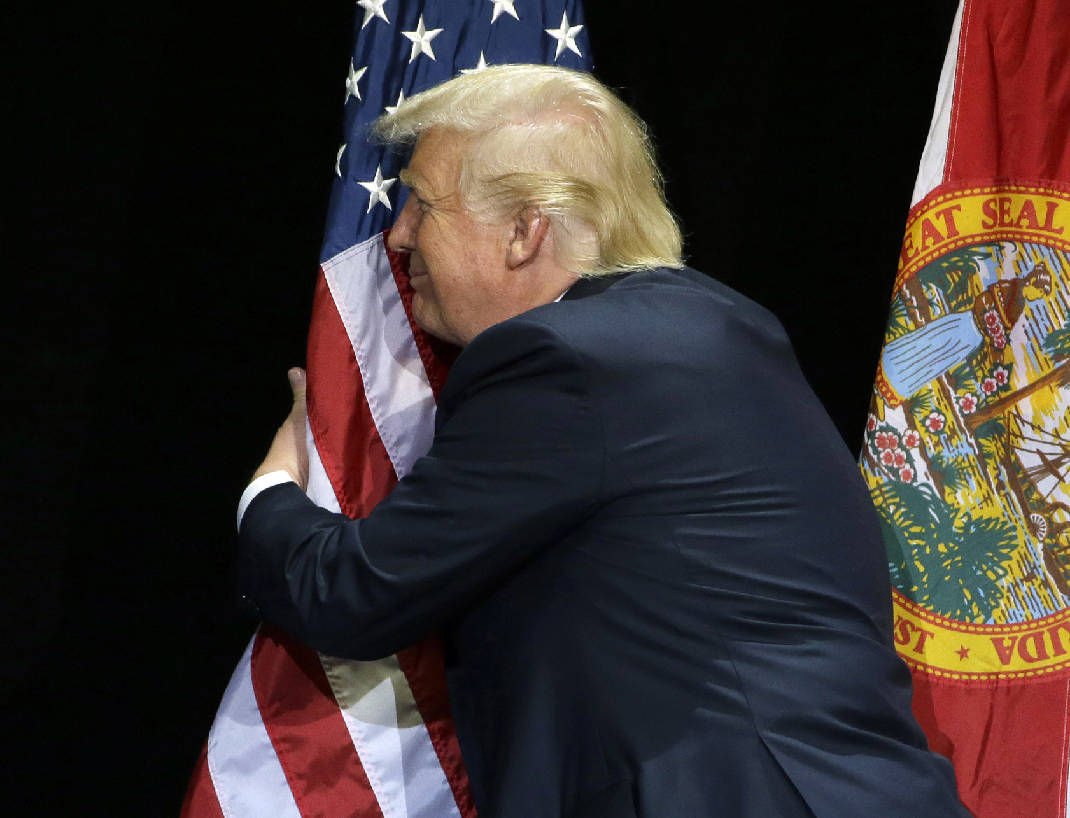
Then candidate 45 hugging US flag at campaign rally (remember, he’s the anti-Midas, everything he touches turns to crap), Tampa, FL, June 11, 2016. (Chris O’Meara/AP, Times Free Press).

I’m changing it up a bit this weekend. With so much focus on the apocalypse that is 45 and his band of greedy, racist, misogynistic, Islamophobia, and Russia-helping yes-men, I have something goofy and meaningful to say. There are already several comprehensive syllabi on Donald J. Trump out, though, so adding my scholarly musings and sources to this almost inexhaustible topic would be a futile exercise. Instead, I have a mix tape (sort of), one that highlights the changes in my music tastes over time and a group of songs that I mostly despise. Just like I loath most of America’s knee-jerk arguments over 45 and his minions from the past two years.

1. “Little Lies” (Fleetwood Mac, 1987). From their Tango In The Night album. Christine McVie sounds like a shot dog on this song (and Lindsey Buckingham doesn’t sound much better). But this was a Top-5 hit on Billboard in 1987, around the same time Trump was likely being turned by Vladimir Putin and the KGB in the former USSR. And, the song’s theme is pretty obvious.

2. “Live to Tell” (Madonna, 1986). Not exactly my favorite artist, but a one-time favorite song from the one-time “Material Girl” for me three decades ago. After several sources quoting the deposed Michael Flynn, “he has a story to tell,” I remembered Madonna’s lyrics, “I have a tale to tell.” Come to think of it, doesn’t Jared Kushner have a tale to tell about his and 45’s “thousand lies?”

3. “Spies Like Us” (Paul McCartney, 1985-86). Proof positive that Baby Boomers will vote for anything, this piece of poop was a Top-10 hit in January 1986. It’s also emblematic of the theme of ineptitude and macabre humor that runs through the song, representing the movie by the same title, and Flynn, Kushner, Carter Page, Roger Stone, and the rest of the monolithic bloc of 45’s White men.

4. “Russians” (Sting, 1985-86). Why? Because Russians (maybe with the exception of Josef Stalin and Putin) “love their children too” — didn’t you know? But they love messing with our corrupt democracy even more.

5. “Oops!…I Did It Again” (Britney Spears, 2000). God, I have no idea why anyone would’ve ever liked this zit-popper. But the then-eighteen-year-old Spears was prescient with the line “I’m not that innocent.” Neither is 45. He made be a narcissistic buffoon who can’t put two coherent sentences together with a pen, two pieces of paper, Scotch tape, and a flashlight. But he knows where his money’s coming from, no?

6. “Just A Friend” (really, “Jus’ a Friend,” Biz Markie, 1989-90). Same theme as Britney Spears’, with a twist of crossover appeal, a ridiculous baroque get-up, and off-key singing that could only be topped by NBA Hall-of-Famer (and internalized racist) Charles Barkley. But it captures perfectly the love affair between ditto-headed supremacist Americans and 45 (it doesn’t go the other way, of course).

7. “White, Discussion” (Live, 1994). A bit of my favorite grunge, which I have used before. It applies to the folks, the so-called American liberals ready to blame non-voters, third-party voters, and Trump supporters for the rise of 45. Still, many of them are to blame also, because most of them aren’t liberal. If you supported Hillary Clinton in 2016 based on principles, and not out of pragmatism, you are not a liberal, and have been voting in center-right candidates for decades. As the song goes, “look where all this talking got us, baby.”

8. “Stranger In Moscow” (Michael Jackson, 1996-97). Jackson’s introspective song applies here as well, because, well, he uses Russia and the theme of isolation throughout. Except in 45’s case, he likes it that way. And apparently, so does Russia.

9. “Lies” (En Vogue, 1990). Trust me, it fits! (s/o to Dawn Robinson).

10. “Thug Paradise” (Capone-N-Noreaga/Tragedy Khadafi, 1997). The lyrics below say it all:

I twist the truth, I rule the world, my crown is called deceit
I am the emperor of lies, you grovel at my feet
I rob you and I slaughter you, your downfall is my gain
And still you play the sycophant and revel in my pain
And all my promises are lies, all my love is hate
I am the politician, and I decide your fate

Supporters and sycophants beware: 45 is coming for you, in a steamroller with a 700-horsepower engine going one hundred.

11. “Fake Love” (Drake, 2017). I’m a Aubrey Graham fan. I can’t stand Drake. Still, this release from More Life should be required listening from 45 supporters who think they’re not racist, misogynistic, xenophobic, or narcissistic. He also has a song on this album titled “Portland,” though I seriously doubt he was thinking about this weekend or Richard Collins III.

12. “Waterfalls” (TLC, 1995). Yep, yep, yep. Both 45 and MAGA-types have been chasing illusory rainbows and torrents off jagged edges, and damning everyone who they perceive as a threat along the way. And they’re both on a one-way trip.

13. “Don’t Forget Me When I’m Gone” (Glass Tiger, 1986). This is the song 45 should play whenever he finally leaves office, whether by resignation, impeachment, and/or force. As everything 45 touches turns into crap, Glass Tiger’s Top-10 schlock cannot be made any worse. Plus, not even Glass Tiger would complain about 45 using their crappy music.

14. (Bonus Track) “No Bravery” (James Blunt, 2006). 45 is part of a continuum, one that stretches through all of American history. On the international stage, though, it has been one of constant chest-thumping while killing innocents in the name of freedom or national security. Though Blunt’s was about fighting for the UK, the song has much more applicability in the US. We have so much blood on our hands, and 45 means to add to this fetid river on the domestic and international frThe #45 Mix Tapeonts.

In·ter·sec·tion·al·i·ty

24 Monday Apr 2017

Posted by decollins1969 in 1, Academia, Carnegie Mellon University, culture, Eclectic, New York City, Pittsburgh, Politics, Pop Culture, race, University of Pittsburgh, Youth

≈ Leave a comment

Tags

Academic Conferences, Afrocentricity, bell hooks, CMU, Critical Race Theory, Diversity, Elsa Barkley Brown, Evelyn Brooks Higginbotham, Intersectionality, Kimberlè Crenshaw, Marginalization, Misogyny, Multiculturalism, OAH, Organization of American Historians, Patricia J. Williams, Paula Giddings, Pitt, Presidential Classroom, Racism, Sexism, Tera Hunter


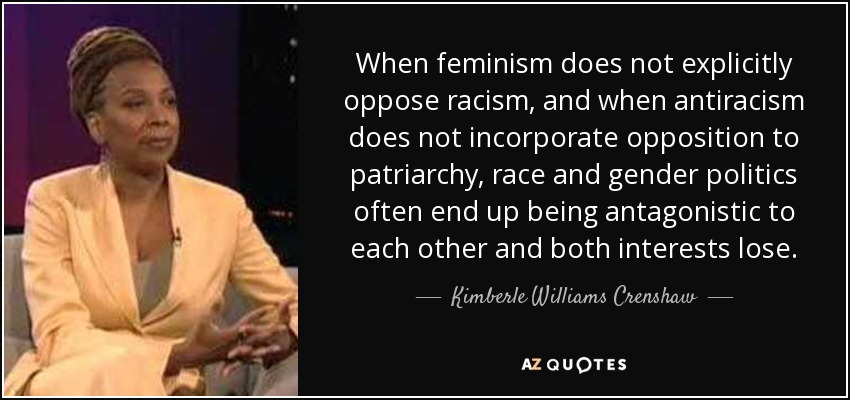
Kimberlè Crenshaw quote, from “Whose Story Is It Anyway?: Feminist and Anti-Racist Appropriations of Anita Hill,” in Toni Morrison’s Race-ing Justice, En-gendering Power, 1992, p. 403. (http://azquotes.com).

In truth, I’ve considered the issue of intersectionality as a historian and writer since 1993, when I wrote my quantitative methods requirement-fulfilling paper, “The Dying of Black Women’s Children.” Except that, for me and for most of my colleagues, the term was barely in use. Matter of fact, in five and half years of graduate school and in my first three years after finishing the doctorate, I may have heard the term used only once or twice. It’s not like I didn’t think about the unique issues facing women of color — especially Black women — in the context of US history and African American history. Sometimes as a historian, how leading Black men and White women marginalized African American women in education movements, in the suffrage movement, and in the Civil Rights Movement was all I could think about. In the context of understanding American education and the role of Black women as teachers and education, it made me reconsider the notion of education as a form of social control versus it as a form of social liberation as an and-both, and not an either-or proposition.

But, as with all other issues, I’m not perfect. I remember getting into an argument with an African American women at a joint Carnegie Mellon-University of Pittsburgh conference on diversity in 1992. She was a second-year master’s student in the public policy program at CMU’s Heinz School (now Heinz College) to my second year as a grad student and first as a PhD student. I had talked about my initial research on multiculturalism and Black education, and what that research could mean in terms of diversity in higher education. Over lunch, I barely got three sentences out about the implications before this student pounced on me for not taking a more Afrocentric approach to my research, all but calling me an Uncle Tom. She also pointed out that while I had accounted for race and gender in my work, I hadn’t accounted for them together. I was already used to middle class Black folk who only radicalized at the ripe young age of twenty-two telling me that my research was too conservative and too White. But on the second part, not accounting enough for Black women in my research, I did take to heart.

In 1999, at my “Black Brahmins” presentation on W. E. B. Du Bois, Carter G. Woodson, and Alain Locke and their ideas around multiculturalism and connections to Harvard at the Organization of American Historians conference in Toronto, I got a cold shoulder from the panel’s moderator, Stephanie Shaw. She barely said a word to me the entire time, and barely commented on my paper. I figured that Shaw thought I should’ve found a way to make the paper more inclusive of Black women graduates of Harvard and multiculturalism, even though Harvard didn’t allow any women to attend. I could’ve included Black women who attended Radcliffe College around the turn of the twentieth century, but even then, those women did not earn graduate degrees or become proponents of pluralism or what we’d call multiculturalism today. I followed up at OAH in Los Angeles in 2001 with my “Multicultural Sisters” paper, but by then, I no longer had an interest in multiculturalism as a historian.

Times Square intersection time-lapse, August 2014. (http://shutterstock.com).

On this day and date in 2000, though, was the argument I had with a colleague at Presidential Classroom, one that would keep me conscious about intersectionality and womanism from that point on. Sev had been brought on by my racist boss Jay Wickliff to help out with the international recruitment for the weekly civic education programs we had for high school juniors and seniors. Sev was Canadian, had been an intern with the program the summer before, and had recently finished up a master’s in history. She had stopped by my office to ask about some revisions I’d been making to parts of our upcoming summer programs, especially the one on media and democracy, which was a new program for Presidential Classroom. Somehow the conversation swung toward women’s rights and issues that Sev thought were important to women. I kept correcting her, saying that some of these issues were “only important to White women.” She took offense, telling me that I shouldn’t be correcting her, that her master’s made her as much an expert on the topic as me. I remember actually chuckling at that assertion, which miffed Sev even more. The common refrain, “Just because you have a PhD…,” was how she responded.

But I did take a few minutes to break down the differences between second-wave and third-wave feminism (or womanism). I went on about the history of exclusion that Black women in particular had faced from Black men in civil rights movements and White women around suffrage and reproductive rights. I said, “maybe it’s because you’re Canadian, but here in the US, these issues you’re bringing up mostly concern middle class White women.” She didn’t like that at all. Before Sev responded, Wickliff, having overheard our argument, came by and said, “Slavery was a hoax” as a joke. That was the moment I knew my days working for this group of Whiteness folks were numbered.

A few months later, in my new job at AED with New Voices, I picked up and read Kimberlè Crenshaw’s essay “Demarginalizing the Intersection of Race and Sex” (1989) for the first time. I knew that I already understood intersectionality for Black women, how misogyny, sexism, and racism constantly confer a double marginalization, discrimination, and violation on Black women. Now, between Crenshaw and my own experiences, I also realized that I could experience intersectionality as a Black man, between White men and White women. Especially middle class ones, where their well-meaning color-blind racism had served to put me in a box as well. It was an and-both box, where I was a historian who didn’t write about intersectionality enough and a professional who had also experienced race and gender-based marginalization, albeit differently from women or color. What I did learn, finally, was that the intersection of race, class, and gender made Times Square look like Walden Pond by comparison.

Yes, I’m A Sexist Feminist

27 Tuesday Dec 2016

Posted by decollins1969 in 1, Academia, Boy @ The Window, Christianity, culture, Eclectic, eclectic music, Hebrew-Israelite, High Rise Buildings, Jimme, Marriage, Mount Vernon New York, My Father, Politics, Pop Culture, race, Religion, Youth

≈ Leave a comment

Tags

Black Masculinity, Chivalry, Contradictions, Dahlia, Damsel-in-Distress Syndrome, Father-Son Relationship, Feminism, Masculinity, Misogyny, Mother-Son Relationship, Nice Guy, Owning Imperfection, Patriarchy, Phyllis, Sexism, Womanism


Hostile vs. Benevolent Sexism, March 10, 2015. (http://www.dailymail.co.uk).

Hostile vs. Benevolent Sexism, March 10, 2015. (http://www.dailymail.co.uk).

I finished up a chapter in Boy @ The Window with the closest approximation to my contemporaneous thoughts about Phyllis (a.k.a., “Crush #2” at times on this blog) in August 1988:

screen-shot-2016-12-27-at-7-43-51-am

I must’ve rewritten these two paragraphs at least a half-dozen times before putting the book out for limited consumption. The thought process that I went through at eighteen years old bothered me then, and looking at the words even today leaves me wanting. Probably because there is more than a bit of sexism contained within these words.

But I wasn’t wrong, of course, not in ’88, not when I wrote and rewrote these paragraphs between 2007 and 2011, and not now, at least in terms of how I perceived things then. While I believed in reproductive rights, in equal pay for equal work, and in passing the Equal Rights Amendment growing up, I also believed in saving damsels from distress and in distinguishing between “ladies” and “bitches.” Or, as my father put it when he argued with my Mom in front of me when I was four years old, “You’s a black bit’!” Or, my contradiction could’ve fully formed when my father tried to set me up with a prostitute a couple of weeks before my seventeenth birthday, in December 1986.

There was no way in 1988 I could’ve understood the contradictions between the idea of feminism (in any form) and the notion of “being a nice guy.” I hadn’t been exposed, or, rather, exposed myself to Paula Giddings, Elsa Barkley Brown, Evelyn Brooks Higginbotham, bell hooks, Maya Angelou, Angela Davis, and Zora Neale Hurston. I hadn’t yet been engaged in the hundreds of conversations I’d eventually have with women folk I’d become friends with, people with whom I bonded because of their suffering, people from whom I’d hidden my own suffering during those years. Date rape, physical abuse, the more typical abuse of serial cheating, among other issues. With many of these women, I recognized the sexism and misogyny I saw in myself in 1988, and saw them again when I wrote down my contemporaneous thoughts in Boy @ The Window. It didn’t occur to me until the mid-1990s that women could be just as sexist and misogynistic as men, and often could pass down their notions of masculinity and patriarchy to their children. And that thought scared me.

Imprisoned brain (or, maybe, Culture Club and "Church of the Poison Mind" [1983]), December 27, 2016. (http://mdjunction.com).

Imprisoned brain (or, maybe, Culture Club and “Church of the Poison Mind” [1983]), December 27, 2016. (http://mdjunction.com).

It scared me because I realized I may have learned more of my contradictions from my Mom than from my father or idiot ex-stepfather. After all, she was the one constant in my parenting, the one person who engaged me in ideas like chivalry and manliness, who through her acquiescence to Maurice might have made it okay for me to see women, especially Black women (and to a lesser extent, Latina women) as ones in need of help, even when they decide not to take it.

And it may have made it okay for me to see myself as the victim in my incident with Dahlia in June 1987, when I accidentally (the first time), and later deliberately smacked her on her left butt cheek. Maybe I was the victim in a way, at least of my own deluded thought process. And there hasn’t been a time in the past twenty-nine and a half years in which I haven’t regretted that second, deliberate slap, in response to Dahlia accusing of thoughts I didn’t have, because my only obsession in 1987 was Phyllis. I’ve said and written this before, including in Boy @ The Window. To Dahlia, I am so sorry.

Beijing smog alert, Beijing, China, December 6, 2016. (http://ibtimes.com).

Beijing smog alert, Beijing, China, December 6, 2016. (http://ibtimes.com).

I may never be the perfect intersectional womanist feminist I’ve tried to be since I told my Mom to abort my future (and since deceased) sister in 1982. I still believe that professional women’s tennis players should play best-of-five-set matches at the Gram Slam tournaments. I think more women — particularly White women — should stop calling themselves feminists if their feminism stops when dealing with women of color or poor women in general. I think that most men who aren’t feminists are assholes. But I also know that, just like with racism (as now well noted by Ibram Kendi) and with narcissism (my next project, maybe), sexist ideas are as pervasive as smog in L.A. and Beijing. I don’t have to like it or accept it, but I do have to accept that I am a man, and I will make mistakes, including sexist ones. I will have to own up, and keep trying to do better.

The Meat-Market Society

08 Saturday Oct 2016

Posted by decollins1969 in 1, culture, Eclectic, New York City, Politics, Pop Culture, race

≈ Leave a comment

Tags

Access Hollywood, American Narcissism, Billy Bush, Black Women, Dehumanization, Donald Trump, Facebook, Meat Market, Meat-Market Mentality, Misogyny, Racism, Reading Terminal Market, Washington Post


Slaughtered pigs in a slaughterhouse line, accessed October 8, 2016. (dezeen.com via Pinterest).

Slaughtered pigs in a slaughterhouse line, accessed October 8, 2016. (dezeen.com via Pinterest).

About a year ago, I figured out someone in my Facebook timeline was a bit of a misogynist. He had been posting pics of Black women as if it was his and his followers’ jobs to rate, or rather, berate women based on how “respectable” they looked while out in public. The comments he elicited were so stereotypical and nasty that I will not quote them here. But I can quote part of my own response. “Why do we get to choose? Are we at a grocery store shopping for ass or something?”

It was as if it never dawned on anyone responding that this was far more than objectifying women. (The truth is, we all objectify, regardless of gender, as any form of attraction comes with this as part of the equation. It’s a question of the degree to which we do so). This was a case of putting “good” versus “bad” women on display. It was as if I had gone to Whole Foods, or, more aptly, Reading Terminal Market in Philly. But instead of butchers and mongers and other vendors with stalls selling cuts of boneless/skinless chicken thighs, prime rib, duck breasts, pork tenderloin, and fresh caught salmon, they were selling big butts, round asses, wide hips, perky breasts, and sanded feet. The post was straight up misogyny, and I all but dropped the person as a result of it.

Cuts of beef, lamb, and pork (plus ground beef), Martin's Quality Meats & Sausages, Reading Terminal Market, Philadelphia, PA, March 2013. (http://hobbiesonabudget).

Cuts of beef, lamb, and pork (plus ground beef), Martin’s Quality Meats & Sausages, Reading Terminal Market, Philadelphia, PA, March 2013. (http://hobbiesonabudget).

But it did make me think. The folks who responded acted as if they really were shopping for groceries, as if you could buy a woman at a store for say, $4.99 a pound, or find a sale where “prime rib” goes for $10.89 instead of $12.99 per pound. The key to this frame on misogyny, then, is literally how little the men in question valued women, and more specifically, Black women, physically and otherwise. After all, with an average weight of 140 pounds, $700 or $1550 is a clear-cut and sickening example of cheapening a person, with slavery auction overtones included. At the very least, if these alleged men were truly interested in any kind of relationship or a long-term commitment, a minimum of three additional zeros should be added to this misogynist numbers, no?

Of course this isn’t the point, that no price tag should be put on the value of a human life, and on women specifically. It’s fairly obvious, though, that many, if not most, men and women think, speak, and act on this mindset. Donald Trump has been an example of this for decades. That it took the release of unused footage from an Access Hollywood clip from 2005 to confirm Trump’s meat-market views on White women is both sad and unsurprising. Sad because it’s as if many Americans haven’t paid attention to Trump’s ridiculousness since announcing his candidacy 17 months ago. Unsurprising because the tape reveals what those of us who have been paying attention over the past months — and in my case, years — already knew.

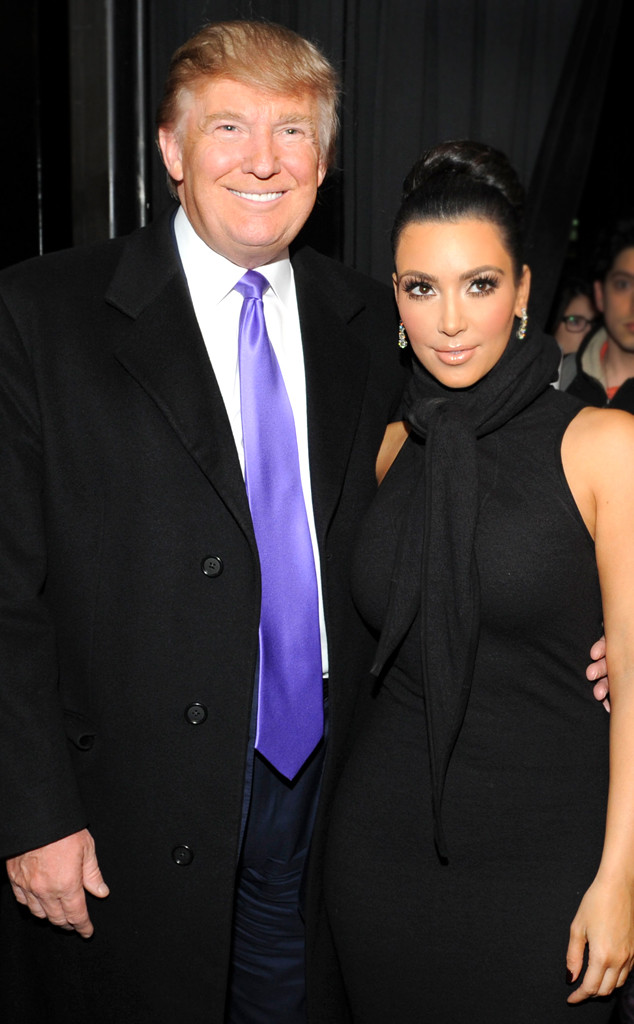
Donald Trump posing with Kim Kardashian at Celebrity Apprentice event, New York, 2010. (Mathew Imaging/WireImage via http://eonline.com).

Donald Trump posing with Kim Kardashian at Celebrity Apprentice event, New York, 2010. (Mathew Imaging/WireImage via http://eonline.com).

Sure, Trump apologized via video on Facebook late last night. But he won’t stop being a misogynist, or seeing people as meat. Heck, the Central Park 5 are still guilty and still deserving of the death penalty in his mind, and the jogger whom had been raped in 1989 is still only a “broken woman” and a “victim.” As far as Trump is concerned, his America consists of 320 million stalls of meat that he “can do anything” with at any time and expect to get away with it.

But if you think that this mindset has merely trickled down from the likes of people like Trump, you would be mistaken. American culture is so rife with a meat-market mentality, that I can smell the lean cuts of animal protein from miles away.

Splitting The Rail Between Nate Parker and His Work

26 Friday Aug 2016

Posted by decollins1969 in 1, culture, Eclectic, Movies, Politics, Pop Culture, race, Youth

≈ Leave a comment

Tags

Cultural Production, Faux Moralisms, Misogyny, Nate Parker, Racism, Rape Culture, Roman Polanski, Sexism, Systemic Misogyny, The Birth of a Nation (2016), Woody Allen


Splitting a log into rails, Arkansas, May 1983. (http://www.motherearthnews.com/).

Splitting a log into rails, Arkansas, May 1983. (http://www.motherearthnews.com/).

I wrote about this in the context of rap and popular music three years ago. Yet, most of us have not learned this lesson. That great artists and the works that they produce often do not equate in any way to the person they are outside of their artistry in their daily lives. It is so rare as to be almost a godsend when a wonderful cultural producer can also be a forthright and social justice-oriented person who has few blemishes on their record. It is so rare, in fact, that it is more likely I find a briefcase with a $2 million in $100-bills next to my car this morning than find successful cultural producers with deep waters’ worth of goodness and doing good as their record.

Twitter and Facebook folk have been up in arms about the discovery that actor/director/producer Nate Parker allegedly raped a women in ’99 along with one of his co-producers, was acquitted a year later, and the woman subsequently committed suicide in 2012. Keep in mind, this information has been out here about Parker for a number of years. Keep in mind, this act occurred when Parker was nineteen years old. Keep in mind, this vile act and the acquittal he received for it may well be the reason Parker had the opportunity to become an actor and a movie producer in the first place.

As a survivor of sexual assault myself (it still reads strange for me to write this), it makes me ill right down to my bowels, having read some of the details about what happened. Especially since I also know women to whom this happened and the impact it had on some for years afterward. I almost wish I didn’t know that Nate Parker might have gotten away with rape seventeen years ago.

But, as I also know all too well, if the idea is to not see his, et al’s The Birth of a Nation revamped to be about Nat Turner/Nat Turner’s Rebellion, good luck with that. Ultimately, to see or not to see the film is a choice that any of us can make. One can decide to see it and still feel like vomiting over Parker’s real-life rape case. One can decide not to see the film and claim that Parker is a reformed man. It is not as simple an equation as, “if you see The Birth of a Nation, you are pouring money into a rapist’s pockets.”

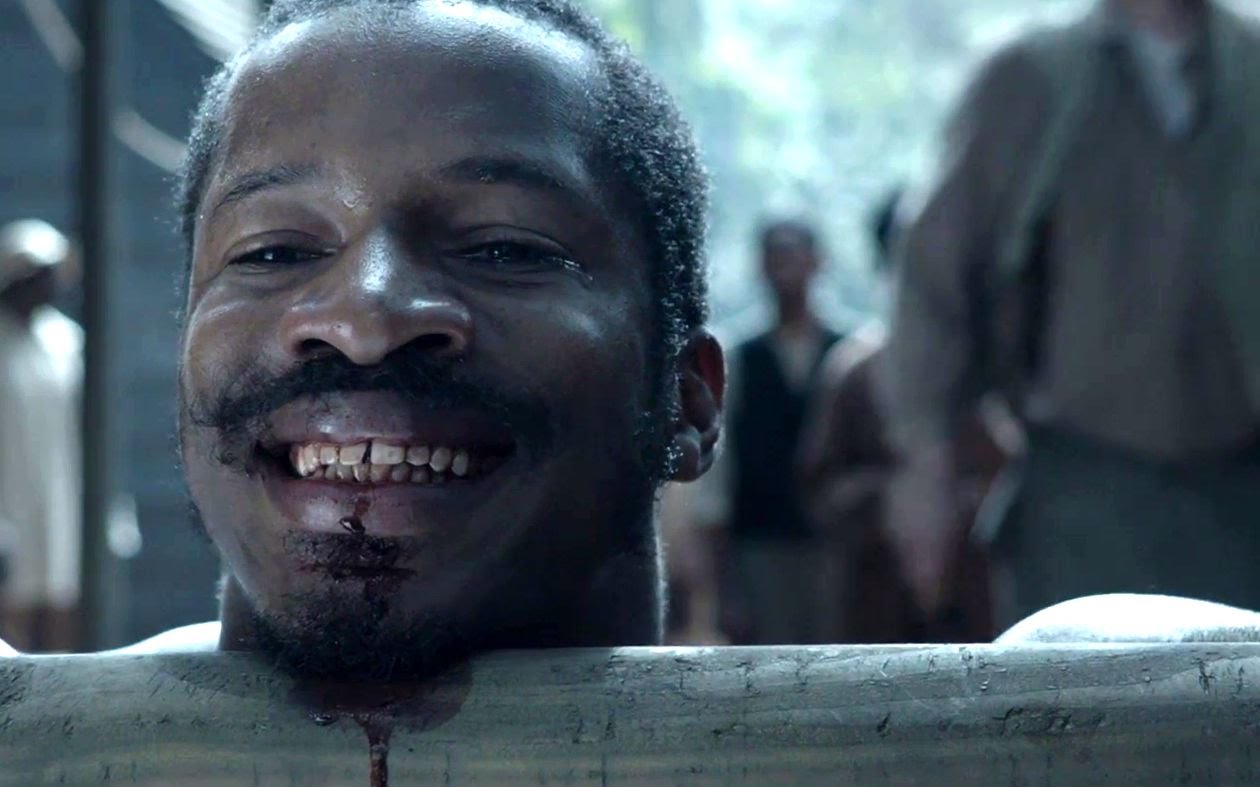
From The Birth of a Nation (2016) trailer, August 26, 2016. (http://youtube.com).

From The Birth of a Nation (2016) trailer, August 26, 2016. (http://youtube.com).

My biggest issue, though, is with all the outrage has come the American penchant for hypocritical moralizations, one that is in part based on race. That is, that we only have the choice of supporting Nate Parker and his revolutionary work or not, that the middle ground of seeing cultural production while reviling the man who helped produce it isn’t an available option. Sorry, but we Americans, we obese consumers and appropriators of all things cultural, do this every day. People have not stopped seeing Woody Allen or Roman Polanski films, though one is likely a child molester and the other one committed rape. We haven’t returned or burned Bill Withers’ tapes, albums, and CDs, though he’s had domestic violence issues in his past. Nor do we think about the poetry we read, the paintings and sculptures we peruse, the TV shows we watch, in which an artist of one kind or another has committed a crime, has killed, stolen from, and destroyed people’s lives along the way. The problem is, if one swings a stick at any cultural production, you will hit a thief, a mugger, an abuser, a rapist, a molester, maybe even a Nazi.

As for me, like with most movies, I will not go to see The Birth of a Nation in a movie theater. I will wait the six months or a year it takes for it to come out on premium cable. I wouldn’t have gone to see it before social media caught wind of Parker’s past. I certainly will not get sucked in to see it, to be part some moralistic wave of cultural immediacy, now.

This issue should not be about Nate Parker at all. It should be about the system that allows for rapists to get no jail time or to be acquitted. It should be about universities like Penn State that allow these crimes to go unpunished, places that punish the victims of sexual violence much more often than they do the perpetrators. It should be about a society where both fathers and mothers do nothing to teach their sons to not rape. Instead, we’re focused on one individual, as if the problem of American rape culture will be solved by going after alleged rapists years after their crimes.

← Older posts
Newer posts →

Boy @ The Window: A Memoir

Boy @ The Window: A Memoir

Places to Buy/Download Boy @ The Window

There's a few ways in which you can read excerpts of, borrow and/or purchase and download Boy @ The Window. There's the trade paperback edition of Boy @ The Window, available for purchase via Amazon.com at http://www.amazon.com/Boy-Window-Donald-Earl-Collins/dp/0989256138/

There's also a Kindle edition on Amazon.com. The enhanced edition can be read only with Kindle Fire, an iPad or a full-color tablet. The links to the enhanced edition through Apple's iBookstore and the Barnes & Noble NOOK edition are below. The link to the Amazon Kindle version is also immediately below:

scr2555-proj697-a-kindle-logo-rgb-lg

Boy @ The Window on Amazon.com: http://www.amazon.com/Boy-The-Window-Memoir-ebook/dp/B00CD95FBU/

iBookstore-logo-300x100

Boy @ The Window on Apple's iBookstore: https://itunes.apple.com/us/book/boy-the-window/id643768275?ls=1

Barnes & Noble (bn.com) logo, June 26, 2013. (http://www.logotypes101.com).

Boy @ The Window on Barnes & Noble: http://www.barnesandnoble.com/w/boy-the-window-donald-earl-collins/1115182183?ean=2940016741567

You can also add, read and review Boy @ The Window on Goodreads.com. Just click on the button below:

Boy @ The Window

Twitter Updates

Tweets by decollins1969
  • RSS - Posts
  • RSS - Comments

Archives

  • June 2025
  • April 2023
  • September 2022
  • August 2022
  • July 2022
  • June 2022
  • May 2022
  • April 2022
  • March 2022
  • January 2022
  • December 2021
  • November 2021
  • October 2021
  • September 2021
  • August 2021
  • July 2021
  • June 2021
  • April 2021
  • March 2021
  • February 2021
  • January 2021
  • December 2020
  • November 2020
  • October 2020
  • September 2020
  • August 2020
  • July 2020
  • May 2020
  • April 2020
  • March 2020
  • January 2020
  • December 2019
  • November 2019
  • August 2019
  • July 2019
  • June 2019
  • May 2019
  • April 2019
  • March 2019
  • February 2019
  • January 2019
  • December 2018
  • November 2018
  • October 2018
  • September 2018
  • August 2018
  • July 2018
  • June 2018
  • May 2018
  • March 2018
  • February 2018
  • January 2018
  • December 2017
  • November 2017
  • October 2017
  • September 2017
  • August 2017
  • July 2017
  • June 2017
  • May 2017
  • April 2017
  • March 2017
  • February 2017
  • January 2017
  • December 2016
  • November 2016
  • October 2016
  • September 2016
  • August 2016
  • July 2016
  • June 2016
  • May 2016
  • April 2016
  • March 2016
  • February 2016
  • January 2016
  • December 2015
  • November 2015
  • October 2015
  • September 2015
  • August 2015
  • July 2015
  • June 2015
  • May 2015
  • April 2015
  • March 2015
  • February 2015
  • January 2015
  • December 2014
  • November 2014
  • October 2014
  • September 2014
  • August 2014
  • July 2014
  • June 2014
  • May 2014
  • April 2014
  • March 2014
  • February 2014
  • January 2014
  • December 2013
  • November 2013
  • October 2013
  • September 2013
  • August 2013
  • July 2013
  • June 2013
  • May 2013
  • April 2013
  • March 2013
  • February 2013
  • January 2013
  • December 2012
  • November 2012
  • October 2012
  • September 2012
  • August 2012
  • July 2012
  • June 2012
  • May 2012
  • April 2012
  • March 2012
  • February 2012
  • January 2012
  • December 2011
  • November 2011
  • October 2011
  • September 2011
  • August 2011
  • July 2011
  • June 2011
  • May 2011
  • April 2011
  • March 2011
  • February 2011
  • January 2011
  • December 2010
  • November 2010
  • October 2010
  • September 2010
  • August 2010
  • July 2010
  • June 2010
  • May 2010
  • April 2010
  • March 2010
  • February 2010
  • January 2010
  • December 2009
  • November 2009
  • October 2009
  • September 2009
  • August 2009
  • July 2009
  • June 2009
  • May 2009
  • April 2009
  • March 2009
  • February 2009
  • January 2009
  • December 2008
  • November 2008
  • October 2008
  • September 2008
  • August 2008
  • July 2008
  • June 2008
  • May 2008
  • April 2008
  • March 2008
  • February 2008
  • January 2008
  • December 2007
  • November 2007
  • October 2007
  • September 2007
  • August 2007
  • July 2007
  • June 2007

Recent Comments

MaryPena's avatarMaryPena on My Day of Atonement/Bitter Hat…
decollins1969's avatardecollins1969 on No Good Teaching Deed Goes…
Mary Rose O’Connell's avatarMary Rose O’Connell on No Good Teaching Deed Goes…

NetworkedBlogs on Facebook

NetworkedBlogs
Blog:
Notes From a Boy @ The Window
Topics:
My Life, Culture & Education, Politics & Goofyness
 
Follow my blog

616 616 East Lincoln Avenue A.B. Davis Middle School Abuse Academia Academy for Educational Development AED Afrocentricity American Narcissism Authenticity Bigotry Blackness Boy @ The Window Carnegie Mellon University Child Abuse Class of 1987 CMU Coping Strategies Crush #1 Crush #2 Death Disillusionment Diversity Domestic Violence Economic Inequality Education Family Friendship Friendships Graduate School Hebrew-Israelites High-Stakes Testing Higher Education History Homelessness Humanities Humanities Program Hypocrisy Internalized Racism Jealousy Joe Trotter Joe William Trotter Jr. K-12 Education Love Manhood Maurice Eugene Washington Maurice Washington Misogyny Mother-Son Relationship Mount Vernon High School Mount Vernon New York Mount Vernon public schools Multiculturalism MVHS Narcissism NFL Pitt Pittsburgh Politics of Education Poverty President Barack Obama Race Racial Stereotypes Racism Relationships Self-Awareness Self-Discovery Self-Reflection Sexism Social Justice Teaching and Learning University of Pittsburgh Violence Whiteness Writing

Top Rated

Blog at WordPress.com.

  • Subscribe Subscribed
    • Notes from a Boy @ The Window
    • Join 103 other subscribers
    • Already have a WordPress.com account? Log in now.
    • Notes from a Boy @ The Window
    • Subscribe Subscribed
    • Sign up
    • Log in
    • Report this content
    • View site in Reader
    • Manage subscriptions
    • Collapse this bar
 

Loading Comments...