• About Me
  • Other Writings
  • Interview Clips
  • All About Me: American Racism, American Narcissism, and the Conversation America Can’t Have
  • Video Clips
  • Boy @ The Window Pictures
  • Boy @ The Window Theme Music

Notes from a Boy @ The Window

~

Notes from a Boy @ The Window

Tag Archives: Maurice Eugene Washington

Holiday Traditions (really, not having any)

12 Saturday Dec 2015

Posted by decollins1969 in 1, Boy @ The Window, Christianity, culture, Hebrew-Israelite, Marriage, Mount Vernon New York, My Father, Pittsburgh, Pop Culture, race, Religion, Work, Youth

≈ Leave a comment

Tags

616, 616 East Lincoln Avenue, Abuse, Chanukah, Chiropractor, Christmas, Domestic Violence, Family, Giving, Haves and Have-Nots, Holiday Traditions, Maurice Eugene Washington, Mom, Mother-Son Relationship, Poverty, Receiving, Suicide, Womanizing


Christmas Holiday and Traditions Around The World ornament bulb, December 12, 2015. (http://johnseville.benchmark.us).

Christmas Holiday and Traditions Around The World ornament bulb, December 12, 2015. (http://johnseville.benchmark.us).

At my chiropractic appointment yesterday morning, my bone-cracking doctor of fourteen years and I got into a discussion of our holiday plans over the next couple of weeks. Her and her family will visit with extended kin in Virginia, while we’re heading to Pittsburgh to see my in-laws. During our conversation, my chiropractor brought up some of the family traditions she’s preserved with her handful of Christmases with her young daughter and two sons. Traditions like Danish pork roast for dinner, ornaments and other hand-me-downs from her grandparents and other ancestors as part of trimming the tree.

“I wouldn’t know anything about traditions. Matter of fact, there were eight years growing up where we didn’t even celebrate Christmas,” I said, with no forethought about what her reaction might be.

“Oh, I’m so sorry,” my chiropractor said in a quiet yet somewhat shocked tone, as if I’d ruined the Christmas spirit for her kids.

“That’s what happens when you go up in poverty,” I said apologetically, realizing that I might have cost my chiropractor some peace of mind this holiday season.

Even at nearly forty-six, I can still say things without thinking, causing others to have to think more than they normally would. Sometimes, it’s without intent or malice, sometimes it’s because I don’t give a crap what people may think. Regardless, it’s certainly not because I want people to feel sorry for me or to give me a hug.

The truth is, the only holiday traditions I have come either from my wife or her family or were born out of my circumstances. Like making super-sweet, two-packs of Fruit Punch Kool-Aid and mixing it with either ginger ale or Sierra Mist for either Thanksgiving or Christmas. Or getting our son’s Christmas presents ready for him without him knowing the night before. Or me making some holiday/birthday cake for me and us (since my birthday is two days after Christmas). And often going to a soup kitchen, homeless shelter or other venue to give away clothes, toys, money, my time in knowing that no matter how I might feel about my life, plenty others have it much worse.

The truth is also more complicated than simple poverty. Up until my eighth birthday in ’77, my Mom and me and Darren (with either my father or my idiot stepfather) celebrated Darren’s birthday, Christmas and my birthday as separate or nearly separate events. Some of my best times growing up were those days. Then, when the hyperinflation of the late-1970s kicked in — along with a second marriage and two more mouths to feed — Christmases ’78 and ’79 consisted of a fake two-foot table tree, a new shirt or sweater and a new pair of slacks. There were no birthday celebrations for me.

A contemporary Candelabrum in the style of a traditional Menorah. United Kingdom, Chanukah service, December 2014. (Gil Dekel; http://www.poeticmind.co.uk; via 39james via Wikipedia). Released to public domain via CC-SA-4.0.

A contemporary Candelabrum in the style of a traditional Menorah. United Kingdom, Chanukah service, December 2014. (Gil Dekel; http://www.poeticmind.co.uk; via 39james via Wikipedia). Released to public domain via CC-SA-4.0.

Between Christmas ’80 and Christmas ’88, we didn’t even have the fake dwarf tree. Of course, four of those years we were Hebrew-Israelites. But there is this holiday known as Chanukah that also occurs in December, in which Torah believers celebrate the Festival of Lights with eight days of gifts and giving. But these were also the worst of our poverty-stricken years, and we could barely afford one candle for the menorah, much less eight or nine. The best gift I got those years was my idiot stepfather being out the apartment at 616 and on the prowl for other victims for his fast-talking nonsense about making money and living a godly way-of-life. I also attempted suicide on my fourteen birthday, not exactly a tradition worth repeating.

Finally, in December ’89, we had our first Christmas at 616 with my Mom having divorced my now idiot ex-stepfather. She bought a fake full-sized tree. I bought my four younger siblings gifts big and small for the holiday. My mom even made me a Duncan Hines chocolate cake with vanilla icing for my twentieth birthday that year. We didn’t have much, but what we did that year meant so much as we moved into the 1990s.

In all of my adult Christmases, I’ve actually only done one in Pittsburgh prior to our trip coming up in eleven days. It was Christmas ’98. That week, perhaps the only important tradition I’ve ever been a part of began. I moved in with my then girlfriend Angelia, mostly as a cost-cutting measure, partly out of love and concern for our respective futures. We’ve been living together and celebrating the holidays ever since!

Aside

Running Away, 30 Years Later

25 Tuesday Aug 2015

Posted by decollins1969 in 1, Boy @ The Window, Christianity, culture, Eclectic, eclectic music, Jimme, Marriage, Mount Vernon High School, Mount Vernon New York, music, My Father, Pittsburgh, Pop Culture, race, University of Pittsburgh, Youth

≈ Leave a comment

Tags

"Emotion (Ain't Nobody)" (2014), "Runnin'" (1995), 616, 616 East Lincoln Avenue, Dreams, Envy, Family Responsibilities, Fleetwood, Lliy-White, Loneliness, Making Plans, Maurice Eugene Washington, Maurice Washington, Maverick Sabre, MVHS, Pharcyde, Single-Minded, Spin Moves, Visions, Whiteness


Today’s date marks three decades since I took on my idiot stepfather Maurice Washington, and actually won, even though I didn’t realize it at the time. I’ve written about the incident and my twenty-three-hour trek through Mount Vernon, my dreams, prayers, and wishes, and my confrontation before, here and in Boy @ The Window. (Even now, the baseline to Pharcyde’s “Runnin'” (1995) is running in my head, temporarily replacing my writing theme song for the past week, Maverick Sabre’s “Emotion (Ain’t Nobody)” (2011), but that’s how my mind works). So I won’t go over all of the details again. Still, there are a few important takeaways that puts Sunday, August 25, 1985 in my lifetime victory column.

Michigan WR Jeremy Gallon's spin move gif on way to a 61-yd TD against Notre Dame, Ann Arbor, MI, September 7, 2013. (http://thebiglead.com/).

Michigan WR Jeremy Gallon’s spin move gif on way to a 61-yd TD against Notre Dame, Ann Arbor, MI, September 7, 2013. (http://thebiglead.com/).

1. Physical advantages. It never occurred to me until Maurice tried to blindside me in the apartment hallway with a punch that I had much faster reflexes than the idiot. It also never occurred to me that I had a better sense of balance. I managed to avoid the punch and spin around him by using his 350-400 pounds of bulk against him (I really hated having to touch the unwashed, greasy fat frog of a man), and in only a foot of space between the two of us. That’s how I escaped Maurice’s punch and grasp, and got out of the apartment to begin my trek. Knowing what I know now, I should’ve tried out for basketball instead of baseball in eleventh grade.

2. Not finding my father. I kind of wished I had, just to have a few hours that day not to think about my present and future. But my alcoholic dad was a significant part of my present, and his absence gave me real time to think about how jacked up my family life was. I knew, if nothing else, that Maurice, Mom, and Jimme couldn’t pin that on me.

3. Walking up Gramatan Avenue and into Fleetwood. It was partly a walk that reminded me about how the other half of Mount Vernon — affluent and predominantly White — lived. I knew that I’d never be a part of that Mount Vernon, and not just because most of them would run me over with a car sooner than say “Hello.” It was the sense of exclusively, the ability to check in and out of progressive issues, like Humanities and magnet programs, that made me see. These folks I could never befriend.

St. Ursulas Roman Catholic Church, 213 East Lincoln Avenue, Mount Vernon, NY, August 2012. (http://maps.google.com).

St. Ursulas Roman Catholic Church, 213 East Lincoln Avenue, Mount Vernon, NY, August 2012. (http://maps.google.com).

4. MVHS overnight dreams and Catholic church prayers. Both reminded me that if I played my cards right, I could be on my way to college in two years, twenty-four months, 730 days. I could cope with 616, Maurice, my older brother Darren and my younger siblings and high school and Humanities for that much longer, I thought. But I also knew I needed to make a conscious, almost single-minded effort to do so. Even then, I was tired of burying my thoughts and emotions and playing the role of enigmatic weirdo, though. I realized this was going to be a battle with myself.

Yet what I didn’t learn from my ordeal would also be two more reasons to leave Mount Vernon. I wouldn’t learn those reasons and lessons until the spring and summer of ’87, when the respectability police, the good middle class folk of Black Mount Vernon, would give me just the push I needed…

Didn’t We Never Have It All

04 Thursday Jun 2015

Posted by decollins1969 in 1, Boy @ The Window, Christianity, culture, Eclectic, eclectic music, Hebrew-Israelite, Marriage, Mount Vernon New York, My Father, New York City, Pop Culture, race, Religion, Work, Youth

≈ Leave a comment

Tags

"Why Women Still Can't Have It All", Anne-Marie Slaughter, Arkansas, Black Migration, Bradley Arkansas, Conservatism, Evangelical Christianity, Hats, Judah ben Israel, Maurice Eugene Washington, Melissa Harris-Perry, Mother-Son Relationship, Mount Vernon Hospital, MSNBC, Perfectionism, Self-Awareness, Self-Loathing, Self-Sufficiency, Self-Worth, Strikebreaker, Tenant Farming, Vanity, Wear and Tear, Welfare, Welfare Poverty, Xenophobia


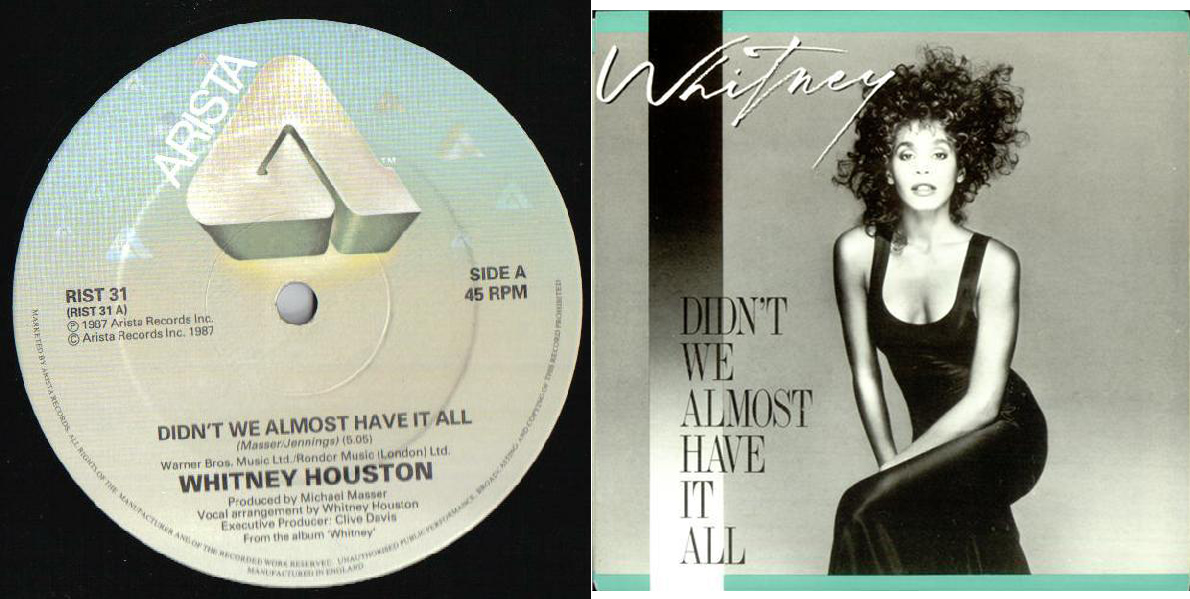
Whitney Houston, "Didn't We Almost Have It All" (released August 1987) Single 45rpm, from 2nd Whitney album (not exactly a favorite), June 4, 2015. (combined/cropped by Donald Earl Collins; http://musicstack.com and http://rapgenius.com).

Whitney Houston, “Didn’t We Almost Have It All” (released August 1987) Single 45rpm, from 2nd Whitney album (not exactly a favorite), June 4, 2015. (combined/cropped by Donald Earl Collins; http://musicstack.com and http://rapgenius.com).

I’ve been thinking about this for nearly a year. It started for me last August. Melissa Harris-Perry had a segment on her MSNBC show regarding the multiple hats women of color have worn over the years in taking care of their families, immediate, extended and non-biological. In response to Anne-Marie Slaughter’s July/August 2012 piece in The Atlantic about “Why Women Still Can’t Have It All,” Harris-Perry and her guests made the point that feminism for women of color has been about far more than having a successful, sexist-free career. That throughout American history, women of color have found themselves wearing multiple hats as primary breadwinners, primary caretakers and primary childrearers, often in ways that traditional feminists don’t discuss or recognize. All without fanfare and with many setback along the way.

What I’ve witnessed and been a part of in my own life reflects much of the conversation that Harris-Perry led on her show. The physical, mental and psychological scars from caring for family, friends and children, while struggling financially and dealing with racism and misogyny often manifests in disease and depression for so many women of color. There’s so much more, though, in terms of how my own mother’s multiple hats and habits led me to so many of my own. All initially to help her, but in the end, helping myself become self-sufficient. Not to mention making myself more understanding of where all the wear, tear and lack of care that wearing so much for so long can lead.

My Mom’s Hats and Habits:

The Anne-Marie Slaughter image of multitasking/wearing multiple hats (just think what this is like for poor, low-income, women of color), February 4, 2015. (ALAMY; http://telegraph.co.uk).

The Anne-Marie Slaughter image of multitasking/wearing multiple hats (just think what this is like for poor, low-income, women of color), February 4, 2015. (ALAMY; http://telegraph.co.uk).

Before I turned thirteen years old, my mother had been far more than my Mom. She’d been a dietary supervisor at Mount Vernon Hospital, just outside New York City, since 1968, the year before I was born. She had been a high school basketball player, a caregiver to her eleven brothers and sisters, and a cotton-picking breadwinner for her family in segregated southwestern Arkansas, an area located in the Red River Valley, part of the larger Mississippi Delta region. She had become our family’s primary breadwinner in the years after she gave birth to my older brother and me. Not to mention a married young woman now living a thirty-minute train ride from Midtown Manhattan, between the Hudson and Hutchinson Rivers, on the border between affluent Westchester County and the Bronx.

Life didn’t treat my Mom too kindly once she married my alcoholic father in 1971. And it actually went from bad to worse as she divorced him for my stepfather in 1978. By then, she had become a cigarette smoker, a one-time adulterer, and an abuse survivor. My Mom did everything she could to shield my older brother and me from her habits and the realities of our tough life in Mount Vernon in the 1970s and early 1980s. But by the end 1982, as I turned thirteen, all the hats my Mom had worn began to fall to the ground. In taking on the role of a strikebreaker, all of our lives would change forever.

In response to concessions made to the union, who left her unprotected, Mount Vernon Hospital cut her from full-time to part-time. My Mom became the besieged one. She was the old woman in the shoe, with six kids — including four under the age of five — and a cheating, abusive, unemployed, sometimes-at-home husband. It was my Mom’s job to take care of us all. Yet no longer was she a breadwinner. My Mom had become one of Reagan’s alleged welfare queens, pulling in $16,600 in AFDC payments per year from April 1983 until I left for college in August 1987. With all of that, I became a hat juggler myself.

Once Her Hats Became My Own:

For a while during my teenage years, my Mom had been my friend, one in which I could usually confide, albeit out of anger and frustration. All while taking on more and more of what had been her duties, including the brunt of her second husband’s rage and fists. I’d become an everyday grocery shopper, a frequent family cook, and a sometimes provider, the last mostly through tracking down my own father for a few extra dollars every Friday or Saturday at one of his favorite bars. Or, by the time I was sixteen, through working part-time. I provided childcare on afternoons, evenings and weekends. I washed clothes with my older brother on Saturdays or Sundays every week without fail from October 1982 on.

Hat stall at a Sunday fair, Amsterdam, The Netherlands, August 31, 2008. (Jorgeroyan via Wikipedia). Released to public domain via CC BY-SA 3.0.

Hat stall at a Sunday fair, Amsterdam, The Netherlands, August 31, 2008. (Jorgeroyan via Wikipedia). Released to public domain via CC BY-SA 3.0.

By the end of high school, I realized too who my Mom wasn’t, maybe for the first time. She wasn’t an encourager, a person who pushed her kids to pursue their dreams. With so many “Are you sure…?” questions my last two years of high school, it’s a wonder I applied to any colleges at all. Mom wasn’t a nurturer either, especially after I became a teenager. My Mom had only said “I love you” to me two times between my twelfth and nineteenth birthdays, including at my high school graduation ceremony in June 1987. She also wasn’t easygoing. Any mistake with money or my time would get a “Serves you right…” sermon about never screwing up.

The Toll Caring For Others Can Take:

All of this has made my Mom a conservatively cautious perfectionist, one living with depression and in constant denial about our shared past. I guess that it was all too much for her, like reaching the Jordan River, but not being allowed to cross it. Our shared experiences had also made me cautious and perfectionistic in my dealings with myself and the world, as I had to wear so many of my Mom’s hats and cross so many of those rivers with her. My mother tried to be all things to me and my older brother especially, and failed more than she succeeded in the process. For that and so many other reasons, despite her mistakes, I love her very much.

It’s been more than twenty-seven years since I moved away for the greener pastures of the University of Pittsburgh. Yet it’s only been in the past decade that I’ve learned to stop striving for perfection in all the things I say and do. It ultimately takes a lifetime to unlearn all the bad habits and prejudices and give up on juggling all the ideas and roles that our parents have put on us. My journey with and without my Mom has been no different. Now that my Mom’s in her late sixties, I just hope that the only hat she tries to wear these days is one to keep her head warm on the coldest of days.

Degrees of Fakery

17 Tuesday Mar 2015

Posted by decollins1969 in 1, Academia, Boy @ The Window, Carnegie Mellon University, culture, Eclectic, Jimme, Mount Vernon High School, Mount Vernon New York, My Father, New York City, Politics, Pop Culture, race, University of Pittsburgh, Upper West Side, Youth

≈ Leave a comment

Tags

616 East Lincoln Avenue, Advanced Degrees, Ben Carson, Bill Cosby, Brian Williams, Chevy Citation, CMU, Cynicism, Doctor, Doctorate, Dr. Steve Perry, Expertise, Experts, Fake Degrees, Fakery, Father-Son Relationship, Hard Work, Henry Kissinger, Honorary Degrees, Lawyer, Maurice Eugene Washington, Michelle Malkin, Newt Gingrich, Obsequious, Opinions, PhD, William Kristol


Anne-Marie Johnson in Im Gonna Git You Sucka (1988), March 17, 2015. (http://cdn5.movieclips.com/). Qualifies as fair use under US copyright laws (low resolution and relevance to subject matter).

Anne-Marie Johnson in Im Gonna Git You Sucka (1988), March 17, 2015. (http://cdn5.movieclips.com/). Qualifies as fair use under US copyright laws (low resolution and relevance to subject matter).

All too often, there are Americans high and low who believe they can say, “That’s just your opinion!” to anyone about anything. It doesn’t matter if the person they say this to is an expert in, say, climate change or American history or twentieth-century education policy. Or, for that matter, if the person they question is a total bullshit artist. All opinions are equal, and equally discountable.

But it does matter if the opinion comes from someone rich and famous. or at least, someone Americans see on TV and/or hear on the radio nearly every day, someone they like, someone they could see themselves sharing a laugh or cry with. That’s why opinions like those of Rudy Giuliani, Bill Cosby, Michelle Malkin, even Brian Williams seem to have mattered more over the years than the expert interpretations of many a scholar, scientist or public intellectual.

On the scale of those experts, those in the media likely view me as a middle-of-the-pack expert. I went to graduate school for five and a half years, earning two advanced degrees with a focus on twentieth-century US and African American history, with an even sharper focus on history of American education, African American identity and multiculturalism.

Front and left-side view of Chevrolet Citation II (1980-1985), Clinton, MD, August 28, 2008. (IFCAR via Wikipedia). Released to public domain.

Front and left-side view of Chevrolet Citation II (1980-1985), Clinton, MD, August 28, 2008. (IFCAR via Wikipedia). Released to public domain.

Despite what my Mom, my dad and some of my more cynical former high school classmates may think, earning a PhD in history wasn’t nearly as simple as answering 1,000 Final Jeopardy questions correctly before getting a stamp of approval. Twenty-three masters and doctoral courses, more than forty paper assignments of twenty pages or more, two years as a teaching assistant, one year as an undergraduate student advisor, two summers as a research assistant, and twenty-seven months of single-minded focus researching and writing a 505-page dissertation with more citations than the number of Citations Chevrolet made between 1980 and 1985. Oh, and did I mention, nineteen months of burnout afterward?

Yet, when I take the years I’ve spent researching, writing, learning, teaching, publishing and working in the fields of history and education, and express views based on that, I get told what anyone else on the street could say. “That’s just your opinion!” Unbelievable!

I think, too, about those from a time not too long ago who could’ve and should’ve earned a doctorate, a medical degree, or a JD, yet the structures of socioeconomic privilege, racism and sexism prevent them from earning these most expert of degrees. Yet, at many an HBCU, in many a segregated classroom, in so many barbershops, we still called them “Doc,” a sign of respect, for their abilities, for their experience, for their — dare I say — expertise.

We still do this now, even for people who don’t deserve the nickname “Doc.” My father and my idiot, late ex-stepfather both at one point in their lives or another laid claim to being doctors and/or lawyers. For the first two years I knew my then stepfather Maurice, between ’77 and ’79, he carried a monogramed briefcase, always full of his “important papers,” telling me and anyone else he bumped into on the streets of Mount Vernon, New York that he was a “doctor” or a “lawyer.” When drunk, my father sometimes took it a step further, telling strangers on the Subway that he was a “big-shot doctor an’ a lawyer” on his Friday-evening paydays. Maurice drove a Reliable taxicab during his delusions-of-grandeur years, and my father was janitorial supervisor.

Given the history of education and our society’s denial of quality education to people of color and the poor in the US, though, I didn’t entirely hold it against them then, and I don’t now. What I do have much bigger problems with, though, are the people who should know better, and yet don’t do any better. Just in my lifetime alone, people with Dr. in front of their names without having earned a doctorate or a four-year medical degree. Like “Dr.” Henry Kissinger, “Dr.” Bill Cosby, and of late, “Dr.” Steve Perry (not to be confused with the former lead singer for Journey, I guess). And no, honorary doctorates for giving money to Harvard, Temple, or the University of Massachusetts don’t count! Nor does starting an outline for a dissertation without actually finishing one. Still, they insist on the “Dr.,” even when it’s obvious I could’ve sat on the stoop at 616 East Lincoln Avenue thirty years ago to get the same half-baked opinions from one of my hydro-smoking neighbors.

Stock photo of former NYC mayor Rudolph Giuliani, August 2013. (AP/New York Post).

Stock photo of former NYC mayor Rudolph Giuliani, August 2013. (AP/New York Post).

Then again, numbskulls like William Kristol and Newt Gingrich have earned doctorates from Harvard and Tulane University respectively, and Ben Carson was once one of the most respected pediatric neurosurgeons in the world! Yet, for some dumb reason, our media and most Americans think that their opinions are somehow more valuable, more consumable, than those of people who’ve spent decades understanding education, American culture, racial, gender and socioeconomic inequality, and government corruption. Or maybe, we just like listening to fake opinions from people with fake degrees and/or fake expertise on a subject in which they know nothing. Because nothing is exactly what Americans want to hear.

Why My Mom Stayed

11 Thursday Sep 2014

Posted by decollins1969 in 1, Boy @ The Window, culture, Eclectic, Hebrew-Israelite, Jimme, Marriage, Mount Vernon New York, My Father, Pop Culture, race, Religion, Youth

≈ Leave a comment

Tags

#WhyIStayed, 616, 616 East Lincoln Avenue, Battered Women's Syndrome, Beverly Gooden, Child Abuse, Domestic Violence, DV, Hypermasculinity, Isshin-ryu Karate, Janay Palmer Rice, Judah ben Israel, Maurice Eugene Washington, Maurice Washington, Misogyny, Ray Rice, Self-Worth, Sexism, Social Media, Twitter


My Mom at 48 years old, Yonkers, NY, December 23, 1995. (Donald Earl Collins).

My Mom at 48 years old, Yonkers, NY, December 23, 1995. (Donald Earl Collins).

I planned to write something about my Mom on her birthday again this October, focusing on her multiple roles as mother, breadwinner, domestic violence victim and evangelical Christian in that post. With the TMZ-released video of Ray Rice and the public response to the NFL’s misogynistic hypocrisy making the issue of domestic violence front and center this week, it makes sense for me to talk about my experience and my observations via my Mom this week as well.

First off, thanks to all the brave women who’ve tweeted, posted on Instagram, Facebook, WordPress and other places their experiences with domestic violence. Thanks especially to Beverly Gooden (@bevtgooden) for creating and using the hashtag #WhyIStayed in response to the barrage of criticism leveled at Janay Palmer Rice for marrying Ray Rice after his brutal act of violence against her. I know domestic violence and child abuse firsthand, as I watched my Mom experience the Isshin-ryu-Karate version of a knockout and concussion on Memorial Day ’82 at the hands of my then stepfather Maurice Washington.

Screen shot 2014-09-11 at 7.54.54 AM

Ivy_Mike_test.ogg.160p

Ivy_Mike_test.ogg.160p

This wasn’t the first time Maurice had hit my Mom, as I’d learn years later, but it was the first time I witnessed it. I’d seen my Mom attacked before, by my own father when I was little. My father was often drunk and equally incompetent during his attacks, so any physical damage that was done was from my Mom beating him up. The psychological and emotional damage, though, flowed right from her first marriage to my father to her second one with Maurice.

For seven years and sixteen days after the day my childhood ended, my Mom and Maurice lived together as husband and wife at 616. I can say with one hundred percent clarity that there wasn’t a day between Memorial Day ’82 and the final fight that led to my late ex-stepfather moving out that I didn’t feel some sort of dread, a cloud of lethargy hanging over my head, even while at college at Pitt. That was partly because I’d made a point of running interference and taking abuse to make up for not calling the police on that day of days.

I didn’t know why my Mom couldn’t find the strength to kick Maurice to the curb, at least not before the middle of ’89. But there was an incident between me and Maurice about a year before he finally moved out, one where what he said afterward gave me additional insight into my Mom’s inaction.

Screen shot 2014-09-11 at 12.52.50 PM

At least, I had to believe that, right? It just seemed we’d been through too much with a man who’d never paid a month’s rent, a phone bill, a Con Ed bill, a cable bill, and only bought Great Northern beans, rice and cabbage for his kids (my younger siblings) on the handful of days he decided to contribute to our malnourished family.

So finally, in the months after he left 616 for good, I asked. My Mom’s first answer was, “He fooled me. He fooled us all!” Her answer was completely unsatisfying, considering that I ran away from home to get away from Maurice when I was nearly nine years old.

The summer of ’89 wouldn’t be the last time I’d ask. Over the years, my Mom has given various explanations. “I thought he was a changed me,” she’d say, referencing their six-month separation in ’80-’81 and Maurice becoming a Hebrew-Israelite and “Judah ben Israel” in the interim. “What good would that done?,” my Mom would ask me in response, implying that she wanted to avoid a physical confrontation.

Really, I spent thirteen years reading in between the lines, asking relatives questions about my Mom, doing research and boning up on domestic violence and child abuse from a social science perspective, all for more substantial answers. Really, my Mom’s domestic violence experience, our fall into welfare poverty, and my child abuse experiences were the first reasons for me wanting to write what would become Boy @ The Window in the first place.

"Divorced at last" layer cake, or "Broken Marriage," March 2014. (http://www.nigeriancurrent.com/).

“Divorced at last” layer cake, or “Broken Marriage,” March 2014. (http://www.nigeriancurrent.com/).

By the time I did the family intervention in January ’02, I knew why. I knew that despite my Mom not remembering much from the beating, knockout and concussion she took in May ’82, she lived in fear. If for no other reason than from seeing the look of hurt on my face whenever the subject of her beating came up. Maybe not a constant, shaking-in-her-shoes fear, but the idea of having to force a six-one and overweight yet powerful man out of 616 probably scared my Mom. But that wasn’t her only fear. As I wrote in Boy @ The Window, “[w]e were already the children of one divorce, and I wasn’t sure if I wanted to see another one so soon.” I’m more than sure that my Mom felt the same way about herself and her relationships with my father Jimme and Maurice as well.

I also know with certainty my Mom would never want me to write about her, especially about her as a victim of domestic violence. But she wasn’t the only one to experience it. I may be able to live my life successfully despite it, but I’ll never be able to un-see what I saw nearly thirty-two and half years ago. It put me on a very long road, one that involved my own conflicting feminism and sexism (though with zero tolerance for violence against women). Or, what I call damsel-in-distress syndrome, where I always want to help, even when that help is unwelcome.

There are millions of reasons why women get married or stay in relationships and marriages, some of them rational, some based in fear, many who stay because abuse does untold damage to self-worth. I may not fully understand what it’s like to be a woman who’s been abused, but I do understand what it’s like to be the son of one. Most of us who don’t know of these horrors need to be quiet, read, and listen more.

Suicide, or, My Last Day as a Hebrew-Israelite

27 Friday Dec 2013

Posted by decollins1969 in 1, Boy @ The Window, culture, Eclectic, Hebrew-Israelite, Jimme, Marriage, Mount Vernon High School, Mount Vernon New York, My Father, Pop Culture, race, Religion, Youth

≈ Leave a comment

Tags

Atheism, Child Abuse, God, Holidays, Loneliness, Maurice Eugene Washington, My Birthday, Ostracism, PTSD, Silly Season, Suicidal Thoughts, Suicide, Suicide Attempt, Teenage Angst


A stone bridge over the Hutchinson River Parkway, near Pelham, NY (about a mile from the bridge I stood on), May 3, 2007. (Anthony22 via Wikipedia). Released to public domain via Creative Commons.

A stone bridge over the Hutchinson River Parkway, near Pelham, NY (about a mile from the bridge I stood on), May 3, 2007. (Anthony22 via Wikipedia). Released to public domain via Creative Commons.

Thirty years ago on this date, on my fourteenth birthday, I was one thirteen-foot jump away from taking my own life. I’d felt this way before, quite a bit throughout ’81, ’82 and ’83, but I’d never come close to actually acting on my suicidal thoughts. I knew that despite getting beat by my then stepfather Maurice, neglected by Mom and family, ostracized at school and walking around with a kufi that only held the promise for more poverty, that my life wasn’t that bad. At least, compared to living in Biafra in the late-1960s or in Cambodia under the Khmer Rouge.

But the support of my classmates after my recent mugging reminded me of the reality that I had no friends, and hadn’t had a friend for more than two and a half years. Combined with the silly season of the holidays and no birthday celebration for me for the sixth year in a row, I was so down on by the morning of Tuesday, December 27, ’83. So much so that when I went to the store for my Mom that mid-afternoon, the stone bridge across the Hutchinson River Parkway that connected Mount Vernon to Pelham via East Lincoln called to me. It might as well have said, “This is the way. This is the only way.”

From Boy @ The Window:

I looked down at the cars underneath as I put myself, one leg at a time, atop the short stone wall, meant to keep young kids from falling off the bridge. As I stood there, I kept thinking, “What do I have to live for anyway?” Tears started to well up as I continued to look down at the cars as they zoomed by on both sides of the four-lane parkway.

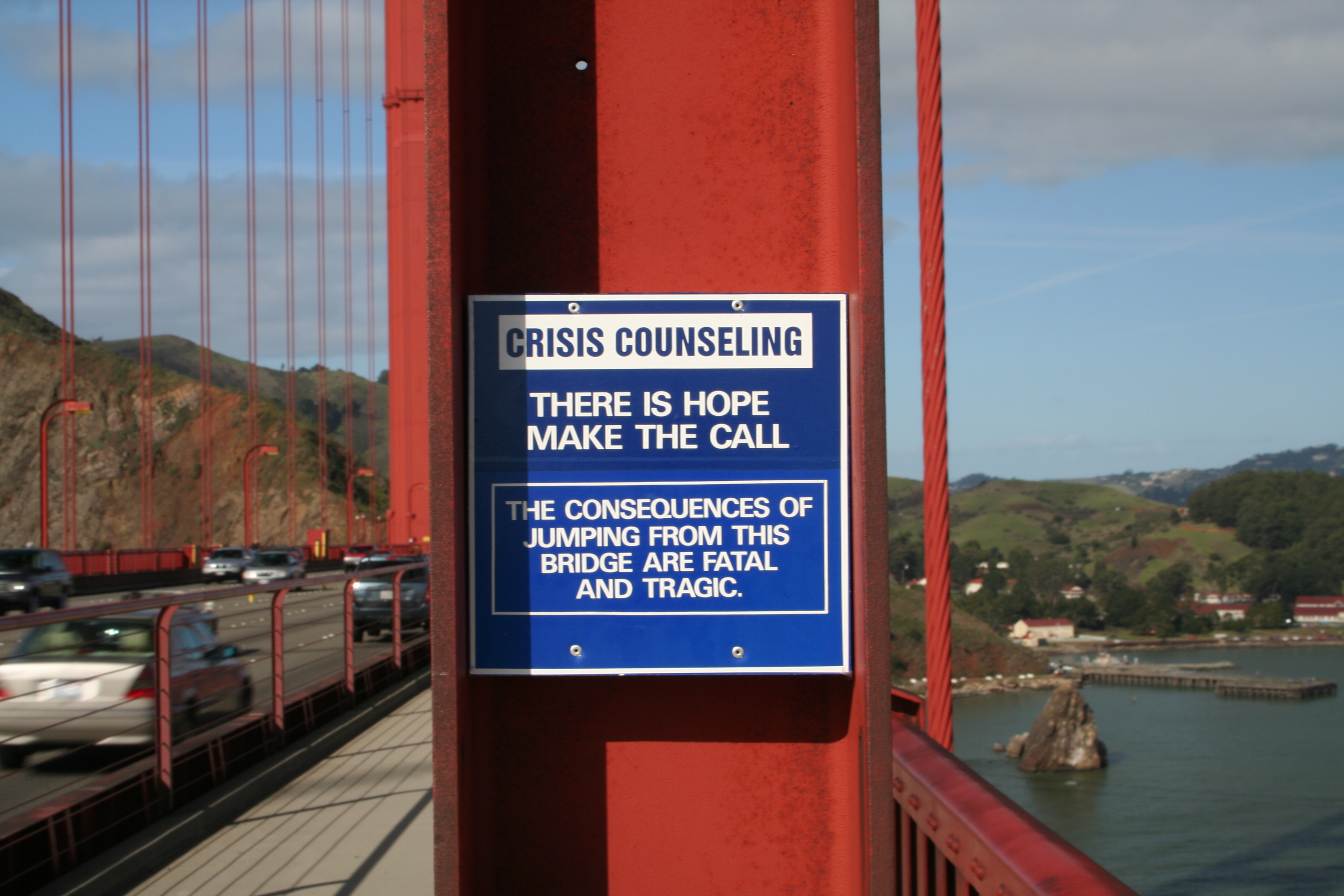
The suicide prevention message on the Golden Gate Bridge (the #1 bridge in the US to jump to one's death), San Francisco CA, February 19, 2006. (David Corby/Miskatonic via Wikipedia). Released to public domain via Creative Commons.

The suicide prevention message on the Golden Gate Bridge (#1 bridge in US to jump to one’s death), San Francisco CA, February 19, 2006. (David Corby/Miskatonic via Wikipedia). Released to public domain via Creative Commons.

Then I had thoughts. And having any thoughts at all, especially thoughts of anything other than suicide, will short-circuit any attempt to kill yourself. One was of the remote possibility that taking my life could actually hurt someone else, Mom, my family, maybe even my classmates or teachers. A second, even more sobering thought was that I could survive the thirteen-foot jump. Only to be run over by a car going at fifty or fifty-five. And I could possibly survive that, too. But I’d end up brain-damaged or paralyzed or a vegetable or in a coma. There were too many risks involved to just jump off the bridge. For a few seconds I stood there, lost and not sure of what to do next. My next thought, my third one, was that maybe, just maybe, this is what hitting bottom really feels like. Maybe something good for me and my life was just around the corner. Maybe if I hold out a little longer, I’d find a reason to live my life and live it well. My fourth thought brought me to Maurice. “Wouldn’t that be the best revenge, that I overcome every situation in my life and become successful? Wouldn’t making the ultimate comeback from the edge of the cliff be better than ending it all now?,” I thought. With that, I got down from the stone wall and went on a long walk through Pelham before going home. I wasn’t relieved, but I wasn’t ready to take my own life yet either.

This was the moment I decided no one else was ever going to make another decision about religion or my eternal spirit for me ever again. That I was no longer a Hebrew-Israelite. But I needed more to believe in, sometime bigger than me, because it was way too early yet for me to simply believe in myself. The only way being an atheist made any sense to me was only if there really was no god or God at all, and the scientific evidence didn’t lean in any direction. Plus, if atheism were a proven fact, and not just a belief born of both science and emotion, then suicide made perfect sense, and after coming off that ledge, it really didn’t seem rational anymore.

Suicide – What If

Suicide – What If

Thank God Facebook or Twitter didn’t exist in ’83. Between Alex and Starling and Wendy, my family and their religion, our poverty and my PTSD, all it would’ve taken thirty years ago would’ve been one tweet or post, and the timeline for me that now includes three degrees, three careers, a wife and a son (not to mention two books) wouldn’t exist. But if there really are alternate universes, then I killed myself in at least one of them three decades ago. And to that version of me, I get it, I understand, and I’m sorry that you didn’t make it.

On Regrets and Forgiveness

22 Tuesday Oct 2013

Posted by decollins1969 in 1, Boy @ The Window, Christianity, culture, Eclectic, Hebrew-Israelite, Jimme, Mount Vernon High School, Mount Vernon New York, New York City, Pop Culture, race, Religion, Youth

≈ Leave a comment

Tags

Child Abuse, Domestic Violence, Forgiveness, Indecision, Love, Maurice Eugene Washington, Maurice Washington, Mother-Son Relationship, Regret, Regrets, Second-Guessing, Self-Reflection, Unforgiveness


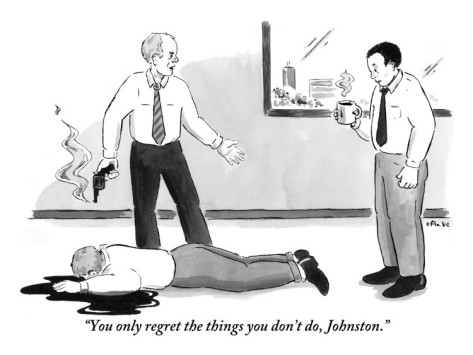
Emily Flake's "You only regret the things you don't do, Johnston," February 28, 2011. (http://newyorker.com)

Emily Flake’s “You only regret the things you don’t do, Johnston,” February 28, 2011. (http://newyorker.com)

One of the things I’ve read and heard from others so far about Boy @ The Window since April has been about catharsis. As in, “this book must’ve been cathartic for you.” I’ve said in response, “Yeah, it sure has.” But that’s not been the whole truth. In more than a few respects, Boy @ The Window has opened up a Pandora’s box of wounds I’d kept locked for years and years.

This might surprise some folks, especially the ones who attended Mount Vernon public schools, Humanities and specifically Mount Vernon High School with me. But there is a dark side to being me. Beneath my well wishes, good graces and generic smile has also been a person with deep regret, repressed anger, smoldering rage over what by far were the worst years of my life. All of which has translated into a person whose worst days since are days of blame — almost always of and for myself. I can forgive almost anyone or anything — my late idiot ex-stepfather, my father Jimme and his years of alcoholism, friends or superiors who’ve attempted to take advantage of me.

The Physics of a Bottomless Pit, February 27, 2013. (MatsuKami of deviantART via http://www.scienceblogs.com).

The Physics of a Bottomless Pit, February 27, 2013. (MatsuKami of deviantART via http://www.scienceblogs.com).

Yet there’s one person I’ve found very hard to forgive — myself. I hold myself to such high standards that it would be impossible for anyone other than Jesus to meet. And God knows I’m not perfect. But in looking at my past, my growing up years in Boy @ The Window, I’ve found that so much of my life’s force and energy has gone into redeeming myself for having to live through those terrible, terrible years. Even though I’ve been at a place in my life in which I’ve pretty much known myself, my passions, my calling, my abilities and limitations, for the better part of twenty years. Until recently, though, I hadn’t given myself any breaks from my past. Putting it under lock and key obviously didn’t work, and airing it for the world to read — while beneficial — had brought with it a truck-load of emotions that I had yet to work through.

As I wrote at the end of Boy @ The Window:

I can say without a doubt that Humanities did make a difference in my life. I wouldn’t be the person I am today without those six bittersweet and indifferent years. It makes any setback I might suffer today seem small and laughable by comparison. There are things I wish would’ve happened, things that would’ve made it easier to enjoy life and savor glorious moments even now. I wish Humanities had been as serious about developing me as a writer as it was about accelerated math and science classes. I regret not asking Phyllis out for a date. I lament not revealing more about the tragedies of my family life or my keen sense of humor to the few classmates and teachers I had some bond with, however weak. I wish I had trusted my instincts and never worn that kufi to Holmes or Davis. I know I should’ve stayed with football or tried out for basketball. And I wish I had the opportunity as a twelve-year-old to kiss Wendy one time. Admittedly, there’s a part of me that wishes I could kiss her now.

I imagine that if I had done all of these things, I would’ve been even more bruised up (especially in the case of Wendy), but at least I could’ve said I tried. Instead of looking back at my past and picking it apart like a forensic vulture.

But my deepest regret, and one that I hadn’t forgiven myself for, at least until recently, was for not calling the cops on my then stepfather after he beat up Mom on Memorial Day, Monday, May 31, ’82. Between my near-photographic memory and my training as an academic historian, it’s been hard to look at my past without reliving it.

How do you mend a broken heart?, 2005, October 22, 2013. (digitalman via deviantART at http://deviantart.net).

How do you mend a broken heart?, 2005, October 22, 2013. (digitalman via deviantART at http://deviantart.net).

I hadn’t figured out that I hadn’t forgiven myself until a few weeks ago. I realized that I hadn’t let go of the worst of my past. Now, letting go doesn’t mean that you forget your past, bury it or repress it emotionally. For me, it simply means not reliving the moment as if it happened last week instead of thirty-one years ago. To treat the moment as a memory, an important reminder that I am not Superman, that I couldn’t have saved my Mom from domestic violence anymore than I could’ve saved myself from poverty as a twelve-year-old.

You know, when I was younger, I thought that I didn’t have any regrets, any resentment or any dark side from growing up the way I did. We all tend to believe that pushing forward to a brighter future will take care of our past. That’s simply not true. We need to live in the present in order to achieve that brighter future. That means working through our pasts, and then letting it go. I should know.

← Older posts
Newer posts →

Boy @ The Window: A Memoir

Boy @ The Window: A Memoir

Places to Buy/Download Boy @ The Window

There's a few ways in which you can read excerpts of, borrow and/or purchase and download Boy @ The Window. There's the trade paperback edition of Boy @ The Window, available for purchase via Amazon.com at http://www.amazon.com/Boy-Window-Donald-Earl-Collins/dp/0989256138/

There's also a Kindle edition on Amazon.com. The enhanced edition can be read only with Kindle Fire, an iPad or a full-color tablet. The links to the enhanced edition through Apple's iBookstore and the Barnes & Noble NOOK edition are below. The link to the Amazon Kindle version is also immediately below:

scr2555-proj697-a-kindle-logo-rgb-lg

Boy @ The Window on Amazon.com: http://www.amazon.com/Boy-The-Window-Memoir-ebook/dp/B00CD95FBU/

iBookstore-logo-300x100

Boy @ The Window on Apple's iBookstore: https://itunes.apple.com/us/book/boy-the-window/id643768275?ls=1

Barnes & Noble (bn.com) logo, June 26, 2013. (http://www.logotypes101.com).

Boy @ The Window on Barnes & Noble: http://www.barnesandnoble.com/w/boy-the-window-donald-earl-collins/1115182183?ean=2940016741567

You can also add, read and review Boy @ The Window on Goodreads.com. Just click on the button below:

Boy @ The Window

Twitter Updates

Tweets by decollins1969
  • RSS - Posts
  • RSS - Comments

Archives

  • June 2025
  • April 2023
  • September 2022
  • August 2022
  • July 2022
  • June 2022
  • May 2022
  • April 2022
  • March 2022
  • January 2022
  • December 2021
  • November 2021
  • October 2021
  • September 2021
  • August 2021
  • July 2021
  • June 2021
  • April 2021
  • March 2021
  • February 2021
  • January 2021
  • December 2020
  • November 2020
  • October 2020
  • September 2020
  • August 2020
  • July 2020
  • May 2020
  • April 2020
  • March 2020
  • January 2020
  • December 2019
  • November 2019
  • August 2019
  • July 2019
  • June 2019
  • May 2019
  • April 2019
  • March 2019
  • February 2019
  • January 2019
  • December 2018
  • November 2018
  • October 2018
  • September 2018
  • August 2018
  • July 2018
  • June 2018
  • May 2018
  • March 2018
  • February 2018
  • January 2018
  • December 2017
  • November 2017
  • October 2017
  • September 2017
  • August 2017
  • July 2017
  • June 2017
  • May 2017
  • April 2017
  • March 2017
  • February 2017
  • January 2017
  • December 2016
  • November 2016
  • October 2016
  • September 2016
  • August 2016
  • July 2016
  • June 2016
  • May 2016
  • April 2016
  • March 2016
  • February 2016
  • January 2016
  • December 2015
  • November 2015
  • October 2015
  • September 2015
  • August 2015
  • July 2015
  • June 2015
  • May 2015
  • April 2015
  • March 2015
  • February 2015
  • January 2015
  • December 2014
  • November 2014
  • October 2014
  • September 2014
  • August 2014
  • July 2014
  • June 2014
  • May 2014
  • April 2014
  • March 2014
  • February 2014
  • January 2014
  • December 2013
  • November 2013
  • October 2013
  • September 2013
  • August 2013
  • July 2013
  • June 2013
  • May 2013
  • April 2013
  • March 2013
  • February 2013
  • January 2013
  • December 2012
  • November 2012
  • October 2012
  • September 2012
  • August 2012
  • July 2012
  • June 2012
  • May 2012
  • April 2012
  • March 2012
  • February 2012
  • January 2012
  • December 2011
  • November 2011
  • October 2011
  • September 2011
  • August 2011
  • July 2011
  • June 2011
  • May 2011
  • April 2011
  • March 2011
  • February 2011
  • January 2011
  • December 2010
  • November 2010
  • October 2010
  • September 2010
  • August 2010
  • July 2010
  • June 2010
  • May 2010
  • April 2010
  • March 2010
  • February 2010
  • January 2010
  • December 2009
  • November 2009
  • October 2009
  • September 2009
  • August 2009
  • July 2009
  • June 2009
  • May 2009
  • April 2009
  • March 2009
  • February 2009
  • January 2009
  • December 2008
  • November 2008
  • October 2008
  • September 2008
  • August 2008
  • July 2008
  • June 2008
  • May 2008
  • April 2008
  • March 2008
  • February 2008
  • January 2008
  • December 2007
  • November 2007
  • October 2007
  • September 2007
  • August 2007
  • July 2007
  • June 2007

Recent Comments

MaryPena's avatarMaryPena on My Day of Atonement/Bitter Hat…
decollins1969's avatardecollins1969 on No Good Teaching Deed Goes…
Mary Rose O’Connell's avatarMary Rose O’Connell on No Good Teaching Deed Goes…

NetworkedBlogs on Facebook

NetworkedBlogs
Blog:
Notes From a Boy @ The Window
Topics:
My Life, Culture & Education, Politics & Goofyness
 
Follow my blog

616 616 East Lincoln Avenue A.B. Davis Middle School Abuse Academia Academy for Educational Development AED Afrocentricity American Narcissism Authenticity Bigotry Blackness Boy @ The Window Carnegie Mellon University Child Abuse Class of 1987 CMU Coping Strategies Crush #1 Crush #2 Death Disillusionment Diversity Domestic Violence Economic Inequality Education Family Friendship Friendships Graduate School Hebrew-Israelites High-Stakes Testing Higher Education History Homelessness Humanities Humanities Program Hypocrisy Internalized Racism Jealousy Joe Trotter Joe William Trotter Jr. K-12 Education Love Manhood Maurice Eugene Washington Maurice Washington Misogyny Mother-Son Relationship Mount Vernon High School Mount Vernon New York Mount Vernon public schools Multiculturalism MVHS Narcissism NFL Pitt Pittsburgh Politics of Education Poverty President Barack Obama Race Racial Stereotypes Racism Relationships Self-Awareness Self-Discovery Self-Reflection Sexism Social Justice Teaching and Learning University of Pittsburgh Violence Whiteness Writing

Top Rated

Blog at WordPress.com.

  • Subscribe Subscribed
    • Notes from a Boy @ The Window
    • Join 103 other subscribers
    • Already have a WordPress.com account? Log in now.
    • Notes from a Boy @ The Window
    • Subscribe Subscribed
    • Sign up
    • Log in
    • Report this content
    • View site in Reader
    • Manage subscriptions
    • Collapse this bar
 

Loading Comments...