• About Me
  • Other Writings
  • Interview Clips
  • All About Me: American Racism, American Narcissism, and the Conversation America Can’t Have
  • Video Clips
  • Boy @ The Window Pictures
  • Boy @ The Window Theme Music

Notes from a Boy @ The Window

~

Notes from a Boy @ The Window

Tag Archives: Domestic Violence

Last Gasps, Anita Baker’s “Sweet Love,” and My ’86 Mets

26 Sunday Oct 2014

Posted by decollins1969 in 1, Boy @ The Window, culture, Eclectic, eclectic music, Mount Vernon High School, Mount Vernon New York, music, My Father, New York City, Pittsburgh, Pop Culture, race, Sports, University of Pittsburgh, Youth

≈ 1 Comment

Tags

"Sweet Love" (1986), 1986 World Series, Alcoholism, Anita Baker, Bill Buckner, Billboard Pop Chart, Cameo, Child Abuse, Club Nouveau, Coping Strategies, Domestic Violence, Drug Abuse, Giants, Grammys, Hip-Hop, Joe Morris, Living Vicariously, Mets, Mookie Wilson, R&B, Rap, Rapture album, Singing, Super Bowl XXI, WFAN
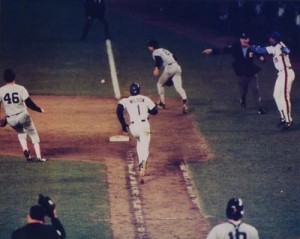

The Mookie Wilson-Bill Buckner connection, Game 6, 1986 World Series, Bottom 10th, Shea Stadium, Queens, NY, October 25, 1986. (http://halloffamememorabilia.net).

The Mookie Wilson-Bill Buckner connection, Game 6, 1986 World Series, Bottom 10th, Shea Stadium, Queens, NY, October 25, 1986. (http://halloffamememorabilia.net).

Sunday, October 26, 1986 was part of a great three days for me, perhaps the three best days during my Boy @ The Window years. My Mets had pulled off a miracle. They survived being within a strike of losing the ’86 World Series because Mookie Wilson put a ball between Boston Red Sox 1st baseman Bill Buckner’s rickety legs the night before. Anita Baker’s “Sweet Love” was #1 or #2 on the R&B charts and was near the top of Billboard’s Top 40 on this day twenty-eight years ago. Within the next thirty-eight hours, my Mets would complete the comeback, and win their second (and last, to this point anyway) World Series after falling behind 3-0 through the first six innings. Meanwhile, my Giants would run through the Deadskins at home in East Rutherford, NJ, as Joe Morris rushed for 185 yards in a 27-21 victory, on their own march to a championship title.

GoGurt, Yoplait's squeeze -in-mouth, portable yogurt, October 26, 2014. (http://freehotsamples.com).

GoGurt, Yoplait’s squeeze -in-mouth, portable yogurt, October 26, 2014. (http://freehotsamples.com).

My coping mechanisms were at their peaks, though, and had nothing else to do but crash down into the Earth. It was also my senior year in high school, a time of too many AP courses, too many college-going pressures, too many haters and doubters among my classmates, and too much of the grinding poverty and chaos that was living at 616. Within two weeks of my Mets, my Giants and Anita Baker’s first big hits, I’d discover my idiot stepfather’s pornography collection, nearly got set up with a prostitute because of my father, and face humiliation at the hands of my AP Physics teacher David Wolf and his boss Estelle Abel for the first time.

It took me almost two years to recover from the happenings of the mid-fall of ’86. In the process, I faced betrayal, ostracism, humiliation, broken-heartedness, and homelessness, but somehow managed to not make every song and every Mets and Giants (and Knicks and Rangers) victory a vicarious signpost for my own life. It helped that I started to think of Pitt — if not Pittsburgh — as my home, with concerns beyond living and dying with my New York teams and with relatively unknown but talented music artists.

Giants' RB Joe Morris running through Deadskins again, RFK Stadium, Washington, DC, December 7, 1986. (http://sikids.com).

Giants’ RB Joe Morris running through Deadskins again, RFK Stadium, Washington, DC, December 7, 1986. (http://sikids.com).

I learned other things along the way, too. That my Mets and Giants weren’t the perfect teams I thought they were. Between the alcohol and drug issues of Darryl Strawberry, Dwight Gooden, Len Dykstra, Lawrence Taylor, Kevin Mitchell, not to mention their and other teammates’ domestic violence issues, it was obvious to me that talent and winning were more important than living by a consistent code. Listening to the new 24/7 sports radio station WFAN when it began its run in the summer of ’87 showed me the hearts and minds of most fans. They obviously weren’t using sports as a coping strategy for dealing with the emotional grind of poverty and threats of abuse and domestic violence at home. Mostly White and male, their constant barrage of vitriol and disparaging racial commentary about my favorite athletes at that time — Mike Tyson in particular — actually made me wary of White sports fans for years afterward.

I also learned that with artists like Anita Baker and Luther was really the last gasp of R&B as I’d known it to be in the US. R&B was already too much like ’80s pop and a bit too mixed up with rock at times, but with Cameo’s “Word Up” and Club Nouveau’s cover of Bill Withers’ “Lean On Me,” R&B was already beginning its merge with hip-hop, and not in a good way, either. Yeah, there were some exceptions, like Levert, or Regina Belle, but the process of R&B devolving into some Yoplait GoGurt version of itself — with Autotunes, bad rap lyrics and worse rhyme spitters, and assembly-line hip-hop beats — had already begun.
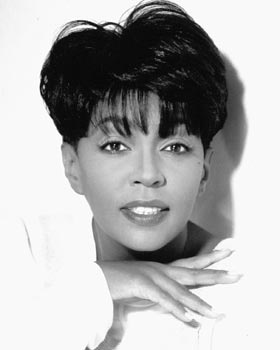
Anita Baker, Rapture phase, circa 1986. (http://projects.latimes.com).

Anita Baker, Rapture phase, circa 1986. (http://projects.latimes.com).

Some of you may say, R&B’s still alive in the US, specifically in our churches, but that’s not true, thanks in large measure to Kirk Franklin. His work in the ’90s made it so that it’s taken longer for jazz to catch on in bands and choirs than rap and hip-hop. No, if you want to find R&B with actual singers these days, try the United Kingdom of Great Britain, try France, try Senegal, try Nigeria. But don’t try the US. Nicki Minaj is no Aretha, no matter how imaginative her videos and her clothes. For that matter, Iggy Azalea’s no Teena Marie, as the former doesn’t understand the difference between cultural appropriation and authenticity. Hip-hop sprang in part from the roots and branches of R&B, but like a parasitic vine, it has cannibalized those roots.

Still, it’s good to remember days like the ones I lived through twenty-eight years ago, with Anita Baker in my ear, my Mets in victory formation, my Giants lined up right beside them. Those days are gone, like the coping strategies I used to get through every one of those days. Not to mention the R&B that was more a part of my life than the hip-hop that my contemporaries were supposedly raised on.

Ass Whuppins and NFL Fanatics

18 Thursday Sep 2014

Posted by decollins1969 in 1, Boy @ The Window, culture, Eclectic, Mount Vernon New York, Politics, Pop Culture, race, Religion, Sports

≈ Leave a comment

Tags

616, 616 East Lincoln Avenue, Adrian Peterson, Anheuser Busch, Arizona Cardinals, Ass-Whuppin', Belts, CBS, Child Abuse, Denial, Deniers, Domestic Violence, ESPN 980, Extension Cords, Hannah Storm, James Brown, Jonathan Dwyer, Maurice Washington, Minnesota Vikings, Racism, Ray Rice, Religion, Roger Goodell, Spanking, Steve Czaban, Switches, Violence, Whiteness


Collage of Houston PD pics of cut/contusion marks on Adrian Peterson's four-year-old son, September 12, 2014. (http://atlantablackstar.com).

Collage of Houston PD pics of cut/contusion marks on Adrian Peterson’s four-year-old son, September 12, 2014. (http://atlantablackstar.com).

I’ve been irritated by what I’ve seen in the media and in social media over the past week. First, the idea that Minnesota Vikings’ running back Adrian Peterson’s alleged crime was the spanking of his four-year-old kid back in May, one that left cuts and contusions all over his body, including the kid’s scrotum. In Peterson’s world, in the world in which I grew up, and in the world of millions of Americans, we didn’t and don’t use the term spanking at all — ass-whuppin’  (or a beating) is what constitutes corporal punishment.

Second has been the response of sports talk radio and many NFL fans — especially including the less enlightened and more entitled of the sports media — to public criticism and how teams have reacted to recent domestic violence and child abuse revelations. Their response to CBS’ Thursday Night Football host James Brown speaking up about men needing to take more responsibility for their actions vis-a-vis domestic violence: “Shut the hell up! You’re ruining my mood for the game! This isn’t the right time or the place to talk about domestic violence, just before my football game!”

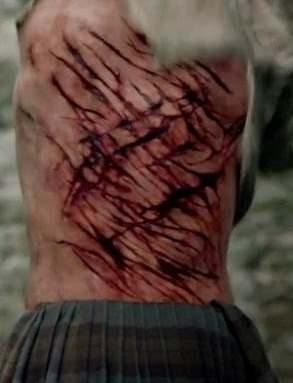
Outlander character Jamie Fraser in midst of second 100-slashes punishment, screenshot (cropped) from S1:Episode 06 "The Garrison Commander," September 13, 2014. (http://plus.google.com).

Outlander character Jamie Fraser in midst of punishment, screenshot (cropped) from S1:Episode 06 “The Garrison Commander,” September 13, 2014. (http://plus.google.com).

Both reflect the insularity of the elitism that is mainstream media and the denier-resentment that is Whiteness in America as reflected in sports and especially football. To call what Peterson did to his son a spanking, well, it defies all logic. It was an ass-whuppin’, plain and simple. Journalists, bloggers and tweeters dedicated many posts and articles over the past six days to the issue of spanking and why so many wee common folk accept spanking as a form of discipline for their children. I have yet to see an article that makes the correct distinction between a spanking — the use of a hand or a light paddle to smack the butt of a child — and an ass-whuppin’.

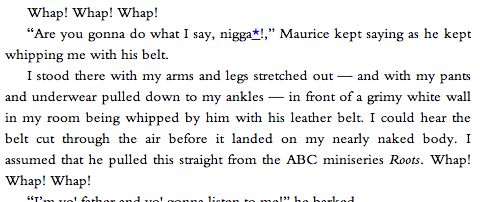
See, between the ages of three and thirteen, my Mom, my father Jimme, and my idiot stepfather Maurice Washington gave me between twenty-five and thirty ass-whuppins, but only two or three spankings. Here’s the last ass-whuppin’ I got from Maurice before he transitioned to upper cuts and kicks to my stomach:

Screen shot 2014-09-18 at 5.48.27 AM

This wasn’t the first time I had to strip down to nothing to have my butt, back and legs beaten to the point of welts and contusions, though this ass-whuppin’ led to my second incident of severe abuse. Over the years, my Mom and my babysitter Ida (she died recently at eighty-six — RIP) had whupped me and my older brother Darren with a switch (though with one far more prepared for beating a child without marking up skin than what Peterson allegedly used). They and Maurice had also used the standard leather belt, an extension cord (the type that you plug into a wall socket), and a shoe (my Mom did that in front of a crowd at a July 4th picnic in ’79).

Over those years, my parents and my somewhat legal guardians slapped me, smacked me, kicked me in the eye, and put me in a head-lock, all before my summer of abuse in ’82. Not once did anyone responsible for disciplining me call it a spanking. Based on my own experience and the experiences of people I’ve met and known over the years, I can pretty much guarantee Peterson didn’t call it a spanking either.

Screen shot 2014-09-18 at 6.07.15 AM

Steve Czaban, host of The Drive, ESPN Radio 980 Washington DC, November 2013. (http://www.theczabe.com/).

Steve Czaban, host of The Drive, ESPN Radio 980 Washington DC, November 2013. (http://www.theczabe.com/).

Then there’s been the NFL’s reaction to the gigantic PR hit it has taken over commissioner Roger Goodell’s handling of the Ray Rice case and the Baltimore Ravens’ subsequent termination of Rice. Not to mention the Vikings’ deactivation-reactivation-deactivation of Peterson, the Carolina Panthers’ deactivation of convicted woman abuser Greg Hardy, and yesterday’s arrest of Arizona Cardinals running back Jonathan Dwyer, whom the Cardinals also deactivated. I’m more than certain that ESPN Radio 980 show host Steve Czaban wasn’t alone when he called these sanctions “overreactions” and lamented the “slippery slope” that the NFL as “moral police” has started to slide down. Czaban represents an ilk of sports show hosts and corresponding listeners and fans who want sports to remain a “diversion” from “real life,” to not have someone’s “politics” like James Brown’s ruin their spectator experience.

To that, I say, good! Men shouldn’t be comfortable living in a bubble in which the athletic “freaks” who entertain them in sports should then be excused when accused of committing crimes. Nor should they be called  “animals” when the law proves that they are guilty of such crimes. White men especially often act as if it’s their world and they have the right to a relaxing day without dealing with issues of racism, misogyny, patriarchy, homophobia and other forms of inequality from which they benefit every day.

To that I say, we need more statements during sports programs from James Brown and Hannah Storm, more advertisers (even ones as hypocritical as Anheuser Busch, as their beers help fuel domestic violence and child abuse) “venting their spleen,” more people taking a stand against people who like their spectator entitlements a bit too much. To those denialists, especially Czaban, I say, kiss my abused Black ass.

Why My Mom Stayed

11 Thursday Sep 2014

Posted by decollins1969 in 1, Boy @ The Window, culture, Eclectic, Hebrew-Israelite, Jimme, Marriage, Mount Vernon New York, My Father, Pop Culture, race, Religion, Youth

≈ Leave a comment

Tags

#WhyIStayed, 616, 616 East Lincoln Avenue, Battered Women's Syndrome, Beverly Gooden, Child Abuse, Domestic Violence, DV, Hypermasculinity, Isshin-ryu Karate, Janay Palmer Rice, Judah ben Israel, Maurice Eugene Washington, Maurice Washington, Misogyny, Ray Rice, Self-Worth, Sexism, Social Media, Twitter


My Mom at 48 years old, Yonkers, NY, December 23, 1995. (Donald Earl Collins).

My Mom at 48 years old, Yonkers, NY, December 23, 1995. (Donald Earl Collins).

I planned to write something about my Mom on her birthday again this October, focusing on her multiple roles as mother, breadwinner, domestic violence victim and evangelical Christian in that post. With the TMZ-released video of Ray Rice and the public response to the NFL’s misogynistic hypocrisy making the issue of domestic violence front and center this week, it makes sense for me to talk about my experience and my observations via my Mom this week as well.

First off, thanks to all the brave women who’ve tweeted, posted on Instagram, Facebook, WordPress and other places their experiences with domestic violence. Thanks especially to Beverly Gooden (@bevtgooden) for creating and using the hashtag #WhyIStayed in response to the barrage of criticism leveled at Janay Palmer Rice for marrying Ray Rice after his brutal act of violence against her. I know domestic violence and child abuse firsthand, as I watched my Mom experience the Isshin-ryu-Karate version of a knockout and concussion on Memorial Day ’82 at the hands of my then stepfather Maurice Washington.

Screen shot 2014-09-11 at 7.54.54 AM

Ivy_Mike_test.ogg.160p

Ivy_Mike_test.ogg.160p

This wasn’t the first time Maurice had hit my Mom, as I’d learn years later, but it was the first time I witnessed it. I’d seen my Mom attacked before, by my own father when I was little. My father was often drunk and equally incompetent during his attacks, so any physical damage that was done was from my Mom beating him up. The psychological and emotional damage, though, flowed right from her first marriage to my father to her second one with Maurice.

For seven years and sixteen days after the day my childhood ended, my Mom and Maurice lived together as husband and wife at 616. I can say with one hundred percent clarity that there wasn’t a day between Memorial Day ’82 and the final fight that led to my late ex-stepfather moving out that I didn’t feel some sort of dread, a cloud of lethargy hanging over my head, even while at college at Pitt. That was partly because I’d made a point of running interference and taking abuse to make up for not calling the police on that day of days.

I didn’t know why my Mom couldn’t find the strength to kick Maurice to the curb, at least not before the middle of ’89. But there was an incident between me and Maurice about a year before he finally moved out, one where what he said afterward gave me additional insight into my Mom’s inaction.

Screen shot 2014-09-11 at 12.52.50 PM

At least, I had to believe that, right? It just seemed we’d been through too much with a man who’d never paid a month’s rent, a phone bill, a Con Ed bill, a cable bill, and only bought Great Northern beans, rice and cabbage for his kids (my younger siblings) on the handful of days he decided to contribute to our malnourished family.

So finally, in the months after he left 616 for good, I asked. My Mom’s first answer was, “He fooled me. He fooled us all!” Her answer was completely unsatisfying, considering that I ran away from home to get away from Maurice when I was nearly nine years old.

The summer of ’89 wouldn’t be the last time I’d ask. Over the years, my Mom has given various explanations. “I thought he was a changed me,” she’d say, referencing their six-month separation in ’80-’81 and Maurice becoming a Hebrew-Israelite and “Judah ben Israel” in the interim. “What good would that done?,” my Mom would ask me in response, implying that she wanted to avoid a physical confrontation.

Really, I spent thirteen years reading in between the lines, asking relatives questions about my Mom, doing research and boning up on domestic violence and child abuse from a social science perspective, all for more substantial answers. Really, my Mom’s domestic violence experience, our fall into welfare poverty, and my child abuse experiences were the first reasons for me wanting to write what would become Boy @ The Window in the first place.

"Divorced at last" layer cake, or "Broken Marriage," March 2014. (http://www.nigeriancurrent.com/).

“Divorced at last” layer cake, or “Broken Marriage,” March 2014. (http://www.nigeriancurrent.com/).

By the time I did the family intervention in January ’02, I knew why. I knew that despite my Mom not remembering much from the beating, knockout and concussion she took in May ’82, she lived in fear. If for no other reason than from seeing the look of hurt on my face whenever the subject of her beating came up. Maybe not a constant, shaking-in-her-shoes fear, but the idea of having to force a six-one and overweight yet powerful man out of 616 probably scared my Mom. But that wasn’t her only fear. As I wrote in Boy @ The Window, “[w]e were already the children of one divorce, and I wasn’t sure if I wanted to see another one so soon.” I’m more than sure that my Mom felt the same way about herself and her relationships with my father Jimme and Maurice as well.

I also know with certainty my Mom would never want me to write about her, especially about her as a victim of domestic violence. But she wasn’t the only one to experience it. I may be able to live my life successfully despite it, but I’ll never be able to un-see what I saw nearly thirty-two and half years ago. It put me on a very long road, one that involved my own conflicting feminism and sexism (though with zero tolerance for violence against women). Or, what I call damsel-in-distress syndrome, where I always want to help, even when that help is unwelcome.

There are millions of reasons why women get married or stay in relationships and marriages, some of them rational, some based in fear, many who stay because abuse does untold damage to self-worth. I may not fully understand what it’s like to be a woman who’s been abused, but I do understand what it’s like to be the son of one. Most of us who don’t know of these horrors need to be quiet, read, and listen more.

Poverty, Violence and PTSD – But What About Racism?

07 Monday Jul 2014

Posted by decollins1969 in 1, Boy @ The Window, culture, Eclectic, High Rise Buildings, Jimme, Marriage, Mount Vernon New York, My Father, Politics, Pop Culture, race, Work, Youth

≈ Leave a comment

Tags

616 East Lincoln Avenue, Chicago, Child Abuse, Community Violence, Culture of Poverty, Culture of Violence, Domestic Violence, Gun Violence, July 4th, July 4th Weekend, Mainstream Media, Mental Health, Mental Illness, Post-Traumatic Stress Disorder, Poverty, PTSD, Public Health, Shooting Deaths, Soft Bigotry, Structural Racism, Uncle Sam


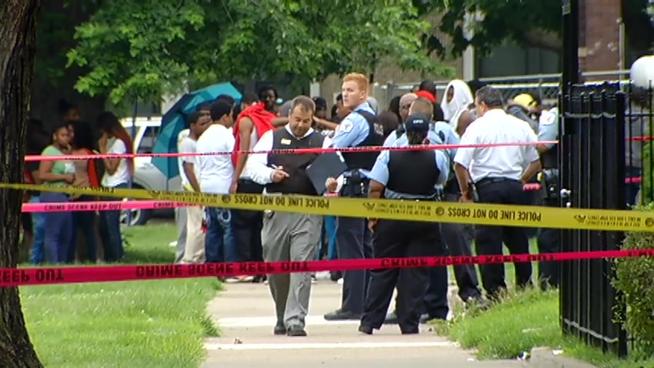
Chicago Police fatally shot a 16-year-old boy in the city’s Gresham neighborhood Saturday night and distraught family members are questioning the incident, July 6, 2014. (http://nbcchicago.com).

Chicago Police fatally shot a 16-year-old boy in the city’s Gresham neighborhood Saturday night and distraught family members are questioning the incident, July 6, 2014. (http://nbcchicago.com).

Over the past two weeks, thanks to Chris Hayes’ reporting on the state of Chicago for MSNBC, not to mention a horrific July 4th weekend, Mayor Rahm Emanuel’s lie of declining violent crime in the metropolis has been thoroughly exposed. In the past eighty-four hours, dozens of shootings in Chicago injured at least sixty people, with between nine and eleven killed. Six of these shootings involved the Chicago PD, as they killed two teenagers over the weekend. But if we leave it to the mainstream media and the moralist Black elite to explain, the Blacks on Chicago’s South Side are just immersed in a “culture of violence.” Black youth simply live careless, nihilistic lives, that “gang, drug, [and] gun violence” is the root of the problem

For those White, bright, and bi-racially White, though, there’s the knee-jerk reaction of media and caring adults that comes with it. For mass shooters apparently with much better aim than folks in Chicago, like Elliot Rodger, Adam Lanza, James Holmes, Wade Michael Page, Eric Harris and Dylan Klebold, mental health and mental illness, along with gun control, is the mainstream media’s topic of the day. Even their explicit racism and misogyny can become the media’s evidence for their mental illness. White and Black moral leaders don’t then speak of cultural deficiencies or of an enjoyment of crime and violence as reasons for their shootings.

It’s terrible that we afford one group of young men every benefit of the doubt because they were/are affluent or White, and the deny humanity of another because they were/are poor and Black or Brown. Yet recent sociological and psychological studies indicate what anyone who has lived in poverty and with violence has at least sensed throughout their lives. That many (if not most) growing up in these conditions experience post-traumatic stress disorder (PTSD), leading to more poverty and violence in adulthood.

I know this better than most. Below is a short sample of the violence I witnessed or experienced from birth through adulthood:

September ’70 – my father, drunk and jealous, attempted to attack my mother with a knife. My Mom with me and my brother Darren in tow, picked up a heavy quartz crystal ashtray and threw it at my father as he charged her in the kitchen. He was apparently struck in the head and knocked unconscious. The ashtray had detached the retina in his left eye, which he never had repaired. Nine years later, my father had to have his left eye removed. I don’t remember this attack or my Mom defending herself — I was all of ten months old. I do remember my father’s eye being removed, and the headache and vertigo he had prior to the surgery in the summer of ’79 The research indicates, though, that there would have been a psychological impact on me and my nearly three-year-old brother nevertheless, and not a good one at that.

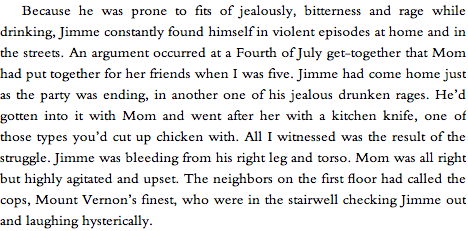
July ’75 –  from Boy @ The Window

Screen shot 2014-07-07 at 1.08.28 PM

December ’76 – when my father stomped in a brand-new glass coffee table and had to go to the hospital with several serious bloody cuts in his legs.

April ’77 – when my Uncle Sam clotheslined my father after his months of psychological and abuse toward my Mom had landed her in Mount Vernon Hospital with kidney problems.

April ’82, May ’82, July-August ’82 – my then stepfather beating me up in a Karate studio in front of a group of men because I refused to call him “Dad,” beating up my Mom for not “lovin’ him,” and beating me up for the first six weeks of my summer between seventh and eighth grade for me defending my Mom.

January ’86 – the last time my stepfather actually laid a fist on me, damaging or chipping three of my front teeth and busting my lip in the process.

June ’89 – the last fight between my Mom and my stepfather, where the same crystal ashtray my Mom used in ’70 easily could’ve fractured her jaw and left cheekbone. Thankfully, my then stepfather had terrible aim.

If it were just a matter of domestic violence and child abuse for me alone, that would be tragic, but not necessarily relevant. The violence of 616 East Lincoln Avenue, sadly, wasn’t contained to A32. Domestic violence was the way of the A-building at 616, starting with our adjacent next-door neighbors. In the two-bedroom department immediately below us, the husband and wife had a violent, alcoholic relationship, so bad that it was a rare weekend in the years between ’77 and ’87 where a plate or wine glass didn’t break or the police weren’t called. Their son once pointed a gun at me on my walk up the front steps of 616 when I was a senior in high school and claimed he’d secretly pointed a gun at me in the past. Muggings and robberies, including the four that I experienced, were as common as the common cold

At the near-door apartment building, 630 East Lincoln, the drug trade had been alive and well years before the arrival of crack cocaine. Fights involving knives and baseball bats were normal, often involved a crowd of kids as spectators. Sometimes these fights would spill onto the front lawn of 616’s A-building, where I could witness it first-hand.

That violence was a frequent companion in my life wasn’t surprising. I never lived anywhere growing up where the majority of the people around me weren’t welfare-poor, working-poor or working-class Blacks, where the heating oil came in time for winter, and where maintaining mental health was a topic of conversation. To act as if employment practices, education policy, public health access, police neglect or brutality or housing policies had nothing to do with the sheer concentration of poverty and violence around me would be at the least naive. Fundamentally, it was the benign neglect in the chain between individual racial assumptions, the soft bigotry of mainstream media, and the hard concrete of structural racism in play.

What was my constant companion growing up in Mount Vernon, New York has remained the story of poverty, race and violence in Chicago’s South Side for a century. Don’t feel sorry, for me or for all of those shot up in Chicago this past July 4th weekend. Do something, say something, or don’t. But feeling sorrow without saying or doing something about shouldn’t be an option.

Fear and (White) Women’s History Month

06 Thursday Mar 2014

Posted by decollins1969 in 1, Boy @ The Window, culture, Eclectic, Politics, Pop Culture, race, Youth

≈ Leave a comment

Tags

Death By A Thousand Cuts, Domestic Violence, Elitism, Fear, Feminism, Microaggressions, Misogyny, Racism, Sexual Harassment, Stereotypes, Threats, Violence, Whiteness, Women's History Month


The Scream (1893) by Edvard Munch, The National Gallery, Oslo, Norway, November 27, 2013. (The Herald via Wikipedia). In public domain (US).

The Scream (1893) by Edvard Munch, The National Gallery, Oslo, Norway, November 27, 2013. (The Herald via Wikipedia). In public domain (US).

I often find it ironic that Women’s History Month follows immediately after Black History Month. In this sequence, both are racialized, as the former tends to represent White women, while the latter represents all Blacks regardless of gender, sexual orientation, or country of origin. Meaning that women of color often have to fight to be recognized during Women’s History Month, that poor women often go unrecognized in both Black and Women’s History months, and that other nuances of demographics and history aren’t thought of at all.

Such is the case with issues of -isms within feminism and Women’s History Month. Particularly when combined with the actualization of fear. In the cases of domestic violence, rape, assault, kidnapping, harassment and other threats against women, it’s certainly understandable that the fear of such things (and the breaking down those threats and fears in dialogue) are a big part of feminism and Women’s History Month more specifically. But when combined with certain -isms — especially racism and elitism — these issues become more about profiling stereotypical threats rather than dealing with real threats against women, especially (but not exclusively) for White women.

Compact Glock 19 in 9x19mm Parabellum, November 4, 2007. (Vladimir Dudak via Wikipedia). Released to public domain via CC 3.0 & GNU.

Compact Glock 19 in 9x19mm Parabellum, November 4, 2007. (Vladimir Dudak via Wikipedia). Released to public domain via CC 3.0 & GNU.

It’s something I experience every day. A White woman crossing the street as I approach, on my way home, to my car, to run an errand, or to pick up my son from school. A woman — White or Black — gasping audibly at the sight of me in an elevator, some even not getting on board, as if I had a ski mask over my face and a Glock in my right hand. White female co-workers who, upon seeing me outside the office, would put on a blank face and walk by me while I’m holding open a door, too scared to even say “Hello,” much less a “Thank you.”

It’s the nearly daily reminder that where feminism and Whiteness intertwine, I represent the Black male misogynist. I am dangerous, the guy whom White women and middle class women of color imbue anti-feminist threats and violence. Even when standing still on an elevator, deep in my own thoughts about work, teaching, family and writing.

Martyrdom of Joseph Marchand (1860) by unknown, September 27, 2008. (World Imaging via Wikipedia). Released to public domain via CC 3.0 and GNU.

Martyrdom of Joseph Marchand (1860) by unknown (or death by 1,000 cuts), September 27, 2008. (World Imaging via Wikipedia). Released to public domain via CC 3.0 and GNU.

I get it. White women often have to expend micro-energies on microaggressions from men — including Black men — in order to get through the day. For some, it’s probably an exhausting part of their existence. Likely so much so that they forget to turn off their shields even when bumping into a male co-worker or friend.

From my perspective, though, it’s not that simple. It’s not like I look at every White male and female and see another willfully ignorant and entitled racist ready to accuse me of ruining the country or threaten me with bodily harm. I think that in some feminist circles, racial and classist profiling goes on even more so than with most police officers. Fear is an important part of our existence, but it shouldn’t be the centerpiece of how anyone lives their lives, even when it’s justifiable.

In thinking about feminism, Whiteness and Women’s History Month, my two little cents’ worth of thoughts come down to this. I’m tired of being a victim of your fears, which when multiplied over the past 150 years, have often led to misunderstandings, false accusations, arrests, convictions, beatings and deaths. I’m tired of abstract discussions of microaggressions, threats and violence against mostly White women that don’t include the perspectives of women of color. And I’m tired of feminists who refuse to evaluate their own elitism and Whiteness in how they go about their everyday lives.

On Regrets and Forgiveness

22 Tuesday Oct 2013

Posted by decollins1969 in 1, Boy @ The Window, Christianity, culture, Eclectic, Hebrew-Israelite, Jimme, Mount Vernon High School, Mount Vernon New York, New York City, Pop Culture, race, Religion, Youth

≈ Leave a comment

Tags

Child Abuse, Domestic Violence, Forgiveness, Indecision, Love, Maurice Eugene Washington, Maurice Washington, Mother-Son Relationship, Regret, Regrets, Second-Guessing, Self-Reflection, Unforgiveness


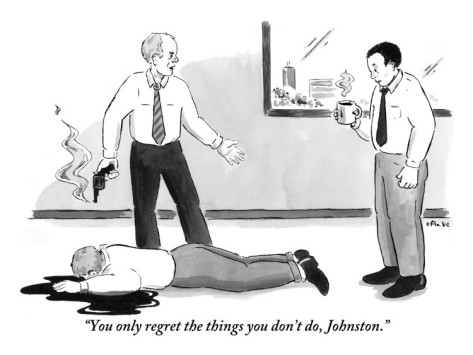
Emily Flake's "You only regret the things you don't do, Johnston," February 28, 2011. (http://newyorker.com)

Emily Flake’s “You only regret the things you don’t do, Johnston,” February 28, 2011. (http://newyorker.com)

One of the things I’ve read and heard from others so far about Boy @ The Window since April has been about catharsis. As in, “this book must’ve been cathartic for you.” I’ve said in response, “Yeah, it sure has.” But that’s not been the whole truth. In more than a few respects, Boy @ The Window has opened up a Pandora’s box of wounds I’d kept locked for years and years.

This might surprise some folks, especially the ones who attended Mount Vernon public schools, Humanities and specifically Mount Vernon High School with me. But there is a dark side to being me. Beneath my well wishes, good graces and generic smile has also been a person with deep regret, repressed anger, smoldering rage over what by far were the worst years of my life. All of which has translated into a person whose worst days since are days of blame — almost always of and for myself. I can forgive almost anyone or anything — my late idiot ex-stepfather, my father Jimme and his years of alcoholism, friends or superiors who’ve attempted to take advantage of me.

The Physics of a Bottomless Pit, February 27, 2013. (MatsuKami of deviantART via http://www.scienceblogs.com).

The Physics of a Bottomless Pit, February 27, 2013. (MatsuKami of deviantART via http://www.scienceblogs.com).

Yet there’s one person I’ve found very hard to forgive — myself. I hold myself to such high standards that it would be impossible for anyone other than Jesus to meet. And God knows I’m not perfect. But in looking at my past, my growing up years in Boy @ The Window, I’ve found that so much of my life’s force and energy has gone into redeeming myself for having to live through those terrible, terrible years. Even though I’ve been at a place in my life in which I’ve pretty much known myself, my passions, my calling, my abilities and limitations, for the better part of twenty years. Until recently, though, I hadn’t given myself any breaks from my past. Putting it under lock and key obviously didn’t work, and airing it for the world to read — while beneficial — had brought with it a truck-load of emotions that I had yet to work through.

As I wrote at the end of Boy @ The Window:

I can say without a doubt that Humanities did make a difference in my life. I wouldn’t be the person I am today without those six bittersweet and indifferent years. It makes any setback I might suffer today seem small and laughable by comparison. There are things I wish would’ve happened, things that would’ve made it easier to enjoy life and savor glorious moments even now. I wish Humanities had been as serious about developing me as a writer as it was about accelerated math and science classes. I regret not asking Phyllis out for a date. I lament not revealing more about the tragedies of my family life or my keen sense of humor to the few classmates and teachers I had some bond with, however weak. I wish I had trusted my instincts and never worn that kufi to Holmes or Davis. I know I should’ve stayed with football or tried out for basketball. And I wish I had the opportunity as a twelve-year-old to kiss Wendy one time. Admittedly, there’s a part of me that wishes I could kiss her now.

I imagine that if I had done all of these things, I would’ve been even more bruised up (especially in the case of Wendy), but at least I could’ve said I tried. Instead of looking back at my past and picking it apart like a forensic vulture.

But my deepest regret, and one that I hadn’t forgiven myself for, at least until recently, was for not calling the cops on my then stepfather after he beat up Mom on Memorial Day, Monday, May 31, ’82. Between my near-photographic memory and my training as an academic historian, it’s been hard to look at my past without reliving it.

How do you mend a broken heart?, 2005, October 22, 2013. (digitalman via deviantART at http://deviantart.net).

How do you mend a broken heart?, 2005, October 22, 2013. (digitalman via deviantART at http://deviantart.net).

I hadn’t figured out that I hadn’t forgiven myself until a few weeks ago. I realized that I hadn’t let go of the worst of my past. Now, letting go doesn’t mean that you forget your past, bury it or repress it emotionally. For me, it simply means not reliving the moment as if it happened last week instead of thirty-one years ago. To treat the moment as a memory, an important reminder that I am not Superman, that I couldn’t have saved my Mom from domestic violence anymore than I could’ve saved myself from poverty as a twelve-year-old.

You know, when I was younger, I thought that I didn’t have any regrets, any resentment or any dark side from growing up the way I did. We all tend to believe that pushing forward to a brighter future will take care of our past. That’s simply not true. We need to live in the present in order to achieve that brighter future. That means working through our pasts, and then letting it go. I should know.

My First Walk (and Making Plans)

15 Thursday Aug 2013

Posted by decollins1969 in 1, Academia, Boy @ The Window, culture, Eclectic, Hebrew-Israelite, Mount Vernon New York, race, Religion, Youth

≈ Leave a comment

Tags

Affluence, Bronxville, Child Abuse, College, Coping Strategies, Domestic Violence, Eastchester, Economic Inequality, Making Plans, New Rochelle, Pelham, Phyllis, Poverty, Racism, Tuckahoe, Walking


Thirty-one years ago this week was the beginning of an inadvertent coping strategy that would lead me away from 616, out of Mount Vernon, New York, into Pittsburgh, and college, and grad school. (And eventually, to a worn-out right knee, leg exercises and a running regiment that I’ve adhered to for nearly a decade.) It was a walk that was literally my only time away from home and my summer of abuse at the hands of my late idiot ex-stepfather Maurice Washington (or Judah ben Israel). It was a walk in which I began to plan my escape from the madness.

From Boy @ The Window:

“It was August ’82, and I didn’t know if I’d make it to the end of the year.

“If masturbation were the only thing that I discovered that month, I might’ve begun aspiring for some other kind of life. Instead, I decided on another boring August day to do something else novel. I didn’t want to go to Wilson Woods again. We didn’t have any money anyway. I decided to take my siblings on a walk on the wild side, to walk outside our immediate neighborhood. First Darren and I took baby Maurice and Yiscoc in his new stroller out of 616 and walked to Pelham…The four of us walked and strollered down East Lincoln Avenue, across the stone bridge over the Hutchinson River Parkway into Pelham, and turned left on Fifth Avenue to go north. This was uncharted territory for all of us, especially me. I hadn’t been down in the city all year, and my life for most of the summer was spent between Wilson Woods, Pearsall Drive, and 616. North Pelham might as well have been Helena, Montana to me.

‘We don’t know where we’re going,’ Darren said.

‘Yeah, and?,’ I said in response.

‘Okay, but it’s your fault if we get lost, Donald,’ Darren said.

“We didn’t get lost. We walked until we hit Chester Heights, the beginning of the village of Eastchester. It was amazing in that it was much more suburban than Mount Vernon or the part of Pelham that I’d known up until that moment. The homes were luxurious by my standards. Everyone seemed to own a BMW, Volvo, Mercedes-Benz, or Peugeot. There weren’t many sidewalks around, only well-manicured lawns. We had walked into a ritzy community without any warning. But instead of becoming depressed or angry, it made me introspective. ‘Look at these houses!,’ I said to Darren as we walked by one Tudor-style home after another three-story mansion, broken up only by a few cul-de-sacs.

We walked across another bridge, this one with an overhanging meshed metal fence, across the Cross-County Parkway, and ended up in Mount Vernon for a brief moment. We veered right as we walked up a hill and out of Mount Vernon again. After walking through what appeared to be an enchanted forest, we discovered we were in Bronxville. Even at twelve, I knew that Bronxville was just about the richest community in America. And it looked like it, too. I began to think that the world was a cruel place, having rich Whites living so close to us yet their lives were so far apart from ours. Darren, having been around rich Whites through Clear View for nearly eight years, didn’t think too much of it.

“That’s when it hit me. If I wanted to live a better life, to have a nice house and a car and a family, it seemed to me that I needed an education, a college education. I wasn’t going to get there just graduating from high school, especially in Humanities, where the expectations for college were so high that some kids already knew that they were going to law school. I just knew that I couldn’t go through another summer of abuse. So I said to myself, ‘I’ve got to get through the next five years. I’ve got to go to college.’ I knew almost intuitively that my choices were to continue to experience abuse without reaching for something that I thought I could do based on my smarts. Yet it seemed like an impossible task.

“So as we walked through the villages of Bronxville and Tuckahoe, ending up on North Columbus Avenue/Route 22, I began to think about what I wanted to get out of eighth grade. It seemed to me that the most important class for my future was Algebra, since that led to higher forms of math. I knew English and Social Studies would be really easy, but with success in Algebra, I could go into high school with a little more confidence.

First Walk

First Walk

“That’s when we passed by a ranch-style home with a stone facade. I looked and saw someone out in front I hadn’t seen since the end of the school year. It was Phyllis, outside in the front yard with her sister, apparently back from bike riding. She called us over, and the four of us talked. Phyllis asked what we’d been up to over the summer. This was the first Black family I’d seen during our two-hour walk.

“Of course I didn’t go into any detail about what we’d been up to. After all, the one thing that the past year had taught me was not to open up my mouth and say everything that was on my mind! So I let her and her older sister Claudia do most of the talking. They’d gone somewhere, somewhere down South to visit family. It looked like they were having a good time, the time of their lives compared to us.

‘Do you live around here?,’ Phyllis asked.

‘Oh, we’re on a long walk and just happened to be in the neighborhood,’ I said.

‘Okay,’ she said in response.

“In the neighborhood. Sure, if Bronxville, Eastchester, Pelham and 616, all part of our eight-mile trek, was all part of one gigantic neighborhood. After about ten minutes, we continued home. Darren was more excited about seeing Phyllis and her sister than I was.

“Yet it wasn’t that I was unexcited… I finally had a plan, a long-term plan, for dealing with the situation at 616. I knew that there would be a lot of smaller steps that I’d have to take before even getting to college, much less getting a degree…Otherwise I really didn’t have anything else to look forward to, except what I thought would be a very painful life and an extremely early death.”

That walk — and the hundreds of walks (and runs) I went on all through eighth grade and high school –was the difference between becoming a professor and a writer and having died well before the turn of this century. If not literally, then certainly psychologically.

← Older posts
Newer posts →

Boy @ The Window: A Memoir

Boy @ The Window: A Memoir

Places to Buy/Download Boy @ The Window

There's a few ways in which you can read excerpts of, borrow and/or purchase and download Boy @ The Window. There's the trade paperback edition of Boy @ The Window, available for purchase via Amazon.com at http://www.amazon.com/Boy-Window-Donald-Earl-Collins/dp/0989256138/

There's also a Kindle edition on Amazon.com. The enhanced edition can be read only with Kindle Fire, an iPad or a full-color tablet. The links to the enhanced edition through Apple's iBookstore and the Barnes & Noble NOOK edition are below. The link to the Amazon Kindle version is also immediately below:

scr2555-proj697-a-kindle-logo-rgb-lg

Boy @ The Window on Amazon.com: http://www.amazon.com/Boy-The-Window-Memoir-ebook/dp/B00CD95FBU/

iBookstore-logo-300x100

Boy @ The Window on Apple's iBookstore: https://itunes.apple.com/us/book/boy-the-window/id643768275?ls=1

Barnes & Noble (bn.com) logo, June 26, 2013. (http://www.logotypes101.com).

Boy @ The Window on Barnes & Noble: http://www.barnesandnoble.com/w/boy-the-window-donald-earl-collins/1115182183?ean=2940016741567

You can also add, read and review Boy @ The Window on Goodreads.com. Just click on the button below:

Boy @ The Window

Twitter Updates

Tweets by decollins1969
  • RSS - Posts
  • RSS - Comments

Archives

  • June 2025
  • April 2023
  • September 2022
  • August 2022
  • July 2022
  • June 2022
  • May 2022
  • April 2022
  • March 2022
  • January 2022
  • December 2021
  • November 2021
  • October 2021
  • September 2021
  • August 2021
  • July 2021
  • June 2021
  • April 2021
  • March 2021
  • February 2021
  • January 2021
  • December 2020
  • November 2020
  • October 2020
  • September 2020
  • August 2020
  • July 2020
  • May 2020
  • April 2020
  • March 2020
  • January 2020
  • December 2019
  • November 2019
  • August 2019
  • July 2019
  • June 2019
  • May 2019
  • April 2019
  • March 2019
  • February 2019
  • January 2019
  • December 2018
  • November 2018
  • October 2018
  • September 2018
  • August 2018
  • July 2018
  • June 2018
  • May 2018
  • March 2018
  • February 2018
  • January 2018
  • December 2017
  • November 2017
  • October 2017
  • September 2017
  • August 2017
  • July 2017
  • June 2017
  • May 2017
  • April 2017
  • March 2017
  • February 2017
  • January 2017
  • December 2016
  • November 2016
  • October 2016
  • September 2016
  • August 2016
  • July 2016
  • June 2016
  • May 2016
  • April 2016
  • March 2016
  • February 2016
  • January 2016
  • December 2015
  • November 2015
  • October 2015
  • September 2015
  • August 2015
  • July 2015
  • June 2015
  • May 2015
  • April 2015
  • March 2015
  • February 2015
  • January 2015
  • December 2014
  • November 2014
  • October 2014
  • September 2014
  • August 2014
  • July 2014
  • June 2014
  • May 2014
  • April 2014
  • March 2014
  • February 2014
  • January 2014
  • December 2013
  • November 2013
  • October 2013
  • September 2013
  • August 2013
  • July 2013
  • June 2013
  • May 2013
  • April 2013
  • March 2013
  • February 2013
  • January 2013
  • December 2012
  • November 2012
  • October 2012
  • September 2012
  • August 2012
  • July 2012
  • June 2012
  • May 2012
  • April 2012
  • March 2012
  • February 2012
  • January 2012
  • December 2011
  • November 2011
  • October 2011
  • September 2011
  • August 2011
  • July 2011
  • June 2011
  • May 2011
  • April 2011
  • March 2011
  • February 2011
  • January 2011
  • December 2010
  • November 2010
  • October 2010
  • September 2010
  • August 2010
  • July 2010
  • June 2010
  • May 2010
  • April 2010
  • March 2010
  • February 2010
  • January 2010
  • December 2009
  • November 2009
  • October 2009
  • September 2009
  • August 2009
  • July 2009
  • June 2009
  • May 2009
  • April 2009
  • March 2009
  • February 2009
  • January 2009
  • December 2008
  • November 2008
  • October 2008
  • September 2008
  • August 2008
  • July 2008
  • June 2008
  • May 2008
  • April 2008
  • March 2008
  • February 2008
  • January 2008
  • December 2007
  • November 2007
  • October 2007
  • September 2007
  • August 2007
  • July 2007
  • June 2007

Recent Comments

decollins1969's avatardecollins1969 on No Good Teaching Deed Goes…
Mary Rose O’Connell's avatarMary Rose O’Connell on No Good Teaching Deed Goes…
Lyndah McCaskill's avatarLyndah McCaskill on The Raunchiest of Them Al…

NetworkedBlogs on Facebook

NetworkedBlogs
Blog:
Notes From a Boy @ The Window
Topics:
My Life, Culture & Education, Politics & Goofyness
 
Follow my blog

616 616 East Lincoln Avenue A.B. Davis Middle School Abuse Academia Academy for Educational Development AED Afrocentricity American Narcissism Authenticity Bigotry Blackness Boy @ The Window Carnegie Mellon University Child Abuse Class of 1987 CMU Coping Strategies Crush #1 Crush #2 Death Disillusionment Diversity Domestic Violence Economic Inequality Education Family Friendship Friendships Graduate School Hebrew-Israelites High-Stakes Testing Higher Education History Homelessness Humanities Humanities Program Hypocrisy Internalized Racism Jealousy Joe Trotter Joe William Trotter Jr. K-12 Education Love Manhood Maurice Eugene Washington Maurice Washington Misogyny Mother-Son Relationship Mount Vernon High School Mount Vernon New York Mount Vernon public schools Multiculturalism MVHS Narcissism NFL Pitt Pittsburgh Politics of Education Poverty President Barack Obama Race Racial Stereotypes Racism Relationships Self-Awareness Self-Discovery Self-Reflection Sexism Social Justice Teaching and Learning University of Pittsburgh Violence Whiteness Writing

Top Rated

Blog at WordPress.com.

  • Subscribe Subscribed
    • Notes from a Boy @ The Window
    • Join 103 other subscribers
    • Already have a WordPress.com account? Log in now.
    • Notes from a Boy @ The Window
    • Subscribe Subscribed
    • Sign up
    • Log in
    • Report this content
    • View site in Reader
    • Manage subscriptions
    • Collapse this bar
 

Loading Comments...