The Arrogance of Youth, Grad School Style

Tags

, , , , , , , , , , , , , , , , , ,


Me taking the most thuggishly-goofy-arrogant picture I could, June 5, 2012. (Donald Earl Collins).

I’m sure that there are plenty of folks I’ve met and known over the past three decades who think that they could sum me up in one word – arrogant. I know beyond a doubt that’s what Crush #1 thought of me back in ’82. I know that some my grad school classmates and friends varied between seeing me as “aloof,” “arrogant,” “cocky,” and “focused” in my five and a half years of master’s and doctoral work. And I know that one person I worked with in the past fifteen years thought of me as arrogant, even though I doubt that he would know what arrogance looked like if he saw it in the mirror every day, which he did (see my post “The Messiah Complex At Work, Part 1” from November ’11).

Former Sen. John Edwards [and new symbol of arrogance], after acquittal/mistrial, Greensboro, NC, May 31, 2012. (AP/Chuck Burton via Salon.com).

But arrogance isn’t simply cockiness run amok, or people bragging about what they intend to do without doing it, or doing it and then showing off with a Tiger Woods’ fist pump or my occasional cross-kick. It’s making assumptions about the things of life as if the march to success is a given, as if victory is guaranteed, like taking the next breath or being able to stand upright.

I did that in the spring and summer of ’93, in the transition between my grad school days at the University of Pittsburgh and my more successful yet gloomy times at Carnegie Mellon. I was a year removed from my great first year of master’s work (see my post “The 4.0 Of It All” from December ’11), and a summer removed from working for Westchester Country Department of Community Mental Health in Mount Vernon for the last time (which I will discuss later this summer). The way I saw things, I knew that God was on my side, that my hard work would pay off, that everything I did led to more success, or more money in my pocket.

I acted on those beliefs that March, April and May. I wanted to move out of my crappy studio and drug-infested apartment building on Penn Circle South in East Liberty, to what I called grad student’s row — Stratford Avenue — off North Negley and Penn Avenue between East Liberty and Friendship. I even put a deposit down on a one-bedroom apartment at the beginning of March, anticipating that I’d find something work-wise for the summer. “Something would come up,” I often thought and said. So typically American of me!

Terrell Owens, somewhere between arrogant and suicidal, 2012. (http://queensofkings.com).

I had applied for three fellowships that year, including a summer fellowship through Pitt and the Ford Foundation’s Predoctoral Fellowship Program (via the National Academies). I just knew that I’d get at least one. But the least laid plans of the arrogant often lead to the land of losses. Throughout April and May, I received rejections for all of my well-received, coming-in-second or “Honorable Mention” applications. Not to mention that my soon-to-be former grad program wouldn’t allow me to teach a US history course, though they didn’t have anyone else to teach it other than me at the time.

I realized after my mid-May root canal (see my “Facing The Tooth” post from May ’12) that I was about to enter a tough summer financially. I managed to get back my deposit for my dream apartment two weeks before I was due to move in, paying my Penn Circle South studio rent in the process. Then, with $350 to work with until further notice, I waited.

It wasn’t until the end of the first week in June that, after some qualms about my over-qualifications, Randy Brockington and the Allegheny County Department of Federal Programs hired me to work on a report. They wanted me to assess the work of their staff on the Job Training Partnership Act portion of their department. And all to the tune of $6 an hour. My mother spent the next four years teasing me about it. As if I had another option, as if coming back to 616 for the summer would be less torturous than falling six weeks behind on my rent and receiving an eviction notice.

I made one minor adjustment in my halcyon days of grad school that in-between summer of ’93. To simply not assume anything to be a sure thing, even when it was, to make Richard Marx’s “Don’t Mean Nothing” my mantra when it came to anything around money. Who knew that a little more than two months later, me and my friend Marc would have a controversial article in Black Issues in Higher Education? Who knew that less than two years later, I’d have a Spencer Foundation Dissertation Fellowship, this despite my advisor? Life is a funny, ironic walk.
Battlescar Galactica

Tags

, , , , , , , , , , , , , , , , , , , ,


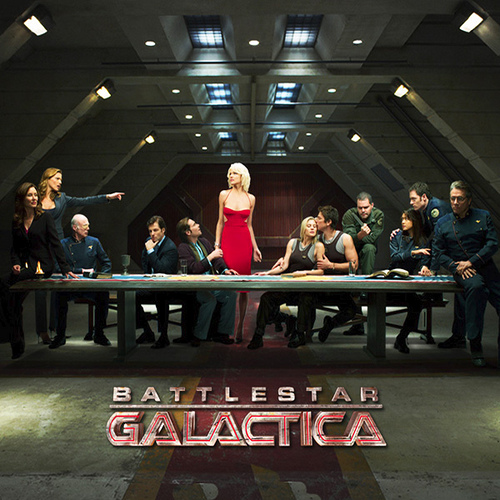
Battlestar Galactica artwork, Season 4, October 12, 2008. (Halil Gökdal via Flickr.com/iTunes TV). Battlestar Galactica Prologue (2003)

I’m a sucker for an epic story in any form. A book, a movie, a TV series, even the occasional epic poem. It really doesn’t matter. I’m also a late bloomer, one who discovers the stuff of life late, but probably enjoys the stuff I discover more because it’s on my own time, without necessarily being part of a crowd or trend.

That convergence has hit me once again, at the ripe old age of forty-two, in the form of the revisioned series Battlestar Galactica (2003, 2004-09). I had planned to watch the original miniseries for this drama when it came out in December ’03, but with so many things outside the realm of then newborn baby Noah, writing and work that year, my watching Battlestar Galactica fell to the side.

I already had a lineup of shows to watch — Six Feet Under, Queer As Folk, Law & Order, CSI. I didn’t need a new thing on my screen, especially something that was based on such an old and goofy series from the ’70s with Lorne Greene, Dirk Benedict and Richard Hatch. “What are they gonna do next, redo BJ & The Bear?,” I said to my wife when I first heard about the Battlestar Galactica miniseries in September ’03.

But as with so many events in my life, I stumbled on the miniseries, thanks in no small part to my wife. It was one late Friday night this past Easter weekend. I woke up about a quarter after three, having only been

Cylon Raider Scar screen shot, September 16, 2009. (Skier Dude via Wikipedia). Qualifies as fair use under US Copyright laws due to image’s poor resolution.

asleep about three hours, to my wife dosing off to the TV in our bedroom. I woke up to the sight of Cylon Raiders in flight, to a strange scientist seeing visions of either a skinny angel or his dead Cylon girlfriend, and Edward James Olmos playing the mercurial Commander Adama. I could tell in ten minutes that this series was way different from the Battlestar Galactica series of my ’70s youth.

The miniseries was on BBC America, so I watched it until 5 am, and then discovered that they had skipped two full seasons ahead to a random Battlestar Galactica episode. I was fully awake by then, so I went on Netflix to find the entire Battlestar Galactica series available on streaming video. I watched season one that day, and season two Easter Sunday and that Monday.

In fact, I watched all four seasons of Battlestar Galactica in six days. I found the story engrossing, the acting intense, and the series an in-depth exploration of the worst features of the human condition under the most difficult of stresses and circumstances. It was so unlike the original series that after a few episodes, I didn’t even think about the differences anymore. The story of a flawed, destructive race of humans fighting each other while fighting for their survival against their more destructive yet more rational creations. I couldn’t help but fall in love with the series.

After that week, I finally read and watched the reviews and the comments about the series. They fell into two categories. There were plenty of folks who refused to watch the new Battlestar Galactica on principle. They saw the recasting of Starbuck as a woman an insult, the ability to make Cylons as human-esque machines blasphemy, and the revisioning of these humans as ones with many of our worst features multipled by a factor of ancient Greece, Rome and Persia an abomination. Oh well! I never liked the original series, with its idealized version of humanity, with its archetype good and evil characters, and with its goofy atmosphere in the midst of potential extinction, the ultimate epic crisis (“All Along The Watchtower” notwithstanding).

The other group was just like me. Fascinated by the lengths to which the producers and writers for the show went to present humanity at its most monstrous, between violence, selfishness, lust, greed, avarice and strive. Mesmerized by the cast’s ability to explore our worst and deepest fears, to hold out hope against hope, to take us into the depths of despair again and again.

The battle-scarred Battlestar Galactica finally reaches Earth (orbiting over the horn of Africa, March 21, 2009. (http://graphic-engine.swarthmore.edu).

I had to watch Battlestar Galactica a second time, this time more slowly and deliberately. So, through the second half of April and first half of May, I watched again, to find something remarkable. Despite their deep flaws, many scars and scabs, and twisted minds, there was something noble and redeemable about these humans, about the Cylons. Even the fact that the Cylons were a human creation didn’t matter. And to top that all off with a divine hand, a guiding force as the prime mover for the 50,000 humans that survived the nuclear annihilation of their twelve planets by the Cylons.

That really is an epic journey. One that heals as much as it scars. The story of my life the past thirty years, not to mention a reference in three of my posts over the past month. A commentary on the state of humanity in the early twenty-first century. What more can a late-bloomer ask for?

Before The Fall

Tags

, , , , , , , , , , , , , , , , , , ,


Cylon Raiders, Battlestar Galactica miniseries (2003), May 28, 2012. (http://tombsofkobol.com). BSG Theme Music (2003) [UK Version]

It’s Memorial Day ’12. It’s been thirty years since that fateful Memorial Day ’82. A part of me, the child that I was, still remains in that day, in the weeks and months before that day.

Little in my life in the previous three years bore a real resemblance to a carefree childhood. But I somehow managed to pretend my way through the three-year-period that included the birth of my younger brothers Maurice and Yiscoc, my idiot stepfather walking out with our food in October ’80, and the first year of the Hebrew-Israelite experiment (see my “Peanuts Land” post from last month).

The speed-of-light shockwave that was my love for Crush #1, and the interrelated turnaround of my grades

Solar flare, aka Coronal Mass Ejection, c. 2010, May 28, 2012. (NASA/GSFC/Solar Dynamics Observatory’s AIA Instrument). In public domain.

in the previous three months gave me a tenuous lifeline to what remained of my childhood self. Making it rain A’s in March, April and May that year reaffirmed the person I thought I was in sixth grade, despite the “Captain Zimbabwe” taunts that began from A and the Italian Club as we approached Memorial Day Weekend (see my post “The Legend of ‘Captain Zimbabwe’” from May ’09).

But the teetering and temporary bliss of grades and the crush on Crush #1 could only distract. They couldn’t delay, even as much as they helped me deny. They could in no way prepare me for the blinding light, the initial shockwave and heat, the full blast effect of what was coming.

It was 5 pm that Memorial Day Monday when it began.

“I’m sick and tired of you treating me this way. I’m sick of you not lovin’ me!,” my stepfather yelled.

“What do you mean ‘love you’?,” Mom said. “Most women wouldn’t even put up with your stinkin’ ass. And now you want more money for a business that I’m not even a part of? You must be kiddin’!”

Mom was on the phone in the master bedroom, while my stepfather yelled into the phone in the kitchen, back in the days when land-lines ruled the world. She picked up the bedroom phone because my stepfather had made a long-distance call to his wayward mother in California, at a time when we were seriously behind on paying the bill. I didn’t understand why he’d want to continue to talk to a woman who abandoned him as a baby to his relatives in Richmond, Virginia and Trenton, New Jersey in ’50. It seemed to me that Maurice was wasting time and money on a woman who cared for him as little as he cared for us.

I was lying down on my bed across the hall from the master bedroom, trying my hardest not to pay any attention to the unfolding drama. With both of them yelling over the phone, though, I couldn’t block their argument out any longer. So I sat up in my bed — giving me a view from our room across the hall into Mom’s bedroom — and continued to listen.

This was one of many arguments over bills and my stepfather’s wack attempts to start a telecommunications business. He had used $2,500 of Mom’s precious money to get a New York State business license for “Sun-Lion Communications” (see my post “Dumb Ass Communications, Inc.” from March ’11 for more). Somehow, Mom’s $15,000-a-year income was supposed to be enough to feed six people and get a business off the ground floor? “Their arguments are insane,” I thought.

I usually could tune them out. But not this time, and not anytime since.

“Who you talkin’ to, bitch!,” Maurice yelped as he punched Mom in the jaw. He followed up with a kick to her stomach and a forearm that knocked her into the queen-sized bed. With each hit he shouted “Are you gonna gimme some respect, bitch!” A moment later, Maurice poured an industrial-sized bucket of water on Mom to wake her up, but that didn’t completely work.

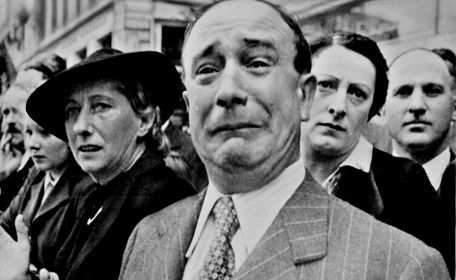
Parisians in shock, tears as German soldiers march into Paris, June 14, 1940. (National Archives). In public domain.

For a full two-minutes, I just stood there. I was in shock, scared for Mom, scared for all of us. Somewhere in that time, my stupid stepfather had escaped the apartment, not to come back for two days, while my mother lay there, nearly lifeless.

I snapped out of it, determined to wake my Mom up. She was groggy, concussed from the battering she took. I sat her up, talked to her, and eventually helped her out of her waterlogged bed down the hallway to the living room, where she lay on the couch for the next day or so.

I should’ve called the cops. As much as I’d been taught not to trust them, I just should’ve dialed 911 and done the deed. What a coward I was! I should’ve done what Jennifer Lopez’s character did in Angel Eyes (2001). It certainly would’ve been easier. In that one decision, I could’ve reported Maurice’s heinous crime, gotten him arrested and jailed, and ended this sham of a marriage and family. Assuming, of course, that my Mom would’ve pressed charges.

Instead, I settled for a psychological and literal guerilla war which left me battered myself by summer’s end and willing to commit suicide within nineteen months. Most of all, I was stuck in that moment (Stuck In A Moment You Can’t Get Out Of), in the weeks and months before that moment, for nearly seven years.

Pre-Prom Paradoxes

Tags

, , , , , , , , , , , , , , ,


“Stop Defacing Signs,” a stop sign ironically defaced, June 24, 2011. (Scheinwerfermann via Wikipedia). Released to public domain via cc-Attribution-Share Alike 3.0 license.

This week a quarter-century ago was my Class of ’87 senior prom. Though I may tell some of the more boring and significant stories from this prom one year, this won’t be the case this year. Especially since the days before presented themselves with a theme that has remained a constant in my life for more than three decades — irony. If irony were a food, I could feed all of the Global South with it, and still have enough left to keep me in protein and P90X recovery drinks until I turn seventy.

And irony was a full-blown buffet the week before the prom. What told me that maybe my prom date “J” wanted more out of this arrangement than I did was an incident at our Humanities Program honors convocation that Tuesday evening (see my post “Prom-Ethos” from earlier this month). Mrs. Flanagan (then the Humanities Program coordinator for Mount Vernon High School) and the Mount Vernon Board of Education wanted to honor us collectively for making Humanities a grand success.

We had a keynote speaker, one who was a recent college grad and MVHS alum who had started her own business and wanted to talk to us about the value of the education we were about to pursue. It was an opportunity for our parents to share in our success.

My Mom decided to come to this event, only the second time she’d been to MVHS in four years. We got there, with Mom dressed in her best business dress, with high heels, hair done, light-brown makeup powder and black cherry-red lipstick on. I was somewhat dressed up, with a collared shirt, cheap black shoes and the polyester black pants my mother mail-ordered for me at the beginning of the year. The event was in the school cafeteria, where we were to have punch and snacks before the festivities began.

The first person I introduced my Mom to was J, whose mouth fell open like I’d slapped her in the face. She looked at Mom as if I’d been cheating on her with Lisa Lisa.  “J, this is my mother,” I said a second time. J just stood there, angry. Then she walked away in a huff.

“What’s wrong with her?,” my mother said in complete disbelief herself, with the “her” part lingering in my ear.

“I don’t know,” I said.

Clio [Muse of History] reading a scroll, (Attic red-figure lekythos, Boeotia c. 435–425 BCE), The Louvre, March 17, 2008 (Jastrow via Wikipedia). In public domain.

Crush #1 must’ve seen the whole thing unfold, because she came over right on cue, gave me a hug, and then politely introduced herself to my mother.

“Thanks,” I whispered as I walked over to talk to J while Crush #1 had a conversation with my Mom, something I’d hoped my prom date would do.

“That’s not your Mom,” J said when I reached her table. As if I would lie about something as serious as that.

“Yeah, J, she is,” I said, pissed that she’d assume that quiet me would suddenly become bold enough to bring an older women to a Humanities.

I knew Mom looked young, but she still had twenty-two years on me. Since she didn’t want to talk about it, I just walked away and joined in the conversation between my former crush and the woman who was the reason Crush #1 was my former crush.

That Crush #1 came to my rescue was ironic and poetic, given the ways in which my muse has come to my rescue over the years. That one of my nicest classmates acted a bit like an ass that evening contradicted everything I’d seen her do and say over the previous six years. That anyone would think that low-confidence me could walk into a ceremony with a thirty-nine year-old woman was both idiotic and ironic. Yeah, even in the land of friendships and emotions, irony walked with me, hand-in-hand and stride-for-stride.

28 Years Later

Tags

, , , , , , , , ,


My brother Eri with my then 3-year-old son Noah roaming free (cropped), November 23, 2006. (Angelia N. Levy).

Knowing the nuances of the solar calendar allows me a unique perspective on the rhythms of life. That this leap year is laid out in exactly the same way as the one from ’84, twenty-eight years ago, means that any event that occurred in ’84 happened on the same day and date that I live in this year. And twenty-eight years ago today, on this Tuesday morning, my youngest brother Eri Washington was born (see my post “The Meaning of Eri’s 25th” from May ’09 for much more).

My youngest sibling’s birth occurred on the fringes of the worst period of all of our lives. But of course the newest member of this poor facsimile of a functioning family didn’t notice any of this in his first moments and days. Despite our fall into welfare in April ’83 (see my “Good Times, Good Times…Not!” post from August ’09), and Eri being the fourth of my younger siblings born in a five-year-span, my youngest brother thrived.

In many ways, Eri had it better than any of us in those first days and months of life. With the great Balkis Makeda having taken up residence in the master bedroom and watching to make sure that my mother didn’t contaminate our food with her “issues of blood,” I became the cook of the house from May 25 through the middle of July (see my “Top Cook” post from May ’09). That freed up my mother to spend more time with Eri and my late sister Sarai than she had with my other younger siblings, or with me and Darren for that matter.

Eri had been born weighing in at something like six pounds and fourteen ounces, making him the smallest baby out of the six of us. But he grew the fastest of any of us in those first weeks. Eri had more than doubled his weight by the second half of July ’84. It wasn’t because of my cooking, though, at least not directly. My mother having more free time to take care of the youngest two, especially Eri, meant that he was as healthy as any breastfed middle class kid in the suburbs, even though he was only choking down Enfamil.

Twenty eight years later, and Eri’s still here, struggling and working. That Sarai isn’t here with us is a testimony to how strong and healthy Eri was from conception to birth to his first days and weeks at 616, in the midst of grinding, unyielding poverty.

I’ve long since ceased to give him and my other brothers serious advice about how to go about their lives. They didn’t listen much to me when I lived at 616 — at least about the value of an advanced education. Nor did they listen during my years in college and grad school in Pittsburgh. Eri certainly didn’t listen much to me between the ages of eight and seventeen. The fact, though, that some things about a basic education and a need to work hard and smart in order to give yourself chances at success, apparently did sink in.

Eri, you’re still my little brother, all six-foot-four, 240 or so pounds of you. So Happy Birthday on this day, your actual birth day twenty-eight years ago. I love you very much!

Curriculum 2.0 – Been There, Done That

Tags

, , , , , , , , , , , , , , ,


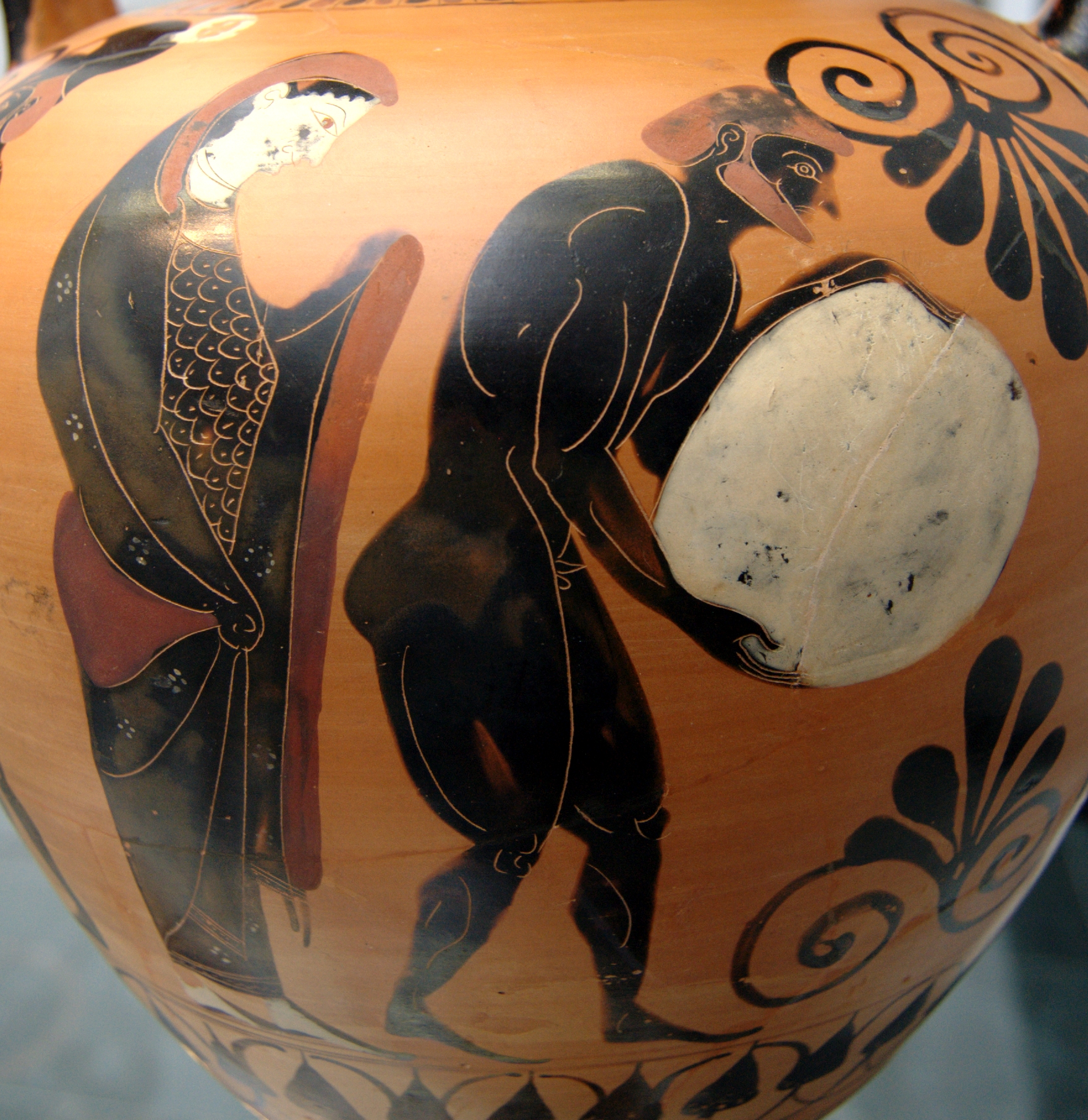
Nekyia: Persephone supervising Sisyphus pushing his rock in the Underworld. Side A of an Attic black-figure amphora, ca. 530 BCE, from Vulci, February 13, 2007. (Bibi Saint-Pol via Wikipedia). In public domain.

This school year, my son’s school district, Montgomery County Public Schools in Maryland, began implementation of what they call Curriculum 2.0. This new curriculum, formerly known as the Elementary Integrated Curriculum, has been in the works for the better part of a decade. As MCPS explained in a flyer to parents, Curriculum 2.o will be one that will “better engage students and teachers, and dedicate more learning time to subjects such as the arts, information literacy, science, social studies and physical education. By blending these subjects with the core content areas of reading, writing, and mathematics, students will receive robust, engaging instruction across all subjects in the early grades.”

Why is better engagement of teachers and students necessary, and how will an integrated curriculum make this possible? The answer to the first part of this question is much more obvious than the answer to the second part. In light of county-level and state-level testing (in the latter case, the MSA for third, fourth and fifth grades), an engaging and integrated curriculum will enable students to be better prepared for the heavy doses of critical reasoning and reading comprehension that this testing involves, at least theoretically.

What hasn’t made much sense has been the implementation process itself, as Curriculum 2.0 became the curriculum for kindergarten and first graders in this 2011-12 school year, with the option of having it for second graders at some schools (like my son’s school in Silver Spring). Meanwhile, third and fourth graders won’t become part of Curriculum 2.0 until 2012-13, and this year’s fifth graders won’t see Curriculum 2.0 at all. It seems as if the implementation process was about as well planned as the SS Minnow’s tour of the South Pacific.

But that’s not the only story here. For someone’s who’s spent a great deal of time attempting to understand

A One Thousand and One Night manuscript written in Arabic under the second half of the Abbasid Era (750-1258 CE), February 9, 2008 (Danieliness via Wikipedia). Released into public domain via cc-by-sa-3.0 license.

the circumstances under which I grew up, including my times in Mount Vernon, New York’s public schools in the ’70s and ’80s, MCPS’s Curriculum 2.0 is sort of like deja vu all over again. Except that in the period between ’76 and ’93, the kind of curriculum MCPS is implementing now was mostly for Mount Vernon’s gifted and talented students then, students who were part of the district’s Humanities Program, particularly those in the Grimes Center for Creative Education. The motivations for developing a similar curriculum three and half decades earlier came out of the need for racial integration and preventing White Flight, and in the process, a measure of academic excellence. Different circumstances in search of the same results, I guess.

A piece of evidence I uncovered a few years ago while working on Boy @ The Window shows how much educators reinvent the wheel in terms of curriculum development, a pitfall in education on which Diane Ravitch has been proven correct for the past thirty years. Charlotte Evans wrote in her April 1981 New York Times article on the Grimes Center that there “is a flowering of creativity at Pennington-Grimes [Grimes had combined with Pennington in the 1980-81 school year] that is evident in the hallways as well as in the classrooms.” Leroy L. Ramsey, New York State Department of Education Administrator of Intercultural Affairs and Educational Integration, when asked by Evans to comment, said that “the intent” of a school like Pennington-Grimes “was to break racial isolation and to stop white flight, and we have done that in Mount Vernon.”

As detailed by Evans in her April 1981 New York Times article, with the

[c]oordinating [of] language, math and science with social studies in the same way, first graders study the family and its roots, how people live and lived in different places. Second graders focus on prehistoric times – the old and new Stone Ages; third graders on the ancient Middle East, fourth graders on Greek and Roman civilization and sixth graders on the Renaissance, Reformation and the Age of Discovery.

This interdisciplinary approach to creating a magnet-style gifted track curriculum did not stop with a focuson other histories and cultures in social studies. “Fifth-graders, for example, specialize in studying the Middle Ages in Islamic nations and in Africa and Europe,” but they also “read Arabian Nights in connection with their Islamic study and went on to African folk tales,” according to fifth-grade teacher Mattie Lucadamo. In addition, there were other “flourishes,” such as “learning the foundation of Hindu-Arabic numbers” and “study[ing] astronomy, tracing it back to the Babylonians.”

It never ceases to amaze me how we as educators, education researchers, and governments spend time, money and human resources recreating what was already in existence, in this case, when I was my son’s age. But, like with the experiment that was the Grimes Center and Humanities, parents with resources will find a way to game the system. In one case, an innovative program was moved to Mount Vernon’s predominantly White North Side in May ’80, and tended to give more preferences to White students in general.

In the case of Curriculum 2.0, the more aware parents will send their kids to Kumon or Kaplan or other testing centers to give their kids every opportunity to do well in this new curriculum, score in the top percentiles on the MSA, and garner the gifted label in time for middle school.

After The Fall

Tags

, , , , , , , , , , , , , , , , ,


The planet Caprica under nuclear attack, Battlestar Galactica (2003), September 28, 2011. (Gary Hutzel/SyFy Channel via http://soundonsight.org). Qualifies as fair use under US Copyright laws because of low resolution of picture.

Fifteen years ago this date, I officially graduated from Carnegie Mellon University with my PhD, no thanks to Carnegie Mellon itself (see my post “The Audacity of Youth, Grad School Style” from August ’11). I’d been done with the dissertation since the Friday before Thanksgiving ’96, so the ceremony itself was anticlimactic. The week of my graduation, though, revealed more about my mother and the ugly truth about how conditional our relationship was than I knew or thought possible (see my post “My Post-Doctoral Life” from May ’08 for much more).

All of that was on top of a week that included doing an interview at Teachers College, going to my mother’s associate’s degree graduation and being followed while Black at the Barnes & Noble that used to be on 66th and Broadway in Manhattan. That week came on the heels of recovering from the ordeal that was the political struggle over my dissertation process with Joe Trotter (see my “You’re Not Ready” and “Running Interference” posts from November ’08 and April ’11).

By the time I went back into town with my girlfriend (now wife of twelve years) Angelia from Pittsburgh International Airport, I was in a space I hadn’t been in since the late spring and summer of ’82. The “summer of abuse” at 616, as I call it now (see my “To My Ex-Stepfather” post from July ’09).  My pursuit of higher education, then advanced degrees and career options, and all of the success — direct, collateral and otherwise — that came with that striving and those triumphs was apparently a lot of what had kept me grounded for the previous fifteen years.

Lava lake, Mount Nyiragongo (volcano), Virunga National Park, Democratic Republic of Congo, May 7, 2011. (Cai Tjeenk Willink via Wikipedia). Released to public domain via cc-Attribution-Share Alike 3.0 license.

Now that I was done, and I was able to see people for who they really were, I found myself unbound. A deep well of rage — along with a bucket of betrayal with which to haul it up — was suddenly available to me, and would remain so for years to come. For the first time since the beginning of my sophomore year at Pitt, I felt despair, as if I was homeless and sleeping on a stairwell landing in Forbes Quadrangle again. I spent that cab ride back to East Liberty in an emotional fog, somewhere between tearing up and ready to beat someone half to death.

Angelia brought me back to her place, made me sit down, and insisted that she make dinner for me. She pulled out of her freezer some leftover stir-fry vegetables and turkey from Thanksgiving ’96, and made it into a stir-fry over rice. I was about halfway through this meal before my brain began receiving messages from my normally precise palate. “Stop eating!,” my synapses started screaming. The food I’d eaten had probably gone bad long before Angelia had frozen it. And despite the sweet and sour and soy sauces, it also became apparent that the meat had experienced severe freezer burn.

Within a few minutes, I had severe bloating and pain in my stomach, and Angelia had given me water and Pepto Bismol to settle my stomach. She apologized, “Sorry, Donald,” with an ironic laugh, adding, “This just isn’t your day.” I went back to my studio apartment on Penn Circle South that evening, in pain in many more ways than one.

My intestinal pains became worse over the next three days. I wasn’t eating much to begin with, and what I

Chemical structure of bismuth subsalicylate, aka, Pepto Bismol, September 5, 2007. (Edgar181 via Wikipedia). In public domain.

had in my system as a result of Angelia’s poisonous gruel had resulted in an intestinal blockage. A clear-headed person would’ve gone to the ER and had himself checked out. But my brain was about as clear as a mushroom cloud in the middle of Central Park. I could barely move, it hurt just sitting up, and I cried, sometimes in my sleep. At some point, the pain in my gastrointestinal tract and the pain from my graduation ceremony merged as one and the same.

Was I experiencing some psychosomatic trauma? It wouldn’t have been the first time my emotional flaying manifested itself in my G/I tract. Angelia’s food may have been the catalyst, but the realization that my mother was never really on my side — along with my advisor and some of my friends — was the root cause.

By that Friday, I was able to eat again. But like my relationship with my mother, my intestinal tract has never been the same. Betrayal and loss of trust — and faith — will do that to the most confident of us.