Boy @ The Window Is Live!

Tags

, , ,


Final Cover

Final Cover

Well, “it is done,” as my former graduate advisor Joe Trotter used to say. Boy @ The Window is now a published book. For now, it’s an e-book, available on Amazon.com through Kindle Books (as Boy @ The Window: A Memoir) and through Smashwords.com (which will then ensure that the book makes its way to iBooks, Apple’s bookstore, as well as Barnes & Noble.com). I also have a free PDF edition of Boy @ The Window (text only) available on this blog site (in the sidebar to the right), at least for the next three months.

I anticipate putting out a trade paperback edition in the next few months, either in July or in the fall. But with more than forty percent of the book market now in the e-book realm, it made far more sense to start with the fastest growing part of the market first. It’s a bit weird not holding a copy of Boy @ The Window in my hands, being able to leaf through the paper pages. It’s been on my iPad, though, for a couple of days, and seeing it there in 100 percent working order has been a pretty good feeling.

For me, at least, incidents like the Boston Marathon bombing yesterday — and so many other tragedies and dastardly events in the seven years and four months since I first began writing my book — are a reminder to live every day like there may not be a next one. After years of work and waiting for the commercial market to say “yes” to Boy @ The Window, I knew I didn’t want to wait forever to put this work of mine out into the world. So, “hello, world!”

Blogging Break

Tags

, , , ,


Me comatose on my MacBook keyboard, March 29, 2013. (Donald Earl Collins).

Me comatose on my MacBook keyboard, March 29, 2013. (Donald Earl Collins).

As of today, I’m taking a blogging hiatus. It will likely last between two and four weeks. I’ve been trying to finalize the Boy @ The Window manuscript, write other articles, post on my blog at least twice a week, work out, run and sometimes play basketball between four and five times a week, teach three classes this semester, and pick up additional work. I can’t do all of that, not all at once. I’ve already cut back my workout schedule to three times a week, and pushed back some work in order to complete the finishing touches to the book ms.

But now, with Boy @ The Window so close to finally, finally, finally being done (at least from a technical perspective), I have more to do on the business and proposal side over the next couple of weeks. I don’t want to shoot the final product into the air, only for it to come crashing down, killing me and everyone else within fifty yards, like an old German V-2 rocket.

So, for the first time in nearly six years of blogging (including three years through WordPress), I’m taking a break. Not exactly a vacation, as my intent is to have my magnum opus out in ebook form, at least, by the end of April. But a break from waxing philosophical, being goofy and sharing anger, rage and tears of joy and pain here. The next time I do a full blog post, Boy @ The Window will be a real book.

In the meantime, there are 610 other posts to take in, and hopefully, to enjoy.

“The Dying of Black Women’s Children”

Tags

, , , , , , , , , , , , , , , , , , , , , , , ,


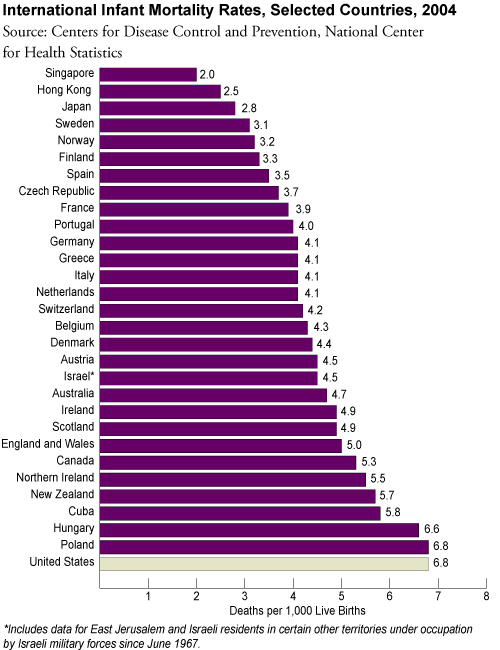
Infant mortality rates by country (2004), March 27, 2013. (http://www.mchb.hrsa.gov/). In public domain.

Infant mortality rates by country (2004), March 27, 2013. (http://www.mchb.hrsa.gov/). In public domain.

That was the title of a research paper I wrote for an independent study course I did with my former Pitt advisor Larry Glasco. It was a paper I wrote during my last semester at the University of Pittsburgh, undergrad and grad school. It was the last paper I would write for any professor at Pitt. But it was a paper that would address a bunch of common themes about me as a historian and scholar knowingly, and a writer unknowingly.

I began this paper without a course and on my own time in the Fall ’92 semester (see my post “December Doctoral Decisions” from last year). I had to fulfill a quantitative methods requirement in order to take my PhD comprehensive examinations at the end of my coursework, which at my pace would’ve meant taking them in the fall of ’93 at Pitt. Why they never included a qualitative methods requirement, I’ll never know. Of course, this digital humanities movement of quantifying the heretofore unquantifiable was but an embryo in the early ’90s.

With my language requirement taken care of the year before, I had no choice but to build on my existing statistical knowledge. Luckily, I’d inadvertently minored in mathematics and had been a computer science major before switching to history. I’d already decided on the topic of comparing infant/child mortality rates among White and Black Pittsburghers between 1900 and 1920, coinciding with the Great Migration period for Blacks. This meant census data from 1900, 1910 and 1920. This meant public health records from the same twenty-year stretch. It meant looking at neighborhoods like the Lower Hill District and Bloomfield, the occupations of the men and (in the case of Blacks) women living in these communities.

And it meant that I had to learn how to use SPSS, the most powerful number-crunching statistical software package on the planet. At least as far as I was concerned. It took me from September ’92 until the end of January ’93 to get comfortable enough with SPSS to plot and correlate different points of data. By then, I could generate reports and make sense of them. I knew that race, poverty/neighborhood and occupation (in that order) correlated best to the 2.5 to 1 ratio between infant/child mortality (death between child birth and the age of five) rates for Black families versus White families.

I used Lotus 1-2-3 to construct the tables, charts and graphs for my statistical correlations and data. Why Lotus 1-2-3? Their charts and graphs looked like “arts and crafts,” to steal a phrase from David Letterman. SPSS’s visuals were boring. Between the numbers crunching, the translation of correlation data into Lotus, and the actual writing of this paper, I completed my work for this independent study and quantitative methods requirement at the end of February ’93.

By then, I had two issues. One, I didn’t know what to title my paper. Most of my titles were inspired by cultural references from music, sports, TV shows, catch commercial jingles. I’d titled one paper “‘Sittin’ On The Dock of The Bay’,” an homage to Otis Redding and in reference to the topic of Black migrants finding permanent economic degradation after leaving the Jim Crow South for places like New York, Chicago and L.A. Another one, which I’d presented at several conferences, was “‘The Evidence of Things Not Seen’,” a prelude to my “‘A Substance of Things Hoped For'” dissertation (thanks to Hebrews 11:1 and James Baldwin).

Pitt Honors Convocation program, (March 1, 1994), March 27, 2013. [Ironic, given that I received this honor when I was at CMU]. (Donald Earl Collins).

Pitt Honors Convocation program, (March 1, 1994), March 27, 2013. [Ironic, given that I received this honor when I was at CMU]. (Donald Earl Collins).

I solved this title problem while simultaneously dealing with the second issue, which was that I knew I was about to transfer to Carnegie Mellon to complete the doctorate. Joe Trotter had invited me to attend the job talks of a young professor who had recently earned tenure at the University of Chicago, I believe. I remember her being fairly attractive and found her work interesting, if not fascinating. While we walked up and down the factory floor, um, second-floor corridors of Baker Hall, I walked by a flyer for an upcoming talk on “The Dying of Young Women’s Children.” I decided that this would be the scaffolding for my paper’s title, right then and there. Only, I’d change “Young” to “Black” and give a footnote of credit to the flyer title.

I submitted my paper to Larry for my independent study, which I was now taking purely as pass/fail (or satisfactory/unsatisfactory), and not for a specific grade. After Larry learned of my departure, he never gave me feedback on the paper. As the end of the semester approached — and I became short on cash — I submitted the paper to the Women’s Studies Program’s Student Research (undergraduate and graduate) contest.

Pitt's Women's Studies Program Annual Prize for Student Research on Women and Gender, June 1993, March 27, 2013. (Donald Earl Collins).

Pitt’s Women’s Studies Program Annual Prize for Student Research on Women and Gender, June 1993, March 27, 2013. (Donald Earl Collins).

Two months later, in June ’93, I learned that I’d finished second in the graduate student category, and earned a check for $75, a week’s worth of groceries! My friend Matt, upon learning of my good fortune, said, “You won that prize because of that title,” adding that I “stole it” from a flyer.

Matt was right, of course. But I also learned something important through “The Dying of Black Women’s Children.” That all writers borrow from others’ words and ideas, and then make them their own.

Transfer Anniversary

Tags

, , , , , , , , , , , , , , , , , , , , , ,


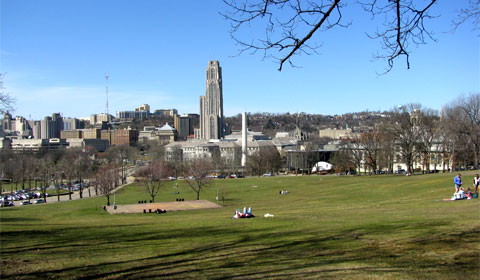
Viewing Pitt's Cathedral of Learning from Carnegie Mellon's mall (with Hamerschlag Hall in foreground), March 29, 2003. (http://post-gazette.com)

Viewing Pitt’s Cathedral of Learning from Carnegie Mellon’s mall (with Hamerschlag Hall in foreground), March 29, 2003. (http://post-gazette.com)

March ’93 was an interesting month for me, to say the least. Just about the biggest thing happening for me that month was my transfer from Pitt to Carnegie Mellon (or CMU) to finish my doctorate. After nearly two years of grad school in the History Department, I knew I needed to leave. Especially with Larry Glasco as my well-meaning but sometimes absentee advisor and with a bunch of professors who never hid their disdain for me as a masters and then a doctoral student. I’d also been at Pitt for six years between undergrad and grad school, most of those focused on history, Black Studies, or education foundations and policy as areas of research.

I knew that Carnegie Mellon wasn’t an ideal situation. I was sure that had I desired, I could’ve applied to and been accepted by doctoral programs as far and wide as NYU, University of Maryland, University of Michigan and other places. All were places where history didn’t simply consist of working-class historians who believed in the supremacy of class and neo-Marxism above all else – race and racism be damned! What I didn’t know, though, was whether those departments would accept my doctoral credits, cutting my coursework time in half. What I couldn’t be sure about was whether I’d be able to move toward PhD comprehensives and my dissertation proposal within a year of enrollment.

See, these were the things that Joe Trotter, my eventual advisor and John Modell, the graduate coordinator for the department, had promised me as part of my deal for transferring across the bridge to CMU. Those promises, along with the idea of working with an enthusiastic professor whose research didn’t seem out-of-date in a department that seemed to fast-track its students toward doctoral completion. That really appealed to me at the time.

Pitt and Carnegie Mellon (with Forbes Quad & Baker Hall included) as seen from Schenley Park, Pittsburgh, PA, March 21, 2013. (http://milliverstravels.com).

Pitt and Carnegie Mellon (with Forbes Quad & Baker Hall included) as seen from Schenley Park, Pittsburgh, PA, March 21, 2013. (http://milliverstravels.com).

When I finally broke it to Larry at the beginning of March that I’d made this decision, he didn’t exactly try to convince me to stay. I think he knew why. An audit of the program in ’98 confirmed officially what I had learned anecdotally over my six years at Pitt. That there were students in the program who’d been ABD (All But Dissertation) since Nixon and Watergate. That fully half of my cohort from ’91 hadn’t even completed their master’s degrees, and only three of us (counting myself) out of twenty-one would ever go on to complete our doctorates. That no Pitt History grad student had obtained substantial research funding from outside the university since my Mom potty-trained me back in ’72-’73. And that politically, the powers that used to be in the department didn’t take my or Larry’s work with me seriously. Even if Larry didn’t see that, I sure did.

Off then, I went. Into the unknown known of CMU, conservative, elite and elitist, not sure if I’d ever be comfortable on the lily-White and honorary-White-as-Asian campus. Still, I reminded myself that Pitt was really only a couple of blocks away at the closest point between the two campuses, that I still had lots of friends and acquaintances there. I also knew, though, that my relationship with Trotter as my advisor would be crucial to my successful navigation of this drab and stuffy world. Too bad I wasn’t clairvoyant!

The Impossible Choice of Driving While Black

Tags

, , , , , , , , , , , ,


Police brutality poster, March 18, 2013. (http://lovethetruth.com).

Police brutality poster, March 18, 2013. (http://lovethetruth.com).

Let me say this right off. I can’t stand cops. I haven’t since I was about five or six years old. That was when a couple of dumb-ass Mount Vernon Police officers idly stood by and laughed as my father was being taken to the hospital with a stab wound in his left thigh, the result of a fight between him and my mother. I’ve been accosted, stopped, frisked and followed by police in Mount Vernon, the Big Apple, DC, Silver Spring, Los Angeles and Virginia since I turned sixteen back in ’85. Mostly for the simple issue of being an over-six-foot tall Black male and man. Walking while Black in Beverly Hills or on my own campus at Carnegie Mellon. Or Driving While Black in Pittsburgh or Maryland (see my post “Why Black Men Carry A Public Anger” from March ’12)..

To me, the issue is not as simple as a White racist cop finding excuses to harass, intimidate or beat up a Black or Brown person. It actually doesn’t matter what race or ethnicity a police officer happens to be, because their uniform, badge and gun are way more important to them than race. By definition, then, they represent our collective psyche of bigotry when it comes to race, class, gender and criminality. So don’t argue with me about the race of any cop in terms of police brutality and intimidation.

Two Bad Driving Choices

For the first time in about a half-decade, a police office pulled me over. This time, it was half my fault, albeit, it depends on how you define fault. Thursday afternoon, March 14, I was driving down Colesville Road past University Blvd East, to do a left turn on Lorain. From there, I’d meander my way back to the Shell station on the opposite side of University Blvd – it’s cheaper than the one on Colesville. Now, there’s a sign on the median next to the left turning lane that prohibits making a U-turn.

No U-Turn sign & left turning lane, Colesville Rd & Lorain Ave, Silver Spring, MD, March 14, 2013 (2:35 pm). (Donald Earl Collins).

No U-Turn sign & left turning lane, Colesville Rd & Lorain Ave, Silver Spring, MD, March 14, 2013 (2:35 pm). (Donald Earl Collins).

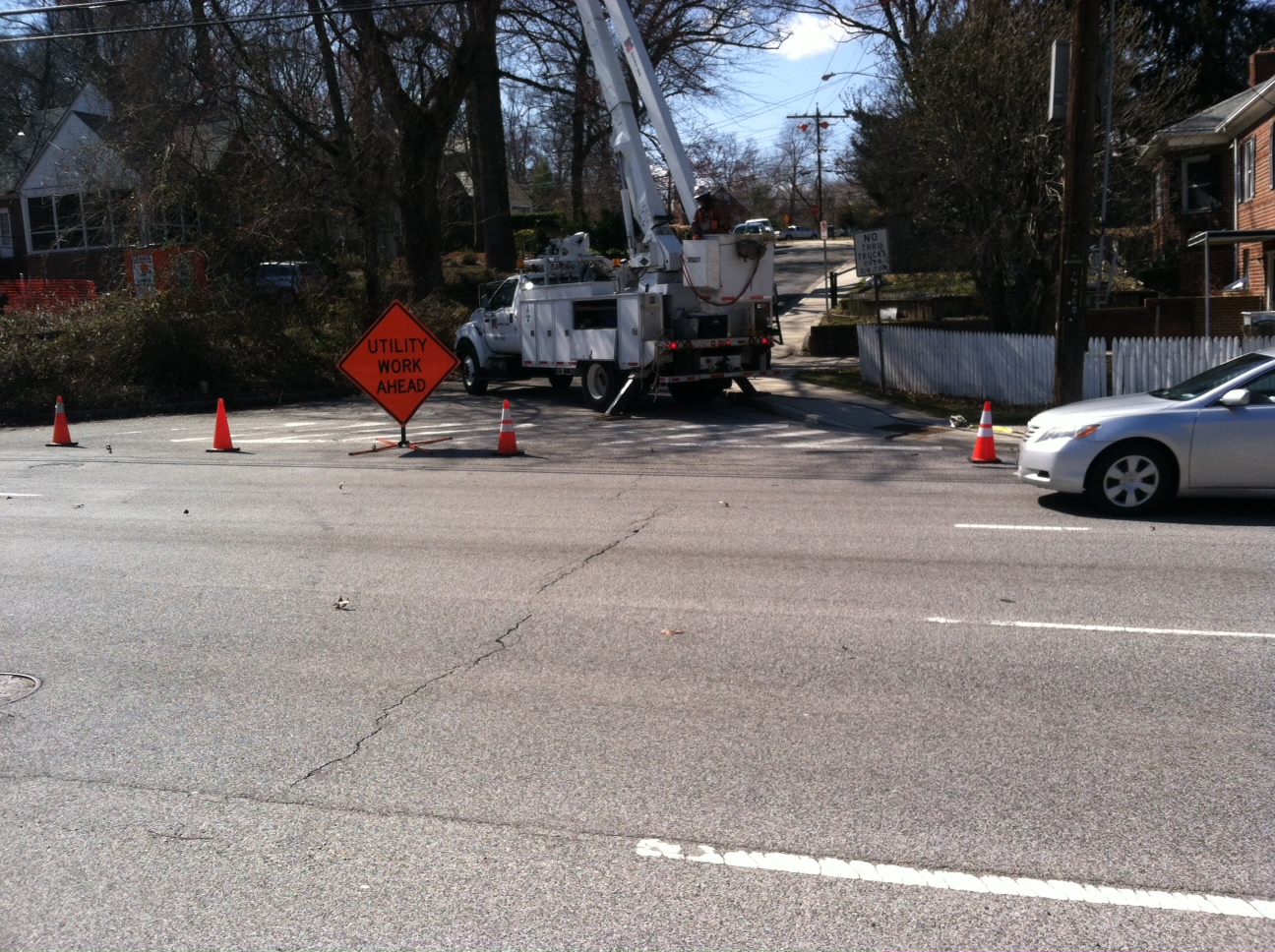
The problem on March 14 was, though, that a utility crew had closed up the street, between their trucks and their cones, making it impossible to make the left turn. I had no warning for this until I reached the front of the left turn lane. By then, I had a blue Toyota Camry behind me, and heavy traffic coming down the adjacent lanes on my side of Colesville.

So I had a choice, and not much time to make one. I couldn’t back up. Cutting across the solid left turning lane line is technically a traffic violation, one which could lead to me being pulled over by police. Not to mention, with so much traffic, I could’ve easily caused a traffic accident.

There wasn’t any traffic coming from the opposing side of Colesville. So I made the U-turn, figuring that this was the only actual choice that made any sense at all. Within three seconds, a siren approached, so I pulled over on the next block, right next to the Colesville Shell gas station. The whole time I’m thinking, “What the heck else was I supposed to do – run over the cones and then jam my car into the back of a utility truck?”

Utility work closing off Lorain Avenue (cones included, Silver Spring, MD, March 14, 2013 (2:37 pm). (Donald Earl Collins).

Utility work closing off Lorain Avenue (cones included, Silver Spring, MD, March 14, 2013 (2:37 pm). (Donald Earl Collins).

Admittedly I was nervous, as I consider police to be about as honest as Mafia bosses and city council members beholden to their local Chambers of Commerce. But I also realized that even if the police officer issued me a ticket, I’d have a crapload of evidence in my favor that would lead to a judge dismissing the citation.

The Not-So-Friendly Neighborhood Cop

So I waited. And waited. Then, after five minutes, a police officer named M. Kane (ID # 1382 for those truly interested) came up to my window, one who must’ve been having the worst day ever. Even for a White or Black police officer, he looked like he was ready to brutalize anyone who said more than “Yes, sir! I’ll suck you dick, sir!” to him. That pissed me off right away. Because a traffic violation, especially under these circumstances, didn’t rise to the level of the threatening nonverbal communication that was coming off of him like heat from an exhaust pipe.

I did get a written warning, and then some directions about what do next. The problem was, the officer issued his directions in a low grind of a growl, and I actually didn’t hear all he said. So I asked, reluctantly

“Officer, can I pull over here into the gas station? That’s where I was on my way to when you pulled me over.”

“You can go wherever the hell you wanna go, just pull out over this other car here!,” he yelled, so close to me I could feel the hot air and spit from his mouth as he was yelling. He looked at me with mean, dead eyes, the kind of look that so many folks who look like me have seen from police all these years.

I pulled out, probably a minute or so away from being arresting for assaulting a police officer, because that’s probably what I would’ve done in a parallel universe.

More Choices

What could I had done, really, to have avoided the situation? Have better hearing? Found my way into a car accident? Not left the house to go get gas and hamburger rolls before going to the Y for a five-mile run? Well, Montgomery County could’ve actually cut off the left turning lane with cones, making folks go elsewhere to make left turns. That is, if they were more interested in safety than in handing out warnings and tickets!

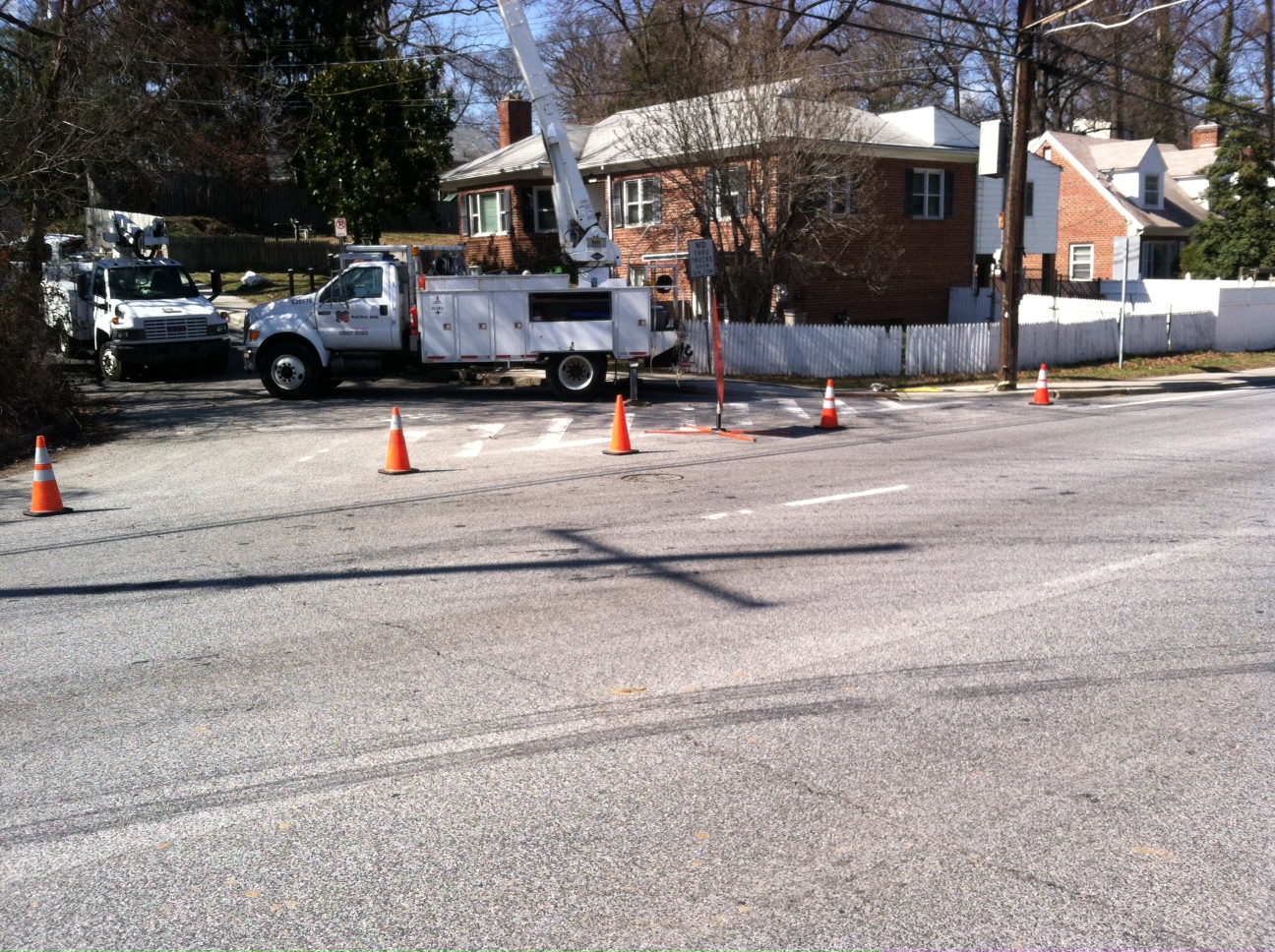
Utility work on Lorain Avenue (slightly different angle - 3rd truck hidden from view), March 14, 2013 (2:38 pm). (Donald Earl Collins).

Utility work on Lorain Avenue (slightly different angle – 3rd truck hidden from view), March 14, 2013 (2:38 pm). (Donald Earl Collins).

Beyond that, I don’t have much choice other than to be me. Despite almost every part of me wanting to smash in this police officer’s head with a twenty-five pound weight, the spirit inside said to forgive, and so, I forgave. But that doesn’t mean condone or not write about my experience. After all, if this officer is like this every day, then he’s a walking time bomb, set to go off on the wrong person of color at the wrong time.

I don’t want to hear about how dangerous it is to be a cop. Right now, it’s dangerous to be a teacher or professor, given mass shootings over the past six years. Last I checked, these officers weren’t conscripted into service. They chose their line of work. I don’t expect cops to ever be nice. But professional would be a pretty good standard to meet.

Conversations With M² About “Big Foot”

Tags

, , , , , , , , , , , , , , , ,


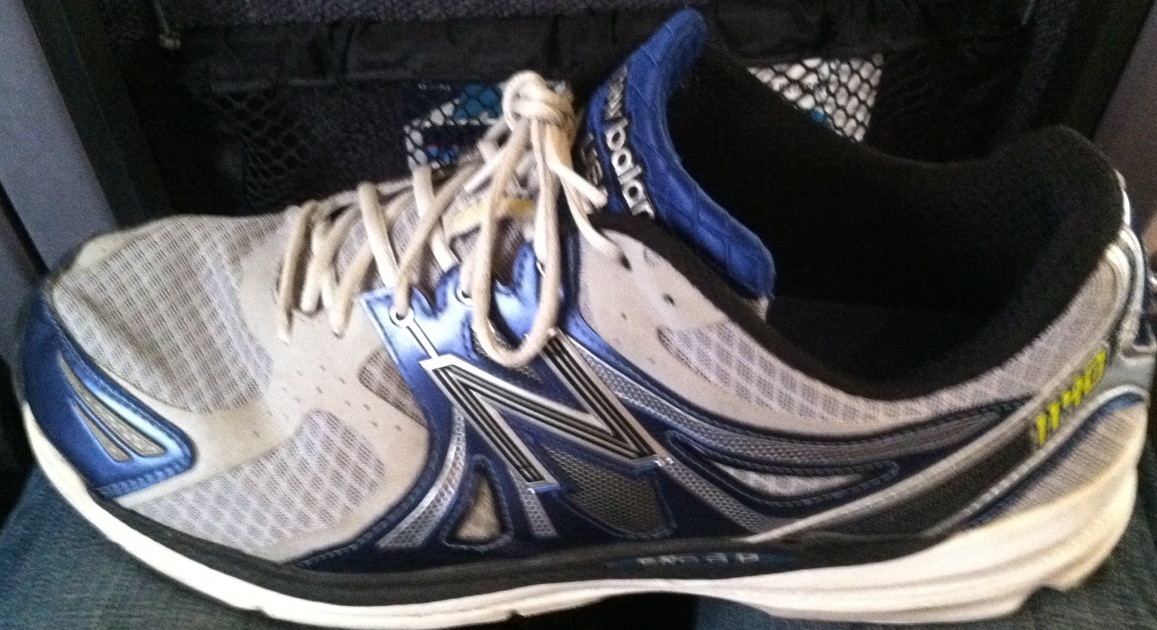
My left foot (excuse movie pun), size 14 4W, March 15, 2013. (Donald Earl Collins).

My left foot (excuse movie pun), size 14 4W, March 15, 2013. (Donald Earl Collins).

Sometimes in my life, my anger and rage are a driver toward the better. Usually it’s because I channel that negative energy into something positive, like writing, running, praying and forgiving. In the case of the year after Crush #2 crushing me emotionally and psychologically, it was school and needing to pull my grades up that gave me a place to channel my anger and rage. But with a twist. I deliberately decided that it was the older students at Pitt that I’d befriend my second semester, shunning all but a few classmates under the age of twenty-two.

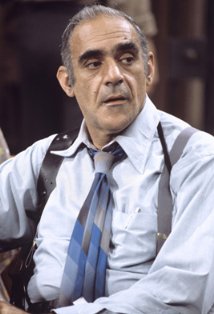
In Geology that Winter ’88 semester, I had a professor who sounded like Abe Vigoda from Barney Miller and looked like he’d been digging up shale every time he lectured in class. The class was pretty easy, all multiple choice. The main issue of significance wasn’t the class, though. It was M². I had met her at the Cathedral lab the previous semester. She always came to the lab with her boyfriend, and always somehow found something she needed help with. She made almost every girl I went to high school with, well, look like they were girls by comparison.

A "young" Abe Vigoda, Barney Miller, circa 1978, March 15, 2013. (http://notalwaysaboutmonkeys.com).

A “young” Abe Vigoda, Barney Miller, circa 1978, March 15, 2013. (http://notalwaysaboutmonkeys.com).

We were in this Geology class together, which apparently gave her a ready-made excuse for toying with me off and on that semester. As sexy and attractive as she was, I was ill-equipped for any drama between her and her boyfriend. M² was twenty-four, her boyfriend twenty-two and six-two at that. He looked like he worked out, or had at least filled out, in ways that I knew I hadn’t yet.

So at first I kept my distance, not wanting any part of what was going on in M²’s head. I bumped into her one day while getting lunch at the Cathedral of Learning, in the Roy Rogers restaurant on the ground floor. She asked me to sit down and eat with her, and for once, I didn’t refuse. We started talking, or rather, M² started talking about her boyfriend and how she felt about their relationship, particularly their sex life. I really didn’t want to know anything about it, but my ears perked up when she said, “You’d think that as tall as he is he would be bigger down there.” That was definitely too much information.

“You know what they say about men with big feet?,” M² asked next.

I really didn’t know. I guessed that I was about to talk my way into a punchline.

“What?”

“Big feet equals a big you-know-what,” she answered while pointing to my size thirteens and then looking at my face.

“You’re blushing,” M² said with a coy smile.

Of course I was blushing. It wasn’t every day that someone six years older than me hinted that they might want to have sex with me, boyfriend or no boyfriend.

Frame 352 from Patterson-Gimlin film, claiming to show Bigfoot, October 20, 1967. (Beao via Wikipedia). Qualifies as fair use under US Copyright laws - low resolution picture.

Frame 352 from Patterson-Gimlin film, claiming to show Bigfoot, October 20, 1967. (Beao via Wikipedia). Qualifies as fair use under US Copyright laws – low resolution picture.

For what it was worth, a gorgeous Black woman in her mid-twenties flirting with and insinuating that she wanted to have sex with me did give me a confidence boost that slowly wore away the anger I started the year with. What also helped was a battery of new music that helped focus my anger and reinvigorate my imagination. Richard Marx’s “Should’ve Known Better” and Paul Carrack’s “Don’t Shed a Tear” were two songs that were close enough in lyrics, meaning and emotion to my situation with Crush #2 that I smiled a silly smile every time I heard or played them both.For the first time in two years, I started paying attention to rap again. Rob Base, Salt ’n Pepa, Big Daddy Kane, and Public Enemy all began to seep into my consciousness that winter and spring. Geto Boys’ “Mind Playin’ Tricks on Me” would’ve been nice to hear six or eight months before, when I was waist deep in obsession over Crush #2.

Still, M² helped me realize, maybe for the very first time, that as much of a mess I was back then, that I was attractive — or at least handsome –in my own right. And that a goodly portion of my former Humanities classmates were assholes.

Revised Preliminary Boy @ The Window Book Cover

Tags

,


Book Cover (version 9.5 officially) for Boy @ The Window, March 7, 2013. (Donald Earl Collins).

Book Cover (version 9.5 officially) for Boy @ The Window, March 7, 2013. (Donald Earl Collins).

Thanks to all of you who’ve publicly (and privately) given me feedback on the “Potential Boy @ The Window Book Covers” from last month. Much appreciated!

Based on suggestions from friends, Twitter peeps, family and students, above is the revised book cover that I intend to use for Boy @ The Window as eventual ebook and trade paperback. Again, please give me you feedback, of the positive and constructive criticism nature.

Up next: gathering more sage advice on the manuscript itself before I put it out there for public consumption, and myself out there as author (again).