• About Me
  • Other Writings
  • Interview Clips
  • All About Me: American Racism, American Narcissism, and the Conversation America Can’t Have
  • Video Clips
  • Boy @ The Window Pictures
  • Boy @ The Window Theme Music

Notes from a Boy @ The Window

~

Notes from a Boy @ The Window

Category Archives: Work

Poverty, Violence and PTSD – But What About Racism?

07 Monday Jul 2014

Posted by decollins1969 in 1, Boy @ The Window, culture, Eclectic, High Rise Buildings, Jimme, Marriage, Mount Vernon New York, My Father, Politics, Pop Culture, race, Work, Youth

≈ Leave a comment

Tags

616 East Lincoln Avenue, Chicago, Child Abuse, Community Violence, Culture of Poverty, Culture of Violence, Domestic Violence, Gun Violence, July 4th, July 4th Weekend, Mainstream Media, Mental Health, Mental Illness, Post-Traumatic Stress Disorder, Poverty, PTSD, Public Health, Shooting Deaths, Soft Bigotry, Structural Racism, Uncle Sam
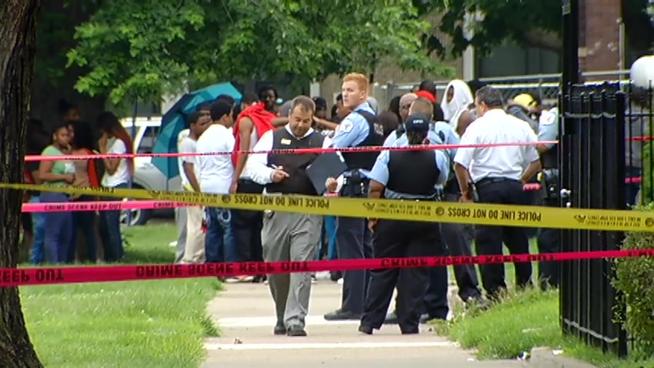

Chicago Police fatally shot a 16-year-old boy in the city’s Gresham neighborhood Saturday night and distraught family members are questioning the incident, July 6, 2014. (http://nbcchicago.com).

Chicago Police fatally shot a 16-year-old boy in the city’s Gresham neighborhood Saturday night and distraught family members are questioning the incident, July 6, 2014. (http://nbcchicago.com).

Over the past two weeks, thanks to Chris Hayes’ reporting on the state of Chicago for MSNBC, not to mention a horrific July 4th weekend, Mayor Rahm Emanuel’s lie of declining violent crime in the metropolis has been thoroughly exposed. In the past eighty-four hours, dozens of shootings in Chicago injured at least sixty people, with between nine and eleven killed. Six of these shootings involved the Chicago PD, as they killed two teenagers over the weekend. But if we leave it to the mainstream media and the moralist Black elite to explain, the Blacks on Chicago’s South Side are just immersed in a “culture of violence.” Black youth simply live careless, nihilistic lives, that “gang, drug, [and] gun violence” is the root of the problem

For those White, bright, and bi-racially White, though, there’s the knee-jerk reaction of media and caring adults that comes with it. For mass shooters apparently with much better aim than folks in Chicago, like Elliot Rodger, Adam Lanza, James Holmes, Wade Michael Page, Eric Harris and Dylan Klebold, mental health and mental illness, along with gun control, is the mainstream media’s topic of the day. Even their explicit racism and misogyny can become the media’s evidence for their mental illness. White and Black moral leaders don’t then speak of cultural deficiencies or of an enjoyment of crime and violence as reasons for their shootings.

It’s terrible that we afford one group of young men every benefit of the doubt because they were/are affluent or White, and the deny humanity of another because they were/are poor and Black or Brown. Yet recent sociological and psychological studies indicate what anyone who has lived in poverty and with violence has at least sensed throughout their lives. That many (if not most) growing up in these conditions experience post-traumatic stress disorder (PTSD), leading to more poverty and violence in adulthood.

I know this better than most. Below is a short sample of the violence I witnessed or experienced from birth through adulthood:

September ’70 – my father, drunk and jealous, attempted to attack my mother with a knife. My Mom with me and my brother Darren in tow, picked up a heavy quartz crystal ashtray and threw it at my father as he charged her in the kitchen. He was apparently struck in the head and knocked unconscious. The ashtray had detached the retina in his left eye, which he never had repaired. Nine years later, my father had to have his left eye removed. I don’t remember this attack or my Mom defending herself — I was all of ten months old. I do remember my father’s eye being removed, and the headache and vertigo he had prior to the surgery in the summer of ’79 The research indicates, though, that there would have been a psychological impact on me and my nearly three-year-old brother nevertheless, and not a good one at that.

July ’75 –  from Boy @ The Window
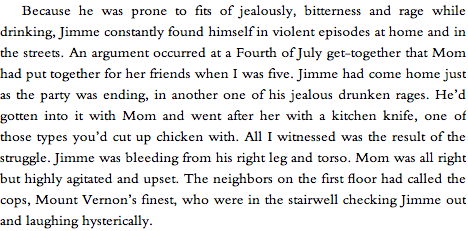
Screen shot 2014-07-07 at 1.08.28 PM

December ’76 – when my father stomped in a brand-new glass coffee table and had to go to the hospital with several serious bloody cuts in his legs.

April ’77 – when my Uncle Sam clotheslined my father after his months of psychological and abuse toward my Mom had landed her in Mount Vernon Hospital with kidney problems.

April ’82, May ’82, July-August ’82 – my then stepfather beating me up in a Karate studio in front of a group of men because I refused to call him “Dad,” beating up my Mom for not “lovin’ him,” and beating me up for the first six weeks of my summer between seventh and eighth grade for me defending my Mom.

January ’86 – the last time my stepfather actually laid a fist on me, damaging or chipping three of my front teeth and busting my lip in the process.

June ’89 – the last fight between my Mom and my stepfather, where the same crystal ashtray my Mom used in ’70 easily could’ve fractured her jaw and left cheekbone. Thankfully, my then stepfather had terrible aim.

If it were just a matter of domestic violence and child abuse for me alone, that would be tragic, but not necessarily relevant. The violence of 616 East Lincoln Avenue, sadly, wasn’t contained to A32. Domestic violence was the way of the A-building at 616, starting with our adjacent next-door neighbors. In the two-bedroom department immediately below us, the husband and wife had a violent, alcoholic relationship, so bad that it was a rare weekend in the years between ’77 and ’87 where a plate or wine glass didn’t break or the police weren’t called. Their son once pointed a gun at me on my walk up the front steps of 616 when I was a senior in high school and claimed he’d secretly pointed a gun at me in the past. Muggings and robberies, including the four that I experienced, were as common as the common cold

At the near-door apartment building, 630 East Lincoln, the drug trade had been alive and well years before the arrival of crack cocaine. Fights involving knives and baseball bats were normal, often involved a crowd of kids as spectators. Sometimes these fights would spill onto the front lawn of 616’s A-building, where I could witness it first-hand.

That violence was a frequent companion in my life wasn’t surprising. I never lived anywhere growing up where the majority of the people around me weren’t welfare-poor, working-poor or working-class Blacks, where the heating oil came in time for winter, and where maintaining mental health was a topic of conversation. To act as if employment practices, education policy, public health access, police neglect or brutality or housing policies had nothing to do with the sheer concentration of poverty and violence around me would be at the least naive. Fundamentally, it was the benign neglect in the chain between individual racial assumptions, the soft bigotry of mainstream media, and the hard concrete of structural racism in play.

What was my constant companion growing up in Mount Vernon, New York has remained the story of poverty, race and violence in Chicago’s South Side for a century. Don’t feel sorry, for me or for all of those shot up in Chicago this past July 4th weekend. Do something, say something, or don’t. But feeling sorrow without saying or doing something about shouldn’t be an option.
Talking Tocqueville Too Much

05 Saturday Jul 2014

Posted by decollins1969 in 1, Academia, culture, Eclectic, Patriotism, Politics, Pop Culture, race, Work, Youth

≈ Leave a comment

Tags

4th of July, Alexis de Tocqueville, American Exceptionalism, Bankers, Chris Matthews, Democracy, Economic Inequality, Egalitarianism, Freedom, Industrialization, July 4th, Labor Exploitation, Liberty, Media, Merchants, Plutocracy, Slavery, Tocqueville, Tourism, Universal White Male Suffrage


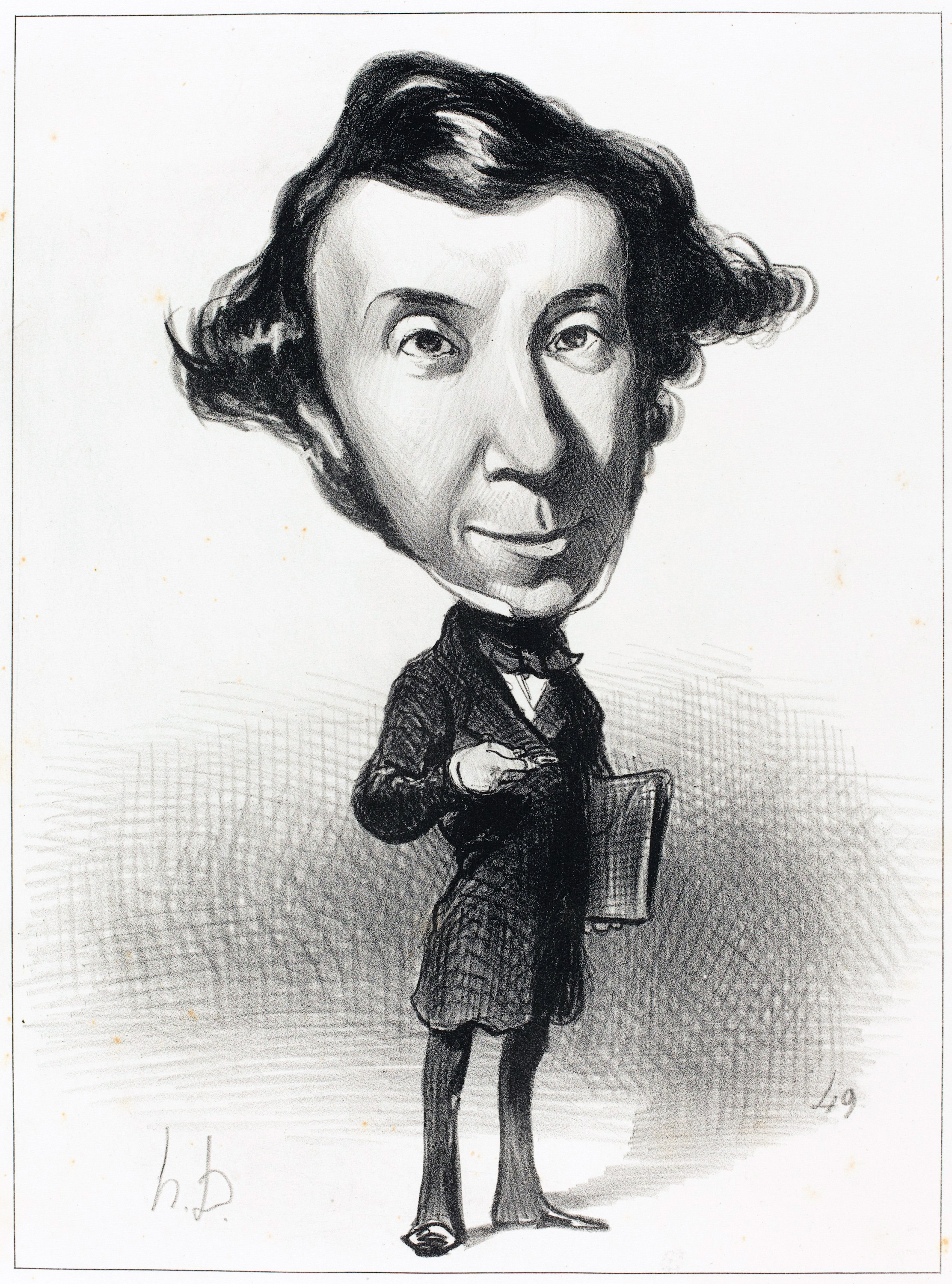
Alexis Tocqueville caricature (1849), by Honoré Daumier, National Gallery of Art, Washington, DC. (Wikipedia). In public domain.

Alexis Tocqueville caricature (1849), by Honoré Daumier, National Gallery of Art, Washington, DC. (Wikipedia). In public domain.

Every year for at least the past thirty years, without fail, I’ve read at least one article, seen or read at least one book, or watched at least one commentary about the great Alexis de Tocqueville. These are almost always about the French political theorist’s grand tour of America in the early 1830s and his affirmation of America’s exceptional democracy, egalitarianism and lack of permanent social classes. Over the years, I’ve found these all too frequent comments and examinations of a long-dead tourist vomit-inducing.

Tocqueville may have gotten it right, that America and its democracy was in a unique position in 1833 to take off and become a powerful nation, if given the time. But he didn’t understand America at all, at least, not really. Tocqueville didn’t understand how central inequality was to the development of America’s unique and exceptional democracy. He assumed, quite wrongly, that any issues of inequality in our then young nation were limited to the American South, where cotton was king and slavery was the backbone of the economy. Tocqueville only saw slavery as a moral dilemma of debasing humanity — slave owner and slave — and not as a political or economic one. So what if he predicted the rise of the US and Russia as world powers if he didn’t predict the American Civil War?

The Half Has Never Been Told: Slavery and the Making of American Capitalism by Edward E. Baptist (due out September 9, 2014 -- there's always Eric Williams' Capitalism and Slavery [1944]), July 5, 2014. (http://bn.com).

The Half Has Never Been Told, by Edward E. Baptist (due out September 9, 2014 – there’s always Eric Williams’ Capitalism and Slavery [1944]), July 5, 2014. (http://bn.com).

Tocqueville looked at America outside of the South and saw an egalitarian and agrarian society, one unconnected to the slavery located south of the Mason-Dixon line and spreading southwest across the Mississippi River. Where did he think the money came from to finance plantations, to ship the raw materials of these plantations overseas and to buy more slaves? How did Tocqueville think these plantation owners could turn cotton into cloth and tobacco into cigarettes and cigars? Much of it came from bankers and merchants in New York, Boston and Philadelphia, and from the factories of New England and New York. Slavery was the backbone of the rise of the American economic system, and was America’s industrialized foundation. Period.

Tocqueville argued that America was unique because of its lack of a permanent class system, particularly an aristocracy. Our country’s democracy, in fact, guaranteed the constant churning of social mobility. Tocqueville must’ve been high on the tobacco leaves he sniffed in his tour of Virginia! While the nation had shed most of the obvious symbolism that came with wealth in Europe, Tocqueville had completely ignored that for the first half-century of US, only rich, land-owning White males could vote (and in many cases, hold office). Only in the five or ten years before his tour of the US did non-propertied White males gain the right to vote.

On top of this, though most Americans were farmers in the 1831-33 period, American urbanization had already begun. American cities didn’t have the age or splendor of European ones, to be sure. But what Tocqueville didn’t recognize was that wealth was already beginning to be concentrated in cities like Philadelphia, Boston and New York, in the form of commerce, in banking, and in the beginnings of modern industries. And though large-scale exploitation of poor and uneducated Irish immigrations wouldn’t begin for another fifteen years, the exploitation of poor, native White (and frequently, female and child) labor was already well underway, pulling Whites from countryside to cities in the process.

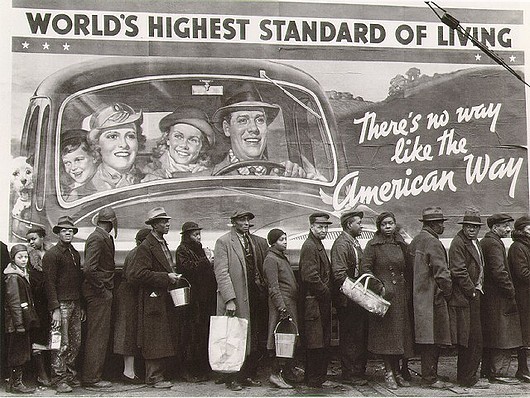
"World's Highest Standard of Living" poster with Black flood victims in bread line, Louisville, Kentucky, by  Margaret Bourke White, February 15, 1937. (ThunderPeel2001 via Wikipedia). Qualifies as fair use under copyright laws -- low resolution.

“World’s Highest Standard of Living” poster with Black flood victims in bread line, Louisville, Kentucky, by Margaret Bourke-White, February 15, 1937. (Wikipedia). Qualifies as fair use under copyright laws — low resolution.

And this is the man who so many of my historian and political scientist colleagues like to cite and quote? Especially around Independence Day! Sorry, but if I did a two-year tour of, say, South Africa right now, and predicted their eventual greatness because of their unique racial democracy and rapid economic development, who’d take me seriously by 2200 CE? Maybe MSNBC host Chris Matthews‘ great-great-great-great grandson, who would then claim South African exceptionalism based on my predictive power from 180 years before.


Race and The OJ Simpson Effect at 20

12 Thursday Jun 2014

Posted by decollins1969 in 1, Carnegie Mellon University, culture, Eclectic, Mount Vernon New York, Pittsburgh, Politics, Pop Culture, race, Sports, Work, Youth

≈ 2 Comments

Tags

1994 NBA Finals, Covenant Church of Pittsburgh, Dialogue on Race, Economic Inequality, Game 5, Houston Rockets, Internalized Racism, Men's Retreat, New York Knicks, Newsweek, Nicole Brown Simpson, O.J. Simpson, OJ Simpson, Pharrell Williams, Race Riots, Racial Stereotypes, Racial Stigma, Racism, Ron Goldman, Time Magazine, Trial, White Bronco


O.J. Simpson on the covers of Newsweek and Time Magazine, (the picture on right altered to make Simpson appear darker and caused an outcry), June 27, 1994. (Theo's Little Bot via Wikipedia). Qualifies as fair use due to low resolution of image and relevance to subject matter.

O.J. Simpson on the covers of Newsweek and Time Magazine, (the picture on right altered to make Simpson appear darker and caused an outcry), June 27, 1994. (Theo’s Little Bot via Wikipedia). Qualifies as fair use due to low resolution of image and relevance to subject matter.

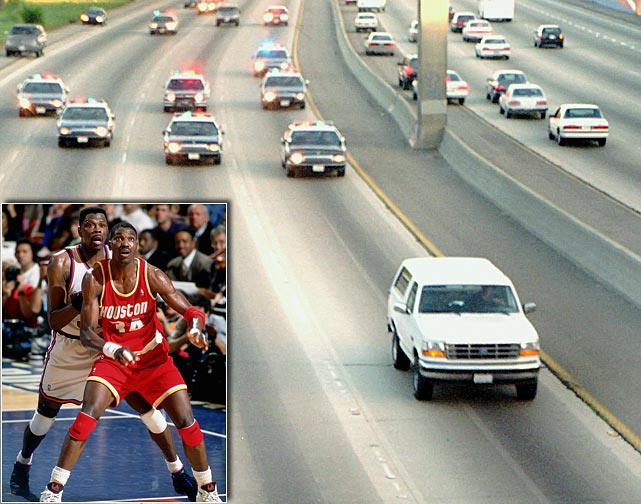
Today’s the twentieth anniversary of the deaths of Nicole Brown Simpson and Ron Goldman, still officially-allegedly murdered by the once great NFL Hall of Fame running back O.J. Simpson. In five days, it’ll be twenty years since the bizarre police chase of Simpson in a white Ford Bronco with his friend Al Cowlings on I-405 in the Los Angeles area. In the process, he took all of us — the media, the sports world, and anyone who cared about race and justice — on a ride that folks are still talking about two decades later. It had an impact on me in terms of how I saw Blacks and Whites and race. I shouldn’t have been, but I was mildly surprised that so many would become so emotionally caught up in a double-homicide case involving what at one time was one of the world’s most recognizable faces.

That week twenty years ago was my absolute commitment to two events. The NBA Finals between my New York Knicks and the Houston Rockets. And a church retreat for the male members (nearly 100 of us, almost all Black — talk about irony!) of Covenant Church of Pittsburgh. It was to be a week of watching my Knicks play at home and three days in the mountains of Western Pennsylvania at a retreat lodge, in a spirit of learning how to be godly men and of adult male bonding. The first full day of the retreat was June 17. After a day of workshops, prayer, praise, and singing (at least for me and the rest of the men’s choir), we all piled into the rec room to watch Game 5 of the Final. Only to see an overhead shot of a slow-moving white Bronco being trailed by an escort of L.A.’s finest instead of Patrick Ewing, John Starks, Doc Rivers, Charles Oakley, and the rest of the cast of characters from my favorite team.

Screen shot of NBA on NBA coverage of 1994 NBA Finals, Game 5, MSG, New York at Bronco chase of OJ Simpson, I-405 in L.A., June 1, 1994. (SI photos via Tumblr).

Screen shot of NBA on NBA coverage of 1994 NBA Finals, Game 5, MSG, New York at Bronco chase of OJ Simpson, I-405 in L.A., June 17, 1994. (SI photos via Tumblr).

The Knicks won, which was great, but I barely saw the game. They were up 3-2, but would lose the last two games in the next six days in Houston, turning Choke City into Clutch City overnight. But that wasn’t what I was thinking about when it first happen. I hoped that the police wouldn’t shoot Simpson before he had a chance to go to trial. The L.A. riots were just two years before. I feared that the issue of race would be front and center, with Simpson’s issues with his now dead White ex-wife.

What I saw within ten days of the Bronco chase was an artificially darkened Simpson on the cover of Time. I watched as the media condemned Simpson well before the trial. As Blacks were becoming angrier about the coverage. As Whites grew more confident about Simpson being convicted, losing his fortune and fame, and possibly getting the death penalty (or at least, life imprisonment). It was amazing how quickly folks took sides on the issue. My mother proclaimed that O.J. was innocent long before the prosecution botched the trial. Some of my grad school colleagues — all White, mind you — made all kinds of assumptions about where I stood on O.J. Simpson. They didn’t like the fact that I was willing to wait until the trial to make up my mind.

Many have benefitted from the O.J. Simpson effect over the last twenty years. From lawyers to journalists, TV stations and authors, many have reaped benefits and have built careers from the O.J. Simpson trial and verdict. Greta Van Susteren, Dan Abrams, Nancy Grace, Court TV (now TruTV), the late Johnnie Cochran, Alan Dershowitz, Christopher Darden and Robert Shapiro, among so many others. Even Mark Fuhrman got a book and a radio talk show (at least for a while) out of the trial. One could argue that Kim Kardashian, daughter of Simpson defense “Dream Team” lawyer Robert Kardashian, has benefited, albeit indirectly (it’s not as if her father’s a regular on her family’s reality shows, right?).

Conservative media in general received the greatest indirect residuals of all from the murders, trial, and acquittal involving Simpson. The events between June 12, ’94 and October 3, ’95 helped intensify an atmosphere of conservatism, a sense that our nation was out of control. With the acquittal, it made sense to millions for cable and talk radio to increase its coverage of news, especially news with a more “fair and balanced” slant.

National dialogue on race cartoon, July 21, 2010. (Bob Englehart/Hartford Courant).

National dialogue on race cartoon, July 21, 2010. (Bob Englehart/Hartford Courant).

Obviously Simpson hasn’t benefited. Our national dialogue on race hasn’t improved, either. Whites still seemingly want Blacks to be stereotypes and to shut up while entertaining them with our lives and our deaths. Some Black elites still make a point of divorcing themselves from other Blacks and from the world that’s race in America, Pharrell Williams most recently so. And with rapidly increasing economic inequality, it’s a wonder that thousands of Whites haven’t come in to Black and Latino neighborhoods to burn down businesses and beat up and lynch those of us unlucky to encounter their mobs, like they typically did this time a century ago.

All because of the multitude of examples of individual Black success, and occasions of Black-on-White (and especially blond)-woman-violence. Things change, but the cancer that is Whiteness and race remain the same, “a shame and a pitiful,” as my father would say.

Visiting My Uncle Paul in Georgia

31 Saturday May 2014

Posted by decollins1969 in 1, Academia, Boy @ The Window, Carnegie Mellon University, culture, earth, wind & fire, Eclectic, eclectic music, Marriage, Mount Vernon New York, music, Pittsburgh, Pop Culture, race, Sports, Work, Youth

≈ Leave a comment

Tags

40th Anniversity of Brown v. Board of Education, Allergies, Atlanta, Basketball, Conference, Delta Airlines, Family, Georgia Dome, Gill Family, Gwinnett County, Hartsfield International Airport, ITT Technical Institute, Joe Trotter, Laser Light Shows, Self-Discovery, Self-Reflection, Stone Mountain, The Gill Family, UGA, Uncle George, Uncle Paul, Uncle Robert, Uncle Sam, University of Georgia


Stone Mountain Park, lake side view/photo (was within visual range on the road side view of Confederate-ana back in '94), Stone Mtn, GA, May 31, 2014. (http://new.gwinnetteconomicdevelopment.com/).

Stone Mountain Park, lake side view/photo (was within visual range on the road side view of Confederate-ana back in ’94), Stone Mtn, GA, May 31, 2014. (http://new.gwinnetteconomicdevelopment.com/).

The second leg of what would eventually be five visits with my extended Gill and Collins families as an adult occurred the month after meeting much of my extended Gill family in Houston in April ’94. This second visit was very different from the first. It was part of a three-city trip, between research for my dissertation in DC (and a visit with my friend Laurell in the process) and going up to Mount Vernon to visit my Mom and siblings. Plus, like the Houston-New Orleans trip, I’d come to the Atlanta area to present at a conference, one at the University of Georgia on the 40th Anniversary of the Brown v. Board of Education decision.

I’d been invited to talk about multiculturalism as it related to desegregation in terms of curriculum by Layli Phillips, then an Assistant Professor in African American Studies and Psychology at the Athens campus, about sixty miles from my uncle’s place in Gwinnett County. It was an invite and acceptance my advisor Joe Trotter wasn’t happy about, as it was “too soon” for me to discuss my topic “in front of strangers.” But Phillips had already bought the round-trip tickets for me to fly from DC to Atlanta, and then from Atlanta to LaGuardia, per my request. Oh well!

I came to Hartsfield all tired and stuffed up from hay-fever-heavy DC that Saturday afternoon in mid-May, a couple of days before my UGA presentation. There, I met my Uncle Paul right at the gate, along with his seventeen-year-old son. Like my Uncles Sam and Robert, Uncle Paul was taller than me, a still wiry six-five at thirty-eight, still fit enough to stop, pop and hit a J despite his swollen knees. His son was built just like him, and a star basketball player at his high school in Gwinnett County.

They didn’t give me any time to rest. I was immediately taken to their two-bedroom apartment in some off-the-main route beaten path, a gated community with stucco walls and plastic pink flamingos to boot. There, I’d also meet one of my uncle’s girlfriends, an older woman who apparently understood that my Uncle Paul wasn’t exactly ready to settle down.

My Uncle Paul’s playing days in Houston (college and NBA) and overseas had ended long before I’d learn how to shoot a J myself. He’d gone back to school — specifically ITT Technical Institute — in the mid-1980s and become an A/V expert who specialized in special effects, including laser lights, smoke and other technologies meant to enhance the concert-going experience. He’d worked before on tours, with Earth, Wind + Fire (when Maurice White was still healthy enough to tour) and New Edition. That’s how our family learned that Johnny Gill was a distant cousin, as his great-grandmother and my great-grandmother were sisters, one staying in the Texas-Arkansas area, the other moving to Seattle for some reason or other.

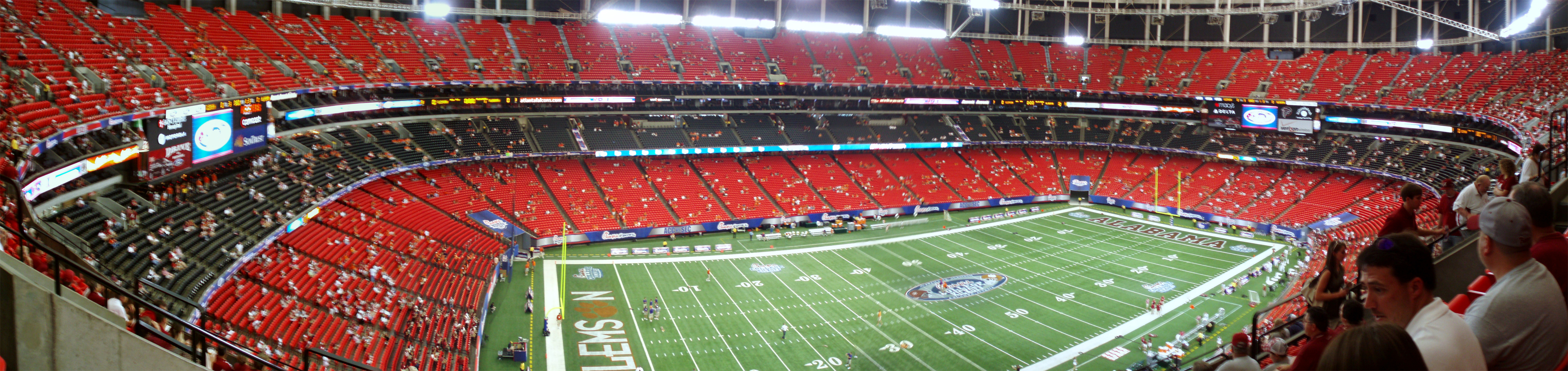
Panoramic pic of the Georgia Dome, Atlanta, GA (where was on the left of the field back in '94), August 30, 2008. (Latics via Wikipedia). Released to  public domain via CC-SA-3.0.

Panoramic pic of the Georgia Dome, Atlanta, GA (where was on the left of the field back in ’94), August 30, 2008. (Latics via Wikipedia). Released to public domain via CC-SA-3.0.

There was a jazz and blues extravaganza going on at the Georgia Dome in downtown Atlanta that evening, and so within hours of landing, we were back in the heart of the city, setting up equipment on what normally was the playing field for the Atlanta Falcons. I was so mesmerized thinking about losing a football in the lights of the Georgia Dome that my uncle yelled at me to “get my ass in gear,” because he needed help unloading some heavy equipment. I wasn’t the biggest fan of the quality of music, but having a backstage view of the whole thing, and to see what my uncle Paul did for a living, I was truly, truly impressed.

That Sunday I spent in my uncle’s home, hearing about his playing days, his knee issues, his knowledge of basketball as a game, his travels to play in Europe, and indirectly, his sexual conquests. That last part I could’ve done without — I’d spent two days hearing the same thing from my other uncles the month before. Then he grilled me with questions about Mount Vernon, about New York, about why I didn’t play sports, about “the chicks in college.” My Uncle Paul assumed, incorrectly, that living in New York was heaven compared to being tenant farmers in southwestern Arkansas, and that I was in grad school for the sex. “I wouldn’t have made it to where I am if that was what it was all about,” I said in shocked response.

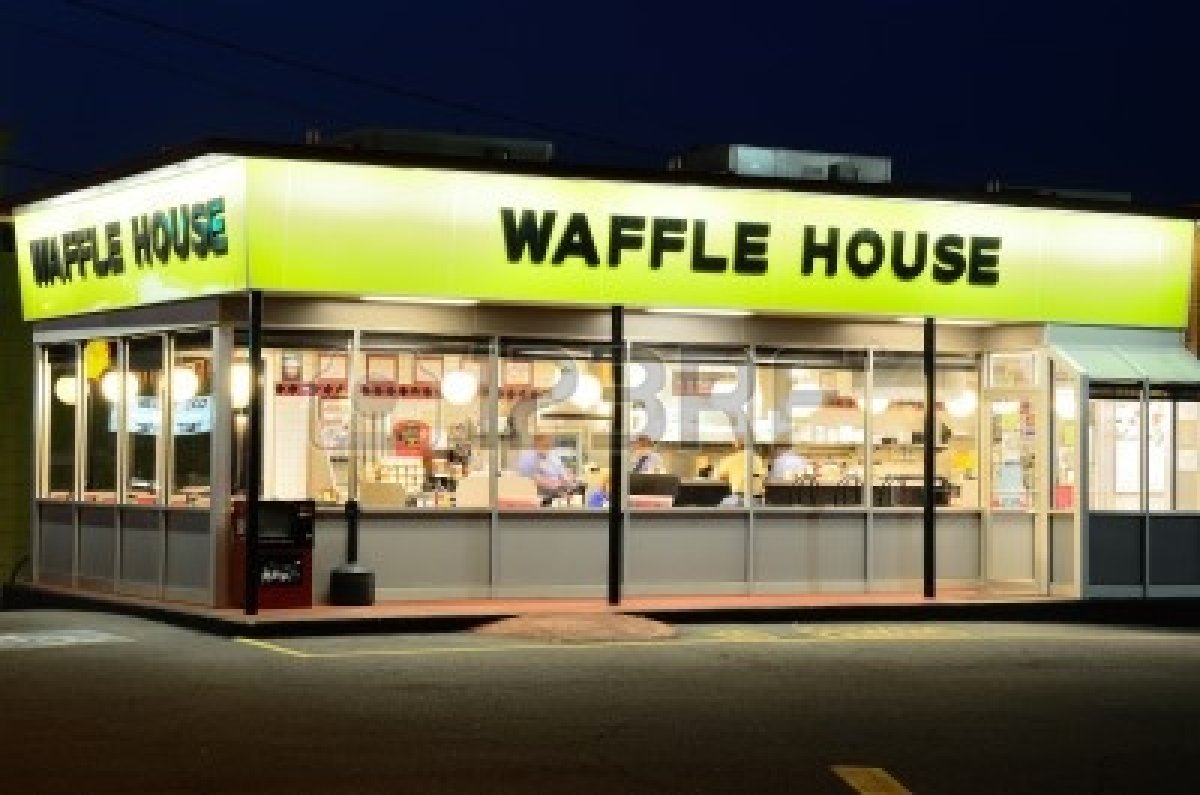
Waffle House, off UGA's main campus (and across street from seedy motel I stay in night before conference), Athens, GA, June 1, 2011. (http://www.123rf.com).

Waffle House, off UGA’s main campus (and across street from seedy motel I stay in night before conference), Athens, GA, June 1, 2011. (http://www.123rf.com).

He made a jambalaya dinner for us and his lady friend, all the while talking about each other’s work. My uncle’s son was bored to tears. Then, after dinner, and after his girlfriend had left and his son had gone to hang out with friends, my uncle took me out in his vintage Porsche 911 (it had been covered in the parking lot up to that point) to some high-class, late-night, members-only club somewhere in Gwinnett. Between him doing somewhere around eighty in a fifty-five and taking me to this place to “meet a girl,” I was in more shock. “I like looking for women on my own, thank you very much,” I yelled through the Mary J. Blige at one point.

I went off that Monday morning to Athens for the Brown Decision conference, and was gone for thirty hours. I did get a ride back from a presenter, and then a ride back my uncle’s place. That’s when I walked into the place to see my cousin on the black-leather living room couch, stripped down and on top of a young woman. He only stopped when I yelled for a second time, “I’m back!” Then, the proverbial scattering of two youngins’ caught up in lust occurred. They left, presumably to finish what they had started.

I left for New York that Wednesday morning, having enjoyed my time with my Uncle Paul, but also seeing some downside to a lifestyle that left him busy and his son without supervision. That some dumb thug killed my cousin four years later was still very much a surprise, as he wasn’t a violent person, at least the person I met in ’94. I felt so horrible for him and for my Uncle Paul, as I couldn’t imagine the totality of the pain of such a tragedy.

But good, bad or otherwise, it felt good to get to know my people, my family. I’d grown up with a family that was one in name only. Poverty, religion, abuse had all rendered the meaning of family useless for me growing up, and seeing more examples of the same thing in my time in Mount Vernon didn’t help. I knew that my Uncle Paul wasn’t perfect. Nor were my uncles in Houston. But I knew they loved each other, had dreams and plans for their lives, and had acted on many of these things in living their lives. I knew that I needed to keep doing the same.

My First Adult Job Interview, Teachers College

12 Monday May 2014

Posted by decollins1969 in 1, Academia, Boy @ The Window, Carnegie Mellon University, culture, Eclectic, eclectic music, Mount Vernon New York, New York City, Pittsburgh, Politics, Pop Culture, race, Upper West Side, Work, Youth

≈ Leave a comment

Tags

Barnes & Noble, Beacon Theater, Calling, CMU, Disillusionment, Finishing Second, Hotel Beacon, job interview, Job Talk, Joe William Trotter Jr., PTSD, Racial Harassment, Rage, Steven Schlossman, Teachers College, Walking While Black, Writer, Writing


Teachers College today, West 120th (between Broadway and Amsterdam), New York, NY, April 15, 2014. (http://ccnmtl.columbia.edu/).

Teachers College today, West 120th (between Broadway and Amsterdam), New York, NY, April 15, 2014. (http://ccnmtl.columbia.edu/).

Seventeen years ago this week (check the calendar – the days and dates coincide with the week of May 12-18, ’97) was perhaps one of the most euphoric and bitterly disappointing weeks in my entire adult life. It was such a strange week that it forced me into second guessing myself and my path in life for many years afterward.

But it didn’t start out that way. On Monday, May 12th, I did my very first post-doctoral interview, for an assistant professor position at Teachers College (Columbia’s school of education) in Morningside Heights (West Harlem, really). I’d flown in from Pittsburgh the evening before, and stayed at the Hotel Beacon at Teachers College’s expense, because Monday was going to be a very long day. It was loud that Sunday night, as there was some event at the Beacon Theater. But somehow, I had just enough discipline and memories of New York’s smells and sounds to fall asleep comfortably.

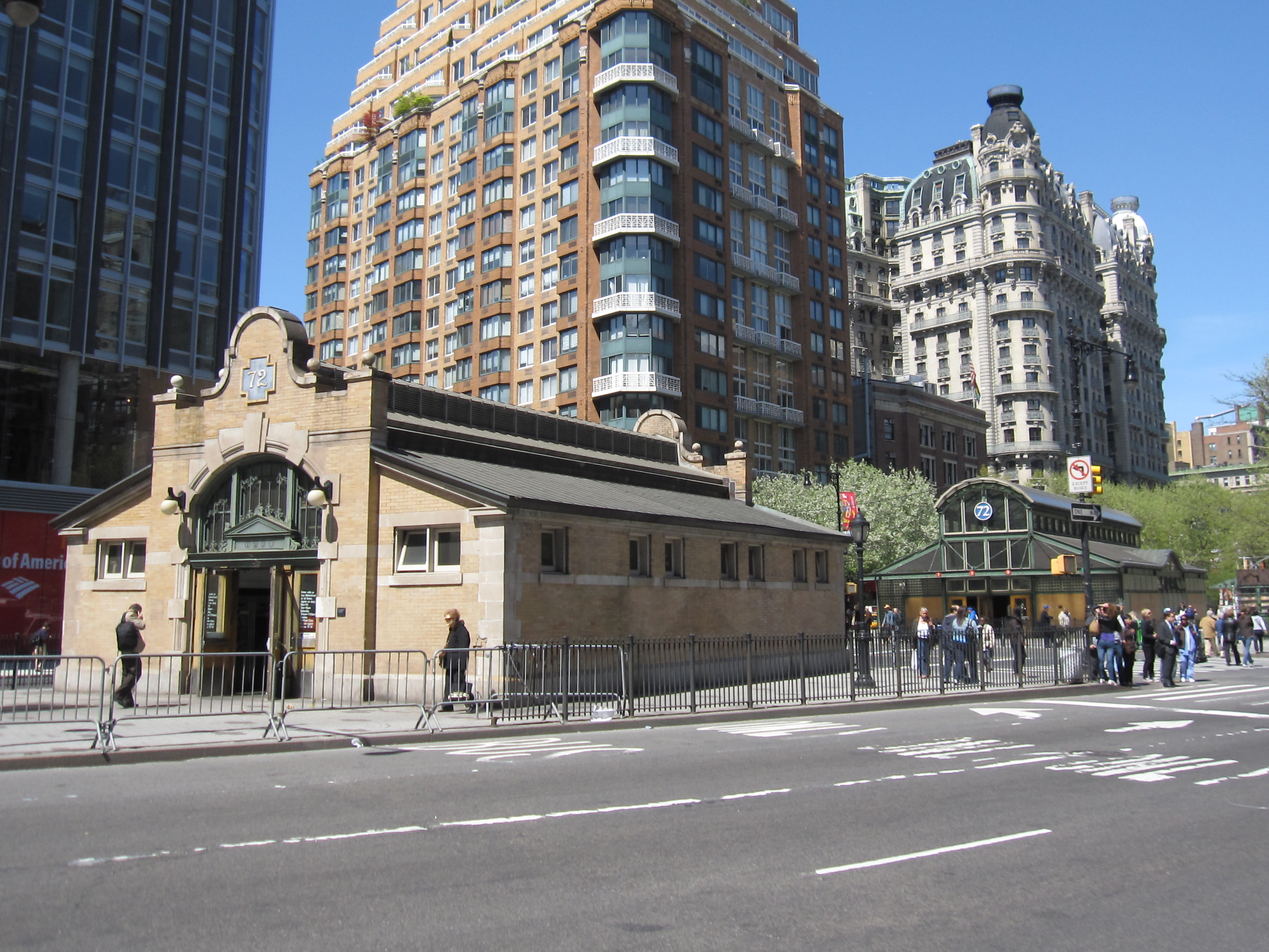
My day started at 8:30 am, so of course, I was up before seven. I put on my one and only suit — at least, the only suit I owned that fit my six-three, 215-pound frame — went over my job talk on multiculturalism, and went on my pensive way to the 72nd Street Subway entrance on Broadway. It was a meat-packed ride to 125th Street, where I had to get off (I had forgotten to walk down to 66th Street to catch the local 1 instead of the express 2 train) and walk the six or so blocks to Teachers College.

Original control house (left) and newer control house, on opposite sides of 72nd Street  (IRT Broadway – Seventh Avenue Line), New York, NY, April 13, 2010. (Gryffindor via Wikipedia). Released to public domain via CC-SA-3.0.

Original control house (left) and newer control house, on opposite sides of 72nd Street (IRT Broadway – Seventh Avenue Line), New York, NY, April 13, 2010. (Gryffindor via Wikipedia). Released to public domain via CC-SA-3.0.

After that, my day was an eight-hour blur, meeting with faculty, grad students and deans. Making sure not to eat too much while being grilled with questions over lunch. Giving my job talk and making sure to tell jokes, to bring up facts relevant to this history of education job, and, of course, to smile. Talking with grad students about how I finished my 505-page dissertation in twenty-seven months, about my teaching style and about growing up in Mount Vernon. It was as intense a process as I had expected it to be, but I felt at the end that I’d done everything possible to get the job.

I knew that I was one out of only five candidates invited to interview, out of over 500 applicants. I even had the chair of the History Department, Steve Schlossman, lobby on my behalf for the job, prior to my interview. And, despite my former advisor in Joe Trotter, I’d managed to put together a group of letters from folks that should’ve passed muster. All I could do after the interview was wait.

But life didn’t wait to intervene. After leaving the interview for the hotel, I changed into my more casual clothing, jeans and a long-sleeve t-shirt, and went off to Tower Records and Barnes & Noble on 66th and Broadway, and later, Haagan Dazs (that last one was a big gastrointestinal mistake!).  

From the moment I walked in the door at Barnes & Noble until I left a half-hour later, a Latino security guard tailed me as I perused books in the African American nonfiction, Cultural Studies and Music sections of the store, across three floors. As I walked out, I walked up to the guard and said

“While you were stalking me, you probably let half a dozen White folks slip out of here with books and CDs. Did you learn anything while you were watching me?”

“I was just doing my job,” the dumb-ass security guard said in response.

“Well, if following a Black guy around for thirty minutes is part of your job, you deserve to lose your job,” I said to him as I walked out.

It was a bit of a harbinger of things to come. I was more pissed off about these everyday slights — or, rather, microaggressions — than I’d been before Trotter and my doctorate. And I was less patient about waiting for what I wanted than I’d been as a grad student.

What your second-place prize often looks like, May 12, 2014. (http://www.wmciu.org.uk/).

What your second-place prize often looks like, May 12, 2014. (http://www.wmciu.org.uk/).

Three weeks later, I received a reimbursement check for my travel and other expenses, and within twenty-four hours, a call from the search committee chair. I’d finished second for the job. Second! To whom, I still don’t know. The chair kept telling me, “you didn’t do anything wrong…you did a very good set of interviews,” as if those compliments would pay my rent next month. I was disappointed, hopeful, but disappointed. It was my first shot, my best shot, and I’d given my best effort. “What now?,” I thought.

It’s a question that I still must ask seventeen years, two books and two careers later. I’ve long since realized that the question of what my life would’ve been like if I’d gotten the Teachers College job was moot, because my issues were about more than finding work. I still would’ve been unhappy, with a New York-esque rage to go with it.

So I counted my blessings, and I count them still. Not getting this particular job bought me the time and energy I needed. I needed that time, to see myself as the writer I also wanted to be, not just the educator and thinker I already knew I was. A better, more personable, more revealing and feeling writer than the cold and metallic one that grad school and Trotter helped turn me into by the end of ’96.

Last Dance, The Last Class

09 Friday May 2014

Posted by decollins1969 in 1, Academia, Carnegie Mellon University, culture, Eclectic, Pittsburgh, Politics, Pop Culture, University of Pittsburgh, Work, Youth

≈ Leave a comment

Tags

"Last Dance" (1979), Boredom, CMU, Coming-of-Age, Coursework, Department of HIstory, Donna Summer, Grad School, Growing Up, Loneliness, Pitt, Single-Minded, Student Life


The late Donna Summer, album cover, circa 1979, May 9, 2014. (http://digboston.com/).

The late Donna Summer, album cover, circa 1979, May 9, 2014. (http://digboston.com/).

Twenty years ago on this date was my last formal class as a formal student, a grad course at Carnegie Mellon with Kate Lynch on Comparative Urban History. I spent that evening of my last day of classes polishing up a twenty-five page research essay that compared the development of public housing practices in Toronto, Berlin and Chicago. It was too ambitious a paper, especially given that I did all the research for it in the final four weeks of that semester, after spending a week at AERA (American Educational Research Association) in New Orleans presenting on a panel and networking, and two days meeting the Gill side of my extended family for the first time. I just wanted to get it done, though.

I made my final edits to my introduction and argument and to a few of my citations and references just before 9:30 pm that second Monday in May ’94. I was working in a computer lab in Wean Hall, using one of the rare PCs on campus. Rare because Carnegie Mellon had made a ridiculous deal with Apple back in ’83 to be a Macintosh campus — a terrible move if you were using Macs in the 1990s.

Apple Macintosh II Computer, April 15, 2004. (Alexander Schaelss via Wikipedia). Released via GNU FDL/CC-SA-3.0.

Apple Macintosh II Computer, April 15, 2004. (Alexander Schaelss via Wikipedia). Released via GNU FDL/CC-SA-3.0.

Normally I wrote my papers on the University of Pittsburgh’s campus, as my alumnus status gave me access to computers and Hillman Library. Plus, it took Pitt almost a year to shut down my grad school accounts, allowing me to make thousands of copies of materials that I would’ve needed a month’s worth of my stipend to make at Carnegie Mellon’s Hunt Library. And, even after a year of torture and courses, nearly all of my friends and interests remained across the bridge connecting Oakland and Pitt with Schenley Park and the southern end of Carnegie Mellon’s campus.

Once I completed my paper, I walked over to Baker Hall, went up to the second floor, and dropped it off for Lynch to review and grade. It was all over but the dissertation overview defense and the dissertation itself. I was happy, but I was more relieved than happy. The last year of transferring to and doing coursework at Carnegie Mellon had taken a toll on me. For the first time ever, I found myself actually hating classes and school in general. Sure, there were individual teachers and professors I despised. Dr. Demontravel. David Wolf. Estelle Abel. Dick Ostreicher. But not the formal process of classroom learning itself. It took a year of redundant courses at CMU at the insistence of the powers that were to steal that immutable joy of learning from me. At least, temporarily.

I thought about it the next day. My first day of kindergarten was September 8, ’74, which meant that I had experienced twenty school years between the ages of four and twenty-four. For virtually all of my life, I’d been a student, from kindergarten to PhD, between Presidents Nixon and Ford and Bill Clinton. I had done several thousand assignments, hundreds of exams, and dozens of papers and essays. Combining undergrad and grad school, I’d taken fifty-eight (58) courses. It’s a wonder I hadn’t tired of listening to mercurial professors any sooner.

Keep Calm and Hate School poster, May 9, 2014. (http://keepcalmstudios.com).

Keep Calm and Hate School poster, May 9, 2014. (http://keepcalmstudio.com).

I spent the next few days doing something I normally didn’t have time for. I slept in late, took lots of naps, and watched my Knicks play and struggle with the Jordan-less Bulls in the NBA’s second round of playoffs. It would be the most rest I’d have for the rest of ’94.

Two decades later, and I’ve taught nearly as many courses as I took to earn my bachelors, masters and doctorate. I do like the view of a classroom — in-person or virtual — from the instructor’s perspective. But I learned so much about being a teacher, too, from what to do and what not to do, long before my final semesters at Carnegie Mellon. Ms. Griffin, Mrs. Shannon, Mrs. O’Daniel, Mrs. Bryant, Harold Meltzer were great counterbalances to the teachers/professors who were as inspiring as watching paint dry in a desert.

Friendship, Marriage and Falsehoods

28 Monday Apr 2014

Posted by decollins1969 in 1, Boy @ The Window, Christianity, culture, Eclectic, Marriage, Pittsburgh, Pop Culture, Religion, Work, Youth

≈ 1 Comment

Tags

Angelia N. Levy, Family, Friendship, Husband-Wife Relationship, Love, Romance, Romantic Love, Wedding Anniversary, Work of Marriage


Me and Angelia at my PhD graduation, Carnegie Mellon University, May 18, 1997. (Edward Lomax).

Me and Angelia at my PhD graduation, Carnegie Mellon University, May 18, 1997. (Edward Lomax).

Today marks fourteen years of marriage. Statistically, we’re either a year away from divorce, or on board for a longer roller-coaster-ride of life and love, struggle and stress, revelation and renewal. Either way, it’s already been a great two decades of learning about myself and my wife, about the meaning of love (conditional and unconditional) and the limits of romance, about the real meaning of family and marriage.

Some of you may not believe this, but a marriage of any realness is hard work. We get tired of ourselves, our baggage, our bullshit. Now add another human being to the mix, the person you share most everything with. It can be a emotional meltdown of epic proportions if you’re not mature enough to have a well-honed sense of empathy, not to mention a sense of humor and a sense of when to back off.

I can say from experience that it helps to have been friends long before love, romance, marriage and parenting became part of the bargain. And not just friends, but the best of friends. Without having that, everything else is work without purpose, drudgery and painful struggles with personal and spiritual growth.

One of the many things I’ve learned in the past decade and nearly a half is that marriage itself has been loaded with context, deriving from Western ideas that have their roots in European royalty and the 19th century warping of such ideas for us ordinary folk. Including Whiteness and chivalry, of weird evangelical notions of masculinity and femininity, of patriarchy and high-born expectations. Only to realize that these ideas come out of an era of arraigned marriages, essential contracts to secure bloodlines and power for another generation of the elite classes. Romance, love, the eternal enduring bond between two soul-mates – that was never part of this bargain. But leave it to capitalism to distort a loveless process of procreation into an intense, always-falling-in-love – but without standing in love in the midst of struggle – idea of marriage.

Because of this knowledge, I know, too, that every marriage is different. And because of the unique nature of every relationship, I also know that my relationship with my wife is constantly evolving. Meaning that any ideas of marriage that I had fourteen years ago have been dead for a while. Trust me, this is a good thing. There is no singular road map to a happy and always-in-love marriage – that fairy tale is for the Anna Hathaway/Princess Bride set who remains at the mental age of eight or twelve.

No, a good marriage is about two people working toward similar goals, to a friendship that keeps changing, even if the contours of that friendship become ever more complicated. After all, it’s from that ground of friendship that our love shot up in the first place. Yay, us!

← Older posts
Newer posts →

Boy @ The Window: A Memoir

Boy @ The Window: A Memoir

Places to Buy/Download Boy @ The Window

There's a few ways in which you can read excerpts of, borrow and/or purchase and download Boy @ The Window. There's the trade paperback edition of Boy @ The Window, available for purchase via Amazon.com at http://www.amazon.com/Boy-Window-Donald-Earl-Collins/dp/0989256138/

There's also a Kindle edition on Amazon.com. The enhanced edition can be read only with Kindle Fire, an iPad or a full-color tablet. The links to the enhanced edition through Apple's iBookstore and the Barnes & Noble NOOK edition are below. The link to the Amazon Kindle version is also immediately below:

scr2555-proj697-a-kindle-logo-rgb-lg

Boy @ The Window on Amazon.com: http://www.amazon.com/Boy-The-Window-Memoir-ebook/dp/B00CD95FBU/

iBookstore-logo-300x100

Boy @ The Window on Apple's iBookstore: https://itunes.apple.com/us/book/boy-the-window/id643768275?ls=1

Barnes & Noble (bn.com) logo, June 26, 2013. (http://www.logotypes101.com).

Boy @ The Window on Barnes & Noble: http://www.barnesandnoble.com/w/boy-the-window-donald-earl-collins/1115182183?ean=2940016741567

You can also add, read and review Boy @ The Window on Goodreads.com. Just click on the button below:

Boy @ The Window

Twitter Updates

Tweets by decollins1969
  • RSS - Posts
  • RSS - Comments

Archives

  • June 2025
  • April 2023
  • September 2022
  • August 2022
  • July 2022
  • June 2022
  • May 2022
  • April 2022
  • March 2022
  • January 2022
  • December 2021
  • November 2021
  • October 2021
  • September 2021
  • August 2021
  • July 2021
  • June 2021
  • April 2021
  • March 2021
  • February 2021
  • January 2021
  • December 2020
  • November 2020
  • October 2020
  • September 2020
  • August 2020
  • July 2020
  • May 2020
  • April 2020
  • March 2020
  • January 2020
  • December 2019
  • November 2019
  • August 2019
  • July 2019
  • June 2019
  • May 2019
  • April 2019
  • March 2019
  • February 2019
  • January 2019
  • December 2018
  • November 2018
  • October 2018
  • September 2018
  • August 2018
  • July 2018
  • June 2018
  • May 2018
  • March 2018
  • February 2018
  • January 2018
  • December 2017
  • November 2017
  • October 2017
  • September 2017
  • August 2017
  • July 2017
  • June 2017
  • May 2017
  • April 2017
  • March 2017
  • February 2017
  • January 2017
  • December 2016
  • November 2016
  • October 2016
  • September 2016
  • August 2016
  • July 2016
  • June 2016
  • May 2016
  • April 2016
  • March 2016
  • February 2016
  • January 2016
  • December 2015
  • November 2015
  • October 2015
  • September 2015
  • August 2015
  • July 2015
  • June 2015
  • May 2015
  • April 2015
  • March 2015
  • February 2015
  • January 2015
  • December 2014
  • November 2014
  • October 2014
  • September 2014
  • August 2014
  • July 2014
  • June 2014
  • May 2014
  • April 2014
  • March 2014
  • February 2014
  • January 2014
  • December 2013
  • November 2013
  • October 2013
  • September 2013
  • August 2013
  • July 2013
  • June 2013
  • May 2013
  • April 2013
  • March 2013
  • February 2013
  • January 2013
  • December 2012
  • November 2012
  • October 2012
  • September 2012
  • August 2012
  • July 2012
  • June 2012
  • May 2012
  • April 2012
  • March 2012
  • February 2012
  • January 2012
  • December 2011
  • November 2011
  • October 2011
  • September 2011
  • August 2011
  • July 2011
  • June 2011
  • May 2011
  • April 2011
  • March 2011
  • February 2011
  • January 2011
  • December 2010
  • November 2010
  • October 2010
  • September 2010
  • August 2010
  • July 2010
  • June 2010
  • May 2010
  • April 2010
  • March 2010
  • February 2010
  • January 2010
  • December 2009
  • November 2009
  • October 2009
  • September 2009
  • August 2009
  • July 2009
  • June 2009
  • May 2009
  • April 2009
  • March 2009
  • February 2009
  • January 2009
  • December 2008
  • November 2008
  • October 2008
  • September 2008
  • August 2008
  • July 2008
  • June 2008
  • May 2008
  • April 2008
  • March 2008
  • February 2008
  • January 2008
  • December 2007
  • November 2007
  • October 2007
  • September 2007
  • August 2007
  • July 2007
  • June 2007

Recent Comments

MaryPena's avatarMaryPena on My Day of Atonement/Bitter Hat…
decollins1969's avatardecollins1969 on No Good Teaching Deed Goes…
Mary Rose O’Connell's avatarMary Rose O’Connell on No Good Teaching Deed Goes…

NetworkedBlogs on Facebook

NetworkedBlogs
Blog:
Notes From a Boy @ The Window
Topics:
My Life, Culture & Education, Politics & Goofyness
 
Follow my blog

616 616 East Lincoln Avenue A.B. Davis Middle School Abuse Academia Academy for Educational Development AED Afrocentricity American Narcissism Authenticity Bigotry Blackness Boy @ The Window Carnegie Mellon University Child Abuse Class of 1987 CMU Coping Strategies Crush #1 Crush #2 Death Disillusionment Diversity Domestic Violence Economic Inequality Education Family Friendship Friendships Graduate School Hebrew-Israelites High-Stakes Testing Higher Education History Homelessness Humanities Humanities Program Hypocrisy Internalized Racism Jealousy Joe Trotter Joe William Trotter Jr. K-12 Education Love Manhood Maurice Eugene Washington Maurice Washington Misogyny Mother-Son Relationship Mount Vernon High School Mount Vernon New York Mount Vernon public schools Multiculturalism MVHS Narcissism NFL Pitt Pittsburgh Politics of Education Poverty President Barack Obama Race Racial Stereotypes Racism Relationships Self-Awareness Self-Discovery Self-Reflection Sexism Social Justice Teaching and Learning University of Pittsburgh Violence Whiteness Writing

Top Rated

Blog at WordPress.com.

  • Subscribe Subscribed
    • Notes from a Boy @ The Window
    • Join 103 other subscribers
    • Already have a WordPress.com account? Log in now.
    • Notes from a Boy @ The Window
    • Subscribe Subscribed
    • Sign up
    • Log in
    • Report this content
    • View site in Reader
    • Manage subscriptions
    • Collapse this bar
 

Loading Comments...