• About Me
  • Other Writings
  • Interview Clips
  • All About Me: American Racism, American Narcissism, and the Conversation America Can’t Have
  • Video Clips
  • Boy @ The Window Pictures
  • Boy @ The Window Theme Music

Notes from a Boy @ The Window

~

Notes from a Boy @ The Window

Category Archives: Pop Culture

The Week The Lights Went Out In America

08 Tuesday Oct 2013

Posted by decollins1969 in 1, Boy @ The Window, culture, Eclectic, Mount Vernon New York, New York City, Politics, Pop Culture, race, Work, Youth

≈ Leave a comment

Tags

American Dominance, American Economy, Arab-Israeli War 1973, Best Days, Brighter Future, Economic Inequality, Gas Lines, Inflation, Job Discrimination, Low-Wage Jobs, OPEC Oil Crisis, OPEC Oil Embargo, Political Will, Politicians, Poverty, Prosperity, social mobility, Stagflation, Superpower, unemployment, Yom Kippur War


Gas station displayed a sign that explained the flag policy during the first OPEC oil embargo and crisis (Oregon), May 1974. March 26, 2013. (NARA via Wikipedia). In public domain.

Gas station displayed a sign that explained the flag policy during the first OPEC oil embargo and crisis (Oregon), May 1974. March 26, 2013. (NARA via Wikipedia). In public domain.

It wasn’t the middle of September of ’08, either. It was the beginning of October ’73, forty Yom Kippur holy days ago. There had been signs for any American who had cared to look at the cracks in the US dominance of the world economy ceiling. Rising unemployment, higher inflation, new monetary control measure, competition from a mostly rebuilt West Germany and Japan. The twenty-eight year-long run America had as the undisputed and undefeated leader of the capitalist world was on its way to a close, and ninety-nine percent of all Americans didn’t know or didn’t care enough to know.

No, the Yom Kippur War between Syria, Egypt and Israel didn’t cause the US to become more dependent on the rest of the world. But our support of Israel against countries from which we imported oil did lead to OPEC’s decision to deny us oil. Up to that point, our government had pretty much done whatever it wanted geopolitically, on behalf of containing Communism and American corporations. It was this week forty years ago, though, that truly began to teach ordinary Americans that there would be consequences for our foreign policy actions without regard for folks who lived at the blunt end of them.
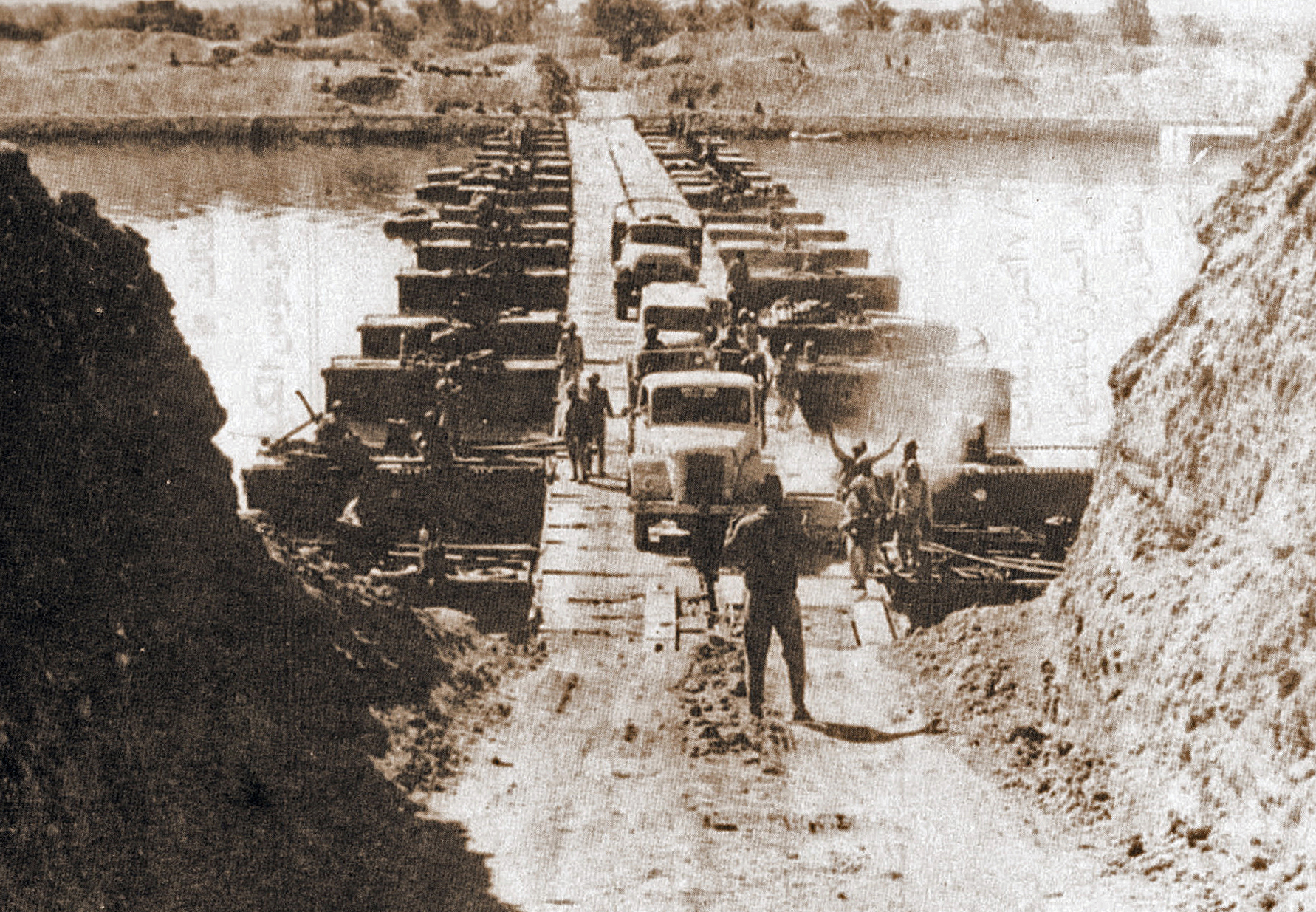
Egyptian forces cross on one of the bridges laid across the Suez Canal, October 7, 1973.   (CIA/Soerfm via Wikipedia). In public domain.

Egyptian forces cross on one of the bridges laid across the Suez Canal, October 7, 1973. (CIA/Soerfm via Wikipedia). In public domain.

I was just a couple of months away from turning four, but I do have vague memories of the week and month from four decades ago. Within a block of where my Mom worked, Mount Vernon Hospital, was a gas station, one that by the end of October had lines wrapped around the block as motorists in their six-miles-to-the-gallon guzzlers desperately waited for some petrol. It was loud and chaotic, from the little bit that I do remember. Fast forward to about a year later, when my Mom took me and my other brother Darren to the old Met grocery store on South Fulton in Mount Vernon. There, she complained about the $2.69 she had to spend on a five-pound bag of Domino’s Sugar ($14.53 in 2013 dollars). I remember her sighing about the high prices and the fact that her paycheck wouldn’t be able to keep up.

It would be years later still before I realized that the last of America’s easiest days as an economic and geopolitical superpower were during my years as a toddler. I did feel secure back then, not knowing about my father’s alcoholism, my mother’s insecurities about being a Black Southern girl living in and around New York City. I had yet to witness the violence embedded in my family, or in my neighborhoods, for that matter. I knew nothing of drug addiction or authentic Blackness, of racism and systemic job discrimination. I had yet to learn that the economic and educational opportunities that had been available to millions of Americans — almost regardless of race and gender — were about to become that much harder to attain and retain as I grew older.

Now, forty years later, as memories of the Reagan and Clinton years have faded, I think of America’s heady days, ones that now seem of lore. I realize that America could have even better days ahead. If we were to acknowledge human involvement in climate change and invest heavily in a green economy. If quality, well-funded universal pre-K to higher education became our reality, without creating one system for elites and another for everyone else. If we as a people finally said it was time to repair $3 trillion worth of infrastructural damage to our bridges and roads, to our sewer and water systems, and to our electrical grid. If we somehow decided to end our expensive wars on drugs and on Black men, on anyone whom we think (but do not know) may do our nation’s interests (if not our people) harm.

Collage of workers placing an F-Series bed onto frame at  Louisville Assembly Plant (Kentucky), 1973. (http://media.ford.com)and a woman carrying a sign past a McDonald's on East 125th Street during a protest by fast food workers and supporters, New York, NY, April 4, 2013. (Stan Honda/AFP/Getty Images via http//:financialpost.com).

Collage of workers placing an F-Series bed onto frame at Louisville Assembly Plant (Kentucky), 1973. (http://media.ford.com); a woman carrying a sign past a McDonald’s on East 125th Street during a protest by fast food workers and supporters, New York, NY, April 4, 2013. (Stan Honda/AFP/Getty Images via http://financialpost.com).

But I know that we won’t have those better days, at least not yet. Not with narcissistic politicians either lining their pockets with money or lining their minds with sugarplum hopes for the Rapture and Armageddon. Not with a media more interested in the political horserace and petty optics than in giving us the full story. And not with an American public more interested in Miley Cyrus than in funding for more psychologists in public schools.

It’s truly depressing to know how far our nation hasn’t come in four decades, virtually my entire lifetime. At least I know, though. For so many born after me — not to mention lacking self-reflection — they may never know what should’ve been.

The Road to Boy @ The Window, Part 4: Fear of a “Black” America

26 Thursday Sep 2013

Posted by decollins1969 in 1, Academia, Boy @ The Window, Carnegie Mellon University, culture, Eclectic, eclectic music, music, Patriotism, Pittsburgh, Politics, Pop Culture, race, University of Pittsburgh, Youth

≈ Leave a comment

Tags

Academia, Afrocentricity, Authentic Blackness, Authenticity, Emotion, Estelle Abel, Fear of a "Black" America, Fear Of A Black Planet, Fear of Black Males, Joe Trotter, Multicultural Education, Multiculturalism, PE, Personal Vignettes, Politics of Academia, Politics of Education, Politics of Fear, Public Enemy, Rage, Richard Altenbaugh


FearBookCover3copy

Given that Fear of a “Black” America was my first book, but one based on my doctoral dissertation, and that Boy @ The Window is a memoir, the road from one to the other may not be that obvious with an initial glance. But despite the intellectual, semi-scholarly nature of my book on Blacks and multiculturalism, there are parallel themes that run between Fear of a “Black” America and Boy @ The Window. Perhaps none are more important, though, than the challenge of authenticity, of fitting in, of being able to mesh the complicated onion that I’ve found myself to be over the years.

I think that was why I decided in November ’98 to turn my dissertation “A Substance of Things Hoped For” into a more readable book. Yes, after all that work to write a 505-page thesis, it would’ve been a shame to just let it sit on my then girlfriend’s coffee table, to be used either as a door stop or a base for her doing her nails. Yes, I still had something to prove to academia. That my scholarship as a historian and educator on the issue of multiculturalism was sound. That the conventional academic wisdom around Blacks, people of color and multiculturalism was paternalistic fear-mongering.

Public Enemy, Fear Of A Black Planet (1990) Album Cover

Public Enemy, Fear Of A Black Planet (1990) Album Cover

And in thinking that last part through, I came up with my Public Enemy-inspired title and thread for the first book. It was about fear in many forms. Elite White fears of a majority-people-of-color US within their own lifetimes. Conservative fears of a K-16 education system that included the cultural and historical perspectives of peoples of color, of the poor, of women, of the LGBT, of so many others they’d rather discard. General American skepticism that any Blacks had ever given any thought at all to cultural pluralism, intercultural education, or multiculturalism/multicultural education, at least before White theorists had thought through these ideas first.

Afrocentrists and nationalists who thought of multiculturalism as soft and utterly unrepresentative of the Black experience — or, at least, what they considered an authentic version thereof? That was as difficult a challenge as any I faced in writing both my dissertation and Fear of a “Black” America. So much so that I made a few interesting decisions along the way. I sought out an agent — yes, a literary agent — for the first book, and found one, too (things were so much easier in ’99). I wanted the book to have an impact beyond academia.

In the writing process, I decided to weave the theme of fear, skepticism, willful and inadvertent misunderstandings throughout the 200-page book. All while covering Black intellectual thought about what we now call Afrocentricity and multiculturalism, Black activism and activities around education and Negro History Week, and the so-called Culture Wars of the 1980s and 1990s. All to show that multiculturalism was/is a part of America’s evolution, even if some folks are gnashing their teeth and wearing sackcloth and ashes along the way.

One thing was missing, though, from my six chapters. Me, in a word. Yes, my argument was crystal clear, my evidence was sound, my notes and analysis lined up well enough by the summer of ’00. Yet, as my one-time agent noted, “there’s not enough of you in this manuscript.”  Bottom line: folks weren’t going to buy the book unless I made it more compelling, which meant putting something of me or about me in it.

Fear Book & The Authentic Me

Fear Book & The Authentic Me

So I did. I wrote mostly about my experiences in academia and how they paralleled with some of the critical issues in Fear of a “Black” America. I talked about my Duquesne University students in the College of Education in ’98 and ’99, most of whom were cultural conservatives. I brought up conversations I had with professors skeptical about my scholarship, like Richard Altenbaugh in March ’98 or my former dissertation advisor Joe Trotter in April ’96. I also wrote about my conversation with Estelle Abel over my lack of authenticity as a young Black man in June ’87, having thought about it for the first time in thirteen years. I wasn’t sure if that made Fear of a “Black” America any better, but it made me feel better about my first book.

By the time I’d given my agent the final draft of Fear of a “Black” America in October ’00, I was ready — maybe for the first time in years — to take a look at my life before Pitt, grad school, Spencer Fellowship and becoming Dr. Collins. I wasn’t sure if I wanted to open up the emotional side of that Pandora’s box just yet. But in some ways, I really needed to, precisely because of my experiences with people in grad school at Pitt and Carnegie Mellon. And precisely because of my occasional moments of rage and overreaction, if only because Fear of a Black “America” helped me tap into emotions I didn’t know I had.

On the Insignificance of Saggy Pants & Respectability

20 Friday Sep 2013

Posted by decollins1969 in Boy @ The Window, culture, Eclectic, eclectic music, Movies, music, Politics, Pop Culture, race, Youth

≈ Leave a comment

Tags

Birmingham Church Bombing, Black Elite, Boyz n the Hood (1991), Economic Inequality, Florida A&M University, Hip-Hop Culture, Institutional Racism, John L. Lewis, Jonathan Ferrell, March on Washington, NWA, Police Brutality, Racism, Respectability, Saggy Pants, Thug Life, TLC, Trayvon Martin, Tupac, Violence, White Supremacists


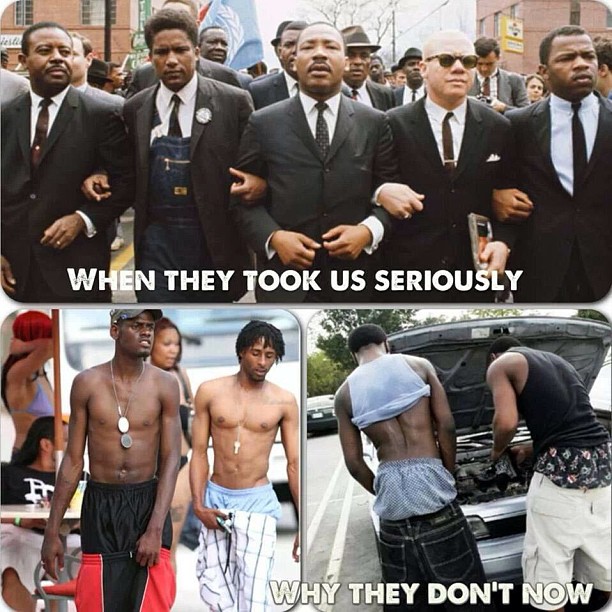
"When They Took Us Seriously/Why They Don't Now" poster, September 20, 2013. (Tim Brinkley/Google +).

“When They Took Us Seriously/Why They Don’t Now” poster, September 20, 2013. (Tim Brinkley/Google +).

In the past month of March on Washington and “I Have A Dream” speech commemorations and Birmingham church bombing dedications, a series of images lamenting rap culture and “thug life” have made their way around the Internet. The one that has stuck with me the most has been the image of the Selma March in 1965 juxtaposed with seemingly random photos of young Black males with saggy pants. The caption reads, “When they took us seriously/Why they don’t now.” Really? White supremacists took respectable Negroes seriously in the ’60s because they marched and wore suits, but don’t take Black males seriously now because of the saggy pants phenomenon? The truth is, they did and didn’t take us seriously then and now, and it has almost nothing to do with pulling our pants up above our boxers.

I have to say, though, that I hate saggy pants. It makes the people wearing them look somewhere between goofballs and idiots. It’s never mattered to me whether White guys or Black guys or college guys or hip-hop divas have worn saggy pants. I didn’t like it when it became a style in the early ’90s, thanks in large measure to NWA and Tupac, TLC and Snoop Dog and a host of other hip-hop/rap artists. I certainly don’t like it now, and would never buy a pair for my ten-year-old son to wear that way. The saggy pants style has been a sad twist on hand-me-downs and poverty as marketable clothes for the hip-hop cool.

But the saggy pants style has never translated for me as embracing a  “thug life” or some devolution of Black culture or American society. It wasn’t life imitating art, ala Boyz n the Hood (1991), Menace II Society (1993) or Clockers (1997). Nor have I ever seen it as something that meant that Whites or the new Black elite could say, “See. These Black folk don’t deserve respect, or health care, or a quality education, or good-paying jobs.” Over the past two decades, I’ve seen it as a style — a bad style, to be sure — but a style that some Blacks (and Whites, Latinos and Asians) have embraced.

Any young Black person who’s striving for higher education, or careers, or their own stereotypical success story in life, will tell you that they don’t wear saggy pants for every time or season. Even those who don’t know learn very quickly that saggy pants aren’t welcome in allegedly more respectable settings. If anything, the prevalence of saggy pants in 2013 has as much to do with the reality that opportunities for education, employment and prosperity remain so out of reach that it really doesn’t matter to many what they wear and where they wear it. There’s no need to code switch if everyone in your world knows the same exact code of cool.

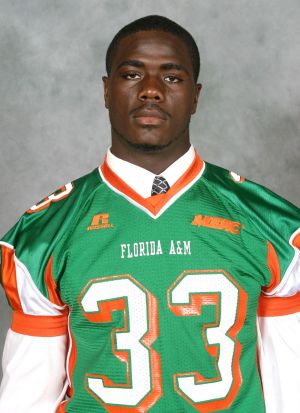
Jonathan Ferrell, Florida A&M football picture, September 20, 2013. (AP/Florida A&M University).

Jonathan Ferrell, Florida A&M football picture, September 20, 2013. (AP/Florida A&M University).

Recent events have made it pretty obvious that it really doesn’t matter what Black males wear. We remain targets for deeply ingrained stereotypes, institutional racism, and pre-emptive White violence. Whether it was Trayvon Martin wearing a hoodie in the rain, or John Lewis wearing a suit in Selma forty-eight years ago, it hasn’t mattered to Whites in fear of the Black boogie man. Florida A&M University graduate and former football player Jonathan Ferrell learned this deadly lesson in North Carolina just a week ago. It doesn’t matter what we wear, at least as far as many Whites and some Black elites are concerned.

Blacks all look the same to them, and looked the same to them in the ’60s. Suits, hoodies or baggy pants, we’re criminals and imbeciles from birth, thugs for life, and a drain on families and American society. This doesn’t mean that any one of us shouldn’t take responsibility for how we act, speak and look in public. I dare say, though, that structural economic issues like unemployment in deeply impoverished Black communities (or crank-infested White ones) won’t be solved with young folk pulling their pants up. We need to stop focusing on the insignificant, because saggy pants and respectability are the trees in this morphing forest of racism and economic inequality.

My Day of Atonement/Bitter Hatred

14 Saturday Sep 2013

Posted by decollins1969 in 1, Boy @ The Window, culture, Eclectic, Hebrew-Israelite, Jimme, Marriage, Mount Vernon New York, My Father, Politics, Pop Culture, race, Religion, Youth

≈ 2 Comments

Tags

Afrocentricity, Day of Atonement, Disillusionment, Family, Forgiveness, Hatred, Judah ben Israel, Judaism, Love, Maurice Eugene Washington, Self-Discovery, Ten Lost Tribes, Torah, Yom Kippur


Prayer at the Wailing Wail, Second Temple, Jerusalem, February 1, 2013. (Steve Ibrom). Released by public domain by author.

Prayer at the Wailing Wail, Second Temple, Jerusalem, February 1, 2013. (Steve Ibrom). Released by public domain by author.

“Yom Kippur ’83 opened me up to understanding why I no longer put my trust in Maurice’s God. I spent part of another September fasting and going to temple to atone for my sins. The temple was on Fifth Avenue and Second Street, just down the street from Washington Elementary School. I’d gone to temple maybe a half-dozen times since the spring of ’81, three of those times to have some rabbi with a ragged beard tell me that Yahweh had forgiven me for my wicked ways.

“And it left me thinking, ‘Well, what about Maurice? His sins are many, and we get treated the same? Does he get forgiveness even if the sin is still in progress?’ It didn’t make sense to me that I needed to starve myself for three days and ask for forgiveness in a situation where a fat, greasy SOB for a stepfather could steal from, cheat on, beat up on, and lie to Mom, get forgiveness, and keep on trying to do what he’d done before Yom Kippur. I said to whoever was a higher power, ‘What did I do to deserve this?’ I didn’t get an answer, and nothing anyone at temple said gave me any answers either. I felt empty, as if everything I thought being in this faith was about was a farce, a morbid, diabolical joke that was played on me and my family. And Maurice was the devil himself.”

That’s what I wrote in Boy @ The Window about my last Yom Kippur as a Hebrew-Israelite. That Saturday, September 17, ’83, was the last time I went to temple, the last time I looked at any aspect of our bizarre and goofy mix of Judaism and Afrocentricity with a modicum of seriousness. By the time I left, I wasn’t in a forgiving mood at all. I hated my then stepfather Maurice, and hated the people who claimed that people like Maurice were descendants of one of the Ten Lost Tribes of Ancient Israelites.

Please understand. When I said, “I hated Maurice,” it wasn’t a euphemism for me in the fall of ’83. If I had access to a gun, I would’ve blown him away and gladly served time in prison for doing so. I had stomach ulcers in the fall of ’83, because I couldn’t stand the smell, sound or sight of the obese asshole. I all but prayed to Yahweh that he get hit by a Mack truck going eighty miles an hour down East Lincoln Avenue. I wanted him dead, and I wanted to piss on his ashes to boot.

Even at thirteen, though, I also understood that this kind of anger and rage wouldn’t help me in the long run between ninth grade and college. Or with sports. Or dating. Or in finding my own path to God or to anything else worth believing. My bitterness and hatred were so deep, about as deep as any love that I’d experienced up to that point in my life. Whether my Mom, my father Jimme, my Uncle Sam or my version of Wendy, all that love was nearly drowned out by my hate for my stepfather.

Even on my irony scale, this hatred broke all records. Especially on a day of atonement, where we all but sacrificed an unblemished lamb at the temple over four hours that Saturday. But I had other reasons to be bitter on this, the holiest of holy days. No bar mitzvah, no celebrations of Hanukkah, no participation in Hebrew-Israelite life for me beyond their 613 rules and regs for nearly two and a half years. I understood and yet didn’t understand this sense of pride and Blackness that came through in a near Asian religion that allowed for reincarnation and an post-Babylonian Israelite diaspora to Sub-Saharan Africa to boot. That confusion didn’t help me deal with a man who wasn’t one, but was a teenage bully who did everything he could to keep me and Mom in submission to him, with Yahweh and Torah as his excuse.

Yom Kippur 1983

Yom Kippur 1983

I knew after I left temple that Yom Kipper afternoon that it would be my last. I didn’t know how, but my days of wearing a kufi or yarmulke were on their way to an end. Still, with hatred and confusion in my heart and mind, I was also lost, more lost than the other ten ancient Israelite tribes undoubtedly were in the aftermath of the Babylonian conquest.

On Academic Entourages & Standing Apart From Them

11 Wednesday Sep 2013

Posted by decollins1969 in 1, Academia, Carnegie Mellon University, culture, Eclectic, Pittsburgh, Politics, Pop Culture, race, Religion, University of Pittsburgh, Work, Youth

≈ Leave a comment

Tags

Academia, African American Studies, Afrocentricity, Authenticity, Black Issues in Higher Education, Blackness, Entourage, Fear of a "Black" America, Followers, Loner, Marc, Molefi Asante, Multiculturalism, Politics of Academia, Publishing, Sycophants, Writing


Lil Wayne entourage, Hartford, CT, July 2011. (http://4umf.com/).

Lil Wayne entourage, Hartford, CT, July 2011. (http://4umf.com/).

This week for many is about anniversary number twelve of the 9/11 attacks, which if I hadn’t lived through them, would sound like something out of a Kurt Vonnegut novel. But because I’ve been counting my days for years, this week also represents two decades since I realized that radical “Islamic” terrorists, pro athletes and popular music artists aren’t the only ones with followers. I learned for the first time that even in the world of academia, paragons and those who allege themselves as such also have their entourages of true believers and sycophants. It was a realization that bothered the loner and the aspiring academic historian in me.

Letters to the Editor, Black Issues in Higher Education, September 9, 1993. (Donald Earl Collins)

Letters to the Editor, Black Issues in Higher Education, September 9, 1993. (Donald Earl Collins).

It all occurred in the aftermath of my first major publication, co-written with my friend Marc and published in Black Issues In Higher Education in August ’93. “Afrocentricity: The Fight for Control of African-American Thought” was our 1,200 word contribution to the debate over multicultural education and Afrocentricity in both higher education and in Black culture more generally. It was a publication that came as a surprise, because the editors at Black Issues In Higher Education (the same folks who ran Emerge Magazine, by the way) hadn’t contacted us about receiving our pitch and article, about accepting it for publication, or about when they intended to publish. And even though our article was literally in the centerfold of their August 12, ’93 issue, the folks at Black Issues in Higher Education never paid us for the publication of our work.

The reason why because clearer in their September 9 and September 23 issues. In the “Letters to the Editor” section, the editors published a dozen letters, ten of which were critical of our work. These weren’t scholarly or even logical critiques — we were wrong because we weren’t members of the Church of Afrocentric Babble, plain and simple. These were “How dare you!” or “Shame on you!” letters, not ones based on what we’d actually written.

What became obvious  to me was that Molefi Asante’s former and current students had written most of the letters. Not exactly an unbiased set of sources, as in the circle of Afrocentricity in the early ’90s, there were few people more prominent than Asante (he was the Father of Afrocentricity, after all). Once I realized this, I found myself disappointed. With Black Issues in Higher Education, with Black folks in academia — particularly at Temple University — and with academia itself. Me and Marc weren’t being challenged on our ideas, but on the idea that two alleged neophytes had the balls to challenge the orthodoxy of the early ’90s in African American studies and in high-brow Black cultural circles.

Marc pushed for a response from one of the editors about their unprofessionalism (and to find out why we weren’t being paid for our piece), which led to a conversation with one of the big-wigs. He apparently said to Marc, “We published it [the “Afrocentricity” piece] to teach you a lesson.” When Marc told me, I said, “Well, I guess we’re not gonna get paid.” (Turned out this was standard practice for the likes of Black Issues in Higher Education, Emerge, and for freelancers at BET as well). Marc, pissed and disillusioned, said, “We were just trying to help.”

Letters to the Editor, Black Issues in Higher Education, September 23, 1993. (Donald Earl Collins).

Letters to the Editor, Black Issues in Higher Education, September 23, 1993. (Donald Earl Collins).

It was the last one of many factors that pushed me to write my dissertation and my first book Fear of a “Black” America (2004) on the relationship between education, multiculturalism, and Black identity. I wanted to show that Afrocentricity wasn’t the only strain of thought that ran through the heads of Black scholars and found its way into small “c” curriculum and cultural events in Black communities. In doing so, I certainly stood apart, but I also stood alone a lot, too.

In recent years, I’ve seen numerous entourages eviscerate lone wolfs. On Twitter, in our 24/7 media coverage of the mundane and insignificant yet insane, and at academic conferences. As recently as a couple of months ago, I saw a version of this on Facebook in response to a post I wrote about Mark Anthony Neal’s Looking for Leroy (2013). The entourage makes it difficult for an up-and-comer to get off to an honest start, for conformity with only subatomic levels of independent thought seems to be the norm.

Somewhere between now and when my son (knock on wood) reaches my age of forty-three, maybe some of what I’ve written over the past twenty years will break through the ice of entourages, mad-dog and otherwise. Still, it is a damnable thing when groups get together to stomp out different voices (literally and figuratively), because that’s seems to be the only way to keep the band together.

First Day of High School, Thirty Years Ago

05 Thursday Sep 2013

Posted by decollins1969 in 1, Boy @ The Window, culture, Eclectic, Mount Vernon High School, Mount Vernon New York, Politics, Pop Culture, race, Youth

≈ 1 Comment

Tags

Educational Inequality, Educational Leadership, MVHS, Paternalism, Principal Leadership, Principals, Racism, Richard Capozzola, School-to-Prison Pipeline, Tough-Love, Violence, White Paternalism


Oz (HBO) poster, September 5, 2013. (http://www.brain-dead-blog.blogspot.com).

Oz (HBO) poster, September 5, 2013. (http://www.brain-dead-blog.blogspot.com).

Our/my first day at Mount Vernon High School (New York) was the first Thursday after Labor Day thirty years ago, which means the exact date was September 8, ’83. It was mostly a very good day, except for our third period assembly with then Principal Richard Capozzola. He pronounced at least half of our class dead on arrival not quite two hours into ninth grade. Capozzola said, “There are 1,075 of you here today. Four years from now, only half of you will graduate” from MVHS. It turned out that he was wrong. Only 545 of us were eligible to march by September ’86, and 509 of us ended up doing so in June ’87. Even when accounting for the twenty or so Class of ’87 folks who decided to take their nineteen credits and graduate in ’86 instead of ’87, less than half of our original cohort graduated in years.

In Boy @ The Window and on the five or so occasions I’ve had to talk about the late Richard Capozzola and MVHS, I’ve attributed much of this to “the reality of self-fulfilling prophecies” and “the damage that low expectations can do.”  There isn’t a single word that I’d change in my description of Capozzola and in my thoughts about what he said, thirty years ago or right now. When you run a school as if the students are inmates and security act on your behalf as corrections officers, it is really a surprise when students drop out? When your security measures have the effect of increasing tensions so that more fights break out, shouldn’t it mean that the head school building administrator re-evaluate such measures? Apparently not.

That’s the principal and school that I remember outside of my Humanities days. Where girls ripped off each other’s earrings in the process of slugging each other. When witnessing one or two fights a week in building was a normal part of the process. When White potheads would sneak a smoke in between classes in the courtyard, but no security would intrude.

Mount Vernon High School main entrance, Mount Vernon, NY, November 22, 2006. (Donald Earl Collins).

Mount Vernon High School main entrance, Mount Vernon, NY, November 22, 2006. (Donald Earl Collins).

I have no doubt that trying to curtail this was a difficult job for any principal in ’83. But MVHS wasn’t Ft. Apache, or Jersey City, or South Central LA in this era. No MVHS student had brought a gun to school to shoot someone, at least in my time there. Short of a Swiss army knife, most students used their words to cut each other down, or in threatening to use a knife, maybe, off school grounds, after school.

Over the past couple of  years, I received comments about what I’ve written about my late principal from one of his children, who has repeatedly defended his father as a hero of sorts. He has disagreed, and rather bitterly, about what I’ve written, as if his experience with his father actually negates my experience with him as a principal. As part of my response to Capozzola’s son two years ago, I wrote:

Make no mistake, I for one, didn’t feel one iota safer in my four years at MVHS because of security sweeps, the closing of the courtyard to student use. Not to mention the general feeling I had that people who looked like me — regardless of my grades — weren’t welcome, whether that was intended or not. It’s a bit paternalistic to suggest that a heavy-handed approach to security “saved my life” or led to a national award for educational excellence in 1983 [It was actually a Blue Ribbon School in 1987]. As an educator myself, I know all too well the politics involved in such descriptions of schools like MVHS and with such awards.

Lion eating wildebeest - "animals" was what administrators & White classmates sometimes called MVHS students, but ironically referencing themselves, September 5, 2013. (YouTube).

Lion eating wildebeest – “animals” was what the White administrators & classmates sometimes called MVHS students, but ironically referencing themselves, September 5, 2013. (YouTube).

I’d add to this, though. I don’t really think that Capozzola actually cared about learning or the closing of achievement gap, either, not based on how he treated Humanities. And “tough love and a firm hand?” Really? That’s how you describe a father or an overseer — it should never be how you describe a principal. There was no love in his so-called toughness, and not enough firmness to prevent fights and slights that were a frequent part of my four-year experience at MVHS. And yes, many of MVHS’ students lived in poverty, but there was a sizable number of middle class Black students who attended as well. To forget that would be to, I don’t know, lump MVHS as a monolithic block of Black (and Latino) kids ready to start a riot. How is this different from a stop and frisk policy that targets poor neighborhoods and Black and Latinos between sixteen and thirty?

Which, in the end, is what both the late Capozzola and his son have done, thirty years ago and much more recently than that. To think that I put up with this for four years, at least one year too long. The embedded racial paternalism and institutional bigotry, in their words and deeds — it just takes my breath away.

On Pitt’s Concrete Slab & A Labor Day Pirates Game

02 Monday Sep 2013

Posted by decollins1969 in 1, Academia, Boy @ The Window, culture, Eclectic, High Rise Buildings, Pittsburgh, Pop Culture, race, University of Pittsburgh, Youth

≈ Leave a comment

Tags

1988, Bucs, College Success, Darryl Strawberry, Forbes Quad, Forbes Quadrangle, Handouts, Homeless, Homelessness, Labor Day, Mets, New York Mets, Pittsburgh Pirates, Schenley Park, Self-Discovery, Three Rivers Stadium, Wesley V. Posvar Hall


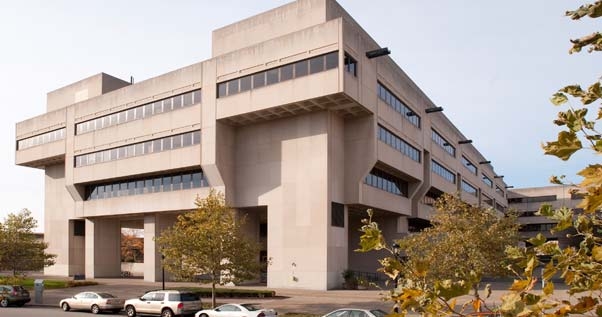
Wesley V. Posvar Hall (formerly Forbes Quadrangle, formerly Forbes Field – I would’ve been on slab in stairwell in SW corner of building 25 years ago), University of Pittsburgh, September 2, 2013. (http://www.tour.pitt.edu).

It was a quarter-century ago that I think I finally became an adult. Or, at least, was no longer stuck at the age of twelve psychologically and emotionally. I understand that five days without a permanent place to sleep, eat and shower isn’t much when compared to many who’ve lived with homelessness much longer. But it was more than enough to wake me up to the fact that my already tumultuous life was on the verge of being a full-blown nightmare if I didn’t find shelter in the form of a South Oakland firetrap.

From Boy @ The Window:

Tuesday and Wednesday were the worst two days of my life since the summer of abuse. Even with the luggage well hidden [in Schenley Park], I worried that fire ants would get a hold of my clothes or that a homeless guy would steal my stuff. But I had no choice. I saw no one from the second half of my freshman year on campus, so I didn’t ask for any other help. I kept looking and calling places for apartment availability. Whether efficiencies or studios or one-bedrooms, the response was always, “the place is taken.” I spent part of the evening at William Pitt Union, watching the news and the Pirates game, thinking all the while about where I’d sleep that night. The student union was out. Pitt Police were always prowling around and looking into the TV room. Hillman Library was still on a summer schedule, and wouldn’t open for its normal hours until after Labor Day. The other buildings were classrooms and faculty offices, better places to hide. My runaway experience in ’85 gave me that idea.

Panther Hollow Lake in Schenley Park, Pittsburgh, PA, September 2, 2013. [note the heavily wooded area behind the lake]. (http://post-gazette.com).

Panther Hollow Lake in Schenley Park, Pittsburgh, PA, September 2, 2013. [note the heavily wooded area behind the lake]. (http://post-gazette.com).

I went over to Forbes Quadrangle (formerly Forbes Field, where the Pirates used to play) and hung out at The Second Plate deli on its benches for a while, pretending to study until well after midnight. Then I looked around for a good place to sleep. Unfortunately, maintenance and security guards locked up all of the classrooms and faculty lounges at night. I settled on the stairwell in the farthest corner of the building away from its two main entrances. I walked up to the fifth floor ledge, laid down on the hard concrete on top of my clothes, and fell asleep. This wasn’t a good sleep, maybe four or five hours. The fluorescent lights were always on, the guard or students would use the stairs, and the ledge was the hardest thing that I’d ever slept on. I woke up on Wednesday and Thursday morning stiffer than I’d been the day before….Before I went to sleep Wednesday night, I got real with myself and real humble with God and started praying. I said, “God, I don’t pray nearly as much as I used to, but I could really use your help. I am your child because of Jesus, and I need you to help me find a place to stay. If you don’t help me find somewhere to live, I’ll have to go home and go to school from home.” I knew full well – and God knew, too – what would happen if I went back home. Nothing. Nothing good, anyway. I was three or four days away from buying a plane ticket back to New York and withdrawing from the university. Thoughts of going to Fordham University or Hunter College crept into my head. They were good schools for someone like me. Living at home, though, wasn’t.

Of course, I did eventually find a house with a room available, one where I’d share a kitchen and bathroom for the next two school years with other Pitt students, reputable and otherwise.

I slept away most of my Labor Day Weekend, except for spending some of my remaining money to take in a Pirates-Mets game at Three Rivers. My Mets won 7-5, on the power of two Darryl Strawberry home runs.

…After what I’d just been through, I learned something new and foreign. That everyone needs folks in their lives – friends, family, mentors and authority figures – if for no other reason than the need to ask for help. I’d come to know at least a dozen people who I could’ve called on during my five-day ordeal, but I never looked through a phone book or gave them a call. Heck, I didn’t even try to keep in touch by getting their addresses and numbers at the end of April. Not to mention contacting Jack Daniel, an Associate Provost at Pitt and the author of the Challenge Scholarship, the one that paid for half of my tuition. If anyone had any incentive to make sure I had a place to lay my head, it would’ve been him. All of these thoughts had been in my head during the week. I didn’t trust them or the instincts or wisdom from which they originated. “I’m so stupid God,” I said to myself, “I’m so incredibly stupid.”

Homeless in Pittsburgh

Homeless in Pittsburgh

Mom’s constant mantra in my head, of not depending on others for help, was a lie, at least for me. I couldn’t will myself through school. Especially when it came to money. I needed all the help I could get. Besides, my family had now been on welfare for five and a half years. If that wasn’t one of my Mom’s examples of so-called handouts, I didn’t know what was.

My approach to college changed with this revelation…I knew that all the things I shied away from talking about were now things I needed to discuss. But I also knew that I had to draw out my better, more sociable self in order to welcome others in my life with open arms. That meant taking some risks, which meant that I could get hurt emotionally or psychologically by them.

My life hasn’t been the same since, thank God.

← Older posts
Newer posts →

Boy @ The Window: A Memoir

Boy @ The Window: A Memoir

Places to Buy/Download Boy @ The Window

There's a few ways in which you can read excerpts of, borrow and/or purchase and download Boy @ The Window. There's the trade paperback edition of Boy @ The Window, available for purchase via Amazon.com at http://www.amazon.com/Boy-Window-Donald-Earl-Collins/dp/0989256138/

There's also a Kindle edition on Amazon.com. The enhanced edition can be read only with Kindle Fire, an iPad or a full-color tablet. The links to the enhanced edition through Apple's iBookstore and the Barnes & Noble NOOK edition are below. The link to the Amazon Kindle version is also immediately below:

scr2555-proj697-a-kindle-logo-rgb-lg

Boy @ The Window on Amazon.com: http://www.amazon.com/Boy-The-Window-Memoir-ebook/dp/B00CD95FBU/

iBookstore-logo-300x100

Boy @ The Window on Apple's iBookstore: https://itunes.apple.com/us/book/boy-the-window/id643768275?ls=1

Barnes & Noble (bn.com) logo, June 26, 2013. (http://www.logotypes101.com).

Boy @ The Window on Barnes & Noble: http://www.barnesandnoble.com/w/boy-the-window-donald-earl-collins/1115182183?ean=2940016741567

You can also add, read and review Boy @ The Window on Goodreads.com. Just click on the button below:

Boy @ The Window

Twitter Updates

Tweets by decollins1969
  • RSS - Posts
  • RSS - Comments

Archives

  • June 2025
  • April 2023
  • September 2022
  • August 2022
  • July 2022
  • June 2022
  • May 2022
  • April 2022
  • March 2022
  • January 2022
  • December 2021
  • November 2021
  • October 2021
  • September 2021
  • August 2021
  • July 2021
  • June 2021
  • April 2021
  • March 2021
  • February 2021
  • January 2021
  • December 2020
  • November 2020
  • October 2020
  • September 2020
  • August 2020
  • July 2020
  • May 2020
  • April 2020
  • March 2020
  • January 2020
  • December 2019
  • November 2019
  • August 2019
  • July 2019
  • June 2019
  • May 2019
  • April 2019
  • March 2019
  • February 2019
  • January 2019
  • December 2018
  • November 2018
  • October 2018
  • September 2018
  • August 2018
  • July 2018
  • June 2018
  • May 2018
  • March 2018
  • February 2018
  • January 2018
  • December 2017
  • November 2017
  • October 2017
  • September 2017
  • August 2017
  • July 2017
  • June 2017
  • May 2017
  • April 2017
  • March 2017
  • February 2017
  • January 2017
  • December 2016
  • November 2016
  • October 2016
  • September 2016
  • August 2016
  • July 2016
  • June 2016
  • May 2016
  • April 2016
  • March 2016
  • February 2016
  • January 2016
  • December 2015
  • November 2015
  • October 2015
  • September 2015
  • August 2015
  • July 2015
  • June 2015
  • May 2015
  • April 2015
  • March 2015
  • February 2015
  • January 2015
  • December 2014
  • November 2014
  • October 2014
  • September 2014
  • August 2014
  • July 2014
  • June 2014
  • May 2014
  • April 2014
  • March 2014
  • February 2014
  • January 2014
  • December 2013
  • November 2013
  • October 2013
  • September 2013
  • August 2013
  • July 2013
  • June 2013
  • May 2013
  • April 2013
  • March 2013
  • February 2013
  • January 2013
  • December 2012
  • November 2012
  • October 2012
  • September 2012
  • August 2012
  • July 2012
  • June 2012
  • May 2012
  • April 2012
  • March 2012
  • February 2012
  • January 2012
  • December 2011
  • November 2011
  • October 2011
  • September 2011
  • August 2011
  • July 2011
  • June 2011
  • May 2011
  • April 2011
  • March 2011
  • February 2011
  • January 2011
  • December 2010
  • November 2010
  • October 2010
  • September 2010
  • August 2010
  • July 2010
  • June 2010
  • May 2010
  • April 2010
  • March 2010
  • February 2010
  • January 2010
  • December 2009
  • November 2009
  • October 2009
  • September 2009
  • August 2009
  • July 2009
  • June 2009
  • May 2009
  • April 2009
  • March 2009
  • February 2009
  • January 2009
  • December 2008
  • November 2008
  • October 2008
  • September 2008
  • August 2008
  • July 2008
  • June 2008
  • May 2008
  • April 2008
  • March 2008
  • February 2008
  • January 2008
  • December 2007
  • November 2007
  • October 2007
  • September 2007
  • August 2007
  • July 2007
  • June 2007

Recent Comments

MaryPena's avatarMaryPena on My Day of Atonement/Bitter Hat…
decollins1969's avatardecollins1969 on No Good Teaching Deed Goes…
Mary Rose O’Connell's avatarMary Rose O’Connell on No Good Teaching Deed Goes…

NetworkedBlogs on Facebook

NetworkedBlogs
Blog:
Notes From a Boy @ The Window
Topics:
My Life, Culture & Education, Politics & Goofyness
 
Follow my blog

616 616 East Lincoln Avenue A.B. Davis Middle School Abuse Academia Academy for Educational Development AED Afrocentricity American Narcissism Authenticity Bigotry Blackness Boy @ The Window Carnegie Mellon University Child Abuse Class of 1987 CMU Coping Strategies Crush #1 Crush #2 Death Disillusionment Diversity Domestic Violence Economic Inequality Education Family Friendship Friendships Graduate School Hebrew-Israelites High-Stakes Testing Higher Education History Homelessness Humanities Humanities Program Hypocrisy Internalized Racism Jealousy Joe Trotter Joe William Trotter Jr. K-12 Education Love Manhood Maurice Eugene Washington Maurice Washington Misogyny Mother-Son Relationship Mount Vernon High School Mount Vernon New York Mount Vernon public schools Multiculturalism MVHS Narcissism NFL Pitt Pittsburgh Politics of Education Poverty President Barack Obama Race Racial Stereotypes Racism Relationships Self-Awareness Self-Discovery Self-Reflection Sexism Social Justice Teaching and Learning University of Pittsburgh Violence Whiteness Writing

Top Rated

Blog at WordPress.com.

  • Subscribe Subscribed
    • Notes from a Boy @ The Window
    • Join 103 other subscribers
    • Already have a WordPress.com account? Log in now.
    • Notes from a Boy @ The Window
    • Subscribe Subscribed
    • Sign up
    • Log in
    • Report this content
    • View site in Reader
    • Manage subscriptions
    • Collapse this bar
 

Loading Comments...