• About Me
  • Other Writings
  • Interview Clips
  • All About Me: American Racism, American Narcissism, and the Conversation America Can’t Have
  • Video Clips
  • Boy @ The Window Pictures
  • Boy @ The Window Theme Music

Notes from a Boy @ The Window

~

Notes from a Boy @ The Window

Category Archives: Politics

“I Am Become Columbus, Destroyer of Worlds”

14 Monday Oct 2013

Posted by decollins1969 in 1, Academia, Boy @ The Window, Christianity, culture, Eclectic, Mount Vernon High School, Patriotism, Politics, Pop Culture, race, Religion, Youth

≈ 1 Comment

Tags

American Indians, Christopher Columbus, Columbus Day, Diseases, Enslavement, Exploitation, Genocide, History, Indigenous Groups, J. Robert Oppenheimer, Native Populations, Teaching and Learning
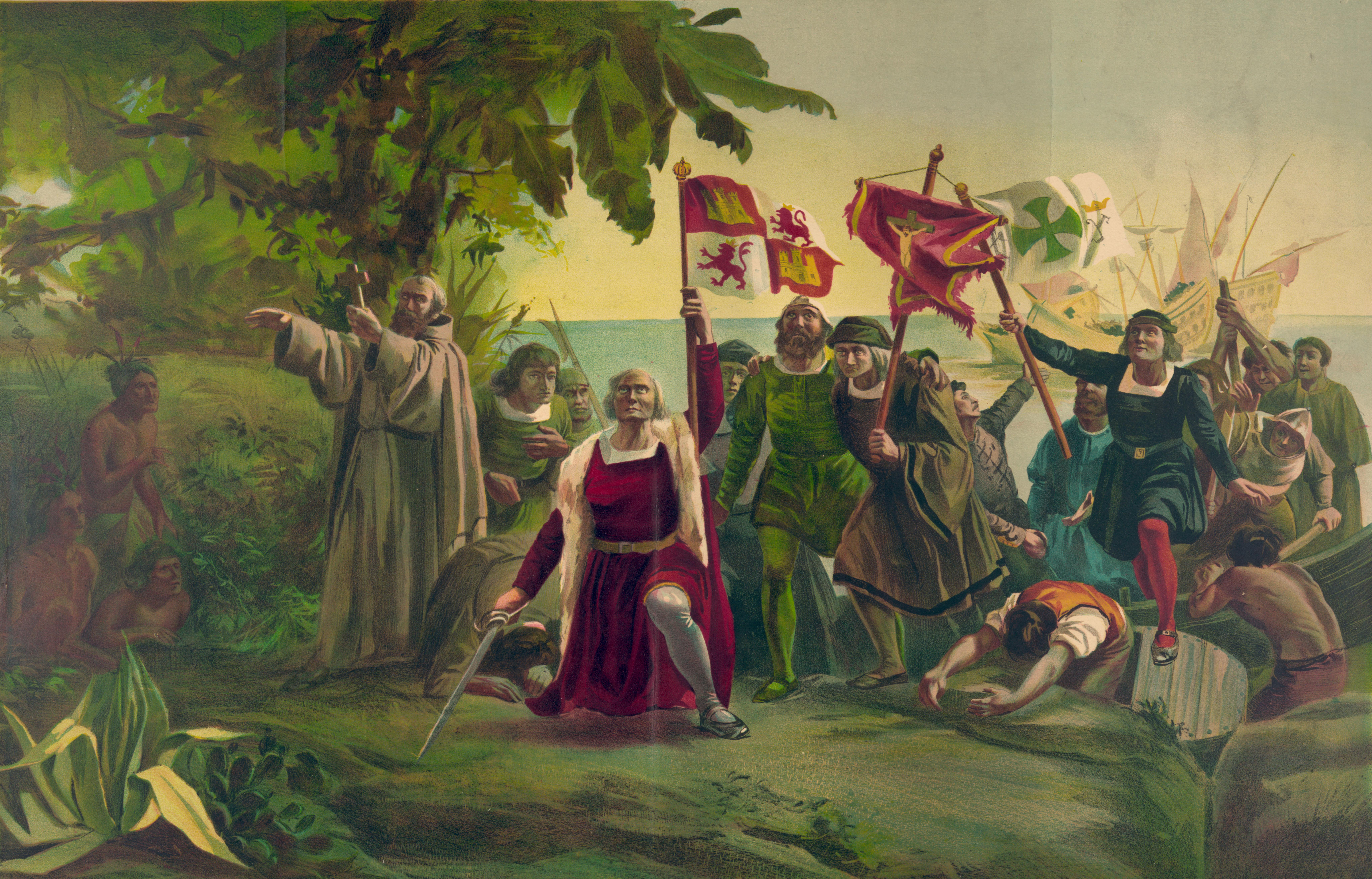

Dióscoro Teófilo Puebla Tolín, First landing of Columbus on the shores of the New World, at San Salvador, West Indies, 1862 (published 1892, Currier& Ives). (Dantadd via Wikipedia). In public domain.

Dióscoro Teófilo Puebla Tolín, First landing of Columbus on the shores of the New World, at San Salvador, West Indies, 1862 (published 1892, Currier& Ives). (Dantadd via Wikipedia). In public domain.

The title kind of says it all, no? On this Columbus Day, 2013, we should all acknowledge this as the beginning of the inadvertent (and frequently deliberate) genocide conducted against the indigenous groups that made up the Western Hemisphere as of October 12, 1492. The day that Christopher Columbus “discovered” America — as if First Nation tribes or Native Americans or American Indians were looking to be discovered — was the first day of more than half a millennium’s worth of physical and psychological assault on the peoples of the Western Hemisphere.

I talk about this in all of my courses — US History, World History (when I get to 1500 CE), and African American History. I describe how this notion of discovery was pretty much invented in the nineteenth century, to create a mythology about the greatness of God-fearing Europeans (and, in the US context, Americans) and their pre-ordained but altruistic triumph over the heathen Indians, those “noble savages.” I go over the fact that the Eurasian diseases that the Spaniards and other Europeans brought with them to the Western Hemisphere wiped out tens of millions of the indigenous between 1492 and 1700. Smallpox, measles, mumps, rubella, bubonic plague, chicken pox all helped reduce a population that experts have estimated to have been between 70 and 100 million at the time of first contact to between seven and 10 million by the end of the seventeenth century.

Drawing accompanying text in Book XII of the 16th-century Florentine Codex (compiled by Fray Bernardino de Sahagún, 1540–1585), showing Nahuas of conquest-era Central Mexico suffering from smallpox, September 11, 2009. (Wikipedia). In public domain.

Drawing in Book XII of Florentine Codex (compiled by Fray Bernardino de Sahagún, 1540–1585), showing Nahuas of Central Mexico suffering from smallpox, September 11, 2009. (Wikipedia). In public domain.

I talk about Columbus’ second voyage, where he helped establish the first European settlement in what is now Haiti and then in the Dominican Republic, all while searching for gold, enslaving Arawak Indians and engaging in full-fledged battles. Just a year and a half after the first, glorious “discovery!”

The justification, of course, was and often remains that Europeans were civilized Catholic Christians, whereas these half-dressed natives were hedonistic polytheists. Even now, we often get caught up in the human sacrifice rituals of the Maya and Aztecs and somehow use that as justification for exploitation, slavery, and the inadvertent wiping out of whole cultures — worlds, if you will. It’s a justification that should make any believer in a higher power queasy, and any non-believer extremely angry.

I’m disappointed. We still sugarcoat the real meaning of Columbus Day for people of all ages. I began to learn about all of this in fifth grade (thank you, Mrs. O’Daniel), in October ’79. But I didn’t come to know most of the full story until high school. Even then, no one — not Flanagan, Zini or Meltzer — mentioned disease, exploitation, slavery and warfare as the genocidal combination that essentially handed Western Europeans the Western Hemisphere. I guess they either didn’t know or thought that it would be too painful a lesson to teach fourteen-to-eighteen year-olds.

As J. Robert Oppenheimer said in ’65, twenty years after the Manhattan Project’s success in creating the world’s first nuclear bomb, “Now I am become Death, the destroyer of worlds.” Well, one doesn’t have to have God-like powers or be a Hindu deity to create large-scale human suffering, as was the case with Columbus. All one really needs is the conviction necessary to treat other humans as if they are only meat with brains and eyes.

God, Graviano and Darwin

10 Thursday Oct 2013

Posted by decollins1969 in 1, Boy @ The Window, Christianity, culture, Eclectic, Hebrew-Israelite, Mount Vernon High School, Mount Vernon New York, Politics, Pop Culture, race, Religion, Youth

≈ Leave a comment

Tags

Atheism, Biology, Charles Darwin, Creationism, Evangelical Christianity, Evolution, God, Higher Power, Identity, John Graviano, Politics of Religion, Salvation, Self-Discovery, Self-Reflection, The Universe


Galaxies in clusters/ superclusters of  dark matter filaments,  as part of Pan-STARRS sky survey, July 17, 2010. (Boylan-Kolchin/The Virgo Consortium/Durham University/PA Wire)

Tens of thousands of galaxies in clusters/superclusters of dark matter filaments, as part of Pan-STARRS sky survey, July 17, 2010. (Boylan-Kolchin/The Virgo Consortium/Durham University/PA Wire)

From Boy @ The Window, circa October ’83:

Bio with Mr. Graviano did provide some answers for me beyond the science. The man was also an assistant coach for MVHS’ basketball team. Although I know he loved basketball, Graviano was a heck of a science teacher. He didn’t do anything particularly exciting. He just made it seem as if we were learning how to tie our shoes when he was teaching us binomial nomenclature or the difference between mitosis and meiosis. Graviano began the year with Charles Darwin’s trip aboard the HMS Beagle to South America and the Galapagos Islands in the 1830s, observing finches and developing his theory of natural selection. We were learning about Darwin and evolution, something I knew flew in the face of my family’s Hebrew-Israelite beliefs. Despite that, what I learned in Biology every day made more sense to me than attempting to interpret the first chapter of Genesis or Balkis Makeda’s dreams warning us against the imperfect science of intellectual types like Darwin. What surprised me more was the fact that no one in our class questioned Graviano or the fact that he was teaching evolution, at least not in the open.

Biology gave me food for thought. I understood the science, the process of natural selection and mutation, the reality that over numerous eons life gradually evolved on earth to include intelligent mammals, primates, and humans. At the same time, we were being taught in temple that God had created or reclaimed (depending on interpretation) the earth in six days or six thousand years. The reclamation interpretation left room for everything that science said had occurred prior to the ascent of modern humans. The creation story obviously didn’t. I was confused, having to reconcile the scientific method with religious beliefs. I solved the problem in my own mind by choosing to stand on the reclamation interpretation of Genesis’ first chapter. But that didn’t completely satisfy me.

It was part of a long but interesting period that led me to become a plain old, nondenominational Christian by April ’84. But at this point in the Boy @ The Window story, I was literally caught between the stupidity of being a Hebrew-Israelite and the idea that there wasn’t a higher power at all.

Yet, despite Graviano’s class, I couldn’t wrap my head around the idea that evolution was a random process. To me, that seemed to approach the ridiculous. Biological evolution’s hardly been perfect. But one completely random set of changes built upon another set of completely random changes over three or four billion years likely doesn’t yield life on this planet in its current state. Too many patterns for me reflected in biology, mathematics and — as I’d learn in a couple of years — physics to accept evolution as a completely random process.

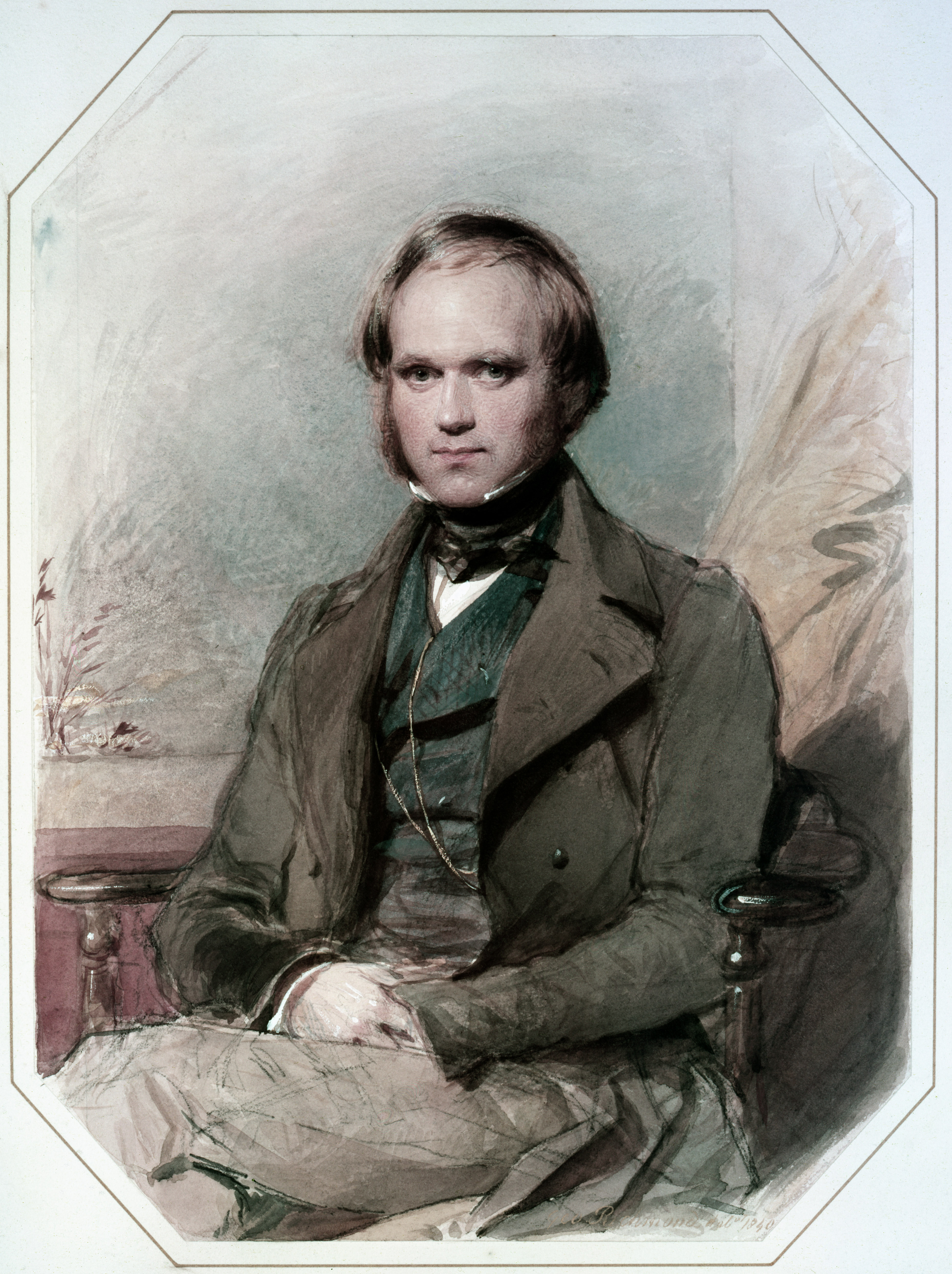
Portrait of Charles Darwin, by George Richmond (circa 1838), October 15, 2012. (Jdcollins13 via Wikipedia). In public domain.

Portrait of Charles Darwin, by George Richmond (circa 1838), October 15, 2012. (Jdcollins13 via Wikipedia). In public domain.

That was really my only sticking point. For my ninth and tenth-grade classmates, though, I couldn’t believe their stone-faced silences over the Darwin story. I knew that some of them held beliefs that ran completely counter to the idea of evolution. Some, even, were likely what we now call evangelical, literal-interpretation-of-the-Bible Christians. Yet they were as silent as comatose patients for most of the first marking period. What I learned a little later on in life was that silence was as much a form of protest or disapproval as outright vocal opposition.

As for me, I found the processes of mutation, mitosis and meiosis fascinating. I felt as if I was learning a small but important secret about God and the universe. That both — if one believes in God and has some understanding of the universe — have intellectual and scientific minds. Graviano, through his mechanical teaching style, was at least able to convey that to us, if any of us paid close enough attention.

If Graviano opened my eyes to modern science and the understanding of life on its most basic level, Yom Kippur ’83 opened me up to understanding why I no longer put my trust in Maurice’s God.

I guess if I hadn’t already been in the midst of a spiritual identity crisis, I wouldn’t have used my classes in ninth grade as my way of figuring out how to rebuild my identity, and in the process, figure out what and in whom I wanted to believe. Too bad folks who now run things in this country never took one moment’s time to do the same.

The Week The Lights Went Out In America

08 Tuesday Oct 2013

Posted by decollins1969 in 1, Boy @ The Window, culture, Eclectic, Mount Vernon New York, New York City, Politics, Pop Culture, race, Work, Youth

≈ Leave a comment

Tags

American Dominance, American Economy, Arab-Israeli War 1973, Best Days, Brighter Future, Economic Inequality, Gas Lines, Inflation, Job Discrimination, Low-Wage Jobs, OPEC Oil Crisis, OPEC Oil Embargo, Political Will, Politicians, Poverty, Prosperity, social mobility, Stagflation, Superpower, unemployment, Yom Kippur War


Gas station displayed a sign that explained the flag policy during the first OPEC oil embargo and crisis (Oregon), May 1974. March 26, 2013. (NARA via Wikipedia). In public domain.

Gas station displayed a sign that explained the flag policy during the first OPEC oil embargo and crisis (Oregon), May 1974. March 26, 2013. (NARA via Wikipedia). In public domain.

It wasn’t the middle of September of ’08, either. It was the beginning of October ’73, forty Yom Kippur holy days ago. There had been signs for any American who had cared to look at the cracks in the US dominance of the world economy ceiling. Rising unemployment, higher inflation, new monetary control measure, competition from a mostly rebuilt West Germany and Japan. The twenty-eight year-long run America had as the undisputed and undefeated leader of the capitalist world was on its way to a close, and ninety-nine percent of all Americans didn’t know or didn’t care enough to know.

No, the Yom Kippur War between Syria, Egypt and Israel didn’t cause the US to become more dependent on the rest of the world. But our support of Israel against countries from which we imported oil did lead to OPEC’s decision to deny us oil. Up to that point, our government had pretty much done whatever it wanted geopolitically, on behalf of containing Communism and American corporations. It was this week forty years ago, though, that truly began to teach ordinary Americans that there would be consequences for our foreign policy actions without regard for folks who lived at the blunt end of them.

Egyptian forces cross on one of the bridges laid across the Suez Canal, October 7, 1973.   (CIA/Soerfm via Wikipedia). In public domain.

Egyptian forces cross on one of the bridges laid across the Suez Canal, October 7, 1973. (CIA/Soerfm via Wikipedia). In public domain.

I was just a couple of months away from turning four, but I do have vague memories of the week and month from four decades ago. Within a block of where my Mom worked, Mount Vernon Hospital, was a gas station, one that by the end of October had lines wrapped around the block as motorists in their six-miles-to-the-gallon guzzlers desperately waited for some petrol. It was loud and chaotic, from the little bit that I do remember. Fast forward to about a year later, when my Mom took me and my other brother Darren to the old Met grocery store on South Fulton in Mount Vernon. There, she complained about the $2.69 she had to spend on a five-pound bag of Domino’s Sugar ($14.53 in 2013 dollars). I remember her sighing about the high prices and the fact that her paycheck wouldn’t be able to keep up.

It would be years later still before I realized that the last of America’s easiest days as an economic and geopolitical superpower were during my years as a toddler. I did feel secure back then, not knowing about my father’s alcoholism, my mother’s insecurities about being a Black Southern girl living in and around New York City. I had yet to witness the violence embedded in my family, or in my neighborhoods, for that matter. I knew nothing of drug addiction or authentic Blackness, of racism and systemic job discrimination. I had yet to learn that the economic and educational opportunities that had been available to millions of Americans — almost regardless of race and gender — were about to become that much harder to attain and retain as I grew older.

Now, forty years later, as memories of the Reagan and Clinton years have faded, I think of America’s heady days, ones that now seem of lore. I realize that America could have even better days ahead. If we were to acknowledge human involvement in climate change and invest heavily in a green economy. If quality, well-funded universal pre-K to higher education became our reality, without creating one system for elites and another for everyone else. If we as a people finally said it was time to repair $3 trillion worth of infrastructural damage to our bridges and roads, to our sewer and water systems, and to our electrical grid. If we somehow decided to end our expensive wars on drugs and on Black men, on anyone whom we think (but do not know) may do our nation’s interests (if not our people) harm.

Collage of workers placing an F-Series bed onto frame at  Louisville Assembly Plant (Kentucky), 1973. (http://media.ford.com)and a woman carrying a sign past a McDonald's on East 125th Street during a protest by fast food workers and supporters, New York, NY, April 4, 2013. (Stan Honda/AFP/Getty Images via http//:financialpost.com).

Collage of workers placing an F-Series bed onto frame at Louisville Assembly Plant (Kentucky), 1973. (http://media.ford.com); a woman carrying a sign past a McDonald’s on East 125th Street during a protest by fast food workers and supporters, New York, NY, April 4, 2013. (Stan Honda/AFP/Getty Images via http://financialpost.com).

But I know that we won’t have those better days, at least not yet. Not with narcissistic politicians either lining their pockets with money or lining their minds with sugarplum hopes for the Rapture and Armageddon. Not with a media more interested in the political horserace and petty optics than in giving us the full story. And not with an American public more interested in Miley Cyrus than in funding for more psychologists in public schools.

It’s truly depressing to know how far our nation hasn’t come in four decades, virtually my entire lifetime. At least I know, though. For so many born after me — not to mention lacking self-reflection — they may never know what should’ve been.

The Road to Boy @ The Window, Part 4: Fear of a “Black” America

26 Thursday Sep 2013

Posted by decollins1969 in 1, Academia, Boy @ The Window, Carnegie Mellon University, culture, Eclectic, eclectic music, music, Patriotism, Pittsburgh, Politics, Pop Culture, race, University of Pittsburgh, Youth

≈ Leave a comment

Tags

Academia, Afrocentricity, Authentic Blackness, Authenticity, Emotion, Estelle Abel, Fear of a "Black" America, Fear Of A Black Planet, Fear of Black Males, Joe Trotter, Multicultural Education, Multiculturalism, PE, Personal Vignettes, Politics of Academia, Politics of Education, Politics of Fear, Public Enemy, Rage, Richard Altenbaugh


FearBookCover3copy

Given that Fear of a “Black” America was my first book, but one based on my doctoral dissertation, and that Boy @ The Window is a memoir, the road from one to the other may not be that obvious with an initial glance. But despite the intellectual, semi-scholarly nature of my book on Blacks and multiculturalism, there are parallel themes that run between Fear of a “Black” America and Boy @ The Window. Perhaps none are more important, though, than the challenge of authenticity, of fitting in, of being able to mesh the complicated onion that I’ve found myself to be over the years.

I think that was why I decided in November ’98 to turn my dissertation “A Substance of Things Hoped For” into a more readable book. Yes, after all that work to write a 505-page thesis, it would’ve been a shame to just let it sit on my then girlfriend’s coffee table, to be used either as a door stop or a base for her doing her nails. Yes, I still had something to prove to academia. That my scholarship as a historian and educator on the issue of multiculturalism was sound. That the conventional academic wisdom around Blacks, people of color and multiculturalism was paternalistic fear-mongering.

Public Enemy, Fear Of A Black Planet (1990) Album Cover

Public Enemy, Fear Of A Black Planet (1990) Album Cover

And in thinking that last part through, I came up with my Public Enemy-inspired title and thread for the first book. It was about fear in many forms. Elite White fears of a majority-people-of-color US within their own lifetimes. Conservative fears of a K-16 education system that included the cultural and historical perspectives of peoples of color, of the poor, of women, of the LGBT, of so many others they’d rather discard. General American skepticism that any Blacks had ever given any thought at all to cultural pluralism, intercultural education, or multiculturalism/multicultural education, at least before White theorists had thought through these ideas first.

Afrocentrists and nationalists who thought of multiculturalism as soft and utterly unrepresentative of the Black experience — or, at least, what they considered an authentic version thereof? That was as difficult a challenge as any I faced in writing both my dissertation and Fear of a “Black” America. So much so that I made a few interesting decisions along the way. I sought out an agent — yes, a literary agent — for the first book, and found one, too (things were so much easier in ’99). I wanted the book to have an impact beyond academia.

In the writing process, I decided to weave the theme of fear, skepticism, willful and inadvertent misunderstandings throughout the 200-page book. All while covering Black intellectual thought about what we now call Afrocentricity and multiculturalism, Black activism and activities around education and Negro History Week, and the so-called Culture Wars of the 1980s and 1990s. All to show that multiculturalism was/is a part of America’s evolution, even if some folks are gnashing their teeth and wearing sackcloth and ashes along the way.

One thing was missing, though, from my six chapters. Me, in a word. Yes, my argument was crystal clear, my evidence was sound, my notes and analysis lined up well enough by the summer of ’00. Yet, as my one-time agent noted, “there’s not enough of you in this manuscript.”  Bottom line: folks weren’t going to buy the book unless I made it more compelling, which meant putting something of me or about me in it.

Fear Book & The Authentic Me

Fear Book & The Authentic Me

So I did. I wrote mostly about my experiences in academia and how they paralleled with some of the critical issues in Fear of a “Black” America. I talked about my Duquesne University students in the College of Education in ’98 and ’99, most of whom were cultural conservatives. I brought up conversations I had with professors skeptical about my scholarship, like Richard Altenbaugh in March ’98 or my former dissertation advisor Joe Trotter in April ’96. I also wrote about my conversation with Estelle Abel over my lack of authenticity as a young Black man in June ’87, having thought about it for the first time in thirteen years. I wasn’t sure if that made Fear of a “Black” America any better, but it made me feel better about my first book.

By the time I’d given my agent the final draft of Fear of a “Black” America in October ’00, I was ready — maybe for the first time in years — to take a look at my life before Pitt, grad school, Spencer Fellowship and becoming Dr. Collins. I wasn’t sure if I wanted to open up the emotional side of that Pandora’s box just yet. But in some ways, I really needed to, precisely because of my experiences with people in grad school at Pitt and Carnegie Mellon. And precisely because of my occasional moments of rage and overreaction, if only because Fear of a Black “America” helped me tap into emotions I didn’t know I had.

Letters of Recommendation (or Wreck-o-mendation) Addendum

24 Tuesday Sep 2013

Posted by decollins1969 in 1, Academia, Boy @ The Window, culture, Eclectic, Pittsburgh, Politics, race, University of Pittsburgh, Youth

≈ Leave a comment

Tags

Admissions Process, George Reid Andrews, Graduate School, Law School, Letters of Recommendation, Pitt, Politics of Academia, Transparency


A car wreck on Jagtvej, a road in Copenhagen, Denmark, May 24, 2005. (Thue via Wikipedia). Released to public domain.

A car wreck on Jagtvej, a road in Copenhagen, Denmark, May 24, 2005. (Thue via Wikipedia). Released to public domain.

Three years ago, I wrote a post about my various not-so-good to horrible experiences in getting my then professors to write letters of recommendation for me for grad school, for fellowships and for the academic job market between ’90 and ’99. Over the course of the past three years, this post has been one of my ten most popular ones, garnering comments, emails and mostly positive feedback about what to do (and not) in seeking letters from the professoriate for graduate and professional education and for a real career.

In June, however, Reid Andrews, one of my former professors at the University of Pittsburgh, sent me a rather terse email about my recollections from the 1990-91 school year. He had served as one of my examples of what not to do in terms of seeking a letter of recommendation (like getting a look at the letter first, putting aside the false notion of academic objectivity in the process) as well as in terms of what may or may not have been in the letter itself. In the email, Andrews wrote that my blog “contains false and defamatory material about [him]” and demanded that I “remove [his] photo and all mention of [him] from [my] blog immediately.” Of course, I didn’t remove the blog, or Andrews from it, which earned me a reply in which he called me a “back-stabber,” referencing something I had said about my letter writers in general.

But I did get something in return. Andrews’ letter of recommendation, allegedly from December 1, ’90. Andrews was right. It was hardly a terrible letter, as he described me as “‘exceptionally talented,’ rank[ed] [me] ‘among the ten best undergraduates that [he] ha[d] taught in [his] ten years at Pitt’ and [gave me his  ‘strongest recommendation.'”

But I am actually more right. For there are any number of indications that Andrews’ letter, while not nearly as loopy or as detrimental as some from my former dissertation committee members at Carnegie Mellon, doesn’t in fact provide a strong recommendation at all. For starters, the letter is one long paragraph and a short one that actually takes away from the strength of Andrews’ recommendation.

He also brought to the class an unusually strong command (for an undergraduate) of US and world history, which was helpful both for the purposes of comparison, and for setting the Latin American revolutions in broader context.

How strong was my command? Why was this unusual? Why throw in the “for an undergraduate” at all as a dampener? Did this mean that I wasn’t ready for graduate school material? The long paragraph is about my performance in his Latin American Revolutions course, common for many a recommendation. The lack of specificity, though, would signal to any professor or administrator on any admissions committee that Andrews really knew very little of me as a student and a person. Despite the part about “the ten best undergraduates,” the first paragraph would read like a form letter.

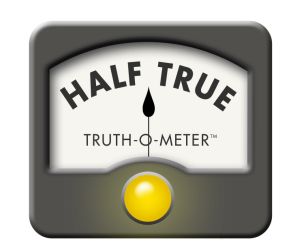
Half True vs. half-hearted, September 24, 2013. (Politifact.com).

Half True vs. half-hearted, September 24, 2013. (http://Politifact.com).

Then there’s Andrews’ shorter second paragraph, the one that made it sound like I was equally interested in going to law school as I was in going into a master’s program in history. I had all of one conversation with Andrews about my forks in the road after undergrad at Pitt. As I told anyone who knew me between May and October ’90, I was “sixty percent in favor of grad school, thirty in favor of law school, and ten in favor of working full-time.” Andrews, however, wrote of me

As of last year his plan was to proceed to law school. However, his talent for history [and]…his enthusiasm for it were so striking that I urged him to consider graduate school in this area, and he has decided to apply both to law schools and to several graduate schools.

I had, in fact, decided by October ’90 not to apply to law schools at all (while applying to six universities for grad school), and communicated that to all of my letter writers at the time. To an admissions committee, this paragraph would make me appear indecisive, and likely to not be as passionate about the prospect of the hard work of academic history as I would be about the law and making money.

In light of everything else I said in my original blog post about letters of recommendation, Andrews’ letter actually proves almost all of my points. That “it’s important to get to know a person, to gain some sense of trust from them, before asking for a letter or a reference.” That “the process of providing a letter of recommendation or a reference ought to be transparent, so that the student or employee can be confident that they’re not being back-stabbed by the same people in which they’re placing significant trust.” Writing a letter of recommendation should always be a serious undertaking, as I’ve learned over the years. Sometimes it’s best to say “No” than to do it in a Freudian-slip fashion.

Freudian "Slip" (2012) by Nathan Davis, September 24, 2013. (http://redbubble.com). Qualifies as fair use - low resolution and subject matter related to post.

Freudian “Slip” (2012) by Nathan Davis, September 24, 2013. (http://redbubble.com). Qualifies as fair use – low resolution and subject matter related to post.

On the “one A in one course does not make for a good recommendation” rule, this has turned out to be inadvertently true. Even if Andrews had intended to write me a glowing letter of recommendation, his feelings about me as a student — ones that he verbalized to me on several occasions between ’90 and ’95 — may well have influenced his rather bland and half-hearted effort at that “good “letter that he supposedly wrote for me in December ’90.

“It was never a question I dared asked — to see my letter of recommendation — before I’d reached the final stages of grad school,” I wrote three years ago. Now that I apparently have Andrews’ letter from twenty-three years ago, my sage advice from three years ago rings as true now as it did then. Maybe even more so.

On the Insignificance of Saggy Pants & Respectability

20 Friday Sep 2013

Posted by decollins1969 in Boy @ The Window, culture, Eclectic, eclectic music, Movies, music, Politics, Pop Culture, race, Youth

≈ Leave a comment

Tags

Birmingham Church Bombing, Black Elite, Boyz n the Hood (1991), Economic Inequality, Florida A&M University, Hip-Hop Culture, Institutional Racism, John L. Lewis, Jonathan Ferrell, March on Washington, NWA, Police Brutality, Racism, Respectability, Saggy Pants, Thug Life, TLC, Trayvon Martin, Tupac, Violence, White Supremacists


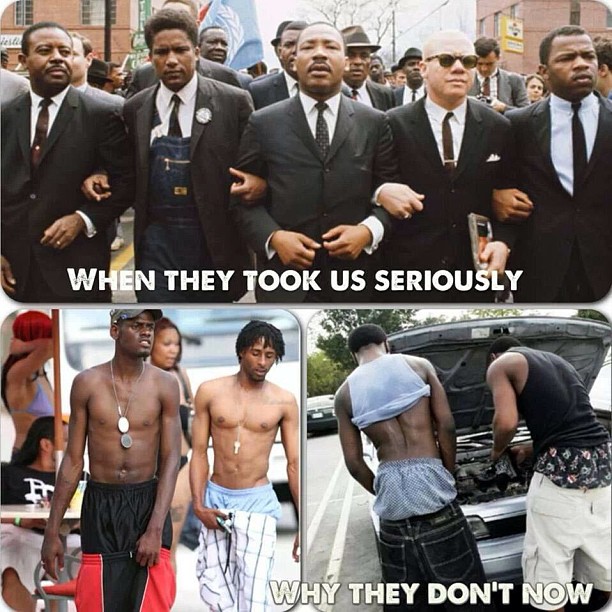
"When They Took Us Seriously/Why They Don't Now" poster, September 20, 2013. (Tim Brinkley/Google +).

“When They Took Us Seriously/Why They Don’t Now” poster, September 20, 2013. (Tim Brinkley/Google +).

In the past month of March on Washington and “I Have A Dream” speech commemorations and Birmingham church bombing dedications, a series of images lamenting rap culture and “thug life” have made their way around the Internet. The one that has stuck with me the most has been the image of the Selma March in 1965 juxtaposed with seemingly random photos of young Black males with saggy pants. The caption reads, “When they took us seriously/Why they don’t now.” Really? White supremacists took respectable Negroes seriously in the ’60s because they marched and wore suits, but don’t take Black males seriously now because of the saggy pants phenomenon? The truth is, they did and didn’t take us seriously then and now, and it has almost nothing to do with pulling our pants up above our boxers.

I have to say, though, that I hate saggy pants. It makes the people wearing them look somewhere between goofballs and idiots. It’s never mattered to me whether White guys or Black guys or college guys or hip-hop divas have worn saggy pants. I didn’t like it when it became a style in the early ’90s, thanks in large measure to NWA and Tupac, TLC and Snoop Dog and a host of other hip-hop/rap artists. I certainly don’t like it now, and would never buy a pair for my ten-year-old son to wear that way. The saggy pants style has been a sad twist on hand-me-downs and poverty as marketable clothes for the hip-hop cool.

But the saggy pants style has never translated for me as embracing a  “thug life” or some devolution of Black culture or American society. It wasn’t life imitating art, ala Boyz n the Hood (1991), Menace II Society (1993) or Clockers (1997). Nor have I ever seen it as something that meant that Whites or the new Black elite could say, “See. These Black folk don’t deserve respect, or health care, or a quality education, or good-paying jobs.” Over the past two decades, I’ve seen it as a style — a bad style, to be sure — but a style that some Blacks (and Whites, Latinos and Asians) have embraced.

Any young Black person who’s striving for higher education, or careers, or their own stereotypical success story in life, will tell you that they don’t wear saggy pants for every time or season. Even those who don’t know learn very quickly that saggy pants aren’t welcome in allegedly more respectable settings. If anything, the prevalence of saggy pants in 2013 has as much to do with the reality that opportunities for education, employment and prosperity remain so out of reach that it really doesn’t matter to many what they wear and where they wear it. There’s no need to code switch if everyone in your world knows the same exact code of cool.

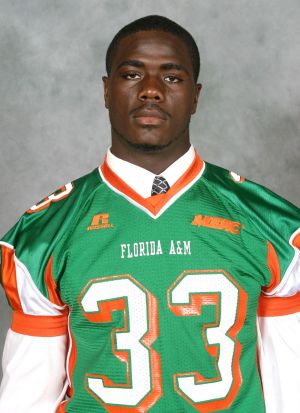
Jonathan Ferrell, Florida A&M football picture, September 20, 2013. (AP/Florida A&M University).

Jonathan Ferrell, Florida A&M football picture, September 20, 2013. (AP/Florida A&M University).

Recent events have made it pretty obvious that it really doesn’t matter what Black males wear. We remain targets for deeply ingrained stereotypes, institutional racism, and pre-emptive White violence. Whether it was Trayvon Martin wearing a hoodie in the rain, or John Lewis wearing a suit in Selma forty-eight years ago, it hasn’t mattered to Whites in fear of the Black boogie man. Florida A&M University graduate and former football player Jonathan Ferrell learned this deadly lesson in North Carolina just a week ago. It doesn’t matter what we wear, at least as far as many Whites and some Black elites are concerned.

Blacks all look the same to them, and looked the same to them in the ’60s. Suits, hoodies or baggy pants, we’re criminals and imbeciles from birth, thugs for life, and a drain on families and American society. This doesn’t mean that any one of us shouldn’t take responsibility for how we act, speak and look in public. I dare say, though, that structural economic issues like unemployment in deeply impoverished Black communities (or crank-infested White ones) won’t be solved with young folk pulling their pants up. We need to stop focusing on the insignificant, because saggy pants and respectability are the trees in this morphing forest of racism and economic inequality.

My Day of Atonement/Bitter Hatred

14 Saturday Sep 2013

Posted by decollins1969 in 1, Boy @ The Window, culture, Eclectic, Hebrew-Israelite, Jimme, Marriage, Mount Vernon New York, My Father, Politics, Pop Culture, race, Religion, Youth

≈ 2 Comments

Tags

Afrocentricity, Day of Atonement, Disillusionment, Family, Forgiveness, Hatred, Judah ben Israel, Judaism, Love, Maurice Eugene Washington, Self-Discovery, Ten Lost Tribes, Torah, Yom Kippur


Prayer at the Wailing Wail, Second Temple, Jerusalem, February 1, 2013. (Steve Ibrom). Released by public domain by author.

Prayer at the Wailing Wail, Second Temple, Jerusalem, February 1, 2013. (Steve Ibrom). Released by public domain by author.

“Yom Kippur ’83 opened me up to understanding why I no longer put my trust in Maurice’s God. I spent part of another September fasting and going to temple to atone for my sins. The temple was on Fifth Avenue and Second Street, just down the street from Washington Elementary School. I’d gone to temple maybe a half-dozen times since the spring of ’81, three of those times to have some rabbi with a ragged beard tell me that Yahweh had forgiven me for my wicked ways.

“And it left me thinking, ‘Well, what about Maurice? His sins are many, and we get treated the same? Does he get forgiveness even if the sin is still in progress?’ It didn’t make sense to me that I needed to starve myself for three days and ask for forgiveness in a situation where a fat, greasy SOB for a stepfather could steal from, cheat on, beat up on, and lie to Mom, get forgiveness, and keep on trying to do what he’d done before Yom Kippur. I said to whoever was a higher power, ‘What did I do to deserve this?’ I didn’t get an answer, and nothing anyone at temple said gave me any answers either. I felt empty, as if everything I thought being in this faith was about was a farce, a morbid, diabolical joke that was played on me and my family. And Maurice was the devil himself.”

That’s what I wrote in Boy @ The Window about my last Yom Kippur as a Hebrew-Israelite. That Saturday, September 17, ’83, was the last time I went to temple, the last time I looked at any aspect of our bizarre and goofy mix of Judaism and Afrocentricity with a modicum of seriousness. By the time I left, I wasn’t in a forgiving mood at all. I hated my then stepfather Maurice, and hated the people who claimed that people like Maurice were descendants of one of the Ten Lost Tribes of Ancient Israelites.

Please understand. When I said, “I hated Maurice,” it wasn’t a euphemism for me in the fall of ’83. If I had access to a gun, I would’ve blown him away and gladly served time in prison for doing so. I had stomach ulcers in the fall of ’83, because I couldn’t stand the smell, sound or sight of the obese asshole. I all but prayed to Yahweh that he get hit by a Mack truck going eighty miles an hour down East Lincoln Avenue. I wanted him dead, and I wanted to piss on his ashes to boot.

Even at thirteen, though, I also understood that this kind of anger and rage wouldn’t help me in the long run between ninth grade and college. Or with sports. Or dating. Or in finding my own path to God or to anything else worth believing. My bitterness and hatred were so deep, about as deep as any love that I’d experienced up to that point in my life. Whether my Mom, my father Jimme, my Uncle Sam or my version of Wendy, all that love was nearly drowned out by my hate for my stepfather.

Even on my irony scale, this hatred broke all records. Especially on a day of atonement, where we all but sacrificed an unblemished lamb at the temple over four hours that Saturday. But I had other reasons to be bitter on this, the holiest of holy days. No bar mitzvah, no celebrations of Hanukkah, no participation in Hebrew-Israelite life for me beyond their 613 rules and regs for nearly two and a half years. I understood and yet didn’t understand this sense of pride and Blackness that came through in a near Asian religion that allowed for reincarnation and an post-Babylonian Israelite diaspora to Sub-Saharan Africa to boot. That confusion didn’t help me deal with a man who wasn’t one, but was a teenage bully who did everything he could to keep me and Mom in submission to him, with Yahweh and Torah as his excuse.

Yom Kippur 1983

Yom Kippur 1983

I knew after I left temple that Yom Kipper afternoon that it would be my last. I didn’t know how, but my days of wearing a kufi or yarmulke were on their way to an end. Still, with hatred and confusion in my heart and mind, I was also lost, more lost than the other ten ancient Israelite tribes undoubtedly were in the aftermath of the Babylonian conquest.

← Older posts
Newer posts →

Boy @ The Window: A Memoir

Boy @ The Window: A Memoir

Places to Buy/Download Boy @ The Window

There's a few ways in which you can read excerpts of, borrow and/or purchase and download Boy @ The Window. There's the trade paperback edition of Boy @ The Window, available for purchase via Amazon.com at http://www.amazon.com/Boy-Window-Donald-Earl-Collins/dp/0989256138/

There's also a Kindle edition on Amazon.com. The enhanced edition can be read only with Kindle Fire, an iPad or a full-color tablet. The links to the enhanced edition through Apple's iBookstore and the Barnes & Noble NOOK edition are below. The link to the Amazon Kindle version is also immediately below:

scr2555-proj697-a-kindle-logo-rgb-lg

Boy @ The Window on Amazon.com: http://www.amazon.com/Boy-The-Window-Memoir-ebook/dp/B00CD95FBU/

iBookstore-logo-300x100

Boy @ The Window on Apple's iBookstore: https://itunes.apple.com/us/book/boy-the-window/id643768275?ls=1

Barnes & Noble (bn.com) logo, June 26, 2013. (http://www.logotypes101.com).

Boy @ The Window on Barnes & Noble: http://www.barnesandnoble.com/w/boy-the-window-donald-earl-collins/1115182183?ean=2940016741567

You can also add, read and review Boy @ The Window on Goodreads.com. Just click on the button below:

Boy @ The Window

Twitter Updates

Tweets by decollins1969
  • RSS - Posts
  • RSS - Comments

Archives

  • June 2025
  • April 2023
  • September 2022
  • August 2022
  • July 2022
  • June 2022
  • May 2022
  • April 2022
  • March 2022
  • January 2022
  • December 2021
  • November 2021
  • October 2021
  • September 2021
  • August 2021
  • July 2021
  • June 2021
  • April 2021
  • March 2021
  • February 2021
  • January 2021
  • December 2020
  • November 2020
  • October 2020
  • September 2020
  • August 2020
  • July 2020
  • May 2020
  • April 2020
  • March 2020
  • January 2020
  • December 2019
  • November 2019
  • August 2019
  • July 2019
  • June 2019
  • May 2019
  • April 2019
  • March 2019
  • February 2019
  • January 2019
  • December 2018
  • November 2018
  • October 2018
  • September 2018
  • August 2018
  • July 2018
  • June 2018
  • May 2018
  • March 2018
  • February 2018
  • January 2018
  • December 2017
  • November 2017
  • October 2017
  • September 2017
  • August 2017
  • July 2017
  • June 2017
  • May 2017
  • April 2017
  • March 2017
  • February 2017
  • January 2017
  • December 2016
  • November 2016
  • October 2016
  • September 2016
  • August 2016
  • July 2016
  • June 2016
  • May 2016
  • April 2016
  • March 2016
  • February 2016
  • January 2016
  • December 2015
  • November 2015
  • October 2015
  • September 2015
  • August 2015
  • July 2015
  • June 2015
  • May 2015
  • April 2015
  • March 2015
  • February 2015
  • January 2015
  • December 2014
  • November 2014
  • October 2014
  • September 2014
  • August 2014
  • July 2014
  • June 2014
  • May 2014
  • April 2014
  • March 2014
  • February 2014
  • January 2014
  • December 2013
  • November 2013
  • October 2013
  • September 2013
  • August 2013
  • July 2013
  • June 2013
  • May 2013
  • April 2013
  • March 2013
  • February 2013
  • January 2013
  • December 2012
  • November 2012
  • October 2012
  • September 2012
  • August 2012
  • July 2012
  • June 2012
  • May 2012
  • April 2012
  • March 2012
  • February 2012
  • January 2012
  • December 2011
  • November 2011
  • October 2011
  • September 2011
  • August 2011
  • July 2011
  • June 2011
  • May 2011
  • April 2011
  • March 2011
  • February 2011
  • January 2011
  • December 2010
  • November 2010
  • October 2010
  • September 2010
  • August 2010
  • July 2010
  • June 2010
  • May 2010
  • April 2010
  • March 2010
  • February 2010
  • January 2010
  • December 2009
  • November 2009
  • October 2009
  • September 2009
  • August 2009
  • July 2009
  • June 2009
  • May 2009
  • April 2009
  • March 2009
  • February 2009
  • January 2009
  • December 2008
  • November 2008
  • October 2008
  • September 2008
  • August 2008
  • July 2008
  • June 2008
  • May 2008
  • April 2008
  • March 2008
  • February 2008
  • January 2008
  • December 2007
  • November 2007
  • October 2007
  • September 2007
  • August 2007
  • July 2007
  • June 2007

Recent Comments

MaryPena's avatarMaryPena on My Day of Atonement/Bitter Hat…
decollins1969's avatardecollins1969 on No Good Teaching Deed Goes…
Mary Rose O’Connell's avatarMary Rose O’Connell on No Good Teaching Deed Goes…

NetworkedBlogs on Facebook

NetworkedBlogs
Blog:
Notes From a Boy @ The Window
Topics:
My Life, Culture & Education, Politics & Goofyness
 
Follow my blog

616 616 East Lincoln Avenue A.B. Davis Middle School Abuse Academia Academy for Educational Development AED Afrocentricity American Narcissism Authenticity Bigotry Blackness Boy @ The Window Carnegie Mellon University Child Abuse Class of 1987 CMU Coping Strategies Crush #1 Crush #2 Death Disillusionment Diversity Domestic Violence Economic Inequality Education Family Friendship Friendships Graduate School Hebrew-Israelites High-Stakes Testing Higher Education History Homelessness Humanities Humanities Program Hypocrisy Internalized Racism Jealousy Joe Trotter Joe William Trotter Jr. K-12 Education Love Manhood Maurice Eugene Washington Maurice Washington Misogyny Mother-Son Relationship Mount Vernon High School Mount Vernon New York Mount Vernon public schools Multiculturalism MVHS Narcissism NFL Pitt Pittsburgh Politics of Education Poverty President Barack Obama Race Racial Stereotypes Racism Relationships Self-Awareness Self-Discovery Self-Reflection Sexism Social Justice Teaching and Learning University of Pittsburgh Violence Whiteness Writing

Top Rated

Blog at WordPress.com.

  • Subscribe Subscribed
    • Notes from a Boy @ The Window
    • Join 103 other subscribers
    • Already have a WordPress.com account? Log in now.
    • Notes from a Boy @ The Window
    • Subscribe Subscribed
    • Sign up
    • Log in
    • Report this content
    • View site in Reader
    • Manage subscriptions
    • Collapse this bar
 

Loading Comments...