• Spinning Sage’s Gold: Allegories on the Western-Dominated Present and a Possible Post-Western Future (2025)
  • About Me
  • Other Writings
  • Interview Clips
  • Video Clips
  • Boy @ The Window Pictures
  • Boy @ The Window Theme Music

Notes from a Boy @ The Window

~

Notes from a Boy @ The Window

Category Archives: Pittsburgh

My Private Aftermath of the O.J. Simpson Verdict 20 Years Ago

01 Thursday Oct 2015

Posted by decollins1969 in 1, Academia, Boy @ The Window, Carnegie Mellon University, culture, Eclectic, Pittsburgh, Politics, Pop Culture, race, University of Pittsburgh, Work, Youth

≈ Leave a comment

Tags

Carl, CMU, Drama, James, Media Coverage, Murder, O.J. Simpson, O.J. Simpson Trial, O.J. Simpson Verdict, OJ Simpson, Race Riots, Racial Divide, Racism, Trial, White Bronco, Whiteness


 O.J. Simpson with his attorneys F. Lee Bailey (left) and the late Johnnie Cochran (right) after being found not guilty, October 3 1995. (Myung J. Chun/Los Angeles Daily News/AP, via http://theguardian.com)

O.J. Simpson with his attorneys F. Lee Bailey (left) and the late Johnnie Cochran (right) after being found not guilty, October 3 1995. (Myung J. Chun/Los Angeles Daily News/AP, via http://theguardian.com)

To think that it’s only been two decades since the overhyped “Trial of the Century” came to a close with a clerk’s initial mispronunciation of Orenthal James Simpson’s first name. And of course, with O.J. Simpson’s acquittal. It’s amazing to think that so many would become so emotionally caught up in a double-homicide case involving what at one time was one of the world’s most recognizable faces. But it did happen, all of it in a sixteen-month span, and the reaction was as predictable as the sunrise, racial profiling, and police harassment.

During the Ford Bronco chase on I-5 on Friday, June 17 (during my Knicks’ Game 5 of the NBA Finals against the Houston Rockets), I hoped that the police wouldn’t shoot Simpson before he had a chance to go to trial. The L.A. riots were just two years before. I feared that the issue of race would be front and center, with Simpson’s issues with his now dead White ex-wife.

O.J. Simpson on the covers of Newsweek and Time Magazine, (the picture on right altered to make Simpson appear darker and caused an outcry), June 27, 1994. (Theo's Little Bot via Wikipedia). Qualifies as fair use due to low resolution of image and relevance to subject matter.

O.J. Simpson on the covers of Newsweek and Time Magazine, (the picture on right altered to make Simpson appear darker and caused an outcry), June 27, 1994. (Theo’s Little Bot via Wikipedia). Qualifies as fair use due to low resolution of image and relevance to subject matter.

I was naive, thinking that our world of ’94 would simply attempt to determine if Simpson was guilty or innocent. Instead what I saw within ten days of the Bronco chase was an artificially darkened Simpson on the cover of Time. I saw Blacks who became angrier about the coverage, even as Whites grew more confident about Simpson being convicted, losing his fortune and fame, and possibly getting the death penalty (or at least, life imprisonment). My Mom proclaimed that O.J. was innocent long before the prosecution botched the trial. Some of my grad school colleagues — all White, mind you — made all kinds of assumptions about where I stood on O.J. They didn’t like the fact that I was willing to wait until the trial to make up my mind.

When the verdict came down on Tuesday, October 3, 1995, it was stunning to watch ecstatic Blacks and angry, dejected Whites react to the “Not Guilty” verdict. And not just on TV, although it was obvious newsrooms were actively looking for a racial divide. My friend James (who’s Black, by the way) from my Pitt grad school days spent his lunch break in my apartment gritting his teeth in anger as the verdict was read. I was more shocked than anything else. I smiled, but it was one of bewilderment observing the reactions, as if we all had some deeply personal stake in the trial and verdict.

That smile disappeared as I went through my day editing and printing out chapter drafts of my dissertation. That was my real focus, not the soap opera enveloping the rest of the country. Late that afternoon, I went to Carnegie Mellon to drop off a draft of a couple of those chapters for my thesis advisor Joe Trotter. Carl, a colleague of mine, one who I had called a friend up to this point, immediately started in on me about the verdict when I reached the grad student cubicles in the History Department. He kept literally spewing the media’s line about an all-Black jury, about jury nullification, about Johnnie Cochran. Carl was in a rage, belligerent, possibly drunk, and seemingly ready to throw down. Seriously, aside from showing up to drop off dissertation chapters, what did I do?

I politely pointed out that the jury was mostly, but not all Black (at least three members were White or Latino), and that the prosecution led by Marcia Clark and Christopher Darden left the door wide open for an acquittal. Carl assumed wrongly that I wanted O.J. free regardless of his “obvious guilt.” I asked my colleague what else could the jury do, given the compelling defense put together by the late Johnnie Cochran, the mistakes with forensics, with the glove, with putting Mark Fuhrman on the stand? I said that “I don’t represent all thirty million African Americans in this country,” and that “our conversation is over.”
Mary J. Blige, No More Drama (with extra tracks) album cover, 2002. (http://amazon.com).

Mary J. Blige, No More Drama (with extra tracks) album cover, 2002. (http://amazon.com).

That reminded me of how irrational supposedly rational, forward-thinking Whites often are on race matters. They either ignore, deny, or when compelled by some betrayal or injustice, badger, threaten and retaliate in response. Carl that day was no exception. I found that incident unsettling because this supposed friend was one of the few folks at Carnegie Mellon who had earned my trust. It reminded me if I were to ever date or marry someone White (not exactly my plan), there would be hell to pay. I had a grand total of three conversations with Carl after that between October 3, 1995 and August 6, 1999, the latter the week before I left Pittsburgh to live in suburban DC/Maryland.

I’m sure that I wasn’t the only Black person who had to confront Whiteness in all of its angry, hurt and juvenile forms in those first two weeks of October ’95. I’m equally sure that if the O.J. Simpson trial’s verdict occurred in 2015, Carl and his like-minded ilk would’ve set off race riots the likes of which this country hasn’t seen since Detroit in 1943, Tulsa in 1921, and Chicago in 1919. You know, the kind where Whites go into segregated Black communities and rape, kill, steal and destroy as much as they can. To me, Carl just represented the White privilege and resentment of millions, smoldering yet ready to erupt at a moment’s notice. Not that many haven’t benefited from the O.J. Simpson effect in the years since.

Carl has a professorship somewhere in New York these days, and we are professional colleagues who maybe exchange an email one or twice a decade now. I’m sure, though, that he avoids the topic of race in US history like most would want to avoid catching Ebola. Especially given his reaction to one jury verdict twenty years ago.
Aside

Past Labor’s Opportunities Lost

07 Monday Sep 2015

Posted by decollins1969 in 1, Academia, Boy @ The Window, Carnegie Mellon University, culture, Eclectic, Pittsburgh, Politics, Pop Culture, race, Work, Youth

≈ Leave a comment

Tags

Advisor-Student Relationships, Anger, CMU, Dissertation Completion, Howard University, Jealousy, job search, Joe William Trotter Jr., Labor Day, Mentoring, NYU, Post-Docs, Rage, Running Interference, Spencer Foundation, Spencer Foundation Dissertation Fellowship Program, Steven Schlossman, University of Maryland, University of Wisconsin-Madison


Title page of the first quarto of William Shakespeare's Love's Labour's Lost (1598), uploaded May 2, 2011 (Tom Reedy via Wikipedia). In public domain.

Title page of the first quarto of William Shakespeare’s Love’s Labour’s Lost (1598), uploaded May 2, 2011 (Tom Reedy via Wikipedia). In public domain.

One of the more gut-wrenching periods of my career began right after Labor Day 1995. In some respects, that period of my career has left a stain over the past two decades. Not so much in terms of what I have done or in what I’m doing now, as much as in setting limits on the range of possible outcomes with which I could’ve begun my career.

Right after Labor Day, I saw an ad in The Chronicle of Higher Education for an open-ranked (tenured or tenure-stream) position at NYU’s school of education in US education history. I hadn’t thought about teaching in a school of education before, but after meeting my friend Cath and having received my Spencer Foundation fellowship, I understood that this was likely a better choice for me than a history department. I wasn’t the only one who thought so. My department chair Steven Schlossman had received a letter and a telephone call from his equivalent peer at NYU asking if there were any graduate students in the pipeline who could apply for the position. Schlossman apparently told that department chair about me and my multiculturalism dissertation, and caught up with me that same week to give me a copy of the letter and encouraged me to apply for the job.

I was two-and-a-half chapters into my planned eight-chapter dissertation, and I still had some US Census data to look at and interviews to conduct as part of the process. I knew that my advisor Joe Trotter wouldn’t be happy about the idea of me applying for a job so soon into the process, but Schlossman and I also knew that the job — if I somehow got it — wouldn’t start for eleven months. That was more than enough time for me to write, revise, revise again, polish up and defend my dissertation. I was on a Spencer fellowship, after all!

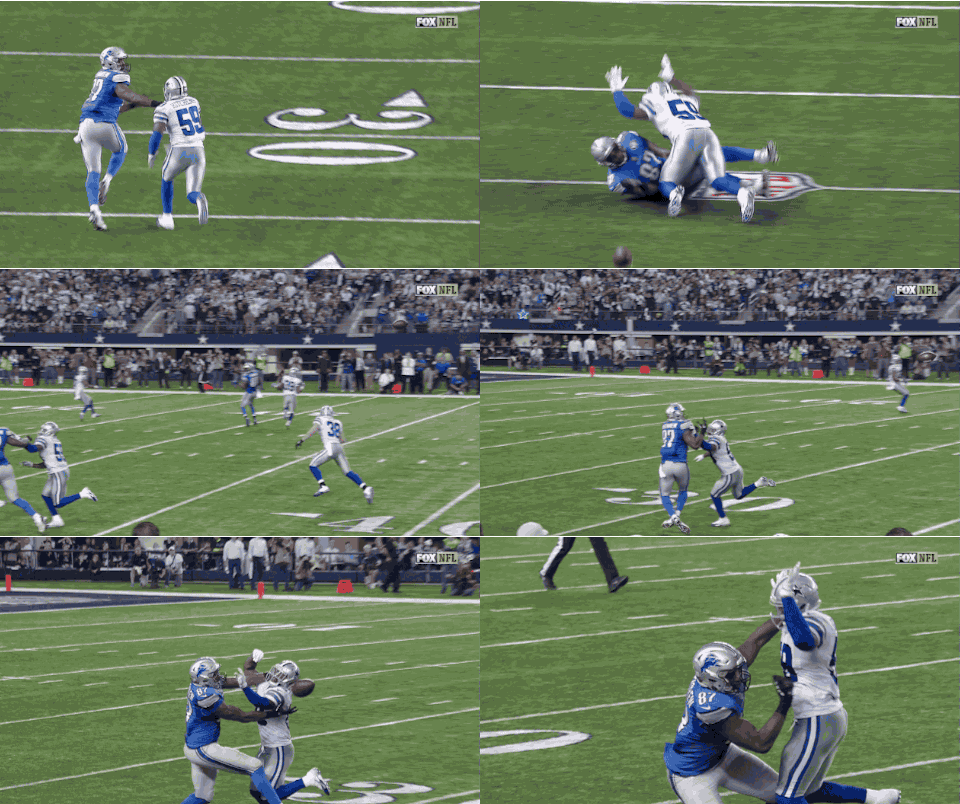
A defensive pass interference penalty not called, Detroit Lions v. Dallas Cowboys Wildcard Game, January 4, 2015. (http://bleacherreport.com/articles/2319198-refs-pick-up-flag-after-pass-interference-on-cowboys-in-4th-quarter; FOX Sports).

A defensive pass interference penalty not called, Detroit Lions v. Dallas Cowboys Wildcard Game, January 4, 2015. (http://bleacherreport.com/articles/2319198-refs-pick-up-flag-after-pass-interference-on-cowboys-in-4th-quarter; FOX Sports).

Of course Trotter thought otherwise. He was incensed that Schlossman had discussed the NYU job with me, that I hadn’t talked with him about the position first. Of course Trotter said that he needed to “run interference” on my behalf, to protect me and my career. By “running interference,” Trotter meant that he would not write a letter of recommendation on my behalf. He told me to put the job out of my mind, to focus on my dissertation, and that we could revisit the prospect of apply for jobs when I was much further along.

A few months later, in February ’96, I saw another job ad in the Chronicle, this one for a history of education assistant professorship at University of Wisconsin-Milwaukee. Schlossman saw that ad as well, but I was still the dutiful ABD student with Trotter as my patron. I decided this time to approach Trotter before meeting with Schlossman about the job. Trotter flipped out again, telling me, “you’re not ready,” that he had seen too many of his own peers not finish dissertations when taking jobs, only to end up unemployed. Keep in mind, I had written six of my eight chapters at this point, and had started working on number seven that month.

Trotter’s “you’re not ready” pronouncements rang even more hollow in March, when I requested a letter from him to apply for a post-doctoral fellowship in African American Studies at University of Maryland, College Park. He refused at first, then agreed, with the caveat that he would write in his letter his belief that  I wouldn’t complete my dissertation in time to begin the fellowship at the end of August ’96. With that kind of endorsement, of course I didn’t apply!

When we finally had our blow-out argument that April 4th, I was frustrated, he was actually angry, for reasons I didn’t put together until I considered my age and his HNIC status and age later on. Most of Trotter’s stonewalling occurred after he found out that I was still only about to turn twenty-six at the time of the NYU job prospect. Between that and the limited mileage remaining in his proletarianization hypothesis, I was working for and with an advisor who was giving me mixed signals and mediocre advice. Both were based in part on jealousy, and in part on Trotter’s own bad experiences at University of Minnesota and on the job front in the 1970s and early 1980s.

Danger Bad Advice Ahead fake sign, September 7, 2015. (http://wordspicturesweb.com).

Danger Bad Advice Ahead fake sign, September 7, 2015. (http://wordspicturesweb.com).

Trotter didn’t understand that in blocking my first attempts to begin my career, he had helped set up a struggle for me to have even a semblance of a career before I had completed the first draft of my dissertation. As it was, I finished the first draft in June ’96, the second at the end of July, and polished it up before Labor Day Weekend ’96. That fact that I was done with all major revisions to my dissertation in time for any job that year made ready to strangle Trotter at that point.

Still, it would be only fair to say that my career moves — good and bad, smart and stupid — have mainly been of my own making. It would also be unfair to blame Trotter for any moves that I have made or didn’t make that didn’t work out after 1996-97. But every career has a beginning. And in the beginning, Trotter was there, making a mess of my first steps. It took until the spring of 2000 before Howard University offered me a tenure-track position in Afro-American Studies, to which I did say no. I didn’t need any more Joe Trotter’s in my life at that point, and working in the nonprofit world paid my bills better than teaching at that time.

My overall advice would be to make damn sure that you choose an advisor who cares about your whole career and about you as a person. Don’t choose someone to advise and mentor you out of convenience, and make sure that your advisor isn’t someone who just wants to mold you into a mediocre version of themselves. After all, it’s not their career trajectory or reputation that’s on the line. It’s yours.

Aside

Leaving Mount Vernon

26 Wednesday Aug 2015

Posted by decollins1969 in 1, Boy @ The Window, Christianity, culture, Eclectic, eclectic music, High Rise Buildings, Jimme, Mount Vernon High School, Mount Vernon New York, music, My Father, New York City, Pittsburgh, Politics, Pop Culture, race, Religion, University of Pittsburgh, Work, Youth

≈ Leave a comment

Tags

"Emotion (Ain't Nobody)" Remix (2014), "Swimming Pools (Drank)" (2012), Child Abuse, College, Domestic Violence, Emotions, Family, Kendrick Lamar, Leaving, Loneliness, Maverick Sabre, Moving, Pitt, Politics of Respectability, Poverty, Respectability Politics, Self-Awareness, Self-Discovery


I left for Pittsburgh and for the University of Pittsburgh on this day/date twenty-eight years ago, my first trip on my own. It was my first trip out-of-state since my Mom took me and my brother Darren on a bus trip to Pennsylvania Amish country in June ’78, nine years earlier. At 5:51 am on the last Wednesday in August ’87, with my older brother Darren’s help — and with my Mom and three of four younger siblings watching us from the living room window — I packed my luggage, Army sack, and two boxes of bedding and materials into a Reliable Taxi. We headed for East 241st to meet up with my dad. From there, we took the 2 Subway all the way to Penn Station, with enough time to board and get all of my stuff on the 7:50 am Pennsylvanian train to the ‘Burgh. For the second time in a row, my dad was sober, and gave me a glassy-eyed hug and shoulder squeeze. Darren was both sad and happy to see me go.

Amtrak's Pennsylvanian train pulling out of Altoona, PA station, heading east for Philly, NYC, uploaded February 2013. (Dustin F.; http://www.northeastrailfans.com/).

Amtrak’s Pennsylvanian train pulling out of Altoona, PA station, heading east for Philly, NYC, uploaded February 2013. (Dustin F.; http://www.northeastrailfans.com/).

I’ve gone over the trip to Pittsburgh and my transformation from a seventeen-year-old with the pent-up emotions of someone who hadn’t left May 31, 1982 behind throughout my eight years of blogging and through my memoir. I’ve written about moving on to Pittsburgh before. What I haven’t really written about fully is how I thought and felt in leaving Mount Vernon, New York behind. The short answer is, I was somewhere between terrified, joyous, embittered, and sad to go, and all at once.

I was terrified. It was my first trip on my own, to a city I’d never been to before, to a university I never visited prior to saying yes. I could meet people who might catch on that I was someone who had spent the previous six years with few acquaintances, much less friends. I was hopeful, but had zero idea what to expect.

But I really was happy to leave. Between my decade living at 616, the abuse, the poverty, the Hebrew-Israelite years, the constant ridicule, the years in Humanities, the constant work of watching after Mom, my dad, my siblings, I was through. Throw in a summer of obsession with and emasculation by Phyllis, and five years of realizing that I needed to get out, and going to Pittsburgh was a no-brainer. Heck, if I’d been a bit smarter about my application process, I could’ve just as easily applied to the University of Washington, Stanford, Northwestern, Georgetown, Michigan, University of Toronto and UPenn and almost certainly gotten in. It didn’t matter where I was going, really. I just needed to go and find my myself, and my education with that.

That last year or so in Mount Vernon had let me know that even with an academic scholarship (after a private investigation) from Columbia, staying would’ve been a huge mistake. Between the silent disdain and snickering of Black teachers at Mount Vernon High School around my sullen presence and the whole Estelle Abel episode at the end of four years of torment. Add to that the years of Black middle class folk talking at me about how my life was so much better because they marched or protested somewhere before I was conceived, or because they prayed for me. Add to that this insistence that I “give back to the community.” As if Black Mount Vernon had given me anything but a hard way to go since I was knee-high to a boil weevil.

Viewing and wake service for Heavy D, Grace Baptist Church, Mount Vernon, NY, November 17, 2011. (Mike Coppola/Getty Images; https://cbsnewyork.files.wordpress.com/).

Viewing and wake service for Heavy D, Grace Baptist Church, Mount Vernon, NY, November 17, 2011. (Mike Coppola/Getty Images; https://cbsnewyork.files.wordpress.com/).

As I saw it, the only difference between the vapid, seething facade of White liberalism among paternalistic White Mount Vernonites and the false smiles and frequent excoriations of Mount Vernon’s Black middle class was skin color. They drank deep from swimming pools full of what we now call respectability politics, born out of a need to be good examples to the world, like Kendrick Lamar described in “Swimming Pools” (2012). (Pour up [drank], head shot [drank]…faded [drank]). This isn’t the same as doing the right thing at the right time or speaking truth to power. You make money, wear nice clothes, drive a nice car, stand up straight, look a White man in the eye while firmly grasping his hand. And apologize for not being as assimilable as you pretend. It was 100%, USDA-approved bullshit, and it smelled like it a lot of days, too.

I was sad to leave, too. There was a part of me that still wanted to fit in, out of loneliness, if nothing else. I still liked Clover Donuts and some of the breakfast places on the South Side. I longed for some sort of acceptance, an acknowledgment that I was a real person, even though that would’ve required being around real people at 616, and in Humanities, and in the rest of Mount Vernon. I knew that I’d miss the close proximity to The City. I’d put my hopes and dreams in a place in which I knew I couldn’t afford to stay, literally and figuratively. That longing would come to haunt me in the coming year, but I’d eventually learn, I could always visit New York.

Aside

Running Away, 30 Years Later

25 Tuesday Aug 2015

Posted by decollins1969 in 1, Boy @ The Window, Christianity, culture, Eclectic, eclectic music, Jimme, Marriage, Mount Vernon High School, Mount Vernon New York, music, My Father, Pittsburgh, Pop Culture, race, University of Pittsburgh, Youth

≈ Leave a comment

Tags

"Emotion (Ain't Nobody)" (2014), "Runnin'" (1995), 616, 616 East Lincoln Avenue, Dreams, Envy, Family Responsibilities, Fleetwood, Lliy-White, Loneliness, Making Plans, Maurice Eugene Washington, Maurice Washington, Maverick Sabre, MVHS, Pharcyde, Single-Minded, Spin Moves, Visions, Whiteness


Today’s date marks three decades since I took on my idiot stepfather Maurice Washington, and actually won, even though I didn’t realize it at the time. I’ve written about the incident and my twenty-three-hour trek through Mount Vernon, my dreams, prayers, and wishes, and my confrontation before, here and in Boy @ The Window. (Even now, the baseline to Pharcyde’s “Runnin'” (1995) is running in my head, temporarily replacing my writing theme song for the past week, Maverick Sabre’s “Emotion (Ain’t Nobody)” (2011), but that’s how my mind works). So I won’t go over all of the details again. Still, there are a few important takeaways that puts Sunday, August 25, 1985 in my lifetime victory column.

Michigan WR Jeremy Gallon's spin move gif on way to a 61-yd TD against Notre Dame, Ann Arbor, MI, September 7, 2013. (http://thebiglead.com/).

Michigan WR Jeremy Gallon’s spin move gif on way to a 61-yd TD against Notre Dame, Ann Arbor, MI, September 7, 2013. (http://thebiglead.com/).

1. Physical advantages. It never occurred to me until Maurice tried to blindside me in the apartment hallway with a punch that I had much faster reflexes than the idiot. It also never occurred to me that I had a better sense of balance. I managed to avoid the punch and spin around him by using his 350-400 pounds of bulk against him (I really hated having to touch the unwashed, greasy fat frog of a man), and in only a foot of space between the two of us. That’s how I escaped Maurice’s punch and grasp, and got out of the apartment to begin my trek. Knowing what I know now, I should’ve tried out for basketball instead of baseball in eleventh grade.

2. Not finding my father. I kind of wished I had, just to have a few hours that day not to think about my present and future. But my alcoholic dad was a significant part of my present, and his absence gave me real time to think about how jacked up my family life was. I knew, if nothing else, that Maurice, Mom, and Jimme couldn’t pin that on me.

3. Walking up Gramatan Avenue and into Fleetwood. It was partly a walk that reminded me about how the other half of Mount Vernon — affluent and predominantly White — lived. I knew that I’d never be a part of that Mount Vernon, and not just because most of them would run me over with a car sooner than say “Hello.” It was the sense of exclusively, the ability to check in and out of progressive issues, like Humanities and magnet programs, that made me see. These folks I could never befriend.

St. Ursulas Roman Catholic Church, 213 East Lincoln Avenue, Mount Vernon, NY, August 2012. (http://maps.google.com).

St. Ursulas Roman Catholic Church, 213 East Lincoln Avenue, Mount Vernon, NY, August 2012. (http://maps.google.com).

4. MVHS overnight dreams and Catholic church prayers. Both reminded me that if I played my cards right, I could be on my way to college in two years, twenty-four months, 730 days. I could cope with 616, Maurice, my older brother Darren and my younger siblings and high school and Humanities for that much longer, I thought. But I also knew I needed to make a conscious, almost single-minded effort to do so. Even then, I was tired of burying my thoughts and emotions and playing the role of enigmatic weirdo, though. I realized this was going to be a battle with myself.

Yet what I didn’t learn from my ordeal would also be two more reasons to leave Mount Vernon. I wouldn’t learn those reasons and lessons until the spring and summer of ’87, when the respectability police, the good middle class folk of Black Mount Vernon, would give me just the push I needed…

Aside

What’s Up With These Leftist Labels, Anyway?

05 Wednesday Aug 2015

Posted by decollins1969 in 1, Academia, Boy @ The Window, Christianity, culture, Eclectic, eclectic music, Hebrew-Israelite, Mount Vernon High School, Mount Vernon New York, Pittsburgh, Politics, Pop Culture, race, Religion, Youth

≈ Leave a comment

Tags

"I Am 32 Flavors" (1998), Alana Davis, Anti-Stereotype, Class Struggle, Critical Race Theory, Derrick A. Bell, Dick Oestreicher, Evangelical Christianity, Franz Fanon, Graduate School, Humanities, JD, Karl Marx, Labeling, Labels, Leftist, Liberal, Marxist, Neo-Marxist, Pitt, Rosemary Martino, Stereotypes, W. E. B. Du Bois


Asian woman in nude breaking through a barcode, September 2010. (unknown author/woman, http://www.willeyelisten.com).

Asian woman in nude breaking through a bar code, September 2010. (unknown author/woman, http://www.willeyelisten.com).

Over the years, I’ve grown tired of the idea that my social, cultural, economic and political beliefs could be summed up with one or two words. Like “progressive,” “Communist,” “neo-Marxist,” “leftist,” “liberal,” and/or “Marxist.” Why? Because like so many things American (or in this case, Western), ideologues and intellectuals take the easiest path and slap overgeneralized labels on groups of people without thought, without nuance, and certainly without an understanding of both people and history.

I’ve felt this way about these labels at least since my first year of grad school in the University of Pittsburgh’s MA and PhD programs (1991-92), and likely longer than that. But in that program, I was surrounded by professors and colleagues who were various shades of Marxism. At least that’s what they claimed. More to the point, they claimed that “the class struggle” was the defining feature of both human history and US history. “The class struggle” trumped slavery and America’s racial caste system, the near eradication of indigenous cultures in the US and around the world, it trumped the exploitation and exclusion of women in Western civilizations.

I admit it. It really, really, really pissed me off to be earning my MA and beginning my doctoral work around such ignorant thinkers. They would ask me about my Marxism, and I’d say, “I’m not a Marxist. I’m not a neo-Marxist. I’m not even a Groucho Marxist.” My Pitt grad school colleagues would laugh, sometimes a little too forcefully. My professors, for the most part, ignored me, since I was an African American history student who believed that race intertwined with class to be US history’s defining feature. How scandalous!

It wasn’t that I hadn’t read Karl Marx’s and Frederick Engels’ Communist Manifesto (1848). I read it via Rosemary Martino in twelfth grade, though I can’t remember if I read it for AP English or for her Humanities Philosophy class. I’d also read Marx’s much longer Das Kapital (1867), Frantz Fanon’s Black Skin, White Masks (1952) and The Wretched of the Earth (1961), Du Bois’ The Souls of Black Folk (1903), Ralph Ellison’s Invisible Man (1952), and so many other supposedly Marxist-leaning tombs by the time I’d taken my first full semester of grad-level courses (I took my first grad course my junior year at Pitt).

A basic world political spectrum chart (really, too simple), August 5, 2015. (http://www.endofprejudice.com/).

A basic world political spectrum chart (really, too simple), August 5, 2015. (http://www.endofprejudice.com/).

I just wasn’t that impressed on the Marxism part of things. I mean, I was well acquainted with oppression, exploitation and abuse long before I’d read anything by Marx and Engels, or George Orwell in ninth grade English, for that matter. I had a contrarian Humanities classmate in JD who espoused what I considered even at the time his version of Communist gibberish all through middle school and into our sophomore year at Mount Vernon High School. So how do you label someone a Marxist or Communist who both views it with disdain and didn’t grow up quoting from it? I’d like to know.

This last question, though, is bigger than just my own experience with poverty, race, racism, child abuse, sexual assault, domestic violence, homelessness, cultish religions, and sheer willful ignorance and neglect. Historically, labeling anyone who had radical ideas about the falsities of human civilizations as civilizing the human tendency to spread inequality and oppression to the most vulnerable as Communist is a bit ahistorical, no? So-called leftists or socialists do that with Jesus and Muhammad almost every day. Maybe we should call Karl Marx an original, Asiatic Christian or original Muslim, minus the spiritual component of kneeling before God in prayer.

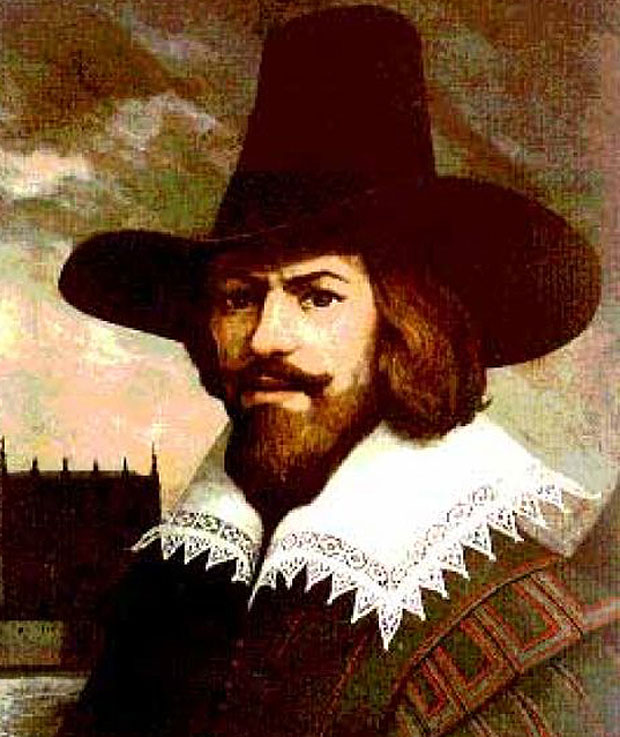
Portrait of Guy Fawkes (1570-1606), author/date unknown, August 5, 2015. (http://plus.google.com).

Portrait of Guy Fawkes (1570-1606), author/date unknown, August 5, 2015. (http://plus.google.com).

For me, growing up in a striving household that ended up in grinding welfare poverty didn’t make me a Communist. I went through several stages of belief, from my Mom and idiot stepfather Maurice hoisting the Hebrew-Israelite thing on me, to evangelical Christianity, to just plain Christianity, to critical race theorist adherent. I never completely gave up on capitalist democracy, because what would’ve been the point of that? By the time my son was born in 2003, I saw myself more in European terms, as either a Social Democrat or a Christian Democrats, believers in compromises and reforms from within that ameliorate the worst forms of racial, gender and other forms of oppression and poverty.

Yet even that is too big a label to hang on me or others, now and across history. What did people call those who wanted to rid the world of poverty and economic oppression prior to 1848? Or prior to the French Revolution, for that matter? Troublemakers? Radicals? Jacobites? Weird? Lunatics? To be honest, any of these terms fit me better than progressive, liberal, leftist or Marxist. Because ultimately, I don’t believe in any single economic or political belief system crafted by Homo sapiens. They’re all subject to corruption, all subject to be bent by those with the most power and resources.

So, who am I, ideologically speaking? To quote Alana Davis, “I am 32 flavors” and dim sum. Go ahead. Try to figure that out and come up with a label that fits!

Aside

Sure I’ve Raised Money, But…

27 Monday Jul 2015

Posted by decollins1969 in 1, Boy @ The Window, culture, Eclectic, Mount Vernon New York, Pittsburgh, Politics, Pop Culture, University of Pittsburgh, Work, Youth

≈ Leave a comment

Tags

Academy for Educational Development, AED, Bob Beane, Capitalism, Diagnostic and Statistical Manual for Mental Disorders, Exploitation, Fundraising, Grant-seeking, Maximizing Profits, Medicaid, Medicare, Mount Vernon Clinic, Partnerships for College Access and Success, PCAS, Presidential Classroom, Valerie Johnstone, Westchester County Department of Community Mental Health


Man on a hamster wheel gif, like constantly looking for money, July 26, 2015. (http://twitter.com).

Man on a hamster wheel gif, like constantly looking for money, July 26, 2015. (http://twitter.com).

Keep in mind that these are just observations, not me axe-grinding or feeling sorry for myself. My biggest observation is that raising money for others without reaping enough benefit for myself shows that even governmental and nonprofit organizations are just as prone to capitalistic exploitation as Walmart and Apple. And that I am not immune, nor have I ever been immune, to the pride and naiveté of production and exploitation.

Many times during my years in the nonprofit world as a manager or consultant, employers have asked me about my ability to raise money. I’ve done a pretty good job of that over the years. Fifteen minutes of work as an educational “closer” at Presidential Classroom led to a $25,000 grant from State Farm’s civic engagement work (a.k.a. service-learning) in 2000. I worked on a $1 million renewal grant from Lumina Foundation for Education for the college access and success initiative for which I served as deputy director during my last four years at the Academy for Educational Development (AED). I also raised $200,000 from Lumina for data collection for the initiative in 2005.

"I come here looking for money (Got to have it)," lyrics from Pet Shop Boys "What Have I Done To Deserve This" (1988), July 27, 2015. (http://nonprofitquarterly.org/).

“I come here looking for money (Got to have it),” lyrics from Pet Shop Boys “What Have I Done To Deserve This” (1988), July 27, 2015. (http://nonprofitquarterly.org/).

I’ve indirectly raised funds from which I didn’t derive a benefit, either because the amount were too small for AED’s vast overhead and other direct costs (read as paying higher-ups salaries for the privilege of raising money on behalf of the now-defunct organization). Or because others used my curriculum vitae and my work for AED to garner grants that I never worked on. My last year at AED we turned down what would’ve been a $100,000 grant from Carnegie Corporation because it would’ve been too small, especially since we needed to collaborate with a sister organization on K-16 access and success work. We turned down potential smaller grants from other private foundations for similar reasons.

And after nine months of work off-and-on, the wife of a Pulitzer Prize winning-columnist for a Washington newspaper received a $250,000 grant from a corporate foundation in New York, based on my work. Because the AED higher-up in charge of the process worked with her as a personal favor — and didn’t put our proposal and implementation work into a contract — her socialite friend and head of a college fund organization received a grant with no strings attached, for AED or for me. I did get paid for my work, as I did it under the AED banner. But the fruits born from that work went outside the organization, to a person almost as duplicitous as the organization for which I once worked.

But in terms of fundraising, or at least, making money for an organization, absolutely nothing in my work history compares to what I did at nineteen. Yes, nineteen! The summer of ’89, I worked for Westchester County Department of Community Mental Health, out of the Mount Vernon, New York clinic, across the bridge from the Mount Vernon East Metro-North stop. After the previous long summer of unemployment followed by five days of homelessness and two more months of living on financial fumes, I was happy, really happy, to have gained steady employment all through ’89.

So happy that I didn’t notice how productive I was being in the office. I had the rather official title of Summer Intern, and had been told by the Director of Community Mental Health Programs in Bob Beane that he was “counting on me.” I came to the Mount Vernon clinic with Beane’s charge to “get their back-billing in order.” Since 1984, the clinic had regularly had its Medicaid and Medicare billing for psychiatric and psychological services rejected by the state-level health folks in Albany, mostly due to coding errors.

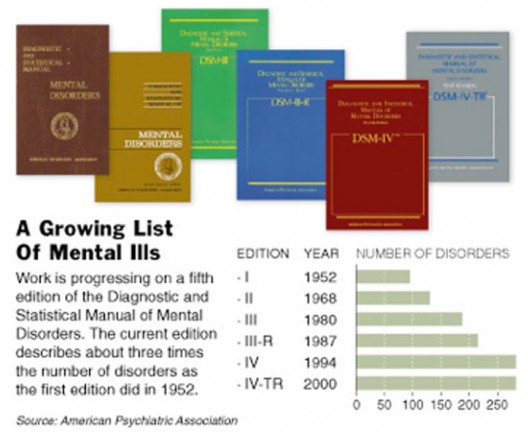
Graphic on DSM editions since 1952 (DSM-V is in its "beta-testing" phase), American Psychiatric Association, 2012. (http://life-surfing.com/).

Graphic on DSM editions since 1952 (DSM-V is in its “beta-testing” phase), American Psychiatric Association, 2012. (http://life-surfing.com/).

Specifically, the clinic staff were putting incorrect codes from the Diagnostic and Statistical Manual for Mental Disorders — in this case, DSM-III and DSM-III-R (with the III-R standing for version number three, revised edition) — on the state billing forms. There were other errors to be sure. Doctor’s names and patients names were often misspelled. Control numbers were incorrect. The proper signature wasn’t obtained. But well over ninety percent of the errors were DSM-III or DSM-III-R codes that staff had entered into a billing form incorrectly.

This was the summer of ’89, so the form itself was printed on a line printer, and the checking of such forms had to be done manually. It would take two or three weeks to hear from Albany about an incorrect code, a month to receive payment. After five years of coding errors, red tape, and the clinic’s administrative staff badly managed by one Valerie Johnstone, my job was to rectify as many of the old billing errors as I could before the summer came to a close.

In eight weeks’ time, despite all the other menial tasks Johnstone would sometimes have me do, as well as having to share the same billing computer with Beverly (who dealt with current billing, and was probably responsible for the majority of my back-billing work), I got through three cabinets’ worth of billing issues. I left at the end of August, I left for the friendly environs of Pittsburgh and Pitt, vaguely aware of how much money I’d made for the Mount Vernon clinic and for the county.

Screen shot of 100 East 1st Street and South 1st Avenue, where I toiled for Westchester County the summer of 1989 (and 1992), April 2012. (http://maps.google.com).

Screen shot of 100 East 1st Street and South 1st Avenue, where I toiled for Westchester County the summer of 1989 (and 1992), April 2012. (http://maps.google.com).

I found out in September that my work had made them $371,000! I was impressed, but then I quickly became depressed. My salary for Westchester County that summer was $5.90 per hour. Over eight weeks, my net income was $1,610. As an intern, I had no fringe benefits, not even a commuter allowance. In terms of ratios, for every dollar I made between June 26th and August 18th, Westchester County and the Mount Vernon clinic made $230.43!

No wonder the staff at the Mount Vernon clinic looked at me with a combination of bemusement and derision! I had shown them up, unknowingly, and allowed myself to be an exploitable resource. And though I had a guaranteed job for the next three years after that summer with Beane and Westchester County, there was no way I could ever make enough income to make up for that kind of profit-generation. So much for the idea of not-for-profit and government enterprises!

Kiss From A Rose – 20 Years On

20 Wednesday May 2015

Posted by decollins1969 in 1, Boy @ The Window, Carnegie Mellon University, culture, Eclectic, eclectic music, Marriage, Movies, music, Pittsburgh, Pop Culture, race, Work, Youth

≈ Leave a comment

Tags

"Kiss From A Rose" (1994/1995), 71B, Angelia, Angelia N. Levy, Batman Forever (1995), Bruce Willis, Carnegie Library of Pittsburgh, CMU, Dating, Die Hard With A Vengeance (1995), Friendships, PAT Transit, Romance, Samuel L. Jackson, Spencer Fellowship, Val Kilmer


Twenty years ago on this date, I re-met the woman who’s now my wife of fifteen years, Angelia on a PAT-Transit bus in Pittsburgh, the old 71B-Highland Park into Oakland. It was an eighty-five degree Saturday afternoon in the ‘Burgh. I decided to treat myself to a movie, Batman Forever (1995), mostly because I knew Val Kilmer was in it. After seeing him act as well as he did in Tombstone, I figured I needed to give it a try. I needed a break, between the euphoria of the Spencer Fellowship and the depression from the fire at 616 that had rendered my family homeless.

So here it was, 3:15 in the afternoon, with me dressed in a blue t-shirt with blue basketball shorts and sneaks. I was standing at the corner of Highland Avenue and Penn Circle South, across from my apartment building, waiting for a bus. The 71B showed up first. I jumped on, sat down on the right-hand side in a front-facing seat. As soon as I sat down, I saw her, sitting right in front of me. It was “Angela with an ‘i’,” Angelia, like that Richard Marx song from ’90.

Seal's second album/CD, Seal (1994): "Kiss From A Rose" re-released as part of Batman Forever (1995) soundtrack in June/July 1995. (http://www.allmusic.com).

Seal’s second album/CD, Seal (1994): “Kiss From A Rose” re-released as part of Batman Forever (1995) soundtrack in June/July 1995. (http://www.allmusic.com).

The thing was, I had a dream that she showed up in the Saturday before this one. I hadn’t seen Angelia in more than two years, hadn’t given her any thought. But it seemed weird that she would just show up a week later in the flesh.

So I said, “Hi Angelia!,” excitedly, wondering what she was doing on the bus. She paused, said “Hi” with the heaviest, stop-bothering-me sigh I’d heard since my high school days. That didn’t deter me. I coaxed out of her the fact that she was pissed off with Carnegie Library because a book she was looking for at the East Liberty branch wasn’t there, even though the catalog said it was. It was a conversation that was one-sided, with Angelia doing most of the complaining.

I listened, and thought, “Yep, same Angelia, same weird Angelia.” But since I was weird also, I kept listening. Finally, she asked me what I was up to. I told her about school, my Spencer Fellowship, my family’s homelessness situation. I kept it brief. I mean, I hadn’t seen her in two years.

By the time we reached Oakland — me to catch one of the 61s to Squirrel Hill to catch the movie, Angelia to walk over to the main branch of Carnegie Library — we exchanged numbers, with Angelia saying, “It was really good talking to you.” I wasn’t so sure about that myself, but at least, she didn’t seem as weird as the woman she was five years earlier.

Screen with Samuel L. Jackson and Bruce Willis from Die Hard With A Vengeance (1995), posted February 28, 2013. (http://chud.com).

Screen with Samuel L. Jackson and Bruce Willis from Die Hard With A Vengeance (1995), posted February 28, 2013. (http://chud.com).

I went to see the movie, but it turned out that it wasn’t out yet. It wasn’t due out for another month! I ended up seeing Die Hard With a Vengeance with Bruce Willis and Samuel L. Jackson. Though much better than Die Hard 2 (1990; one shouldn’t really watch any feature film with John Amos taking up significant screen time, it still sucked, because Willis and Jackson spent half the movie yelling, and Jeremy Irons’ performance didn’t have Alan Rickman’s sense of social irony. I walked home, got together some grub, and through all preconceptions out the window. I gave her a call to tell her about the film mix-up. We ended up talking for more than three hours! It was the first time in a long time I had talked to a woman who wanted to hear what I thought about, well, anything, at least anything outside of sex. It was the start of a beautiful friendship.

A month later, we went to see Batman Forever, and it sucked, just like Angelia said it would. But Seal’s “Kiss From A Rose” didn’t. I bought his CD, though, and not the movie soundtrack!

← Older posts
Newer posts →

Boy @ The Window: A Memoir

Boy @ The Window: A Memoir

Places to Buy/Download Boy @ The Window

There's a few ways in which you can read excerpts of, borrow and/or purchase and download Boy @ The Window. There's the trade paperback edition of Boy @ The Window, available for purchase via Amazon.com at http://www.amazon.com/Boy-Window-Donald-Earl-Collins/dp/0989256138/

There's also a Kindle edition on Amazon.com. The enhanced edition can be read only with Kindle Fire, an iPad or a full-color tablet. The links to the enhanced edition through Apple's iBookstore and the Barnes & Noble NOOK edition are below. The link to the Amazon Kindle version is also immediately below:

scr2555-proj697-a-kindle-logo-rgb-lg

Boy @ The Window on Amazon.com: http://www.amazon.com/Boy-The-Window-Memoir-ebook/dp/B00CD95FBU/

iBookstore-logo-300x100

Boy @ The Window on Apple's iBookstore: https://itunes.apple.com/us/book/boy-the-window/id643768275?ls=1

Barnes & Noble (bn.com) logo, June 26, 2013. (http://www.logotypes101.com).

Boy @ The Window on Barnes & Noble: http://www.barnesandnoble.com/w/boy-the-window-donald-earl-collins/1115182183?ean=2940016741567

You can also add, read and review Boy @ The Window on Goodreads.com. Just click on the button below:

Boy @ The Window

Twitter Updates

Tweets by decollins1969
  • RSS - Posts
  • RSS - Comments

Archives

  • June 2025
  • April 2023
  • September 2022
  • August 2022
  • July 2022
  • June 2022
  • May 2022
  • April 2022
  • March 2022
  • January 2022
  • December 2021
  • November 2021
  • October 2021
  • September 2021
  • August 2021
  • July 2021
  • June 2021
  • April 2021
  • March 2021
  • February 2021
  • January 2021
  • December 2020
  • November 2020
  • October 2020
  • September 2020
  • August 2020
  • July 2020
  • May 2020
  • April 2020
  • March 2020
  • January 2020
  • December 2019
  • November 2019
  • August 2019
  • July 2019
  • June 2019
  • May 2019
  • April 2019
  • March 2019
  • February 2019
  • January 2019
  • December 2018
  • November 2018
  • October 2018
  • September 2018
  • August 2018
  • July 2018
  • June 2018
  • May 2018
  • March 2018
  • February 2018
  • January 2018
  • December 2017
  • November 2017
  • October 2017
  • September 2017
  • August 2017
  • July 2017
  • June 2017
  • May 2017
  • April 2017
  • March 2017
  • February 2017
  • January 2017
  • December 2016
  • November 2016
  • October 2016
  • September 2016
  • August 2016
  • July 2016
  • June 2016
  • May 2016
  • April 2016
  • March 2016
  • February 2016
  • January 2016
  • December 2015
  • November 2015
  • October 2015
  • September 2015
  • August 2015
  • July 2015
  • June 2015
  • May 2015
  • April 2015
  • March 2015
  • February 2015
  • January 2015
  • December 2014
  • November 2014
  • October 2014
  • September 2014
  • August 2014
  • July 2014
  • June 2014
  • May 2014
  • April 2014
  • March 2014
  • February 2014
  • January 2014
  • December 2013
  • November 2013
  • October 2013
  • September 2013
  • August 2013
  • July 2013
  • June 2013
  • May 2013
  • April 2013
  • March 2013
  • February 2013
  • January 2013
  • December 2012
  • November 2012
  • October 2012
  • September 2012
  • August 2012
  • July 2012
  • June 2012
  • May 2012
  • April 2012
  • March 2012
  • February 2012
  • January 2012
  • December 2011
  • November 2011
  • October 2011
  • September 2011
  • August 2011
  • July 2011
  • June 2011
  • May 2011
  • April 2011
  • March 2011
  • February 2011
  • January 2011
  • December 2010
  • November 2010
  • October 2010
  • September 2010
  • August 2010
  • July 2010
  • June 2010
  • May 2010
  • April 2010
  • March 2010
  • February 2010
  • January 2010
  • December 2009
  • November 2009
  • October 2009
  • September 2009
  • August 2009
  • July 2009
  • June 2009
  • May 2009
  • April 2009
  • March 2009
  • February 2009
  • January 2009
  • December 2008
  • November 2008
  • October 2008
  • September 2008
  • August 2008
  • July 2008
  • June 2008
  • May 2008
  • April 2008
  • March 2008
  • February 2008
  • January 2008
  • December 2007
  • November 2007
  • October 2007
  • September 2007
  • August 2007
  • July 2007
  • June 2007

Recent Comments

MaryPena's avatarMaryPena on My Day of Atonement/Bitter Hat…
decollins1969's avatardecollins1969 on No Good Teaching Deed Goes…
Mary Rose O’Connell's avatarMary Rose O’Connell on No Good Teaching Deed Goes…

NetworkedBlogs on Facebook

NetworkedBlogs
Blog:
Notes From a Boy @ The Window
Topics:
My Life, Culture & Education, Politics & Goofyness
 
Follow my blog

616 616 East Lincoln Avenue A.B. Davis Middle School Abuse Academia Academy for Educational Development AED Afrocentricity American Narcissism Authenticity Bigotry Blackness Boy @ The Window Carnegie Mellon University Child Abuse Class of 1987 CMU Coping Strategies Crush #1 Crush #2 Death Disillusionment Diversity Domestic Violence Economic Inequality Education Family Friendship Friendships Graduate School Hebrew-Israelites High-Stakes Testing Higher Education History Homelessness Humanities Humanities Program Hypocrisy Internalized Racism Jealousy Joe Trotter Joe William Trotter Jr. K-12 Education Love Manhood Maurice Eugene Washington Maurice Washington Misogyny Mother-Son Relationship Mount Vernon High School Mount Vernon New York Mount Vernon public schools Multiculturalism MVHS Narcissism NFL Pitt Pittsburgh Politics of Education Poverty President Barack Obama Race Racial Stereotypes Racism Relationships Self-Awareness Self-Discovery Self-Reflection Sexism Social Justice Teaching and Learning University of Pittsburgh Violence Whiteness Writing

Top Rated

Blog at WordPress.com.

  • Subscribe Subscribed
    • Notes from a Boy @ The Window
    • Join 103 other subscribers
    • Already have a WordPress.com account? Log in now.
    • Notes from a Boy @ The Window
    • Subscribe Subscribed
    • Sign up
    • Log in
    • Report this content
    • View site in Reader
    • Manage subscriptions
    • Collapse this bar
 

Loading Comments...