• About Me
  • Other Writings
  • Interview Clips
  • All About Me: American Racism, American Narcissism, and the Conversation America Can’t Have
  • Video Clips
  • Boy @ The Window Pictures
  • Boy @ The Window Theme Music

Notes from a Boy @ The Window

~

Notes from a Boy @ The Window

Category Archives: New York City

The Life of Mary Louise

28 Sunday Oct 2012

Posted by decollins1969 in 1, Boy @ The Window, Christianity, culture, Eclectic, Hebrew-Israelite, Marriage, Mount Vernon New York, New York City, Politics, race, Religion, Work, Youth

≈ 2 Comments

Tags

616, 616 East Lincoln Avenue, Bradley Arkansas, Depression, Faith, Gill Family, Happiness, Homelessness, Jim Crow, Joblessness, Mary Louise Gill, Mount Vernon Hospital, Resilience, Self-Awareness, Self-Loathing, Self-Reflection, Sixty-Fifth Birthday, Underemployment, unemployment, Welfare


My Mom, Thanksgiving 2006, Mount Vernon, NY. (Donald Earl Collins).

Today, my mother turns sixty-five years old. My mom has now officially hit elderly status, which reads and sounds so weird, considering that she’s only twenty-two years and two months older than me. That Mom’s here at all at sixty-five is really a not-so-minor miracle, considering how hard her life’s been from day one in ’47.

This was what I wrote about my mother’s first thirty-five and a half years of her life, courtesy of Boy @ The Window:

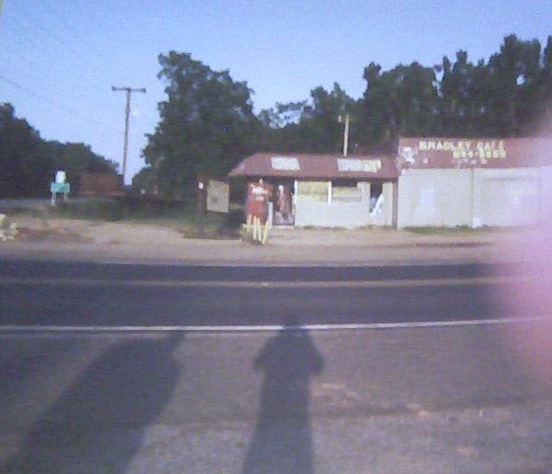
Bradley, Arkansas main road (Route 29) with me and my Uncle Charles in the shadows, June 2, 2001. (Donald Earl Collins).

Mom came from a long line of folk whose lives were hard and impossible ones, where they  couldn’t take handouts even if they wanted to. She was born to Samuel and Beulah Gill in October ’47, their first of twelve children and her father’s second overall child of thirteen. The Gills of Bradley, Arkansas were tenant farmers who lived in the Red River valley in the southwest corner of the state and five miles north of the Arkansas-Louisiana border. The town was a one-flashing- yellow-light-four-corner one. Just over five hundred people lived there, with farms, shotgun houses, and ranch-style homes neatly segregated between a few affluent Whites, lots of po’ White trash and the abundantly poor Black side of town. The conditions she grew up in included corrugated tin roofs and outhouses to boot.

Being born into this family in the late-’40s meant that Mom’s life would be a difficult and emotionally tortured one. She started doing household chores when she was five, helping with her siblings when she was six, and graduated to hoeing and picking cotton by the time she was eight. There wasn’t the time, energy, and experience in the household for Mom to receive any affection or nurturing.

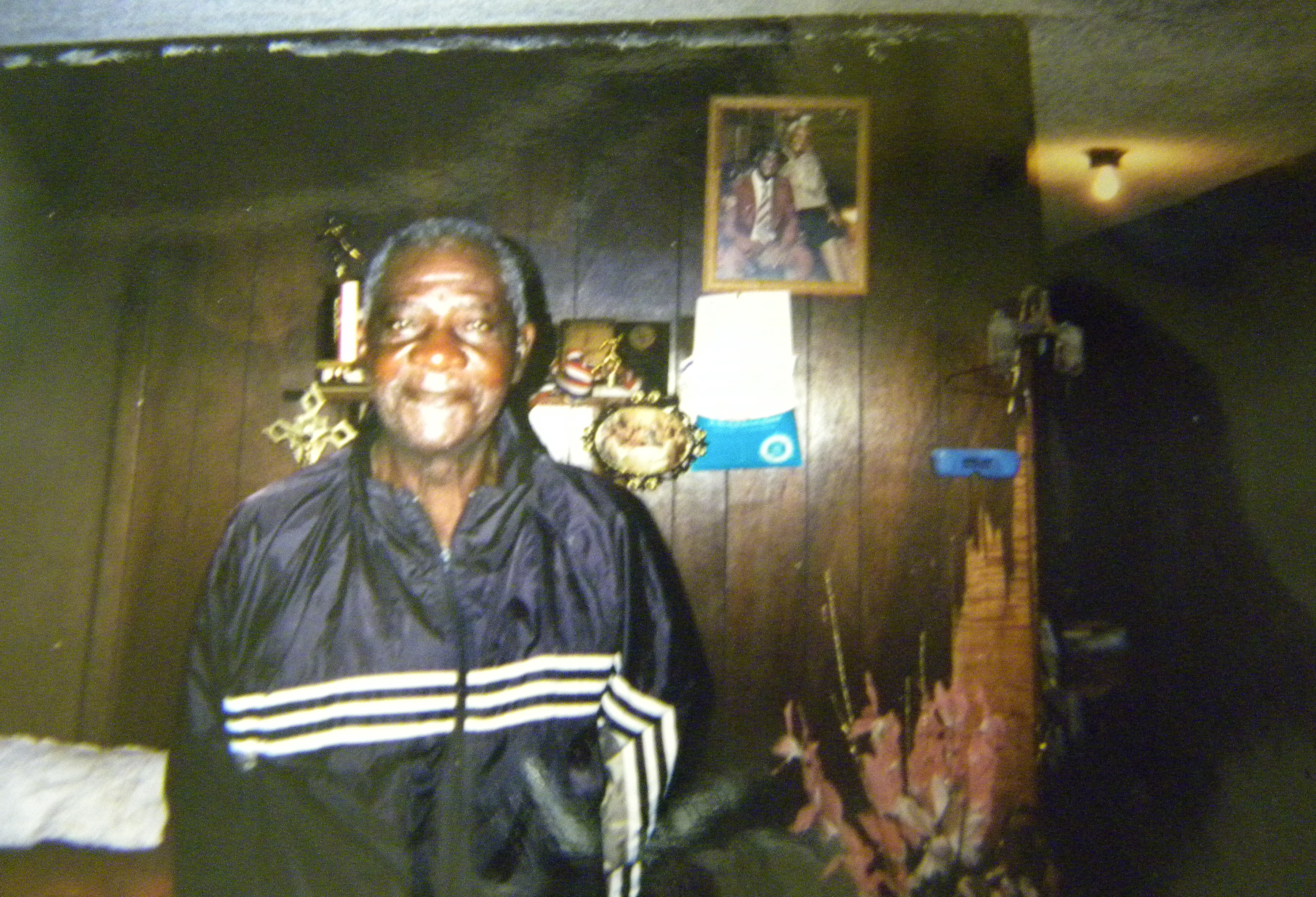
My maternal grandfather Sam Gill, Sr. (82 at the time, 93 now), Bradley, AR, June 2, 2001. (Donald Earl Collins).

With all that and her mother’s constant neglect and occasional abuse — she was once beat with the back of a hair brush for not getting ready for church on time — it’s amazing that Mom wanted to get married or have kids. Yet I knew that what little nurturing and affection Mom received came from her great-grandmother, her aunt, and high school basketball. All served that role as Mom grew into an attractive six-foot woman. Her great-grandmother, half-Choctaw and half-Irish and originally from Indian Territory (now Oklahoma), taught Mom to see herself as beautiful despite her dark complexion. Her Texarkana, Texas aunt taught Mom her basic adult survival skills. And high school basketball took her as a senior to the segregated state quarterfinals in ’65, an amazing feat to say the least.

Still, it was a hard life, one that Mom had vowed she’d never live again. That’s why she moved to New York in the first place. I’d heard these stories for years, and like her, I believed that our lives would get better through sheer hard work. Welfare was never to be something we would live with.

After nearly seventeen years in the New York area, never had all but finally arrived. She had spent my whole life up to that point telling us not to take “handouts,” that she’d “never be on welfare.”
By her thirty-fifth birthday at the end of October ’82, my mother no longer had full-time work at Mount Vernon Hospital, with her hours cut and four mouths to feed. That weekend, all we had left to eat in our two-refrigerator kitchen was a box of Duncan Hines’ Devil’s Food cake mix, Pillsbury All-Purpose Flour, and some sugar. That Saturday and Sunday, we truly ate like Torah-era Jews. Mom made us pancakes out of the flour, without baking powder, eggs or milk, and cooked down some sugar in water to make us a crude
glucose syrup.

Between an abusive Maurice for a husband, the loss of an already insufficient income after not joining her union in a strike, and two toddler-age kids (and another one on the way), the period between May ’82 and April ’83 was probably one of the lowest points in her life.

As I’ve realized over the years, though, Mom’s life was always hard. It was simply a matter of degrees, not of distinction or difference. The mistake of marrying Maurice, becoming a scab (see my post “The Quest For Work, Past and Present” from August ’12) and leaving my older brother Darren at The Clearview School for fourteen years has had an impact on all of our lives to this day. Just as much as fourteen years on welfare, the three-year-long loss of our home at 616 in the ’90s (see post “The Fire This Time” from April ’08 for more) and my late sister Sarai’s twenty-seven year-long struggle with sickle-cell anemia. “Wow” is only the beginning of a description of calamity that has been my mother’s life, about as long as the first hundred digits after 3.14.

What’s made the difference? My mother’s belief in God or Jesus? Her general sense of resilience? Her uncanny ability to deny reality and frequent lack of self-reflection? But I’d say that Mom has learned to expect little from this world and, unfortunately, even less for herself. She often expected the worst, and then being surprised at how not-so-bad “the worst”  was, could continue to soldier on.
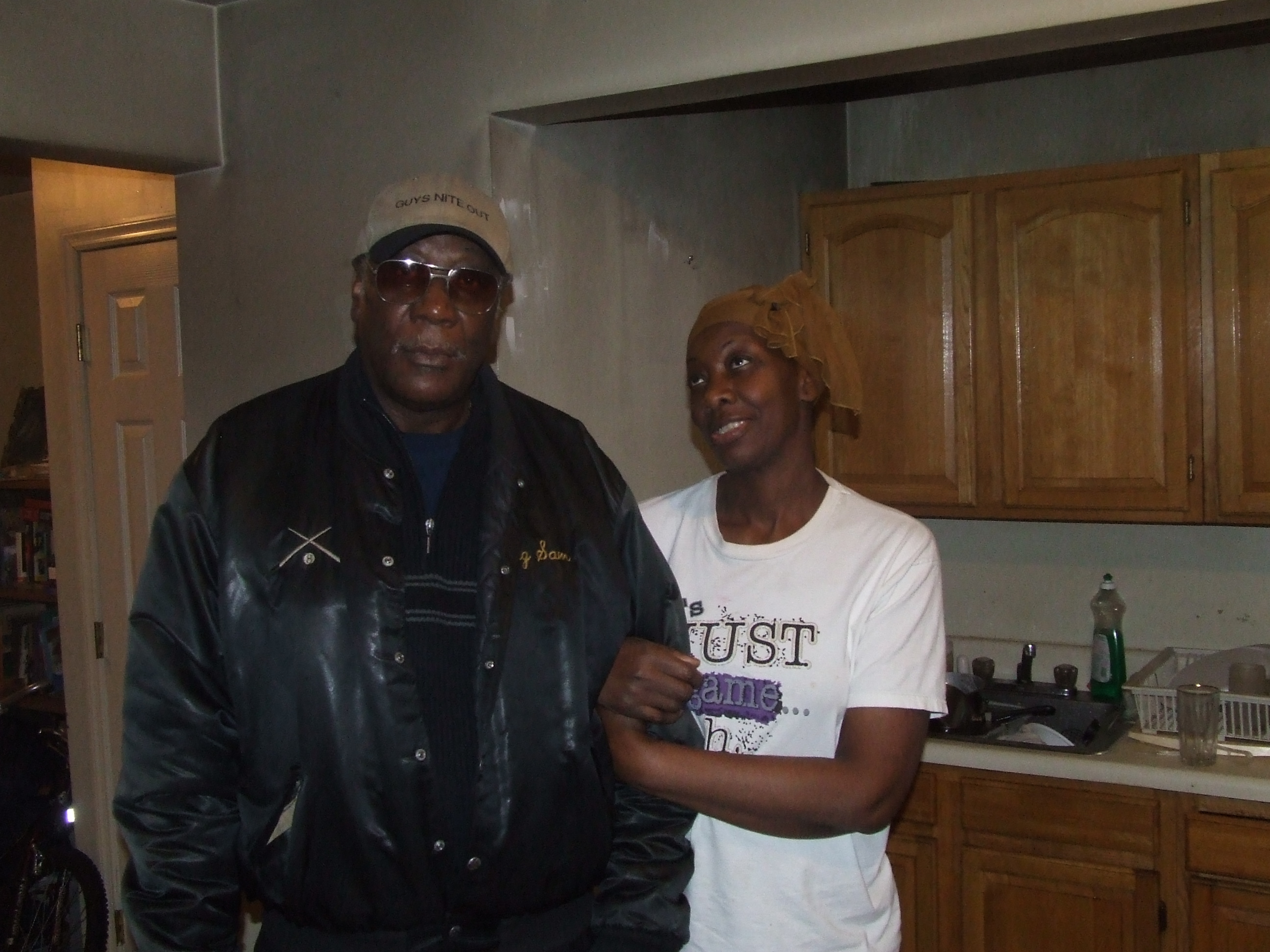
My Mom and my Uncle Sam Gill, Jr., Mount Vernon, NY, November 23, 2006. (Donald Earl Collins).

So I wish my mother a happy sixty-fifth birthday. One in which she can just spend the day at her church in New Rochelle, and then just rest and be. Only one of my siblings lives at 616 these days, and apparently spends more time out and about than he does at home. So, I hope my mother can relax, knowing that she has endured all the evil that this world could throw at her, and despite her view of life, has come out on the other side, badly damaged, but still here.
My Take On K-12 & Higher Education & Corporatism

08 Monday Oct 2012

Posted by decollins1969 in 1, Academia, Boy @ The Window, culture, Eclectic, Mount Vernon High School, Mount Vernon New York, Movies, New York City, Politics, Pop Culture, race, Youth

≈ Leave a comment

Tags

Adult Learners, Bill & Melinda Gates Foundation, Corporatized Education Reform, Education, For-Profit Colleges, Future of American Education, High-Stakes Testing, Higher Education, Higher Education Access and Success, K-12 Education, K-12 Education Reform, KIPP, Knowledge Is Power Program, Low-Income Students, Poverty, Privatization, Self-Discovery, Students of Color, Teach for America, Technocrats, The New Teacher Project, University of Phoenix


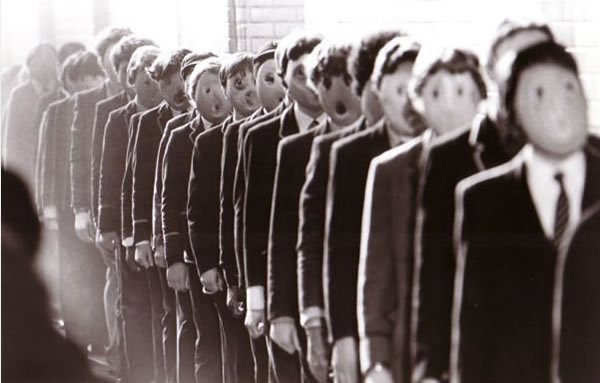
Pink Floyd–The Wall (1982), February 16, 2012. (http://free-education.info). Qualifies as fair use under US Copyright laws – low res and related to blog subject.

We often treat K-12 education and higher education as if they have nothing in common, as if they possess completely separate values and have developed in complete isolation from each other. But in this age where the American technocratic and the plutocratic elites want to privatize everything, there are clear connections behind and between emerging trends in corporatized K-12 education reform and with the rise of for-profit colleges and universities. These trends and connections aren’t good ones for the mass of American students, particularly for those who are poor and of color.

It’s pretty simply really. Both public education and postsecondary education have been under attack from profiteers and the politicians who do their bidding for at least a quarter century. In particular, the issues have been how to improve public schools so that poor Black and Latino kids can graduate high school on the one hand, and how to modify higher education so that the adult version of these kids can obtain a serviceable certificate or degree on the other. With these changes comes the theme of a watered-down education for the poorest twenty-five percent of Americans. It’s the new pathway to a sub-living wage job and tens of thousand of dollars of student loan debt.

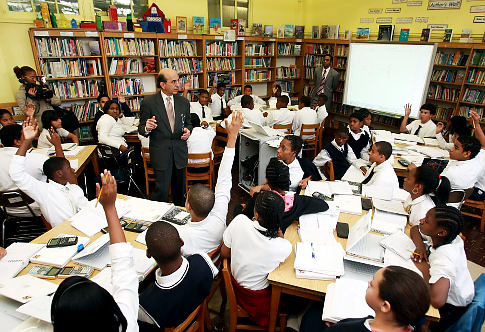
A better way of presenting this reality, though, would be to overlay my own educational journey as a poor African American growing up in Mount Vernon, New York onto this corporatized educational insanity. I would’ve gone to public school to be sure. But instead of the SRA exam test that I took every year between third and sixth grade (not a high-stakes test evaluating teaching effectiveness, by the way), I would’ve seen some sort of comprehensive reading/mathematics test from at least second grade on.

Overcrowded classroom (with DOE Chancellor Joel Klein) with two teachers, PS 189, Brooklyn, NY, September 16, 2009. (Craig Warga/NY Daily News). Qualifies as fair use – blog subject with no comparable picture.

Given where I grew up, instead of having a group of veteran Black teachers for most of elementary schools, I would’ve ended up with some teachers from Teach for America or The New Teacher Project. For the technocrats surely would’ve held my teachers responsible for the sixty-percent poverty rate at my elementary schools, um, I mean, the low test scores. Teachers from these alternate certification programs tend to be well-meaning, perhaps even extremely smart, but not passionate or fully trained teachers. Certainly not like the highly dedicated African American teachers I had at Nathan Hale (now Cecil Cooper) and William H. Holmes Elementary, who held us all to high enough standards to prepare me for a gifted-talented magnet school program known as Humanities.

Of course, given the resources devoted to high-stakes testing, and the constant practice tests, there would’ve been the virtual elimination of music, art, PE, and creative writing. With that shift, there wouldn’t have been a Humanities Program, just a few classes for the best and brightest students. Instead, the option of a private charter school or a KIPP program may have been a possibility. With an average cost of $10,000, however, I doubt a $1,000 or $2,500 voucher would’ve made it possible for me to attend the one, and with KIPP schools being all about discipline, I would’ve thrived there about as much as fish thrive in the desert.

I would’ve moved on to middle school and high school, received algebra in ninth or tenth grade (if at all), struggled to enhance my reading, writing, science, math and other skills, and otherwise would’ve goofed my way to a high school diploma. Would I have taken an AP class, or had a Meltzer as a history teacher, or taken the PSAT or SAT? I’m not sure, but highly unlikely. Still, I would’ve graded with a diploma, with proof that my education was the equivalent of an average ninth or tenth grader’s, confirmed by a decade of standardized state tests!

Then, after three to five years of struggling to find full-time work above minimum wage, or after several years in the military, I’d make the choice between  a University of Phoenix, Kaplan University, DeVry University or some other for-profit college. I’d discover quite quickly that I was wholly unprepared for even the most watered-down online college curriculum, taking courses in a four, six or eight-week format (instead of the typical ten or sixteen-week semester format).

Romanian Army POWs from Battle of Stalingrad, February 3, 1943. (http://ww2incolor.com).

There would’ve been no agonizing choice between Columbia University and the University of Pittsburgh, no switch of majors from computer science to history, no big moment in my development as a person. All because I wouldn’t have had the kind of earth-shattering experience that attending college full-time and in-person often can be.

Somehow, if I’d somehow survived the first semester or first year, I might’ve eventually graduated, albeit with a degree that will be of limited use in obtaining a good living wage. And with $70,000 in student loan debt and a degree from a disreputable for-profit college, forget about me going to graduate school to be a professor.

That’s what this K-16 system will lead to. Money flowing into the hands of illegitimate technocrats, testing companies, charter schools and for-profit institutions. Money and influence flowing from entities like the Bill & Melinda Gates Foundation and Teach for America. A permanent, if slightly better educated, low-wage underclass. That’s the now and future construction of K-16 education if we allow these trends to continue.

Moving (On) To Pittsburgh

26 Sunday Aug 2012

Posted by decollins1969 in 1, Academia, Boy @ The Window, culture, Eclectic, Hebrew-Israelite, Mount Vernon New York, New York City, Politics, race, Religion, Youth

≈ Leave a comment

Tags

241st Street Subway, 616, 616 East Lincoln Avenue, Abuse, Alternative History, Alternative Universe, Amtrak, Darren Gill, Eri Washington, Fighting Demons, Hebrew-Israelites, Maurice Eugene Washington, Maurice Washington, Pitt, Pittsburgh, Poverty, Self-Discovery, Subway, University of Pittsburgh


241st Street-Wakefield Subway Station, Bronx, NY, August 25, 2012. (jag9889 via http://flickr.com). In public domain.

I’m now a quarter-century removed from leaving my original hometown, Mount Vernon, New York, for Pittsburgh and the University of Pittsburgh. Wednesday, August 26, ’87 wasn’t my first day of adulthood, but it turned into my first day of freedom from the disappointment that my years in Mount Vernon and at 616 East Lincoln Avenue had turned into. It’s been a long road of triumphs and setbacks, of mistakes and sins, of excellence and miracles (see my post “Trip to the ‘Burgh” from August ’09).

But I’ve frequently wondered what would’ve happened if I’d stayed in Mount Vernon, or, at least, somewhere in or near New York City. Would I have turned out like my older brother Darren, a forty-four year-old who’s never been able to shake off the years of psychological torture he endured at 616? He was caught between my mother believing him to be retarded and being in a school for the mentally retarded as a kid with an above-average IQ for fourteen years. Darren never had a chance to build on him teaching himself to read at three and teaching me how to read at five (see post “About My Brother” from December ’07).

Outside of the upper-crust lily-Whiteness that was his Clear View School experience, Darren’s never known a middle-class adult life, a middle-class education or people he could talk to about his experience in order to move on from it. My brother lives around 233rd Street in the Bronx, as isolated now as he was at 616, trapped in our 616 past and in the warped thinking that has retarded his growth as a human being for nearly forty years.

Or would I have turned into my youngest brother Eri, a twenty-eight year-old frequently angry with the world? He’s been taking solace in a father (my ex-stepfather) who was never there for him and in his father’s twisted sense of Afrocentric Judaism? Unlike me and my older brother Darren, who at least knew what it was like to live in a time when even we experienced some sense of the old American Dream, Eri never had that chance.

Poverty, the grinding-with-millstones kind, and joblessness are really all that Eri’s seen the past three decades. Job Corp and the Army National Guard have really been his only times away from the daily anguish of 616 and Mount Vernon. And with the death of our sister Sarai two years ago, I know that he’s felt even more angst and isolation. Leading Eri to begin the process of re-upping with Uncle Sam for this fall.

Amtrak’s Pennsylvanian passing the 1895 Bryn Mawr Interlocking Control Towerat Bryn Mawr, PA, en route from New York to Pittsburgh, June 6, 2011. (Centpacrr via Wikipedia). Permission granted via cc-by-sa-3.0.

If I had stayed, my story would likely have ended up somewhere between Darren’s and Eri’s. I would’ve somehow gone to college, maybe Westchester Community College, Hunter or possibly Fordham. But the drama of living at 616 and the constant reminders of the worst years of my life all around me would’ve made demon-slaying a near-impossible task.

It was bad enough occasionally bumping into Crush #1, Crush #2 or one of my silent treatment classmates during the holidays and summers I was away from Pittsburgh between ’87 and ’92. Seeing them regularly and knowing that they only saw me as a twelve-year-old asshole or socially-inept seventeen-year-old? That would’ve stunted me (see my post “The Silent Treatment” from June ’10). I simply wouldn’t have felt that I had the space — geographically or psychologically — to move on from those morbid times.

Even if I somehow found the focus of Tiger Woods and Michael Jordan combined to complete a bachelor’s degree, I would’ve needed to make the decision to leave the area anyway. Especially if I had any other aspirations besides helping my mother take care of my younger siblings, including going to graduate school.

All the decisions I made after August 26, ’87, in fact, wouldn’t have occurred if I had stayed at 616, in Mount Vernon, even anywhere in the New York City area. I would’ve been too close to allow my mother to be beaten by my ex-stepfather again. I would’ve been too embarrassed by my father’s increasing alcoholism. And I would’ve been too angry with myself for all of the fun I’d denied myself while my former high school classmates were living what I assumed was the equivalent of Sheila E’s “Fabulous Life.”

Moving (On) To Pittsburgh

Moving (On) To Pittsburgh

There would’ve been no decision to even risk being homeless my sophomore year for a degree — much less actually being homeless for nearly a week. There then wouldn’t have been a decision to change my major to history, much less rediscovering myself as a writer years later. I wouldn’t have ever seen myself as worthy of happiness, or seen myself as handsome, or seen myself through the eyes of others as funny or charming or goofy. Instead, I could’ve counted on anger, rage, disappointment and misery to be my four emotional companions, ever ready to introduce themselves to the New York City area.

We often need change to move on from the demons of our past and present. Thank God I made the decision to literally leave 616 and Mount Vernon for Pittsburgh. That decision has enabled me to remember the past without wallowing in it.

Summer of Sound

05 Sunday Aug 2012

Posted by decollins1969 in 1, Boy @ The Window, culture, Eclectic, eclectic music, Mount Vernon New York, Movies, music, New York City, Pop Culture, race, Work, Youth

≈ Leave a comment

Tags

"End Of The Road", "Walking On Broken Glass, Annie Lennox, Boyz II Men, Garth Brooks, Grover Washington Jr., Growing Up, John Coltrane, Jon Secada, Mariah Carey, Mary J. Blige, Michael Jackson, Miles Davis, Musical Tastes, Ronny Jordan, Sounds of Blackness, U2, What's the 411?


Mary J. Blige’s What’s the 411? (1992) CD cover, August 5, 2012. (Donald Earl Collins).

One of the few great things for me about being back in Mount Vernon and New York City the summer of ’92 was that I was ahead of the slow pop cultural curve that was Pittsburgh two decades ago (although it’s still slow — just not as slow as it used to be). For one last summer, despite the turmoil of kids and my mother treating me like I was one (see my post “The Last 616 Summer” from June ’12) and the constant chaos at my job (see my “Working With Wackos, Part I” post from July ’12), I had access to all the immediate in music, movies and other forms of culture, pop or otherwise.

This was truly the summer that my tastes turned from randomly weird to eclectic. To think that just five years earlier, early Whitney Houston, Thompson Twins, Glass Tiger and ABC were all part of my regular cassette rotation for my Walkman! My tastes had grown up to the point where music had to have a mood or rhythm to it. It no longer needed to be quirky or silly in order to put me in a quirky or silly mood.

But those weren’t the only emotions available to me by the summer of ’92. I could actually feel sexy, romantic, generous, loving, caring, and not just angry, depressed and goofy in my normal life. A half-decade away from the crushing life of strife at 616 and in Mount Vernon, high school, Humanities and in general, had something to do with that. Dating off and on had brought others into my life, which meant that Crush #1 and Crush #2 had become somewhat repressed memories. The bottom line was, I no longer needed music or pop culture to block out the daily emotional pain that had been my life in the ’80s.

And that opened me up to new and more eclectic (if still occasionally goofy experiences) music experiences that year and summer. I became a big Jon Secada fan that summer (see my “Otro Dia Mas Sin Verte” post from August ’09), both in English and en Espanol. I was so glad he branched off from Gloria Estefan, as I’d had it with the Miami Sound Machine’s sound years ago.

I also became enthralled a bit with jazz and what we now call smooth jazz that summer, between Grover Washington, Jr., Ronny Jordan’s “After Hours”, John Coltrane, even some Miles Davis (who I did appreciate, but never quite understood). I had friend at Pitt who had exposed me to jazz over the previous five years, but it took graduate school for me to finally fully appreciate it. It also took working in an office with a woman who played all kinds of music all the time for me to actually go out and buy their stuff on CDs.

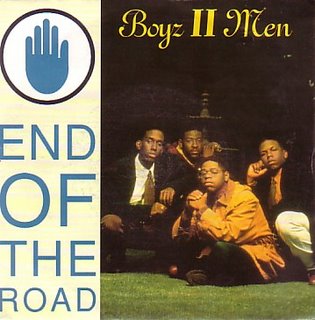
Boyz II Men’s “End Of The Road” (1992) singles cover, May 19, 2009. (Undermedveten via Wikipedia). Qualifies as fair use under US Copyright laws (low resolution picture).

The expansion of hip-hop and rap twenty summers ago to include new and fresh sounds ended up having an impact on my own music collection as well. Mary J. Blige’s What’s The 411? hit the stores and her songs the NYC-area airwaves that July and August, so raw and so new that even I the late-bloomer noticed. And who could forget Boyz II Men’s “End Of The Road.” I heard that song at least eight times a day nearly every day between the end of June and the middle of August, especially at my Mount Vernon Clinic job. I guess if I’d been divorced or in a bad relationship, I would’ve appreciated it more. As it was, any thought of buying Boyz II Men’s second album disappeared by the beginning of August. The same was true for me regarding Jodeci, the hip-hop screechers and beggars from the Upper South. They were like nails on chalkboard to me then.

Still, I incorporated music more typical of my earlier tastes into my collection that summer as well. Mariah Carey’s “I Don’t Wanna Cry” became the song I went to every time my sister Sarai started whining about me telling her to do chores at 616. Sounds of Blackness’ “Optimistic,” I discovered that summer (one summer after its release). U2’s Achtung Baby, Garth Brooks’ “The Thunder Rolls” and Michael Jackson’s “Remember The Time” rounded out my catching up to the current that summer, while Annie Lennox’s “Walking On Broken Glass” was, new, silly and serious at the same time.

There have been other times, other summer in which my tastes have taken leaps forward. I must admit, this has usually occurred after great pain or after having recovered from a major trial in my life. The summer of ’92, though, was a transition summer for me, from having to act like an adult due to stressful circumstances to just being an adult because I actually was.

The Third Armpit of Hell

27 Friday Jul 2012

Posted by decollins1969 in 1, Boy @ The Window, culture, Eclectic, High Rise Buildings, Marriage, Mount Vernon New York, My Father, New York City, Politics, Pop Culture, race, Upper East Side, Upper West Side, Work, Youth

≈ 1 Comment

Tags

Coming-of-Age, Dante's Inferno, Economic Inequality, Growing Up, Home, Metro-North, Neighborhoods, New York, New York City, NYC, Poverty, Race, Self-Discovery, Subway Trains, The City


Illustration of Dante’s Inferno, Map of Lower Hell, 16th century. (Giovanni Stradano via Wikipedia). In public domain.

During most of my Pittsburgh years, whenever someone I knew asked me what it was like to live in the New York City area, I often said two things. One, that “New York was a great place to live if you have money.” But, “if you don’t have money, New York could be like the third armpit of hell.”

I didn’t even bother to discuss Mount Vernon until I was well into graduate school. Too unknown, too complicated to explain its proximity to the Bronx and to midtown Manhattan. And from the average Pittsburgher’s perspective, it was a distinction without a difference. As far as some were concerned, Mount Vernon could’ve just as easily been outside of Buffalo as it could’ve been in the heart of Harlem.

But I definitely knew better, that my relationship with Mount Vernon and “The City” was a love-hate one, born from my growing-up experiences during the Reagan years. The lens with which I viewed the New York City area, a trifocal one of race, poverty and “outsider” status, made me ambivalent about my times growing up in Mount Vernon and all of my times in New York.

2 NYC subway train with graffiti (cropped), 1980s, December 20, 2009. (Cope2 via http://www.doobybrain.com/). Qualifies as fair use – low resolution picture.

I have my father Jimme to thank, though. Without him, I would still be afraid of New York, not just ambivalent about it. Drunk or not, working or on his way to a hole-in-the-wall bar. Jimme would take me and my older brother Darren out and down to the city often enough, to ride the Subway, to hang out with him in Harlem, Spanish Harlem, and especially Midtown. Whether it was to help him with his janitorial work on weekends, or just to hang out, we frequented Manhattan and other parts of the five boroughs off and on between ’80 and ’85, ’82 — the year of abuse — excepted.

Because of that year, the longest time I spent outside of the city growing up was between April ’81 and July ’83. After not making it down to Manhattan in all of ’82, we went to Midtown in July, where we learned about two of my father’s watering holes between 43rd and 47th. They were both near Mickey Mantle’s restaurant on 47th. He also had an Irish pub he’d like to go to around East 59th and Third, a drinking bar near his job on 64th and Columbus, and a couple of places near Macy’s on 34th Street. Because of our height and the times, when it was still legal for eighteen-year-olds to drink in public watering holes, me and Darren were allowed into these fine establishments. I learned a lot about vermouth, vodka, Cosmos and Long Island Iced Tea that summer.

Grand Central Terminal Main Concourse in New York City, March 4, 2006. (Janke and Diliff via Wikipedia). Permission granted via cc-Attribution-Share Alike 3.0 license.

I also learned a lot about the not-so-nice side of New York in those years. I recognized this as I’d board the Uptown 2 Subway from West 42nd Street and 7th Avenue in Manhattan at the tail end of rush hour. As I’d board the train, I’d notice the crunch of humanity in all of its oblivion, self-absorption, and diversity. As the doors close, I’d watch as the express train passed 50th, 59th, and 66th Street before it would grind to a halt at 72nd Street. I’d notice that a fair number of the White passengers alighted here. Between 96th and 125th Street, the load of the train would gradually lighten as about half of the passengers who’d crushed me between a tall, stale-breathed smoker and a woman who wasn’t my girlfriend were now at street level.

About three-quarters of the passengers for the rest of my trip would be Latino and Afro-Caribbean. After another hour of endless stops in the Bronx, the 2 would pull me out of my slumber as it would slowly roll into the rickety East 241st stop.

By the time I was a rising senior at Pitt, I certainly didn’t need my father to accompany on my trips into Manhattan. I also avoided the long trek from 616 across Mount Vernon to 241st to take the 2 whenever I could afford to. Metro-North was a luxurious godsend compared to the puddles of piss and infinite amounts of graffiti on the Subway I’d seen throughout the ’80s.

Toph’s “Hairy Pits” from Avatar: The Last Airbender (screenshot), July 26, 2012. (Donald Earl Collins). Qualifies as fair use — low resolution picture.

But it introduced me to other odious issues. Like Grand Central Station, which by the summer of ’90 was in desperate need of renovation. Especially the restrooms, festooned with enough garbage, feces and bodily odors and fluids to make a coroner vomit.

Off a return trip from Pittsburgh that summer, I made the mistake of having no choice but to use the almost  unusable facilities there, which in the end I couldn’t use. Meanwhile, I observed homeless males hanging out in the restroom with carts, along with an individual who looked to have Kaposi’s sarcoma, an obvious sign of full-blown AIDS.

That’s when I coined New York to be “the third armpit of hell,” the place where poverty had meant your dreams were dead on arrival. For once, it made me content that I was from a place where many smug New Yorkers disdainly considered “upstate.” Though the New York City area has changed — and mostly for the better — since ’90, it’s still a place where economic inequality can easily grind the life out of people.

Oligarchy: The Future Is Now

28 Thursday Jun 2012

Posted by decollins1969 in 1, Academia, Boy @ The Window, culture, Eclectic, New York City, Patriotism, Politics, race, Religion, Work

≈ Leave a comment

Tags

Affordable Care Act, Citizens United, Corporate Interests, Corruption, Divide & Conquer, Economic Inequality, Fascism, Neocons, Neoconservatives, Obamacare, Oligarchy, Plutocracy, President Barack Obama, President Bill Clinton, President Obama, Seeds of Discontent, Supreme Court


“History Repeats Itself: The Robber Barons of the Middle Ages and the Robber Barons of Today”, Puck, Samuel Ehrhardt (1889), June 28, 2012. (http://http://www.library.gsu.edu). In public domain.

Though many of us have been fighting this long war against neocon, reactionary, even fascist elements in American society over the course of the past four decades, it appears that, like the Fire Nation in the Avatar: The Last Airbender series (2004-08), that we’ve lost the war. I’m not predicting that Romney will beat Obama in November. But this election will be closer than it ought to be, thanks mostly to the SuperPAC maelstrom stirred up by the Supreme Court’s Citizens United decision (2010) and our own get-rich-quick apathy with politics and responsibility in this country.

More importantly, though, is the reality that this election, even with an Obama win, is merely a chink in the armor that is our American oligarchy, now firmly established. With so much in regulations, social welfare, education, unionization, and other protections for the ordinary American rolled back, it’ll take at least a generation to undo the damage done since the Nixon years to our society, economy and environment. With so much wrong, though, it may well be too late to make course corrections without significant consequences for our nation and for the world.

That only in the past couple of years folks who weren’t staunch progressive or true leftist liberals have come to realize that the neocon endgame was a powerful plutocracy is testimony to the long, successful war of identity politics, wedge issues and other distractions that they have fought since ’68. The funny thing is, though, that for most of American history, our government has been a representative democratic oligarchy, especially for the poor or those whom are of color. How can you explain the history of slavery, even the half-century it took for non-landowning White males to get the right to vote?

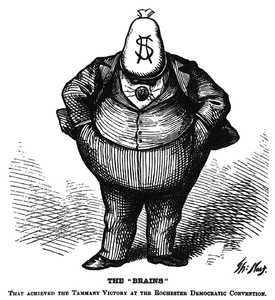
“The ‘Brains'” Boss Tweed, by Thomas Nast (1871), June 28, 2012. (Vizu via Wikipedia). In public domain.

There have only been brief periods in American history in which the federal government has been responsive to the ordinary American citizen, a protector of the rights of the many and the minority over the rights of rich individuals and powerful economic interests. One of them came as a result of the Great Depression, the start of a nearly forty-year run where our government, despite its flaws and lies, frequently erred on the side of ordinary citizens. People can talk about the Clinton years being an oasis in the middle of a neocon desert, but between the vast expansion of credit, the tearing down of Glass-Steagall, NAFTA and other corporation-friendly policies, we now know that much of what occurred in the ’90s was a mirage.

What is different now — but not so different from the turn of the twentieth century — is the brazenness with which the rich and powerful flaunt their control over our lives. It’s as if they’ve drugged us, tied us down, and occasionally even tortured us, expecting no response or retaliation. And the media has played its role in this, too. From Kim Kardashian to the Real Housewives of RichLandUSA, and from American Idol to Mad Men to Dancing With The Stars. The rest of us just live vicariously through the oligarchy, or become raging and jealous while laughing at the folly of the rich in the process.

Even the wars we fight and the Supreme Court decisions made are steeped in oligarchy and the privileges of the rich and the corporate. That’s why we spent a decade in Iraq, billions on a military fighter we don’t need (F-22), and think that decisions that treat corporations as people and lower taxes for the wealthiest Americans are good for the country.

That’s why today’s Supreme Court decision on the Affordable Care Act of 2010 — otherwise known as Obamacare — matters little in the larger scheme. Of course it matters that millions of Americans have access to healthcare. But even before the Supreme Court decision, the best most un- and under-insured Americans could hope for is a system in which they pay less for crappy health insurance. And health insurance isn’t same as healthcare, folks. Either way, the real winners long-term are private health insurance providers, and not ordinary Americans or the Obama Administration.

It is an unfortunate reality that over the past forty-five years, every aspect of government in this country has been infused with oligarchy. It takes tremendous and unyielding pressure for even a city government like New York (e.g., Rockefeller Laws, stop-and-frisk policy, decriminalization of marijuana) to bend to the demands of its own citizenry. Even then, protests, sit-in and petitions don’t always work (see Occupy Wall Street and the fifteen million protestors before the Second Gulf War as examples).

Mitt Romney Bain Capital “money shot,” October 13, 2011. (http://theatlantic.com via Boston Globe).

So, what to do? I haven’t given up hope, but I can’t spend the days I have left — whether it be moments or decades — waiting for the worm to turn. Next best thing is to hope that my son will drink of my wisdom and learn to fight against this kind of ruling class when he is old enough to do so.

The Last 616 Summer

15 Friday Jun 2012

Posted by decollins1969 in 1, Boy @ The Window, Christianity, culture, Eclectic, Mount Vernon New York, Movies, New York City, Pop Culture, race, Religion, Work, Youth

≈ 1 Comment

Tags

616, 616 East Lincoln Avenue, Adulthood, Boomerang (Movie), Home, Mother-Son Relationship, Motherhood, Overprotective Mother, Role-Playing, Westchester County Department of Community Mental Health


Toni Collette and Nicholas Hoult, About A Boy (2002) screenshot, June 14, 2012. (http://www.movieactors.com).

Twenty summers ago was my last summer at home — 616 East Lincoln Avenue — for more than a visit. It was the long, hot summer of ’92, two months in which my master’s-degree-earnin’, twenty-two year-old-self reverted to my teenage years. At least, in terms of the responsibilities that I carried beyond taking care of myself, dating or clubbing, working or going to school. And it was a painful two months of submergence, revealing to me that I’d long since been on my own. Too long to be happy to play the role of big brother, young uncle, surrogate father, and my mother’s confidant all rolled into one.

I ended up in Mount Vernon that summer after an unsuccessful search for work in Pittsburgh in the six weeks between the end of the school year and the middle of June. At the last minute, I contacted the Director of Westchester County Government’s Department of Community Mental Health, hoping (and knowing) that he could toss me some work. From him, I found out that the work I’d done at the Mount Vernon clinic in ’89, though successful, hadn’t been followed up with improvements in the front office or in billing. Once again, I’d be working as a senior summer intern with Valerie Johnstone and a group of wacky psychiatrists.

I knew it would be a bumpy ride, as I’d only been home a total of thirty-five days in the previous two years. But I hadn’t counted on my mother acting like I was still a senior at Mount Vernon High School. Right from jump, I found myself constantly being nagged about how I trimmed my mustache, the “baggy” pants I wore, who my friends were, who I did and didn’t keep in touch with while I was back.

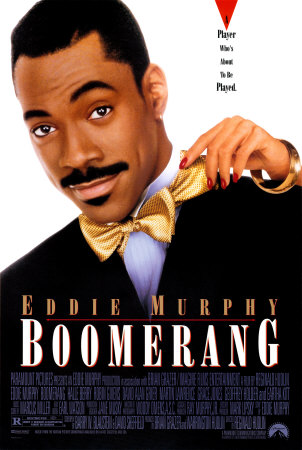
Boomerang (movie) poster, 1992, October 31, 2007. (Alessgrimal via Wikipedia). Qualifies as fair use under US Copyright laws because this image is a low resolution copy.

That wasn’t all though. One Saturday night that July, I decided to go check out Eddie Murphy’s latest movie, Boomerang. It had more good reviews than bad, and I just wanted a night to myself, to just be myself. I told my mother that I’d be home late.

I didn’t get in until about 2 am. To my surprise, my mother was awake, in the living room, waiting for me. “Where havey ou been?,” she asked, as if I had a curfew. “I went to see the movie down in the city, I hung out, I walked around, and then I took the last train back,” I said, with shock. “When you said late, I was thinkin’ 12 o’clock,” my mother said in response.

I was pissed. As many Friday and Saturday nights I spent during the ’80s tracking down my father Jimme for $50 or to pull him out of some dive in Mount Vernon, the Bronx or in Midtown Manhattan. I was a teenager then! I’m an adult, and now I’m supposed to be home by a certain time?

It got so that on another occasion, as I was pressing my clothes to go out — anywhere really — my mother tried to take the iron out of my hand to iron my clothes. “Mom, I got this,” I said, not about to let go. “You ain’t doin’ it right!,” my mother half-yelled as she yanked the iron away from me to press my jeans. Then, I realized that she was about to put creases in then, I yelled, “Mom, stop! No one wears creases in their jeans anymore.”

I took the iron away, and finished what I started, all with the b-word in my head. My mother knew what was in my head, too. “You can think it, but you better not say it!,” she yelled as she left the room.It was the first time I ever found myself thinking that way about my mother. Unfortunately, it wouldn’t be the last.

Of course, the word that was really in my head most of the last summer was weird. Everyone around me seemed weird that summer, especially my mother. She was overprotective, in my business, and talking to me about gettin’ filled with the Spirit more than usual.

Or was it me that had become weird? After all, I’d been in the role of the dutiful son for so long that it probably was weird for my mother to see me go out to see a movie, hang out with a friend, or go down to the city at night. Maybe, at least in my mother’s case, she simply wasn’t used to me carving out time for myself, to actually act like the adult male that I had become.

← Older posts
Newer posts →

Boy @ The Window: A Memoir

Boy @ The Window: A Memoir

Places to Buy/Download Boy @ The Window

There's a few ways in which you can read excerpts of, borrow and/or purchase and download Boy @ The Window. There's the trade paperback edition of Boy @ The Window, available for purchase via Amazon.com at http://www.amazon.com/Boy-Window-Donald-Earl-Collins/dp/0989256138/

There's also a Kindle edition on Amazon.com. The enhanced edition can be read only with Kindle Fire, an iPad or a full-color tablet. The links to the enhanced edition through Apple's iBookstore and the Barnes & Noble NOOK edition are below. The link to the Amazon Kindle version is also immediately below:

scr2555-proj697-a-kindle-logo-rgb-lg

Boy @ The Window on Amazon.com: http://www.amazon.com/Boy-The-Window-Memoir-ebook/dp/B00CD95FBU/

iBookstore-logo-300x100

Boy @ The Window on Apple's iBookstore: https://itunes.apple.com/us/book/boy-the-window/id643768275?ls=1

Barnes & Noble (bn.com) logo, June 26, 2013. (http://www.logotypes101.com).

Boy @ The Window on Barnes & Noble: http://www.barnesandnoble.com/w/boy-the-window-donald-earl-collins/1115182183?ean=2940016741567

You can also add, read and review Boy @ The Window on Goodreads.com. Just click on the button below:

Boy @ The Window

Twitter Updates

Tweets by decollins1969
  • RSS - Posts
  • RSS - Comments

Archives

  • June 2025
  • April 2023
  • September 2022
  • August 2022
  • July 2022
  • June 2022
  • May 2022
  • April 2022
  • March 2022
  • January 2022
  • December 2021
  • November 2021
  • October 2021
  • September 2021
  • August 2021
  • July 2021
  • June 2021
  • April 2021
  • March 2021
  • February 2021
  • January 2021
  • December 2020
  • November 2020
  • October 2020
  • September 2020
  • August 2020
  • July 2020
  • May 2020
  • April 2020
  • March 2020
  • January 2020
  • December 2019
  • November 2019
  • August 2019
  • July 2019
  • June 2019
  • May 2019
  • April 2019
  • March 2019
  • February 2019
  • January 2019
  • December 2018
  • November 2018
  • October 2018
  • September 2018
  • August 2018
  • July 2018
  • June 2018
  • May 2018
  • March 2018
  • February 2018
  • January 2018
  • December 2017
  • November 2017
  • October 2017
  • September 2017
  • August 2017
  • July 2017
  • June 2017
  • May 2017
  • April 2017
  • March 2017
  • February 2017
  • January 2017
  • December 2016
  • November 2016
  • October 2016
  • September 2016
  • August 2016
  • July 2016
  • June 2016
  • May 2016
  • April 2016
  • March 2016
  • February 2016
  • January 2016
  • December 2015
  • November 2015
  • October 2015
  • September 2015
  • August 2015
  • July 2015
  • June 2015
  • May 2015
  • April 2015
  • March 2015
  • February 2015
  • January 2015
  • December 2014
  • November 2014
  • October 2014
  • September 2014
  • August 2014
  • July 2014
  • June 2014
  • May 2014
  • April 2014
  • March 2014
  • February 2014
  • January 2014
  • December 2013
  • November 2013
  • October 2013
  • September 2013
  • August 2013
  • July 2013
  • June 2013
  • May 2013
  • April 2013
  • March 2013
  • February 2013
  • January 2013
  • December 2012
  • November 2012
  • October 2012
  • September 2012
  • August 2012
  • July 2012
  • June 2012
  • May 2012
  • April 2012
  • March 2012
  • February 2012
  • January 2012
  • December 2011
  • November 2011
  • October 2011
  • September 2011
  • August 2011
  • July 2011
  • June 2011
  • May 2011
  • April 2011
  • March 2011
  • February 2011
  • January 2011
  • December 2010
  • November 2010
  • October 2010
  • September 2010
  • August 2010
  • July 2010
  • June 2010
  • May 2010
  • April 2010
  • March 2010
  • February 2010
  • January 2010
  • December 2009
  • November 2009
  • October 2009
  • September 2009
  • August 2009
  • July 2009
  • June 2009
  • May 2009
  • April 2009
  • March 2009
  • February 2009
  • January 2009
  • December 2008
  • November 2008
  • October 2008
  • September 2008
  • August 2008
  • July 2008
  • June 2008
  • May 2008
  • April 2008
  • March 2008
  • February 2008
  • January 2008
  • December 2007
  • November 2007
  • October 2007
  • September 2007
  • August 2007
  • July 2007
  • June 2007

Recent Comments

MaryPena's avatarMaryPena on My Day of Atonement/Bitter Hat…
decollins1969's avatardecollins1969 on No Good Teaching Deed Goes…
Mary Rose O’Connell's avatarMary Rose O’Connell on No Good Teaching Deed Goes…

NetworkedBlogs on Facebook

NetworkedBlogs
Blog:
Notes From a Boy @ The Window
Topics:
My Life, Culture & Education, Politics & Goofyness
 
Follow my blog

616 616 East Lincoln Avenue A.B. Davis Middle School Abuse Academia Academy for Educational Development AED Afrocentricity American Narcissism Authenticity Bigotry Blackness Boy @ The Window Carnegie Mellon University Child Abuse Class of 1987 CMU Coping Strategies Crush #1 Crush #2 Death Disillusionment Diversity Domestic Violence Economic Inequality Education Family Friendship Friendships Graduate School Hebrew-Israelites High-Stakes Testing Higher Education History Homelessness Humanities Humanities Program Hypocrisy Internalized Racism Jealousy Joe Trotter Joe William Trotter Jr. K-12 Education Love Manhood Maurice Eugene Washington Maurice Washington Misogyny Mother-Son Relationship Mount Vernon High School Mount Vernon New York Mount Vernon public schools Multiculturalism MVHS Narcissism NFL Pitt Pittsburgh Politics of Education Poverty President Barack Obama Race Racial Stereotypes Racism Relationships Self-Awareness Self-Discovery Self-Reflection Sexism Social Justice Teaching and Learning University of Pittsburgh Violence Whiteness Writing

Top Rated

Blog at WordPress.com.

  • Subscribe Subscribed
    • Notes from a Boy @ The Window
    • Join 103 other subscribers
    • Already have a WordPress.com account? Log in now.
    • Notes from a Boy @ The Window
    • Subscribe Subscribed
    • Sign up
    • Log in
    • Report this content
    • View site in Reader
    • Manage subscriptions
    • Collapse this bar
 

Loading Comments...