• About Me
  • Other Writings
  • Interview Clips
  • All About Me: American Racism, American Narcissism, and the Conversation America Can’t Have
  • Video Clips
  • Boy @ The Window Pictures
  • Boy @ The Window Theme Music

Notes from a Boy @ The Window

~

Notes from a Boy @ The Window

Category Archives: New York City

American Racism: “Same As It Ever Was”

14 Saturday Nov 2015

Posted by decollins1969 in 1, culture, Eclectic, eclectic music, music, New York City, Politics, Pop Culture, race

≈ Leave a comment

Tags

"Once In A Lifetime" (1983), Beatings, Ben Fields, Booker T. Washington, Central Park, Death, Ida B. Wells, Institutional Racism, James Blake, James Frascatore, Morning Oregon, NYPD, Police Brutality, Racial Harassment, Racial Incidents, Racism, Spring Valley High School, Talking Heads, University of Missouri, White Vigilantism, Yale University


Ida B. Wells-Barnett, age 32, photographed by Mary Garrity, c. 1893, cropped and restored, September 8, 2013. (Adam Cuerden via Wikipedia). In public domain.

Ida B. Wells-Barnett, age 32, photographed by Mary Garrity, c. 1893, cropped and restored, September 8, 2013. (Adam Cuerden via Wikipedia). In public domain.

A young African American woman refuses to leave her seat. Authority figures arrive to demand that she leaves. She refuses again. One authority charged with “upholding the law” then picks the young woman up and drags her from her seat. But this isn’t Spring Valley High School near Columbia, South Carolina. Nor is it 2015. This incident involved the anti-lynching journalist Ida B. Wells, who sat in a first-class ladies car on the segregated Memphis and Charleston Railroad train rolling through Tennessee. It occurred on May 4, 1884. Except it was three White men, who dragged and threw the then not-quite-twenty-two year-old off the train for refusing to give up a seat she paid for.

Just like with the Black teenager whom Ben Fields assaulted in the name of the law, I’m sure one of the things Wells might have thought was, “This is 1884. Why is this still happening?” The circumstances that led to both incidents were obviously different, but the racism that led to these violent responses was not.

With all that has occurred to break the illusion that Americans live in a twenty-first-century, post-racial utopia, Americans still bring up the times in which we live whenever racism rears its ugly head. Whether it’s the NYPD tackling ex-tennis star James Blake in September, the Black teenager at Spring Valley HS in October, or the responses to Black students at the University of Missouri or Yale in the past week, the need for temporal incredulousness is often present in the midst of these racist incidents. “You would think at some point they would get the memo that this isn’t okay, but it seems that there’s no stopping it,” Blake said after the incident with Officer James Frascatore.

At what point or time? As if saying “Why is this happening in 2015?” has anything to do with bringing systemic, institutional, individual, and internalized racism to an end. If there had been truth and reconciliation commissions at the end of Jim Crow in the South in the 1960s and 1970s, maybe then Americans can quote the year as evidence of irrational racial dissonance. If the federal government had provided reparations after Emancipation in 1865 or after Congress passed the Civil Rights Act of 1964, perhaps then what year this is would matter. Racism and racists have never cared about the year or the supposedly multicultural, progressive times in which Americans lived.

Harris & Ewing photo of Booker T. Washington, circa 1905-1915, Library of Congress, Washington, DC, January 18, 2010. (Cantheasswonder via Wikipedia). In public domain.

Harris & Ewing photo of Booker T. Washington, circa 1905-1915, Library of Congress, Washington, DC, January 18, 2010. (Cantheasswonder via Wikipedia). In public domain.

Before his death in 1915, Tuskegee Institute founder Booker T. Washington experienced something all too many Americans of color face year after year. Washington delivered two speeches at churches in Manhattan on Sunday, March 19, 1911. That same evening, Washington went to an apartment building on West 63rd Street near Central Park, allegedly to meet up with a friend of his accountant on business. After attempting to find this mystery person at the building twice, Henry Ulrich, a 40-year-old White male, confronted Washington and punched him in the head. A White bystander handed Ulrich a walking stick and together, the two men chased Washington toward Central Park, hitting him with the stick on his head and face at least a dozen times. It wasn’t until Washington fell into the arms of NYPD Officer Chester Hagan, at a southwest entrance to Central Park, that the attack came to an end. After his initial arrest, Washington produced his identification papers. Only then was he released, allowed to press charges against Ulrich, and taken to a hospital to get 16 stitches and recover from his head bashing.

Morning Oregon headline on Booker T. Washington trial, November 7, 1911.

Morning Oregon headline on Booker T. Washington trial, November 7, 1911.

Despite having the support of Andrew Carnegie, former New York City mayor Seth Low and President William Taft, Washington’s assault charge was destined to fail. The New York and national press — yellow journalism at its best in 1911 — tried Washington on their front pages from March 20 on. Laura Alverez did a wonderful job in misrepresenting herself as “Mrs. Ulrich” in defense of her paramour at the trial. Alverez accused Washington of saying, “Hello, Sweetheart” to her — a dog whistle back then for the ultimate taboo of interracial sex — when Washington was outside the apartment building. Two of the three judges voted on Monday, November 6, 1911, to acquit Ulrich of the assault charge, news the national press gleefully reported. Among them was the Morning Oregonian, which had “‘Beating Up’ Darky Brings No Punishment to Man” as part of its headline.

All this took its toll on an already sick 55-year-old Washington, a man already suffering from hypertension and high-blood pressure. The result was a physically and emotionally diminished Washington after 1911. Booker T. Washington died on November 16, 1915. The power Washington had exercised as an advisor to Presidents Theodore Roosevelt and Taft and as a racial accommodationist (some would say, an apologist) who befriended White philanthropists, it didn’t matter. His poor health may have been the symptom, but racism in all its forms was the ultimate cause.

It does not matter what year it is. Racists don’t care. It doesn’t matter if African Americans and White progressives hold die-ins in Ferguson, Cleveland and New York. Blacks and other people of color don’t have the same right to breathe without a racist’s say-so. It doesn’t matter if respectable Blacks wear nice suits and ties, attend Harvard, establish a university, or serve as President of the United States. Americans of color are all criminals and playthings in the eyes of racists, and the power structures for which they work have been set up to preserve racial inequality for centuries. And it doesn’t matter if liberals Black, White and Brown call for healing. Racists don’t want healing, and calling for it without acknowledging a flesh-eating, bacterial-infested wound like racism doesn’t do Americans any good. Booker T. Washington learned that lesson in 1911, and Ida B. Wells learned it in 1884. Millions of other Americans of color have learned that lesson all too well today.
“Glory Days”

25 Sunday Oct 2015

Posted by decollins1969 in 1, Boy @ The Window, culture, Eclectic, eclectic music, Jimme, Mount Vernon High School, Mount Vernon New York, music, My Father, New York City, Pop Culture, race, Sports, Youth

≈ Leave a comment

Tags

"Glory Days" (1985), Baseball, Baseball Glove, Bruce Springsteen, Darryl Strawberry, Double Play, Dwight Gooden, John Tudor, Lenny Dykstra, Merit, Meritocracy, Modell's Sporting Goods, MVHS, Myths, Naivete, New York Mets, Single-Minded, St. Louis Cardinals, Talent, Varsity Baseball


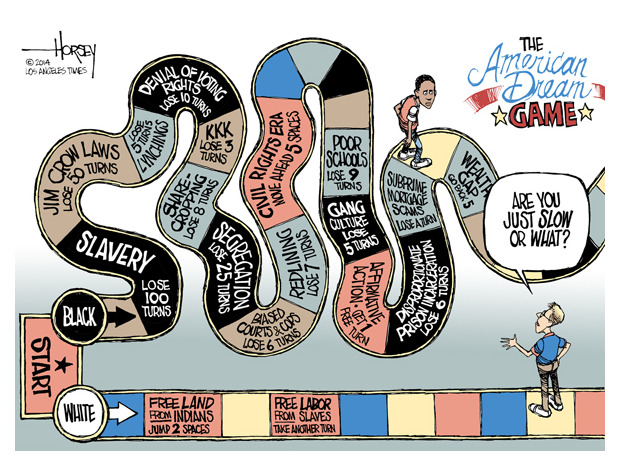
There are times I wish I could have back the tunnel-vision naiveté I had to have during my Boy @ The Window years. The kind of naiveté in which I believed I could literally do anything, with hard work and talent alone. You know, that great old American myth of a level playing field, a meritocracy. It took me years to give this myth of an ideal up, despite the evidence of the lie all around me.

The American Dream Game cartoon, January 21, 2014. (David Horsey/LA Times).

The American Dream Game cartoon, January 21, 2014. (David Horsey/LA Times).

Three decades ago, I believed in it. I had to. If I hadn’t, I would likely not be here to say anything about merit or any other American falsehood or truth. Where my belief in the meritocracy was strongest was in sports, where literal examples of the level playing field abounded. I was coming off a year of watching my Mets win 98 games while missing the playoffs by three games, yielding the NL East to the St. Louis Cardinals. It was really one game during the next-to-last series of the year, against the Cardinals in St. Louis. Dwight Gooden won a pitcher’s duel against John Tudor while Darryl Strawberry and Lenny Dykstra hit timely or game-winning home runs in the first two games. But we couldn’t win that final game. As unfair as it seemed, the Mets had given me a great season.

So great that it inspired me to try out for baseball that year, out of all the sports I could’ve played. It had become my favorite sport, and knowing I had more of acumen for football and basketball didn’t distract me from my master plan. But first, I needed to learn how to play baseball.

My year slipped a bit in October and November as football and baseball provided distraction, which was why I had to refocus in early December. And not just because I spent my time watching TV. Richard P. — for me an almost unknown person — had invited me to practice with the varsity baseball team. He might’ve been in my gym class or friends with Suzanne. Richard P. was a senior and a star pitcher who’d been clocked throwing a ninety-mile-an-hour fastball — absolutely awesome! Of course I said “Yes” without thinking about my reality at home. I never owned a baseball glove, never played on any Little League team, and had only used a baseball bat during softball and gym class three times between seventh and eleventh grade. I had Jimme take us to Modell’s Sporting Goods store in the city and bought a $55 outfielder’s glove.

I still needed to break it in, which would be even harder with the crooked ring and pinky fingers on my left hand. With Richard P. and the other members of the baseball team, some of the breaking-in happened pretty quickly. I went to three of their practices in October and saw the difference that the years of athletic experience I didn’t have made in the case of the varsity players. Frank dived for a ball at his shortstop position on our indoor Astroturf practice field, caught it, got up, and gunned the ball to first base. His right arm had two purple rug burn marks on it. “There’s no way I’d ever want to dive for a ball like that,” I thought. The next thing I knew I was out there with the team taking grounders at shortstop and catching balls at first base. We were practicing double-plays. One grounder came up on me faster than I expected. I got down for the ball, got it in my glove, but then it popped out as I rose up to throw it to second. The ball popped out and went right to Frank at second, who then threw to first, a real double-play. I got cheered and jeered at the same time!

My first-base experience was less memorable. I caught several Richard P. throws to first in holding-the-runner simulations. Every time I caught one of his balls I wanted to scream from the pain. I needed to get calluses on my left hand fast if I was going to hang with these guys!

1980s-era Mets cap, October 25, 2015. (http://academy.com).

1980s-era Mets cap, October 25, 2015. (http://academy.com).

If given another year, with lots of practice, I probably could’ve made this baseball team. But to what end? I already had a plan for going to college, on the academic track, after all. “So what if the baseball team was stacked with Italian guys and I was better at basketball? I should be able to play what I want to play.” That’s what I thought at the time, at least.

Merit, even in sports, is never the only consideration. Egos, politics, the expense of playing a specific sport, and of course, race, all play a role in the paths that athletes take and in the decision-making of coaches as well. I was just too naive, too focused on one thing, too stupid at fifteen to allow myself to see that my raw talent was never going to be enough. Five months after that last practice, though, I did see the truth, if only for a moment or two.


Aside

Cable, Anyone?

11 Friday Sep 2015

Posted by decollins1969 in 1, Boy @ The Window, culture, Eclectic, eclectic music, Jimme, Mount Vernon High School, Mount Vernon New York, music, My Father, New York City, Pop Culture, race, Youth

≈ Leave a comment

Tags

"Broken Wings" (1985), "Sweetest Taboo" (1985), "What About Love" (1985), 1010 WINS, 616, 616 East Lincoln Avenue, Aliens (1986), Bernard Shaw, BET, Cable, Cable TV, CNN, Heart, HLN, Lynne Russell, Michael Jackson, Mr. Mister, Platoon (1986), Sade, Thriller (1982)


1980s-style MTV logo, accessed September 11, 2015. (http://dogoodmediamix.weebly.com/).

1980s-style MTV logo, accessed September 11, 2015. (http://dogoodmediamix.weebly.com/).

The platform of multimedia access via paid cable subscriptions through the monopolies of Time-Warner, Verizon FiOS, and Comcast Xfinity is so normal that it would be hard for anyone under twenty-five to imagine the world that existed beforehand.

Yet on the first Friday in September ’85, my family at 616 didn’t have cable the morning I left for my second day of eleventh grade. We had the channels we always had: WCBS2, WNBC-4, WNEW-5 (which had just been bought by Rupert Murdoch via 20th Century FOX), WABC-7, WOR-9, WPIX-11, and WNET-13. The MTV revolution was more than six years old, and the hype from Michael Jackson’s classic Thriller album videos had come and gone. Though I was now current enough to be up with pop music, some rap, and some R&B — not to mention my Mets — so many cultural references went over my head at Mount Vernon High School that many of my classmates thought I was stupid and weird. (Don’t worry – I felt exactly the same way about many of them).

I came home from school that Friday afternoon to a platform I’d never seen before. A long, thick white wire and a couple of coaxial cables linking to a box next to our TV in the living room. The TV set was off, and my Mom was out picking up Maurice from Holmes Elementary (he had just started first grade). I turned it on, looked at the cable guide, and punched in the numbers to MTV for the very first time. Heart’s “What About Love” video had just started on the channel. To think that this would be my first direct experience with MTV, for the few moments I had to myself in the transition to yet another weekend of kids, laundromat duty, and hunting down my father Jimme at one of a dozen of his watering holes between Wakefield and The Bronx and Midtown.

It was actually, um, uplifting. I felt goofy. I didn’t mind hearing the overwrought band from the Pacific Northwest. I enjoyed the video that followed it, Mr. Mister’s “Broken Wings.” I even had time to flip over to BET to watch part of a Sade video (I think it was “Sweetest Taboo”) before my Mom and my four younger siblings came in, making me feel like watching these videos was really taboo. I didn’t want them to know what I was watching, so I dialed in either CNN or Headline News for the first time.

That afternoon would be one of only a handful of times I’d have clear access to cable TV without the cognitive dissonance of siblings and family and arguments and constant fighting and abuse. If first impressions really meant anything, then MTV and BET on September 6, 1985 pretty much reinforced my music eclecticism over a twelve-minute span. That was reinforced further in the coming weeks, with good, bad, and awful videos from a-ha, Eddie Murphy (with Rick James), Phil Collins, Billy Ocean, Journey, Lionel Richie, Lisa Lisa, and Run-D.M.C.

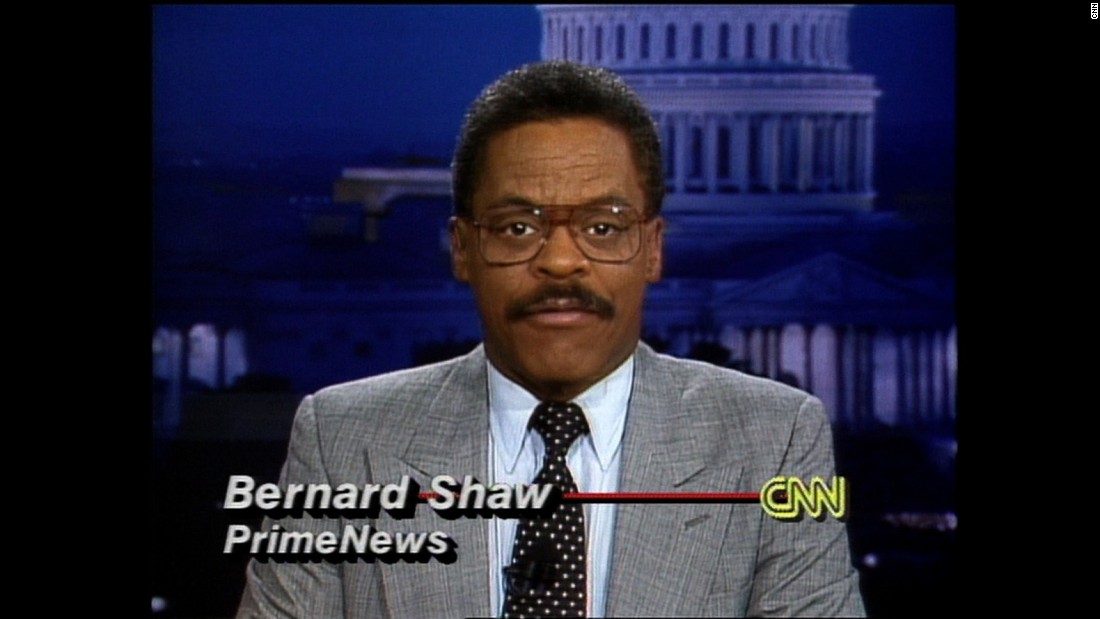
The great Bernard Shaw, CNN news anchor from 1980 to 2001, accessed September 11, 2015. (http://cnn.com).

The great Bernard Shaw, CNN news anchor from 1980 to 2001, accessed September 11, 2015. (http://cnn.com).

Getting news from beyond the local sources, Tom Brokaw, Peter Jennings and Dan Rather was pretty important too. Bernard Shaw, Lynne Russell, and Chuck Roberts became new news names for me that fall. Catching movies within six months of their release — instead of three to five years later (if ever) — like Aliens or Platoon was new to me. And getting more accurate data from The Weather Channel made me more aware of chilly spring mornings that would turn into summer-esque afternoons as ’85 turned into ’86 and then ’87.

It wasn’t until 1994 that I got cable on my own in Pittsburgh for the first time, otherwise having to go to bars or William Pitt Union’s TV room to catch moments that weren’t on network or independent television. To think that there was a time when information moved slower, when I listened to 1010 (AM) WINS, “you give us 22 minutes, we’ll give you the world” instead of watching BBC News or hitting Twitter for the latest news. Can’t wait for the streaming/mobile news and music revolution. Oh, wait a second…

Aside

Leaving Mount Vernon

26 Wednesday Aug 2015

Posted by decollins1969 in 1, Boy @ The Window, Christianity, culture, Eclectic, eclectic music, High Rise Buildings, Jimme, Mount Vernon High School, Mount Vernon New York, music, My Father, New York City, Pittsburgh, Politics, Pop Culture, race, Religion, University of Pittsburgh, Work, Youth

≈ Leave a comment

Tags

"Emotion (Ain't Nobody)" Remix (2014), "Swimming Pools (Drank)" (2012), Child Abuse, College, Domestic Violence, Emotions, Family, Kendrick Lamar, Leaving, Loneliness, Maverick Sabre, Moving, Pitt, Politics of Respectability, Poverty, Respectability Politics, Self-Awareness, Self-Discovery


I left for Pittsburgh and for the University of Pittsburgh on this day/date twenty-eight years ago, my first trip on my own. It was my first trip out-of-state since my Mom took me and my brother Darren on a bus trip to Pennsylvania Amish country in June ’78, nine years earlier. At 5:51 am on the last Wednesday in August ’87, with my older brother Darren’s help — and with my Mom and three of four younger siblings watching us from the living room window — I packed my luggage, Army sack, and two boxes of bedding and materials into a Reliable Taxi. We headed for East 241st to meet up with my dad. From there, we took the 2 Subway all the way to Penn Station, with enough time to board and get all of my stuff on the 7:50 am Pennsylvanian train to the ‘Burgh. For the second time in a row, my dad was sober, and gave me a glassy-eyed hug and shoulder squeeze. Darren was both sad and happy to see me go.

Amtrak's Pennsylvanian train pulling out of Altoona, PA station, heading east for Philly, NYC, uploaded February 2013. (Dustin F.; http://www.northeastrailfans.com/).

Amtrak’s Pennsylvanian train pulling out of Altoona, PA station, heading east for Philly, NYC, uploaded February 2013. (Dustin F.; http://www.northeastrailfans.com/).

I’ve gone over the trip to Pittsburgh and my transformation from a seventeen-year-old with the pent-up emotions of someone who hadn’t left May 31, 1982 behind throughout my eight years of blogging and through my memoir. I’ve written about moving on to Pittsburgh before. What I haven’t really written about fully is how I thought and felt in leaving Mount Vernon, New York behind. The short answer is, I was somewhere between terrified, joyous, embittered, and sad to go, and all at once.

I was terrified. It was my first trip on my own, to a city I’d never been to before, to a university I never visited prior to saying yes. I could meet people who might catch on that I was someone who had spent the previous six years with few acquaintances, much less friends. I was hopeful, but had zero idea what to expect.

But I really was happy to leave. Between my decade living at 616, the abuse, the poverty, the Hebrew-Israelite years, the constant ridicule, the years in Humanities, the constant work of watching after Mom, my dad, my siblings, I was through. Throw in a summer of obsession with and emasculation by Phyllis, and five years of realizing that I needed to get out, and going to Pittsburgh was a no-brainer. Heck, if I’d been a bit smarter about my application process, I could’ve just as easily applied to the University of Washington, Stanford, Northwestern, Georgetown, Michigan, University of Toronto and UPenn and almost certainly gotten in. It didn’t matter where I was going, really. I just needed to go and find my myself, and my education with that.

That last year or so in Mount Vernon had let me know that even with an academic scholarship (after a private investigation) from Columbia, staying would’ve been a huge mistake. Between the silent disdain and snickering of Black teachers at Mount Vernon High School around my sullen presence and the whole Estelle Abel episode at the end of four years of torment. Add to that the years of Black middle class folk talking at me about how my life was so much better because they marched or protested somewhere before I was conceived, or because they prayed for me. Add to that this insistence that I “give back to the community.” As if Black Mount Vernon had given me anything but a hard way to go since I was knee-high to a boil weevil.

Viewing and wake service for Heavy D, Grace Baptist Church, Mount Vernon, NY, November 17, 2011. (Mike Coppola/Getty Images; https://cbsnewyork.files.wordpress.com/).

Viewing and wake service for Heavy D, Grace Baptist Church, Mount Vernon, NY, November 17, 2011. (Mike Coppola/Getty Images; https://cbsnewyork.files.wordpress.com/).

As I saw it, the only difference between the vapid, seething facade of White liberalism among paternalistic White Mount Vernonites and the false smiles and frequent excoriations of Mount Vernon’s Black middle class was skin color. They drank deep from swimming pools full of what we now call respectability politics, born out of a need to be good examples to the world, like Kendrick Lamar described in “Swimming Pools” (2012). (Pour up [drank], head shot [drank]…faded [drank]). This isn’t the same as doing the right thing at the right time or speaking truth to power. You make money, wear nice clothes, drive a nice car, stand up straight, look a White man in the eye while firmly grasping his hand. And apologize for not being as assimilable as you pretend. It was 100%, USDA-approved bullshit, and it smelled like it a lot of days, too.

I was sad to leave, too. There was a part of me that still wanted to fit in, out of loneliness, if nothing else. I still liked Clover Donuts and some of the breakfast places on the South Side. I longed for some sort of acceptance, an acknowledgment that I was a real person, even though that would’ve required being around real people at 616, and in Humanities, and in the rest of Mount Vernon. I knew that I’d miss the close proximity to The City. I’d put my hopes and dreams in a place in which I knew I couldn’t afford to stay, literally and figuratively. That longing would come to haunt me in the coming year, but I’d eventually learn, I could always visit New York.

Aside

“And There’s Winners, And There’s Losers…

19 Wednesday Aug 2015

Posted by decollins1969 in 1, Christianity, culture, Eclectic, eclectic music, New York City, Patriotism, Politics, Pop Culture, race, Religion, Work

≈ Leave a comment

Tags

"Pink Houses" (1983), 2016 Election, American Narcissism, Bankruptcy, Comb-Over, Donald Trump, FOX News Debate, Frank Sinatra, Hypocrisy, John Mellencamp, Losers, Misogyny, Narcissism, New York, New York" (1980), Racism, RNC Debate, The Donald, Trump Supporters, Winners, Xenophobia


“But they ain’t no big deal/’Cause the simple man, baby/Pays for thrills/The bills the pills that kill” – John Mellencamp, “Pink Houses” (1983).

Donald Trump’s entire campaign might as well be called “The Ultimate Narcissist Does The Pink Houses” Tour, complete with Def Leppard, his kids, and Omarosa going to bat for him on CNN. Trump and his angry band of supporters see the world in the simplest way, like an indoctrinated twelve-year-old forced to be part of a religious cult (I can definitely relate). Trump sees himself as a “winner,” the US as a country that used to be a “winner,” and anything or anyone who doesn’t fit his narrative as “losers.” Of course there’s a contradiction here. Trump doesn’t have the courage to call many of his supporters “losers,” though there are about four decades’ worth of his actions and statements that would serve as evidence of his thoughts about his base.

2016 presidential candidate Donald Trump meeting with New England Patriots owner Robert Kraft, Gillette Stadium, Foxboro, MA, October 21, 2012. (Nancy Lane/Boston Herald;http://bostonhearld.com).

2016 presidential candidate Donald Trump meeting with New England Patriots owner Robert Kraft, Gillette Stadium, Foxboro, MA, October 21, 2012. (Nancy Lane/Boston Herald;http://bostonhearld.com).

At the “Big Boys” RNC debate a couple of weeks ago, Trump couched everything in terms of “winners” and “losers.” President Obama was an “incompetent loser.” The US is “losing to China” economically. Mexican immigrants are turning the US into “a nation of losers.” The US has to “win” against ISIS (I prefer the term Islamic State or IS that most news agencies use outside the US, but that would make me a loser). Trump’s pronouncements at the debate and since have been about more than sound bites of “us” vs. “them,” as the more progressive media elements have said. It’s been about presenting himself as America’s winner, as the one at “the top of the heap, king of the hill, A-number-1.”

In a nation full of narcissists, this has a real appeal, even if the reality of Trump’s life contradicts both the winner image he portrays and the lives that most of his supporters actually live. The most obvious is Trump’s net worth being more like between $1.4 billion and $4 billion (Oprah Winfrey territory), and not the $10 billion he says it is. Or that he has — or, as Trump would say, “my companies” have — filed for Chapter 11 four times in the past quarter-century. Or his multiple divorces. Or his ridiculous comb-over in 20+mph winds.

I guess all of those falsities and setbacks should be more nuanced, as part of life’s long and bumpy journey. By Trump’s own definition, because his net worth — though envy-inducing — is hardly #1 (still between Bill Gates, Warren Buffett, and Michael Bloomberg), he should see himself as a loser. Because Trump has seen multiple business ventures crash and burn, the “loser” moniker could fit. Oh, but narcissism allows for those suffering from grandiose inflations of themselves to see their failings, their losses as mere bumps in the road, and not part of the “winners and losers” narrative.

Picture of abandoned Palma Nova mobile home park, where the last of the 900 families had been evicted in 2009, Davie, Florida, February 15, 2010. (Mike Stocker/Miami Sun-Sentinel; http://www.sun-sentinel.com/local/broward/fl-palma-nova-davie-pg-photogallery.html).

Picture of abandoned Palma Nova mobile home park, where the last of the 900 families had been evicted in 2009, Davie, Florida, February 15, 2010. (Mike Stocker/Miami Sun-Sentinel; http://www.sun-sentinel.com/local/broward/fl-palma-nova-davie-pg-photogallery.html).

The same goes for Trump’s supporters, most of whom couldn’t hope to be PTA president at their neighborhood elementary school, much less run for POTUS. The US is so replete with narcissism that it’s in the bloodstream of ordinary low-income Americans (the majority of the working population, by the way). And as such, their reasons for supporting Trump are as sad as they are predictable. They see him as a winner, even though he was born into wealth via his real estate magnate father (or as many New Yorkers saw him, slum lord), Fred Trump. The Donald was born halfway between third and home plate, and somehow ordinary Americans see him as a quintessential American?

Trump’s supporters also see him as someone who “tells it like it is.” Really? Ready to be fooled again, just like with so many numbskulls and wing-nuts who’ve sold Americans the magic of tax cuts for the rich and for corporations and endless prosperity in the past? Some of these narcissists are like gambling addicts, taking their last dollars to a slot machine on the hope of making it rich with crusty toenails. It both a real shame, and pitiful to watch.

Aside

Midnight Train To Georgia

15 Saturday Aug 2015

Posted by decollins1969 in 1, Boy @ The Window, culture, Eclectic, eclectic music, Jimme, Marriage, Mount Vernon New York, My Father, New York City, Pop Culture, race, Youth

≈ Leave a comment

Tags

"Midnight Train To Georgia" (1973), Amtrak, Burger King, Chevy Impala, Clover Donuts, Collins Family, Extended Family, Fucious Collins, Gladys Knights and The Pips, Harrison Georgia, Horses, Imogene Collins, Krispy Kreme Donuts, Mckinley Collins, Pigs, Respite, Rural Georgia, Sow, Steam Locomotive, Trip, Vacation, Whopper


Forty years ago this week, my father took me and my brother Darren on the biggest trip of our growing up years. Especially since I was just five and Darren was only seven. We went to see our extended Collins clan in Georgia, spread between Atlanta and Harrison, the latter a small town of ex-farms in the east central portion of the state. Macon is the nearest city, with Augusta about ninety minutes away.

It was paid for courtesy of my Mom, who likely did it to give herself a vacation from Jimme’s weekly drinking, days-on-end-abandonment, followed by verbal abuse and threats. And the occasional physical fight, as the month before, after a July 4th party Mom threw, my father came in late, became jealous, and went after her with a meat cutting knife, only to end up stabbed in the torso and leg. All with the Mount Vernon police coming over to 425 South Sixth, and, upon finding Jimme in the stairwell suffering from his wounds, began laughing hysterically (more on that at a later date). I’m sure that Mom needed a break from Darren and me as well.

We went down to the city via Metro-North, took the Shuttle (in all likelihood) to Penn Station, and then the Amtrak to Atlanta. I don’t remember much of the trip itself. It was an overnight affair, and Mom had bought us overnight tickets, enabling us to sleep on cots or small beds, I guess. I do remember us pulling out of Washington, DC and seeing the Capitol from a distance after crossing into Virginia.

Known as the 750, it was donated to the Atlanta Chapter of the National Railway Historical Society in 1962, and operated through the 1980s (likely the train that scared me in 1975), August 15, 2015. (http://www.steamlocomotive.com/nc-ga/sa750.jpg).

Known as the 750, it was donated to the Atlanta Chapter of the National Railway Historical Society in 1962, and operated through the 1980s (likely the train that scared me in 1975), August 15, 2015. (http://www.steamlocomotive.com/nc-ga/sa750.jpg).

Then, after seemingly endless forests and nothing to do but sleep or watch my father sleep, we pulled into Atlanta sometime the next morning. After getting off the Amtrak and watching it depart, an old smokestack steam pulled in, blowing its whistle as loud as anything I’d ever heard. I practically jumped out of my skin, prompting some White guy who worked on the tracks to tell me, “That’s okay, that’s just ol’ [?] blowin’ off steam.” I didn’t much like the White guy, either.

Our Uncle McKinley and one of our older cousins picked us up from the train station, drove us around West Atlanta, and then down to the family farm in Harrison. Along the way, we stopped at my cousin’s job at Burger King for Whoppers. Except they got me the Whopper Jr, which didn’t make me too happy. But then I got to ride in the front of my uncle’s ’73 green Chevy Impala, with all of its chrome and tan leather seats.

A nice, juicy sow, August 15, 2015. (http://www.platnershowpigs.com/OldSite/Sow8.jpg0.

A nice, juicy sow, August 15, 2015. (http://www.platnershowpigs.com/OldSite/Sow8.jpg0.

We got there late in the afternoon, but mostly what I remember was the smell of the rural area. I’d never been to a farm before, much less one that was still somewhat in operation. The next couple of days were the most memorable part of the Georgia visit for me. The first morning on the farm, I woke up, washed up, and stumbling into the dining area and kitchen, which seemed so vast. Wood paneling, rich dark colors and the strong smell of Maxwell House coffee were what penetrated my five-year-old mind that morning. I remember sitting on my grandfather Fucious’ lap while he asked me a few questions. Then he gave me this syrupy yet somewhat crisp and doughy glazed donut to eat. My grandfather was eating one of his own, to go with his strong and sugarless cup of coffee. It wasn’t as good as the Clover Donuts donuts I’d eaten, but this first experience with Krispy Kreme was pretty good. Darren had a jelly donut, with the jelly all around the corners of his mouth.

They tried to take us horseback riding, my grandmother Imogene and my Aunts Christene and Charity. It worked fine for Darren, but for me, not so much. The whinnying of the horse scared me, and when they lifted me up to put me on the saddle, I started to cry. My grandmother hugged me, and told me that it would be okay. Then, they grabbed one of the sows and let me ride on her for what was probably ten minutes, taking a couple of pictures and laughing at the same time.

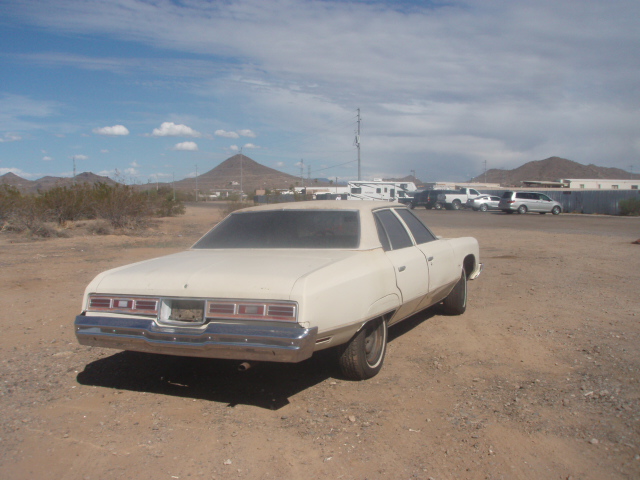
A beat-up version of the 1975 Chevy Impala my uncle Mckinley bought in August 1975, August 15, 2015. (http://www.dvap.com).

A beat-up version of the 1975 Chevy Impala my uncle McKinley bought in August 1975, August 15, 2015. (http://www.dvap.com).

A couple of nights later, I remember waking up in the middle of the night. There had been an accident involving my father, my cousin and my Uncle McKinley, and the green Impala was no more. Despite not wearing their seat belts, all three came out of the accident more or less unscathed. The next to last day of our time on the Collins family farm, my uncle drove up in a ’75 Chevy Impala, cream-colored and even more impressive. 

It was a good trip, meeting my country-strange family, and the longest trip I’d go on until ’92, when I went to DC to visit a former high school classmate. it was also a welcome break from the constant fighting between Mom and Jimme.

My son, thankfully, has been going on trips since before his first birthday, although the flight he’ll take next week will be on his own, with his aunt meeting him at the destination gate.

Aside

Brotherly Love

12 Wednesday Aug 2015

Posted by decollins1969 in 1, Boy @ The Window, culture, Eclectic, High Rise Buildings, Jimme, Mount Vernon High School, Mount Vernon New York, My Father, New York City, Pop Culture, race, Sports, Youth

≈ Leave a comment

Tags

Bronxville, Brother-Brother Relationship, Chester Heights, Competition, Darren, Eastchester, Internalized Racism, Jealousy, Jump Shot, Lessons, Mental Disability, Mental Retardation, Self-Discovery, Self-Loathing, Shyness, Sibling Relationship, Sibling Rivalry, The Clear View School


Not quite the courts at Chester Heights (aka, Bronxville/Mount Vernon border), but more or less what would've looked like 30 years ago, Eastchester Playground, Capitol Projects, Bronx, NY, August 11, 2015. (http://www.nycgovparks.org/).

Not quite the courts at Chester Heights (aka, Bronxville/Mount Vernon border), but more or less what they would’ve looked like 30 years ago, Eastchester Playground, Capitol Projects, Bronx, NY, August 11, 2015. (http://www.nycgovparks.org/).

This is a Boy @ The Window story, one that occurred a little more than thirty years ago, and so typical of my experiences growing up with my older brother Darren. Nothing I ever did to help my older brother seemed to help him overcome the trap of going to The Clear View School, a school for the mild to severely mentally retarded (of course, we say mentally disabled in 2015), although Darren was never such. He, in fact, had taught himself to read at the age of three, and taught me to read on my fifth birthday. Darren’s issue was severe shyness, and between my Mom, my father Jimme, and the good White liberals and moderates at The Clear View School, the trap for Darren’s potential genius had been set by the summer of ’74. By the time I was aware enough to say anything about Darren’s predicament, it was already too late.

But say and try I did anyway. Everything from sharing music to talking to Darren about our futures and my escape-Mount-Vernon-for-college plans. I shared books, and tutored him through algebra and geometry and US history.

I even tried playing sports with Darren, including basketball, which in the summer of ’85 was only my third favorite sport. As I wrote in the memoir

“Darren played at the center spot on Clear View’s basketball team, which made sense since he was already between six-three and six-four at seventeen. Of course they crushed every team they played. It was truly unfair. Darren towered over his classmates and his opponents, and being the only non-mentally retarded person on the floor, he could run rings around folks.

Still, Darren could knock down any jump shot within thirty feet of the hoop. His shot was smooth, like Isiah Thomas’ or Bernard King’s. It was the kind of shot no one on MVHS’ basketball team had at the time. Knowing this, I wanted to — no, I had to play my brother to see this shot up close. There were two well-maintained courts near 616, one in Pelham near its main street of Fifth Avenue, the other a longer walk in Chester Heights. We chose Chester Heights for most of these battles. Their court felt like a good outside court should, surrounded by trees, with level, quality-painted asphalt, and bright-white mesh nets.

The first few times we played that summer, Darren just killed me. Every time I left him open for a jumper, he buried it. It was obvious I hadn’t touched a basketball other than in gym class since I was ten. I didn’t have a jump shot, had never worked on my footwork, and could dribble only moderately well with my right hand. Forget about using my left hand! I was so afraid of hurting my two crooked fingers that the left hand’s role for me was to block shots, not to catch passes or take shots.

"Nothing but net" (in context of UPS/NCAA March Madness cross-promotional ad), March 2012. (http://compass.ups.com/).

“Nothing but net” (in context of UPS/NCAA March Madness cross-promotional ad), March 2012. (http://compass.ups.com/).

My semi-buried competitive nature got the better of me. I knew I couldn’t beat Darren in a shootout. But I knew I was quicker than my taller brother. So I decided after another embarrassing performance (I lost 23-2!) that it would be easier to play defense and try to steal a few balls to keep the next game close. Amazingly, the plan worked! It worked so well that I took Darren completely out of his game. After three blocked shots and a couple of steals, I discovered that Darren couldn’t play me one-on-one if I drove hard for the hoop, that I could beat him with my first step. So every time I got the ball I attacked the rim. The last two games we played I won by a combined score of 50-18. I started feeling bad when Darren started forcing long jumpers. After a while, he just gave up. I wanted to win, but I wanted it to be competitive, too.

Darren was so upset that we didn’t talk on our way back to 616. He then walked to the back of our apartment building and threw his basketball down the garbage chute. I wanted to continue to play because I thought it would make both of us better and give us something positive to build on in our relationship. Instead it just made Darren mad and made it even harder for me to talk to him about what was going on at 616.

Standard New York-area garbage chute door, June 2009. (http://theferrisfiles.com/).

Standard New York-area garbage chute door, June 2009. (http://theferrisfiles.com/).

I really did feel awful about how Darren felt after the game. I had shattered confidence in one of the few areas in his life in which he had any. I had humbled a star basketball player at his own game, a game I’d yet to learn. I’d given my older brother yet another reason to be jealous of me. It was shocking to watch him throw the basketball away. I really didn’t know what to say. “I’m sorry, Darren, for beating you two straight games, for making you look bad at your favorite sport?” I guess I could’ve said that. What fifteen-year-old with as much on my plate as me would, though, especially in an environment as competitive as ours when it came to basketball? It made me pity Darren for his situation at Clear View, but also left me angry with him. I was trying to help him, after all, not break his spirit. The incident left me shaking my head.”

I didn’t play basketball with Darren again until the spring of ’97, during my Teachers College interview/PhD graduation week. By that time, Darren’s jealousy and stubbornness had pretty much forced me to give up on my reclamation efforts. But, when left open, Darren could still nail a twenty-four-footer with ease.

← Older posts
Newer posts →

Boy @ The Window: A Memoir

Boy @ The Window: A Memoir

Places to Buy/Download Boy @ The Window

There's a few ways in which you can read excerpts of, borrow and/or purchase and download Boy @ The Window. There's the trade paperback edition of Boy @ The Window, available for purchase via Amazon.com at http://www.amazon.com/Boy-Window-Donald-Earl-Collins/dp/0989256138/

There's also a Kindle edition on Amazon.com. The enhanced edition can be read only with Kindle Fire, an iPad or a full-color tablet. The links to the enhanced edition through Apple's iBookstore and the Barnes & Noble NOOK edition are below. The link to the Amazon Kindle version is also immediately below:

scr2555-proj697-a-kindle-logo-rgb-lg

Boy @ The Window on Amazon.com: http://www.amazon.com/Boy-The-Window-Memoir-ebook/dp/B00CD95FBU/

iBookstore-logo-300x100

Boy @ The Window on Apple's iBookstore: https://itunes.apple.com/us/book/boy-the-window/id643768275?ls=1

Barnes & Noble (bn.com) logo, June 26, 2013. (http://www.logotypes101.com).

Boy @ The Window on Barnes & Noble: http://www.barnesandnoble.com/w/boy-the-window-donald-earl-collins/1115182183?ean=2940016741567

You can also add, read and review Boy @ The Window on Goodreads.com. Just click on the button below:

Boy @ The Window

Twitter Updates

Tweets by decollins1969
  • RSS - Posts
  • RSS - Comments

Archives

  • June 2025
  • April 2023
  • September 2022
  • August 2022
  • July 2022
  • June 2022
  • May 2022
  • April 2022
  • March 2022
  • January 2022
  • December 2021
  • November 2021
  • October 2021
  • September 2021
  • August 2021
  • July 2021
  • June 2021
  • April 2021
  • March 2021
  • February 2021
  • January 2021
  • December 2020
  • November 2020
  • October 2020
  • September 2020
  • August 2020
  • July 2020
  • May 2020
  • April 2020
  • March 2020
  • January 2020
  • December 2019
  • November 2019
  • August 2019
  • July 2019
  • June 2019
  • May 2019
  • April 2019
  • March 2019
  • February 2019
  • January 2019
  • December 2018
  • November 2018
  • October 2018
  • September 2018
  • August 2018
  • July 2018
  • June 2018
  • May 2018
  • March 2018
  • February 2018
  • January 2018
  • December 2017
  • November 2017
  • October 2017
  • September 2017
  • August 2017
  • July 2017
  • June 2017
  • May 2017
  • April 2017
  • March 2017
  • February 2017
  • January 2017
  • December 2016
  • November 2016
  • October 2016
  • September 2016
  • August 2016
  • July 2016
  • June 2016
  • May 2016
  • April 2016
  • March 2016
  • February 2016
  • January 2016
  • December 2015
  • November 2015
  • October 2015
  • September 2015
  • August 2015
  • July 2015
  • June 2015
  • May 2015
  • April 2015
  • March 2015
  • February 2015
  • January 2015
  • December 2014
  • November 2014
  • October 2014
  • September 2014
  • August 2014
  • July 2014
  • June 2014
  • May 2014
  • April 2014
  • March 2014
  • February 2014
  • January 2014
  • December 2013
  • November 2013
  • October 2013
  • September 2013
  • August 2013
  • July 2013
  • June 2013
  • May 2013
  • April 2013
  • March 2013
  • February 2013
  • January 2013
  • December 2012
  • November 2012
  • October 2012
  • September 2012
  • August 2012
  • July 2012
  • June 2012
  • May 2012
  • April 2012
  • March 2012
  • February 2012
  • January 2012
  • December 2011
  • November 2011
  • October 2011
  • September 2011
  • August 2011
  • July 2011
  • June 2011
  • May 2011
  • April 2011
  • March 2011
  • February 2011
  • January 2011
  • December 2010
  • November 2010
  • October 2010
  • September 2010
  • August 2010
  • July 2010
  • June 2010
  • May 2010
  • April 2010
  • March 2010
  • February 2010
  • January 2010
  • December 2009
  • November 2009
  • October 2009
  • September 2009
  • August 2009
  • July 2009
  • June 2009
  • May 2009
  • April 2009
  • March 2009
  • February 2009
  • January 2009
  • December 2008
  • November 2008
  • October 2008
  • September 2008
  • August 2008
  • July 2008
  • June 2008
  • May 2008
  • April 2008
  • March 2008
  • February 2008
  • January 2008
  • December 2007
  • November 2007
  • October 2007
  • September 2007
  • August 2007
  • July 2007
  • June 2007

Recent Comments

MaryPena's avatarMaryPena on My Day of Atonement/Bitter Hat…
decollins1969's avatardecollins1969 on No Good Teaching Deed Goes…
Mary Rose O’Connell's avatarMary Rose O’Connell on No Good Teaching Deed Goes…

NetworkedBlogs on Facebook

NetworkedBlogs
Blog:
Notes From a Boy @ The Window
Topics:
My Life, Culture & Education, Politics & Goofyness
 
Follow my blog

616 616 East Lincoln Avenue A.B. Davis Middle School Abuse Academia Academy for Educational Development AED Afrocentricity American Narcissism Authenticity Bigotry Blackness Boy @ The Window Carnegie Mellon University Child Abuse Class of 1987 CMU Coping Strategies Crush #1 Crush #2 Death Disillusionment Diversity Domestic Violence Economic Inequality Education Family Friendship Friendships Graduate School Hebrew-Israelites High-Stakes Testing Higher Education History Homelessness Humanities Humanities Program Hypocrisy Internalized Racism Jealousy Joe Trotter Joe William Trotter Jr. K-12 Education Love Manhood Maurice Eugene Washington Maurice Washington Misogyny Mother-Son Relationship Mount Vernon High School Mount Vernon New York Mount Vernon public schools Multiculturalism MVHS Narcissism NFL Pitt Pittsburgh Politics of Education Poverty President Barack Obama Race Racial Stereotypes Racism Relationships Self-Awareness Self-Discovery Self-Reflection Sexism Social Justice Teaching and Learning University of Pittsburgh Violence Whiteness Writing

Top Rated

Blog at WordPress.com.

  • Subscribe Subscribed
    • Notes from a Boy @ The Window
    • Join 103 other subscribers
    • Already have a WordPress.com account? Log in now.
    • Notes from a Boy @ The Window
    • Subscribe Subscribed
    • Sign up
    • Log in
    • Report this content
    • View site in Reader
    • Manage subscriptions
    • Collapse this bar
 

Loading Comments...