• About Me
  • Other Writings
  • Interview Clips
  • All About Me: American Racism, American Narcissism, and the Conversation America Can’t Have
  • Video Clips
  • Boy @ The Window Pictures
  • Boy @ The Window Theme Music

Notes from a Boy @ The Window

~

Notes from a Boy @ The Window

Category Archives: Movies

How Nixon’s Resignation Made Me A Self-Aware 4-Year-Old

06 Wednesday Aug 2014

Posted by decollins1969 in 1, Boy @ The Window, culture, Eclectic, eclectic music, Jimme, Marriage, Mount Vernon New York, Movies, My Father, Politics, Pop Culture, race, Youth

≈ Leave a comment

Tags

48 Adams Street, Another World, Continual Memories, Days of Our Lives, Headstart, Home Accident, Hot Oven, Hot Stove, Impeachment, Memories, Memory Cap, Mom, Mother-Son Relationship, My Mom, Nixon, President Nixon, President Richard M. Nixon, Resignation, Richard Nixon, Seared Skin, Self-Awareness, Self-Discovery, Total Recall (1990), Watergate


President Richard Nixon delivering his resignation speech (cropped screen shot) ahead of impeachment over Watergate, abuse of power, August 8, 1974. (http://washingtonpost.com). In public domain.

President Richard Nixon delivering his resignation speech (cropped screen shot) ahead of impeachment over Watergate, abuse of power, August 8, 1974. (http://washingtonpost.com). In public domain.

I have a deeply personal perspective from which I saw President Richard Nixon’s resignation forty years ago. It’s a perspective that has ordered my steps nearly every day for the past four decades. If it weren’t for a kitchen accident and his televised resignation speech, I probably wouldn’t be the person I am today, or the person I’ve been over the past 14,610 days. Nixon and my kitchen accident combined to “pop my memory cap,” to quote a line from the original Total Recall (1990) starring Arnold Schwarzenegger.

Total Recall (1990) scene where fake memories meet real ones (a.k.a., "memory cap scene"), August 5, 2014. (http://www.rellimzone.com/).

Total Recall (1990) scene where fake memories meet real ones (a.k.a., “memory cap scene”), August 5, 2014. (http://www.rellimzone.com/).

That Thursday evening, August 8, ’74, was the very first time I became continually self-aware, forming memories like a video camera records scenes, with thoughts of myself and the world around me. I didn’t understand everything I saw, of course. But I did know that I saw what I saw, and for more than just a few moments.

Seeing Nixon’s big head on my Mom’s 19-inch color Zenith wasn’t my first memory, though. I remember crawling by my Mom’s TV set in ’72 at our second-floor flat in which we shared a kitchen with another family in Mount Vernon, NY. I remember because it was the first time I’d seen numbers, the numbers being 1972 with a copyright symbol in front of it. (I told a graduate student friend of mine about this first memory once – she told me it would be impossible for me as a two-year-old to remember specific numbers. What did she know?) I also remember the closing theme song from the show that was on immediately before Another World, which I figured out in later years was NBC’s other soap opera Days of Our Lives.
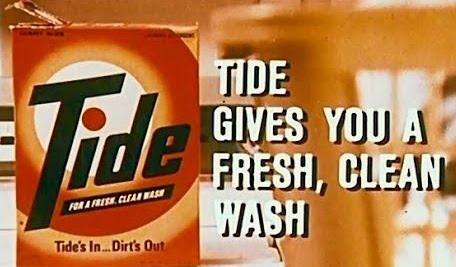
"Tide Gives You A Fresh, Clean Wash" commercial (cropped screen shot), circa 1970 (guess our babysitter took this literally), October 14, 2013. (http://article.wn.com).

“Tide Gives You A Fresh, Clean Wash” commercial (cropped screen shot), circa 1970 (guess our babysitter took this literally), October 14, 2013. (http://article.wn.com).

Two other memories prior to August 8, ’74 stand out. One was me escaping from the front yard at 48 Adams Street and walking down the block to the local asphalt playground, with basketball hoops and jungle gym included. I remember playing with much older boys, having fun, and my Mom whupping me from the playground all the way down the block back to the house. The other was when our babysitter Ida bathed me and my older brother Darren in a tub full of scolding hot water with Tide Detergent. I was so angry, I called her a “Bitch!” Angry likely because I was itching all over, the b-word likely because my Mom and my father Jimme used the word like it was a period to end a sentence. Miss Ida backhanded me like I was going cross-court as a tennis ball at the US Open. All of this happened when I was three.

The flood gates opened the following summer of ’74, though. It started because of a traumatic injury. My Mom was cooking in the shared kitchen at 48 Adams, making some kind of chicken dish. She had the oven door open, having just taken the chicken out of it and having placed it on the stove. I asked her if I could have a bite. Of course my Mom said, “No, Donald, it’s too hot!” I didn’t listen. I tried to climb up to the top of the stove by using the open oven door as a step stool, and lo and behold, I scorched my right leg when I put it on the inside of the door. I remember my Mom screaming, “Oh my God!” as I fell to the floor, screaming along with her.
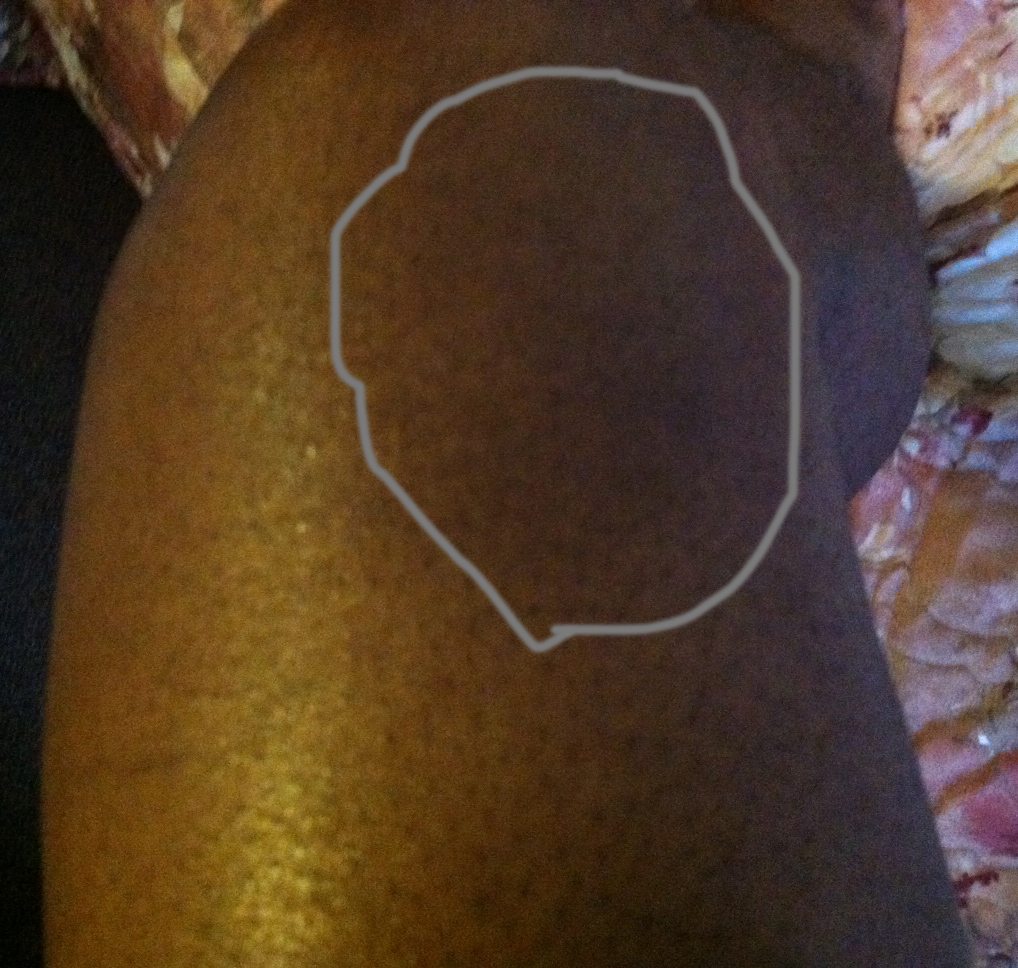
My second-degree leg burn, 40 years later - darker area circled is faded mark that was once on the right side of my right calf, August 5, 2014. (Donald Earl Collins).

My second-degree leg burn, 40 years later – darker area circled is faded mark that was once on the right side of my right calf, August 5, 2014. (Donald Earl Collins).

The skin around the burn area was gone (if it had happened today, it would’ve been a pretty good second-degree burn, and I probably would’ve ended up at the hospital), leaving a white — not pink, white — circular burn mark. My Mom applied ointment and a bandage, made me take two Bayer aspirin for the pain, and told me to calm down and be quiet. She plopped me down on the couch in the living room, which was slightly to the right of the TV.

I was still crying in pain from the shock of seeing, smelling and feeling my skin being seared in the kitchen. As my Mom sat me down, a man with a gigantic head appeared on the television screen, a man I vaguely knew as the President of the United States. I really didn’t understand much of what President Nixon said, but I do recall my Mom shaking her head, and Cronkite calling it a “sad time” for the country. Given how sad I already felt, I think I might have felt sorry for the man with the big head on the TV set.

From that moment on, I’ve had continual memories. I remember my Mom taking me to Darren’s Headstart program somewhere around South 2nd or South 3rd Avenue in Mount Vernon the next day to pick him up, seeing the man with the big head wave with his fingers sticking in the air before going on a helicopter ride, and then being dragged to Met Grocery Store on South Fulton Avenue for groceries, all with a painfully sore leg. Luckily, my Mom caught us a cab home.

And the week after that, we moved to 425 South Sixth, next to Nathan Hale Elementary, where I would go to kindergarten the following month. And the week after that, my father Jimme introduced Darren to The Clear View School, after an argument with my Mom about him “drinkin’ up all his money again.” Ah, the parallels between big historical events and key moments in my life haven’t stopped since!

When Nightmares Go Nuclear

03 Saturday May 2014

Posted by decollins1969 in 1, Academia, Boy @ The Window, Christianity, culture, earth, wind & fire, Eclectic, Hebrew-Israelite, High Rise Buildings, Mount Vernon New York, Movies, music, New York City, Pittsburgh, Politics, Pop Culture, Religion, Youth

≈ Leave a comment

Tags

"99 Luftballons" (1983), Dreams, Ebony Pictorial History of Black America (1974), Lerone Bennett, Mrs. O'Daniel, Nena, Nightmares, Nuclear Annihilation, Nuclear War, Post-Traumatic Stress Disorder, PTSD, Subliminal Messages, Terminator 2 (1991), Textbooks, The Day After (1983), Whiteness


Color version of mushroom cloud over Nagasaki, Japan, August 9, 1945. (http://www.mphpa.org via US Army Air Force). In public domain.

Color version of mushroom cloud over Nagasaki, Japan, August 9, 1945. (http://www.mphpa.org via US Army Air Force). In public domain.

I find myself seeing bright orange, yellow and white lights filling the sky and obscuring everything around me. It doesn’t matter whether I’m above ground, at home, at school or work, or on a Subway platform underground in New York. Once these lights hit, it’s over. I find myself no longer in my body, for it no longer exists. Yet I still have eyes with which to witness. Through a purple haze, the intense heat, literally searing, melting and vaporizing flesh and bone. A shock wave, crushing and churning the world all at once. Spirits once safely in bodies are now on the same plane of this new existence with me, all watching as the light, the heat and the supersonic shock wave tear into our former world. Where do we go from here, as the world is no more?

That’s a milder version of a nightmare that has been with me now off and on for thirty-four years. I’m sure that I was among the hundreds of millions of folks in the West whom dreamt often of a nuclear nightmare. It was during the final phase of the Cold War, with Soviet and American aggressions, Reagan’s presidency, and a renewed arms race. All made the prospect of “99 Luftballons” (1983) and the launch of 1,000 nuclear tipped ICBMs and SLBMs and one billion or more dead a dreadful, gnawing fact that I couldn’t do a damn thing about.

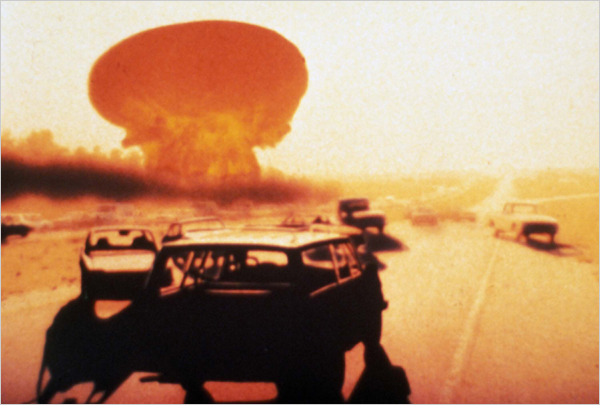
Screen shot from The Day After (November 1983) ABC movie, presumably suburban Kansas City, MO/KS, October 21, 2007. (Stout/NY Times).

Screen shot from The Day After (November 1983) ABC movie, presumably suburban Kansas City, MO/KS, October 21, 2007. (Stout/NY Times).

The very first time I fully understood the dangerous and fatal that defined this world was toward the end of fifth grade, in May ’80. It was an early May Thursday in Mrs. O’Daniel’s classroom at William H. Holmes Elementary in Mount Vernon, New York, a bright, sunny spring day. We were in independent reading mode, and Mrs. O’Daniel had given me permission to read ahead in our social studies textbook, which focused on American history.

We had left off with the Great Depression and all of the suffering that came with it. Of course, this was a collective history, one which didn’t even have the special sufferings of people of color or women in blue boxes — yet. So Whites represented all Americans. This wasn’t something I picked up on in ’80, at least consciously. But luckily, between Lerone Bennett’s edited three-volume Ebony Pictorial History of Black America (1974) at home and Mrs. O’Daniel constantly supplementing our knowledge at school, I was more aware of the deficiencies of textbooks long before I could articulate them.

As I turned the pages and read about the great battles of World War II, the horrors of Pearl Harbor and the gathering of the righteous power of the US to win the war, I suddenly saw something that shook me to my core. It was the picture of the atomic bomb’s mushroom cloud hovering over Nagasaki like death itself. It was in full color, bright and yellow and white, and obviously hot and broiling. The camera shot had managed to capture some of the landscape below, the area surrounding Nagasaki an August summer green. As I read about the 70,000 killed instantly at Hiroshima, an area the size of Mount Vernon completely flattened by a bomb that at its core had only a few pounds of weapons-grade uranium, I was frightened. I could be dead at a moment’s notice, or worse, suffer from radiation burns and sickness, in which case I’d truly be among the walking dead.

But this was only one phase of my nightmare. As things at 616 went from stable to completely out of control, my nuclear nightmares became more frequent. It seemed like there was a nuke for every day of the week during my last year as a Hebrew-Israelite. Watching The Day After on ABC in November ’83 didn’t help matters, but I also couldn’t help myself. I was both repulsed by and attracted to the idea of nuclear annihilation and survival. Maybe because I was already living through one hell of a disaster at 616.

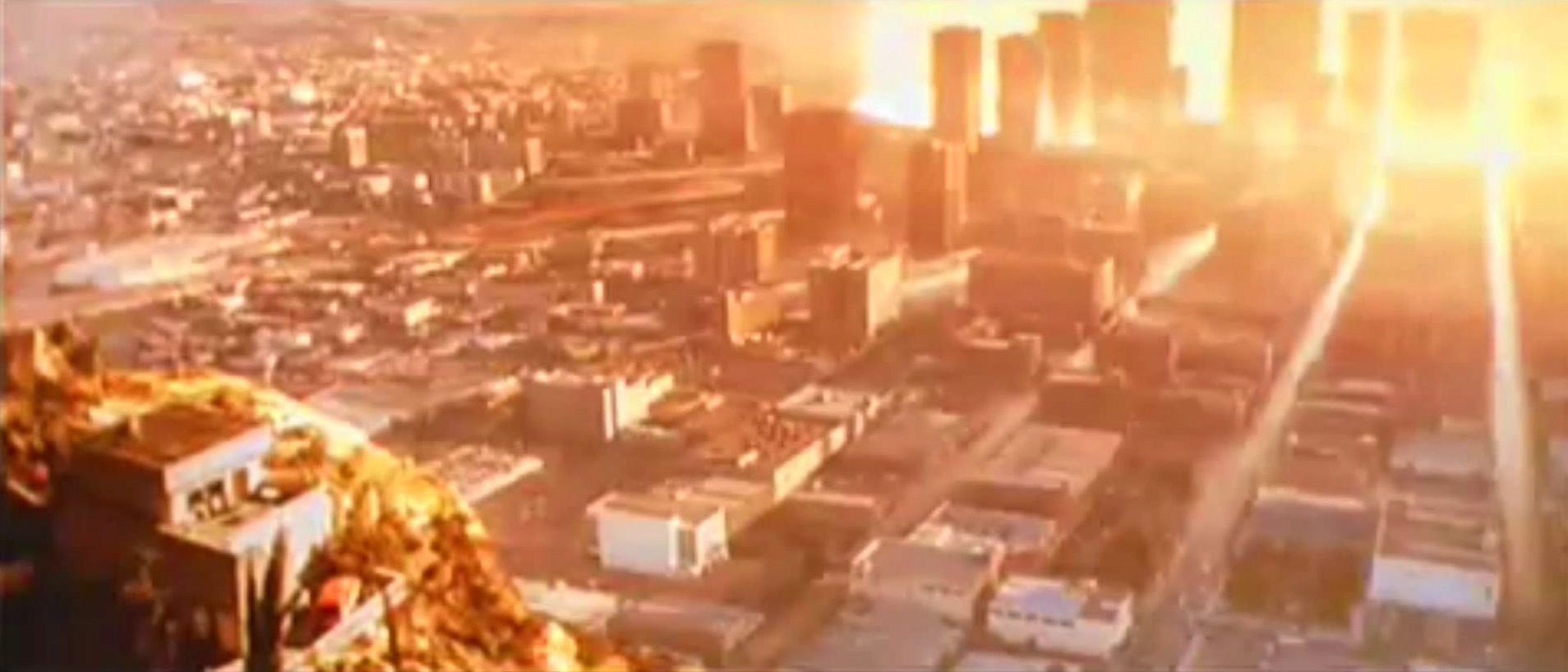
Cropped screen shot of Los Angeles at beginning of nuclear strike, from Terminator 2 (1991), May 3, 2014. (http://youtube.com).

Cropped screen shot of Los Angeles at beginning of nuclear strike, from Terminator 2 (1991), May 3, 2014. (http://youtube.com).

My nuclear nightmares continued at nearly daily pace until after I saw Terminator 2 in June ’91. At that point, I realized that my nightmares weren’t so much about the plausibility of surviving a nuclear holocaust as they were about surviving my own preteen and teenage years. It occurred to me there are worse things in life than dying, and like surviving nuclear war, surviving a violent and unstable childhood like mine has significant side effects. I could be occasionally be up, I was much more frequently down, I could occasionally fly into a rage. And I could have recurring nightmares of me murdering my now dead ex-stepfather. All signs of PTSD.

Realizing this, I took control over my dream world, and managed to push my plutonium-tipped dreams into a box, along with so many things from my decade of evangelistically twisted fire and brimstone from two religions. I still watch end-of-the-world movies, though without the extreme fervor of dream-based certainty of suffering a lingering death. Though I do often find it funny how White fears permeate these movies.

Why I Waited 9 Months to Watch 12 Years A Slave

20 Sunday Apr 2014

Posted by decollins1969 in 1, Academia, Boy @ The Window, Christianity, culture, Eclectic, eclectic music, Hebrew-Israelite, Movies, music, Politics, Pop Culture, race, Religion, Youth

≈ Leave a comment

Tags

12 Years A Slave (2013), African American History, Black Heritage, Chiwetel Ejiofor, Father-Son Relationships, Growing Pains, Growing Up, Inhumanity, Late Bloomer, Learning About Race, Lupita Nyong'o, Michael Fassbender, Slavery, Solomon Northrup, Steve McQueen, US History


Chiwetel Ejiofor in 12 Years A Slave (2013) screen shot, January 17, 2014. (http://blog.sfgate.com/). Qualifies as fair use under US copyright laws -- it illustrates subject of piece.

Chiwetel Ejiofor in 12 Years A Slave (2013) screen shot, January 17, 2014. (http://blog.sfgate.com/). Qualifies as fair use under US copyright laws — it illustrates subject of piece.

I’m usually late to the game. That’s been a running theme in my life since the early ’80s, when, as a result of my Hebrew-Israelite years, I found myself often years behind on pop culture trends. New books, new music, new dance moves, new colloquialisms, new movies. I might as well declared myself as an adult in April ’81, at least as far as the ’80s were concerned. Yet I did catch up, sometimes taking as long as a decade to get a punchline to a joke that my nemesis and classmate Alex made in seventh grade.

But not following the herd has its benefits, too. For one, I’ve gotten to look at things from a fresh perspective (some would even say as an outsider — that’s accurate as well), without succumbing to hype or groupthink about a piece of culture. Waiting also has meant that I’ve often read reviews of movies but managed to miss content-based details and that I’ve read books without forming an opinion based on its popularity ahead of my read (it’s also true about my path to Christianity). Being forced by circumstance to wait has meant that I am less apt to make sweeping declarations like “I grew up on hip-hop” when I in fact grew up with it, not on it like a drug.

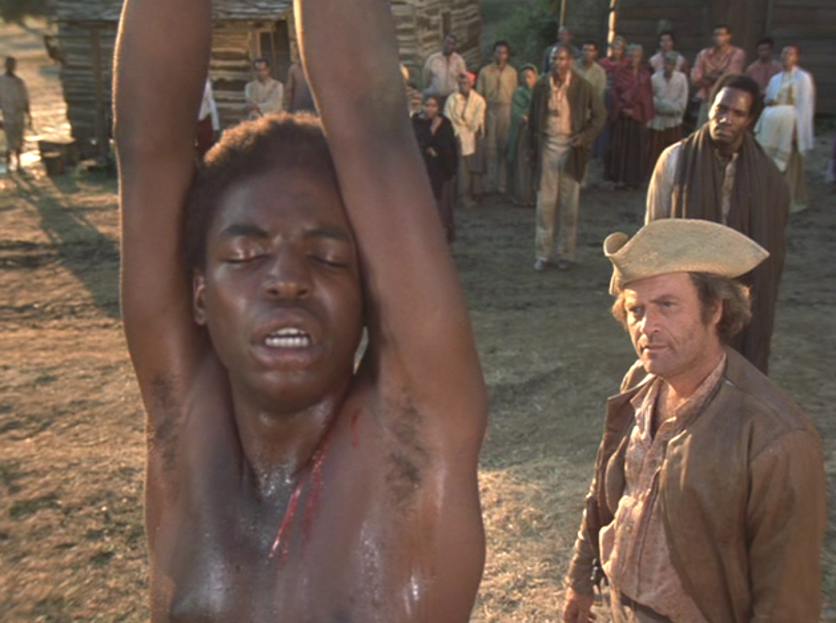
Kunta Kinte being whipped, Roots (1977) screenshot, July 6, 2012. (http://irvine.wikis.gdc.georgetown.edu). Qualifies as fair use under US Copyright laws because of screenshot's low resolution.

Kunta Kinte being whipped, Roots (1977) screenshot, July 6, 2012. (http://irvine.wikis.gdc.georgetown.edu). Qualifies as fair use under US Copyright laws because of screenshot’s low resolution.

With 12 Years A Slave (2013), though, I wanted to see it even before it came out here in the DC area in August. I’d heard about this film for months even before it was out in “select cities” in the US. Between Chiwetel Ejiofor and Michael Fassbender — two supreme British actors — I knew the film would be good. And depressing. And sad. And anger-inducing. And stomach churning. It would be an emotional roller-coaster-ride akin to my introduction to Roots on ABC in February ’77, when I was only seven years old.

So what stopped me from seeing it? My ten-year-old son. I wanted him to see the film with me. But I also knew that he would have a lot of questions. Outside of family and his visits to watch me teach my American and World History classes, my son has had little exposure to race in popular culture in an obvious sense. Most of his friends in our suburban, middle-class Silver-Spring-world are White, and his other Black friends have even less exposure to race than our deliberate injections (or inoculations) for our son.

I decided not to take him to see 12 Years A Slave because it would’ve been two hours of questions in a crowded theater, with those sitting around us ready to strangle us for ruining their watching experience. But I did queue it via Netflix weeks before it came out on DVD, with the expectation that we would watch it during his Spring Break, Easter Week.

As soon as I told my son that we were watching 12 Years A Slave last week, he became whiny and upset. Whiny because his time away from anime and Disney shows would be interrupted with parenting. Upset because of the movie title and its implications. As my son said to me when he was upset, “You made me watch Roots last year!” Well, we watched three hours of it, enough for him to see the sequence of kidnapping, the Middle Passage, slave auctions, running away, rape, whippings, and Kunta Kinte’s foot cut off. I guess the message of slavery and history really did stick with him!

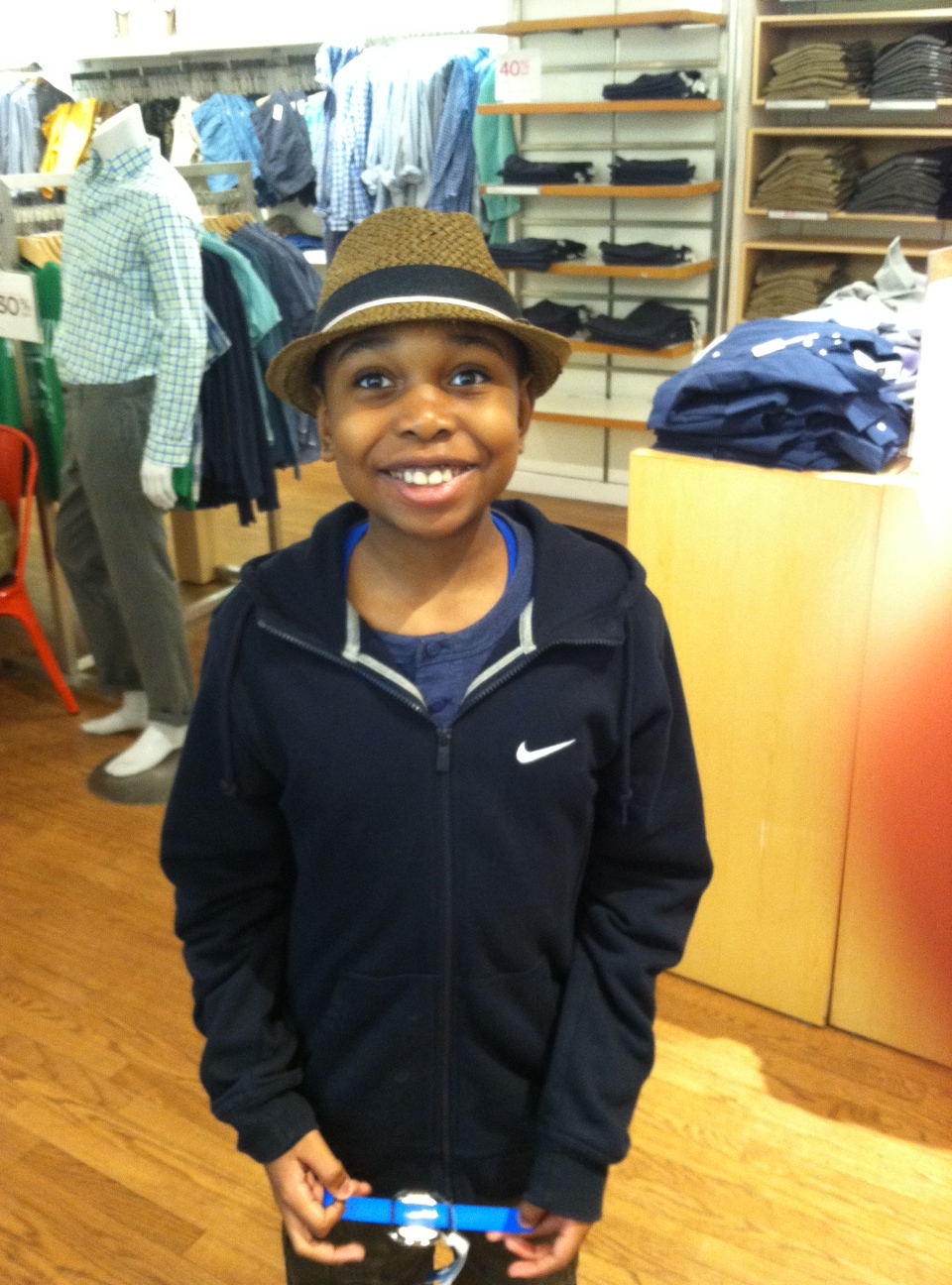
Noah trying to look cool at  The Gap store, Chevy Chase, MD, March 28, 2014. (Donald Earl Collins).

Noah trying to look cool at The Gap store, Chevy Chase, MD, March 28, 2014. (Donald Earl Collins).

We finally sat down and watched 12 Years A Slave Thursday evening. And yes, Noah did have a ton of questions, about Solomon Northrup, about free Blacks, kidnapping, mistreatment and the concept of property, about race, sexual attraction and rape, and about the rule of law. But I was more surprised about two things. One, my son sat through most of the two-and-a-quarter hour film, and only got up twice. Two, he paid serious attention in a way that he hadn’t appeared to in watching serious films before.

Still, my son was more than happy to return to his Nintendo 3DS and the land of Disney shows before bedtime that evening. The fact that he fell asleep right after bedtime, though, made it obvious, at least to me, that we’d given him more thought for food about history, race, and his own heritage.

And though I don’t think the movie was as epic as the hype-meisters have presented it to be, it was a great film, with great acting — I’m not sure if todays American actors could’ve pulled off Ejiofor’s, Fassbender’s or Lupita Nyong’o’s roles. 12 Years A Slave is also an important film, at least in terms of interrogating the meaning of race and inhumanity in this world. I just hope that those messages made it into my son’s conscious thinking. Time will tell, but enlightenment is a journey, not a race.

Over 3 Billion Blacks Killed

19 Wednesday Feb 2014

Posted by decollins1969 in 1, culture, Eclectic, Movies, music, Politics, Pop Culture, race, Youth

≈ Leave a comment

Tags

Black Lives, Dehumanization, Gangsta Rap, George Zimmerman, Hunger Games, Independence Day, Individual Racism, Institutional Racism, Jordan Davis, Michael Dunn, Nikita (2010-13), Popular Culture, Racial Stereotypes, Racism, Sardonic, Terminator, The Day After Tomorrow (2004), The Purge (2013), The War of The Worlds (2005), Trayvon Martin, Violence


McDonald's signage, Austin, MN, May 20, 2006. (Jonathunder via Wikipedia). Released to public domain via CC and GFDL.

McDonald’s signage, Austin, MN, May 20, 2006. (Jonathunder via Wikipedia). Released to public domain via CC and GFDL.

Do you remember those McDonald’s signs back in the ’70 and ’80s, before the corporation went global (from 6,000 to 30,000 franchises since ’92), where they said, “Over 100 Million Served” hamburgers or “10 Billion Served?” If the signage is there at all these days, it usually says “Billions and Billions Served.” That’s about as cheap as Black life is in the US as well, though maybe a bit more expensive in Western countries in general (they do use the Euro, after all!).

I’ve been thinking about the low value of Black lives for years, even in the middle of grad school at Pitt. But I must admit, it’s been on my mind more and more since George Zimmerman shot and killed Trayvon Martin nearly two years ago. Now, with the hung jury over the murder of Jordan Davis, with so many who find it easy to render Black and Brown lives cheaper than dog meat in the middle of the Roman Coliseum 2,000 years ago, it seems that there’s no such thing as a dead stereotype.

Jordan Davis' Facebook picture, February 17, 2014. (via Huffington Post).

Jordan Davis’ Facebook picture, February 17, 2014. (via Huffington Post).

It’s so infused in popular culture, as life and art intertwine in a macabre dance on Black and Brown bodies. Blacks especially (and for the most part, Latinos) don’t feel pain the same way as Whites. We lack the emotional and psychological control of Whites. We’re irrational and prone to criminal behavior. We’re lazy and don’t mind living in abject poverty. We love illegal drugs, but love malt liquor and hard alcohol even more. We’ll eat anything deep-fried, and don’t mind dying before middle age just so that we can save the Social Security dollars for elderly White folk.

With that as the backdrop, it’s no wonder much of the movies, music, TV and Internet depictions of us ultimately ends in our gratuitous, ubiquitous and anonymous deaths. Yes, even in 2014! I’ve recently binge-watched the now defunct CW series Nikita (2010-14) with Maggie Q as the lead. I counted at least thirty Black actors on the series over its seventy-four episodes. Only two survived the series, and one (character played by Lyndie Greenwood) wasn’t even in the last two episodes because the actress was doing double-duty on FOX’s Sleepy Hollow!

But if anyone were to take some of the largest grossing films and franchises of all time, it would become obvious how cheap folks in the US and elsewhere think Black and Brown lives really are. Between Independence Day (1996) and The Terminator series of films (1984-2009) alone, you would have to assume that almost all of the forty million Blacks living in the US died in these fictional realities, not to mention the 1.2 billion folks of at least partial African descent living in other Western nations, Africa, the Caribbean, Brazil and the rest of Latin America. That this has occurred more than once in these films alone puts us at 2.48 billion Blacks killed.

Then, between lesser known/lesser quality films like The Day After Tomorrow (2004), Deep Impact (1998), The War of the Worlds (2005) and Hunger Games (2012-present), it would seem that in every global calamity, most Blacks draw the short straw. These movies (and, prior to these movies, books) put us easily over three billion Blacks and Browns killed. And that’s without accounting for standard action films, cops-and-criminals shows, and other cinematographic renderings of the Black and Brown as disposable human beings. Unless you’re Don Cheadle, Denzel Washington, Will Smith, Morgan Freeman (sometimes) or Halle Berry, if you’re Black or Brown, your job in popular culture is to die a violent death.

Of course, those upset with my sardonic take will say, “Well what about gansta rap? What about Ice-T, Ice Cube, Snoop Dogg and so many other rappers who present Black lives as cheaper than bottled water?” Three things: 1. you really need to update yourself on today’s rap, between Lil Jon, Rick Ross and Lil Wayne, before commenting; 2. the “gansta rappers” of the ’90s were mostly rapping about a lived experience, not some fantasy life; and 3. they figured out that they could and can make money off of Black deaths in lyrical rhymes, just like folks in the movie, TV and real worlds.

Venison meat for braising, February 19, 2014. (http://www.simplyscratch.com).

Venison meat for braising, February 19, 2014. (http://www.simplyscratch.com).

This will make the likes of George Zimmerman, Michael Dunn, and substantial numbers in the NYPD and LAPD happy. Actually, what would really make them happy would be a version of the movie The Purge (2013). But instead of crime and murder being legal for one day a year, they would have to get a “coon hunting” license to kill themselves a Black or Brown person one day a year. That way, they could keep our numbers low, just like hunters do with deer every fall.

Racism Doesn’t Care What Year It Is

09 Sunday Feb 2014

Posted by decollins1969 in 1, culture, Eclectic, eclectic music, Movies, music, Politics, Pop Culture, Youth

≈ 1 Comment

Tags

"And The Beat Goes On" (1979), "I Have A Dream" speech, "We Shall Overcome", Bigotry, Civil Rights Act, Individual Racism, Institutional Racism, Internet, James Byrd, Jonathan Ferrell, Laws, Marissa Alexander, MOVE, Oppression, Philadelphia PD, Racism, Rev. Dr. Martin Luther King Jr., Social Justice, Social Media, Sophia Stewart, Structural Racism, Technology, Television, The Matrix (1999), The Whispers, Trayvon Martin, Voting Rights Act, Wachowski Siblings, Yusef Hawkins


Joel Ward in celebration with Washington Capitals teammates after scoring game/series winning goal in Round 1 of Stanley Cup Playoffs against Boston Bruins (all while fans chanted racial slurs), April 26, 2012. (http://www.flightunit.com/).

Joel Ward in celebration with Washington Capitals teammates after scoring game/series winning goal in Round 1 of Stanley Cup Playoffs against Boston Bruins (all while fans chanted racial slurs), April 26, 2012. (http://www.flightunit.com/).

One of the many throwaway sentences I’ve heard and read for almost all of my life has increasingly driven me more nuts over the years. In response to a racist statement or incident, an interviewee on the air or someone writing a column will say, “It’s 1984!” or “This is 2006!,” with “and we’re still putting up with this?” or “and we’re still dealing with” racism or bigotry to finish the thought. It’s the one phrase you can expect anyone White, Black, Latino, Asian and/or American Indian to use when interviewed or with access to a public platform. As if the year in which racial injustice and bigotry manifests itself actually matters!

Seriously, did people think that marches, speeches and laws alone would end up killing the complex and morphing structure of American racism that’s existed for more than three centuries? Did we really think that singing “We Shall Overcome” and quoting Dr. Martin Luther King’s “I Have A Dream” speech would allow individual Whiteness and hatred to melt away? Was the Civil Rights Act of 1964 and the Voting Rights Act of 1965 somehow supposed to end all race-based discrimination, even when fully enforced (of course, the federal government has never fully enforced these laws)?

Picture of Michael Griffith, killed by car after group of Whites in Howard Beach, Queens attempted to beat him and his friends with baseball bats on December 20, 1986. (Denis Hamill; http://nydailynews.com).

Picture of Michael Griffith, killed by car after group of Whites in Howard Beach, Queens attempted to beat him and his friends with baseball bats on December 20, 1986. (Denis Hamill; http://nydailynews.com).

Yes, we live in an ultra-modern age, where my generation and my son’s generation know more about the world, the universe and life than my mother and grandfather’s generations. But having more knowledge often means that we as humans tend to be more destructive toward each other before becoming wise enough to end that specific pattern of destruction. Or, as has often been the case in human history, until a new group comes along and topples one structure of oppression before implementing a new and sometimes kinder and gentler one.

To think about it another way, just because we’re technologically advanced and more scientifically driven doesn’t mean that humans in general — and Americans specifically — will act rationally and change their behaviors. Especially if it involves giving up an advantage — real or perceived — in the process.

Even though we invented the atomic bomb in 1945, it didn’t stop us from using it against the Japanese or racist White rednecks from beating to death Black veterans of World War II. Though we had television sets in nearly every American home in the 1960s, it didn’t stop Bull Conner from unleashing dogs and turning fire hoses on Black kids in Birmingham, Alabama, Medgar Evers from getting shot in Mississippi or Selma, Alabama marchers from getting beat up. And though we were poised to land on the Moon in July ’69, it didn’t mean that James Earl Ray wouldn’t take a moment to blow away Dr. King fifteen months earlier.

The first oracle from The Matrix (1999, 2003), played by the late Gloria Foster, February 9, 2014. (http://matrix.wikia.com).

The first oracle from The Matrix (1999, 2003), played by the late Gloria Foster, February 9, 2014. (http://matrix.wikia.com).

In my own lifetime, there’s been more of this lag between knowledge, self-interest and racism. From Yusef Hawkins in Bensonhurst in ’89 to James Byrd being beaten, chained and dragged behind a pickup truck in Jasper, Texas in ’98. From the Philly PD’s bombing of MOVE and the community around it in ’85 to Hurricane Katrina in ’05. Not to mention individual incidents and distinctions, like Trayvon Martin, Marissa Alexander and Jonathan Ferrell. As the ’70s hit by The Whispers goes, “And The Beat Goes On.” We have the Internet, social media, the ability to mobilize outrage and righteous indignation into demonstrations for human rights and social justice. But the human capacity to build oppressive institutions remains, as well as our capacity to hate.

But, to quote The Oracle from The Matrix trilogy (1999-2003), not to mention Buddha, “Everything that has a beginning has an End,” right? Of course, that quote might well have been inspired by a story written by Sophia Stewart in ’81, whom the Wachowski siblings apparently plagiarized in making their multi-billion dollar films. Again, why does the year racism manifests itself matter?

JFK & Innocence Never Lost, RFK & Real History

21 Thursday Nov 2013

Posted by decollins1969 in 1, Academia, culture, Eclectic, Movies, music, Patriotism, Politics, Pop Culture, Youth

≈ Leave a comment

Tags

Activism, American Exceptionalism, Assassination, Baby Boomers, Backlash, Camelot, Gun Violence, History, Innocence, JFK, JFK Assassination, LBJ, Lee Harvey Oswald, Legend, Mythology, Neo-Conservative Movement, President John F. Kennedy, President Lyndon Baines Johnson, RFK, Robert Kennedy, Social Justice, The '60s, Violence, Violent Society


President John F. Kennedy, presidential portrait (1961-63). (Wikipedia via John Fitzgerald Kennedy Library, Boston)

President John F. Kennedy, presidential portrait (February 20, 1961). (Wikipedia via John Fitzgerald Kennedy Library, Boston). In public domain.

I’ve heard about the JFK assassination in Dallas my whole life. Only the Civil Rights Movement, World War II and the Holocaust outrank JFK’s murder at the hands of Lee Harvey Oswald (or numerous other candidates) as subjects more often discussed in pop history circles of which I’ve been a part. But with the fiftieth anniversary of President John Fitzgerald Kennedy’s upon us tomorrow (fifty years to both the day and date), the mythology of his presidency and the state of the nation’s soul since November 22, 1963 is well into high gear.

But of all the myths and legends — including this ridiculousness about Camelot and the Kennedys in the White House — there’s one that bothers me more than any other. The common refrain that “America lost its innocence” the day President Kennedy took three bullets to his back and head in Daley Plaza in Dallas. Really? What about Abraham Lincoln, James Garfield and William McKinley? What about slavery, the Civil War, the eradication and forced relocation of American Indians, nuking Hiroshima and Nagasaki? Heck, what about the Cuban Missile Crisis, where JFK came within hours of jeopardizing the lives of eighty million Americans thirteen months before his murder?

Bloom off the rose, November 21, 2013. ( ).

Bloom is off the rose, November 21, 2013. (http://www.marctomarket.com).

The fact is, America has always been a violent nation, especially for those not in charge of running things here. But this bald-faced lie of a myth has been one built by those who were young when Oswald took out JFK. Teenager Baby Boomers and those only a few years older, big fans of President Kennedy, and those who loved him and lamented what could’ve been. Those are the folks that claim that the nation was young and innocent, but somehow deflowered on that dark, dark day. 

I call poppycock and balderdash on this one. Like Malcolm X in the days after the JFK assassination, I say that this was an example of America’s violent chickens coming home to kill. Luckily it’s forty-nine years and 364 days later, so I won’t be setting up my own assassination at the hands of former friends and real foes. Yet there’s some truth to Malcolm X’s statement. In a country as violent as ours, where Presidents like Kennedy endure death threats day after day, where arguments and oppression lead to mass shootings, should we ever be surprised? Ever? I say that there was no innocence lost here.

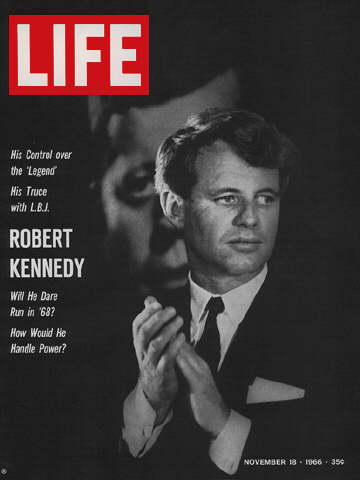
No, what we should really be discussing this week in terms of what could’ve been is RFK’s assassination in June ’68 in California. For all the sorrow over JFK’s murder, one good thing came out of it. President Lyndon Baines Johnson. LBJ took the best parts of JFK’s potential legacy — civil rights, the spreading of prosperity and Vietnam — and doubled down on it. Given LBJ’s scope of influence when compared with JFK’s, it was doubtful if the slain president could’ve pushed through half of what LBJ did get done. LBJ revealed himself to be to the left of JFK, a real Cold War liberal (for better and for worse), and not a borderline centrist.

Robert Francis Kennedy, Life Magazine Cover, November 1966. ( )

Robert Francis Kennedy, Life Magazine Cover, November 1966. (http://www.arlingtoncemetery.net/)

Of course, RFK likely wouldn’t have had the chance to run in ’68 but for his brother’s assassination. Keep in mind, too, that LBJ’s successes, failures and decision to not run for re-election also made Robert F. Kennedy’s run possible. But bottom line: RFK’s assassination affected America political and culturally in ways that have been deeper and longer lasting than even JFK’s. For starters, Americans likely do not elect Richard Nixon president in ’68 if RFK’s steadying influence is present at the ’68 Democratic Convention in Chicago. That would’ve set up some real opposition to the neo-conservative movement and the ’70s and ’80s backlash against Blacks, women, gays and labor that had been brewing since JFK’s assassination in ’63.

I know that many of you will vehemently disagree, shake your heads, or deliberately ignore the ideas of this post. What else is new in the land of the Baby Boomers, where a few so-called activists get to tell the rest of us how to see the 77 million of them and their growing up years? I say that this narrative is worn out, and neglects the reality that neither JFK nor America were innocent, but RFK’s evolving left-of-center integrity was a much bigger loss.

On the Insignificance of Saggy Pants & Respectability

20 Friday Sep 2013

Posted by decollins1969 in Boy @ The Window, culture, Eclectic, eclectic music, Movies, music, Politics, Pop Culture, race, Youth

≈ Leave a comment

Tags

Birmingham Church Bombing, Black Elite, Boyz n the Hood (1991), Economic Inequality, Florida A&M University, Hip-Hop Culture, Institutional Racism, John L. Lewis, Jonathan Ferrell, March on Washington, NWA, Police Brutality, Racism, Respectability, Saggy Pants, Thug Life, TLC, Trayvon Martin, Tupac, Violence, White Supremacists


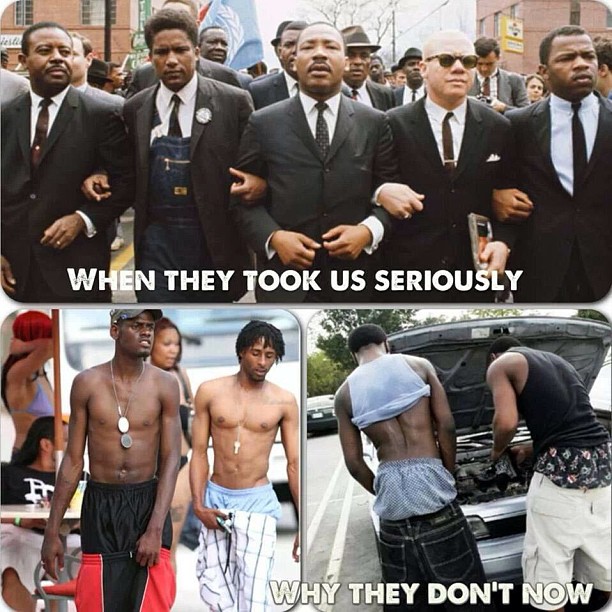
"When They Took Us Seriously/Why They Don't Now" poster, September 20, 2013. (Tim Brinkley/Google +).

“When They Took Us Seriously/Why They Don’t Now” poster, September 20, 2013. (Tim Brinkley/Google +).

In the past month of March on Washington and “I Have A Dream” speech commemorations and Birmingham church bombing dedications, a series of images lamenting rap culture and “thug life” have made their way around the Internet. The one that has stuck with me the most has been the image of the Selma March in 1965 juxtaposed with seemingly random photos of young Black males with saggy pants. The caption reads, “When they took us seriously/Why they don’t now.” Really? White supremacists took respectable Negroes seriously in the ’60s because they marched and wore suits, but don’t take Black males seriously now because of the saggy pants phenomenon? The truth is, they did and didn’t take us seriously then and now, and it has almost nothing to do with pulling our pants up above our boxers.

I have to say, though, that I hate saggy pants. It makes the people wearing them look somewhere between goofballs and idiots. It’s never mattered to me whether White guys or Black guys or college guys or hip-hop divas have worn saggy pants. I didn’t like it when it became a style in the early ’90s, thanks in large measure to NWA and Tupac, TLC and Snoop Dog and a host of other hip-hop/rap artists. I certainly don’t like it now, and would never buy a pair for my ten-year-old son to wear that way. The saggy pants style has been a sad twist on hand-me-downs and poverty as marketable clothes for the hip-hop cool.

But the saggy pants style has never translated for me as embracing a  “thug life” or some devolution of Black culture or American society. It wasn’t life imitating art, ala Boyz n the Hood (1991), Menace II Society (1993) or Clockers (1997). Nor have I ever seen it as something that meant that Whites or the new Black elite could say, “See. These Black folk don’t deserve respect, or health care, or a quality education, or good-paying jobs.” Over the past two decades, I’ve seen it as a style — a bad style, to be sure — but a style that some Blacks (and Whites, Latinos and Asians) have embraced.

Any young Black person who’s striving for higher education, or careers, or their own stereotypical success story in life, will tell you that they don’t wear saggy pants for every time or season. Even those who don’t know learn very quickly that saggy pants aren’t welcome in allegedly more respectable settings. If anything, the prevalence of saggy pants in 2013 has as much to do with the reality that opportunities for education, employment and prosperity remain so out of reach that it really doesn’t matter to many what they wear and where they wear it. There’s no need to code switch if everyone in your world knows the same exact code of cool.

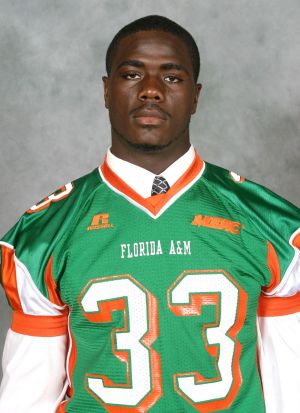
Jonathan Ferrell, Florida A&M football picture, September 20, 2013. (AP/Florida A&M University).

Jonathan Ferrell, Florida A&M football picture, September 20, 2013. (AP/Florida A&M University).

Recent events have made it pretty obvious that it really doesn’t matter what Black males wear. We remain targets for deeply ingrained stereotypes, institutional racism, and pre-emptive White violence. Whether it was Trayvon Martin wearing a hoodie in the rain, or John Lewis wearing a suit in Selma forty-eight years ago, it hasn’t mattered to Whites in fear of the Black boogie man. Florida A&M University graduate and former football player Jonathan Ferrell learned this deadly lesson in North Carolina just a week ago. It doesn’t matter what we wear, at least as far as many Whites and some Black elites are concerned.

Blacks all look the same to them, and looked the same to them in the ’60s. Suits, hoodies or baggy pants, we’re criminals and imbeciles from birth, thugs for life, and a drain on families and American society. This doesn’t mean that any one of us shouldn’t take responsibility for how we act, speak and look in public. I dare say, though, that structural economic issues like unemployment in deeply impoverished Black communities (or crank-infested White ones) won’t be solved with young folk pulling their pants up. We need to stop focusing on the insignificant, because saggy pants and respectability are the trees in this morphing forest of racism and economic inequality.

← Older posts
Newer posts →

Boy @ The Window: A Memoir

Boy @ The Window: A Memoir

Places to Buy/Download Boy @ The Window

There's a few ways in which you can read excerpts of, borrow and/or purchase and download Boy @ The Window. There's the trade paperback edition of Boy @ The Window, available for purchase via Amazon.com at http://www.amazon.com/Boy-Window-Donald-Earl-Collins/dp/0989256138/

There's also a Kindle edition on Amazon.com. The enhanced edition can be read only with Kindle Fire, an iPad or a full-color tablet. The links to the enhanced edition through Apple's iBookstore and the Barnes & Noble NOOK edition are below. The link to the Amazon Kindle version is also immediately below:

scr2555-proj697-a-kindle-logo-rgb-lg

Boy @ The Window on Amazon.com: http://www.amazon.com/Boy-The-Window-Memoir-ebook/dp/B00CD95FBU/

iBookstore-logo-300x100

Boy @ The Window on Apple's iBookstore: https://itunes.apple.com/us/book/boy-the-window/id643768275?ls=1

Barnes & Noble (bn.com) logo, June 26, 2013. (http://www.logotypes101.com).

Boy @ The Window on Barnes & Noble: http://www.barnesandnoble.com/w/boy-the-window-donald-earl-collins/1115182183?ean=2940016741567

You can also add, read and review Boy @ The Window on Goodreads.com. Just click on the button below:

Boy @ The Window

Twitter Updates

Tweets by decollins1969
  • RSS - Posts
  • RSS - Comments

Archives

  • June 2025
  • April 2023
  • September 2022
  • August 2022
  • July 2022
  • June 2022
  • May 2022
  • April 2022
  • March 2022
  • January 2022
  • December 2021
  • November 2021
  • October 2021
  • September 2021
  • August 2021
  • July 2021
  • June 2021
  • April 2021
  • March 2021
  • February 2021
  • January 2021
  • December 2020
  • November 2020
  • October 2020
  • September 2020
  • August 2020
  • July 2020
  • May 2020
  • April 2020
  • March 2020
  • January 2020
  • December 2019
  • November 2019
  • August 2019
  • July 2019
  • June 2019
  • May 2019
  • April 2019
  • March 2019
  • February 2019
  • January 2019
  • December 2018
  • November 2018
  • October 2018
  • September 2018
  • August 2018
  • July 2018
  • June 2018
  • May 2018
  • March 2018
  • February 2018
  • January 2018
  • December 2017
  • November 2017
  • October 2017
  • September 2017
  • August 2017
  • July 2017
  • June 2017
  • May 2017
  • April 2017
  • March 2017
  • February 2017
  • January 2017
  • December 2016
  • November 2016
  • October 2016
  • September 2016
  • August 2016
  • July 2016
  • June 2016
  • May 2016
  • April 2016
  • March 2016
  • February 2016
  • January 2016
  • December 2015
  • November 2015
  • October 2015
  • September 2015
  • August 2015
  • July 2015
  • June 2015
  • May 2015
  • April 2015
  • March 2015
  • February 2015
  • January 2015
  • December 2014
  • November 2014
  • October 2014
  • September 2014
  • August 2014
  • July 2014
  • June 2014
  • May 2014
  • April 2014
  • March 2014
  • February 2014
  • January 2014
  • December 2013
  • November 2013
  • October 2013
  • September 2013
  • August 2013
  • July 2013
  • June 2013
  • May 2013
  • April 2013
  • March 2013
  • February 2013
  • January 2013
  • December 2012
  • November 2012
  • October 2012
  • September 2012
  • August 2012
  • July 2012
  • June 2012
  • May 2012
  • April 2012
  • March 2012
  • February 2012
  • January 2012
  • December 2011
  • November 2011
  • October 2011
  • September 2011
  • August 2011
  • July 2011
  • June 2011
  • May 2011
  • April 2011
  • March 2011
  • February 2011
  • January 2011
  • December 2010
  • November 2010
  • October 2010
  • September 2010
  • August 2010
  • July 2010
  • June 2010
  • May 2010
  • April 2010
  • March 2010
  • February 2010
  • January 2010
  • December 2009
  • November 2009
  • October 2009
  • September 2009
  • August 2009
  • July 2009
  • June 2009
  • May 2009
  • April 2009
  • March 2009
  • February 2009
  • January 2009
  • December 2008
  • November 2008
  • October 2008
  • September 2008
  • August 2008
  • July 2008
  • June 2008
  • May 2008
  • April 2008
  • March 2008
  • February 2008
  • January 2008
  • December 2007
  • November 2007
  • October 2007
  • September 2007
  • August 2007
  • July 2007
  • June 2007

Recent Comments

MaryPena's avatarMaryPena on My Day of Atonement/Bitter Hat…
decollins1969's avatardecollins1969 on No Good Teaching Deed Goes…
Mary Rose O’Connell's avatarMary Rose O’Connell on No Good Teaching Deed Goes…

NetworkedBlogs on Facebook

NetworkedBlogs
Blog:
Notes From a Boy @ The Window
Topics:
My Life, Culture & Education, Politics & Goofyness
 
Follow my blog

616 616 East Lincoln Avenue A.B. Davis Middle School Abuse Academia Academy for Educational Development AED Afrocentricity American Narcissism Authenticity Bigotry Blackness Boy @ The Window Carnegie Mellon University Child Abuse Class of 1987 CMU Coping Strategies Crush #1 Crush #2 Death Disillusionment Diversity Domestic Violence Economic Inequality Education Family Friendship Friendships Graduate School Hebrew-Israelites High-Stakes Testing Higher Education History Homelessness Humanities Humanities Program Hypocrisy Internalized Racism Jealousy Joe Trotter Joe William Trotter Jr. K-12 Education Love Manhood Maurice Eugene Washington Maurice Washington Misogyny Mother-Son Relationship Mount Vernon High School Mount Vernon New York Mount Vernon public schools Multiculturalism MVHS Narcissism NFL Pitt Pittsburgh Politics of Education Poverty President Barack Obama Race Racial Stereotypes Racism Relationships Self-Awareness Self-Discovery Self-Reflection Sexism Social Justice Teaching and Learning University of Pittsburgh Violence Whiteness Writing

Top Rated

Blog at WordPress.com.

  • Subscribe Subscribed
    • Notes from a Boy @ The Window
    • Join 103 other subscribers
    • Already have a WordPress.com account? Log in now.
    • Notes from a Boy @ The Window
    • Subscribe Subscribed
    • Sign up
    • Log in
    • Report this content
    • View site in Reader
    • Manage subscriptions
    • Collapse this bar
 

Loading Comments...