• About Me
  • Other Writings
  • Interview Clips
  • All About Me: American Racism, American Narcissism, and the Conversation America Can’t Have
  • Video Clips
  • Boy @ The Window Pictures
  • Boy @ The Window Theme Music

Notes from a Boy @ The Window

~

Notes from a Boy @ The Window

Category Archives: Movies

Everyone Needs A Ferris Bueller

16 Thursday Jun 2016

Posted by decollins1969 in 1, Boy @ The Window, culture, Eclectic, Mount Vernon High School, Mount Vernon New York, Movies, Pittsburgh, Pop Culture, race, University of Pittsburgh, Youth

≈ 2 Comments

Tags

Alan Ruck, Chicago, Comedy, Diversity, Dramedy, Ferris Bueller's Day Off (1986), Friendships, Interventions, Intolerance, John Hughes, Lily-White, Matthew Broderick, Mia Sara, Narcissism, Pitt, Teenage Angst


Mia Sara, Alan Ruck, and Matthew Broderick in Ferris Bueller's Day Off (1986) screen shot, June 16, 2016. (http://www.playbuzz.com).

Mia Sara, Alan Ruck, and Matthew Broderick in Ferris Bueller’s Day Off (1986) screen shot, June 16, 2016. (http://www.playbuzz.com).

This week mark thirty years since the release of the Hollywood hit Ferris Bueller’s Day Off (1986). The movie is mostly known for Matthew Broderick imbuing energy into the title character, taking his best friend Cameron Frye (Alan Ruck played him) and his girlfriend Sloane Peterson (Mia Sara played her) on a joy ride through North Side Chicago while embarrassing his high school principal and avoiding his parents. Going to a Cubs game, insinuating himself into a parade, and otherwise making Chicago pretty lily-White. For most watchers, Ferris Bueller’s Day Off was a John Hughes comedy. Period.

Not so for me. At least once I finally watched the film. Like with most movies made between ’81 and ’87, I didn’t see it when it first came out. With my high school classmates only quoting Ben Stein’s character saying “Bueller?” over and over again, or commenting on the ability of anyone to roam the streets of Chicago so easily between roughly 8 am and 6 pm in the middle of the work week, I had no interest in seeing it. I eventually caught bits and pieces of scenes from Ferris Bueller on cable, but by nearly a decade after the movie first came out, I’d seen maybe fifteen minutes of the film.

It took my eventual wife Angelia to get me to see the movie in ’96. By then, I’d seen other Matthew Broderick films, enough where I was willing to give a comedy on White teen Gen Xer angst a chance. For whatever reason, I realized for the first time Ferris Bueller really wasn’t a comedy. It had plenty of funny moments, but at best it was a dramedy. I even remember saying to Angelia after I watched it, “Are you sure this is a comedy?”

The movie’s not-so-hidden theme is friendship. In this case, how one friend in Ferris Bueller goes above and beyond as a high school senior to save his best friend from a quietly tragic future. In Cameron’s case, one in which he wouldn’t be in charge of the shape of his life. It would either be guided by his domineering father (whom we never see in the movie) or by some future domineering wife. Apparently that was the real reason behind all of Ferris Bueller’s days off from school in the final months of his senior year.

Cameron Frye (Alan Ruck) underwater in pool (literal and figurative), Ferris Bueller's Day Off (1986), June 16, 2016. (http://www.giphy.com).

Cameron Frye (Alan Ruck) underwater in pool (literal and figurative), Ferris Bueller’s Day Off (1986), June 16, 2016. (http://www.giphy.com).

By Bueller and his girlfriend colluding to permit Cameron his first look at a naked female body and performing an intervention through the use of Cameron’s father’s precious classic car, Cameron would somehow recognize the need to break free. That Bueller also got to thumb his nose at authority and hang out with his girlfriend was a bonus, of course. Otherwise, the movie is a zany comedy about playing hooky in the streets of Chicago on the most unlikely of school days in the middle of May.

I certainly didn’t have any Ferris Buellers in my life during my Humanities years. If there were classmates like him, they didn’t shine a light on me. Sure, there was White male angst, Black male angst, teenager angst, middle class angst, and Black and White female angst at Mount Vernon High School. I would assume now that this has been true as long as the concept of teenager and comprehensive high school has existed (about eighty years in all). But to deliberately perform an intervention on behalf of a friend to save them from themselves and their upbringing? I’m sure it happened, just not with me or any of my Humanities classmates.

This realization begs a question. Would a Ferris Bueller have emerged in my life in middle school or in high school if I were from a family of means? All issues aside, the reason why Bueller and Frye were friends probably had as much to do with location as anything else. And with residential segregation also comes income segregation. Money may not have been the reason the two teenagers were friends. Yet with both families firmly in the ranks of the affluent (not one percent, but certainly in the top 10-25 percent), their friendship is more unlikely than a Cubs game and a White ethnic pride parade on the same day. The answer to my question, of course, is no. Diversity without acknowledgement or discussion — whether by race, gender, and/or class — doesn’t exist, leaving the teenage angst that was my experience unresolved until college.

The rainbow flag waving in the wind at San Francisco's Castro District, San Francisco, CA, August 5, 2010. (Benson Kua via Wikipedia). Released to public domain via CC-SA-2.0.

The rainbow flag waving in the wind at San Francisco’s Castro District, San Francisco, CA, August 5, 2010. (Benson Kua via Wikipedia). Released to public domain via CC-SA-2.0.

As for the events in Orlando in the past week, aside from the obvious implications of misogyny, homophobia, racism, and hate/terror, there is another more subtle issue. That people who grow up with angst but minus interventions can easily become disaffected adults. Obviously most of these adults don’t become mass shooters or stalkers who kill. But it does mean that in a society geared toward narcissistic individualism and winning, there are millions out of touch with themselves and lacking empathy (forget about love) for other human beings.

Ferris Bueller’s Day Off is a sense that we all need one friend to intervene in our lives at least one time or for one day. We need that one day, to draw perspective, or maybe even, to find out that we truly need help and healing. My Ferris Buellers didn’t intervene until college at the University of Pittsburgh. They were gay and straight, Christian and Jewish and atheist, old and young, men and women, and Black, White, Brown, and Yellow. They came into my life later than I wanted, but not too late for me.

Black Power Generation

24 Wednesday Feb 2016

Posted by decollins1969 in 1, Academia, Boy @ The Window, culture, Eclectic, Movies, Politics, Pop Culture, race, Religion, Youth

≈ Leave a comment

Tags

Afrocentricity, Alondra Nelson, Angela Davis, Assata Shakur, Authentic Blackness, Authenticity, Black Freedom, Black Panther Party, Black Power, Black Studies, Blackness, Bobby Seale, Community Control, Eldridge Cleaver, Free Breakfast, Harold Cruse, Huey Newton, Kwame Touré, Michael Eric Dyson, Nathan Wright Jr., Peniel Joseph, Policy Brutality, Robin D. G. Kelley, Stokely Carmichael, Whiteness


Black Panther national chairman Bobby Seale, wearing a Colt .45 and defense minister Huey Newton with a bandolier and shotgun, poster, Oakland, CA, 1968. (AP via http://pbs.org).

Black Panther national chairman Bobby Seale, wearing a Colt .45 and defense minister Huey Newton with a bandolier and shotgun, poster, Oakland, CA, 1968. (AP via http://pbs.org).

This year marks a half-century since the official shift of the Civil Rights Era from the traditional Civil Rights leadership of the Black Church toward one of “Black Power.” Between Stokely Carmichael/Kwame Touré’s famous 1966 speech, Huey Newton and Bobby Seale’s founding of the Black Panther Party that October, and riots that began with Watts in L.A. the year before, this was a pivotal year in American and African American history. Of course, as historians and other scholars like Peniel Joseph and Alondra Nelson have illuminated in recent years, while 1966 was a pivotal year, it was not a departure from a long history of the Black freedom struggle, but part a continuity. For Joseph and Nelson (not to mention, Robin D. G. Kelley and Michael Eric Dyson), Black Power was a continuation of radical ideas and actions in order to stand in opposition to American capitalism and racism as an intertwined system of oppression. The roots of which go at least as far back as Black sharecroppers and their union organizing efforts during the Great Depression, if not in fact to the radicalism of Martin Delany of the 1850s.

These wonderful scholars are absolutely right to dump the simplistic narrative of Black Power as a symbol of/departure from the struggle for civil rights or as a philosophy that advocates violence against Whites, especially Whites in law enforcement. They are also more than right to point out how Black Power and the Black Panther Party did way more good on a policy level than most Americans would ever give their leaders credit for. Fred Hampton and Newton and the Free Breakfast for School Children Program that started in Chicago and Oakland between 1969 and 1972. The People’s Free Medical Centers (PFMC), Free Ambulance Service, and other direct community involvement to provide free access to health care and screenings for thousands of impoverished Black families. Free food programs for the destitute.

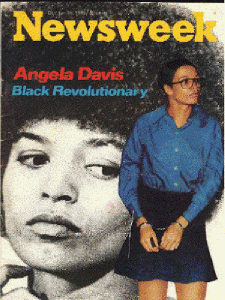
Angela Davis on Newsweek cover after 1970 arrest, October 26, 1970. (http://pinterest.com). Qualifies as fair use due to adjustments for low resolution.

Angela Davis on Newsweek cover after 1970 arrest, October 26, 1970. (http://pinterest.com). Qualifies as fair use due to adjustments for low resolution.

But more than that. The idea that Black communities could work to provide services and opportunities otherwise denied to them by American society was to be a major takeaway from this era of the overall Black freedom struggle. And of course, the idea that police served as an oppressive occupying force, and that Black citizens had every right to defend themselves against police brutality. Though direct armed struggle with law enforcement was in the Black Panther Party toolbox, the notion of policing the police, community control over schools, a community using its available resources, is still more positive than negative. These remain implementable ideas that have and do provide an outlet to the daily grind of racial discrimination and deep poverty in so many parts of the US.

Culturally, the freedom struggle as expressed through Black Power and the Black Panther Party, particularly by leaders like Angela Davis, Assata Shakur, Amiri Baraka, and Kwame Touré, was one of what we know would call Afrocentricity today. This was/is far more than wearing Afros, daishikis, sea shells and beads (or for that matter, black turtlenecks and tight pants). It would mean advocating for and getting universities (both predominantly White universities and HBCUS) to adopt Black Studies programs. It would mean influencing a whole generation of Black artists (the arts, music, and cinema) to adopt a “I’m Black and proud” stance in their work, from Marvin Gaye and the Lost Poets and Gil Scott Heron, to movies like Shaft and that first mainstream miniseries, Roots.

The Black Power Generation (kind of like Prince and The Revolution that tried to incorporate a mesh of messages between 1979 and 1986), for all of the elements that survived Huey Newton and his purges of the 1970s and early 1980s — not to mention their continuing influence in American pop culture, in Black intellectual thought, and in Black movements in general — was hardly perfect. Some, like the late Kwame Touré, promoted Black Power as a sort of authentic Blackness, a kind in which one had to buy all of the options on the table in order to be authentic. The “Uncle Tom” accusation or its equivalent was thrown at Martin Luther King, Whitney Young, Arthur Ashe, and others whose support of Black Power was less that full-throated. Not to mention, the tensions between leaders within the Black Panther Party and among African American intellectuals who attempted to ride the wave of Black Power, as nearly forgotten Black intellectuals Harold Cruse and Nathan Wright, Jr. noted in the late-1960s.

Gemasolar Thermosolar Plant (solar power concentration, converting solar energy to thermal turbine power generation), Fuentes de Andalucía, Seville province, Spain, June 22, 2014. (Wikipedia via http://vice.com).

Gemasolar Thermosolar Plant (solar power concentration, converting solar energy to thermal turbine power generation), Fuentes de Andalucía, Seville province, Spain, June 22, 2014. (Wikipedia via http://vice.com).

That lingering legacy of Black Power is part of its appeal and one of its limits — the ability to redefine ourselves and retell our history in a way that brings nuance and truth. But nuance and truth are not always absolutes. In many respects, Black Power over the generations shares a similarity with Marxist thought and action. Just as Marxism represents a dialectical opposition to capitalist oppression, Black Power has always represented a dialectical resistance to Whiteness and the racist/capitalist oppression that comes with Whiteness. It just doesn’t represent the only form of resistance there is, at least not as Newton, Touré, and others lived their resistance. Black Power is more than resistance, and more than just an amorphous idea standing in opposition to Whiteness. It’s just not the only form of Blackness there is. My own upbringing would be a further testimony to this (to be continued…).

The Fountain of Middle Age

27 Sunday Dec 2015

Posted by decollins1969 in 1, Boy @ The Window, Christianity, culture, Eclectic, Mount Vernon New York, Movies, New York City, Pittsburgh, Politics, Pop Culture, race, Religion, Sports, Youth

≈ Leave a comment

Tags

616, 616 East Lincoln Avenue, Aging, Back To School (1986), Beauty, Demographics, Family, Fountain of Middle Age, Fountains, Friends, Health, Philadelphia, Rodney Dangerfield, Self-Reflection, Youth


Alexander Stirling Calder's "Swann Memorial Fountain," Benjamin Franklin Parkway, Philadelphia, PA, August 18, 2012. (Donald Earl Collins).

Alexander Stirling Calder’s “Swann Memorial Fountain,” Benjamin Franklin Parkway, Philadelphia, PA, August 18, 2012. (Donald Earl Collins).

By most measures, today marks my full transition from relative youth to middle age. Although, when I really think about it, didn’t I really hit middle age in December ’07, when I turned thirty-eight? The average life expectancy of an American male is about seventy-seven, right? And for Black males, it’s barely sixty-five. Given my family history, though, I won’t hit middle age for another two years. My maternal grandfather turned ninety-six three months ago, and my paternal grandfather lived until he was ninety-six. Even my father’s still moving along at seventy-five, despite his battle with alcoholism between the ages of twenty and fifty-eight.

I do feel things in my body and mind that until a few years ago were merely minor aches and pains. My right hip is misaligned with my left hip, likely from years of walking at warp speed, lots of basketball, and six years of my running regime. My L-5 vertebrae is a bit compressed, due to years of activity, including many years hunched over a keyboard trying to make myself into a writer, author and educator. My right knee has been a bother since I was twenty-four, but the issue has gotten worse in the past two years (maybe time for some HGH or microfracture surgery?). I now have white-coat syndrome (because most doctors and nurses get on my last nerve), and I’m mildly anemic. No, folks, forty-six isn’t the new thirty-six, even if I can still run forty yards in under five seconds, pop a three over my son’s outstretched hand or leg press 360 pounds.

Me via Photo Booth, December 17, 2015. (Donald Earl Collins).

Me via Photo Booth, December 17, 2015. (Donald Earl Collins).

But I still have good health and a mostly healthy body and mind. Since I turned twenty-seven, my weight has never been higher than 241 pounds (including clothes, wallet, phone, and keys) or lower than 212 (I weight 229 now). I can still memorize when inspired to do so, remember virtually anything important from my life from the age of four to the present, and could still probably win at Jeopardy if I ever got the call.

What’s more impressive, though, is whom remains in my life now that I’m no longer “young” anymore. My friends live all over the map, from the DC area to Pittsburgh to the Bay Area and New York, from Atlanta to Athens and from Seattle to Shanghai. I’ve made peace (mostly) with my family and my past, even if they aren’t always at peace with me. There’s my wife and son, of course, who are mostly likely the reason I’m still “young” relative to my age. Though I remain a Christian, I do not have the blind faith or evangelical -isms of my youth, and I’m at peace with that as well. I’m probably further to the left culturally and politically than I was at sixteen, twenty-six, or thirty-six. Because I’ve learned, sadly, that so much of what I was taught or fed growing up was either incorrect or a complete lie. But even with that sad disillusionment, I’ve come to accept the possibility of change for myself and the Sisyphean task that this nation and world always has been.

Me at 45 and 364.25 days, Pittsburgh, PA, December 26, 2015. (Donald Earl Collins).

Yet even the idea of middle age has changed in the minds of capitalists as the Baby Boomer generation has begun retirement and all of them have received their first AARP cards. Before 2000, the ad folks and entertainment folks had split up adults into the age demographics of 18-34, 35-44, 45-64, and 65 and up. Now, it’s 18-24, 25-54, and 55 and up. This privileges Baby Boomers (as usual) and props up Millennials (folks who used to be Gen Y). My middle age is not the same as Baby Boomers’ middle age. Even in demographic representations, money-grubbing capitalists give us Gen Xers little respect.

Rodney Dangerfield quipped this funny line in Back to School (1986):

Coach Turnbull: What’s a guy your age doing here with these kids?
Thornton (played by Dangerfield): I’m lookin’ for the fountain of middle age.

Maybe when I’m sixty-five (like Rodney Dangerfield was in this film), I’ll be looking for the Fountain of Middle Age, too. But my choice will be to stand in it for the next thirty or forty years!

Hollywood and the Sounds of Empire

21 Monday Dec 2015

Posted by decollins1969 in 1, Academia, culture, Eclectic, Movies, Politics, Pop Culture, race

≈ Leave a comment

Tags

Acting, British Accent, British English, Commonwealth English, Cultural Imperialism, Da Vinci's Demons (2013-15), East vs. West, Historical Lies, Hollywood, Imperialism, Leonardo da Vinci, Linguistic Imperialism, Paris Climate Summit, Tom Riley, TV Shows, World History


Da Vinci's Demons Season 3 Poster, October 2015. (Starz via http://www.ew.com/). Fair use due to direct connection with subject matter and non-commercial use.

Da Vinci’s Demons Season 3 Poster, October 2015. (Starz via http://www.ew.com/). Fair use due to direct connection with subject matter and non-commercial use.

I finished catching up on the Starz series Da Vinci’s Demons over the weekend, which included me watching the final episode via Xfinity On Demand last night. I will not provide any spoilers. But, I am at a loss regarding the one constant with most period pieces or fantasy TV series and movies. I simply do not understand the need for a British accent in everything that isn’t American in Hollywood or its near-equivalent. If my understanding of history is correct, Romans didn’t speak in British English with English colloquialisms like “Needs must” or “bollocks.” Alexander the Great was never “knackered” or “gobsmacked.” And Leonardo da Vinci as played by Tom Riley saying “codswallop” or “fortnight” or any of a hundred British sayings with a nasally, pretentious accent is about as accurate as firing a shotgun at a barn’s broadside from 1,000 meters away.

Brit Slang Explained: Translation Chart for a British Slang Bus Blind T-shirt Design, December 21, 2015. (https://anglotees.com.

Brit Slang Explained: Translation Chart for a British Slang Bus Blind T-shirt Design, December 21, 2015. (https://anglotees.com.

In general, I love hearing and reading the differences in British and other forms of English when not spoken by Americans. With so many TV series and movies now done with international casts, though, it has turned into a form of cultural imperialism. Especially since I know that until two centuries ago, the average Brit sounded more like the average Canadian or American than like James Bond while attending Oxford. The change in accent was part of the United Kingdom of Great Britain’s rise to superpower empire status during the eighteenth and nineteenth centuries. Anyone who wanted to become part of the British gentry class — including newly monied industrialists and merchants — hired speech coaches to train them to speak English in the manner that we hear from most British English speakers in 2015.

Even with the rise of the US as the world’s leading superpower and its gigantic cultural and economic footprint, British English still is the language and sound of empire. At least where Hollywood is concerned. Because British English sounds imperial, high-class, important, urgent, and intelligent, according to the ears of many an English speaker, whether in the UK, the US, or elsewhere in the world. It doesn’t matter if the modern version of f–k didn’t exist until the eighteenth century. It doesn’t matter if some shows like Game of Thrones or movies like Lord of the Rings are complete fantasy and should have no adherence to any particular language or sound. British English is all that and a bag of chips, the cat’s meow, is dope for the English-speaking world.

For me, though, all I’m hearing with shows like Da Vinci’s Demons, Rome, Spartacus and The Borgias (the Showtime version), and with movies like 300 and Gladiator is a narrative framed by imperialism and the triumph of the West. It’s not just the British English accent and the imperialism it represents. It’s also how producers, directors, and actors consistently frame period pieces in the West vs. East, civilization vs. savagery narrative. Be them Ottoman Turks, Germanic barbarians or Persian emperors, they’re all simplistic antagonists for cinematic fodder that reinforces the West as good, godly and victorious. Or, rather, to quote Pittsburgh Steelers’ head coach Mike Tomlin, those without British accents are “the dead Indians” in these modern-day “cowboy” movies.

"Linguistic Imperialism" - what the world might look like if borders were based upon the 10 major languages, May 10, 2014. (The Economist via http://pinterest.com ).

“Linguistic Imperialism” – what the world might look like if borders were based upon the 10 major languages, May 10, 2014. (The Economist via http://pinterest.com ).

And like Tomlin, in the case of screen entertainment, I’m kind of tired of the same theme running over and over again. Not only is depicting the Ottoman Empire or Achaemenid Persia as evil heathens when compared with Italy in the 1480s or Greece in 480 BCE a historical lie. It also reinforces the idea that when the West wields its power and imperialism, the world is always a better place. If the climate summit in Paris demonstrated anything, it showed how much damage the West has done to the world.

A century or two from now — assuming our globalized world doesn’t fall apart due to wars and climate change — entertainment will likely be highlighted with accents unfamiliar to today’s Western ears. Even if one of entertainment’s primary languages remains English, it will likely have another accent. Ace!


This Is NOT Sparta!

11 Wednesday Nov 2015

Posted by decollins1969 in 1, culture, Eclectic, Movies, Patriotism, Politics, Pop Culture, race, Religion, Sports

≈ Leave a comment

Tags

Black Americans, Black Migration, Blind Patriotism, Civil Rights Movement, Civilians, Erasure, Freedom, History Lessons, Honoring, Hyper-Patriotism, Invisibility, Jim Crow, Meaning, Native Americans, Patriotism for Profit, Sacrifice, Service, Slavery, Veterans Day


"If you live in a free country, thank a veteran" poster slogan, November 10, 2015. (http://facebook.com).

“If you live in a free country, thank a veteran” poster slogan, November 10, 2015. (http://facebook.com).

Just like with Memorial Day and with Independence Day, I often find myself conflicted about Veterans Day. Not because I think individual members of the military deserve praise or scorn. As usual, the vast majority of Americans think too simplistically about their country, its people, its intentions and history, even its holidays. Too many of us go along to get along. It’s as if we expect the contradictions and tensions that make up our times and days like today to simply melt away in some high-pitched display of blind patriotism. I have not — and likely will never be — that American, pumped up with pride and affection, shouting slogans as gospel truth, thanking every member of the military for every single breath of American air that I breathe. And that is because the narrative for days like today has never worked for me.

In some respects, the blind march of Veterans Day is with Americans every single day. The media covers the military and individual military members as if all of them have spent weeks on the front lines, as if all of them are patriots above reproach. Almost all of us have known someone who’s served, and we know that service for most was never as simple as wrapping the American flag around themselves in defense of American freedoms halfway around the world (or at a base a few miles from home). In recent months, we’ve learned that much of the constant drumbeat of military-fueled patriotism the military itself has bought and paid for, at NFL and college football and baseball games. Reinforcing one of America’s main values — profit.

Army National Guardsmen about to run on field with American flags with the New England Patriots, Super Bowl XLIX, University of Phoenix Stadium, Glendale, AZ, February 1, 2015. (http://latimes.com; Getty Images).

Army National Guardsmen about to run on field with American flags with the New England Patriots, Super Bowl XLIX, University of Phoenix Stadium, Glendale, AZ, February 1, 2015. (http://latimes.com; Getty Images).

Today is Veterans Day, created seventy-seven years ago in the aftermath of the Great War, the “War to End All Wars,” World War I. It was a terrible war, after all. Ten million soldiers and sailors on all sides died, twenty million found themselves ripped and torn apart, and eight million civilians died. But not for or in the US, where 120,000 soldiers and sailors died, a few hundred thousand were wounded, and few hundred civilians died. The US didn’t enter the war until April 1917, nearly three years into the raging Eurasian conflict. American weapons manufacturers and merchants profited greatly from the war even before the US declared war on Germany, selling arms and food to both sides.

War is never simple. Neither should be what we think of those who served or are serving. Veterans Day is about respecting those who have served or are serving. Like my youngest brother Eri, or my Uncle Felton, or my sister-in-law or my late uncle-in-laws. Thanking or respecting them, though, shouldn’t be tied directly to the idea that I “live in a free country.” I don’t believe that the US is a free country, not for me and for millions of others like me. Nor do I believe that the US military has played a role in preserving my individual freedoms and liberties historically. I am a Black man living in a society built in part on systemic racism, often maintained or reinforced by the US military. Except for some elements of the Union Army during the Civil War, the US military has played a very small role in making sure that I or anyone who looks like me — male, female or transgender — lives in a free country.

Not to mention, the US hasn’t been invaded in over 200 years (I don’t want to hear about Pancho Villa — that wasn’t an invasion). Since when does fighting North Koreans, the Viet Cong, or even Nazis equate to me and others and our “freedoms?” Seriously, every time someone says this, it’s as if you’re attempting to erase long civilian fights for civil rights, for the most basic of freedoms that the US purports to grant to every citizen. Folks who say that we should be grateful to the military for living in a free country completely make invisible Native Americans. The US military was what guaranteed their near annihilation, deculturalization and unyielding poverty, especially from 1865 on.

"This is madness!" with actor Peter Mensah, screen shot from 300 (2007), November 11, 2015. (http://youtube.com).

“This is madness!” with actor Peter Mensah, screen shot from 300 (2007), November 11, 2015. (http://youtube.com).

Yes, some of you will note that I can write my post without fear of retribution from the government. Then I will say in response, “How does serving overseas guarantee my rights?” It doesn’t. A lot went into putting me in a better position in my life. Black migration, the Civil Rights Movement (flaws and all), the sacrifices of Black and White civilian leadership (including their deaths). I am one generation removed from sharecropping and tenant farming in Georgia and Arkansas, one generation removed from the last years of the Jim Crow era. But somehow, the US military is responsible for me living “in a free country.” Sorry, but that’s a narrative I cannot get behind.

So, we should all thank individual veterans for their service. We should honor the dead and the broken among them. For whether they came to serve out of a deep sense of patriotism, because of the draft (prior to 1973), because there weren’t any jobs in their communities, or because they wanted a chance at today’s version of the GI bill, some of them have paid dearly in their service. But since we do not live in a military junta or in a totalitarian society, I dare say that I don’t have to go along with the narrative that without the military, I would be a slave. History contradicts every aspect of this false narrative.

This isn’t Sparta (Sparta wasn’t even Sparta). Nor should the US ever be Sparta.

Continuum’s Legacy: Dystopia Now

07 Saturday Nov 2015

Posted by decollins1969 in 1, culture, Eclectic, Movies, Patriotism, Politics, Pop Culture, Work, Youth

≈ Leave a comment

Tags

2077, Alex Sadler, Alternate Future, Alternate History, Bill Gates, Charles Koch, Continuum (2012-15), Corporate Congress, Economic Inequality, Erik Knudsen, Firefly (2002), Fringe (2008-13), Kiera Cameron, Liber8, Michael Bloomberg, Oppression, Plutocracy, Rachel Nichols, Resistance, Revolution, Sci-Fi, Simon Barry, SyFy, Time-Travel, William B. Davis


Continuum series art, August 2012. (http://liber8thecontinuum.tumblr.com).

Continuum series art, August 2012. (http://liber8thecontinuum.tumblr.com).

Continuum (2012-15) ended its fourth and final season on SyFy here in the US and Showcase in Canada last month (we can still watch it — eventually all of it — on Netflix, though). Typical of most science-fiction series, Continuum ended with a six-episode arc that cannibalized its main theme, in this case, time-travel. Six episodes about soldiers from the future attempting to prevent the creation of a better-future-alternate-timeline for the year 2077, one that didn’t include corporate plutocratic totalitarianism over the rest of the world. Continuum’s creator Simon Barry could have and should have done better. This ending obscured what Barry attempted to illuminate throughout the series. Despite the problems of a bludgeoned timeline and plot in Season Four, Barry did get the idea of a potential corporate dystopia correct. His Continuum offered up the idea that the twenty-first century world is already at war, between more economic and political freedom on the one hand, and increasing global economic inequality and corporate influence on the other.

Continuum was the Canadian sci-fi show about Kiera Cameron (played by Rachel Nichols), a police officer from 2077 but stuck in the 2010s with a group of time-traveling anti-capitalist terrorists known as Liber8. Continuum, though, is hardly the only show with the theme of a dark near future. FOX’s Fringe (2008-13) and the short-lived yet cult favorite SyFy series Firefly (2002) were both examples of a world in which corporate interests and government power had nearly become one and the same. Yet in those series, whether located on an alternative Earth or the twenty-sixth century, there remained a line between corporate influence and governmental authority.

Humans as mindless drones (implanted with mind-controlling chips) working off debt at a factory in British Columbia, Continuum, Season 2, Episode 9, July 7, 2013. (http://www.syfy.com).

Humans as mindless drones (implanted with mind-controlling chips) working off debt at a factory in British Columbia, Continuum, Season 2, Episode 9, July 7, 2013. (http://www.syfy.com).

On this point alone, Continuum succeeded precisely because it didn’t pretend there were better days of capitalism and democracy in the past. From its pilot episode, set in present/alternate future Vancouver, British Columbia, Barry’s vision of a plausible darker future shined through. It was a future in which corporations would eliminate the nation-state entirely as the middleman for its profitability and power interests. The Global Corporate Congress would be the resulting outcome of the failures of governments around the globe to address population growth, climate change, trillions of dollars of debt and a host of other issues. But really, it would also be the outcome of corporations using governments and government tax breaks to corrupt democracy and hoard wealth. Barry realized that this alternative course is one the world is already on.

The biggest question any serious fan of Continuum should have is this. Why didn’t Barry send the terrorist group Liber8 back to 1977, where the path toward the Global Corporate Congress could’ve been destroyed before billionaire social-control advocates like Bill Gates, Michael Bloomberg, and Charles Koch would have been able to build their paternalistic view of the world? After all, it’s really not that much of a leap from Gates’ heavy-handed philanthropic work in public education and the Citizens United decision in the US to a world plutocratic government run by the heads of multi-trillion-dollar corporations.

The saddest aspect about the end of Continuum was the idea that it ultimately took a 83-year-old robber baron with a conscious in Alec Sadler (played by William B. Davis and Erik Knudsen) to change this dark trajectory. That billions of humans didn’t revolt to a future in which corporations controlled every aspect of their lives — that’s just appalling. Yes, Liber8 and other anti-capitalist and anti-Corporate Congress rebels (or terrorists) were around and engaged. But most people apparently allowed themselves to be led like sheep to the slaughterhouse, all for reasons involving food and security. Still, were it not for Sadler and his great time-travel device, this would be a world in which all of us would be plutocratic corporate slaves. Hard to imagine anyone like Sadler willing to change this future, precisely because this is the future real-life plutocrats like Gates, Bloomberg, Koch (and Steve Jobs, and Mark Zuckerberg, and Phil Knight) want.

Then-Mayor Michael Bloomberg attempting to sell soda size ban to New Yorkers, May 30, 2012. (http://adweek.com).

Then-Mayor Michael Bloomberg attempting to sell soda size ban to New Yorkers, May 30, 2012. (http://adweek.com).

That a corporation could arbitrarily decide how families could discharge their debts, make works of art of acts of free speech contraband, and insert microchips in humans in order to keep them from rebelling or to force them to work off their debts. As disgusting as that was to see on Continuum, the sad truth is that we’re not very far from this future at all. If anything, we needed more examples of this soul-destroying future, not more muddled attempts to destroy it.

This is the real legacy of Continuum. Not its fancy time-travel motif or cool-looking gadgets. The reminder that freedoms from economic and political oppression are ideals humanity must fight for in every era. That people shouldn’t cede power to corporations over the food supply, water, law enforcement or education out of fear or desperation. That societies shouldn’t blindly trust billionaire robber barons—no matter how well-intentioned—simply because they promise some of their billions to help the poor. We the people need to trust and verify, through governments, through muckraking, protests, and, if necessary, through revolution, against this plausible future.

On Anachronistic Bullshit

12 Monday Oct 2015

Posted by decollins1969 in 1, Academia, Carnegie Mellon University, Christianity, culture, Eclectic, Movies, Patriotism, Politics, Pop Culture, race, Work, Youth

≈ 2 Comments

Tags

Afrocentricity, Anachronisms, Anachronistic, Beating a Dead Horse, Black Nationalism, Bullshit, Burnout, Conference Presentations, Fear of a "Black" America (2004), Jesus, Journal of American History, Mental Exhaustion, Multicultural Education, Multiculturalism, Nat Turner, OAH, Politics of Academia, Politics of Education, Socialism, Toronto


Kirsten Dunst and Jason Schwartzman get anachronistic between shots on set of Marie Antoinette (2006), September 2012. (Pinterest via http://buzzfeed.com).

Kirsten Dunst and Jason Schwartzman get anachronistic between shots on set of Marie Antoinette (2006), September 2012. (Pinterest via http://buzzfeed.com).

It’s that time of year in academia, folks. The heart of the fall scholarly conference schedule, between the beginning of October and mid-November (American Political Science Association conference as an exception, though). For the first time in a few years, I’m part of the schedule, as part of a panel on American imperialism and narcissism this weekend at the Society of U.S. Intellectual Historians conference here in DC.

The topic is a departure for me. In the couple of dozen or so conference presentations I’ve done since the mid-1990s, I have discussed two interrelated topics. Multiculturalism in the contexts of US history, African American history, and education policy was one, and covered every presentation I did between 1992 and 2003. Education reform in the context of college access, retention, and diversity was the other, and covered every conference presentation or other talk I did from 2004 through 2009.

Bokeem Woodbine, October 12, 2015.

Bokeem Woodbine, October 12, 2015. (http://imdb.com)

I never wanted to be wedded to one topic my whole career. It was the academic equivalent of being typecast, like Bokeem Woodbine (thug) or Anthony Azizi (terrorist). But in the spring of 2003, there I was, doing conferences as “Dr. Multiculturalism,” either for the benefit of eager grad students or to the chagrin of more senior scholars.

No one really discusses this issue in academia. The idea that any of us can decide to move on to a completely different topic as a scholar, become engrossed in it, even become an expert and present and write on that topic, and then move on to the next one (yes, there are consequences, but…). At best, most scholars in academia have variations-on-a-theme careers, covering sports history and society, moving from baseball to football to tennis. Or from Black migration in the early 20th century to gentrification and its impact on Black families in the ’90s and ’00s. (It’s not as if many academicians can’t find the time to pick up another idea!)

What’s even worse are the ways in which we in academia beat up on each other’s work at conferences, and not in a constructively critical way, either (that would be refreshing). The key for me moving on from multiculturalism began at the 1999 Organization of American Historians conference in Toronto. I presented on “The Black Brahmins of Harvard: W. E. B. Du Bois, Carter G. Woodson, and Alain L. Locke on
Multiculturalism, 1890-1940.” Admittedly, there were a few issues with the paper. I didn’t include any Black women in my consideration (although, given Harvard’s institutional racism and sexism in this period, Black women were almost nonexistent, including at the doctoral level). I had to deal with the Afrocentricity sect, who didn’t see multiculturalism as a fellow traveler, but instead as a Eurocentric “feel-good” understanding of US and Black culture.

Most importantly, I was being “anachronistic.” I had applied a term that hadn’t become commonplace until the 1970s to a previous period in history, one in which the term hadn’t been conceived. It didn’t matter that cultural pluralism had existed as a term since the 1890s and that many in the philosophy and education fields had used cultural pluralism and multiculturalism interchangeably. For this group of cultural and education historians, multiculturalism in my work equalled a no-go zone.

Jesus was a Socialist bumper sticker, an anachronism, October 12, 2015. (http://plus.google.com).

Jesus was a Socialist bumper sticker, an anachronism, October 12, 2015. (http://plus.google.com).

Though I managed a few short articles and a chapter on multiculturalism, time and time again, the question of anachronism came up. And despite all of my documented evidence, more senior scholars at journals refused to accept multiculturalism and Black history in the same sentence. “Surely you must be referring to Afrocentricity or Black Nationalism,” one reviewer for the Journal of American History wrote on a manuscript that he rejected in 2002.

It never occurred to me to call them directly on this bullshit. These same folks will write articles with titles like, “Was Jesus a Socialist?” or “a Marxist?,” or “Nat Turner’s Rebellion and the Birth of Black Nationalism.” Talk about anachronistic! Jesus and Karl Marx are roughly 1,800 years apart, and Black Nationalism is a specifically mid-to-late-twentieth century term. Yet this was much more all right than my early-thirties-self yammering about something as complex as multiculturalism and its role in the thinking and education of African Americans.

Beating a dead horse cartoon, September 2012. (Marc Cortez, http://marccortez.com).

Beating a dead horse cartoon, September 2012. (Marc Cortez, http://marccortez.com).

I’m hardly arguing that academicians who didn’t like my work should have seen my brilliance and allowed me to publish or present more on multiculturalism. Heck, by 1999, I was tired of my former dissertation topic already! A bit more honesty about what really bothered them, though, would’ve been helpful. The idea that ordinary people could be unconsciously participating in multiculturalist activities, in this case, ordinary Black folk, some academicians found unacceptable. The idea that I could write this was unacceptable to quite a few. The fact that my former patron in Joe Trotter wasn’t out there opening up doors for me on my topic left me in a bad place politically as well. I wasn’t supposed to be in academia, after all, at conferences or in scholarly journals. I know now that part of the point was to thin out the herd of competition, to anoint some and shun so many others, me included.

The constant rejection on fairly hypocritical grounds just made it easier for me to publish Fear of a “Black” America in ’04 and move on. Since I am at the beginning of the process of thinking through a new topic, I don’t have mental exhaustion as an excuse for crumbling in the face of soul-destroying, narcissistic opposition. I also have at least one thing going for me these days. I feel I’m old enough now to call numbskulls on their bullshit.

← Older posts
Newer posts →

Boy @ The Window: A Memoir

Boy @ The Window: A Memoir

Places to Buy/Download Boy @ The Window

There's a few ways in which you can read excerpts of, borrow and/or purchase and download Boy @ The Window. There's the trade paperback edition of Boy @ The Window, available for purchase via Amazon.com at http://www.amazon.com/Boy-Window-Donald-Earl-Collins/dp/0989256138/

There's also a Kindle edition on Amazon.com. The enhanced edition can be read only with Kindle Fire, an iPad or a full-color tablet. The links to the enhanced edition through Apple's iBookstore and the Barnes & Noble NOOK edition are below. The link to the Amazon Kindle version is also immediately below:

scr2555-proj697-a-kindle-logo-rgb-lg

Boy @ The Window on Amazon.com: http://www.amazon.com/Boy-The-Window-Memoir-ebook/dp/B00CD95FBU/

iBookstore-logo-300x100

Boy @ The Window on Apple's iBookstore: https://itunes.apple.com/us/book/boy-the-window/id643768275?ls=1

Barnes & Noble (bn.com) logo, June 26, 2013. (http://www.logotypes101.com).

Boy @ The Window on Barnes & Noble: http://www.barnesandnoble.com/w/boy-the-window-donald-earl-collins/1115182183?ean=2940016741567

You can also add, read and review Boy @ The Window on Goodreads.com. Just click on the button below:

Boy @ The Window

Twitter Updates

Tweets by decollins1969
  • RSS - Posts
  • RSS - Comments

Archives

  • June 2025
  • April 2023
  • September 2022
  • August 2022
  • July 2022
  • June 2022
  • May 2022
  • April 2022
  • March 2022
  • January 2022
  • December 2021
  • November 2021
  • October 2021
  • September 2021
  • August 2021
  • July 2021
  • June 2021
  • April 2021
  • March 2021
  • February 2021
  • January 2021
  • December 2020
  • November 2020
  • October 2020
  • September 2020
  • August 2020
  • July 2020
  • May 2020
  • April 2020
  • March 2020
  • January 2020
  • December 2019
  • November 2019
  • August 2019
  • July 2019
  • June 2019
  • May 2019
  • April 2019
  • March 2019
  • February 2019
  • January 2019
  • December 2018
  • November 2018
  • October 2018
  • September 2018
  • August 2018
  • July 2018
  • June 2018
  • May 2018
  • March 2018
  • February 2018
  • January 2018
  • December 2017
  • November 2017
  • October 2017
  • September 2017
  • August 2017
  • July 2017
  • June 2017
  • May 2017
  • April 2017
  • March 2017
  • February 2017
  • January 2017
  • December 2016
  • November 2016
  • October 2016
  • September 2016
  • August 2016
  • July 2016
  • June 2016
  • May 2016
  • April 2016
  • March 2016
  • February 2016
  • January 2016
  • December 2015
  • November 2015
  • October 2015
  • September 2015
  • August 2015
  • July 2015
  • June 2015
  • May 2015
  • April 2015
  • March 2015
  • February 2015
  • January 2015
  • December 2014
  • November 2014
  • October 2014
  • September 2014
  • August 2014
  • July 2014
  • June 2014
  • May 2014
  • April 2014
  • March 2014
  • February 2014
  • January 2014
  • December 2013
  • November 2013
  • October 2013
  • September 2013
  • August 2013
  • July 2013
  • June 2013
  • May 2013
  • April 2013
  • March 2013
  • February 2013
  • January 2013
  • December 2012
  • November 2012
  • October 2012
  • September 2012
  • August 2012
  • July 2012
  • June 2012
  • May 2012
  • April 2012
  • March 2012
  • February 2012
  • January 2012
  • December 2011
  • November 2011
  • October 2011
  • September 2011
  • August 2011
  • July 2011
  • June 2011
  • May 2011
  • April 2011
  • March 2011
  • February 2011
  • January 2011
  • December 2010
  • November 2010
  • October 2010
  • September 2010
  • August 2010
  • July 2010
  • June 2010
  • May 2010
  • April 2010
  • March 2010
  • February 2010
  • January 2010
  • December 2009
  • November 2009
  • October 2009
  • September 2009
  • August 2009
  • July 2009
  • June 2009
  • May 2009
  • April 2009
  • March 2009
  • February 2009
  • January 2009
  • December 2008
  • November 2008
  • October 2008
  • September 2008
  • August 2008
  • July 2008
  • June 2008
  • May 2008
  • April 2008
  • March 2008
  • February 2008
  • January 2008
  • December 2007
  • November 2007
  • October 2007
  • September 2007
  • August 2007
  • July 2007
  • June 2007

Recent Comments

decollins1969's avatardecollins1969 on No Good Teaching Deed Goes…
Mary Rose O’Connell's avatarMary Rose O’Connell on No Good Teaching Deed Goes…
Lyndah McCaskill's avatarLyndah McCaskill on The Raunchiest of Them Al…

NetworkedBlogs on Facebook

NetworkedBlogs
Blog:
Notes From a Boy @ The Window
Topics:
My Life, Culture & Education, Politics & Goofyness
 
Follow my blog

616 616 East Lincoln Avenue A.B. Davis Middle School Abuse Academia Academy for Educational Development AED Afrocentricity American Narcissism Authenticity Bigotry Blackness Boy @ The Window Carnegie Mellon University Child Abuse Class of 1987 CMU Coping Strategies Crush #1 Crush #2 Death Disillusionment Diversity Domestic Violence Economic Inequality Education Family Friendship Friendships Graduate School Hebrew-Israelites High-Stakes Testing Higher Education History Homelessness Humanities Humanities Program Hypocrisy Internalized Racism Jealousy Joe Trotter Joe William Trotter Jr. K-12 Education Love Manhood Maurice Eugene Washington Maurice Washington Misogyny Mother-Son Relationship Mount Vernon High School Mount Vernon New York Mount Vernon public schools Multiculturalism MVHS Narcissism NFL Pitt Pittsburgh Politics of Education Poverty President Barack Obama Race Racial Stereotypes Racism Relationships Self-Awareness Self-Discovery Self-Reflection Sexism Social Justice Teaching and Learning University of Pittsburgh Violence Whiteness Writing

Top Rated

Blog at WordPress.com.

  • Subscribe Subscribed
    • Notes from a Boy @ The Window
    • Join 103 other subscribers
    • Already have a WordPress.com account? Log in now.
    • Notes from a Boy @ The Window
    • Subscribe Subscribed
    • Sign up
    • Log in
    • Report this content
    • View site in Reader
    • Manage subscriptions
    • Collapse this bar
 

Loading Comments...