• About Me
  • Other Writings
  • Interview Clips
  • All About Me: American Racism, American Narcissism, and the Conversation America Can’t Have
  • Video Clips
  • Boy @ The Window Pictures
  • Boy @ The Window Theme Music

Notes from a Boy @ The Window

~

Notes from a Boy @ The Window

Category Archives: Jimme

Shopping at C-Town

09 Thursday Sep 2010

Posted by decollins1969 in 1, Boy @ The Window, culture, Eclectic, Jimme, Mount Vernon High School, Religion, Youth

≈ Leave a comment

Tags

C-Town, Crush #1, Food Stamps, Humility, Mount Vernon High School, Mount Vernon New York, Stereotype Threat, Stigma


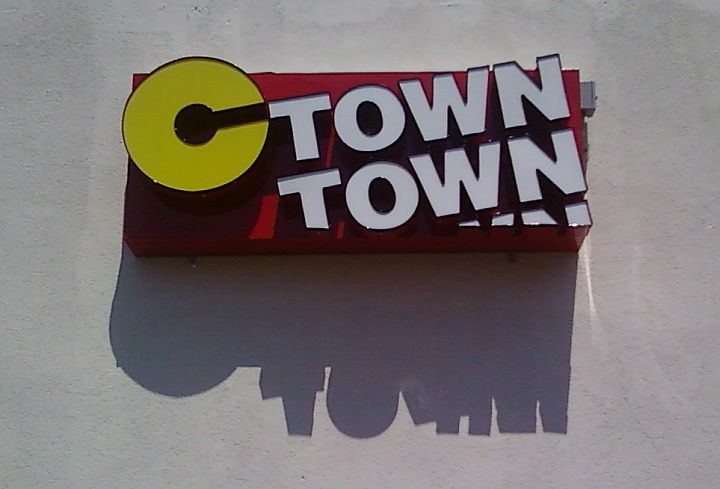
C-Town Sign, Plainfield, NJ. Source: Plainfield Today, http://ptoday.blogspot.com/2010/07/c-town-supermarket-touches-nerve.html

I’ve spent very little time walking down memory lane regarding Crush #1 this year. Partly because I’m sure some of my readers are sick of hearing about my love for her, and partly because I’m sure she’s sick of hearing about herself. But this short story is more about me than her.

Twenty-seven years ago this week, I experienced my first — and nearly my last — embarrassment around food stamps at the one-time C-Town grocery store near the corner of Park Avenue and East Prospect Avenue in Mount Vernon. I was shopping after 7 pm for groceries after a quick stop at Mount Vernon Public Library early on in my freshman year at Mount Vernon High School. It was right around the last Rosh Hashanah I’d recognize as a Hebrew-Israelite, a Wednesday or Thursday night. I was buying some pinto beans, Carolina Long Grain Rice, beef neck bones and other healthy yet cheap things to eat for the next few days.

It’d always been a struggle to shop for my family during the Hebrew-Israelite years, to find kosher food, to buy strange things like matzohs or kosher salt. But it had become stranger for me earlier that year, when we ended up on welfare and using food stamps after April ’83. By that fateful evening, I’d maybe used my

Vintage Food Stamps. Source: http://slashfood.com

mother’s food stamps a half-dozen times. Other times, I’d used my father Jimme’s money to pay for the groceries, the indignity of using food stamps was so great. And when I shopped in Mount Vernon, I was acutely aware of the possibility that I could bump into one of my better-off classmates while paying for groceries with my stereotypical food stamps. As far as I was concerned, they already had too many things they could make fun of me about as it was.

So as I finished combing the slender and short aisles of C-Town for kosher bargains, I began my trek to the cash registers at the front, relieved that I hadn’t bumped into any folks I knew. Only to run into Crush #1, having beaten me to the cashier that was open at the time.” Damn,” I thought, one of the few times before the age of twenty-one that the word damn ever invaded my thoughts. She was polite enough to say “Hey, Donald,” to engage me in a short conversation about the start of high school.

Although I was usually grateful to be in my first love’s presence, all I wanted to do at that moment was run away, get out of the store as fast as I could. Instead, I went through the motions, answering her questions and asking a couple of ones about the teachers we had in common that year, like Cuglietto and Murphy. Luckily for me, she didn’t linger after she paid the cashier, and said her laters while I was still being rung up. I quickly handed the cashier my $20 in food stamps, told them to keep the Monopoly money change, and walked around the corner and down Prospect to 616 at Warp Factor 3.

The funny thing about getting older — not old, but older — is that it would take a lot more than food stamps to embarrass me these days. Especially now that you can get welfare checks and food stamps through direct deposit and EBT cards. I’m sure that Crush #1 thought nothing of our short conversation that evening, and neither did I, other than feeling awkward about the reminder that I was completely out of my league, not only from a relationship standpoint, but in terms of my lot in life overall. Boy, I’m glad that things have changed — that I’ve grown — so much in past twenty-seven years. Otherwise, I wouldn’t have a blog to remind me of my ridiculous past.

My Father Jimme — Happy Birthday!

17 Saturday Jul 2010

Posted by decollins1969 in 1, Boy @ The Window, Eclectic, Jimme, My Father, New York City, Work, Youth

≈ Leave a comment

Tags

Alcoholism, Boy @ The Window, Forgiveness, Jimme, Mount Vernon New York, My Father, New York City, Reconciliation, Work


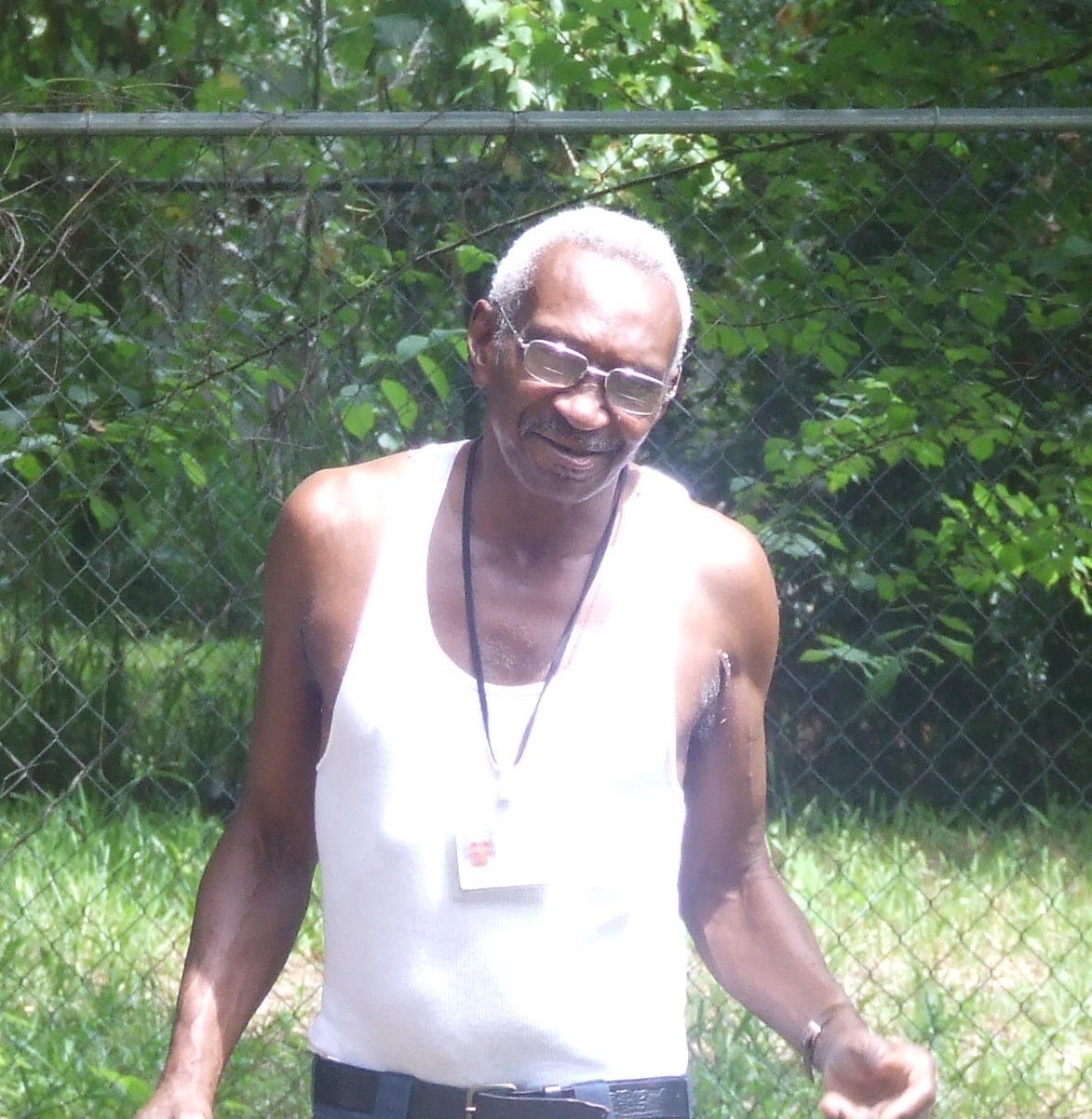
My Father, August 2007

On Monday, my father Jimme turns seventy years old. Seventy, 70, 7-oh! Amazing! Given the years of alcohol abuse, so much loss, so much pain, so much rage, and to recover and make it to the age of seventy? That’s a big-M miracle, the kind that you can only attribute to sheer strength of will and the grace of God.

I must admit, after the summer of ’92, I had my doubts about my father’s future. The few times I saw him that summer, he was drinking like he had never drank before. The first time I saw him, he accused me of lying about having my master’s degree. “No college gonna giv’ you a degree afta a year,” he said. Only when his Jewish bosses told him it was possible for someone to finish a master’s in a year did he believe me.

The second time I went to see him, his landlord Mrs. Smalls was about to evict him. But my father wasn’t there. Or, I guess he was, in a way. He had made plops of defecation, from the front gate and blue slate walk up to the front steps and porch, into the entrance way and foyer, up the gloomy carpeted steps, all the way to the attic bathroom next to his room. They’d been cleaning for hours, according to Mrs. Smalls, but it sure didn’t smell like it.

Fast-forward two years to Christmas Eve ’94. My mother and my younger siblings and I went on a bus trip to Cross County Mall and Toys ‘R Us in Yonkers. Jimme showed up at the last minute to join us and to regale us with his “po’ ass muddafuccas” and his other favorite Jimme-isms. We were on the 7 bus to Yonkers, packed with parents who were shopping late for toys and Christmas trees. Jimme was so drunk that he fell over on some people on the bus once, and fell into the rear stairwell one other time. I wasn’t embarrassed as much as I was disappointed and saddened.

So by the time I finished my doctorate at the end of ’96, I’d all but given up on my father turning things

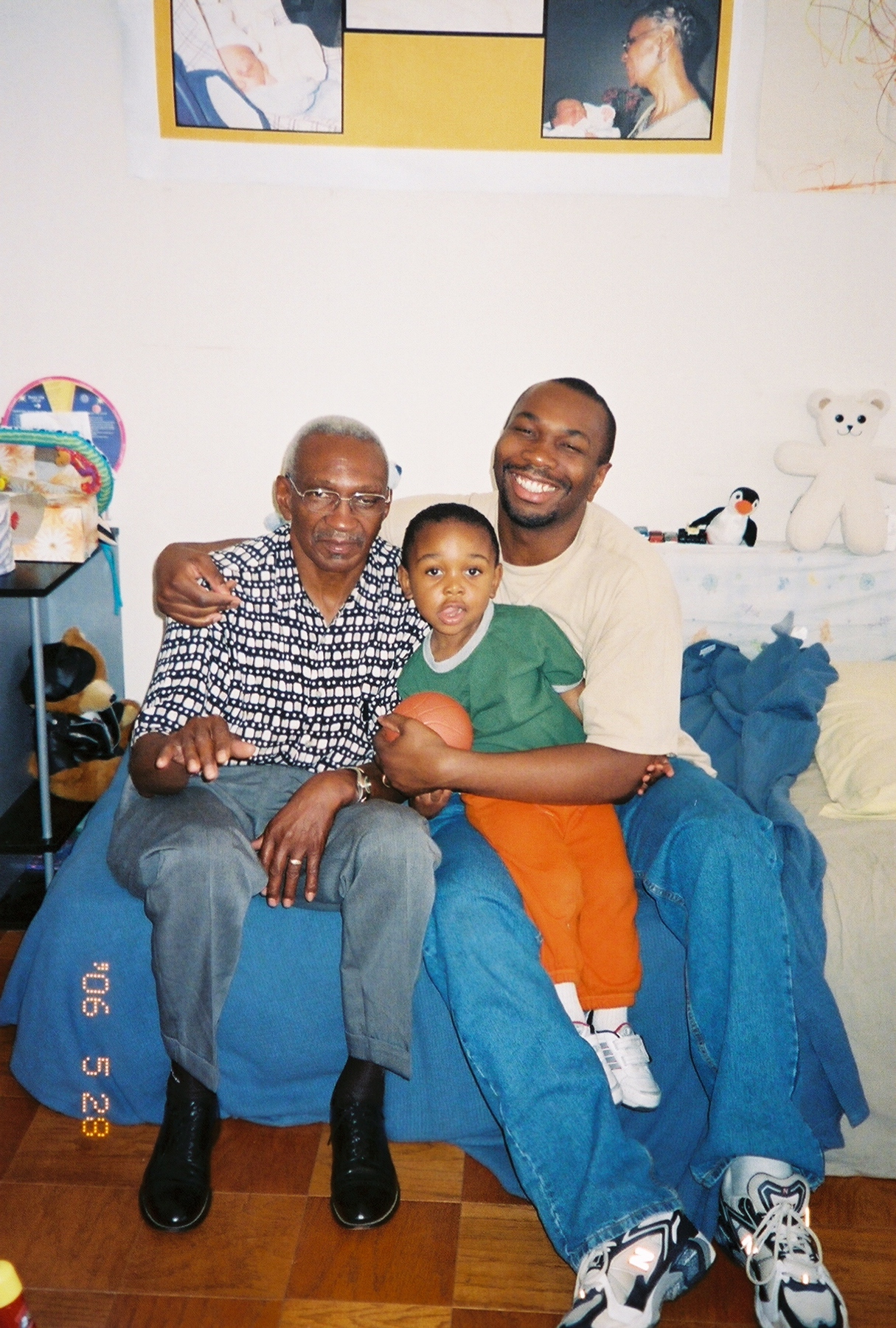
Three Generations, May 2006

around. A few months later, my father, unemployed and no longer enabled by his former bosses, finally left New York for the family home in Georgia at the invitation of one of his sisters. By the end of ’97, I heard that he had cleaned up his act and moved to Jacksonville. Throughout ’98 and into ’99, I began to get calls from Jimme about how he was finally sober, had found God, and was getting married, to another woman named Mary.

I thought long and hard about blowing him off. All my life, and certainly all of my older brother Darren’s, Jimme had been an evil drunk, verbally abusive and incapable of staying sober for more than three weeks at a time. But he had also been there for me growing up during my Humanities and Hebrew-Israelite years. He helped keep Darren and me from starving or walking around barefoot in ’82 and ’83. He kept the example of hard work in front of us even as the other parent figures in our lives went on dreaded welfare and laid around as if our lives were over. His money was the reason I was able to stay in school after five days of homelessness my sophomore year at Pitt.

So I called him, deciding to give him a second chance. That was February ’99, a two-hour conversation about how he managed to become a recovering alcoholic, a church-goer, and a married man. He admitted that he had made many mistakes, that he was an alcoholic, that he loved me and my brother. It was a conversation, a real conversation, an unbelievable change of relationship. After twenty-nine years and two months, I finally had a father that I really could call father.

That was eleven and a half years ago. I’m still amazed that I’m able to talk to my father as my father, and not as the person I used to have to drag out of bars on 241st Street or in Midtown Manhattan growing up. But most of all, I’m amazed how much I love him and care about him. Happy Birthday…Dad!

Crush #1 and Other Bedtime Stories

10 Saturday Jul 2010

Posted by decollins1969 in 1, Boy @ The Window, Eclectic, Jimme, Mount Vernon High School, Sports, Youth

≈ Leave a comment

Tags

616 East Lincoln Avenue, A.B. Davis Middle School, Bedtime Stories, Characters, Class of 1987, Classmates, Holmes ES, Humanities, Mount Vernon High School, Mount Vernon New York, Stories


Noah Sleeping, September 2009

For about the past year and a half, me and my wife have spent some of our time at the end of the day with our son Noah telling him bedtime stories. Actually, it’s been mostly me, since my wife doesn’t like making up stuff. At first, it was just about every night, with me telling Noah true stories about family, friends, former classmates and my school experiences.

I’d often put Noah in those stories, especially the ones I knew he’d laugh at. Like the science teacher who came in one day smelling like a skunk had sprayed him because a skunk actually did. Or the story about my second day of high school, where I had to fight a class hipster because he thought that I was a wimpy push-over.

With me injecting Noah into these stories — usually as the character Ben 10 turning into Big Chill or Humongousaur — I realized I had to embellish a bit, making some of my real-life encounters less like real-life. I told stories about my father where I changed almost all of the wording because the real stories involved more profanity and bigotry than a five or six-year-old should ever have to hear. I’d leave out parts of stories about how mean some of my classmates or teachers were just to make sure Noah was ready to go to sleep happy and without asking me a lot of questions about my past.

About six months ago, I started making up stories, about eighty-five percent fictional in nature. The names

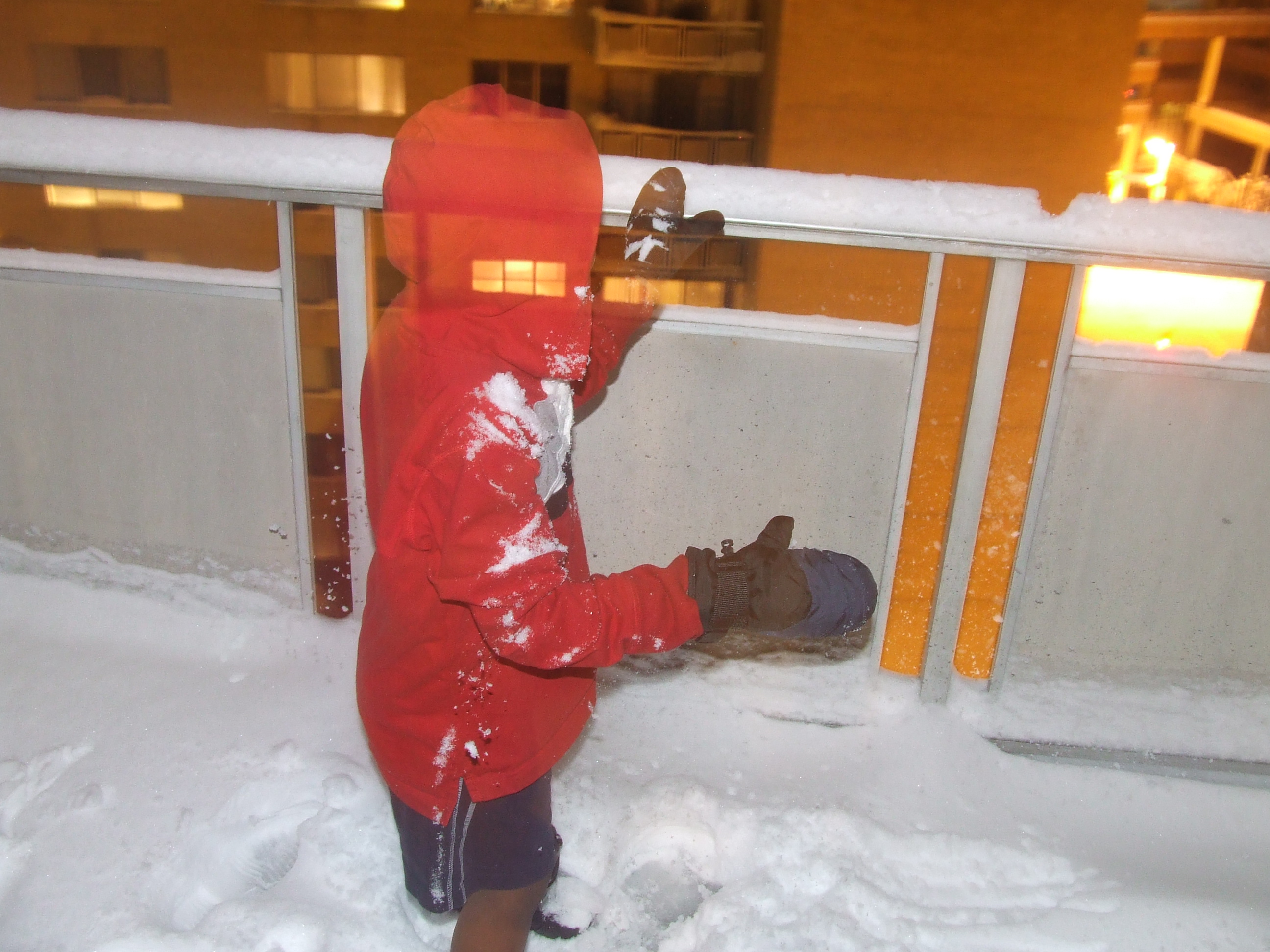
Noah in Snowaggedon (on balcony), February 2010

and places remained the same, but the incidences and their improbable outcomes didn’t. I figured out that Noah mostly enjoyed a few choice characters: a fictionalized ’80s version of my father, a singing, wise-cracking fictional classmate, a super-smart classmate who’d get a case of the “ums” and “uhs” under duress, a friend from my elementary school days who’d fart when under pressure, and an even more tomboyish version of my Crush #1. Noah has since asked for those characters in my stories over and over again.

He’s also asked a lot of questions about my real-life classmates, teachers and family. Like, “Did you really have a classmate who sings ‘Roxanne’ all the time?” Or “Did [your friend] really fart all the time?” “Are you still friends with [super-smart boy]?” So I pulled out the MVHS Class of ’87 yearbook that I had borrowed from a former classmate when revising drafts of Boy @ The Window to show Noah pictures of them so that he could see that these weren’t the larger-than-life, made-up characters I used in my bedtime stories. Not to mention using the power of Facebook to bring home that fact as well.

This past week, Noah’s asked a few more questions. “Do you still like [Crush #1] a lot?,” Noah asked me a couple of days ago. “I still like her, but not the way I liked her when I was twelve,” I said in response, kind of shocked that he asked me that question out of the blue. I then thought for a moment, “Maybe I should keep the twelve-year-old in me to myself until he’s older.”

Noah Salutes

Then I realized. I have to tell Noah these stories. At the very least, it’ll help him not make the same mistakes I made growing up. That way, he won’t have to spend most of his time growing up without good friends, without an eleven-year gap between kisses, with mostly stories that would make most six-year-olds cry. Or, at the least, sad. He can read all about it when he’s older and Boy @ The Window’s published.

Trip to the ‘Burgh

26 Wednesday Aug 2009

Posted by decollins1969 in 1, Academia, Boy @ The Window, culture, Eclectic, Jimme, Mount Vernon High School, Mount Vernon New York, My Father, New York City, Politics, Pop Culture, race, Youth

≈ Leave a comment

Tags

616, 616 East Lincoln Avenue, Amtrak, Leaving Home, NAACP, Pittsburgh, Racism, The Pennsylvanian, University of Pittsburgh, Yellow Cab


My years as a full-fledged adult now number twenty-two. On this day and date, I left 616, Humanities, MVHS, Mount Vernon public schools, Mount Vernon and NYC behind for the first time. Even though I’d call New York City and Grand Central Station “the third armpit of hell” for the next seven years, I had plenty of times during my undergraduate days in which I missed the sights and smells of New York, the constant buzz. Not to mention quality deli meats, good pizza, Clover Donuts, the noise of Subway cars and Metro-North trains. But from the moment I started getting ready, truly ready to go, I had already left these things behind.

It was the last Wednesday in August when I took my five suitcases, Army bag, and two boxes by cab from 616 to 241st. But not before a long and tearful good-bye with my mother, Eri, Sarai, and Maurice. Yiscoc didn’t wake up to say good-bye until I was practically out the door. My stepfather insisted on giving me an extra fifty dollars for my college journey. I thought for a second about turning it down, and decided against it. “This was the least he owed me,” I thought. I felt bad about leaving, especially for Eri, who was just a little more than three years old. Darren and I took my stuff downstairs to the Reliable Taxi cab at five in the morning, got to the Subway stop and met Jimme there. We quietly rode the train to Penn Station on West 34th, where I’d catch the 7:50 am Amtrak for Pittsburgh. Once it was time to catch the train, Darren and Jimme helped with getting all of my stuff on the train, most of which I half-realized I probably wouldn’t need. We hugged, and Jimme actually teared up. This was the second time in a row I’d seen him sober, and he seemed happy for me.

The train ride to Pittsburgh was much longer than I expected. My assumption was that since Philly and Pittsburgh were in the same state that the ride wouldn’t last more than a couple of hours. What I didn’t know was that once we pulled into the City of Brotherly Love that the engineers would have to uncouple the electric engine and connect a diesel one. What I didn’t know was that the trip across the state of Pennsylvania was a long and windy one, with hills and mountains, small towns and tunnels. What I didn’t know was that there would be a boring recording describing the construction of track through the Allegheny Mountains which led to the creation of Horseshoe Lake. I took two naps, listened to five tapes, and with all of that, still had an hour and a half to spare. I ended up talking with a young Catholic priest during that time about the nuances of Christian faith and how Christians often misapply their faith in secular situations.

We pulled in about thirty minutes late, just before 5 pm. I immediately found a phone book and called for a Yellow Cab. I waited, and waited, and waited, all while about six cabs came up and picked up other passengers from my train. I looked at the downtown skyline and thought, “It doesn’t look like a hick town so far.” Yet the cab drivers sure acted like it was. They refused to make eye contact with me, much less pick me up. After an hour, I called Yellow Cab again, this time threatening them with a lawsuit. “If I don’t see a cab real soon, I’m contacting the NAACP and filing a discrimination lawsuit!,” I yelled to the dispatcher over the phone. Within three minutes I got my taxi. I was already beginning to think that Pittsburgh wasn’t my best choice for pursuing higher education.

My first drive through the heart of Pittsburgh reminded me of what people had been saying for years about New York and how great it was. Once we passed through downtown, which took less time than driving through Mount Vernon, we went through these decidedly working-class neighborhoods and Black communities that looked at least they belonged in South Side Mount Vernon. Then we reached the Oakland section of the ’Burgh. School buildings, college dorms that looked like silos, shops and restaurants abounded. Just before we turned left off of Forbes Avenue, I saw it, the Cathedral of Learning, for the first time. I was starting to feel better about my decision.

The driver turned left again, off Atwood and onto Fifth Avenue, then a right onto Lothrop, where, of course, Lothrop Hall was. It was an eleven-story dirty uranium-brown building, where years of coke soot had built up. There were few students or staff around. I went through security, using my high school ID for the last time, and the guard gave me a temporary dorm pass that I could use until I got my Pitt ID. My dorm room was on the third floor. It overlooked a drab and empty yet clean courtyard. I was lucky, since there was a good chance I might’ve ended up with a roommate. The dorm rooms at Lothrop went to one student apiece. I was so exhausted from all of the emotions and stresses of the day. I grabbed some junk food from the vending machine in the lobby, called my mother to tell her I was fine, somehow found the Mets game on my portable radio, and fell asleep in my twin bed.

Despite all that had happened at 616, in Humanities, MVHS and in Mount Vernon, I was homesick the last third of the semester. Not homesick because I missed having my ex-stepfather say, “take that base out of ya voice before I cave ya chest in.” Not homesick because I missed spending my Friday evenings and Saturdays tracking down Jimme at some dive in the Bronx or in Manhattan. I think that I was homesick because I was still reeling from crush #2, which made me realize that I never really had a home in the first place.

It took me a bit longer — about a year or so — to realize that despite the ‘Burgh’s lack of almost anything I’d normally describe as city or city-suburban life, I could still make the place my home. At the very least, the University of Pittsburgh was relatively more diverse, urban, and exciting than compared to the rest of the area. That was the reason I was there, after all. Still, I gave myself the room necessary to criticize the university and the city when I saw fit. But I also took time to look around, to see that whatever else was or wasn’t going on, I was in charge of my life now, and safe from the slights, hurts and abuses of my past.

Strange Days

24 Wednesday Jun 2009

Posted by decollins1969 in 1, Boy @ The Window, Christianity, culture, Eclectic, Jimme, Marriage, Mount Vernon High School, Mount Vernon New York, Movies, music, race, Youth

≈ Leave a comment

Tags

616 East Lincoln Avenue, Black Male Identity, College Years, Crush #1, Humanities, Identity, Mount Venron HIgh School, Popularity, Salutatorian, Self-Reflection


Cover for the album Strange Days by The Doors, September 1967, scanned June 27, 2008. (Father McKenzie via Wikipedia). Qualifies as fair use because of low resolution of scanned album cover.

Being on campus at Princeton teaching for a few weeks and working with college-ready high school students sometimes takes me back into my past. It’s funny really, realizing that the “best and the brightest” were hardly the best and weren’t quite so bright, even at the time I went to school with them. That’s not to say that the students I’ve had or have now at Princeton or the classmates I graduated with didn’t or don’t have loads of potential. They did and do. It’s more about what can happen when teachers, administrators and parents fill our heads full with delusions of grandeur, with ideas of intellectual greatness based on signs of academic excellence. It’s what can happen when students spend more time trying to keep up with the image of high academic achievement that others have created for them rather than finding their own path, one that allows them to be themselves and to tap into their potential.

I know, I know, some students strive and thrive even with the pressures from their parents, the doting of teachers, and the turning-the-other-way of administrators. I could also be accused of playa hatin’, I suppose. After all, I was far from popular in my glory days of high school, and only found myself in the last two and a half years of college. But that’s just it. Even I had to come to grips with my family’s expectations — especially the lack of them — in high school and college. I needed to find myself in order to be all that I could be in college and in grad school. I needed to make a clean break from the doubters in my life — including of course, my teachers and administrators.

That’s the unfortunate truth I faced in my last two years at Mount Vernon High School. Especially when the class rankings came out a month into our senior year. Out of 545 potential graduates, I was ranked fourteenth. I was a little disappointed because I didn’t crack the top ten, mostly because I knew I needed scholarship money and a good financial aid package to help pay for college, wherever I went. I had already learned that my performance wasn’t good enough for my teachers in eleventh grade. They kept reminding me that I was doing nothing in comparison to the salutatorian in our class, an involved-in-everything Black male. I guess I could’ve argued that they should’ve been comparing me to our Class of ’87 valedictorian, but my teachers saw the second in our class as a much more well-rounded student. At the very least, I knew from the comparisons that the person I was supposed to be more like had a charming way with our teachers.

I saw this particular classmate as more of an enigma than many of the other ones I had done time with in Humanities. I genuinely felt both in awe of and disheartened by his presence in my life during the Humanities years. I thought it was amazing that he was able to do as much as he did. The high school band. The mock trial team. The school newspaper. Our yearbook. An appearance on Phil Donahue! At least he wasn’t a star basketball player too, especially in Mount Vernon.

Yet I saw the results of all of that involvement on his part, and not just in terms of how teachers saw me. As far as teachers were concerned, it was as if I was this classmate’s younger, underachieving brother. But I also saw how the young man occasionally worked his reputation to his advantage, cashing in on his built-up academic capital to give himself more time to work on assignments no one else got a second of overtime to do. I don’t think I ever wanted to be him or become close friends with him, though. Something about his need to be well-liked by our peers and teachers bothered me. So I was happy in more ways than one to see our salutatorian gallop into the sunset with his diploma, a law firm job in Manhattan, and his ticket to Harvard punched some twenty-two years ago.

Ralph Fiennes and Angela Bassett in Strange Days (1995), screen shot, November 12, 2009. (http://ugo.com via Fox Entertainment). Qualifies as fair use because of low resolution of screen shot, not meant for redistribution.

Something strange happened in the days after the final fight between my mother and ex-stepfather in June ’89 (see my “The Miracle of Divorce” post from earlier this month). It was a week after idiot Maurice had moved out for the last time. Me and my older brother Darren were on our way to my father Jimme’s for money and because Darren was in the process of moving out of 616 — God knows he needed to. Along the way, we bumped into Crush #1, which is a story unto itself, a good one that is. Ten minutes later we bumped into salutatorian off The Avenue and West First, still trekking toward Jimme’s. This surprise meeting trumped my Crush #1 conversation and made a lasting impression on my understanding of myself as a Black male. So much so that I had a long conversation with my late teacher Harold Meltzer about it years later.

When I bumped into the man en route to Jimme’s with Darren, he’d just gotten off work at his summer law firm job in the city, his third summer working there. He was wearing a hideous green-and-white-checkered dress shirt with dark green suspenders and even darker green slacks. Why hideous? Because on a hot and hazy day in late-June ’89, a day in which batting an eyelash required some degree of sweat, the guy was dressed like it was the middle of March. The color scheme didn’t blend at all with his dark chocolate skin, and his face was both greasy and sweaty from a long, hard day. But the biggest shock was his hair. It was conked — or fried as some folks say — ala Miles Davis or Malcolm Little before he became Malcolm X. This was the first thing I noticed, even before the Green Giant getup. Since I was already in a pissy mood, one only mildly moderated by my Crush #1 sighting and conversation, I didn’t outwardly react to it.

I realized as I stood there with Darren talking to my former classmate what had bothered me about him

Jolly Green Giant statue in Blue Earth, Minnesota, May 20, 2006. (Jonathunder via Wikipedia). Released into public domain via CC and & GFDL.

during all of our years together in Humanities. I had called him an “Oreo Cookie “—Black on the outside, White in the middle — in my head and under my breath on a few occasions during our Humanities years. Yet this sighting and conversation let me know that I was wrong. Sadly, I realized that our salutatorian didn’t have any identity at all. He made himself into whomever others wanted him to be. To his family, he was the mild-mannered and religiously faithful kid who just happened to be smart. To our teachers, he was super-intelligent, an overstretched overachiever whom teachers gave the benefit of the doubt if his assignment was late and he needed an extra day. To many of us, he was the polar opposite of our eventual valedictorian, a talented competitor who was far more worthy of our school’s number one status. I’m sure to a fair number of his Harvard classmates saw him as a marvel, either not “Black” enough or too much of a “credit to his race.”

The person I saw that day wasn’t the confident, take-on-the-world with a-smile-on-his-face person I’d seen in action for six years in Humanities. He was confident enough to attempt to act that way toward me, though. I got the story about how life at Harvard was good, that he was succeeding academically and that he’d found a way to fit in with his mostly White, six-figure and two-comma classmates. He also still intended to go to law school. And though his job at the law firm was difficult, he said that he enjoyed that also. My former classmate must’ve thought that he was talking to the uncultured twelve-year-old I once had been. His utter lack of details about classes, people, majors or professors let me know right away that life for his at America’s preeminent university was somewhere between rocky and a living hell.

My conversation with the person folks thought I should be much more like was a major revelation. It explained why it took until I was a sophomore in college to find my footing. We all had significant identity issues, exaggerated by our competitive conditioning as Humanities students. These weren’t typical teenage struggles over being cool or not. Especially when being cool meant being “Black” or “Italian” or “anti-intellectual” or a “brainiac,” not just “cool” in general. You could say that our grades and ranks—or shunning them as the case might’ve been—were as much a part of our individual identities as being affluent or Jewish or Black. Our salutatorian may well have been an extreme example of this, but he was hardly alone. Everyone in Humanities, even the “cool” cliques within had their share of identity issues to reconcile or struggle with.

My own identity issues were many and varied. In my case, though, I’d been working on reconciling mine since the middle of seventh grade. I realized that the battle I’d been waging for so long came out of my identity crisis, one that started as a spiritual disconnect between being a Hebrew-Israelite and watching my stepfather break every rule in the Talmud while attempting to break me and my mother. That battle didn’t even begin to subside until I decided to embrace myself for who I was, good, bad and ugly. Once I took that proactive step, shooting for the best person I could be and small miracles like real friendships were only a matter of time. It’s a lesson that I hope the high-potential students I’ve taught the past couple of years learn, and learn well.

Summer Camp

20 Saturday Jun 2009

Posted by decollins1969 in 1, Boy @ The Window, culture, Eclectic, eclectic music, Jimme, Mount Vernon New York, music, Politics, Pop Culture, race, Youth

≈ Leave a comment

Tags

Darren, Development Disabilities, Karen Holtslag, Mental Retardation, Psychological Abuse, Psychology, Summer Camp, The Clear View School


I’ve had more than a few friends ask me, “Are you sure your doctorate’s not in psychology?” over the years. I usually laughed it off, saying that well-heeled historians are ones that can look at the human condition through a variety of disciplines. But that’s hardly the whole truth. I have a lifetime of experiences that have enabled me to play the role of pop psychologist and psychiatrist, mostly because of Darren and issues related to him.

For example, if this were any summer between ‘77 and ‘83, these would’ve been years I could’ve gone with my older brother to his summer day camps at The Clear View School in Dobbs Ferry, upper Westchester County. For four summers I did go with Darren to his private school for the mentally retarded and developmentally disabled, between ‘77 and ‘80. It was a strange experience, but I learned a lot about diversity, the human psyche, and perceptions of intelligence. I hardly realized how much until much later, in my years in the workforce and in grad school.

The first two summers at Clear View were a blur for me. I remember a few things. Like going to see Star Wars for the first time. Or going swimming, learning how to ride a bike, bowling, and lots of other fun activities. In that sense, Clear View was a fun place to be. I picked up a bunch of things there that I would’ve never learned at 616.

It wasn’t until my third summer there, the summer of ‘79, that I noticed the distinct differences between myself and Darren’s friends and classmates. Not to mention between Darren and them. It came as a bit of a shock to realize that Darren simply didn’t belong at a school for the mentally retarded — he was acting out at times in order to get whatever he wanted. As for me, I seldom had any lengthy conversations with the other kids. Not for lack of trying, though. It was the summer between fourth and fifth grade for me, and I’d already become used to talking politics and pop culture with a few kids my age.

I ended up talking mostly with staff, summer staff or regular staff. It didn’t matter. Even as socially awkward some of the teachers were, it was far better than forcing a conversation with a kid who might’ve had the equivalent abilities of Noah at two and a half or three years old. I had nothing against the kids at Clear View. They obviously suffered from Down’s syndrome, autism, bipolar disorder, severe brain injuries and so on. But at nine years old, I recognized the differences, and they were in stark contrast to anything I’d ever seen from Darren. I knew by the middle of that summer that my older brother wasn’t mentally retarded. I also knew, deep down, that staying at Clear View would do permanent damage to his psyche and destroy his best chances at living a normal life.

A visit to Mrs. Holtslag’s (Darren’s psychiatrist’s) Hastings-on-the-Hudson home in ’79, in which the front sat on a hill, the back on stilts, all overlooking a pale sandy-rock beach and the Hudson River below, was further evidence of both his relative normal-ness and of what bothered me about Clear View. This was my first experience of visiting anyone from an affluent or upper-middle class background, and certainly anyone White. A bunch of kids were there, including Darren. My older brother’s well-practiced autistic behavior — similar to at least three of his friends — was what bothered me about the visit. That, and being in a house I’d only seen before in a Hollywood movie. Wow, I remember thinking. Psychiatrists must make a ton of money.

I learned about other things affluent and White through my summers at Clear View in ‘79 and ‘80. That Darren’s initial diagnosis had changed, from “mildly mentally retarded” to “emotional mentally retarded.” That Clear View’s tuition was $33,000 a year – about $55,000 in today’s dollars. That New York State was paying for all of the tuition. That our group of healthy-eating White counselors thought that a cottage cheese and cucumber sandwich on whole wheat was a normal lunch. And that they were moving in ‘81 to a lush private campus in Briarcliff Manor.

I did get something out of that summer. Another layer of eclectic-ness to add to my already eclectic music tastes. Donna Summer, meet Kool & The Gang. Billy Joel, meet Barbra Streisand. I did get to see Star Wars: The Empire Strikes Back. But I also saw affluent White parents who’d occasionally visit, sometimes with their “normal” kids in tow. It made me realize that despite all of the hardships of life, many of these mentally retarded and developmental disabled kids had it better financially than anything I would see for more than twenty years. That’s hardly to say that this wasn’t a hardship, either for the parents or the kids in question. It was something I noticed, an ironic twist between the psychology of race and class and the psychiatry involved in working with both.

I provoked my mother into at least thinking about getting Darren out of Clear View after my last summer there in ‘80, six years after my father Jimme had him placed there because of Darren’s shyness. Darren at twelve had been institutionalized long enough to become more comfortable around the mentally retarded than in mainstream settings. He threw a temper-tantrum, kicking and screaming on the floor of our neighborhood laundromat when my mother suggested that she should send him to our local public school. My mother gave up, saying that “Darren only listens to White people,” and Darren stayed at Clear View for another seven years. This was typical Mom, taking the path of least resistance when the best option was often the more difficult one. It’s sad, but I still haven’t given up, on Darren or my mother.

In the Closet, On the Down Low

01 Monday Jun 2009

Posted by decollins1969 in 1, Boy @ The Window, Christianity, culture, Eclectic, Jimme, Mount Vernon High School, Mount Vernon New York, My Father, Pittsburgh, Politics, Pop Culture, race, Religion, Youth

≈ 3 Comments

Tags

Asexuality, Black Masculinity, Covenant Church of Pittsburgh, Evangelical Christianity, F-Bomb, Faggots, Gay Pride Month, Heterosexism, Heterosexuality, Hypermasculinity, LGBT rights, Masculinity, Self-Reflection, Uncomfortability


The rainbow flag waving in the wind at San Francisco's Castro District, San Francisco, CA, August 5, 2010. (Benson Kua via Wikipedia). Released to public domain via CC-SA-2.0.

The rainbow flag waving in the wind at San Francisco’s Castro District, San Francisco, CA, August 5, 2010. (Benson Kua via Wikipedia). Released to public domain via CC-SA-2.0.

It’s Gay Pride Month, or LGBT Month, or GLBT Month, I guess, depending on one’s perspective. I have nothing directly to contribute, being the semi-well-adjusted heterosexual I am. But I do have something to say about what it means to me to have moved from a world where homophobia and heterosexism was a part of everyday speech (and sometimes action) to a place where it’s actually easy for me to embrace others of a different sexual orientation. Of course, I’m not talking about the world at large. I’m talking about 616 and the folks I knew growing up in Mount Vernon.

This isn’t easy for me to discuss. It means revealing more about myself and some painful memories growing up than even I’m used to doing. Still, it’s important for me and for others to understand that uncomfortable as folks may be about the reality that some people aren’t strictly male, female or heterosexual, these so-called others exist, and are a part of our family, among our co-workers, and deserve our acceptance, love, friendship and support. Or at least, our tolerance.

This story starts with an exchange I had with my father Jimme a couple of weeks before the start of my senior year in high school, August ’86. In a summer when my sexuality was no longer a question — at least to me — my father still had his doubts. I’d hardly seen Jimme most of the summer, only coming over occasionally to see how he was doing or to bum a few bucks off of him. I saved enough money from my job to cover the cost of my three AP classes — $159 to cover the $53 fee for each of the three classes. The College Board and MVHS didn’t grant fee waivers for these courses. Even though I had put that money in my mother’s checking account, I knew that with our money issues my savings were gone. So I found Jimme one Saturday morning near the end of August hanging out on the street corner and having drunk his fill.

His mood was especially foul that day, like his body odor. He refused to give me any money. “I don’ give my money to no faggats!” Jimme yelled at me as he came walking down his block toward me. He’d seen me come out of the front yard of the house he lived in. I wasn’t in the mood for his crap. “I’m not a faggot and I’m not gay,” I yelled back. When he got closer, I could see that he’d been out too long already. Jimme’s clothes were a mess, and his face was in a twisted rage. He grabbed me by my arm.

“Did you get yo’ dict wet?,” he asked as usual.

“Even if I did, I wouldn’t tell you,” I said.

“YOU’RE A FAGGAT,” he yelled again.

I was so pissed with him that I said, “Forget it. I don’t want your money. I’ll find a job somewhere.”

That was when the conversation got ugly.

“Ain’t no one gonna giv’ a faggat like you no job.”

“You’re a drunk and you’ve had a job for years.”

“Watch who you talkin’ to bo’. I da boss of the bosses. No one tell me what to do.”

“Why should I? I’m a faggot, right? Faggots don’t have to listen to an alcoholic like you”

“I yo’ father, an’ if you want my money, you do what I say.”

“I don’t have to listen to you or anybody else.”

“Come here bo’!”

At that point, I came over and Jimme grabbed my arm. Then he tried to punch me in the face. I caught his right arm, twisted it away from me and toward him, and then pushed him away. The push sent him to the ground, tipsy as he was.

“I can’ believe you hit yo’ dad”

“I didn’t hit you, I pushed you. Besides, you tried to hit me first. You’re not acting like much of a dad right now, anyway.”

I started to walk away, only to be hit in the head with folded up money, about $200 in all. “Take it all, faggat. I don’ want you aroun’ here no more,” he said.

This time I grabbed him and stuffed half the money in his pocket.

“Don’t you still have to eat, pay rent, get some more to drink?”

I kept all of the rest because I figured I earned it that day. Darren, par for the course, just stood around and watched.

That was a scary conversation and confrontation for me. It meant seeing myself for the first time as someone not only defending myself, but defending unnamed others. I could’ve easily said that I love women, and only women, that there was something wrong with gays and being gay. But I didn’t. I guess because at least gays hadn’t chased me down the street, calling me a “faggat” in the process.

I was also ambivalent, though. My mother, for all of her quietness about my lack of dating and friends in the five years before I went off to college, would make weird statements basically daring me to say that I was gay just so she could somehow un-gay me if I was. For her, the mixed signals she received from me started when I was seven. We had just moved to 616, and after a summer camp at Darren’s Clearview School, we went outside on 616’s grounds for the first time, in August ’77. The kids at 616 and 630 harrassed us, chased us around while throwing rocks at us. Scared, we hid behind the big, wooden, dark brown front door and huddled, hoping that the kids wouldn’t find us.

Instead, a couple of young Black Turks saw us, took us to my mother and stepfather, and declared that they saw us doing “the dukey.” I had no idea what they were talking about. All I knew was that my mother and stepfather proceeded to whip us as if we’d gone to the grocery store and stolen $100 worth of candy and soda. Besides “dukey,” the only other new word I picked up that day was “faggot.” That, and an incident one year earlier, one in which an older boy attempted to force me to suck his penis, was about all I knew about how others were “different” and how others saw difference until high school. Even then, I understood at some level the difference between someone attempting to force you to into a sexual act and someone simply being themselves. It didn’t necessarily make me feel better, though.

There were others who dropped the F-bomb on me over the years. Most of them were Black and Afro-Caribbean guys whom I’d shown up in the classroom or in gym class. All of it made me feel as if there were something wrong with me, like a target had been painted on my forehead that said this fool is so different that we can see in him the worst of our homophobic fears.

Even when I started to date, and even after I started having sex, I would occassionally run into women and men who assumed I was gay. Or at least, “asexual,” “sober,” “boring.” It was partly due to my overintellectualizing sex as a distraction, combined with a well-developed habit of protecting myself emotionally, that led to others making these cosmic-leap assumptions.

By the time I had reached my junior year at Pitt, I knew full well that not only I wasn’t gay, but that I was comfortable being around gays, lesbians, even transgender folk. And that made me uncomfortable. I was also a Christian, and between my mother, televangelists like Frederick K.C. Price, Kenneth Copeland, Jimmy Swaggert, Oral Roberts, as well as some of my friends, I found it difficult to reconcile their interpretations of scripture with my own natural comfortability with people of different sexual orientations. Even in grad school, if someone asked me — I certainly didn’t volunteer this — I’d trip over my own words quoting scripture while saying that it’s none of my business what other people do in their private lives.

It took an interview I did with an office at the University of Maryland in ’98 to finally see what I was doing. They asked me flat out if I had a problem advising LGBT students. I actually didn’t, but I also didn’t want to come off as gay myself. So I kind of tripped all over the place while answering the question. Not only did I not get the job. The phone clicked about five seconds after I gave my answer.

I realized that I was still being heterosexist myself, that I had yet to confront the issues I had around sexuality growing up. I made a few decisions around this issue after that interview. One was to stop spouting out-of-context scriptural rhetoric about homosexuality, and to stop attending churches where gays and lesbian were blamed for high crime rates and poverty, like the church I used to attend in Wilkinsburg back in the ’90s. I realized that there was a higher law, one that says “judge not, lest ye be judged,” and “do unto others…” Beyond that, it’s okay to say “I don’t know” when it comes to Christianity and to say “I’m comfortable” when I’m at work or in conversation with someone who happens to be gay or lesbian.

For those wholly uncomfortable with what they’ve been reading, let me say this. Uncomfortability with someone different is hardly unusual. But your uncomfortability shouldn’t mean that someone else’s human and civil rights should be trampled in the process. On the spiritual front, we aren’t supposed to pass judgment on others because we’re uncomfortable with who they are or even how they live as Christians. What do we know, anyway? Otherwise, we’re no different from the White bigots who rapped themselves around a Confederate flag while killing, maiming and intimidating Blacks and others of color out of their rights. Oh well! I guess I’m out of the closet now myself.

← Older posts
Newer posts →

Boy @ The Window: A Memoir

Boy @ The Window: A Memoir

Places to Buy/Download Boy @ The Window

There's a few ways in which you can read excerpts of, borrow and/or purchase and download Boy @ The Window. There's the trade paperback edition of Boy @ The Window, available for purchase via Amazon.com at http://www.amazon.com/Boy-Window-Donald-Earl-Collins/dp/0989256138/

There's also a Kindle edition on Amazon.com. The enhanced edition can be read only with Kindle Fire, an iPad or a full-color tablet. The links to the enhanced edition through Apple's iBookstore and the Barnes & Noble NOOK edition are below. The link to the Amazon Kindle version is also immediately below:

scr2555-proj697-a-kindle-logo-rgb-lg

Boy @ The Window on Amazon.com: http://www.amazon.com/Boy-The-Window-Memoir-ebook/dp/B00CD95FBU/

iBookstore-logo-300x100

Boy @ The Window on Apple's iBookstore: https://itunes.apple.com/us/book/boy-the-window/id643768275?ls=1

Barnes & Noble (bn.com) logo, June 26, 2013. (http://www.logotypes101.com).

Boy @ The Window on Barnes & Noble: http://www.barnesandnoble.com/w/boy-the-window-donald-earl-collins/1115182183?ean=2940016741567

You can also add, read and review Boy @ The Window on Goodreads.com. Just click on the button below:

Boy @ The Window

Twitter Updates

Tweets by decollins1969
  • RSS - Posts
  • RSS - Comments

Archives

  • June 2025
  • April 2023
  • September 2022
  • August 2022
  • July 2022
  • June 2022
  • May 2022
  • April 2022
  • March 2022
  • January 2022
  • December 2021
  • November 2021
  • October 2021
  • September 2021
  • August 2021
  • July 2021
  • June 2021
  • April 2021
  • March 2021
  • February 2021
  • January 2021
  • December 2020
  • November 2020
  • October 2020
  • September 2020
  • August 2020
  • July 2020
  • May 2020
  • April 2020
  • March 2020
  • January 2020
  • December 2019
  • November 2019
  • August 2019
  • July 2019
  • June 2019
  • May 2019
  • April 2019
  • March 2019
  • February 2019
  • January 2019
  • December 2018
  • November 2018
  • October 2018
  • September 2018
  • August 2018
  • July 2018
  • June 2018
  • May 2018
  • March 2018
  • February 2018
  • January 2018
  • December 2017
  • November 2017
  • October 2017
  • September 2017
  • August 2017
  • July 2017
  • June 2017
  • May 2017
  • April 2017
  • March 2017
  • February 2017
  • January 2017
  • December 2016
  • November 2016
  • October 2016
  • September 2016
  • August 2016
  • July 2016
  • June 2016
  • May 2016
  • April 2016
  • March 2016
  • February 2016
  • January 2016
  • December 2015
  • November 2015
  • October 2015
  • September 2015
  • August 2015
  • July 2015
  • June 2015
  • May 2015
  • April 2015
  • March 2015
  • February 2015
  • January 2015
  • December 2014
  • November 2014
  • October 2014
  • September 2014
  • August 2014
  • July 2014
  • June 2014
  • May 2014
  • April 2014
  • March 2014
  • February 2014
  • January 2014
  • December 2013
  • November 2013
  • October 2013
  • September 2013
  • August 2013
  • July 2013
  • June 2013
  • May 2013
  • April 2013
  • March 2013
  • February 2013
  • January 2013
  • December 2012
  • November 2012
  • October 2012
  • September 2012
  • August 2012
  • July 2012
  • June 2012
  • May 2012
  • April 2012
  • March 2012
  • February 2012
  • January 2012
  • December 2011
  • November 2011
  • October 2011
  • September 2011
  • August 2011
  • July 2011
  • June 2011
  • May 2011
  • April 2011
  • March 2011
  • February 2011
  • January 2011
  • December 2010
  • November 2010
  • October 2010
  • September 2010
  • August 2010
  • July 2010
  • June 2010
  • May 2010
  • April 2010
  • March 2010
  • February 2010
  • January 2010
  • December 2009
  • November 2009
  • October 2009
  • September 2009
  • August 2009
  • July 2009
  • June 2009
  • May 2009
  • April 2009
  • March 2009
  • February 2009
  • January 2009
  • December 2008
  • November 2008
  • October 2008
  • September 2008
  • August 2008
  • July 2008
  • June 2008
  • May 2008
  • April 2008
  • March 2008
  • February 2008
  • January 2008
  • December 2007
  • November 2007
  • October 2007
  • September 2007
  • August 2007
  • July 2007
  • June 2007

Recent Comments

MaryPena's avatarMaryPena on My Day of Atonement/Bitter Hat…
decollins1969's avatardecollins1969 on No Good Teaching Deed Goes…
Mary Rose O’Connell's avatarMary Rose O’Connell on No Good Teaching Deed Goes…

NetworkedBlogs on Facebook

NetworkedBlogs
Blog:
Notes From a Boy @ The Window
Topics:
My Life, Culture & Education, Politics & Goofyness
 
Follow my blog

616 616 East Lincoln Avenue A.B. Davis Middle School Abuse Academia Academy for Educational Development AED Afrocentricity American Narcissism Authenticity Bigotry Blackness Boy @ The Window Carnegie Mellon University Child Abuse Class of 1987 CMU Coping Strategies Crush #1 Crush #2 Death Disillusionment Diversity Domestic Violence Economic Inequality Education Family Friendship Friendships Graduate School Hebrew-Israelites High-Stakes Testing Higher Education History Homelessness Humanities Humanities Program Hypocrisy Internalized Racism Jealousy Joe Trotter Joe William Trotter Jr. K-12 Education Love Manhood Maurice Eugene Washington Maurice Washington Misogyny Mother-Son Relationship Mount Vernon High School Mount Vernon New York Mount Vernon public schools Multiculturalism MVHS Narcissism NFL Pitt Pittsburgh Politics of Education Poverty President Barack Obama Race Racial Stereotypes Racism Relationships Self-Awareness Self-Discovery Self-Reflection Sexism Social Justice Teaching and Learning University of Pittsburgh Violence Whiteness Writing

Top Rated

Blog at WordPress.com.

  • Subscribe Subscribed
    • Notes from a Boy @ The Window
    • Join 103 other subscribers
    • Already have a WordPress.com account? Log in now.
    • Notes from a Boy @ The Window
    • Subscribe Subscribed
    • Sign up
    • Log in
    • Report this content
    • View site in Reader
    • Manage subscriptions
    • Collapse this bar
 

Loading Comments...