• About Me
  • Other Writings
  • Interview Clips
  • All About Me: American Racism, American Narcissism, and the Conversation America Can’t Have
  • Video Clips
  • Boy @ The Window Pictures
  • Boy @ The Window Theme Music

Notes from a Boy @ The Window

~

Notes from a Boy @ The Window

Category Archives: High Rise Buildings

There’s Know Place Like Home…

29 Friday Aug 2014

Posted by decollins1969 in 1, Academia, Boy @ The Window, Carnegie Mellon University, Cleaning, culture, Eclectic, High Rise Buildings, Jimme, Mount Vernon New York, My Father, New York City, Pop Culture, race, Upper East Side, Upper West Side, Work, Youth

≈ Leave a comment

Tags

241st Street Subway, East Side, Father-Son Relationships, Gramercy Park, Home, Levi Brothers, Manhattan, Metro-North, Sense of Direction, Street Knowledge, Subway, The Bronx, Wakefield, West Side


Dorothy's heel-clicking in screen shot from The Wizard of Oz (1939), August 29, 2014. (http://vivandlarry.com). Qualifies as fair use under US copyright laws - low resolution and relevance to subject matter.

Dorothy’s heel-clicking in screen shot from The Wizard of Oz (1939), August 29, 2014. (http://vivandlarry.com). Qualifies as fair use under US copyright laws – low resolution and relevance to subject matter.

Yes, the title’s a deliberate play on words. In no small part because of Facebook and Boy @ The Window, I am reminded every day of where I grew up, Mount Vernon, New York. But all too frequently, those who think they know me either assume that Mount Vernon’s so far from New York City that I seldom spent time there. Or, more recently, some have assumed that my experience of The Big Apple is a recent phenomenon, as if I only started spending time in the five boroughs when I hit my mid-thirties.

Neither is true, of course. In many ways, I’m as much of a child of The Bronx and Manhattan as I am of Mount Vernon. I spent countless hours catching the 2, 3, 5 and 6 trains between 241st, Dyre Avenue, 180th, Pelham Parkway, 149th, 110th, 125th, 72nd, 86th and so many other stops. I used to know where to get the best brownies in the area, in Wakefield, at a bakery near some taxi stands and between the 238th and 241st Street stops. I could tell you which bars my father Jimme frequented, which bars he didn’t, what pizza shops had slices to die for, and what places to avoid near Times Square. I’d been to Mets games, Ice Capades, the Bronx Zoo, a Puerto Rican Day and a Pulaski Day parade, concerts at Van Cortlandt Park, even MOMA before I graduated high school.

One of the reasons I could do all of this by the time I was fifteen was because of all the times Jimme had taken me and Darren down to the Bronx and Manhattan. Mostly to watch him pick up his paycheck from the Levi brothers at their cleaners on 20 West 64th or on East 59th. But between ’82 and ’85, I learned where nearly all of my father’s watering holes were, and on the most desperate of weekends, could track him to one of them in order to get money for myself and to help out my Mom at 616. While my classmates would occasionally take the Metro-North into the city to take in a Broadway play or go to a Knicks game, I was learning about the city in all of its varying inequalities and nuances by looking for and working for my father.
Screen shot 2014-08-29 at 6.28.50 AM

Fast-forward to the end of August ’93, just a few days before I began the Carnegie Mellon University phase of my grad school and doctoral journey. I had been short on money that whole summer, unemployed for six weeks after transferring from Pitt, working as an “intern” for six dollars and hour, and nearly $600 behind on rent at one point in late June. I’d survived the eviction notice and a summer in which I learned who my truest, closest friends were. I took a few days from my personal drama to visit my Mom and my siblings at 616, and in the process, decided to track down my father for a few extra dollars, as well as to see him for the first time in over a year. It had been that long because Jimme had accused me of faking my master’s degree when I lasted visited him.

Central Park, looking out toward Midtown's West Side, New York, NY, August 5, 2014. (Donald Earl Collins).

Central Park, looking out toward Midtown’s West Side, New York, NY, August 5, 2014. (Donald Earl Collins).

But I wasn’t fifteen anymore. Instead of a long walk and the Subway, I took the Metro-North down from Pelham to Grand Central, took the S (Shuttle) over to Times Square, and the 1 train to 66th, and walked over to the Levi’s cleaners on West 64th. Only to find out Jimme wasn’t in that day. I then remembered that the other Levi brother had a dry cleaner on East 59th. I walked the ten blocks over there and found the other Levi brother in the midst of arguing with clients and barking orders to his Latino and Afro-Caribbean underlings. My father was doing a cleaning job for him at some high-rises down near Gramercy Park.

I rode the 4 train down to 23rd Street, got my east-west bearings, and walked toward a set of high-rises near FDR Drive. Though I’d forgotten the address, I knew somehow that Jimme would be in the most expensive-looking high-rise or set of high-rises in the bunch. I found a guard, who sent me to the floor where Jimme and his co-worker John were working.

As soon as Jimme saw me come off the elevator, he said, “Bo’ watcha doin’ up here? How the hell yo’ find me?”

“You’re not the only one who knows The City, you know” I said.

It’s no wonder I feel a bit insulted when people either tell me I’m from upstate New York or that I’m not a New Yorker. I know the city better than at least a third of the people who live and work there every day.
Poverty, Violence and PTSD – But What About Racism?

07 Monday Jul 2014

Posted by decollins1969 in 1, Boy @ The Window, culture, Eclectic, High Rise Buildings, Jimme, Marriage, Mount Vernon New York, My Father, Politics, Pop Culture, race, Work, Youth

≈ Leave a comment

Tags

616 East Lincoln Avenue, Chicago, Child Abuse, Community Violence, Culture of Poverty, Culture of Violence, Domestic Violence, Gun Violence, July 4th, July 4th Weekend, Mainstream Media, Mental Health, Mental Illness, Post-Traumatic Stress Disorder, Poverty, PTSD, Public Health, Shooting Deaths, Soft Bigotry, Structural Racism, Uncle Sam


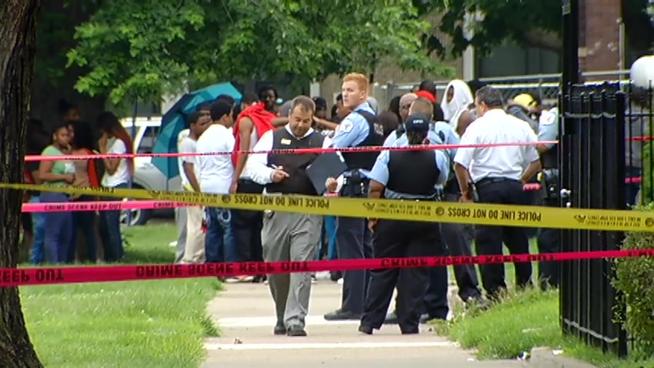
Chicago Police fatally shot a 16-year-old boy in the city’s Gresham neighborhood Saturday night and distraught family members are questioning the incident, July 6, 2014. (http://nbcchicago.com).

Chicago Police fatally shot a 16-year-old boy in the city’s Gresham neighborhood Saturday night and distraught family members are questioning the incident, July 6, 2014. (http://nbcchicago.com).

Over the past two weeks, thanks to Chris Hayes’ reporting on the state of Chicago for MSNBC, not to mention a horrific July 4th weekend, Mayor Rahm Emanuel’s lie of declining violent crime in the metropolis has been thoroughly exposed. In the past eighty-four hours, dozens of shootings in Chicago injured at least sixty people, with between nine and eleven killed. Six of these shootings involved the Chicago PD, as they killed two teenagers over the weekend. But if we leave it to the mainstream media and the moralist Black elite to explain, the Blacks on Chicago’s South Side are just immersed in a “culture of violence.” Black youth simply live careless, nihilistic lives, that “gang, drug, [and] gun violence” is the root of the problem

For those White, bright, and bi-racially White, though, there’s the knee-jerk reaction of media and caring adults that comes with it. For mass shooters apparently with much better aim than folks in Chicago, like Elliot Rodger, Adam Lanza, James Holmes, Wade Michael Page, Eric Harris and Dylan Klebold, mental health and mental illness, along with gun control, is the mainstream media’s topic of the day. Even their explicit racism and misogyny can become the media’s evidence for their mental illness. White and Black moral leaders don’t then speak of cultural deficiencies or of an enjoyment of crime and violence as reasons for their shootings.

It’s terrible that we afford one group of young men every benefit of the doubt because they were/are affluent or White, and the deny humanity of another because they were/are poor and Black or Brown. Yet recent sociological and psychological studies indicate what anyone who has lived in poverty and with violence has at least sensed throughout their lives. That many (if not most) growing up in these conditions experience post-traumatic stress disorder (PTSD), leading to more poverty and violence in adulthood.

I know this better than most. Below is a short sample of the violence I witnessed or experienced from birth through adulthood:

September ’70 – my father, drunk and jealous, attempted to attack my mother with a knife. My Mom with me and my brother Darren in tow, picked up a heavy quartz crystal ashtray and threw it at my father as he charged her in the kitchen. He was apparently struck in the head and knocked unconscious. The ashtray had detached the retina in his left eye, which he never had repaired. Nine years later, my father had to have his left eye removed. I don’t remember this attack or my Mom defending herself — I was all of ten months old. I do remember my father’s eye being removed, and the headache and vertigo he had prior to the surgery in the summer of ’79 The research indicates, though, that there would have been a psychological impact on me and my nearly three-year-old brother nevertheless, and not a good one at that.

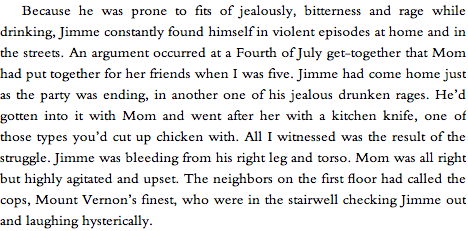
July ’75 –  from Boy @ The Window

Screen shot 2014-07-07 at 1.08.28 PM

December ’76 – when my father stomped in a brand-new glass coffee table and had to go to the hospital with several serious bloody cuts in his legs.

April ’77 – when my Uncle Sam clotheslined my father after his months of psychological and abuse toward my Mom had landed her in Mount Vernon Hospital with kidney problems.

April ’82, May ’82, July-August ’82 – my then stepfather beating me up in a Karate studio in front of a group of men because I refused to call him “Dad,” beating up my Mom for not “lovin’ him,” and beating me up for the first six weeks of my summer between seventh and eighth grade for me defending my Mom.

January ’86 – the last time my stepfather actually laid a fist on me, damaging or chipping three of my front teeth and busting my lip in the process.

June ’89 – the last fight between my Mom and my stepfather, where the same crystal ashtray my Mom used in ’70 easily could’ve fractured her jaw and left cheekbone. Thankfully, my then stepfather had terrible aim.

If it were just a matter of domestic violence and child abuse for me alone, that would be tragic, but not necessarily relevant. The violence of 616 East Lincoln Avenue, sadly, wasn’t contained to A32. Domestic violence was the way of the A-building at 616, starting with our adjacent next-door neighbors. In the two-bedroom department immediately below us, the husband and wife had a violent, alcoholic relationship, so bad that it was a rare weekend in the years between ’77 and ’87 where a plate or wine glass didn’t break or the police weren’t called. Their son once pointed a gun at me on my walk up the front steps of 616 when I was a senior in high school and claimed he’d secretly pointed a gun at me in the past. Muggings and robberies, including the four that I experienced, were as common as the common cold

At the near-door apartment building, 630 East Lincoln, the drug trade had been alive and well years before the arrival of crack cocaine. Fights involving knives and baseball bats were normal, often involved a crowd of kids as spectators. Sometimes these fights would spill onto the front lawn of 616’s A-building, where I could witness it first-hand.

That violence was a frequent companion in my life wasn’t surprising. I never lived anywhere growing up where the majority of the people around me weren’t welfare-poor, working-poor or working-class Blacks, where the heating oil came in time for winter, and where maintaining mental health was a topic of conversation. To act as if employment practices, education policy, public health access, police neglect or brutality or housing policies had nothing to do with the sheer concentration of poverty and violence around me would be at the least naive. Fundamentally, it was the benign neglect in the chain between individual racial assumptions, the soft bigotry of mainstream media, and the hard concrete of structural racism in play.

What was my constant companion growing up in Mount Vernon, New York has remained the story of poverty, race and violence in Chicago’s South Side for a century. Don’t feel sorry, for me or for all of those shot up in Chicago this past July 4th weekend. Do something, say something, or don’t. But feeling sorrow without saying or doing something about shouldn’t be an option.

When Nightmares Go Nuclear

03 Saturday May 2014

Posted by decollins1969 in 1, Academia, Boy @ The Window, Christianity, culture, earth, wind & fire, Eclectic, Hebrew-Israelite, High Rise Buildings, Mount Vernon New York, Movies, music, New York City, Pittsburgh, Politics, Pop Culture, Religion, Youth

≈ Leave a comment

Tags

"99 Luftballons" (1983), Dreams, Ebony Pictorial History of Black America (1974), Lerone Bennett, Mrs. O'Daniel, Nena, Nightmares, Nuclear Annihilation, Nuclear War, Post-Traumatic Stress Disorder, PTSD, Subliminal Messages, Terminator 2 (1991), Textbooks, The Day After (1983), Whiteness


Color version of mushroom cloud over Nagasaki, Japan, August 9, 1945. (http://www.mphpa.org via US Army Air Force). In public domain.

Color version of mushroom cloud over Nagasaki, Japan, August 9, 1945. (http://www.mphpa.org via US Army Air Force). In public domain.

I find myself seeing bright orange, yellow and white lights filling the sky and obscuring everything around me. It doesn’t matter whether I’m above ground, at home, at school or work, or on a Subway platform underground in New York. Once these lights hit, it’s over. I find myself no longer in my body, for it no longer exists. Yet I still have eyes with which to witness. Through a purple haze, the intense heat, literally searing, melting and vaporizing flesh and bone. A shock wave, crushing and churning the world all at once. Spirits once safely in bodies are now on the same plane of this new existence with me, all watching as the light, the heat and the supersonic shock wave tear into our former world. Where do we go from here, as the world is no more?

That’s a milder version of a nightmare that has been with me now off and on for thirty-four years. I’m sure that I was among the hundreds of millions of folks in the West whom dreamt often of a nuclear nightmare. It was during the final phase of the Cold War, with Soviet and American aggressions, Reagan’s presidency, and a renewed arms race. All made the prospect of “99 Luftballons” (1983) and the launch of 1,000 nuclear tipped ICBMs and SLBMs and one billion or more dead a dreadful, gnawing fact that I couldn’t do a damn thing about.

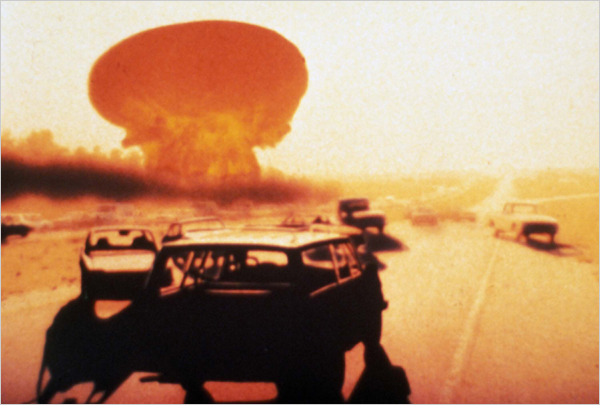
Screen shot from The Day After (November 1983) ABC movie, presumably suburban Kansas City, MO/KS, October 21, 2007. (Stout/NY Times).

Screen shot from The Day After (November 1983) ABC movie, presumably suburban Kansas City, MO/KS, October 21, 2007. (Stout/NY Times).

The very first time I fully understood the dangerous and fatal that defined this world was toward the end of fifth grade, in May ’80. It was an early May Thursday in Mrs. O’Daniel’s classroom at William H. Holmes Elementary in Mount Vernon, New York, a bright, sunny spring day. We were in independent reading mode, and Mrs. O’Daniel had given me permission to read ahead in our social studies textbook, which focused on American history.

We had left off with the Great Depression and all of the suffering that came with it. Of course, this was a collective history, one which didn’t even have the special sufferings of people of color or women in blue boxes — yet. So Whites represented all Americans. This wasn’t something I picked up on in ’80, at least consciously. But luckily, between Lerone Bennett’s edited three-volume Ebony Pictorial History of Black America (1974) at home and Mrs. O’Daniel constantly supplementing our knowledge at school, I was more aware of the deficiencies of textbooks long before I could articulate them.

As I turned the pages and read about the great battles of World War II, the horrors of Pearl Harbor and the gathering of the righteous power of the US to win the war, I suddenly saw something that shook me to my core. It was the picture of the atomic bomb’s mushroom cloud hovering over Nagasaki like death itself. It was in full color, bright and yellow and white, and obviously hot and broiling. The camera shot had managed to capture some of the landscape below, the area surrounding Nagasaki an August summer green. As I read about the 70,000 killed instantly at Hiroshima, an area the size of Mount Vernon completely flattened by a bomb that at its core had only a few pounds of weapons-grade uranium, I was frightened. I could be dead at a moment’s notice, or worse, suffer from radiation burns and sickness, in which case I’d truly be among the walking dead.

But this was only one phase of my nightmare. As things at 616 went from stable to completely out of control, my nuclear nightmares became more frequent. It seemed like there was a nuke for every day of the week during my last year as a Hebrew-Israelite. Watching The Day After on ABC in November ’83 didn’t help matters, but I also couldn’t help myself. I was both repulsed by and attracted to the idea of nuclear annihilation and survival. Maybe because I was already living through one hell of a disaster at 616.

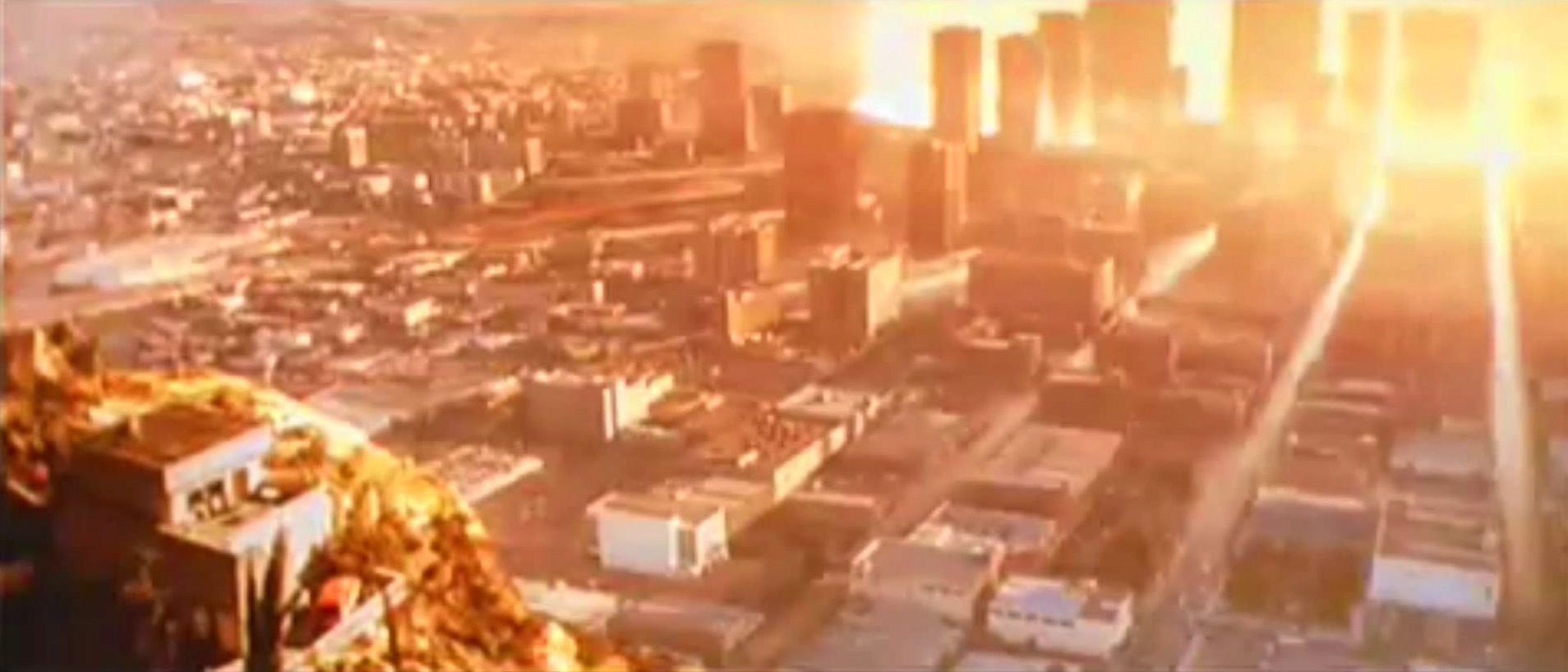
Cropped screen shot of Los Angeles at beginning of nuclear strike, from Terminator 2 (1991), May 3, 2014. (http://youtube.com).

Cropped screen shot of Los Angeles at beginning of nuclear strike, from Terminator 2 (1991), May 3, 2014. (http://youtube.com).

My nuclear nightmares continued at nearly daily pace until after I saw Terminator 2 in June ’91. At that point, I realized that my nightmares weren’t so much about the plausibility of surviving a nuclear holocaust as they were about surviving my own preteen and teenage years. It occurred to me there are worse things in life than dying, and like surviving nuclear war, surviving a violent and unstable childhood like mine has significant side effects. I could be occasionally be up, I was much more frequently down, I could occasionally fly into a rage. And I could have recurring nightmares of me murdering my now dead ex-stepfather. All signs of PTSD.

Realizing this, I took control over my dream world, and managed to push my plutonium-tipped dreams into a box, along with so many things from my decade of evangelistically twisted fire and brimstone from two religions. I still watch end-of-the-world movies, though without the extreme fervor of dream-based certainty of suffering a lingering death. Though I do often find it funny how White fears permeate these movies.

Boy @ The Window – 1st Anniversary!

17 Thursday Apr 2014

Posted by decollins1969 in 1, Boy @ The Window, Christianity, culture, Eclectic, Hebrew-Israelite, High Rise Buildings, Jimme, Marriage, Mount Vernon High School, Mount Vernon New York, My Father, New York City, Pittsburgh, Pop Culture, race, Religion, Sports, University of Pittsburgh, Youth

≈ Leave a comment

Tags

Book Promotions, BookExpo America 2014, Positive Feedback, Publishing Business


Boy @ The Window 1st Anniversary

Boy @ The Window 1st Anniversary

Nope, no balloons or streamers for this one, the one-year anniversary since I put out the first e-book version of Boy @ The Window on Amazon Kindle. Yay, me! It’s been a pretty good twelve months, one of a few highs and a bunch of lows in selling and promoting the book, in moving forward with a plan, only to have tossed it aside for a new set of plans for the remainder of 2014 and 2015.

The bit of encouraging news — aside from some royalties for Boy @ The Window so far — is that there are a couple of places reviewing it now (finally), and I’m finally moving along with promoting the book. Beyond that, there are few things tougher psychologically than book promotions. This is why folks hire publicists — emotional distance can be helpful in reaching out to friends and strangers.

But, from the feedback (mostly through email and Facebook) I’ve gotten so far, people really like Boy @ The Window. Trust me, when a reader tells you they couldn’t put the book down once they started to read it, that’s an emotional boost! It’s part of what has enabled me to keep going on this venture into the cyclone of the publishing world.

I’ve planned for attending BookExpo America for the first time at the end of next month in New York. It’ll likely be a gigantic sea of authors, publishers, editors and others looking for an edge. I just hope that it’s worth the money I’m about to spend there.

One thing that I should note, though, as I continue to write on my blog and proceed with Boy @ The Window promotions. There are plenty of posts here that aren’t in the memoir, and plenty of stories in Boy @ The Window that I haven’t posted here. You can get some idea of what’s in the book from reading my posts, but it would be far from a complete picture. Buy a copy. Take it for a spin. It’ll make you laugh and cry, angry and hopeful, and all at times in the same paragraph.

My First Mugging

03 Thursday Apr 2014

Posted by decollins1969 in 1, Boy @ The Window, culture, Eclectic, High Rise Buildings, Mount Vernon New York, Pop Culture, race, Youth

≈ 2 Comments

Tags

616 East Lincoln Avenue, Black Boys, Brotherhood, Bullying, Darren, Manhood, Mother-Son Relationship, Muggers, Mugging, Pearsall Drive, Poverty, Projects, Robbery, Street Smarts, Thugs, Vernon Woods, Wannabe


New York mugging, Granger (1857), April 3, 2014. (http://chroniclevitae.com).

New York mugging, Granger (1857), April 3, 2014. (http://chroniclevitae.com).

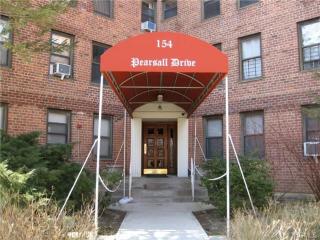
This is another story not in Boy @ The Window, though it could’ve been. It was thirty-five years ago this week that a group of my preteen neighbors from the Pearsall Drive projects (now the Vernon Woods co-op community) jumped me on my way home from the store, beat me up and stole a grand total of four dollars. It seems like such a small thing now, getting mugged for the first time, a block from 616 East Lincoln, our apartment building on the eastern edge of Mount Vernon, New York. Still, I learned a few things on that first Saturday in April ’79 about myself, my older brother, my mother and humans in general, things that haven’t changed in the three and a half decades since.

That particular day was definitely a crisp early spring one, windy, partly sunny and cloudy, just warm enough not to need a winter coat. I’d barely been out the house at all since attempting to run away from home some four months earlier. In the months in between, I’d been engrossed in reading everything I could, especially World Book Encyclopedia, not to mention what I hadn’t already read in Charles Schulz’ Peanuts series.

I hadn’t been out the apartment to do much of anything other than go to school or to the store. So little was my time outside that when I had to do a full food shop, I’d forgotten a few basic rules about protecting myself. Like making sure that a group of nine-to-fourteen-year-olds weren’t following us home from the local grocery store. And making sure to take the most direct route home when I could, or a circuitous route home when necessary. Going west on the north side of East Lincoln, making a left on Station Place, then a left on Lafayette Avenue, then a final left on Bradley, walking four short blocks that would’ve left us in front of 616.

134 Pearsall Drive (now part of the Vernon Woods co-op complex), April 3, 2014. (http://trulia.com)

134 Pearsall Drive (now part of the Vernon Woods co-op complex), April 3, 2014. (http://trulia.com)

On this day, the circuitous route would’ve been better. But that would’ve meant me being better, too. I was already not feeling well when I left with Darren for the grocery store. I had a stomach ache, and the diarrhea that came with it. So my best bet was to go to the store at 671 East Lincoln with Darren, cross over to the south side of East Lincoln, and walk as quickly as we could back to 616.

Only, the half-dozen boys trailing me and Darren back home had crossed with us, and immediately tried to surround us near East Lincoln and Pearsall. Darren, to his credit, ran off for home, leaving me alone and holding two paper bags of groceries. Somewhere between “nigga” and “muthafucka” and “giv’ me the money,” I struggled and ran away with the groceries, where after a minute or two, I ended up in the bottom floor of one of the project buildings.

I was jumped again, punched in the face and the mouth until one of the wannabe thugs had busted my lip and left me bleeding down the side of my face. I somehow crapped on myself during the run, but hadn’t noticed because I was too busy trying to not get mugged. After they took the four dollars’ worth of change I had in my right pant pocket, another wannabe said, “Oh shit, the punk dukeyed on hisself!” They laughed and left me there, in this abandoned, junky apartment, garbage and groceries and two ripped grocery bags all over the room, bloodied and soiled.

I picked up all I could from what remained of the groceries and began the long one-block walk home. By the time I walked through the front door, there was my Mom, angry with me about the groceries. “What I’m gonna do with this!” she said. It was afterward that she noticed my condition. “You let them kids scare the shit out of you!,” she gasped with what seemed like a bit of laughter in her voice. I said, very angrily, “I told you before I left that I had diarrhea!,” then went into the bathroom and cried.

Oscar de la Hoya's face after his beat-down via Manny Pacquiao, December 6, 2008. (AP via http://boxingscene.com).

Oscar de la Hoya’s face after his beat-down via Manny Pacquiao, December 6, 2008. (AP via http://boxingscene.com).

My Mom came in later to help me wash myself down. In the meantime, I had a bruised left cheek, a busted lip, feces all over my lower body, and soreness all over my ribs and stomach. It took about twenty minutes in all, but by the time I was done and washed, I went into mine and Darren’s bedroom and fell asleep.

It was April 7, ’79, and I already knew that I couldn’t count on my older brother to help whenever there would be a crisis. I knew that my Mom cared about me, but apparently not enough to keep me protected. I knew that the assholes that lived around me wouldn’t have minded it if I’d been run over by a Mack truck, as long as they could get a dollar out of me. I knew, most of all, that I needed to look out for myself as much as I could, since there weren’t any cousins or other family around to look out for me.

So when at the end of ’83, the city had sold the projects at Pearsall Drive to a real estate developer, though I was sad for a few individuals, I wasn’t sad in general. Those wannabes had helped make one relatively small aspect of my life — going to the store, going outside and going to Wilson’s Woods — miserable. And with so much misery in my life already, I was glad to see many of those kids move away.

City Place Mall: Why You Don’t Shop Where There’s A “Hood Policy”

04 Tuesday Mar 2014

Posted by decollins1969 in 1, culture, eclectic music, High Rise Buildings, Pop Culture, race

≈ 1 Comment

Tags

Breathing While Black, City Place Mall, Criminalization, Dehumanization, George Zimmerman, Hood Policy, Hoodies, Institutional Racism, Lisa Petrie, Malls, Petri Dish, Petrie Ross Ventures, Racial Stereotypes, Racism, Silver Spring Maryland, Trayvon Martin, White Fears, White Supremacy, Whiteness


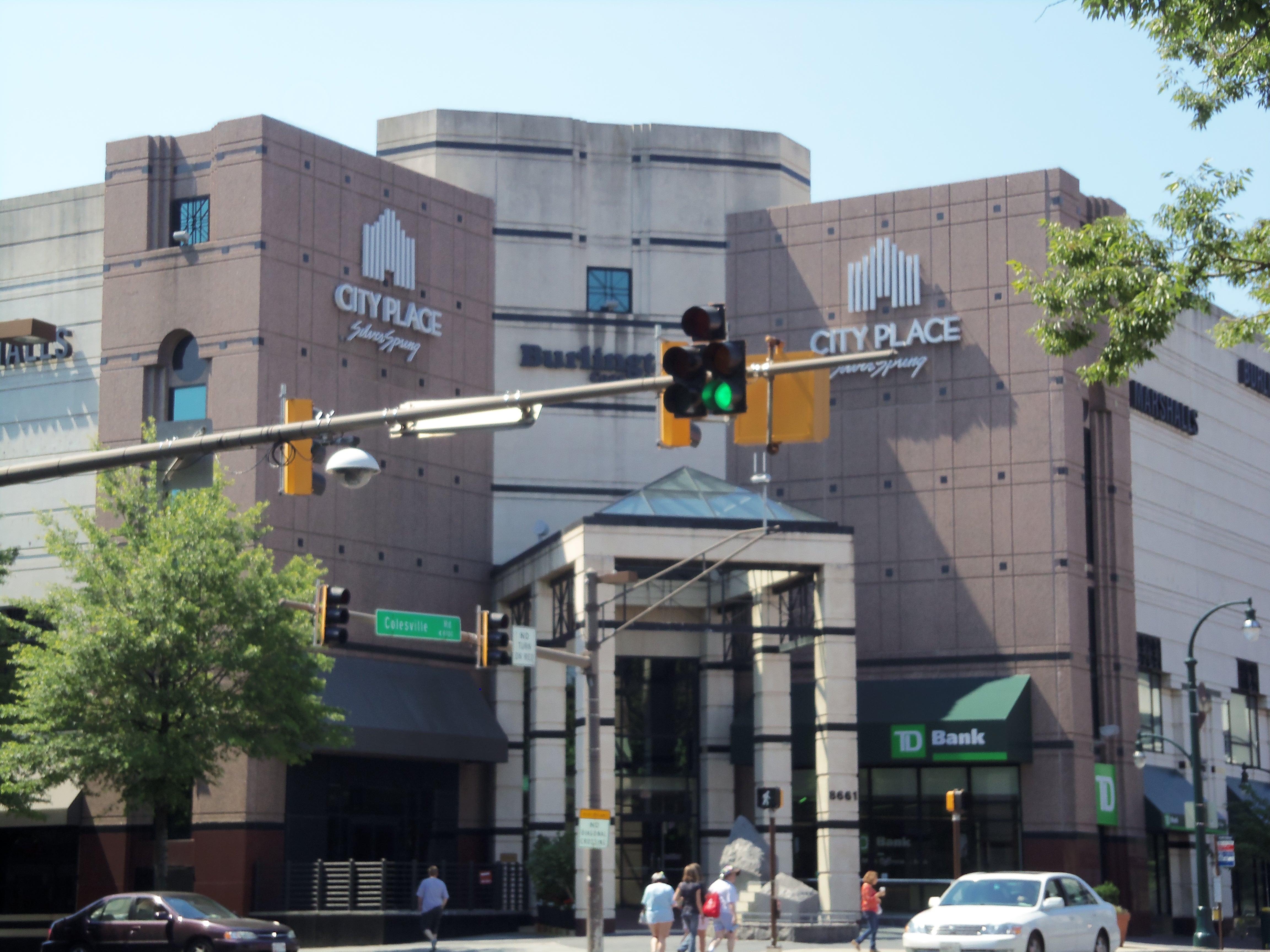
City Place Mall, main entrance, Silver Spring, MD, June 10, 2012. (Farragutful via Wikipedia). Released to public domain via CC 3.0.

City Place Mall, main entrance, Silver Spring, MD, June 10, 2012. (Farragutful via Wikipedia). Released to public domain via CC 3.0.

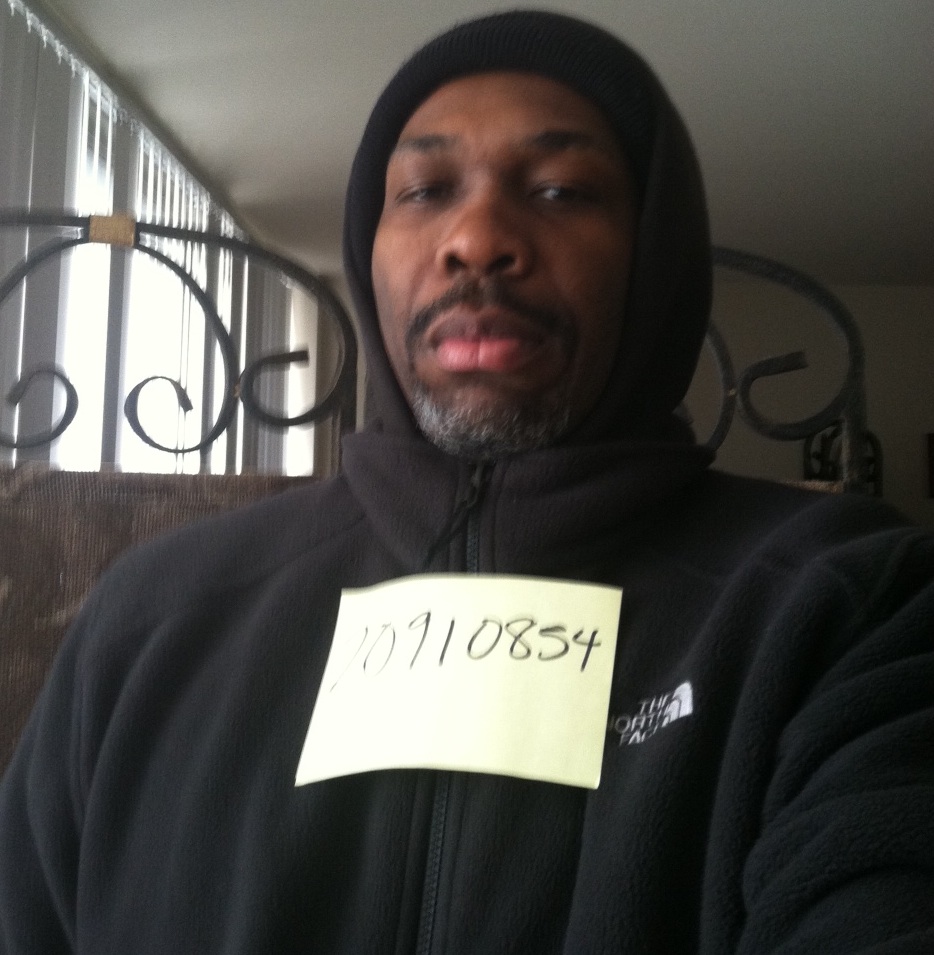
Last Thursday afternoon (February 27), a security guard at City Place Mall in Downtown Silver Spring, Maryland confronted me and my 10-year-old son about wearing a hood over our heads, having just come inside from below-freezing and windy weather. The security guard explained that the policy at City Place Mall is to forbid patrons from wearing hoods, hats, scarves, sunglasses and other clothing that would make us more difficult to identify. When I asked for a written indication of this policy, the security guard told us that the one sign for your 400,000-square-foot mall was downstairs in the lower lobby, which does patrons like me little good in informing us of their racism and stupidity.

Keep in mind, I’m a 44-year-old man with a 10-year-old kid, who’s only intent was to go to an indoor ATM machine to withdraw my money from my bank account so that we wouldn’t freeze. We weren’t shopping at Marshall’s or another store in the mall. What were we going to do, buy two packs of Skittles at the dump of a snack store at City Place instead of just one? Buy two bottles of Lipton Ice Tea (Arizona Ice Tea makes our teeth hurt)?

Me with hood get-up I wore last week with son in tow (numbers added), March 4, 2014. (Donald Earl Collins).

Me with hood get-up I wore last week with son in tow (numbers added), March 4, 2014. (Donald Earl Collins).

If this is how they treat all patrons, this policy would merely be a stupid one. I suspect, though, that they don’t stop women in veils or burqas, Sikhs with turbans or every person wearing sunglasses. No, Black and Brown male patrons — especially ones that look young and healthy — are their targets for such an idiotic policy.

I emailed Lisa Petrie about this incident and wanted clarifications about this policy. Petrie is a co-owner of Petrie Ross Ventures, LLC, the Annapolis-based group that manages (read owns here) City Place Mall. In addition, I asked her to answer the following questions:

1. Is this in fact the policy of City Place Mall, to force patrons to remove hoods and other clothing upon entering the mall?

2. If this is in fact your policy, then why isn’t it posted conspicuously at the entrances to the mall for all patrons to see and read?

3. Is this policy one that security guards are supposed to apply, and if so, are they doing so in an equitable manner?

Petrie didn’t answer any of my questions. Instead, she emailed me this response:

It is our policy in all of our properties to ask our patrons to remove their hats, hoods, etc. only as a safety precaution for all that visit our malls. I am unsure as to the procedures as I am not part of the operations team however I will ask that if you have any questions that you follow up with the property manager on site, Mr. Gary Brewer.

Bottom half of a Petri dish, the only thing I'll buy from City Place Mall in the future, October 20, 2005. (Miaow Miaow via Wikipedia). Released to public domain via CC 2.0.

Bottom half of a Petri dish, the only thing I’ll buy from City Place Mall in the future, October 20, 2005. (Miaow Miaow via Wikipedia). Released to public domain via CC 2.0.

This is a ridiculous statement, unless by “safety precaution,” Petrie means that there are George Zimmermans in all their malls waiting to shoot anyone with a hood over their heads if their skin has a significant melanin content. I did, after Petrie sent me his contact information, send Brewer the same information about the incident, as well as my questions. Mr. Brewer has refused to respond.

If this is how City Place Mall and Petrie Ross expects to treat its patrons, though, I think that whatever plans you have for this mall should come with the disclaimer that not all patrons are welcome, especially Black and Brown males. You can name your dilapidated mall Ellsworth or even Crap. I already don’t shop there. I can always withdraw money from another ATM.

When Work Really Is Too Much

27 Monday Jan 2014

Posted by decollins1969 in 1, Carnegie Mellon University, culture, High Rise Buildings, Jimme, My Father, New York City, Pittsburgh, Politics, Pop Culture, race, University of Pittsburgh, Work, Youth

≈ Leave a comment

Tags

Bigotry, Burnout, CIS, Computer and Information Systems, Hard Work, Hard Work Mythology, Jay Wickliff, Long Hours, Pitt, Presidential Classroom, Racism, Sexual Harassment, Sleep Deprivation, Workplace Harassment


From "How to Do More Work in Less Time" article, Forbes Magazine, February 28, 2012. (Deborah L. Jacobs/http://forbes.com).

From “How to Do More Work in Less Time” article, Forbes Magazine, February 28, 2012. (Deborah L. Jacobs/http://forbes.com).

I’ve been working for a paycheck in some capacity since September ’84, when me and my brother Darren began working with our father Jimme down in Upper West/East Side and Midtown Manhattan. Back then, we cleaned the floors of corporate offices, the carpets of condos and co-ops, and endured Jimme’s alcoholic ups and downs. There was one lesson, though, that stuck with me in the year or so that we worked for our father, one that extended the lesson we observed from our Mom before we fell into welfare in April ’83. That we wouldn’t get far without hard work or without having work, and that if we wanted to avoid the work of a low-paying, back-breaking job like buffing and waxing floors, we also needed to work smart, to use our brains and our muscles

Since then, the longest I’ve been without a job has been ten months, between August ’86 and June ’87. I worked all the way through undergrad at Pitt and was a grad assistant and teaching assistant throughout grad school (with the exception of my time as a Spencer Foundation Dissertation Fellow in ’95-’96, and even then, I worked on two of Joe Trotter’s research projects). I’ve faced periods of unemployment and longer periods where I’ve cobbled together part-time and full-time work, as well as held stable full-time work in the nonprofit and higher education worlds.

Working long hours, January 23, 2014. (Mark Holder/http://www.findersandsellers.com).

Working long hours, January 23, 2014. (Mark Holder/http://www.findersandsellers.com).

In all that time, I’ve only held two jobs where I’d been overwhelmed with work. Not the actual act of performing the duties of these jobs, mind you. The number of hours in which I had to show up for work was what eventually made these jobs overwhelming. My first time experiencing full-time work outside of a summer job was in the middle of my Winter/Spring ’89 semester. I worked for Pitt’s Computer and Information Systems’ (CIS) computer labs back then. I had requested more hours, and had gone from twelve to twenty to thirty-six between the beginning of January and the second-half of February, covering for folks who had moved on to real full-time work after graduating.

This was a seven-week period in which I averaged 36 hours per week while taking sixteen credits — five classes — and all while facing sexual harassment from my co-worker Pam, harassment tacitly sanctioned by our boss and her friend Cindy. Despite it all and my $4.15/hour salary, I focused on the work, the need for extra cash, and my friends, and came out the other side, and hoped to avoid a situation like that again.

I stumbled my way into a worse situation in my first full-time work after earning my doctorate, with the now out-of-business Presidential Classroom. My official title was Director of Curriculum, but that was my main job for only nine months out of the year. Because Presidential Classroom had dedicated itself to edu-tainment with a full-time staff of only a dozen, this meant that all full-time staff were also part of what we called Program. Fifteen weeks during the winter, early spring and summer, one group of 300-400 high school juniors and seniors from across the country (and Puerto Rico and outside the US/commonwealth) after another would spend a week in DC learning about “how government and politics work on Capitol Hill.” Or, as our brochures would say, “Not your typical week in Washington.”

One version of Presidential Classroom logo, January 27, 2014. (http://congressionalaward.org).

One version of Presidential Classroom logo, January 27, 2014. (http://congressionalaward.org).

I worked on-site at the Georgetown University Conference Center (where Marriott had a hotel, primarily for families visiting their hospitalized loved ones at Georgetown University Hospital) for seven of those weeks. I supervised interns, so-called faculty (some of whom were government employees who seemed more interested in chasing skirts than in sharing their experiences) and worked with other staff while watching over these groups of students roaming all over DC and Northern Virginia week after week.

One week in February ’00, I counted up, and found that I’d worked 120 hours in all. This included a 21-hour-day, in which I’d caught a boy in a girls’ hotel room, and then proceeded to contact his parents and expel him from the program. Between that and the bigoted staff I worked with — including my boss, the ED, who once told the joke that “slavery was a hoax” — I knew that putting in 100+ hours per week and sleeping in lumpy beds for $35,000 a year wasn’t worth it. By the last week of June ’00, I was severely sleep-deprived and ready to run my co-workers through with a long spear.

The lesson here was that we all need work, and we all need to work hard in order to guarantee success. But working hard also requires hard thinking and decision-making. It required me to say “No” to things that I had said “Yes” to when I was younger and more desperate for any job. What’s the damnable misery of it, though, is knowing that there are millions of people stuck in jobs that require so much more of them than they should be willing to give.

No job should require the kind of hours I put in combined with harassment and bigotry unless the salary is in the six-figure range, and even then, it’s not worth it. It won’t be worth the loss of self-esteem, the sleep deprivation, the sudden weight gain, the irritability and the temptation to turn to forms of self-medication. It wasn’t worth it for me in ’89 or in ’00, as I’m sure it isn’t for those of you in jobs like this now.

← Older posts
Newer posts →

Boy @ The Window: A Memoir

Boy @ The Window: A Memoir

Places to Buy/Download Boy @ The Window

There's a few ways in which you can read excerpts of, borrow and/or purchase and download Boy @ The Window. There's the trade paperback edition of Boy @ The Window, available for purchase via Amazon.com at http://www.amazon.com/Boy-Window-Donald-Earl-Collins/dp/0989256138/

There's also a Kindle edition on Amazon.com. The enhanced edition can be read only with Kindle Fire, an iPad or a full-color tablet. The links to the enhanced edition through Apple's iBookstore and the Barnes & Noble NOOK edition are below. The link to the Amazon Kindle version is also immediately below:

scr2555-proj697-a-kindle-logo-rgb-lg

Boy @ The Window on Amazon.com: http://www.amazon.com/Boy-The-Window-Memoir-ebook/dp/B00CD95FBU/

iBookstore-logo-300x100

Boy @ The Window on Apple's iBookstore: https://itunes.apple.com/us/book/boy-the-window/id643768275?ls=1

Barnes & Noble (bn.com) logo, June 26, 2013. (http://www.logotypes101.com).

Boy @ The Window on Barnes & Noble: http://www.barnesandnoble.com/w/boy-the-window-donald-earl-collins/1115182183?ean=2940016741567

You can also add, read and review Boy @ The Window on Goodreads.com. Just click on the button below:

Boy @ The Window

Twitter Updates

Tweets by decollins1969
  • RSS - Posts
  • RSS - Comments

Archives

  • June 2025
  • April 2023
  • September 2022
  • August 2022
  • July 2022
  • June 2022
  • May 2022
  • April 2022
  • March 2022
  • January 2022
  • December 2021
  • November 2021
  • October 2021
  • September 2021
  • August 2021
  • July 2021
  • June 2021
  • April 2021
  • March 2021
  • February 2021
  • January 2021
  • December 2020
  • November 2020
  • October 2020
  • September 2020
  • August 2020
  • July 2020
  • May 2020
  • April 2020
  • March 2020
  • January 2020
  • December 2019
  • November 2019
  • August 2019
  • July 2019
  • June 2019
  • May 2019
  • April 2019
  • March 2019
  • February 2019
  • January 2019
  • December 2018
  • November 2018
  • October 2018
  • September 2018
  • August 2018
  • July 2018
  • June 2018
  • May 2018
  • March 2018
  • February 2018
  • January 2018
  • December 2017
  • November 2017
  • October 2017
  • September 2017
  • August 2017
  • July 2017
  • June 2017
  • May 2017
  • April 2017
  • March 2017
  • February 2017
  • January 2017
  • December 2016
  • November 2016
  • October 2016
  • September 2016
  • August 2016
  • July 2016
  • June 2016
  • May 2016
  • April 2016
  • March 2016
  • February 2016
  • January 2016
  • December 2015
  • November 2015
  • October 2015
  • September 2015
  • August 2015
  • July 2015
  • June 2015
  • May 2015
  • April 2015
  • March 2015
  • February 2015
  • January 2015
  • December 2014
  • November 2014
  • October 2014
  • September 2014
  • August 2014
  • July 2014
  • June 2014
  • May 2014
  • April 2014
  • March 2014
  • February 2014
  • January 2014
  • December 2013
  • November 2013
  • October 2013
  • September 2013
  • August 2013
  • July 2013
  • June 2013
  • May 2013
  • April 2013
  • March 2013
  • February 2013
  • January 2013
  • December 2012
  • November 2012
  • October 2012
  • September 2012
  • August 2012
  • July 2012
  • June 2012
  • May 2012
  • April 2012
  • March 2012
  • February 2012
  • January 2012
  • December 2011
  • November 2011
  • October 2011
  • September 2011
  • August 2011
  • July 2011
  • June 2011
  • May 2011
  • April 2011
  • March 2011
  • February 2011
  • January 2011
  • December 2010
  • November 2010
  • October 2010
  • September 2010
  • August 2010
  • July 2010
  • June 2010
  • May 2010
  • April 2010
  • March 2010
  • February 2010
  • January 2010
  • December 2009
  • November 2009
  • October 2009
  • September 2009
  • August 2009
  • July 2009
  • June 2009
  • May 2009
  • April 2009
  • March 2009
  • February 2009
  • January 2009
  • December 2008
  • November 2008
  • October 2008
  • September 2008
  • August 2008
  • July 2008
  • June 2008
  • May 2008
  • April 2008
  • March 2008
  • February 2008
  • January 2008
  • December 2007
  • November 2007
  • October 2007
  • September 2007
  • August 2007
  • July 2007
  • June 2007

Recent Comments

MaryPena's avatarMaryPena on My Day of Atonement/Bitter Hat…
decollins1969's avatardecollins1969 on No Good Teaching Deed Goes…
Mary Rose O’Connell's avatarMary Rose O’Connell on No Good Teaching Deed Goes…

NetworkedBlogs on Facebook

NetworkedBlogs
Blog:
Notes From a Boy @ The Window
Topics:
My Life, Culture & Education, Politics & Goofyness
 
Follow my blog

616 616 East Lincoln Avenue A.B. Davis Middle School Abuse Academia Academy for Educational Development AED Afrocentricity American Narcissism Authenticity Bigotry Blackness Boy @ The Window Carnegie Mellon University Child Abuse Class of 1987 CMU Coping Strategies Crush #1 Crush #2 Death Disillusionment Diversity Domestic Violence Economic Inequality Education Family Friendship Friendships Graduate School Hebrew-Israelites High-Stakes Testing Higher Education History Homelessness Humanities Humanities Program Hypocrisy Internalized Racism Jealousy Joe Trotter Joe William Trotter Jr. K-12 Education Love Manhood Maurice Eugene Washington Maurice Washington Misogyny Mother-Son Relationship Mount Vernon High School Mount Vernon New York Mount Vernon public schools Multiculturalism MVHS Narcissism NFL Pitt Pittsburgh Politics of Education Poverty President Barack Obama Race Racial Stereotypes Racism Relationships Self-Awareness Self-Discovery Self-Reflection Sexism Social Justice Teaching and Learning University of Pittsburgh Violence Whiteness Writing

Top Rated

Blog at WordPress.com.

  • Subscribe Subscribed
    • Notes from a Boy @ The Window
    • Join 103 other subscribers
    • Already have a WordPress.com account? Log in now.
    • Notes from a Boy @ The Window
    • Subscribe Subscribed
    • Sign up
    • Log in
    • Report this content
    • View site in Reader
    • Manage subscriptions
    • Collapse this bar
 

Loading Comments...