• About Me
  • Other Writings
  • Interview Clips
  • All About Me: American Racism, American Narcissism, and the Conversation America Can’t Have
  • Video Clips
  • Boy @ The Window Pictures
  • Boy @ The Window Theme Music

Notes from a Boy @ The Window

~

Notes from a Boy @ The Window

Category Archives: Academia

The Temptations of Pizza

12 Tuesday Apr 2016

Posted by decollins1969 in 1, Academia, Boy @ The Window, culture, Eclectic, Mount Vernon New York, Pittsburgh, Pop Culture, race, University of Pittsburgh, Youth

≈ Leave a comment

Tags

Advertisements, Challenge Scholarship, College Applications, College Brochures, Mineo's Pizza Shop (Pittsburgh), National Honor Society, Pitt, Pizza, Sales Pitch, SAT score, Self-Discovery, Self-Reflection, Sicilian Pizza Pie, The 'O'

Pitt logo, the one closest to what was on their brochures in April 1986, April 12, 2016. (http://pitt.edu).

Pitt logo, the one closest to what was on their brochures in April 1986, April 12, 2016. (http://pitt.edu).

It’s been a full thirty years since I received a big envelope in the mail from my future alma mater. No, not that one. It wasn’t the big packet about my life-changing. No, it was their introduction.

It was at the end of a school day, and like clockwork, I went downstairs to check our mail. There it was. It was always news whenever I got mail, at least to me. It was a packet from the University of Pittsburgh, or rather Pitt. It was more the latter because the Pitt logo was gigantic and on the back of the large white envelope.

I opened the packet immediately. I barely began to read the form letter introducing me to Pitt and all of its eclectic buildings, wonderful faculty and staff, and precocious students, when I saw the brochure. On it was writing that formed a circle, something like “Pitt, a world of possibilities” (I say “something like” because I don’t really remember what it said, but that’s what I translated it to mean).
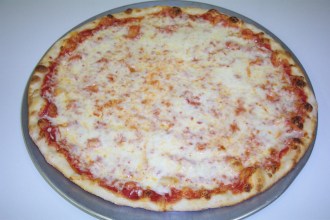
A cheese pizza similar to the one used on that '86 Pitt brochure (only a LOT less orange), April 12, 2016. (http://student.plattsburgh.edu).

A cheese pizza similar to the one used on that ’86 Pitt brochure (only a LOT less orange), April 12, 2016. (http://student.plattsburgh.edu).

The writing circle surrounded a large, traditional, New York-style plain cheese pizza. The background of the brochure was set in Pitt’s traditional medium light blue. With the writing all in white, that pizza pie stood out like it was in 4D. I could smell it, taste it, lick it, eat it at that moment. My sixteen-year-old bean pole ass probably would’ve eaten a slice or two, too, if I hadn’t already planned to go down the street to a pizza shop for a Sicilian slice.

Never mind the letter that mentioned that I had been identified because of my 1050 SAT score from October ’85 and because of my National Honor Society membership. Forget about the fact that I didn’t even know where Pittsburgh was or what kind of city it was. Did I even notice that Pitt was starting a new academic scholarship program to attract more students of color and women to the university?

No, I was focused squarely on this picture of culinary beauty, a pizza after my own stomach, er, heart. I wanted to be at a college where I had an opportunity to eat that pizza, to feel my teeth bite down on that rich combination of tomato sauce, olive oil, basil, oregano, bread, mozzarella, and parmesan. I needed to feel those tidbits fall from the back of my mouth and into my throat before gravitating their way into my waiting stomach, to have that enzymatic orgasm.

But then I remembered the last time I made an academic decision on an empty stomach. That was in May ’81. Right after the Humanities Program had accepted me into their fold for middle school, I had to pick a language. The only choices were between French, Italian, and Spanish. My muy estupido culo picked Italiano over the other two. Why? Because I loved, absolutely loved, spaghetti. I loved spaghetti the way some people love their dogs. That’s not a reason, that’s literally a gut decision! I imagine that I would’ve picked Mandarin Chinese if it had been on the language menu because I loved Papa Wong’s egg rolls and chicken fried rice!

I decided to do some serious background research on Pitt and Pittsburgh before I would even suggest the idea of applying their to anyone. They was only the first college to invite me to apply, after all. I hadn’t planned on going out-of-state. As desperate as I was to leave 616 and Mount Vernon, I pretty much only saw myself applying to schools within 100 miles of New York City, like Columbia or Yale or Concordia College. Obviously I hadn’t yet thought through the places I really wanted to spend four or more years of my life. I just knew I didn’t want to spend most of it under the same roof with my insane family.

*************************

Mineo's Pizza House, Squirrel Hill, Pittsburgh, November 22, 2008. (http://thepodanys.blogspot.com/).

Mineo’s Pizza House, Squirrel Hill, Pittsburgh, November 22, 2008. (http://thepodanys.blogspot.com/).

Fast forward to my junior year at Pitt. At that point, I’d been in Pittsburgh for nearly three years, and had yet to find that elusive New York-style cheese pizza pie they used to lure me to this po-dunk town. Oh, they said the pizza they used in that brochure was from The ‘O’, The Original Hot Dog Shop on Forbes Avenue in Oakland near the Cathedral of Learning for those unfamiliar with Pitt and Pittsburgh. Except their pizza was wack. It was a greasy pile of limp cheapness, with mozzarella that probably came from an arthritic cow, olive oil that was strained from Wish-Bone Italian dressing, and dough made out of Wonder Bread. Since Pittsburgh’s water came from reservoirs or from the Allegheny or Monongahela River, it didn’t come close to tasting like that pizza on the brochure either.

But at the end of ’96, the same month my advisor finally said he’d sign off on my doctoral thesis, I finally found my elusive pizza in Pittsburgh. It was at Mineo’s Pizza on Murray Avenue in Squirrel Hill. I’d probably passed the joint three dozen times in nine years, but never at night. I stopped there with my girlfriend (now wife) Angelia, and we bought a couple of slices. Not only were they good, but they had an added bonus. They specialized in Sicilian pies! After nine years, I finally found a slice of food heaven in Pittsburgh!

A Little Diddy About Madison Jack

08 Friday Apr 2016

Posted by decollins1969 in 1, Academia, Carnegie Mellon University, culture, Eclectic, New York City, Pittsburgh, Pop Culture, race, Youth

≈ Leave a comment

Tags

Academic Competition, Academic Conferences, AERA, American Educational Research Association, Burnout, CMU, Collegiality, Conferences, Harvey Kantor, Jack, Joe William Trotter Jr., Michael Fultz, Milford Plaza, Mom, Narcissism, Obsequious, Self-Awareness, Spencer Foundation, University of Wisconsin-Madison, Yonkers


Jack-In-The-Box 3D model, April 5, 2016. (http://turbosquid.com).

Jack-In-The-Box 3D model, April 5, 2016. (http://turbosquid.com).

Jack-o’-Lantern, Jack-in-the-Box, Monterey Jack, Colby Jack, and jackknife all have something in common with the Jack I’m writing about in this post. They’re all the kinds of Jacks that I’m not a fan of or outright dislike. They also tend to surprise me at precisely the wrong place and at precisely the wrong time. My Jack, the Jack who finished a doctorate in the School of Education at UWisconsin-Madison in the late-1990s, was one of the most competitive and obsequious humans I had ever met. What made my knowing him worse was that he never had to be cutthroat in the first place.

I first “met” Madison Jack the summer of ’95, via telephone and email. My favorite benefactor at the Spencer Foundation in Catherine Lacey had provided Jack my information. It made sense at the time. Both Jack’s dissertation and my own discussed the process of Black migration, White flight, and school desegregation, though his work involved Milwaukee and mine was on DC. Jack had gotten a small Spencer grant, and I had a Spencer Dissertation Fellowship.

Most importantly, Madison Jack wanted to put together a panel presentation for the April 1996 American Educational Research Association (AERA) Annual Meeting in New York. The panel would involve a group of Spencer-funded folk working on various angles of school desegregation, involving community control, racial discrimination, White anti-desegregation protests, and ideas like my own on multiculturalism and diversity. Over a three-week period between mid-July and early August ’95, we put together a panel of five presenters and a moderator. The moderator was none other than Jack’s dissertation advisor Michael Fultz. Two presenters were 1995 Spencer Dissertation Fellows (including me), and two others would become Dissertation Fellows in 1996 (including Madison Jack).

It could’ve been a powerful panel under the right set of conditions. But it was to be underwhelming by default. We had at least two too many people on the panel. Our panel’s presentation date and time in New York was on the last day of the conference, Friday, April 12th, at 8:15 am, both too early and too late at the same time. With my own troubles with my HNIC advisor in Joe Trotter — not to mention a dissertation nearly complete — AERA wasn’t exactly my primary focus. Plus, visiting my home area with my family living in temporary housing in Yonkers post-616 fire didn’t exactly help with my concentration.

A five-inch folding jackknife, perfect for ingratiating back-stabbers, April 5, 2016. (http://www.lifesupportintl.com/).

A five-inch folding jackknife, perfect for ingratiating back-stabbers, April 5, 2016. (http://www.lifesupportintl.com/).

But it was Madison Jack’s obsessive competition that reared its ugly head and left a raw horseradish taste in my mouth. It was that much more disgusting because I knew it would be my last conference presentation as a graduate student. Jack and I had agreed that all five of us would have twelve minutes apiece for our presentations, leaving time for audience questions. On that brisk spring morning after a rough night at the Milford Plaza, I began the panel with my talk timed for exactly twelve minutes. With my Mom having not yet arrived and only six people in the room to start, I muddled through as if I needed a cup of coffee just to know that I needed to wake up. Mom arrived five minutes into the second presentation, one by my fellow 1995 Spencer Dissertation Fellow, where she used the term “a cacophony of voices” in describing the different sides involved in the 1968 Ocean Hill-Brownsville (Queens) controversy over community control and racial inequality. Two scholars I knew well were in the audience — including one who was a one-time professor at Carnegie Mellon’s Heinz School (now Heinz College). She said to Harvey Kantor, “This presentation’s ‘caca’ all right” and they both laughed, loud enough for my sleep-deprived mind to notice.

Madison Jack was the last to present. My co-organizer broke our agreed-upon rules. He spoke for more than twenty minutes, all to garner more attention for his work over myself and the other three panelists. Jack also used a slide show, another thing that we had agreed we wouldn’t do, mostly because of the time constraints on the panel. It was a classic example of narcissistic behavior at the doctoral level. By the time Jack had finished — combined with his advisor’s ten minutes of droning commentary — there were only six minutes left for questions from an audience of nearly twenty people, most of whom had missed the first four presentations. Jack fielded all but one of the audience’s questions. If I’d been in my right frame of mind, I would’ve jammed a slide down Jack’s obsequious throat.

Fast-forward nearly a decade to the 2004 AERA conference in San Diego. It was my first time attending the conference since grad school. I decided to go to the Spencer-sponsored talk (an annual tradition), to see if any of my fellow Fellows from 1995 would also be there. A couple of them did show up, which was the good part about this gathering. But so did Madison Jack. He made a bee-line toward me. I made a point of not making eye contact until he was nearly in my face with his grizzly beard and outstretched hand. I shook it as hard as I could, feeling my right hand squeeze his knuckles into each other.

A block of Monterey Jack in all its bland whiteness, January 13, 2015. (Mitch Mandel via http://menshealth.com).

A block of Monterey Jack cheese in all its bland whiteness, January 13, 2015. (Mitch Mandel via http://menshealth.com).

After I let him talk for three minutes about his professorship at some small New England liberal arts college, about his first book, and after introducing me to his wife, he wanted to know how I was doing. Or rather, if I had bested him in my career up to that point. I didn’t take the bait. Knowing that a couple of big wigs had just walked into the room, I started with small talk about my wife and newborn son. I knew. Madison Jack being Madison Jack, I knew he would walk away, with me in mid-sentence, seeking to soak wisdom and advancement out of his next unknowing victims.

With colleagues and friends like Madison Jack, who needed enemies? What made his sycophantic displays and overt attempts at dominance so pitiful was that I never cared. I was too ambivalent about my place in academia and too much in turmoil about myself as a writer to ever care. Fighting over a job or a book with a scholarly publisher? To me in 1996 and in 2004, it was a waste of time and energy.

To me in 2016, it’s also a waste of potential friendships and connections beyond the “what’s in it for me?” perspective. I know lots of folks, but few I count as friends, and only a small number of those are in academia. While much of my work is independent of others, it isn’t work I do or think about alone. Madison Jack probably knows tons of folk in high places. But with an approach to career that is me first, me foremost, and me last, I’m pretty sure that he repels more true connections in his world than he attracts. Kind of like smelling week-old Monterey Jack that’s been left out in the sun too long.

The Student-Athlete System and the Exploitation Lens

01 Friday Apr 2016

Posted by decollins1969 in 1, Academia, culture, Eclectic, eclectic music, music, Politics, Pop Culture, race, Sports, Work, Youth

≈ Leave a comment

Tags

"I Got Plenty O' Nuttin'" (1935), Bob Stoops, College Athletes, Ed O'Bannon, Exploitation, Jim Boeheim, Justifications, Kirk Schulz, Mark Emmert, National Collegiate Athletic Association, NCAA, NCAA Division I Football, NCAA Division I Men's Basketball, O'Bannon v. NCAA (2015), Ocsar G. Johnston, Porgy & Bess, Real Sports (HBO), Rhetoric, Sharecropping, Slavery, Student-Athletes, The Business of Amateurs (2016), The Sporting News


NCAA logo, September 4, 2014. (Getty Images/SportingNews.com).

NCAA logo, September 4, 2014. (Getty Images/SportingNews.com).

In July, US District Judge Claudia Wilken gave final approval to a combined $60 million in settlements of former and current college athletes’ claims against the NCAA and EA Sports. The deal granted as many as 93,000 claims of up to $7,000 for the use of college athletes’ images and likenesses in video games between 2003 and 2014. The groundbreaking decision provides student-athletes payments for the fruits of their labor for the first time. But these combined settlements are separate from the O’Bannon v. NCAA case. This main lawsuit against the NCAA’s use of unpaid college athletes remains in limbo. The NCAA asked for and the courts granted a stay, delaying a process that would make every college athlete eligible for some compensation in exchange for universities using their labor.

Beyond the response that often compares the NCAA student-athlete labor system to slavery, few have discussed the ways in which the NCAA’s defenders construct their arguments for the status quo. In many ways, the NCAA system isn’t much different from sharecropping. It was an agricultural economic system mostly located in the American South that took advantage of impoverished Whites and Blacks between 1870 and 1980. Both provided meager benefits like room, board, and clothing at an exorbitant cost while reaping huge profits from its workers. One system kept sharecroppers deeply in debt while the other has kept college athletes from profiting off of their work. The carrot in sharecropping was access to land to grow cotton and other crops for a profit at the end of a harvest season, minus landownership and all the necessary tools, seeds, and other necessities for producing those crops. The incentive in the NCAA’s system has been a year-to-year scholarship to cover the cost of a four-year degree, with the remote possibility in a handful of sports to earn enough recognition to become a professional athlete. Minus, until last fall, coverage for books, clothing, food outside of sporting events and practices, and the hours necessary to take advantage of an athletic scholarship. Defenders of both systems fought tooth-and-nail to keep sharecroppers and college athletes from organizing themselves into unions.

Unlike in slavery, the majority of sharecroppers were White, although more than a third were African American. All entered into sharecropping under contract, though the poor economic conditions of the South after the Civil War and the terror of White supremacist groups left poor Whites and Blacks few options. Likewise, NCAA’s college athletes also sign contracts and waivers that left them with few options in pursuing their athletic craft or in completing a college degree a year earlier than the average college student. And at least three different ways, the people defending the NCAA’s student-athlete system match sharecropping’s defenders with the language of exploitation. Though neither system is slavery, both are still closely related forms of exploitation, with a brutality that provides few good options for those engaged in doing the actual work.

George Gershwin's Porgy & Bess, with "I Got Plenty O' Nuttin'" (1935), oft sung by Ella Fitzgerald and Louie Armstrong (among others), April 1, 2016. (cropped and combined).

George Gershwin’s Porgy & Bess, with “I Got Plenty O’ Nuttin'” (1935), oft sung by Ella Fitzgerald and Louie Armstrong (among others), April 1, 2016. (cropped and combined).

1. The circular reasoning argument. This one is where defenders use the very label of their system — whether “sharecroppers” or “student-athletes” — to justify the existence and need for their system. Historian Chris Myers Asch documented numerous examples of this in his 2008 book The Senator and the Sharecropper. Asch included in his book a 1936 interview with psychologist John Dollard, one in which Mississippi planter William Alexander Percy said, “To live among a people whom, because of their needs, one must in common decency protect and defend is a sore burden in a world where one’s own troubles are about all any life can shoulder” (p. 70). Especially since many elites like Edward Everett Davis — dean of North Texas Agricultural College (now University of Texas at Arlington) from 1925 to 1946 — saw sharecroppers as “the most serious rural problem in the South.” In his The White Scourge (1940), Davis wrote that sharecroppers were “those biologically impoverished tribes of marginal humanity — black, white, and Mexican — subsisting on cotton” (p. ix).

Compare this line of reasoning with NCAA President Mark Emmert’s on why universities should not pay college athletes. On the 2011 Frontline episode “Money and March Madness,” Emmert said, “fact is, they’re not employees, they’re student-athletes.” In another interview, for the upcoming documentary The Business of Amateurs (release date TBD), Emmert said, “there’s not even a salary to debate. They’re not employees, they’re students.” For Emmert and the portions of the public who support his stance, the label “student-athlete” by itself justifies not paying college athletes, just like the label “sharecropper” did for planters who frequently cheated their workers out of profits. The idea for both has been they are but children that institutions need to care for, albeit under contract.

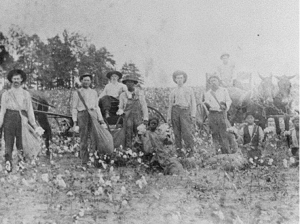
Black and White sharecroppers in Randolph County, Georgia, 1910. (Georgia Archives, Vanishing Georgia Collection)

Black and White sharecroppers in Randolph County, Georgia, 1910. (Georgia Archives, Vanishing Georgia Collection)

2. The low or no profit-margin argument. This has been a popular idea, to claim that despite the wealth generated under sharecropping, landowners made few, if any, profits. As shown by historian Lawrence J. Nelson in his 1999 book King Cotton’s Advocate, Oscar G. Johnston, head of the financial division of the Agricultural Adjustment Administration (a New Deal program), wrote in a 1937 memo, “any person familiar with the operation realizes that the sharecropper system is more favorable to the tenant than the cash wage system [paying hourly wages].” According to Johnston, any “criticisms” of sharecropping as an exploitative economic system came “from persons wholly ignorant of the system or the economic situation” (p. 88).

Syracuse University men’s basketball coach Jim Boeheim claimed that there are few to no profits in college athletics in his 2013 New York State Associated Press symposium speech. “I’m not against kids getting money. But the problem is, you give the 12 basketball players $150, now you gotta give the field hockey players. So now you’re talking 150 athletes. One-hundred fifty times $150 times eight. That’s a lot of money,” Boeheim said. In pleading for a stay in the O’Bannon case last year, the NCAA’s lawyers said that it and “many schools and students” would be “irreparably harmed” if the court allowed the injunction to go into effect. Yet the NCAA’s $11-billion contract with CBS and Turner Broadcasting for the NCAA Men’s Basketball Tournament and $500-million-per-year contract with ESPN for the college football playoffs contradicts the notion of irreparable harm.

3. The fringe-benefits argument. This is the assertion that a person’s status in this system produces material and intangible benefits, even despite the potential pitfalls and vulnerabilities. Asch wrote of another 1936 interview John Dollard conducted, in which one farmer said, “when times are bad he has to take care of the Negroes first, whether they make anything or not.” Another farmer said that sharecroppers only worked about three months out of the year, and used the rest of their time to “fish, fool around, attend revivals, and follow other trivial pursuits” (p. 71). Despite the evidence of poverty for the vast majority, planters consistently painted sharecroppers’ lives as ones with benefits than ones full of rampant exploitation.

Oklahoma football coach Bob Stoops' 17,000 square-foot home on lakefront property, Norman, OK, November 25, 2015. (http://sportshoop.la/).

Oklahoma football coach Bob Stoops’ 17,000 square-foot home on lakefront property, Norman, OK, November 25, 2015. (http://sportshoop.la/).

The common refrain in college athletics is likewise about benefits that outweigh injuries, long-term disabilities, the pressures of athletic and academic performance, and the loss of material benefits. University of Oklahoma head football coach Bob Stoops put it this way in a 2013 Sporting News interview: “I don’t see why people say these guys don’t get paid. It’s simple, they are paid quite often, quite a bit and quite handsomely.” They also “get room and board…the best nutritionist, the best strength coach to develop you, the best tutors to help you academically, and coaches to teach you and help you develop. How much do you think it would cost to hire a personal trainer and tutor for four to five years?,” Stoops said. The athletic scholarship, a non-guaranteed, year-by-year deal, is the only fringe benefit that matters in the case of college athletes.

Like Oscar Johnston’s defense of the sharecropping system in the 1930s, the NCAA’s defense fits the pattern of “it’s a terrible system, but it could be much worse.” During his Real Sports conversation last March, Kansas State University president and NCAA Board of Governors member Kirk Schulz said, “Well, a scholarship at Kansas State, a four-year scholarship, is about $180,000, and our average debt load of all of our students is about $26, $27,000.”

—————————————–

Apparently, the system is fair precisely because naked exploitation is better than the illusion of choices given to the typical college student. These arguments in support of student-athlete system dovetail almost perfectly with the arguments that supported sharecropping as a necessary evil in the 1930s. The justifications are paternalistic and elitist, with a mix of class and racial imagery to boot. To the point where any NCAA executive, college or university coach or athletic director, university president or journalist in support of not paying these athletes should be beyond embarrassed.

Afrocentrists, Evangelicals, Hebrew-Israelites and the False Revolution

28 Monday Mar 2016

Posted by decollins1969 in 1, Academia, Boy @ The Window, Carnegie Mellon University, Christianity, culture, Eclectic, Hebrew-Israelite, Mount Vernon New York, Patriotism, Pittsburgh, Politics, Pop Culture, race, Religion, University of Pittsburgh, Youth

≈ Leave a comment

Tags

Afrocentric, Afrocentricity, Authentic Blackness, Authority Figures, Black Action Society, Child Abuse, Covenant Church of Pittsburgh, Cross of Gold (1896), Dick Oestriecher, Domestic Violence, Estelle Abel, Evangelical Christianity, Frances Cress Welsing, Frederick K.C. Price, Gospel of Prosperity, Hoteps, Jack Van Impe, Judah ben Israel, Karl Marx, Kenneth Copeland, Kufi, Marxism, Maurice Eugene Washington, Molefi Asante, Neo-Marxists, Ostracism, Prosperity Gospel, Racism, Rapture, Religion, Wendy Goldman, William Jennings Bryan


Kenneth and Gloria Copeland, Believer's Voice of Victory television broadcast, November 23, 2011. (Carpetsmoker via Wikipedia). Released to public domain via CC-SA-3.0.

Kenneth and Gloria Copeland, Believer’s Voice of Victory television broadcast, November 23, 2011. (Carpetsmoker via Wikipedia). Released to public domain via CC-SA-3.0.

For nearly all of my life folks with even a kernel of authority have tried to convince me that there was one right way to live, one true path to liberation. Mostly religion has been the means through which others have attempted to box me in, although ideologues around Marxism, Afrocentricity, and Capitalism have all been in my figurative kitchen over the years. And like any well-meaning human being, at times I tried real hard to adapt myself to these right ways of thinking, of living out the one correct way to live. Only to fail, or rather, to recognize that none of these ways are the one right way, unless you are a closet right-winger, a conservative (non-ideological) wearing revolution-esque clothing.

My introduction to this madness began with my years as a Hebrew-Israelite, from April ’81 to April ’84 (although I wore my kufi until September ’84). That any parent could suddenly impose a new religion on their kids without explanation is abusive enough. When combined with vague notions about the Lost Tribes of ancient Israel and the wearing of clothes that set us apart culturally while in the middle of puberty, it was a forced societal ostracism. Even still, I tried to live by these strictures. “Remember the Sabbath day and keep it holy.” Eat kosher food, don’t use Ivory soap, shop only at Black or Hebrew-Israelite stores, avoid “unclean issues of blood.” But the physical abuse and poverty that came with being a Hebrew-Israelite in the Judah ben Israel madhouse of contradictions at 616 made me despise anything involving Hebrew-Israelite pretty much for all time.

Molefi Asante speech, Philadelphia, PA, September 13, 2014. (AP photo/file).

Molefi Asante speech, Philadelphia, PA, September 13, 2014. (AP photo/file).

Fast-forward a few years to the early 1990s, to the rise of Afrocentricity and the Afrocentric ethos. After three and a half years of being around Hebrew-Israelites, these kente-cloth wearing fools made me weary more times than not of their exclusionary our-way-or-no-way Blackness. Molefi Asante and the late Frances Cress Welsing were just the tip of a much larger iceberg in search of revolutionary “authentic” Blackness. From the Afrocentric undergrads who hijacked the Black Action Society leadership at the University of Pittsburgh in 1991 to folks who picked arguments with me for “sounding White” while I was in grad school, I saw them the same way I saw my now idiot ex-stepfather and the obnoxious Estelle Abel from my high school days. They were well-meaning but stupid. As far as I was concerned, they thought that their words alone would foster a revolution, that being Black meant turning one’s back on the world while also indirectly embracing an ethnocentric capitalism. Or at least, a Black American collective individualism, otherwise known as an “Afrocentric cool.”  I could not, I would not, exchange one form of oppressive uplift in Hebrew-Israelites for the shiny fool’s gold that mostly represented the Afrocentrists.

The neo-Marxists I met in Pittsburgh throughout the 1990s were no better. For all their revolutionary rhetoric, theirs was a world of theoretical activism, of scholarly examples of past oppression. Most of them didn’t know poverty and didn’t comprehend oppression beyond their own limited experience. Most of all, they couldn’t find a connection between American racism and class oppression if I gave them an industrial strength magnet. The fact that most of them hadn’t read Franz Fanon, W. E. B. Du Bois, Eric Williams, C. L. R. James, Anna Julia Cooper, Zora Neale Hurston, Derrick Bell, Angela Davis — but could quote Karl Marx the way Hebrew-Israelites could quote the Torah and Afrocentrists could quote Asante and Welsing — I found troubling. That’s putting it nicely. I found it contemptuous that folks who didn’t know my experience or who would all but refuse to read folks who written about experiences like mine would expect my allegiance to an ideology that was never meant for people who look like me.

The evangelical Christian part of my life was literally the last of the major dogmas to go. It was the hardest for me because I literally had given my life to Jesus in the midst of the whole Hebrew-Israelite crisis, Easter Sunday ’84. With my Mom coming down the same path by the late-1980s, it made it easier to not interrogate my Christianity as thoroughly as I would excoriate Afrocentrists and Marxists in graduate classes and in articles and papers a decade later. But even at nineteen, I realized that the Van Impe’s weekly predictions of the Apocalypse were as ridiculous as Welsing’s exulting of the magical properties of melanin. Or, for that matter, a fake Balkis Makeda cautioning against the use of Ivory Soap among her Hebrew-Israelite flock because of a dream she had.

Grant Hamilton cartoon for Judge Magazine on William Jennings Bryan's "Cross of Gold" speech, Democratic National Convention, Chicago, July 9, 1896. (Wikipedia). In public domain.

Grant Hamilton cartoon for Judge Magazine on William Jennings Bryan’s “Cross of Gold” speech, Democratic National Convention, Chicago, July 9, 1896. (Wikipedia). In public domain.

I went along to get along for years, until the hypocrisy of evangelical Christianity’s Gospel of Prosperity became too much. They took the metaphor of William Jennings Bryan’s cross of gold and actually went literal and nuclear with it. Somehow being Christian now meant blind patriotic allegiance to anything US and fully supporting capitalism, and yet an exclusionary separation between “true” evangelical Christians and the rest of the world. Especially on Rapture Day.

The last time I sat comfortably in a pew was in January ’97, although I’ve been to churches of various denominations dozens of times since. I still believe in Jesus, the life and the death and even the resurrection. But I don’t believe in most who claim to represent him, yet turn around and ignore the vulnerable standing right in front of them, making weak claims around individualism and poverty in the process.

In so many ways, evangelicals, Marxists, Afrocentrists, and Hebrew-Israelites are more alike than different. They all insist on a singular path, a quintessential truth. While some aspects of their thinking are appealing, I find accepting their bullshit in entirety poisonous to my spirit, mind, and gastrointestinal tract. There still may well be a revolution or even a rapture, but it won’t be because of any of these groups.

The Grad School Maze

22 Tuesday Mar 2016

Posted by decollins1969 in 1, Academia, Boy @ The Window, culture, Eclectic, Pittsburgh, Politics, Pop Culture, race, University of Pittsburgh, Work, Youth

≈ Leave a comment

Tags

Acceptance Letters, African American History, Applications, Dr. Jack L. Daniel, GPA, Graduate School, GRE Scores, History, Howard University, Incompetence, Lessons, MA Programs, NYU, Pitt, Rejection Letters, UC Berkeley, University of Maryland College Park, US History, UVA


An endless maze, May 24, 2014. (http://turbosquid.com/).

An endless maze, May 24, 2014. (http://turbosquid.com/).

It’s been a quarter-century since I had to choose my academic path post-bachelor’s degree. That statement in itself is proof that I am no longer young, seeing that I was barely smart enough at twenty-one to decide on my advanced degree path in the first place.

In the fall of ’90, I had applied to six schools to do master’s degree (and potentially PhD) work in the history field: University of Pittsburgh, UC-Berkeley, University of Maryland-College Park, Howard University, University of Virginia, and New York University. I had briefly considered law schools, but decided against a year or torts and contracts for something a bit more relevant to my interests. Beyond the master’s, I still wasn’t sure if I wanted to do a doctorate, teach, write, work outside academia, or just find a job that enabled me to buy my first car. Such are the issues with a student too close to his former life of grinding poverty making decisions about an ill-defined path to his future. I could’ve been my eleven-year-old self applying to Humanities for middle school for the first time, almost as naive, and nearly as myopic.

My GPA at the time of my applications in October ’90 was a 3.28 (I’d reach a 3.4 by the end of the spring semester ’91), with a 3.8 as a history major, and my one GRE test had me in the 64th percentile in reading, 54th in math, and 78th in analytical. The analytical section was new and — as I sensed at the time (and would learn for sure a few years later) — the most relevant part of the GRE for anyone planning on a humanities or social sciences graduate degree. But I couldn’t convince either Berkeley or UVA of that. Berkeley rejected me in January ’91, saying that the GRE scores of their typical students were in the 80th and 90th percentiles in math and reading. UVA sent me a one-page rejection a month later. As I learned later on, my post-1900 focus on US and Black history — UVA’s main specializations were pre-1900 US and African American history — was the biggest reason for my rejection.

University of Virginia Cavaliers' sabers logo, March 21, 2016. (http://www.southwesttimes.com).

University of Virginia Cavaliers’ sabers logo, March 21, 2016. (http://www.southwesttimes.com).

By March, I started to hear more positive news. NYU had accepted me into their program just before Pitt’s mid-March Spring Break, and Pitt’s acceptance followed soon after. I had been back and forth with Howard’s graduate admissions office, who had acknowledged receipt of my application packet before losing it for two months, finding it and sending it back to me because I missed one checkbox on the first page, and then losing it again in February. By the time Howard found my packet again and then accepted me, I had already moved on in my mind.

The main sticking points in most of these acceptances were around my GRE scores or what aid or fellowships I qualified for. Not one school knew what to do with my GRE analytical score, but they seemed quick to jump on my math score as cause for concern. Seriously, unless I had planned to be a statistician or engineer, why would my math score matter in earning an MA in History? Wouldn’t my ability to do broader analysis beyond numbers matter more?

As for aid and fellowships, this was where the University of Maryland became part of the story. They had also accepted me initially in March, but somehow managed to “lose” my application packet for more than a month. I say “lose,” because the admissions office and the history department at College Park lost my application just long enough for all the deadlines to grant fellowships and departmental aid to pass. Not exactly a coincidence.

Afterward, the folks at College Park contacted me to let me know that I was a “provisional status” grad student if I wanted to do my master’s work at UMD. I was “provisional” because of my GRE math score, thus making me ineligible for aid, and requiring a minimum GPA of 3.25 my first semester before being granted any aid. NYU, for its part, wanted me to sign a letter of commitment to the university and the history program before revealing to me any financial aid or fellowship options at all. Even I knew that this was ridiculous, especially after my experience with Columbia four years earlier.

This week twenty-five years ago, I began saying no. I said no to NYU’s heavy-handed slight-of-hand acceptance, and I’d say no to College Park’s deceit seventeen days later. I never actually responded to Howard at all, figuring that my packet was gathering dust bunnies in a dry-as-dust room in Founders Hall.

New York University logo, March 21, 2016. (http://pinoyespressoshots.com).

New York University logo, March 21, 2016. (http://pinoyespressoshots.com).

That left Pitt as my only choice, a place that despite its nurturing, was now lukewarm to me as a student they accepted into their master’s program. It would take a small miracle, in the form of Pitt’s assistant provost Jack Daniel, for me to have the money I needed to earn my master’s degree.

What are the lessons here? That I should’ve worked full-time for a year after graduation, taken some more courses to raise my GPA to a 3.5 and my history GPA to a 3.9? That given my interests, I should’ve also applied to schools of education for an MA in education with a focus in history? That the change to add the analytical section of the GRE was a waste of money and time? That admissions officers and departmental selection committees in the pre-Internet era were even more incompetent in 1991 than they are today?

The most important lesson for me was that grad school wasn’t completely about merit. Just because I had the grades and other achievements and intangibles didn’t mean that admissions offices and departmental committees would recognize them. People play favorites, provide aid and opportunities to some and not others equally deserving, out of spite, because of narrow-mindedness, or because of their -isms. That applying to graduate school was no safe haven, that there were folks who not only didn’t want me to success, but who would actually actively work to make sure I didn’t succeed.

That was a sobering reality. The kind of disillusionment that was the stuff of success for me over the subsequent six years.

On My Own Narcissism

19 Saturday Mar 2016

Posted by decollins1969 in 1, Academia, Boy @ The Window, culture, Eclectic, Mount Vernon New York, Patriotism, Politics, Pop Culture, race, Religion, Youth

≈ Leave a comment

Tags

American Narcissism, Donald Trump, Humanities, Jean W. Twenge, Narcissism, NPD, NPI, Self-Awareness, Ted Bundy, W. Keith Campbell


You are from God, little children, and have overcome them; because greater is He who is in you than he who is in the world.

— 1 John 4:4 (New American Standard Bible)

For those who regularly read my blog, you’ve probably noticed the increased focus over the past year on the issue of American obsession with individualism and its own greatness mythology. At least, the parts of which I’ve roughly translated into a collective American narcissism, or a collective American absorption with itself. It has become the latest idea, my latest potential project, but still too early to tell what, if anything, will come out of this so far. Most Americans remain blissfully unaware of anything that doesn’t involve winners, losers, vicarious living, and America always being seen as #1 at everything (even though in most cases it isn’t).

This post, though, isn’t about how the world’s #1 nation is deeply flawed by a narcissism that runs nearly as deep as the center of a black hole. No, this post is all about me. Really, it’s about the fact that even as I recognize America’s narcissism — both historical and current — that I myself am not inoculated from that narcissism.

Expanding red giant stars will engulf too-close planets before turning into white dwarfs, August 13, 2013. (James Gitlin/STScI AVL via http://www.space.com/).

Expanding red giant stars will engulf too-close planets before turning into white dwarfs, August 13, 2013. (James Gitlin/STScI AVL via http://www.space.com/).

My first bout with narcissism began at the end of elementary school at William H. Holmes in Mount Vernon, New York. It was the spring of ’81. I’d just finished up three years as a straight-A student, been made into a Hebrew-Israelite, came in second for a city-wide essay contest, and been granted the honor of introducing the keynote speaker at my graduation. Even with fighting my best friend Starling, my family’s slow but steady fall into grinding poverty, and the next six years of Humanities in front of me, who wouldn’t have a head as inflated as the Sun at its red-giant stage?

As I wrote in Boy @ The Window

I firmly believed that no one in the world was smarter than me. It wouldn’t have been any funnier if I’d pretended I was Mr. October himself, Reggie Jackson, saying his words, ‘Sometimes I underestimate the magnitude of me.’

It took a year of relative mediocrity while in seventh-grade Humanities for my march toward narcissistic personality disorder to end at the cliff of disillusionment. I wasn’t the “smartest kid in the whole world.” But as I also discovered in my time in this magnet program, neither were any of my classmates.

Perhaps the biggest lesson here was that I was all of eleven and twelve years old when America’s narcissism with individual achievement had caught me in a tangled web of lies and myths. No success or failure or anything in between occurs in a vacuum. No individual’s success happens purely on her or his own, without support, context, and in many cases, an advantage of one sort or another. It took years to learn this lesson, between Humanities and graduate school, the nonprofit world and academia, to learn to give up on the bullshit that is the American meritocracy.

That’s not to say that one can eliminate selfishness (which isn’t the same as narcissism, by the way), or shouldn’t strive for success or a better life for themselves or their kids or their families. But we should always ask ourselves why, in what context, how should we measure our victories, and even if running over others to achieve those victories is the right way to live? Most Americans don’t ask, don’t tell, don’t verify, and don’t think about their lives in this way, because most of us have been taught by this culture that the empathetic lens is a loser’s way of viewing the world.

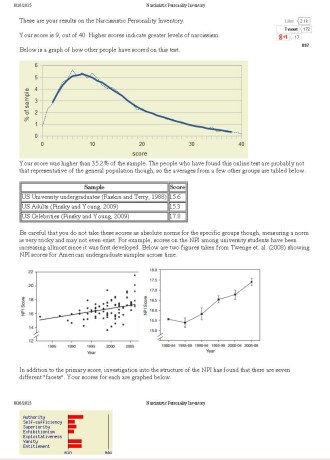
My NPI Score, done August 20, 2015. (http://personality-testing.info/tests/NPI.php).

My NPI Score, done August 20, 2015. (http://personality-testing.info/tests/NPI.php).

I have taken a read — actually, several in the past year — of Jean M. Twenge and W. Keith Campbell’s book The Narcissism Epidemic: Living in the Age of Entitlement (2009). Theirs is a good base to begin to view American society as one so obsessed with individualism that it renders us all anywhere between a little narcissistic to borderline Donald Trumps and Ted Bundys. The psychologists and psychiatrists in this niche have a test for narcissistic personality disorder or NPD, the Narcissistic Personality Index. It consists of 40 questions, seeking to determine whether one is low, medium, or high in narcissism within the index.

I took the NPI last August, and scored a 9 out of 40. It meant that I have some narcissistic tendencies, but only scored higher than 35 percent of those who’ve taken the NPI. I wasn’t even close to being an average American narcissist! Not really a surprise, as those seeking to take such an index are likely less narcissistic than their navel-gazing neighbors.

So, I am in this world and mostly of it, if only because it’s hard to divorce one’s existence from the world in which they live. But I am self-aware enough to know my own narcissism, and empathetic enough to see the narcissism in others.

Great. It still means that as a nation, our narcissism goes as far back as the mind can imagine. It still means that in a couple of centuries, historians will lament about the America that was. Those historians will see a country and a people so busy in building themselves up that they stomped on the oppressed and crushed the downtrodden in the process. A US with so many myths and ideals, but so few attempts at making any of them true.

My Inevitable Walkman Era

05 Saturday Mar 2016

Posted by decollins1969 in 1, Academia, Boy @ The Window, Christianity, culture, Eclectic, eclectic music, High Rise Buildings, Jimme, Mount Vernon New York, music, My Father, New York City, Pittsburgh, Pop Culture, race, Religion, University of Pittsburgh, Work, Youth

≈ Leave a comment

Tags

616, 616 East Lincoln Avenue, Black Masculinity, Coping Strategies, Disillusionment, Escape, Escapism, Manhood, Masculinity, Self-Discovery, Sony Walkman, Walking, Walkman


This version was my first Sony Walkman (between May 1987 and June 1988), posted August 28, 2013. (http://ebay.ie).

This version was my first Sony Walkman (between May 1987 and June 1988), posted August 28, 2013. (http://ebay.ie).

This week marks three decades since I finally entered the ’80s technologically, buying my first portable radio/cassette player with headphones. It wasn’t the Sony Walkman — I’d get my first one of those a year later. No, it was a Taiwan-made knockoff that I got at Crazy Eddie’s on 46th and Fifth in Manhattan, on sale for $22, that was my jump into the era of the Walkman. After a year and a half of carrying around a plug-in radio, playing with records on cheap $15 turntables (that cost $130 and much more in 2016), contemplating boom boxes, and having no control over what music I listened to outside of laundromat runs and 616, I found a new way to escape.

As I wrote in my memoir, this new toy was

my passport to another world, a world where I could make anything happen and no one could hurt me. Taking the Subway to go to The Wiz or Crazy Eddie’s or Tower Records was as much a part of mine and Darren’s Saturday ritual as our tracking down of Jimme. I no longer had to wait for WPLJ or Z-100 or WBLS to play the music I wanted to hear. I could buy a cassette tape for as little as six dollars. In the month after I’d bought my Walkman I’d gone out and bought more than twenty tapes. Whitney Houston, Simple Minds, Phil Collins, Sting, The Police, Mr. Mister, Mike + The Mechanics, Tears for Fears, even Sade. All were welcome who could contribute to my all-consuming effort at conquering my courses.

I was tough on my first Walkman, though. I must’ve dropped it a dozen times in two months, as it barely made it to Memorial Day ’86. My second one was a $42 Panasonic, which I bought with my Technisort earnings, and it lasted from July 4th until the end of October. I bought a decent Aiwa knockoff of the Sony Walkman in December, and that one made it to April ’87. before I finally found the $60 I needed for my Sony Walkman the month before high school graduation.

In a span of a year, I would accumulate more than seventy tapes, covering everything from pop and hard rock to rap and R&B, new age and jazz. As anyone who knew me in the spring of ’87 could attest, I carried my tapes with me in my book bag to have at the ready, the same way in which I had toted my Bible everywhere when I became a Christian three years earlier.

I walked everywhere in the Upper Bronx and Southern Westchester County for nearly three and a half years before I bought a Walkman of any kind. But in that window between March ’86 and my college move to Pittsburgh seventeen months later, my walks became much more frequently and much more eventful. I was walking to escape, to find mental space away from the gang of under-five-year-olds that ruled the too-small, two-bedroom space of pain in which I had grown up. I walked to figure out who I was and who I wasn’t, to be angry at my family, at the world, and at myself. I walked to find meaning in a chaotic life and world. I walked because I could wear myself out with warp speed, spin moves and high-falsetto highs, with questions and emotions and sometimes even, some answers, before coming back to 616 and grabbing some sleep. I must’ve have gone on 100 or 150 walks of five miles or more in that year and a half before college.

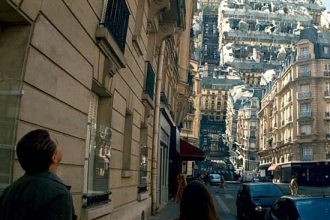
Inception (2010), Paris dream construct screen shot, April 27, 2012. (http://dpmlicious.com). Qualifies as fair use under US Copyright laws because of poor resolution of shot, not intended for distribution.

Inception (2010), Paris dream construct screen shot, April 27, 2012. (http://dpmlicious.com). Qualifies as fair use under US Copyright laws because of poor resolution of shot, not intended for distribution.

That doesn’t even count my more frequent forays into the city, not to do anything or be anything. I wasn’t working for my father anymore, and after he repeatedly called me a “Faggat” in August ’86 and tried to set me up with a prostitute in December ’86, I hardly went to see him at all until the last few weeks before leaving for Pitt. I didn’t even take Darren down to Midtown Manhattan, the Upper West Side, Harlem or Flatbush with me. That’s what I did with the spare hours I started stealing from my Mom on weekends during that year. I’d go down to the city, maybe buy a few tapes at Tower Records on 66th and Broadway (usually not, since most of my tapes came via Terra Haute, Indiana). Sometimes if I had a few dollars, I’d go to MOMA or Radio City or some other place and go into escape/observation mode there. Mostly, I walked and people watched for an hour or so, and then take the long way home between the 2 train, 241st Street and the heart of Mount Vernon.

All the while, my music was on, often at full blast. It was a coping strategy, a pain and stress reliever, my sword and my shield. It took my Phyllis obsession and my freshman year at the University of Pittsburgh to break the link between music, Walkman, and the need to escape. It took the pain of rejection, removal from an anti-Donald environment, and a bout of homelessness to make music about enjoyment and education. When that happened, sometime in ’88, I knew I couldn’t escape anymore.


← Older posts
Newer posts →

Boy @ The Window: A Memoir

Boy @ The Window: A Memoir

Places to Buy/Download Boy @ The Window

There's a few ways in which you can read excerpts of, borrow and/or purchase and download Boy @ The Window. There's the trade paperback edition of Boy @ The Window, available for purchase via Amazon.com at http://www.amazon.com/Boy-Window-Donald-Earl-Collins/dp/0989256138/

There's also a Kindle edition on Amazon.com. The enhanced edition can be read only with Kindle Fire, an iPad or a full-color tablet. The links to the enhanced edition through Apple's iBookstore and the Barnes & Noble NOOK edition are below. The link to the Amazon Kindle version is also immediately below:

scr2555-proj697-a-kindle-logo-rgb-lg

Boy @ The Window on Amazon.com: http://www.amazon.com/Boy-The-Window-Memoir-ebook/dp/B00CD95FBU/

iBookstore-logo-300x100

Boy @ The Window on Apple's iBookstore: https://itunes.apple.com/us/book/boy-the-window/id643768275?ls=1

Barnes & Noble (bn.com) logo, June 26, 2013. (http://www.logotypes101.com).

Boy @ The Window on Barnes & Noble: http://www.barnesandnoble.com/w/boy-the-window-donald-earl-collins/1115182183?ean=2940016741567

You can also add, read and review Boy @ The Window on Goodreads.com. Just click on the button below:

Boy @ The Window

Twitter Updates

Tweets by decollins1969
  • RSS - Posts
  • RSS - Comments

Archives

  • June 2025
  • April 2023
  • September 2022
  • August 2022
  • July 2022
  • June 2022
  • May 2022
  • April 2022
  • March 2022
  • January 2022
  • December 2021
  • November 2021
  • October 2021
  • September 2021
  • August 2021
  • July 2021
  • June 2021
  • April 2021
  • March 2021
  • February 2021
  • January 2021
  • December 2020
  • November 2020
  • October 2020
  • September 2020
  • August 2020
  • July 2020
  • May 2020
  • April 2020
  • March 2020
  • January 2020
  • December 2019
  • November 2019
  • August 2019
  • July 2019
  • June 2019
  • May 2019
  • April 2019
  • March 2019
  • February 2019
  • January 2019
  • December 2018
  • November 2018
  • October 2018
  • September 2018
  • August 2018
  • July 2018
  • June 2018
  • May 2018
  • March 2018
  • February 2018
  • January 2018
  • December 2017
  • November 2017
  • October 2017
  • September 2017
  • August 2017
  • July 2017
  • June 2017
  • May 2017
  • April 2017
  • March 2017
  • February 2017
  • January 2017
  • December 2016
  • November 2016
  • October 2016
  • September 2016
  • August 2016
  • July 2016
  • June 2016
  • May 2016
  • April 2016
  • March 2016
  • February 2016
  • January 2016
  • December 2015
  • November 2015
  • October 2015
  • September 2015
  • August 2015
  • July 2015
  • June 2015
  • May 2015
  • April 2015
  • March 2015
  • February 2015
  • January 2015
  • December 2014
  • November 2014
  • October 2014
  • September 2014
  • August 2014
  • July 2014
  • June 2014
  • May 2014
  • April 2014
  • March 2014
  • February 2014
  • January 2014
  • December 2013
  • November 2013
  • October 2013
  • September 2013
  • August 2013
  • July 2013
  • June 2013
  • May 2013
  • April 2013
  • March 2013
  • February 2013
  • January 2013
  • December 2012
  • November 2012
  • October 2012
  • September 2012
  • August 2012
  • July 2012
  • June 2012
  • May 2012
  • April 2012
  • March 2012
  • February 2012
  • January 2012
  • December 2011
  • November 2011
  • October 2011
  • September 2011
  • August 2011
  • July 2011
  • June 2011
  • May 2011
  • April 2011
  • March 2011
  • February 2011
  • January 2011
  • December 2010
  • November 2010
  • October 2010
  • September 2010
  • August 2010
  • July 2010
  • June 2010
  • May 2010
  • April 2010
  • March 2010
  • February 2010
  • January 2010
  • December 2009
  • November 2009
  • October 2009
  • September 2009
  • August 2009
  • July 2009
  • June 2009
  • May 2009
  • April 2009
  • March 2009
  • February 2009
  • January 2009
  • December 2008
  • November 2008
  • October 2008
  • September 2008
  • August 2008
  • July 2008
  • June 2008
  • May 2008
  • April 2008
  • March 2008
  • February 2008
  • January 2008
  • December 2007
  • November 2007
  • October 2007
  • September 2007
  • August 2007
  • July 2007
  • June 2007

Recent Comments

MaryPena's avatarMaryPena on My Day of Atonement/Bitter Hat…
decollins1969's avatardecollins1969 on No Good Teaching Deed Goes…
Mary Rose O’Connell's avatarMary Rose O’Connell on No Good Teaching Deed Goes…

NetworkedBlogs on Facebook

NetworkedBlogs
Blog:
Notes From a Boy @ The Window
Topics:
My Life, Culture & Education, Politics & Goofyness
 
Follow my blog

616 616 East Lincoln Avenue A.B. Davis Middle School Abuse Academia Academy for Educational Development AED Afrocentricity American Narcissism Authenticity Bigotry Blackness Boy @ The Window Carnegie Mellon University Child Abuse Class of 1987 CMU Coping Strategies Crush #1 Crush #2 Death Disillusionment Diversity Domestic Violence Economic Inequality Education Family Friendship Friendships Graduate School Hebrew-Israelites High-Stakes Testing Higher Education History Homelessness Humanities Humanities Program Hypocrisy Internalized Racism Jealousy Joe Trotter Joe William Trotter Jr. K-12 Education Love Manhood Maurice Eugene Washington Maurice Washington Misogyny Mother-Son Relationship Mount Vernon High School Mount Vernon New York Mount Vernon public schools Multiculturalism MVHS Narcissism NFL Pitt Pittsburgh Politics of Education Poverty President Barack Obama Race Racial Stereotypes Racism Relationships Self-Awareness Self-Discovery Self-Reflection Sexism Social Justice Teaching and Learning University of Pittsburgh Violence Whiteness Writing

Top Rated

Blog at WordPress.com.

  • Subscribe Subscribed
    • Notes from a Boy @ The Window
    • Join 103 other subscribers
    • Already have a WordPress.com account? Log in now.
    • Notes from a Boy @ The Window
    • Subscribe Subscribed
    • Sign up
    • Log in
    • Report this content
    • View site in Reader
    • Manage subscriptions
    • Collapse this bar
 

Loading Comments...