• About Me
  • Other Writings
  • Interview Clips
  • All About Me: American Racism, American Narcissism, and the Conversation America Can’t Have
  • Video Clips
  • Boy @ The Window Pictures
  • Boy @ The Window Theme Music

Notes from a Boy @ The Window

~

Notes from a Boy @ The Window

Author Archives: decollins1969

We Were Never United

11 Sunday Sep 2016

Posted by decollins1969 in 1, culture, Eclectic, High Rise Buildings, New York City, Patriotism, Politics, Pop Culture, race, Religion

≈ Leave a comment

Tags

"Never Forget", #NeverForget, 9/11, Archetypes, Atlanta, Genocide, Greyhound Bus, Holocaust, Hyper-Patriotism, Ignorance, Islamophobia, Media, Navel Gazing, Racism, Sikhs, Stereotypes, Tropes, Xenophobia


9/11 Memorial reflecting pool (w/ reflection of Freedom Tower off building straight ahead), August 5, 2014. (Donald Earl Collins).

9/11 Memorial reflecting pool (w/ reflection of Freedom Tower off building straight ahead), August 5, 2014. (Donald Earl Collins).

The media trades in archetypes, stereotypes, and tropes the way an alcoholic can become drunk by just smelling ethanol from a block away. It’s been so true around every 9/11 anniversary that it’s somewhat sickening.

There are two tropes the mainstream media has used to keep Americans in a perpetual state of fear and hyper-patriotism since that gruesome second September Tuesday in 2001. One is the theme of “Never Forget” (and the most obvious Twitter hashtag ever). The only other times the mantra of “Never Forget” normally comes up is either in reference to Jews and the Holocaust or to the systematic genocide Native Americans experienced. It should also come up for Blacks and Africans regarding the Middle Passage and slavery, Aborigines in Australia, and other groups who’ve experienced the wanton destruction of their lives and culture in the relatively recent past. Of course Americans shouldn’t forget what happened on 9/11. Nearly 3,000 people died on that tragic day. But 5.9 million Jews, 8-10 million Native Americans, untold millions of Africans, Aborigines, and other groups? Not exactly a fair comparison. If we cannot consistently have empathy and sympathy for the plight of others who suffer and die in the thousands or millions — like with Syrians, Iraqis, South Sudanese — then what does “Never Forget” really mean beyond an extravagant display of navel-gazing?

The second trope the media sells Americans every year is the idea that we “came together” in the weeks after 9/11 like never before. This is some high-grade bull crap. Maybe White Americans did. Maybe Americans who saw Arab Americans, Sikhs, Black and Latinos who looked like they could be Arabs united. But to say that the US “united” in a common bond to bring each other peace in a grand display of patriotism belies the reality of what happened in the six weeks between the attacks and the passage of the USA Patriot Act.

The most poignant moment of my own 9/11 experience was on a fifteen-hour Greyhound bus trip I took from Atlanta to DC after the government grounded commercial airplanes. There was a Sikh man on our bus, who got on somewhere between Atlanta and Charlotte, North Carolina. Two men, one White and one Black, tried to get in the face of this man and blame him for what happened in New York, in DC, and in Western Pennsylvania. I literally had to get in between these dumb asses to keep them from doing worse than their ridiculous name-calling. If this is what the media meant/means by Americans “uniting” after 9/11, then, yes, we did, if only to show our religious and ethnic ignorance, to vent our not-so-subtle hatred and intolerance.

This was some of what I wrote in the days after 9/11 and my wonderful bus trip up I-85/75.

If we as Americans continue to commit and condone through our silence acts of hatred against Arab Americans, are we much better than the tortured souls who flew four Boeing jets as weapons of mass destruction, all in the name of Allah? If we are to defeat terrorism as a nation and a world, we must also defeat its roots, fear and hatred. If we are to be one undivided and multicultural nation united against terrorism, we can no longer tolerate incidents of terrorism against one another, no matter how much we hurt.

Welp, I was wrong. We would “Never Again” condone acts of terror against our own citizens, right? Whether through the systemic use of law enforcement as death squads against Blacks or Latinos, or the occasional White vigilante dispensing their own form of racist justice? We would unite to stop White supremacists from blowing up mosques, synagogues, and temples, to stop other Americans from harassing Arab American citizens and Sikhs for their open display of their First Amendment religious freedoms, no? We Americans would stand up for the rights of those who protest in opposition to existing examples of lethal oppression, because the American flag is about much more than the US military? Yeah, right!

Americans have proven that “united” and “never forget” are proxies for our societal narcissism. It runs as deep as anything that has taken root in American culture, including racism, individualism, and xenophobia. For me, at least, it is why media mantras like “united” and “never forget” ring hollow, despite my memories of the week that was 9/11.


 

Looking Back to My Future

04 Sunday Sep 2016

Posted by decollins1969 in 1, Boy @ The Window, Christianity, culture, Eclectic, Mount Vernon High School, Mount Vernon New York, My Father, New York City, Pittsburgh, Politics, Pop Culture, race, Religion, University of Pittsburgh, Work, Youth

≈ Leave a comment

Tags

616, 616 East Lincoln Avenue, Blair Kelley, Dr. Jack Daniel, Familial Obligations, Forbes Quadrangle, Fordham University, Grit, Homelessness, Hunter College, Pedro Noguera, Pitt, Poverty, Resilience, Ron Slater, Survivor's Guilt, Wesley V. Posvar Hall, What Ifs


The power of "What If?," September 4, 2016. (http://giphy.com).

The power of “What If?,” September 4, 2016. (http://giphy.com).

I don’t “what if” my past moments nearly as much as I used to, thanks in part to one of my first Twitter conversations six years ago. It was with Blair Kelley, a professor and dean at North Carolina State University. I brought up the fact that I sometimes indulged my students’ “What if…?” scenarios regarding slavery and other issues in US history in order to help them find the truth. She said that this was a waste of time, that “What is…?” is already hard enough for students to understand, much less playing out a “What if…?” to get to a “What is…?”

Kelley was right. Students often play the “What if…?” game to deflect from what actually happened, out of potential pain or discomfort with historical truths, or because their conception of history doesn’t allow for humanity and human nature as significant factors. So I stopped humoring my students in fantasies about the South winning the Civil War or Nazi Germany winning World War II in Europe. It hasn’t made my students any happier, but it has made teaching them easier.

As for my own “What ifs…?,” I still think of a few on occasion. Like what if I had gone to college at Columbia or another elite institution instead of Pitt? Or what if I had possessed the courage to act on my crush on Wendy in seventh grade, or not wear my kufi to school during the Hebrew-Israelite years at all? Those can be very good mental distractions when I’m running a 10K or working on a boring set of revisions to an education piece. But they’re also rather silly distractions, with me knowing full well why I did or didn’t do most things, even knowing my thought process at the time they occurred in ’81, ’82, or ’87.

With this weekend being exactly twenty-eight years since my five days of undergraduate homelessness on Pitt’s campus, I have a real “What if…?” scenario to reconsider. What if I hadn’t bumped into my friend Leandrew, who had told me about the dilapidated fire-trap rowhouse he lived in on Welsford? What if I hadn’t met with my landlord Mr. Fu and gotten my 200-square-foot room with a literal hole in the wall so that two rooms could share a single radiator, all for $140 per month (about $285 in 2016 dollars)? What if I had to spend Labor Day weekend on a closed Pitt campus sleeping on that top floor concrete landing in a Forbes Quadrangle (now Posvar Hall) stairwell, where I had already spent three nights?

The mythical 6th-floor landing I slept on for three days (leading out to the roof), Wesley Posvar Hall, September 29, 2013. (Donald Earl Collins).

The mythical 6th-floor landing I slept on for three days (leading out to the roof), Wesley Posvar Hall, September 29, 2013. (Donald Earl Collins).

I already know the answers to these questions. I decided on this after praying about this on Wednesday, August 31 in ’88 while in that stairwell, laying on some of my clothes and my book bag. If I came out of Labor Day weekend without housing, I’d have to take my remaining $300 and go back to New York, to Mount Vernon, to 616. I’d have to drop or withdraw from my courses at Pitt. Maybe, with add-drop still going on, I could have some of my financial aid refunded, after Pitt deducted the $819 I owed them from my freshman year. I could enroll at Fordham or at CUNY’s Hunter College for the Winter/Spring 1989 semester, maybe find work somewhere in the area, and gut it out a few months at 616 with my nonfunctioning family.

I knew then that this was a scenario as ridiculous as Napoleon conquering Russia in the dead of winter. One of the reasons (but not the main reason) I left for the University of Pittsburgh in the first place was to get away from my family, to meet people unlike my Mom, my idiot stepfather, my five siblings at crowded 616, and the asshole Humanities classmates I’d gone to school with every day for the previous six years. I knew I had to have the mental space I needed to find myself, to figure myself out, all in considering whether I even had a future, much less how that future would take shape or how I’d shape myself into a future.

If I had gone with my cockamamie idea, the best case outcome would’ve been me transferring to Hunter or Fordham with my first year’s credits from Pitt, and me making it through a few semesters full-time before becoming a part-time student. I have no idea if I would’ve finished with a degree in history or something else from Hunter or Fordham. But given how exhausted I was each time I went back to Pitt after a summer of paid and familial work, I likely wouldn’t have even considered grad school.

The weight of guilt, survivor's and otherwise, September 2014. (http://www.fumsnow.com/).

The weight of guilt, survivor’s and otherwise, September 2014. (http://www.fumsnow.com/).

Why? I would’ve been at 616. I would’ve been obligated to help out with everything, from dealing with my idiot stepfather before me and my Mom finally forced him out, to providing food, entertainment, and childcare for my four younger siblings. I know this because during my college years, I did come back to 616 to work each summer and during the holidays. Those additional responsibilities were ones I felt obligated to fulfill until I was in my early thirties, and felt most intense when I had to face my family’s poverty head-on.

Keep in mind, this is the best-case outcome. Most likely, I would have stopped going to school all together after my bout with homelessness. I would’ve found part-time or full-time low-wage work, first to help out, then to find a roach trap somewhere in Mount Vernon or in the Bronx, and been relegated to the torture of “What ifs?” around getting a degree and having a better life. Maybe, just maybe, I would’ve been bumped around enough by that rough life to try again, to seek help from the likes of an ombudsman like Ron Slater or a provost like Jack Daniel. But I barely knew how to seek help when I first went about doing it as a homeless and broke-ass student in ’88. Given my mental makeup back then, it would’ve been a monumental task to trust that much after years of low-wage work and unrelenting poverty at 616.

UCLA education professor (although he is so much more than that) Pedro Noguera reminded me of something I’ve come to disdain in recent years. This idea that philanthropists and researchers can use kids and families as experimental subjects on the issue of “grit” or “resilience” is one I find disgusting. The idea that oppression and inequality can be overcome if you or I simply toughen up, grow a thick outer shell and just push through? The idea that with grit and spit and sweat, anyone can just overcome through sheer will power a lack of preparation, a lack of resources, a lack of access to resources, a lack of connections, and a lack of knowledge? Are you kidding me?

Quaker Instant Grits, Super Family Size, September 4, 2016. (http://soap.com).

Quaker Instant Grits, Super Family Size, September 4, 2016. (http://soap.com).

I had just about the best academic preparation anyone could have going into college, and I still came within three or four days of dropping out and heading back to 616. I was staring into the abyss of my future. The only grit I knew that would’ve worked for me on August 31, ’88 would’ve been a gigantic box of Quaker’s Instant Grits. And that was assuming I found a place to live in Pittsburgh so I could buy a pot and cook them. I didn’t want to be resilient. I’d always been resilient. But I didn’t call it that. I called it surviving.

And without help, without knowing how to ask for help, without some occasional divine or quantum-level intervention, my grit, resiliency, or survival up to August 31, ’88, wouldn’t have mattered. Philanthropists, educators, and social scientists need to stop asking individuals, families, and communities in poverty to be part of their test of resiliency as if we’re all rats in their maze. They need to start asking all of us not just how we survive, but what we need to succeed. Then again, they shouldn’t even need to ask. It’s not as if this is a “What if…?” The Great Society and War on Poverty efforts in the 1960s haven’t already provided a roadmap. Go study that!

Shut Up and Play

30 Tuesday Aug 2016

Posted by decollins1969 in 1, culture, Eclectic, eclectic music, music, Patriotism, Politics, Pop Culture, race, Sports

≈ Leave a comment

Tags

"Shut Up and Play!", "White Discussion", American Exceptionalism, American Narcissism, Colin Kaepernick, Colorblind Racism, Derrick A. Bell, Freedom, Hyper-Patriotism, Live, NFL, Racism, Rules of Racial Standing, White Male Angst


“Shut up play!” That’s what the average White-bred American wants. Not just from Colin Kaepernick. They want that from all vulnerable Americans, especially those of us Black, Brown, and female. Like the chain-smoking, beer-drinking, and buffalo-wing-eating archetypes many are, these average Joes have been going after Kaepernick since Saturday afternoon, attempting to do to him virtually what their great-grandfathers would’ve done to him in the town square. These folk should know that they know nothing of the flag, the national anthem, or the Constitution they claim to believe in so forthrightly. They have proven beyond any shadow of a doubt that the racism and oppression that motivated Kaepernick to take his stand by sitting is alive and well, both in American institutions and in the hearts and minds of average Joes.

But so are the rules of racial standing, or race rules, for that matter (to quote both Derrick Bell and Michael Eric Dyson). In the past two days, eloquent Black ex-NFL players Hines Ward, Jerry Rice, Rodney Harrison, and Tiki Barber have all weighed in, saying dumb and racist crap in the process. “All lives matter?” “Can’t we just all get along?” Kaepernick “isn’t Black?” Who are these dumb asses? And why is the media searching for anti-Kaepernick perspectives harder than Shell is searching for Arctic oil?

Because Americans demand it. Americans want a society with a permanent underclass, where even the few who somehow “make it” swear their allegiance to the status quo. Americans want to believe that racism is a mere boogieman that can be kept in the closet and will rarely see the light of day. And, most of all, Americans want their Black and Brown athletes, especially in football, to not have brains, mouths, or a conscious. Americans wants to be entertained, not educated.

As a couple of lines from Live’s “White, Discussion” (1994) go,

I talk of freedom
You talk of the flag
I talk of revolution
You’d much rather brag

That is America in a nutshell. Nothing’s wrong with the country, but everything is wrong with those Black and Brown who are willing to say that there is. The flag and the national anthem are sacred, but the lives of those Black, Brown, and female are cheaper than sewer water. Any sweeping changes to policing, foreign and economic policies, or other aspects of American culture are met with “U-S-A! U-S-A! U-S-A!,” as if everyone Black and Brown must prove their patriotism in order to confront oppression.

So I say this. The only people who need to “shut up and play” are the ones with a Bud in one hand and three buffalo wings in the other. Shut up and play ball with America’s reality, and not with America’s symbols. Shut up and play the real game of understanding why Kaepernick is protesting and why the ideals of the flag and the anthem are daggers in the hearts of millions. Otherwise, you’re part of the problem. Period.

Splitting The Rail Between Nate Parker and His Work

26 Friday Aug 2016

Posted by decollins1969 in 1, culture, Eclectic, Movies, Politics, Pop Culture, race, Youth

≈ Leave a comment

Tags

Cultural Production, Faux Moralisms, Misogyny, Nate Parker, Racism, Rape Culture, Roman Polanski, Sexism, Systemic Misogyny, The Birth of a Nation (2016), Woody Allen


Splitting a log into rails, Arkansas, May 1983. (http://www.motherearthnews.com/).

Splitting a log into rails, Arkansas, May 1983. (http://www.motherearthnews.com/).

I wrote about this in the context of rap and popular music three years ago. Yet, most of us have not learned this lesson. That great artists and the works that they produce often do not equate in any way to the person they are outside of their artistry in their daily lives. It is so rare as to be almost a godsend when a wonderful cultural producer can also be a forthright and social justice-oriented person who has few blemishes on their record. It is so rare, in fact, that it is more likely I find a briefcase with a $2 million in $100-bills next to my car this morning than find successful cultural producers with deep waters’ worth of goodness and doing good as their record.

Twitter and Facebook folk have been up in arms about the discovery that actor/director/producer Nate Parker allegedly raped a women in ’99 along with one of his co-producers, was acquitted a year later, and the woman subsequently committed suicide in 2012. Keep in mind, this information has been out here about Parker for a number of years. Keep in mind, this act occurred when Parker was nineteen years old. Keep in mind, this vile act and the acquittal he received for it may well be the reason Parker had the opportunity to become an actor and a movie producer in the first place.

As a survivor of sexual assault myself (it still reads strange for me to write this), it makes me ill right down to my bowels, having read some of the details about what happened. Especially since I also know women to whom this happened and the impact it had on some for years afterward. I almost wish I didn’t know that Nate Parker might have gotten away with rape seventeen years ago.

But, as I also know all too well, if the idea is to not see his, et al’s The Birth of a Nation revamped to be about Nat Turner/Nat Turner’s Rebellion, good luck with that. Ultimately, to see or not to see the film is a choice that any of us can make. One can decide to see it and still feel like vomiting over Parker’s real-life rape case. One can decide not to see the film and claim that Parker is a reformed man. It is not as simple an equation as, “if you see The Birth of a Nation, you are pouring money into a rapist’s pockets.”

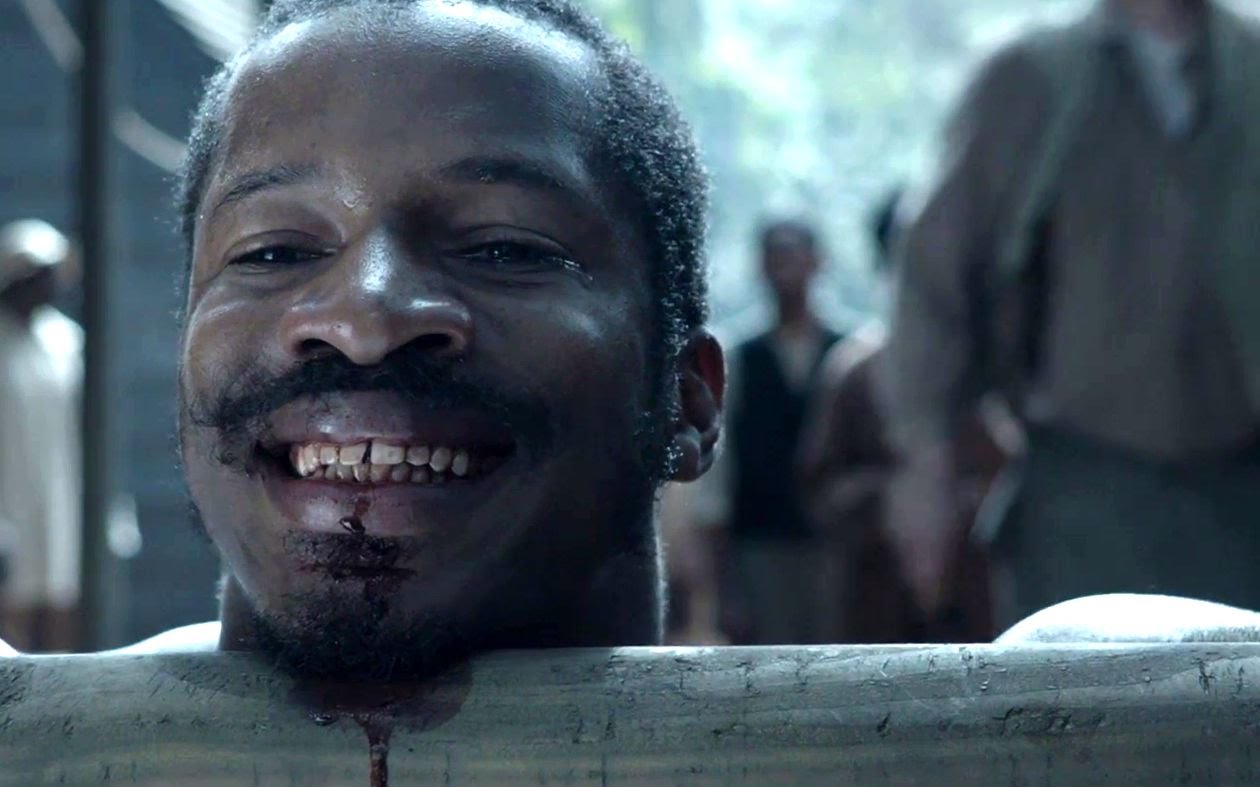
From The Birth of a Nation (2016) trailer, August 26, 2016. (http://youtube.com).

From The Birth of a Nation (2016) trailer, August 26, 2016. (http://youtube.com).

My biggest issue, though, is with all the outrage has come the American penchant for hypocritical moralizations, one that is in part based on race. That is, that we only have the choice of supporting Nate Parker and his revolutionary work or not, that the middle ground of seeing cultural production while reviling the man who helped produce it isn’t an available option. Sorry, but we Americans, we obese consumers and appropriators of all things cultural, do this every day. People have not stopped seeing Woody Allen or Roman Polanski films, though one is likely a child molester and the other one committed rape. We haven’t returned or burned Bill Withers’ tapes, albums, and CDs, though he’s had domestic violence issues in his past. Nor do we think about the poetry we read, the paintings and sculptures we peruse, the TV shows we watch, in which an artist of one kind or another has committed a crime, has killed, stolen from, and destroyed people’s lives along the way. The problem is, if one swings a stick at any cultural production, you will hit a thief, a mugger, an abuser, a rapist, a molester, maybe even a Nazi.

As for me, like with most movies, I will not go to see The Birth of a Nation in a movie theater. I will wait the six months or a year it takes for it to come out on premium cable. I wouldn’t have gone to see it before social media caught wind of Parker’s past. I certainly will not get sucked in to see it, to be part some moralistic wave of cultural immediacy, now.

This issue should not be about Nate Parker at all. It should be about the system that allows for rapists to get no jail time or to be acquitted. It should be about universities like Penn State that allow these crimes to go unpunished, places that punish the victims of sexual violence much more often than they do the perpetrators. It should be about a society where both fathers and mothers do nothing to teach their sons to not rape. Instead, we’re focused on one individual, as if the problem of American rape culture will be solved by going after alleged rapists years after their crimes.

My Mom’s Migration Story, 50 Years Later

23 Tuesday Aug 2016

Posted by decollins1969 in 1, Boy @ The Window, Christianity, culture, Eclectic, Hebrew-Israelite, Jimme, Marriage, Mount Vernon New York, My Father, New York City, Pittsburgh, Politics, race, Religion, Work, Youth

≈ Leave a comment

Tags

Black Migrants, Black Migration, Bradley Arkansas, Child Abuse, Domestic Violence, Education, Highs and Lows, Insecurities, Intervention, Mary Louise Gill, Mother-Son Relationship, Mount Vernon Hospital, Self-Defense, Self-Reflection, Southern Stigmas, Welfare Poverty


I would be a pretty terrible son and historian to not discuss the fact that this July and August marks fifty years since my mother moved to New York from little ol’ Bradley, Arkansas. For those who think fifty years on anything revolving around race and class is “a long time ago” or “ancient history,” consider the following. At the time Mom moved across the country to Gotham, the Civil Rights Movement had entered its northern, splintered phase, the Voting Rights Act of 1965 was barely a year old, and the very first episode of Star Trek with William Shatner and Leonard Nimoy would air that September.

Bus route my mother took from Bradley, Arkansas to New York City in late-July 1966, August 23, 2016. (http://maps.google.com).

Bus route my mother took from Bradley, Arkansas to New York City in late-July 1966 (highlighted in blue with yellow dots), August 23, 2016. (http://maps.google.com).

On balance, with any neutral but fair eye at all, I’d have to say that Mom’s transition has been more failure than success. Five decades of crisis after crisis, of having a handful of fleeting moments of peace and progress followed by years of abuse, misery, poverty, and sorrow. That could be the summary I’d write about Mom’s fifty years of post-migration experiences in New York and in Mount Vernon.

But, let’s start from the top, through Boy @ The Window:

After drifting a bit after her high school graduation, one of Mom’s first cousins came for a visit to Arkansas in the summer of ’66 and told her that there was good-paying work in New York City. Her cousin lived in the [170s, the Tremont section of the] Bronx, a hotbed of Black migration and West Indian immigration in those years. Without much thought, Mom took a four-day bus trip from Texarkana to New York to what she hoped would be a new life. Given the alternative of tenant farming and generational poverty, New York must’ve seemed like going to heaven.

Mom had it rough long before my father and my older brother Darren and I had come along to be a burden. She lived with her cousin for nearly a year in the Bronx, paying $15 a week for a one-bedroom flat, before good luck turned to bad and then back to wonderful. They had both lost jobs at some factory, but had heard through the other late Black arrivals in the Bronx and Mount Vernon about good paying jobs at Mount Vernon Hospital. When Mount Vernon Hospital hired Mom to be a cook in their dietary department, she and her first cousin went their separate ways living-together-wise. They’d stay in touch until ’78, when Mom’s first cousin moved to Virginia, presumably for work with the Navy.

In the interim, Mom met my father at a juke joint on Mount Vernon’s South Side. It was a place where only Southern Black migrants would be comfortable. They didn’t have to pretend to like the grime, the hustle, the noise, and the taunts that New York and New Yawkers threw at them every day. They could be themselves. They could be shy, apprehensive, even, about their time in a place where everyone joked about their Southern accents and their slow ways. I think that’s what made my father attractive to Mom. Here was someone who made Mom sound much less Southern by comparison. At the same time, my father worked in the city, had a job as a janitor with the Federal Reserve Bank, and knew the Subway better than she knew the route from her one-room flat on Adams Street to Mount Vernon Hospital.

My Mom at 48 years old, Yonkers, NY, December 23, 1995. (Donald Earl Collins).

My Mom at 48 years old, Yonkers, NY, December 23, 1995. (Donald Earl Collins).

Within a year of meeting, Mom gave birth to my older brother Darren. Mom often said that she “wasn’t a teenager” when Darren was born in December ’67, as she had turned twenty six weeks earlier. Yet as I finally pointed out during the intervention fourteen years ago, “But you got pregnant when you were nineteen,” all to let Mom know that the stigma of teenage pregnancy was more about her and her insecurities than it was about what White folks thought, especially back then.

I came along two years later, Mom married my father in ’70, and things started falling apart soon after. Mom never gave herself a chance to live the city, and not just work in it. Mom never gave herself time to grow beyond her insecurities and her vanity about her looks. She never really tried to make her aspirations for joining the Navy or going to college happen. The latter, at least until after I went off to the University of Pittsburgh in ’87.

As I wrote about Mom’s/our family’s fall into welfare poverty by ’83 in Boy @ The Window,

Sixteen years, a dead-end job and two abusive husbands later, Mom must’ve been thinking that Mount Vernon was a hellish pit that got hotter every time she tried to make her and our lives better. With a fourteen-year-old kid in a school for the retarded, a twelve-year-old getting beat up by the second husband, a three-year-old who all but refused to speak because of his abuse, a one-year-old and another one on its way, it was little wonder that she showed about as much affection as an NYPD police officer. The ‘I love you, Donald’ faucet, which was an occasional drip prior to the summer of ’82, was pretty much turned off after that.

Yes, this is all truly sad. There was way too much too soon for Mom. Family, marriage, abuse, poverty, and internalized issues around race, sexism, misogyny, Black masculinity, evangelical Christianity (and the whole Hebrew-Israelite debacle), and all in New York. It would’ve been overwhelming for anyone whose income never saw $20,000 in any year prior to temp work in ’99, and $30,000 until working for Westchester County Medical Center in 2003.

There are so many mistakes Mom made, with me, my siblings older and younger, in choosing mates, and with work. I’ve written about roughly half of them. But, awful or awesome, without Mom’s momentary hope and courage — often the very definition of Black migration, especially to New York — I wouldn’t be here to tell the tale.

America Denies For Others What It Demands For Itself

16 Tuesday Aug 2016

Posted by decollins1969 in 1, culture, Eclectic, eclectic music, music, Patriotism, Politics, Pop Culture, race, Sports, Youth

≈ Leave a comment

Tags

"Crumbs From Your Table" (2004), 2016 Summer Olympics, American Moralisms, American Narcissism, Brazil, Chad Le Clos, Doping, Frank Deford, Gabby Douglas, Lilly King, Michael Phelps, NBC Coverage, Rich vs. Poor, Rio, Rio de Janeiro, Sports Illustrated, U2, Wholesome Images, Winners and Losers, Yuliya Efimova


Screen Shot 2016-08-16 at 7.57.50 AM

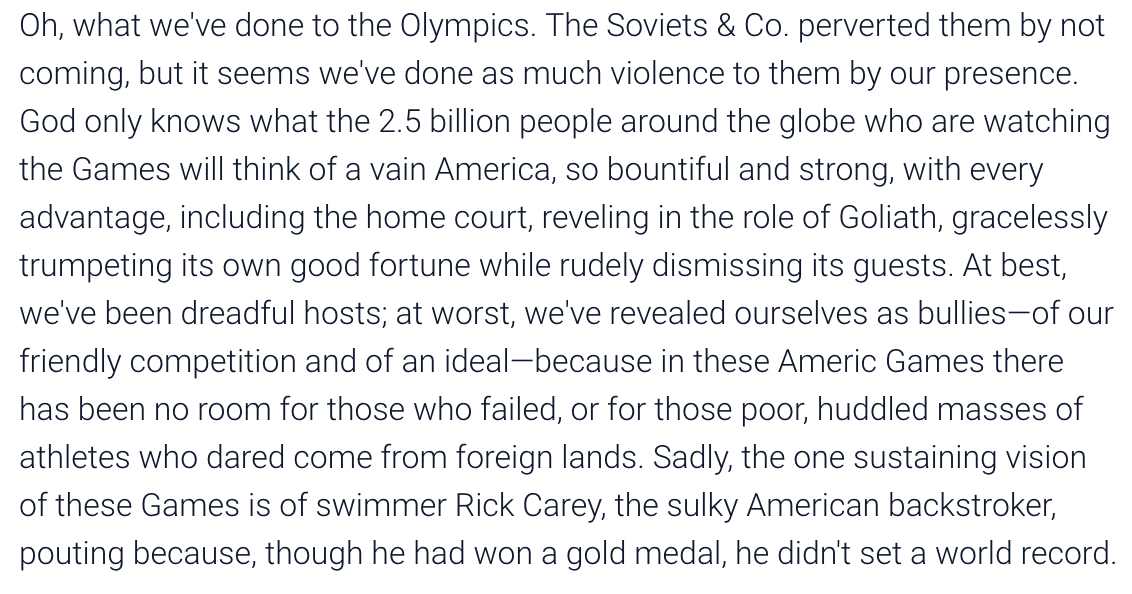
Excerpt from Frank Deford, “Cheer, Cheer, Cheer For The Home Team,” Sports Illustrated, August 13, 1984, p. 38. (http://www.si.com/vault/1984/08/13/620469/cheer-cheer-cheer-for-the-home-team).

The famous and often loopy sports writer Frank Deford wrote this about America’s narcissistic display of celebration in the 1984 Summer Olympics in Los Angeles. Despite the changes in location, the change in networks, and the shifts in coverage over the years, the ability of the US to celebrate its greatness as if the nation was an underdog every four years knows no bounds. Americans moralize, spin stories of wholesome athletes, and frame the games as if the rest of the world is a bunch of losers. Chuck a few words like “The Soviets,” “2.5 billion,” and “Rick Carey,” and substitute “The Chinese,” “5 billion,” and “Lilly King” or “Michael Phelps.” That, and the locale being Rio de Janeiro, are the main differences.

The late Barbara Billingsley as June Cleaver in Leave It To Beaver, October 17, 2010. (http://www.digitaljournal.com/article/299042).

The late Barbara Billingsley as June Cleaver in Leave It To Beaver, October 17, 2010. (http://www.digitaljournal.com/article/299042).

NBC’s coverage has been narcissistic jingoism to the extreme. If you want to see Olympians from other countries who competed but didn’t win gold — or Olympians who won gold but don’t speak English — you can pretty much forget about seeing them on NBC. BBC News has provided more of this global coverage, even in the midst of its British/British Commonwealth bias. NBC can say that it’s giving Americans what they want. Really? Primetime coverage on the mothership and spotty and often tape-delayed coverage on its other channels, with a few clips online? Wow, Americans must only care about America so much that they are willing to miss hours of inspirational stories and exemplary athletic performances. Yet apparently Americans do want the dozens of mentions of Maya DiRado’s recent marriage and new house in Atlanta, where she’ll apparently settle down like June Cleaver after The Games. That, and that most Americans expect to win, like the way L.A. Lakers fans have been at home games assuming twenty-point blowouts night after night for the better part of 60 years.

This isn’t to say that Americans haven’t achieved greatness during the Rio Games. Michael Phelps, Katie Ledecky, Lilly King, Maya DiRado, Simone Biles, Simone Manuel, Laurie Hernandez, Michelle Carter, Ibtihaj Muhammad, Aly Raisman, Gabby Douglas, Corey Cogdell-Unrein, Allyson Felix, among so many others, have had great, even historic, times. Yet Americans celebrated Ledecky’s 11-second win in the 800m final as if it was preordained magic and proof of American imperial superiority at the same time. Swimming is a resources-dependent sport, requiring Olympic-sized pools, investments in coaching, and thousands of hours of training. That Ledecky won by such a huge margin isn’t just an indication of superior athletic talent and training. It’s a reflection of a serious financial commitment by parents and public/private funds from the richest nation in the world to making gold medals in swimming a priority. It’s an example of haves versus have-nots, an unfairness baked into the cake of the Social Darwinist modern Olympics from the time they began in 1896.

Rich vs. Poor cartoon, John Darkow, September 18, 2011. (http://www.columbiatribune.com).

Rich vs. Poor cartoon, John Darkow, September 18, 2011. (http://www.columbiatribune.com).

Lilly King and others have moralized about their achievements being done without the enhancements of PEDs. As if American athletes are always clean. As if American Olympians haven’t been caught doping in the recent past. As if the advantages of living in a wealthy nation committed to winning above all else doesn’t translate into maximizing athletic talents in every Olympic sport. King’s bravado might have been seen as cute or wonderful by some, especially over her Russian competitor Yuliya Efimova. But it’s no different from Donald Trump bragging about how much money he has to a room full of ex-cons who served time for shop lifting or stealing a few dollars.

There’s a racial component to all of this as well. It’s okay for wholesome folks like Phelps to make Chad Le Clos look stupid, or for King to moralize about doping. Not so much in the Black-dominated track and field, or in men’s basketball, or for Blacks in swimming and gymnastics. There, Americans not only expect their Olympians to win. They expect them to know their place, not discuss race, and have their hand over their heart when the National Anthem’s playing.

U2 in “Crumbs From Your Table” (2004) asked the question — in regard to rich countries like the US — “Would you deny for others what you demand for yourself?” In the case of the US, the answer is, “U-S-A! U-S-A! U-S-A!,” or “Y-E-S! Y-E-S! Y-E-S!” Americans already do it to each other, through racism, misogyny, homophobia, xenophobia, and plutocracy. Why would it be different for the US regarding the rest of the world?

When Your Music Turns 30

11 Thursday Aug 2016

Posted by decollins1969 in 1, Boy @ The Window, culture, Eclectic, eclectic music, music, Pop Culture, race, Youth

≈ Leave a comment

Tags

1980s music, Anita Baker, Beyonce, Bruce Hornsby and The Range, Chaka Khan, Chicago, Fountain of Middle Age, Kendrick Lamar, Maverick Sabre, Nneka, Pet Shop Boys, Run-D.M.C., Starship, Steve Winwood


Well, some of my music, anyway. About a third of all the music I own, like, or have access to was produced at least thirty years ago, as of this month. I guess I shouldn’t be bothered with the fact that everything from Johann Sebastian Bach, Blind Willie Johnson, and John Coltrane to Anita Baker, Steve Winwood, and Pet Shop Boys are all ancient in the mind of my teenage son. In a way, though, I am. Not so much that my music collection is an indication that I am no longer physically young. That happens to all of us. But whether this is a sign that my mind is no longer plastic enough to absorb new music, new styles, new ways of delivering a form of entertainment and escapism.

The fact that I’m still catching up with music released between 2011 and 2014 is troubling. I mean, it’s only been a year and a half since I picked up Kendrick Lamar’s Good Kid, MAAD City (2012). I have Nneka and Maverick Sabre on my playlists only because my wife keeps up with music through YouTube, Spotify, and Pandora. I still haven’t heard or seen the video for Beyoncé’s “Lemonade,” have yet to hear a Nicki Minaj or Rihanna song that I truly like, and think that Drake and Meek Mill are pretty weak. Am I getting so old that I don’t understand what is or isn’t good music anymore? Or, did I ever have a handle on what was and is good music when I was sixteen, and am more discerning or snobbish now? Or, am I just a goofball who wouldn’t know good music if it bit me in the ass?

Maybe it’s all of the above. Below is a sample of my list of song that I described as theme music for Boy @ The Window. This is all music that came out in ’86.

Screen Shot 2016-08-10 at 12.17.21 PM

There are some amazing songs on this list. Anita Baker’s “Sweet Love.” Simply Red’s “Holding Back The Years.” Sade’s “Never As Good As The First Time.” Who could argue with these? If anyone does, they just hate the whole genre of ’80 pop and R&B, and refuse to appreciate the music on any level.

Now there are other where I will concede the quality is questionable, but I like anyway. Pet Shop Boys’ “West End Girls,” Michael McDonald’s “Sweet Freedom,” and Falco’s “Rock Me Amadeus” all fit into all kinds of questionable tastes here. But compare “Sweet Freedom” to Prince’s “Raspberry Beret” and its syrupy goofiness. Or, really, Michael McDonald’s super-popular duet with Patti LaBelle in “On My Own.” I hated that song as much as I could hate any music, but I was apparently in a small minority three decades ago. Baby Boomers – gotta love ’em!

There’s also Steve Winwood’s “Higher Love” with Chaka Khan doing background vocals. You take Chaka Khan out of this song, and it’s an ’80s display of synthesizer prowess with pretty decent lyrics. Bruce Hornsby and The Range’s “The Way It Is” was and remains a simplistic “hearts and minds” analysis of American racism, but it was at least a self-consciously effort to address a social issue. Even when folks fall short, I can appreciate their music.

There are plenty of songs from thirty years ago that I either thought were silly, didn’t represent my mood from that time, or were a reflection of my need to escape my life. Anything by Chicago or Starship from ’86 would fit. I heard Starship’s “Nothing’s Going To Stop Us” at the local Trader Joe’s, a few days ago, and my stomach started cramping up. I actually got nauseous over a song! Grace Slick’s voice remains scary, I guess.

The thread between the music I listened to three decades ago and the music I have on my iPod, iPhone, and computers is clear, to me, if no one else. With the exception of country music as Whiteness affirming, I generally don’t care what genre it’s from. The lyrics are more important than the quality of vocals, and the vocals and music are way more important than any video made with the song. That probably makes me a bit old-fashioned. But it’s also why I still have music in my collection that predates my birth.

← Older posts
Newer posts →

Boy @ The Window: A Memoir

Boy @ The Window: A Memoir

Places to Buy/Download Boy @ The Window

There's a few ways in which you can read excerpts of, borrow and/or purchase and download Boy @ The Window. There's the trade paperback edition of Boy @ The Window, available for purchase via Amazon.com at http://www.amazon.com/Boy-Window-Donald-Earl-Collins/dp/0989256138/

There's also a Kindle edition on Amazon.com. The enhanced edition can be read only with Kindle Fire, an iPad or a full-color tablet. The links to the enhanced edition through Apple's iBookstore and the Barnes & Noble NOOK edition are below. The link to the Amazon Kindle version is also immediately below:

scr2555-proj697-a-kindle-logo-rgb-lg

Boy @ The Window on Amazon.com: http://www.amazon.com/Boy-The-Window-Memoir-ebook/dp/B00CD95FBU/

iBookstore-logo-300x100

Boy @ The Window on Apple's iBookstore: https://itunes.apple.com/us/book/boy-the-window/id643768275?ls=1

Barnes & Noble (bn.com) logo, June 26, 2013. (http://www.logotypes101.com).

Boy @ The Window on Barnes & Noble: http://www.barnesandnoble.com/w/boy-the-window-donald-earl-collins/1115182183?ean=2940016741567

You can also add, read and review Boy @ The Window on Goodreads.com. Just click on the button below:

Boy @ The Window

Twitter Updates

Tweets by decollins1969
  • RSS - Posts
  • RSS - Comments

Archives

  • June 2025
  • April 2023
  • September 2022
  • August 2022
  • July 2022
  • June 2022
  • May 2022
  • April 2022
  • March 2022
  • January 2022
  • December 2021
  • November 2021
  • October 2021
  • September 2021
  • August 2021
  • July 2021
  • June 2021
  • April 2021
  • March 2021
  • February 2021
  • January 2021
  • December 2020
  • November 2020
  • October 2020
  • September 2020
  • August 2020
  • July 2020
  • May 2020
  • April 2020
  • March 2020
  • January 2020
  • December 2019
  • November 2019
  • August 2019
  • July 2019
  • June 2019
  • May 2019
  • April 2019
  • March 2019
  • February 2019
  • January 2019
  • December 2018
  • November 2018
  • October 2018
  • September 2018
  • August 2018
  • July 2018
  • June 2018
  • May 2018
  • March 2018
  • February 2018
  • January 2018
  • December 2017
  • November 2017
  • October 2017
  • September 2017
  • August 2017
  • July 2017
  • June 2017
  • May 2017
  • April 2017
  • March 2017
  • February 2017
  • January 2017
  • December 2016
  • November 2016
  • October 2016
  • September 2016
  • August 2016
  • July 2016
  • June 2016
  • May 2016
  • April 2016
  • March 2016
  • February 2016
  • January 2016
  • December 2015
  • November 2015
  • October 2015
  • September 2015
  • August 2015
  • July 2015
  • June 2015
  • May 2015
  • April 2015
  • March 2015
  • February 2015
  • January 2015
  • December 2014
  • November 2014
  • October 2014
  • September 2014
  • August 2014
  • July 2014
  • June 2014
  • May 2014
  • April 2014
  • March 2014
  • February 2014
  • January 2014
  • December 2013
  • November 2013
  • October 2013
  • September 2013
  • August 2013
  • July 2013
  • June 2013
  • May 2013
  • April 2013
  • March 2013
  • February 2013
  • January 2013
  • December 2012
  • November 2012
  • October 2012
  • September 2012
  • August 2012
  • July 2012
  • June 2012
  • May 2012
  • April 2012
  • March 2012
  • February 2012
  • January 2012
  • December 2011
  • November 2011
  • October 2011
  • September 2011
  • August 2011
  • July 2011
  • June 2011
  • May 2011
  • April 2011
  • March 2011
  • February 2011
  • January 2011
  • December 2010
  • November 2010
  • October 2010
  • September 2010
  • August 2010
  • July 2010
  • June 2010
  • May 2010
  • April 2010
  • March 2010
  • February 2010
  • January 2010
  • December 2009
  • November 2009
  • October 2009
  • September 2009
  • August 2009
  • July 2009
  • June 2009
  • May 2009
  • April 2009
  • March 2009
  • February 2009
  • January 2009
  • December 2008
  • November 2008
  • October 2008
  • September 2008
  • August 2008
  • July 2008
  • June 2008
  • May 2008
  • April 2008
  • March 2008
  • February 2008
  • January 2008
  • December 2007
  • November 2007
  • October 2007
  • September 2007
  • August 2007
  • July 2007
  • June 2007

Recent Comments

MaryPena's avatarMaryPena on My Day of Atonement/Bitter Hat…
decollins1969's avatardecollins1969 on No Good Teaching Deed Goes…
Mary Rose O’Connell's avatarMary Rose O’Connell on No Good Teaching Deed Goes…

NetworkedBlogs on Facebook

NetworkedBlogs
Blog:
Notes From a Boy @ The Window
Topics:
My Life, Culture & Education, Politics & Goofyness
 
Follow my blog

616 616 East Lincoln Avenue A.B. Davis Middle School Abuse Academia Academy for Educational Development AED Afrocentricity American Narcissism Authenticity Bigotry Blackness Boy @ The Window Carnegie Mellon University Child Abuse Class of 1987 CMU Coping Strategies Crush #1 Crush #2 Death Disillusionment Diversity Domestic Violence Economic Inequality Education Family Friendship Friendships Graduate School Hebrew-Israelites High-Stakes Testing Higher Education History Homelessness Humanities Humanities Program Hypocrisy Internalized Racism Jealousy Joe Trotter Joe William Trotter Jr. K-12 Education Love Manhood Maurice Eugene Washington Maurice Washington Misogyny Mother-Son Relationship Mount Vernon High School Mount Vernon New York Mount Vernon public schools Multiculturalism MVHS Narcissism NFL Pitt Pittsburgh Politics of Education Poverty President Barack Obama Race Racial Stereotypes Racism Relationships Self-Awareness Self-Discovery Self-Reflection Sexism Social Justice Teaching and Learning University of Pittsburgh Violence Whiteness Writing

Top Rated

Blog at WordPress.com.

  • Subscribe Subscribed
    • Notes from a Boy @ The Window
    • Join 103 other subscribers
    • Already have a WordPress.com account? Log in now.
    • Notes from a Boy @ The Window
    • Subscribe Subscribed
    • Sign up
    • Log in
    • Report this content
    • View site in Reader
    • Manage subscriptions
    • Collapse this bar
 

Loading Comments...