• About Me
  • Other Writings
  • Interview Clips
  • All About Me: American Racism, American Narcissism, and the Conversation America Can’t Have
  • Video Clips
  • Boy @ The Window Pictures
  • Boy @ The Window Theme Music

Notes from a Boy @ The Window

~

Notes from a Boy @ The Window

Tag Archives: University of Pittsburgh

Beyond The Asexual Me

14 Tuesday Jun 2011

Posted by decollins1969 in 1, Boy @ The Window, culture, Eclectic, Pop Culture, race, Youth

≈ Leave a comment

Tags

Concealing, Friendship, Male Psyche, Manhood, Pittsburgh, Psychological Development, Relationships, Revealing, Self-Discovery, Sex, Sexuality, University of Pittsburgh, Youth
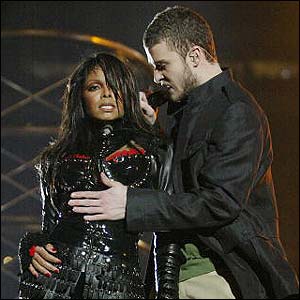

Janet Jackson & Justin Timberlake, one second from revealing more than concealing, Super Bowl 2004. Source: http://www.eurweb.com

The art of the personal essay or larger memoir is the balance between revealing and concealing. You don’t want to reveal too much, but just enough to tell a good and compelling story. You also don’t want to hide too much, because concealing degrades the honesty of the work. For me, though, today’s post reveals a bit more than I’m comfortable with, even though it may not reveal enough for some of you.

This time twenty years ago, even as much as I’d become a more open person and young man in most respects, I still struggled with my heterosexual identity. I’d dated off and on as an undergrad at Pitt and had a few sexual encounters. But I really wasn’t comfortable with any woman within three years of my age. They were often confused about men, themselves, and life in general. I had enough confusion in my life already from my Mount Vernon, New York years without spending time with another confused twenty-two-year-old whose goal in life was to be a professional student.

The personification of “another confused twenty-two-year-old” was my sometimes friend, sometimes more in “Another E” (see my post “The Power of Another E” from April ’09). By the time June ’91 rolled around, she’d bitterly disappointed me — again. E had stood me up for a date to see Godfather III, had stopped returning my phone calls, and somehow managed to duck me for lunch for more than two weeks. I was angry, more with myself than her, about how turned around I felt about this sudden loss of contact.

I wanted to move on, to get over the pedestal-building, damsel-in-distress paradigm that had been my relationship with girls and women since the days of Crush #1 (and the need to save my mother from my ex-stepfather) from so many years before. So I deliberately sought advice, deciding for once that I could live with the shame and embarrassment of liking a female who may have liked me well enough, but also enjoyed the thought of taking advantage of me.

A Black guy I worked with at the PAARC project at Western Psych was my key counsel. We’d become good acquaintances over the previous couple of months while he complained about his doctoral courses and I complained about the flat-butt Whites in charge of the project. On the first Saturday in June, he invited me and a couple of his closer friends over to his place on the North Side for barbecue and basketball. He killed me on the court, not telling me until he won 21-12 that he’d played as a starter on Grambling’s basketball team.

Later we talked about my troubles with E, in between the ribs and the beer on his over-leathery couch. After

Woman on a pedestal, with a man on his knees, in this case, me from '82 to '91, June 14, 2011. Source: http://elephantjournal.com

two minutes of hearing me pine and opine, he said, “She’s trifling, dude. Just ignore her and move on.” I said, “I’m not sure I can,” thinking, I don’t want to play games here. Then my friend explained that I needed to see E exactly the way I saw myself, as a flawed human being with human needs. That if she really liked me like she said, then she’d eventually give me a call or try to contact me. If not, then get out there in the world and find someone else to hook up with.

I left, reluctant about the man’s advice, but determined to do something besides feeling lonely all summer. For nearly a year, I’d lived in the East Liberty neighborhood, about a block away from a hole-in-the-wall bar that’s now a CVS on Penn Avenue. I’d thought about going in before, but that second Saturday in June ’91, I finally did, by myself, with no plans other than to observe the wild life. I witnessed two fights, at least two women too drunk to stand up, and a bartender that mixed drinks about as well as a seven-year-old making Kool-Aid.

Then I met her. An older woman — at least by my twenty-one-year-old standards — who was in much better shape than anyone I’d been in undergrad with. She started a conversation with me, and I engaged, something I usually avoided. After about fifteen minutes, our small talk that suddenly became very direct. We left, for my place.

It turned out that she was thirty-four, had been married once, and had two kids between ten and fifteen years old. She also had experience (no, not just that kind of experience) that taught me quite a bit in those months before my first year of grad school at Pitt. I learned that I liked older women — if by older, women between twenty-four and fifty — and that I was much more of a butt man than I was a breast man.

But I learned something much more valuable than developing a mental tape measurer. I learned that I could be intimate, really intimate with another person, with a woman, about who I was and wanted to be, without putting them on a pedestal and making them untouchable, heavenly beings. I learned that a sexual encounter could be both awkward and fun at the same time. I learned to see myself as a man, not just a young man or a man-child, but as a man and only a man, in no small part because of that encounter and that summer.

Black Male Id-entity & the F-Bomb

26 Thursday May 2011

Posted by decollins1969 in 1, Boy @ The Window, culture, Eclectic, Politics, Pop Culture, race, Youth

≈ Leave a comment

Tags

616, 616 East Lincoln Avenue, Anti-Gay Slur, Authenticity, Basketball, Basketball Courts, Bigotry, Black Males, Carnegie Mellon University, Context, Coolness, F-Bomb, F-word, Faggot, Heterosexism, Homophobia, Joakim Noah, Kobe Bryant, Michael Wilbon, Mount Vernon New York, Nathan Hale Elementary, NBA, Nigga, Pitt, Pittsburgh, Playgrounds, Sean Miller, Toure X, Twitter, University of Pittsburgh, Washington DC, Words


Joakim Noah Apparently Says ‘F–k You Faggot’ To Fan (VIDEO)

Joakim Noah Apparently Says ‘F–k You Faggot’ To Fan (VIDEO)

Gay Rights Month isn’t for another six days, as it’s still May. But in light of Joakim Noah’s unfortunate anti-gay slur outburst, “Fuck you, faggot!,” it makes sense to start this year’s conversation a week early.

This is more than about the NBA, gay athletes in the closet or what professional athletes should and shouldn’t say to fans and to each other. The behind-the-curtain issue here could just as well be about Black male identity (whether heterosexual or gay) and how Black males express themselves to each other and to the rest of the world.

My first memories playing with a group of Black males in Mount Vernon, New York are all negative. When I was six in ’76, a group of preteens on the neighborhood playground near Nathan Hale Elementary on South 6th Avenue tried to force me into sucking one of their dicks, practically sticking it in my face to do so. I got away before being truly scarred for life. After we moved to 616 East Lincoln Avenue in April ’77, our first time playing outside was spent running away from the other kids, who greeted us by throwing rocks at us and calling me and my brother Darren “faggots.” (see my June 1, 2009 post, “In the Closet, On the Down Low” for more).

When I was nine, I played basketball on a court near 616 for the first time with a group of kids from my building. After throwing up an awkward brick and an air ball, I got five minutes of “You terrible!,” “You need to sit down!,” “You’re never gonna be an athlete!,” “You need to get back to reading them books of yours!,” and “You shoot like a faggot!”

Even though I eventually learned how to dribble with both hands, shoot a j, make layups, block shots, and on rare occasions, dunk a basketball, I’ve been leery being around other Black males on the basketball court. One would think after playing pickup with former Pitt basketball players while in grad school that I’d completely forgotten what happened to me back in the spring of ’79. But I hadn’t, at least on an unconscious level. I often watched what I said, I mean, down to every single word. Not to mention how I walked, where my arms were, and how I held my head. Still, I sometimes felt inadequate on the court, whether I went 8-for-9 or 2-for-7, blocked a shot, stole a ball, or got knocked down guarding someone six-foot-six and 260 pounds.

But I figured out something in those years of playing pickup at Pitt and Carnegie Mellon and other places in Pittsburgh and DC over the years. That blending in doesn’t matter. Fools — even ones with momentary lapses in judgment like Joakim Noah — will be fools because on the playground or court, it makes them cool in the minds of their peers.

Yes, this isn’t just a Black male issue. Sean Miller, currently coach of the University of Arizona men’s basketball team — not to mention an all-time Pitt basketball great — once played a prank on me our freshmen year. He called me up in my Lothrop Hall dorm room late one night, offered me a blow job, and called me a “faggot” in the process.  So being called a “faggot” or saying that something or someone is “gay” is part of our culture on and off the basketball court, for Black and White males to be sure.

But unlike Michael Wilbon, I can’t excuse it because it’s commonplace and therefore it may be difficult for some young men to immediately stop themselves from saying “faggot.” Nor can I rationalize this like Touré (a.k.a. TouréX on Twitter) attempted to do in a Twitter exchange with me a couple of days ago. He compared the use of “faggot” to “nigga,” with the idea that both words have more than one meaning and that the meaning can sometimes be positive, depending on context.

I can see the argument for “nigga,” even though I don’t like it when younger men use it to affirm each other and especially me. But “faggot” meaning “less than a man?” Or “stupid” or “dumb?” So is Noah or Kobe more of a man for telling someone else they’re not a man? Even in context, this isn’t positive — it’s potentially soul-destroying, and not just for someone being called a faggot.

Of the preteens and young boys who called me “faggot” growing up, at least three have served hard time. Is there a direct connection? Of course not. Still, it seems that a culture steeped in the requirement of being cool, finding quick and easy success and putting down others while doing so lends itself well to a crash-and-burn mentality that so many of us have about our lives.

The Miracle of Dr. Jack Daniel

16 Monday May 2011

Posted by decollins1969 in 1, Academia, Boy @ The Window, culture, Politics, race, Youth

≈ Leave a comment

Tags

"Sometimes Starvation", Cathedral of Learning, Challenge Scholarship, Department of HIstory, Diversity, Divine Intervention, Dr. Jack Daniel, Dr. Jack L. Daniel, Grad School, Graduate Fellowships, History Department, Jack Daniel, Joe Carbone, Miracles, Pitt, Qualifications, Race, Students of Color, University of Pittsburgh, Van Beck Hall, Westchester County Department of Community Mental Health


Dr. Jack L. Daniel, University of Pittsburgh, 2004. Pitt Magazine. http://www.pittmag.pitt.edu/summer2004/feature1.html. The use of this photo falls under fair use under US Copyright laws because this blog post is in fact about the subject in this photo.

Last week I started a conversation about my three weeks of starvation in order to secure my entry into graduate school through my post, “Sometimes Starvation.” I’m continuing that conversation with today’s post. For it was that on this date twenty years ago that divine intervention came in the form of a voice inside my head, leading me to a meeting with then University of Pittsburgh Vice-Provost for Academic Affairs, Dr. Jack L. Daniel.

Even as I turned down the opportunity to go back to Mount Vernon and work up in White Plains with Joe Carbone and Westchester County Department of Community Mental Health for the summer of ’91, a name kept popping in my head. And I didn’t know why. I’d only met Jack Daniel on two occasions, both during my freshman year at Pitt. I was a Challenge Scholar, in the inaugural class of Challenge Scholars no less, a merit-based half-tuition scholarship meant to attract more students of color to Pitt, and Dr. Daniel was the author of the program.

I knew that he was a professor with expertise in Black communications. I also knew that he was one of the activists who helped bring the Black Studies Department to Pitt in ’69 by occupying the central computing system on the seventh floor of the Cathedral of Learning, back when he was a freshly minted Ph.D. Other than that, I had zero contact with the man in my four years of undergrad.

For once, I listened to the voice inside my head and, after some coaxing of Dr. Daniel’s assistant, made an appointment with him to discuss my financial options for going to Pitt for my history MA. I figured that I had nothing to lose. I really only hoped that there was an extra $1,000 or two left in his budget that would at least help to feed me through my first year of grad school.

That Thursday, the sixteenth of May, I arrived at my 2:30 pm meeting with Dr. Daniel on the eighth floor of the Cathedral of Learning, not knowing exactly what I was going to say. I walked into the Office of the Provost, where the stale stone of the super-tall building turned into the sights and smells of dark wood, cherry, mahogany even. We exchanged pleasantries, shook hands, and I sat down feeling like I was in sixth grade instead of like I’d recently finished my bachelor’s.

I started. “I’m looking for a little extra money for grad school this fall, so that I don’t have to borrow money to cover tuition and eat,” I said. Dr. Daniel then asked

“What was your GPA here?”

“A 3.4,” I said, rounding up from a 3.37 average.

“What about your GRE scores?”

“60th and 70th percentile on math and reading,” I said.

“What about your major?,” Dr. Daniel asked.

“I was a history major with a 3.82 average,” I said with a smile.

Then Dr. Daniel got this look on his face, like he was actually angry, like there was a piece to the puzzle that I was missing. “Hold on for a second, I need to make a phone call,” he said.

He called Pitt’s History Department Chair, who at the time was one of my future grad school professors, Van Beck Hall, and spent the next couple of minutes chewing him out about my record and about why I hadn’t been awarded a fellowship. I sat there with a stone face, not wanting to give away the sense of glee I felt watching Dr. Daniel on the phone while verbally beating up on a department chair. Politely, of course.

After he got off the phone, he said, “You’ve got your money for school next year.” My mouth fell open, and not just because I couldn’t believe it. I couldn’t believe how easy it was. Then Dr. Daniel explained how his office had worked with the Faculty of Arts and Sciences (and the other major schools within the university) to create a new fellowship to attract more students of color and women into Pitt’s grad programs. He also explained how some departments and programs had resisted communicating the existence of this new fellowship program to potential grad students. I apparently was another case demonstrating how some folks within the university simply refused to address Pitt’s lack of diversity at the graduate level.

I was beyond thankful. Incredulous, thankful, even speechless. I couldn’t stop shaking Dr. Daniel’s hand. Despite three weeks and a loss of twenty-plus pounds, I played basketball at Pitt’s athletic center that evening, making shots as if I’d been on an athlete’s diet for the past three weeks. I was more excited about the possibility of grad school being paid for than I was about getting my first paycheck of the summer that Friday.

The following Tuesday evening, the twenty-first of May, I saw Dr. Daniel walking down Fifth Avenue outside of the Cathedral of Learning as I was on my evening walk home from work. I told him that I’d gotten the paperwork for my full-tuition fellowship and $7,000 graduate student assistantship stipend for the ’91-’92 school year. As he walked away after I said, “Thank you!,” again, I yelled “You’re the man!” All Dr. Daniel did was stretch out his long arms, shrugging it off as if he’d given me a nickel to buy a Tootsie Roll.

Sometimes Starvation

12 Thursday May 2011

Posted by decollins1969 in 1, Academia, Boy @ The Window, Eclectic, race, Work, Youth

≈ 1 Comment

Tags

Andrea Hegedus, Department of HIstory, East Liberty, Graduate School, Job, Joe Carbone, Malnourishment, Oakland, PAARC, PAARC project, Shadyside, Starvation, Undergrad, University of Pittsburgh, Weight Training, Weights, Westchester County Department of Community Mental Health, Western Psych, Western Psychiatric Institute & Clinic, Work


Me (at 185 lbs) & Mark James (Cropped), Pan-African Graduate & Professional Student Association, University of Pittsburgh, February 27, 1993. Lois Nembhard.

My last semester at the University of Pittsburgh as an undergrad (Spring ’91), I took a one-credit Weight Training course. I wanted to learn how to use free weights and weight machines so that I could build muscle tone. I wanted a course that would be easy for me to pass, one in which I could burn up my anxieties while awaiting word about my graduate school future.

Over the course of the semester, I did build muscle. I weighed 175 pounds in January. By my last class on the twenty-third of April, I weighed 183 pounds. I was proud of the fact that the eight-pound gain was all muscle.

But with the end of the school year and undergrad at Pitt came a crisis. Even though I’d start work on the twenty-ninth with the PAARC project at Western Psychiatric as a full-time employee, I wouldn’t receive a paycheck that Friday, the third of May. Instead, I’d have to work for three weeks before receiving pay. After a year of underemployment as a student (I only worked ten or twelve hours a week because I couldn’t pay the other half of my tuition via student loans and keep my work-study allotment at the same time), I thought I was finally over the hump.

It was bad enough that despite my degree, which qualified me for $8.50 an hour, Andrea Hegedus and the other PAARC  bosses only saw fit to pay me at $5.20 per hour. Now I knew that I’d have to figure out how to live on $30 for the next three weeks.

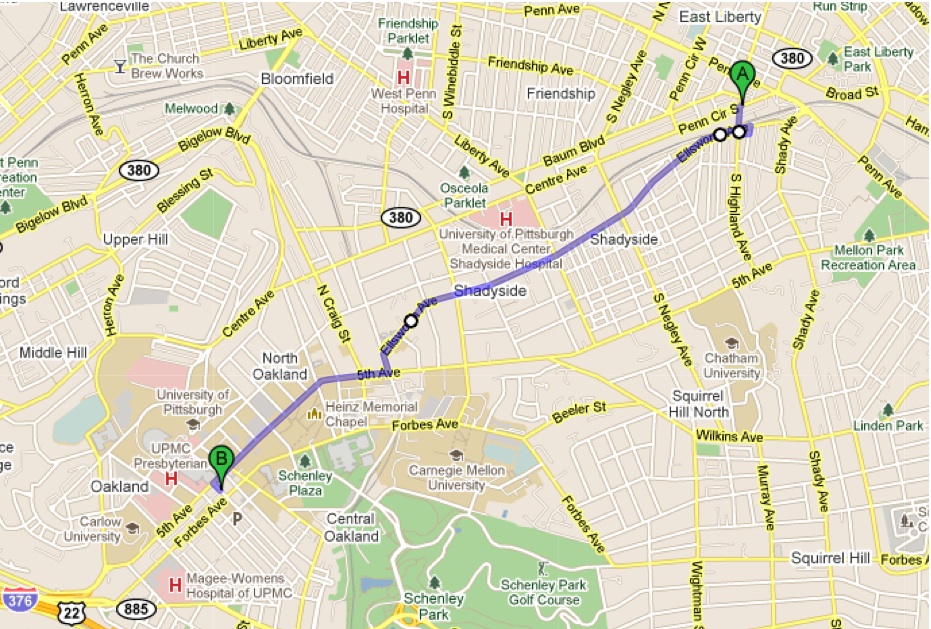
The first week went well enough. I brought lunch from home, consisting of a dried-up hamburger on wheat bread one day, leftover spaghetti the next, and a couple of days in which I didn’t eat lunch at all. That was because I saved my baked chicken and spaghetti leftovers for dinner. I also conserved money by walking the two and a half miles between my apartment on the East Liberty/Shadyside neighborhood border and the Oakland neighborhood in which Pitt and Western Psychiatric are located. Each way.

My Route To/From Work, 6007 Penn Cir S, Pittsburgh, PA 15206 to Atwood St & Forbes Ave – Google Maps, May 12, 2011.

By the end of the second week, I was down to my last $5. It was the tenth of May, and I had another week before payday. It was bad enough I walked five miles to and from work every day and skipped lunch all that second week. The PAARC folks used me to do everything from going to Giant Eagle to buy half-and-half for their coffee to running across Pitt’s campus hunting for books and making 3,000 copies of X and 2,200 copies of Y. Mind you, they hired me to design databases and input data. Surprise, surprise, I had a headache at the end of every work day.

That Friday, I got a call from my old job at Westchester County Department of Federal Programs. It was my boss from the previous summer and holiday season, Joe Carbone, wanting to know if I’d come work for him another summer. Working for him had been a wonderful experience. But the reason I stayed in Pittsburgh was because I wanted to explore the option of grad school as far as possible, even if it meant getting doors slammed in my face. I couldn’t do that while working in White Plains and living at 616 all summer. So, reluctantly, I said, “No, I can’t do it this year,” knowing that I’d get an earful from Mom once I told her my decision.

The one and only time in my life I dined on these, May 12-16, 1991. Source: http://www.stevegarufi.com/ramen1.jpg

It seemed a ridiculous decision two days later. I was down to my final $2.10. I went to Giant Eagle that Sunday, bought a six-pack of ramen noodles for a dollar, and two packs of Kool-Aid for forty cents more. I had enough to by a can of soda, maybe some candy, and that was it until the seventeenth of May.

What compounded my confounding decision was that I remained sixth on the teaching assistant fellowship waiting list in Pitt’s History Department. What made that worse was the fact that no fewer than four students had passed me on the list since I’d first seen it four weeks earlier, all White and male.

Somehow, though, I had faith beyond my circumstances that things were going to work out just fine. I guess all those years of malnutrition at 616 helped me. By the week after my first paycheck for the summer, grad school at Pitt was a done deal, and I had food to eat again.

I weighed myself about five days after my starvation diet at the student athletic center. I weighed 167 pounds, which meant that my weight had dropped to nearly 160 pounds by May 17, and had only begun to recover. I could see nearly all of my ribs, front and back, not to mention my collarbone.

By the Wednesday after three weeks of little and no food, none of that ordeal mattered. For the miracle that I’d hoped in happened just days after my infamous “No” to Joe Carbone. (to be continued).

One Good Woman

28 Thursday Apr 2011

Posted by decollins1969 in 1, Boy @ The Window, culture, Eclectic, eclectic music, Marriage

≈ Leave a comment

Tags

"Another E", "One Good Woman", "Ordinary People", Crush #1, Images, John Legend, Love, Marriage, Peter Cetera, Pitt, Pittsburgh, Romance, The Power of Another E, Understanding, University of Pittsburgh, Women


My Wife, Angelia Levy, April 2010. Angelia N. Levy

Today is our eleventh wedding anniversary. Tomorrow is a Crush #1 day. The next month covers a series of events that includes my first “date” with my now wife nearly sixteen years ago. Not to mention my last “dates” with the woman who’s the subject of my blog post, “The Power of Another E” (April ’09) from twenty years ago.

And then there’s my Mom, somewhere in the background, distant but still there, reminding me of all that made me, well, me. At least the me that wanted Crush #1, thought too highly of the twenty-two year-old version of “Another E,” and was ready to be involved with my eventual wife. Things have grown so much more complicated since the days when I couldn’t say “Hi” to a woman, much less date or be married to one.

One of my favorite adult contemporary songs about how women can inspire in relationships is Peter Cetera’s “One Good Woman” (1988). It was the first song I’d heard that really summed up the way I’d felt about my first crush back in ’82. And it provided a stark contrast to the way I felt about my second crush/obsession by the time the fall of ’88 rolled around. I bopped to the feelings in that song for much of my sophomore year at Pitt.

But I wasn’t a fool. I knew that there wasn’t anyone in my life at the time, or had been at any time, who could measure up to those lyrics. While Crush #1 definitely “brought out the best in me,” it certainly wasn’t because of her “love and understanding.” The two things I longed for in my life from others I cared for and about was love and understanding. My mother had little of either by the time I was a teenager, even though I know that she did the best she could. It just wasn’t close to good enough. So I put some of my faith in those lyrics, my romantic side in singing those words, eventually with no one in mind.

Even with dating and the ’90s, and even though I played “One Good Woman” less and less, I sought someone in my life who’d fit those lyrics. The problem with a country full of arrogant narcissists — me included — is that most of us present with DSM-IV neuroses (and in some cases, psychoses) long before we reach the stage of love and understanding. For better and certainly for worse, my mother was really the only woman who approximated any sense of the feeling Cetera releases so well in his song. And by approximate, I mean less than one-tenth of the full strength of the music and lyrics of “One Good Woman.”

This isn’t necessarily a bad thing. Sons shouldn’t really think too often of their mother in a romantic light. It certainly would’ve helped to have known how deeply or how superficially I was loved by my mother, but I had nothing in my dating life really to compare it to.

That was, until I met my eventual son’s mother. Angelia was everything in Cetera’s “One Good Woman” lyrics. She wasn’t a dream of it like Crush #1. Or an obsession like Crush #2. Or someone who could be that for a moment like “Another E” or be a trifling ass the next minute like so many women I dated between ’91 and ’96. She was a real woman, good, bad, warts and all.

So when we married eleven years ago, with the Napster era that was, I downloaded Cetera’s “One Good Woman” and made it a permanent part of the collection that would end up on my iPod in ’06. Except that in recent years, my “One Good Woman” image feels more like John Legend’s “Ordinary People,” proving that even women that inspire you to love, cherish and understand are human beings as well.

When I listen to “One Good Woman” these days, I do think of my wife. But I also think of all of the other women who’ve inspired me over the years. Including my mother. Including even some of my more trifling exs. I love my wife, and I hope things in our marriage continue to work even as we work through whatever issues we have from time to time.

Still, I need to remember that romance comes and goes, but marriage only works when people work hard to communicate when they don’t understand, despite their love for each other. If either of us were to quit, it shouldn’t diminish all of the good that I saw and see in that woman, my wife, and the life we’ve had over the past fifteen plus years.

Hail To Pitt

27 Wednesday Apr 2011

Posted by decollins1969 in 1, Academia, Boy @ The Window, culture, Eclectic, eclectic music, Mount Vernon High School, music, New York City, Pop Culture, race, Sports, Work, Youth

≈ Leave a comment

Tags

'91, 1991, Adulthood, Civic Arena, Class of 1991, Diversity, Fellowships, Financial Aid, Graduate School, Graduation, Job, Mount Vernon High School, Mount Vernon New York, NYU, Pitt, Student Loans, Uncertainty, Ungraduate Education, University of Maryland, University of Pittsburgh, Wesley Posvar, Western Psychiatric Institute & Clinic, Work


University of Pittsburgh Logo, April 27, 2011. http://www.pitt.edu

I can be hard on people, places and things, especially the ones I like and love. That’s as true of my undergraduate alma mater as anything else. Twenty years ago this date, I graduated from the University of Pittsburgh. I didn’t attend the cattle-call ceremony at the Civic Arena that Sunday in ’91. Almost none of my immediate circle of friends attended, either. My mother and my younger siblings, still in the midst of welfare, weren’t going to be there to see me anyway. The Penguins were on that day, in the middle of a dominant playoff run, with Lemieux scoring at will. And I had other things on my mind that day and weekend. Like, will I be able to go to grad school without taking out tens of thousands of dollars in student loans?

This was a time of major transition for me. Two years removed from the end of the reign of my ex-stepfather at 616, and four years after I graduated from Mount Vernon High School and my obsession

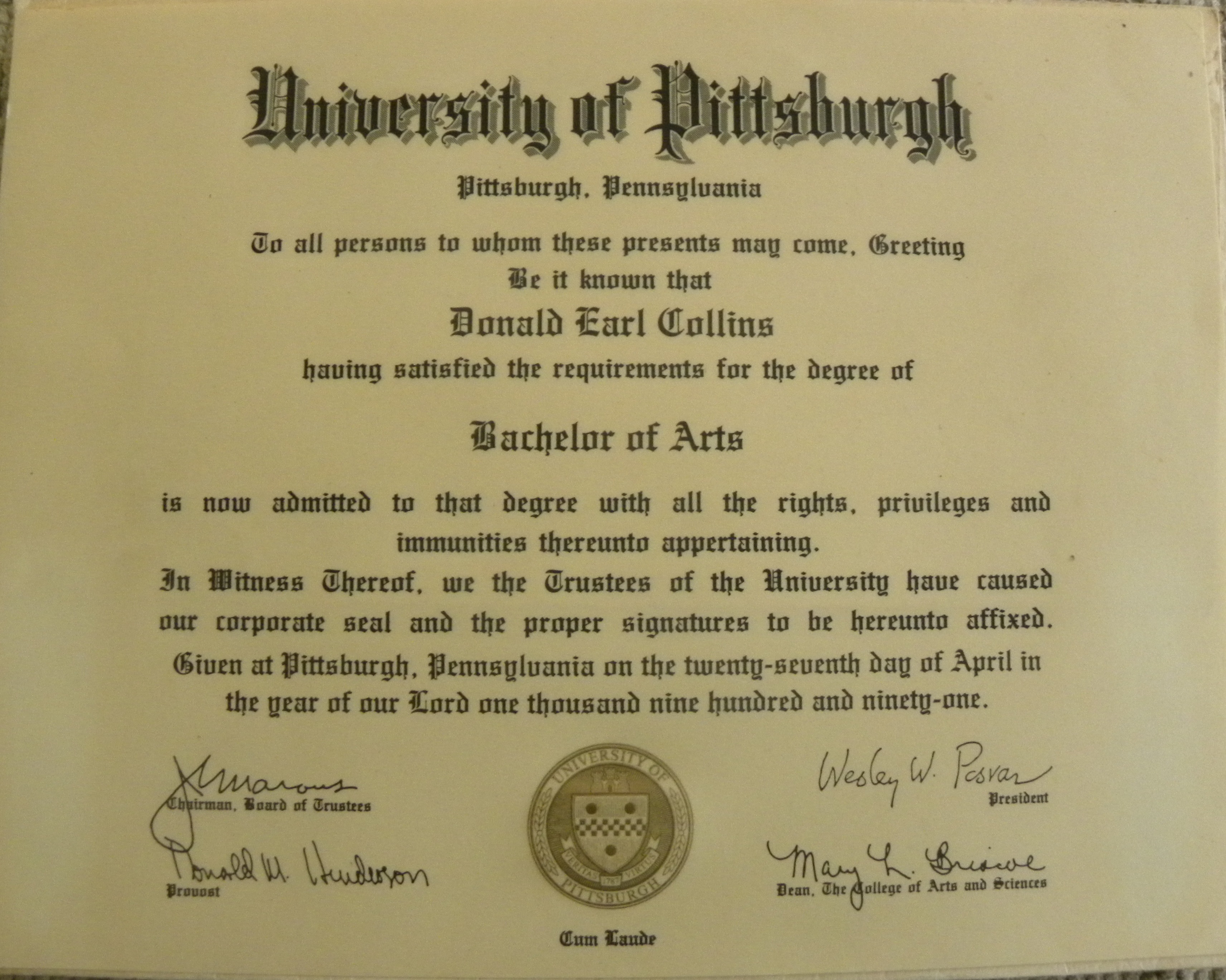
My B.A. degree, University of Pittsburgh, April 27, 2011. Note that this was Wesley Posvar's last graduation signature. The university president would retire the following month amid a $3 million golden parachute scandal.

with Crush #2. I was essentially the same person, and yet there was something inside me that had started clawing its way out over the previous year. It was a drive, a determination, a rage that I’d buried since my first year in Humanities and the summer of abuse that followed in ’82. I was going to graduate school, at least I hoped that I was. Or I was going to have to find a real job, something that made me feel like I had diarrhea.

I knew on my Pitt graduation date that the departments of history at NYU, University of Maryland and Pitt had accepted me into their masters programs. But NYU wanted me to make a signed commitment before they awarded me any financial aid. The University of Maryland conveniently lost my application packet during their graduate fellowship decision process. By the time my packet resurfaced, the department had awarded all of their fellowships, and decided to put me on provisional status. Not based on my grades, mind you, but based on how late they were in going through my application. Pitt had accepted me a couple of weeks before my graduation, but I was sixth on the alternate list for teaching fellowships that would cover my tuition and provide a stipend.

I felt a lot of anxiety about all of this uncertainty regarding my immediate future. It helped to have friends, even with my friends in the middle of their own uncertainty. My friend Marc was working at a Black newspaper, dreaming of law school but uncertain about his prospects. Three other friends, including someone I was sort of dating, were taking their last classes or unsure about grad school or law school. Even my summer job working for a project at the Western Psychiatric Institute and Clinic was shaky. It only paid $5.20 an hour, and I could’ve easily gone back to Mount Vernon and New York making $8 an hour or more doing the same work.

But as uncertain as I felt about things, this much I was certain about. The four years I spent at Pitt were ones that cocooned me in a way that none of my time growing up in Mount Vernon, New York did. I began to heal while I was there, academically, socially, emotionally. I was far from done learning how to connect to people, but I wasn’t the twelve-year-old neophyte keeping only the most rudimentary connections to humans either. My education was a valuable part of that experience. The friendships and other bonds I forms, the lessons I learned about trust, the efforts — however limited — the university made toward creating a campus climate that embraced diversity were all appreciated.

Even at the time, I felt comfortable at Pitt because it was the first place I learned to be comfortable in my own skin. It was a place where my friends, my acquaintances and others around me didn’t look at me like I was a freak because I listened to U2, sang in high-falsetto or walked at Warp Factor 3 to get across campus.

Those are the feelings, those good feelings, that I have about my four years of undergrad and two years of grad school (more on that in May) at the University of Pittsburgh. So, “Hail to Pitt,” and to my Pitt friends and folks from the classes of ’90-’94, Happy Graduation Anniversary Day.

Living in the Land of “No!”

23 Wednesday Mar 2011

Posted by decollins1969 in 1, Academia, Boy @ The Window, culture, Eclectic, Politics, race, Youth

≈ Leave a comment

Tags

Academia, Academic Writing, Ageism, Bias, Bigotry, Career Options, Forbes Quadrangle, Historical Dictionary of American Education, History of Education Quarterly, Multiculturalism, No!, Passion, Pitt, Race, Richard J. Altenbaugh, The Second Plate, University of Pittsburgh, Wesley Posvar Hall, Writing, Yes


People forming a "NO" to London's Heathrow Airport Expansion, May 31, 2008. Source: The Daily Mail http://bit.ly/hc0KSP

There was a time in my career and life when I was desperate to publish an article in a scholarly journal. Right after finishing grad school at Carnegie Mellon at the end of ’96, I set out to write a literature review essay on how folks in education foundations and education policy had covered multiculturalism and connected it — or, in most cases, not connected it — to the politics around this controversial topic during the 1980s and 1990s. Of all the things I’d written up to this point in my career, this was a bit ambitious.

I had submitted an article for publication with the History of Education Quarterly in March ’97 and had made several revisions at Richard Altenbaugh’s request. He was the new senior editor of the journal, as it had recently moved from Indiana University to Slippery Rock to be under his direction. Altenbaugh had also been my professor for my education foundations graduate class in the spring of ’92, and I’d done entries for his Historical Dictionary of American Education, which was published in ’99.

Historical Dictionary of American Education Cover, March 23, 2011. Donald Earl Collins

At Altenbaugh’s behest, I met him and a wildly bearded co-editor at an informal meeting in March ’98. We met at The Second Plate, an eating place on the second floor of Forbes Quadrangle at Pitt, where I’d spent my homeless days in ’88, my history major days, and my first two years of grad school. Over the course of a two-hour lunch that had little to do with the food, Altenbaugh and his assistant grilled me about the contents of my article, my writing in general, and about the publishing business. Now I knew that this essay would need more revisions, but a two-hour inquisition on why a twenty-eight-year-old was too young to make bold conclusions based on existing studies was just a ridiculous argument.

For Altenbaugh and the other editor, I was simply too young to write an essay that reviewed previous scholarly work. Their logic: “even a senior scholar with fifteen years in the field would have trouble pulling this off.” The editors also insisted that the only road to academic Nirvana regarding my work would be through publishing academic articles and books that met the approval of an exclusive scholarly community. Translation: “write something that is interesting to a few other professors — but not so exciting that it would catch the public’s attention — and by all means do not work on something as controversial as multiculturalism.” Oh yeah, they also recommended that get approval for my essay draft from two elderly, nearly-dead White historians before resubmitting to the journal.

Bottom line: my essay was rejected, given a “No!” Not because it didn’t have potential, or because the early drafts weren’t any good. But because I was working on a topic too cutting edge as a Black male who even now at forty-one would be too young — according to these guys — to work on a state of the profession essay on multiculturalism, much less thirteen years ago.

Did their “No!” matter? In one sense it really did. I knew that the topic itself was too controversial for most conservative-thinking (in a topical, not political, sense) editors in scholarly publishing. That there were few venues for me to address multiculturalism in an academic sense. I also knew that their “No!” was about much more than my topic. My age and my race also played a role in their decision to not publish my essay — they said as much by implication. Funny thing is, that in these weird times, I’d probably have a much better shot at publishing this essay now than I did when multiculturalism seemed more relevant.

But in the end, it didn’t matter at all. I was already in the middle of a five-year period of questioning whether I was an academic historian first and a writer second, or was it really the other way around? If the latter was true — and it’s turned out to be — then what did it matter that I pushed to publish on a topic that I cared about, but I was already beginning to lose passion for?

What I learned from that “No!” is that there are times to force a “Yes!” out of the land of “No!” And that there are other times when I should choose to take that “No!” and evaluate my own motives for wanting a “Yes!” In the case of my growth as a writer — both in academic writing and in other kinds of writing — there couldn’t have been a better, more bigoted “No!” than the one I received thirteen years ago.

← Older posts
Newer posts →

Boy @ The Window: A Memoir

Boy @ The Window: A Memoir

Places to Buy/Download Boy @ The Window

There's a few ways in which you can read excerpts of, borrow and/or purchase and download Boy @ The Window. There's the trade paperback edition of Boy @ The Window, available for purchase via Amazon.com at http://www.amazon.com/Boy-Window-Donald-Earl-Collins/dp/0989256138/

There's also a Kindle edition on Amazon.com. The enhanced edition can be read only with Kindle Fire, an iPad or a full-color tablet. The links to the enhanced edition through Apple's iBookstore and the Barnes & Noble NOOK edition are below. The link to the Amazon Kindle version is also immediately below:

scr2555-proj697-a-kindle-logo-rgb-lg

Boy @ The Window on Amazon.com: http://www.amazon.com/Boy-The-Window-Memoir-ebook/dp/B00CD95FBU/

iBookstore-logo-300x100

Boy @ The Window on Apple's iBookstore: https://itunes.apple.com/us/book/boy-the-window/id643768275?ls=1

Barnes & Noble (bn.com) logo, June 26, 2013. (http://www.logotypes101.com).

Boy @ The Window on Barnes & Noble: http://www.barnesandnoble.com/w/boy-the-window-donald-earl-collins/1115182183?ean=2940016741567

You can also add, read and review Boy @ The Window on Goodreads.com. Just click on the button below:

Boy @ The Window

Twitter Updates

Tweets by decollins1969
  • RSS - Posts
  • RSS - Comments

Archives

  • June 2025
  • April 2023
  • September 2022
  • August 2022
  • July 2022
  • June 2022
  • May 2022
  • April 2022
  • March 2022
  • January 2022
  • December 2021
  • November 2021
  • October 2021
  • September 2021
  • August 2021
  • July 2021
  • June 2021
  • April 2021
  • March 2021
  • February 2021
  • January 2021
  • December 2020
  • November 2020
  • October 2020
  • September 2020
  • August 2020
  • July 2020
  • May 2020
  • April 2020
  • March 2020
  • January 2020
  • December 2019
  • November 2019
  • August 2019
  • July 2019
  • June 2019
  • May 2019
  • April 2019
  • March 2019
  • February 2019
  • January 2019
  • December 2018
  • November 2018
  • October 2018
  • September 2018
  • August 2018
  • July 2018
  • June 2018
  • May 2018
  • March 2018
  • February 2018
  • January 2018
  • December 2017
  • November 2017
  • October 2017
  • September 2017
  • August 2017
  • July 2017
  • June 2017
  • May 2017
  • April 2017
  • March 2017
  • February 2017
  • January 2017
  • December 2016
  • November 2016
  • October 2016
  • September 2016
  • August 2016
  • July 2016
  • June 2016
  • May 2016
  • April 2016
  • March 2016
  • February 2016
  • January 2016
  • December 2015
  • November 2015
  • October 2015
  • September 2015
  • August 2015
  • July 2015
  • June 2015
  • May 2015
  • April 2015
  • March 2015
  • February 2015
  • January 2015
  • December 2014
  • November 2014
  • October 2014
  • September 2014
  • August 2014
  • July 2014
  • June 2014
  • May 2014
  • April 2014
  • March 2014
  • February 2014
  • January 2014
  • December 2013
  • November 2013
  • October 2013
  • September 2013
  • August 2013
  • July 2013
  • June 2013
  • May 2013
  • April 2013
  • March 2013
  • February 2013
  • January 2013
  • December 2012
  • November 2012
  • October 2012
  • September 2012
  • August 2012
  • July 2012
  • June 2012
  • May 2012
  • April 2012
  • March 2012
  • February 2012
  • January 2012
  • December 2011
  • November 2011
  • October 2011
  • September 2011
  • August 2011
  • July 2011
  • June 2011
  • May 2011
  • April 2011
  • March 2011
  • February 2011
  • January 2011
  • December 2010
  • November 2010
  • October 2010
  • September 2010
  • August 2010
  • July 2010
  • June 2010
  • May 2010
  • April 2010
  • March 2010
  • February 2010
  • January 2010
  • December 2009
  • November 2009
  • October 2009
  • September 2009
  • August 2009
  • July 2009
  • June 2009
  • May 2009
  • April 2009
  • March 2009
  • February 2009
  • January 2009
  • December 2008
  • November 2008
  • October 2008
  • September 2008
  • August 2008
  • July 2008
  • June 2008
  • May 2008
  • April 2008
  • March 2008
  • February 2008
  • January 2008
  • December 2007
  • November 2007
  • October 2007
  • September 2007
  • August 2007
  • July 2007
  • June 2007

Recent Comments

MaryPena's avatarMaryPena on My Day of Atonement/Bitter Hat…
decollins1969's avatardecollins1969 on No Good Teaching Deed Goes…
Mary Rose O’Connell's avatarMary Rose O’Connell on No Good Teaching Deed Goes…

NetworkedBlogs on Facebook

NetworkedBlogs
Blog:
Notes From a Boy @ The Window
Topics:
My Life, Culture & Education, Politics & Goofyness
 
Follow my blog

616 616 East Lincoln Avenue A.B. Davis Middle School Abuse Academia Academy for Educational Development AED Afrocentricity American Narcissism Authenticity Bigotry Blackness Boy @ The Window Carnegie Mellon University Child Abuse Class of 1987 CMU Coping Strategies Crush #1 Crush #2 Death Disillusionment Diversity Domestic Violence Economic Inequality Education Family Friendship Friendships Graduate School Hebrew-Israelites High-Stakes Testing Higher Education History Homelessness Humanities Humanities Program Hypocrisy Internalized Racism Jealousy Joe Trotter Joe William Trotter Jr. K-12 Education Love Manhood Maurice Eugene Washington Maurice Washington Misogyny Mother-Son Relationship Mount Vernon High School Mount Vernon New York Mount Vernon public schools Multiculturalism MVHS Narcissism NFL Pitt Pittsburgh Politics of Education Poverty President Barack Obama Race Racial Stereotypes Racism Relationships Self-Awareness Self-Discovery Self-Reflection Sexism Social Justice Teaching and Learning University of Pittsburgh Violence Whiteness Writing

Top Rated

Blog at WordPress.com.

  • Subscribe Subscribed
    • Notes from a Boy @ The Window
    • Join 103 other subscribers
    • Already have a WordPress.com account? Log in now.
    • Notes from a Boy @ The Window
    • Subscribe Subscribed
    • Sign up
    • Log in
    • Report this content
    • View site in Reader
    • Manage subscriptions
    • Collapse this bar
 

Loading Comments...