• About Me
  • Other Writings
  • Interview Clips
  • All About Me: American Racism, American Narcissism, and the Conversation America Can’t Have
  • Video Clips
  • Boy @ The Window Pictures
  • Boy @ The Window Theme Music

Notes from a Boy @ The Window

~

Notes from a Boy @ The Window

Tag Archives: Racism

Emancipation and Compromise

01 Tuesday Jan 2013

Posted by decollins1969 in 1, culture, Eclectic, Patriotism, Politics, Pop Culture, race

≈ 3 Comments

Tags

American Civil War, Compromise, Economic Inequality, Emancipation Proclamation, Fiscal Cliff, Fiscal Cliff Deal, Harry Reid, President Abraham Lincoln, President Barack Obama, President Lincoln, President Obama, Racism, Sen. Mitch McConnell, Slavery, Social Justice, social mobility, Social Safety Net, The Great Emancipator, US Civil War
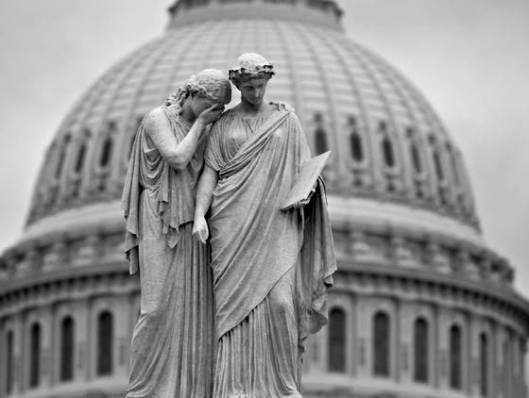

Statuary by the US Capitol, Washington, DC, December 25, 2012. (J. Scott Applewhite/AP).

Statuary by the US Capitol, Washington, DC, December 25, 2012. (J. Scott Applewhite/AP).

Today marks 150 years since President Abraham Lincoln issued an order as Commander-in-Chief that granted freedom to slaves in territories that remained in rebellion against the Union. It enabled Lincoln to become know as the Great Emancipation, and paved the road for the passage and ratification of the 13th Amendment to the Constitution, outlawing slavery in the US, nearly three years later. This is a great thing to remember on this New Years Day, and yet, the Emancipation Proclamation exemplifies flaws in the political tactics of our leaders.

We seldom see real, lasting changes in our nation. Our Founding Fathers wrote our very Constitution with the expressed purpose of protecting “life, liberty, and property,” specifically the property of rich White male slaveowners and merchants. Lincoln used his office to strip the Southern one-percenters of the Civil War period of the one thing that was central to their “way of life,” the liberty of owning African slaves, of treating humans as property.

But even Lincoln’s proclamation was as much political posturing as it was an order on the road to emancipation and abolition. It would take the bulk of 1863, 1864 and 1865 to bring enough of the Confederate states under Union Army control to make emancipation a reality for three out of four million slaves. Border states and areas already under Union Army would only be forced to free the other one million slaves with the ratification of the 13th Amendment on December 6, 1865. This wasn’t exactly a great compromise, especially for the slaves and for abolitionists.

Fast-forward a century and a half to our tumultuous Congress and jelly boned White House. They’re fighting over tax cuts that should’ve never been enacted in ’01, or expanded in ’03. The cuts should’ve expired two years ago instead of fourteen hours ago. The compromise that the Senate passed at 2 am today is weaker than the Emancipation Proclamation. At least Lincoln knew that he had an Army and Navy that could enforce it over time. In the case of President Barack Obama, Senators Harry Reid and Mitch McConnell, the compromise deal is worth about as much as Neville Chamberlain’s “peace in our time” Munich Agreement with Hitler in September 1938, and led indirectly to World War II less than a year later.

"Kicking the can down the road" cartoon, September 23, 2012. (Clay Bennett/ Chattanooga Times Free Press).

“Kicking the can down the road” cartoon, September 23, 2012. (Clay Bennett/ Chattanooga Times Free Press).

The media loves to say that “both sides need to compromise to make a deal.” President Obama loves to say that “no side can get a hundred percent of what they want.” Let’s follow this line of thought by looking at the compromises that led to the Civil War and Lincoln’s proclamation. Here’s seventy-six years of compromise (starting with the US Constitution):

  • Kicking can of end of US participation in international slave trade to 1808;
  • African slaves (not term used) equated to three-fifths of a person for political representation purposes;
  • Missouri Compromise of 1819 (creating distinction between slave and free states at the 36°30′ parallel);
  • Gag Resolution (forbade Congress from debating anti-slavery bills on the floor of the House and (essentially) the Senate between 1836 and 1844);
  • The Compromise of 1850, which tore up the Missouri Compromise, opening up new territories for slavery’s expansion, while allowing California into the Union as a free state; and
  • Kansas-Nebraska Act (1854) officially declared policy of “popular sovereignty,” that each territory in its petition for statehood could determine to be a state that allowed or did not allow slavery.

Years of compromise led to increasing violence to protect or destroy slavery (including “Bleeding Kansas” and John Brown’s Harper’s Ferry raid in 1859), and of course, to the Civil War. So while Lincoln’s Emancipation Proclamation was itself a compromise, it might as well have been an ultimatum compared to the previous seven decades of inaction and negotiation.

Emancipation Proclamation reproduction, National Underground Railroad Freedom Center,  Cincinnati, OH, (photo taken November 15, 2009). (Wikipedia). In public domain.

Emancipation Proclamation reproduction, National Underground Railroad Freedom Center, Cincinnati, OH, (photo taken November 15, 2009). (Wikipedia). In public domain.

Not that taxes, spending and the social safety net are the same as slavery. But after nearly four decades of declining social mobility, expanding economic inequality and every conceivable break in favor of the wealthy and corporations, isn’t it time to stop compromising our lives and our children’s lives?

Unless we consider the reality that Congress is only doing what its greedy Civil War-era predecessors did a century and a half ago. That the White House is too beholden to moneyed interests to stand for anything that truly helps ordinary Americans. That it will take something far more serious than the Great Recession (or even something potentially as violent as the Civil War) to make this group finally find religion.

President Obama vs. Fake Obama Today

06 Tuesday Nov 2012

Posted by decollins1969 in 1, culture, Eclectic, Movies, Patriotism, Politics, Pop Culture, race, Religion, Work

≈ Leave a comment

Tags

Barack Obama, Conservatives, Election '12, Election 2012, Fake Obama, Liberals, Magic, Magic Negro, Michael Duncan Clarke, Mysticism, Nigger, Obama Derangement Syndrome, President Barack Obama, President Obama, Progressives, Racism, Real Obama, Tea Baggers, Tea Party, The Green Mile, The Legend of Bagger Vance (2000), Will Smith


Eddie Million’s Obama Effigy, Moreno Valley, CA, October 22, 2012. (Moreno Valley Press-Enterprise).

I’ve already voted, a week ago Sunday at my early voting polling place in downtown Silver Spring, Maryland. So Election Day for me today is both a matter of waiting and reflecting on the past four years. What I’ve come to realize is that this election has never been about Mitt Romney, Republicans, the Tea Baggers or even President Barack Obama’s actual record. No, this election has been between the President Obama who has let us down versus the President Obama who has sullied the White House because he’s a nigger in the minds of millions of Americans (I hate that word, but it sums up the sentiments of a third of the electorate very well).

Both views refuse to take what President Obama has and hasn’t been able to do into account, to treat him as we would any other president. For progressives — real liberals, not the people who the media paint as liberal merely because they’re registered Democrats — President Obama has done almost nothing right since his second day in office. For some, because he hasn’t done a complete 180° turnaround on Gitmo, on the War on Terror, on immigration reform and environmental policy, Obama has merely been a continuation of Bush 43. Because Obama’s charismatic intelligence wasn’t able to turn Congress into a rubber stamp, because Obama’s magic didn’t bring real unemployment down to under five percent, progressives are less enthused this time around.

The late Michael Duncan Clarke in The Green Mile (1999), December 1999. (http://movies.com). Qualifies as fair use under US Copyright laws – related to subject of post.

It’s almost as if many expected the late Michael Duncan Clarke’s character from The Green Mile (1999) or Will Smith’s character Bagger Vance from The Legend of Bagger Vance (2000) to erupt from President Obama. No wonder the disappointment in the first Black president, who only had to face the worst set of economic, financial, social, international and environmental crises any president has ever faced, Lincoln and FDR included.

For Republicans, conservatives and racists, the issue has always been about how to keep this Islamic jihadist, socialist atheist, and communist anti-patriot from destroying the country since his first day in office. Though President Obama received nearly 68 million votes, there’s no way he earned those votes. Somehow, the Black guy either leveraged the White guilt of White liberals, or he used the Chicago machine to electronically stuff ballot boxes by the millions. Plus, of course, we need his college transcripts from Occidental and Columbia, his original birth certificate and his original application for an American passport to prove that he’s a legitimately intelligent American citizen. But somehow, none of this is about race?

Will Smith and Matt Damon in The Legend of Bagger Vance (2000), August 24, 2009. (http://grist.org). Qualifies as fair use under US copyright laws – subject of post.

For this group, it wouldn’t have mattered if Obama had single-handedly developed perpetual nuclear fusion, warp drive for space ships and a cure for cancer. He’s a Black guy in the White House, and they can’t have this. That’s why from the moment Chief Justice John Roberts swore President Obama into office, Congressional leaders, their filthy-rich supporters and Tea Bagger racists have worked non-stop to make Obama a one-term president. They can only paint President Obama in the worst ways because an honest portrayal of him would leave this group with “he’s Black” as their only reason for opposition.

As the rest of you vote today and/or wait for the results, keep the past four years of Obama Derangement Syndrome across the political spectrum in mind, so that you vote for the real President Obama. Don’t vote for the magic man, and certainly don’t vote for the Magic Negro either.

Irksome American Conversations on Gender & Race With “Impact”

31 Wednesday Oct 2012

Posted by decollins1969 in 1, culture, Eclectic, Marriage, Politics, Pop Culture, race

≈ Leave a comment

Tags

"Impact", "Impacted", American Conversations, Bigotry, Cliches, Discourse, Feminism, Interracial Marriage, Interracial Relationships, News Media, Platitudes, Racism, Social Media, Strong Women


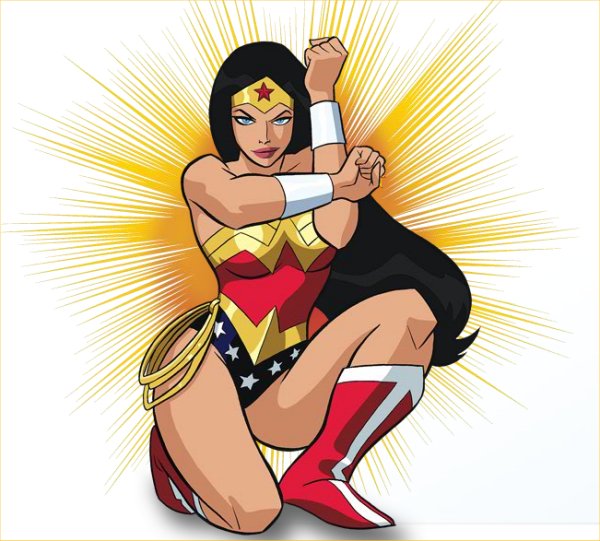
Wonder Woman, October 30, 2012. (http://tvequals.com).

I’ve wanted to write about this one for a few months now. Post-Tropical Cyclone Sandy or not, this one is important to me. The fact that so much of our discourse in traditional media, social media and everyday conversation remains so much more about cliché commentary than about any exploration of the meaning behind the words we say.

I’ve already looked at the laziness that a monopolized media has created in the world of journalism (see my recent post “The Make-Believe Media” from earlier this month). But this is about more than the “both sides do it” media world. It’s about the contradictions between the style in which we use our words and the substance within. The reality behind our words, then, becomes buried, and has made us all a little bit more ignorant in the process.

For me, three random examples stand out:

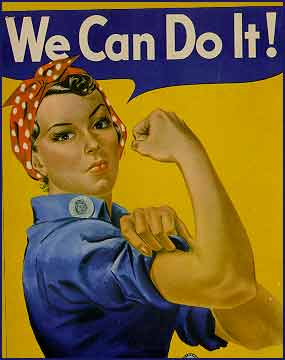
“We Can Do It!” – Rosie the Riveter poster [1942], by J. Howard Miller, October 30, 2012 (Wikipedia). In public domain.

1. “I’m a strong woman” – This could also be “I’m a smart woman,” or “I’m a bitch,” or “I’m a tough woman,” or a hundred other phrases I see every day on Twitter or hear in our public discourse. Even if this is meant to show some sort of feminist solidarity, it seems trite to proclaim strength as part of a conversation about gender (or any other topic, for that matter). I learned my lesson more than thirty years ago, courtesy of Crush #1, at the ripe old age of twelve, to not spend so much of my time telling people how smart I was (see my “Was I Really In Love In 7th Grade?” post from March ’12).

Really, how weird would it sound for me at six-three and 230 pounds to say that “I’m a strong man?” Or in commenting about all the abuse I survived, that “I’m a tough man?” I think that most of us can recognize a strong, tough, intelligent woman without the use of underwhelming language. I think most of us regardless of gender genuinely admire women who are who they are without saying the words all day and every day. To slightly misquote the name of the foundation that Lance Armstrong just stepped down from, just live strong, be strong and stay strong, and tell others females (and occasionally males) to do the same.

2. “Interracial/multiracial marriages are on the rise” = a less racist/post-racial America – Yeah, if there hadn’t been a long history of grossly unequal interracial relationships in this country for the previous two hundred years prior to the late ’80s.  This isn’t to say that the average American citizen isn’t less bigoted or racist than they would’ve been thirty years ago. But a sexual or even marital bond doesn’t automatically mean a lack of prejudice. It certainly doesn’t mean a massive empathy for and participation in social justice and other human rights causes. Just like with any relationship or marriage, people from different ethnic backgrounds can also come together for all the wrong reasons, can be abusive, and can even be racist.

Mildred Loving and Richard Loving (famous for landmark Supreme Court Loving v. Virginia (1967) miscegnation case), January 26, 1965. (AP). Qualifies as fair use under US Copyright laws – subject of post and no other photos available.

Making an exception for a few Whites, Blacks, Latinos or Asians as an individual doesn’t mean that one doesn’t generally view Whites as racist, Blacks as intellectually inferior, Latinos as “illegals” or Asians as “model minorities.” The fact that interracial marriages have been on the rise for nearly thirty years merely proves that the taboo against these marriages has broken down, not that the nation isn’t divided around the issue of race.

Manny Pacquiao v. Antonio Margarito (true meaning of the verb “impact”), Arlington, TX, November 13, 2010. (AP via http://9run.ca).

3. The growing use of impact as a verb and an adverb: Whether “impact,” “impacted,” “impacting,” or “impactful,” most of the time, this term is used incorrectly, especially in terms of politics. Take the use of impact during the 2012 Presidential Election cycle. “Nothing has impacted the 2012 race more than Romney’s 47% tape.” Really? Did someone take the recording and literally hit Mitt Romney in the head with it until he was rendered unconscious? If that didn’t occur, then the correct sentence would be “Nothing has had more of an impact on the 2012 race than Romney’s 47% tape.”

It’s as if journalists, reporters, pundits, commentators, intellectuals and scholars have forgotten that there are other, better words in the English language to use than impact. Like “affect,” or “effect,” or “influence,” or “sway,” or “transform,” or “change.” There are NFL color commentators and WWE announcers who use the word impact more correctly than most in the news and social media worlds. But this incorrect overuse is apparently here to stay, affecting and infecting our already ignorant use of language.

All of these uses of language irk me, because if we are to ever have real discussions of serious issues, we need our language to have real substance to it. Not just platitudes and clichés that wouldn’t survive Fashion Avenue if they took the form of a dress.

Touré’s Post-Blackness ≈ I’ma Be Me?

01 Monday Oct 2012

Posted by decollins1969 in 1, Academia, Boy @ The Window, Christianity, culture, Eclectic, eclectic music, Hebrew-Israelite, Mount Vernon New York, Patriotism, Politics, Pop Culture, race, Religion, Youth

≈ Leave a comment

Tags

"Pound Cake" speech, Acting White, American Identity, Authentic Blackness, Authenticity, Bill Cosby, Black Identity, Blackness, Boy @ The Window, I'ma Be Me (2009), Identity Issues, Intrarace Relations, Litmus Test, Post-Blackness, Post-Civil Rights Generation, Post-Racialism, Race, Racism, Reaching Youth, Self-Discovery, Self-Loathing, Self-Reflection, Touré, Wanda Sykes, Who's Afraid of Post-Blackness (2011)


Illustration of red wolf with dinner after a hunt, by Sandra Koch, September 29, 2012. (http://nc-es.fws.gov). In public domain.

I know, I know. Touré’s Who’s Afraid of Post-Blackness (2011) has been out for over a year, and I’ve finally, finally managed to read it in the past couple of weeks. I did not want to like this book. I found — and still find — the title to be pretentious and over the top, a perfect fit for Touré’s Twitter and TV persona. Touré values his ideas like they all are new finds of platinum or a form of safe and sustained nuclear fusion. Sometimes Touré can be cutting-edge, but many times, he goes over the edge (as was the case in August on MSNBC with his “niggerization” of Obama comment).

But in Who’s Afraid of Post-Blackness, Touré puts forward a variety of ideas and insights that I’ll be contemplating in my blogo-neighborhood off and on over the next few months. Touré’s is a very good book. It’s one that is both intellectual and yet revealing about the challenges Blacks face inter- and intraracially in the early twenty-first century.

The premise — once I got past the ridiculous term post-Blackness — is that African Americans and America has advanced just far enough in terms of race for all of our old conceptions of Blackness to have now become meaningless. That Blackness is fully infused in American — maybe even world — culture. That there was never one way to be Black in the first place. Touré himself says, “[t]here is no dogmatically narrow, authentic Blackness because the possibilities for Black identity are infinite. To say something or someone is not Black — or is inauthentically Black — is to sell Blackness short. To limit the potential of Blackness. To be a child of a lesser blackness.” (p. 5).

Litmus paper used in litmus tests, September 29, 2012. (http://chemistry.about.com).

Ironically, though, much of Touré’s book picks apart the notion that the US has become post-racial in the past couple of decades, as best exemplified by the election of President Barack Obama in 2008. Of course, Touré uses notions of Blackness and where it has expanded beyond the authenticity litmus test to show that race/racial bias/racism is still alive and well in America. At the same time, Touré shows how post-Blackness has also provided opportunities for millions of Americans White, Black and Brown to reach beyond their own misconceptions of race and themselves, to enrich our lives in politics, scholarship, the arts, not to mention through hip-hop.

One of my main criticisms of Who’s Afraid of Post-Blackness is that Touré uses a term like post-Blackness (mind you, I hate terms like post-structuralism, post-modernism, and post-racialism too) and doesn’t try in any way to provide a definition that distinguishes it from post-racial. For the purposes of this post, though, the main issue I have revolves around Touré virtually ignoring poor and struggling African Americans in his post-Blackness tour-de-force.

I get it when Touré says that he “never lived a typical Black experience.” (p. 53). At least, I think I do. That despite Touré middle class upbringing, middle-class neighborhood, private school experience, that his is but one representation of Blackness. And that Touré’s experience is as representative of Blackness as my experience of being a Hebrew-Israelite preteen in a working poor family while enrolled in Humanities in Mount Vernon, New York would’ve been thirty years ago (see my post “A Question of My Blackness, Sexuality and Masculinity” from September ’11). Or, for that matter, Wanda Sykes’ comedy special I’ma Be Me (2009) was for her.

That’s great for us, for anyone with enough intellectual power, outsider status, unusual amounts of wisdom, or just plain middle class standing to get the details of Who’s Afraid of Post-Blackness. But when Touré does bring up the twenty-five percent of Blacks who aren’t part of this post-Blackness elite, he talks at them, and not to them. Yes, I completely agree that Blackness isn’t to be defined in terms of poverty, prison, and projects. No, Blackness shouldn’t be defined by how “down” one is with an impoverished community or how “hard” someone is for beating the shit out of another person (see my “Raised on Hip-Hop?” post from April ’10).

Hakeem Olajuwon posting up Patrick Ewing, 1994 NBA Finals, June 1994. (http://rgj.com).

Still, while I stand with almost one hundred percent of what Touré says in Who Afraid of Post-Blackness in ’12, I don’t think that this book would’ve reached me thirty years ago. The way I would’ve seen it in ’82 or even ’87, a middle class Black guy telling me about how my poverty is insignificant to who I was would’ve been excommunicated from my life for eternity. It wouldn’t have helped me at all deal with the pressures I faced socially, academically and in my family (see my “The Silent Treatment” post from June ’10).

Touré wouldn’t have been able to provide for me a roadmap for how to be me and to ignore the crowd of those in my life — White and Black — who regularly told me that I wasn’t authentically Black or that I was “talkin’ White.” If mild-mannered me at twelve wouldn’t have been reached by Touré’s chapter on Black artists taking Blackness and standing it on its head, I imagine that young African Americans growing up in poverty or struggling with identity issues would find Who’s Afraid of Post-Blackness about as easy to embrace as Bill Cosby’s criticism of poor Blacks in ’04.

For me as a writer, the question of how to reach beyond the already converted is always an issue. Touré, as good as he is in his book, merely affirms the path I’ve traveled over the past thirty-one years. He doesn’t really reach those whose path of Blackness has barely begun.

Milk-N-Things

21 Saturday Apr 2012

Posted by decollins1969 in 1, Boy @ The Window, culture, Eclectic, eclectic music, race, Youth

≈ Leave a comment

Tags

Adulthood, Black Males, Coming-of-Age, Discrimination, Fear of Black Males, Frank Sinatra, Hutchinson River Parkway, Milk-n-Things, Pelham New York, Persecution, Race, Racism, Shopping While Black


Major fire Sunday evening at F&Y Store (formerly Milk-n-Things), Grand Cleaners, Pelham, New York, March 9, 2008. (PelhamWeekly.com). Qualifies as fair use because of low resolution of picture and subject of this blog post.

As most folks who aren’t Black males have learned in the past couple of months, part of our collective coming-of-age story involves this sordid and cruel rite of passage to manhood. One in which people we’ve known since childhood suddenly start to treat us as if we’ve committed a crime or an unpardonable sin. No matter how smart, how tall or short, how athletic or waif-like, this ritual has continued unabated in American culture for as long as there have been free Black males living their lives.

My whole year between my seventeenth and eighteenth birthday in ’87 was like that. Between a crossing guard I’d know since third grade, some of my classmates, my idiot Mount Vernon High School principal, the late Richard Capozzola (see post “Capo, Mi Capo” from September ’09) and Tower Records (see my post “Why Black Men Carry A Public Anger” from March ’12). I was constantly shown through their eyes how my man-sized Black body was a threat to them.

One of the bigger kickers that year was an incident at the former Pelham, New York mini-mart Milk-n-Things. It was in a strip mall across the street from a Mobil gas station, off a Hutchinson River Parkway exit, just across the bridge on East Lincoln connecting Mount Vernon to Pelham. The store was two doors down from the laundromat in which we washed our clothes every week (or just about) between ’78 and ’87, and next to Hutchinson Elementary School and Pelham Library.

I’d been shopping there on my own since ’77, before I’d started third grade. Over the years, I’d gotten used to the smell of cheap cologne, the noise of broken Italian and Brooklyn-ese as spoken by the Hair Club for Couples, the people who owned Milk-n-Things. Not to mention their love of all things from the ’50s, especially with a gigantic picture of Frank Sinatra on the wall that greeted customers upon entrance. By the time I was fourteen, it dawned on me that these folks may have been mobbed up, but what did that matter to me?

Then one day in April ’87, the Italian folks who owned Milk-n-Things reacted to me as if they’d never seen me before. As usual, I went there to buy a few groceries late in the evening, somewhere around 9 pm, when C-Town had already closed. Milk, eggs and butter were among the things I planned to buy. When I got to the counter, the old Italian lady said, “I got you on camera.”

“On camera doing what?,” I asked without thinking.

“You know whatcha been up to. I got you stealing, thief,” she said as if she had another word in mind.

“There’s no way you could have me on camera. You might have someone else on camera, but I know I haven’t stolen a thing,” I said, as I felt both hurt and rage coming out of me.

“Get out of my store now before I call the cops!,” the woman yelled.

I left the groceries and took back my money, feeling persecuted. This was a store I’d been shopping at for ten years. Now this Frank Sinatra-worshiping bitch has the nerve to accuse me of stealing right out of the blue? “Fine,” I thought. “You’re not getting another dime of my money.” That was the last time I shopped there.

I actually didn’t step foot into the space again until ’06, during a Thanksgiving visit with family. By that time, it was no longer Milk-n-Things, and the Italians who owned the place had long since moved away. I went in, realized they had nothing I wanted, and left. No one walked up to me to check my pockets as I walked out. I was mildly surprised.

Why Black Men Carry A Public Anger

21 Wednesday Mar 2012

Posted by decollins1969 in 1, Academia, Boy @ The Window, culture, Eclectic, eclectic music, High Rise Buildings, Mount Vernon High School, music, New York City, Politics, Pop Culture, race, Upper West Side, Youth

≈ 3 Comments

Tags

Anger, Barnes & Noble, Bigotry, Black Males, Columbia University, Driving While Black, Fear, George Zimmerman, Lincoln Square, Manhattan, Murder, Racism, Teachers College, Tower Records, Trayvon Martin, Walking While Black, West Side


Harvard University Professor Henry Louis Gates, Jr. arrested by Cambridge Police, Cambridge, MA, July 22, 2009. (http://assets.nydailynews.com/img/2009/07/22/alg_henry-louis.jpg via Wikipedia). Qualifies as fair use under US Copyright laws because of historical significance of photo and topic and its poor resolution.

I hadn’t planned on posting this piece until June, when it will be twenty-five and fifteen years since my shopping while Black incidents literally a block apart on the Upper West Side of Manhattan. But in light of the Trayvon Martin murder — and that’s what this is, a murder — at the hands of the racist vigilante George Zimmerman more than three weeks ago, it makes sense to do this post now.

Tower Records, 1961 Broadway (NW corner of 66th and Broadway, Lincoln Square), New York City, November 22, 2006. (Stuart Johnson via Flickr.com). In public domain.

Tower Records, Friday afternoon, June 19th, ’87, the day after I graduated from Mount Vernon High School (see more from my “The Day After” post from June ’08). With high school now over, I was in a celebratory mood. I took the 2 train from 241st to 72nd and walked the six short blocks to the great Tower Records on 66th. I had my latest Walkman, my first Sony Walkman, actually, and my book bag with my recent tape investments, including a few I’d bought at Tower Records the previous Friday. Investments like Fleetwood Mac’s Tango In The Night, Genesis’ Invisible Touch, and Glass Tiger (yes, Glass Tiger — absolutely terrible).

I went into the store and began to browse the R&B and Pop/Rock sections for tapes. There I noticed some plastic wrapping on the floor, as if someone had taken a tape out of its case and stolen it. While I thought about the wrapper on the floor, three White security guards came out of nowhere, grabbed me and dragged me to a storage room downstairs.

“We got you for stealing,” one of them said, presumably the store’s head of security.

“You don’t have me for anything. Is this because I’m Black?”

“Well, how do you explain the wrappers we found on the floor and the tapes in your bag?”

“The wrappers were on the floor when I got there and the tapes . . .”

“You’re going to jail, asshole, when we bring the cops in here!”

“First of all, I’m not going anywhere. The tapes are all mine, and some of them I bought in this store last Friday. I have the receipt at home. Don’t you have ways to verify my purchases?”

“We don’t believe you!”

“It doesn’t matter if you don’t believe me. I’m under eighteen. You can’t hold me or turn me over to police without calling my parents. I’m not even from here, I’m from Westchester County, and my receipts are back home there.”

“If we were outside instead of in here, I’d slap you around, wise-ass!”

“Then I guess I’m the lucky one. Why don’t we check the receipts from your cash registers up front for my purchases from last Friday? I know they’ll show that I’m right and you’re wrong!”

The hotheaded White man who did all of the talking got up and made a threatening slap gesture with the back of his left hand before the other ones grabbed him and told him to calm down. They let me go. On my way out, I said, “I hope you learned that not every Black person coming in your store is a thief!” It would be ten years before I went into Tower Records again (of course, Tower Records went out of business in ’06).

That next time was May 12, ’97, and I had just finished a day-long interview for an assistant professor

Barnes & Noble, 1972 Broadway (NE corner of 66th and Broadway), New York City, December 30, 2010, three days before it closed. (Jim In Times Square via Flickr.com). In public domain.

position at Teacher College (Columbia University’s school of education). I had no problems as I browsed Tower Records for about twenty minutes. It was my first time there since the ’87 incident. Then I went across the street to the Barnes & Noble mega-store. From the moment I walked in the door until I left a half-hour later, a Latino security guard tailed me as I perused books in the African American nonfiction, Cultural Studies and Music sections of the store, across three floors. As I walked out, I walked up to the guard and said

“While you were stalking me, you probably let half a dozen White folks slip out of here with books and CDs. Did you learn anything while you were watching me?”

“I was just doing my job,” the dumb-ass security guard said in response.

“Well, if following a Black guy around for thirty minutes is part of your job, you deserve to lose your job,” I said as I walked out, not to return until Christmas ’02.

Over the years, I have been stopped by police in Mount Vernon, Pittsburgh, DC and L.A., followed by police in Maryland, Pittsburgh and L.A., patted down by police at Carnegie Mellon and the University of Pittsburgh, and followed by more security guards — including ones guarding those precious gated communities — than I’d ever care to count. My only crime was being a Black male in America’s public sphere.

Trayvon Martin in hoodie, March 19, 2012. (http://media.metronews.topscms.com/). Qualifies as fair use under US Copyright laws because photo is an illustration of one of the subjects of this post.

Like so many others, I could’ve easily been Trayvon Martin twenty-five, fifteen and even five years ago. This constant tightrope dance that we must do to make old White ladies and scared White guys and ig’nit Black folks feel comfortable. So that I’m not arrested, or maimed, or killed. So that I can go about the business of being me and making myself and the people in my life better. As Nathan McCall would say, it “makes me wanna holler.”

Short of moving to a nation not built on the imperialism and fear of Black males in particular, all I can do, for better and for worse, is to prepare my son for this very racial America in which we still live. And yes, that makes me angry.

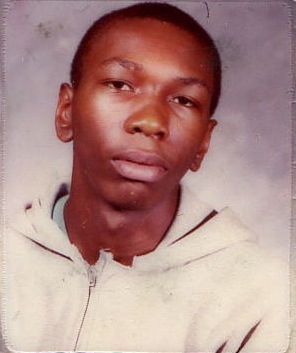
Me at 16 (with torn gray hoodie), Mount Vernon High School ID, Mount Vernon, NY, November 1985, March 21, 2012. (Donald Earl Collins).

Virtual Linsanity

25 Saturday Feb 2012

Posted by decollins1969 in 1, Academia, Boy @ The Window, culture, Eclectic, eclectic music, New York City, Pop Culture, race, Sports, Youth

≈ 2 Comments

Tags

Basketball, Cultural Stereotypes, ESPN, Hype, Jason Whitlock, Jeremy Lin, Knicks, Linsanity, NBA, New York City, New York Knicks, Patrick Ewing, Racial Stereotypes, Racism, Stereotype Threat, Stereotypes, Twitter


Jeremy Lin (Knicks) beating Matt Barnes (Lakers) in the paint for a layup, Madison Square Garden, February 10, 2012. (AP).

As a New York Knicks fan since my mother’s third trimester with me (the fall of ’69, the season the Knicks won their first of two NBA titles) here hasn’t been much to be excited about since Patrick Ewing popped his Achilles’ tendon in between Games 2 and 3 of the ’99 Eastern Conference Finals.

Enter Jeremy Lin, the sensation that’s sweeping the NBA Nation. When he scored 28 points in his first game as a starter nearly three weeks ago, my only thoughts were, “Finally, we have a real point guard who can get the ball to Stoudamire and Carmelo.” Beyond that, I thought of one of my high school students from the JSA-Princeton University Summer Program in which I taught in ’09, because they have the same first and last name. My former student, though, is still in college, and not at Harvard, either.

Patrick Ewing raising the roof after a dunk in Game 7 of the 1994 NBA Eastern Conference Finals against the Indiana Pacers, June 5, 1994. (AP).

Leave it to ESPN, the New York media and the motley crew of naysayers, though, to raise Lin to celebrity status faster than the USS Enterprise-D could reach maximum warp. The fact that Lin plays for the Knicks, a franchise in a decade-long search for respectability, and decades-long search for its lost glory, is reason enough for me to see their perspectives on the point guard as more than slightly skewed. I mean, New York’s the reason why sports fan still think the sun shines out of every Yankees’ behind, even Don Mattingly’s.

Not that Lin’s good and often very good play didn’t warrant attention. But if you could dig deeper into all the attention, it was as if the sports and entertainment worlds were shocked — actually shocked — that Lin could start and play with all the precision and poise of an above-average NBA player. What would bring this kind of outpouring of skepticism wrapped in somewhat exaggerated hype? The fact that Lin went to Harvard? The fact that he’s just under six-foot-three? What, pray tell, has been the key to this burst of attention?

Could it be, could it possibly be, about race? Really? After two decades of international competitions between Chinese and American basketball players? Really. By the time some of the shock jocks and uncouth commentators began to spread their versions of Lin-adjectives, Lin-verbs and Lin-phrases, it was obvious that the shock went something like this: “Oh my God! An Asian guy from Harvard can play professional basketball? Bring on the MSG!”

It all crystallized in one stupid, and yes, racist tweet on the part of a “journalist” I used to respect, Jason Whitlock. “Some lucky lady in NYC is gonna feel a couple of inches of pain tonight,” Whitlock tweeted while Lin scored 38 points against the Lakers on February 10. At the very least, this is a sign of some deep-seated insecurity being pushed upon Lin as a proxy for two stereotypes rolled into one. At worst, Whitlock was merely expressing what many White and Black folks feel about some Asian American guy excelling in an allegedly “Black” sport. Either way, it’s almost as disgusting as ESPN’s “Chink In The Armor” headlines from

Jay Kay in Jamiroquai's "Virtual Insanity" (1997) music video screen shot, January 6, 2006. (via Wikipedia). Qualifies as fair use under US Copyright laws because of picture's low resolution and relevance to blog post.

the Knicks’ February 17 loss to the New Orleans Hornets.

I don’t understand the exaggerated hype and the subsequent race-baiting, playa hatin’ comments in mass and social media around Lin since the middle of Black History Month. I played tons of pickup games at Pitt and Carnegie Mellon when I was in graduate school, and a good portion of the folks I played with were Asian or Asian American. Like the Whites, Blacks and Latinos I played with, some of them could really play basketball, and some couldn’t dribble three steps without bouncing the ball off their foot. Some could shoot from seventeen feet blindfolded, and others had the accuracy of a Scud missile.

Lin, as good as he is now, can and should get better. How good is anyone’s guess, but we shouldn’t be comparing him to Steve Nash or Magic Johnson quite yet. Nor should we write him off when he faces a team like the Miami Heat and turns the ball over five times in a three-minute span. We shouldn’t celebrate a media that apparently has bipolar disorder when it comes to anyone whose body of work cuts against stereotypes.

Lin’s success shouldn’t threaten anyone’s Blackness, sense of manhood or intelligence or the world view of American sports journalists. At least no more than my having a PhD or being a writer on race, education reform and diversity should threaten higher education or anyone’s Whiteness. But, then again…

← Older posts
Newer posts →

Boy @ The Window: A Memoir

Boy @ The Window: A Memoir

Places to Buy/Download Boy @ The Window

There's a few ways in which you can read excerpts of, borrow and/or purchase and download Boy @ The Window. There's the trade paperback edition of Boy @ The Window, available for purchase via Amazon.com at http://www.amazon.com/Boy-Window-Donald-Earl-Collins/dp/0989256138/

There's also a Kindle edition on Amazon.com. The enhanced edition can be read only with Kindle Fire, an iPad or a full-color tablet. The links to the enhanced edition through Apple's iBookstore and the Barnes & Noble NOOK edition are below. The link to the Amazon Kindle version is also immediately below:

scr2555-proj697-a-kindle-logo-rgb-lg

Boy @ The Window on Amazon.com: http://www.amazon.com/Boy-The-Window-Memoir-ebook/dp/B00CD95FBU/

iBookstore-logo-300x100

Boy @ The Window on Apple's iBookstore: https://itunes.apple.com/us/book/boy-the-window/id643768275?ls=1

Barnes & Noble (bn.com) logo, June 26, 2013. (http://www.logotypes101.com).

Boy @ The Window on Barnes & Noble: http://www.barnesandnoble.com/w/boy-the-window-donald-earl-collins/1115182183?ean=2940016741567

You can also add, read and review Boy @ The Window on Goodreads.com. Just click on the button below:

Boy @ The Window

Twitter Updates

Tweets by decollins1969
  • RSS - Posts
  • RSS - Comments

Archives

  • June 2025
  • April 2023
  • September 2022
  • August 2022
  • July 2022
  • June 2022
  • May 2022
  • April 2022
  • March 2022
  • January 2022
  • December 2021
  • November 2021
  • October 2021
  • September 2021
  • August 2021
  • July 2021
  • June 2021
  • April 2021
  • March 2021
  • February 2021
  • January 2021
  • December 2020
  • November 2020
  • October 2020
  • September 2020
  • August 2020
  • July 2020
  • May 2020
  • April 2020
  • March 2020
  • January 2020
  • December 2019
  • November 2019
  • August 2019
  • July 2019
  • June 2019
  • May 2019
  • April 2019
  • March 2019
  • February 2019
  • January 2019
  • December 2018
  • November 2018
  • October 2018
  • September 2018
  • August 2018
  • July 2018
  • June 2018
  • May 2018
  • March 2018
  • February 2018
  • January 2018
  • December 2017
  • November 2017
  • October 2017
  • September 2017
  • August 2017
  • July 2017
  • June 2017
  • May 2017
  • April 2017
  • March 2017
  • February 2017
  • January 2017
  • December 2016
  • November 2016
  • October 2016
  • September 2016
  • August 2016
  • July 2016
  • June 2016
  • May 2016
  • April 2016
  • March 2016
  • February 2016
  • January 2016
  • December 2015
  • November 2015
  • October 2015
  • September 2015
  • August 2015
  • July 2015
  • June 2015
  • May 2015
  • April 2015
  • March 2015
  • February 2015
  • January 2015
  • December 2014
  • November 2014
  • October 2014
  • September 2014
  • August 2014
  • July 2014
  • June 2014
  • May 2014
  • April 2014
  • March 2014
  • February 2014
  • January 2014
  • December 2013
  • November 2013
  • October 2013
  • September 2013
  • August 2013
  • July 2013
  • June 2013
  • May 2013
  • April 2013
  • March 2013
  • February 2013
  • January 2013
  • December 2012
  • November 2012
  • October 2012
  • September 2012
  • August 2012
  • July 2012
  • June 2012
  • May 2012
  • April 2012
  • March 2012
  • February 2012
  • January 2012
  • December 2011
  • November 2011
  • October 2011
  • September 2011
  • August 2011
  • July 2011
  • June 2011
  • May 2011
  • April 2011
  • March 2011
  • February 2011
  • January 2011
  • December 2010
  • November 2010
  • October 2010
  • September 2010
  • August 2010
  • July 2010
  • June 2010
  • May 2010
  • April 2010
  • March 2010
  • February 2010
  • January 2010
  • December 2009
  • November 2009
  • October 2009
  • September 2009
  • August 2009
  • July 2009
  • June 2009
  • May 2009
  • April 2009
  • March 2009
  • February 2009
  • January 2009
  • December 2008
  • November 2008
  • October 2008
  • September 2008
  • August 2008
  • July 2008
  • June 2008
  • May 2008
  • April 2008
  • March 2008
  • February 2008
  • January 2008
  • December 2007
  • November 2007
  • October 2007
  • September 2007
  • August 2007
  • July 2007
  • June 2007

Recent Comments

MaryPena's avatarMaryPena on My Day of Atonement/Bitter Hat…
decollins1969's avatardecollins1969 on No Good Teaching Deed Goes…
Mary Rose O’Connell's avatarMary Rose O’Connell on No Good Teaching Deed Goes…

NetworkedBlogs on Facebook

NetworkedBlogs
Blog:
Notes From a Boy @ The Window
Topics:
My Life, Culture & Education, Politics & Goofyness
 
Follow my blog

616 616 East Lincoln Avenue A.B. Davis Middle School Abuse Academia Academy for Educational Development AED Afrocentricity American Narcissism Authenticity Bigotry Blackness Boy @ The Window Carnegie Mellon University Child Abuse Class of 1987 CMU Coping Strategies Crush #1 Crush #2 Death Disillusionment Diversity Domestic Violence Economic Inequality Education Family Friendship Friendships Graduate School Hebrew-Israelites High-Stakes Testing Higher Education History Homelessness Humanities Humanities Program Hypocrisy Internalized Racism Jealousy Joe Trotter Joe William Trotter Jr. K-12 Education Love Manhood Maurice Eugene Washington Maurice Washington Misogyny Mother-Son Relationship Mount Vernon High School Mount Vernon New York Mount Vernon public schools Multiculturalism MVHS Narcissism NFL Pitt Pittsburgh Politics of Education Poverty President Barack Obama Race Racial Stereotypes Racism Relationships Self-Awareness Self-Discovery Self-Reflection Sexism Social Justice Teaching and Learning University of Pittsburgh Violence Whiteness Writing

Top Rated

Blog at WordPress.com.

  • Subscribe Subscribed
    • Notes from a Boy @ The Window
    • Join 103 other subscribers
    • Already have a WordPress.com account? Log in now.
    • Notes from a Boy @ The Window
    • Subscribe Subscribed
    • Sign up
    • Log in
    • Report this content
    • View site in Reader
    • Manage subscriptions
    • Collapse this bar
 

Loading Comments...