• About Me
  • Other Writings
  • Interview Clips
  • All About Me: American Racism, American Narcissism, and the Conversation America Can’t Have
  • Video Clips
  • Boy @ The Window Pictures
  • Boy @ The Window Theme Music

Notes from a Boy @ The Window

~

Notes from a Boy @ The Window

Tag Archives: Race

A Friendship Changing Lanes

03 Monday Oct 2011

Posted by decollins1969 in 1, Boy @ The Window, Christianity, Eclectic, Mount Vernon High School, Mount Vernon New York, My Father, race, Religion

≈ Leave a comment

Tags

Education, Family, Friendship, Friendships, Humanities, Ideology, Johns Hopkins University, Mount Vernon High School, Mount Vernon New York, MVHS, Politics, Race, Religion, University of Pittsburgh, Valedictorian


Changing Lanes (Movie, 2002) Screen Shot, March 2008. (Source/http://swedenborgiancommunity.org).

Part of the problem of being me is the fact that my close friends change as I change. Meaning that there have been transitional periods throughout my life that my old friends fall away. Oftentimes I make new ones, and sometimes, like during my six years in Humanities, my best friend was my imagination. Ironically, the best friendship I had from my Humanities days came with a classmate that I hadn’t become close to until my last couple of years at Mount Vernon High School. More ironically, that friendship didn’t truly become such until we both went away for college in ’87.

I’ve written about her before, the valedictorian of my class, whom I called “V” in a previous post (see Valedictorian Blues from July ’09). To be honest, I’m not sure how our acquaintanceship ever became a friendship. Somewhere between having circumstances in which our fathers weren’t around consistently, or at least being able to relate to Billy Joel, or both of us scoring “5”s on the AP US History exam.

But really, it might’ve just come down to both of us not belonging, or facing a small degree of ostracism from our Humanities and MVHS classmates overall. I wasn’t Black and cool enough, and V, well, she was a classic White nerd, a grinder who had the gall to finish ahead of our Black male salutatorian, at least from the perspective of some authority figures and the school’s popular crowd.

The fact that we went our respective ways, to Pitt and Johns Hopkins, helped. The fact that we wrote each other about some of our social triumphs and challenges helped more. Most importantly, it helped a lot that we both were more honest about our family troubles. Everything from my mother’s need to divorce my idiot stepfather and the issues with my younger siblings to V’s mother and her health issues and struggling with burnout trying to watch over her family while going to school.

So, by the time I began my second year of grad school, we’d become fairly close. I visited her and her family in the DC area eight times during the ’90s, and went to her mother’s funeral and wake in ’96. V came to my PhD graduation ceremony the following year. By ’97, me and V had been friends for ten years, and known each other more than fifteen. For more than six years, she’d really been the only person from my Humanities and high school days with whom I’d been in regular contact.

Changing lanes, Las Vegas Strip, December 12, 2010. (Source/Bjørn Giesenbauer - http://Flickr.com).

Who knew that within four years of marching for my doctorate that our friendship would become a distant one? I think that our approaches to life was so different that we couldn’t help but become distant friends. I am one who refuses to take life on its own terms. If I had taken V’s approach, I’d still be living in Mount Vernon, New York, only with a nine-dollar-an-hour job sorting mail or flipping carcinogenic burgers. V’s was based on some sort of realism that mixed with a sense of eugenic inevitability. That one’s slot in life should remain such, and if one does make it, one must do so without ruffling any feathers.

Besides that, it was obvious that things about who we had been since the early ’80s had evolved, and was changing even more rapidly as we reached our late twenties. I was no longer the blank-faced, closed-mouthed, socially-awkward kid I was in ’82. V was no longer responsible for watching over her mother and her younger sister. We agreed to disagree on so many things. Our politics diverged. Our views on race and racism were growing further apart, as if I was Michael Eric Dyson and she was Ann Coulter.

But even with all of that, I think the seeds of it began when I started dating my future wife at the end of ’95. Something about being in a serious relationship has changed the dynamics of every friendship I had then and have now. I never thought that my friendship with V would be affected. But of course it was. We live in a world where a man and a woman can’t be close friends without it being made into something more than friendship.

Like the seasons, people change, and even if they change for the better, our change will cause our friendships to change as well. It’s just too bad that V couldn’t adapt to all of the good changes in my life like I adapted to hers.
When Being An American Equals Never Having to Say Sorry

08 Friday Jul 2011

Posted by decollins1969 in 1, Academia, Boy @ The Window, culture, Eclectic, Mount Vernon High School, Politics, race, Religion

≈ Leave a comment

Tags

"Another E", A Curriculum of Inclusion, Academia, Afrocentricity, Arthur Schlesinger Jr., Asa Hilliard III, Blackness, Commissioner's Task Force on Minorities: Equity and Excellence, Cultural Pluralism, Culture Wars, Davis Middle School, Diane Ravitch, Diversity, Ethnic Studies, Ethnicity, Humanities, Humanities Program, K-12 Curriculum, K-12 Educaiton, Leonard Jeffries, Mount Vernon High School, Multicultural Education, Multiculturalism, New York State Department of Education, Race, University of Pittsburgh, Whiteness, Writing


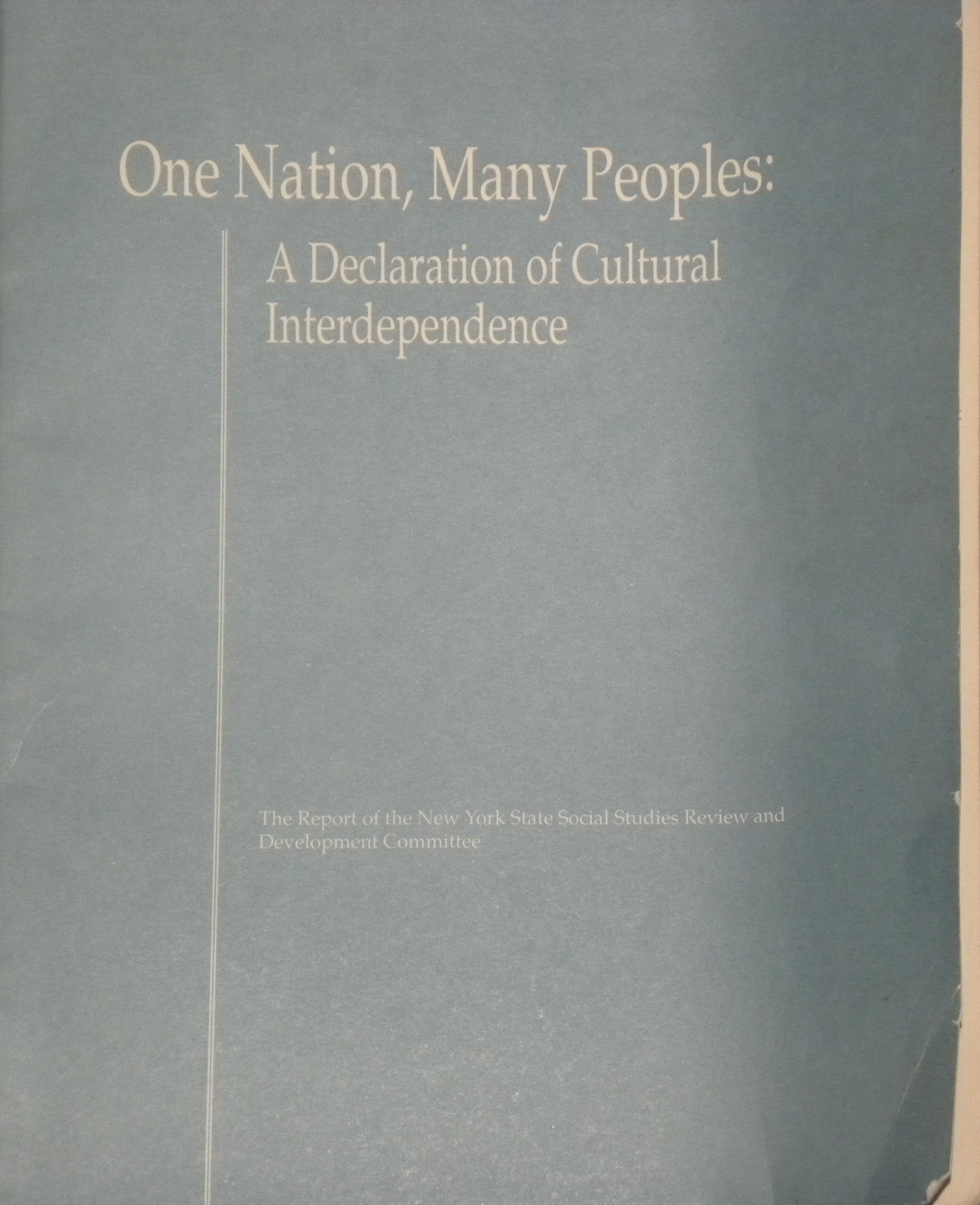
New York State Social Studies Review and Development Committee Report, June 1991 (Picture/Donald Earl Collins). One of several reports produced for the New York State Education Department and Commissioner, as part of the Commissioner's Task Force on Minorities: Equity and Excellence

Twenty years ago this week, I began writing an academic piece that would lead to my dissertation topic, doctorate and first book Fear of a “Black” America (2004). It was a topic that I’d fall in and then out of love with. Ironically, I pursued this topic because of my academic experiences in Humanities at Davis Middle and Mount Vernon High School. The topic was multiculturalism, and more specifically, multicultural education, and how to achieve this kind of curriculum reform in K-12 education. Just writing these words makes me feel both young and naive at the same time.

This whole quest started with a girl. Actually, with the young woman “Another E” (see “The Power of Another E” from April ’09 and “Beyond the Asexual Me” from last month”). She wanted to put an article together for publication, in response to what was then a major controversy involving research into the revision of New York State’s social studies and other curricula. The New York State Department of Education had given a committee the task of figuring out how to make the state’s K-12 curriculum more inclusive and representative of the state’s tremendous racial, ethnic and other forms of diversity.

By the end of September ’91, it would produce A Curriculum of Inclusion: Report of the Commissioner’s Task Force on Minorities: Equity and Excellence. But that deliverable was far from my mind when, tired from my weeks of near starvation post-graduation that April (see “Sometimes Starvation” from May ’11), I reluctantly said okay to working on this article.

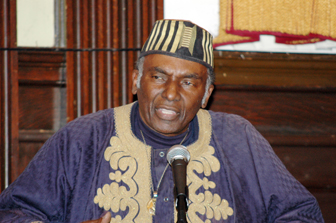
Leonard Jeffries, Newark Public Library, February 1, 2007. (http://npl.org)

Now here I was, minus the young woman in whom I no longer had an interest, now working on a piece that had become more academic than either of us had originally intended. By the time I’d written my first words on multiculturalism, I’d already learned the names Leonard Jeffries, Asa Hilliard III and Arthur Schlesinger, Jr. I’d read articles from the New York Times and the Wall Street Journal about Jeffries’ name-calling, Schlesinger’s incredulousness about calling slaves “enslaved persons,” and about the committee in general getting along like hyenas tearing at a dead wildebeest.

If I’d been just a tad bit smarter, I would’ve done an investigative piece and called and emailed the people on this task force. I would’ve asked them to divulge to me what they would eventually tell the world about their dislike of each other and of anything “multicultural,” which was in quotes for them. For Schlesinger, multicultural was the equivalent of bad ethnic studies or a kind of Afrocentrism that blamed Whites for all that has ailed America and the world for the past 500 years. For Jeffries, it was a racist attempt at appeasing Blacks and other groups of color while maintaining the main theme of Whites on top.

Although this is an oversimplification, it’s not by much. There really wasn’t anyone from the task force, the

Arthur Schlesinger, Jr., CUNY, circa 2006, months before his death on February 28, 2007. (http://www.nytimes.com)

NYS Department of Education, or anyone who spoke on the Himalayas-out-of-a-termite-mound controversy over a more inclusive K-12 curriculum without taking one of those two views. That’s what interested me the most. Schlesinger, and eventually, folks like Diane Ravitch, Mario Cuomo and others completely against revision that even approached cultural pluralism, versus Jeffries, Hilliard and others arguing beyond what they called a White multiculturalism.

I didn’t have the capacity at that stage of my life to see myself as a writer or a journalist in any way. Just two years removed from the end of my mother’s marriage to my now idiot ex-stepfather, I only saw the piece that I’d turn into a Master’s research paper, doctoral thesis and first book as an academic exercise, one where I found the philosophical middle. I hadn’t a clue as to how to make myself part of the Ground Zero issue of the first seven years of the ’90s, the Culture Wars.

But I did have one experience that provided unique insight into multiculturalism and the arguments made by scholars and pols on all sides. Six years in Humanities in Mount Vernon, New York’s public schools. A place where cultural diversity and how to deal with it within the curriculum was the elephant in the classroom. Some teachers and classes addressed it, and many didn’t, to the detriment of what was a solid program, not to mention me and the others who were my classmates.

Either way, I saw more issues of diversity crop up where a multiculturalist approach would’ve been helpful all during my time in Humanities, including with my kufi and my Hebrew-Israelite years. It was a missed opportunity, one that I unconsciously wanted to address with my research of and writing on multiculturalism.

Elephant in School, retrieved July 7, 2011. (http://teachhub.com)

Eugene Robinson Disses Black Generation X

08 Wednesday Jun 2011

Posted by decollins1969 in 1, Academia, Boy @ The Window, culture, Eclectic, Politics, Pop Culture, race

≈ Leave a comment

Tags

Abandoned, Abandoned Communities, African Americans, African Immigrants, Black Americans, Black Baby Boomers, Black Gen Xers, Caribbean Immigrants, Disintegration, Emergent, Eugene Robinson, Generational Divide, Intrarace Relations, Invisibility, Mainstream, Mlllennial Generation Blacks, Model Minority, MSNBC, Post-Civil Rights Generation, Pulitzer Prize, Race, Racism, Thomas Sowell, Transcendent, Washington Post


Disintegration Book Cover, June 8, 2011. Donald Earl Collins. Note the beat-up look of the cover, thanks to my wife, who had it for more than five months before I read it last week.

I finally got around to reading Eugene Robinson’s Disintegration: The Splintering of Black America this week. Despite my doubts, I hoped that the famed Washington Post columnist, MSNBC rock star and Pulitzer Prize winner would say something profound, or at the least, provocative. Not only did I not learn anything new in the three and half hours it took for me to read Disintegration. I learned that Robinson, like so many accomplished Blacks of his generation, doesn’t see Black Generation Xers when talking about the state of African America. The generational divide, perhaps the greatest example of disintegration that Robinson should’ve discussed, he rendered invisible throughout his book.

I know I’m late by Black literati standards in taking so long to sit down and read this book. After all, I bought the book this past Christmas as my personal birthday present. I had a feeling, though, that somehow, this book really wasn’t for me, a forty-one year-old Black Gen Xer who’s spent about half of my life thinking about this and other related issues. To slightly misquote Arnold Schwarzenegger from Total Recall, “Welcome to the party, Robinson!”

Over and over again in Disintegration, Robinson referred to the positions of Black Baby Boomers in a splintered Black America, as well as to the hopes, fears and aspirations of millennial generation African Americans (particularly on issues like the decline of interracial prejudice and educational attainment). I guess because Robinson mostly relied on his personal journey as a guide to understanding the history of African America’s disintegration — including using his sons as a time line template — it meant that folks born between ’65 and ’85 didn’t really count.

Unless, of course, they were part of the Abandoned class, the ones who found themselves increasingly poor and isolated after ’68 in communities like Shaw and U Street in DC. Or, in my case, on the South Side and other pockets of Mount Vernon, New York by the late 70s and ’80s. Then Robinson’s sympathetic voice kicked in, one which acknowledged all of the ills that one in four Blacks face every day. Still, Black Gen Xers are only in the Abandoned in Robinson’s mind and words by proxy.

There are far more obvious errors of omission in Robinson’s somewhat thought-provoking, 237-page column than leaving out an entire generation of post-Civil Rights era Black folk. Like Robinson stumbling his way into Thomas Sowell’s “model minority” argument like a punch-drunk boxer in the final round of a fight. Or, really, like a writer running out of steam at the end of a manuscript.

Robinson’s fifteen-page chapter “The Emergence (Part 1): Coming To America” is all about a new immigration wave of Blacks from sub-Saharan Africa and the Caribbean who are more highly educated than any other immigrant group arriving these days (and are better educated than most Americans, for that matter). Yes this is true in the aggregate. But besides a few examples that serve to exaggerate more than enlighten, Robinson’s analysis sounds like Sowell’s arguments from ’72. Only without the conservative policy implications and with a generous lack of sophistication in understanding the diversity within these immigrant groups.

There’s also the use of these troubling terms of Transcendent and Mainstream, both of which evoke a ’70s-style thinking about African Americans who’ve “made it.” How about “New Black Elite” and “Successful Yet Struggling Black Middle,” both of which are more accurate descriptors? I understand that Robinson’s purpose with Disintegration was to poke and prod readers, albeit in a light way. Still, the book seems written for what he would describe as aspiring Transcendents who are far too busy climbing social ladders to think about cultural and community disintegration post-1968, rather than those of us who do.

Which brings me back to Robinson’s Black Gen X blind spot. How is it possible that someone with the panache and diligence of Robinson could forget about the 26-46 year-old demographic in Disintegration? The reasons are as plain as the positions of prestige that Transcendent African American Baby Boomers occupy and cling to like a man with a fingernail death grip on a precipice. (And, despite Robinson’s protestations to the contrary, by his own definition, he and his family are Transcendent. Who else gets to hang out with Oprah and Vernon Jordan or do interviews with President Obama without being Transcendent?)

Me and my generation of Blacks had been written off by Robinson’s gangs of elites and wannabe elites by the time I was a college freshman at the University of Pittsburgh in ’87. Our ideas about the disintegration of Black America and what that has meant over the past forty years are undoubtedly fresher. Yet we as a group aren’t asked about our ideas. Apparently when Black America disintegrated, we fell into a black hole. At least in Mr. Robinson’s neighborhood.

Balkis Makeda’s 2nd Coming

23 Monday May 2011

Posted by decollins1969 in 1, Boy @ The Window, culture, Eclectic, Mount Vernon High School, Politics, race, Religion, Youth

≈ Leave a comment

Tags

616, 616 East Lincoln Avenue, Balkis Makeda, Balqis Makeda, Birthday, Christianity, Cooking, Cult, Cults, Eri, Hebrew-Israelites, Hell, Hello, Interpreting Dreams, Israelites, Ivory Soap, Judah ben Israel, King Solomon, Kufi, Maurice Eugene Washington, Mount Vernon High School, Mount Vernon New York, Poverty, Queen of Sheba, Race, Reincarnation, Rituals, Unclean Issues of Blood


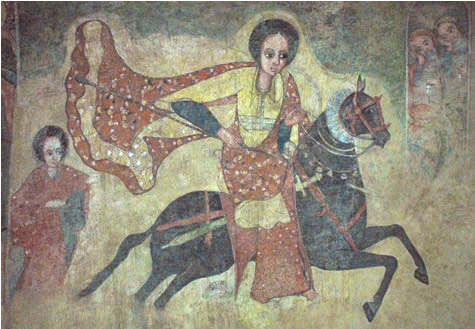
Queen of Sheba traveling to Solomon: A fresco in Ethiopia, Date Unknown. Source: http://www.expedition360.com/journal/archives/2007/05/. In public domain.

Yesterday, my youngest brother Eri turned twenty-seven (Happy Birthday again, bro!). He was the fourth baby my mother gave birth to in a five-year span. I’d been pissed before about all that had happened with us regarding my mother, my stupid (ex)-stepfather, our poverty and being on welfare, and the whole Hebrew-Israelite thing. But now, along with Eri’s birth, came with it an elderly trespasser at 616, courtesy of the fifty-four-inch waist — and waste — of an idiot Maurice.

You see, my stupid stepfather invited his Hebrew-Israelite matriarch “Balkis Makeda” to stay with us. The woman claimed to be a reincarnated Balkis Makeda (Queen of Sheba and wife of King Solomon of the ancient Israelites), and was the catalyst in Maurice’s Hebrew-Israelite conversion during his separation from Mom between October ’80 and April ’81.

Because of Maurice — um, excuse me, Judah ben Israel — and our fearless leader “Balkis Makeda,” we followed a number of un-Torah-like practices. This included the requirement that we all were to believe that she was the reincarnation of the Queen of Sheba, living among us in the twentieth century as an average person and showing us the way to Yahweh and ultimate truth.

Bar of Ivory Soap, December 28, 2009. Source: Erin Gifford, http://couponcravings.com/2009/12/cvs-free-ivory-soap.html.

We stopped using Ivory Soap at home because our leader had a dream once about rats gnawing on a bar of it. Baby Maurice couldn’t use a soap that’s 99.44 percent pure because of Makeda’s dream, and we switched to Zest. (The real reason, I think, was because the soap was white — like Whites ethnically — and considered the opposite of pure by many in the Hebrew-Israelite community).We weren’t allowed to use the word “Hello” when greeting someone in person or when answering the telephone. Maurice explained that “Hello’s got the word Hell in it, you know, Hell-low!” We’d somehow be committing someone to eternal damnation with a universal English greeting.

Now in her seventies and in declining health, the geezer was moved in before Mom could seriously object. What a situation! Six kids, including me, plus Mom, Maurice, and an old woman living together in a 1,200-square-foot, two-bedroom, one-bathroom apartment. We now needed to behave like good little Hebrew-Israelites with this woman in our house, so as to not embarrass my stepfather. Yeah, right!

One of the other rules of our absurdly orthodox practice was that Mom couldn’t cook or do any familial tasks for the next three months. She was “unclean” because she’d just given birth to Eri. This might’ve made sense in the deserts of ancient Canaan, with no antibiotics and drugs to deal with unclean issues of blood and other bodily fluids. It didn’t now. Plus I didn’t remember Mom not cooking for three months after Yiscoc and Sarai were born. This was suck-up time, plain and simple.

Maurice made what was an abyss of bad even worse by cooking dinner for three days. Three straight nights of over-boiled and under-ripened cabbage drenched in its own juices and seasoned to high heaven with red and black pepper. My stepfather could’ve been the founder of a new weight-loss diet. Mom, of course, asked me to take over her cooking duties, which I did for the next six weeks (see my “Top Cook” post from May ’09).

The woman couldn’t stand us, and especially couldn’t stand me. She probably sensed how much I couldn’t

A child in the Black Hebrews community, in Dimona, Israel, September 5, 2005. Source: Dror Eiger, http://flickr.com/photos/95465714@N00/41252116. In public domain, as file is licensed under the Creative Commons Attribution-Share Alike 2.0 Generic license.

stand her and her idiotic notions of Judaism, even with the context of being a Hebrew-Israelite. All I knew was that when I cut through all of the words and nuggets of truth, ritual and superstition, that “Makeda” was full of crap, and had fostered the conversion of my stupid stepfather, the only person I knew who was even more full of crap than her. I was already a Christian in the closet by then. Now I faced the prospect of revealing my spiritual conversion in the middle of such a grand mess. But I knew I had little other choice.

Within weeks of “coming out” to Mom, Maurice and my classmates at Mount Vernon High School (see my post “Kufi Emancipation Day” from September ’09 for more), the older woman moved out, under pressure from Mom. Both, ironically, were under pressure from me, as I threatened to move out myself. She died in Section 8 housing on Mount Vernon’s South Side in February ’85. I dare say that she wasn’t the reincarnated Makeda. For the only one who could’ve learned a lesson from a lifetime of poverty and cult-like rituals would’ve been her, not us.

Ego Inflation

18 Wednesday May 2011

Posted by decollins1969 in 1, Academia, Boy @ The Window, culture, Eclectic, Politics, race

≈ 2 Comments

Tags

A Room With A View, Academia, Academic Politics, Carnegie Mellon University, College of Humanities & Social Sciences, Denholm Elliott, Dune, Ego Inflation, Egocentrism, Elite Institution, Elitist Institutions, George Mason University, Grade Inflation, Jace Nance, Mercurial, Napoleonic Complex, Nefud, Peter N. Stearns, Peter Stearns, PhD Graduation, Provost, Race, World History, World Stereotypes


My PhD Graduation, Thackeray Club, Pittsburgh, PA, May 18, 1997. Angelia N. Levy

May 18th. Another year, fourteen years now, in fact. I’ve been Dr. Collins to my students and the world of academia officially for that long. I’ve learned a lot of lessons about the values and limits of having a doctorate in history over the course of the past decade and a half. One of them is how easily egos are inflated by it. And everything else gets inflated in the process of having an ego that could challenge the Himalayas for supremacy.

One of the more stunning and thoughtful moments I had during the graduation ceremony at Carnegie Mellon on that hot and sticky Sunday in ’97 — besides the dreadful realization that my own mother was jealous of me — was shaking Peter Stearns‘ hand on stage. The Napoleonic red-and-white-haired Stearns — currently the university provost at George Mason — was the Dean of Humanities & Social Sciences at

Provost Peter N. Stearns, George Mason University, 2008. Source: http://provost.gmu.edu.

Carnegie Mellon at the time. Having to touch his rough yet clammy right hand as they read off the names of the doctorates that afternoon brought back quite a few not-so-pleasant memories of why I found Carnegie Mellon a terrible elitist (as opposed to elite) school to attend for four years.

I’d most recently co-presented with Stearns on how to successfully finish a doctorate that March, which wasn’t so unpleasant. Except for the fact that most of his presentation was off-the-cuff ego-stroking. Except that the lessons learned from writing a dissertation in six weeks in ’64 were mostly irrelevant to the students in front of us that day. Except that I already knew that Stearns was equally polite and dismissive of my presentation by proxy.

Too bad hand sanitizers — or as my son Noah calls them, hanitizers — were in their infancy in ’97. For as I shook Stearns’ hand, the memory that crept to the fore was my other experience working with the man, when I was a teaching assistant for two sections of his world-famous World Stereotypes, oops, World History course in the fall of ’94. He spent lecture after lecture entertaining mostly White college freshman with dirty jokes about beer and sex in covering World History Plato-to-NATO style. I spent most of my teaching time attempting to refocus my group of students away from stereotyping South Asian women as “demur” and Arab men as horn dogs.

Then the end of that semester came, and I turned in all of my grades. I had a few students with D’s and F’s because they had failed their exams, or hadn’t shown up for class really, or both. One of those students was a White male freshman who’d only been to class twice, had failed one exam and barely passed his final. I received an email from Stearns two days before the end of the semester ordering me to change the student’s grade from an F to a C. The reason: “[h]e’s a good kid…he showed up for a couple of my sections…” [emphasis added]. I send an email back that basically read, “So?” Stearns repeated his order to change the grade, in person, which meant that I needed to change the grades of five other students so that their grades weren’t worse than the student that Stearns had coddled.

It was the one and only time I found myself inflating grades. That exchange confirmed so much that I heard and suspected about the father of college-level World History. Stearns was mercurial, egotistical and played favorites, who somehow were usually White and often male. I knew of at least one former grad student who’d all but been blackballed from finding academic jobs because of him. I also knew that he arbitrarily provided vastly different pay levels to grad students and instructors when he was the history department chair.

Denholm Elliott in A Room With A View, 1985. Source: http://content8.flixster.com/photo/13/52/75/13527526_gal.jpg

When my future wife first saw Stearns in ’96 at some history department conference in which my then advisor Joe Trotter forced me to do a presentation, she said that the five-foot-four man looked like the late British actor Denholm Elliott, especially from the movie A Room With A View (1985). That’s really an insult to Elliott. A better comparison would be between the actor who played the emperor in the Star Wars prequel trilogy. Or, more specifically, like the late actor Jack Nance’s character Nefud from Dune (1984). Very mean of me, I suppose, not to mention, a digression.

As I began to walk off the stage after shaking Stearns’ hand, I felt agitated, and thought of all that I’d gone through with him and with Carnegie Mellon in general. Ultimately, like the characters I mentioned above, Stearns was and remains an imperialist, building an academic empire in his image and crushing all opposition (real and imagined) along the way. His legacy will be the multiplication of inflated student egos who believe they understand the world but instead really only understand how to see the world in their own egocentric ways.

Jack Nance as Nefud in Dune, 1984. Source: http://www.aveleyman.com/FilmCredit.aspx?FilmID=5459

The Miracle of Dr. Jack Daniel

16 Monday May 2011

Posted by decollins1969 in 1, Academia, Boy @ The Window, culture, Politics, race, Youth

≈ Leave a comment

Tags

"Sometimes Starvation", Cathedral of Learning, Challenge Scholarship, Department of HIstory, Diversity, Divine Intervention, Dr. Jack Daniel, Dr. Jack L. Daniel, Grad School, Graduate Fellowships, History Department, Jack Daniel, Joe Carbone, Miracles, Pitt, Qualifications, Race, Students of Color, University of Pittsburgh, Van Beck Hall, Westchester County Department of Community Mental Health


Dr. Jack L. Daniel, University of Pittsburgh, 2004. Pitt Magazine. http://www.pittmag.pitt.edu/summer2004/feature1.html. The use of this photo falls under fair use under US Copyright laws because this blog post is in fact about the subject in this photo.

Last week I started a conversation about my three weeks of starvation in order to secure my entry into graduate school through my post, “Sometimes Starvation.” I’m continuing that conversation with today’s post. For it was that on this date twenty years ago that divine intervention came in the form of a voice inside my head, leading me to a meeting with then University of Pittsburgh Vice-Provost for Academic Affairs, Dr. Jack L. Daniel.

Even as I turned down the opportunity to go back to Mount Vernon and work up in White Plains with Joe Carbone and Westchester County Department of Community Mental Health for the summer of ’91, a name kept popping in my head. And I didn’t know why. I’d only met Jack Daniel on two occasions, both during my freshman year at Pitt. I was a Challenge Scholar, in the inaugural class of Challenge Scholars no less, a merit-based half-tuition scholarship meant to attract more students of color to Pitt, and Dr. Daniel was the author of the program.

I knew that he was a professor with expertise in Black communications. I also knew that he was one of the activists who helped bring the Black Studies Department to Pitt in ’69 by occupying the central computing system on the seventh floor of the Cathedral of Learning, back when he was a freshly minted Ph.D. Other than that, I had zero contact with the man in my four years of undergrad.

For once, I listened to the voice inside my head and, after some coaxing of Dr. Daniel’s assistant, made an appointment with him to discuss my financial options for going to Pitt for my history MA. I figured that I had nothing to lose. I really only hoped that there was an extra $1,000 or two left in his budget that would at least help to feed me through my first year of grad school.

That Thursday, the sixteenth of May, I arrived at my 2:30 pm meeting with Dr. Daniel on the eighth floor of the Cathedral of Learning, not knowing exactly what I was going to say. I walked into the Office of the Provost, where the stale stone of the super-tall building turned into the sights and smells of dark wood, cherry, mahogany even. We exchanged pleasantries, shook hands, and I sat down feeling like I was in sixth grade instead of like I’d recently finished my bachelor’s.

I started. “I’m looking for a little extra money for grad school this fall, so that I don’t have to borrow money to cover tuition and eat,” I said. Dr. Daniel then asked

“What was your GPA here?”

“A 3.4,” I said, rounding up from a 3.37 average.

“What about your GRE scores?”

“60th and 70th percentile on math and reading,” I said.

“What about your major?,” Dr. Daniel asked.

“I was a history major with a 3.82 average,” I said with a smile.

Then Dr. Daniel got this look on his face, like he was actually angry, like there was a piece to the puzzle that I was missing. “Hold on for a second, I need to make a phone call,” he said.

He called Pitt’s History Department Chair, who at the time was one of my future grad school professors, Van Beck Hall, and spent the next couple of minutes chewing him out about my record and about why I hadn’t been awarded a fellowship. I sat there with a stone face, not wanting to give away the sense of glee I felt watching Dr. Daniel on the phone while verbally beating up on a department chair. Politely, of course.

After he got off the phone, he said, “You’ve got your money for school next year.” My mouth fell open, and not just because I couldn’t believe it. I couldn’t believe how easy it was. Then Dr. Daniel explained how his office had worked with the Faculty of Arts and Sciences (and the other major schools within the university) to create a new fellowship to attract more students of color and women into Pitt’s grad programs. He also explained how some departments and programs had resisted communicating the existence of this new fellowship program to potential grad students. I apparently was another case demonstrating how some folks within the university simply refused to address Pitt’s lack of diversity at the graduate level.

I was beyond thankful. Incredulous, thankful, even speechless. I couldn’t stop shaking Dr. Daniel’s hand. Despite three weeks and a loss of twenty-plus pounds, I played basketball at Pitt’s athletic center that evening, making shots as if I’d been on an athlete’s diet for the past three weeks. I was more excited about the possibility of grad school being paid for than I was about getting my first paycheck of the summer that Friday.

The following Tuesday evening, the twenty-first of May, I saw Dr. Daniel walking down Fifth Avenue outside of the Cathedral of Learning as I was on my evening walk home from work. I told him that I’d gotten the paperwork for my full-tuition fellowship and $7,000 graduate student assistantship stipend for the ’91-’92 school year. As he walked away after I said, “Thank you!,” again, I yelled “You’re the man!” All Dr. Daniel did was stretch out his long arms, shrugging it off as if he’d given me a nickel to buy a Tootsie Roll.

Humanities Origins: Goofball

05 Thursday May 2011

Posted by decollins1969 in 1, Boy @ The Window, culture, Eclectic, race, Religion, Youth

≈ Leave a comment

Tags

Academic Identity, Class, Della Bryant, Friendships, Growing Pains, Hebrew-Israelites, Humanities, Humanities Program, Identity, Italian, Languages, Mount Vernon New York, Mount Vernon public schools, Ostracism, Preteen, Race, Sixth Grade, SRA Test, Straight-A Student, William H. Holmes Elementary


X-Men Origins: Wolverine Poster, May 12, 2009. http://movies.yahoo.com/photos/movie-stills/gallery/1263/xmen-origins-wolverine#photo41

This week marks thirty years since I learned that my sixth grade teacher Mrs. Della Bryant had recommended me and two other classmates into Mount Vernon public schools’ Humanities Program. It was a great achievement, but it felt bittersweet at the same time. For it came a week after the end of my friendship to Starling, and three weeks into the bizarre-ness of being a Hebrew-Israelite. It was the beginning of six long years of learning life’s lessons the hard way, like a soft-shelled crab in the middle of a hailstorm.

====================

Mrs. Bryant had pushed for my acceptance into Mount Vernon’s Humanities Program at the beginning of May. Between my SRA scores (Reading, 12th grade level; Math, 11th grade level), three years as a straight-A student and her recommendation, it was pretty much a slam dunk. This meant that I could spend as much as the next six years taking accelerated courses with the brightest students in Mount Vernon. When Mrs. Bryant told me about her recommendation, I bounced the seven blocks home to tell Mom about the opportunity. Mom asked, “Are you sure about this?,” as if I was planning to become a Catholic priest. I responded with an emphatic, sportscaster Marv Albert-esque “Yes!”

Of all the things that I was first asked to do after Mrs. Bryant told me that I was in, I had to pick a language of study — for the next four years! I didn’t think much past the next couple of weeks, except when waxing philosophic, so four years might as well have been forty. I opted for Italian over Spanish and French, mostly because of my love for spaghetti and pizza and Italian cheeses, a desire to visit Little Italy, and because the other six Holmes School classmates who had been accepted into Humanities chose the other languages.

====================

But with the loss of Starling as my best friend, it was hard to celebrate without feeling lost and loss. I hoped that, at the least, that I could connect with the other kids that would make up Humanities at A.B. Davis Middle School in seventh grade. I hoped that I would do as well as I’d done between fourth and sixth grade, that I could prove myself as among the smartest — if not the smartest — kid in the program. Most of all, I hoped that I’d be challenged in ways that fourth, fifth and sixth grade hadn’t.

A.B. Davis Middle School, Humanities Wing, November 21, 2006. Donald Earl Collins.

As it turned out, I was challenged. Thoroughly. My future and now former classmates challenged all of my assumptions about people and life, about how the world works, about relationships, tolerance and acceptance. I faced challenges that I couldn’t have possibly anticipated three decades ago.

I attended William H. Holmes Elementary, a school that was 99.8 Black and Latino, with high number of kids from poor and low-income backgrounds. I assumed that with a greater degree of intelligence came a greater degree of acceptance, but I hadn’t learned anything about eugenics or Nazism as an intellectual practice yet. (Not that Humanities was an incubator of Nazism, but it shows how poor my assumptions were.) I was arguably the highest performing student in my class, but that’s like saying that I’d won a hot-dog eating contest against a two-year-old.

But that was all to come with the transition to middle school, the economic collapse of my family and the puberty process. In the moment of origin in May ’81, I was on an academic high that I wouldn’t achieve again until my junior year at the University of Pittsburgh. I was a newborn baby, beautiful yet naive, not yet ready for the torture of the growing pains that would follow.

← Older posts
Newer posts →

Boy @ The Window: A Memoir

Boy @ The Window: A Memoir

Places to Buy/Download Boy @ The Window

There's a few ways in which you can read excerpts of, borrow and/or purchase and download Boy @ The Window. There's the trade paperback edition of Boy @ The Window, available for purchase via Amazon.com at http://www.amazon.com/Boy-Window-Donald-Earl-Collins/dp/0989256138/

There's also a Kindle edition on Amazon.com. The enhanced edition can be read only with Kindle Fire, an iPad or a full-color tablet. The links to the enhanced edition through Apple's iBookstore and the Barnes & Noble NOOK edition are below. The link to the Amazon Kindle version is also immediately below:

scr2555-proj697-a-kindle-logo-rgb-lg

Boy @ The Window on Amazon.com: http://www.amazon.com/Boy-The-Window-Memoir-ebook/dp/B00CD95FBU/

iBookstore-logo-300x100

Boy @ The Window on Apple's iBookstore: https://itunes.apple.com/us/book/boy-the-window/id643768275?ls=1

Barnes & Noble (bn.com) logo, June 26, 2013. (http://www.logotypes101.com).

Boy @ The Window on Barnes & Noble: http://www.barnesandnoble.com/w/boy-the-window-donald-earl-collins/1115182183?ean=2940016741567

You can also add, read and review Boy @ The Window on Goodreads.com. Just click on the button below:

Boy @ The Window

Twitter Updates

Tweets by decollins1969
  • RSS - Posts
  • RSS - Comments

Archives

  • June 2025
  • April 2023
  • September 2022
  • August 2022
  • July 2022
  • June 2022
  • May 2022
  • April 2022
  • March 2022
  • January 2022
  • December 2021
  • November 2021
  • October 2021
  • September 2021
  • August 2021
  • July 2021
  • June 2021
  • April 2021
  • March 2021
  • February 2021
  • January 2021
  • December 2020
  • November 2020
  • October 2020
  • September 2020
  • August 2020
  • July 2020
  • May 2020
  • April 2020
  • March 2020
  • January 2020
  • December 2019
  • November 2019
  • August 2019
  • July 2019
  • June 2019
  • May 2019
  • April 2019
  • March 2019
  • February 2019
  • January 2019
  • December 2018
  • November 2018
  • October 2018
  • September 2018
  • August 2018
  • July 2018
  • June 2018
  • May 2018
  • March 2018
  • February 2018
  • January 2018
  • December 2017
  • November 2017
  • October 2017
  • September 2017
  • August 2017
  • July 2017
  • June 2017
  • May 2017
  • April 2017
  • March 2017
  • February 2017
  • January 2017
  • December 2016
  • November 2016
  • October 2016
  • September 2016
  • August 2016
  • July 2016
  • June 2016
  • May 2016
  • April 2016
  • March 2016
  • February 2016
  • January 2016
  • December 2015
  • November 2015
  • October 2015
  • September 2015
  • August 2015
  • July 2015
  • June 2015
  • May 2015
  • April 2015
  • March 2015
  • February 2015
  • January 2015
  • December 2014
  • November 2014
  • October 2014
  • September 2014
  • August 2014
  • July 2014
  • June 2014
  • May 2014
  • April 2014
  • March 2014
  • February 2014
  • January 2014
  • December 2013
  • November 2013
  • October 2013
  • September 2013
  • August 2013
  • July 2013
  • June 2013
  • May 2013
  • April 2013
  • March 2013
  • February 2013
  • January 2013
  • December 2012
  • November 2012
  • October 2012
  • September 2012
  • August 2012
  • July 2012
  • June 2012
  • May 2012
  • April 2012
  • March 2012
  • February 2012
  • January 2012
  • December 2011
  • November 2011
  • October 2011
  • September 2011
  • August 2011
  • July 2011
  • June 2011
  • May 2011
  • April 2011
  • March 2011
  • February 2011
  • January 2011
  • December 2010
  • November 2010
  • October 2010
  • September 2010
  • August 2010
  • July 2010
  • June 2010
  • May 2010
  • April 2010
  • March 2010
  • February 2010
  • January 2010
  • December 2009
  • November 2009
  • October 2009
  • September 2009
  • August 2009
  • July 2009
  • June 2009
  • May 2009
  • April 2009
  • March 2009
  • February 2009
  • January 2009
  • December 2008
  • November 2008
  • October 2008
  • September 2008
  • August 2008
  • July 2008
  • June 2008
  • May 2008
  • April 2008
  • March 2008
  • February 2008
  • January 2008
  • December 2007
  • November 2007
  • October 2007
  • September 2007
  • August 2007
  • July 2007
  • June 2007

Recent Comments

MaryPena's avatarMaryPena on My Day of Atonement/Bitter Hat…
decollins1969's avatardecollins1969 on No Good Teaching Deed Goes…
Mary Rose O’Connell's avatarMary Rose O’Connell on No Good Teaching Deed Goes…

NetworkedBlogs on Facebook

NetworkedBlogs
Blog:
Notes From a Boy @ The Window
Topics:
My Life, Culture & Education, Politics & Goofyness
 
Follow my blog

616 616 East Lincoln Avenue A.B. Davis Middle School Abuse Academia Academy for Educational Development AED Afrocentricity American Narcissism Authenticity Bigotry Blackness Boy @ The Window Carnegie Mellon University Child Abuse Class of 1987 CMU Coping Strategies Crush #1 Crush #2 Death Disillusionment Diversity Domestic Violence Economic Inequality Education Family Friendship Friendships Graduate School Hebrew-Israelites High-Stakes Testing Higher Education History Homelessness Humanities Humanities Program Hypocrisy Internalized Racism Jealousy Joe Trotter Joe William Trotter Jr. K-12 Education Love Manhood Maurice Eugene Washington Maurice Washington Misogyny Mother-Son Relationship Mount Vernon High School Mount Vernon New York Mount Vernon public schools Multiculturalism MVHS Narcissism NFL Pitt Pittsburgh Politics of Education Poverty President Barack Obama Race Racial Stereotypes Racism Relationships Self-Awareness Self-Discovery Self-Reflection Sexism Social Justice Teaching and Learning University of Pittsburgh Violence Whiteness Writing

Top Rated

Blog at WordPress.com.

  • Subscribe Subscribed
    • Notes from a Boy @ The Window
    • Join 103 other subscribers
    • Already have a WordPress.com account? Log in now.
    • Notes from a Boy @ The Window
    • Subscribe Subscribed
    • Sign up
    • Log in
    • Report this content
    • View site in Reader
    • Manage subscriptions
    • Collapse this bar
 

Loading Comments...