• About Me
  • Other Writings
  • Interview Clips
  • All About Me: American Racism, American Narcissism, and the Conversation America Can’t Have
  • Video Clips
  • Boy @ The Window Pictures
  • Boy @ The Window Theme Music

Notes from a Boy @ The Window

~

Notes from a Boy @ The Window

Tag Archives: Maurice Eugene Washington

Forty Years of 616

10 Monday Apr 2017

Posted by decollins1969 in 1, Boy @ The Window, culture, Eclectic, High Rise Buildings, Jimme, Marriage, Mount Vernon New York, My Father, Pop Culture, race, Religion, University of Pittsburgh, Youth

≈ Leave a comment

Tags

425 South Sixth Avenue, 48 Adams Street, 616, 616 East Lincoln Avenue, Child Abuse, Darren, Jimme, Maurice Eugene Washington, Mother-Son Relationship, Neighborhood, Neighbors, Parental Neglect, Sexual Abuse


Screen shot of 616 East Lincoln Avenue, Mount Vernon, NY, June 2016. (http://maps.google.com)

This past weekend marked four decades since my Mom and my late one-time stepfather (though not quite in 1977) Maurice moved me and my older brother from South Side Mount Vernon to an apartment complex three blocks from the Mount Vernon-Pelham border. This is much more a memorial of remembrance than of anything to celebrate.

For me, it was part of an endless series of storms. Mom had filed for divorce with my father and had decided to move in with her allegedly new boyfriend Maurice (who wasn’t so new, as I’d learn years later). My father Jimme’s alcoholism had gotten worse. He had drowned my Mom’s clothes in a bathtub, thrown a color TV out of our second-floor window, and stomped in a glass coffee table during dinner after my seventh birthday in response to the cheating and the divorce. My Mom ended up in the hospital for two months due to the stress and her kidneys, which had almost shut down due to her nonexistent diet. Add to all this the sexual abuse that I had suffered while Mom and Jimme were going at it during the centennial summer of ’76. My world was upside down, in shambles, as shattered as glass blown out of a skyscraper by well-placed plastic explosives.

A week ago, my thirteen-year-old son asked me, “Did you ever live in a house?” Even though I had talked about my life before the move to 616 East Lincoln Avenue before, it had been a few years. I think my son asked because of our plans to move out of our “luxury” high-rise after fourteen years. The truth is, I have lived in four homes over the years. But in my first seven years (with 240 East Third as a notable exception during my Mom’s illness), I grew up in three houses: 24 Adams Street, 48 Adams Street, and 425 South Sixth Avenue. We lived in one-bedroom flats in the first two homes, where we shared a kitchen and a bathroom with one other family. I have memories of playing in the front yards of both, of older neighbors (by toddler standards) hosing down their cars, of older kids and teenagers at the Adams Street Park on monkey bars and shooting hoops. I even remember the day my Mom told me we were moving to 425 South Sixth, August 12, 1974. It was the same week I burned my knee on an over door, the same week Richard Nixon announced his resignation from the presidency.

48 Adams Street, Mount Vernon, NY, November 22, 2006. (Donald Earl Collins)

At 425, we had a two-bedroom, one-bath flat, on the second floor, with a separate entrance. It was as close to owning a home as we got during those years. And boy did my Mom and Jimme blow it! Between the sexual abuse incident and my unconscious attempts at self-erasure, even suicide, 425 never quite felt like home.

The move to 616 occurred about a week after my Uncle Sam clotheslined my father like he was the late Deacon Jones and Jimme was a running back whose career was coming to a crashing halt. I remember it being the second Friday in April, near Easter Sunday time. It had warmed up from the frozen winter of ’77 to the light chills of early spring. But I didn’t feel particularly warmed up inside.

It didn’t help that where we end up moving didn’t look at all like the newer — if more impoverished — series of apartment complexes down the street on Pearsall Drive. It wasn’t the first time I’d been in an apartment building. But from the first time I walked into the A section of 616, I didn’t like it. The vestibule was too dark, the elevator too slow, and the building too smelly for my tastes. Plus, because of the haste of the move and the damage my father had done to our furniture, me and my older brother Darren didn’t even have a bed. From April to December ’77, we slept on the floor or on the couch in the new living room or in our eventual bedroom, with Mom and Maurice staying up sometimes until Johnny Carson time watching sitcoms and the news. So many times in those first months, I felt like I was a rag doll that had been hurriedly thrown into a box marked “Miscellaneous.” I was along for whatever ride Mom and Maurice were on, a permanent reminder of yesterday’s marital storms, a yoke on whatever future they had in mind.

I acted out repeatedly the first twenty months after the move. I chewed on a red-and-blue-striped t-shirt until I had swallowed about a third of it. I began biting and eating my nails until I made the skin underneath bleed. I stuffed sandwiches into the holes I made in my coats, and ate every booger my nose could expel as a substitute for lunch. That’s how much I hated Mom, Maurice, myself, my life, and 616 forty years ago.

Mom and Maurice tried to explain it away as simple selfish jealousy, that as a soft mama’s boy, I wanted Mom to myself. That’s only about twenty or twenty-five percent accurate. What I did know was that Maurice wasn’t my dad, yet Mom foisted him on us as if Jimme had died and none of us had any other choice. What I did know was that I was hurting, and since I was getting an ass-whuppin’ about once a week, I couldn’t lash out. What I did know was that not a single neighbor or kid in the building, especially the Bagleys, welcomed our presence in the building or my existence at 616.

Danger Keep Out sign, April 9, 2017. (http://www.safetysign.com/).

With what I’ve learned about Mom, Maurice, Jimme, myself, and my neighbors since ’77, it’s a wonder I didn’t go up to the roof and just throw myself off it those first two years, or in ’82, ’83, or ’84. God knows I ran away enough, got beat up enough times, and was called “faggot” often enough to see slamming myself into the slate sidewalk leading to 616’s front stairs as a better alternative to living. College was the first opportunity I got to get away from this living hell, and I took full advantage.

Mom and my two youngest siblings still live at 616. The youngest barely remembers the end of the abuse and chaos that I lived through and Mom put up with. The other sibling has horrible memories of his own. After the fire at 616 in ’95, when Mom asked me for advice about where to move after the renovations, I told her, “Anywhere but back to 616.” Mom, as nearly always, didn’t listen to me. I guess misery is as addicting as anything else.

Fun Times With Stepfather Maurice

03 Wednesday Aug 2016

Posted by decollins1969 in 1, Boy @ The Window, Christianity, culture, Eclectic, Hebrew-Israelite, Marriage, Mount Vernon New York, Pop Culture, race, Religion, Youth

≈ Leave a comment

Tags

616, 616 East Lincoln Avenue, Child Abuse, Colorism, Immaturity, Internalized Racism, Maurice Eugene Washington, Misogyny, Self-Abuse, Stepfather, Stupid Sayings, Stupidity, Type 2 Diabetes


Male lion eating carcass (the equivalent of fun times with Maurice), August 3, 2016. (Aljameen Alston via http://pinterest.com).

Male lion eating carcass (the equivalent of fun times with Maurice), August 3, 2016. (Aljameen Alston via http://pinterest.com).

Today would be my idiot ex-stepfather’s Maurice Eugene Washington’s sixty-sixth birthday. Maurice died almost four years ago, after a twenty-year losing battle with Type-2 diabetes, kidney failure, hypertension, heart disease, limbs lost, and a host of other ailments included. That, after years of abusing his body with food, much more often than he laid a fist or kick on me or my Mom.

Most of the time these days, I feel far more pity for Maurice than anger. Forgiveness does come with the benefit of some empathy. If only because I know that Maurice had less maturity and more confusion in his heart than a sociopathic misogynist in the middle of puberty. Which, in point of fact, would pretty much describe my ex-stepfather from the time his was fifteen until his death in 2012.

So in the spirit of macabre humor, below are some of Maurice’s favorite stock phrases from my being forced to grow up around him between ’81 and ’89. Most of these made it to Boy @ The Window:

“You and your brother [Darren] are gonna be my brown-skinned servants.”

“Take that base outta ya voice, boy, before I cave yo’ chest in!”

Maurice would sometimes sing his threats, bellowing

‘I’m gonna beat yo’ ass, jus’ like a car burns gas,’ adding, ‘And ya KNOW that!’ at the end

It was something he pulled from the disco group known as the The Jammers.

Whenever I reminded him that he wasn’t my father or whenever I told him that I’d never call him “Dad” again, Maurice would yell

Don’t you EVER say that again, muthafucka! I’ll kill you next time!

Sometimes, he’d threatened to kick me out of 616.

That boy’s defiant. I won’t tolerant it in my house!

Once I passed fourteen, I knew this was an idle threat. Boy, he loved calling me “boy” or “it” when I stood my ground. Maurice had colorism issues long before I ever knew what colorism was.

Or, Maurice would get all Hebrew-Israelite on me and quote from Exodus 20.

Honour thy father and thy mother: that thy days may be long upon the land which the LORD thy God giveth thee.

Even in the midst of busted lips, bruised ribs, and knots on my forehead, I found that last one absolutely preposterous. We owned nothing. This irrational abusive asshole wasn’t my father, and had beaten up my Mom in front of me. Only a god in cahoots with the devil him or herself — or my idiot ex-stepfather — would think that Exodus 20 applied to my situation with this shell of a human being. Mind you, the fool kept quoting this verse to me as late as the week before he broke up with my Mom in ’89!

There is some humor to glean from these, as much as you can find alcohol content in a fresh slice of bacon. I just hope I never say things even in the same galaxy of stupid, demeaning, or threatening to my own son as this idiot said to me growing up.

Sometimes, though, when my son asks, I tell him what it would be like to have an abusive father in the form of Maurice. Sometimes I’ve even imitated how the fool would’ve sounded, and my son will then start to laugh. Luckily, he sees my stories as stories, not the hellish nightmare that my life had once been.

How I Met My Son

31 Sunday Jul 2016

Posted by decollins1969 in 1, Boy @ The Window, Christianity, culture, Eclectic, Hebrew-Israelite, Jimme, Marriage, Mount Vernon New York, Politics, Pop Culture, race, Religion, Youth

≈ Leave a comment

Tags

616 East Lincoln Avenue, 9/11, Abuse, Amadou Diallo, Baggage, Black Masculinity, Burden of Success, Child Abuse, Darren Gill, Domestic Violence, Eri, Family Intervention, Father-Son Relationship, Humanities, Maurice, Maurice Eugene Washington, Misogyny, Mother-Son Relationship, Noah, Parenting, Penguins, Poverty, Self-Reflection, Siblings, Teenager, Yiscoc


Noah's birthday cake, Cheesecake Factory Original Cheesecake, adorned with candles, July 30, 2016. (Donald Earl Collins).

Noah’s birthday cake, Cheesecake Factory Original Cheesecake, adorned with candles, July 30, 2016. (Donald Earl Collins).

My son turned thirteen yesterday. That sentence by itself speaks volumes. That I have a son, that he’s reached an age where he’s in the midst of puberty, with a discernible personality, with a set of abilities and potential for developing more talents. Wow! Noah loves art, anime, and apples. He’s a classic contrarian who’s just beginning to realize that he has academic and athletic talents. He’s mostly observant, thoughtful, and independent thinking enough to deal with this crazy world outside our home. That he’s managed to get to this point without me messing him up with my own baggage as his father. To me, that’s not just amazing. That’s a miracle.

As late as the early spring of ’02, a half-year before me and my wife conceived our one and only egg, I had some doubts about ever being a dad. But those small doubts mattered little compared to where I’d been the summer and fall of ’01. I wasn’t dead set against becoming a parent. I just felt that in this dangerous, chaotic, racist, oppressive world, how could I be so selfish as to bring a child into this life?

Daddy Emperor Penguin with baby penguin, accessed July 31, 2016. (National Geographic via http://pinterest.com).

Daddy Emperor Penguin with baby penguin, accessed July 31, 2016. (National Geographic via http://pinterest.com).

I wasn’t just thinking of Amadou Diallo or the aftermath of 9/11. This wasn’t just about the expense of raising a kid. Mostly, it had to do with growing up as the second of six, but with ALL of the responsibilities of a first-born Gen-Xer watching over four siblings ten to fourteen years younger than me, not to mention my wayward older brother. It was the trauma of living through eight years of abject, unrelenting poverty with an abusive asshole of a bully who frequently threatened my and my Mom’s existence. It was having to swallow shit from all of my legal guardians about my lack of observable Black testosterone coursing through my brain cells. Add going through a magnet program from middle school to high school and going to the University of Pittsburgh to this baggage. What I was by twenty was a hopeful but yet emotionally exhausted human being.

So, I was never someone who had this American evangelical desire to get married or have kids (which is also a passion connected to Whiteness, by the way, to propagate their numbers, but not just). Even when it was obvious that me and my wife were heading toward marriage by 1998, I was more against having kids than in favor of the idea. I was still occasionally sending money to my Mom and my siblings to help them out, and taking trips to 616 to put out figurative fires. I had changed enough diapers, made enough bottles, dressed, lunched, dinnered, and laundered enough for my siblings to say “I’m good” when it came to having my own child.

But when my youngest brother Eri beat me to the punch by siring his own kid with his high school girlfriend at seventeen in the spring of ’01, I lost it. I couldn’t sleep soundly for months. I listened to my Mom complain week after week about him and his post-high school dropout future. My brothers Maurice and Yiscoc weren’t doing much better. My family was a cyclone of a disaster, and nothing I had done to blaze a trail for them since 1982 had done much good.

This was when I decided to do my intervention, to go after both my Mom and my siblings. Not so much out of anger, and yes, I had enough anger to keep my current iPhone powered for three days. No, this was a combination of righteous indignation and, well, love. I did my due diligence to dig into my Mom’s life with a few questions that I already knew the answers to, about when and how it all went so wrong for us all. And then I did the intervention, in January ’02, right after the birth of my only nephew.

Only later did I realize the intervention I did was really for me. Only later did I figure out that the 616 intervention had freed me from my self-imposed burden to help lift my family out of poverty. The constant anguish and exhaustion I felt when dealing with my family went away in the weeks after the intervention, and I was able to get a good night’s sleep for the first time in months, maybe years.

Noah in portrait, May 16, 2016. (Donald Earl Collins)

Noah in portrait, May 16, 2016. (Donald Earl Collins)

That’s when I was ready to do my part in the miracle of conception, childbirth, and parenting. Giving myself that permission and then having the recognition of the baggage I carried going in has made fatherhood and parenting much easier (not easy, just much easier) than it would’ve been if I had done like Eri or followed Phil Knight’s “Just Do It” advice.

It’s hard to really be passionate about having a child when nearly all your free time with family between the ages of twelve and thirty-one has been to participate in raising kids. Since my little egg arrived thirteen years ago, though, I’ve reserved my parenting for him. I’m the father penguin in -100°F temps, braving blizzards in eighty-mile-an-hour winds to see my son through. I think it’s paid off so far.

Fife and Shalom

12 Tuesday Jul 2016

Posted by decollins1969 in 1, Boy @ The Window, culture, Eclectic, eclectic music, Hebrew-Israelite, Mount Vernon New York, music, New York City, Pop Culture, race, Religion, Youth

≈ Leave a comment

Tags

A.B. Davis Middle School, Black Male Identity, Black Masculinity, Chorus, Domestic Violence, Fife, Judah ben Israel, Manhood, Maurice Eugene Washington, Mentoring, Music Lessons, Oppression, Poverty, Pulaski Day Parade, Summer of Abuse, Tamrin, Trombone, Type 2 Diabetes, William H. Holmes Elementary


Civil War-era wooden fife, May 19, 2004. (Kevin Saff/National Parks Service via Wikipedia). In public domain.

Civil War-era wooden fife, May 19, 2004. (Kevin Saff/National Parks Service via Wikipedia). In public domain.

One thing I never discussed here or in Boy @ The Window were the handful of “leisure” activities I had during the Hebrew-Israelite years. The world in which we lived back in the ’81-to-’84 period had precious few resources and even less room for things like summer camps, overseas travel, baseball games, amusement parks, or even a free impromptu rap battle at Van Cortlandt or Hartley Park. Heck, the Kool cigarettes’ music series that sponsored “Teddy Pendergast” or “Rufus and Chaka Khan” in those days might as well have been a trip to see the World Cup in France compared to our pitiful roach-and-belt circumstances.

One of my idiot stepfather Maurice’s Hebrew-Israelite friends, though, did provide a free service for us males in ’81 and ’82. His name was Tamrin. He was a heavy-set dude, probably about five-foot-eight, maybe 120 or 125 kilos (between 245-260 pounds), and likely in his late-thirties. Unlike so many of the Hebrew-Israelite men I had the curse to meet in those naiveté-shattering years, Tamrin had a lighter touch. His idea was to put together a boy’s band of fifes, drums, bugles, and other marching instruments to lead us Hebrew-Israelites in marches through the street of Mount Vernon, as well as temple sites in the Bronx, in Harlem, and in Brooklyn (specifically, Bed-Stuy and Flatbush, if memory serves). Even at twelve, I knew how ridiculously uncool that idea sounded.

That was his plan, anyway. So off and on, between August ’81 through the second week in July ’82, Tamrin gave me and other kids music lessons to play overly bombastic marching band music. These were the kind of joyless songs which one was mostly likely to hear at Moscow’s May Day parade of soldiers and nuclear missiles than hear anywhere in ancient Israel. I was picked out because I had musical training in my immediate pass. I played the trombone in fifth grade. Or rather, I had six months of trombone-playing lessons at William H. Holmes ES before my music teacher had a heart attack and died in March ’80. I sang in chorus all through sixth, seven, and eventually, eighth grade. I could read music, though I struggled in transition between half-notes and quarter-notes.

Pulaski Day Parade on Fifth Avenue in Manhattan, October 6, 2013. (http://www.posteaglenewspaper.com).

Pulaski Day Parade on Fifth Avenue in Manhattan, October 6, 2013. (http://www.posteaglenewspaper.com).

So Tamrin would come over about twice a month, usually on Saturday afternoons, and spend a couple of hours with me playing the fife. (Can you imagine that? A twelve-year-old, kufi-wearing Donald playing such a small and delicate reed instrument? Really? Really!) Tamrin took us to the Pulaski Day Parade down in Manhattan the first Sunday in October ’81 to see how the pros do the fife-and-drum thing. The costumes I found fascinating, but I dreamed of food, not of marching around with fife.

Once Mom’s already pitiful funds got down to a disposal income of $5 per day — that was in December ’81 — Tamrin didn’t come around as much. Though he wasn’t getting paid much, I think he still expected $10 per lesson. Still, he came around even when he wasn’t getting paid, though it was only once a month during the ’81-’82 winter. That’s when I noticed, though just barely, that Tamrin had diabetes. His fingers had swelled during the winter, and he moved slower, too.

From mid-April to the beginning of July, Tamrin was around nearly every Saturday for an hour at a time, working with me on marching while playing fife, polishing up fife-ful flourishes, and getting me to learn more bombastic music. There were a couple of times I played with the other preteen and teenage Hebrew-Israelite kids. They seemed about as cool with this fife-and-drum band as I was with having an abusive stepfather.

And that’s who stopped my participation in Tamrin’s pet project. After my summer of abuse began in earnest on July 6, ’82, Tamrin came around that Saturday, July 10. I played my fife to some music, but the knot on my head, the bruises to my left cheek and jaw, and my busted lip would’ve been obvious to any observer in the week after Maurice tried to beat me into submission. I kept playing my music, but I knew that Tamrin and Maurice were jawing at each other about something or other, hopefully not me. All I know was, that was Tamrin’s last time working with me to play the fife. I’d continue to see Tamrin at temple. But that second Saturday in July ’82 would be the last he’d come over to 616 to teach me terrible music for the fife.

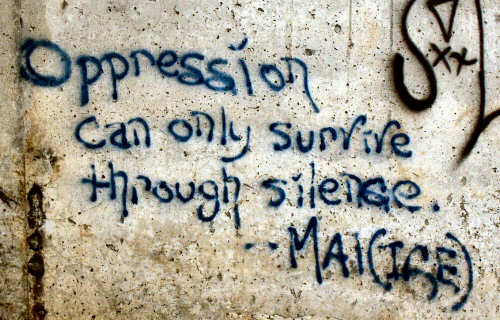
Oppression graffiti, January 15, 2013. (Students for Liberty via http://genderlitutopiadystopia.wikia.com).

Oppression graffiti, January 15, 2013. (Students for Liberty via http://genderlitutopiadystopia.wikia.com).

Did I play a good fife? Tamrin thought so. Compared to my Hebrew-Israelite comrades, I’m pretty sure I did. But like with so many things Hebrew-Israelite during those years, it was a bitter march to nowhere. The fife was part of a Hebrew-Israelite physical and spiritual gulag that put me into more chains, rather than freeing me to be me. Despite Tamrin’s intentions, the idea of molding me and others into men in conditions that would make most “men” contemplate homelessness or running away was a ridiculous pipe-dream.

That Tamrin was likely the only adult male in the Hebrew-Israelite camp who saw Maurice for the lying, abusive, womanizing asshole he was made me realize not everyone in this world was against me. But in a religion that when practiced helped oppress me and others more than the outside world, what was any Tamrin to do?

My Muhammad Ali

05 Sunday Jun 2016

Posted by decollins1969 in 1, Boy @ The Window, culture, Eclectic, High Rise Buildings, Jimme, Mount Vernon New York, My Father, New York City, Politics, Pop Culture, race, Religion, Youth

≈ Leave a comment

Tags

"Impact", Blackness, Bonds, Boxing, Closed-Circuit TV, Death, HBO, Legacy, Life, Maurice Eugene Washington, Meaning, Muhammad Ali, Parkinson's Disease, Robert Farmer, Roots (1977), Self-Awareness, Self-Discovery, The Greatest (1977)


Meme of Muhammad Ali quote on "impossible" combined with iconic photo of Ali in 1st Round of first fight with Sonny Liston, February 25, 1964. (Getty Images via Twitter).

Meme of Muhammad Ali quote on “impossible” combined with iconic photo of Ali in 1st Round of first fight with Sonny Liston, February 25, 1964. (Getty Images via Twitter).

There is so much I could say about Muhammad Ali. His greatness. His contradictions. His imperfections and frailness. And all of them would be true. He was both a great man and a deeply flawed man at the same time. But, from 1964 through 1980, Muhammad Ali was the most recognizable person on the planet, with every aspect of his complicated onion on display in every corner of the world.

I have a few childhood memories of Ali’s headier days and nights. One was in ’74. It was the “Rumble in the Jungle” fight between Ali and George Forman. My father Jimme took me and my brother Darren over to his drinking buddy Robert Farmer’s house to watch the fight on closed-circuit TV (yep, Mr. Farmer spent good money on this fight). I do remember seeing bits and pieces of the fight, with Ali using the ropes around the ring like they were a trampoline. But mostly, I remember my dad and Farmer and Lo and others drinking and smoking away while watching the fight. October 30, 1974 was also the night that I learned my first colloquialism, the “rope-a-dope.” I know that the “dope” was Foreman, but I’ve seen lots of people as dopes in the four decades since that fight.

The Rumble in the Jungle poster, October 29, 1974. (Armbrust via Wikipedia). Qualifies as fair use because of low resolution for reproduction.

The Rumble in the Jungle poster, October 29, 1974. (Armbrust via Wikipedia). Qualifies as fair use because of low resolution for reproduction.

I remember watching the “Thrilla in Manila” nearly a year later between Ali and Joe Frazier, either at Mr. Farmer’s place or at a bar, I’m not sure. Again, smoke, drinks, beer cans, sunflower seeds and cigars, all in the midst of two fellas knocking the hella outta each other. My father sure knew how to show his two young sons (I was five and Darren was seven at the time) a good time.

These two fights became vague but embedded memories, perhaps two of the greatest bouts of all time. Although, Jack Johnson-James Jeffries, Joe Louis-Max Schmeling I and II, and Ali (née Cassius Clay)-Sonny Lister also come to mind in terms of historical significance.

But where I remember seeing Ali in a context beyond the right was in this movie The Greatest in May 1977. Believe it or not, my soon-to-be idiot stepfather Maurice took us to see this mediocre docudrama of a biopic on Muhammad Ali’s through 1974. (So I guess I was wrong when I said my stepfather had only done two good things for me growing up). At seven, there was no way I could know how bad the film was, between scenery chewers Ernest Borgnine and James Earl Jones. Still, the movie put those hazy memories from ages four and five in better perspective. After having seen Roots a few months earlier, I was really conscious of the wider world, of race, and of Muhammad Ali’s importance for the first time.

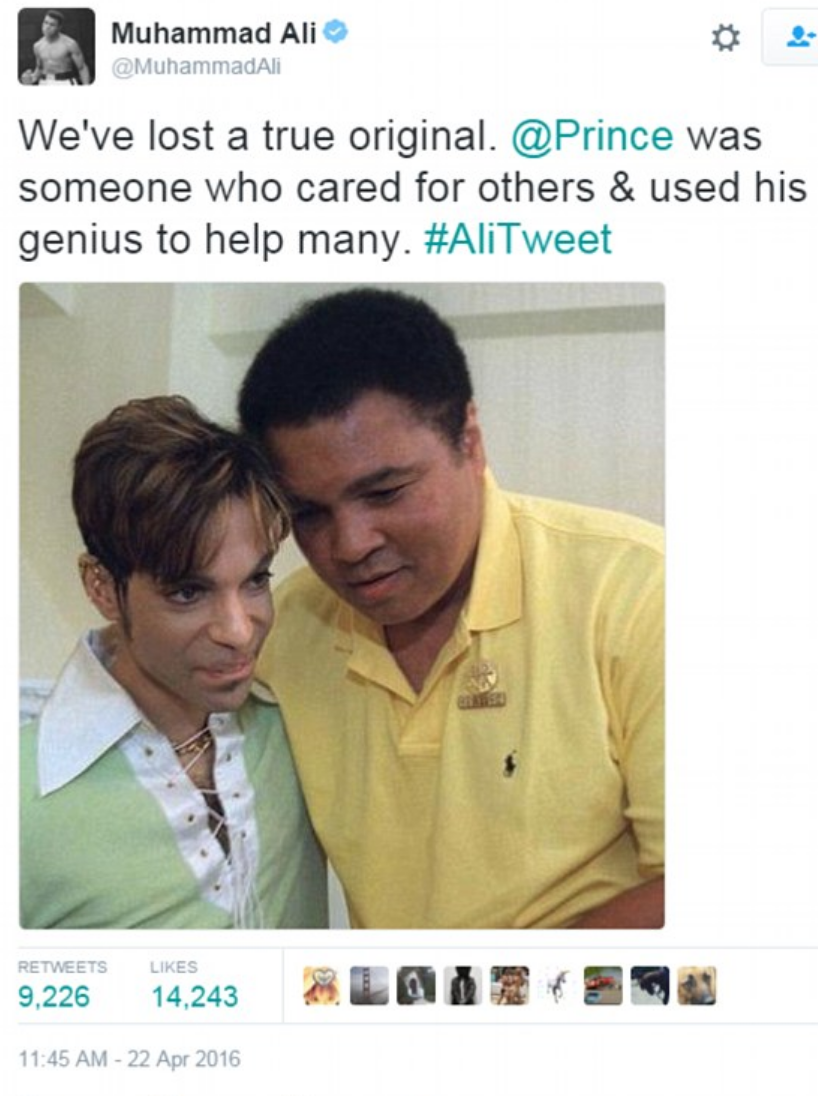
Muhammad Ali tweet re: Prince's death (pic is from their first meeting in 1997), April 22, 2016. (Twitter).

Muhammad Ali tweet re: Prince’s death (pic is from their first meeting in 1997), April 22, 2016. (Twitter).

Unlike Natalie Cole, David Bowie, Prince, and going back before 2016, Michael Jackson, I’ve been expecting Ali’s death for quite some time. His Parkinson’s wasn’t just Parkinson’s, but likely brain damage the likes of which NFL players have come to fear. That it took Ali until 1984 to announce what millions had suspected as far back as 1978 told us that he had taken a long time to come to grips with what would become his second act, his new reality. That Ali became a symbol of philanthropy, activism, and humanitarianism during this second act suggests that his strong will and support system deserves way more credit for the quality of his life than anything he did in the ring.

“Show me a hero, and I’ll write you a tragedy” comes from the 1920 mind of F. Scott Fitzgerald. If he were to write Muhammad Ali’s story, it would likely read as a tragedy. Luckily for us, Fitzgerald isn’t around to do so.

We have glossed over a few things in our millions of small eulogies for Ali this weekend. His sexism and occasional misogyny and abuse, both in words and deeds. His obvious colorism, calling Joe Foreman a “gorilla” and most of his somewhat darker skinned opponents “ugly” as a euphemism for their failure to pass the brown-paper-bag test. His rejection of Malcolm X at the very time when Malcolm needed him the most. Ali in the years between his biggest bouts and his mostly silent second life expressed regret about these -ism words and actions.

Despite this, Ali was still a father, a husband, a Muslim, a three-time heavyweight champion of the world, an author, a poet, an actor, an anti-war activist, a civil rights advocate, a social justice leader, a humanitarian, a hostage negotiator, and a Parkinson’s survivor. Ali was a fighter, in the most panoramic sense of the word. And yes, he was a Black man, in the narrowest and most intersectional senses of that two-word phrase. And all of that made him an icon. RIP.

Striking members of Memphis Local 1733 hold signs whose slogan symbolized the sanitation workers' 1968 campaign, March 1968. (Richard L. Copley/http://dlxs.lib.wayne.edu/).

Striking members of Memphis Local 1733 hold signs whose slogan symbolized the sanitation workers’ 1968 campaign, March
1968. (Richard L. Copley/http://dlxs.lib.wayne.edu/).

Afrocentrists, Evangelicals, Hebrew-Israelites and the False Revolution

28 Monday Mar 2016

Posted by decollins1969 in 1, Academia, Boy @ The Window, Carnegie Mellon University, Christianity, culture, Eclectic, Hebrew-Israelite, Mount Vernon New York, Patriotism, Pittsburgh, Politics, Pop Culture, race, Religion, University of Pittsburgh, Youth

≈ Leave a comment

Tags

Afrocentric, Afrocentricity, Authentic Blackness, Authority Figures, Black Action Society, Child Abuse, Covenant Church of Pittsburgh, Cross of Gold (1896), Dick Oestriecher, Domestic Violence, Estelle Abel, Evangelical Christianity, Frances Cress Welsing, Frederick K.C. Price, Gospel of Prosperity, Hoteps, Jack Van Impe, Judah ben Israel, Karl Marx, Kenneth Copeland, Kufi, Marxism, Maurice Eugene Washington, Molefi Asante, Neo-Marxists, Ostracism, Prosperity Gospel, Racism, Rapture, Religion, Wendy Goldman, William Jennings Bryan


Kenneth and Gloria Copeland, Believer's Voice of Victory television broadcast, November 23, 2011. (Carpetsmoker via Wikipedia). Released to public domain via CC-SA-3.0.

Kenneth and Gloria Copeland, Believer’s Voice of Victory television broadcast, November 23, 2011. (Carpetsmoker via Wikipedia). Released to public domain via CC-SA-3.0.

For nearly all of my life folks with even a kernel of authority have tried to convince me that there was one right way to live, one true path to liberation. Mostly religion has been the means through which others have attempted to box me in, although ideologues around Marxism, Afrocentricity, and Capitalism have all been in my figurative kitchen over the years. And like any well-meaning human being, at times I tried real hard to adapt myself to these right ways of thinking, of living out the one correct way to live. Only to fail, or rather, to recognize that none of these ways are the one right way, unless you are a closet right-winger, a conservative (non-ideological) wearing revolution-esque clothing.

My introduction to this madness began with my years as a Hebrew-Israelite, from April ’81 to April ’84 (although I wore my kufi until September ’84). That any parent could suddenly impose a new religion on their kids without explanation is abusive enough. When combined with vague notions about the Lost Tribes of ancient Israel and the wearing of clothes that set us apart culturally while in the middle of puberty, it was a forced societal ostracism. Even still, I tried to live by these strictures. “Remember the Sabbath day and keep it holy.” Eat kosher food, don’t use Ivory soap, shop only at Black or Hebrew-Israelite stores, avoid “unclean issues of blood.” But the physical abuse and poverty that came with being a Hebrew-Israelite in the Judah ben Israel madhouse of contradictions at 616 made me despise anything involving Hebrew-Israelite pretty much for all time.

Molefi Asante speech, Philadelphia, PA, September 13, 2014. (AP photo/file).

Molefi Asante speech, Philadelphia, PA, September 13, 2014. (AP photo/file).

Fast-forward a few years to the early 1990s, to the rise of Afrocentricity and the Afrocentric ethos. After three and a half years of being around Hebrew-Israelites, these kente-cloth wearing fools made me weary more times than not of their exclusionary our-way-or-no-way Blackness. Molefi Asante and the late Frances Cress Welsing were just the tip of a much larger iceberg in search of revolutionary “authentic” Blackness. From the Afrocentric undergrads who hijacked the Black Action Society leadership at the University of Pittsburgh in 1991 to folks who picked arguments with me for “sounding White” while I was in grad school, I saw them the same way I saw my now idiot ex-stepfather and the obnoxious Estelle Abel from my high school days. They were well-meaning but stupid. As far as I was concerned, they thought that their words alone would foster a revolution, that being Black meant turning one’s back on the world while also indirectly embracing an ethnocentric capitalism. Or at least, a Black American collective individualism, otherwise known as an “Afrocentric cool.”  I could not, I would not, exchange one form of oppressive uplift in Hebrew-Israelites for the shiny fool’s gold that mostly represented the Afrocentrists.

The neo-Marxists I met in Pittsburgh throughout the 1990s were no better. For all their revolutionary rhetoric, theirs was a world of theoretical activism, of scholarly examples of past oppression. Most of them didn’t know poverty and didn’t comprehend oppression beyond their own limited experience. Most of all, they couldn’t find a connection between American racism and class oppression if I gave them an industrial strength magnet. The fact that most of them hadn’t read Franz Fanon, W. E. B. Du Bois, Eric Williams, C. L. R. James, Anna Julia Cooper, Zora Neale Hurston, Derrick Bell, Angela Davis — but could quote Karl Marx the way Hebrew-Israelites could quote the Torah and Afrocentrists could quote Asante and Welsing — I found troubling. That’s putting it nicely. I found it contemptuous that folks who didn’t know my experience or who would all but refuse to read folks who written about experiences like mine would expect my allegiance to an ideology that was never meant for people who look like me.

The evangelical Christian part of my life was literally the last of the major dogmas to go. It was the hardest for me because I literally had given my life to Jesus in the midst of the whole Hebrew-Israelite crisis, Easter Sunday ’84. With my Mom coming down the same path by the late-1980s, it made it easier to not interrogate my Christianity as thoroughly as I would excoriate Afrocentrists and Marxists in graduate classes and in articles and papers a decade later. But even at nineteen, I realized that the Van Impe’s weekly predictions of the Apocalypse were as ridiculous as Welsing’s exulting of the magical properties of melanin. Or, for that matter, a fake Balkis Makeda cautioning against the use of Ivory Soap among her Hebrew-Israelite flock because of a dream she had.

Grant Hamilton cartoon for Judge Magazine on William Jennings Bryan's "Cross of Gold" speech, Democratic National Convention, Chicago, July 9, 1896. (Wikipedia). In public domain.

Grant Hamilton cartoon for Judge Magazine on William Jennings Bryan’s “Cross of Gold” speech, Democratic National Convention, Chicago, July 9, 1896. (Wikipedia). In public domain.

I went along to get along for years, until the hypocrisy of evangelical Christianity’s Gospel of Prosperity became too much. They took the metaphor of William Jennings Bryan’s cross of gold and actually went literal and nuclear with it. Somehow being Christian now meant blind patriotic allegiance to anything US and fully supporting capitalism, and yet an exclusionary separation between “true” evangelical Christians and the rest of the world. Especially on Rapture Day.

The last time I sat comfortably in a pew was in January ’97, although I’ve been to churches of various denominations dozens of times since. I still believe in Jesus, the life and the death and even the resurrection. But I don’t believe in most who claim to represent him, yet turn around and ignore the vulnerable standing right in front of them, making weak claims around individualism and poverty in the process.

In so many ways, evangelicals, Marxists, Afrocentrists, and Hebrew-Israelites are more alike than different. They all insist on a singular path, a quintessential truth. While some aspects of their thinking are appealing, I find accepting their bullshit in entirety poisonous to my spirit, mind, and gastrointestinal tract. There still may well be a revolution or even a rapture, but it won’t be because of any of these groups.

EWF, A Reminder That I Did Have a Childhood

06 Saturday Feb 2016

Posted by decollins1969 in 1, Boy @ The Window, culture, earth, wind & fire, Eclectic, eclectic music, High Rise Buildings, Mount Vernon New York, music, New York City, Pop Culture, race, Religion, Youth

≈ Leave a comment

Tags

EWF, Funk, Hebrew-Israelite, Humanities, Imagination, Jazz, Maurice Eugene Washington, Maurice Washington, Maurice White, Pop, R&B, Self-Awareness, Self-Discovery


Earth, Wind & Fire's All 'N All (1977) album cover, February 6, 2016. (http://www.allmusic.com).

Earth, Wind & Fire’s All ‘N All (1977) album cover, February 6, 2016. (http://www.allmusic.com).

I’m still reeling over Maurice White. Yeah, I still have my Earth, Wind & Fire on my CDs, my iPod, my iPhone, on three laptops and a desktop. Phillip Bailey and White’s brothers-in-arts are still here. Their music will always be with me and with us. But it feels like a little piece of my relative (if not contrived) innocence from my pre-Humanities, pre-Hebrew-Israelite days died with White Wednesday night.

Here’s what I wrote about those days of deliberately-induced blissful naiveté, Earth, Wind & Fire included, in my memoir:

“For me, this boy, this tweener, an active imagination and an even more animated dream life was critical. Living in between the hustle and bustle of “The City,” — Manhattan and the other four boroughs of New York — and the relative quiet of the ritzy suburbs immediately north of it was everything and everyone I knew before the age of twelve. Just three blocks after the elevated 2 Subway line ended at East 241st Street in the Bronx was where “Mount Vernon, New York” began. From the hard concrete sidewalks and green street signs of New York to the crumbling light blue slate and dark blue signs were my only indications that I had truly left the city. This despite the claims of so many I knew that upstate New York began somewhere above 125th or 207th Street in Manhattan. I knew by the time I was twelve that, sleepy bedroom suburb or not, Mount Vernon had more features in common with the Bronx and upper Manhattan than most city folk were willing to recognize.

“My only links to the great metropolis to the south were WNBC-TV (Channel 4), Warner Wolf — with his famous “Let’s go to the video tape line — doing sports on WCBS-TV (Channel 2), and WABC-AM 77 and WBLS-FM 107.5 on the radio. I found the AM station more fun to listen to, but I also liked listening to the sign-off song WBLS played at the end of the evening, Moody’s Mood for Love, with that, ‘There I go, There I go, The-ere I go…’ start. Music had been an important part of my imagination in ’79, with acts like Earth, Wind & Fire, Christopher Cross, Billy Joel and The Commodores. Not to mention Frank Sinatra, Queen, Donna Summer and Michael Jackson’s Off The Wall album. The music also made me feel like I was as much a part of New York as I was a part of Mount Vernon. It left me thinking of the ozone and burnt rubber smell that I noticed as soon as I would walk down into the Subway system in Manhattan. But aside from my occasional slip of the tongue — ‘warda’ for ‘water’ and ‘bawwgt’ for ‘bought’ — I didn’t sound or act much like a New Yawker. Still, I discovered something about New York from afar. I could sneak up to the rooftop of my apartment building, 616 East Lincoln, a five-story complex of three connected brick buildings with Tudor-style facades and a concrete-stone foundation. I’d find the exit to the roof unlocked and see the tops of the Twin Towers floating over some low-lying clouds on an otherwise sunny day. The symbols of the greatest city on Earth seemed to float toward the heavens on those days, and me with them.

“Besides the occasional reminder of life outside of my world, of Mount Vernon, I was the center of my own universe. Mount Vernon was but a stage on which my life played out, a place I hoped would stay this way forever. I was an eleven-year-old who thought that my world was the world. I lived my life like Philip Bailey and Maurice White would’ve wanted me to. I came to see ‘victory in a life [sic] called fantasy’ as my own life, living as if my imagination and dreams could be made into reality. All I had to do was wish it so.”

Because of what I went through during the Boy @ The Window years, I had to learn to get over my idiot ex-stepfather’s abuse to continue listening to Earth, Wind & Fire between ’82 and ’89. The late Maurice Eugene Washington was a fan as well, and I didn’t want us to both like the same music. Who the heck knew what was going on in his head when he heard “Fantasy” or “After The Love Is Gone,” anyway?

All I know is, there won’t be another group like the one Maurice White founded in ’69, the year I was born. All I can do is hold on to my precious Earth, Wind & Fire music, and the imagination that it helped spark. All I can do now is hope that someone can even begin to approach the kind of ethereal and powerfully Black-and-proud mix of music that White, Bailey, et al. were able to construct for nearly a decade. One can fantasize, right?


← Older posts
Newer posts →

Boy @ The Window: A Memoir

Boy @ The Window: A Memoir

Places to Buy/Download Boy @ The Window

There's a few ways in which you can read excerpts of, borrow and/or purchase and download Boy @ The Window. There's the trade paperback edition of Boy @ The Window, available for purchase via Amazon.com at http://www.amazon.com/Boy-Window-Donald-Earl-Collins/dp/0989256138/

There's also a Kindle edition on Amazon.com. The enhanced edition can be read only with Kindle Fire, an iPad or a full-color tablet. The links to the enhanced edition through Apple's iBookstore and the Barnes & Noble NOOK edition are below. The link to the Amazon Kindle version is also immediately below:

scr2555-proj697-a-kindle-logo-rgb-lg

Boy @ The Window on Amazon.com: http://www.amazon.com/Boy-The-Window-Memoir-ebook/dp/B00CD95FBU/

iBookstore-logo-300x100

Boy @ The Window on Apple's iBookstore: https://itunes.apple.com/us/book/boy-the-window/id643768275?ls=1

Barnes & Noble (bn.com) logo, June 26, 2013. (http://www.logotypes101.com).

Boy @ The Window on Barnes & Noble: http://www.barnesandnoble.com/w/boy-the-window-donald-earl-collins/1115182183?ean=2940016741567

You can also add, read and review Boy @ The Window on Goodreads.com. Just click on the button below:

Boy @ The Window

Twitter Updates

Tweets by decollins1969
  • RSS - Posts
  • RSS - Comments

Archives

  • June 2025
  • April 2023
  • September 2022
  • August 2022
  • July 2022
  • June 2022
  • May 2022
  • April 2022
  • March 2022
  • January 2022
  • December 2021
  • November 2021
  • October 2021
  • September 2021
  • August 2021
  • July 2021
  • June 2021
  • April 2021
  • March 2021
  • February 2021
  • January 2021
  • December 2020
  • November 2020
  • October 2020
  • September 2020
  • August 2020
  • July 2020
  • May 2020
  • April 2020
  • March 2020
  • January 2020
  • December 2019
  • November 2019
  • August 2019
  • July 2019
  • June 2019
  • May 2019
  • April 2019
  • March 2019
  • February 2019
  • January 2019
  • December 2018
  • November 2018
  • October 2018
  • September 2018
  • August 2018
  • July 2018
  • June 2018
  • May 2018
  • March 2018
  • February 2018
  • January 2018
  • December 2017
  • November 2017
  • October 2017
  • September 2017
  • August 2017
  • July 2017
  • June 2017
  • May 2017
  • April 2017
  • March 2017
  • February 2017
  • January 2017
  • December 2016
  • November 2016
  • October 2016
  • September 2016
  • August 2016
  • July 2016
  • June 2016
  • May 2016
  • April 2016
  • March 2016
  • February 2016
  • January 2016
  • December 2015
  • November 2015
  • October 2015
  • September 2015
  • August 2015
  • July 2015
  • June 2015
  • May 2015
  • April 2015
  • March 2015
  • February 2015
  • January 2015
  • December 2014
  • November 2014
  • October 2014
  • September 2014
  • August 2014
  • July 2014
  • June 2014
  • May 2014
  • April 2014
  • March 2014
  • February 2014
  • January 2014
  • December 2013
  • November 2013
  • October 2013
  • September 2013
  • August 2013
  • July 2013
  • June 2013
  • May 2013
  • April 2013
  • March 2013
  • February 2013
  • January 2013
  • December 2012
  • November 2012
  • October 2012
  • September 2012
  • August 2012
  • July 2012
  • June 2012
  • May 2012
  • April 2012
  • March 2012
  • February 2012
  • January 2012
  • December 2011
  • November 2011
  • October 2011
  • September 2011
  • August 2011
  • July 2011
  • June 2011
  • May 2011
  • April 2011
  • March 2011
  • February 2011
  • January 2011
  • December 2010
  • November 2010
  • October 2010
  • September 2010
  • August 2010
  • July 2010
  • June 2010
  • May 2010
  • April 2010
  • March 2010
  • February 2010
  • January 2010
  • December 2009
  • November 2009
  • October 2009
  • September 2009
  • August 2009
  • July 2009
  • June 2009
  • May 2009
  • April 2009
  • March 2009
  • February 2009
  • January 2009
  • December 2008
  • November 2008
  • October 2008
  • September 2008
  • August 2008
  • July 2008
  • June 2008
  • May 2008
  • April 2008
  • March 2008
  • February 2008
  • January 2008
  • December 2007
  • November 2007
  • October 2007
  • September 2007
  • August 2007
  • July 2007
  • June 2007

Recent Comments

MaryPena's avatarMaryPena on My Day of Atonement/Bitter Hat…
decollins1969's avatardecollins1969 on No Good Teaching Deed Goes…
Mary Rose O’Connell's avatarMary Rose O’Connell on No Good Teaching Deed Goes…

NetworkedBlogs on Facebook

NetworkedBlogs
Blog:
Notes From a Boy @ The Window
Topics:
My Life, Culture & Education, Politics & Goofyness
 
Follow my blog

616 616 East Lincoln Avenue A.B. Davis Middle School Abuse Academia Academy for Educational Development AED Afrocentricity American Narcissism Authenticity Bigotry Blackness Boy @ The Window Carnegie Mellon University Child Abuse Class of 1987 CMU Coping Strategies Crush #1 Crush #2 Death Disillusionment Diversity Domestic Violence Economic Inequality Education Family Friendship Friendships Graduate School Hebrew-Israelites High-Stakes Testing Higher Education History Homelessness Humanities Humanities Program Hypocrisy Internalized Racism Jealousy Joe Trotter Joe William Trotter Jr. K-12 Education Love Manhood Maurice Eugene Washington Maurice Washington Misogyny Mother-Son Relationship Mount Vernon High School Mount Vernon New York Mount Vernon public schools Multiculturalism MVHS Narcissism NFL Pitt Pittsburgh Politics of Education Poverty President Barack Obama Race Racial Stereotypes Racism Relationships Self-Awareness Self-Discovery Self-Reflection Sexism Social Justice Teaching and Learning University of Pittsburgh Violence Whiteness Writing

Top Rated

Blog at WordPress.com.

  • Subscribe Subscribed
    • Notes from a Boy @ The Window
    • Join 103 other subscribers
    • Already have a WordPress.com account? Log in now.
    • Notes from a Boy @ The Window
    • Subscribe Subscribed
    • Sign up
    • Log in
    • Report this content
    • View site in Reader
    • Manage subscriptions
    • Collapse this bar
 

Loading Comments...