• About Me
  • Other Writings
  • Interview Clips
  • All About Me: American Racism, American Narcissism, and the Conversation America Can’t Have
  • Video Clips
  • Boy @ The Window Pictures
  • Boy @ The Window Theme Music

Notes from a Boy @ The Window

~

Notes from a Boy @ The Window

Tag Archives: American Narcissism

“Fear of The Unknown” or “Other” = Inhumanity

09 Saturday Jul 2016

Posted by decollins1969 in 1, Academia, culture, Eclectic, Politics, Pop Culture, race, Religion, Work, Youth

≈ Leave a comment

Tags

"Fear of the Other", "Fear of the Unknown", #AltonSterling, #PhiladoCastile, American Narcissism, Black Box, Dallas, Duquesne University College of Education, Empathy, History of American Education, Humanity, Inhumanity, Islamophobia, Racism, Southern and Eastern European Immigrants, Teaching and Learning, Xenophobia


A black box with question mark, a certain "fear of the unknown," July 9, 2016. (http://socialcapitalmarkets.net).

A black box with question mark, a certain “fear of the unknown,” July 9, 2016. (http://socialcapitalmarkets.net).

The phrases “fear of the unknown” or “fear of the other” has been something that I’ve been familiar with as long as I’ve been in the classroom. So many essays, so many discussions, so many presentations where these stock phrases have greeted me in my capacity as instructor, professor, facilitator, administrator, and public speaker. Ultimately, the use of these all-too-often used phrases reflects the inability of the people who speak and write them to see other people as Homo sapiens, thus diminishing their humanity in the process.

The first time I seriously encountered either phrase, though, was in my second semester of teaching History of American Education in the College of Education at Duquesne University for MAT students. It was the fall of 1998, and I was teaching a required education foundations course (I was also doing Multicultural Education that semester). To be sure, there were a couple of veteran teachers who didn’t like having a twenty-eight year-old Black man telling them about the marbled history of their profession and the institutions for which they served as K-12 teachers. Some of their bigoted evaluation responses disclosed as much.

It was the week I lectured on the Southern and Eastern European immigrant experience in America’s emerging public school systems between roughly 1880 and 1930. In going through the efforts of educators to literally beat out of these children the language of their mother countries (e.g., Italian, Yiddish, Greek, Polish, etc.) while sorting them into lower intellectual tracks within public schools, I noted the anti-immigrant xenophobia among WASPs at that time. One of my students during discussion tried to explain it away as a WASP “fear of the unknown.” I asked, “What was the unknown? Were these immigrants aliens?” — in this case, I meant “extraterrestrials.”

Data Mining/Fear of the Unknown cartoon, Adam Zyglis, Buffalo News, July 6, 2013. (http://adamzyglis.buffalonews.com/2013/07/06/data-mining/).

Data Mining/Fear of the Unknown cartoon, Adam Zyglis, Buffalo News, July 6, 2013. (http://adamzyglis.buffalonews.com/2013/07/06/data-mining/).

The student didn’t really answer my question, as if “fear of the unknown” needed no explanation. But on the paper related to the experiences of the children of Southern and Eastern European immigrants, Black migrants, and working-class women, over and over again, the phrase “fear of the unknown” kept showing up. What made this use of phrase even more disappointing was an even more sobering Western Pennsylvanian reality. Most of my students were the descendants of Southern and Eastern European immigrants, some of whom were old enough to have had contact with grandparents who must have recounted their experiences with xenophobia in public education. That these students couldn’t possibly see the inhumanity of the phrase “fear of the unknown” made me question whether these current and future teachers should be in a classroom at all.

Luckily, I did manage to reach a few of my more skeptical students around these sorts of issues as this course progressed. After all, most teachers really do want to help their students. A couple even wrote me notes after slamming me in their evaluations about how my History of American Education course had opened their eyes to inequality and social reproduction in K-12 education.

Since then, I have remained keenly aware of when students, colleagues, public speakers, and fellow administrators (specifically in the context of the nonprofit world) have said or written the “fear of the unknown” or “fear of others” phrases. Mostly, it’s not in the context of White ethnics from an era in which “White” mostly meant “White Anglo-Saxon Protestants.” Over the past fifteen years, I’ve seen and heard “fear of the unknown” in reference to Blacks, Latinos viewed only as free-loading immigrants, and Arab-Muslim Americans as US-hating terrorists. There have been students who have justified the race riots of the not-so-recent past (the ones where White mobs stormed into Black neighborhoods and burned them out while maiming and killing Black men, women, and children) with the phrase “fear of the unknown.” Or co-workers who’ve explained away their xenophobia or homophobia as a natural “fear of the other.” Or public speakers who’ve explained Islam as if it were a magical black box that churns out terrorists the way Detroit used to turn out automobiles.

Caravaggio's Narcissus (1594-96) , May 15, 2011. (Masur via Wikipedia). In public domain.

Caravaggio’s Narcissus (1594-96) , May 15, 2011. (Masur via Wikipedia). In public domain.

Stop it. Just stop it. What does “fear of the unknown” really mean? That you didn’t know that Black Americans were human beings with a need for work, education, housing, sleep, air to breathe, and food to eat? That you couldn’t conceive of Latinos as a group of folks who’ve been part of the American landscape (specifically Texas and the southwestern US) for far longer than there has been a US? That you can’t contemplate the idea that Arab Muslims have just as much right to exercise their First Amendment rights to freedom of speech, religion, and assembly as any “red-blooded American?”

Using the phrase “fear of the unknown” says more about the people using it than it does about the “others” they attempt to describe as “unknowns.” All anyone really needs to know is that the so-called others are human beings. To say “unknown” or “other” means than you think you are superior to these “unknowns.” Or, conversely, that these “other” humans are not “normal,” that they are defective or not quite your equals. When groups of humans attempt to justify inequality or their fear with phrases like “fear of the unknown” or “fear of the other,” it means they have little or no empathy for the “unknown” or “other.” And when we as humans can cut ourselves off from other humans in this way, doesn’t that make us less humane, more “other” because we believe ourselves to be normal, even special, and therefore, better, than these “unknown others?”

Of course, there are tremendous psychological and material advantages to seeing other humans as “unknowns” and “others.” This week of #AltonSterling, #PhiladoCastile, and #Dallas has been proof positive of the value of some lives versus “unknown others.” The truth is, no Homo sapiens live in black holes. Unless those with the power to cut off empathy to their psychological and material advantage make a mental home for us there.

Addendum to “My Muhammad Ali:” Open Agendas

11 Saturday Jun 2016

Posted by decollins1969 in 1, culture, Eclectic, Patriotism, Politics, Pop Culture, race, Religion, Sports, Work, Youth

≈ Leave a comment

Tags

American Exceptionalism, American Individualism, American Narcissism, Anti-Racism, Attallah Shabazz, Billy Crystal, Bryant Gumbel, Economic Inequality, Funeral, Hypocrisy, Interfaith Service, Joe Rapport, KFC Center, Louisville Kentucky, Muhammad Ali, President Barack Obama, President Bill Clinton, Public Funeral, Religious Acceptance, Religious Bigotry, Structural Racism, Valerie Jarrett


Ambassador Attallach Shabazz (eldest daughter of Malcolm X) speaking at Muhammad Ali's public funeral, KFC Yum! Center, Louisville, KY, June 10, 2016. (http://www.odt.co.nz/).

Ambassador Attallah Shabazz (eldest daughter of Malcolm X) speaking at Muhammad Ali’s public funeral, KFC Yum! Center, Louisville, KY, June 10, 2016. (http://www.odt.co.nz/).

Public spectacles, if not properly processed and analyzed, are like champagne and wedding cake at a reception. Without a filter, a spectacle can easily become empty calories and shiny objects, lacking in context and devoid of implications.

The hours-long coverage of both Muhammad Ali’s ride to his grave and the public funeral service that followed the private one in Louisville, Kentucky on Friday had its moments. Ambasador Attallah Shabazz’s heartbreak, joy, and eloquence regarding her lifelong relationship with Ali and the connections between him, her, and her father, Malcolm X. Bryant Gumbel’s somber and bittersweet speech about Ali the man and athlete, so imperfect, so flawed, and yet, nearly as great as Ali said he himself was. Billy Crystal’s ability to mix comedy and sorrow, so typical of the great comedian when he was in his heyday. Rabbi Joe Rapport’s ability to keep his words and stories simple, to make his message plain. They were the highlight of the public interfaith spectacle that despite all objections to the contrary (including my own), was all that Ali wanted in the aftermath of his death.

"Ali Wins Decision" on 8-0 Supreme Court decision to "Kayo Draft Rap," June 29, 1971. (http://www.nydailynews.com).

“Ali Wins Decision” with SCOTUS decision to “Kayo Draft Rap,” June 29, 1971. (http://www.nydailynews.com).

If the service had only consisted of this group of men and women, the service would’ve been over in under an hour, and would have accomplished all Ali apparently wanted. Sadly, other people had the opportunity to speak for Ali and on his behalf, imbuing their own selfish and whitewashing stamps on the man and his public funeral. Valerie Jarrett, one of the powers behind President Barack Obama’s Oval Office chair, read Obama’s statement commemorating Ali at the funeral. Except that Valerie Jarrett’s reading of the president’s commemorative letter sounded more like a call to America as a great and exceptional nation.

He’d have everything stripped from him – his titles, his standing, his money, his passion, very nearly his freedom.  But Ali still chose America. I imagine he knew that only here, in this country, could he win it all back.

Where else was Ali going to go to continue his career? Ali was going through the courts in order to keep from going to prison for draft dodging, no? Running away would’ve made his predicament worse, not better. Ali may have chosen America between 1967 and 1970. But let’s not pretend as if Saudi Arabia, Australia, Sweden, and the USSR had invited him to live and fight heavyweight championship fights abroad as an alternative.

President 42, William Jefferson Clinton, ended the four (or was it five?) hour public funeral with his standard “I feel your pain” speech. Clinton had been crying for at least twenty minutes before he walked up the steps to the podium. His face was flush and a bright pink from grief. Clinton began with a few choked words as he stifled tears. Now, I am not saying that any of this was Clinton fakery. He has always been in the moment as long as he’s been in the public eye. And in that moment on Friday, the former president was as heartbroken as anyone in that 18,000-seat arena.

Still, Clinton managed a select choice of words that conjured up America the beautiful and the message of American individualism.

We have all seen the beautiful pictures of the humble Muhammad Ali with a boy and people visiting and driving by. I think he decided something I hope every young person here will decide. I think he decided very young, to write his own life story. I think he decided, before he could possibly have worked it all out, and before fate and time could work their will on him, he decided he would not be ever be disempowered. He decided that not his race nor his place, the expectations of others, positive negative or otherwise would strip from him the power to write his own story.

See how Clinton just slipped that in his eulogy, as if structural racism, economic inequality, the chaos of one’s family or community can be overcome by sheer force of will? (Or, as the researchers call it these days, “grit” and “resilience?”) Clinton snuck that American rugged individualism in there faster than a twenty-seven year-old Ali could turn out the lights and jump into bed. Or, rather, the way a sneaky teenager can spike a bowl of punch with whisky or rum.

How much grit does one need to overcome society's barriers?, June 11, 2016. (http://shop.takachpress.com).

How much grit does one need to overcome society’s barriers?, June 11, 2016. (http://shop.takachpress.com).

For Ali, it wasn’t just grit or determination that was critical. He had skills that only a handful of people on the entire planet have ever possessed in any generation. The kind of skills that made him a three-time heavyweight champion. His family was working-class in the Jim Crow South, a major achievement in the 1940s and 1950s. A Louisville police officer who also happened to train boxers “discovered” Ali in 1954, when the latter was twelve years old. Maybe Ali, like me at twelve, had discovered some sense of his calling and pursued it fully. But opportunities matter. Talent matters. A background that incubates and nurtures that talent matters. Sheer will alone only gets individuals so far. Thanks for continuing to spread the American mythology, Clinton.

Clinton also said

I have spent a lot of time now, as I get older and older, trying to figure out what makes people tick, how do they turn out the way they are, how do some people refuse to become victims and rise from every defeat.

The answer isn’t merely in individual struggle, but in dismantling structures that stifle the ability of individuals to overcome. Or really, dismantling structures so that there is no need to overcome racism and inequality in the first place. The idea that it’s just the individual’s fault that they do not overcome being victims. This could just as easily be the argument that rapist Brock Turner’s father made against “Emily Poe” after his son was sentenced to only six months in county jail for sexual assault in California.

The Trials of Muhammad Ali (2013) poster, June 11, 2016. (http://www.kartemquin.com).

The Trials of Muhammad Ali (2013) poster, June 11, 2016. (http://www.kartemquin.com).

Maybe President Obama’s right. “Muhammad Ali was America. He will always be America.” But what America was he? Was he a narcissistic megalomaniac who had no empathy for the plight of the poor and vulnerable and didn’t understand structural racism and religious intolerance as fundamental obstacles to freedom? Or was he the unapologetic Black man who stood for what America ought to be, rather than the hypocrisy that America often is? Or, perhaps, Ali represents both strands of this bipolar and narcissistic American identity after all?

What this means is that while Ali can forever rest in peace, for America, peace will remain elusive.

On My Own Narcissism

19 Saturday Mar 2016

Posted by decollins1969 in 1, Academia, Boy @ The Window, culture, Eclectic, Mount Vernon New York, Patriotism, Politics, Pop Culture, race, Religion, Youth

≈ Leave a comment

Tags

American Narcissism, Donald Trump, Humanities, Jean W. Twenge, Narcissism, NPD, NPI, Self-Awareness, Ted Bundy, W. Keith Campbell


You are from God, little children, and have overcome them; because greater is He who is in you than he who is in the world.

— 1 John 4:4 (New American Standard Bible)

For those who regularly read my blog, you’ve probably noticed the increased focus over the past year on the issue of American obsession with individualism and its own greatness mythology. At least, the parts of which I’ve roughly translated into a collective American narcissism, or a collective American absorption with itself. It has become the latest idea, my latest potential project, but still too early to tell what, if anything, will come out of this so far. Most Americans remain blissfully unaware of anything that doesn’t involve winners, losers, vicarious living, and America always being seen as #1 at everything (even though in most cases it isn’t).

This post, though, isn’t about how the world’s #1 nation is deeply flawed by a narcissism that runs nearly as deep as the center of a black hole. No, this post is all about me. Really, it’s about the fact that even as I recognize America’s narcissism — both historical and current — that I myself am not inoculated from that narcissism.

Expanding red giant stars will engulf too-close planets before turning into white dwarfs, August 13, 2013. (James Gitlin/STScI AVL via http://www.space.com/).

Expanding red giant stars will engulf too-close planets before turning into white dwarfs, August 13, 2013. (James Gitlin/STScI AVL via http://www.space.com/).

My first bout with narcissism began at the end of elementary school at William H. Holmes in Mount Vernon, New York. It was the spring of ’81. I’d just finished up three years as a straight-A student, been made into a Hebrew-Israelite, came in second for a city-wide essay contest, and been granted the honor of introducing the keynote speaker at my graduation. Even with fighting my best friend Starling, my family’s slow but steady fall into grinding poverty, and the next six years of Humanities in front of me, who wouldn’t have a head as inflated as the Sun at its red-giant stage?

As I wrote in Boy @ The Window

I firmly believed that no one in the world was smarter than me. It wouldn’t have been any funnier if I’d pretended I was Mr. October himself, Reggie Jackson, saying his words, ‘Sometimes I underestimate the magnitude of me.’

It took a year of relative mediocrity while in seventh-grade Humanities for my march toward narcissistic personality disorder to end at the cliff of disillusionment. I wasn’t the “smartest kid in the whole world.” But as I also discovered in my time in this magnet program, neither were any of my classmates.

Perhaps the biggest lesson here was that I was all of eleven and twelve years old when America’s narcissism with individual achievement had caught me in a tangled web of lies and myths. No success or failure or anything in between occurs in a vacuum. No individual’s success happens purely on her or his own, without support, context, and in many cases, an advantage of one sort or another. It took years to learn this lesson, between Humanities and graduate school, the nonprofit world and academia, to learn to give up on the bullshit that is the American meritocracy.

That’s not to say that one can eliminate selfishness (which isn’t the same as narcissism, by the way), or shouldn’t strive for success or a better life for themselves or their kids or their families. But we should always ask ourselves why, in what context, how should we measure our victories, and even if running over others to achieve those victories is the right way to live? Most Americans don’t ask, don’t tell, don’t verify, and don’t think about their lives in this way, because most of us have been taught by this culture that the empathetic lens is a loser’s way of viewing the world.

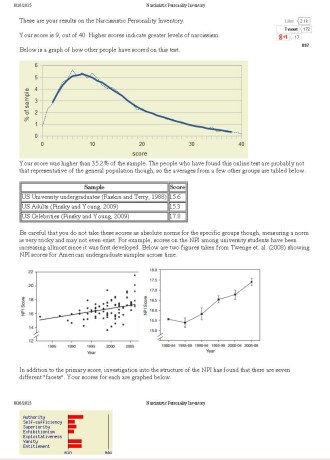
My NPI Score, done August 20, 2015. (http://personality-testing.info/tests/NPI.php).

My NPI Score, done August 20, 2015. (http://personality-testing.info/tests/NPI.php).

I have taken a read — actually, several in the past year — of Jean M. Twenge and W. Keith Campbell’s book The Narcissism Epidemic: Living in the Age of Entitlement (2009). Theirs is a good base to begin to view American society as one so obsessed with individualism that it renders us all anywhere between a little narcissistic to borderline Donald Trumps and Ted Bundys. The psychologists and psychiatrists in this niche have a test for narcissistic personality disorder or NPD, the Narcissistic Personality Index. It consists of 40 questions, seeking to determine whether one is low, medium, or high in narcissism within the index.

I took the NPI last August, and scored a 9 out of 40. It meant that I have some narcissistic tendencies, but only scored higher than 35 percent of those who’ve taken the NPI. I wasn’t even close to being an average American narcissist! Not really a surprise, as those seeking to take such an index are likely less narcissistic than their navel-gazing neighbors.

So, I am in this world and mostly of it, if only because it’s hard to divorce one’s existence from the world in which they live. But I am self-aware enough to know my own narcissism, and empathetic enough to see the narcissism in others.

Great. It still means that as a nation, our narcissism goes as far back as the mind can imagine. It still means that in a couple of centuries, historians will lament about the America that was. Those historians will see a country and a people so busy in building themselves up that they stomped on the oppressed and crushed the downtrodden in the process. A US with so many myths and ideals, but so few attempts at making any of them true.

The Academic Conference: Likes and Dislikes

31 Saturday Oct 2015

Posted by decollins1969 in 1, Academia, Carnegie Mellon University, culture, Eclectic, Patriotism, Pittsburgh, Politics, Pop Culture, race, University of Pittsburgh

≈ Leave a comment

Tags

American Narcissism, Andrew Hartman, Christopher Lasch, Conference Presentations, Diagnostic and Statistical Manual for Mental Disorders, Diversity of Thought, DSM, Elisabeth Lasch-Quinn, Hamilton Crowne Plaza, Jackson Lears, Jonathan Holloway, No-Shows, Psychiatry, Psychology, Public Speaking, Randal Maurice Jelks, S-USIH 2015 Conference, Society of U.S. Intellectual Historians, US Imperialism, Washington DC


Summer Breeze, July 2014 (they served these at the hotel where the S-USIH Conference was held). (http://sommerbuffet.dk/).

Summer Breeze, July 2014 (they served these at the hotel where the S-USIH Conference was held). (http://sommerbuffet.dk/).

This will not be a post in which I list every possible takeaway I’ve ever had from any conference or set of conferences. Instead, I have a few notable impressions to discuss, things of which the Society of U.S. Intellectual Historians 2015 Conference reminded me two weeks ago.

For one, October 17 was my first academic conference presentation in eight and a half years, my longest stretch without going in front of an academically trained crowd since before my first day of grad school in August 1991. It was a good presentation, not my best, but far from my worst. I presented as part of my panel on American Imperialism, American Narcissism, with my paper, titled “‘We’re #1:’ How US Imperialism and American Narcissism Reinforce Each Other.” My main points in the paper and in the presentation:

2 Cheers for American Exceptionalism, March 2010. (http://www.aei.org).

2 Cheers for American Exceptionalism, March 2010. (http://www.aei.org).

1. That historians and other scholars (really, other writers, other intellectuals, educators, psychologists, and social scientists) should take a closer look at the Diagnostic and Statistical Manuel for Mental Disorders (a.k.a., the DSM) and maybe use it as a means for evaluating American culture and society as narcissistic (301.81, the code for narcissistic personality disorder as of DSM-IV-TR), rather than merely assuming that it is so based on simplistic observations. (I knew from my previous experience in grad school and through working for Western Psych in Pittsburgh and Westchester County Department of Community Mental Health that some historians would have trouble with the soft evidence of psychology).

2. That even though my paper concentrated on the period after 1945, my argument was far more comprehensive. My larger argument is that narcissism has always been a fundamental default position of American culture and society, rooted in part in imperialism, but part of the basic character of the nation from its outset as a group of English colonies.

It was kind of fun to present, but would have been even more fun if folks on my panel or in the audience challenged some of my ideas and evidence. That’s often the way to make a paper or a presentation even better. (For those who have an interest, a copy of the paper is here to download, but I do expect some feedback).

It was good to meet some folks I either hadn’t seen in years or had never met before, like Elisabeth Lasch-Quinn, Jonathan Holloway, and Jackson Lears. It was good to see my friend and one-time student Andrew Hartman as he facilitated the conference (flaws and all). Mostly, it was good to be able to get out of my own head and own writing, to hear others talk about some of the issue I care about from a perspective different from my own.

A bored audience, April 2012. (https://ispeakcomics.files.wordpress.com/).

A bored audience, April 2012. (https://ispeakcomics.files.wordpress.com/).

But it wasn’t exactly like going to do the boogie-down at a Sade concert. Two things really stood out. One, academicians need serious public speaking training. The older I get, the more quickly I tire of watching presenters read their papers verbatim, as if the audience couldn’t download it and read it at their leisure. Even a mediocre presentation delivered as a speech is generally better than the best-read papers. Of course, even in the extemporaneous category, many academicians could still use lots of training and deliberate focus.

Two, where is the common courtesy when someone cannot make a conference to serve as a chair or present their work? The chair for my panel bagged out without so much as a tweet, much less an email or a telephone call. As the senior person on the panel, I became the chair the same afternoon I delivered my talk by default. Not a new thing, but a heads-up even that Saturday morning would’ve helped. I followed up with the derelict chair after the conference. He still has yet to respond to my message.

All I know is, I need to do more of this, especially if this idea of mine is to evolve into a larger project. But it can’t be me speaking only at academic conferences. Other settings, with other thinkers, old and young, disagreeable and full-fledged advocates, I’m in need of them all. If or when I do come through, though, please, please show up.

Aside

We’re Talking About Plutonomics

04 Friday Sep 2015

Posted by decollins1969 in 1, Boy @ The Window, culture, Eclectic, eclectic music, Politics, Pop Culture, Work, Youth

≈ Leave a comment

Tags

"Money's Too Tight (To Mention)" (1985), American Narcissism, Capitalism, Mick Hucknall, Plutocracy, Plutonomics, Reaganomics, Simply Red, Top 1%


"The Logic of the 'Haves'" cartoon illustration, November 20, 2010. (Chan Lowe/Florida Sun-Sentinel; http://blogs.trb.com/0.

“The Logic of the ‘Haves'” cartoon illustration, November 20, 2010. (Chan Lowe/Florida Sun-Sentinel; http://blogs.trb.com/).

On my iPod (yes, iPod, where I can still store thousands of songs and not have to make a phone call and check my email, I listened to Simply Red’s version “Money’s Too Tight (To Mention)” (released in the US in 1986) this morning. At one point, lead singer Mick Hucknall croons, “We’re talking ’bout Reagan’omic’s,” and after hearing this song off and on for twenty-nine years (my life story’s in most of those lyrics), it hit me. Reaganomics really doesn’t do justice to what Congress and the GOP and conservatives and neocons and corporate/wealthy interests have done to the US economy in my lifetime.

It’s been the culmination of the plutocrats’ ultimate fantasy – tricking Americans into thinking that the marriage between the federal, state and local governments and rigged capitalism doesn’t actually exist. All while garnering hero status in the eyes of the majority of Americans. They now have their narcissism, and can eat it with caviar and champagne, too.

It doesn’t matter if the unemployment rate is 5.1 percent as of today. Fewer people are in the workforce now than there were when the economy cratered in 2008. Real income is 25 percent lower in 2015 than its peak in 1973. College graduates must take a job at Costco (if they are really lucky) or Starbucks to make anywhere near a living wage. There is simply not enough skilled work to employ a highly educated workforce in a nation that has moved heavily toward lower-tiered service industry work.

Yet, we continue to call this state of affairs capitalism, or unbridled capitalism, or something akin to capitalism run amok. Of course that’s true, especially for card-carrying Marxists. But psychologically, given the ability of the wealthy and the corporations they own to profit regardless of the Dow Jones or the socioeconomic status of ordinary Americans, it’s not enough to say that this is capitalism. It’s Plutonomics, the economic screwing of the bottom ninety percent (or especially, the bottom three-fifths) of Americans for the benefit of the top ten and especially the top one-percent. Plutocrats have such a hold on the American psyche, that even now, most Americans believe that Donald Trump became a billionaire through hard work. Most Americans take in the prosperity gospel the way a thirsty person drinks water after a day in the desert.

And Plutonomics has been around much, much, much longer than capitalism. Think Rome, think Han China, think slavery and the Western Hemisphere.


Aside

“And There’s Winners, And There’s Losers…

19 Wednesday Aug 2015

Posted by decollins1969 in 1, Christianity, culture, Eclectic, eclectic music, New York City, Patriotism, Politics, Pop Culture, race, Religion, Work

≈ Leave a comment

Tags

"Pink Houses" (1983), 2016 Election, American Narcissism, Bankruptcy, Comb-Over, Donald Trump, FOX News Debate, Frank Sinatra, Hypocrisy, John Mellencamp, Losers, Misogyny, Narcissism, New York, New York" (1980), Racism, RNC Debate, The Donald, Trump Supporters, Winners, Xenophobia


“But they ain’t no big deal/’Cause the simple man, baby/Pays for thrills/The bills the pills that kill” – John Mellencamp, “Pink Houses” (1983).

Donald Trump’s entire campaign might as well be called “The Ultimate Narcissist Does The Pink Houses” Tour, complete with Def Leppard, his kids, and Omarosa going to bat for him on CNN. Trump and his angry band of supporters see the world in the simplest way, like an indoctrinated twelve-year-old forced to be part of a religious cult (I can definitely relate). Trump sees himself as a “winner,” the US as a country that used to be a “winner,” and anything or anyone who doesn’t fit his narrative as “losers.” Of course there’s a contradiction here. Trump doesn’t have the courage to call many of his supporters “losers,” though there are about four decades’ worth of his actions and statements that would serve as evidence of his thoughts about his base.

2016 presidential candidate Donald Trump meeting with New England Patriots owner Robert Kraft, Gillette Stadium, Foxboro, MA, October 21, 2012. (Nancy Lane/Boston Herald;http://bostonhearld.com).

2016 presidential candidate Donald Trump meeting with New England Patriots owner Robert Kraft, Gillette Stadium, Foxboro, MA, October 21, 2012. (Nancy Lane/Boston Herald;http://bostonhearld.com).

At the “Big Boys” RNC debate a couple of weeks ago, Trump couched everything in terms of “winners” and “losers.” President Obama was an “incompetent loser.” The US is “losing to China” economically. Mexican immigrants are turning the US into “a nation of losers.” The US has to “win” against ISIS (I prefer the term Islamic State or IS that most news agencies use outside the US, but that would make me a loser). Trump’s pronouncements at the debate and since have been about more than sound bites of “us” vs. “them,” as the more progressive media elements have said. It’s been about presenting himself as America’s winner, as the one at “the top of the heap, king of the hill, A-number-1.”

In a nation full of narcissists, this has a real appeal, even if the reality of Trump’s life contradicts both the winner image he portrays and the lives that most of his supporters actually live. The most obvious is Trump’s net worth being more like between $1.4 billion and $4 billion (Oprah Winfrey territory), and not the $10 billion he says it is. Or that he has — or, as Trump would say, “my companies” have — filed for Chapter 11 four times in the past quarter-century. Or his multiple divorces. Or his ridiculous comb-over in 20+mph winds.

I guess all of those falsities and setbacks should be more nuanced, as part of life’s long and bumpy journey. By Trump’s own definition, because his net worth — though envy-inducing — is hardly #1 (still between Bill Gates, Warren Buffett, and Michael Bloomberg), he should see himself as a loser. Because Trump has seen multiple business ventures crash and burn, the “loser” moniker could fit. Oh, but narcissism allows for those suffering from grandiose inflations of themselves to see their failings, their losses as mere bumps in the road, and not part of the “winners and losers” narrative.

Picture of abandoned Palma Nova mobile home park, where the last of the 900 families had been evicted in 2009, Davie, Florida, February 15, 2010. (Mike Stocker/Miami Sun-Sentinel; http://www.sun-sentinel.com/local/broward/fl-palma-nova-davie-pg-photogallery.html).

Picture of abandoned Palma Nova mobile home park, where the last of the 900 families had been evicted in 2009, Davie, Florida, February 15, 2010. (Mike Stocker/Miami Sun-Sentinel; http://www.sun-sentinel.com/local/broward/fl-palma-nova-davie-pg-photogallery.html).

The same goes for Trump’s supporters, most of whom couldn’t hope to be PTA president at their neighborhood elementary school, much less run for POTUS. The US is so replete with narcissism that it’s in the bloodstream of ordinary low-income Americans (the majority of the working population, by the way). And as such, their reasons for supporting Trump are as sad as they are predictable. They see him as a winner, even though he was born into wealth via his real estate magnate father (or as many New Yorkers saw him, slum lord), Fred Trump. The Donald was born halfway between third and home plate, and somehow ordinary Americans see him as a quintessential American?

Trump’s supporters also see him as someone who “tells it like it is.” Really? Ready to be fooled again, just like with so many numbskulls and wing-nuts who’ve sold Americans the magic of tax cuts for the rich and for corporations and endless prosperity in the past? Some of these narcissists are like gambling addicts, taking their last dollars to a slot machine on the hope of making it rich with crusty toenails. It both a real shame, and pitiful to watch.

Aside

American Narcissism, or, “Smiling, Crying, and Celebrity”

10 Friday Jul 2015

Posted by decollins1969 in 1, Christianity, culture, Eclectic, eclectic music, Movies, music, Patriotism, Politics, Pop Culture, race, Religion

≈ Leave a comment

Tags

"Charlie X", "Original Of The Species" (2005), American Narcissism, Captain James T. Kirk, Gordon Ramsey, How To Dismantle An Atomic Bomb (2004), Kitchen Nightmares, Narcissism, Psychic Powers, Self-Aggrandizement, Self-Love, Self-Promotion, South Carolina State Rep. Jenny Horne, Star Trek, Star Trek TOS (1966-69), Thasians, U2, US Foreign Policy, US History, William Shatner


South Carolina Representative Jenny Horne (Republican) speaking on floor of House chamber, Columbia, SC, July 8, 2015. (http://www.slate.com via C-SPAN3).

South Carolina Representative Jenny Horne (Republican) speaking on floor of House chamber, Columbia, SC, July 8, 2015. (http://www.slate.com via C-SPAN3).

There are so many examples of the US as a nation of narcissists that when I step outside of my own narcissism, it literally leaves me with vertigo. I can see narcissism everywhere. In how Americans drive, as if they’re the only car on the road in bumper-to-bumper traffic. I see it in how people walk on sidewalks, as if no one else will ever need space to walk in the opposite direction, or as if everyone wants to walk at a slow, plodding pace. I see it in how we reacted to even minor criticism, as if the comment “this needs revision” equals “you’re a lazy, untalented hack of a writer,” and deserves a response equally personal and nasty.

From U2's "Original Of The Species" (2005) video, from How To Dismantle An Atomic Bomb (2004) album, July 9, 2015. (http://youtube.com).

From U2’s “Original Of The Species” (2005) video, from How To Dismantle An Atomic Bomb (2004) album, July 9, 2015. (http://youtube.com).

One of the better demonstrations of narcissism American style is through our popular culture. From Frank Sinatra to Rick Ross, Mae West to Nicki Minaj, we have a century’s worth of pop culture divas as examples of narcissism at the level of prominent American individuals. The narcissism is so normal that we have benign terms for it, like “self-promotion” or “self-love.” People, especially in the pop culture world, should promote and love themselves, of course. But at what point is narcissism a self-defeating process of “me as triumphant,” “me as the center of the universe,” “me for everyone to like/love more and more?”

A clear-cut example of art imitating life imitating art for me around narcissism would be a Star Trek: TOS (The Original Series) episode. Season 1, Episode 2, September 15, 1966, was the airing of the “Charlie X” episode on NBC. It was the one in which a seventeen-year-old who had been stranded on an alien planet since the age of three was taken up to the Enterprise by a transport ship. Once on the Enterprise, the teenager displayed both petulance and his toolbox of god-like powers, hurting crew members or making them disappear at a whim. All because they either unknowingly insulted him or made him jealous in some way. As one story line summary for the episode reads, “Captain Kirk must learn the limits to the power of a 17-year-old boy with the psychic ability to create anything and destroy anyone.”

Charlie Evans, played by Robert Walker, Jr., Star Trek TOS, Season 1, Episode 2, September 15, 1966. (https://thesouloftheplot.files.wordpress.com/).

Charlie Evans, played by Robert Walker, Jr., Star Trek TOS, Season 1, Episode 2, September 15, 1966. (https://thesouloftheplot.files.wordpress.com/).

The Charlie Evans character became fixated on a female crew member — consistently called “a girl” in 1966 (that wasn’t acceptable even back then) — in one Yeoman Janice Rand. Charlie’s obsession with having her, his dislike for criticism and being told what to do, his inability to check his emotions, his destructive responses, were all based on his needs from moment to moment. Every potential slight, every action that he couldn’t control led Charlie to do some damning things. With his thoughts, Charlie took away Lt. Uhura’s voice, broke Spock’s legs, blinded another crew member, took away one woman’s face, aged another woman, and made one other woman disappear. When Charlie couldn’t win at chess, he melted the chess pieces. “I can make you all go away! Any time I want to!,” Charlie exclaimed at one point in the episode.

Within a scene or two, just before the episode’s climax, Kirk finally said, “Charlie, there are a million things in this universe you can have and a million things you can’t have. It’s no fun facing that, but that’s the way things are.” This was when Charlie was on the verge of taking over the ship and possibly wiping out the Enterprise‘s crew. But then, the Thasians came (the aliens who’d given Charlie his powers in the first place) with their own starship to take Charlie in as one of their own. “We gave him [Charlie] the power so he could live. He will use it – always. And he will destroy you, or, you will be forced to destroy him,” the face of the Thasians said. Then, the Thasians disappeared Charlie to their starship, with Charlie’s final words, “I wanna stay… stay… stay… stay… sta…” lingering on the Enterprise‘s bridge.

Defaced woman, Star Trek TOS, Season 1, Episode 2, September 15, 1966. (http://goodcomics.comicbookresources.com/).

Defaced woman, Star Trek TOS, Season 1, Episode 2, September 15, 1966. (http://goodcomics.comicbookresources.com/).

If this episode doesn’t serve as a metaphor for America as a nation and Americans as 320 million individuals with varying levels of narcissism, I don’t know what does. America has always declared itself at the center of the world, centuries before it became a world superpower. Any affront — real or perceived — has often led to skirmishes and wars, embargoes and removals. America’s relatively short history includes Indian wars, Barbary pirates, the War of 1812, the American Revolution, Manifest Destiny and the Mexican-American War, the Monroe Doctrine, Banana Republics and Cuba, Manuel Noriega and Panama, Beirut and Grenada. The central theme of American history and foreign policy has been to self-aggrandize, to settle scores, to challenge other countries to duels, to take advantage of those in the most vulnerable places in the US and around the globe.

So too has narcissism been a part of ordinary Americans’ lives. Just watch a rerun of Kitchen Nightmares on BBC America or on FOX. Any criticism delivered by soccer coach-chef Gordon Ramsey is received about the same way as a toddler reacts when their favorite toy goes missing. Taunts, tantrums, threats, gnashing of teeth, juvenile guilt and despair.

And, for a moment, there may even be a haunting realization that your intellect and experiences aren’t at the center of the universe. But just for a moment. After all, there aren’t any Thasians to check and balance America’s narcissism. Still, narcissism has a way of using up people and nations. Maybe in a hundred years, maybe in 500, but some time in the future, historians will write about American narcissism the same way many historians write about the gross inequalities of an over-glorified ancient Rome.

← Older posts
Newer posts →

Boy @ The Window: A Memoir

Boy @ The Window: A Memoir

Places to Buy/Download Boy @ The Window

There's a few ways in which you can read excerpts of, borrow and/or purchase and download Boy @ The Window. There's the trade paperback edition of Boy @ The Window, available for purchase via Amazon.com at http://www.amazon.com/Boy-Window-Donald-Earl-Collins/dp/0989256138/

There's also a Kindle edition on Amazon.com. The enhanced edition can be read only with Kindle Fire, an iPad or a full-color tablet. The links to the enhanced edition through Apple's iBookstore and the Barnes & Noble NOOK edition are below. The link to the Amazon Kindle version is also immediately below:

scr2555-proj697-a-kindle-logo-rgb-lg

Boy @ The Window on Amazon.com: http://www.amazon.com/Boy-The-Window-Memoir-ebook/dp/B00CD95FBU/

iBookstore-logo-300x100

Boy @ The Window on Apple's iBookstore: https://itunes.apple.com/us/book/boy-the-window/id643768275?ls=1

Barnes & Noble (bn.com) logo, June 26, 2013. (http://www.logotypes101.com).

Boy @ The Window on Barnes & Noble: http://www.barnesandnoble.com/w/boy-the-window-donald-earl-collins/1115182183?ean=2940016741567

You can also add, read and review Boy @ The Window on Goodreads.com. Just click on the button below:

Boy @ The Window

Twitter Updates

Tweets by decollins1969
  • RSS - Posts
  • RSS - Comments

Archives

  • June 2025
  • April 2023
  • September 2022
  • August 2022
  • July 2022
  • June 2022
  • May 2022
  • April 2022
  • March 2022
  • January 2022
  • December 2021
  • November 2021
  • October 2021
  • September 2021
  • August 2021
  • July 2021
  • June 2021
  • April 2021
  • March 2021
  • February 2021
  • January 2021
  • December 2020
  • November 2020
  • October 2020
  • September 2020
  • August 2020
  • July 2020
  • May 2020
  • April 2020
  • March 2020
  • January 2020
  • December 2019
  • November 2019
  • August 2019
  • July 2019
  • June 2019
  • May 2019
  • April 2019
  • March 2019
  • February 2019
  • January 2019
  • December 2018
  • November 2018
  • October 2018
  • September 2018
  • August 2018
  • July 2018
  • June 2018
  • May 2018
  • March 2018
  • February 2018
  • January 2018
  • December 2017
  • November 2017
  • October 2017
  • September 2017
  • August 2017
  • July 2017
  • June 2017
  • May 2017
  • April 2017
  • March 2017
  • February 2017
  • January 2017
  • December 2016
  • November 2016
  • October 2016
  • September 2016
  • August 2016
  • July 2016
  • June 2016
  • May 2016
  • April 2016
  • March 2016
  • February 2016
  • January 2016
  • December 2015
  • November 2015
  • October 2015
  • September 2015
  • August 2015
  • July 2015
  • June 2015
  • May 2015
  • April 2015
  • March 2015
  • February 2015
  • January 2015
  • December 2014
  • November 2014
  • October 2014
  • September 2014
  • August 2014
  • July 2014
  • June 2014
  • May 2014
  • April 2014
  • March 2014
  • February 2014
  • January 2014
  • December 2013
  • November 2013
  • October 2013
  • September 2013
  • August 2013
  • July 2013
  • June 2013
  • May 2013
  • April 2013
  • March 2013
  • February 2013
  • January 2013
  • December 2012
  • November 2012
  • October 2012
  • September 2012
  • August 2012
  • July 2012
  • June 2012
  • May 2012
  • April 2012
  • March 2012
  • February 2012
  • January 2012
  • December 2011
  • November 2011
  • October 2011
  • September 2011
  • August 2011
  • July 2011
  • June 2011
  • May 2011
  • April 2011
  • March 2011
  • February 2011
  • January 2011
  • December 2010
  • November 2010
  • October 2010
  • September 2010
  • August 2010
  • July 2010
  • June 2010
  • May 2010
  • April 2010
  • March 2010
  • February 2010
  • January 2010
  • December 2009
  • November 2009
  • October 2009
  • September 2009
  • August 2009
  • July 2009
  • June 2009
  • May 2009
  • April 2009
  • March 2009
  • February 2009
  • January 2009
  • December 2008
  • November 2008
  • October 2008
  • September 2008
  • August 2008
  • July 2008
  • June 2008
  • May 2008
  • April 2008
  • March 2008
  • February 2008
  • January 2008
  • December 2007
  • November 2007
  • October 2007
  • September 2007
  • August 2007
  • July 2007
  • June 2007

Recent Comments

decollins1969's avatardecollins1969 on No Good Teaching Deed Goes…
Mary Rose O’Connell's avatarMary Rose O’Connell on No Good Teaching Deed Goes…
Lyndah McCaskill's avatarLyndah McCaskill on The Raunchiest of Them Al…

NetworkedBlogs on Facebook

NetworkedBlogs
Blog:
Notes From a Boy @ The Window
Topics:
My Life, Culture & Education, Politics & Goofyness
 
Follow my blog

616 616 East Lincoln Avenue A.B. Davis Middle School Abuse Academia Academy for Educational Development AED Afrocentricity American Narcissism Authenticity Bigotry Blackness Boy @ The Window Carnegie Mellon University Child Abuse Class of 1987 CMU Coping Strategies Crush #1 Crush #2 Death Disillusionment Diversity Domestic Violence Economic Inequality Education Family Friendship Friendships Graduate School Hebrew-Israelites High-Stakes Testing Higher Education History Homelessness Humanities Humanities Program Hypocrisy Internalized Racism Jealousy Joe Trotter Joe William Trotter Jr. K-12 Education Love Manhood Maurice Eugene Washington Maurice Washington Misogyny Mother-Son Relationship Mount Vernon High School Mount Vernon New York Mount Vernon public schools Multiculturalism MVHS Narcissism NFL Pitt Pittsburgh Politics of Education Poverty President Barack Obama Race Racial Stereotypes Racism Relationships Self-Awareness Self-Discovery Self-Reflection Sexism Social Justice Teaching and Learning University of Pittsburgh Violence Whiteness Writing

Top Rated

Blog at WordPress.com.

  • Subscribe Subscribed
    • Notes from a Boy @ The Window
    • Join 103 other subscribers
    • Already have a WordPress.com account? Log in now.
    • Notes from a Boy @ The Window
    • Subscribe Subscribed
    • Sign up
    • Log in
    • Report this content
    • View site in Reader
    • Manage subscriptions
    • Collapse this bar
 

Loading Comments...