Poverty, Violence and PTSD – But What About Racism?

Tags

, , , , , , , , , , , , , , , , , , , ,


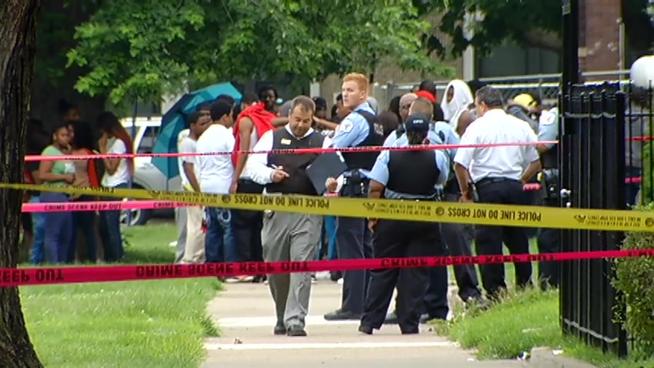
Chicago Police fatally shot a 16-year-old boy in the city’s Gresham neighborhood Saturday night and distraught family members are questioning the incident, July 6, 2014. (http://nbcchicago.com).

Chicago Police fatally shot a 16-year-old boy in the city’s Gresham neighborhood Saturday night and distraught family members are questioning the incident, July 6, 2014. (http://nbcchicago.com).

Over the past two weeks, thanks to Chris Hayes’ reporting on the state of Chicago for MSNBC, not to mention a horrific July 4th weekend, Mayor Rahm Emanuel’s lie of declining violent crime in the metropolis has been thoroughly exposed. In the past eighty-four hours, dozens of shootings in Chicago injured at least sixty people, with between nine and eleven killed. Six of these shootings involved the Chicago PD, as they killed two teenagers over the weekend. But if we leave it to the mainstream media and the moralist Black elite to explain, the Blacks on Chicago’s South Side are just immersed in a “culture of violence.” Black youth simply live careless, nihilistic lives, that “gang, drug, [and] gun violence” is the root of the problem

For those White, bright, and bi-racially White, though, there’s the knee-jerk reaction of media and caring adults that comes with it. For mass shooters apparently with much better aim than folks in Chicago, like Elliot Rodger, Adam Lanza, James Holmes, Wade Michael Page, Eric Harris and Dylan Klebold, mental health and mental illness, along with gun control, is the mainstream media’s topic of the day. Even their explicit racism and misogyny can become the media’s evidence for their mental illness. White and Black moral leaders don’t then speak of cultural deficiencies or of an enjoyment of crime and violence as reasons for their shootings.

It’s terrible that we afford one group of young men every benefit of the doubt because they were/are affluent or White, and the deny humanity of another because they were/are poor and Black or Brown. Yet recent sociological and psychological studies indicate what anyone who has lived in poverty and with violence has at least sensed throughout their lives. That many (if not most) growing up in these conditions experience post-traumatic stress disorder (PTSD), leading to more poverty and violence in adulthood.

I know this better than most. Below is a short sample of the violence I witnessed or experienced from birth through adulthood:

September ’70 – my father, drunk and jealous, attempted to attack my mother with a knife. My Mom with me and my brother Darren in tow, picked up a heavy quartz crystal ashtray and threw it at my father as he charged her in the kitchen. He was apparently struck in the head and knocked unconscious. The ashtray had detached the retina in his left eye, which he never had repaired. Nine years later, my father had to have his left eye removed. I don’t remember this attack or my Mom defending herself — I was all of ten months old. I do remember my father’s eye being removed, and the headache and vertigo he had prior to the surgery in the summer of ’79 The research indicates, though, that there would have been a psychological impact on me and my nearly three-year-old brother nevertheless, and not a good one at that.

July ’75 –  from Boy @ The Window
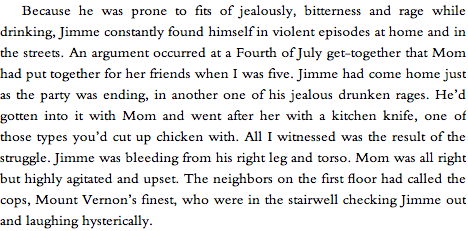
Screen shot 2014-07-07 at 1.08.28 PM

December ’76 – when my father stomped in a brand-new glass coffee table and had to go to the hospital with several serious bloody cuts in his legs.

April ’77 – when my Uncle Sam clotheslined my father after his months of psychological and abuse toward my Mom had landed her in Mount Vernon Hospital with kidney problems.

April ’82, May ’82, July-August ’82 – my then stepfather beating me up in a Karate studio in front of a group of men because I refused to call him “Dad,” beating up my Mom for not “lovin’ him,” and beating me up for the first six weeks of my summer between seventh and eighth grade for me defending my Mom.

January ’86 – the last time my stepfather actually laid a fist on me, damaging or chipping three of my front teeth and busting my lip in the process.

June ’89 – the last fight between my Mom and my stepfather, where the same crystal ashtray my Mom used in ’70 easily could’ve fractured her jaw and left cheekbone. Thankfully, my then stepfather had terrible aim.

If it were just a matter of domestic violence and child abuse for me alone, that would be tragic, but not necessarily relevant. The violence of 616 East Lincoln Avenue, sadly, wasn’t contained to A32. Domestic violence was the way of the A-building at 616, starting with our adjacent next-door neighbors. In the two-bedroom department immediately below us, the husband and wife had a violent, alcoholic relationship, so bad that it was a rare weekend in the years between ’77 and ’87 where a plate or wine glass didn’t break or the police weren’t called. Their son once pointed a gun at me on my walk up the front steps of 616 when I was a senior in high school and claimed he’d secretly pointed a gun at me in the past. Muggings and robberies, including the four that I experienced, were as common as the common cold

At the near-door apartment building, 630 East Lincoln, the drug trade had been alive and well years before the arrival of crack cocaine. Fights involving knives and baseball bats were normal, often involved a crowd of kids as spectators. Sometimes these fights would spill onto the front lawn of 616’s A-building, where I could witness it first-hand.

That violence was a frequent companion in my life wasn’t surprising. I never lived anywhere growing up where the majority of the people around me weren’t welfare-poor, working-poor or working-class Blacks, where the heating oil came in time for winter, and where maintaining mental health was a topic of conversation. To act as if employment practices, education policy, public health access, police neglect or brutality or housing policies had nothing to do with the sheer concentration of poverty and violence around me would be at the least naive. Fundamentally, it was the benign neglect in the chain between individual racial assumptions, the soft bigotry of mainstream media, and the hard concrete of structural racism in play.

What was my constant companion growing up in Mount Vernon, New York has remained the story of poverty, race and violence in Chicago’s South Side for a century. Don’t feel sorry, for me or for all of those shot up in Chicago this past July 4th weekend. Do something, say something, or don’t. But feeling sorrow without saying or doing something about shouldn’t be an option.
Talking Tocqueville Too Much

Tags

, , , , , , , , , , , , , , , , , , ,


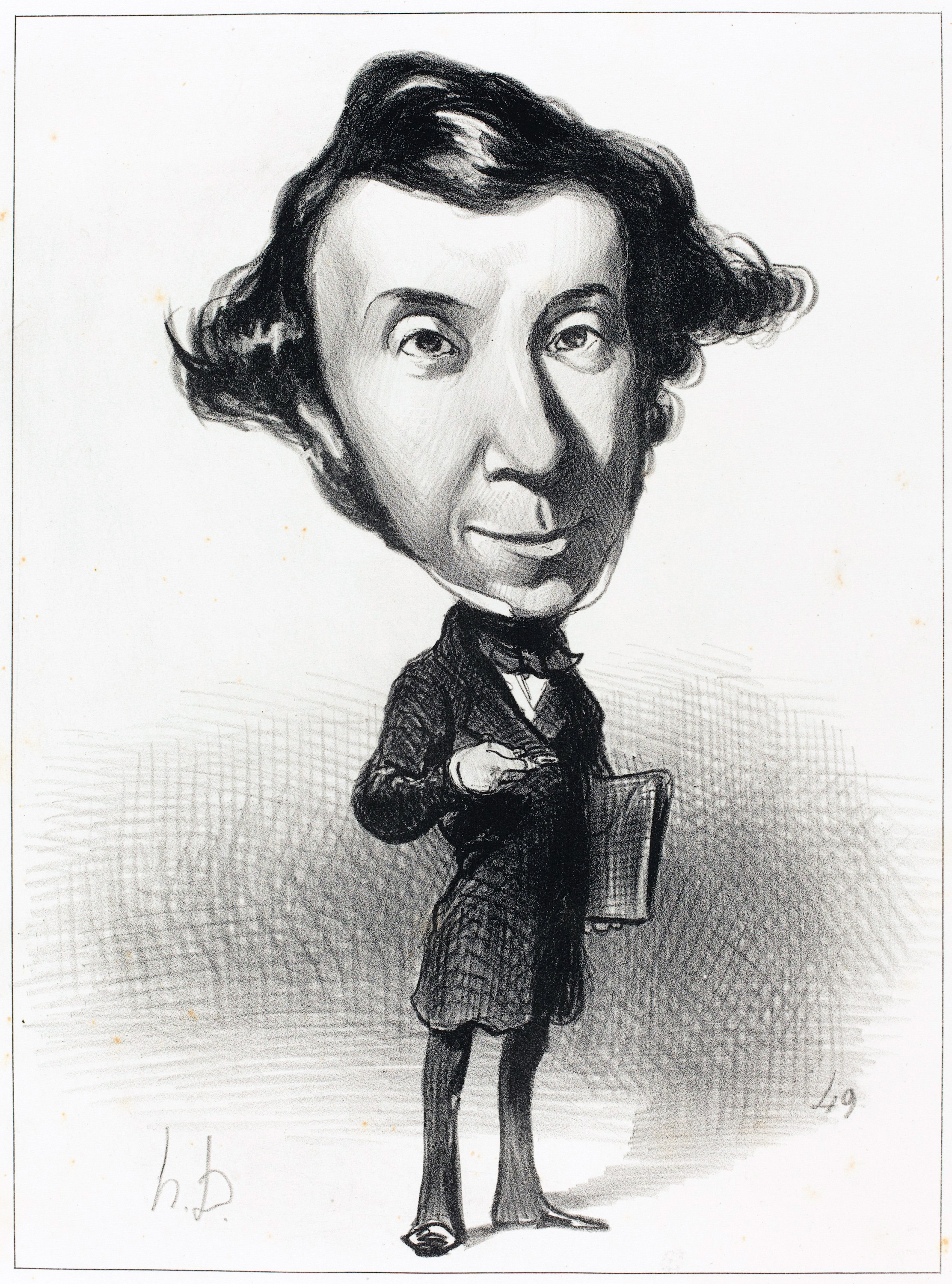
Alexis Tocqueville caricature (1849), by Honoré Daumier, National Gallery of Art, Washington, DC. (Wikipedia). In public domain.

Alexis Tocqueville caricature (1849), by Honoré Daumier, National Gallery of Art, Washington, DC. (Wikipedia). In public domain.

Every year for at least the past thirty years, without fail, I’ve read at least one article, seen or read at least one book, or watched at least one commentary about the great Alexis de Tocqueville. These are almost always about the French political theorist’s grand tour of America in the early 1830s and his affirmation of America’s exceptional democracy, egalitarianism and lack of permanent social classes. Over the years, I’ve found these all too frequent comments and examinations of a long-dead tourist vomit-inducing.

Tocqueville may have gotten it right, that America and its democracy was in a unique position in 1833 to take off and become a powerful nation, if given the time. But he didn’t understand America at all, at least, not really. Tocqueville didn’t understand how central inequality was to the development of America’s unique and exceptional democracy. He assumed, quite wrongly, that any issues of inequality in our then young nation were limited to the American South, where cotton was king and slavery was the backbone of the economy. Tocqueville only saw slavery as a moral dilemma of debasing humanity — slave owner and slave — and not as a political or economic one. So what if he predicted the rise of the US and Russia as world powers if he didn’t predict the American Civil War?

The Half Has Never Been Told: Slavery and the Making of American Capitalism by Edward E. Baptist (due out September 9, 2014 -- there's always Eric Williams' Capitalism and Slavery [1944]), July 5, 2014. (http://bn.com).

The Half Has Never Been Told, by Edward E. Baptist (due out September 9, 2014 – there’s always Eric Williams’ Capitalism and Slavery [1944]), July 5, 2014. (http://bn.com).

Tocqueville looked at America outside of the South and saw an egalitarian and agrarian society, one unconnected to the slavery located south of the Mason-Dixon line and spreading southwest across the Mississippi River. Where did he think the money came from to finance plantations, to ship the raw materials of these plantations overseas and to buy more slaves? How did Tocqueville think these plantation owners could turn cotton into cloth and tobacco into cigarettes and cigars? Much of it came from bankers and merchants in New York, Boston and Philadelphia, and from the factories of New England and New York. Slavery was the backbone of the rise of the American economic system, and was America’s industrialized foundation. Period.

Tocqueville argued that America was unique because of its lack of a permanent class system, particularly an aristocracy. Our country’s democracy, in fact, guaranteed the constant churning of social mobility. Tocqueville must’ve been high on the tobacco leaves he sniffed in his tour of Virginia! While the nation had shed most of the obvious symbolism that came with wealth in Europe, Tocqueville had completely ignored that for the first half-century of US, only rich, land-owning White males could vote (and in many cases, hold office). Only in the five or ten years before his tour of the US did non-propertied White males gain the right to vote.

On top of this, though most Americans were farmers in the 1831-33 period, American urbanization had already begun. American cities didn’t have the age or splendor of European ones, to be sure. But what Tocqueville didn’t recognize was that wealth was already beginning to be concentrated in cities like Philadelphia, Boston and New York, in the form of commerce, in banking, and in the beginnings of modern industries. And though large-scale exploitation of poor and uneducated Irish immigrations wouldn’t begin for another fifteen years, the exploitation of poor, native White (and frequently, female and child) labor was already well underway, pulling Whites from countryside to cities in the process.

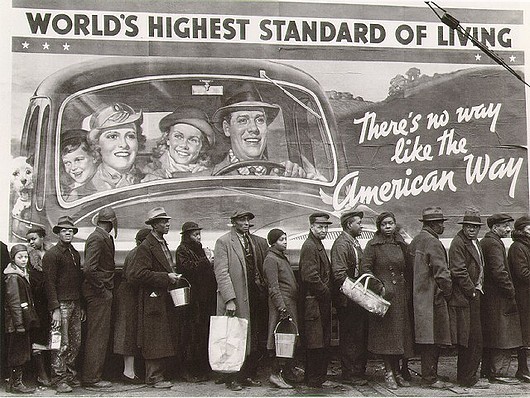
"World's Highest Standard of Living" poster with Black flood victims in bread line, Louisville, Kentucky, by  Margaret Bourke White, February 15, 1937. (ThunderPeel2001 via Wikipedia). Qualifies as fair use under copyright laws -- low resolution.

“World’s Highest Standard of Living” poster with Black flood victims in bread line, Louisville, Kentucky, by Margaret Bourke-White, February 15, 1937. (Wikipedia). Qualifies as fair use under copyright laws — low resolution.

And this is the man who so many of my historian and political scientist colleagues like to cite and quote? Especially around Independence Day! Sorry, but if I did a two-year tour of, say, South Africa right now, and predicted their eventual greatness because of their unique racial democracy and rapid economic development, who’d take me seriously by 2200 CE? Maybe MSNBC host Chris Matthews‘ great-great-great-great grandson, who would then claim South African exceptionalism based on my predictive power from 180 years before.


Corporations, Dogs, and a Possible Civil Rights Future

Tags

, , , , , , , , , , , , , , , , , , , , , , , , , , , , ,


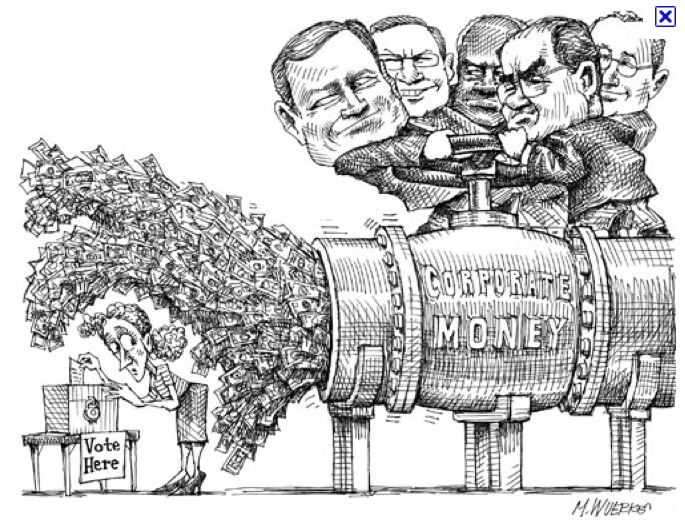
Matt Wuerker, Corporate Money/Vote Here, January 2010. (Politico.com). Qualifies as fair use -- low resolution, related to subject matter of this blog post.

Matt Wuerker, Corporate Money/Vote Here, January 2010. (Politico.com). Qualifies as fair use — low resolution, related to subject matter of this blog post.

It finally happened. After twenty-two attempts between the 117th and the 118th Congress, and a short ratification process, the US Constitution finally has a Twenty-Eight Amendment. For the first time, more than two million corporations with headquarters within America’s borders have citizenship rights, including the right to vote. Despite widespread opposition from Democrats and independent progressives, thirty-eight states ratified the amendment in record time, 72 days. The Twenty-Sixth Amendment — the one lowering the national voting age from 21 to 18 — had held the previous record of 100 days, as three-fourths of the states had ratified it in 1971.

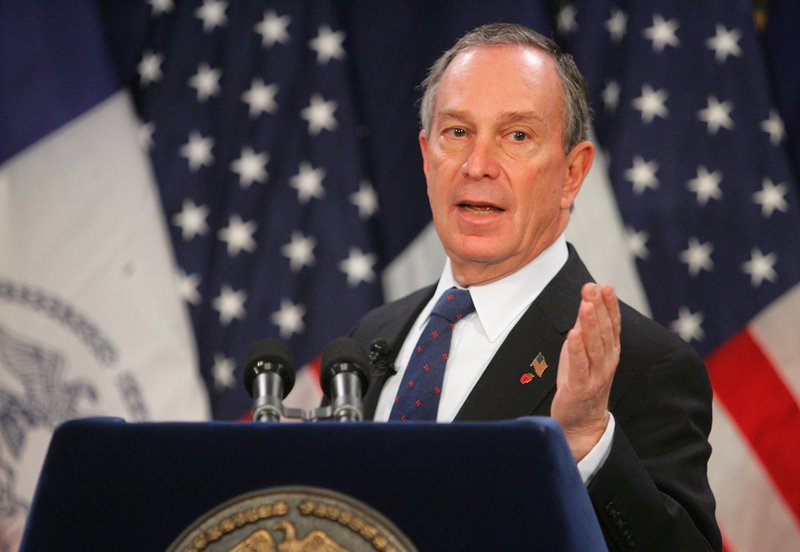
President Michael Bloomberg signed the bill this morning in a well-attended Rose Garden ceremony. With such luminaries as Mark Cuban, Bill Gates and David Koch present, the President said, “This is a great victory of American democracy, ensuring its preservation for future generations.” House Speaker Paul Ryan (R-WI), also present at the ceremony, said, “The American people finally have a democracy that represents us all, one that will stabilize our government and our economic way of life.”

Former New York City Mayor Michael Bloomberg, City Hall, January 27, 2005. (http://themoderatevoice.com).

Former New York City Mayor Michael Bloomberg, City Hall, January 27, 2005. (http://themoderatevoice.com).

What President Bloomberg and Speaker Ryan didn’t say was that this was the most expensive constitutional amendment campaign in the nation’s history. The Walton family, the Koch Brothers and NBC Universal Comcast-Time-Warner alone spent almost $1 billion in saturating the Internet and airwaves with ads in support of the amendment between mid April and the end of June, according to the Toronto Star. Independent watchdog groups, including the United Nations Department of Political Affairs, put the total amount at $2.2 billion, with much of the money going directly to state legislatures and much-needed infrastructural projects.

“When governments can only operate at the behest of corporations, you no longer have a democracy, you have a plutocracy,”  UN spokesperson Malala Yousafzai said at a press conference in New York this afternoon. “Only twenty percent of the US electorate participated in the ratification process,” Yousafzai said, corresponding roughly to the demographics of America’s rich and middle classes.

That this came on the same day as the 60th anniversary of President Lyndon B. Johnson’s signing of the Civil Rights Act of 1964 was not lost on America’s public intelligentsia. “This is a shame that the America republic will have to live with for years to come — if there’s an American republic in the future,” Melissa Harris-Perry said in an interview on CBC Radio in Toronto.

This expansion of American democracy comes on the heels of a landmark US Supreme Court decision. Last week, in a 5-4 ruling, the majority decided PETA v. US in favor of the plaintiff, saying that for the first time, “dogs have a constitutional standing on par with persons.” Justice Samuel Alito wrote the court’s majority opinion, and Justice Clarence Thomas wrote a concurring opinion. What made the PETA decision truly historic was that Justice Thomas explained the court’s decision. “We have found, with the help of significant scientific evidence, that dogs are sentient beings, and thus, deserving of the same civil rights that we have all enjoyed in this country for decades. Although dogs today have not been granted the power of the ballot box, they, like my generation of black men and women, have come a long way in their fight for civil rights,” Justice Thomas said.

Co-founder and President of People for the Ethical Treatment of Animals Ingrid Newkirk, and David Shankbone's dog Little Man, New York City, November 1, 2007. (David Shankbone via Wikipedia). Released to public domain via CC BY-SA 3.0, GFDL.

Co-founder and President of People for the Ethical Treatment of Animals Ingrid Newkirk, and David Shankbone’s dog Little Man, New York City, November 1, 2007. (David Shankbone via Wikipedia). Released to public domain via CC BY-SA 3.0, GFDL.

The PETA decision overturned a lower court ruling, throwing out the case on the grounds that dogs aren’t human beings. PETA fought the lower court’s ruling based on the Burwell v. Hobby Lobby Stores, Inc. (2014) decision, where the Supreme Court had ruled that a corporate, non-living entity had personhood status because it represented people’s interests and values. This earlier ruling provided an opportunity for PETA to bring in scientific evidence that could elevate the status of dogs as a living entity representing people’s interests and values.

“Dogs everywhere will celebrate this victory, along with their caregivers,” Ingrid Newkirk, founder and president of PETA said last week from her home outside Norfolk, Virginia. “It is our hope that these personhood rights will protect dogs from abuse and neglect for now and for the future, giving them the same rights as a living human being,” Newkirk added. It helped that the Leona Helmsley Charitable Trust covered the estimated $20 million in legal fees and scientific studies for the PETA claim.

Former US Solicitor General Kamala Harris, who had presented the government’s case to the Supreme Court last December, said after last week’s decision, “with this court making a dog a person, this court has made a mockery of American jurisprudence for all time. What about the rights of racial minorities to a fair trial, of women to reproductive choice, of ordinary Americans to a living wage?” Harris resigned on Friday, June 28, just hours after the PETA ruling. President Bloomberg declined comment on Harris’ resignation.

Georgetown University professor Michael Eric Dyson expressed the feelings of many Americans in opposition when he said, “The Star-Spangled Banner should be rewritten. It should be, ‘O say does that star-spangled banner yet wave, with corporations’ roaming free, and dogs over descendants of slaves!'”

Open Letter: My Knicks Have Sucked For Four Decades

Tags

, , , , , , , , , , , , , , , , , , , , , , ,


knicks_suck

We (NY Knicks) Suck (logo off t-shirt), May 26, 2014. (http://nyill.wordpress.com).

I wish that I could be much more positive than this. But to think that the New York Knicks, once one of the NBA’s great franchises, haven’t won a title in forty-one years! They used to be a great franchise because of their two NBA championships (1969-70, 1972-73), or at least, because they regularly competed with the LA Lakers, the Boston Celtics, and the Milwaukee Bucks for a title. The only reason people who follow NBA basketball still see my Knicks as a great franchise is because they’re in New York, or more specifically, Manhattan (since the Nets are in Brooklyn now). But the simple fact is, my Knicks have sucked for forty-one of the forty-four years and six months I’ve been alive.

You can talk about Micheal Ray Richardson, Bernard King, Marc Jackson, and the great Patrick Ewing. You can bring up our ’94 run to the NBA Finals against the Houston Rockets, or our miracle run to the finals in ’99 against the San Antonio Spurs. You can even consider the coaching chops of Hubie Brown (overrated), Rick Pitino (overrated), Pat Riley, Don Nelson, Jeff Van Gundy (unbelievably overrated) and so many has-beens and never-weres over the past four decades. Diehard fan as I’ve been and am, my Knicks, my childhood franchise, has sucked more than the oldest running oil well in Texas. Period.

Even the New York Rangers have won a Stanley Cup since the last time the Knicks have won a title. Matter of fact, the Philadelphia ’76ers, Houston Rockets, Chicago Bulls, Detroit Pistons, San Antonio Spurs, Washington Bullets (now Wizards), Seattle Supersonics (now Oklahoma City Thunder), Portland Trailblazers, Dallas Mavericks, and Miami Heat have all won at least one title since the Knicks with Red Holzman as coach and Walt Frazier, Willis Reed, Dave DeBusschere, et al. as players won their second. The Watergate scandal was still in its infancy, and the last American troops had withdrawn from Vietnam just months before we’d beaten the Lakers (again) in the ’73 NBA Finals.

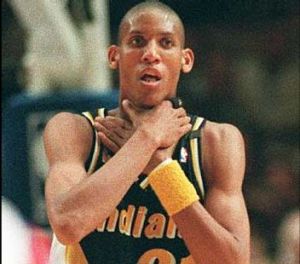
Indiana Pacers great (and NBA Hall of Famer) Reggie Miller giving Knicks, Spike Lee the choke sign, Game 5, Eastern Conference Finals, Madison Square Garden, New York, screenshot, June 1, 1994. (NBC Sports).

Our best teams were essentially a bunch of bruisers, a team of low-percentage shooters ringed around Patrick Ewing in the ’90s. The Knicks were so anemic offensively that we had to foul and beat up the other team in order to hold them under ninety points if we were going to win consistently. Still, after have a 3-2 lead in the ’94 Finals, we choked at the end of Game Six in Houston, and barely had a chance in Game Seven (thank you, John Starks!). The following year, we made the Indiana Pacers’ Reggie Miller an even bigger star in Game One of the second round (eight points in 8.9 seconds – ridiculous)! Two years later, we brawled our way out of the playoffs in the middle of the first round against the Heat. A good team for its time — yes. A championship-caliber team — absolutely not. We overachieved, riding the rickety knees of Ewing and Starks’ streak shooting.

From the moment Ewing fully ruptured his right Achilles tendon in Game Six of the Eastern Conference Finals in June ’99, we have been in full-on suck mode. A few playoff appearances, a win or two in fifteen years? When we’ve drafted talented players, we didn’t keep them or they end up cutting their careers short with big-time injuries. When we’ve gotten great talent as free agents, our coaches and front office have driven them away, as was most recently the case with Carmelo Anthony. Most of the past forty-one years, though, we’ve drafted like a gambling addict on a binge in Las Vegas. And we’ve picked up free agents the way an ignorant and inebriated gold prospector hunts for fool’s gold.

"Drainage! I drink your milkshake...I drank it up..." scene/ screenshot from There Will Be Blood (2007), with Daniel Day Lewis and Pano Dano. (http://klipd.com/)

“Drainage! I drink your milkshake…I drank it up…” scene/ screenshot from There Will Be Blood (2007), with Daniel Day-Lewis and Pano Dano. (http://klipd.com/)

Reggie Miller was absolutely right in June ’94 when he gave my Knicks and Spike Lee the choke sign. But he should’ve directed the choke sign at ownership, at the front office, and at a presumptive, arrogant fan base. Whether Gulf+Western or James Dolan, or Dave Checketts, Ernie Grunfeld, Isiah Thomas or Donnie Walsh, all have assumed and still assume that because we’re the New York Knickerbockers, that players would want to play for the franchise. We’re New York, we’re a great city, and so the Knicks should always be great. So wrong, so wrong we’ve been!

I will now and always be a Knicks fan. But that doesn’t mean that I have to watch bad basketball year after year after year. And bad drafts, and free agent pickups like J.R. Smith. For the foreseeable future, I’ll watch basketball played by teams who know how to score, pass and/or defend. Teams with front offices smart enough to draft at least two quality players and surround them with a solid supporting cast. Wake me up the day the Knicks can manage to do what the best franchises in the NBA consistently do.

When In Crime, Blame a Young Black Male

Tags

, , , , , , , , , , , , , , , , , ,


Abby Dean screenshot, Ferndale, WA, June 23, 2014. (Fox6News, WITI, Milwaukee, WI).

Abby Dean screenshot, Ferndale, WA, June 23, 2014. (Fox6News, WITI, Milwaukee, WI).

Yesterday morning, I was stuck watching ABC’s Good Morning America segment “4-Year-Old Leads Police to Prime Suspect in Burglary Case,” with the lead, “Real Life Nancy Drew.” The Whatcom County police (Ferndale, WA) interviewed Abby Dean, a four-year-old girl who witnessed two burglars breaking into and robbing her home. The four-year-old’s babysitter had identified “two armed Black men”  — including the next-door neighbor — as the perpetrators of this home invasion. But the brave little Abby Dean apparently went off script and bravely told the truth. “It wasn’t the right skin color,” as one of them had “beach-colored skin. And no one had dark skin,” the toddler said to police. It turned out that the babysitter, the babysitter’s boyfriend and another man had planned the burglary.

Meanwhile, the police handcuffed and questioned Cody Oaks, the next-door neighbor, for hours apparently, and prior to questioning, had a sniper trained on Oaks’ home. “It’s kinda sad ’cause I don’t think she realizes the dangerous position she put me in,” Oaks said.

Cody Oaks, Ferndale, WA, June 23, 2014. (Fox6News, WITI, Milwaukee).

Cody Oaks, Ferndale, WA, June 23, 2014. (Fox6News, WITI, Milwaukee).

Abby Dean’s no more Nancy Drew than I’m Sherlock Holmes. Truth is, the headline should be “Another Example of Overt Racism By Criminals and Police Foiled by Truthful Toddler.” While Dean deserves media coverage — she’s already done more at four than most people do about crimes in their whole lives — the real story is Cody Oaks. This could’ve very easily turned into a botched investigation, which could’ve led to Oaks’ death or serving serious jail time. For a crime in which he played NO role. All because in the minds of so many Whites, young and Black and male equals a violent criminal. That’s what that racist, seventeen-year-old, criminal mastermind babysitter thought, and apparently, so did the local police.

That this isn’t the story from this story shows how well colorblind racism has worked in the average American’s mind. It is obviously okay for Whites — especially White women — to blame Blacks for crimes they didn’t commit, no matter how outrageous. There’s Charles Stuart in Boston, who killed his pregnant wife, shot himself and then tried to blame a mysterious Black man (the boogie man) for his heinous acts in ’89-’90. There’s Susan Smith, the South Carolina woman who drove her car into a lake and drowned her child in that car in ’94. Only to then blame two young Black men for her insane crime, as these imaginary Black males attempted to carjack her. There’s Ashley Todd, the McCain presidential campaign staff who claimed that a Black guy robbed her and carved a backwards “B” on her left cheek in ’08. Only to learn that she mugged and mutilated herself for attention. Let’s not forget the Central Park 5, with whom the city of New York settled a lawsuit for $40 million over their wrongful arrests and convictions.

And people wonder why many of us continue to carry a public anger.


The Meaning of Chicken McNuggets

Tags

, , , , , , , , , , , , , , , , , , , ,


McDonald's Chicken McNuggets with Sweet and Sour Sauce, November 17, 2006. (The Food Pornographer via Flickr). In public domain.

McDonald’s Chicken McNuggets with Sweet and Sour Sauce, November 17, 2006. (The Food Pornographer via Flickr). In public domain.

I’ve found it amazing over the years how much my diet and palate has changed, and how my cooking has changed with it. Once upon a time, I thought that Burger King, Arthur Treacher’s, and (to go more local) Mount Vernon’s Papa Wong’s and Clover Donuts had the best food in the world. I knew no other way of preparing fish other than frying it in oil and coating it with a combination of flour and corn meal. And any meal that cost more than $10 — whether eating out or in buying the ingredients to make a meal for my 616 party-of-eight — was a real luxury.

By the summer of ’87 — the summer between the end of high school and the beginning of my college journey at Pitt — I was working for General Foods (now Kraft Foods) in Tarrytown, New York as part of the minority access program Operation Opportunity (the details are all in Boy @ The Window). After work, I often stopped in White Plains at or near The Galleria to switch buses, since it took two buses and a three-quarters-of-a-mile walk to get from 616 and Mount Vernon to the company’s testing facilities down the road from the Tappan Zee Bridge. I also stopped at The Galleria to avoid the hum-drum grind of poverty and chaos at home, to get something substantial to eat, to check out and/or buy the latest tune. And, to feel like a normal seventeen-year-old, and not the boy-man who always felt as if he was part of some epic struggle.

As I described it in Boy @ The Window:

Screen shot 2014-06-23 at 7.32.17 AM

And it was a heaven, a haven, a distraction, if only temporarily, from all of my terrors and fears. Of being permanently alone, of not being able to establish real, lasting friendships, of not being able to love, of only being able to evaluate myself through the eyes of women who saw me as a boring automaton. Not to mention, of having yet another incident with my idiot stepfather Maurice over my refusal to submit to him as “Dad.”

It was also really my first time on my own for more than a few hours without the crutch of high school and Humanities, without the constant noise of my younger siblings tearing up the apartment like it was the Daytona 500. So with every bite of those six orange-yellow McNuggets and every slurp of that fake vanilla milkshake, I savored my quieter mind. I may have looked to others as if I was woofing down the food faster than Scooby Doo and Shaggy in the middle of a food orgy. But for me, those five or six minutes lasted more like twenty, as if I was in deep meditation or watching a bird flap its wings in slow-motion.

Mechanically processed chicken, the key ingredient in McDonald's Chicken McNuggets, pouring out into small tubs, October 5, 2010. (http://huffingtonpost.com).

Mechanically processed chicken, the key ingredient in McDonald’s Chicken McNuggets, pouring out into small tubs, October 5, 2010. (http://huffingtonpost.com).

Twenty seven years later, and I can barely stand the sight or smell of anything McDonald’s — or any fast food in general. Thank you, by the way, Eric Schlosser and your Fast Food Nation (2002) book for making my stomach churn with every fast-food smell my nose can detect! I even make my own pizzas most of the time now! I buy my son Noah and my wife (on occasion) Mickey D’s, mostly McNuggets, and lately, with milkshakes that apparently now contain some dairy-like substances. As for me, I do sometimes eat a couple of fries, but my near-middle-aged tongue and stomach limits my ability to push down the food.

My palate after thirty years of cooking and progressing from $5 spaghetti meals for eight to broiling sockeye salmon in olive oil with a from-scratch fettuccine dish is far more sophisticated now. I no longer can lose myself in food in order to de-stress from carrying the weight of my world. Cooking, however, has been my one of my cathartic exercises for the past twenty years. It’s sometimes even more of a remedy than writing. Too bad there was never any hemp in those McNuggets, though!

Tyranny of the Self-Righteous “Liberal”

Tags

, , , , , , , , , , , , , , , , , , , , , , , , , , , ,


Toni Collette as Fiona, "Ms. Granola Suicide," in movie About A Boy (2002), screen shot, June 18, 2014. (http://hotmovies.com via Universal). Qualifies as fair use - low resolution picture is personification of topic (self-righteous liberal).

Toni Collette as Fiona, “Ms. Granola Suicide,” in movie About A Boy (2002), screen shot, June 18, 2014. (http://hotmovies.com via Universal). Qualifies as fair use – low resolution picture is personification of topic (self-righteous liberal).

More and more, I’ve tired of folks who proclaim that because they’ve finally “seen the light” on a particular niche or chic liberal issue, that their view is not only the right and only one. Anyone who doesn’t fall in line with their perspective is the enemy, a sap in support of the destructive forces of capitalism, a person whose individual actions will destroy the world.

That most — but not all, of course — of these people are White liberals isn’t exactly a surprise. This first occurred to me a quarter-century ago, when, as a Pitt undergrad, students active in environmentalism were going around campus asking us to donate time, money and signatures to stop Brazil from tearing down their Amazonian rain forests. Though I understood that we needed to process as much oxygen as our bodies would allow (and pull as much CO2 out of the atmosphere as possible), I also thought, “where the heck do we get off telling Brazil what to do?”

Brazil was and still is a leader in Global South economic development, with massive inequalities to boot. After two and a half centuries of virtually unchecked economic and industrial growth at the expense of the environment, though, where did we as Americans have the right to tell people in other countries to slow or halt their economic development? After exploiting the riches, resources and peoples of the world, where did these do-gooders get off telling other countries that they ‘d have to find a slower way to deal with poverty, or to not exploit their own resources?

An aerial picture of an area of the Amazon Rainforest, Brazil, September 9, 2009. (Felipe Menegaz via Wikipedia). Released to public domain via CC-SA-3.0/GNU.

An aerial picture of an area of the Amazon Rainforest, Brazil, September 9, 2009. (Felipe Menegaz via Wikipedia). Released to public domain via CC-SA-3.0/GNU.

I would get into the occasional argument about this very White, very un-liberal liberal way of thinking. One where we’d get to keep our modern development while countries like Brazil were supposed to languish in the Third World box we and Europe built for them. Of course, the do-gooders would argue back at me, telling me that I wanted to destroy the environment and make the air unhealthy for our future kids and grandkids to breathe. As far as they were concerned, keeping the Global South poor and exploitable was our only chance at beating back global warming and species destruction.

It’s not any different today with issues like food justice, gun control and safety, and drug policy (and for some, religion). I have a Facebook friend who has become more belligerent about promoting veganism and condemning us so-called meat-eaters (technically, humans are omnivores) over the past half-decade. The issue for him couldn’t just be about agribusinesses and their gross abuse of the land, of crops and of domesticated animals, their control and degradation of much of the world’s food supply. No, it’s about individuals making choices that empower these massive corporations instead of going to an organic farm or farmers market or choosing to turn away from all animal proteins for the sake of their bodies or to curtail climate change.

I have no problems with vegans or veganism (I’ve tried it myself on occasion) or with fighting Archer Daniels Midland, Monsanto and ConAgra. I do have a problem with the myopic thinking that people like my Facebook friend have in attacking individuals. It’s such a ’70s liberal way of confronting a huge issue. Not to mention a very White and elitist perspective. Fact is, a truly healthy and well-rounded vegan diet is an expensive one, as the federal government doesn’t subsidize vegan products like it does agribusiness. In a nation like the US, with a shrinking middle class and growing inequality, to expect every individual to stop shopping at Walmart and eating Big Macs in exchange for the organic farm and lentils is arrogant and wholly unrealistic.

There’s no way I’d tell my Facebook friend all this. I’d get argued down as if I were attempting to spread a superflu across the planet. And it wouldn’t be a rational argument either. But then again, it’s okay for White liberals to be irrational in their arguments, especially when it’s in defense of the planet!

ConAgra Foods logo, June 18, 2014. (http://innovate.unl.edu/).

ConAgra Foods logo, June 18, 2014. (http://innovate.unl.edu/).

There’s also irony around gun control and safety and drug policy. When it’s so-called Black-on-Black crime, or a drive-by in New York or Chicago, those meet White liberal expectations. When it’s Columbine or Newtown or Santa Barbara, involving White-on-White crime, then it becomes time for more mental health screenings and more gun control. When heroin and crack cocaine found their way into poor Black and Latino communities in the ’70s and ’80s, we needed tougher drug laws to lock away “the animals” and “thugs.” Now that crystal meth and heroin have made their ways into White-middle-class suburbia, it’s now time to decriminalize some drug possessions and legalize marijuana. But no contradictions there!

A big part of the problem with everyday White liberalism is the idea that individuals and their individual decisions will add up to a groundswell of societal change. Yet how can you change the world if you’re not willing to sacrifice the structures that exploit others who aren’t White and middle class, who don’t live in America or in some suburban cul-de-sac? But go ahead, keep on keeping on with your non-GMO, organic vegan tuna salads made of soybeans and carrots while yelling at the rest of us impoverished shlubs to get with the program!