Rich, Lorde, and What I Care/Don’t Care About

Tags

, , , , , , , , , ,


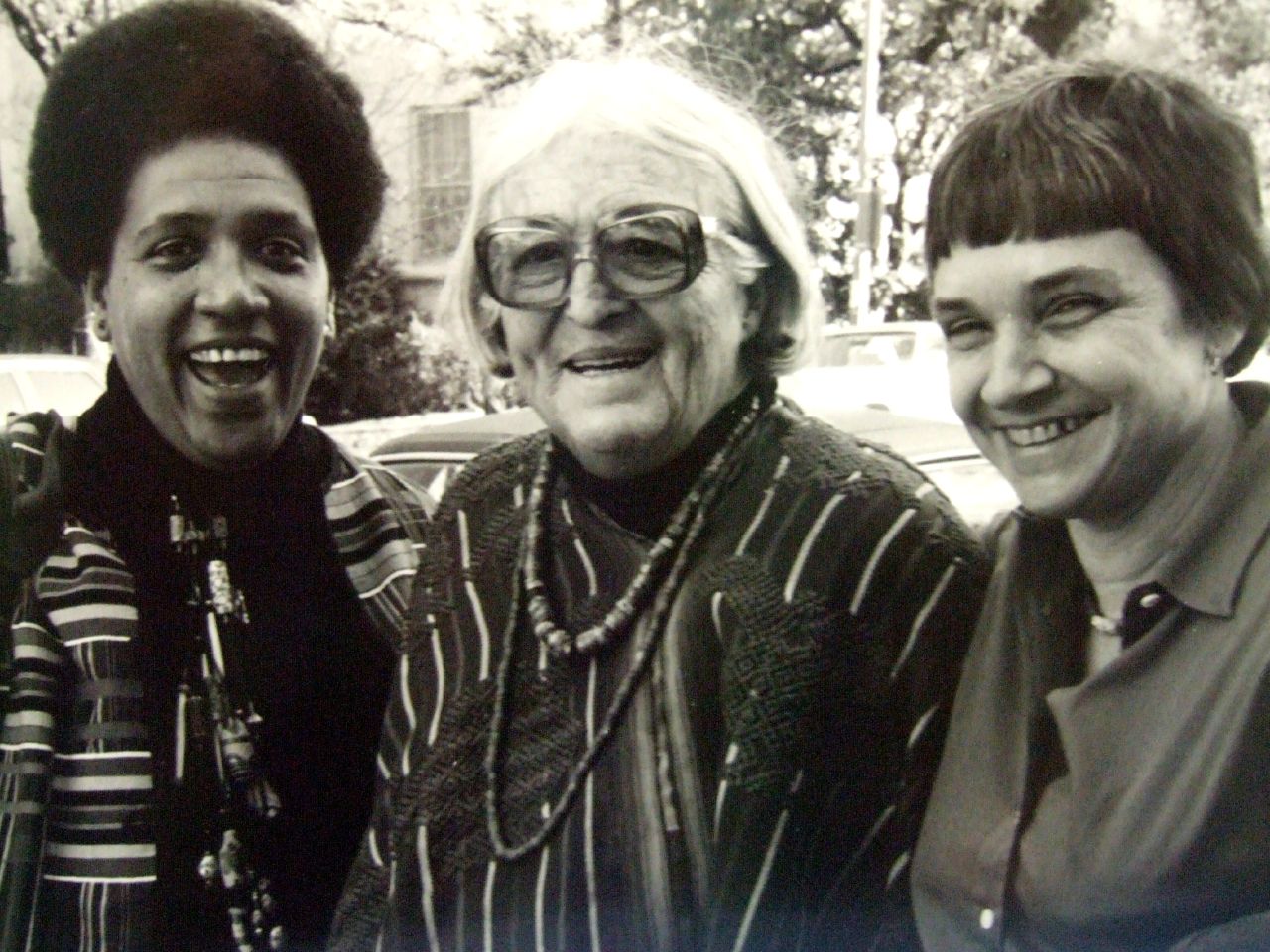
Audre Lorde, Meridel Lesueur, and Adrienne Rich after leading a writing workshop, Austin, TX, 1980. (K. Kendall/Flickr, July 15, 2007). Released to the public domain via CC-SA-2.0.

Among the literary arts, poetry is somewhere between okay and blech for me. At least most of the time. That doesn’t mean I hate all poetry or all poets. I fully appreciate the rhyme and meter (and lack thereof) of so many, from James Weldon Johnson and Archibald MacLeish to Phillis Wheatley and Langston Hughes. I love the emotional layering in the choice of the words, and in more modern times, the delivering of such words, with The Last Poets, with Gil Scott-Heron, and of course, Maya Angelou. Rap legends like Tupac, Nas, Eminem, Public Enemy have lyrics that are essentially spoken-word poetry put to bass, beats, and music loops. Heck, I’ve even enjoyed W. E. B. DuBois’ forays in the art in my scholarly research (when I more regularly did it) over the years.

But as a writer of prose (and often, long-winded prose), I also find the form of poetry ill-fitting. For me, it’s like being a home-run hitter in baseball playing hard-court tennis. It’s not that I can’t hit a baseline winner or an ace. But for every one of those, I could easily hit four tennis balls in a row out of the court, and literally onto the roof of a house half a block away. I prefer the ability to lay out my thoughts and explain them in full sentences, without worrying over every single word and the rhythm that a sequence of carefully chosen words may or may not bring.

I barely read any poetry during my Humanities years, unless my English classes forced me to. Emily Dickinson, Edgar Allan Poe, John Keats, Alexander Pope, all for 10th grade English, and with the exception of Pope’s “The Rape of the Lock,” not particularly entertaining. I was convinced after high school in ’87 that I’d never read poetry again.

What brought on a new interest in poetry came from my sophomore year at Pitt. I had to take a General Writing class in Fall 1988. I had to because if I wanted to take upper-level History classes as a History major, this general education requirement needed to be knocked off.  But I had an enthusiastic graduate student as my instructor. When I say enthusiastic, I mean someone who knew their students wouldn’t be, but whose passion for teaching and literature of all kinds made the class and the readings more interesting. She told me early on, after reading one of my first essays, that I should’ve been able to pass out of General Writing through the diagnostic tests Pitt gave my freshman year. “I wasn’t exactly awake when I took it last year,” I said in response.
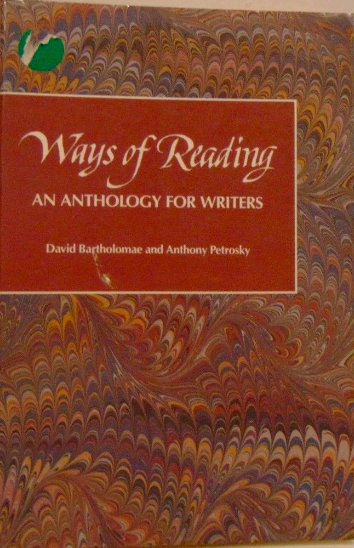
Ways of Reading anthology book (2nd edition), used in 1988. (http://ebay.ca).

When we got to the poetry portion of the course, I thought at first I was going to die from boredom. But our instructor didn’t assign us the usual suspects. The main poet we read that week was Adrienne Rich. She was someone I’d heard of growing up, but that was about it. Until the assignment of reading both Rich’s poetry and her essay “When We Dead Awaken: Writing as Re-Vision,” that is.

There were three things I’d never considered before reading Rich. One was the idea that writing was both art and craft, and that most writing was editing and re-envisioning one’s work. Two was the notion of transforming and being transformed through the writing process, and all as a proxy for a meaningful life. Three was the positioning of poets and other writers in literature, the privileging of men over women, of White males over feminists, of White heterosexual feminists over lesbian feminists, and especially Black lesbian feminists.

That last one about power, privilege, and positioning, it really grabbed me. So much so that I read more Rich that October weekend, in between pangs of hunger from lack of money and my Saturday evening shift at the Cathedral of Learning computer lab.

And the more I read of Rich, the more I decided to read about one of Rich’s contemporaries. I moved on to Audre Lorde the following week. She wasn’t among the long list of readings we had for General Writing, but she should’ve been. I couldn’t believe that someone who lived only miles away from my growing up experience in Mount Vernon and in New York could yet have such a vastly different experience with the city and the area.

I picked up Sister Outsider (1984) for the first time near the end of that fall semester. Lorde’s collection of essays about civil rights, about Black feminism (or womanism), about what we now call intersectionality, opened my eyes to how even Rich’s brand of feminism could be problematic. But more than that. Lorde, along with Rich, helped me realize, and not for the first time, that I didn’t care if the person I read or learned from was straight or gay, male or female (or later on, transgender), Black, Brown, or White. This despite what the Hebrew-Israelites and the evangelicals tried to teach me. They just had to be excellent in their work.

Excerpt of Audre Lorde’s Power (1978) (screenshot). (http://poetryfoundation.org).

Sister Outsider also opened up my eyes to the possibility that even my poetry-loathing ass could appreciate a true master at work in the art. So early on the following semester, I read Lorde’s poetry for the first time, likely some poems from her Coal (1976). Lorde talking about her upbringing, her relationship with her mother, and her issues with her own skin color, resonated with me.

But that was it with poetry for me until I borrowed my friend E’s recording of The Lost Poets 1971 album, and then read Angelou’s poetry, both in the summer of ’91. By then, I knew that while I’d never be a full-fledged fan of it, I could still appreciate the work, the art, and the layering of ideologies, emotions, and ideas contained in the best of poetry.
Is “Never” the Best Time for a Critique?

Tags

, , , , ,


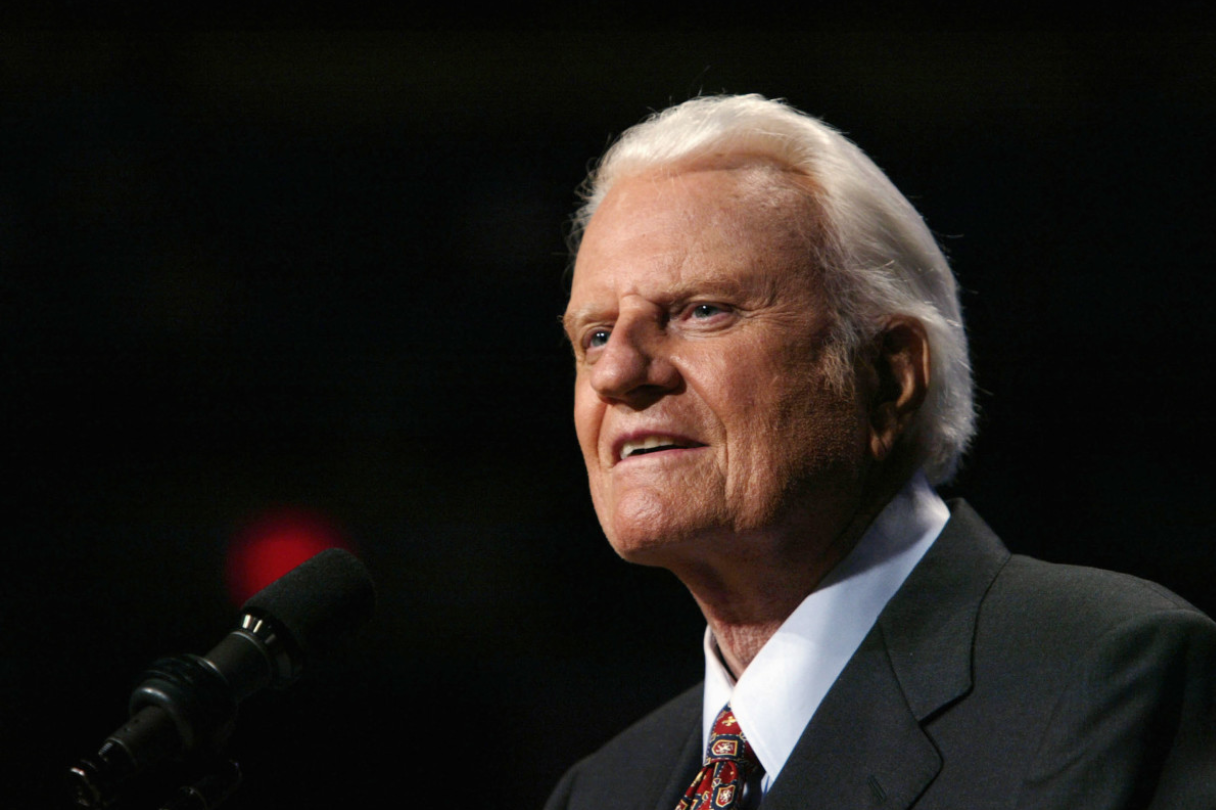
Rev. Billy Graham, 2003. (David Hume/Getty Images). Cropped slightly; qualifies as fair use due to cropping and subject matter.

I’ve been watching the variety of responses to the death of the late great Billy Graham over the past seven or ten days. Most people have been in mourning, which was something to expect. Many, like UPenn religious studies professor Anthea Butler, have reminded the world of the White nationalist, segregationist, and sexist views Graham either represented or excused during his six-decade-long run on the national stage.

And like mechanical clockwork, those who have Victorian and transactional notions of Christianity have defended, deflected, and denied on Graham’s behalf. It’s led to this series of questions for me. When can we critique the legacy of a famous person? While they’re alive? “No siree! That would be disrespectful.” If they claim to be serving God, they’ll add, “That would be blasphemous!” If I were to ask, When they die?, they’ll respond, “Now’s not the time — can’t you see their family’s in morning? The Bible says, ‘Judge not, lest thou be judged’.”

Translation: apparently, we’re never supposed to question what some famous person has done. Especially if they have the word “reverend” or “pastor” as part of their official title. It’s a thought process that imbues power to religious leaders, so much so that we might as well make them god-like, since our job is merely to obey and stay quiet.

But as I’ve learned over the past three-and-a-half decades, religious leaders are fallible. They aren’t sacrosanct. And while seminaries or other religious institutions have ordained them, that doesn’t mean that every vision they’ve ever had came straight from God. Meaning that we can question. Meaning that we can critique. Meaning that we can provide evidence that humanizes whom others would consider a pedestal perfect being. For those whom aren’t Christian, it certainly means they can judge Graham, too.

To err is human, no? Which means we shouldn’t have any sacred cows. Graham might’ve saved millions of souls for eternal life. But that shouldn’t automatically exempt him from a critique of his unwillingness to help those same souls while they were still here on Earth.

We Need a Partnership for a Gun-Free America

Tags

, , , , , , , , , , , , , , ,


With all of the fierce courage and eloquence of Marjory Stoneman Douglas herself, students from the Parkland, Florida high school have stepped up and reignited a movement. Emma Gonzales, David Hogg, Cameron Kasky, Sophie Whitney, and so many others from the school have turned their grief, sorrow, and anger into activism in the past seven days. This in the wake of a mass shooting that left 14 classmates and three teachers dead and another 17 wounded. Not only this. High school students from my son’s in Silver Spring to those all across the US have declared this chapter of the gun control movement “Never Again,” and have already staged walkouts and protest demonstrations that could be a watershed in a long-suffering push to end wanton gun violence.

I, for one, hope that they never stay quiet again. I hope, for their sakes (and for mine) that there is never another mass shooting at a public school or anywhere else. But I’m a historian and an educator, not Pollyanna. I cannot afford such a lofty wish, not when there’s so much work to do. That’s why I’m glad that post-millennial teenagers are standing up and taking on this issue. With enough pressure and long-term strategizing, they may well be able to achieve some measure of gun control in the US for the first time in the nation’s history.

Five Stoneman Douglas students speaking out (see names above), February 20, 2018. (http://mediamatters.com).

But we’re not going to get there with mealy-mouthed proposals and idiotic ideas. Arming teachers? Arming veterans as volunteers? Putting more police in schools? Really? How stupid does anyone have to be to believe that more people with guns in public spaces with large numbers of other people to stop a potential threat is a good idea? That’s like saying every country in the world should have as many nuclear weapons as Israel or Pakistan. Because everyone sleeps better knowing that on the wrong day and with the wrong person, they and their families could be vaporized!

Even half-baked measures like age limits, more extensive background checks, and a ban on assault rifles (the old 1994 Brady Bill and the 1994 Crime Bill, really) do little in the end to prevent mass shootings. After all, Jonesboro, Columbine, and the Georgia day trader massacres all occurred between 1994 and when the federal assault weapons ban expired in 2004. Even if it was possible, turning the clock back to the 1990s would still mean that most Americans willing to use guns to kill themselves and others indiscriminately will be more than able to do just that.

Though “Never Again” is overused (think Holocaust and 9/11 here), the idea of working without ceasing on making America as gun-free as possible should be the long-term goal. I think that the nation should mobilize for a War on Guns, just like it did in the 1980s for a War on Drugs, and in the 1970s against drunk driving. Only, without an eye toward racial stereotypes of Black pathologies and cultural dependency on the one hand, and the assumption of White goodness on the other. After all, White males own the vast majority of guns in the US. I think that children, teenagers, and the young adults that are part of my son’s generation should lead the charge. Not conservative dumb asses who believed weed was a gateway drug to cocaine and heroin (look where that got us).

Just like we have a Partnership for a Drug-Free America, we need a Partnership for a Gun-Free America. We need graphic commercials demonstrating what occurs when a bullet rips through flesh, disintegrates bone and nerves, and pummels brain matter. We need commercials where a mass shooter kills a bunch of people and then is somehow captured. One where the father asks

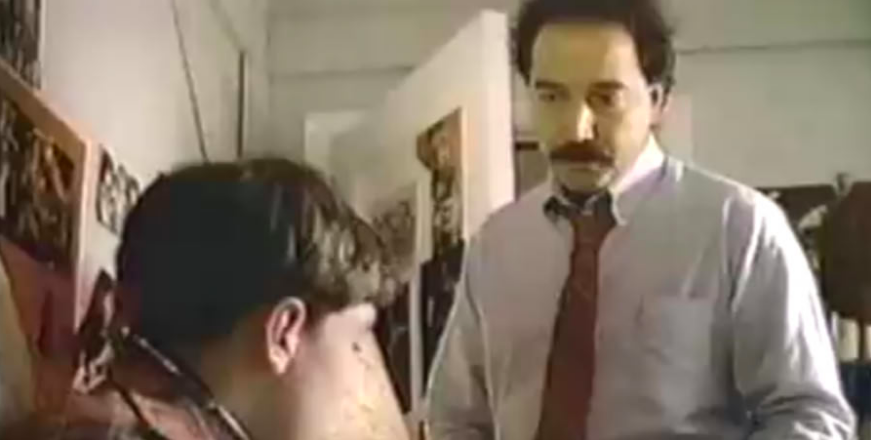
“I learned it by watching you, Dad!” PSA, July 1987. (Partnership for a Drug-Free America).

“Where did you get the guns? Who did you learn this from?”

“You, all right! I learned it by watching you!,” the son would and should say.

Why? Because, despite the relatively diversity of the student body at Stoneman Douglas High School and despite the pain of what those students went through, they are hardly alone in their suffering. So many Americans of color know this pain, too, between crime-related shootings in poorer communities and the police state that is all about shooting and killing much, much, much more than deescalation of potential threats. While I would’ve been proud to have a daughter like Emma Gonzales, I also want to not worry that some racist, trigger-happy cop or some random White supremacist/misogynist (the typical profile of a mass shooter) will one day cross paths with my son.

So many Whites know this pain as well. For their access to guns has ripped apart their families, between the accidental shootings, suicides, and family annihilators. So many own guns out of fear of crime (really, a proxy for their fear/hatred/disdain for the Black and Brown) or a need to feel powerful, this despite the evidence that most people never get to use their guns when they are the victims of crime.

What I want ultimately, is the repeal of the Second Amendment. The US needs to go the way of Japan, the UK, and so many other countries, where some older firearms or some guns that are specifically for hunting may be kept, everything else must go. This means no firearms for law enforcement as well. This is what the more radical of us want. This is what Black Lives Matter wants. I’m sure so many who’ve survived these mass shootings would at least strongly consider this proposition.

There will be those who’ll say, “Not a chance in Hell! If someone comes for my guns, I’ll put them in a bodybag!” I’m not arguing the Second Amendment will be gone today. Or that it’ll be gone tomorrow. But with the kind of sustained effort that only youth, mass mobilization, and coalition-building can bring, maybe America can get part of the way there in the next decade or two. Or not.

Du Bois Was a Marxist. Aye. So?

Tags

, , , , , , , ,


W.E.B. Du Bois at 82 (cropped), New York, NY, 1950. (Keystone/Getty Images). Cropped photo qualifies as fair use under US copyright law.

In recent months, a few people I know have brought up the fact that at least since the mid-1930s, the great W. E. B. Du Bois had professed himself a Marxist. The poet E. Ethelbert Miller, one of my co-panelists at a talk a couple of months back, made a point of interrogating notions of Blackness with the idea that Black activists were/are afraid to identity Du Bois as a Marxist. Certainly by the time Du Bois broke free from the federal government’s McCarthy-era ban on his international travel in 1958, he was. Du Bois re-obtained his passport, traveled the world, and ended up in Ghana in 1961. There, at the age of 93, he renounced his US citizenship and declared himself a Communist. Two years later, on the eve of the March of Washington, Du Bois died. The end.

All the above is true, but not so fast! The thing I’ve known in all my years of reading Du Bois’ work, writing about Du Bois, and in reading others who’ve written about Du Bois, was that Du Bois wasn’t just one thing. Nearly every social science and humanities tradition in the US can claim influence from Du Bois’ work. Poetry, theology, philosophy, psychology, economics, and American literature would be one set of his influences, and that’s just with The Souls of Black Folk!

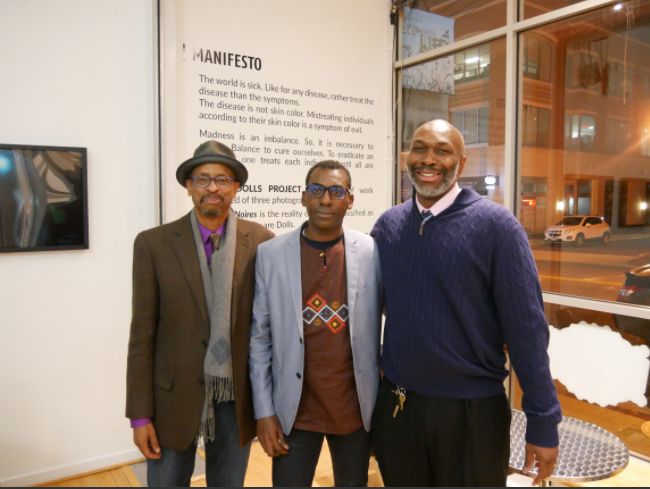
E. Ethelbert Miller, Mirtho Languet, and Me, Anacostia Arts Center, Washington, DC, November 18, 2017. (Keita Stephenson).

Though Du Bois’ Harvard doctorate was in history, he’s widely recognized as one of the founders (if not the actual founder) of American sociology. His 1898 study The Philadelphia Negro is really the first urban sociological study ever conducted in the US. His dissertation on the Trans-Atlantic slave trade was the only major work to cover the cost of the Middle Passage for kidnapped Africans (and estimate the total number of Africans stolen for slavery in the Western Hemisphere) for nearly seven decades. And there’s Black Reconstruction, probably Du Bois’ magnum opus of scholarly work.

With almost 70 years’ worth of Du Bois’ writings alone, anyone who’d think that Du Bois was just one thing would be guilty of a gross oversimplification of the man. Really, Du Bois was a mess of contradictions. He believed in elitist ideas like The Talented Tenth. Yet Du Bois also fought Booker T. Washington in books and in the press for more than a decade over the latter’s prominence as the “race man who Teddy Roosevelt and “liberal” White philanthropists talked to about uplifting Black folk.

He was a founder of both the NAACP and the Niagara Movement that preceded the organization. He befriended White philanthropists just as easily as Washington, though, and kept a personal war between himself and long-time NAACP president Walter White going for nearly two decades. On more than one occasion, Du Bois punned White’s last name as an insult, as the man was biracial, and could’ve easily passed for White.

Du Bois was also a Pan-Africanist. One, though, that used his editorialship at The Crisis to discredit Marcus Garvey and his ill-fated “Back-to-Africa” movement. David Levering Lewis in his Pulitzer Prize-winning, two-volume biography of Du Bois has even documented the likelihood that Du Bois helped the FBI (née BOI) in their mail fraud case against Garvey.

Du Bois was also a socialist. Though for most Americans, socialism and Marxism is a distinction, socialism in Du Bois’ mind meant alleviating the worst effects of market capitalism, not necessarily doing away with capitalism all together.

Du Bois was also a pacifist. But like so many of Du Bois’ positions, this one evolved over time. When the US became a military participant in World War I, Du Bois wrote essays where he argued that Black involvement could provide evidence of the need for full integration and citizenship rights for African Americans. By the Cold War, Du Bois was giving speeches about the threat of American imperialism and nuclear war.

Du Bois was also a multiculturalist. One of his more well-known extramarital affairs was with Rachel Davis DuBois (White, no relation), a key founder of the intercultural education movement, which had its heyday between the late-1920s and early 1940s. The idea of a diverse and inclusive curriculum was first fully demonstrated in DuBois’ work, which Du Bois endorsed in the mid-1930s. At the same time, how much can anyone believe from a man who at this point in his career was also serial adulterer?

Even saying Du Bois was a Marxist isn’t the full truth. “I mean by communism, a planned way of life in the production of wealth and work designed for building a state whose object is the highest welfare of its people and not merely the profit of a part.” This was what Du Bois wrote soon after renouncing his American citizenship in Ghana. Technically, this would be socialism more than communism. But more to the point, it’s anti-capitalism and anti-imperialism. It’s really Du Bois using Marxism to protest American imperialism and capitalism through his Pan-African affinity for Ghanian revolutionary and prime minister Kwame Nkrumah, not to mention, with America’s archenemy, the Soviet Union.

The one thing I wish those in the scholarly community would stop doing is taking the pyramid that was Du Bois’ life and reducing it to a two-dimensional square. Why can’t we just call an idea whose main source is Du Bois, well, Du Boisian? Like, Du Boisian sociology, or Du Boisian economics, or Du Boisian politics? Is this an example of Whiteness rearing its ugly head, where it’s too difficult to give Du Bois his own due without subsuming him under another White guy? It seems to me that so many are attempting to use Du Bois for their own ideological purposes, when it’s better to just let him be the so much that he was.

“Grace,” #MeToo, and Our Binary World

Tags

, , , , , , , , , , , , , , , , , , , , , , ,


Water buffaloes in mud, January 2017. (http://reddit.com).

Part of me knows that some of you will assume that I shouldn’t be discussing this on my blog at all. I’m a man, a Black man, a middle-aged Black man, so what do I know, really? I haven’t been on a date with anyone other than my wife since 1995. And my own history with hypermasculinity and sexism combined with my exposure to patriarchy and misogyny should disqualify me from making any comments on Babe.net’s “Grace” piece, right?

But I do have a few things to say. That is, after a week of reading tweets, articles, Facebook posts, as well as conversations with my wife and a couple of friends. Most of the divide has been between those adamant that “Grace” was a #MeToo victim of some form of sexual violation and those who believed that her evening with Aziz Ansari was little more than a bad date. This is yet another time in which the American penchant for seeing the world as white or black, or in computer code, as 0s or 1s, can literally blind most from the truth. Both sides are sort of right and sort of wrong. And like an electron (which can be in two places seemingly at once), this isn’t a binary issue. It’s a both-and situation.

Either-or thinking, December 2014. (http://survivingchurch.org).

Ansari was a doggish pig. Period. His intent with “Grace” was purely sexual. He saw her as a piece of meat (or, really, a “piece of ass”). That would explain both Ansari’s words and actions as Katie Way wrote them last week. Does that make his sexist? Of course!

Ansari also tried to persuade “Grace” into full-blown intercourse a couple of times after she had expressed her uncomfortability with moving beyond kissing, oral sex, and other fondling. Coercive behave is also doggish, venturing toward the misogynistic. All of this is true, and is certainly part of how entitlement and patriarchy can work together in sexual relationships.

Context, however, is always important in any situation. Especially one that isn’t as cut and dry as what Way described regarding “Grace” and her Ansari date. So many have harped on the idea that questioning “Grace’s” decision-making in any form is the equivalent of what misogynists do to rape victims. Not true. Not when the power dynamic is limited and diffuse at best. Not when Ansari never used physical coercion or the threat thereof to get the sex he obviously wanted.

And certainly not when “Grace’s” actions didn’t line up with her word. Some have argued about the inability of men to read the subliminal subtext of women when they are saying “No” or “I’m leaning toward no.” And for many men, this may well be the case. For so many women, being too direct may well lead to a verbal or physical confrontation with a misogynistic man. But that negates the context of Way’s piece. “Grace’s” physical responses and cues throughout the sexual encounter either belied her words, or her words were simply unclear.

Truth is, after their first try, Ansari should’ve not only just stopped, which he did. He should’ve also immediately called “Grace” a cab and sent her home. But in even writing this, isn’t this as much a form of ceding power to patriarchy as it would be a sign of sexual maturity, at least on Ansari’s part? 

Truth is, “Grace” should’ve also have been clearer with herself about what she wanted from her date. And should’ve just ended the date, rudely, discreetly, with clearer words and clearer actions, either at the restaurant or after the first sign of being uncomfortable. Because feminism is about taking charge of one’s own womanhood, and not just merely resisting patriarchy and misogyny with mealy-mouthed language.

Truth is, “Grace” had very different expectations of Ansari and that one-and-only date. The kind of expectations that are a bit immature, especially for a women who thinks that “[y]ou guys are all the same. You guys are all the fucking same.” That the main divide among women who’ve commented on “Grace” is age (with the over-under around 35 years old) is telling. Some will say that women (especially younger women) shouldn’t put up with legal yet boorish behavior, either. So don’t!

Truth is, “Grace’s” story via Way’s article is a hit piece, a sort of revenge for Ansari bursting her internalized image of him as one of the few “good guys.” “Grace” got to violate Ansari’s private life because she was enraged that Ansari saw her as little more than a piece of sexual meat. And while Ansari showed himself on this date with “Grace” to be a sexist pig, this isn’t a #MeToo moment.

Unless, of course, we distance ourselves from context, privilege, and intersectionality. Most assume that “Grace” was a 22-year-old White woman. Probably. But even if not, Way’s article about “Grace” is drowning in Whiteness. Especially when considering “Grace’s” relatively lofty expectations that Ansari would be different from other men. Especially when taking the approach that she wanted Ansari to calm her down after the awkwardness of their first sexual try. What made “Grace” think that he was so different? What made her actions as confusing as they were?

A lock of blonde hair (an allusion to Pope’s Rape of the Lock), June 18, 2013. (http://allure.com).

The Sturm und Drang over this hit piece reminds me of when I read Alexander Pope’s mock epic poem The Rape of the Lock in tenth grade. I might not remember much from Mrs. Buckley’s otherwise boring-ass English class in 1984-85, but I do remember the story of how a war started because a baron cut a lock of Belinda’s hair and kept it. It’s also typical of how race riots and lynchings of Black men often occurred, over perceived slights and embarrassing winks.

Speaking of intersectionality, where have all the “Grace” defenders been this week on serious #MeToo issues? Where have they been on Jade Martin for the past week, as a video of her assault at the hands of a Pizza Milano manager in Pittsburgh went viral, an instance of both racism and misogyny? Where have they been on the sentencing phase for Larry Nassar, a man who sexually assault over 100 young women and girls over decades? Where are they on the Rohingya, as the Myanmar security forces have admitted killing and raping women and children while driving them out of the country?

No, for so many privileged, younger, and White American women, a bad sexual encounter with a man whose sexual sexism was obvious is more important that the felony assault of a Black women for wanting to use the bathroom. The last week has shown yet again the racial, ethnic, class, and even age divide that has plagued #MeToo ever since it became more about White women and less about marginalized women and people.

Colson Whitehead’s a Genius, But What’s Slavery to Me?

Tags

, , , , , , , , , , , , , , ,


Colson Whitehead is a genius. I am absolutely convinced of this truth. I’ve read other things by him. But his novel The Underground Railroad is one part Joseph Heller’s Catch-22 and two parts Ralph Ellison’s Invisible Man mixed with the macabre and mystical in Octavia Butler and Toni Morrison. Every sentence in Underground Railroad was written with precision, especially the first 120 pages. It was as if Whitehead put every word through a metal acid bath, every phrase was pored over with an electron microscope. I was hooked by page 24, and didn’t stop to put the book down again until page 160. I finished the book in eight hours over two days, not a record, but pretty close.

The Underground Railroad is all about escape, of course, but not just the obvious, physical escape from slavery’s asphyxiating grasp. It was a need to escape the post-traumatic stress of having been a slave. It was finding ways to use the mind and spirit to cope with torture, whippings, rapes, mangled bodies, demonic rhythms of an existence in which humans are little more than broken toys. It was escaping inhumanity to find humanity and the divine, even in the most minuscule of proportions.

I loved the main character Cora. That Whitehead made his main character female, a third-generation slave from a plantation in Georgia during the antebellum period wasn’t lost on me. As with all of his characters, Whitehead developed Cora with a full sense of imperfection, making her a nearly perfect lens for me to view the novel. She and Mabel and Ajarry fully embodied kidnapping and slavery in all its horror. Folks, if you want anyone to come close to the actual experience of what slavery was for Africans in America, Whitehead got as close as any writer I’ve read in my lifetime.

I could nitpick about Whitehead a bit, too. That Cora’s femaleness wasn’t fully explored, with everything from not having periods to how she may have experienced her development as a woman prior to her first escapes or her one almost romantic moment. Or about the mystical mashup of the last twenty to thirty pages. Or about the railroad going on to infinity, in this case, Missouri, as Cora never really escapes.

My biggest criticism, though, isn’t really a criticism at all. It’s an admission. I really didn’t want to read The Underground Railroad. I made no plans to buy it or to check it out from a library. I would’ve been content in life to have never read this masterpiece.

Why? I’m sick and tired of talking about slavery, about the physical, mental, psychic, and spiritual torture of millions of Africans so that a few Whites could profit financially and many more could profit psychologically. It feels like I’ve been talking about slavery my whole life, even though I’ve only been aware of it since Roots and its television debut in February 1977, or for 41 of my forty-eight years.

I studied slavery with deliberate disembodiment in my teens and twenties. It might’ve been through reading books by Alice Walker or Morrison. But by the Fall Semester 1989 at Pitt, I was reading and writing about slavery and American racism in earnest. I wrote my undergraduate readings paper about the slavery studies literature for my professor Larry Glasco’s class. The next semester, I took a grad course in Comparative Slavery, reading about the differences between slave systems in Brazil, Cuba, the US, and for my 34-page paper, slavery in South Africa before 1838.

Having done that, nearly every course I took through my master’s program in 1991-92 had a slavery studies component. So I read White paternalists like Ulrich B. Phillips. Racist historians like him contended that Blacks in the US should be on their knees and thankful that Whites stole them, sold them, and slaughtered their ancestors during slavery, such was the civilizing effect. I read slavery studies by not-so-obscure authors like Sterling Stuckey and John Blassingame, who made the living hell that was slavery come alive in stories and statistics. I also read White apologists like Fogel and Engerman in their Time on the Cross. I remember saying in my US history grad seminar in 1991, “so they’re saying that slavery wasn’t so harsh because the average slave received 21 lashes per year versus the standard 39?.” It was my translation of their multiple regression analysis.

By the time I started my PhD work in September 1992, I was through with studying slavery. It was too painful to be in class with White students who at their best could never really understand slavery beyond statistics and ideology. Even if it was in their DNA via an unknown African ancestor (some estimate that as many as one in eight Southern Whites carry recent African DNA, and about four percent of Whites in the US overall). That any person could and did regularly argue that slavery was a “necessary evil” or “saved” Africans in the US from “savagery” helped me move into twentieth-century US and African American history as a field of study. Still brutal, still mind-destroying, but not the complete horror show of slavery.

Whenever I touch the subject of slavery in the courses I teach these days, I still get that sense of outrage and indignation when I see students unable to deal with the bitter, devastating truth. “C’mon, slavery wasn’t that bad. They were fed and clothed. And wasn’t there White slavery for the Irish, too?” That’s what one of my White students said in a world history course I taught a couple of years ago, in response to a discussion of the differences between the American, French, and Haitian Revolutions. The latter was the first fully successful slave revolt in the Western Hemisphere, leading to the founding of Haiti as an independent nation in 1804.

I don’t know how Whitehead could write this novel and not go through hours of emotional torment at the end of each day. In my own experience, writing about any trauma has left me dazed for minutes or even an hour or two at a time, unable to sleep, and wondering why I’ve never smoked weed. I’m thankful Whitehead did, and I hope that he’s healing.

I was so uncomfortable reading Whitehead’s The Underground Railroad because I knew that the horror and pain of slavery was literally encoded in my DNA. I was uncomfortable because I knew that people like this one UMUC student would never get it, even if he did read the novel. Whitehead didn’t write the novel for him, though. I think he wrote it for me, freeing me from my discomfort with the horrible.

“You Can Tell From The Lines On Her Face…”

Tags

, , , , , ,


One of the more haunting songs for me from the ’80s is Phil Collins’ “Another Day In Paradise.” It came out in the mid-fall of 1989, and ended the ’80s as a #1 hit. It was also #1 to start the ’90s. For those who were younger than ten in late ’89, “Another Day In Paradise” was a song about chronic homelessness and the callousness of folk toward the homeless, in the UK and in the US.

There were at least three million people living on the streets between Battery Park in New York and the Santa Monica Pier in Southern California when Collins released his admonishment for the world and God to do something about what was then considered a serious crisis. It’s not Phil Collins’ best song. But if you gave a damn about people you saw every day, leather-faced, wearing tatters, obviously sick in body and broken in mind, then this song may have touched you in some way.

It touched me. Just sixteen months removed from five days of worry about my future, sleeping on a concrete slab, and washing up in public bathrooms, I was going to be moved by “Another Day In Paradise” anyway. Unlike most Americans, I cannot walk by someone homeless and not have it register that this could be me. I don’t give change every time a panhandler asks me. I’m not made of money. Sometimes, though, I do tear up, because seeing families without a place or home sitting on a sidewalk in the rain should make anyone sad or angry. Especially on days like today, when much of the nation is around 10ºF (-11 or -12ºC).

America had as many as five million homeless people during the height of the Great Recession, and as few as about 600,000 as recently as a year or two ago. But as with most social statistics, this is likely an underestimate. There are plenty of well-washed, well-kempt, and somewhat healthy folk in this country who don’t have a place of permanent residence. They bounce from friend to friend or from extended family member to caring loved one. They may have access to a bed or some halfway house or temporary housing. Still, they aren’t guaranteed a place to sleep, sit, or rest from one day, week, or month to the next. And this takes a toll.

It took a toll on my own family between April 1995 and March 1998, especially the first seven months after the 616 fire. I’m convinced it’s why my younger siblings struggled for years afterward to earn a high school diploma or GED. The disruption in their lives, of their dreams, in their peace of mind. It can and does drive many people to drink, drugs, and madness. It drives those who are with mental illness to the grave, like my former classmate Brandie Weston.

Yet our nation homeless-proofs itself with jagged spikes on stone walls, covered steam grates, and patrol officers hell-bent on making sure homeless Americans will not see one moment of sleep and rest. We treat our most vulnerable Americans as if they’re some form of contagion, a diseased sort of garbage that we’d love to put on a barge and dump in the middle of the Pacific.

America in our policies and our people visits indignities, malignancies, and wrath upon our homeless, whether military veterans, impoverished families, or mentally ill individuals. It’s what we do to anyone in our nation who isn’t a so-called winner. And if you’re a person of color who’s homeless, the best you can hope for is being near a college campus, where a steady stream of the well-off exploit your stories for A’s and writing jobs.

America does “to the least of us” whatever it can to take advantage, ridicule, hide, and even eliminate their existence. Proving once again that while America is a great nation, we are a horrible people. Phil Collins was right. We “can tell from the lines on her face” that America has forever calloused itself, human but often devoid of humanity.