
• About Me
  • Other Writings
  • Interview Clips
  • All About Me: American Racism, American Narcissism, and the Conversation America Can’t Have
  • Video Clips
  • Boy @ The Window Pictures
  • Boy @ The Window Theme Music

Notes from a Boy @ The Window

~

Notes from a Boy @ The Window

Category Archives: Youth

The Black Man-White Woman Matrix

05 Sunday Dec 2021

Posted by decollins1969 in 1, Boy @ The Window, culture, Eclectic, Marriage, Pittsburgh, Politics, Pop Culture, race, University of Pittsburgh, Youth

≈ Leave a comment

Tags

Alfonso Ribeiro, Binary Thinking, Dave Chappelle, Homophobia, Hubert Davis, Misogynoir, Misogyny, Patriarchy, Pitt, Sexual Harassment, The Matrix (1999), Transphobia, White Supremacy
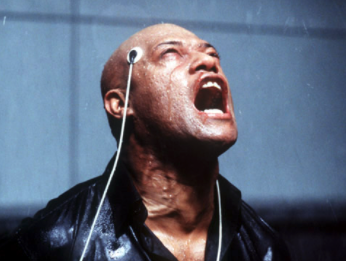

Laurence Fishburne as Morpheus in The Matrix (1999) chained up (screen shot), accessed October 14, 2021. (https://racism.org/articles/defining-racism/338-thematrixa).

There have been and will be tons of think pieces about the misogyny, the homophobia, and the transphobia in Dave Chappelle’s The Closer, his latest/last stand-up comedy special for Netflix. Within that maelstrom of using the stage as a 75-minute patriarchal therapy session, I noticed how most of the people whom Chappelle apparently discussed his id issues with were white women, whether straight, lesbian, or transgender, including the late Daphne Dorman. “Maybe he should spend time with transgender Black women. They are among the most marginalized in the US, with deadly results, between suicides & murders,” I tweeted. But Chappelle never would. His hypermasculine defense of transphobes and homophobes like Harry Potter billionaire J. K. Rowling, fellow comedian Kevin Hart, and rapper DaBaby, means seeing the binary and non-binary white women he referenced throughout his latest stand-up concert as a sign of personal progress, or even, as part of a televised revolution.

From a deeply emotional and psychological level, I fail to understand this penchant for Black men like Chappelle to use and idolize white women as if they are the pentacle of all that America ought to be. Hubert Davis and Alfonso Ribeiro have publicly uplifted their marriages to white women as a commentary on racial progress. “I’m very proud to be African-American. But I’m also very proud that my wife is white, and I’m also very proud that my three very beautiful, unbelievable kids are a combination of us,” Davis said during his opening press conference as the first Black men’s head basketball coach at the University of North Carolina. Ribeiro of Fresh Prince fame believes “the Black house” has ostracized him. “I am in a mixed relationship….And it’s not easy to make that choice…I’m never going to be white and I’m never going to be fully supported in the Black house,” he said in an interview with Newsweek in August.

Davis’ and Ribeiro’s are both very strange statements. Somehow they and many other Black men have convinced themselves that marrying white women is a sign of racism’s end. Somehow, this is the televised revolution the US needs. Somehow, marrying white will dismantle the latticework of racism on which this nation is built. But, as sociologist Crystal M. Fleming wrote in her How to be Less Stupid About Race, “we’re not going to end white supremacy by ‘hugging it out.’ And we’re certainly not going to fuck our way out of racial oppression. That’s not how power works.” The US Supreme Court’s 1967 Loving v. Virginia decision that legalized interracial marriage was groundbreaking, but it never was the “promised land” that Dr. Martin Luther King, Jr. envisioned the night before his death in 1968.

My first time thinking through the social and political implications of Black men and white women together in union or solidarity was in 1990, my third year at the University of Pittsburgh. At the student union one day, I sat down for lunch in between classes to hang out with three of my friends. Two were already in the middle of conversation about a growing visible concern on campus — young Black men dating young white women. The two of them (one man, one woman), were biracial themselves, each the child of a white mother and a Black father. One other Black girlfriend also chimed in. They were decidedly against the idea of interracial dating and marriage. At one point I said, “If they love each other, what does it matter?” My two Black biracial friends both sighed and side-eyed me, and then laughed like I was telling a cruel joke. 

What they understood and I didn’t get in 1990 was that while universal love ultimately conquers all, romantic love and friendships will never negate racism in any of its forms. I also knew about Emmett Till’s lynching for winking or whistling at a white woman. I definitely knew from the movie Birth of a Nation (the original one) the deadly dangers of white women accusing Black men of rape or unwanted flirtations. 

I also knew this from personal experience. The year before, and with the support of my one-time boss, a 26-year-old white woman at my campus computing lab job who was my supervisor’s high school friend accused me of sexual harassment. This after she had groped and squeezed my ass cheeks on two occasions during our shifts. I was 19 years old at the time.

In his Afropessimism, Frank B. Wilderson III wrote, “You marry White. It doesn’t change…What do you do with an unconscious that appears to hate you?” The bigger question is, why would any Black man ever expect to end the latticework of American racism and anti-Blackness through interracial marriage? This is  the typical combination of Black mens’ colorism, hypermasculinity, and seeking the same status as white men through white women. “Those black men who believe deeply in the American dream…a masculine dream of dominance and success at the expense of others, are most likely to express negative feelings about black women and…desire [for] a white woman,” as bell hooks wrote in her Ain’t I A Woman.

Davis, Ribeiro, Chappelle, Wilderson, and many other Black men are too susceptible to the idea of interracial relationships as their revolution, their American Dream. The late critical race theorist Derrick Bell foresaw this in one of his lesser known allegorical essays from Faces at the Bottom of the Well, “The Last Black Hero.” It’s a story about a leading Black revolutionary who fell in love with a white woman. As Bell wrote, many whites in power see Black men with white women “as proof that black men in such relationships were, despite their militant rhetoric, not really dangerous.” For anyone working to dismantle the matrix of American racism, though, this way of Black-man-thinking (and white-woman-thinking) is very dangerous. Especially in the words and deeds of people like Chappelle, Davis, Ribeiro, and Wilderson.

This is why if the revolution does come, not only will it not be televised, it will rely predominantly on Black women binary and non-binary to lead it from imagination to actuality. Like in The Matrix movie series, there are too many Black men and white women who have “the world pulled over their eyes,” a world of white binary hypermasculine and patriarchal racism. Too many Black men — whether they are entertainers in need of long-term therapy like Chappelle or are people who see themselves leading revolutions — are too compromised by their own gendered privilege and social status desires to be the leaders they’ve all been waiting for.

While My PhD’s Getting Cold…

21 Sunday Nov 2021

Posted by decollins1969 in 1, Academia, Boy @ The Window, Carnegie Mellon University, Christianity, culture, Eclectic, Pittsburgh, Politics, Pop Culture, race, University of Pittsburgh, Work, Youth

≈ Leave a comment

Tags

Bruce Anthony Jones, Career Paths, CMU, Dan Resnick, Failure, Joe William Trotter Jr., Lessons Learned, Petty Jealousy, Pitt, Self-Loathing, Self-Reflection, Success, Writing


Cold, lumpy grits, September 26, 2013. (HuffPost via Flickr: Marshall Astor – Food Fetishist).

I have been Dr. Donald Earl Collins for almost half my life. (It will be exactly half my life on October 11 or October 12 of next year, a couple of months before my 53rd birthday.) Only a small handful of things have brought me more pain, failure, and momentary triumphs than earning the PhD during the 1996-97 school year. But while writing is a profession that pays, I am still paying off the debt I generated earning this degree, literally and figuratively. This debt is something I will not pass on. I hope my life has more meaning than earning this degree ever took away.

Friday morning, November 22, 1996, I checked my email just after getting out of bed. Since the beginning of that August, after banging out a full second draft of my dissertation, I knew. Since the end of that July, really, after spending eight hours combing every iteration of every chapter of my doctoral thesis for comments from my advisor I missed, I knew. Since my advisor’s one-page response three weeks later to my six-page memo detailing every change, revision, dressed-up lie, obfuscated statistic, and glossed-over fact, I knew. Really, it was moot on October 23, when my other two committee members both approved it and knew, too.

That Friday morning before Thanksgiving 1996, Professor Joe William Trotter, Jr. sent me a rare email, officially signing off on me becoming Dr. Collins with the words, “It is done.” It was anticlimactic, but it was also freeing at the same time. Yay, me, right?

Not so much. I was a month away from possibly leaving my PhD work behind. That was how much Trotter and the whole process of petty jealous and verbal abuse and threats had taken their toll. To know that my advisor did not support any endeavors to give my career a boost, including the Spencer Fellowship that I won despite his lukewarm letter on my behalf. To feel so betrayed that I felt solace dreaming of wrapping piano wire around his throat from behind and pulling until I spilled his blood and death occurred. It should have been a sign for moving on to something less soul-destroying. But I prayed. I persevered. I finished what I started. 

And I lost the thread for why I started in the first place. I went to graduate school to become a writer with enough knowledge and authority in my expertise to not be challenged in whatever writing project I decided to take on post-PhD. Boy was I a naive, dumb-ass 21-year-old! I ruined my writing for more than a decade as a result of this path. It took me until my blog and Boy @ The Window to find my voice again, my true, authentic, uncopyable voice. By then, I was already fortysomething (or, really between 39 and 44 years old at this point). My doctoral degree was already more than a decade old.

If I could do it all over again, would I choose to relive what I have truly reviled as much as I have relished? No, no, no. You don’t need to have a PhD to be an excellent writer. You certainly do not need one to write in relative obscurity. I learned that from Edgar Allan Poe and Mary Martino in AP English in 1987. No. I probably would have earned a PhD in social psychology instead, with stints of working as a K-12 teacher and a freelance writer or journalist in between. That path would have been more fun — if not just as morbid — at least.

I can think of what pursuing a more direct path to writing and working would have done. It would’ve saved me from four years of Trotter as my advisor, from “poverty wages,” never-to-be-counted-on Bruce Anthony Jones, and from abusive theoretical Marxists like Dick Oestreicher and Wendy Goldman. It would have saved me from myself and my self-doubt and constant need to prove myself to others to the exclusion of everything else in my life. 

My mom does get a few things right about me. After I finished my master’s in 1992, she said one day, “Why you always gotta ‘I’ll show you’?” I wasn’t trying to “I’ll show you,” especially to the white gatekeepers aligned like a fraternity or a gang with baseball balls eager to jump me in (or out) of academia. Still, I do not like being told “No.” Especially by mediocre people with half-baked ideas motivated by their own racism and ageism.

This will not be a self-loathing celebration, though. I have figured it out, myself included. I know what I want to write, and why. I have succeeded more than I have failed on this front since turning 45. I may never make up for those years in the wilderness, between academia and the nonprofit world, chasing dollars and chasing the approval of white gazers and HNIC (Head N-word In Charge) types. But I am still here. I am much closer to the life I’ve always wanted than I am  to the life I have gradually been putting behind me since 2008.

I’ve Been An Educator for 30 Years

05 Friday Nov 2021

Posted by decollins1969 in 1, Academia, Boy @ The Window, culture, Eclectic, Movies, Pittsburgh, Politics, Pop Culture, race, University of Pittsburgh, Youth

≈ Leave a comment

Tags

Black History, History of Black Pittsburgh, Larry Glasco, Laurence Glasco, Pitt, Teaching and Learning, Wylie Avenue Days


Me with my old Duquesne University ID, where I taught in 1998 and 1999, May 2017. (Donald Earl Collins)

It’s a bittersweet anniversary for me. Thirty years since the first time I was in a classroom as an instructor. Thirty years of providing professional development advice (because I assisted with undergraduate advising of history majors in 1991 also). Thirty years of traveling this path, whether in higher education, the nonprofit world, or as a consultant. Thirty years of being seen as “less than,” of exploitation, of disappointment, of disrespect, regardless of my degree status or age or how I dressed. Thirty years of the occasional thanks or pat on the back for a job well done. Thirty years. Maybe too long for a person who should have always put being a writer first.

It was the first Thursday in November 1991 when my advisor Larry (Laurence Glasco) had me run his brand-new course for one evening, History of Black Pittsburgh. It was one of my elective courses toward my MA in History degree, an easy-A in the midst of two core courses, third-semester Swahili, and a primary research paper project on the intercultural education movement. I had fully-charged Energizer bunny energy back then.

Larry’s History of Black Pittsburgh was an evening block course, which at the University of Pittsburgh meant that it met from 5:45 to 8:10 pm. The class met in one of the auditorium-style rooms in David G. Lawrence Hall. The object that evening was for the class to watch and then discuss/critique the documentary “Wylie Avenue Days.” It was a film about the cultural heyday of the Lower and Upper Hill District, Black “Picksburgh’s” mecca from the 1920s until urban renewal wiped out the Lower Hill to build a sports arena in 1958. The film, though, continued through the 1960s, when somehow, the remnants of the Lower Hill did not explode in uprising and riot after MLK’s assassination, but marched in massive protest instead.

I was terrified of the idea of being in front of any classroom in 1991. But with 15 of the 35 students in the course over the age of 35 — and some old enough to have met and have known the people who were in the film — my stomach did flips in the days before I had to run the class. Larry sensed this, I think, which was why he gave me this assignment to begin with. “You’ll do fine, Donald” was the only thing Larry said to me about guest lecturing that day.

Looking back, it was a pretty easy assignment. The documentary took up an hour by itself, and with a ten-minute break, all I really had to do was facilitate discussion for an hour. No big deal.

But it was a big deal. With about 20 traditional college-aged students (mostly Black, with a few brave white Yinzers), the older students would dominate the conversation about “Wylie Avenue Days,” about meeting jazz artist Billy Eckstine or swooning over Lena Horne, about how the clubs were “integrated” every Saturday night between “6 pm and 6 am.” They also discussed the need for community reliance and self-sufficiency, because shopping for clothes “dahntahn” at Horne’s, while not Jim Crow illegal, certainly could get Black Picksburghers in trouble.

We also had retired Pittsburgh Courier correspondent Frank Bolden in the classroom that night. Larry had Bolden as a guest speaker earlier in the course. Bolden would show up on occasion and just hang out and add a story here or there to provide a living perspective on something that would otherwise only be a footnote in a newspaper article or a book. Bolden was in his eighties by this time, so he had a lifetime of stories.

With so many older students and guests in the audience, I barely had to ask any questions at all. My main challenge was to find a way to get the younger students involved, but after a couple of quick comments, I realized that it was better for them to listen and learn than for me to run a more typical and less free-flowing discussion.

The older students were extremely respectful. They kept calling me “Mr. Collins” or “Professor,” even though Larry and I had told them I was just a first-year grad student. “Don’t pay that no never mind,” one of the other students said. “You up there, you a professor.” And then they kept talking about the good-old days, the sense of community on the Lower Hill, and then, the end of it all because of urban renewal and eminent domain.

The class went over by ten minutes, and the younger students began to leave. But a core group of about 10 of the students and Bolden stayed until after 8:30. The last of us didn’t leave until after 9. “Larry, I have to admit, this was fun,” I remember me saying afterward, before catching a bus back to East Liberty and home.

I have TAed for or taught 95 standalone classes in the 30 years since, helped run a national social justice and leadership development project and a national education reform project, and have directly and indirectly worked with thousands of high school, undergraduate, and graduate students since. There have been more good days than difficult ones, and more than a few great discussions and wonderful times with the 2,500 students I have taught directly. 

I must thank Larry for the opportunity, and for allowing me to use his class and classroom as a way to break out of my shell, to get over my social anxiety and other insecurities about being in front of fickle crowds. And yes, students, especially the younger ones, are a fickle bunch, more jaded these days than in the 1990s. I wonder why…

Will I do this thing called teaching another 30 years, just like Larry is still doing? I do not know. If I am doing this into my eighties, I would have to be able to teach the courses I want to teach, not the courses I am assigned or the courses that I’ve designed but are picked apart by the affluent and white who may be a little uncomfortable with my critiques of the rich and powerful, of the capitalistic and the racist. Especially as I have added American narcissism to these critiques. Ha! Here’s 30 years!

Eric The Red

27 Monday Sep 2021

Posted by decollins1969 in 1, Academia, Boy @ The Window, culture, Eclectic, Pittsburgh, Politics, Pop Culture, race, University of Pittsburgh, Youth

≈ Leave a comment

Tags

Breaking Bad, Colleagues, Eric, Graduate School, Indoctrination, Marxism, Mentoring, Pitt, Politics of Academia, Racism, Walter White, White Privilege


Bryan Cranston as Walter White (“bald” edition) in AMC’s Breaking Bad (screen shot, cropped), August 2011.

All these years with this blog and I’ve never written about the first of the people who came into my life and decided that I needed their tutelage about grad school and life in general. Because of people like him, despite their helpfulness, I always have found myself leery about people telling me that they will “mentor me” or about calling myself a mentor of any kind. It should be the type of process that happens organically, based on mutual respect and trust, and not just because one person is a generation or more older than the other person.

The first person to volunteer themselves as a mentor during my first year as a graduate school in the University of Pittsburgh’s History department was Eric, who was 42 or 43 to my 21 year-old self in September 1991. A year and a half earlier, Eric was the teaching assistant for my upper-level American Working-Class History course with Dick Oestreicher. We had exactly two interactions that semester. One was when Eric had scored my midterm exam short essays an 89. I asked him, “So, what’s the difference between an 89 and a 90 on this exam, anyway?” His mouth fell open, because he didn’t have an answer. He changed my grade to a 90 on the spot. Two was at a going-away party for my TA from my Western Civ II course my first year at Pitt, Paul Riggs. Paul was headed to Edinburgh, Scotland on fellowship to explore the height, weight, and diet differences among 18th and early 19th century European men in connection to a larger econometrics dissertation. (I still don’t quite know what Paul’s dissertation was about, beyond half-starve British and French soldiers hoping to grow to five-three before dying from bayonets or typhoid during the Napoleonic Wars.)

It just happened that when administrators assigned me a cubby hole for a desk my first year in grad-school-land, that it was in the same part of the department as Eric’s cubicle. His spot included a window that looked out from the third floor of Forbes Quadrangle (now Wesley Posvar Hall) to the open space below, as well as to Hillman Library, David Lawrence Hall, and if you tilted your head to the right, Carnegie Library of Pittsburgh and the lower floor of the Cathedral of Learning. It was a prime spot, and Eric never hesitated to let me or anyone else know that he had earned it.

Eric had, in fact, earned it. He became a grad student in the department at the same time Pitt had awarded me an academic scholarship to attend as an undergrad, in 1987. He bragged about the fact that he had gone from having “only an Associate’s Degree to ABD in just three years.” Pitt had also rewarded Eric an Andrew W. Mellon Dissertation Fellowship in 1990, making it seem he was on “cruise control” for finishing his doctorate in a couple of years.

What I’d learn about Eric over the next two years was that he was also a very active Marxist, a card-carrying member of the Community Party USA (or, maybe, if I’m remembering it wrong, the Socialist Party USA), and a trained actor who had made documentaries and written for news rags about union-busting, union-organizing, and class struggle since the mid-1970s. This would appeal to the powers that were in the department (including Oestreicher, his dissertation advisor), a place that privileged Marxist and neo-Marxist thought above all else. 

The acting and other public-facing work made Eric a stand-out pontificator, but was also where his open declaration of his “mentoring” of me irritated me a helluva lot. Many times during our two years together in the same department, Eric would interrupt me in the middle of a conversation with a peer, or when reading a book before class, or when I was prepping to TA, or otherwise just working away on a research project. It was usually with articles on a topic different from my research on multiculturalism or with an issue he wanted to debate me on. Sometimes, these interruptions and distractions I welcomed, maybe even, needed. But so many times, not so much.

Eric accused me on several occasions of having “a chip on [my] shoulder.” Maybe I did have one, mostly about the erasure of anything on American race and racism by the Marxist set in the department. Eric, though, was the proverbial pot-meet-kettle type. His chip made mine look like a speck. Looking back, Eric reminds me a bit of Bryan Cranston’s Walter White from Breaking Bad. Both he and the fictionalized White could not see how their sense of white male privilege shaped their worldview and their interactions with people. In my case, Eric assumed that I sometimes asked him a question or sought his advice as a sign that I needed mentoring, when in my mind, I was just asking a question or seeking an opinion from whomever was around at 9 pm on a Thursday night. 

But nothing piqued Eric’s interest in me more than his attempts to make me into a Marxist. “Racism is a byproduct of dialectic materialism” or “capitalism,” Eric would sometimes say (or at least, as much as I can remember him saying). This line of whitemansplaining I had heard in less sophisticated circles years ago. I never told Eric about all my arguments over the years with my Humanities classmate JD, but it probably wouldn’t have mattered if I had. Eric was deep into his cups of Marxist wisdom, deep enough to ignore my counterarguments. “You cannot understand inequality in America without also accounting for racism,” I often said. I did enjoy these debates, at least at first. By my second semester, and especially by my second year, I was weary. 

I didn’t see Eric much the second half of the 1992-93 school year (this as I prepared to transfer from Pitt to Carnegie Mellon to battle with privileged-white-privileged, ass-kissing center-right fake Marxists). I guess that was when he finally sat down to write his dissertation, though it would be a number of years before Eric would complete it to his doctoral thesis committee’s satisfaction. 

I wouldn’t have learned about the good qualities of Rolling Rock or explored hard apple cider without his encouragement. But, as intriguing as these arguments with Eric could sometimes be, I longed for being understood, for people who took the centrality of racism to everything that is the US and the West seriously. It would be a long time before I’d find people like me in this life.

The Three Stooges of My Paths

03 Friday Sep 2021

Posted by decollins1969 in 1, Academia, culture, Eclectic, Pop Culture, race, Work, Youth

≈ Leave a comment

Tags

Academia, Capitalism, Cogs in the Machine, Corruption, Moe Larry and Curly, Nonprofit World, Politics, Publishing Industry, Racism, The Three Stooges


This is the fourth post in my series arc of More Confessions From an Educated Fool. This one deals with the “cares of this world,” and how I got caught in a web of them, over and over again, like I was prey for a spider to bite and suck the life out of me.


So, a university president, a corporate senior vice president, and nonprofit senior program officer are all sitting at a bar off East 59th Street, after a long decision-day Thursday. Gus, their bartender, asks in his Hollywood-exaggerated New Yorker accent, “Hey jerks, what is it that youse do for a living, anyway?

Damon, the university president says, “I kneel and grovel for money.”

Steve, the senior program officer says, “I do cartwheels, somersaults, and floor exercises for money.”

After a brief pause, Alan, the senior VP says, “I use ads spots to hold up people for money,” while gesturing with his right hand in his blazer pocket. “Now give me your wallets!,” he says. The other two stooges laugh without restraint.

Gus pulls out his Saturday night special, and points it at the senior VP. “You mean like this?”

The senior VP says, without batting an eyelash or turning away, “I work for a trillion-dollar company. We get a billion people to sign their lives away every day. Hell yeah, it’s like this!”

The other stooges and Gus laugh. Damon pounds the table with his fist so hard he knocks over his drink.

After putting away his gun, Gus says, “What’ll it be? This one’s on me!”

Without taking a beat, all three gents say, “A vodka tonic.”

I have walked three paths in my career. Academia, the nonprofit world, and writing and publishing (and self-publishing) articles and books. Academia will claim that it isn’t a capitalist endeavor. The nonprofit world will say it claims 501(c)(3) tax status because they are changing the world by doing good works. The corporate world deflects while fully engaged in public displays of affection with capitalism, lips and tongues and spit included. “That’s just the way it is,” they sigh before another round of groping.

All of them are liars, I have found with 30 years (mostly) in and (sometimes) out of academia, 11 years working and consulting with nonprofits, and 20 years of off-and-on work in publishing articles and beating my brains into mush in book publishing. But if they are all liars, the lies are for people who are looking to do good in the world, for disdainful people, but people not so cynical that they have given up their core principles and universal moral values. They are for people like me.

That’s what capitalists do. They take advantage of people and rob them of their wealth, of their minds and bodies and souls. They like to do this at gunpoint, but they love to do it with slogans and pitches. “Connecting People, Creating Change” was the mantra of one Academy for Educational Development (AED), a nonprofit I worked with for nearly eight years. I used to joke that their real slogan was “Corrupting People, Creating Chaos.” The sad part was how correct I was in my assessment. This was even before I took on budgetary duties for a multimillion-dollar grant on a K-16 education project, where I learned AED had us mid- and senior-level program officer types to keep three separate budgets: one for the government, one for funders and potential funders (to hide our overhead), and the real one for AED’s nabobs. That last one included a one-percent vig on all grants that any of us brought in, a “rainy day fund” meant only for AED’s most senior staff.

It turned AED into a $600-million-a-year Ponzi scheme, and included millions in bribes to corrupt Afghans as part of the cost of “Connecting People, Creating Change” in Afghanistan and Pakistan. The truth was, the 501(c)(3) status was only to get away with making a profit off government and private foundation funding without having to pay a cent in corporate income taxes. I knew this was the reality of this world in 1999, when I made the switch to full-time nonprofit work with Presidential Classroom, when my former APUSH teacher Harold Meltzer laughed at the idea of nonprofits in the US’ capitalist regime. I had ideals about doing good outside of higher education, but I was never naive about their larger money-making agenda.

Publishers, agents, and editors would have me believe that the only criteria for publishing my stuff is if my fastball, curveball, and slider/sinker combination is good enough for dissemination. But first always comes the disclaimer: “if you have a work that doesn’t easily fit into a formulaic category, or if you are Black and over 40, or if you don’t account for the feelings of fragile white readers, we can’t make money, so we can’t publish you.” However, “we will publish schlock, how-to guides, and very famous people with ghostwriters, because that’s easy work for quick bucks.” They are the most honest liars, mostly because they don’t give a shit about the greater good. I can work with this.

But what I can no longer stomach is academia’s hypocrisy. This time 30 years ago was my first week as an MA student in the Department of History at the University of Pittsburgh. Eric, a fourth-year grad student and PhD candidate in the program, a man who once saw himself as my mentor (I never saw him that way), explained the nature of academia this way. “The academy is a medieval institution, whose ways are founded on the idea of the guild.” In my head, I’m thinking, This is utter bullshit. The European university began its missions during the 12th, 13th, and 14th centuries to be sure. But they needed funds to run then, and they damn sure do now. This analysis from an avowed 40-something Marxist let me know just how much he didn’t get about the academic world.

The only thing medieval about academia in my three decades of learning, teaching, and experiencing it is its ideals. In reality, academia is a money-making machine for its boards, for its athletics programs, and for the “hot stuff,” scientific and technological research. It serves at the will of deep pocketed robber barons, professional athletic corporations, and at the behest of corrupt governments and the military-industrial complex. That anyone comes out of a college or graduate or professional school with their sense of morality and social justice intact is no small miracle. That anyone these days earns their degrees with low debt or no debt at all is either part of the super-rich class or has performed a feat John the Baptist would be proud of. And in that latter-day case, they probably are completely fine with the system the way it is, supporting the bloated salaries of upper university managers everywhere.

The story about the three stooges of my career should end with them all stumbling drunk out of the bar, only to be robbed by some random guy wearing a ski mask. After all, that is what they deserve. What I deserve, well, that’s a bit more complicated. Loving money has a way of making the mediocre hireable, popular, and powerful, while marginalizing everything and everyone else. I spent so many years chasing promotions for funds to help pay down student loan debt and to provide for our son the life I never had growing up with poverty (and then welfare poverty in my teens). The strategy didn’t work.

I had to accept that I am not built to be a capitalist cog or hamster. I had to accept that I as a person ask questions, and make good trouble doing so. I am at my best as a writer and thinker. I am at my best when I question the worlds I have inhabited, not when I am just going along to get along in them.

When Their Lies Become The Truth

16 Monday Aug 2021

Posted by decollins1969 in 1, Academia, Carnegie Mellon University, culture, Eclectic, eclectic music, music, New York City, Pittsburgh, Pop Culture, race, Work, Youth

≈ Leave a comment

Tags

"Billie Jean", Distractions, Doctoral Thesis, Failure, Fear of a "Black" America, Michael Jackson, Plagiarism, Theft, Whose America?, Writing


Michael Jackson in the middle of his first public moonwalk while singing “Billie Jean” (cropped screen shot), Motown 25: Yesterday, Today, Forever, May 16, 1983. (NBC/Starvista; https://www.smoothradio.com/artists/michael-jackson/first-moonwalk-motown-video-1983/)

This is the third of my multi-part series on my paths as a writer. This piece is one that I’ve work on for nearly a year. Mostly because of the issue to out or not out the guy who plagiarized me in 2002. Partly because I do not really want the kind of attention this post could bring. But the more uncomfortable and painful a writing becomes all the more reason to share it with readers.


There is an ugly truth that inhabits every arena of work. Racist, misogynistic, and elitist politics make all workplaces toxic, some dangerously and lethally so. The never-ending palace intrigue, the perpetual ambitious drive and thirst for clout, the absolute must of self-promotion. All of it makes the idea of “just here to do a job” laughable.

With this toxicity comes the need to lay claim to words and works that are not one’s own. In academia, it means stealing ideas, references to primary resources, even actual words from the work of lesser known academicians. All for the lofty prize of permanent tenure and plum professorships at elite universities. All while destroying careers and breaking people.

I was a victim of such a theft. The plagiarist was one Dr. Jonathan Zimmerman, today a decently prominent full professor at the University of Pennsylvania Graduate School of Education, with a career that was undoubtedly helped along by a book about the so-called culture wars. It nearly broke me as a writer. It took nearly 15 years for me to fully recover. In some ways, I am still recovering.

My story is a case study of how easily White mediocrity can trump Black excellence unless or until the latter forces acknowledgment out of the world. But it is also my tale of an aspiring academician snuffed out in his younger years, a wonder-man who had yet to decide the kind of thinker, writer, educator, and gift-user he wanted to be.

I was only partly aware of the possibility of being plagiarized in the 1990s. Oh, I was paranoid enough. As a Black doctoral candidate at lily-White Carnegie Mellon University, I worried about losing my own work and not finishing. By the summer of 1996, I was mailing out seven 3.5-inch, not-so-floppy-disks-at-a-time to my trusted circle, because I had little trust for folks in my academic world, including my dissertation advisor. But I had no idea that I should have extended my lack of trust to trained academicians who were so devoid of ideas and so bereft of imagination that they would steal from little-old me.

My off-and-on dealings with Zimmerman was where I learned eggs should never mix with stones. In 1994, Zimmerman was an assistant professor in the subfield of social and historical foundations of education at West Chester University. I and a couple of other Black doctoral students (the latter two from the University of Pittsburgh School of Education) had promised to present our work at a conference Zimmerman had organized, but reneged at the last minute. The two thirtysomething Black students felt leery about the invitation. “This is very disappointing…I wish you’d let us know sooner…I was so looking forward to reading your work,” Zimmerman said haltingly over the phone with a tone that combined reassurance with condescension when I informed him of our cancellation. Zimmerman had me agree to send him a copy of my dissertation, “A Substance of Things Hoped For”: Multiculturalism, Desegregation, and Identity in African-American Washington, D.C., 1930–1960, once I finished it.

I bumped into Dr. Zimmerman twice at scholarly conferences after that, in 1996 and 1997. He sought me out about my dissertation, for what purpose, I wasn’t sure. I was too worn out after finishing my degree to find out. The next and last time I saw Zimmerman was at the end of April 1999. New York University invited me to their campus for a job interview in the school of education. It was for a social foundations in education opening. I learned that Zimmerman was on the search committee. He had moved on from his previous job, and was now a tenured associate professor.

I gave a seventy-five-minute job talk about my dissertation research and soon-to-be book topic, titled “Fear of a ‘Black’ America: Multiculturalism and Black Education in Washington, DC.” During the talk and Q-and-A session that followed, I noticed Zimmerman had brought with him a paperback copy of my doctoral thesis to the talk. He must have ordered a copy from ProQuest, the main depository for dissertations in the US.

“Can you tell me more about why Black parents didn’t want Little Black Sambo taught in DC Public Schools?,” Zimmerman asked. “Why do you keep using ‘multiculturalism’ to describe what happened in the past — isn’t this anachronistic?,” he inquired with a bit of disdain. “Do you have a publisher lined up for your manuscript?,” I remember him probing, as if that was really his damn business.

It should have been obvious, but at the time, I honestly wasn’t sure why Zimmerman asked me so many questions. Between a two-year-long search for full-time work, of living off fumes from the one $1,850-class I taught at Duquesne University every semester, of burnout and rage from completing my degree, my head wasn’t right. I also wanted to move on from Pittsburgh. “I’d just about have to wait for Joe or Larry [my former dissertation and graduate advisors] to die before I’d get a job that pays around here,” I said to my significant other numerous times.

I didn’t get the NYU job. Six weeks after that interview, I ended up with a job in civic education in suburban DC, working with high-potential high school juniors and seniors. Soon after, I landed a literary agent with my book proposal for Fear of a “Black” America.

Three years and two jobs later, I heard from Zimmerman again, indirectly. I had stumbled into an opportunity while already working as a nonprofit administrator for the New Voices National Fellowship Program to teach a graduate course in social foundations of education at George Washington University. In looking for books suitable for the class, I discovered Zimmerman had published Whose America?: Culture Wars in the Public Schools, his book on a century of America’s culture wars as embodied in history textbooks. I decided to buy it in case any of my students wanted to research this topic.

In those pages, Zimmerman carefully avoided referring to the book Little Black Sambo. Instead, he used the term “Sambo” in reference to mainline history textbooks from the 1940s and 1950s. But in one paragraph, Zimmerman’s skill in textual microsurgery broke down like an old and rusted-out car. Where Zimmerman had written, “[e]ven champions of so-called intergroup education in the 1950s turned a blind eye — or a disdainful frown — on black text protests,” I had written, “the Washington Post [in September 1947] published an editorial on the Little Black Sambo controversy that accused the [NAACP-DC] Branch and the…black Washington community of overreacting.”

Where he had wrapped his quote with “opined the Washington Post, denouncing blacks’ ‘humorless touchiness’ about the term ‘Sambo’ in textbooks,” I had the fuller quote, as “the Post could not ‘believe that the humorless touchiness reflected in these protests represents the attitude of Negroes in general.’” And where Zimmerman cited the original sources as the Washington Post from September 30, 1947 and some reference to papers from the Moorland-Spingarn Research Center, I also had those same references, plus additional references to the Washingtoniana Division of DC Public Library.

If this theft of ideas and research was pure coincidence, then so is the existence of systemic racism in the US. Zimmerman had access to my doctoral thesis for at least three years before the publication of his book. The likelihood that Zimmerman independently went through the same files at Moorland-Spingarn to address the specific issue of “Sambo” references in textbooks during the 1950s when the controversy over the children’s book Little Black Sambo occurred in 1947 is infinitesimally low (he doesn’t refer to Moorland-Spingarn as a place he visited to conduct research in Whose America?).

The specific Washington Post quote could be coincidental, but not when combined with the Moorland-Spingarn citation. Back in the late 1990s and early 2000s, one couldn’t just do a Google search for a then-55-year-old article. One either had to dig it out from among the thousands of files in archives like Moorland-Spingarn at Howard University, where I spent nearly two weeks in March 1995 uncovering information about issues like the 1947 Little Black Sambo controversy. Or, a researcher would have had to go through reels of newspaper microfilm at libraries looking for clues and key words, like I did for another two weeks at the Washingtoniana Division of DC Public Library’s main branch, the Martin Luther King, Jr. Library, in February 1995. My doctoral thesis was never cited as a source in these sections, either.

A couple of weeks later, I found Dr. Zimmerman’s NYU email address. I wrote to him about his erasure of my years of sweat, tears, and even blood (in the case of paper cuts) in gathering the information that had gone into my dissertation. “I don’t know who you are,” was his one-sentence response, as was and remains the typical retort from those who are caught using another’s words, work, and ideas as their own. “Fuck it,” I said to myself after that exchange. I definitely should have found a lawyer back then.

I received a note a few days after I discovered Zimmerman’s thievery from my one-time agent Claudia Menza about the acquisition editors at Random House. They had come close to accepting my book, but ultimately rejected Fear of a “Black” America for publication. It was a gut punch while walking carelessly through Central Park on a cloudless early fall day. The kind of punch that leaves one falling on their ass while exchanging pain for air, trying one’s hardest not to cry or scream for fear of embarrassment. I eventually self-published my book in 2004, a shell of the dream I originally held for this manuscript.

I hated academia and academicians. I hated myself for the desperate academic/nonacademic/non-writing writer-who-also-wanted-to-write-more it turned me into. I hated that I had earned a PhD, only to find myself working as a nonprofit administrator where the only thing people cared about was bringing in more multimillion-dollar grants. Most of all, I hated that I had never thought enough of the possibility that others would find ingenious and craven ways to steal from me, and that I couldn’t do a damn thing about it.

Fast-forward more than a decade later to 2018. I am no longer working as a nonprofit administrator chasing dollars for watered-down education and social justice efforts. I am teaching full-time as contingent faculty between two universities. My writings are now meant for the world, and not for academia. After reading a story about how a plagiarist had copied and pasted huge portions of the author Leta Hong Fincher’s words from Leftover Women, it dredged up my experiences with Dr. Zimmerman.

This is how the big dogs do it. They steal your ideas, your ideals and your soul, really. They do it while simultaneously erasing you from the public record. They violently make you into the intellectual undead, a ghost that exists, but cannot haunt. Like with Napoleon allegedly blasting away at the Sphinx’s nose for fear that the truth of ancient Egypt as a Black civilization would drown the myth of white Egypt. The big dogs make you feel the theft, the death, and the erasure, right down to them blowing your bits of graphite, wood pulp, and synthetic rubber off of history’s pages.

“And mother always told me be careful of who you love/And be careful of what you do ’cause the lie becomes the truth.” These are the last two lines of the second stanza in Michael Jackson’s “Billie Jean.” That Michael Jackson — the Black genius that he was — also was a pedophile who preyed on star-struck children and their naive parents. He lied by omission and commission, for nearly half his life. The topic of multiculturalism, and being able to profit from it, no longer matters to me. But having people like Zimmerman out there profiting from their theft and their lies does.

Agents and Not Agents, The Hard Way

10 Tuesday Aug 2021

Posted by decollins1969 in 1, Academia, Boy @ The Window, Carnegie Mellon University, culture, Eclectic, music, New York City, Patriotism, Pittsburgh, Politics, Pop Culture, race, University of Pittsburgh, Work, Youth

≈ Leave a comment

Tags

Barbara Sizemore, Book Publishing, Claudia Menza, Failure, Fear of a "Black" America, Joe William Trotter Jr., Literary Agents, Mistakes, The Business of Writing, The Hard Way, Writing


Agents from The Matrix (1999) screenshot (cropped), August 8, 2021. (https://matrix.fandom.com)

This is the second of several posts I’ve put together about my journeys as a writer. Please laugh when and where appropriate.


“You always gotta do things the hard way, don’t you?” my one-time professor Barbara Sizemore said with some sighed frustration. It was in response to me telling her I had decided to stay at Pitt, to pursue my history doctorate at the University of Pittsburgh and possibly transfer to Carnegie Mellon to complete it. It was April 1992. We were standing in the main corridor of the third floor of Wesley Posvar Hall (née Forbes Quadrangle), I was on my way back to my grad student cubicle in the History Department. Sizemore was heading back to her office in the adjacent Africana Studies Department. If I had known this would be my last conversation with the prickly educator, her of squinty eyes and well-manicured afro, before she return to Chicago, took a position at DePaul, and passed away in 2004, I would have done more than given Sizemore a blank stare. As the tall, lanky, and sarcastic 23-year-old I was, I probably would’ve said, “Why yes, professor, I really do!”

I knew what Sizemore was really saying. It was about attending a lily-white university, where there were only four tenured Black professors out of 800 total faculty. My advisor Joe William Trotter, Jr. was one of them. Sizemore assumed that going to Ohio State or Temple to earn a doctorate in Black studies would have been my best move. But even though Sizemore was incorrect about my education decision, she was definitely correct about me taking “always doing things the hard way” paths toward so many of my goals.

Claudia Menza became my first (and so far, only) literary agent in July 1999. The idea of finding a literary agent to help me publish my first book was something I had played with as an idea for nearly a year. At least once I had begun to emerge from my state of rage, depression, and sheer burnout from my years finishing my doctorate at Carnegie Mellon and having Professor “running interference” Trotter as my advisor. I made the decision to turn my doctoral thesis into a book that would straddle the fence between the scholarly and the general. I wanted to publish what would become Fear of a “Black” America for a larger audience, to include both the academic and the personal in the same book. No one told me this was impossible. No one said this was the harder road for a first-time book author. I owned books by scholars that had mainstream imprints and labels. And many, if not most of them, had an agent helping them.

Soon after I finally found my full-time gig with the nonprofit Presidential Classroom in the DMV, I went ahead, did some research in those big, thick books on books and lit agents at Pitt’s Hillman Library, and wrote pitch letters to seven of them. Three weeks later, Menza wrote me back offering to represent me.

She started querying publishing house editors in October 2000, just as I was leaving Presidential Classroom for a higher paying nonprofit job working in social justice in DC. I was so busy with work and my New York family and with married life that I took my eye off the process. One year went by, with a few rejection letters here and there. Then 9/11 happened. I met up with Menza in New York six weeks later. I was already there to do a site visit with a social justice fellow. That’s when I learned Menza at this stage of her time as an agent predominantly represented fiction and poetry. Still, she had some high-powered authors under her belt. I remained confident in her and the mysterious process of finding an editor willing to publish me, in between bites of delicious pasta at a wonderful Italian bistro in the Village.

Two more years went by after that. I received rejections from Basic Books, Random House, Palgrave, Oxford University Press, Farrar, Straus, and Giroux, among others. Some stood out because the acquiring editors met to debate the merits for my book before ultimately rejecting it. Some stood out for being two-sentence rejections. I remember Menza saying, “I don’t understand why they don’t want your book.” That was at the end of 2002. By then, even though I remained outwardly confident, I had given up on finding a mainstream commercial publisher. “Maybe I need to go learn how to write again,” I said to my partner more than once. This, just after she became pregnant with our first and only egg.

With the ugly transition between jobs within my nonprofit organization and the birth of and caring for our one and only son, I knew I didn’t have it in me to continue the process of pitch-and-reject with Menza. I was also thinking about writing a memoir, something that could explain how I got to be me. I wrote Menza in March 2004, formally cutting ties with her as my agent. “I wish it had all worked out,” she wrote back.

That July, with some encouragement from my new boss and from my significant other, I decided to look at Fear of a “Black” America one last time, but this time, to self-publish. I went and found a house that did its own reviews of manuscripts and provided adequate enough copyediting to make sure I didn’t embarrass myself. Sometime in that process, Barbara Sizemore died. I read about her death in a nicely done obituary DePaul University put out (The Washington Post obit, not so nice about her years as DC Public Schools chancellor). I imagined Sizemore looking down at me that July and August, shaking her head.

The book came out at the end of August. Somehow, despite myself, I sold over a thousand copies in 16 months, did radio and newspaper interviews and talks and signings all over the DMV. I was happy and a bit bitter, like a cup of black coffee not sugary enough for my taste buds. This book could’ve been so much more, I thought so many times in 2004 and 2005.

But none of this is Menza’s fault, or Trotter’s, or even my fault, not in any direct sense. The world of book writing is more mysterious than the cloistered world of academia, and much more mercurial, too. It’s a popularity contest cloaked in American -isms, especially individualism and elitism (which of course contains racism and misogyny, too). It puts all the effort and blame on you and me. In my case, for not having a job in academia that lined up with my expertise in writing Fear of a “Black” America. For not having a degree from an Ivy League institution, or for not having enough successful writer contacts in my genre(s) or in general. For not living in New York as a writer. Maybe even for not being light enough or good-looking enough.

And, even in the four-and-a-half years of having an agent, for not paying close enough attention to how the industry had become a set of six monopolies. All with independent presses being squeezed, to sell out, to fold, to become niches for a small group of aspiring authors. It went from being an industry where you could pitch your books directly to publishers with or without an agent to “Get outta here!” unless you do have an agent. So many agents would prefer DIY schlock or books that easily fit the tastes of elite or hokey white readers than to ever read a query from me. I’m too eclectic, too determined to write for Black folk and beat up on white ways of thinking. I received more than 130 rejections from agents for my memoir Boy @ The Window, between 2007 and 2011, including one that read, “Alas, another book on childhood abuse!”

So, is it really me making it more difficult, because I like to “do things the hard way?” Is it because I have frequently put the need to pay bills and eat over pursuing my art and craft first? Is it because my writing sucks and agents see that immediately? Is it because I don’t know what I’m doing, or because of all of the above? Well, fam, what I do know is that I need help. I don’t quite know what I need to know to navigate this strange world of finding representation. I don’t quite know what I need to know to make publishing with a reputable press work without representation. Kenny Loggins says “when you can’t give love, you give out advice.” Advice with love is preferable, and usually, specific to where I am.

← Older posts
Newer posts →

Boy @ The Window: A Memoir

Boy @ The Window: A Memoir

Places to Buy/Download Boy @ The Window

There's a few ways in which you can read excerpts of, borrow and/or purchase and download Boy @ The Window. There's the trade paperback edition of Boy @ The Window, available for purchase via Amazon.com at http://www.amazon.com/Boy-Window-Donald-Earl-Collins/dp/0989256138/

There's also a Kindle edition on Amazon.com. The enhanced edition can be read only with Kindle Fire, an iPad or a full-color tablet. The links to the enhanced edition through Apple's iBookstore and the Barnes & Noble NOOK edition are below. The link to the Amazon Kindle version is also immediately below:

scr2555-proj697-a-kindle-logo-rgb-lg

Boy @ The Window on Amazon.com: http://www.amazon.com/Boy-The-Window-Memoir-ebook/dp/B00CD95FBU/

iBookstore-logo-300x100

Boy @ The Window on Apple's iBookstore: https://itunes.apple.com/us/book/boy-the-window/id643768275?ls=1

Barnes & Noble (bn.com) logo, June 26, 2013. (http://www.logotypes101.com).

Boy @ The Window on Barnes & Noble: http://www.barnesandnoble.com/w/boy-the-window-donald-earl-collins/1115182183?ean=2940016741567

You can also add, read and review Boy @ The Window on Goodreads.com. Just click on the button below:

Boy @ The Window

Twitter Updates

Tweets by decollins1969
  • RSS - Posts
  • RSS - Comments

Archives

  • June 2025
  • April 2023
  • September 2022
  • August 2022
  • July 2022
  • June 2022
  • May 2022
  • April 2022
  • March 2022
  • January 2022
  • December 2021
  • November 2021
  • October 2021
  • September 2021
  • August 2021
  • July 2021
  • June 2021
  • April 2021
  • March 2021
  • February 2021
  • January 2021
  • December 2020
  • November 2020
  • October 2020
  • September 2020
  • August 2020
  • July 2020
  • May 2020
  • April 2020
  • March 2020
  • January 2020
  • December 2019
  • November 2019
  • August 2019
  • July 2019
  • June 2019
  • May 2019
  • April 2019
  • March 2019
  • February 2019
  • January 2019
  • December 2018
  • November 2018
  • October 2018
  • September 2018
  • August 2018
  • July 2018
  • June 2018
  • May 2018
  • March 2018
  • February 2018
  • January 2018
  • December 2017
  • November 2017
  • October 2017
  • September 2017
  • August 2017
  • July 2017
  • June 2017
  • May 2017
  • April 2017
  • March 2017
  • February 2017
  • January 2017
  • December 2016
  • November 2016
  • October 2016
  • September 2016
  • August 2016
  • July 2016
  • June 2016
  • May 2016
  • April 2016
  • March 2016
  • February 2016
  • January 2016
  • December 2015
  • November 2015
  • October 2015
  • September 2015
  • August 2015
  • July 2015
  • June 2015
  • May 2015
  • April 2015
  • March 2015
  • February 2015
  • January 2015
  • December 2014
  • November 2014
  • October 2014
  • September 2014
  • August 2014
  • July 2014
  • June 2014
  • May 2014
  • April 2014
  • March 2014
  • February 2014
  • January 2014
  • December 2013
  • November 2013
  • October 2013
  • September 2013
  • August 2013
  • July 2013
  • June 2013
  • May 2013
  • April 2013
  • March 2013
  • February 2013
  • January 2013
  • December 2012
  • November 2012
  • October 2012
  • September 2012
  • August 2012
  • July 2012
  • June 2012
  • May 2012
  • April 2012
  • March 2012
  • February 2012
  • January 2012
  • December 2011
  • November 2011
  • October 2011
  • September 2011
  • August 2011
  • July 2011
  • June 2011
  • May 2011
  • April 2011
  • March 2011
  • February 2011
  • January 2011
  • December 2010
  • November 2010
  • October 2010
  • September 2010
  • August 2010
  • July 2010
  • June 2010
  • May 2010
  • April 2010
  • March 2010
  • February 2010
  • January 2010
  • December 2009
  • November 2009
  • October 2009
  • September 2009
  • August 2009
  • July 2009
  • June 2009
  • May 2009
  • April 2009
  • March 2009
  • February 2009
  • January 2009
  • December 2008
  • November 2008
  • October 2008
  • September 2008
  • August 2008
  • July 2008
  • June 2008
  • May 2008
  • April 2008
  • March 2008
  • February 2008
  • January 2008
  • December 2007
  • November 2007
  • October 2007
  • September 2007
  • August 2007
  • July 2007
  • June 2007

Recent Comments

MaryPena's avatarMaryPena on My Day of Atonement/Bitter Hat…
decollins1969's avatardecollins1969 on No Good Teaching Deed Goes…
Mary Rose O’Connell's avatarMary Rose O’Connell on No Good Teaching Deed Goes…

NetworkedBlogs on Facebook

NetworkedBlogs
Blog:
Notes From a Boy @ The Window
Topics:
My Life, Culture & Education, Politics & Goofyness
 
Follow my blog

616 616 East Lincoln Avenue A.B. Davis Middle School Abuse Academia Academy for Educational Development AED Afrocentricity American Narcissism Authenticity Bigotry Blackness Boy @ The Window Carnegie Mellon University Child Abuse Class of 1987 CMU Coping Strategies Crush #1 Crush #2 Death Disillusionment Diversity Domestic Violence Economic Inequality Education Family Friendship Friendships Graduate School Hebrew-Israelites High-Stakes Testing Higher Education History Homelessness Humanities Humanities Program Hypocrisy Internalized Racism Jealousy Joe Trotter Joe William Trotter Jr. K-12 Education Love Manhood Maurice Eugene Washington Maurice Washington Misogyny Mother-Son Relationship Mount Vernon High School Mount Vernon New York Mount Vernon public schools Multiculturalism MVHS Narcissism NFL Pitt Pittsburgh Politics of Education Poverty President Barack Obama Race Racial Stereotypes Racism Relationships Self-Awareness Self-Discovery Self-Reflection Sexism Social Justice Teaching and Learning University of Pittsburgh Violence Whiteness Writing

Top Rated

Blog at WordPress.com.

  • Subscribe Subscribed
    • Notes from a Boy @ The Window
    • Join 103 other subscribers
    • Already have a WordPress.com account? Log in now.
    • Notes from a Boy @ The Window
    • Subscribe Subscribed
    • Sign up
    • Log in
    • Report this content
    • View site in Reader
    • Manage subscriptions
    • Collapse this bar
 

Loading Comments...