• About Me
  • Other Writings
  • Interview Clips
  • All About Me: American Racism, American Narcissism, and the Conversation America Can’t Have
  • Video Clips
  • Boy @ The Window Pictures
  • Boy @ The Window Theme Music

Notes from a Boy @ The Window

~

Notes from a Boy @ The Window

Category Archives: Work

Regis and Donald Earl

12 Thursday Jan 2012

Posted by decollins1969 in 1, Academia, Boy @ The Window, culture, Eclectic, Mount Vernon New York, Movies, Pop Culture, race, Work, Youth

≈ Leave a comment

Tags

Friendship, Pitt, Pittsburgh, Regis, Relationships, University of Pittsburgh, Weird, Weirdness, Youth


Regis & Kathie Lee cover, cropped, People Magazine, September 30, 1991. (http://people.com). Qualifies as fair use under US Copyright laws because picture is cropped and of low resolution.

In a conversation I had with my mother about sixteen years ago, she said, “I always thought that all your friends were weird.” This after having broken up with a girlfriend a few weeks before, my first serious relationship in three years. Thanks, Mom! Of course, a month later, I began dating my wife of nearly twelve years (and yes, my mother thinks that Angelia’s weird, too!).

But she did have a point, albeit a small one. Some nerve, since I’m her son, after all! I had accepted this reality by my second semester at the University of Pittsburgh. This after a semester of attempting to be cool, then to not be cool, then to just close myself off out of picking my old Crush #2 scab.

I began my second semester in January ’88, attempting to meet people more like myself, which often meant meeting people a good five or ten years older than me, students comfortable in their own weirdness. The first friend I made this way was Regis. He was a working-class Western Pennsylvanian through and through, with that guttural Pittsburgh-ese accent. Regis said “jag-off” for “jack-off,” “ruff” for “roof,” “yinz” for “you all” or “y’all,” and “dahntahn” for “downtown.”

Regis had been unemployed for nearly a year, laid-off by Westinghouse, where for the previous five years he guarded a boiler room in one of their plants. He was about five-foot-six, constantly scruffy and disheveled, and sometimes looked like he was a step or two away from insanity. Kind of like a Pitt student’s version of Rasputin.

Richard Dreyfuss in Close Encounters of the Third Kind (1977), screen shot -- closest approximation to Regis, circa 1988 -- January 12, 2012. (http://examiner.com). Qualifies as fair use under US Copyright Laws due to low resolution and limited use for blog post.

But Regis was a quick study and absolutely enjoyed going to college, as he was a deeply critical thinker. Heck, he was the smartest person I knew during my Pitt and Carnegie Mellon years! As a result, we hit it off right away in our discussion sections on Friday mornings in Western Civilization II. Me and Regis would often gang up on the rest of the class in the discussion of all things Western European-related, from the French Revolution  to the connections between the European slave trade, the Industrial Revolution, and European imperialism. It was wonderful not being the only oddball in class for a change.

What made us friends, though, had more to do with the fact that Regis didn’t allow himself to be blinded by my attempts to hide the real truth behind my weirdness. He saw through my coping strategies to mask the battering I’d taken from poverty, abuse and Humanities in Mount Vernon. Regis was there for me my sophomore year at Pitt in a way that any true friend would be.

After my bout with homelessness — which I hadn’t told Regis about — I was broke from Labor Day to Thanksgiving. Despite my pride and my mother’s constant mantra of not asking for “handouts,” I first asked Regis for help in November ’88. This after he noticed that we weren’t even hanging out at the Roy Rogers in the Cathedral of Learning anymore.

“To be honest, I’ve only had $205 to my name since September,” I said.

“How’ve you been making it?,” Regis asked.

“Spaghetti one week, pork neck bones and rice the next, tuna fish after that. I’m now down to peanut butter sandwiches,” I said.

“What’s ‘pork neck bones’?” Regis asked, with this incredulous look on his face.

After explaining the intricacies of my diet and poor people’s cooking — especially since this was the first time I’d eaten any pork in seven and a half years — Regis finally said

“I don’t have much, but I can at least bring you some bread and a potata. We don’t want you out here starvin’,” having patted me on my right shoulder as our conversation ended.

Sure enough, later that week, Regis actually gave me some bread and a small sack of potatoes. It would’ve been enough to make me cry, but I was too hungry and tired to do much more than say a weak “Thank you.” That, and make the most of four days’ worth of Russet potatoes.

Regis was in my circle on other matters that semester. We talked, mostly about his Heidegger course, a scary existential philosophy course for anyone to take. I heard so much from Regis about Heidegger’s Being and Time that I felt like I was in the course. Whenever the subject came up, he was always like, “So you got a hot date tonight, right?” No excuse was good enough for him, whether it was lack of money or lack of confidence.

I stayed in touch with Regis for years after that semester and year. We took a Greek History course together in the fall of ’89. I began introducing him to my other weird and not-so-weird friends. He introduced me to working-class White Pittsburgh, for better and for worse. We stayed in touch during the summers I was back in Mount Vernon, through our master’s degrees and my doctorate at Carnegie Mellon.

The last time I saw Regis was in May ’96, just as my fight over my dissertation with Joe Trotter (see my “Running Interference” post from April ’11) was in high gear. Despite two degrees — both in Philosophy — and a professorial disposition, Regis hadn’t secured regular work and was still living at home in East Pittsburgh with his parents. I encouraged him to get a doctorate. But sensing how unhappy I was with my own process, Regis said, “How’s that workin’ out for ya?”

I wonder how Regis is doing today. Well, I should just look him up. After all, we’re both weird Pitt grads!

Breakdown: The Messiah Complex At Work, Part II

07 Saturday Jan 2012

Posted by decollins1969 in 1, Boy @ The Window, culture, Eclectic, race, Work

≈ 1 Comment

Tags

Academy for Educational Development, AED, Bipolar Disorder, Driving Miss Daisy, Georgetown University Hospital, Ken, Messiah Complex, Nervous Breakdown, New Voices, New Voices Fellowship Program, Race, Sexual Orientation, Workplace Issues


Cosmo, from Nicktoons' Fairly Odd Parents, a reminder of Ken, January 5, 2012. (http://fairlyoddparents.wikia.com).

The saying goes that a lawyer who represents him or herself at trial has a fool as counsel. This is also true of a supervisor who believes that the only ideas worth pursuing are his own, unadulterated ones. Especially one in the midst of a nervous breakdown, who who’d know since the late-1980s that he had bipolar disorder. This was the case of my last days at New Voices in January ’04, as I prepared to move on, and as Ken prepared to flip out (see my “The Messiah Complex At Work, Part I” from November ’11).

The seven weeks between the weird November meeting with Ken and others and his breakdown were tension filled. I worked out a schedule that allowed me to take until the middle of February — three months — to find another position at the Academy for Educational Development or elsewhere. Beyond that, I did my job, and found Ken constantly snooping in my office, monitoring my telephone calls, and double-checking my times in and out of the office in the meantime. It was as bad as it was during my first weeks working for him in December ’00 and January ’01.

I’d long suspected that Ken had some mental illness, either bipolar disorder or paranoid schizophrenia (as I noted in my “Working At AED: Alternate Sources of Fear” post in June ’11). And in the year prior to January ’04, I’d made some of my suspicions known, to superiors like “Driving Miss Daisy” Sandra, my former Center Director Yvonne. I’d even taken two New Voices colleagues out to lunch that summer — a month before the birth of my son — to warn them about the signs I’d seen of Ken become more maniac and paranoid than usual.

Breakdown & Complexes, Part 1

Breakdown & Complexes, Part 1

But I didn’t realize that Ken’s condition knew no bounds. So it was that on the morning of Wednesday, January 7, that Driving Miss Daisy had called us into an impromptu meeting with Ken. We went into the seventh floor conference room, not knowing why we were meeting. Ken came in last, after I’d spent about five minutes updating Driving Miss Daisy about the preparation status for the New Voices gathering at the World Social Forum in Mumbai.

His face was flush, the color of freshly caught and gutted salmon, and sweat ran through his hair like he’d just run his five-foot-two frame a couple of miles in a sprint. He came in, sat down as I continued the update, then started to cry. Ken said, “Sandra, I’ve got to go,” and then left in a rush. By the time we had adjourned, Ken had left the building.

I wouldn’t see the man again for another five weeks. In the meantime, several AED higher-ups brought me up to speed on what had occurred between the time I changed my son’s diapers and disembarked from the Metro at Du Pont Circle that morning. Ken and Driving Miss Daisy had met with AED’s president and CEO that morning about the status of the project. During that meeting, Ken had gone off on the head honcho, accusing him of sabotaging the project, of sabotaging him as the project leader, of being a corrupt, money-grubbing president. Of course, I found a letter in a printer two days before which summarized some of these

Georgetown University Hospital, Washington, DC December 16, 2008. (http://flickr.com).

ideas, but I’d no idea that Ken had printed it or planned to use it.

The next revelation dropped that Saturday, although I wouldn’t learn of it until I came back to work that Monday, January 12. Ken had left me a message Saturday morning, around 8 am, apologizing for the hell that he had put me through the previous couple of months. Then, as his voice started to crack, Ken said, “I love you, Donald!” I heard a sniffle, and then a click on the message. Within that week, I learned from one colleague in human resources that Ken had checked into the psychiatric ward at Georgetown University Hospital, and from another person that it was Driving Miss Daisy who’d driven him there.

There are any number of lessons that I or anyone can draw from this experience. For me, of all of the jobs I’ve held, this one was the most bittersweet experience, and in retrospect, I probably should’ve said no to it when it was offered to me in November ’00. That everyone with some authority who worked with me or Ken should’ve but didn’t notice the signs of his manic-depressive behavior.

That no matter my integrity or proper professional behavior under the circumstances, that I’d end up the bad guy. After all, my staff went to Mumbai without me — Driving Miss Daisy’s decision — while I went on to hold down the fort and found another position at AED. And don’t tell me race wasn’t involved. A tall mentally stable and heterosexual Black male versus a short, bipolar and semi-in-the-closet White male? Only in this world does the latter keep his position another six years after this and several other breakdowns.

Breakdown & Finding Fault, Part 2

Breakdown & Finding Fault, Part 2

That said, one thing stands out above all else. It’s a sad but important lesson about the difference being true to yourself and lying to yourself, about finding the right balance between life and career.

Down The Rabbit Hole

03 Tuesday Jan 2012

Posted by decollins1969 in 1, culture, Eclectic, Politics, Pop Culture, race, Religion, Work

≈ 1 Comment

Tags

1984, Alice in Wonderland, Down The Rabbit Hole, Election 2012, Entitlements, George Orwell, GOP, Iowa Caucuses, Race, Race-Baiting, Racism, Rick Santorum, TPers, Van Halen, Welfare


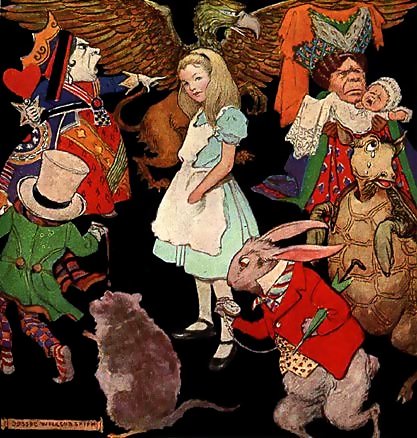
Alice In Wonderland, surrounded by the characters of Wonderland, illustration, by Jessie Wilcox Smith, 1923. In public domain.

Once again, it’s time for the leap year silly season, between the presidential election cycle and the Summer Olympics. Only with a twist. Between the reactionary GOP/TPers, the state of the world in general and over-hyped Mayan predictions, 2012 promises to be a year full of surprises, for better and for worse. Only, as far as I can read a calendar, this year runs on the same day and date lines as 1984. Minus George Orwell’s post-apocalyptic impressions or Van Halen’s first big album (That reminds me — I should download “Panama” from iTunes).

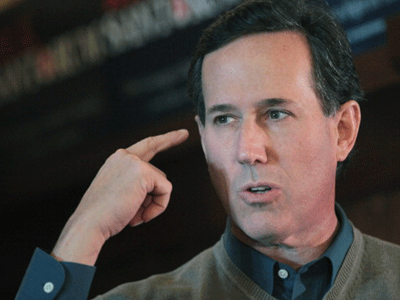
Former U.S. Sen. Rick Santorum (R-PA) speaks about entitlements during a campaign rally at the Hotel Pattee, Perry, Iowa, January 2, 2012. (Scott Olson/Getty Images).

What has been predictable so far includes Rick “Sanitarium” Santorum’s race-baiting via entitlements, calling on Blacks to not take “other people’s money” yesterday on the eve of the Iowa caucuses. What a dumb, racist ass! Especially since the overwhelming number of Americans on welfare are White. Especially because most poor Blacks still feel the lingering effects of a society built on racial preferences that denied them and previous generations the wealth that helped make America the richest country in the history of the world. Especially since Santorum has tried these tactics before, in Pennsylvania, where he showed how crazy he was six and eighteen years ago (Please Pitt, stop using him in your promotional ads!)

Yes, America’s all Alice in Wonderland again, sliding down the rabbit hole into an election cycle that’s more about style than substance, where the spin cycle’s constantly on and character is only defined in the most sanctimonious of terms. Between San”scrotum,” Ron Paul, Mitt Romney, Newt Gingrich, Michelle Bachmann, and Jon Huntsman and their idiotic campaigns, I’d take an ancient Roman approach. Cut each of them on their right butt cheeks, throw them all in a bag with a wild leopard, and drop them in a river full of hippos. Whoever survives should then get to run against President Obama. That would be fairer than the system we have now.

Finding My Father for the First Time

30 Wednesday Nov 2011

Posted by decollins1969 in 1, Boy @ The Window, culture, Eclectic, Jimme, Mount Vernon New York, My Father, New York City, Work, Youth

≈ Leave a comment

Tags

Alcoholism, Father-Son Relationships, Jacksonville, Jimme, Mount Vernon New York, My Father, New York City, Redemption


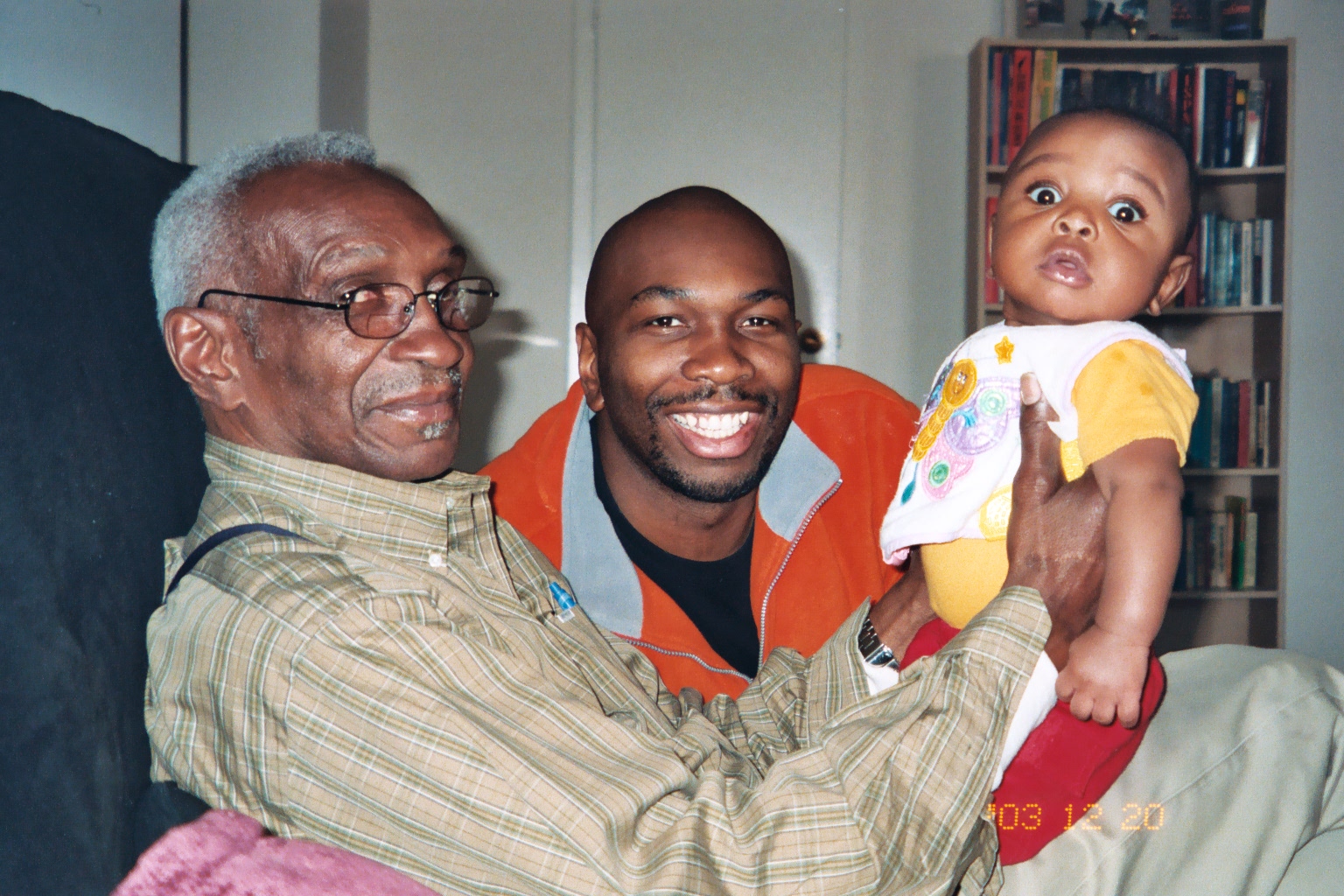
Noah meeting his grandpa for the first time, December 21, 2003. (Angelia N. Levy).

It’s a funny thing to realize that it’s only been about thirteen years since my relationship with my father Jimme became a father-son relationship. That I was a month away from turning twenty-nine before I could say that I’d had a conversation with my father that lasted for more than ten minutes, that didn’t revolve mostly around his job and how many “muddafuckas” he could “buy an’ sell.” That, finally, finally, at the age of fifty-eight, he’d admitted his failings as my father and to being an alcoholic.

The last time I had talked with Jimme before the ’98 holiday season was in the summer of ’96. He’d been living with his boss’ family, the Levi’s, on Long Island because his last drinking binge had led to his landlord Mrs. Small finally evicting him from his South 10th Avenue boarding room. Even though he was with the Levi family (for more on this, read my “New York, New York” post from October ’09), his bosses were about to go out of business. Turned out that one of the Levi brothers made the mistake of talking to an undercover federal agent about doing a contract killing on a competitor. Sounded like fiction at the time, but life is stranger than fiction.

In any case, on that last call, my father seemed lost. Not because he’d been drinking. But because he had nothing left in New York to cling to anymore. A few months later, my father, unemployed and no longer enabled by his former bosses, finally left New York for the family home in Georgia at the invitation of one of his sisters. By the end of ’97, I heard that he had cleaned up his act and moved to Jacksonville. Throughout ’98 and into ’99, I began to get calls from Jimme about how he was finally sober, had found God, and was getting married, to another woman named Mary.

Right after Thanksgiving ’98, though, was the first time I returned one of his calls, just to see if the number worked, to see if he was sane and sober. I wasn’t ready to talk, as I’d heard my father’s song and dance about turning his life around since The Brady Bunch was still on the air with new episodes. But, the fact that he sounded sober for the first time in at least fifteen years was an encouraging sign.

Still, I thought long and hard about blowing him off, keeping my father at the distance of a light-year. All my life, and certainly all of my older brother Darren’s, Jimme had been an evil drunk, verbally abusive and incapable of staying sober for more than three weeks at a time. But he had also been there for me growing up during my Humanities and Hebrew-Israelite years. He helped keep Darren and me from starving or walking around barefoot in ’82 and ’83. He kept the example of hard work in front of us even as the other parent figures in our lives went on dreaded welfare and laid around as if our lives were over. His money was the reason I was able to stay in school after five days of homelessness my sophomore year at Pitt.

So I called him again, deciding to give him a second chance. That was February ’99, a two-hour conversation about how he managed to become a recovering alcoholic, a church-goer, and a married man. He admitted that he had made many mistakes, that he was an alcoholic, that he loved me and my brother. It was a conversation, a real conversation, an unbelievable change of relationship. After twenty-nine years and two months, I finally had a father that I really could call father.

Thirteen years later, and I’m still amazed that I’m able to talk to my father as my father, and not as the person I used to have to drag out of bars on 241st Street or in Midtown Manhattan growing up. I tracked Jimme down many times for money or to save him from himself between ’82 and ’93. And yet, I only found my father once he became so lost he had to leave New York to find himself for the first time.

The Messiah Complex At Work, Part 1

12 Saturday Nov 2011

Posted by decollins1969 in 1, Boy @ The Window, Eclectic, Politics, race, Work

≈ 1 Comment

Tags

Academy for Educational Development, AED, Bipolar Disorder, Driving Miss Daisy, False Accusations, Jealousy, Ken, Managing Your Boss, Manic Depression, Messiah Complex, Micromanagement, New Voices, New Voices Fellowship Program, Paternaiism, Race, Racism, Washington DC


Heinrich Himmler, ala Messiah Complex, 1938. (German Federal Archive via Wikipedia).

Today marks eight years since my former immediate supervisor Ken (see my “Working At AED: Alternate Sources of Fear” post from June ’11) forced me into a meeting with the head of HR and his “all-wise” boss Sandra “Driving Miss Daisy” in an effort to strip me of my Assistant Director of New Voices title at the now defunct Academy for Educational Development. All because I did my job while he was out of the office tacking on a couple of extra days after we’d attended the Independent Sector Conference in San Francisco the week before.

But this wasn’t about me or me doing my job as I’d been doing it for three years. No, this was about Ken in the middle of a period of emotional and psychological instability, and about me no longer trying to work around his moments of mania and depression. After all, I had a newborn son to worry about, a job search to keep secret, and a book I was determined to publish. Couple that with a fifteen percent cut in funding from the Ford Foundation for the New Voices program, and there was no way I’d make it through my last months with New Voices without Ken reacting irrationally.

Anglo Corned Beef, November 11, 2011. (cgi.ebay.com).

It didn’t help that Ken suddenly wanted to do a New Voices conference in Mumbai, India as part of the World Social Forum with no significant planning that August, while I was out on maternity leave. It also didn’t help that Yvonne, our center director, chose early retirement in June over being kept into “Driving Miss Daisy’s” box of highly talented and experienced but underutilized managers of color.

Most of all, it didn’t help that I was completely honest, for once, in my assessment of my performance in my annual review that October. I dutifully reported my recent publications in The Washington Post and a semi-scholarly journal, presentations, teaching of graduate courses at George Washington University, and so on. During that meeting, Ken all but told me he was jealous of the kind of year I was having professionally. He even asked me where I wanted to be in five years. “I want to be director of my own project, of something like New Voices,” I said, again being all too honest.

So, during a week in which we had zero babysitter coverage, where I’d taken the week off to take care of my three-month-old son, Ken insisted that I come into the office. All so I could listen to an hour of accusations, insinuations and wild speculations. He accused me of undermining his authority because I relayed State Department travel warnings for Mumbai to New Voices Fellows. He told me how “amusing it was” that I had titled my position Assistant Director, even though that was the title of my position when I applied for it, interviewed for it, and accepted the position three years earlier. And even though he’d been introducing me as his assistant director for three years.

He accused me of sexually harassing a New Voices Fellow and two staff members back in ’01 over two conversations that he had heard about third hand, and not from a staff member. One was about a strange site visit conversation that had nothing to do with anything approaching sexual harassment. The other conversation, it turned out, was about me and a former staff member’s gastrointestinal illnesses, something we had in common. Ken also accused me of wanting to take his job, of believing that I could do his job better than he could. Only on that last part I agreed, with a definitive nod of my head.

So when he asked me to accept having my title as Assistant Director stripped, along with the commensurate duties that went with that title (including supervisory authority), I said, “No, I think it’s time for me to move on from New Voices.” It left Ken in shock. Heck, it left me in shock, thinking about how we’d make it without my income if I couldn’t find another job over the next three months. The HR director and “Driving Miss Daisy,” though, weren’t surprised at all.

The meeting Ken had forced made my secret decision to move on an open one. Either way, it was inevitable. As I’d written in my journal after my annual review with Ken a couple of weeks before the meeting:

Mr. Magoo screen shot (and a serious lack of vision), June 23, 2011. (http://tumeke.blogspot.com).

“The most telling comment that my Director made during our fundraising effort came when I asked about his vision for our project. ‘I don’t know what the project’s vision should be,’ he said. I realized at that moment that everything we had worked for would fail, no matter how sound our ideas. My Director’s vision for the project did not extend beyond his need to feel needed, to feel as if he alone could keep our project – and by extension, himself – alive. I concluded that this was a dangerous position to find myself in professionally, and that it was beyond time to go.”

Herman Cain’s Greatest Hits

01 Tuesday Nov 2011

Posted by decollins1969 in 1, Eclectic, eclectic music, Patriotism, Politics, Pop Culture, race, Work

≈ Leave a comment

Tags

Bruce Hornsby and The Range, Class Warfare, Dean Martin, Herman Cain, Naughty By Nature, Opposition, Otis Redding, Phil Collins, Politics, Popular Music, Racial Denial, Racial Stereotypes, Republicans, Sexism, Singing


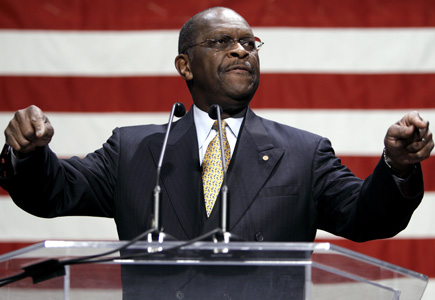
Mr. Herman "Get A Job!" Cain, at Republican Party of Florida Presidency 5 Convention, Orlando, FL , September 24, 2011. (AP).

Since the allegedly sexually harassing, racism and classism denying, Republican presidential candidate leader of the moment Herman Cain likes to sing, I decided to make a short list of Cain’s greatest hits. Trust me, they’re all doozies. They draw on the experiences of a man about as in touch with average Americans as Marie Antoinette was with French peasants on the eve of the French Revolution.

1. “The Way It Is” (1986) — Bruce Hornsby and The Range: Here, he puts special emphasis on the line, “Just for fun he says, ‘Get a job!,” not out of sarcasm, but out of sincerity.

2. “Another Day In Paradise” (1989) — Phil Collins: Cain tries to get a bit of social consciousness, at least, in emphathizing with “the man on the street,” the poor guy subjected to a worn-out homeless women begging for help.

She calls out to the man on the street
“Sir, can you help me?
It’s cold and I’ve nowhere to sleep
Is there somewhere you can tell me?”

He walks on, doesn’t look back
He pretends he can’t hear her
He starts to whistle as he crosses the street
She’s embarrassed to be there

The real test with this song would be whether Cain’s whistling is as good as his crooning.

3. “O.P.P.” (1991) — Naughty By Nature: Here Cain would need help from ex-RNC head Michael Steele to get his rap game together, as well as from Supreme Court Justice Clarence Thomas in interpreting the sexual laden lyrics. But in light of the accusations — and in Justice Thomas’ case, evidence — of sexual harassment and general insensitivity of Cain, Steele and Thomas, figuring out “who’s down with O.P.P.?” is an appropriate question in their bubble.

4. “Cigarettes And Coffee” (1966) — Otis Redding: Cain’s tribute to his campaign manager in his recent commercial as he slows down the pace a bit. “And please, darling, help me smoke this one more cigarette,” Cain baritones to Mark Block.

5. “Ain’t That A Kick In The Head” (1960) — Dean Martin: Cain’s theme song for his campaign. The main lyrical refrain for him would be as much about his rise to the top of the Republican heap as it would be about the people he’s stereotyped, vilified, denigrated and ultimately exploited over the course of his career and campaign.

My head keeps spinning;
I go to sleep and keep grinning;
If this is just the beginning,
My life’s gonna be beautiful.
I’ve sun- shine enough to spread;
It’s like the fella said…

“Ain’t [I] like a kick in the head?” And the 99 percent of us say, “Hell, yeah, where’s the aspirin?”

Education Incorporated

13 Thursday Oct 2011

Posted by decollins1969 in 1, Academia, culture, Eclectic, Politics, race, Work, Youth

≈ 1 Comment

Tags

"genius" award, Anya Kamenetz, Bill & Melinda Gates Foundation, Brookings Institution, Center for American Progress, Corporate Interests, Corporate Models, DIYu, Early College High Schools, Education, Education Reform, Edupunks Guide, Higher Education, K-12 Education, MacArthur Foundation Award, Michelle Rhee, No Child Left Behind, Roland Fryer Jr., Single-Track College Prep School Systems, Teach for America, The Hamilton Project, The New Teacher Project, Wendy Kopp, Workforce Development


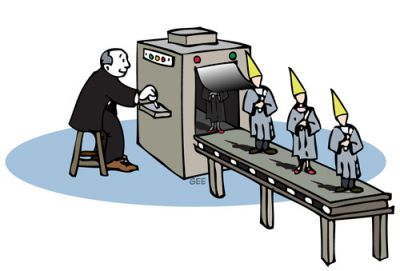
Capitalist Education Factory, November 1, 2010. (Source/http://communiststudents.org.uk).

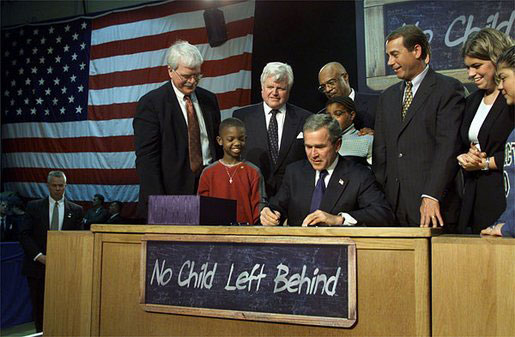
A generation ago, most of us in education worried about a federal government takeover of America’s 15,000 school districts with mandated standards. Wow, that prediction was way off, wasn’t it? (Oh, wait, the No Child Left Behind Act, passed in 2001, created a new era of national standards for accountability, not to mention high-stakes testing).

President George W. Bush signs into law the No Child Left Behind Act, Hamilton HS, Hamilton, Ohio, January 8, 2002. (http://www.whitehouse.gov). In public domain.

Now, we worry with good reason, as corporate interests inject themselves into education reform at every level. This has brought an imbalance to the education reform conversation that hasn’t existed since the days of Andrew Carnegie and the height of immigration of swarthy peoples from Southern and Eastern Europe. Now, as it was a century ago, it was the inclusion-vs.-exclusion debate. Whether to provide the best possible education for all comers, or sort and kick out as many “dull-minded” “undesirables” (both literally from 1911 to describe the learning disabled, immigrants and Black migrants) in K-12 schools as possible.

But this debate today — if we can really call it that — includes higher education. Of course, we know better than to call the millions of potential students who need some sort of post-high school training and education “morons” (also a 1911 term used by White psychologists who assumed anyone not WASP didn’t have the mental capacity to make use of a high school education). Yet we do attempt to sort these students and potential students into categories, like “adult learners,” “non-traditional students,” even “Edupunks,” a term

Anya Kamenetz, author of Edupunks Guide, at University of South Dakota, August 27, 2010. (http://www.usd.edu). In public domain.

coined by author Anya Kamenetz.

None of this has eliminated a common refrain in our field. That a four-year degree “isn’t for everyone,” as Kamenetz said to me after I asked her a tough question regarding the accessibility of her ideas for a Do-It-Yourself-university (DIYu) process of pursuing a college degree. It was a conference hosted by the Center for American Progress, but paid for by the Bill & Melinda Gates Foundation. Her idea, while helpful to 18-30 year-olds who are tech-savvy and with enough income to make this piecemeal education process work, was unhelpful to low-income students, and students of color over the age of thirty. And Kamenetz’s response was the typical exclusionary one.

Apparently, in our current economic climate, a full-time job isn’t for everyone either. Still, despite this reality, the Gates Foundation, Lumina Foundation for Education, and the Hewlett Foundation have all adopted similar models of thought around K-12 and higher education reform that have legitimized the work of people like Wendy Kopp and Michelle Rhee (Teach for America and The New Teacher Project, respectively) and institutions like University of Phoenix and Kaplan University. Models which draw heavily from corporate paradigms for success, including the punishment of failure. But they haven’t led millions of us to jobs in the new economy.

I recently attended a meeting hosted by the Brookings Institution’s Hamilton Project, in which authors presented a series of papers on K-12 education reform. Supposedly with cutting-edge ideas. Like one presented by MacArthur Foundation “genius” (emphasis on the quotation marks) Award winner Roland Fryer on providing student incentives linked to immediate and long-term educational goals for those most at risk of

Professor Roland Fryer, Harvard University Department of Economics, September 2011. (http://economics.harvard.edu).

dropping out of school, like low-income boys of color. Examples of paying fifth graders in Houston and New York $2 for every book they read or for completing their homework wasn’t so much cutting-edge as it was unremarkable. Incentives are fine, if you can pay for them or show how they nurture a passion for learning beyond the goal of completing individual tasks. This, of course, the “genius” couldn’t show.

The ridiculous assumption that Fryer made, arguing that because money in K-12 education had doubled since 1970, that funding wasn’t the issue, would’ve made me laugh as a high school senior. When you account for inflation, K-12 funding has declined, and not by a small amount, since the 1970s, and by the way, the millennial generation has created a new demand for schools, as the number of new schools or schools in need of renovations adds to this doubling in four decades. Fryer’s exclusion of data that a first-year graduate student wouldn’t have missed made me realize that most people in the field are so desperate for ideas that anything that sounds new must be good or cutting-edge. Especially if it’s funded by the Gates Foundation.

It’s not just the Gates Foundation, per se. It’s the idea that since things aren’t working for millions of students and undereducated workers, a model that concentrates on teacher effectiveness and treating students as customers — whether in fifth grade or in college — is the best way to go. This attitude has become so pervasive among well-funded education reformers that the idea of increasing funding for schools, or of making schools from pre-K on focus on all students in need of college/workforce readiness is about as welcome as Michael Moore at a Koch Brothers fundraiser.

Early college high schools and single-track, college-prep K-12 school districts, two of the great secrets of K-12 and higher education reform, remain such because these are difficult to bring to scale, and require more upfront investment than most philanthropists and businesses are willing to make. Not to mention, these represent the hard work of real reform, but ones that won’t make people like Kamenetz, Fryer, Kopp and Rhee stars. But by all means, let’s continue to fund every hair-brained idea as if tweaking our education system will yield results like a nuclear fusion plant on steroids.

← Older posts
Newer posts →

Boy @ The Window: A Memoir

Boy @ The Window: A Memoir

Places to Buy/Download Boy @ The Window

There's a few ways in which you can read excerpts of, borrow and/or purchase and download Boy @ The Window. There's the trade paperback edition of Boy @ The Window, available for purchase via Amazon.com at http://www.amazon.com/Boy-Window-Donald-Earl-Collins/dp/0989256138/

There's also a Kindle edition on Amazon.com. The enhanced edition can be read only with Kindle Fire, an iPad or a full-color tablet. The links to the enhanced edition through Apple's iBookstore and the Barnes & Noble NOOK edition are below. The link to the Amazon Kindle version is also immediately below:

scr2555-proj697-a-kindle-logo-rgb-lg

Boy @ The Window on Amazon.com: http://www.amazon.com/Boy-The-Window-Memoir-ebook/dp/B00CD95FBU/

iBookstore-logo-300x100

Boy @ The Window on Apple's iBookstore: https://itunes.apple.com/us/book/boy-the-window/id643768275?ls=1

Barnes & Noble (bn.com) logo, June 26, 2013. (http://www.logotypes101.com).

Boy @ The Window on Barnes & Noble: http://www.barnesandnoble.com/w/boy-the-window-donald-earl-collins/1115182183?ean=2940016741567

You can also add, read and review Boy @ The Window on Goodreads.com. Just click on the button below:

Boy @ The Window

Twitter Updates

Tweets by decollins1969
  • RSS - Posts
  • RSS - Comments

Archives

  • June 2025
  • April 2023
  • September 2022
  • August 2022
  • July 2022
  • June 2022
  • May 2022
  • April 2022
  • March 2022
  • January 2022
  • December 2021
  • November 2021
  • October 2021
  • September 2021
  • August 2021
  • July 2021
  • June 2021
  • April 2021
  • March 2021
  • February 2021
  • January 2021
  • December 2020
  • November 2020
  • October 2020
  • September 2020
  • August 2020
  • July 2020
  • May 2020
  • April 2020
  • March 2020
  • January 2020
  • December 2019
  • November 2019
  • August 2019
  • July 2019
  • June 2019
  • May 2019
  • April 2019
  • March 2019
  • February 2019
  • January 2019
  • December 2018
  • November 2018
  • October 2018
  • September 2018
  • August 2018
  • July 2018
  • June 2018
  • May 2018
  • March 2018
  • February 2018
  • January 2018
  • December 2017
  • November 2017
  • October 2017
  • September 2017
  • August 2017
  • July 2017
  • June 2017
  • May 2017
  • April 2017
  • March 2017
  • February 2017
  • January 2017
  • December 2016
  • November 2016
  • October 2016
  • September 2016
  • August 2016
  • July 2016
  • June 2016
  • May 2016
  • April 2016
  • March 2016
  • February 2016
  • January 2016
  • December 2015
  • November 2015
  • October 2015
  • September 2015
  • August 2015
  • July 2015
  • June 2015
  • May 2015
  • April 2015
  • March 2015
  • February 2015
  • January 2015
  • December 2014
  • November 2014
  • October 2014
  • September 2014
  • August 2014
  • July 2014
  • June 2014
  • May 2014
  • April 2014
  • March 2014
  • February 2014
  • January 2014
  • December 2013
  • November 2013
  • October 2013
  • September 2013
  • August 2013
  • July 2013
  • June 2013
  • May 2013
  • April 2013
  • March 2013
  • February 2013
  • January 2013
  • December 2012
  • November 2012
  • October 2012
  • September 2012
  • August 2012
  • July 2012
  • June 2012
  • May 2012
  • April 2012
  • March 2012
  • February 2012
  • January 2012
  • December 2011
  • November 2011
  • October 2011
  • September 2011
  • August 2011
  • July 2011
  • June 2011
  • May 2011
  • April 2011
  • March 2011
  • February 2011
  • January 2011
  • December 2010
  • November 2010
  • October 2010
  • September 2010
  • August 2010
  • July 2010
  • June 2010
  • May 2010
  • April 2010
  • March 2010
  • February 2010
  • January 2010
  • December 2009
  • November 2009
  • October 2009
  • September 2009
  • August 2009
  • July 2009
  • June 2009
  • May 2009
  • April 2009
  • March 2009
  • February 2009
  • January 2009
  • December 2008
  • November 2008
  • October 2008
  • September 2008
  • August 2008
  • July 2008
  • June 2008
  • May 2008
  • April 2008
  • March 2008
  • February 2008
  • January 2008
  • December 2007
  • November 2007
  • October 2007
  • September 2007
  • August 2007
  • July 2007
  • June 2007

Recent Comments

MaryPena's avatarMaryPena on My Day of Atonement/Bitter Hat…
decollins1969's avatardecollins1969 on No Good Teaching Deed Goes…
Mary Rose O’Connell's avatarMary Rose O’Connell on No Good Teaching Deed Goes…

NetworkedBlogs on Facebook

NetworkedBlogs
Blog:
Notes From a Boy @ The Window
Topics:
My Life, Culture & Education, Politics & Goofyness
 
Follow my blog

616 616 East Lincoln Avenue A.B. Davis Middle School Abuse Academia Academy for Educational Development AED Afrocentricity American Narcissism Authenticity Bigotry Blackness Boy @ The Window Carnegie Mellon University Child Abuse Class of 1987 CMU Coping Strategies Crush #1 Crush #2 Death Disillusionment Diversity Domestic Violence Economic Inequality Education Family Friendship Friendships Graduate School Hebrew-Israelites High-Stakes Testing Higher Education History Homelessness Humanities Humanities Program Hypocrisy Internalized Racism Jealousy Joe Trotter Joe William Trotter Jr. K-12 Education Love Manhood Maurice Eugene Washington Maurice Washington Misogyny Mother-Son Relationship Mount Vernon High School Mount Vernon New York Mount Vernon public schools Multiculturalism MVHS Narcissism NFL Pitt Pittsburgh Politics of Education Poverty President Barack Obama Race Racial Stereotypes Racism Relationships Self-Awareness Self-Discovery Self-Reflection Sexism Social Justice Teaching and Learning University of Pittsburgh Violence Whiteness Writing

Top Rated

Blog at WordPress.com.

  • Subscribe Subscribed
    • Notes from a Boy @ The Window
    • Join 103 other subscribers
    • Already have a WordPress.com account? Log in now.
    • Notes from a Boy @ The Window
    • Subscribe Subscribed
    • Sign up
    • Log in
    • Report this content
    • View site in Reader
    • Manage subscriptions
    • Collapse this bar
 

Loading Comments...