• About Me
  • Other Writings
  • Interview Clips
  • All About Me: American Racism, American Narcissism, and the Conversation America Can’t Have
  • Video Clips
  • Boy @ The Window Pictures
  • Boy @ The Window Theme Music

Notes from a Boy @ The Window

~

Notes from a Boy @ The Window

Category Archives: Religion

The State of the Union, That’s Not Optimistic

13 Wednesday Jan 2016

Posted by decollins1969 in 1, culture, Eclectic, Patriotism, Politics, Pop Culture, race, Religion, Work, Youth

≈ 1 Comment

Tags

2016 SOTU, Accomplishments, American Dream, American ideals, Congress, Denial, Fables, Faith, Falsehoods, Great Men In History, Oligarchy, Optimism, Plutocracy, Pollyanna, President Barack Obama, State of the Union Address, Supreme Court, Vision


President Barack Obama's final State of the Union speech, The US Capitol, January 12, 2016. (Evan Vucci, Pool/AP, via http://abcnews.com).

President Barack Obama’s final State of the Union speech, The US Capitol, January 12, 2016. (Evan Vucci, Pool/AP, via http://abcnews.com).

President Barack Obama ended his eighth and final State of the Union address in front of Congress and the nation last night with the words, “That’s why I stand here as confident as I have ever been that the state of the union is strong.” The president’s crescendo came after nearly fifteen minutes of describing the America that he sees and believes in. Obama illuminated individual examples of dedication and hard work and courage he has witnessed since he first began running for president in February 2007.

That President Obama chooses to look at his hundreds of — if not several thousand — examples of individual Americans striving for and maybe even achieving some sort of American Dream is admirable. But in light of the remaining 320 million Americans unaccounted for in his speech, the president’s speech isn’t an expression of optimism. President Obama has chosen the path of too many in power, to ignore how deep the wounds and injuries of the nation go, to fight what the US faces in terms of its cavernous and even cancerous problems with beliefs and limited actions. That’s not optimism. That’s both faith — albeit a bit misplaced — and blind devotion to an ideal that this America in 2016 has been moving away from for decades.

There are just a few examples from President Obama’s speech that point to a combination of near-religious faith and ostrich head-in-sand denial. Most notably:

The idea that the US economy has produced a net +14 million jobs since the day President Obama took office. That number is probably correct, but just like with all previous presidents since FDR, this number is hardly the whole story. Fact is, millions of Americans who lost their jobs during the Great Recession have yet to regain employment. Millions more have taken the jobs that the American economy creates the most frequently: low-wage, part-time, seasonal and/or contract work. And for those Americans who have been able to hold on to employment despite the Great Recession, their real wages are just in the last two years beginning to approach 2008 numbers. More importantly, their ability to move to a better or higher paying position has diminished since 2008, which is part of a four-decade-long trend. Yes, Americans should credit the Obama Administration for stanching the bleed from the femoral artery in 2009, 2010, and 2011. But the American economy still needs an arterial graft and a heart transplant.

2016 presidential candidate Donald Trump meeting with New England Patriots owner Robert Kraft, Gillette Stadium, Foxboro, MA, October 21, 2012. (Nancy Lane/Boston Herald;http://bostonhearld.com).

2016 presidential candidate Donald Trump meeting with New England Patriots owner Robert Kraft, Gillette Stadium, Foxboro, MA, October 21, 2012. (Nancy Lane/Boston Herald;http://bostonhearld.com).

President Obama’s claim that Donald Trump’s anti-immigrant, anti-Latino, anti-Muslim, anti-Black, and anti-feminist populism is just “wrong” and “doesn’t represent our American values.” Trump’s campaign certainly doesn’t represent American ideals or visions of a “shining city upon a hill,” to quote the late former President Ronald Reagan from his 1984 campaign. But despite what Obama said last night, Trump and his supporters and potential voters are a strain of American values and politics that has always been, and perhaps always will be. Trump is very much exploiting a clear-eyed vision of America as a White (and male) Christian nation, one with automatic exclusions from the club of those not entitled to the American Dream socioeconomically, culturally, and even spiritually. While President Obama acknowledged this in his speech, he ignored the reality that this strain of -isms in American politics and culture remains powerful and needs to be fought, not just wished away with a more conciliatory vision of America.

The idea that a better statesman, that an all-time great president like FDR or Abraham Lincoln could have bridged the divide in Congress, with the Supreme Court, and in American politics in general. This is patently false and extremely tongue-in-cheek on President Obama’s part. His great-man-in-politics theme has actually grown tired over the course of the past nine years. For as great as both of those presidents were, President Franklin Roosevelt and President Lincoln presided over an America in def-con-one crises, before America was officially a superpower. As terrible as the Great Recession and its after-effects have been, as deplorable as American use of force in the Middle East, East Africa, and South Asia has been, the Civil War, the Great Depression and World War II were foundational periods of change. President Obama might not have been the GPAT (Greatest President of All-Time), but in an era of an oligarchic Congress and a plutocratic Supreme Court, he did as good as job as FDR and President Lincoln would have. It still wasn’t good enough, but not because President Obama wasn’t a great person or very good president. Americans needed someone willing to make radical changes, and not just a centrist committed to a grand vision of bipartisan compromise and slow, incremental changes.

I will definitely miss President Obama as my president when he relinquishes the office on Friday, January 20, 2017 at 12 noon. But I won’t miss his brand of optimism. For optimism that relies on falsehoods about America as a meritocracy, Americans as a tolerant people, and American imperialism as a force for good in the world isn’t optimism. It’s a fable more vast and more deadly than any the Grimm brothers could have written two hundred years ago.

Black Lives Matter and My Dreamy Heaven

01 Friday Jan 2016

Posted by decollins1969 in 1, culture, Eclectic, Politics, Pop Culture, race, Religion, Youth

≈ Leave a comment

Tags

#BlackLivesMatter, Black Lives Matter, Dreams, Eric Garner, Freddie Gray, God, Heaven, Institutional Racism, Jordan Davis, Life and Death, Michael Brown, Nature, Photons, Police Brutality, Quantum Energy, Quantum Mechanics, Racism, Renisha McBride, Revelation, Sandra Bland, Self-Reflection, Structural Racism, Tamir Rice, The Universe, Trayvon Martin, Walter Scott, White Vigilantism


A shower of photons, December 31, 2015. (http://www.theallium.com).

A shower of photons, December 31, 2015. (http://www.theallium.com).

It was a strange place, this place of peace and comfort. To realize that at the quantum level, we each were all bundles of energy, that our bodies were but vessels that carried our real selves in our earthly years. That heaven was much, much more. Pearly gates and a white-bearded God? Nonsense! Try singularities and endless connections between the past, present, and future, between multiple universes and realities! We existed everywhere and in every time. There was no pain and no need, because we were everything and everything was in us and with us.

A high-resolution picture of the Pillars of Creation, in the Eagle Nebula, 7,000-light-years from Earth, via the Hubble Telescope, circa 1995, retouched January 5, 2014. (Armbrust via Wikipedia via NASA). In public domain.

A high-resolution picture of the Pillars of Creation, in the Eagle Nebula, 7,000-light-years from Earth, via the Hubble Telescope, circa 1995, retouched January 5, 2014. (Armbrust via Wikipedia via NASA). In public domain.

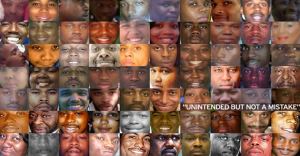
In this space and place, I met them. The ones that once left us behind. The entities who once lived in the earthly realm, whose bodies were decimated, whose minds had been wounded. It was here that I met Trayvon Martin, Renisha McBride, Tamir Rice, Sandra Bland, Walter Scott, Freddie Gray, Kindra Chapman, Samuel DuBose, Joyce Curnell, Ralkina Jones, Raynette Turner, Christian Taylor, Eric Garner, Michael Brown, Jordan Davis, John Crawford, and Jonathan Ferrell.

There were so many more bundles of light and energy in my presence that I felt myself cry. Not real tears, because while I could see and hear everything, I didn’t have any eyes or ears. I wanted to hug them all, but didn’t have any arms. I wanted to embrace them, but didn’t have any lips.

But there was one thing I could do. I merged my little bundle of energy with theirs. It was a joining more real and miraculous than anything I ever felt when tethered to Earth. I felt so alive, so free, so one with the universe. It was as if my material life was a nightmare and a dream, and this heaven the one true real.

In an instant, every feeling and thought I had merged with the feelings and thoughts of hundreds, if not thousands of other lights. And in that instant, the one question I had they asked and answered before I knew what my question was.

Don’t feel for dead. We are alive and well, and will be always so. Feel for the living. For theirs is a world of struggle and suffering.

They do not know who they really are. They do not know that their bodies are but machines, and their lives are not real.

In that singular moment, I understood. How could anyone in the living years truly appreciate the privilege of a corporeal existence when that is but only one form of life? If we as humanity could not know ourselves, how could we protect ourselves from ourselves?

I did get a glimpse, just a brief one, of another answer.

“To make our lives matter, fight for a better world. It doesn’t matter if you lose, but it does matter if you give up.”

As soon as that thought materialized, I woke up, sad to find myself in my middle-aged body, reconnected to my one quadrillion cells and Earth’s gravity and pressure.

————————————————————

A collage of Black and Brown people killed by police and White vigilantes, February 2015. (http://thefreethoughtproject.com/ via Gawker.com).

A collage of Black and Brown people killed by police and White vigilantes, February 2015. (http://thefreethoughtproject.com/ via Gawker.com).

If I could, I’d want to meet all of the recent victims of police brutality and murder and White vigilantism and have a conversation. I would ask each of them only one question. Something like, “What did you want to get out of life?” or “What did you want your life to mean?” Because ultimately, that’s the most important question any of us can ask ourselves while we are alive in this physical world.

The structures that allow law enforcement agencies to assume those with Black and Brown bodies are criminals and undeserving of life pass those assumptions on to their individual police officers. The fourth estate does at least as good a job of passing these assumptions on to millions of ordinary civilians. The result is that thousands of us never got the chance to answer this most important question in our living years. If we cannot agree that this is a shame and a pitiful way to live, than we truly live in a nation in which Black and Brown lives (not to mention, people in poverty and others of different religions and ethnicities) don’t matter. For that — if for no other reason — is why we need Black Lives Matter, and we need Black Lives Matter to matter more, in the here-and-now linear world right now, in 2016.

The Fountain of Middle Age

27 Sunday Dec 2015

Posted by decollins1969 in 1, Boy @ The Window, Christianity, culture, Eclectic, Mount Vernon New York, Movies, New York City, Pittsburgh, Politics, Pop Culture, race, Religion, Sports, Youth

≈ Leave a comment

Tags

616, 616 East Lincoln Avenue, Aging, Back To School (1986), Beauty, Demographics, Family, Fountain of Middle Age, Fountains, Friends, Health, Philadelphia, Rodney Dangerfield, Self-Reflection, Youth


Alexander Stirling Calder's "Swann Memorial Fountain," Benjamin Franklin Parkway, Philadelphia, PA, August 18, 2012. (Donald Earl Collins).

Alexander Stirling Calder’s “Swann Memorial Fountain,” Benjamin Franklin Parkway, Philadelphia, PA, August 18, 2012. (Donald Earl Collins).

By most measures, today marks my full transition from relative youth to middle age. Although, when I really think about it, didn’t I really hit middle age in December ’07, when I turned thirty-eight? The average life expectancy of an American male is about seventy-seven, right? And for Black males, it’s barely sixty-five. Given my family history, though, I won’t hit middle age for another two years. My maternal grandfather turned ninety-six three months ago, and my paternal grandfather lived until he was ninety-six. Even my father’s still moving along at seventy-five, despite his battle with alcoholism between the ages of twenty and fifty-eight.

I do feel things in my body and mind that until a few years ago were merely minor aches and pains. My right hip is misaligned with my left hip, likely from years of walking at warp speed, lots of basketball, and six years of my running regime. My L-5 vertebrae is a bit compressed, due to years of activity, including many years hunched over a keyboard trying to make myself into a writer, author and educator. My right knee has been a bother since I was twenty-four, but the issue has gotten worse in the past two years (maybe time for some HGH or microfracture surgery?). I now have white-coat syndrome (because most doctors and nurses get on my last nerve), and I’m mildly anemic. No, folks, forty-six isn’t the new thirty-six, even if I can still run forty yards in under five seconds, pop a three over my son’s outstretched hand or leg press 360 pounds.

Me via Photo Booth, December 17, 2015. (Donald Earl Collins).

Me via Photo Booth, December 17, 2015. (Donald Earl Collins).

But I still have good health and a mostly healthy body and mind. Since I turned twenty-seven, my weight has never been higher than 241 pounds (including clothes, wallet, phone, and keys) or lower than 212 (I weight 229 now). I can still memorize when inspired to do so, remember virtually anything important from my life from the age of four to the present, and could still probably win at Jeopardy if I ever got the call.

What’s more impressive, though, is whom remains in my life now that I’m no longer “young” anymore. My friends live all over the map, from the DC area to Pittsburgh to the Bay Area and New York, from Atlanta to Athens and from Seattle to Shanghai. I’ve made peace (mostly) with my family and my past, even if they aren’t always at peace with me. There’s my wife and son, of course, who are mostly likely the reason I’m still “young” relative to my age. Though I remain a Christian, I do not have the blind faith or evangelical -isms of my youth, and I’m at peace with that as well. I’m probably further to the left culturally and politically than I was at sixteen, twenty-six, or thirty-six. Because I’ve learned, sadly, that so much of what I was taught or fed growing up was either incorrect or a complete lie. But even with that sad disillusionment, I’ve come to accept the possibility of change for myself and the Sisyphean task that this nation and world always has been.

Me at 45 and 364.25 days, Pittsburgh, PA, December 26, 2015. (Donald Earl Collins).

Yet even the idea of middle age has changed in the minds of capitalists as the Baby Boomer generation has begun retirement and all of them have received their first AARP cards. Before 2000, the ad folks and entertainment folks had split up adults into the age demographics of 18-34, 35-44, 45-64, and 65 and up. Now, it’s 18-24, 25-54, and 55 and up. This privileges Baby Boomers (as usual) and props up Millennials (folks who used to be Gen Y). My middle age is not the same as Baby Boomers’ middle age. Even in demographic representations, money-grubbing capitalists give us Gen Xers little respect.

Rodney Dangerfield quipped this funny line in Back to School (1986):

Coach Turnbull: What’s a guy your age doing here with these kids?
Thornton (played by Dangerfield): I’m lookin’ for the fountain of middle age.

Maybe when I’m sixty-five (like Rodney Dangerfield was in this film), I’ll be looking for the Fountain of Middle Age, too. But my choice will be to stand in it for the next thirty or forty years!

Holiday Traditions (really, not having any)

12 Saturday Dec 2015

Posted by decollins1969 in 1, Boy @ The Window, Christianity, culture, Hebrew-Israelite, Marriage, Mount Vernon New York, My Father, Pittsburgh, Pop Culture, race, Religion, Work, Youth

≈ Leave a comment

Tags

616, 616 East Lincoln Avenue, Abuse, Chanukah, Chiropractor, Christmas, Domestic Violence, Family, Giving, Haves and Have-Nots, Holiday Traditions, Maurice Eugene Washington, Mom, Mother-Son Relationship, Poverty, Receiving, Suicide, Womanizing


Christmas Holiday and Traditions Around The World ornament bulb, December 12, 2015. (http://johnseville.benchmark.us).

Christmas Holiday and Traditions Around The World ornament bulb, December 12, 2015. (http://johnseville.benchmark.us).

At my chiropractic appointment yesterday morning, my bone-cracking doctor of fourteen years and I got into a discussion of our holiday plans over the next couple of weeks. Her and her family will visit with extended kin in Virginia, while we’re heading to Pittsburgh to see my in-laws. During our conversation, my chiropractor brought up some of the family traditions she’s preserved with her handful of Christmases with her young daughter and two sons. Traditions like Danish pork roast for dinner, ornaments and other hand-me-downs from her grandparents and other ancestors as part of trimming the tree.

“I wouldn’t know anything about traditions. Matter of fact, there were eight years growing up where we didn’t even celebrate Christmas,” I said, with no forethought about what her reaction might be.

“Oh, I’m so sorry,” my chiropractor said in a quiet yet somewhat shocked tone, as if I’d ruined the Christmas spirit for her kids.

“That’s what happens when you go up in poverty,” I said apologetically, realizing that I might have cost my chiropractor some peace of mind this holiday season.

Even at nearly forty-six, I can still say things without thinking, causing others to have to think more than they normally would. Sometimes, it’s without intent or malice, sometimes it’s because I don’t give a crap what people may think. Regardless, it’s certainly not because I want people to feel sorry for me or to give me a hug.

The truth is, the only holiday traditions I have come either from my wife or her family or were born out of my circumstances. Like making super-sweet, two-packs of Fruit Punch Kool-Aid and mixing it with either ginger ale or Sierra Mist for either Thanksgiving or Christmas. Or getting our son’s Christmas presents ready for him without him knowing the night before. Or me making some holiday/birthday cake for me and us (since my birthday is two days after Christmas). And often going to a soup kitchen, homeless shelter or other venue to give away clothes, toys, money, my time in knowing that no matter how I might feel about my life, plenty others have it much worse.

The truth is also more complicated than simple poverty. Up until my eighth birthday in ’77, my Mom and me and Darren (with either my father or my idiot stepfather) celebrated Darren’s birthday, Christmas and my birthday as separate or nearly separate events. Some of my best times growing up were those days. Then, when the hyperinflation of the late-1970s kicked in — along with a second marriage and two more mouths to feed — Christmases ’78 and ’79 consisted of a fake two-foot table tree, a new shirt or sweater and a new pair of slacks. There were no birthday celebrations for me.

A contemporary Candelabrum in the style of a traditional Menorah. United Kingdom, Chanukah service, December 2014. (Gil Dekel; http://www.poeticmind.co.uk; via 39james via Wikipedia). Released to public domain via CC-SA-4.0.

A contemporary Candelabrum in the style of a traditional Menorah. United Kingdom, Chanukah service, December 2014. (Gil Dekel; http://www.poeticmind.co.uk; via 39james via Wikipedia). Released to public domain via CC-SA-4.0.

Between Christmas ’80 and Christmas ’88, we didn’t even have the fake dwarf tree. Of course, four of those years we were Hebrew-Israelites. But there is this holiday known as Chanukah that also occurs in December, in which Torah believers celebrate the Festival of Lights with eight days of gifts and giving. But these were also the worst of our poverty-stricken years, and we could barely afford one candle for the menorah, much less eight or nine. The best gift I got those years was my idiot stepfather being out the apartment at 616 and on the prowl for other victims for his fast-talking nonsense about making money and living a godly way-of-life. I also attempted suicide on my fourteen birthday, not exactly a tradition worth repeating.

Finally, in December ’89, we had our first Christmas at 616 with my Mom having divorced my now idiot ex-stepfather. She bought a fake full-sized tree. I bought my four younger siblings gifts big and small for the holiday. My mom even made me a Duncan Hines chocolate cake with vanilla icing for my twentieth birthday that year. We didn’t have much, but what we did that year meant so much as we moved into the 1990s.

In all of my adult Christmases, I’ve actually only done one in Pittsburgh prior to our trip coming up in eleven days. It was Christmas ’98. That week, perhaps the only important tradition I’ve ever been a part of began. I moved in with my then girlfriend Angelia, mostly as a cost-cutting measure, partly out of love and concern for our respective futures. We’ve been living together and celebrating the holidays ever since!

This Is NOT Sparta!

11 Wednesday Nov 2015

Posted by decollins1969 in 1, culture, Eclectic, Movies, Patriotism, Politics, Pop Culture, race, Religion, Sports

≈ Leave a comment

Tags

Black Americans, Black Migration, Blind Patriotism, Civil Rights Movement, Civilians, Erasure, Freedom, History Lessons, Honoring, Hyper-Patriotism, Invisibility, Jim Crow, Meaning, Native Americans, Patriotism for Profit, Sacrifice, Service, Slavery, Veterans Day


"If you live in a free country, thank a veteran" poster slogan, November 10, 2015. (http://facebook.com).

“If you live in a free country, thank a veteran” poster slogan, November 10, 2015. (http://facebook.com).

Just like with Memorial Day and with Independence Day, I often find myself conflicted about Veterans Day. Not because I think individual members of the military deserve praise or scorn. As usual, the vast majority of Americans think too simplistically about their country, its people, its intentions and history, even its holidays. Too many of us go along to get along. It’s as if we expect the contradictions and tensions that make up our times and days like today to simply melt away in some high-pitched display of blind patriotism. I have not — and likely will never be — that American, pumped up with pride and affection, shouting slogans as gospel truth, thanking every member of the military for every single breath of American air that I breathe. And that is because the narrative for days like today has never worked for me.

In some respects, the blind march of Veterans Day is with Americans every single day. The media covers the military and individual military members as if all of them have spent weeks on the front lines, as if all of them are patriots above reproach. Almost all of us have known someone who’s served, and we know that service for most was never as simple as wrapping the American flag around themselves in defense of American freedoms halfway around the world (or at a base a few miles from home). In recent months, we’ve learned that much of the constant drumbeat of military-fueled patriotism the military itself has bought and paid for, at NFL and college football and baseball games. Reinforcing one of America’s main values — profit.

Army National Guardsmen about to run on field with American flags with the New England Patriots, Super Bowl XLIX, University of Phoenix Stadium, Glendale, AZ, February 1, 2015. (http://latimes.com; Getty Images).

Army National Guardsmen about to run on field with American flags with the New England Patriots, Super Bowl XLIX, University of Phoenix Stadium, Glendale, AZ, February 1, 2015. (http://latimes.com; Getty Images).

Today is Veterans Day, created seventy-seven years ago in the aftermath of the Great War, the “War to End All Wars,” World War I. It was a terrible war, after all. Ten million soldiers and sailors on all sides died, twenty million found themselves ripped and torn apart, and eight million civilians died. But not for or in the US, where 120,000 soldiers and sailors died, a few hundred thousand were wounded, and few hundred civilians died. The US didn’t enter the war until April 1917, nearly three years into the raging Eurasian conflict. American weapons manufacturers and merchants profited greatly from the war even before the US declared war on Germany, selling arms and food to both sides.

War is never simple. Neither should be what we think of those who served or are serving. Veterans Day is about respecting those who have served or are serving. Like my youngest brother Eri, or my Uncle Felton, or my sister-in-law or my late uncle-in-laws. Thanking or respecting them, though, shouldn’t be tied directly to the idea that I “live in a free country.” I don’t believe that the US is a free country, not for me and for millions of others like me. Nor do I believe that the US military has played a role in preserving my individual freedoms and liberties historically. I am a Black man living in a society built in part on systemic racism, often maintained or reinforced by the US military. Except for some elements of the Union Army during the Civil War, the US military has played a very small role in making sure that I or anyone who looks like me — male, female or transgender — lives in a free country.

Not to mention, the US hasn’t been invaded in over 200 years (I don’t want to hear about Pancho Villa — that wasn’t an invasion). Since when does fighting North Koreans, the Viet Cong, or even Nazis equate to me and others and our “freedoms?” Seriously, every time someone says this, it’s as if you’re attempting to erase long civilian fights for civil rights, for the most basic of freedoms that the US purports to grant to every citizen. Folks who say that we should be grateful to the military for living in a free country completely make invisible Native Americans. The US military was what guaranteed their near annihilation, deculturalization and unyielding poverty, especially from 1865 on.

"This is madness!" with actor Peter Mensah, screen shot from 300 (2007), November 11, 2015. (http://youtube.com).

“This is madness!” with actor Peter Mensah, screen shot from 300 (2007), November 11, 2015. (http://youtube.com).

Yes, some of you will note that I can write my post without fear of retribution from the government. Then I will say in response, “How does serving overseas guarantee my rights?” It doesn’t. A lot went into putting me in a better position in my life. Black migration, the Civil Rights Movement (flaws and all), the sacrifices of Black and White civilian leadership (including their deaths). I am one generation removed from sharecropping and tenant farming in Georgia and Arkansas, one generation removed from the last years of the Jim Crow era. But somehow, the US military is responsible for me living “in a free country.” Sorry, but that’s a narrative I cannot get behind.

So, we should all thank individual veterans for their service. We should honor the dead and the broken among them. For whether they came to serve out of a deep sense of patriotism, because of the draft (prior to 1973), because there weren’t any jobs in their communities, or because they wanted a chance at today’s version of the GI bill, some of them have paid dearly in their service. But since we do not live in a military junta or in a totalitarian society, I dare say that I don’t have to go along with the narrative that without the military, I would be a slave. History contradicts every aspect of this false narrative.

This isn’t Sparta (Sparta wasn’t even Sparta). Nor should the US ever be Sparta.

The Progressive’s Karl Marx Altar

22 Thursday Oct 2015

Posted by decollins1969 in 1, Academia, Carnegie Mellon University, culture, Eclectic, Politics, Pop Culture, race, Religion

≈ 6 Comments

Tags

Altars, Class Struggle, Conservatives, Cultural Imperialism, False Gods, False Idols, Ideology, Karl Marx, Marxism, Michael Eric Dyson, Political Imperialism, Progressives, Ronald Reagan, S-USIH 2015 Conference, Society of U.S. Intellectual Historians, Ta-Nehisi Coates, The New Republic, White Progressives


A portrait of Karl Marx, age 57, approximately August 24, 1875, by John Jabez Edwin Mayall, International Institute of Social History, Amsterdam. (Quibik via Wikipedia). In public domain.

A portrait of Karl Marx, age 57, approximately August 24, 1875, by John Jabez Edwin Mayall, International Institute of Social History, Amsterdam. (Quibik via Wikipedia). In public domain.

For so many things ideological in the US, there are more similarities than differences. That’s why the difference between most “liberals” and most “conservatives” is more issue-driven than an overall difference in philosophy or intellectual outlook.

On the issue of ideological altars, there are more similarities than differences as well. Democrats specifically — and leftists more broadly — often poke fun at conservatives and their constant invoking of Ronald Reagan as their intellectual guru and mascot. The idea that Reagan was a pro-life, anti-immigration and evangelical Christian conservative is as ludicrous as seeing Alexander the Great as a socialist muse. There’s no way that the once living-and-breathing Ronald Reagan would ever get along with most conservatives today, who tend to use his name in vain.

But if that’s true of American conservatives, many progressives are just as guilty, just as myopic, just as delusional. For them, though, their guru and intellectual Father has been Karl Marx (1818-1883), a Prussian-Jewish political philosopher and activist who found himself kicked out of Prussia, France, and Belgium before living out his final three decades in the UK. Of course, the father of Marxism makes sense, since class struggle has always been the very definition of being a progressive, a liberal, a leftist, no?

Well, class struggle has not always been at the center of being a leftist or a progressive. Standing against injustice and inequality, though, has. That is the distinction that most progressives — especially White progressives — all but refuse to make. Though Marx’s great intellectual and literary works were all about class struggle and the need to overthrow capitalism and return to the pre-classical, pre-imperialist days of communal living and economic equality, he left so much out. About the world outside of Europe, about slavery and women’s suffrage, about forms of inequality that weren’t just explained by human civilizations and class struggle. Not to mention, many of his predictions were just plain wrong.

Is your glass half-empty? - Optimism Quiz, August 2012. (http://oprah.com).

Is your glass half-empty? – Optimism Quiz, August 2012. (http://oprah.com).

A question at the Society of U.S. Intellectual Historians Conference last week reminded me of this over-reliance on Marx. At a plenary session on progressive public intellectuals, a graduate student asked a question about Black public intellectuals (particularly the freshly ordained Ta-Nehisi Coates and others identified by Michael Eric Dyson in The New Republic earlier this fall) and some idea about the need to return to Marxism. If I’d been on the panel, I would’ve responded, “Why Marxism? Why is this the only choice progressives, liberals, and leftist believe they have?”

Marx and his -isms don’t speak to me. I never thought to worship at his altar. I’ve almost always found White progressive attempts to make me see systems of racial inequality and discrimination as all part of class struggle ridiculous. I never saw Marx as having an answer to issues like intersectionality and Black/Latino/APA feminism, or in dealing with cultural imperialism (which is embedded in Marx’s own writings) via multiculturalism.

Stacks of money, April 13, 2008. (Allureme via Wikipedia). Released to public domain via cc-Attribution 3.0 License.

Stacks of money, April 13, 2008. (Allureme via Wikipedia). Released to public domain via cc-Attribution 3.0 License.

Plus, why do progressives need a White guy born in the nineteenth century as their utopian guide toward a twenty-first century revolution, anyway? Anybody ever heard of W. E. B. Du Bois or bell hooks, Edward Said or Erykah Badu? At this point in my intellectual life, Baduizm, Saidism or Sonia Sanchez-ism all fit where I am much more than Karl Marx. For me, Marx is just as much a false idol as Ronald Reagan and Baal.

Fifteen Years + 1 Million Men Equals?

16 Friday Oct 2015

Posted by decollins1969 in 1, Academia, Boy @ The Window, culture, Eclectic, Politics, Pop Culture, race, Religion

≈ Leave a comment

Tags

African American Men, Authenticity, Black Leadership, Black Males, Black Masculinity, Black Men, Exclusion, Inspiration, Louis Farrakhan, Million Man March, Nation of Islam, National Mall, October 16 1995, Race, Symbolism, Symbols, Washington DC


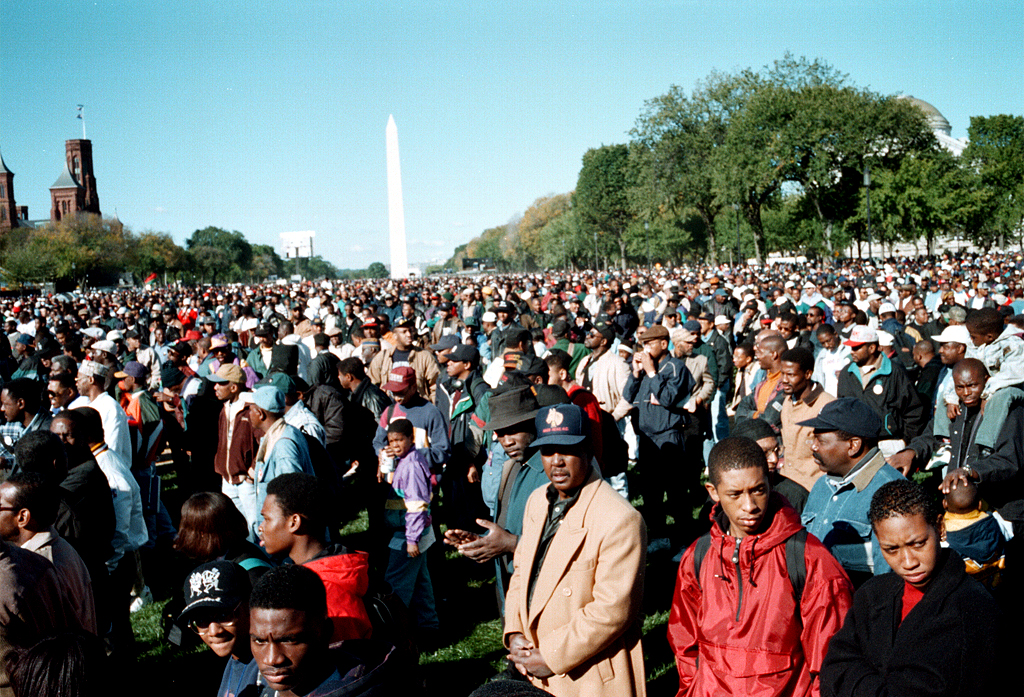
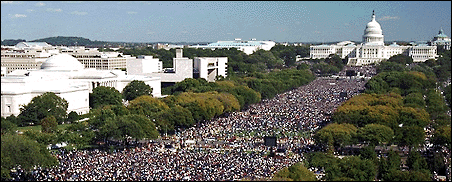
Million Man March, Washington, DC, October 16, 1995. Source: http://www.flickr.com/photos/yoke_mc/12469525/flick.com This file is licensed under the Creative Commons Attribution 2.0 Generic license.

I wrote this five years ago, but the same questions can be asked, for better and worse, with an addendum. That in the light of what Black men should do and shouldn’t, should expect and shouldn’t expect — of themselves and of the world — this is a very narrow-minded way of thinking. Concentrating on some limited definition of Black masculinity neglects the need to address inequality, systemic racism, the theft of hopes and dreams, not to mention, relationships and the intersection of race, class, gender, sexual orientation, religion, and everything else (though Black women and women of color have to deal with intersectionality every day, the issue goes mostly neglected and — if ever thought about — misunderstood by Black men).

If the past five years have shown anything, the issues addressing Black men have never existed in a vacuum. Police brutality and regular killings, White vigilantism, joblessness, debt, a dismantling of already under-resourced public schools, mass incarceration. These cannot ever be divorced from the issues facing Black women, women of color, the Black LGBT community, Latinos and Latinas, Native Americans, the poor and low-wage workers of color. Nor should they have been twenty years ago.

=====================================================

Today’s date has meaning for millions of people. Forty-one years ago, the New York Mets won their first World Series, beating the heavily favored Baltimore Orioles in five games. Crush #2 was also born forty-one years ago on this date (Happy Birthday!). But for a select group of African Americans — especially for over a million on the National Mall — today’s date marks fifteen years since the Million Man March.

I was there, though not among the million or so on the Mall that cold, windy and sunny day. I was in DC, on the Mall two hours before the gathering. I watched the highlights on CNN on the University of Maryland’s campus, all but completely clear of Black men under the age of thirty that afternoon. I met up with many a Black guy before and after the march, on the Metro as young men had taken the day off from work, school or college classes to go. On my bus back to Pittsburgh as older men talked of their broken lives, their remaining hopes and dreams. Most of all, I heard many speak of how inspired they were to go, as if God was calling them down to the Mall to find their true selves.

I didn’t go because I’d come down to the area that weekend for my dissertation research (including interviews) and to spend time with my long-distance girlfriend, who was a grad student at University of Maryland at the time. While I had some regrets about not attending, it’d been a while since I’d been involved with anyone on more than a passing occasion. Plus, I figured that my doctoral thesis on Black Washington and multiculturalism provided a significant intellectual exception to attending.

Louis Farrakhan, Million Man March, Washington, DC, October 16, 1995. Source: http://www.africawithin.com

Maybe I wasn’t being truly and authentically Black because I didn’t attend the march live, because I refused to stand in a sea of bodies to hear Louis Farrakhan’s voice encouraging Black men to take charge over themselves, their lives, their families. Maybe I did see myself as being above the fray because I saw all of this as a whole bunch of sound and fury signifying nothing but symbols. Maybe, in the end, being around so many Black men doing the same thing at the same time made me uncomfortable, just because I wasn’t sure what they expected to get out of the march after it was over.

Of course, symbols and inspiration are important, because without them, there is no action, no activism, no movement toward a goal that will ultimately change our lives, individually or collectively. But in listening to dozens of men who did attend the Million Man March that day and in the weeks that followed (as I traveled back to Pittsburgh, then to Minneapolis, then back to Pittsburgh, then DC, then New York in the month after the march), I realized that symbols and inspiration was all they expected out of the march.

Fifteen years later, the realization that nothing has really changed in the lives of many, if not most, of the million-plus men that attended the march on this date is disheartening. Those in poverty on that date may well still be in poverty. Those with years of addiction, or lives of crime, or without the compassion and skills necessary for fatherhood, all still struggling with these issues. That the cultural gap between Black men and Black women has widened since ’95 is obvious.

Yet there’s always hope, inspiration, and symbols that show that not all was for naught on Monday, October 16, ’95. It brought major issues facing African American males front and center to America and African America, and inspired many to work for social change and social justice for Blacks and for Black males in particular. Even if the messages of Farrakhan and company were mixed, contradictory, hypocritical, even sexist and bigoted. The march at least provided the realization that many Blacks cared deeply about finding themselves and finding solutions to issues that haunted them then, and haunt us still. Symbols are a powerful thing, even if it means we need many more of them before change can truly take hold.

Million Man March (Wide Above Shot), October 16, 1995. Source: Smithsonian Institution-http://photo2.si.edu/mmm/mmm08.gif


← Older posts
Newer posts →

Boy @ The Window: A Memoir

Boy @ The Window: A Memoir

Places to Buy/Download Boy @ The Window

There's a few ways in which you can read excerpts of, borrow and/or purchase and download Boy @ The Window. There's the trade paperback edition of Boy @ The Window, available for purchase via Amazon.com at http://www.amazon.com/Boy-Window-Donald-Earl-Collins/dp/0989256138/

There's also a Kindle edition on Amazon.com. The enhanced edition can be read only with Kindle Fire, an iPad or a full-color tablet. The links to the enhanced edition through Apple's iBookstore and the Barnes & Noble NOOK edition are below. The link to the Amazon Kindle version is also immediately below:

scr2555-proj697-a-kindle-logo-rgb-lg

Boy @ The Window on Amazon.com: http://www.amazon.com/Boy-The-Window-Memoir-ebook/dp/B00CD95FBU/

iBookstore-logo-300x100

Boy @ The Window on Apple's iBookstore: https://itunes.apple.com/us/book/boy-the-window/id643768275?ls=1

Barnes & Noble (bn.com) logo, June 26, 2013. (http://www.logotypes101.com).

Boy @ The Window on Barnes & Noble: http://www.barnesandnoble.com/w/boy-the-window-donald-earl-collins/1115182183?ean=2940016741567

You can also add, read and review Boy @ The Window on Goodreads.com. Just click on the button below:

Boy @ The Window

Twitter Updates

Tweets by decollins1969
  • RSS - Posts
  • RSS - Comments

Archives

  • June 2025
  • April 2023
  • September 2022
  • August 2022
  • July 2022
  • June 2022
  • May 2022
  • April 2022
  • March 2022
  • January 2022
  • December 2021
  • November 2021
  • October 2021
  • September 2021
  • August 2021
  • July 2021
  • June 2021
  • April 2021
  • March 2021
  • February 2021
  • January 2021
  • December 2020
  • November 2020
  • October 2020
  • September 2020
  • August 2020
  • July 2020
  • May 2020
  • April 2020
  • March 2020
  • January 2020
  • December 2019
  • November 2019
  • August 2019
  • July 2019
  • June 2019
  • May 2019
  • April 2019
  • March 2019
  • February 2019
  • January 2019
  • December 2018
  • November 2018
  • October 2018
  • September 2018
  • August 2018
  • July 2018
  • June 2018
  • May 2018
  • March 2018
  • February 2018
  • January 2018
  • December 2017
  • November 2017
  • October 2017
  • September 2017
  • August 2017
  • July 2017
  • June 2017
  • May 2017
  • April 2017
  • March 2017
  • February 2017
  • January 2017
  • December 2016
  • November 2016
  • October 2016
  • September 2016
  • August 2016
  • July 2016
  • June 2016
  • May 2016
  • April 2016
  • March 2016
  • February 2016
  • January 2016
  • December 2015
  • November 2015
  • October 2015
  • September 2015
  • August 2015
  • July 2015
  • June 2015
  • May 2015
  • April 2015
  • March 2015
  • February 2015
  • January 2015
  • December 2014
  • November 2014
  • October 2014
  • September 2014
  • August 2014
  • July 2014
  • June 2014
  • May 2014
  • April 2014
  • March 2014
  • February 2014
  • January 2014
  • December 2013
  • November 2013
  • October 2013
  • September 2013
  • August 2013
  • July 2013
  • June 2013
  • May 2013
  • April 2013
  • March 2013
  • February 2013
  • January 2013
  • December 2012
  • November 2012
  • October 2012
  • September 2012
  • August 2012
  • July 2012
  • June 2012
  • May 2012
  • April 2012
  • March 2012
  • February 2012
  • January 2012
  • December 2011
  • November 2011
  • October 2011
  • September 2011
  • August 2011
  • July 2011
  • June 2011
  • May 2011
  • April 2011
  • March 2011
  • February 2011
  • January 2011
  • December 2010
  • November 2010
  • October 2010
  • September 2010
  • August 2010
  • July 2010
  • June 2010
  • May 2010
  • April 2010
  • March 2010
  • February 2010
  • January 2010
  • December 2009
  • November 2009
  • October 2009
  • September 2009
  • August 2009
  • July 2009
  • June 2009
  • May 2009
  • April 2009
  • March 2009
  • February 2009
  • January 2009
  • December 2008
  • November 2008
  • October 2008
  • September 2008
  • August 2008
  • July 2008
  • June 2008
  • May 2008
  • April 2008
  • March 2008
  • February 2008
  • January 2008
  • December 2007
  • November 2007
  • October 2007
  • September 2007
  • August 2007
  • July 2007
  • June 2007

Recent Comments

MaryPena's avatarMaryPena on My Day of Atonement/Bitter Hat…
decollins1969's avatardecollins1969 on No Good Teaching Deed Goes…
Mary Rose O’Connell's avatarMary Rose O’Connell on No Good Teaching Deed Goes…

NetworkedBlogs on Facebook

NetworkedBlogs
Blog:
Notes From a Boy @ The Window
Topics:
My Life, Culture & Education, Politics & Goofyness
 
Follow my blog

616 616 East Lincoln Avenue A.B. Davis Middle School Abuse Academia Academy for Educational Development AED Afrocentricity American Narcissism Authenticity Bigotry Blackness Boy @ The Window Carnegie Mellon University Child Abuse Class of 1987 CMU Coping Strategies Crush #1 Crush #2 Death Disillusionment Diversity Domestic Violence Economic Inequality Education Family Friendship Friendships Graduate School Hebrew-Israelites High-Stakes Testing Higher Education History Homelessness Humanities Humanities Program Hypocrisy Internalized Racism Jealousy Joe Trotter Joe William Trotter Jr. K-12 Education Love Manhood Maurice Eugene Washington Maurice Washington Misogyny Mother-Son Relationship Mount Vernon High School Mount Vernon New York Mount Vernon public schools Multiculturalism MVHS Narcissism NFL Pitt Pittsburgh Politics of Education Poverty President Barack Obama Race Racial Stereotypes Racism Relationships Self-Awareness Self-Discovery Self-Reflection Sexism Social Justice Teaching and Learning University of Pittsburgh Violence Whiteness Writing

Top Rated

Blog at WordPress.com.

  • Subscribe Subscribed
    • Notes from a Boy @ The Window
    • Join 103 other subscribers
    • Already have a WordPress.com account? Log in now.
    • Notes from a Boy @ The Window
    • Subscribe Subscribed
    • Sign up
    • Log in
    • Report this content
    • View site in Reader
    • Manage subscriptions
    • Collapse this bar
 

Loading Comments...