• Spinning Sage’s Gold: Allegories on the Western-Dominated Present and a Possible Post-Western Future (2025)
  • About Me
  • Other Writings
  • Interview Clips
  • Video Clips
  • Boy @ The Window Pictures
  • Boy @ The Window Theme Music

Notes from a Boy @ The Window

~

Notes from a Boy @ The Window

Category Archives: race

The Contrarian One

15 Tuesday Feb 2011

Posted by decollins1969 in 1, Boy @ The Window, Christianity, culture, Eclectic, eclectic music, Mount Vernon High School, Politics, race, Religion, Youth

≈ Leave a comment

Tags

A.B. Davis Middle School, Anonymity, Contrarian, Dune, Humanities, MacGyver, Mount Vernon High School, Mount Vernon New York, Mount Vernon public schools, Privacy, Richard Dean Anderson, Sting, troubled youth


Sting as Feyd-Rautha in David Lynch's Dune, July 20, 2007. TAnthony. Qualifies as fair use under US Copyright laws because this is a low-resolution screenshot illustrating a character which is a subject in the article that uses it, and by nature no free version exists.

For the most part, I have protected the privacy of my childhood classmates and friends by not calling them by their actual names in this blog. I have used pseudonyms, code names like “Crush #1” or “Crush #2,” code letters based on their position in my cohort or how I saw them growing up. I don’t apply these rules to the adults I interacted with because they were public figures, authority figures really. That’s been one of my unofficial journalist-esque rules for this blog, and I’m sticking to it.

In this case, however, I’m pushing the envelope a bit. Even though I have no plans on using a name today, I’m using some initials of a former classmate that almost none of my readers will know. But for those that went through Humanities with me and read this post, the initials may make this person obvious. This classmate — and friend, I guess — was one of the few free thinkers I knew in my Humanities days. He wasn’t just smart — we were all smart. He fashioned himself an intellectual, someone who either thought against the grain or refused to get caught up in what he considered the daily stupid stress sandwich of grades, awards, and more grades that was our magnet program. Most of all, the kid was a contrarian, the one and only JD.

Just like with most of my classmates, I didn’t get along with him at first. He immediate came off to me as someone who saw himself above the fray, maybe even better than the rest of us. It didn’t help that JD introduced himself as “half-Russian, one-quarter French and one-quarter English” that first day of seventh grade nearly thirty years ago. For most of the first year, I thought that his persona was an act, an attempt at upper-crust coolness. I didn’t understand how girls — White and Black — liked this guy, zits and all.

Richard Dean Anderson as MacGyver, May 18, 2007. Source: http://www.just-whatever.com/2007/05/18/what-would-macgyver-do/

At various times during our Humanities days, his looks were compared to Sting, and later, MacGyver — actor Richard Dean Anderson’s most famous character. I’m sure that he liked the comparisons. If you meshed the two, you’d maybe end up with a JD, but probably about two inches shorter than the real life person.

At first, I didn’t think that he was all that smart. After all, we ended up in a fight over my outburst of laughter because he said Australians spoke “Australian” instead of English. I always wondered why we fought this week, of all weeks (twenty-nine years ago this week, by the way). It wasn’t as if we hadn’t annoyed each other before. Eventually I did begin to get Mr. OshKosh, as I called JD in my mind — and occasionally, out loud — during our Davis years. He was a deliberate individual, often trying too hard to be one. It was obvious to me that he thought the whole Humanities thing was a joke, that he found school a Sisyphean effort.

Still, even though we had fought — and I somehow managed to win against the karate kid — we’d get caught up in weird intellectual conversations about communism versus capitalism, or about America’s endless cultural corruption. JD would always take the most extreme view of America the ugly, leaving me no choice other than to argue with him or to agree with him, depending on the severity of his argument. He was a devout atheist, at least in argument, indirectly questioning my Hebrew-Israelite and, later on, early Christian beliefs. That he made me question what I thought I believed and what I actually did believe, I appreciated even at the time. I also got the sense that he was constantly questioning his world while casting doubt in my direction.

It was part of the dissatisfaction that I sensed in him all during our six years together in Mount Vernon’s schools. I didn’t know how much of it came from his home life, but my guess by the middle of high school was that we only saw a tip of a very large iceberg for six and half hours a day and five days a week. What was more obvious, at least to me, was that he seemed comfortable in his uncomfortability at Mount Vernon High School, with the flight of his White classmates in ninth and tenth grade, with the hypocrisy of Humanities as academic light in a sea of ignorance while ignoring the elephants in the room.

Despite holding many of his most private cards to his vest, JD was probably one of the five most honest people I knew in all of my education. His body language, his lack of interest in most things in the classroom, his varied cultural and intellectual interests outside of the classroom, his dating habits all but betrayed his closed-mouthness when it came to who he understood himself to be. He was, and has remained, my favorite contrarian.


Dairy Queens, Dick Oestreicher and Race

01 Tuesday Feb 2011

Posted by decollins1969 in 1, Academia, Boy @ The Window, culture, Eclectic, Mount Vernon High School, Pop Culture, race

≈ Leave a comment

Tags

"Sittin' on the Dock of the Bay", Affirmative Action, Bigotry, Black History Month, Dairy Queen, Dick Oestreicher, History Department, Michael Bolton, Otis Redding, Race, Racism, Richard Oestreicher, Segregation, Thomas Sowell, University of Pittsburgh, William Julius Wilson


Dairy Queen Sign, Near Frankstown Road, Penn Hills (outside of Pittsburgh, PA), June 14, 2005. Shawn Wall. Qualifies as fair use under US Copyright law because there is no attempt to distribute or alter, and this photo is only being used for illustrative purposes.

Black History Month is upon us once again. But instead of the same tired discussion of Carter G. Woodson, MLK or the meaning (or lack thereof) of this month, I’m telling a story that will (hopefully) dredge up issues for many of you.

It was the last Tuesday in October ’92. I was a student in Dick Oestreicher’s US General Field 2 graduate seminar in the history department at the University of Pittsburgh. The topic for our discussion this day

Otis Redding Album Cover, January 31, 2011. Unknown. This photo qualified as fair use under US copyright laws because of its low quality.

was, “Why has black economic mobility, political assimilation, and cultural identity differed from other ethnic groups.” On the surface, it sounded like a good academic discussion to have. But after having to write a fifteen-page analysis on the topic, where I was restricted to William Julius Wilson’s Declining Significance of Race (1978), Thomas Sowell’s Ethnic America (1971), and Kenneth Kusmer’s analysis of race in the context of Black migration to Cleveland (1976), I wasn’t so sure. I made the mistake of being provocative, naming my paper “Sittin’ on the Dock of the Bay” — after the Otis Redding version, and not the Michael Bolton one.

It was a long two-and-a-half hour class. Especially since I was the lone African American in the room talking about race and standing up to the classroom consensus that class was more important than race in the case of the thirty-million-plus people who looked like or had been classified the same as me. I was on the hot seat, arguing that both Sowell and Wilson’s bias was politically conservative in nature, which influenced their analysis of the question of Black progress and lack of such. I also decided that — like so many issues in history — the question of race versus class was an and-both and not an either-or one. That race and class were so intertwined in American culture and history that to separate them would do severe damage to our ability as historians to understand the nature of racism and poverty in American society.

One of my classmates, an over-50 White male, decided at this point to cut off my final point. “You should be grateful, to be able to go to an esteemed institution like the University of Pittsburgh, to be able to sit in that chair and get to earn a Ph.D. If it were thirty years ago, we couldn’t stand in the same Dairy Queen line, right here in Pittsburgh,” the older man said as slowly and as deliberately as someone giving an Oscar acceptance speech. I was amazed, angry, ready to put the man in his place academically. I wanted to verbally take a Dairy Queen triple-scooper and smash it in his stubby nose.

Then my mentally absent professor Dick Oestreicher immediately interrupted, literally positioning himself in the middle of the room to keep me from giving my response. Oestreicher ended class right then and there, dismissing us without even summarizing our discussion or criticizing our allegedly weak academic

Dick Oestreicher, circa 2009

analysis, which he had done in all of the previous weeks.

I was incensed, actually more pissed with Oestreicher than with the bigoted older man. I made sure to stop by Oestreicher’s office the next afternoon after my other grad seminar to find out why he interfered. “You’re going to have to deal with this anyway,” he said while shrugging his shoulders. The following week, I received an A- on my paper, with “Sowell’s well read” as the only comment on my critique of the authors and the undeniably conservative, pro-class and anti-race analysis that the authors provided.

Of my five and a half years in graduate school — and in my two years of grad school at Pitt — it was one of my most unbelievable moments. I wanted to pick Oestreicher up by his mangy hair and show him how some people deal with moments of racism and the people who allow it to continue on their watch. I wanted to tell him that he should stay out of the classroom if he’s too scared to actually teach students.

In the end, I was more patient at twenty-two than I’d probably be about something like this now. I remained academically defiant the rest of the semester, opposed every argument he made whenever he made it. Meanwhile, the bigoted old man had withdrawn from the course in the last month of the semester.

I learned, more than anything else, that many so-called liberal professors were only academic liberals, not actual liberals. Oestreicher in my mind was worse than my hard-ass principal Richard Capozzola at Mount Vernon High School. At least with Capozzola, you knew that he didn’t like anyone who looked like me — meaning young, Black, male, unpopular and poor. With Oestreicher and so many in academia, their liberalism and expressions in support of racial equality were mere scholarly arguments. In reality, people like him would never expect someone like me to have a chance in hell or heaven to become one of their academic peers.

But you know what was the funniest thing of all? I’d never been to a Dairy Queen before.

The Turd Dream

24 Monday Jan 2011

Posted by decollins1969 in 1, Boy @ The Window, culture, Eclectic, Mount Vernon High School, Politics, Pop Culture, race, Religion, Youth

≈ Leave a comment

Tags

1980s culture, A.B. Davis Middle School, Board of Education, Boy @ The Window, City Hall, Coming-of-Age, Dreams, Friendship, Growing Up, Hebrew-Israelites, Interpreting Dreams, Mount Vernon public schools, Nightmares, Pittsburgh, Race, Racial Strife, Russet Potatoes, Socioeconomic Strife, University of Pittsburgh


Russet Potatoes, January 23, 2011. Source: http://www.Fotosearch.com. Qualifies as fair use under US Copyright laws because of the limited use of picture and because its use is for illustrative purposes directly related to the topic of this post.

I found myself at a party one cold and starry evening, standing in an equally cold kitchen. It was really bright in the kitchen, almost to the point of overpowering my eyes. The walls and cabinets were all-white, the counters made of formica, and the floor light blue-and-white tiled. This was in stark relief from the adjacent living room. It was in a red-brown, ’70s dimmed-light den mode, with beads hanging over the doorway leading out of the kitchen to it. It was the kind of party I never had the chance to go to in high school.

But everyone was there. Even people I hadn’t seen since my Davis Middle School days. The class valedictorian and salutatorian, the affluent and middle class types who went to Pennington Elementary, Crushes #1 and #2, members of the Italian Club, and so many others were there. Two of them were peeling potatoes and throwing them into big pots of boiling water. They started slicing and dicing them, laughing as they were throwing the pieces into the bubbling clean and clear liquid.

Except these weren’t potatoes. These were turds, each shaped like a large Russet, being peeled and chopped, looking white but quickly turning crappy-brown upon contact with the air. The two turd-peelers shared the boiled and mashed turds with my former classmates, who were smiling in glee and eating them up with delight. I then looked at this six-foot, trapezoidal pyramid of a rack in the middle of the super-bright kitchen. It was full of turds, stacked on each one of its seven levels. It was enough to feed the guests several times over.

When I sat up from this dream in my small room in a shared row house on Welsford in Pittsburgh and found myself in the present, the first Saturday of February ’90, I gave Mom a call. I told her about the dream in all of its strange details. I asked her what she thought of it. “You’re friends are full of shit,” she said. After laughing so hard that I nearly rolled out of bed, I said, “That can’t be. It’s got to be more complicated than that.”

Yet I knew that Mom was absolutely right. Most of the people I knew during my years in Humanities — classmates, teachers, administrators, family members and neighbors — were full of crap when it came to me. I certainly included myself in that category. I might’ve made sure of or accidentally given myself a couple of enemas between 7S and the University of Pittsburgh. But it would’ve been hard to stay clean around all the filth on which we dined growing up. This was thanks in large measure to our community leaders and all of the racial and socioeconomic strife that was part of everyday politics and conversations at school and at city hall.

What Mom said was ironic, too. For better and mostly for worse, Mom, father and ex-stepfather had crapped up our lives with their baggage. The turds from their lives were the reason why my dreams had grown to be so vivid, so complicated by the time I reached adulthood. Mostly, my dreams and nightmares brought me to anger, as if someone were trying to steal my life from me, which, as it turned out, was how I felt most of the time when I was awake. And that also made me resolute whenever I left my dreams for the conscious world.

This was the final break between my immediate past of Mount Vernon, the whole Hebrew-Israelite and Humanities thing, and all of the ridicule, ostracism, poverty and abuse that came with those things. My past experiences were all now a part of my dream world. It was an occasional reminder that I wasn’t really myself in the relatively recent past.

That was nearly twenty-one years ago. Except for the occasional email from an ex-teacher or ex-Humanities classmate, the only reminders I have of the time before I became myself again are my Boy @ The Window project and manuscript. And though I don’t necessarily see the people whom I grew up with and around as being full of crap these days, I do see how our collective community baggage would make it difficult for many of us to find our way, our calling. Even in the midst of the best education our city had to offer.

Why Ferengi Are Jewish & The Maquis Are Latino

17 Monday Jan 2011

Posted by decollins1969 in 1, culture, Eclectic, Movies, Pop Culture, race

≈ 3 Comments

Tags

Acting, Actor Roles, Anti-Stereotype, Archetypes, Armin Shimerman, Aron Eisenberg, Avery Brooks, Cultural Stereotypes, Deep Space 9, DS9, Ferengi, Jr., LeVar Burton, Martin Luther King, Max Grodenchik, Michael Dorn, MLK Day, Racial Stereotypes, Reggie Miller, Robert Beltran, Roxann Dawson, Star Trek, Star Trek: Deep Space Nine, Star Trek: Enterprise, Star Trek: The Next Generation, Star Trek: Voyager, Stereotype Threat, Stereotypes, The Maquis, TNG, Tony Plana


Ferengi Characters, Star Trek: DS9, "Little Green Men" Episode Screen Shot, January 16, 2011. Image qualifies as fair use under United States copyright law because of its low quality and limited use nature.

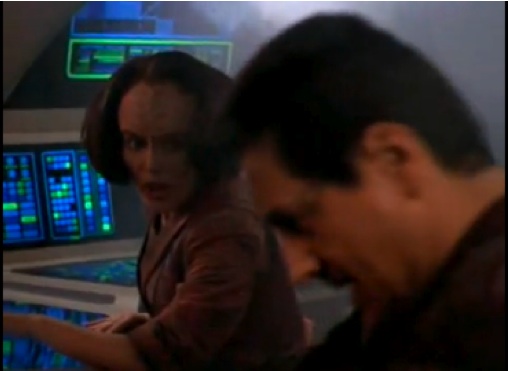
Maquis Characters, Star Trek: Voyager, "Caretaker, Part I" Episode Screen Shot, January 16, 2011. Image qualifies as fair use under United States copyright law because of its low quality and limited use nature.

In honor of Martin Luther King Day ’11, it’s my privilege to discuss Star Trek and stereotypes. For whatever reason, I’ve spent the better part of the past six months watching episodes of different Star Trek series in my spare entertainment time. Whether the theatrically great DS9 (Deep Space 9), the ever-goofy TNG (Next Generation), or the uneven and mediocre Voyager, the Star Trek franchise that made runs of four different series between ’87 and ’05 had at least one theme consistent with our much less harmonious twentieth and twenty-first century times. Playing to stereotypes seemed to be a common undercurrent, though with great makeup artists — and at least with DS9, good writing and acting — those stereotypes were light and subtle.


In watching, it amazed me that nearly all actors who played the alien Ferengi were Jewish. Yes, the actors who played the Ferengi characters were supposed to be short, but I didn’t know that Jews had cornered the acting market for people under five and a half feet tall. Armin Shimerman, Aron Eisenberg, Wallace Shawn, and Max Grodenchik all played the main Ferengi characters on DS9. Not so ironically, the Ferengi culture centered itself on making profit by virtually any means necessary, a pretty vile stereotype for an entertainment franchise based on a future and better human race.

Reggie Miller, Potential Ferengi


Even while watching DS9 in the late-90s, when all of the episodes were new ones, I commented to my friends that NBA Hall-of-Famer Reggie Miller could easily play a Ferengi, even at six-foot-seven, because the makeup artists would have very little work to do. Of course, that wasn’t to be.


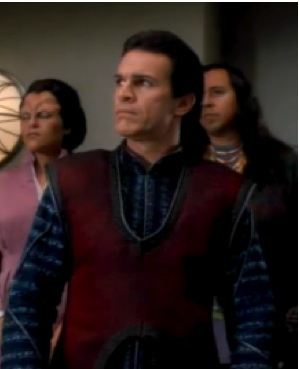
Tony Plana as Maquis Character, Star Trek: DS9, "The Maquis" Episode Screen Shot, January 16, 2011. Image qualifies as fair use under United States copyright law because of its low quality.

It wasn’t just the Jews-as-Ferengi that I picked up on the first or second time around. On both Voyager and DS9, the Maquis, a guerilla group fighting for disputed territories, had a disproportionate number of Latino actors playing those lead characters. Robert Beltran, Roxann Dawson and Tony Plana (mostly known these days as the father on the recently ended TV series Ugly Betty) were among the Latino actors playing these characters. I guess that the passionate or hot-blooded Latino stereotype played a role in the selection of these quality actors to play passionate or hot-blooded rebels in the relatively placid paradise of the Star Trek galaxy.


Of course, Black men on these shows found themselves emasculated for the most part. From LeVar Burton

Anthony Montgomery as Travis Mayweather, Star Trek: Enterprise, January 16, 2011. This screen shot qualifies as fair use under US Copyright laws because it is of low resolution screen shot and is a minimal use.

as the blind engineer to Michael Dorn as the semi-defanged Klingon, and from Tim Russ as the more-emotionally-repressed-than-normal Vulcan to the milquetoast twenty-second century human played by Anthony Montgomery, these characters seldom were provided the opportunity of a higher level of complexity beyond stereotypes or in playing an anti-stereotype. The one notable exception was Avery Brooks’ character Capt. Benjamin Sisko, who became one of the Bajoran Prophets at the end of the DS9 series, destined not to enjoy the fruits of his god-like work in the here-and-now.


I’m not bringing all of this up to denigrate the Star Trek franchise. I actually love DS9, still like TNG, and can tolerate an occasional Voyager episode. Rather, this is about the battle over racial stereotypes, living them down, defying them, and being surprised when others don’t exhibit them. The fact that a franchise as optimistic and progressive as Star Trek couldn’t avoid major stereotypes says a lot about how deeply ingrained they are in our advanced culture.

Here’s a stereotype-breaking thought. Let’s make most of our images of alien humanoids out there somewhere in the Milky Way into folks who have various shades of brown skin. I know that this wouldn’t play well on any future Star Trek series. But this has about as much of a chance being true as the pink-skinned humanoids that characters in the Star Trek franchise constantly encounter. This first-contact stereotype, of course, is the hardest one of all for the Hollywood set to break.

It still amazes me that people are amazed that someone like me, a six-foot-three Black guy, has a doctorate, teaches, writes and still likes to play basketball. It also amazes me that many are still waiting for President Obama to slip into a stereotype, even though he’s bent over backwards to be neither a stereotype nor an anti-stereotype. Or, for that matter, the amazement of Blacks or others of color in watching a fast White guy play football or a tall one dunk a basketball. Stereotypes, like perceptions, are real, but not as real as the human capacity to defy them. Anyone who doesn’t believe that doesn’t believe in anything that Martin Luther King, Jr. stood for.

Cracking Skulls

10 Monday Jan 2011

Posted by decollins1969 in 1, Academia, Boy @ The Window, culture, race, University of Pittsburgh, Youth

≈ Leave a comment

Tags

Alcoholism, Binge Drinking, Bullying, Depression, Dorms, Dust Mop Handle, Harassment, Lothrop Hall, Pitt, Pranks, Security, Self-Defense, Stereotype Threat, Violence


Bighorn sheep in Silver Canyon near the town of Bishop, California, October 24, 2007. Rhalden (copyright holder of this work, has released it into the public domain).

Originally posted January 10, 2011:

I’ve written about this before, but not completely from the context of violence. Twenty-eight years ago today, I had a violent incident in my college dorm. It was never reported, thank goodness, since it really didn’t do damage to anyone per se. But it did involve striking two human beings out of anger, in response to a prank and violence on the part of two of my Lothrop Hall dorm mates at the University of Pittsburgh, “Mike” and “Aaron.”

I came back to Pitt after the holiday season in January ’88, determined not to make the same mistakes I’d made the semester before, since another 2.63 GPA performance would mean losing my academic scholarship. Whatever homesickness I felt for Mount Vernon and New York was crushed by the realities of home life at 616 and the sheer lack of friends in Mount Vernon in general. I knew I needed to channel the anger, bitterness, hurt and embarrassment I felt regarding my Crush #2 into my second semester at Pitt.

Lothrop Hall (we lived on the third floor in 1987-88), University of Pittsburgh, June 8, 2008. (TheZachMorrisExperience via Wikipedia). Released to the public domain via CC-SA-3.0.

Lothrop Hall (we lived on the fourth floor in 1987-88), University of Pittsburgh, June 8, 2008. (TheZachMorrisExperience via Wikipedia). Released to the public domain via CC-SA-3.0.

The answer as to how to begin involved my dorm mates on the third floor, half of whom were on Pitt’s basketball team, the other half the folks I usually hung around (geeks who would make most of my high school Humanities classmates look like socialites by comparison). The latter group had spent most of November and December binge drinking and occasionally taking me along for the ride. Aaron had begun to build a pyramid of Busch beer cans in their room, one nearly five feet tall by the time I returned from the holiday break. I needed to figure out how to co-exist with these dorm mates, as they had enabled my holiday blues and sheer lack of caring about my grades with their morbid, drinking ways.

The opportunity I needed happened a few days after I straightened out my Pitt bill. As usual, I left my door open and walked down the hall to the bathroom, took a leak, and went back to the room to call my mother. When I called, my mother kept saying “Hello . . . Hello . . . Who’s there?” She apparently couldn’t here me. After my third attempt, I checked my phone to see what was wrong. One of my idiot dorm mates had unscrewed the phone and taken the transmitter piece out, which was why my mother couldn’t hear me. I couldn’t even make a call to report what they did! I set out looking for Aaron and Mike in their room. When Mike saw me, he ran and immediately closed his door, almost breaking my hand and bruising my foot as I kept slamming my body into his door and put my foot between the door and the door jam.

The Breakfas Club Screen Shot, "Cracking Skulls" line, january 9, 2011. Donald Earl Collins.

The Breakfas Club Screen Shot, “Cracking Skulls” line, january 9, 2011. Donald Earl Collins.

I thought about telling our RA, who was too busy screwing his girlfriend to notice that he had no control over our floor. So I took matters in my own hands. The next day, the stupid asses were next door in a mutual dorm mate’s room, bouncing balls off my wall and laughing like there was something funny about it. My anger turned into a rage I hadn’t felt since my fight with one of my classmates six years before. I grabbed my dust mop and unscrewed the handle, walked next door, and proceeded to smash Aaron and Mike — both drunk — on top of their heads. “I don’t hear anyone laughing now!,” I yelled. “If I don’t get my phone piece back by this time tomorrow, there’s going to be a fight, and I don’t intend to lose! We can ALL get kicked out of school!”

I’d never seen three White guys so scared and quiet. I knew I had crossed a line, but so had they. To make sure they knew that I meant business, I smashed my dust mop handle against the wall as hard as I could and said, “That’s what’s gonna happen to your heads if I don’t get my phone piece back.” They sent Samir, another dorm mate — the only other person of color in our group — as an emissary with the transmitter by the end of the day.

I didn’t allow myself to feel bad about going psycho or, from their perspective, “Black” on my dorm mates. With only a couple of exceptions, I saw everyone on my floor as the enemy for a while. And for the next couple of weeks, whenever I left the room at night for the bathroom or for something else on my floor, I kept my door locked and took the dust mop handle with me. I wasn’t crazy. I was as sane as I’d been in a long, long time.

===================================================

Could I have been expelled from the University of Pittsburgh for that incident? Possibly, but not likely. Was I crazy? Hardly. Still, it wasn’t my best moment, if you define good moment by always taking the high road. I suppose I could’ve reported Mike and Aaron to security and gotten the transmitter back that way. But at eighteen, I had already begun to get used to the idea that I had to take life on directly. That included taking risks and not following rules and procedures. I had to learn how to stand up for myself and for what I knew, even if it meant being seen as the angry Black guy or as a troublemaker.

On this day/date twenty-eight years ago, it worked. If only because the dorm mates I confronted probably had no business being in college in the first place.

Mark Twain New Editions: ‘Offensive’ Words To Be Removed

07 Friday Jan 2011

Posted by decollins1969 in 1, Boy @ The Window, culture, Eclectic, music, Politics, Pop Culture, race

≈ Leave a comment

Tags

History, Huckleberry Finn, HuffingtonPost, Mark Twain, N-Word, Nigger, Race, Racial Reconciliation, Racism, Truth & Reconciliation Commissions, Writing


Mark Twain New Editions: ‘Offensive’ Words To Be Removed

Dear HuffingtonPost:

I find your deletion of my comment on the N-word-to-“slave” change in Mark Twain’s Huckleberr­y Finn offensive, Huffington­Post. You can’t erase history by simply erasing a word. Your knee-jerk deletion actually proves the point of my previous comment. That we Americans are willfully dumb and unwilling to have a real, ugly yet conciliato­ry conversati­on about race, racism, and racist behavior and speech. I guess I should’ve written Randall Kennedy’s book [N-word]: The Strange Career of a Troublesom­e Word (2002) or Stevie Wonder’s “Living For The City” (1973), where the warden says “in your cell, [N-word]” or Carl Van Vechten’s [N-word] Heaven (1926) instead of the actual word. We’d spend the next 50 years editing the word out of existence, only having not dealt with the hurt, anger, discrimina­tion, and issues of inferiorit­y contained in the context in which the N-word was and is being used.

Let’s go a step further, and edit Shakespear­e’s Othello or Rudyard Kipling’s “White Man’s Burden” (1899) or any number of other works because they contain potentiall­y offensive attitudes about race. Your deletion explains well why South Africa could do a truth and reconcilia­tion commission on apartheid, and why it will take a cultural revolution for racial reconcilia­tion to happen here in the US.

Slumming Lords Spinning Stories Out Of Suffering

15 Wednesday Dec 2010

Posted by decollins1969 in 1, Academia, Boy @ The Window, culture, Eclectic, Politics, race, Work

≈ Leave a comment

Tags

August 1983, Creative Nonfiction Writing, Food Stamps, Homelessness, John Block, John R. Block, Matthew Boyle, Mediabistro.com, Misery, New York Times, Poverty, Race, Reagan Administration, Secretary of Agriculture, Slumming, USA Today, Welfare, White middle class


New York City – “Doing the slums” – A scene in the Five Points / from a sketch by a staff artist, Policeman leading upper class people through the Five Points neighborhood, Published 1885; December 15, 2010. Source: http://memory.loc.gov/service/pnp/cph/3c20000/3c22000/3c22600/3c22660v.jpg

In July and August ’83, my family’s first summer on welfare, then US Secretary of Agriculture John Block decided to do an experiment involving food stamps, at least as reported by USA Today at the time (unfortunately, USA Today’s archives only go as far back as ’87). He had himself and his family “live” off of food stamps — $58 worth — for a week.

Official Secretary of Agriculture Photo, John R. Block, December 15, 2010. Source: http://news.siu.edu/news/April04/040104pr4039.htm

Mind you, Block didn’t move them out of their comfortable home in NW DC to live in SE Washington or off North Capitol Street and New Jersey Avenue. They didn’t stop buying clothes, driving cars or paying their other bills. No, for a week, the Block family — including their nineteen-year-old daughter and the daughter’s equally anorexic nineteen-year-old friend — bought their food with food stamps to show how hard (or easy) it was for a family of four to budget for all of their eating needs on the government welfare dime.

Last week, Mediabistro.com reported on twenty-three year-old Daily Caller reporter and American University grad student Matthew Boyle’s work to do a three-story account of his food stamps experience. “You wouldn’t think I’d qualify….I don’t meet the traditional definition of a poor person, and in fact I’m not poor. But that didn’t matter to the District’s Department of Human Services. They approved me anyway,” Boyle said. Then Boyle gave his income. “I make $600 a month writing for Daily Caller and another $493 as a teaching assistant at AU. My rent is $1,365.”

Sorry Boyle, but by income alone, you qualify for food stamps, because unless things have changed since my grad school years, only your part-time reporter income counts as traditional income from a workforce standpoint, enabling you to qualify. By definition, you are poor, no matter your middle-income and elite university sensibilities.

But there’s a more important point than shattering Boyle’s socioeconomic views of himself that I need to make here, though. It stems in part from these strokes of Boyle’s keyboard: “The arrangement works because most of my rent and other expenses are covered under my student loans or paid by my parents (thanks, Mom and Dad).”

Vintage Food Stamps. Source: http://slashfood.com

Yes, this is what makes your situation a middle class one, your loans and your parents. As if millions of other people who are poor or solidly middle class haven’t received help from loans, parents, or, God-forbid, food stamps. That someone with Boyle’s background shouldn’t qualify because his parents have the dollars to bail him out.

It’s downright idiotic to complain about qualifying for food stamps. There are millions of other people with similar incomes, including grad students, who are grateful to have the program to supplement their income so that they can eat and pay rent. It’s also a bit arrogant to see the system as flawed from the contrarian perspective of a White middle class outsider — one who is technically poor at present — who thinks that it’s too easy to get food stamps.

This goes beyond John Block or Matthew Boyle, though. I took a creative nonfiction writing class to help kick-start my transition from academic writing to other, more literary forms in September ’01. The class was mostly made up of folks who saw themselves as middle class, many of whom were White. For one particular personal literary account assignment, four of these students decided to interview homeless men and women, all of whom were of color. I think that was the last class I showed up for, to hear these students talk about how touched they were by the horrors that had affected their subjects.

There’s nothing wrong with wanting to understand or even help others less fortunate than us. The need to go slumming so that you can tell a story, though, is all too typical of a superficially minded society and journalism community. I didn’t need Block’s August ’83 experiment to know that it was hard to shop with food stamps — I shopped every day for my mother with them, and usually with a tinge of bitterness about using them. Boyle’s slumming to uncover inconsistencies is an example of yet another wannabe journalist making their name off of others misery.

These are stories that would be much better told by someone who’s either lived the experience or is extremely knowledgeable of the people and subjects involved. But in our screwed up world, people like me are too biased to tell these stories, in articles and in books. And people wonder why writers like James Baldwin and Ralph Ellison became expatriates or bitter later in their careers.

← Older posts
Newer posts →

Boy @ The Window: A Memoir

Boy @ The Window: A Memoir

Places to Buy/Download Boy @ The Window

There's a few ways in which you can read excerpts of, borrow and/or purchase and download Boy @ The Window. There's the trade paperback edition of Boy @ The Window, available for purchase via Amazon.com at http://www.amazon.com/Boy-Window-Donald-Earl-Collins/dp/0989256138/

There's also a Kindle edition on Amazon.com. The enhanced edition can be read only with Kindle Fire, an iPad or a full-color tablet. The links to the enhanced edition through Apple's iBookstore and the Barnes & Noble NOOK edition are below. The link to the Amazon Kindle version is also immediately below:

scr2555-proj697-a-kindle-logo-rgb-lg

Boy @ The Window on Amazon.com: http://www.amazon.com/Boy-The-Window-Memoir-ebook/dp/B00CD95FBU/

iBookstore-logo-300x100

Boy @ The Window on Apple's iBookstore: https://itunes.apple.com/us/book/boy-the-window/id643768275?ls=1

Barnes & Noble (bn.com) logo, June 26, 2013. (http://www.logotypes101.com).

Boy @ The Window on Barnes & Noble: http://www.barnesandnoble.com/w/boy-the-window-donald-earl-collins/1115182183?ean=2940016741567

You can also add, read and review Boy @ The Window on Goodreads.com. Just click on the button below:

Boy @ The Window

Twitter Updates

Tweets by decollins1969
  • RSS - Posts
  • RSS - Comments

Archives

  • June 2025
  • April 2023
  • September 2022
  • August 2022
  • July 2022
  • June 2022
  • May 2022
  • April 2022
  • March 2022
  • January 2022
  • December 2021
  • November 2021
  • October 2021
  • September 2021
  • August 2021
  • July 2021
  • June 2021
  • April 2021
  • March 2021
  • February 2021
  • January 2021
  • December 2020
  • November 2020
  • October 2020
  • September 2020
  • August 2020
  • July 2020
  • May 2020
  • April 2020
  • March 2020
  • January 2020
  • December 2019
  • November 2019
  • August 2019
  • July 2019
  • June 2019
  • May 2019
  • April 2019
  • March 2019
  • February 2019
  • January 2019
  • December 2018
  • November 2018
  • October 2018
  • September 2018
  • August 2018
  • July 2018
  • June 2018
  • May 2018
  • March 2018
  • February 2018
  • January 2018
  • December 2017
  • November 2017
  • October 2017
  • September 2017
  • August 2017
  • July 2017
  • June 2017
  • May 2017
  • April 2017
  • March 2017
  • February 2017
  • January 2017
  • December 2016
  • November 2016
  • October 2016
  • September 2016
  • August 2016
  • July 2016
  • June 2016
  • May 2016
  • April 2016
  • March 2016
  • February 2016
  • January 2016
  • December 2015
  • November 2015
  • October 2015
  • September 2015
  • August 2015
  • July 2015
  • June 2015
  • May 2015
  • April 2015
  • March 2015
  • February 2015
  • January 2015
  • December 2014
  • November 2014
  • October 2014
  • September 2014
  • August 2014
  • July 2014
  • June 2014
  • May 2014
  • April 2014
  • March 2014
  • February 2014
  • January 2014
  • December 2013
  • November 2013
  • October 2013
  • September 2013
  • August 2013
  • July 2013
  • June 2013
  • May 2013
  • April 2013
  • March 2013
  • February 2013
  • January 2013
  • December 2012
  • November 2012
  • October 2012
  • September 2012
  • August 2012
  • July 2012
  • June 2012
  • May 2012
  • April 2012
  • March 2012
  • February 2012
  • January 2012
  • December 2011
  • November 2011
  • October 2011
  • September 2011
  • August 2011
  • July 2011
  • June 2011
  • May 2011
  • April 2011
  • March 2011
  • February 2011
  • January 2011
  • December 2010
  • November 2010
  • October 2010
  • September 2010
  • August 2010
  • July 2010
  • June 2010
  • May 2010
  • April 2010
  • March 2010
  • February 2010
  • January 2010
  • December 2009
  • November 2009
  • October 2009
  • September 2009
  • August 2009
  • July 2009
  • June 2009
  • May 2009
  • April 2009
  • March 2009
  • February 2009
  • January 2009
  • December 2008
  • November 2008
  • October 2008
  • September 2008
  • August 2008
  • July 2008
  • June 2008
  • May 2008
  • April 2008
  • March 2008
  • February 2008
  • January 2008
  • December 2007
  • November 2007
  • October 2007
  • September 2007
  • August 2007
  • July 2007
  • June 2007

Recent Comments

MaryPena's avatarMaryPena on My Day of Atonement/Bitter Hat…
decollins1969's avatardecollins1969 on No Good Teaching Deed Goes…
Mary Rose O’Connell's avatarMary Rose O’Connell on No Good Teaching Deed Goes…

NetworkedBlogs on Facebook

NetworkedBlogs
Blog:
Notes From a Boy @ The Window
Topics:
My Life, Culture & Education, Politics & Goofyness
 
Follow my blog

616 616 East Lincoln Avenue A.B. Davis Middle School Abuse Academia Academy for Educational Development AED Afrocentricity American Narcissism Authenticity Bigotry Blackness Boy @ The Window Carnegie Mellon University Child Abuse Class of 1987 CMU Coping Strategies Crush #1 Crush #2 Death Disillusionment Diversity Domestic Violence Economic Inequality Education Family Friendship Friendships Graduate School Hebrew-Israelites High-Stakes Testing Higher Education History Homelessness Humanities Humanities Program Hypocrisy Internalized Racism Jealousy Joe Trotter Joe William Trotter Jr. K-12 Education Love Manhood Maurice Eugene Washington Maurice Washington Misogyny Mother-Son Relationship Mount Vernon High School Mount Vernon New York Mount Vernon public schools Multiculturalism MVHS Narcissism NFL Pitt Pittsburgh Politics of Education Poverty President Barack Obama Race Racial Stereotypes Racism Relationships Self-Awareness Self-Discovery Self-Reflection Sexism Social Justice Teaching and Learning University of Pittsburgh Violence Whiteness Writing

Top Rated

Blog at WordPress.com.

  • Subscribe Subscribed
    • Notes from a Boy @ The Window
    • Join 103 other subscribers
    • Already have a WordPress.com account? Log in now.
    • Notes from a Boy @ The Window
    • Subscribe Subscribed
    • Sign up
    • Log in
    • Report this content
    • View site in Reader
    • Manage subscriptions
    • Collapse this bar
 

Loading Comments...