• About Me
  • Other Writings
  • Interview Clips
  • All About Me: American Racism, American Narcissism, and the Conversation America Can’t Have
  • Video Clips
  • Boy @ The Window Pictures
  • Boy @ The Window Theme Music

Notes from a Boy @ The Window

~

Notes from a Boy @ The Window

Category Archives: race

Teachers That “Demon”-ize History

29 Tuesday Mar 2011

Posted by decollins1969 in 1, Academia, Boy @ The Window, Christianity, Eclectic, Politics, Pop Culture, race, Religion

≈ Leave a comment

Tags

A.B. Davis Middle School, Demontravel, History, History Teaching, Humanities, K-12 Education, K-16 Education, Pedagogy, Schools of Education, Teaching, Teaching and Learning


Qin Shihuangdi, China's 1st Emperor, book burner and scholar burier (except for historians of the Qin kingdom), 221-210 BCE. In public domain.

As I promised ten days ago in my “This…Is…Jeopardy?” post, this one continues my thoughts about the inability of most students and teachers to appreciate how to really teach and learn from history. To think that what most in the profession call social history has existed for a half-century, yet few outside of academia actually teach history in this manner. That between the schools of education that prepare them, the curricular paradigms adhered to by state boards of education and the rules and regulations at the district and school building level, few history teachers encourage their students to imagine. Or to think critically. Or  to ask “how” and “why” questions.

And we pay for these educational atrocities every single day, in our public discourse, in journalism, in international politics. Not to mention in our idiotic discussions of race, class, gender, religion, sexual orientation, in just about every endeavor that involves thinking beyond our selfish selves.

Michelle Bachmann Portrait, US Congress, January 14, 2011 - A case in point. In public domain.

The worst example of this for my money was my eighth grade US history teacher, Mr. Demontravel. Or as he preferred in the last three months of eighth grade in the spring of ’83, Dr. Demontravel (he had finished his doctoral thesis on the Civil War. Or as I liked to call him throughout that year, “Demon Travel.”

Beyond the trivia of him finishing his doctorate, Demontravel’s teaching style, while terrible, was also one that remains all too typical in our public school (and unfortunately, some of our colleges as well). His was a class that sucked the life out of history for most of the Humanities students at A.B. Davis. Like most teachers of K-12 social studies or history, it was an important and obscure dates, important names, and key places class.

Unlike most social studies teachers, his teaching methodology was the epitome of lazy. Every class, five days a week, Demontravel would put up five questions on the blackboard for us to copy down and answer using our textbook. At the end of every two-week period, we’d get a fifty-question multiple choice exam made up of those questions written out on the blackboard over the previous two weeks, helping Scan-Tron stay in business.

Demontravel rarely stood up to lecture or do anything else. Lectures for him might as well have been appearances by Halley’s Comet, only the lectures were far less memorable. This process went on unabated for forty-weeks, four marking periods, seventeen exams (counting the final), an entire school year. Calling this boring would only get you into the door of the intellectual famine Demontravel subjected us to in eighth grade.

Over the years, I’ve had hundreds of students complain about various versions of this kind of history teaching. That they hated history, didn’t understand its purpose. Many students have loved my teaching of social history off and on over the past two decades, and have told me so, that there interest in a particular issue or topic was peaked as a result of one of my courses. But there are some, perhaps as many as ten percent of my students (about 200 in all) who would’ve preferred the mind-numbing methodology of teaching history as trivia. For that group, Demontravel would’ve been a preference over being able to
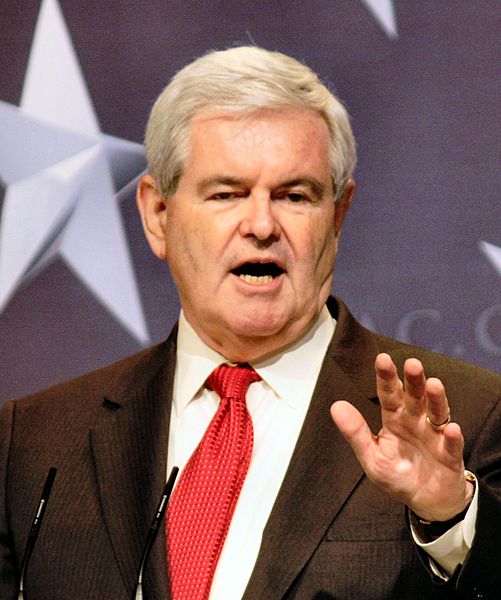
Newt Gingrich, potential 2012 GOP candidate, at CPAC meeting, February 20, 2010. (Irony is that Gingrich, an opponent of social history, was a history professor for eight years before turning to a political career.) Gage Skidmore. Permission granted via Creative Commons and attribution to Gage Skidmore.

understand that, like life, history is full of irony, hurt, passion, hatred, and serendipity.

Maybe this is a losing battle, that most students will never have a teacher with the ability to inspire them to think beyond the trivial when it comes to history. Maybe this is a losing battle because there are far more demons traveling through K-12 as social studies and history teachers than there are people like me, or my late teacher Harold Meltzer, for that matter. I have a feeling, though, that generations from now, future students will look at this aspect of hypocrisy in American education and just shake their heads. They won’t understand why it was so hard to teach the truth of how and why good, bad and ugly things occurred in US and world history.


Living in the Land of “No!”

23 Wednesday Mar 2011

Posted by decollins1969 in 1, Academia, Boy @ The Window, culture, Eclectic, Politics, race, Youth

≈ Leave a comment

Tags

Academia, Academic Writing, Ageism, Bias, Bigotry, Career Options, Forbes Quadrangle, Historical Dictionary of American Education, History of Education Quarterly, Multiculturalism, No!, Passion, Pitt, Race, Richard J. Altenbaugh, The Second Plate, University of Pittsburgh, Wesley Posvar Hall, Writing, Yes


People forming a "NO" to London's Heathrow Airport Expansion, May 31, 2008. Source: The Daily Mail http://bit.ly/hc0KSP

There was a time in my career and life when I was desperate to publish an article in a scholarly journal. Right after finishing grad school at Carnegie Mellon at the end of ’96, I set out to write a literature review essay on how folks in education foundations and education policy had covered multiculturalism and connected it — or, in most cases, not connected it — to the politics around this controversial topic during the 1980s and 1990s. Of all the things I’d written up to this point in my career, this was a bit ambitious.

I had submitted an article for publication with the History of Education Quarterly in March ’97 and had made several revisions at Richard Altenbaugh’s request. He was the new senior editor of the journal, as it had recently moved from Indiana University to Slippery Rock to be under his direction. Altenbaugh had also been my professor for my education foundations graduate class in the spring of ’92, and I’d done entries for his Historical Dictionary of American Education, which was published in ’99.

Historical Dictionary of American Education Cover, March 23, 2011. Donald Earl Collins

At Altenbaugh’s behest, I met him and a wildly bearded co-editor at an informal meeting in March ’98. We met at The Second Plate, an eating place on the second floor of Forbes Quadrangle at Pitt, where I’d spent my homeless days in ’88, my history major days, and my first two years of grad school. Over the course of a two-hour lunch that had little to do with the food, Altenbaugh and his assistant grilled me about the contents of my article, my writing in general, and about the publishing business. Now I knew that this essay would need more revisions, but a two-hour inquisition on why a twenty-eight-year-old was too young to make bold conclusions based on existing studies was just a ridiculous argument.

For Altenbaugh and the other editor, I was simply too young to write an essay that reviewed previous scholarly work. Their logic: “even a senior scholar with fifteen years in the field would have trouble pulling this off.” The editors also insisted that the only road to academic Nirvana regarding my work would be through publishing academic articles and books that met the approval of an exclusive scholarly community. Translation: “write something that is interesting to a few other professors — but not so exciting that it would catch the public’s attention — and by all means do not work on something as controversial as multiculturalism.” Oh yeah, they also recommended that get approval for my essay draft from two elderly, nearly-dead White historians before resubmitting to the journal.

Bottom line: my essay was rejected, given a “No!” Not because it didn’t have potential, or because the early drafts weren’t any good. But because I was working on a topic too cutting edge as a Black male who even now at forty-one would be too young — according to these guys — to work on a state of the profession essay on multiculturalism, much less thirteen years ago.

Did their “No!” matter? In one sense it really did. I knew that the topic itself was too controversial for most conservative-thinking (in a topical, not political, sense) editors in scholarly publishing. That there were few venues for me to address multiculturalism in an academic sense. I also knew that their “No!” was about much more than my topic. My age and my race also played a role in their decision to not publish my essay — they said as much by implication. Funny thing is, that in these weird times, I’d probably have a much better shot at publishing this essay now than I did when multiculturalism seemed more relevant.

But in the end, it didn’t matter at all. I was already in the middle of a five-year period of questioning whether I was an academic historian first and a writer second, or was it really the other way around? If the latter was true — and it’s turned out to be — then what did it matter that I pushed to publish on a topic that I cared about, but I was already beginning to lose passion for?

What I learned from that “No!” is that there are times to force a “Yes!” out of the land of “No!” And that there are other times when I should choose to take that “No!” and evaluate my own motives for wanting a “Yes!” In the case of my growth as a writer — both in academic writing and in other kinds of writing — there couldn’t have been a better, more bigoted “No!” than the one I received thirteen years ago.

Five Ingredients to Higher Education Access and Success

11 Friday Mar 2011

Posted by decollins1969 in 1, Academia, Boy @ The Window, culture, Eclectic, Politics, race, Youth

≈ Leave a comment

Tags

Academic Preparation, College Access and Success, Disadvantaged Students, Education Reform, Financial Aid, Higher Education Access and Success, K-16 Education, Low-Income Students, Parental Engagement, Postsecondary Education Access and Success, Race, Social Class, Social Preparation, Student Development, Student Engagement, Students of Color, Underrepresented Students, Will to Power


Five Ingredients for Cream of Mushroom Gravy with Bell Peppers, Soy Sauce, Chicken Broth and More Mushrooms, March 10, 2011. Donald Earl Collins

There should be five pillars to college access and success, similar to the Five Pillars of Islam, essential for the successful and lifelong practice of Islam. For all students, but especially for disadvantaged and underrepresented students, having a guide to the five most necessary ingredients for college entrance, matriculation and graduation is long overdue.


I should know. Between six years of Humanities in Mount Vernon, New York’s public schools in the ’80s, twenty years off and on as an instructor and professor, and a decade’s worth of nonprofit work in fields like civic education and K-16 education reform. So many students — especially those without the financial means and the academic preparation necessary to be successful at the college level — fail for lack of knowledge and lack of access to such knowledge as well.

Based on reports like the Pathways to College Network‘s  A Shared Agenda (2004) and the Social Science

Questions That Matter Report Cover, June 15, 2006. Social Science Research Council

Research Council’s Questions That Matter (2006), the book Double the Numbers (2004) edited by staff from Jobs for the Future, as well as the work of innovative organizations like The Posse Foundation, below are what I believe are the five ingredients of higher education access and success, in order of their importance.


1. Social Preparation: Students must be prepared for the world outside of their towns, cities, neighborhoods, blocks, apartment buildings, homes and individual families. Most disadvantaged and underrepresented students are inadequately prepared for the cultural, social class, philosophical, ideological and spiritual differences between them and most traditional college and college-age students. Leadership development, critical thinking (and not just for academic purposes), a sense of belonging, a passion for active learning are all the seasonings needed to help students become socially comfortable in a postsecondary setting. Academic preparation is one important aspect of a student’s social preparation for college, but it’s not the only one.

2. Academic Preparation: This is of obvious importance, but in terms of higher education access and success, it’s actually overemphasized. Or at least, the acquisition of facts and the assessments used to determine how successful students were at assimilating these facts has been overdone. This high-stakes testing phase in the history of American education has also put too much of the task of preparation on individual teachers, and not enough on the students themselves. Academic preparation for college requires broad knowledge. But it also requires students to be able to analyzes and interpret facts, to begin to put facts together in combinations that cannot be derived by simply reading a textbook or from a teacher’s lesson plan. That requires good-to-great teachers, administrators, and students.

3. Parent, Family and Community Engagement: This aspect of K-16 educational success never gets the attention it deserves. Active parents and adults in schools can and does create the atmosphere necessary for students’ academic and social preparation in the college access and success process. There are times, of course, in which parental engagement can evolve into abuse of staff and teachers, particularly with parents and families who have unrealistic expectations of their children and their children’s teachers. For disadvantaged and underrepresented students, however, it’s of the utmost importance for parents and other concerned adults to be engaged in this process, to apply pressure on schools and students when necessary.

4. Financial Means and Aid: This is a nice phrase, but the fact is, student loans account for nearly three-fifths of the funds for a four-year degree for most students. The real issue here is to not only take advantage of scholarships, application fee-waivers and need-based aid like the Pell Grant and SEOG grants. It’s also to use social preparation and engaged parents to find additional funds and to agitate for more need-based state and federal aid. Or to use academic preparation to obtain the substantial private and state-level merit-based scholarships to cover the skyrocketing costs of college.

5. Will to Power: Researchers and practitioners rarely discuss this aspect of postsecondary access and success. But the bottom line is, the difference between success and failure for any student really is how much pain they are willing to endure to be successful in finishing a college degrees. Even with the proper academic preparation, excellent social preparation, solid financial aid and consistent parental and community engagement, it’s ultimately up to each student to decide to overcome whatever obstacles they face, especially once they become a college student. While willpower alone isn’t enough, it’s still a necessary ingredient to make the other four ingredients jell.


Columns In The Inner Court of The Baal Temple, December 4, 2007. Ddxc. Already in the public domain.


Had I known even half of this back in the day, I wouldn’t have been homeless my sophomore year at Pitt, struggling financially most of my time as an undergrad, or reluctant to take on leadership roles prior to my senior year. But my will to realize success and graduate overcame all of that, making the difference between where I am now and where I was so long ago.

Dumb Ass Communications, Inc.

08 Tuesday Mar 2011

Posted by decollins1969 in 1, Boy @ The Window, culture, Eclectic, Marriage, Pop Culture, race, Religion, Work, Youth

≈ Leave a comment

Tags

616, 616 East Lincoln Avenue, Abuse, Arguments, BET, Bob Johnson, Business, Business Proposal, Comedy of Errors, Domestic Violence, Dumb Ideas, Hebrew-Israelites, Judah ben Israel, Marriage, Maurice Washington, Mount Vernon New York, Parents, Poverty, Sun Lion, Sun-Lion Communications, unemployment, Vicks Building, Wilson Woods


Lion and Sun, December 30, 2006. Original by [http://www.cais-soas.com/News/2006/December2006/30-12.htm CAIS

Of all my one-time stepfather Maurice Washington’s get-rich-quick schemes, the one that was the most elaborate, most expensive, most ridiculous of ideas was one that initially had some promise. In the year after he and my mother reconciled while making us all into Hebrew-Israelites in ’81, he concocted the idea of beginning a media entertainment business.

His great vision was to start a business that catered to Blacks audiences in TV and radio land, one that would redefine how media would in fact reach niche audiences. Maurice wanted to call it Sun-Lion Communications, partly after his Hebrew-Israelite moniker, Judah ben Israel, a lion of Jehovah. Of course, the dumb ass didn’t know that he was following a combination of Babylonian astrological, Persian and

Sun Lion Coin, 13th Century, Seljuq Turks. Source: http://mehmeteti.150m.com/thamara/index.htm

Islamic traditions in the process.

The plan grew from an idea at the end of ’81 into a full-fledged business proposal during ’82. So much so that my mother took $2,500 of the precious and pitiful few funds we had and bought a business license to incorporate this Sun-Lion Communications. In fact, she did that this time twenty-nine years ago. The one thing that my mother did right in doing so, that stuck in Maurice’s craw for years afterward, was to get a business license in her name, not my stepfather’s.

That was one of the underlying reasons for the Memorial Day ’82 incident in which Maurice drop-kicked my mother into unconsciousness — besides him being an asshole, of course. My mother may have made many dumb decisions over the years, but she wasn’t an idiot. Maurice had plenty of ideas before. When we first met the blowhard in ’77, Maurice told me and my older brother Darren that he was “a writer, a lawyer and a doctor.” All while driving a Reliable Taxi cab in Mount Vernon. Even at the age of seven, I wasn’t that naive. I knew enough to ask, “So how many books have you written?” But he did write. Street poetry and a few half-worked out plays. With time, focus and a lot of hard work, who knows?

Maurice, though, never wanted to work that hard. After losing his cab driver job on April 30, ’79 because he was literally caught sleeping at the wheel, he’d been unemployed for more than three years. At one point prior to him and my mother separating before becoming a Hebrew-Israelite, Maurice had the idea of starting a restaurant, to which my mother said, “Yeah, if you wanna eat us outta business!” in response.

I digress. After Memorial Day ’82 and spending most of June and July abusing me — I was a witness, to domestic violence, after all — Maurice finally got a job. It was as a part-time security guard for the closed Vicks plant in the middle of Wilson Woods (it’s a school now, I think). Within a few weeks of working the night and weekend shifts guarding the empty building, Maurice found inspiration. He had a “vision from God” that this empty shell was where Sun-Lion Communications would be headquartered, with studios, satellites, soundproofing, and so many other things a media business would need.

Although the idea still had promise (Bob Johnson had started BET only three years earlier, mind you), it was a high-risk business, with national cable in its early toddler stage. Not to mention our own growling stomachs, my mother consistently three weeks behind in rent, and us facing Con Ed’s warnings of our electricity being cutoff because we were $180 behind on that too.

That led to one of my mother and Maurice’s classic 616 arguments at the end of October ’82. In the living room, with all of our run-down furniture, Maurice was bellyaching about my mother’s refusal to put the business license in his name and her lack of emotional support. “I support a candy shop if we had the money, but we don’t,” she said. With Maurice yelling, demanding, “Give me the license, woman!,” I started worrying, as I was in the kitchen, drying dishes from the wonderful dinner of Great Northern Beans and rice. It was the standard meal when the idiot decided that he should play the role of stepfather and father and help feed us.

“How much you think this gonna cost?,” my mother finally asked.

“A hundred million dollars,” Maurice said.

“Man, you must be a fool!” my mother yelled. “With that kind of money, why would I need to start a business? You must think I’m pea-brained idiot!”

“You are!” Maurice yelled as he walked out the living room, went into the master bedroom, put on his clothes and coat and then came back up front, and left.

That was the last time I heard about Sun-Lion Communications. My ex-stepfather was and remains a dumb ass, never having found his way in this world, and about as good at business as he’s been as maintaining a proper diet and good health.

Mr. Mister’s “Kyrie”

01 Tuesday Mar 2011

Posted by decollins1969 in 1, Boy @ The Window, Christianity, culture, Eclectic, eclectic music, Mount Vernon High School, music, New York City, Pop Culture, race, Religion, Youth

≈ Leave a comment

Tags

"Kyrie", #1 Hit, 1986, 616, 616 East Lincoln Avenue, Academic Achievement, Billboard Pop Chart, Christianity, Crazy Eddie's, Faith, Imagination, Kyrie Eleison, Lyrics, Manhattan, Mount Vernon High School, Mount Vernon New York, Mr. Mister, Pop Culture, Pop Music, Race, Richard Page, Walkman


Mr. Mister, “Kyrie” Single Cover, August 8, 2010. Vanjagenije. Qualifies as fair use under US Copyright laws because of the image’s low resolution and because image illustrates subject of this blog post.

Twenty-five years ago this week, Mr. Mister’s “Kyrie” made it to the top of the Billboard pop charts, making me goofy and giddy beyond belief. March ’86 was the beginning of a great month of music for me. I bought my first Walkman — a Walkman-knockoff really — from Crazy Eddie’s on 47th and Fifth in Manhattan, as well as the first of what would be about 200 cassettes of my favorite music. Not to mention a ton of musical experimentation — most of it bad, goofy and un-listen-able for even the musically impaired.

For many of you, Mr. Mister’s “Kyrie” would likely fall into that last category. It was semi-religious rock at a time when the closest thing to that was Amy Grant. It was Creed a whole decade before Creed, but with better musicians. It was a group of studio musicians putting out a breakout album that actually stood apart from the super-serious or super-sugary music of the mid-80s. It was a perfect storm for a sixteen-year-old in search of inspiration beyond the chaos of 616 and the lonely march toward college via Humanities and Mount Vernon High School.

“Kyrie” was one of two songs that kept me in overdrive in and out of the classroom through most of my junior year at Mount Vernon High School. Simple Minds’ “Alive and Kicking” was the other song. It almost became my mantra in the months that straddled ’85 and ’86. Every time I heard that song, especially the album version, was like going on a game-winning touchdown drive at the end of the fourth quarter. Studying was time to throw screen passes or seven-yard slants, to run the ball on a power sweep or on a draw play. It was methodical, the drums and synthesizers, and put me in a determined, methodical mood as I prepared for a test.

But Mr. Mister’s “Kyrie” was magical. Short for “Kyrie Eleison” Latin/Greek for “Lord have mercy,” it became my go-to song for every big academic play I needed to make for the rest of the year, even for the rest of high school. “Kyrie” combined all of the elements that my vivid imagination relied on. My faith in The One, my hope for a better future, lyrics that made me think, music that evoked a big play, like throwing it deep and completing it for a game-changing score. It was as methodical as “Alive and Kicking,” but the bigger bass guitar and heavier synthesizers as the background gave me the feeling that God’s grace was with me wherever I went and whatever I did. It was a true underdog’s song.

It was like I was singing a high-falsetto, four-and-a half-minute prayer whenever I played “Kyrie.” Some of my classmates, as usual, didn’t appreciate whatever deeper meaning I saw in the song or in its lyrics. See, my being Black and high-pitched singing to it was another obvious sign of my weirdness. Yet somehow, when it came to music, I didn’t really care what any of them thought.

As I went off to college and became more sophisticated in my understanding of music, I realized that there were some songs I couldn’t completely part with, no matter how goofy or out-of-date the music video was. “Kyrie” was one of those songs for me. I didn’t play it regularly by the time I’d reached my mid-twenties, but that didn’t mean that I didn’t sing to it in high-falsetto while shopping at Giant Eagle in Pittsburgh when the song would come on over the PA system.

Once iPod and iTunes technology became part of my household in ’06, I uploaded the old song and listened to it regularly again. I’ve wondered from time to time what would the sixteen-year-old version of me would think about me at forty-one. I’ve achieved more, and been hurt and lost more, than I could’ve possibly imagined a quarter-century ago.

It’s taken me more than twenty years to fully understand Richard Page’s lyrics about “would I have followed down my chosen road, or only wish what I could be?” The answer is both. Life is a funny and winding journey, even when on the path of the straight and narrow. Christian or atheist or of some other faith, it’s always good to hope that someone is there to watch over us, to protect us, even our younger selves from our older and allegedly wiser versions of ourselves. And that’s what I here now when I listen to — and sing high-falsetto still to — “Kyrie.”

I’m Not Happy Feet (or Ted Williams)

21 Monday Feb 2011

Posted by decollins1969 in 1, Academia, Boy @ The Window, culture, Eclectic, Movies, music, Politics, Pop Culture, race

≈ Leave a comment

Tags

Acting, Avatar: The Last Airbender, Class, Classism, Dancing for Dinner, Drug Abuse, Drug Addiction, Entitlement, Gender, Happy Feet, Homelessness, Hustle, Hustlin', Hustling, Poverty, Prince Zuko, Race, Racism, Shuckin' an' Jivin', Tap Dancing, Ted Williams, The Soloist, Trained Seals, Uncle Iroh, Voyeurism, YouTube


Happy Feet Big Dancing Scene Screen Shot, February 19, 2011. Qualifies as fair use under US Copyright laws, as screen shot is of low quality and illustrates the subject of this post.

Happy Feet Big Dancing Scene Screen Shot, February 19, 2011. Qualifies as fair use under US Copyright laws, as screen shot is of low quality and illustrates the subject of this blog post.

Remember that homeless Black guy who kicked off our new year a few weeks ago through the power of YouTube and some folks who recorded him and his golden voice on their smartphone? Yeah, how could any of you forget, really? Ted Williams had a whirlwind ten days, as thirteen million people watched the YouTube recording, companies and individuals offered him jobs and money, his family came back into his life. And then, of course, Williams became violent, relapsed into drug use, and is in the midst of rehab — again.

But it all started with his YouTube performance for the good folks of voyeur America. The whole incident made me cringe from start to finish. It also made me think about something that has always bothered me about race in America. Why? Especially since the video surfaced a man who’d been on a downward spiral for three decades? Because it seems that in order for a Black person to be taken seriously in this society, we have to perform like trained seals in order to get the attention we need and deserve.

Ted Williams, Columbus, OH, January 3, 2011. AP. Qualifies as fair use under US Copyright laws because of low resolution and use as subject in blog post.

This isn’t about some metaphorical relationship between excellence and success, or displaying intellect at school and in the world of work. No, this is actually about giving a performance, acting, or as the older folks would say, shuckin’ an’ jivin’, or hustlin’, to grab the attention of mostly Whites in high places. While this isn’t always a bad thing, it also is mostly not good. For it also seems that many of us must experience hardship, prison, drug addiction, abuse and homelessness in order to get attention in the first place.

That’s why it pisses me off when hearing about journalists shadowing the homeless in order to learn about life on the streets. Or when writers sit down with a homeless man or woman to learn about their ironic life story. It also bothers me when I see lists of the “50 Most Successful X” and the “100 Most Innovative Y,” knowing before I read one word that the only Blacks who made these lists were entertainers (I include professional athletes in this category, by the way). It’s disheartening to know that, for all of my writing ability and intellect, the only way I’ll likely be as successful as I hope to be will be by delivering a performance that allows Americans — mostly White — to be voyeurs of my life beyond my words and deep thoughts.

It all came together for me in the Avatar: The Last Airbender episode  (Season 2, Episode 4) “The Swamp,” where Prince Zuko and his uncle Iroh sit at the side of the road in an Earth Kingdom town begging for change. One man forces the once proud general to dance for a gold coin — “Nothing like a fat man dancing for his dinner,” the man says. It speaks to shameful classism — or, at the very least, a sense of class and race entitlement — that we in this country engage in every day.

Fat Man Dancing For His Dinner

Fat Man Dancing For His Dinner

So, here are a few more thoughts. I look at Ted Williams, The Soloist with Robert Downey, Jr. and Jamie Foxx, even the Pixar/Disney movie Happy Feet (2006) — which me and my wife made the mistake of taking our son Noah to see (he didn’t like the movie, by the way) — and see lots of shuffling across a floor for the attention of Whites (and some people of color) in high places. Do two million penguins really need to tap dance ala Savion Glover in order to get attention from White scientists trying to save life on this planet from our global warming ways? No, but Blacks have had to literally tap dance for food and spare change in the exact same way.

I felt this way in grad school and at various times throughout my career. That I needed to sing, dance and do flips and cartwheels to make myself stand out for my middling White professors and supervisors. It would explain why some of them would ignore my grades, papers and awards to ask me if I could palm or dunk a basketball — out of the blue! Or why a muckity-muck at the Academy for Educational Development would walk by my office, notice the PhD on my name plate, and say, “Wow! You have a doctorate! I thought you only played softball!” I said, “Yeah, that’s why I’ve been working here for three years, just so I can play on the organization’s softball team.”

We ignore those suffering the most, whether because of race or class or gender or a combination of the three (or more) until they do something that impresses us. That’s when they deserve a chance, at least from the perspective of those laughing at them. And that’s shameful, demeaning, and yes, racist and elitist in a very specific way.

Fried Green Toenails

19 Saturday Feb 2011

Posted by decollins1969 in 1, Boy @ The Window, culture, Eclectic, Mount Vernon High School, race, Work

≈ 1 Comment

Tags

Blackened Toenail, Bob Beane, DSM-III, Fungus, Ingrown Toenail, Medicare, Mount Vernon Clinic, Mount Vernon High School, Mount Vernon New York, Podiatrist, Podiatry, Psychiatry, Psychology, Re-Billing, Split Toenail, Surgery, Toenail Fungus, Toenail Removal, Valerie Johnstone, Westchester County Department of Community Mental Health, Work


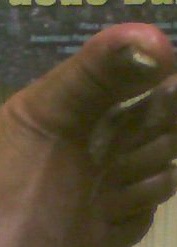
My Right Big Toenail Pre-Op, February 17, 2011. Donald Earl Collins. Note the black color of and the White Cliffs of Dover effect underneath my nail. Yuck, right?

Right Big Toe Post-Op, February 19, 2011. Donald Earl Collins. It feels like it looks right now, but I hope it becomes passable in time for sandals this spring and summer.

Well, not exactly green toenails, but a toenail story that might turn your face green. It’s a story that begins on Monday, June 26, ’89, my first day working for Valerie Johnstone at the Westchester County Department of Community Mental Health’s Mount Vernon Clinic on First Avenue and First Street. My first week without my stupid ass ex-stepfather at 616, my first time feeling like my future was truly my own.

I was hired to help get the clinic’s Medicaid and Medicare re-billing in order, as they had a five-year backlog in unpaid bills for psychiatric treatment, and not enough staff to do the work. That’s what I was hired to do, at $5.90 an hour. To eventually and successfully re-bill $371,000 worth of diagnoses and treatments to New York State, all the while learning DSM-III codes (that’s the Diagnostic Statistical Manual for Psychiatric Disorders for those of you who are not psychologists or psychiatrists) and the drugs that went with them. Xanax and Thorazine were among the most commonly prescribed medications to patients. I learned, sadly, that there were a few folks I knew who were also in need of psychiatric help. It was a sobering and valuable experience.

But that’s not what the boss woman had me do on my first day. Johnstone was pissed with her boss, Bob Beane, the director of clinics for the county, who had hired me because the Mount Vernon clinic was easily the furthest behind in billing, re-billing, and in covering their expenses. And she took her pissyness out on me, as well as a man I called Mr. Charles. He was in his mid-sixties and within months of retirement, but at least looked the part of a strong ex-athlete, very stout in the chest and muscular in the arms. His son had graduated a year or two before me, a trophy-winner on the Mount Vernon High School wrestling team.

Mr. Charles should’ve been taking it easy. But not with Johnstone as his boss. She berated him, yelled at him when he made mistakes, and generally treated the man as if he was less than the dirt that needed to be scraped off the bottom of her shoe. She sent the two of us to the warehouse in Tarrytown to pick up some old furniture — for her office! They had folks who worked for the county whose job it was to move furniture, but she sent a sixty-four-year-old man with arthritis and a nineteen-year-old who weighed 175 pounds to move cabinets and heavy wooden tables around. The two Black guys in the office, of course. Mr. Charles was still angry at Johnstone, though he tried to act as if he wasn’t.

I could tell anyway, because he was moving way too fast with the furniture for slow and weak young me. He moved so fast that he yanked a piece of heavy furniture out of my hands as we were carrying it downstairs, with part of a fifty-pound table coming down on my right big toe. The impact split the nail almost completely in two.

I should’ve gone to see a doctor. No insurance, no longer a regular resident, my mother and family still on welfare, and me being nineteen, I didn’t give it a second thought. I was mostly angry at Johnstone because she was an asshole of a boss. So I worked through that summer on a sore toe. It had bothered me all that fall when I went back to Pittsburgh and Pitt as well. Finally, in the middle of a snowstorm on Friday, December 15, ’89, I felt a popping sound on the top of my toe. The cold and snow had caused my toenail to fully crack, revealing a two-layer, ingrown toenail that had developed in the six months after my run-in with a wooden table.

I removed that nail, but I’ve had problems with that right big toenail ever since. Between basketball and hundreds of pickup games, with big guys stepping all over it. Years of walking everywhere, with me tripping on it. And a year of turf toe in ’05-’06, where I constantly played on it, that toenail grew darker and darker. Finally, in ’08, after dropping another, much smaller piece of furniture on the nail, it became susceptible to fungus, and that took over the growth, color, and thickness of the nail.

After removing it myself twice, I finally went to podiatrist, who told me that the best solution was to remove the nail and cauterize the nail root to stop it from growing — permanently. On Thursday, February 17, ’11, at 4:28 pm, after twenty minutes of bloody surgery, my right big toenail was gone. I’ll miss you. You didn’t deserve this. What should I do now? Maybe I should send pictures of it to Valerie Johnstone, thanking her for driving the office pool crazy, literally!

← Older posts
Newer posts →

Boy @ The Window: A Memoir

Boy @ The Window: A Memoir

Places to Buy/Download Boy @ The Window

There's a few ways in which you can read excerpts of, borrow and/or purchase and download Boy @ The Window. There's the trade paperback edition of Boy @ The Window, available for purchase via Amazon.com at http://www.amazon.com/Boy-Window-Donald-Earl-Collins/dp/0989256138/

There's also a Kindle edition on Amazon.com. The enhanced edition can be read only with Kindle Fire, an iPad or a full-color tablet. The links to the enhanced edition through Apple's iBookstore and the Barnes & Noble NOOK edition are below. The link to the Amazon Kindle version is also immediately below:

scr2555-proj697-a-kindle-logo-rgb-lg

Boy @ The Window on Amazon.com: http://www.amazon.com/Boy-The-Window-Memoir-ebook/dp/B00CD95FBU/

iBookstore-logo-300x100

Boy @ The Window on Apple's iBookstore: https://itunes.apple.com/us/book/boy-the-window/id643768275?ls=1

Barnes & Noble (bn.com) logo, June 26, 2013. (http://www.logotypes101.com).

Boy @ The Window on Barnes & Noble: http://www.barnesandnoble.com/w/boy-the-window-donald-earl-collins/1115182183?ean=2940016741567

You can also add, read and review Boy @ The Window on Goodreads.com. Just click on the button below:

Boy @ The Window

Twitter Updates

Tweets by decollins1969
  • RSS - Posts
  • RSS - Comments

Archives

  • June 2025
  • April 2023
  • September 2022
  • August 2022
  • July 2022
  • June 2022
  • May 2022
  • April 2022
  • March 2022
  • January 2022
  • December 2021
  • November 2021
  • October 2021
  • September 2021
  • August 2021
  • July 2021
  • June 2021
  • April 2021
  • March 2021
  • February 2021
  • January 2021
  • December 2020
  • November 2020
  • October 2020
  • September 2020
  • August 2020
  • July 2020
  • May 2020
  • April 2020
  • March 2020
  • January 2020
  • December 2019
  • November 2019
  • August 2019
  • July 2019
  • June 2019
  • May 2019
  • April 2019
  • March 2019
  • February 2019
  • January 2019
  • December 2018
  • November 2018
  • October 2018
  • September 2018
  • August 2018
  • July 2018
  • June 2018
  • May 2018
  • March 2018
  • February 2018
  • January 2018
  • December 2017
  • November 2017
  • October 2017
  • September 2017
  • August 2017
  • July 2017
  • June 2017
  • May 2017
  • April 2017
  • March 2017
  • February 2017
  • January 2017
  • December 2016
  • November 2016
  • October 2016
  • September 2016
  • August 2016
  • July 2016
  • June 2016
  • May 2016
  • April 2016
  • March 2016
  • February 2016
  • January 2016
  • December 2015
  • November 2015
  • October 2015
  • September 2015
  • August 2015
  • July 2015
  • June 2015
  • May 2015
  • April 2015
  • March 2015
  • February 2015
  • January 2015
  • December 2014
  • November 2014
  • October 2014
  • September 2014
  • August 2014
  • July 2014
  • June 2014
  • May 2014
  • April 2014
  • March 2014
  • February 2014
  • January 2014
  • December 2013
  • November 2013
  • October 2013
  • September 2013
  • August 2013
  • July 2013
  • June 2013
  • May 2013
  • April 2013
  • March 2013
  • February 2013
  • January 2013
  • December 2012
  • November 2012
  • October 2012
  • September 2012
  • August 2012
  • July 2012
  • June 2012
  • May 2012
  • April 2012
  • March 2012
  • February 2012
  • January 2012
  • December 2011
  • November 2011
  • October 2011
  • September 2011
  • August 2011
  • July 2011
  • June 2011
  • May 2011
  • April 2011
  • March 2011
  • February 2011
  • January 2011
  • December 2010
  • November 2010
  • October 2010
  • September 2010
  • August 2010
  • July 2010
  • June 2010
  • May 2010
  • April 2010
  • March 2010
  • February 2010
  • January 2010
  • December 2009
  • November 2009
  • October 2009
  • September 2009
  • August 2009
  • July 2009
  • June 2009
  • May 2009
  • April 2009
  • March 2009
  • February 2009
  • January 2009
  • December 2008
  • November 2008
  • October 2008
  • September 2008
  • August 2008
  • July 2008
  • June 2008
  • May 2008
  • April 2008
  • March 2008
  • February 2008
  • January 2008
  • December 2007
  • November 2007
  • October 2007
  • September 2007
  • August 2007
  • July 2007
  • June 2007

Recent Comments

MaryPena's avatarMaryPena on My Day of Atonement/Bitter Hat…
decollins1969's avatardecollins1969 on No Good Teaching Deed Goes…
Mary Rose O’Connell's avatarMary Rose O’Connell on No Good Teaching Deed Goes…

NetworkedBlogs on Facebook

NetworkedBlogs
Blog:
Notes From a Boy @ The Window
Topics:
My Life, Culture & Education, Politics & Goofyness
 
Follow my blog

616 616 East Lincoln Avenue A.B. Davis Middle School Abuse Academia Academy for Educational Development AED Afrocentricity American Narcissism Authenticity Bigotry Blackness Boy @ The Window Carnegie Mellon University Child Abuse Class of 1987 CMU Coping Strategies Crush #1 Crush #2 Death Disillusionment Diversity Domestic Violence Economic Inequality Education Family Friendship Friendships Graduate School Hebrew-Israelites High-Stakes Testing Higher Education History Homelessness Humanities Humanities Program Hypocrisy Internalized Racism Jealousy Joe Trotter Joe William Trotter Jr. K-12 Education Love Manhood Maurice Eugene Washington Maurice Washington Misogyny Mother-Son Relationship Mount Vernon High School Mount Vernon New York Mount Vernon public schools Multiculturalism MVHS Narcissism NFL Pitt Pittsburgh Politics of Education Poverty President Barack Obama Race Racial Stereotypes Racism Relationships Self-Awareness Self-Discovery Self-Reflection Sexism Social Justice Teaching and Learning University of Pittsburgh Violence Whiteness Writing

Top Rated

Blog at WordPress.com.

  • Subscribe Subscribed
    • Notes from a Boy @ The Window
    • Join 103 other subscribers
    • Already have a WordPress.com account? Log in now.
    • Notes from a Boy @ The Window
    • Subscribe Subscribed
    • Sign up
    • Log in
    • Report this content
    • View site in Reader
    • Manage subscriptions
    • Collapse this bar
 

Loading Comments...