• About Me
  • Other Writings
  • Interview Clips
  • All About Me: American Racism, American Narcissism, and the Conversation America Can’t Have
  • Video Clips
  • Boy @ The Window Pictures
  • Boy @ The Window Theme Music

Notes from a Boy @ The Window

~

Notes from a Boy @ The Window

Category Archives: race

The Ultimate Sports Corruption Scandal

29 Tuesday Mar 2022

Posted by decollins1969 in 1, Boy @ The Window, culture, Eclectic, Jimme, Marriage, Mount Vernon New York, New York City, Patriotism, Politics, Pop Culture, race, Sports, Youth

≈ Leave a comment

Tags

Betting, Cheating, Collusion, Corruption, Duke, Entertainment, Fakery, Money, Officiating


Rolls of $100 bills (makes me think of Cyndi Lauper’s “Money Changes Everything”), April 9, 2018. (https://www.gtgoodtimes.com/)

I have long believed professional sports and elite college sports as severely compromised enterprises. It’s not just the obvious examples of league officials turning a blind eye away from the lack of fair play, like with baseball players doping and hitting home runs between 1998 and 2004. Or with the New England Patriots and them filming their opponents’ practices to gain an advantage during games. Or with the Houston Astros stealing baserunning signs from the Los Angeles Dodgers during the 2017 World Series. Or even with NCAA Division I football and men’s basketball, where there are enough recruiting and (until last year) pay-for-play violations to render the student part of student-athlete a really bad joke.

No, I believe owners, universities, and league offices collude to put their thumbs on the scale, and have done so for years. They do it for two reasons: 1., to generate revenue and renewed interest in their sport (whether basketball, hockey, baseball, or football, or — more obviously — WWE) and/or 2., to steer a sport-wide championship in the direction of a particular team (also a way to keep those multi-billion-dollar TV contracts aflowing). 

This doesn’t just explain the New England Patriots and the mysterious “tuck rule” ruling during the 2001 NFL Playoffs, a ruling that cost the Oakland Raiders the game and catapulted the Patriots toward the first post-9/11 Super Bowl (patriotism and sports — it’s kismet!). It explains when referees, umpires, and other officials make consistently favorable rulings helping certain teams win playoffs series and championships. Game 4 of the Western Conference Finals between the LA Lakers and the Sacramento Kings in the 2002 NBA Playoffs comes to mind. An official even admitted they may have rigged this particular series in favor of the Lakers. And Duke and Coach K. All anyone has to do is look at the difference between the team UNLV stomped in by 30 points in 1990 and the team UNLV “lost” to in 1991. Really? What difference — no difference! 

Even this isn’t the worst of it. With the newly opened frontier of legal betting on professional and college sports across the board, the temptations for individuals, for officials, for athletes themselves to alter outcomes to win bets will be enormous. The sports would is only a few years away from healthy athletes dying in their athletic prime of suicide or “suspicious circumstances,” stemming from their own gambling addiction, or because of a fan’s gambling addiction and narcissism.

I kid you not. We are a decade or two away at most from discovering how some of these great moments we have seen in a sport should have never been. All because money changed hands, or because of deliberately calibrated officiating, or because of tampering with equipment or with schedules, or because of general collusion among college conferences and universities or between sports leagues and team owners (or, with the student-athlete system, between all of the above). 

And when these turds hit an industrial-sized fan meant for a large indoor arena, what do any of us say then? That we knew all along? That we just went along because we wanted the distraction of sports free from corruption and politics? All of this is bullshit.

The truth is, sports has always been a source of entertainment, a place where we have pretended for years the outcome was never fully assured. But, we all have known the outcome has been helped along, sometimes by a lot. To build a fantasy around sports as set of institutions that brings people together and creates a sense of community is incredibly superficial. Those moments are fleeting and do nothing to change communities, cities, or our societies. Those moments, even as they temporarily unite folks around as flimsy a thing as a win or winning a title, are not untainted ones. 

Listen, I love sports, and have appreciated athleticism going all the way back to the Ali v. Frazier and Ali v. Foreman days. Heck, when my Uncle Sam clotheslined my father as payback for psychologically torturing my mother after she filed for divorce in 1977, I had appreciation for it then. That moment of college athletic-level tackling and the physics around it have been in super-slo-mo in my mind for 45 years. I have loved watching sports since I was 12, and playing sports since puberty grew me to five-foot-eight before I turned 13, and six-feet-even before my 14th birthday. The business of professional sports (including college sports programs and Olympic sports), though, is ugly. That is why I no longer care if athletes dope, stopped caring ages ago how much money they and the sports team owners make, or care much about wins and losses for my Knicks or other teams I kinda root for. 

Because I believe as much as I believe in anything a day of reckoning is coming for these institutions. And when it does, don’t say I didn’t write about it. When it does occur, we can then finally agree there is no difference in pop culture between commercialized music, PG-13 movies, fashion, and the world of sports.
What Remains in the Ashes…

05 Saturday Mar 2022

Posted by decollins1969 in 1, Academia, Boy @ The Window, culture, Eclectic, Marriage, Mount Vernon New York, Pop Culture, race, Work, Youth

≈ Leave a comment

Tags

Academia, Apathy, Capitalism, Family, Intervention, Jealousy, Miscellaneous, Mother-Son Relationship, Pandemic, Racism, Sarai, Siblings, Students, Teaching and Learning, Unions, Whiteness, Writing


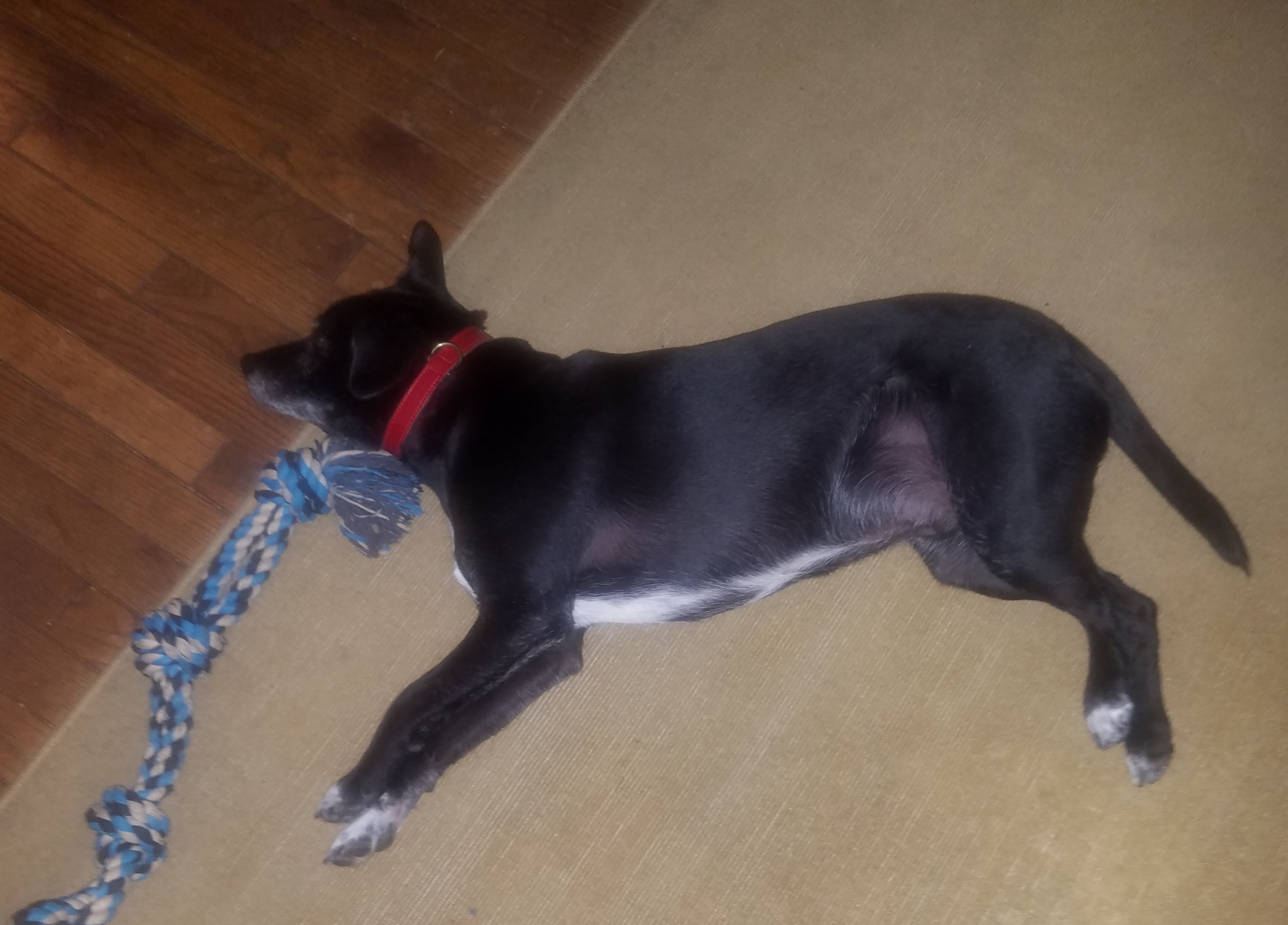
Jacobi playing dead on dining room carpet, Silver Spring, MD, February 13, 2022. (Donald Earl Collins).

There are so many anniversaries I haven’t discussed over the past month. Just trying to make it week-by-week through being back in a classroom in-person, trying to teach groups of bratty, disengaged students while also wearing an N95 mask over a medical mask. It is torture, an emotional labor I wouldn’t wish on any of my nemeses. My students do not (and really, refuse to) understand the toll of having to teach in front of a group who complains about not going on field trips or couldn’t care less about oppression. All with their arms folded for two and a half hours at a time. If these were my first two courses as a professor, they would definitely be my last two courses as a professor.

That and our weak ass union at American has taken up a good deal of my February. To think the previous negotiators had only gotten our “liberal” employer to pony up a $25-per-course increase per year over three years. To know the whitemansplainers on American’s side of the table thought this was asking too much. To see how shocked my white colleagues were when they realized their well-reasoned arguments, their math, their impassioned pleas, their heartfelt stories didn’t matter. 

It all merely confirmed what I have known for years. Whites unaware of their white privilege will think themselves able to negotiate their way out of all jams and all forms of oppression. Except that white privilege does not mean socioeconomic privilege. And racial capitalism is a Ponzi scheme, a form of the Matrix too many white Americans have hooked themselves into. I had to allow myself the right of righteous anger, and the ability to call out these win-at-all-costs lawyers and shills for what they are, before any of my colleagues would say anything with a sense of anger themselves. Whiteness is a Matrix-level drug, and so is the narcissism that comes with it.

Several dates have come and gone since my last post. My significant other celebrated her 55th. My sister Sarai would have been 39 years old on February 9th, that is if the scourge of sickle cell anemia didn’t exist. Toto’s “Africa” peaked at #2 on the Billboard Pop chart in February 1983 also. (I was in eighth grade, reading Upton Sinclair’s The Jungle at the time.)

Yesterday marked two milestones. One was the 40th anniversary of a crush-turned-love for me, on the wings of Ballerina Wendy (I am truly a goofy romantic). Two, it’s been two years since I taught a course in-person and maskless, the last time I felt mostly “safe” in public (truth is, with everyday racism, I have never felt truly safe). I am not sure I will ever feel either of those ways again — March 1982 and March 2020 seem like different timelines that someone who was sorta me walked once in my dreams.

What feels painfully real about the pandemic is the distrust I feel toward humanity these days, not counting my partner, my son, and my dog (and in his case, he sniffs too many disease-carrying turds for me to trust his in-stink-ts). It’s been more than 20 years (February 2002) since I did a family intervention to reach out to my mother and my siblings about being honest about where we were as a family and how we ended up with the poverty and abuse we all experienced growing up. 

I have given up on having the kind of adult relationship a 50-something Black man should be able to have with his 70-something mother. Maybe being only 22 years apart in age, and witnessing so many of her failures and her small triumphs has been too much. Then again, refusing to admit she caught COVID, and that her church friends died from COVID, and refusing to get jabbed with a COVID vaccine, all based on vanity and willful ignorance, has completely worn me out.

I have mostly given up on having the kind of adult relationship a 50-something Black man should be able to have with his four brothers ages 54, 42, 40, and 37 (my door remains open for them, but just). The longest conversation I have had with Darren since 2002 was maybe ten minutes total. My younger brothers admitted during the intervention in 2002 they were jealous of me. That, unfortunately, has not changed over the past two decades. They don’t return my phone calls or my texts. They don’t respond to my Facebook posts on their timelines, or my LinkedIn messages. Of course, at least one of them refuses to vaccinate, and would prefer unemployment instead. Their job prospects in recent years have made them bitter, especially toward me. If they only knew the extent of labor exploitation in higher education and in the writing world. But they would still be jealous anyway, I suppose.

I need no one to tell me how blessed I am overall. I have reinvented myself into the person I always was.  I still make good trouble for my benefit and (hopefully) the benefit of others. My own family life remains good. I can only hope what remains in the ashes will rise again, for me and my own family, even for the flea-bitten dog.

The Elite Jerkiness of Journalistic “Genius,” aka, Advanced White-Mansplaining

29 Saturday Jan 2022

Posted by decollins1969 in 1, Academia, Boy @ The Window, Carnegie Mellon University, culture, Eclectic, Mount Vernon High School, Mount Vernon New York, Pittsburgh, Politics, race, Work

≈ Leave a comment

Tags

Academia, Chris Hayes, CMU, Elitism, Genius, Journalism, Mediocrity, Pitt, Racism, Ross Douthat, Thomas Friedman, Whitemansplaining, Writing


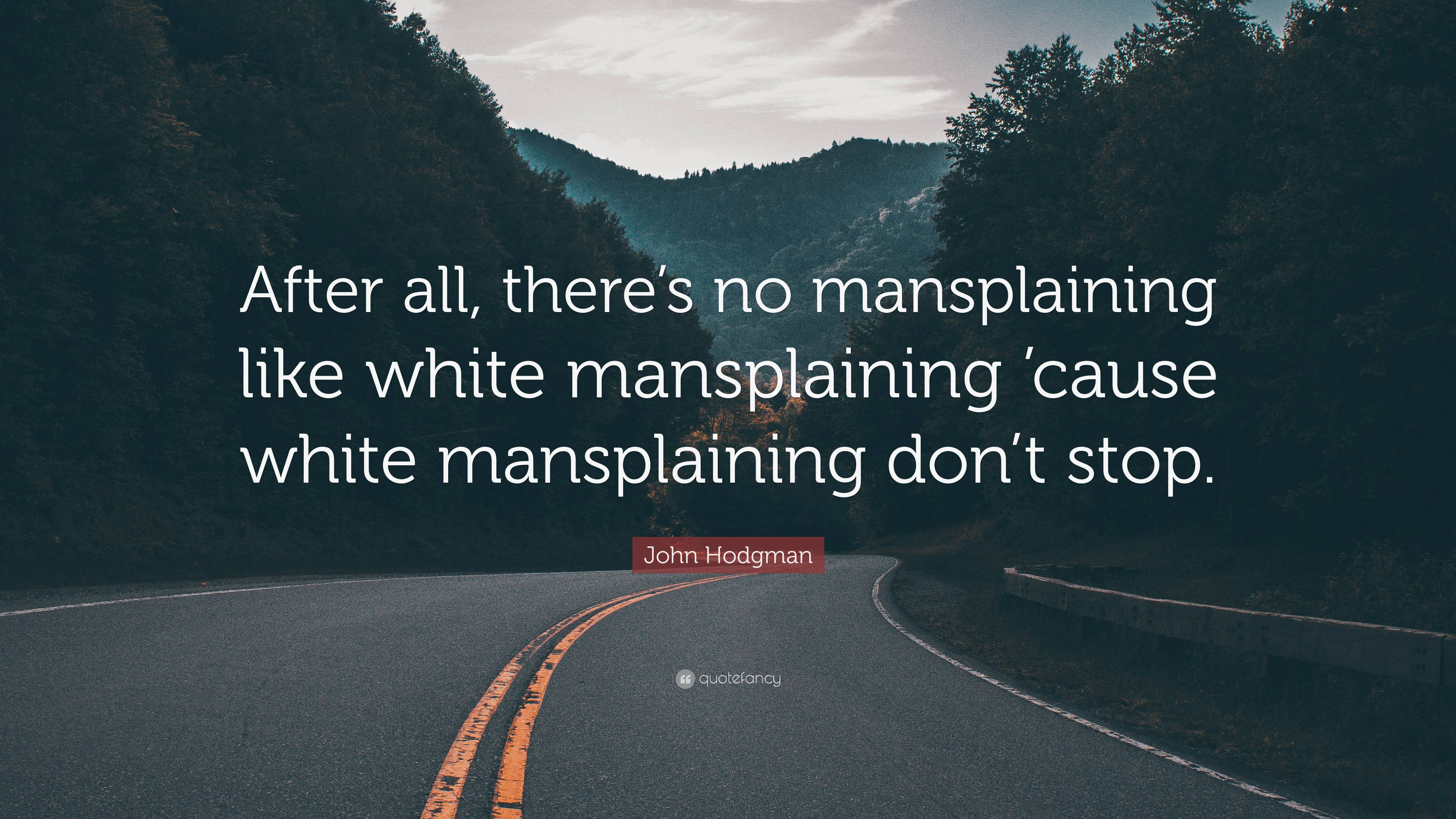
John Hodgman quote via QuoteFancy, January 29, 2022. (https://quotefancy.com/quote/2072271/John-Hodgman-After-all-there-s-no-mansplaining-like-white-mansplaining-cause-white)

I am most definitely not a journalist. At least not in any professionally trained sense. I majored in computer science, then in history, all while picking up minors in mathematics and in Black studies. Going further back in time, I refused to be part of the high school yearbook committee, even though my classmates asked me to be on it at least four times. I was always a writer, even when I was only in observation mode, even though I didn’t see myself as one until I was well into my 30s. I just didn’t want to work with a group of people who were caught up in their own middle class dramas, the petty jealousies, and the even pettier emotions over pop cultural icons and incidents. 

By the time I thought about J school, I already had my doctorate. I’d already learned from one of my former professors and several senior colleagues my academic writing was “too journalistic.” That’s what they thought, anyway. I knew my writer was stuck between the way I wrote before my PhD work at Carnegie Mellon and the four years of academic abuse I endured to make my writing colder and more “scholarly.” 

I did find my way back to writing without all the high-falutin’ bells and whistles. The words fait accompli and raison d’etre and “promulgated” and “posited,” and (especially for me) “indeed” all had to die in a supernova. Less is more, clarity and conciseness are more important than showing off my super-dense writing skills, at least that’s what the proverbial they say. And “they” are mostly correct.

But in my twenty-plus years of venturing into the world of journalism and writing, it is so clear to me the rules of academia operate in this white-male dominated world, too. Especially when discussing big ideas, like the West’s past, the US’ present, our collective futures. No, that domain is a “white man’s country.” Thomas Friedman, Ezra Klein, David Brooks, Nate Silver, Matt Yglesias, Matt Taibbi, Chris Hayes, Ross Douthat, Tucker Carlson, and an army of others. While there are Black and Brown men and some white women (and nary any Black women and women of color) working as big-idea columnists, I could lock them in a medium-sized conference room and light a match. And many in this group have spent more time discouraging me as a writer than doing anything else, from Pittsburgh to DC and back.

If you are like me and have decided to convert your research and your lifetime of expertise and experience to write about big ideas, then you know the marketplace for our ideas is small. Add to this my penchant for writing pieces on American racism and American identity, about racism’s impact on Black folx and people of color, and the window for publishing my work is a few micrometers in width. 

Rarely do I hear from folks in my circles about what they think of my writing or my ideas. Not even disagreement or open disparagement — even that would be something to work with. But it’s mostly deafening silence out there among the literati set whenever a piece of mine is out there to read. 

If it were just the geniuses group, I wouldn’t really care. (I mean, if Ross Doofus is a genius because he among the white male set was honest about the mythology of Harvard, then everyone’s a genius. Many of us knew this without spending $200,000 to go to Harvard or before even attending college at all. Elite white folk and their narcissism start off in K-12, after all. Woe to us who school with them!) 

Academicians and their silence, their “meh” responses to anything not published in a “peer-reviewed journal” with 300 footnotes and a few pages on multivariate chi-squared bullshit analysis (this includes Black academia). Journalists and their silence, their sort-of, “you write about race and racism well, but you don’t really know anything” when I do hear the occasional burp. The result is me feeling like Sisyphus, constantly reinventing the wheel to publish, well, anything, even though I have enough bylines to my credit to be part of a meaningful conversation about virtually any topic related to the US and the West.

None of this, though, is anything compared to the granting of “genius” status to the white-male set in journalism. To me, they are journalists. Period. Even the ones who have to edit and interpret the bigger picture think in newsworthy hooks, news cycles, and the relative immediate response of a reading or watching or listening audience. They do not care that their response to the January 6th insurrection might well lead to obvious fascism in the US by the 2030s. Nor do they care that their coverage and their analysis often ignores the anecdotal, emotional, and statistical regarding racist oppression in the US and its implications for the future. 

Friedman’s “flat-earth” ideas are mind-numbing. David Brooks’ conservatism is really fairly well-written middle-class white teenager angst and contrarianism. Chris Hayes’ neoliberalism assumes total insulation from the deep cracks in America’s facade of freedom and ignores the falsehoods of ever-increasing progress toward equality. Their whitemansplaing allows them to ignore the past and the future, to focus in blindly ignorant ways on the present. They are only “geniuses” because there is an army of other white men who like what they are saying.

As I have said many times, I am not going to win any popularity contests. Nor do I seek to win them either. I don’t need praise to keep writing. It would be nice, though, if maybe once every couple of months, someone I know or sorta know would go, “hey, this is really good. It’s given me lots of things to rethink about x, y, or z.” It would be better still to get paid for my think pieces, at least more than $150 here, $300 or $400 there. It’s not much comfort that the powers that remain did this to W. E. B. Du Bois, too, and often denigrated Lorraine Hansberry and James Baldwin as much as they praised them. 

All I know is, “genius” without challenging yourself, your supporters, or the status quo isn’t genius at all. It’s a bunch of grinning dumbasses slapping each other on the back for stating the obvious in their white-bred world.

Signs of Elitism

17 Monday Jan 2022

Posted by decollins1969 in 1, Academia, Boy @ The Window, Carnegie Mellon University, culture, Eclectic, High Rise Buildings, Jimme, Mount Vernon High School, Mount Vernon New York, My Father, New York City, Pittsburgh, Politics, Pop Culture, race, Upper East Side, Upper West Side, Work, Youth

≈ Leave a comment

Tags

Academia, Academy for Educational Development, CMU, Crabgrass Frontier, Elitism, Elitist Assumptions, Nonprofit World, Presidential Classroom, Racism, Savage Inequalities, Wet Rags, White Women's Tears


Front cover, Joel Stein’s In Defense of Elitism (2019, cropped), January 16, 2022. (https://amazon.com).

I have spent four-fifths of my life in elite spaces among affluent whites, middle class Blacks, and Americans elites in general. I have so little in common with them aside from eating, drinking, breathing, and having a sex drive. So little that I sometimes think that God made a mistake and missed my exact time and place for my existence by 20 or 30 years, meaning 1949 or 1994 would have been better years for my birth. 

But it’s not when I was born so much as the lack of material resources with which I lived growing up in the most resourced area in the US. And that has brought consequences for me since the year I began puberty. The years in Humanities in middle school and in high school in Mount Vernon, New York. Hearing about everyone’s summers those first days of school between seventh and 12th grade, for example. Black and Black Caribbean classmates regaling us with their summers spent down South, in Jamaica or Barbados or  Trinidad and Tobago visiting close relatives. Or, their trips around the US, from the Grand Canyon to cities I wouldn’t travel to until I was 24 or 35. Or my white peers spending their Junes, Julys, and Augusts in France, the UK, Japan, Germany, Italy, Greece, Egypt, or Israel. I lied about going to Tel Aviv my first year.

I rarely left Mount Vernon and New York City those years. Albany was the furthest I’d been away from home, on a school trip in October 1985. My walks occasionally took me across the New York-Connecticut border (in 1986 and in 1987), but that was somewhat accidental.

In grad school, especially once I transferred to Carnegie Mellon to complete my PhD, these awkward communications involving my lack of socioeconomic privilege and my white classmates’ rose-colored worldviews continued. In my final semester of grad courses in Spring 1994, I took Comparative Urban History with Katherine Lynch. One week, we were in a discussion of Kenneth Jackson’s Crabgrass Frontier: The Suburbanization of the United States, about the correlation between suburbanization and the expansion of the white middle class. Jennifer, one of my classmates, contributed her not-so-insightful analysis of what this correlation meant, about how “most Americans benefited” from the growth of suburbs between 1945 and 1980. 

I was not happy with her elitist worldview. I already knew that she was 23 or 24, married, and from suburban Philly (think a place like Cherry Hill, New Jersey). I also knew that Jackson’s point correlated well with White Flight from increasingly Black and Brown cities like Philly, New York, Boston, DC, Detroit, and Chicago. Being in my third year of grad school overall and surrounded in this course by first-years, I had one advantage. I was almost as well read on topics of inequality as most of my professors. 

So I said to Jennifer and the rest of the class, “Well, if by ‘most Americans benefited,’ you mean white Americans, then yes, suburbanization was a good thing. But cities’ tax bases didn’t benefit, and neither did the African Americans who moved into cities that whites flew out of. Redlining and restrictive covenants made it harder for middle-class Blacks to ‘benefit’ from suburbanization. And last I checked, poor people live in suburbs, too.” That last past was a direct reference to my growing up with poverty in Mount Vernon, and the scores of poor Black and Latinx and Black Caribbean folk I knew in Mount Vernon and throughout the New York area, suburban and urban. 

During the class break, Jennifer came up to me as I was standing outside the seminar talking with my other white classmates congratulating me for my eye-opening perspective on how to break down Jackson’s book. She brought all five-foot-three of her frame to bear, almost as if she had attempted to stand on a soap box (even with one, at six-three, I would’ve had to bend down to see her ire). She had tears in her eyes and one running down each cheek. “I can’t help how I grew up. I am not a racist,” she said, and then walked away in a huff. “I guess I struck a nerve,” I said in response to one of my other peers.

I really didn’t give a rat’s ass about her crying. None of it was going to make the lives of Blacks and Latinx people with poverty in Camden or Philly or even Cherry Hill any better. White women’s tears and crying foul when challenged for their elitism had already hardened me against placating them. My experiences matter, damn it!, was what I thought after that exchange.

Even outside academia, the elitism wafted like millions of gallons of human shit at a sewage treatment plant. Between Presidential Classroom and AED, I spent much of my nonprofit years (meaning, a good portion of my thirties) proving to others that despite my background, I could do work on behalf of others. My bosses held it against me that my parents weren’t GS-12 or higher federal employees, or diplomats, or advisors, or members of country clubs. Or, especially in AED’s case, that neither I nor my parents ever served in the Peace Corps or traveled overseas. I practically had to do somersaults and cartwheels to do my work between 1999 and 2008, but could not maintain social connections, because my doctorate from Carnegie Mellon would never be good enough.

Maybe I’ll discuss Black middle class folk and their rites of privilege and passage, especially fraternities and other organizations. But I’ve already written quite extensively about why I’ll never fit it with such groups. And at 52, I’m not entirely sure I want to. I guess after a lifetime of my peers ignoring me or erasing me or acting as if only their socioeconomic and racial privileges matter in explaining how the world works, I simply don’t care anymore.

My mom grew up as part of a sharecropping family in southwestern, Red River Arkansas. She’s the oldest of 12 children. She worked mostly in the kitchen of Mount Vernon Hospital or in the billing department of Westchester County Medical Center in Valhalla as a paraprofessional for 34 years, with a 16-year period on welfare in between. My dad worked as a janitor or a supervisor of janitors and building cleaners all his time in New York and in Jacksonville. He grew up as a tenant farmer (before his family bought out their land) in rural south-central Georgia. He barely finished seventh grade. His two sisters were the first in the family to go to college, and both spent years teaching during segregated times. Despite it all, I am proud of their work. No pedigree is fine with me.

The Scourge of Scholarship & Scallops

01 Saturday Jan 2022

Posted by decollins1969 in 1, Academia, Carnegie Mellon University, culture, Eclectic, Politics, Pop Culture, race, Work, Youth

≈ Leave a comment

Tags

Academic Culture, Bias, CMU, Elites, Elitism, Fishiness, Fishy, Genius, Joe William Trotter Jr., Objectivity, Oppression, Privilege, Racism, Scallops, Status Quo


Pan-seared scallops with bacon cream sauce, February 10, 2015 (cropped, December 31, 2021). (https://www.cakenknife.com/pan-seared-scallops-bacon-cream-sauce/).

I am not much of a scholar. No, really, I’m not. At least not in the extremely narrow way those who taught me to do historical research defined scholarship. For me, uncovering deliberately hidden truths or coming to new ideas, realizations, and leap-in-logic epiphanies was always about more than just “evidence.” It was about the nexus between human history and human behavior, the ability to use the past to understand the present and possibly the future. And through all that, to predict, to prevent, to propose remedies or possibilities for being, and being better, as a person, as people, as entire societies.

But all through graduate school in the 1990s, especially during my Carnegie Mellon years, all I was supposed to learn was about the greatness of “scholarship.” The way my dissertation advisor Joe Trotter would say “scholarship,” it reminded me of how my now recovering-alcoholic father would say “pep-up” when he wanted a drink. Trotter said “scholarship” with the zeal and relish of a person ready to eat at their favorite down-home restaurant or fish shack. 

For years even after finishing my doctorate, I could still hear Trotter’s “scholarship” and think of scallops, the ugliest and fishiest tasting of mollusks, in my opinion. I imagined them raw, then either sautéed or seared in butter, as this is the only way to eat the nasty things. Just like with academic scholarship. None of this removed their fishiness or the loads of carcinogens lurking in their lumps of meat.

For years, I have watched former and current colleagues, former and current students, and big-fish academicians I have only seen from my cold and cheap seats in the Kuiper Belt promote scholarship as a great and mystical process. “This is groundbreaking scholarship” is a common phrase in my academic world. “The genius of” so-and-so’s “scholarship” can also be read and heard, in book reviews, in scholarly journals, at academic conferences. I could be jealous, but I’d eat a can of unseasoned and undressed tuna again before eating up these scallop-y descriptions of scholarship.

For those who really don’t know, “scholarship” is really a combination of three things. 

1. Research, which in my field usually involves archival materials, like a letter Martha Washington might have written about making “her” Rum Punch, or a diary left behind by a granddaughter of an enslaved African woman, providing details not normally found in historical literature. For me, it’s interdisciplinary. Interviewing people about their experiences, asking common questions along the way for comparative purposes. It could also mean looking at census records, running microfiche machines for 100-year-old op-eds about “Saturday Night and the Negro.” But it is ALL research, and you don’t even need a high school diploma to be this nosy. I knew this already, but was reminded of this by a former student, an archivist who recently completed his bachelor’s.

2. Training and Methodology helps folks shape the research they do into what we call scholarship. It is very hard to do historical research on any given topic without “going to the archives.” That’s where researchers can commune with the primary sources, where they can most readily find the first-hand and “objective evidence” they need. But, if dead folks didn’t write anything down, then proximate evidence, like census records, can tell us about a people who didn’t leave written records, or because of oppressors, might have seen their records destroyed. Ethnographies, all the rage in my profession in the 1990s, are a sociologist’s and an anthropologist’s tool. So is mere observation or years spent reading others’ research. This is how I and so many others know lazy-ass Martha Washington ain’t never mixed no drinks in her Mount Vernon mansion. Not when she had trusted enslaved Africans as cooks and mixologists doing all the work.

3. Experience works on multiple levels, and is often the way others who like what they’re reading reach the conclusion that so-and-so’s “scholarship” is “genius.” There’s the experience of interpretation and being able to take new information and meld it with everything one already knows about a specific person, a group of people, a given topic, event, question, and/or social problem. There’s the experience of being a human being, and how those experiences have shaped you and how you process information, including the small and big epiphanies gleaned from one’s research. There’s also the experience of being oppressed or benefiting from oppression, which utterly colors whatever “objectivity” one may believe they have. In the case of oppressors and their beneficiaries, those experiences often dilute one’s ability to take quantum and cosmic leaps in logic to cover up the ginormous holes in their research, training, and methodology.

So when like-minded people get together to discuss what is and is not “scholarship,” 3. outweighs 1. and 2., just like Jupiter outweighs the other seven planets in our solar system — combined. It is a toxic, cannibalizing system, made more potent by the riches and miseries of capitalism, where research grants, book deals, and media appearances, and lecture circuit checks are on the line. 

When people ask for “evidence,” whether at this year’s American Historical Association conference or on Twitter, they are saying, “My experiences in life and in my field are privileged and limited, so I have decided your experiences in life and in my field do not matter.” When people refuse to accept your findings, it is often their myopia and their sense of narcissism and entitlement at work, and not flaws within the research you did. Especially when one’s research is about oppression, oppressors, how to fight oppression, and what happens when a people succeed in that fight.

This is why I chafed at Trotter’s salivations over scholarship some 26 years ago. This is why I find much about the idea of scholarship offensive today. Oh, I think doing one’s own research in a field of expertise or even to acquire expertise is fundamentally important. I just don’t think genius and scholarship are in any way related. Not without the experiences of life, the understanding of one’s positionality in privilege, not only to do research, but one’s unique life experience through which to process it. This is why I can never be a scholar. I refuse to be part of a club that has to sear and sauté its poisonous, fishy-ass scallops and declare themselves all “geniuses” for doing so. 

One might say that there’s something fishy going on here in the academic world. Scholarship is like scallops in that way. Do not leave it at room temperature for too long. Just like the academic “geniuses” who refuse to shower while writing their latest unreadable tome.

How Does Self-Determination Work in a Place Determined to Kill Me?

27 Monday Dec 2021

Posted by decollins1969 in 1, Academia, Boy @ The Window, Christianity, culture, Eclectic, Hebrew-Israelite, Mount Vernon High School, Mount Vernon New York, Politics, Pop Culture, race, Religion, Work, Youth

≈ Leave a comment

Tags

Abuse, Faith, Fake People, Fake Unity, Imani, Kujichagulia, Kwanzaa, Maulana Karenga, Nia, Poverty, Self-Determination, Suicide, Ujima, Umoja, Unity


Kujichagulia, the Second Day of Kwanzaa, the principle of self-determination (cropped), December 27, 2021. (Caroline Moman via Pinterest).

Today is my 52nd birthday. My born day always coincides with the early Capricorn season, winter breaks, and falls two days after the celebration of Jesus’ birthday (which is NOT December 25th, no matter what dumb white people and unthinking Christians think). My birthday sometimes falls in the middle of Hanukkah (I think it did one time during the Hebrew-Israelite years, but I’d have to look that one up). My date of birth is also always on the second day of Kwanzaa, known as Kujichagulia, Swahili roughly meaning “self-determination.”

On this last one, I must confess. I learned a bit about Kwanzaa growing up, but it was in my Black Studies courses I learned about Maulana Karenga and his Afrocentric visions and philosophy. Kwanzaa was among the creations of Karenga and other like-minded brothas and sistas from the more radical part of the Movement. That was more than 30 years ago. I am not a Kwanzaa celebrant. But I fully believe in all its principles. Mostly because I would not be here at 52 if I didn’t.

Kujichagulia was a principle I understood long before I took my first Swahili class in Fall 1990. I had to. Between poverty, physical abuse, suicidal ideations, and the occasional bouts with bullying and ostracism, not taking some charge over my life would’ve ended it. Seriously. But too much self-determination without others’ help or guidance (Ujima or Nia) between twelve and a half and my 14th birthday left me one leap off a bridge away from death. Somehow, I managed not to take my own life that day, or in the 38 years since. 

Self-determination has been very good to me, despite the bruises and busted up body parts I picked up early on. I determined I should cut my own path, to the chagrin of my teachers and a good portion of my middle school and high school classmates, not to mention my guidance counselor. I learned how to cook like my mom despite her not wanting to teach me how to cook, a week or so after my youngest brother came into the world. The same thing goes with shooting a J, dribbling left and right handed, writing, jumping rope, loving and forgiving others, moving on (eventually) from those who have hurt me, and a million other things I cannot name because Kujichagulia has been my everything since 1982. I am so fully into Kujichagulia that I’ve made my own birthday cakes and desserts most years since my 15th birthday in 1984. This year, I made myself German Chocolate cupcakes!

But Umoja is just as important. Unity as a principle has been as hard for me as Kujichagulia has been easy. Most people in my life have given me little reason to trust them in their truth, in their half-hearted offers of help, in their words consistently not matching their deeds or follow-through. I live by the words, “do unto others as you would have others do unto you,” but so many have failed to live up to those words, my family members included. Even when I ask for help, what I often get back is silence, or few offers in kind, and usually no equivalent measure in deed. Maybe it’s because I never joined a frat, never found a permanent church home, was never particularly “cool,” or have worked in affluent spaces around folks who would never get my one-generation-removed-from-sharecropping-but-lived-with-welfare-poverty-for five-years self. What makes me truly sad is the Black folks who should get me, but choose not to.

But none of this is really about me. It’s about people who want unity without self-determination or purpose or faith. Umoja cannot work without Kujichagulia, Nia, and Imani. We live in an especially narcissistic age, on top of the half-millennium of narcissism that systemic racism, nationalism, and capitalism has wrought. I am not trying to be popular. I am trying desperately to be me, the best version of me I can be. 

I have a couple of more mountains to climb. One is to finally publish a book in a more traditional way, so that all the work isn’t on me (alternatively, I were to self-publish, maybe raise $20,000 or $25,000 through GoFundMe — probably not). I suspect this goal is not the mountain I have built it up to be. The other is to get out of the adjuncting ratrace. If that means leaving academia again, or leaving the US and living overseas, or even giving up on writing for a time. Whatever is next, I hope that Kujichagulia is the principle guiding me to these places and spaces, and not fake Umoja. There’s already been too much of that in my life.

Another Year of Not Seeing Family

20 Monday Dec 2021

Posted by decollins1969 in 1, Boy @ The Window, Christianity, culture, Eclectic, Mount Vernon New York, New York City, Politics, Pop Culture, race, Religion

≈ Leave a comment

Tags

Anti-Vaxxers, COVID-19, Dysfunction, Family, Home, Hypermasculity, Jealousy, Misogynoir, Mixed Feelings, Patriarchy, Vanity


The Welsh word hiraeth, not easy to say, but easy to understand, December 19, 2021. (Reddit.com)

I wish I could say I am fine with going into my eighth year since my last visit with my mother and sibs in Mount Vernon, New York. I am and I ain’t. The one thing this pandemic has exposed is how little things have changed with my folks back in the New York area, and how little and how much I have changed living away from them and New York in the past couple of decades.

I had originally planned to visit my mom in March 2020 during my “Spring” Break week from teaching at American University and University of Maryland Global Campus. But we know what began to occur in the US due to bad policies combined with brutal narcissism, racism, and capitalism. COVID-19 Alpha slammed into the Big Apple like one of those ginormous worms from Dune, and ate into it faster than a supernova. My mom was sick by mid-April, as was my younger brother Maurice. If you ask her, my mom would say her “tests came back inconclusive,” but given the accuracy of her tests and the reality of her symptoms, she had COVID Alpha. My youngest brother contracted the virus a month later. I do not know for certain if I would have contracted COVID-19 if I had gone through with my plans in March 2020, but had I done so, I very likely could have infected my wife and then 16-year-old son, unacceptable by my standards then and today.

Then they started doing the unthinkably ignorant. They started having gatherings sans masks and vaccinations. My mom had my siblings and niece and nephew over for Thanksgiving 2020, and babysat the young’uns all during this shitstorm. My mom’s apartment is barely 800 square feet. Ten people gathered in the living room/kitchenette area of her place, nine not masked at all. My older brother Darren wore a KN-95, “except when [he] was eating and drinking,” he said. I all but facepalmed my forehead into mashed potatoes.

When the vaccines finally came on line for emergency use last December and the beginning of 2021, I assumed my mom would reluctantly but definitely get hers. After all, she worked for Mount Vernon Hospital and Westchester County Medical Center for a combined 27 or 28 years. Boy was I wrong! We last discussed it in May. “I don’t know what’s in it,” she said. “I wanna wait and see how it affects people,” she also said. Keep in mind, the younger brother between Maurice and the youngest one (convoluted, I know, but the 40-year-old doesn’t want me to mention him on my blog anymore) and his wife caught COVID-19 Delta earlier that month. They went out to eat at a restaurant, unvaccinated. “Probably got it off a fork or something,” my mom said.

After I explained the facts, that at that point, a billion people had been partially or fully vaxxed, she gave her usual defensive response. “I know the facts, Donald. You think I’m stupid?” Even now, though I may think, No mom, but you are acting as stupid as stupid can be, I don’t say it. It’s all part of her vanity, her anger and misunderstanding of me. At this point in her life, I couldn’t convince my mom that water is wet and the sky is blue, not even if I quoted Jesus himself. So I conceded. Do what you want. But it’ll be a long, long time before I come visit again. Don’t expect a lot of phone calls or letters or cards moving forward, either. For me, this was and remains about self-preservation, body, mind, and spirit, and not about anger or spite.

I last checked on my mom and brothers during Thanksgiving last month. I didn’t even bother to ask my mom about her vaccination status or her health. I knew she wouldn’t tell me the truth about her decisions, anyway. But my brother Maurice. Yep. He too refused to vaccinate. “I don’t know what’s in that stuff!,” he raised his voice while lilting on “stuff.” He was out of work, too, because New York State’s not allowing unvaccinated people to work for them.

He said one other thing that made me truly sad. I asked about what being unvaccinated has done with his social life. “I can’t be around these…’modern women’,” Maurice said with a pause and the feel of air quotes around the term. Somehow, a woman who doesn’t need a man to “take care of them” is “modern,” and made Maurice feel obsolete. All I could think was, Wow! Mom’s misogynoir and patriarchy really rubbed off on you. You, and all of us at some point.

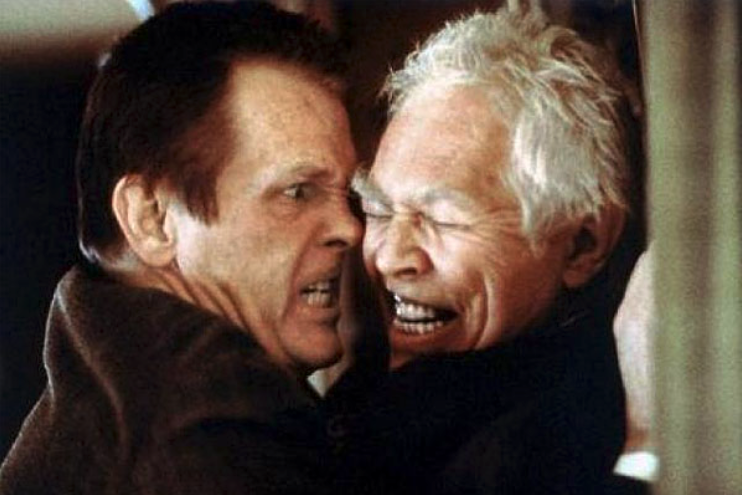
Nick Nolte’s character about ready to kill James Coburn’s (screen shot, cropped), Affliction (1997), December 20, 2021. (http://www.camera-roll.com/raging-bulls-affliction/)

There’s this not-so-famous 1997 movie Affliction, starring the late James Coburn, Nick Nolte, and Willem Dafoe. The cycles of physical and psychological abuse, the obvious misogyny and hypermasculinity, the mental breakdown, the need for distance from family, are all part of this movie. Nolte’s character eventually kills his father (Coburn), and eventually loses his grip with reality. His withdrawn and recluse brother (Dafoe), a writer and English professor, wrote down his brother’s story for posterity. This as Nolte’s character disappears to Canada, where someone eventually finds a cadaver matching his physical features. 

I wonder if I am Willem Dafoe’s character. Probably not. At least, I don’t think my partner since 1995 and my 18-year-old see me that way. But I do feel the lurch to stay away from people, especially my immediate family outside of Silver Spring, Maryland. It’s not like I don’t want to see them. But they have never ever seen me, not even during all the years I stared them in the face.

← Older posts
Newer posts →

Boy @ The Window: A Memoir

Boy @ The Window: A Memoir

Places to Buy/Download Boy @ The Window

There's a few ways in which you can read excerpts of, borrow and/or purchase and download Boy @ The Window. There's the trade paperback edition of Boy @ The Window, available for purchase via Amazon.com at http://www.amazon.com/Boy-Window-Donald-Earl-Collins/dp/0989256138/

There's also a Kindle edition on Amazon.com. The enhanced edition can be read only with Kindle Fire, an iPad or a full-color tablet. The links to the enhanced edition through Apple's iBookstore and the Barnes & Noble NOOK edition are below. The link to the Amazon Kindle version is also immediately below:

scr2555-proj697-a-kindle-logo-rgb-lg

Boy @ The Window on Amazon.com: http://www.amazon.com/Boy-The-Window-Memoir-ebook/dp/B00CD95FBU/

iBookstore-logo-300x100

Boy @ The Window on Apple's iBookstore: https://itunes.apple.com/us/book/boy-the-window/id643768275?ls=1

Barnes & Noble (bn.com) logo, June 26, 2013. (http://www.logotypes101.com).

Boy @ The Window on Barnes & Noble: http://www.barnesandnoble.com/w/boy-the-window-donald-earl-collins/1115182183?ean=2940016741567

You can also add, read and review Boy @ The Window on Goodreads.com. Just click on the button below:

Boy @ The Window

Twitter Updates

Tweets by decollins1969
  • RSS - Posts
  • RSS - Comments

Archives

  • June 2025
  • April 2023
  • September 2022
  • August 2022
  • July 2022
  • June 2022
  • May 2022
  • April 2022
  • March 2022
  • January 2022
  • December 2021
  • November 2021
  • October 2021
  • September 2021
  • August 2021
  • July 2021
  • June 2021
  • April 2021
  • March 2021
  • February 2021
  • January 2021
  • December 2020
  • November 2020
  • October 2020
  • September 2020
  • August 2020
  • July 2020
  • May 2020
  • April 2020
  • March 2020
  • January 2020
  • December 2019
  • November 2019
  • August 2019
  • July 2019
  • June 2019
  • May 2019
  • April 2019
  • March 2019
  • February 2019
  • January 2019
  • December 2018
  • November 2018
  • October 2018
  • September 2018
  • August 2018
  • July 2018
  • June 2018
  • May 2018
  • March 2018
  • February 2018
  • January 2018
  • December 2017
  • November 2017
  • October 2017
  • September 2017
  • August 2017
  • July 2017
  • June 2017
  • May 2017
  • April 2017
  • March 2017
  • February 2017
  • January 2017
  • December 2016
  • November 2016
  • October 2016
  • September 2016
  • August 2016
  • July 2016
  • June 2016
  • May 2016
  • April 2016
  • March 2016
  • February 2016
  • January 2016
  • December 2015
  • November 2015
  • October 2015
  • September 2015
  • August 2015
  • July 2015
  • June 2015
  • May 2015
  • April 2015
  • March 2015
  • February 2015
  • January 2015
  • December 2014
  • November 2014
  • October 2014
  • September 2014
  • August 2014
  • July 2014
  • June 2014
  • May 2014
  • April 2014
  • March 2014
  • February 2014
  • January 2014
  • December 2013
  • November 2013
  • October 2013
  • September 2013
  • August 2013
  • July 2013
  • June 2013
  • May 2013
  • April 2013
  • March 2013
  • February 2013
  • January 2013
  • December 2012
  • November 2012
  • October 2012
  • September 2012
  • August 2012
  • July 2012
  • June 2012
  • May 2012
  • April 2012
  • March 2012
  • February 2012
  • January 2012
  • December 2011
  • November 2011
  • October 2011
  • September 2011
  • August 2011
  • July 2011
  • June 2011
  • May 2011
  • April 2011
  • March 2011
  • February 2011
  • January 2011
  • December 2010
  • November 2010
  • October 2010
  • September 2010
  • August 2010
  • July 2010
  • June 2010
  • May 2010
  • April 2010
  • March 2010
  • February 2010
  • January 2010
  • December 2009
  • November 2009
  • October 2009
  • September 2009
  • August 2009
  • July 2009
  • June 2009
  • May 2009
  • April 2009
  • March 2009
  • February 2009
  • January 2009
  • December 2008
  • November 2008
  • October 2008
  • September 2008
  • August 2008
  • July 2008
  • June 2008
  • May 2008
  • April 2008
  • March 2008
  • February 2008
  • January 2008
  • December 2007
  • November 2007
  • October 2007
  • September 2007
  • August 2007
  • July 2007
  • June 2007

Recent Comments

decollins1969's avatardecollins1969 on No Good Teaching Deed Goes…
Mary Rose O’Connell's avatarMary Rose O’Connell on No Good Teaching Deed Goes…
Lyndah McCaskill's avatarLyndah McCaskill on The Raunchiest of Them Al…

NetworkedBlogs on Facebook

NetworkedBlogs
Blog:
Notes From a Boy @ The Window
Topics:
My Life, Culture & Education, Politics & Goofyness
 
Follow my blog

616 616 East Lincoln Avenue A.B. Davis Middle School Abuse Academia Academy for Educational Development AED Afrocentricity American Narcissism Authenticity Bigotry Blackness Boy @ The Window Carnegie Mellon University Child Abuse Class of 1987 CMU Coping Strategies Crush #1 Crush #2 Death Disillusionment Diversity Domestic Violence Economic Inequality Education Family Friendship Friendships Graduate School Hebrew-Israelites High-Stakes Testing Higher Education History Homelessness Humanities Humanities Program Hypocrisy Internalized Racism Jealousy Joe Trotter Joe William Trotter Jr. K-12 Education Love Manhood Maurice Eugene Washington Maurice Washington Misogyny Mother-Son Relationship Mount Vernon High School Mount Vernon New York Mount Vernon public schools Multiculturalism MVHS Narcissism NFL Pitt Pittsburgh Politics of Education Poverty President Barack Obama Race Racial Stereotypes Racism Relationships Self-Awareness Self-Discovery Self-Reflection Sexism Social Justice Teaching and Learning University of Pittsburgh Violence Whiteness Writing

Top Rated

Blog at WordPress.com.

  • Subscribe Subscribed
    • Notes from a Boy @ The Window
    • Join 103 other subscribers
    • Already have a WordPress.com account? Log in now.
    • Notes from a Boy @ The Window
    • Subscribe Subscribed
    • Sign up
    • Log in
    • Report this content
    • View site in Reader
    • Manage subscriptions
    • Collapse this bar
 

Loading Comments...