• About Me
  • Other Writings
  • Interview Clips
  • All About Me: American Racism, American Narcissism, and the Conversation America Can’t Have
  • Video Clips
  • Boy @ The Window Pictures
  • Boy @ The Window Theme Music

Notes from a Boy @ The Window

~

Notes from a Boy @ The Window

Category Archives: Politics

On Academic Entourages & Standing Apart From Them

11 Wednesday Sep 2013

Posted by decollins1969 in 1, Academia, Carnegie Mellon University, culture, Eclectic, Pittsburgh, Politics, Pop Culture, race, Religion, University of Pittsburgh, Work, Youth

≈ Leave a comment

Tags

Academia, African American Studies, Afrocentricity, Authenticity, Black Issues in Higher Education, Blackness, Entourage, Fear of a "Black" America, Followers, Loner, Marc, Molefi Asante, Multiculturalism, Politics of Academia, Publishing, Sycophants, Writing


Lil Wayne entourage, Hartford, CT, July 2011. (http://4umf.com/).

Lil Wayne entourage, Hartford, CT, July 2011. (http://4umf.com/).

This week for many is about anniversary number twelve of the 9/11 attacks, which if I hadn’t lived through them, would sound like something out of a Kurt Vonnegut novel. But because I’ve been counting my days for years, this week also represents two decades since I realized that radical “Islamic” terrorists, pro athletes and popular music artists aren’t the only ones with followers. I learned for the first time that even in the world of academia, paragons and those who allege themselves as such also have their entourages of true believers and sycophants. It was a realization that bothered the loner and the aspiring academic historian in me.

Letters to the Editor, Black Issues in Higher Education, September 9, 1993. (Donald Earl Collins)

Letters to the Editor, Black Issues in Higher Education, September 9, 1993. (Donald Earl Collins).

It all occurred in the aftermath of my first major publication, co-written with my friend Marc and published in Black Issues In Higher Education in August ’93. “Afrocentricity: The Fight for Control of African-American Thought” was our 1,200 word contribution to the debate over multicultural education and Afrocentricity in both higher education and in Black culture more generally. It was a publication that came as a surprise, because the editors at Black Issues In Higher Education (the same folks who ran Emerge Magazine, by the way) hadn’t contacted us about receiving our pitch and article, about accepting it for publication, or about when they intended to publish. And even though our article was literally in the centerfold of their August 12, ’93 issue, the folks at Black Issues in Higher Education never paid us for the publication of our work.

The reason why because clearer in their September 9 and September 23 issues. In the “Letters to the Editor” section, the editors published a dozen letters, ten of which were critical of our work. These weren’t scholarly or even logical critiques — we were wrong because we weren’t members of the Church of Afrocentric Babble, plain and simple. These were “How dare you!” or “Shame on you!” letters, not ones based on what we’d actually written.

What became obvious  to me was that Molefi Asante’s former and current students had written most of the letters. Not exactly an unbiased set of sources, as in the circle of Afrocentricity in the early ’90s, there were few people more prominent than Asante (he was the Father of Afrocentricity, after all). Once I realized this, I found myself disappointed. With Black Issues in Higher Education, with Black folks in academia — particularly at Temple University — and with academia itself. Me and Marc weren’t being challenged on our ideas, but on the idea that two alleged neophytes had the balls to challenge the orthodoxy of the early ’90s in African American studies and in high-brow Black cultural circles.

Marc pushed for a response from one of the editors about their unprofessionalism (and to find out why we weren’t being paid for our piece), which led to a conversation with one of the big-wigs. He apparently said to Marc, “We published it [the “Afrocentricity” piece] to teach you a lesson.” When Marc told me, I said, “Well, I guess we’re not gonna get paid.” (Turned out this was standard practice for the likes of Black Issues in Higher Education, Emerge, and for freelancers at BET as well). Marc, pissed and disillusioned, said, “We were just trying to help.”

Letters to the Editor, Black Issues in Higher Education, September 23, 1993. (Donald Earl Collins).

Letters to the Editor, Black Issues in Higher Education, September 23, 1993. (Donald Earl Collins).

It was the last one of many factors that pushed me to write my dissertation and my first book Fear of a “Black” America (2004) on the relationship between education, multiculturalism, and Black identity. I wanted to show that Afrocentricity wasn’t the only strain of thought that ran through the heads of Black scholars and found its way into small “c” curriculum and cultural events in Black communities. In doing so, I certainly stood apart, but I also stood alone a lot, too.

In recent years, I’ve seen numerous entourages eviscerate lone wolfs. On Twitter, in our 24/7 media coverage of the mundane and insignificant yet insane, and at academic conferences. As recently as a couple of months ago, I saw a version of this on Facebook in response to a post I wrote about Mark Anthony Neal’s Looking for Leroy (2013). The entourage makes it difficult for an up-and-comer to get off to an honest start, for conformity with only subatomic levels of independent thought seems to be the norm.

Somewhere between now and when my son (knock on wood) reaches my age of forty-three, maybe some of what I’ve written over the past twenty years will break through the ice of entourages, mad-dog and otherwise. Still, it is a damnable thing when groups get together to stomp out different voices (literally and figuratively), because that’s seems to be the only way to keep the band together.

First Day of High School, Thirty Years Ago

05 Thursday Sep 2013

Posted by decollins1969 in 1, Boy @ The Window, culture, Eclectic, Mount Vernon High School, Mount Vernon New York, Politics, Pop Culture, race, Youth

≈ 1 Comment

Tags

Educational Inequality, Educational Leadership, MVHS, Paternalism, Principal Leadership, Principals, Racism, Richard Capozzola, School-to-Prison Pipeline, Tough-Love, Violence, White Paternalism


Oz (HBO) poster, September 5, 2013. (http://www.brain-dead-blog.blogspot.com).

Oz (HBO) poster, September 5, 2013. (http://www.brain-dead-blog.blogspot.com).

Our/my first day at Mount Vernon High School (New York) was the first Thursday after Labor Day thirty years ago, which means the exact date was September 8, ’83. It was mostly a very good day, except for our third period assembly with then Principal Richard Capozzola. He pronounced at least half of our class dead on arrival not quite two hours into ninth grade. Capozzola said, “There are 1,075 of you here today. Four years from now, only half of you will graduate” from MVHS. It turned out that he was wrong. Only 545 of us were eligible to march by September ’86, and 509 of us ended up doing so in June ’87. Even when accounting for the twenty or so Class of ’87 folks who decided to take their nineteen credits and graduate in ’86 instead of ’87, less than half of our original cohort graduated in years.

In Boy @ The Window and on the five or so occasions I’ve had to talk about the late Richard Capozzola and MVHS, I’ve attributed much of this to “the reality of self-fulfilling prophecies” and “the damage that low expectations can do.”  There isn’t a single word that I’d change in my description of Capozzola and in my thoughts about what he said, thirty years ago or right now. When you run a school as if the students are inmates and security act on your behalf as corrections officers, it is really a surprise when students drop out? When your security measures have the effect of increasing tensions so that more fights break out, shouldn’t it mean that the head school building administrator re-evaluate such measures? Apparently not.

That’s the principal and school that I remember outside of my Humanities days. Where girls ripped off each other’s earrings in the process of slugging each other. When witnessing one or two fights a week in building was a normal part of the process. When White potheads would sneak a smoke in between classes in the courtyard, but no security would intrude.

Mount Vernon High School main entrance, Mount Vernon, NY, November 22, 2006. (Donald Earl Collins).

Mount Vernon High School main entrance, Mount Vernon, NY, November 22, 2006. (Donald Earl Collins).

I have no doubt that trying to curtail this was a difficult job for any principal in ’83. But MVHS wasn’t Ft. Apache, or Jersey City, or South Central LA in this era. No MVHS student had brought a gun to school to shoot someone, at least in my time there. Short of a Swiss army knife, most students used their words to cut each other down, or in threatening to use a knife, maybe, off school grounds, after school.

Over the past couple of  years, I received comments about what I’ve written about my late principal from one of his children, who has repeatedly defended his father as a hero of sorts. He has disagreed, and rather bitterly, about what I’ve written, as if his experience with his father actually negates my experience with him as a principal. As part of my response to Capozzola’s son two years ago, I wrote:

Make no mistake, I for one, didn’t feel one iota safer in my four years at MVHS because of security sweeps, the closing of the courtyard to student use. Not to mention the general feeling I had that people who looked like me — regardless of my grades — weren’t welcome, whether that was intended or not. It’s a bit paternalistic to suggest that a heavy-handed approach to security “saved my life” or led to a national award for educational excellence in 1983 [It was actually a Blue Ribbon School in 1987]. As an educator myself, I know all too well the politics involved in such descriptions of schools like MVHS and with such awards.

Lion eating wildebeest - "animals" was what administrators & White classmates sometimes called MVHS students, but ironically referencing themselves, September 5, 2013. (YouTube).

Lion eating wildebeest – “animals” was what the White administrators & classmates sometimes called MVHS students, but ironically referencing themselves, September 5, 2013. (YouTube).

I’d add to this, though. I don’t really think that Capozzola actually cared about learning or the closing of achievement gap, either, not based on how he treated Humanities. And “tough love and a firm hand?” Really? That’s how you describe a father or an overseer — it should never be how you describe a principal. There was no love in his so-called toughness, and not enough firmness to prevent fights and slights that were a frequent part of my four-year experience at MVHS. And yes, many of MVHS’ students lived in poverty, but there was a sizable number of middle class Black students who attended as well. To forget that would be to, I don’t know, lump MVHS as a monolithic block of Black (and Latino) kids ready to start a riot. How is this different from a stop and frisk policy that targets poor neighborhoods and Black and Latinos between sixteen and thirty?

Which, in the end, is what both the late Capozzola and his son have done, thirty years ago and much more recently than that. To think that I put up with this for four years, at least one year too long. The embedded racial paternalism and institutional bigotry, in their words and deeds — it just takes my breath away.

Grad School & My Most Special Summer Reading List

31 Saturday Aug 2013

Posted by decollins1969 in 1, Academia, Boy @ The Window, culture, Eclectic, Pittsburgh, Politics, Pop Culture, race, University of Pittsburgh, Work, Youth

≈ Leave a comment

Tags

"I Have A Dream" speech, Afrocentricity, Black Culture, Black History, Blackness, Books, Carter G. Woodson, Department of HIstory, Elaine, Graduate School, Higher Education, Joe White, K-12 Education, Malcolm X, March on Washington, Multicultural Education, Pitt, Readings, Self-Discovery, Toni Morrison, W. E. B. Du Bois, Western Psych, Western Psychiatric Institute & Clinic


Just a small sample of the books I read/re-read summer before grad school in 1991, August 31, 2013. (Donald Earl Collins).

Just a small sample of the books I read/re-read summer before grad school in 1991, August 31, 2013. (Donald Earl Collins).

For me, August 28 this week was significant for any number of reasons. It wasn’t just that it was fifty years to the exact day and date that the March on Washington occurred and MLK gave his “I Have A Dream” speech. Or that is was fifty-eight years to the date that White supremacists lynched Emmett Till for allegedly whistling at some flat-butt White girl. This past Wednesday was also twenty-two years to the day and date that I began my first day of graduate school as a master’s student in the University of Pittsburgh’s Department of History.

Of course, I didn’t discuss this earlier this week (it would’ve been incredibly arrogant on my part to bring this up three days ago). My big steps for myself were infinitesimal when in measured comparison to the beginning of the two-year height of the official Civil Rights Movement. But even on an afternoon in which I attended my first course and meeting about teaching/advising assignments for the semester, it did feel like a bit of a triumph. Especially when considering what I had to do that spring and summer to get into the program with funding in the first place.

I didn’t learn that much that day. Except the low contempt Joe White and some of the other professors held toward pedagogy and teaching. “You already know more than your students,” White said as advice to us who’d be TAs that semester. I was lucky to not be among them for my first year. I was a GSA assisting in the advising of history majors, some of whom were my fellow undergrads just a few months before. But even then, I thought two minutes’ worth of advice on viewing students as empty vessels was insufficient training for learning how to lecture and facilitate conversations with upwards of 100 students spread out over several discussion sections each week.

I had other things on my mind at that moment, though, including the relief that I’d survived a summer making $5.20 per hour as a full-time employee with a Western Psychiatric Institute & Clinic project in which the project investigators were far more psychotic than the patients. Aside from that, I thought about how the previous four months had served as my preparation for the White world of grad school.

I’d done a lot of reading that late spring and summer, spurned on by boredom, disappointment in my weirdly evolving friendship with Elaine, and a sense that I needed to read to fortify myself against the neo-Marxists in my eventual field. So I read. I started off with Alex Haley’s The Autobiography of Malcolm X (1965), believe it or not, the first time I’d ever read it. Like so many before me, it made my views of the man less black and white than it had been before. I then picked up W. E. B. Du Bois’ Souls of Black Folk (1903), the first time I’d read that book since I wrote a book report on it for Mrs. O’Daniel’s class in fifth grade. Unsurprisingly, I got much more out of it in May ’91 than I did in May ’80.

I didn’t stop there, as my reading took me on three different tracks in June, July and August. One was the “I didn’t get to read this before” track, as I read Toni Morrison’s Tar Baby, Song of Solomon and Beloved (didn’t understand it then, and still don’t get the big deal about it now). Along with Alice Walker’s The Color Purple, Maya Angelou’s I Know Why The Caged Bird Sings (1969), bell hooks and several others on Black Women’s literature. Then, I decided to go back and reread some James Baldwin and Richard Wright that I’d first read for high school, and added Ralph Ellison’s Invisible Man (1952) to the mix. On the non-literature track, I ended up reading Franz Fanon, Du Bois’ Black Reconstruction (1935) — at least, I put a significant dent in it — Derrick Bell’s And We Are Not Saved (1987), and other writings on Black history and culture (broadly speaking).

But the third track would end up taking me on a path toward my dissertation topic and my first book, Fear of a “Black” America (2004). It started with articles on multicultural education that took me to James Banks’ theoretic constructions of what multicultural education ought to have been, but wasn’t. I also found myself reading books like Jonathan Kozol’s Savage Inequalities (1991), Molefi Asante’s The Afrocentric Idea (1987), Dinesh D’Souza’s Illiberal Education (completely indecipherable in a circular firing squad of a thesis kind of way) and Carter G. Woodson’s The Mis-education of the Negro (1933). I was reading anything that could inform my thinking about K-12 and higher education and how it played the role as both equalizer and oppressor for so many Black folks over the years.

Books, Grad School & Blackness

Books, Grad School & Blackness

It was easily the most reading I’d done on my own since the year before I’d gone into seventh grade, middle school and the Humanities Program. I wanted to read all I wanted to read before spending the next few years drowning my brain in hundreds of books and articles that I’d absolutely need to read as a historian. In the process, I may’ve radicalized myself a bit for the otherwise hum-drum experience of reading mind-numbing accounts of history in which the authors didn’t seem to see their own sense of high-brow White maleness.

And with all of it, I surprised myself. I realized once again that my Black classmates and 616 neighbors were wrong about me not being Black enough. Their “Black” wasn’t my “Black,” of course. But all those books confirmed for me that there were many ways to be Black that folks who didn’t read could barely understand.

“I Marched With Dr. Martin Luther King!” – and Other Record Scratchers

28 Wednesday Aug 2013

Posted by decollins1969 in 1, Boy @ The Window, culture, Eclectic, Mount Vernon High School, Mount Vernon New York, Pittsburgh, Politics, Pop Culture, race, University of Pittsburgh, Youth

≈ Leave a comment

Tags

American Dream, Bill Cosby, Civil Rights Generation, Civil Rights Movement, Disillusionment, Don Lemon, Estelle Abel, March on Washington, Post-Civil Rights Generation, Rev. Dr. Martin Luther King Jr., Tavis Smiley, Tough-Love


Dr. Martin Luther King and Benjamin Spock leading antiwar protest, Chicago, IL, March 25, 1967. (AP via LA Times).

Dr. Martin Luther King and Dr. Benjamin Spock leading antiwar protest, Chicago, IL, March 25, 1967. (AP via LA Times).

I’ve posted about my last official contact at Mount Vernon High School in June ’87 before graduating several times, and documented it well. The brow-beating I took from one Estelle Abel moments after my last day and last class of high school was one of the most puzzling and humiliating moments of a long series of them up to that point in my life. As I’ve written in both Fear of a “Black” America and Boy @ The Window:

I walked down the second floor steps and the first floor halls of the high schools to my locker one more time. While clearing out my locker, Estelle Abel walked by and asked to meet with me. I went over to her office, and for the next fifteen minutes, she attacked me for being a slacker.

“You’ve been a disappointment, young man,” Abel said.

“What?,” I said, completely shocked.

“Your work this year is nothing to be proud of.”

I stood across from the tall, witchy-looking lady, speechless, but telling her “Fuck you” in my head. Abel claimed that I had underachieved throughout my four years as a student, that I should have been ranked in the top ten of my class, and that my performance in AP Physics was beyond abominable. All I could focus on was the amount of anger and emotion she possessed in her voice and eyes. You’d have thought that I’d been expelled from school or had raped her daughter!

“By you not graduating in the top ten of your class, you’ve let everyone down. Your family, your friends and our community,” she said, as if anyone around here really cared about me.

Abel continued. “You could’ve been a shining example of achievement to us,” all but hinting at Sam as the person I should’ve been like.

I guess I did let my Black classmates down. I only ranked second in GPA among Black males and eighth among all African Americans and Afro-Caribbeans in my class. I guess I should’ve been taking out back, blindfolded, with cigarette in mouth, and executed by a firing squad.

Abel finished her soliloquy. “You don’t have any excuses! There is nothing going on at home that could justify your performance!”

“Well, that’s not true…” I interrupted. I felt rage rising up from the pit of my stomach. If she’d been anywhere near my age, I would’ve taken all of the Jimme-ese I knew and laid it all on her stupid ass.

Her face turned stern as she cut me off, determined to make some sort of point, to prove that I was a worthless Black man in her eyes.

“Nothing going on in your life would ever compare to what we went through back in the ’60s . . . I marched with Dr. Martin Luther King!”

My mind clicked off my eardrums at that point. Short of showing her my war wounds and having her meet my family, what could I possibly do or say to that? I left her office feeling like my years at MVHS and in Humanities were just bullshit. Abel’s tirade reminded me of the fact that I simply didn’t fit in anywhere.

What I’ve never discussed in all my posts about Abel and her tough-love speech is how this incident — and others like it — have shaped my thinking about the Civil Rights generation. Those local Urban League or NAACP members who gave talks at MVHS or at Pitt or at Carnegie Library of Pittsburgh who said, “I’ve got mine. Now go and get yours” — a reference to businesses, jobs and higher education, as if we were all well financed enough to achieve their American Dream goals. Those usual suspects on the local or national level who gave the same speech year after year about the one time they shook Dr. King’s hand, or about their personal experience at the March on Washington in ’63. As if their experience would be more inspiring than the fact that folks like Medgar Evers and MLK actually gave their lives for the movement.

So many folks like Abel have used their kernels of experience with the March on Washington or the Civil Rights Movement more broadly as a club to beat over the heads of other African Americans, particularly those of us born after 1965. What they thought of as inspiration felt like damnation to me. The idea that nothing was worse than fighting for civil rights in the ’60s would be humorous to the four million slaves who lived in the South 150 years ago. It’s certainly an insult to so many deeply impoverished Blacks, White and other people of color who would have to stretch themselves like Plastic Man just to touch the first rung of the American middle class ladder.

Would I had been able to attend Pitt without a Challenge Scholarship for high-achieving Blacks in ’87? Probably not. Would I had been a part of a gifted-track program for six years without the NAACP filing a desegregation lawsuit against Mount Vernon public schools in ’76? Of course not. But those small windows of opportunity do not a movement make. Nor should it make me forever grateful to folks who considered me a waste of space to begin with — I wasn’t righteously “Black” enough for them, respectable enough for them, and obviously did not come from a home well-resourced enough for them, either.

Caned by Abel, Civil Rights

Caned by Abel, Civil Rights

So what if Abel or anyone else marched with Dr. King? What have you done with your life and for the lives of other since then besides discouraged where you could have encouraged, disillusioned where you could’ve provided comfort, or acted as if people like me owed you libations and gratitude? Estelle Abel represented for me in ’87 what folks like Bill Cosby, Don Lemon, Tavis Smiley and so many others have done in recent years — condemning those most in need of help and inspiration. They’ve all in their words helped turn the most hopeful and rhetorical part of “the Dream” into a nightmare.

Not Praying At The Civil Rights Altar

27 Tuesday Aug 2013

Posted by decollins1969 in 1, Boy @ The Window, culture, Eclectic, Politics, Pop Culture, race, Religion, Youth

≈ 4 Comments

Tags

"I Have A Dream" speech, 50th Anniversary, Altars, Civil Right Legacy, Civil Rights Generation, Civil Rights Movement, Derrick Bell, Faces at the Bottom of the Well (1992), False Idols, Hero Worship, Jesse B. Semple, Langston Hughes, March on Washington, Martin Luther King Jr., Symbols


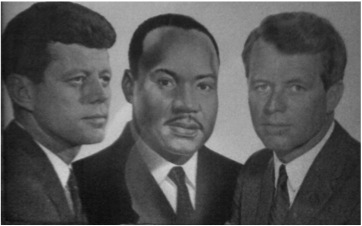
A facsimile of the JFK, MLK & RFK painting that used to hang over many a Black home's mantle, August 27, 2013. (http://robertktanenbaumbooks.com).

A facsimile of the JFK, MLK & RFK paintings that used to hang over many a Black home’s mantle, August 27, 2013. (http://robertktanenbaumbooks.com).

The legacy of the Civil Rights Movement a half-century removed from the March on Washington and Dr. Martin Luther King, Jr.’s “I Have A Dream” speech remains a mixed bag, especially for poor Blacks and other persons of color. This, of course, isn’t to say that the Civil Rights Movement and those who fought, bled, and died for civil rights and Black equality aren’t to be honored by us. After all, White supremacists assassinated, bombed, jailed, beat up, hosed down and sicked dogs on scores of civil rights activists and innocents, especially in 1963. But the fact that I needed to add this disclaimer is a significant part of the problem of the movement’s legacy. The knee-jerk kneeling and crossing of ourselves on behalf of the Civil Rights generation has all but obscured the fact that what mostly remains of the movement’s successes are mere symbols.

It remains beyond strange that we bow to the recently dead and the still living instead of to the long-dead who did the backbreaking work in paving the road for the Civil Rights Movement in the first place. From escaped slaves to lynched Blacks, from Nat Turner and Martin Delany to Sojourner Truth and Ida B. Wells-Barnett, their sacrifices were so much greater, and for so little in their own lives. Yet the Civil Rights generation enjoys honors as if they somehow generated the milestones of integration, the Civil Rights Act of 1964 and the Voting Rights Act of 1965 out of thin air. As if the movement’s victories were the equivalent of a modern-day Jesus walking on water.

For those who may well have witnessed these miracles, this is tantamount to civil rights sacrilege. But for millions of us – especially those who remain in poverty – the civil rights legacy is a mirage of symbols. More than twenty years ago, the late civil rights law professor Derrick Bell wrote about a character named Jesse B. Semple (a character originally invented by Langston Hughes) in his best-seller Faces at the Bottom of the Well (1992). Semple, in response to Bell’s claims of significant strides made during the movement, said, “most whites and lots of black folks rely on symbols to support their belief that people have come a long way since slavery and segregation to the present time.”

Two decades later, and Bell’s words through Semple ring even truer today. With Black unemployment at 14 percent and one in four African Americans living below the poverty line (including two in five Black children), it seems that the reach of the Civil Rights Movement has long exceeded its grasp. The MLK Holiday and President Barack Obama’s election and re-election, while hard-won battles, are mere symbols out of efforts to address the racism and poverty that ordinary Blacks and other people of color face every day, as both are on the rise. Even the two single biggest achievements of the movement — the Civil Rights Act of 1964 and the Voting Rights Act of 1965 – have been weakened over the past three decades by all three branches of our increasingly anti-civil rights government. They stand as symbols now. They are hardly pieces of landmark legislation that would provide a path out of poverty and discrimination.

The real beneficiaries of the Civil Rights Movement have been Blacks on the cusp of the American middle class in the 1960s and 1970s, the ones with the education and social pedigree necessary to become part of the American elite over the past forty years. The same folks who’ve said repeatedly in the past couple of decades that those Blacks who remain undereducated, in poverty and likely to go to jail are in this predicament due to hip-hop and rap or because they wear saggy-baggy jeans. More symbols, but this time, to persecute rather than to uplift. It’s their fault they’re in poverty, say the Bill Cosbys and Don Lemons of this group. This despite the fact that the ladder to the Black elite has been pulled up by both the eroding of the civil rights victories from a half-century ago and the huge wealth gap between rich and poor, Black and White that has become a gulf in recent years.

To turn around and then say that folks who have benefited little to zero from the legacy of the Civil Rights Movement should then take on this mantle now is a bit disingenuous. No, I don’t think that I or anyone who was born far too late to march with Dr. King in August 1963 owe the altar of civil rights any prayers, libations or tithes. If we need to be activists in this age, we need to move beyond relics, symbols and elitist notions of civil rights triumphs.

K-16 Education Reform and the Unlevel Playing Field

23 Friday Aug 2013

Posted by decollins1969 in 1, Academia, culture, Eclectic, Politics, Pop Culture, race

≈ Leave a comment

Tags

Adult Learners, College Affordability, College Success, Degree Attainment, Dr. Steve Perry, Economic Inequality, Education Inequality, Employability, First-Generation Students, High-Stakes Testing, Higher Education, K-16 Education Reform, Michelle Rhee, Poor Students, Private Foundations, Student Loans, Students of Color, Teacher Accountability, Two-Tiered System, US Department of Education, Wendy Kopp


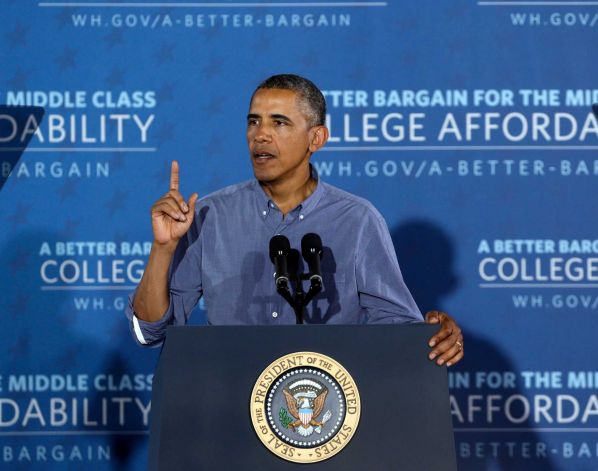
President Barack Obama speaking college affordability and a rating system, University of Buffalo (NY), August 22, 2013. (http://sfgate.com).

President Barack Obama speaking college affordability and a rating system, University of Buffalo (NY), August 22, 2013. (http://sfgate.com).

The shape and direction of education reform in America’s public schools and in US higher education is such that one can only conclude that this is the century in which social mobility will be limited to a precious and lucky few. With high-stakes testing and No Child Left Behind on the K-12 side, and the rise of for-profit online institutions in postsecondary education, we’re well on our way to a two-tiered system of education. One tier for the affluent, who will attend private schools and elite colleges, and a much lower tier for the rest of us, who will increasingly receive a watered down public education and have ever more limited higher education options.

The Problem With Mainstream K-16 Reformers:

The problem is, though, most reformers actually believe that their efforts at reform will result in a fairer and more level playing field for our kids and for first-generation college students of every stripe. They have an unwavering desire to make testing the cornerstone of curriculum revisions and the key determinant in measuring teacher effectiveness, and thus, tying future funds to school performance levels. Or, in the case of for-profit online higher education, they believe that financial aid in the form of student loans, accelerated classes with a curriculum strictly geared for current job market trends and lack of academic support is the shape of their river. Leaving vulnerable millions of first-generation students — particularly low-income adult learners (many of whom are of color) — to dropping out of college with tens of thousands of dollars of student loans to pay off and with few good career prospects.

Mock Time Magazine cover with Michelle Rhee alleging her full knowledge of cheating scandal in DC Public Schools, April 14, 2013.  (By a college student whose mom is a 7th grade teacher -http://www.susanohanian.org/)

Mock Time Magazine cover with Michelle Rhee alleging her full knowledge of cheating scandal in DC Public Schools, April 14, 2013. (By a college student whose mom is a 7th grade teacher -http://www.susanohanian.org/)

These reforms go further in providing an unlevel playing field. One where only a privileged few get to go down Mount Everest in a helicopter. The rest of us, meanwhile, must climb up Everest, ill-equipped for the climate while dodging rock slides, avalanches and other land mines all along the way.

An Unasked Question About K-12 Reform:

That reformers don’t see this is one thing. That they don’t even ask the questions that they should about their reform endgame has been the real problem for years. For example, they don’t ask the simple question, “Will high-stakes testing and teacher effectiveness measures close the achievement gap and make it so that students regardless of race and family income will be well prepared after graduating high school for college or for workforce training?”

The answer to this, of course, is no. High-stakes testing cannot and will not close the achievement gap or lead to students graduating high school better prepared for college and the 21st century working world. Teachers and administrators will continue to devote more of their time and efforts to testing than to other aspects of their jobs, for fear of losing their jobs. Reformers will continue to use the mantra of testing to siphon those precious and limited taxpayer dollars out of state legislatures and school boards to cover the costs of test development and test-based teacher evaluations. And students attending the allegedly worst performing schools will continue to lose good teachers and move from school to school in search of the promise — but not the reality — of a quality K-12 education.

Reformers like Michelle Rhee, Wendy Kopp and Dr. Steve Perry (not to be confused with Journey’s lead singer) don’t ask this question. They are too busy procuring funds from the Bill & Melinda Gates Foundation, Lumina Foundation for Education, the Wallace Foundation and the US Department of Education to discuss the shape of their reform river. They are much more interested in proving a strong correlation between teacher effectiveness and student achievement via test scores, because they believe this is the way, truth and life for K-12 reform. And pretty soon, we will know that this correlation either doesn’t exist or is a weak one at best, under some rather ideal circumstances.

An Unasked Question About Higher Education Reform:

Futurama poster "A Mindless Worker Is A Happy Worker," August 23, 2013. (http://d3.ru)

Futurama poster “A Mindless Worker Is A Happy Worker,” August 23, 2013. (http://d3.ru)

For-profit institutions involved in online higher education do no better in asking fundamental questions about their endgame. University of Phoenix, Kaplan University and Capella University don’t ask, “Is an accelerated online college format that is highly dependent on underprepared first-generation college students, provides few or no academic support services and is heavily subsidized by federal student loans the best possible postsecondary education for these students?” Of course it isn’t. Over the past 20 years, these institutions have been too busy figuring out ways to increase the enrollment of low-income students to ask this question. They have been more interested in drawing in as much federal student loan aid as possible to cover the costs of student enrollment to ask whether they are providing the best services.

For those not-so-lucky students attending these institutions, they face a great distance between the promises of this new higher education regime and its brutal reality. For-profits promise an online education that is tailor-made for students’ job and career aspirations, one even more alluring because it is an allegedly convenient fit for the demands of any adult lifestyle. For-profits seem to be proud of the fact that fewer than 20 percent of their students complete a degree eight years after they first enroll in one of their courses. For those few students who do manage to complete a degree, many are finding that their narrowly focused degrees don’t match up with their career aspirations.

Irony and Shame:

The irony is that for-profit online higher education has all but moved away from testing at a time when the only thing that matters in K-12 education is testing, from a child’s first week in kindergarten to his or her last day of 12th grade. The ironic shame of it all is that reformers in both K-12 and higher education never ask the question of what we should expect at the end of the reforming rainbow. Their reform efforts are purely about making a profit, for themselves or for others. The rest of us, meanwhile, can’t wait for Superman, with reformers stealing his powers on both ends of the K-16 spectrum, and placing kryptonite for real reform at every turn.

—-

I wrote all this months ago. Now, with President Barack Obama offering a formalized version of accountability for higher education institutions that connects market-relevant degrees and employment to college success, him and his administration are pushing the two-tiered agenda even further. Private elite colleges can easily opt out of this Race to the Top-esque rating system for higher education costs-to-employability ratios, and create their own measures around affordability, degree-attainment and career pathways. Or not, for that matter.

Public institutions — the ones tied most directly to US Department of Education funds — will have little choice but to go down this money-wasting path. One that in the end will do nothing for first-generation students, students of color, older students, heck, any student who comes from a humble background. “It’s a shame and a pitiful,” as my father would say.

Aaron Hernandez — Face of a Killer?

22 Thursday Aug 2013

Posted by decollins1969 in 1, culture, Eclectic, Politics, Pop Culture, race, Sports, Youth

≈ Leave a comment

Tags

Aaron Hernandez, Affectations, Black Bodies, Criminal Justice, Execution, First-Degree Murder, George Zimmerman, Indictment, Murder, New England Patriots, NFL, Odin Lloyd, Psychotic Killers


Aaron Hernandez indicted on six charges, including 1st-degree murder for allegedly killing Odin Lloyd, Attleboro, MA, August 22, 2013. (Screenshot via NFL Network).

Aaron Hernandez indicted on six charges, including 1st-degree murder, for allegedly killing Odin Lloyd, Attleboro, MA, August 22, 2013. (Screenshot via NFL Network).

I know, I know. Innocent until proven guilty is still the law of this land, even if we often convict people (especially if they’re Black or Brown) in the court of the public arena early, often and forever. But looking at Aaron Hernandez’s affectations while in court this afternoon as the court indicted him on six charges (including first-degree murder) involving the killing of Odin Lloyd reminded me of another unrepentant criminal of recent lore. Yep, yep, George Zimmerman, of course.

George Zimmerman during jury selection phase of trial, Sanford, FL, June 19, 2013. (Pool photos, Getty Images).

George Zimmerman during jury selection phase of trial, Sanford, FL, June 19, 2013. (Pool photos, Getty Images).

There would be no way I’d be anything other than distraught if I were facing murder charges. Then again, I wouldn’t be in court for executing a supposed friend (or two or three) in the first place.

← Older posts
Newer posts →

Boy @ The Window: A Memoir

Boy @ The Window: A Memoir

Places to Buy/Download Boy @ The Window

There's a few ways in which you can read excerpts of, borrow and/or purchase and download Boy @ The Window. There's the trade paperback edition of Boy @ The Window, available for purchase via Amazon.com at http://www.amazon.com/Boy-Window-Donald-Earl-Collins/dp/0989256138/

There's also a Kindle edition on Amazon.com. The enhanced edition can be read only with Kindle Fire, an iPad or a full-color tablet. The links to the enhanced edition through Apple's iBookstore and the Barnes & Noble NOOK edition are below. The link to the Amazon Kindle version is also immediately below:

scr2555-proj697-a-kindle-logo-rgb-lg

Boy @ The Window on Amazon.com: http://www.amazon.com/Boy-The-Window-Memoir-ebook/dp/B00CD95FBU/

iBookstore-logo-300x100

Boy @ The Window on Apple's iBookstore: https://itunes.apple.com/us/book/boy-the-window/id643768275?ls=1

Barnes & Noble (bn.com) logo, June 26, 2013. (http://www.logotypes101.com).

Boy @ The Window on Barnes & Noble: http://www.barnesandnoble.com/w/boy-the-window-donald-earl-collins/1115182183?ean=2940016741567

You can also add, read and review Boy @ The Window on Goodreads.com. Just click on the button below:

Boy @ The Window

Twitter Updates

Tweets by decollins1969
  • RSS - Posts
  • RSS - Comments

Archives

  • June 2025
  • April 2023
  • September 2022
  • August 2022
  • July 2022
  • June 2022
  • May 2022
  • April 2022
  • March 2022
  • January 2022
  • December 2021
  • November 2021
  • October 2021
  • September 2021
  • August 2021
  • July 2021
  • June 2021
  • April 2021
  • March 2021
  • February 2021
  • January 2021
  • December 2020
  • November 2020
  • October 2020
  • September 2020
  • August 2020
  • July 2020
  • May 2020
  • April 2020
  • March 2020
  • January 2020
  • December 2019
  • November 2019
  • August 2019
  • July 2019
  • June 2019
  • May 2019
  • April 2019
  • March 2019
  • February 2019
  • January 2019
  • December 2018
  • November 2018
  • October 2018
  • September 2018
  • August 2018
  • July 2018
  • June 2018
  • May 2018
  • March 2018
  • February 2018
  • January 2018
  • December 2017
  • November 2017
  • October 2017
  • September 2017
  • August 2017
  • July 2017
  • June 2017
  • May 2017
  • April 2017
  • March 2017
  • February 2017
  • January 2017
  • December 2016
  • November 2016
  • October 2016
  • September 2016
  • August 2016
  • July 2016
  • June 2016
  • May 2016
  • April 2016
  • March 2016
  • February 2016
  • January 2016
  • December 2015
  • November 2015
  • October 2015
  • September 2015
  • August 2015
  • July 2015
  • June 2015
  • May 2015
  • April 2015
  • March 2015
  • February 2015
  • January 2015
  • December 2014
  • November 2014
  • October 2014
  • September 2014
  • August 2014
  • July 2014
  • June 2014
  • May 2014
  • April 2014
  • March 2014
  • February 2014
  • January 2014
  • December 2013
  • November 2013
  • October 2013
  • September 2013
  • August 2013
  • July 2013
  • June 2013
  • May 2013
  • April 2013
  • March 2013
  • February 2013
  • January 2013
  • December 2012
  • November 2012
  • October 2012
  • September 2012
  • August 2012
  • July 2012
  • June 2012
  • May 2012
  • April 2012
  • March 2012
  • February 2012
  • January 2012
  • December 2011
  • November 2011
  • October 2011
  • September 2011
  • August 2011
  • July 2011
  • June 2011
  • May 2011
  • April 2011
  • March 2011
  • February 2011
  • January 2011
  • December 2010
  • November 2010
  • October 2010
  • September 2010
  • August 2010
  • July 2010
  • June 2010
  • May 2010
  • April 2010
  • March 2010
  • February 2010
  • January 2010
  • December 2009
  • November 2009
  • October 2009
  • September 2009
  • August 2009
  • July 2009
  • June 2009
  • May 2009
  • April 2009
  • March 2009
  • February 2009
  • January 2009
  • December 2008
  • November 2008
  • October 2008
  • September 2008
  • August 2008
  • July 2008
  • June 2008
  • May 2008
  • April 2008
  • March 2008
  • February 2008
  • January 2008
  • December 2007
  • November 2007
  • October 2007
  • September 2007
  • August 2007
  • July 2007
  • June 2007

Recent Comments

MaryPena's avatarMaryPena on My Day of Atonement/Bitter Hat…
decollins1969's avatardecollins1969 on No Good Teaching Deed Goes…
Mary Rose O’Connell's avatarMary Rose O’Connell on No Good Teaching Deed Goes…

NetworkedBlogs on Facebook

NetworkedBlogs
Blog:
Notes From a Boy @ The Window
Topics:
My Life, Culture & Education, Politics & Goofyness
 
Follow my blog

616 616 East Lincoln Avenue A.B. Davis Middle School Abuse Academia Academy for Educational Development AED Afrocentricity American Narcissism Authenticity Bigotry Blackness Boy @ The Window Carnegie Mellon University Child Abuse Class of 1987 CMU Coping Strategies Crush #1 Crush #2 Death Disillusionment Diversity Domestic Violence Economic Inequality Education Family Friendship Friendships Graduate School Hebrew-Israelites High-Stakes Testing Higher Education History Homelessness Humanities Humanities Program Hypocrisy Internalized Racism Jealousy Joe Trotter Joe William Trotter Jr. K-12 Education Love Manhood Maurice Eugene Washington Maurice Washington Misogyny Mother-Son Relationship Mount Vernon High School Mount Vernon New York Mount Vernon public schools Multiculturalism MVHS Narcissism NFL Pitt Pittsburgh Politics of Education Poverty President Barack Obama Race Racial Stereotypes Racism Relationships Self-Awareness Self-Discovery Self-Reflection Sexism Social Justice Teaching and Learning University of Pittsburgh Violence Whiteness Writing

Top Rated

Blog at WordPress.com.

  • Subscribe Subscribed
    • Notes from a Boy @ The Window
    • Join 103 other subscribers
    • Already have a WordPress.com account? Log in now.
    • Notes from a Boy @ The Window
    • Subscribe Subscribed
    • Sign up
    • Log in
    • Report this content
    • View site in Reader
    • Manage subscriptions
    • Collapse this bar
 

Loading Comments...