• About Me
  • Other Writings
  • Interview Clips
  • All About Me: American Racism, American Narcissism, and the Conversation America Can’t Have
  • Video Clips
  • Boy @ The Window Pictures
  • Boy @ The Window Theme Music

Notes from a Boy @ The Window

~

Notes from a Boy @ The Window

Category Archives: Politics

Continuum’s Legacy: Dystopia Now

07 Saturday Nov 2015

Posted by decollins1969 in 1, culture, Eclectic, Movies, Patriotism, Politics, Pop Culture, Work, Youth

≈ Leave a comment

Tags

2077, Alex Sadler, Alternate Future, Alternate History, Bill Gates, Charles Koch, Continuum (2012-15), Corporate Congress, Economic Inequality, Erik Knudsen, Firefly (2002), Fringe (2008-13), Kiera Cameron, Liber8, Michael Bloomberg, Oppression, Plutocracy, Rachel Nichols, Resistance, Revolution, Sci-Fi, Simon Barry, SyFy, Time-Travel, William B. Davis


Continuum series art, August 2012. (http://liber8thecontinuum.tumblr.com).

Continuum series art, August 2012. (http://liber8thecontinuum.tumblr.com).

Continuum (2012-15) ended its fourth and final season on SyFy here in the US and Showcase in Canada last month (we can still watch it — eventually all of it — on Netflix, though). Typical of most science-fiction series, Continuum ended with a six-episode arc that cannibalized its main theme, in this case, time-travel. Six episodes about soldiers from the future attempting to prevent the creation of a better-future-alternate-timeline for the year 2077, one that didn’t include corporate plutocratic totalitarianism over the rest of the world. Continuum’s creator Simon Barry could have and should have done better. This ending obscured what Barry attempted to illuminate throughout the series. Despite the problems of a bludgeoned timeline and plot in Season Four, Barry did get the idea of a potential corporate dystopia correct. His Continuum offered up the idea that the twenty-first century world is already at war, between more economic and political freedom on the one hand, and increasing global economic inequality and corporate influence on the other.

Continuum was the Canadian sci-fi show about Kiera Cameron (played by Rachel Nichols), a police officer from 2077 but stuck in the 2010s with a group of time-traveling anti-capitalist terrorists known as Liber8. Continuum, though, is hardly the only show with the theme of a dark near future. FOX’s Fringe (2008-13) and the short-lived yet cult favorite SyFy series Firefly (2002) were both examples of a world in which corporate interests and government power had nearly become one and the same. Yet in those series, whether located on an alternative Earth or the twenty-sixth century, there remained a line between corporate influence and governmental authority.

Humans as mindless drones (implanted with mind-controlling chips) working off debt at a factory in British Columbia, Continuum, Season 2, Episode 9, July 7, 2013. (http://www.syfy.com).

Humans as mindless drones (implanted with mind-controlling chips) working off debt at a factory in British Columbia, Continuum, Season 2, Episode 9, July 7, 2013. (http://www.syfy.com).

On this point alone, Continuum succeeded precisely because it didn’t pretend there were better days of capitalism and democracy in the past. From its pilot episode, set in present/alternate future Vancouver, British Columbia, Barry’s vision of a plausible darker future shined through. It was a future in which corporations would eliminate the nation-state entirely as the middleman for its profitability and power interests. The Global Corporate Congress would be the resulting outcome of the failures of governments around the globe to address population growth, climate change, trillions of dollars of debt and a host of other issues. But really, it would also be the outcome of corporations using governments and government tax breaks to corrupt democracy and hoard wealth. Barry realized that this alternative course is one the world is already on.

The biggest question any serious fan of Continuum should have is this. Why didn’t Barry send the terrorist group Liber8 back to 1977, where the path toward the Global Corporate Congress could’ve been destroyed before billionaire social-control advocates like Bill Gates, Michael Bloomberg, and Charles Koch would have been able to build their paternalistic view of the world? After all, it’s really not that much of a leap from Gates’ heavy-handed philanthropic work in public education and the Citizens United decision in the US to a world plutocratic government run by the heads of multi-trillion-dollar corporations.

The saddest aspect about the end of Continuum was the idea that it ultimately took a 83-year-old robber baron with a conscious in Alec Sadler (played by William B. Davis and Erik Knudsen) to change this dark trajectory. That billions of humans didn’t revolt to a future in which corporations controlled every aspect of their lives — that’s just appalling. Yes, Liber8 and other anti-capitalist and anti-Corporate Congress rebels (or terrorists) were around and engaged. But most people apparently allowed themselves to be led like sheep to the slaughterhouse, all for reasons involving food and security. Still, were it not for Sadler and his great time-travel device, this would be a world in which all of us would be plutocratic corporate slaves. Hard to imagine anyone like Sadler willing to change this future, precisely because this is the future real-life plutocrats like Gates, Bloomberg, Koch (and Steve Jobs, and Mark Zuckerberg, and Phil Knight) want.

Then-Mayor Michael Bloomberg attempting to sell soda size ban to New Yorkers, May 30, 2012. (http://adweek.com).

Then-Mayor Michael Bloomberg attempting to sell soda size ban to New Yorkers, May 30, 2012. (http://adweek.com).

That a corporation could arbitrarily decide how families could discharge their debts, make works of art of acts of free speech contraband, and insert microchips in humans in order to keep them from rebelling or to force them to work off their debts. As disgusting as that was to see on Continuum, the sad truth is that we’re not very far from this future at all. If anything, we needed more examples of this soul-destroying future, not more muddled attempts to destroy it.

This is the real legacy of Continuum. Not its fancy time-travel motif or cool-looking gadgets. The reminder that freedoms from economic and political oppression are ideals humanity must fight for in every era. That people shouldn’t cede power to corporations over the food supply, water, law enforcement or education out of fear or desperation. That societies shouldn’t blindly trust billionaire robber barons—no matter how well-intentioned—simply because they promise some of their billions to help the poor. We the people need to trust and verify, through governments, through muckraking, protests, and, if necessary, through revolution, against this plausible future.

The Academic Conference: Likes and Dislikes

31 Saturday Oct 2015

Posted by decollins1969 in 1, Academia, Carnegie Mellon University, culture, Eclectic, Patriotism, Pittsburgh, Politics, Pop Culture, race, University of Pittsburgh

≈ Leave a comment

Tags

American Narcissism, Andrew Hartman, Christopher Lasch, Conference Presentations, Diagnostic and Statistical Manual for Mental Disorders, Diversity of Thought, DSM, Elisabeth Lasch-Quinn, Hamilton Crowne Plaza, Jackson Lears, Jonathan Holloway, No-Shows, Psychiatry, Psychology, Public Speaking, Randal Maurice Jelks, S-USIH 2015 Conference, Society of U.S. Intellectual Historians, US Imperialism, Washington DC


Summer Breeze, July 2014 (they served these at the hotel where the S-USIH Conference was held). (http://sommerbuffet.dk/).

Summer Breeze, July 2014 (they served these at the hotel where the S-USIH Conference was held). (http://sommerbuffet.dk/).

This will not be a post in which I list every possible takeaway I’ve ever had from any conference or set of conferences. Instead, I have a few notable impressions to discuss, things of which the Society of U.S. Intellectual Historians 2015 Conference reminded me two weeks ago.

For one, October 17 was my first academic conference presentation in eight and a half years, my longest stretch without going in front of an academically trained crowd since before my first day of grad school in August 1991. It was a good presentation, not my best, but far from my worst. I presented as part of my panel on American Imperialism, American Narcissism, with my paper, titled “‘We’re #1:’ How US Imperialism and American Narcissism Reinforce Each Other.” My main points in the paper and in the presentation:

2 Cheers for American Exceptionalism, March 2010. (http://www.aei.org).

2 Cheers for American Exceptionalism, March 2010. (http://www.aei.org).

1. That historians and other scholars (really, other writers, other intellectuals, educators, psychologists, and social scientists) should take a closer look at the Diagnostic and Statistical Manuel for Mental Disorders (a.k.a., the DSM) and maybe use it as a means for evaluating American culture and society as narcissistic (301.81, the code for narcissistic personality disorder as of DSM-IV-TR), rather than merely assuming that it is so based on simplistic observations. (I knew from my previous experience in grad school and through working for Western Psych in Pittsburgh and Westchester County Department of Community Mental Health that some historians would have trouble with the soft evidence of psychology).

2. That even though my paper concentrated on the period after 1945, my argument was far more comprehensive. My larger argument is that narcissism has always been a fundamental default position of American culture and society, rooted in part in imperialism, but part of the basic character of the nation from its outset as a group of English colonies.

It was kind of fun to present, but would have been even more fun if folks on my panel or in the audience challenged some of my ideas and evidence. That’s often the way to make a paper or a presentation even better. (For those who have an interest, a copy of the paper is here to download, but I do expect some feedback).

It was good to meet some folks I either hadn’t seen in years or had never met before, like Elisabeth Lasch-Quinn, Jonathan Holloway, and Jackson Lears. It was good to see my friend and one-time student Andrew Hartman as he facilitated the conference (flaws and all). Mostly, it was good to be able to get out of my own head and own writing, to hear others talk about some of the issue I care about from a perspective different from my own.

A bored audience, April 2012. (https://ispeakcomics.files.wordpress.com/).

A bored audience, April 2012. (https://ispeakcomics.files.wordpress.com/).

But it wasn’t exactly like going to do the boogie-down at a Sade concert. Two things really stood out. One, academicians need serious public speaking training. The older I get, the more quickly I tire of watching presenters read their papers verbatim, as if the audience couldn’t download it and read it at their leisure. Even a mediocre presentation delivered as a speech is generally better than the best-read papers. Of course, even in the extemporaneous category, many academicians could still use lots of training and deliberate focus.

Two, where is the common courtesy when someone cannot make a conference to serve as a chair or present their work? The chair for my panel bagged out without so much as a tweet, much less an email or a telephone call. As the senior person on the panel, I became the chair the same afternoon I delivered my talk by default. Not a new thing, but a heads-up even that Saturday morning would’ve helped. I followed up with the derelict chair after the conference. He still has yet to respond to my message.

All I know is, I need to do more of this, especially if this idea of mine is to evolve into a larger project. But it can’t be me speaking only at academic conferences. Other settings, with other thinkers, old and young, disagreeable and full-fledged advocates, I’m in need of them all. If or when I do come through, though, please, please show up.

Spring Valley HS, A Damn Shame

27 Tuesday Oct 2015

Posted by decollins1969 in 1, culture, Eclectic, Politics, race, Youth

≈ Leave a comment

Tags

Columbia South Carolina, Incident, Individual Racism, Institutional Racism, Internalized Racism, Misogyny, Narcissism, Police Brutality, Racism, Richland County School District Two, Spring Valley High School, Teacher Autonomy, Voyeurism


Ben Fields in midst of dragging student out of desk and throwing her across room, North Columbia, SC, October 26, 2015. (http://nydailynews.com).

Ben Fields in midst of dragging student out of desk and throwing her across room, North Columbia, SC, October 26, 2015. (http://nydailynews.com).

We all have in the past twenty-four hours either heard about the incident, read the details, or watched the video. Ben Fields, a White police officer (called a “resource officer” in the benignly dangerous language of public schools), brutally attacked a teenage Black girl in her classroom. The asshole with a badge flipped her over her desk and then threw her across the room like a piece of garbage. Arresting her for using a phone and refusing to get up, and threatening any other kid who came to her defense? This isn’t acceptable behavior. Period.

But this is more than the issue of an individual’s racism or even institutional racism in the case of this Richland County School District Two outside of Columbia, South Carolina. Yesterday’s incident speaks to, among other issues:

1. Lack of teacher autonomy. We now live in a place where a whole generation of teachers are risk averse, partly because of school shootings, but primarily because of corporate education reform. Many, if not most teachers are ill-equipped to deal with disciplinary issues in their own classrooms, and are too quick to turn to the violent hand of police and security because they have no idea how to do this aspect of their job.

2. Black misogyny. How could that teacher stand there, watch and condone that action? Aside from this Black teacher’s lack of autonomy, there may be a lack of empathy on his part as well. For all of the complaints about the police officer, this guy masquerading as a teacher was a coward, and implicit has condoned violence against a woman in an obviously nonviolent situation.

3. Voyeurism as racism. Even though a student recorded this incident and literally millions of people are now aware of what occurred, many respectable Negroes and a cacophony of Whites support the primal brutality captured in it. So much so that one could conclude that they embrace the idea that the police have the right to kill and brutalize kids without fear of reprisals. These narcissists may even love the idea of hurting kids of color, because that’s exactly what they would if they thought they could get away with it, too.

It hurts to watch the video or read about the incident, because if someone laid their hands on my kid with that level of brutality…

The Progressive’s Karl Marx Altar

22 Thursday Oct 2015

Posted by decollins1969 in 1, Academia, Carnegie Mellon University, culture, Eclectic, Politics, Pop Culture, race, Religion

≈ 6 Comments

Tags

Altars, Class Struggle, Conservatives, Cultural Imperialism, False Gods, False Idols, Ideology, Karl Marx, Marxism, Michael Eric Dyson, Political Imperialism, Progressives, Ronald Reagan, S-USIH 2015 Conference, Society of U.S. Intellectual Historians, Ta-Nehisi Coates, The New Republic, White Progressives


A portrait of Karl Marx, age 57, approximately August 24, 1875, by John Jabez Edwin Mayall, International Institute of Social History, Amsterdam. (Quibik via Wikipedia). In public domain.

A portrait of Karl Marx, age 57, approximately August 24, 1875, by John Jabez Edwin Mayall, International Institute of Social History, Amsterdam. (Quibik via Wikipedia). In public domain.

For so many things ideological in the US, there are more similarities than differences. That’s why the difference between most “liberals” and most “conservatives” is more issue-driven than an overall difference in philosophy or intellectual outlook.

On the issue of ideological altars, there are more similarities than differences as well. Democrats specifically — and leftists more broadly — often poke fun at conservatives and their constant invoking of Ronald Reagan as their intellectual guru and mascot. The idea that Reagan was a pro-life, anti-immigration and evangelical Christian conservative is as ludicrous as seeing Alexander the Great as a socialist muse. There’s no way that the once living-and-breathing Ronald Reagan would ever get along with most conservatives today, who tend to use his name in vain.

But if that’s true of American conservatives, many progressives are just as guilty, just as myopic, just as delusional. For them, though, their guru and intellectual Father has been Karl Marx (1818-1883), a Prussian-Jewish political philosopher and activist who found himself kicked out of Prussia, France, and Belgium before living out his final three decades in the UK. Of course, the father of Marxism makes sense, since class struggle has always been the very definition of being a progressive, a liberal, a leftist, no?

Well, class struggle has not always been at the center of being a leftist or a progressive. Standing against injustice and inequality, though, has. That is the distinction that most progressives — especially White progressives — all but refuse to make. Though Marx’s great intellectual and literary works were all about class struggle and the need to overthrow capitalism and return to the pre-classical, pre-imperialist days of communal living and economic equality, he left so much out. About the world outside of Europe, about slavery and women’s suffrage, about forms of inequality that weren’t just explained by human civilizations and class struggle. Not to mention, many of his predictions were just plain wrong.

Is your glass half-empty? - Optimism Quiz, August 2012. (http://oprah.com).

Is your glass half-empty? – Optimism Quiz, August 2012. (http://oprah.com).

A question at the Society of U.S. Intellectual Historians Conference last week reminded me of this over-reliance on Marx. At a plenary session on progressive public intellectuals, a graduate student asked a question about Black public intellectuals (particularly the freshly ordained Ta-Nehisi Coates and others identified by Michael Eric Dyson in The New Republic earlier this fall) and some idea about the need to return to Marxism. If I’d been on the panel, I would’ve responded, “Why Marxism? Why is this the only choice progressives, liberals, and leftist believe they have?”

Marx and his -isms don’t speak to me. I never thought to worship at his altar. I’ve almost always found White progressive attempts to make me see systems of racial inequality and discrimination as all part of class struggle ridiculous. I never saw Marx as having an answer to issues like intersectionality and Black/Latino/APA feminism, or in dealing with cultural imperialism (which is embedded in Marx’s own writings) via multiculturalism.

Stacks of money, April 13, 2008. (Allureme via Wikipedia). Released to public domain via cc-Attribution 3.0 License.

Stacks of money, April 13, 2008. (Allureme via Wikipedia). Released to public domain via cc-Attribution 3.0 License.

Plus, why do progressives need a White guy born in the nineteenth century as their utopian guide toward a twenty-first century revolution, anyway? Anybody ever heard of W. E. B. Du Bois or bell hooks, Edward Said or Erykah Badu? At this point in my intellectual life, Baduizm, Saidism or Sonia Sanchez-ism all fit where I am much more than Karl Marx. For me, Marx is just as much a false idol as Ronald Reagan and Baal.

Fifteen Years + 1 Million Men Equals?

16 Friday Oct 2015

Posted by decollins1969 in 1, Academia, Boy @ The Window, culture, Eclectic, Politics, Pop Culture, race, Religion

≈ Leave a comment

Tags

African American Men, Authenticity, Black Leadership, Black Males, Black Masculinity, Black Men, Exclusion, Inspiration, Louis Farrakhan, Million Man March, Nation of Islam, National Mall, October 16 1995, Race, Symbolism, Symbols, Washington DC


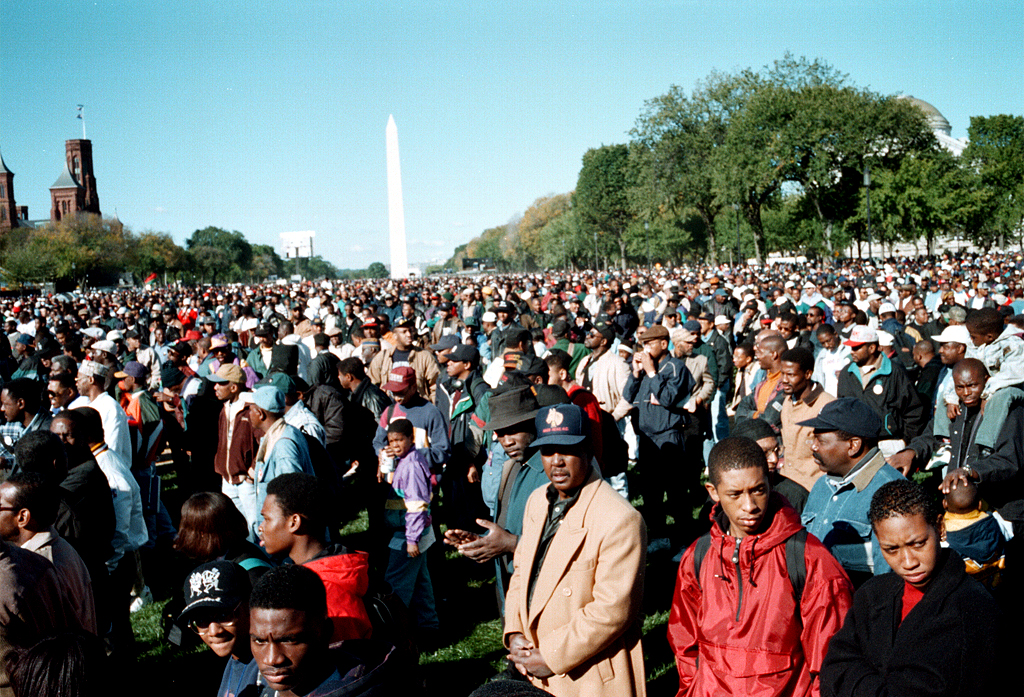
Million Man March, Washington, DC, October 16, 1995. Source: http://www.flickr.com/photos/yoke_mc/12469525/flick.com This file is licensed under the Creative Commons Attribution 2.0 Generic license.

I wrote this five years ago, but the same questions can be asked, for better and worse, with an addendum. That in the light of what Black men should do and shouldn’t, should expect and shouldn’t expect — of themselves and of the world — this is a very narrow-minded way of thinking. Concentrating on some limited definition of Black masculinity neglects the need to address inequality, systemic racism, the theft of hopes and dreams, not to mention, relationships and the intersection of race, class, gender, sexual orientation, religion, and everything else (though Black women and women of color have to deal with intersectionality every day, the issue goes mostly neglected and — if ever thought about — misunderstood by Black men).

If the past five years have shown anything, the issues addressing Black men have never existed in a vacuum. Police brutality and regular killings, White vigilantism, joblessness, debt, a dismantling of already under-resourced public schools, mass incarceration. These cannot ever be divorced from the issues facing Black women, women of color, the Black LGBT community, Latinos and Latinas, Native Americans, the poor and low-wage workers of color. Nor should they have been twenty years ago.

=====================================================

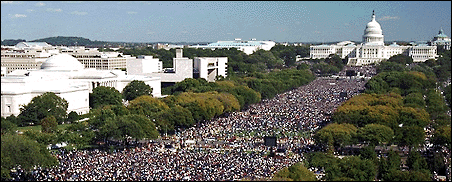
Today’s date has meaning for millions of people. Forty-one years ago, the New York Mets won their first World Series, beating the heavily favored Baltimore Orioles in five games. Crush #2 was also born forty-one years ago on this date (Happy Birthday!). But for a select group of African Americans — especially for over a million on the National Mall — today’s date marks fifteen years since the Million Man March.

I was there, though not among the million or so on the Mall that cold, windy and sunny day. I was in DC, on the Mall two hours before the gathering. I watched the highlights on CNN on the University of Maryland’s campus, all but completely clear of Black men under the age of thirty that afternoon. I met up with many a Black guy before and after the march, on the Metro as young men had taken the day off from work, school or college classes to go. On my bus back to Pittsburgh as older men talked of their broken lives, their remaining hopes and dreams. Most of all, I heard many speak of how inspired they were to go, as if God was calling them down to the Mall to find their true selves.

I didn’t go because I’d come down to the area that weekend for my dissertation research (including interviews) and to spend time with my long-distance girlfriend, who was a grad student at University of Maryland at the time. While I had some regrets about not attending, it’d been a while since I’d been involved with anyone on more than a passing occasion. Plus, I figured that my doctoral thesis on Black Washington and multiculturalism provided a significant intellectual exception to attending.

Louis Farrakhan, Million Man March, Washington, DC, October 16, 1995. Source: http://www.africawithin.com

Maybe I wasn’t being truly and authentically Black because I didn’t attend the march live, because I refused to stand in a sea of bodies to hear Louis Farrakhan’s voice encouraging Black men to take charge over themselves, their lives, their families. Maybe I did see myself as being above the fray because I saw all of this as a whole bunch of sound and fury signifying nothing but symbols. Maybe, in the end, being around so many Black men doing the same thing at the same time made me uncomfortable, just because I wasn’t sure what they expected to get out of the march after it was over.

Of course, symbols and inspiration are important, because without them, there is no action, no activism, no movement toward a goal that will ultimately change our lives, individually or collectively. But in listening to dozens of men who did attend the Million Man March that day and in the weeks that followed (as I traveled back to Pittsburgh, then to Minneapolis, then back to Pittsburgh, then DC, then New York in the month after the march), I realized that symbols and inspiration was all they expected out of the march.

Fifteen years later, the realization that nothing has really changed in the lives of many, if not most, of the million-plus men that attended the march on this date is disheartening. Those in poverty on that date may well still be in poverty. Those with years of addiction, or lives of crime, or without the compassion and skills necessary for fatherhood, all still struggling with these issues. That the cultural gap between Black men and Black women has widened since ’95 is obvious.

Yet there’s always hope, inspiration, and symbols that show that not all was for naught on Monday, October 16, ’95. It brought major issues facing African American males front and center to America and African America, and inspired many to work for social change and social justice for Blacks and for Black males in particular. Even if the messages of Farrakhan and company were mixed, contradictory, hypocritical, even sexist and bigoted. The march at least provided the realization that many Blacks cared deeply about finding themselves and finding solutions to issues that haunted them then, and haunt us still. Symbols are a powerful thing, even if it means we need many more of them before change can truly take hold.

Million Man March (Wide Above Shot), October 16, 1995. Source: Smithsonian Institution-http://photo2.si.edu/mmm/mmm08.gif


On Anachronistic Bullshit

12 Monday Oct 2015

Posted by decollins1969 in 1, Academia, Carnegie Mellon University, Christianity, culture, Eclectic, Movies, Patriotism, Politics, Pop Culture, race, Work, Youth

≈ 2 Comments

Tags

Afrocentricity, Anachronisms, Anachronistic, Beating a Dead Horse, Black Nationalism, Bullshit, Burnout, Conference Presentations, Fear of a "Black" America (2004), Jesus, Journal of American History, Mental Exhaustion, Multicultural Education, Multiculturalism, Nat Turner, OAH, Politics of Academia, Politics of Education, Socialism, Toronto


Kirsten Dunst and Jason Schwartzman get anachronistic between shots on set of Marie Antoinette (2006), September 2012. (Pinterest via http://buzzfeed.com).

Kirsten Dunst and Jason Schwartzman get anachronistic between shots on set of Marie Antoinette (2006), September 2012. (Pinterest via http://buzzfeed.com).

It’s that time of year in academia, folks. The heart of the fall scholarly conference schedule, between the beginning of October and mid-November (American Political Science Association conference as an exception, though). For the first time in a few years, I’m part of the schedule, as part of a panel on American imperialism and narcissism this weekend at the Society of U.S. Intellectual Historians conference here in DC.

The topic is a departure for me. In the couple of dozen or so conference presentations I’ve done since the mid-1990s, I have discussed two interrelated topics. Multiculturalism in the contexts of US history, African American history, and education policy was one, and covered every presentation I did between 1992 and 2003. Education reform in the context of college access, retention, and diversity was the other, and covered every conference presentation or other talk I did from 2004 through 2009.

Bokeem Woodbine, October 12, 2015.

Bokeem Woodbine, October 12, 2015. (http://imdb.com)

I never wanted to be wedded to one topic my whole career. It was the academic equivalent of being typecast, like Bokeem Woodbine (thug) or Anthony Azizi (terrorist). But in the spring of 2003, there I was, doing conferences as “Dr. Multiculturalism,” either for the benefit of eager grad students or to the chagrin of more senior scholars.

No one really discusses this issue in academia. The idea that any of us can decide to move on to a completely different topic as a scholar, become engrossed in it, even become an expert and present and write on that topic, and then move on to the next one (yes, there are consequences, but…). At best, most scholars in academia have variations-on-a-theme careers, covering sports history and society, moving from baseball to football to tennis. Or from Black migration in the early 20th century to gentrification and its impact on Black families in the ’90s and ’00s. (It’s not as if many academicians can’t find the time to pick up another idea!)

What’s even worse are the ways in which we in academia beat up on each other’s work at conferences, and not in a constructively critical way, either (that would be refreshing). The key for me moving on from multiculturalism began at the 1999 Organization of American Historians conference in Toronto. I presented on “The Black Brahmins of Harvard: W. E. B. Du Bois, Carter G. Woodson, and Alain L. Locke on
Multiculturalism, 1890-1940.” Admittedly, there were a few issues with the paper. I didn’t include any Black women in my consideration (although, given Harvard’s institutional racism and sexism in this period, Black women were almost nonexistent, including at the doctoral level). I had to deal with the Afrocentricity sect, who didn’t see multiculturalism as a fellow traveler, but instead as a Eurocentric “feel-good” understanding of US and Black culture.

Most importantly, I was being “anachronistic.” I had applied a term that hadn’t become commonplace until the 1970s to a previous period in history, one in which the term hadn’t been conceived. It didn’t matter that cultural pluralism had existed as a term since the 1890s and that many in the philosophy and education fields had used cultural pluralism and multiculturalism interchangeably. For this group of cultural and education historians, multiculturalism in my work equalled a no-go zone.

Jesus was a Socialist bumper sticker, an anachronism, October 12, 2015. (http://plus.google.com).

Jesus was a Socialist bumper sticker, an anachronism, October 12, 2015. (http://plus.google.com).

Though I managed a few short articles and a chapter on multiculturalism, time and time again, the question of anachronism came up. And despite all of my documented evidence, more senior scholars at journals refused to accept multiculturalism and Black history in the same sentence. “Surely you must be referring to Afrocentricity or Black Nationalism,” one reviewer for the Journal of American History wrote on a manuscript that he rejected in 2002.

It never occurred to me to call them directly on this bullshit. These same folks will write articles with titles like, “Was Jesus a Socialist?” or “a Marxist?,” or “Nat Turner’s Rebellion and the Birth of Black Nationalism.” Talk about anachronistic! Jesus and Karl Marx are roughly 1,800 years apart, and Black Nationalism is a specifically mid-to-late-twentieth century term. Yet this was much more all right than my early-thirties-self yammering about something as complex as multiculturalism and its role in the thinking and education of African Americans.

Beating a dead horse cartoon, September 2012. (Marc Cortez, http://marccortez.com).

Beating a dead horse cartoon, September 2012. (Marc Cortez, http://marccortez.com).

I’m hardly arguing that academicians who didn’t like my work should have seen my brilliance and allowed me to publish or present more on multiculturalism. Heck, by 1999, I was tired of my former dissertation topic already! A bit more honesty about what really bothered them, though, would’ve been helpful. The idea that ordinary people could be unconsciously participating in multiculturalist activities, in this case, ordinary Black folk, some academicians found unacceptable. The idea that I could write this was unacceptable to quite a few. The fact that my former patron in Joe Trotter wasn’t out there opening up doors for me on my topic left me in a bad place politically as well. I wasn’t supposed to be in academia, after all, at conferences or in scholarly journals. I know now that part of the point was to thin out the herd of competition, to anoint some and shun so many others, me included.

The constant rejection on fairly hypocritical grounds just made it easier for me to publish Fear of a “Black” America in ’04 and move on. Since I am at the beginning of the process of thinking through a new topic, I don’t have mental exhaustion as an excuse for crumbling in the face of soul-destroying, narcissistic opposition. I also have at least one thing going for me these days. I feel I’m old enough now to call numbskulls on their bullshit.

My Private Aftermath of the O.J. Simpson Verdict 20 Years Ago

01 Thursday Oct 2015

Posted by decollins1969 in 1, Academia, Boy @ The Window, Carnegie Mellon University, culture, Eclectic, Pittsburgh, Politics, Pop Culture, race, University of Pittsburgh, Work, Youth

≈ Leave a comment

Tags

Carl, CMU, Drama, James, Media Coverage, Murder, O.J. Simpson, O.J. Simpson Trial, O.J. Simpson Verdict, OJ Simpson, Race Riots, Racial Divide, Racism, Trial, White Bronco, Whiteness


 O.J. Simpson with his attorneys F. Lee Bailey (left) and the late Johnnie Cochran (right) after being found not guilty, October 3 1995. (Myung J. Chun/Los Angeles Daily News/AP, via http://theguardian.com)

O.J. Simpson with his attorneys F. Lee Bailey (left) and the late Johnnie Cochran (right) after being found not guilty, October 3 1995. (Myung J. Chun/Los Angeles Daily News/AP, via http://theguardian.com)

To think that it’s only been two decades since the overhyped “Trial of the Century” came to a close with a clerk’s initial mispronunciation of Orenthal James Simpson’s first name. And of course, with O.J. Simpson’s acquittal. It’s amazing to think that so many would become so emotionally caught up in a double-homicide case involving what at one time was one of the world’s most recognizable faces. But it did happen, all of it in a sixteen-month span, and the reaction was as predictable as the sunrise, racial profiling, and police harassment.

During the Ford Bronco chase on I-5 on Friday, June 17 (during my Knicks’ Game 5 of the NBA Finals against the Houston Rockets), I hoped that the police wouldn’t shoot Simpson before he had a chance to go to trial. The L.A. riots were just two years before. I feared that the issue of race would be front and center, with Simpson’s issues with his now dead White ex-wife.

O.J. Simpson on the covers of Newsweek and Time Magazine, (the picture on right altered to make Simpson appear darker and caused an outcry), June 27, 1994. (Theo's Little Bot via Wikipedia). Qualifies as fair use due to low resolution of image and relevance to subject matter.

O.J. Simpson on the covers of Newsweek and Time Magazine, (the picture on right altered to make Simpson appear darker and caused an outcry), June 27, 1994. (Theo’s Little Bot via Wikipedia). Qualifies as fair use due to low resolution of image and relevance to subject matter.

I was naive, thinking that our world of ’94 would simply attempt to determine if Simpson was guilty or innocent. Instead what I saw within ten days of the Bronco chase was an artificially darkened Simpson on the cover of Time. I saw Blacks who became angrier about the coverage, even as Whites grew more confident about Simpson being convicted, losing his fortune and fame, and possibly getting the death penalty (or at least, life imprisonment). My Mom proclaimed that O.J. was innocent long before the prosecution botched the trial. Some of my grad school colleagues — all White, mind you — made all kinds of assumptions about where I stood on O.J. They didn’t like the fact that I was willing to wait until the trial to make up my mind.

When the verdict came down on Tuesday, October 3, 1995, it was stunning to watch ecstatic Blacks and angry, dejected Whites react to the “Not Guilty” verdict. And not just on TV, although it was obvious newsrooms were actively looking for a racial divide. My friend James (who’s Black, by the way) from my Pitt grad school days spent his lunch break in my apartment gritting his teeth in anger as the verdict was read. I was more shocked than anything else. I smiled, but it was one of bewilderment observing the reactions, as if we all had some deeply personal stake in the trial and verdict.

That smile disappeared as I went through my day editing and printing out chapter drafts of my dissertation. That was my real focus, not the soap opera enveloping the rest of the country. Late that afternoon, I went to Carnegie Mellon to drop off a draft of a couple of those chapters for my thesis advisor Joe Trotter. Carl, a colleague of mine, one who I had called a friend up to this point, immediately started in on me about the verdict when I reached the grad student cubicles in the History Department. He kept literally spewing the media’s line about an all-Black jury, about jury nullification, about Johnnie Cochran. Carl was in a rage, belligerent, possibly drunk, and seemingly ready to throw down. Seriously, aside from showing up to drop off dissertation chapters, what did I do?

I politely pointed out that the jury was mostly, but not all Black (at least three members were White or Latino), and that the prosecution led by Marcia Clark and Christopher Darden left the door wide open for an acquittal. Carl assumed wrongly that I wanted O.J. free regardless of his “obvious guilt.” I asked my colleague what else could the jury do, given the compelling defense put together by the late Johnnie Cochran, the mistakes with forensics, with the glove, with putting Mark Fuhrman on the stand? I said that “I don’t represent all thirty million African Americans in this country,” and that “our conversation is over.”

Mary J. Blige, No More Drama (with extra tracks) album cover, 2002. (http://amazon.com).

Mary J. Blige, No More Drama (with extra tracks) album cover, 2002. (http://amazon.com).

That reminded me of how irrational supposedly rational, forward-thinking Whites often are on race matters. They either ignore, deny, or when compelled by some betrayal or injustice, badger, threaten and retaliate in response. Carl that day was no exception. I found that incident unsettling because this supposed friend was one of the few folks at Carnegie Mellon who had earned my trust. It reminded me if I were to ever date or marry someone White (not exactly my plan), there would be hell to pay. I had a grand total of three conversations with Carl after that between October 3, 1995 and August 6, 1999, the latter the week before I left Pittsburgh to live in suburban DC/Maryland.

I’m sure that I wasn’t the only Black person who had to confront Whiteness in all of its angry, hurt and juvenile forms in those first two weeks of October ’95. I’m equally sure that if the O.J. Simpson trial’s verdict occurred in 2015, Carl and his like-minded ilk would’ve set off race riots the likes of which this country hasn’t seen since Detroit in 1943, Tulsa in 1921, and Chicago in 1919. You know, the kind where Whites go into segregated Black communities and rape, kill, steal and destroy as much as they can. To me, Carl just represented the White privilege and resentment of millions, smoldering yet ready to erupt at a moment’s notice. Not that many haven’t benefited from the O.J. Simpson effect in the years since.

Carl has a professorship somewhere in New York these days, and we are professional colleagues who maybe exchange an email one or twice a decade now. I’m sure, though, that he avoids the topic of race in US history like most would want to avoid catching Ebola. Especially given his reaction to one jury verdict twenty years ago.

← Older posts
Newer posts →

Boy @ The Window: A Memoir

Boy @ The Window: A Memoir

Places to Buy/Download Boy @ The Window

There's a few ways in which you can read excerpts of, borrow and/or purchase and download Boy @ The Window. There's the trade paperback edition of Boy @ The Window, available for purchase via Amazon.com at http://www.amazon.com/Boy-Window-Donald-Earl-Collins/dp/0989256138/

There's also a Kindle edition on Amazon.com. The enhanced edition can be read only with Kindle Fire, an iPad or a full-color tablet. The links to the enhanced edition through Apple's iBookstore and the Barnes & Noble NOOK edition are below. The link to the Amazon Kindle version is also immediately below:

scr2555-proj697-a-kindle-logo-rgb-lg

Boy @ The Window on Amazon.com: http://www.amazon.com/Boy-The-Window-Memoir-ebook/dp/B00CD95FBU/

iBookstore-logo-300x100

Boy @ The Window on Apple's iBookstore: https://itunes.apple.com/us/book/boy-the-window/id643768275?ls=1

Barnes & Noble (bn.com) logo, June 26, 2013. (http://www.logotypes101.com).

Boy @ The Window on Barnes & Noble: http://www.barnesandnoble.com/w/boy-the-window-donald-earl-collins/1115182183?ean=2940016741567

You can also add, read and review Boy @ The Window on Goodreads.com. Just click on the button below:

Boy @ The Window

Twitter Updates

Tweets by decollins1969
  • RSS - Posts
  • RSS - Comments

Archives

  • June 2025
  • April 2023
  • September 2022
  • August 2022
  • July 2022
  • June 2022
  • May 2022
  • April 2022
  • March 2022
  • January 2022
  • December 2021
  • November 2021
  • October 2021
  • September 2021
  • August 2021
  • July 2021
  • June 2021
  • April 2021
  • March 2021
  • February 2021
  • January 2021
  • December 2020
  • November 2020
  • October 2020
  • September 2020
  • August 2020
  • July 2020
  • May 2020
  • April 2020
  • March 2020
  • January 2020
  • December 2019
  • November 2019
  • August 2019
  • July 2019
  • June 2019
  • May 2019
  • April 2019
  • March 2019
  • February 2019
  • January 2019
  • December 2018
  • November 2018
  • October 2018
  • September 2018
  • August 2018
  • July 2018
  • June 2018
  • May 2018
  • March 2018
  • February 2018
  • January 2018
  • December 2017
  • November 2017
  • October 2017
  • September 2017
  • August 2017
  • July 2017
  • June 2017
  • May 2017
  • April 2017
  • March 2017
  • February 2017
  • January 2017
  • December 2016
  • November 2016
  • October 2016
  • September 2016
  • August 2016
  • July 2016
  • June 2016
  • May 2016
  • April 2016
  • March 2016
  • February 2016
  • January 2016
  • December 2015
  • November 2015
  • October 2015
  • September 2015
  • August 2015
  • July 2015
  • June 2015
  • May 2015
  • April 2015
  • March 2015
  • February 2015
  • January 2015
  • December 2014
  • November 2014
  • October 2014
  • September 2014
  • August 2014
  • July 2014
  • June 2014
  • May 2014
  • April 2014
  • March 2014
  • February 2014
  • January 2014
  • December 2013
  • November 2013
  • October 2013
  • September 2013
  • August 2013
  • July 2013
  • June 2013
  • May 2013
  • April 2013
  • March 2013
  • February 2013
  • January 2013
  • December 2012
  • November 2012
  • October 2012
  • September 2012
  • August 2012
  • July 2012
  • June 2012
  • May 2012
  • April 2012
  • March 2012
  • February 2012
  • January 2012
  • December 2011
  • November 2011
  • October 2011
  • September 2011
  • August 2011
  • July 2011
  • June 2011
  • May 2011
  • April 2011
  • March 2011
  • February 2011
  • January 2011
  • December 2010
  • November 2010
  • October 2010
  • September 2010
  • August 2010
  • July 2010
  • June 2010
  • May 2010
  • April 2010
  • March 2010
  • February 2010
  • January 2010
  • December 2009
  • November 2009
  • October 2009
  • September 2009
  • August 2009
  • July 2009
  • June 2009
  • May 2009
  • April 2009
  • March 2009
  • February 2009
  • January 2009
  • December 2008
  • November 2008
  • October 2008
  • September 2008
  • August 2008
  • July 2008
  • June 2008
  • May 2008
  • April 2008
  • March 2008
  • February 2008
  • January 2008
  • December 2007
  • November 2007
  • October 2007
  • September 2007
  • August 2007
  • July 2007
  • June 2007

Recent Comments

MaryPena's avatarMaryPena on My Day of Atonement/Bitter Hat…
decollins1969's avatardecollins1969 on No Good Teaching Deed Goes…
Mary Rose O’Connell's avatarMary Rose O’Connell on No Good Teaching Deed Goes…

NetworkedBlogs on Facebook

NetworkedBlogs
Blog:
Notes From a Boy @ The Window
Topics:
My Life, Culture & Education, Politics & Goofyness
 
Follow my blog

616 616 East Lincoln Avenue A.B. Davis Middle School Abuse Academia Academy for Educational Development AED Afrocentricity American Narcissism Authenticity Bigotry Blackness Boy @ The Window Carnegie Mellon University Child Abuse Class of 1987 CMU Coping Strategies Crush #1 Crush #2 Death Disillusionment Diversity Domestic Violence Economic Inequality Education Family Friendship Friendships Graduate School Hebrew-Israelites High-Stakes Testing Higher Education History Homelessness Humanities Humanities Program Hypocrisy Internalized Racism Jealousy Joe Trotter Joe William Trotter Jr. K-12 Education Love Manhood Maurice Eugene Washington Maurice Washington Misogyny Mother-Son Relationship Mount Vernon High School Mount Vernon New York Mount Vernon public schools Multiculturalism MVHS Narcissism NFL Pitt Pittsburgh Politics of Education Poverty President Barack Obama Race Racial Stereotypes Racism Relationships Self-Awareness Self-Discovery Self-Reflection Sexism Social Justice Teaching and Learning University of Pittsburgh Violence Whiteness Writing

Top Rated

Blog at WordPress.com.

  • Subscribe Subscribed
    • Notes from a Boy @ The Window
    • Join 103 other subscribers
    • Already have a WordPress.com account? Log in now.
    • Notes from a Boy @ The Window
    • Subscribe Subscribed
    • Sign up
    • Log in
    • Report this content
    • View site in Reader
    • Manage subscriptions
    • Collapse this bar
 

Loading Comments...