• Spinning Sage’s Gold: Allegories on the Western-Dominated Present and a Possible Post-Western Future (2025)
  • About Me
  • Other Writings
  • Interview Clips
  • Video Clips
  • Boy @ The Window Pictures
  • Boy @ The Window Theme Music

Notes from a Boy @ The Window

~

Notes from a Boy @ The Window

Category Archives: Pittsburgh

The Road to My Memoir, Part 1: Welfare

07 Tuesday May 2013

Posted by decollins1969 in 1, Academia, Boy @ The Window, culture, Eclectic, High Rise Buildings, Mount Vernon New York, Pittsburgh, Politics, Pop Culture, race, University of Pittsburgh, Youth

≈ Leave a comment

Tags

Academic Writing, Adrian Nicole LeBlanc, AFDC, Case Managers, Case Workers, Criminalization, Discrimination, Emotional Detachment, Irony, Journaling, Journals, Kaaryn Gustafson, Personal Vignettes, Pitt, Public Housing, Racial Stereotypes, Racial Stigmas, Research, Rhonda Y. Williams, Scholarship, Welfare, Writing, Writing Process


Adrian LeBlanc's Random Family (2002) and Rhonda Y. Williams' The Politics of Public Housing (2005), May 7, 2013. (Donald Earl Collins).

Adrian LeBlanc’s Random Family (2002) and Rhonda Y. Williams’ The Politics of Public Housing (2005), May 7, 2013. (Donald Earl Collins).

This isn’t a straight-forward post or series of posts. I didn’t come to Boy @ The Window quickly or easily. I didn’t intend it to be a memoir, even though I’d left myself bread crumbs to turn it into a memoir years ago.

The first time I’d thought about writing a book related to my experiences was at the beginning of my junior year of college, in September and October ’89. Not even three months after my idiot stepfather had left 616 for good, and I was thinking about writing up something about the experience? A bit ambitious I was!

What I did do, though, was somehow find my old scraps of journals about what happened to me when I was twelve before I came back to Pittsburgh and Pitt for the school year. I wrote up additional experiences, about running away from 616 in August ’85, about my Mom’s experience at the feet and fists of my now ex-stepfather, about my time on a drafty Pitt stairwell the year before.

That was painful to write about, so soon after finally being rid of Maurice, too soon, really, for me to fully process it without re-living the experience. So I wrote or rewrote four of these experiences in all, and put them away in one of my Pitt notebooks.

But there was one other experience I wanted to write about, to move from a personal story to one of academic scholarship. It was the experience of my being on welfare from ’83 to ’87, covering on-the-ground perspectives from people like me and my Mom, as well as those of case workers. I thought that it would fill a void in both media coverage and in historical scholarship about the topic of welfare, particularly how it became a racial stereotype and slur.

I thought that by juxtaposing (and that’s the word I used for this back in ’89) the plight of welfare recipients and case workers, that I could show some sense of irony. That so many of the case workers and managers were only a paycheck or two away from being on welfare — and that some of them had been on welfare themselves, at least based on my limited experience — would make for an interesting story. What I hoped to show, ultimately, was the inhumanity of the welfare system itself, pitting people from similar socioeconomic backgrounds against each other because of the mix of welfare as racial and as a form of the undeserving getting their government handouts, of crumbs from America’s table being turned into a political football.

I didn’t say this exactly when I had a conversation about this topic with my former TA Paul Riggs in October ’89. The ideas and many of the sentiments, particularly about “juxtaposing,” “irony,” and “inhumanity,” though, were all part of the conversation. Riggs told me I needed to slow down, that even if I somehow were able to make this topic historical, that I’d need to much more reading on the topic, to divorce myself from my emotions around this topic.

In some ways, my late-twenties mentor was right. It’s hard to do scholarly work on a topic in which you are heavily emotionally invested. The topic wasn’t historical, given that I had just lived it and my Mom and younger siblings were still living it. And I was nineteen after all, and after seven years of seldom writing for any purpose outside of the classroom except letters to former high school classmates and college friends, a book would’ve been a daunting, almost immeasurable task.

That started me on the path to learn how to write like an academic historian, instead of writing out of emotion and irony. One that would delay my writing on anything like Boy @ The Window for the better part of a decade, even as the academic process enabled me to do the interviews and research necessary to put the memoir together.

Luckily, there are three authors whose work over the past decade has covered this topic of welfare, racial stereotypes, inhumanity, criminality and irony. Mostly in ways I would’ve covered it had I had the words and research skills to do this work twenty-four years ago. Adrian LeBlanc‘s Random Family (2002), though a sensational accounting of a Latino family in the Bronx between ’88 and ’01, does provide a glimpse (still MacArthur “genius” Award winner). Rhonda Y. Williams‘ The Politics of Public Housing: Black Women’s Struggles Against Urban Inequality (2005) is her excellent collection of research and personal vignettes about public housing, welfare, Black women and empowerment despite the odds covering the period between the 1940s and the early 1980s (with a bit on the early 1990s). All just before crack cocaine, TANF and the gentrification of previously off-limit poor neighborhoods in a city like Baltimore became bigger themes.

And now there’s Kaaryn Gustafson‘s Cheating Welfare: Public Assistance and the Criminalization of Poverty (2012). She covers in so many ways what I’d once hoped to capture in emotion and storytelling about the stain of welfare as illustrated in policies and politics. Kaaryn’s (I know her from my New Voices days) written a great book, one that I wished I could’ve read or written when I was nineteen.

Kaaryn Gustafson's Cheating Welfare (2012), May 7, 2013. (http://nyupress.org).

Kaaryn Gustafson’s Cheating Welfare (2012), May 7, 2013. (http://nyupress.org).

That wasn’t my path, though I had interests that would include welfare. No, my path was about race, diversity, education and self-discovery, not just about my Mom and family.

Boy @ The Window Update

03 Friday May 2013

Posted by decollins1969 in 1, Boy @ The Window, culture, Eclectic, Mount Vernon High School, Mount Vernon New York, Pittsburgh, Pop Culture, University of Pittsburgh, Youth

≈ Leave a comment

Tags

Apple iBookstore, Breaking News, iTures, Publishing, self-publishing, Smashwords.com, Third Party Distribution


iBookstore-logo-300x100

Final Cover

Latest news: Boy @ The Window is now available in enhanced digital (i.e., video, pictures and links) mode, via Apple’s iBookstore (through iTunes). Yay me!!!

Also, I’ve dropped Smashwords.com as a third-party distributor. Unlike many authors, I understand html/css code, and I have time to review and fill out contracts. Plus, getting support from Smashwords was like pulling teeth out of an elephant’s mouth with a teaspoon.

You can purchase Boy @ The Window for $4.99 through this link: https://itunes.apple.com/us/book/boy-the-window/id643768275?ls=1. And, it’s also available for the Kindle world on Amazon.com. Enjoy!

scr2555-proj697-a-kindle-logo-rgb-lg

Carnegie Mellon and the “Pope Girl”

03 Friday May 2013

Posted by decollins1969 in 1, Academia, Carnegie Mellon University, culture, Eclectic, Pittsburgh, Politics, Pop Culture, Religion, Youth

≈ 4 Comments

Tags

Alumni, Anti-Gravity Downhill Derby, Birth of a Nation (1915), Bishop David Zubik, Buggy Races, Carnival, Catholic Church, Catholic Diocese of Pittsburgh, Jared Cohon, Parody, Pittsburgh Tribune-Review, Pope, Pope Girl, School of Art, Spring Carnival, Spring Carnival 2013, WPXI


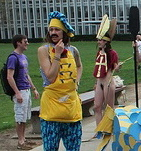
Pope Girl, Carnegie Mellon University, Pittsburgh, PA, April 18, 2013. (Pittsburgh Tribune-Review).

Pope Girl, Carnegie Mellon University, Pittsburgh, PA, April 18, 2013. (Pittsburgh Tribune-Review).

A couple of days ago, outgoing Carnegie Mellon University President Jared Cohon responded to criticism from the Catholic Diocese of Pittsburgh regarding an incident during the Spring Carnival 2013 festivities in mid-April. Known primarily for buggy cart races on campus/near Schenley Park, the Spring Carnival has also been a time for alumni to gather in force on the sanitarium of a campus, to relive whatever wonderful memories they have of attending CMU (by comparison, I’ve never attended, not even when I was a graduate student at CMU).

This year, though, the fourth annual spoofing of Carnival and the cart races by CMU’s School of Art — known as the Anti-Gravity Downhill Derby — involved a student dressed as the pope from the waist up. The get-up included a facsimile of the pontiff’s hat and crimson gown. From the waist down, the young woman wore nothing. Except for her vagina hair, cut in the shape of the cross. If this wasn’t bad enough, she and her compadres marched in the parade and handed out condoms during the event.

Now folks like Bishop David Zubik — and likely some deep-pocket conservative (and maybe even Catholic) alumni — want to see the CMU student the local media has called the “Pope Girl” punished. Hence, President Cohon’s emailed statement to the CMU alumni community on Wednesday:

Email message from CMU President Cohon to alumni, May 1, 2013. (Donald Earl Collins).

Email message from CMU President Cohon to alumni, May 1, 2013. (Donald Earl Collins).

I don’t find what this CMU student did “highly offensive” or even mildly offensive at all. Maybe it’s because I’d been to gay and lesbian pride parades at NYU back in the ’90s, where women and men dressed as the pope. Where women put black tape in the shape of a cross across their breasts while holding signs that said, “F— the Catholic Church.” Maybe I’m not offended because CMU’s the same university that didn’t close on the Martin Luther King holiday back in the ’90s, yet somehow thought it okay for students to show Birth of a Nation (1915) on that day.

CMU student dressed as pope (cropped, pre-parade), April 18, 2013. (http://bit.ly/109fnni for full pic).

CMU student dressed as pope (cropped, pre-parade), April 18, 2013. (http://bit.ly/109fnni for full pic).

I’m sure that exposing one’s pubic hair and butt cheeks in public violates some standards, either public nudity or lewdness in general. But beyond this, if there’s to be any punishment, it would be beyond unfair. After all, the Pope Girl is an adult, and has First Amendment rights to free speech, free expression and in this case, freedom of religion (specifically, the right to mock the pope). Yes, five centuries ago, she would’ve been declared a heretic, tortured and burned at the stake. But then again, so would’ve the 6,000 or so Catholic priests and their superiors who were involved in child molestation and rape over the years.

Face it. CMU’s only responding now because money may be involved, as in the loss of financial support from donors and potential donors. Morality, religion and decency aren’t exactly the central tenets of a university that’s dying to be seen on the same level of elite as MIT or Stanford. Still, this is the most exciting end to the Spring Carnival that I or anyone else has likely ever heard of or seen.

K-12 Curriculum as a Mystery Novel

02 Thursday May 2013

Posted by decollins1969 in 1, Academia, culture, Eclectic, Pittsburgh, Politics, Pop Culture, race, Youth

≈ 3 Comments

Tags

4th Grade, Facts of Life, Head of the Class, High-Stakes Testing, History, Homework, Immigration, Jacob Lawrence, K-12 Curriculum, K-12 Education, K-12 Education Reform, MAP-M, MAP-R, Maryland, MCPS, Migration, Montgomery County Public Schools, MSA, Mystery Novels, Parenting, Phillips Collection, Sherlock Holmes, Silver Spring, Social Studies, Student Development, Teacher-Parent Relationship, Teaching and Learning, Textbooks, The Migration Series, Washington DC, Writing


Unsolved Mysteries, December 19, 2011. (http://news.discovery.com).

Unsolved Mysteries, December 19, 2011. (http://news.discovery.com).

This week, my son will complete a fourth-grade project in which he interviewed his Pittsburgh grandmother about her migration experience from rural Arkansas to Pittsburgh, Pennsylvania during the Depression decade. Sounds pretty good — and very advanced — on the surface of things. But the reality of how this school project evolved shows how much has changed — and not for the better — regarding schools and curriculum. For my son’s school in Silver Spring, Maryland, for Montgomery County Public Schools and for schools across the country.

You see, the bulk of testing season is over for MCPS’ elementary schools. So instead of practice tests, formative assessments (otherwise known as “formatives”) and the actual exams (MSA, MAP-M and MAP-R), the teachers now have to focus on lesson plans that aren’t test-driven. For April, the fourth-grade teachers at my son’s school decided to do a social studies project on immigration. They started with a wax museum project at school, as well as a field trip to the Phillips Collection in DC.

This was where things began to get interesting for me as a parent. The permission slip for the field trip presented this unit as immigration. Yet in my son’s trip to the Phillips Collection, him and his classmates would peruse a set of Jacob Lawrence’s paintings on migration. For those of you who don’t know, Lawrence’s most famous paintings were of the Great Migration of African Americans from the rural South to the urban North between roughly 1915 and 1930.

Jacob Lawrence: Migration Series, Phillips Collection, Washington, DC (1993), May 1, 2013. (Elizabeth Hutton Turner; http://ucdavis.libguides.com/).

Jacob Lawrence: Migration Series (Cover Art), Phillips Collection, Washington, DC (1993), May 1, 2013. (Elizabeth Hutton Turner; http://ucdavis.libguides.com/).

I could barely contain the historian side of me when I read such an obvious and unbelievable error. But I decided to not assume that the fourth-grade teachers made the decision to treat immigration the same as migration. So I hand-wrote a note that politely suggested that they make a correction on the permission slip and for the overall assignment, since immigration and migration aren’t the same at all.

This was the response I received by email on April 4:

“We have had this wonderful trip planned for the 4th grade for the past 4 years and we always make sure to front load the students with information about the migration process.”

When teachers go into placating-mode without actually addressing my concerns as a parent (and an educator, for that matter), it’s usually a sign of trouble where there otherwise shouldn’t have been any trouble.

Then, nearly two weeks ago, my son brought home his interview/presentation assignment based on the wax museum project and his Phillips Collection field trip. It was titled “Immigrants in Their Own Words.” The fourth-grade teachers had charged the students — including my son — with the task of finding a family member who had immigrated to the US, interviewing them and asking them questions like “In which year did you come to America?” and “What is the biggest difference between America and your country of origin?”

Flabbergasted is just the beginning of my deep sense of puzzlement over the assignment. It was an assignment straight out of a Facts of Life or Head of the Class episode from the 1980s, culturally and racial insensitive to the core. After all, the height of White immigration to the US ended nearly a century ago. For Blacks, well, if I have to explain it, then it may be worth the while of those of you who do teach to take my History of American Education course (that is, whenever I get to teach it again).

My wife wrote an email about this follow-up assignment, to which my son’s teacher replied, “[e]migration and [i]mmigration are almost splitting hairs.” Really? In what history or ed foundations course? With some prodding, we were given the opportunity to adapt the assignment so that my son could work on migration. Of course, even without that note, I would’ve insisted on him doing migration anyway.

Mysterious...the new Sherlock Holmes, January 17, 2011. (H. Armstrong, Roberts/Corbis; http://www.guardian.co.uk/).

Mysterious…the new Sherlock Holmes, January 17, 2011. (H. Armstrong, Roberts/Corbis; http://www.guardian.co.uk/).

That this process was poorly executed is only part of the story. For nearly five years, my son’s curriculum has been a mystery to me, as it jumped around from pre-algebra to basic addition, from writing letters in which he could write phonetically to having to write about beetles in grammatically correct but short sentences. After five years, my son has never brought a textbook home. The weekly emails from teachers and postings on the neighborhood school website and the MCPS website tell me a lot about nothing.

In sum, I know quite a bit about test dates, subject areas and sometimes subject matter in which the state of Maryland and the school district will test the students. What we don’t know from day one of any school year are the themes for each subject for the year or for any given marking period. Because of the priority of testing above all else, the amount of time in the curriculum on subjects like social studies has narrowed, and with it, a teacher’s ability to be autonomous and to think through curriculum in a critical manner. And without textbooks, I as a parent can’t truly anticipate how to help prepare my son for any new or potentially challenging materials.

It’s difficult, though, to anticipate that your son will come home with an assignment on immigration in the fourth marking period of fourth grade. Especially when I as a history professor know how complicated these processes are for undergraduate and graduate students to wrap their brains around. Especially since my son has yet to write a full-fledged book report on any any book he has read for school. Or spent significant time on history or other, non-test-related subjects. Education should always be a journey, but never a mystery.

Boy @ The Window Is Live!

16 Tuesday Apr 2013

Posted by decollins1969 in 1, Boy @ The Window, Christianity, culture, Eclectic, eclectic music, Hebrew-Israelite, Jimme, Mount Vernon High School, Mount Vernon New York, Movies, music, My Father, New York City, Pittsburgh, Pop Culture, race, Religion, Sports, University of Pittsburgh, Work, Youth

≈ 3 Comments

Tags

E-Book, ebook, PDF edition, Publishing


Final Cover

Final Cover

Well, “it is done,” as my former graduate advisor Joe Trotter used to say. Boy @ The Window is now a published book. For now, it’s an e-book, available on Amazon.com through Kindle Books (as Boy @ The Window: A Memoir) and through Smashwords.com (which will then ensure that the book makes its way to iBooks, Apple’s bookstore, as well as Barnes & Noble.com). I also have a free PDF edition of Boy @ The Window (text only) available on this blog site (in the sidebar to the right), at least for the next three months.

I anticipate putting out a trade paperback edition in the next few months, either in July or in the fall. But with more than forty percent of the book market now in the e-book realm, it made far more sense to start with the fastest growing part of the market first. It’s a bit weird not holding a copy of Boy @ The Window in my hands, being able to leaf through the paper pages. It’s been on my iPad, though, for a couple of days, and seeing it there in 100 percent working order has been a pretty good feeling.

For me, at least, incidents like the Boston Marathon bombing yesterday — and so many other tragedies and dastardly events in the seven years and four months since I first began writing my book — are a reminder to live every day like there may not be a next one. After years of work and waiting for the commercial market to say “yes” to Boy @ The Window, I knew I didn’t want to wait forever to put this work of mine out into the world. So, “hello, world!”

“The Dying of Black Women’s Children”

27 Wednesday Mar 2013

Posted by decollins1969 in 1, Academia, Boy @ The Window, Carnegie Mellon University, culture, Eclectic, eclectic music, music, Pittsburgh, Politics, Pop Culture, race, University of Pittsburgh, Youth

≈ Leave a comment

Tags

"A Substance of Things Hoped For", "Sittin' on the Dock of the Bay", "The Evidence of Things Not Seen", Black Migrants, Black Migration, C. Matthew Hawkins, Census Data, Child Mortality, Child Mortality Rates, Correlation, Infant Mortality, Infant Mortality Rates, Joe William Trotter Jr., Julie Saville, Larry Glasco, Laurence Glasco, Lotus 1-2-3, Otis Redding, Pitt Honors Convocation 1994, Public Health Records, Quantitative Analysis, Quantitative Methods, SPSS, University of Chicago, Women Studies Program Award


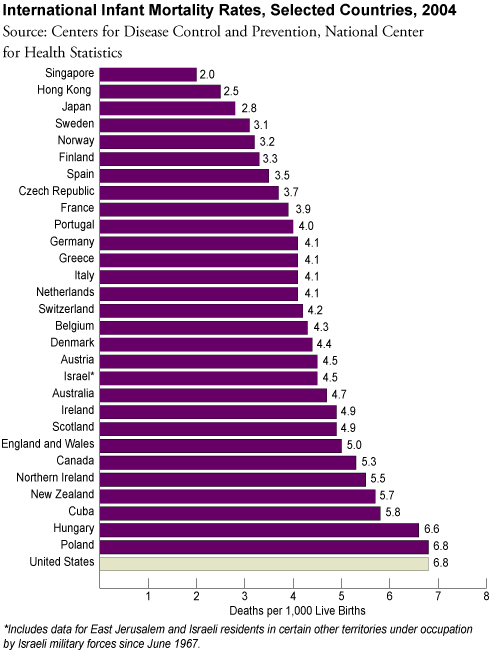
Infant mortality rates by country (2004), March 27, 2013. (http://www.mchb.hrsa.gov/). In public domain.

Infant mortality rates by country (2004), March 27, 2013. (http://www.mchb.hrsa.gov/). In public domain.

That was the title of a research paper I wrote for an independent study course I did with my former Pitt advisor Larry Glasco. It was a paper I wrote during my last semester at the University of Pittsburgh, undergrad and grad school. It was the last paper I would write for any professor at Pitt. But it was a paper that would address a bunch of common themes about me as a historian and scholar knowingly, and a writer unknowingly.

I began this paper without a course and on my own time in the Fall ’92 semester (see my post “December Doctoral Decisions” from last year). I had to fulfill a quantitative methods requirement in order to take my PhD comprehensive examinations at the end of my coursework, which at my pace would’ve meant taking them in the fall of ’93 at Pitt. Why they never included a qualitative methods requirement, I’ll never know. Of course, this digital humanities movement of quantifying the heretofore unquantifiable was but an embryo in the early ’90s.

With my language requirement taken care of the year before, I had no choice but to build on my existing statistical knowledge. Luckily, I’d inadvertently minored in mathematics and had been a computer science major before switching to history. I’d already decided on the topic of comparing infant/child mortality rates among White and Black Pittsburghers between 1900 and 1920, coinciding with the Great Migration period for Blacks. This meant census data from 1900, 1910 and 1920. This meant public health records from the same twenty-year stretch. It meant looking at neighborhoods like the Lower Hill District and Bloomfield, the occupations of the men and (in the case of Blacks) women living in these communities.

And it meant that I had to learn how to use SPSS, the most powerful number-crunching statistical software package on the planet. At least as far as I was concerned. It took me from September ’92 until the end of January ’93 to get comfortable enough with SPSS to plot and correlate different points of data. By then, I could generate reports and make sense of them. I knew that race, poverty/neighborhood and occupation (in that order) correlated best to the 2.5 to 1 ratio between infant/child mortality (death between child birth and the age of five) rates for Black families versus White families.

I used Lotus 1-2-3 to construct the tables, charts and graphs for my statistical correlations and data. Why Lotus 1-2-3? Their charts and graphs looked like “arts and crafts,” to steal a phrase from David Letterman. SPSS’s visuals were boring. Between the numbers crunching, the translation of correlation data into Lotus, and the actual writing of this paper, I completed my work for this independent study and quantitative methods requirement at the end of February ’93.

By then, I had two issues. One, I didn’t know what to title my paper. Most of my titles were inspired by cultural references from music, sports, TV shows, catch commercial jingles. I’d titled one paper “‘Sittin’ On The Dock of The Bay’,” an homage to Otis Redding and in reference to the topic of Black migrants finding permanent economic degradation after leaving the Jim Crow South for places like New York, Chicago and L.A. Another one, which I’d presented at several conferences, was “‘The Evidence of Things Not Seen’,” a prelude to my “‘A Substance of Things Hoped For'” dissertation (thanks to Hebrews 11:1 and James Baldwin).

Pitt Honors Convocation program, (March 1, 1994), March 27, 2013. [Ironic, given that I received this honor when I was at CMU]. (Donald Earl Collins).

Pitt Honors Convocation program, (March 1, 1994), March 27, 2013. [Ironic, given that I received this honor when I was at CMU]. (Donald Earl Collins).

I solved this title problem while simultaneously dealing with the second issue, which was that I knew I was about to transfer to Carnegie Mellon to complete the doctorate. Joe Trotter had invited me to attend the job talks of a young professor who had recently earned tenure at the University of Chicago, I believe. I remember her being fairly attractive and found her work interesting, if not fascinating. While we walked up and down the factory floor, um, second-floor corridors of Baker Hall, I walked by a flyer for an upcoming talk on “The Dying of Young Women’s Children.” I decided that this would be the scaffolding for my paper’s title, right then and there. Only, I’d change “Young” to “Black” and give a footnote of credit to the flyer title.

I submitted my paper to Larry for my independent study, which I was now taking purely as pass/fail (or satisfactory/unsatisfactory), and not for a specific grade. After Larry learned of my departure, he never gave me feedback on the paper. As the end of the semester approached — and I became short on cash — I submitted the paper to the Women’s Studies Program’s Student Research (undergraduate and graduate) contest.

Pitt's Women's Studies Program Annual Prize for Student Research on Women and Gender, June 1993, March 27, 2013. (Donald Earl Collins).

Pitt’s Women’s Studies Program Annual Prize for Student Research on Women and Gender, June 1993, March 27, 2013. (Donald Earl Collins).

Two months later, in June ’93, I learned that I’d finished second in the graduate student category, and earned a check for $75, a week’s worth of groceries! My friend Matt, upon learning of my good fortune, said, “You won that prize because of that title,” adding that I “stole it” from a flyer.

Matt was right, of course. But I also learned something important through “The Dying of Black Women’s Children.” That all writers borrow from others’ words and ideas, and then make them their own.

In the Closet, On the Down Low

01 Monday Jun 2009

Posted by decollins1969 in 1, Boy @ The Window, Christianity, culture, Eclectic, Jimme, Mount Vernon High School, Mount Vernon New York, My Father, Pittsburgh, Politics, Pop Culture, race, Religion, Youth

≈ 3 Comments

Tags

Asexuality, Black Masculinity, Covenant Church of Pittsburgh, Evangelical Christianity, F-Bomb, Faggots, Gay Pride Month, Heterosexism, Heterosexuality, Hypermasculinity, LGBT rights, Masculinity, Self-Reflection, Uncomfortability


The rainbow flag waving in the wind at San Francisco's Castro District, San Francisco, CA, August 5, 2010. (Benson Kua via Wikipedia). Released to public domain via CC-SA-2.0.

The rainbow flag waving in the wind at San Francisco’s Castro District, San Francisco, CA, August 5, 2010. (Benson Kua via Wikipedia). Released to public domain via CC-SA-2.0.

It’s Gay Pride Month, or LGBT Month, or GLBT Month, I guess, depending on one’s perspective. I have nothing directly to contribute, being the semi-well-adjusted heterosexual I am. But I do have something to say about what it means to me to have moved from a world where homophobia and heterosexism was a part of everyday speech (and sometimes action) to a place where it’s actually easy for me to embrace others of a different sexual orientation. Of course, I’m not talking about the world at large. I’m talking about 616 and the folks I knew growing up in Mount Vernon.

This isn’t easy for me to discuss. It means revealing more about myself and some painful memories growing up than even I’m used to doing. Still, it’s important for me and for others to understand that uncomfortable as folks may be about the reality that some people aren’t strictly male, female or heterosexual, these so-called others exist, and are a part of our family, among our co-workers, and deserve our acceptance, love, friendship and support. Or at least, our tolerance.

This story starts with an exchange I had with my father Jimme a couple of weeks before the start of my senior year in high school, August ’86. In a summer when my sexuality was no longer a question — at least to me — my father still had his doubts. I’d hardly seen Jimme most of the summer, only coming over occasionally to see how he was doing or to bum a few bucks off of him. I saved enough money from my job to cover the cost of my three AP classes — $159 to cover the $53 fee for each of the three classes. The College Board and MVHS didn’t grant fee waivers for these courses. Even though I had put that money in my mother’s checking account, I knew that with our money issues my savings were gone. So I found Jimme one Saturday morning near the end of August hanging out on the street corner and having drunk his fill.

His mood was especially foul that day, like his body odor. He refused to give me any money. “I don’ give my money to no faggats!” Jimme yelled at me as he came walking down his block toward me. He’d seen me come out of the front yard of the house he lived in. I wasn’t in the mood for his crap. “I’m not a faggot and I’m not gay,” I yelled back. When he got closer, I could see that he’d been out too long already. Jimme’s clothes were a mess, and his face was in a twisted rage. He grabbed me by my arm.

“Did you get yo’ dict wet?,” he asked as usual.

“Even if I did, I wouldn’t tell you,” I said.

“YOU’RE A FAGGAT,” he yelled again.

I was so pissed with him that I said, “Forget it. I don’t want your money. I’ll find a job somewhere.”

That was when the conversation got ugly.

“Ain’t no one gonna giv’ a faggat like you no job.”

“You’re a drunk and you’ve had a job for years.”

“Watch who you talkin’ to bo’. I da boss of the bosses. No one tell me what to do.”

“Why should I? I’m a faggot, right? Faggots don’t have to listen to an alcoholic like you”

“I yo’ father, an’ if you want my money, you do what I say.”

“I don’t have to listen to you or anybody else.”

“Come here bo’!”

At that point, I came over and Jimme grabbed my arm. Then he tried to punch me in the face. I caught his right arm, twisted it away from me and toward him, and then pushed him away. The push sent him to the ground, tipsy as he was.

“I can’ believe you hit yo’ dad”

“I didn’t hit you, I pushed you. Besides, you tried to hit me first. You’re not acting like much of a dad right now, anyway.”

I started to walk away, only to be hit in the head with folded up money, about $200 in all. “Take it all, faggat. I don’ want you aroun’ here no more,” he said.

This time I grabbed him and stuffed half the money in his pocket.

“Don’t you still have to eat, pay rent, get some more to drink?”

I kept all of the rest because I figured I earned it that day. Darren, par for the course, just stood around and watched.

That was a scary conversation and confrontation for me. It meant seeing myself for the first time as someone not only defending myself, but defending unnamed others. I could’ve easily said that I love women, and only women, that there was something wrong with gays and being gay. But I didn’t. I guess because at least gays hadn’t chased me down the street, calling me a “faggat” in the process.

I was also ambivalent, though. My mother, for all of her quietness about my lack of dating and friends in the five years before I went off to college, would make weird statements basically daring me to say that I was gay just so she could somehow un-gay me if I was. For her, the mixed signals she received from me started when I was seven. We had just moved to 616, and after a summer camp at Darren’s Clearview School, we went outside on 616’s grounds for the first time, in August ’77. The kids at 616 and 630 harrassed us, chased us around while throwing rocks at us. Scared, we hid behind the big, wooden, dark brown front door and huddled, hoping that the kids wouldn’t find us.

Instead, a couple of young Black Turks saw us, took us to my mother and stepfather, and declared that they saw us doing “the dukey.” I had no idea what they were talking about. All I knew was that my mother and stepfather proceeded to whip us as if we’d gone to the grocery store and stolen $100 worth of candy and soda. Besides “dukey,” the only other new word I picked up that day was “faggot.” That, and an incident one year earlier, one in which an older boy attempted to force me to suck his penis, was about all I knew about how others were “different” and how others saw difference until high school. Even then, I understood at some level the difference between someone attempting to force you to into a sexual act and someone simply being themselves. It didn’t necessarily make me feel better, though.

There were others who dropped the F-bomb on me over the years. Most of them were Black and Afro-Caribbean guys whom I’d shown up in the classroom or in gym class. All of it made me feel as if there were something wrong with me, like a target had been painted on my forehead that said this fool is so different that we can see in him the worst of our homophobic fears.

Even when I started to date, and even after I started having sex, I would occassionally run into women and men who assumed I was gay. Or at least, “asexual,” “sober,” “boring.” It was partly due to my overintellectualizing sex as a distraction, combined with a well-developed habit of protecting myself emotionally, that led to others making these cosmic-leap assumptions.

By the time I had reached my junior year at Pitt, I knew full well that not only I wasn’t gay, but that I was comfortable being around gays, lesbians, even transgender folk. And that made me uncomfortable. I was also a Christian, and between my mother, televangelists like Frederick K.C. Price, Kenneth Copeland, Jimmy Swaggert, Oral Roberts, as well as some of my friends, I found it difficult to reconcile their interpretations of scripture with my own natural comfortability with people of different sexual orientations. Even in grad school, if someone asked me — I certainly didn’t volunteer this — I’d trip over my own words quoting scripture while saying that it’s none of my business what other people do in their private lives.

It took an interview I did with an office at the University of Maryland in ’98 to finally see what I was doing. They asked me flat out if I had a problem advising LGBT students. I actually didn’t, but I also didn’t want to come off as gay myself. So I kind of tripped all over the place while answering the question. Not only did I not get the job. The phone clicked about five seconds after I gave my answer.

I realized that I was still being heterosexist myself, that I had yet to confront the issues I had around sexuality growing up. I made a few decisions around this issue after that interview. One was to stop spouting out-of-context scriptural rhetoric about homosexuality, and to stop attending churches where gays and lesbian were blamed for high crime rates and poverty, like the church I used to attend in Wilkinsburg back in the ’90s. I realized that there was a higher law, one that says “judge not, lest ye be judged,” and “do unto others…” Beyond that, it’s okay to say “I don’t know” when it comes to Christianity and to say “I’m comfortable” when I’m at work or in conversation with someone who happens to be gay or lesbian.

For those wholly uncomfortable with what they’ve been reading, let me say this. Uncomfortability with someone different is hardly unusual. But your uncomfortability shouldn’t mean that someone else’s human and civil rights should be trampled in the process. On the spiritual front, we aren’t supposed to pass judgment on others because we’re uncomfortable with who they are or even how they live as Christians. What do we know, anyway? Otherwise, we’re no different from the White bigots who rapped themselves around a Confederate flag while killing, maiming and intimidating Blacks and others of color out of their rights. Oh well! I guess I’m out of the closet now myself.

← Older posts
Newer posts →

Boy @ The Window: A Memoir

Boy @ The Window: A Memoir

Places to Buy/Download Boy @ The Window

There's a few ways in which you can read excerpts of, borrow and/or purchase and download Boy @ The Window. There's the trade paperback edition of Boy @ The Window, available for purchase via Amazon.com at http://www.amazon.com/Boy-Window-Donald-Earl-Collins/dp/0989256138/

There's also a Kindle edition on Amazon.com. The enhanced edition can be read only with Kindle Fire, an iPad or a full-color tablet. The links to the enhanced edition through Apple's iBookstore and the Barnes & Noble NOOK edition are below. The link to the Amazon Kindle version is also immediately below:

scr2555-proj697-a-kindle-logo-rgb-lg

Boy @ The Window on Amazon.com: http://www.amazon.com/Boy-The-Window-Memoir-ebook/dp/B00CD95FBU/

iBookstore-logo-300x100

Boy @ The Window on Apple's iBookstore: https://itunes.apple.com/us/book/boy-the-window/id643768275?ls=1

Barnes & Noble (bn.com) logo, June 26, 2013. (http://www.logotypes101.com).

Boy @ The Window on Barnes & Noble: http://www.barnesandnoble.com/w/boy-the-window-donald-earl-collins/1115182183?ean=2940016741567

You can also add, read and review Boy @ The Window on Goodreads.com. Just click on the button below:

Boy @ The Window

Twitter Updates

Tweets by decollins1969
  • RSS - Posts
  • RSS - Comments

Archives

  • June 2025
  • April 2023
  • September 2022
  • August 2022
  • July 2022
  • June 2022
  • May 2022
  • April 2022
  • March 2022
  • January 2022
  • December 2021
  • November 2021
  • October 2021
  • September 2021
  • August 2021
  • July 2021
  • June 2021
  • April 2021
  • March 2021
  • February 2021
  • January 2021
  • December 2020
  • November 2020
  • October 2020
  • September 2020
  • August 2020
  • July 2020
  • May 2020
  • April 2020
  • March 2020
  • January 2020
  • December 2019
  • November 2019
  • August 2019
  • July 2019
  • June 2019
  • May 2019
  • April 2019
  • March 2019
  • February 2019
  • January 2019
  • December 2018
  • November 2018
  • October 2018
  • September 2018
  • August 2018
  • July 2018
  • June 2018
  • May 2018
  • March 2018
  • February 2018
  • January 2018
  • December 2017
  • November 2017
  • October 2017
  • September 2017
  • August 2017
  • July 2017
  • June 2017
  • May 2017
  • April 2017
  • March 2017
  • February 2017
  • January 2017
  • December 2016
  • November 2016
  • October 2016
  • September 2016
  • August 2016
  • July 2016
  • June 2016
  • May 2016
  • April 2016
  • March 2016
  • February 2016
  • January 2016
  • December 2015
  • November 2015
  • October 2015
  • September 2015
  • August 2015
  • July 2015
  • June 2015
  • May 2015
  • April 2015
  • March 2015
  • February 2015
  • January 2015
  • December 2014
  • November 2014
  • October 2014
  • September 2014
  • August 2014
  • July 2014
  • June 2014
  • May 2014
  • April 2014
  • March 2014
  • February 2014
  • January 2014
  • December 2013
  • November 2013
  • October 2013
  • September 2013
  • August 2013
  • July 2013
  • June 2013
  • May 2013
  • April 2013
  • March 2013
  • February 2013
  • January 2013
  • December 2012
  • November 2012
  • October 2012
  • September 2012
  • August 2012
  • July 2012
  • June 2012
  • May 2012
  • April 2012
  • March 2012
  • February 2012
  • January 2012
  • December 2011
  • November 2011
  • October 2011
  • September 2011
  • August 2011
  • July 2011
  • June 2011
  • May 2011
  • April 2011
  • March 2011
  • February 2011
  • January 2011
  • December 2010
  • November 2010
  • October 2010
  • September 2010
  • August 2010
  • July 2010
  • June 2010
  • May 2010
  • April 2010
  • March 2010
  • February 2010
  • January 2010
  • December 2009
  • November 2009
  • October 2009
  • September 2009
  • August 2009
  • July 2009
  • June 2009
  • May 2009
  • April 2009
  • March 2009
  • February 2009
  • January 2009
  • December 2008
  • November 2008
  • October 2008
  • September 2008
  • August 2008
  • July 2008
  • June 2008
  • May 2008
  • April 2008
  • March 2008
  • February 2008
  • January 2008
  • December 2007
  • November 2007
  • October 2007
  • September 2007
  • August 2007
  • July 2007
  • June 2007

Recent Comments

MaryPena's avatarMaryPena on My Day of Atonement/Bitter Hat…
decollins1969's avatardecollins1969 on No Good Teaching Deed Goes…
Mary Rose O’Connell's avatarMary Rose O’Connell on No Good Teaching Deed Goes…

NetworkedBlogs on Facebook

NetworkedBlogs
Blog:
Notes From a Boy @ The Window
Topics:
My Life, Culture & Education, Politics & Goofyness
 
Follow my blog

616 616 East Lincoln Avenue A.B. Davis Middle School Abuse Academia Academy for Educational Development AED Afrocentricity American Narcissism Authenticity Bigotry Blackness Boy @ The Window Carnegie Mellon University Child Abuse Class of 1987 CMU Coping Strategies Crush #1 Crush #2 Death Disillusionment Diversity Domestic Violence Economic Inequality Education Family Friendship Friendships Graduate School Hebrew-Israelites High-Stakes Testing Higher Education History Homelessness Humanities Humanities Program Hypocrisy Internalized Racism Jealousy Joe Trotter Joe William Trotter Jr. K-12 Education Love Manhood Maurice Eugene Washington Maurice Washington Misogyny Mother-Son Relationship Mount Vernon High School Mount Vernon New York Mount Vernon public schools Multiculturalism MVHS Narcissism NFL Pitt Pittsburgh Politics of Education Poverty President Barack Obama Race Racial Stereotypes Racism Relationships Self-Awareness Self-Discovery Self-Reflection Sexism Social Justice Teaching and Learning University of Pittsburgh Violence Whiteness Writing

Top Rated

Blog at WordPress.com.

  • Subscribe Subscribed
    • Notes from a Boy @ The Window
    • Join 103 other subscribers
    • Already have a WordPress.com account? Log in now.
    • Notes from a Boy @ The Window
    • Subscribe Subscribed
    • Sign up
    • Log in
    • Report this content
    • View site in Reader
    • Manage subscriptions
    • Collapse this bar
 

Loading Comments...