• Spinning Sage’s Gold: Allegories on the Western-Dominated Present and a Possible Post-Western Future (2025)
  • About Me
  • Other Writings
  • Interview Clips
  • Video Clips
  • Boy @ The Window Pictures
  • Boy @ The Window Theme Music

Notes from a Boy @ The Window

~

Notes from a Boy @ The Window

Category Archives: Pittsburgh

Boy @ The Window – 1st Anniversary!

17 Thursday Apr 2014

Posted by decollins1969 in 1, Boy @ The Window, Christianity, culture, Eclectic, Hebrew-Israelite, High Rise Buildings, Jimme, Marriage, Mount Vernon High School, Mount Vernon New York, My Father, New York City, Pittsburgh, Pop Culture, race, Religion, Sports, University of Pittsburgh, Youth

≈ Leave a comment

Tags

Book Promotions, BookExpo America 2014, Positive Feedback, Publishing Business


Boy @ The Window 1st Anniversary

Boy @ The Window 1st Anniversary

Nope, no balloons or streamers for this one, the one-year anniversary since I put out the first e-book version of Boy @ The Window on Amazon Kindle. Yay, me! It’s been a pretty good twelve months, one of a few highs and a bunch of lows in selling and promoting the book, in moving forward with a plan, only to have tossed it aside for a new set of plans for the remainder of 2014 and 2015.

The bit of encouraging news — aside from some royalties for Boy @ The Window so far — is that there are a couple of places reviewing it now (finally), and I’m finally moving along with promoting the book. Beyond that, there are few things tougher psychologically than book promotions. This is why folks hire publicists — emotional distance can be helpful in reaching out to friends and strangers.

But, from the feedback (mostly through email and Facebook) I’ve gotten so far, people really like Boy @ The Window. Trust me, when a reader tells you they couldn’t put the book down once they started to read it, that’s an emotional boost! It’s part of what has enabled me to keep going on this venture into the cyclone of the publishing world.

I’ve planned for attending BookExpo America for the first time at the end of next month in New York. It’ll likely be a gigantic sea of authors, publishers, editors and others looking for an edge. I just hope that it’s worth the money I’m about to spend there.

One thing that I should note, though, as I continue to write on my blog and proceed with Boy @ The Window promotions. There are plenty of posts here that aren’t in the memoir, and plenty of stories in Boy @ The Window that I haven’t posted here. You can get some idea of what’s in the book from reading my posts, but it would be far from a complete picture. Buy a copy. Take it for a spin. It’ll make you laugh and cry, angry and hopeful, and all at times in the same paragraph.

On My Mother’s Side – Meeting The Gill Family

05 Saturday Apr 2014

Posted by decollins1969 in 1, Academia, Boy @ The Window, Carnegie Mellon University, culture, Eclectic, Pittsburgh, Pop Culture, Religion, Youth

≈ Leave a comment

Tags

AERA, Basketball, Bruce Anthony Jones, Continental Airlines, Extended Family, Family, Family Stories, Final Four 1994, Genealogy, Houston Texas, New Orleans, Poverty, Remembrance, Sports, The Gill Family, Third Ward, Travel, Uncle Darryl, Uncle George, Uncle Robert


Continental Airlines ticket stubs/itinerary, Pittsburgh to New Orleans (with Houston layover), April 2-10, 1994. (Donald Earl Collins).

Continental Airlines ticket stubs/itinerary, Pittsburgh to New Orleans (with Houston layover), April 2-10, 1994. (Donald Earl Collins).

This weekend marks twenty years since visiting my extended family on my mother’s side for the first time. It was Final Four weekend ’94 when I hopped on a Continental Airlines flight from Pittsburgh to Houston. To think that until April 2 ’94, I hadn’t been farther west than Atlanta or been in any other time zone seems far-fetched now that I’ve crisscrossed this country enough times to earn hundreds of thousands of frequent flyer miles. To think that for years I never felt I had a family to talk about at all or that what I did have wasn’t worth talking about. That all changed that weekend.

A conference presentation proposal I put together with Bruce Anthony Jones — my unofficial advisor in the School of Education at Pitt — had successfully made it through the difficult American Educational Research Association’s review process. So me, Bruce, and two other School of Education grad students were headed to the Big Easy to take in the sights and the serious scholarship that would be discussed, ad nauseum, the first full week of April. I managed to get a layover in Houston, all so that I’d have the chance to meet my extended family for the first time. Between the letter I sent to my Uncle Robert and my first adult conversation with a Gill relative other than my mother or Uncle Sam, I hoped that someone would be at the airport in Houston to meet me.

I landed in Houston around 9 am local time. I slept well on the flight, but I had only had about five hours total sleep before arriving in Bush country. I expected a dump of an airport, but the George H.W. Bush Intercontinental Airport (it wasn’t call that at the time I think) was as modern as Pittsburgh’s then two-year-old airport. I got down to baggage claim, and there they were. Uncle George and Uncle Darryl were there, grinning and smiling as if they could see me from a mile away. “I knew it was you, with that Gill nose,” he said as he walked toward me and gave me a big hug.

Historic Third Ward, Houston, Texas, March 2012 (not the part I got to visit). (Nelson Bowman III; http://www.myhbcuinterview.com)

Historic Third Ward, Houston, Texas, March 2012 (not the part I got to visit). (Nelson Bowman III; http://www.myhbcuinterview.com)

We got in George’s car, stopped by a gas station near downtown Houston first, to get gas and to get me something to eat and drink. Then they immediately went to the Third Ward to hang out with friends and play basketball. They only let me take three shots, and I missed all three, tired as I was. “We need real ballers out here,” my Uncle George said.

My uncles were good, but given the amount of time they spent on the court, they should’ve been. They both played basketball in high school in Bradley, Arkansas. Heck, all of the Gill boys played at least two sports growing up. My Uncle Sam played four — basketball, football, baseball, and track — and all of the others at least played basketball and football. George at thirty-two and Darryl at twenty-eight (neither of them liked me calling them “Uncle,” with me being twenty-four at the time) were still in pretty good shape, though Darryl complained about his midsection. They kept asking me, “Are you sure you’re a Gill?,” based on three shots I missed, including two that rimmed out.

Eventually I’d meet my Uncle Robert, his wife and sons, my Uncle Darryl’s girlfriend and eventual wife, and a few of Uncle George’s friends that weekend. Of all of the family meetings that took place, none was more meaningful than me sitting down to dinner that Saturday evening and Sunday afternoon with three of my uncles at one time. They grilled me with more questions than I’d get from my dissertation committee some five months later. “How big sis [my Mom] doin’?” “Do any of the kids play sports?” “What’s it like livin’ in the big city?” Even though my mother had been on welfare for eleven years, and living in poverty for some thirteen — working or not — they still thought that we were doing better than they were living in the middle of Texas. I tried, but failed, to convince them that our poverty was real.

It was a weird conversation, seeing that it was happening in the dining and living rooms of my Uncle Robert’s ranch-style house, a four-bedroom, two-bath home with a carport, backyard and decent front yard in suburban Houston. They owned four cars, and a leaky boat that needed some repairs. Pretty good for a man with a high school diploma and someone who was a shift supervisor for a local trucking company. Uncle Robert was the man, a six-five rail-thin man who looked almost like he could be his brother Sam’s twin instead of his slightly younger brother at forty-four years old. But Uncle Robert and the rest of them all assumed that since my mother hadn’t come running back to Texas or Arkansas for help that things were all right. They weren’t, as they’d learn a year later when the 616 fire left my mother and younger siblings homeless.

My Uncle, Robert Gill, Houston, Texas, received April 3, 1994. (Robert Gill/Donald Earl Collins).

My Uncle, Robert Gill, Houston, Texas, received April 3, 1994. (Robert Gill/Donald Earl Collins).

Beyond that, I learned a lot about the family. I confirmed some of the stories that my mother had told me over the years, including the one about my half-Irish, half Choctaw/Black great-great grandmother who was born in Indian Territory (now Oklahoma) in 1880. I also learned that my grandmother Beulah was originally from Tulsa, Oklahoma, that I really did have a great-grand aunt in Seattle, apparently New Edition lead singer Johnny Gill’s grandmother or great-grandmother, making all of us related.

That my uncles were and remained close was heartening, and that they managed to get decent and good-paying jobs was encouraging. It also gave me some sense of reassurance, if not pride, in the fact that they had put their lives together in Houston without any real guidance from family. By the time I boarded my flight to New Orleans that Sunday evening, I felt like I knew enough to talk about my family, mother’s and father’s side, for the first time.

Carnegie Mellon Stamp of Approval

17 Monday Mar 2014

Posted by decollins1969 in 1, Academia, Boy @ The Window, Carnegie Mellon University, culture, Eclectic, Pittsburgh, Pop Culture, race, University of Pittsburgh, Work, Youth

≈ Leave a comment

Tags

Advice, Barbara Lazarus, Book Reviews, CMU, Coursework, Doctoral Completion, Graduate School, Hazing, Joe William Trotter Jr., John Modell, Oral Comprehensive Exams, PhD, Pitt, Politics of Academia, Prayer, Stamp of Approval, Steve Schlossman, Sycophants, Torture


Approved rubbed stamp in green, March 17, 2014. (http://depositphotos.com).

Approved rubbed stamp in green, March 17, 2014. (http://depositphotos.com).

Two decades ago on this date, I took my oral PhD comprehensive exam. It was on a cloudy Thursday, a day after a late afternoon shower had left a rainbow over the otherwise dreary campus. Like the day after that rainbow, the exam was anticlimactic, more indicative of what I’d learned in two years as a grad student at Pitt than in my two semesters at Carnegie Mellon.

Getting to this exam was sheer torture. Not because I didn’t understand historiography, or hadn’t read at least 230 books and countless articles since my first day of grad school. No, it was torturous because the powers that were had insisted to make my schedule more like the one of a first-semester grad student the previous fall.

I ended up with two courses that I didn’t want and didn’t need, especially since the History Department at CMU had told me that they had accepted all of my master’s and PhD credits from the University of Pittsburgh. Though I had taken four grad seminars in US history (not to mention CMU Professor Joe Trotter’s grad seminar in African American history the year before), I was taking a first-year student’s grad seminar in US history – again! I also had to take comparative working-class history seminar with a combination of anti-race Marxists and brown-nosing sycophants more interested in an A than in actual evidence-based historical interpretation.

Prostate exam from Family Guy (1999-2003, 2005-present) screen shot, July 17, 2013. (http://chattanoogaradiotv.com).

Prostate exam from Family Guy (1999-2003, 2005-present) screen shot, July 17, 2013. (http://chattanoogaradiotv.com).

That, and being broke for most of the ’93-’94 school year — I took what amounted to a $2,000 stipend cut in my transfer from Pitt to CMU — made me pretty cranky my first six months at the home of elitist lily-Whiteness. There were days in those courses where I wanted to literally strangle some of my fellow grad students for being so dense (in the case of first-years) or for being so obviously fake in their praise of a given professor’s argument (in the case of two sycophants in particular). Only the late Barbara Lazarus and Trotter kept me grounded enough so that I didn’t spend every moment of Fall ’93 making voodoo dolls out of Steve Schlossman and John Modell for putting me through the hazing process.

Somewhere around the beginning of November ’93 — after some much-needed time in prayer — I began to realize a few things. One, that I’d already done so much reading on topics like immigration, industrialization, slavery and the connections between race and class (and race, class and gender). So much so that unless it was an author of major interest, I could skim or skip the reading, or even find a few book reviews and compare them to my extensive library of notes on the other authors in a given subfield or field.

Two, that my time outside of class was still my time. I knew that I wanted to do multiculturalism as a dissertation topic, and that I wanted to do it in the context of Black Washington, DC. So I began ordering microfilm of Black weekly newspapers like the Washington Tribune and Washington Bee (going back as far as 1915) to look at as much material as possible. It calmed me to know that I was working on my dissertation topic nearly a year before Trotter and my committee would official approve it.

Three, I knew by January ’94 that Schlossman, et al. had agreed that the Spring ’94 semester would be my last one in coursework. I still had to take Modell’s goofy Historical Methodologies course, but having to do things like my oral comprehensives made going to class just bearable enough.

Acting a part quotes from actors, March 17, 2014. (http://thepeopleproject.com/actors/quotes).

Acting a part quotes from actors, March 17, 2014. (http://thepeopleproject.com/actors/quotes).

Finally, I took out a loan. I’d only taken out one student loan since finishing undergrad in ’91, but it was obvious I couldn’t live off of a $7,500-per-year stipend. Really, no one could, not without rooming with another student or having a spouse with a real income. The money came in at the beginning of March, making my march to become ABD that year that much easier.

By the time I walked into the second-floor conference room in Baker Hall to take my orals, I knew there wasn’t a question about what I knew and how well I knew it. It was about whether I could show the folks at CMU that I could play along with them in their version of grad school, which wasn’t any different from any other history doctoral program’s version. And I did play along, for two hours, more than long enough to move on to the dissertation proposal round.

When I said years later to my friend Laurell that Humanities and Mount Vernon High School had prepared me more for grad school than it did for undergrad at Pitt, this was what I meant!

My and Diane Ravitch’s Path to Reign of Error

11 Tuesday Mar 2014

Posted by decollins1969 in 1, Academia, Boy @ The Window, Carnegie Mellon University, culture, Eclectic, Mount Vernon High School, Mount Vernon New York, New York City, Patriotism, Pittsburgh, Politics, Pop Culture, race, Upper East Side, Youth

≈ Leave a comment

Tags

Bill & Melinda Gates Foundation, Book Review, Corporate Education Reform, Diane Ravitch, Fear of a "Black" America (2004), High-Stakes Testing, Humanities Program, Institutional Racism, Michelle Rhee, Multiculturalism, Neoconservative Movement, Politics of Education, Poverty, Privatization, Racial Segregation, Racism, Reign of Error (2013), Social Injustice, Social Justice, Teach for America, Writing Passion


Reign of Error (2013) by Diane Ravitch, front cover. (http://bn.com).

Reign of Error (2013) by Diane Ravitch, front cover. (http://bn.com).

I first began reading Diane Ravitch in July 1990, the summer before my senior year at the University of Pittsburgh. It was the summer in which I became interested in understanding magnet programs and their relationship with desegregation and diversity efforts, courtesy of my own experience with Mount Vernon, New York public schools and its now defunct Humanities Program. I read both The Great School Wars: New York City, 1805-1973 (1974) and The Troubled Crusade: American Education, 1945-1980 (1985) that summer, with education scholar and Ford Foundation director Jeanne Oakes’ Keeping Track: How Schools Structure Inequality (1985) sandwiched in between.

It was the beginning of a twenty-year period of constantly intellectual disagreement between me and Ravitch. Oakes’ work captured inequality in terms of race and socioeconomics so much better than Ravitch, whose writings back then often treated these inequalities and distinctions as afterthoughts. When I shifted my research area to multicultural education and multiculturalism, though, that was when I found Ravitch’s absolutist defense of so-called traditional American democratic education and all things e pluribus unum unbelievably stifling. With all Ravitch knew about the politics of education, in New York and with the US Department of Education, how could she possibly defend a system that did as much to control and exclude students as it did to provide something akin to an equal opportunity?

I chalked Ravitch up to being another out-of-touch neoconservative, scared to death of race and diversity and multiculturalism. I said as much at conferences like the American Educational Research Association meeting and other conferences. I wrote as much in my dissertation and in my first book, Fear of a “Black” America: Multiculturalism and the African American Experience (2004). Through it all, I always found Ravitch’s writing compelling, but her conclusions wanting, because they lacked perspective and empathy in the context of public schools and diversity.

Then, Ravitch wrote Left Back: A Century of Battles Over School Reform in 2000. Though it contained some of her common themes — overemphasis on the mantra of reform, the need for more testing, support for school choice, denigration of a multicultural curriculum — Ravitch showed growth in this book. She was less hostile to a more progressive curriculum and seemed, for the first time, really, to understand how much race and poverty had shaped the direction and the harshness of school reform going back to 1900. I happily used Ravitch’s Left Back in my History of American Education Reform course at George Washington in 2002. For her book provided a comprehensive and even-handed overview of the politics of K-12 education in a way that any educator of any American ideological perspective could understand.

I’ve finally read Ravitch’s Reign of Error: The Hoax of the Privatization Movement and the Danger to America’s Public Schools (2013). Reign of Error is Ravitch at her most passionate and energized. If I hadn’t read a couple dozen of Ravitch’s articles from the 1980s and 1990s and four of her previous books, I would think that this was her first book, as there is sense of urgency in Reign of Error that can seldom be found outside of epic memoirs and epic fiction novels.

Ravitch’s argument in Reign of Error is a simple one. Corporate education reform, if allowed to continue unfettered, will destroy public education in the US, and in the process, American democracy. Privatizing public schools (i.e., turning them into “public” charter schools), destroying teacher’s unions, constant high-stakes testing, bypassing school boards and forgetting about racial segregation and poverty — that’s corporate education reform’s agenda. As Ravitch said in Chapter 12 on the fallacies of merit pay for teachers, “Merit pay is the idea that never works and never dies (p. 119).” She could have also substituted the words “school choice,” “creationism,” “standardized testing,” “closing schools,” and “privatization” for “merit pay.”

But Ravitch goes further in her 400-page treatise. That though public education in the US has had its share of problems — the need for more teacher training and time for professional development, racial segregation and high levels of poverty while underfunded — that corporate education reform has compounded these problems several times over. That with corporate education reform, teachers, parents and students will have no say in public education, at least the ones without their own personal foundation with which to endow their own public charter school.

From a writer’s standpoint, this wasn’t Ravitch’s best effort. Her argument is repetitive, one where she likely could’ve cut the main chapters by a quarter (about 100 pages) and made the same points. I likely could’ve become inebriated if I had a shot of vodka every time the words “poverty,” “Gates,” “Walton,” “Broad,” “high-stakes testing,” and “corporate education reform” come up. But given my history with reading Ravitch and with this topic, of course Reign of Error was repetitive — it was like reading my own words on this same topic.

Ultimately, Ravitch’s Reign of Error is a primer for anyone interested in averting the social injustice that is the corporate education reform tyranny of wealthy philanthropists, money-grubbing entrepreneurs and politicians across America’s limited ideological spectrum. For those whom up to now this issue has been of limited interest, or for those who’ve felt the change in public education but haven’t quite been able to articulate those feelings, Reign of Error is for you.

For educators, parents and even students already involved in writing about or protesting against corporate education reform, this book is still for you. Ravitch provides so much ammunition that Reign of Error can be applied in numerous ways to numerous situations. At school board meetings. With #AskMichelleRhee hash tags on Twitter. In job interviews with Teach for America and with the Bill & Melinda Gates Foundation. In letters to the editor of the mainstream newspapers and in comments to mainstream TV and radio newscasters. In arguments with neoconservative parents who send their kids to private schools.

“Protecting our public schools against privatization and saving them for generations of American children is the civil rights issue of our time (p. 325).” is how Ravitch ended her Reign of Error. It’s not an exaggeration. But it does beg a question. If we can successfully fend off corporate education reform — and assume that the country will continue to ignore the poverty and racial segregation that Ravitch desperately wants addressed — can she and I then spend five minutes discussing multiculturalism?

My First Boy @ The Window Interview

29 Wednesday Jan 2014

Posted by decollins1969 in 1, Academia, Boy @ The Window, Carnegie Mellon University, culture, Pittsburgh, Politics, Pop Culture, race, University of Pittsburgh, Youth

≈ Leave a comment

Tags

Book Promotion, CMU, Honesty, Lily-White, PR, Public Relations, Whiteness


Screen shot of CMU website's front page, January 29, 2014. (Donald Earl Collins).

Screen shot of CMU website’s front page, January 29, 2014. (Donald Earl Collins).

I had my first interview related to Boy @ The Window two and a half weeks ago, with a public relations person working on behalf of the Carnegie Mellon University website, CMU.edu. But this interview will likely never be posted on Carnegie Mellon’s website. Why, pray tell? Because I was honest about my CMU experience, in that it was bitter work, a frustrating time, a place in which I felt isolated in its lily-White conservatism (with a nod toward Asian students as honorary Whites).

I didn’t say all this in my interview. Okay, here’s what they asked and what I actually said (also on my Boy @ The Window Facebook  page):

Q: Why did you choose to attend CMU and pursue a Ph.D. in history?
A: Joe Trotter, in a word, was my deciding factor. I didn’t want to earn all of my degrees in history at the University of Pittsburgh, and the history department offered to accept my master’s degree and Ph.D. credits from Pitt. Plus, CMU’s history program was simply better, in that I knew I could graduate years ahead of time. But I came because I wanted to work with Joe Trotter.

Q: You mention that you’ve based your career in the areas of education reform and multiculturalism -why? Could you describe your work in these areas a bit more?
A: From the time I began reading history when I was nine years old, I’ve wondered about the horrors of this world, and how we as humans have shown a capacity for compassion and strength despite those horrors. My interest in multiculturalism was a natural extension of my quest to understand my past, those horrors, and especially the people from various backgrounds whom were my classmates in middle school and high school in Mount Vernon, New York. The irony was, though, that I didn’t consciously recognize these connections until I began working on Boy @ The Window. As for education reform, especially around college access and retention, it’s that sense that despite it all, access to higher education can and does transform lives, and provide a pathway to a more productive life. Multiculturalism was my dissertation research while at CMU – not to mention my first book, Fear of a “Black” America (2004) — while my interest in education reform began in my work in the nonprofit world. First with Presidential Classroom in 1999 and 2000, then with an initiative known as Partnerships for College Access and Success (PCAS), where I was the deputy director from 2004 to 2008.

Q: Did CMU play a role in your difficult journey to success? (Perhaps network, training, culture, etc…) Any professor/mentors to note?
A: Yes, because I earned my Ph.D. while at CMU. But in order to become the writer I am now, I actually had to unlearn much of what I learned as a writer while at CMU. By the time I began my doctoral work at CMU in the fall of 1993, my difficult journey was mostly complete. In terms of mentors, the late Barbara Lazarus was mine during my four years at CMU. She was the toughest and kindest administrator, a sharp and clear mind, a quick wit, one of the positive memories I have of CMU.

Q: You work as an author, academic, consultant and more – why such a varied path? Did your time at CMU help you to span these various fields and topics?
A: CMU helped me on my eclectic path because my dissertation committee provided no help in my search for work after I graduated in May 1997. I had to find a way to use the skills I picked up as a historian and academic writer before I could go about the task of remaking myself as a writer. Luckily my dissertation research was as much about education history – and to a lesser extent, education policy – as it was about US and African American history. This helped me find work in the nonprofit sector, as well as adjunct work in schools of education like at Duquesne and George Washington University. I think that the lesson I learned at CMU was that I needed to decide and define my own path, with or without the help of those who taught me.

Q: Have you stayed in touch with anyone, been back to campus or been involved in any CMU groups or activities I should mention? (I realize you live in Silver Spring..)
A: I’ve been back to CMU four times since I graduated in 1997, two of those times to visit with Barbara Lazarus before she passed away in 2003. I have remained in touch with a couple of folks who were in graduate school with me at CMU between 1993 and 1997, but with a wife, a near-preteen son and so much taking up my time, I don’t stay involved with CMU much at all. Mine was hardly a positive experience, and there were times that I as an African American male didn’t exactly feel welcome on campus. So by necessity, my interactions with the CMU community have been limited over the past 17 years.

Within 24 hours of my interview answers, I noticed on my blog site that traffic regarding my CMU-related posts had increased by nine-fold, and stayed that way for a day or two. I guess the public relations folks at Carnegie Mellon wanted a more positive and race-less view from me about my experiences there. Oh well.

When I followed up to find out what they planned to do with my interview, this was what they emailed in response:

Dear Dr. Collins,

Melissa forwarded your message to me. Thank you for sharing your story with us. We are currently vetting a larger number than expected potential stories for use on the homepage. We will keep your responses on file, and let you know if we move forward on a story.

Have a great day,
Heidi

What they really meant to say was, “We’re experiencing technical difficulties with your answers, please stand by…”

When Work Really Is Too Much

27 Monday Jan 2014

Posted by decollins1969 in 1, Carnegie Mellon University, culture, High Rise Buildings, Jimme, My Father, New York City, Pittsburgh, Politics, Pop Culture, race, University of Pittsburgh, Work, Youth

≈ Leave a comment

Tags

Bigotry, Burnout, CIS, Computer and Information Systems, Hard Work, Hard Work Mythology, Jay Wickliff, Long Hours, Pitt, Presidential Classroom, Racism, Sexual Harassment, Sleep Deprivation, Workplace Harassment


From "How to Do More Work in Less Time" article, Forbes Magazine, February 28, 2012. (Deborah L. Jacobs/http://forbes.com).

From “How to Do More Work in Less Time” article, Forbes Magazine, February 28, 2012. (Deborah L. Jacobs/http://forbes.com).

I’ve been working for a paycheck in some capacity since September ’84, when me and my brother Darren began working with our father Jimme down in Upper West/East Side and Midtown Manhattan. Back then, we cleaned the floors of corporate offices, the carpets of condos and co-ops, and endured Jimme’s alcoholic ups and downs. There was one lesson, though, that stuck with me in the year or so that we worked for our father, one that extended the lesson we observed from our Mom before we fell into welfare in April ’83. That we wouldn’t get far without hard work or without having work, and that if we wanted to avoid the work of a low-paying, back-breaking job like buffing and waxing floors, we also needed to work smart, to use our brains and our muscles

Since then, the longest I’ve been without a job has been ten months, between August ’86 and June ’87. I worked all the way through undergrad at Pitt and was a grad assistant and teaching assistant throughout grad school (with the exception of my time as a Spencer Foundation Dissertation Fellow in ’95-’96, and even then, I worked on two of Joe Trotter’s research projects). I’ve faced periods of unemployment and longer periods where I’ve cobbled together part-time and full-time work, as well as held stable full-time work in the nonprofit and higher education worlds.

Working long hours, January 23, 2014. (Mark Holder/http://www.findersandsellers.com).

Working long hours, January 23, 2014. (Mark Holder/http://www.findersandsellers.com).

In all that time, I’ve only held two jobs where I’d been overwhelmed with work. Not the actual act of performing the duties of these jobs, mind you. The number of hours in which I had to show up for work was what eventually made these jobs overwhelming. My first time experiencing full-time work outside of a summer job was in the middle of my Winter/Spring ’89 semester. I worked for Pitt’s Computer and Information Systems’ (CIS) computer labs back then. I had requested more hours, and had gone from twelve to twenty to thirty-six between the beginning of January and the second-half of February, covering for folks who had moved on to real full-time work after graduating.

This was a seven-week period in which I averaged 36 hours per week while taking sixteen credits — five classes — and all while facing sexual harassment from my co-worker Pam, harassment tacitly sanctioned by our boss and her friend Cindy. Despite it all and my $4.15/hour salary, I focused on the work, the need for extra cash, and my friends, and came out the other side, and hoped to avoid a situation like that again.

I stumbled my way into a worse situation in my first full-time work after earning my doctorate, with the now out-of-business Presidential Classroom. My official title was Director of Curriculum, but that was my main job for only nine months out of the year. Because Presidential Classroom had dedicated itself to edu-tainment with a full-time staff of only a dozen, this meant that all full-time staff were also part of what we called Program. Fifteen weeks during the winter, early spring and summer, one group of 300-400 high school juniors and seniors from across the country (and Puerto Rico and outside the US/commonwealth) after another would spend a week in DC learning about “how government and politics work on Capitol Hill.” Or, as our brochures would say, “Not your typical week in Washington.”

One version of Presidential Classroom logo, January 27, 2014. (http://congressionalaward.org).

One version of Presidential Classroom logo, January 27, 2014. (http://congressionalaward.org).

I worked on-site at the Georgetown University Conference Center (where Marriott had a hotel, primarily for families visiting their hospitalized loved ones at Georgetown University Hospital) for seven of those weeks. I supervised interns, so-called faculty (some of whom were government employees who seemed more interested in chasing skirts than in sharing their experiences) and worked with other staff while watching over these groups of students roaming all over DC and Northern Virginia week after week.

One week in February ’00, I counted up, and found that I’d worked 120 hours in all. This included a 21-hour-day, in which I’d caught a boy in a girls’ hotel room, and then proceeded to contact his parents and expel him from the program. Between that and the bigoted staff I worked with — including my boss, the ED, who once told the joke that “slavery was a hoax” — I knew that putting in 100+ hours per week and sleeping in lumpy beds for $35,000 a year wasn’t worth it. By the last week of June ’00, I was severely sleep-deprived and ready to run my co-workers through with a long spear.

The lesson here was that we all need work, and we all need to work hard in order to guarantee success. But working hard also requires hard thinking and decision-making. It required me to say “No” to things that I had said “Yes” to when I was younger and more desperate for any job. What’s the damnable misery of it, though, is knowing that there are millions of people stuck in jobs that require so much more of them than they should be willing to give.

No job should require the kind of hours I put in combined with harassment and bigotry unless the salary is in the six-figure range, and even then, it’s not worth it. It won’t be worth the loss of self-esteem, the sleep deprivation, the sudden weight gain, the irritability and the temptation to turn to forms of self-medication. It wasn’t worth it for me in ’89 or in ’00, as I’m sure it isn’t for those of you in jobs like this now.

In Denigration of the Black and Accomplished

20 Monday Jan 2014

Posted by decollins1969 in 1, Academia, Carnegie Mellon University, culture, Eclectic, Pittsburgh, Politics, Pop Culture, race, University of Pittsburgh, Work

≈ 1 Comment

Tags

Abuse, Academic Culture, Academic Politics, Accomplishments, Achievements, Black Milwaukee, CMU, Denigration, Joe Trotter, Joe William Trotter Jr., Larry Glasco, Laurence Glasco, Meritocracy, Neglect, Pitt, Richard Oestreicher, Running Interference, Scholarship, Whiteness


Screenshot of Richard Sherman post-game interview with Erin Andrews, NFC Championship Game, Seattle, WA, January 19, 2014. (http://msn.foxsports.com).

Screenshot of Richard Sherman post-game interview with Erin Andrews, NFC Championship Game, Seattle, WA, January 19, 2014. (http://msn.foxsports.com).

I plan half of my blog posts in advance. At the beginning of every year, I make up a list of topics that I intend to cover, listed by month, and then go through that list. For the other half, I take advantage of relevant news stories or sudden life experiences that also seem relevant. Screen shot 2014-01-20 at 9.25.25 AM

Today’s post is a combination of planning and the impromptu. I’d already planned to write about the tightrope of being Black and accomplished — actually, more like the noose of it. But thanks to @profragsdale’s tweet, aka, Rhonda Ragsdale, an Associate Professor of History at Lone Star College-North Harris (Houston, Texas) and a PhD candidate at Rice University, I started on this topic a day early. Her tweet was the kick-off to eight hours of tweets about the cold and often cold-shoulder reception women — and Black male and LGBT — faculty and grad students receive when bringing up, discussing or even promoting themselves and their accomplishments.

Only to see more of these tweets and thoughts confirmed in another arena. The response of the racist, George-Zimmerman-set to Richard Sherman’s post-game interview with Erin Andrews on FOX within a couple of moments after he made the play to seal the game for his Seattle Seahawks to go play in Super Bowl XLVIII. You, Black man, can’t have a flash of anger and moment of passion on TV after playing in the NFC Championship Game, for then your accomplishments will be used against you. (Sarcasm aside, Sherman’s taunting will likely result in a fine, but that’s the NFL).

Single Drum Rollers with Rock Crushing Drum crushing soil and rocks (similar to how Whiteness can crush Black accomplishments), January 20, 2014. (http://bomag.com).

Single Drum Rollers with Rock Crushing Drum crushing soil and rocks (similar to how Whiteness can crush Black accomplishments), January 20, 2014. (http://bomag.com).

My post is much, much closer to home. I had the blessing and the curse of having two Black males as my official advisors while in grad school at Pitt and Carnegie Mellon, Larry Glasco for two years at Pitt, and Joe Trotter for four years at CMU. My gripes and complaints about their neglect, selective attentions to my development, and, in Trotter’s case, harassment and psychological torture I’ve already documented well here. What I haven’t discussed is that they were part of a cycle of academic abuse that they passed down to my generation of grad students, and likely some of my colleagues are passing on to their grad students as I write today.

My best example of how denigration in academia works was a conversation I had with Dick Oestreicher, a Pitt professor for my grad seminar in American Working-Class History in Fall ’92. I was in Trotter’s African American History seminar at CMU at the same time. Oestreicher asked me what else I was taking that semester, I guess because I’d proven resistant to the idea that social class had primacy over all forms of inequality, even in the US (a neo-Marxist to the core, I guessed).

When I told him I was in Trotter’s seminar, Oestreicher said, “Oh, I’ve heard of him,” with the disdain a fashion designer usually reserved for suits off Sears’ rack. You’ve “heard of him?” Really? Trotter, an award-winner scholar and author with a groundbreaking book on Black migration, urbanization and class formation in Black Milwaukee: The Making of an Industrial Proletariat, 1915-1945 (1985; 2007), and you’ve heard of him? A colleague only three blocks and one bridge away, and you’ve heard of him? Even now, the only word I have to that is, “Wow!”

If Oestreicher was the only one to do that, and only to Trotter, then my observations here would be suspect. But I witnessed this same kind of thing from other White history professors at Pitt and CMU toward Trotter and Glasco during my grad school years. Heck, one of the reasons I left for CMU in the first place was because I knew several of the most powerful professors in the Pitt history department didn’t respect Glasco’s work, and by extension, my own progress and work.

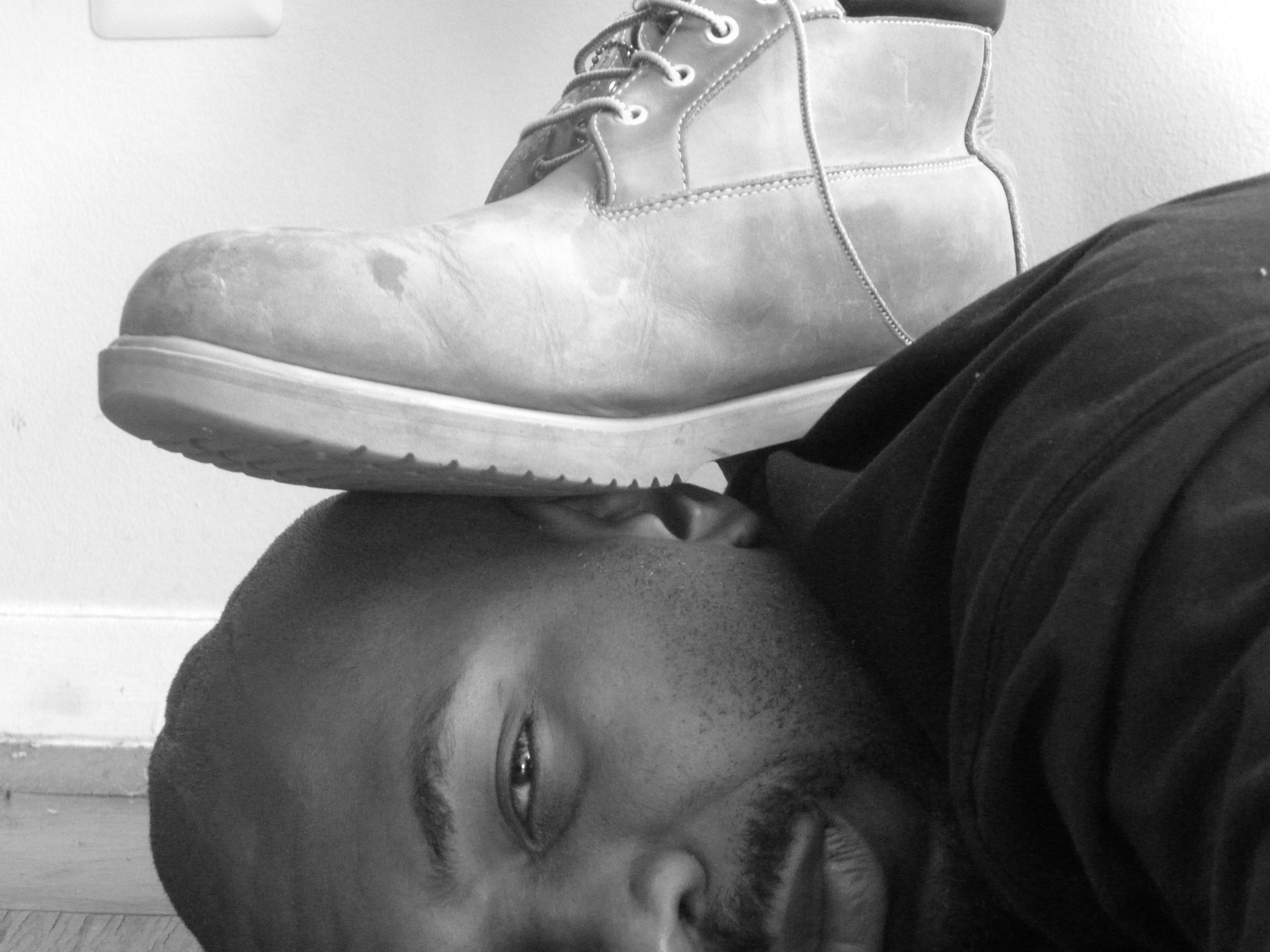
Foot On My Neck & Head, symbolic of my years as a Hebrew-Israelite (also of grad school), April 18, 2011. (Donald Earl Collins).

Foot On My Neck & Head, symbolic of my years as a Hebrew-Israelite (also of grad school), April 18, 2011. (Donald Earl Collins).

Maybe that was part of the reason why Trotter would constantly “run interference” on my behalf, to protect my “interests” during my four years there. Because, despite all the long hours, the sweat, tears and blood, there were folks at CMU who just saw him as a mere Black man, not a colleague or scholar every bit their equal. Given the books, the articles, the grants and so many other accomplishments, Trotter was easily the most productive professor in the department.

None of this justified how Trotter treated me when I was his student. I was semi-aware of the racial politics of accomplishment denial that folks around us practiced. I often chalked it up to jealousy or stress, thinking that the quality of my work or — to use Trotter’s terminology — my scholarship would show the academic world my worth. What White disdain toward Glasco and Trotter — and Trotter’s harassment of me — taught me, though, is that I’d have to be White in order for my accomplishments to seriously matter in academia, and I wasn’t planning on being White in my lifetime. And, that intellectual Whiteness can be nurtured and grown into Black professors.

In the years since finishing my own PhD, I’ve faced my own dilemmas around my achievements. I’ve at times attempted to fit in by downplaying my publications, by not bringing up my degrees, by not talking about my fellowship awards. What have I learned? To deny myself of my own accomplishments is like making a fine wine but not even daring to take a sip. White accomplishment deniers be damned.

← Older posts
Newer posts →

Boy @ The Window: A Memoir

Boy @ The Window: A Memoir

Places to Buy/Download Boy @ The Window

There's a few ways in which you can read excerpts of, borrow and/or purchase and download Boy @ The Window. There's the trade paperback edition of Boy @ The Window, available for purchase via Amazon.com at http://www.amazon.com/Boy-Window-Donald-Earl-Collins/dp/0989256138/

There's also a Kindle edition on Amazon.com. The enhanced edition can be read only with Kindle Fire, an iPad or a full-color tablet. The links to the enhanced edition through Apple's iBookstore and the Barnes & Noble NOOK edition are below. The link to the Amazon Kindle version is also immediately below:

scr2555-proj697-a-kindle-logo-rgb-lg

Boy @ The Window on Amazon.com: http://www.amazon.com/Boy-The-Window-Memoir-ebook/dp/B00CD95FBU/

iBookstore-logo-300x100

Boy @ The Window on Apple's iBookstore: https://itunes.apple.com/us/book/boy-the-window/id643768275?ls=1

Barnes & Noble (bn.com) logo, June 26, 2013. (http://www.logotypes101.com).

Boy @ The Window on Barnes & Noble: http://www.barnesandnoble.com/w/boy-the-window-donald-earl-collins/1115182183?ean=2940016741567

You can also add, read and review Boy @ The Window on Goodreads.com. Just click on the button below:

Boy @ The Window

Twitter Updates

Tweets by decollins1969
  • RSS - Posts
  • RSS - Comments

Archives

  • June 2025
  • April 2023
  • September 2022
  • August 2022
  • July 2022
  • June 2022
  • May 2022
  • April 2022
  • March 2022
  • January 2022
  • December 2021
  • November 2021
  • October 2021
  • September 2021
  • August 2021
  • July 2021
  • June 2021
  • April 2021
  • March 2021
  • February 2021
  • January 2021
  • December 2020
  • November 2020
  • October 2020
  • September 2020
  • August 2020
  • July 2020
  • May 2020
  • April 2020
  • March 2020
  • January 2020
  • December 2019
  • November 2019
  • August 2019
  • July 2019
  • June 2019
  • May 2019
  • April 2019
  • March 2019
  • February 2019
  • January 2019
  • December 2018
  • November 2018
  • October 2018
  • September 2018
  • August 2018
  • July 2018
  • June 2018
  • May 2018
  • March 2018
  • February 2018
  • January 2018
  • December 2017
  • November 2017
  • October 2017
  • September 2017
  • August 2017
  • July 2017
  • June 2017
  • May 2017
  • April 2017
  • March 2017
  • February 2017
  • January 2017
  • December 2016
  • November 2016
  • October 2016
  • September 2016
  • August 2016
  • July 2016
  • June 2016
  • May 2016
  • April 2016
  • March 2016
  • February 2016
  • January 2016
  • December 2015
  • November 2015
  • October 2015
  • September 2015
  • August 2015
  • July 2015
  • June 2015
  • May 2015
  • April 2015
  • March 2015
  • February 2015
  • January 2015
  • December 2014
  • November 2014
  • October 2014
  • September 2014
  • August 2014
  • July 2014
  • June 2014
  • May 2014
  • April 2014
  • March 2014
  • February 2014
  • January 2014
  • December 2013
  • November 2013
  • October 2013
  • September 2013
  • August 2013
  • July 2013
  • June 2013
  • May 2013
  • April 2013
  • March 2013
  • February 2013
  • January 2013
  • December 2012
  • November 2012
  • October 2012
  • September 2012
  • August 2012
  • July 2012
  • June 2012
  • May 2012
  • April 2012
  • March 2012
  • February 2012
  • January 2012
  • December 2011
  • November 2011
  • October 2011
  • September 2011
  • August 2011
  • July 2011
  • June 2011
  • May 2011
  • April 2011
  • March 2011
  • February 2011
  • January 2011
  • December 2010
  • November 2010
  • October 2010
  • September 2010
  • August 2010
  • July 2010
  • June 2010
  • May 2010
  • April 2010
  • March 2010
  • February 2010
  • January 2010
  • December 2009
  • November 2009
  • October 2009
  • September 2009
  • August 2009
  • July 2009
  • June 2009
  • May 2009
  • April 2009
  • March 2009
  • February 2009
  • January 2009
  • December 2008
  • November 2008
  • October 2008
  • September 2008
  • August 2008
  • July 2008
  • June 2008
  • May 2008
  • April 2008
  • March 2008
  • February 2008
  • January 2008
  • December 2007
  • November 2007
  • October 2007
  • September 2007
  • August 2007
  • July 2007
  • June 2007

Recent Comments

MaryPena's avatarMaryPena on My Day of Atonement/Bitter Hat…
decollins1969's avatardecollins1969 on No Good Teaching Deed Goes…
Mary Rose O’Connell's avatarMary Rose O’Connell on No Good Teaching Deed Goes…

NetworkedBlogs on Facebook

NetworkedBlogs
Blog:
Notes From a Boy @ The Window
Topics:
My Life, Culture & Education, Politics & Goofyness
 
Follow my blog

616 616 East Lincoln Avenue A.B. Davis Middle School Abuse Academia Academy for Educational Development AED Afrocentricity American Narcissism Authenticity Bigotry Blackness Boy @ The Window Carnegie Mellon University Child Abuse Class of 1987 CMU Coping Strategies Crush #1 Crush #2 Death Disillusionment Diversity Domestic Violence Economic Inequality Education Family Friendship Friendships Graduate School Hebrew-Israelites High-Stakes Testing Higher Education History Homelessness Humanities Humanities Program Hypocrisy Internalized Racism Jealousy Joe Trotter Joe William Trotter Jr. K-12 Education Love Manhood Maurice Eugene Washington Maurice Washington Misogyny Mother-Son Relationship Mount Vernon High School Mount Vernon New York Mount Vernon public schools Multiculturalism MVHS Narcissism NFL Pitt Pittsburgh Politics of Education Poverty President Barack Obama Race Racial Stereotypes Racism Relationships Self-Awareness Self-Discovery Self-Reflection Sexism Social Justice Teaching and Learning University of Pittsburgh Violence Whiteness Writing

Top Rated

Blog at WordPress.com.

  • Subscribe Subscribed
    • Notes from a Boy @ The Window
    • Join 103 other subscribers
    • Already have a WordPress.com account? Log in now.
    • Notes from a Boy @ The Window
    • Subscribe Subscribed
    • Sign up
    • Log in
    • Report this content
    • View site in Reader
    • Manage subscriptions
    • Collapse this bar
 

Loading Comments...