• About Me
  • Other Writings
  • Interview Clips
  • All About Me: American Racism, American Narcissism, and the Conversation America Can’t Have
  • Video Clips
  • Boy @ The Window Pictures
  • Boy @ The Window Theme Music

Notes from a Boy @ The Window

~

Notes from a Boy @ The Window

Category Archives: New York City

Boy @ The Window, Now in Paperback

20 Wednesday Nov 2013

Posted by decollins1969 in 1, Boy @ The Window, Christianity, Eclectic, eclectic music, Hebrew-Israelite, High Rise Buildings, Jimme, Marriage, Mount Vernon High School, Mount Vernon New York, music, My Father, New York City, Pittsburgh, Politics, Pop Culture, race, Religion, Sports, University of Pittsburgh, Upper East Side, Upper West Side, Youth

≈ 2 Comments


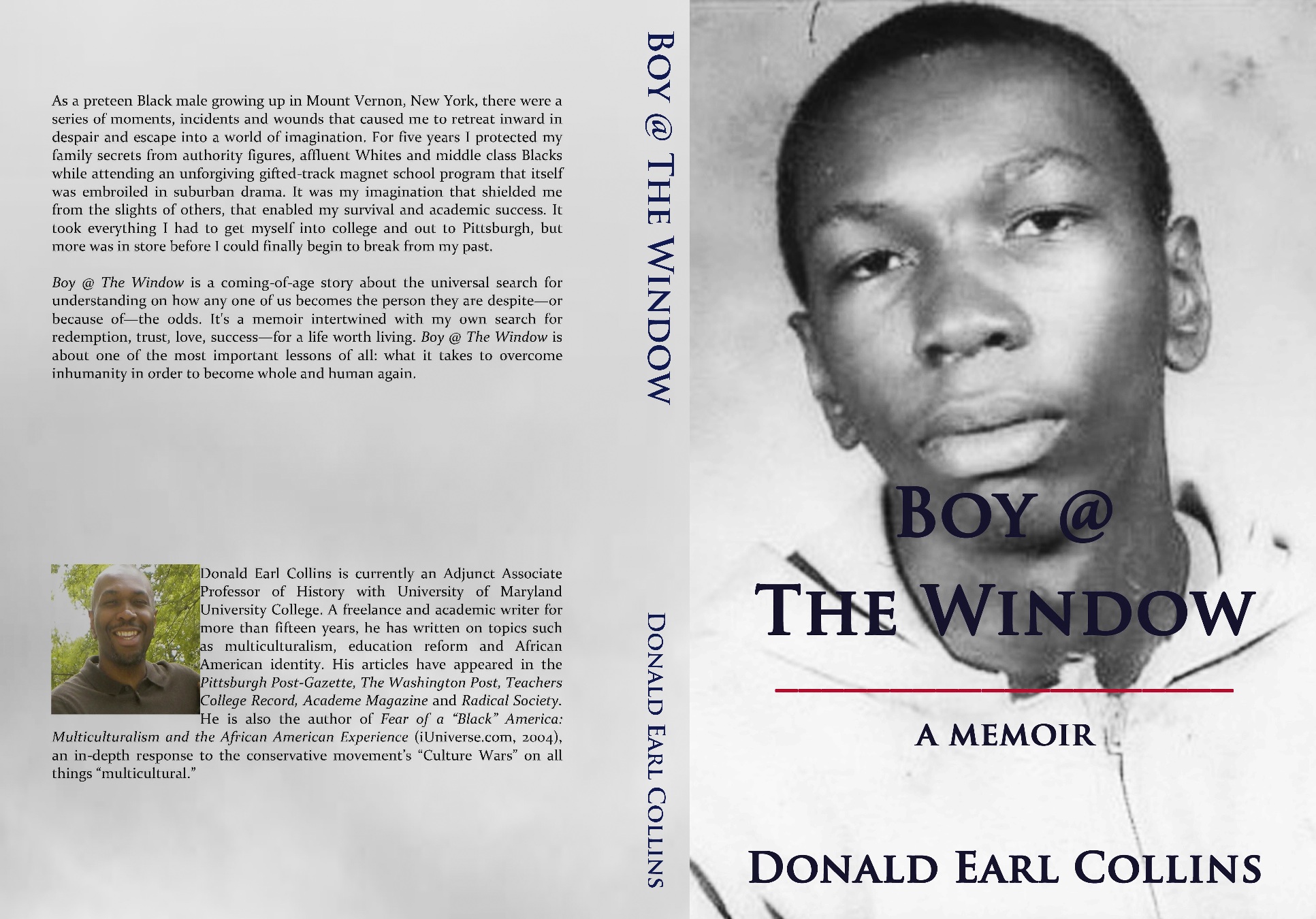
Boy @ The Window, front and back cover, and side, November 11, 2013. (Donald Earl Collins).

Boy @ The Window, front/back cover, and side, November 11, 2013. (Donald Earl Collins).

I have some really good news. My book Boy @ The Window is not just an e-book anymore. I now have a trade paperback edition, out and available through Amazon.com as of yesterday (via http://www.amazon.com/Boy-Window-Donald-Earl-Collins/dp/0989256138/). You can also order and buy Boy @ The Window the old-fashioned way — directly through your local bookstore.

Please take a look, support, buy, read, comment and share. I will post as reviews and opportunities to talk about the book arise. Thanks to all of you who’ve supported my blog and the path to Boy @ The Window over the past six years!

On Regrets and Forgiveness

22 Tuesday Oct 2013

Posted by decollins1969 in 1, Boy @ The Window, Christianity, culture, Eclectic, Hebrew-Israelite, Jimme, Mount Vernon High School, Mount Vernon New York, New York City, Pop Culture, race, Religion, Youth

≈ Leave a comment

Tags

Child Abuse, Domestic Violence, Forgiveness, Indecision, Love, Maurice Eugene Washington, Maurice Washington, Mother-Son Relationship, Regret, Regrets, Second-Guessing, Self-Reflection, Unforgiveness


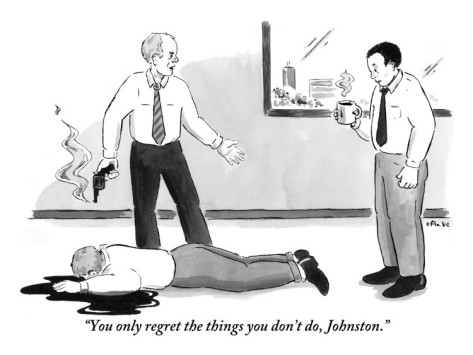
Emily Flake's "You only regret the things you don't do, Johnston," February 28, 2011. (http://newyorker.com)

Emily Flake’s “You only regret the things you don’t do, Johnston,” February 28, 2011. (http://newyorker.com)

One of the things I’ve read and heard from others so far about Boy @ The Window since April has been about catharsis. As in, “this book must’ve been cathartic for you.” I’ve said in response, “Yeah, it sure has.” But that’s not been the whole truth. In more than a few respects, Boy @ The Window has opened up a Pandora’s box of wounds I’d kept locked for years and years.

This might surprise some folks, especially the ones who attended Mount Vernon public schools, Humanities and specifically Mount Vernon High School with me. But there is a dark side to being me. Beneath my well wishes, good graces and generic smile has also been a person with deep regret, repressed anger, smoldering rage over what by far were the worst years of my life. All of which has translated into a person whose worst days since are days of blame — almost always of and for myself. I can forgive almost anyone or anything — my late idiot ex-stepfather, my father Jimme and his years of alcoholism, friends or superiors who’ve attempted to take advantage of me.

The Physics of a Bottomless Pit, February 27, 2013. (MatsuKami of deviantART via http://www.scienceblogs.com).

The Physics of a Bottomless Pit, February 27, 2013. (MatsuKami of deviantART via http://www.scienceblogs.com).

Yet there’s one person I’ve found very hard to forgive — myself. I hold myself to such high standards that it would be impossible for anyone other than Jesus to meet. And God knows I’m not perfect. But in looking at my past, my growing up years in Boy @ The Window, I’ve found that so much of my life’s force and energy has gone into redeeming myself for having to live through those terrible, terrible years. Even though I’ve been at a place in my life in which I’ve pretty much known myself, my passions, my calling, my abilities and limitations, for the better part of twenty years. Until recently, though, I hadn’t given myself any breaks from my past. Putting it under lock and key obviously didn’t work, and airing it for the world to read — while beneficial — had brought with it a truck-load of emotions that I had yet to work through.

As I wrote at the end of Boy @ The Window:

I can say without a doubt that Humanities did make a difference in my life. I wouldn’t be the person I am today without those six bittersweet and indifferent years. It makes any setback I might suffer today seem small and laughable by comparison. There are things I wish would’ve happened, things that would’ve made it easier to enjoy life and savor glorious moments even now. I wish Humanities had been as serious about developing me as a writer as it was about accelerated math and science classes. I regret not asking Phyllis out for a date. I lament not revealing more about the tragedies of my family life or my keen sense of humor to the few classmates and teachers I had some bond with, however weak. I wish I had trusted my instincts and never worn that kufi to Holmes or Davis. I know I should’ve stayed with football or tried out for basketball. And I wish I had the opportunity as a twelve-year-old to kiss Wendy one time. Admittedly, there’s a part of me that wishes I could kiss her now.

I imagine that if I had done all of these things, I would’ve been even more bruised up (especially in the case of Wendy), but at least I could’ve said I tried. Instead of looking back at my past and picking it apart like a forensic vulture.

But my deepest regret, and one that I hadn’t forgiven myself for, at least until recently, was for not calling the cops on my then stepfather after he beat up Mom on Memorial Day, Monday, May 31, ’82. Between my near-photographic memory and my training as an academic historian, it’s been hard to look at my past without reliving it.

How do you mend a broken heart?, 2005, October 22, 2013. (digitalman via deviantART at http://deviantart.net).

How do you mend a broken heart?, 2005, October 22, 2013. (digitalman via deviantART at http://deviantart.net).

I hadn’t figured out that I hadn’t forgiven myself until a few weeks ago. I realized that I hadn’t let go of the worst of my past. Now, letting go doesn’t mean that you forget your past, bury it or repress it emotionally. For me, it simply means not reliving the moment as if it happened last week instead of thirty-one years ago. To treat the moment as a memory, an important reminder that I am not Superman, that I couldn’t have saved my Mom from domestic violence anymore than I could’ve saved myself from poverty as a twelve-year-old.

You know, when I was younger, I thought that I didn’t have any regrets, any resentment or any dark side from growing up the way I did. We all tend to believe that pushing forward to a brighter future will take care of our past. That’s simply not true. We need to live in the present in order to achieve that brighter future. That means working through our pasts, and then letting it go. I should know.

The Week The Lights Went Out In America

08 Tuesday Oct 2013

Posted by decollins1969 in 1, Boy @ The Window, culture, Eclectic, Mount Vernon New York, New York City, Politics, Pop Culture, race, Work, Youth

≈ Leave a comment

Tags

American Dominance, American Economy, Arab-Israeli War 1973, Best Days, Brighter Future, Economic Inequality, Gas Lines, Inflation, Job Discrimination, Low-Wage Jobs, OPEC Oil Crisis, OPEC Oil Embargo, Political Will, Politicians, Poverty, Prosperity, social mobility, Stagflation, Superpower, unemployment, Yom Kippur War


Gas station displayed a sign that explained the flag policy during the first OPEC oil embargo and crisis (Oregon), May 1974. March 26, 2013. (NARA via Wikipedia). In public domain.

Gas station displayed a sign that explained the flag policy during the first OPEC oil embargo and crisis (Oregon), May 1974. March 26, 2013. (NARA via Wikipedia). In public domain.

It wasn’t the middle of September of ’08, either. It was the beginning of October ’73, forty Yom Kippur holy days ago. There had been signs for any American who had cared to look at the cracks in the US dominance of the world economy ceiling. Rising unemployment, higher inflation, new monetary control measure, competition from a mostly rebuilt West Germany and Japan. The twenty-eight year-long run America had as the undisputed and undefeated leader of the capitalist world was on its way to a close, and ninety-nine percent of all Americans didn’t know or didn’t care enough to know.

No, the Yom Kippur War between Syria, Egypt and Israel didn’t cause the US to become more dependent on the rest of the world. But our support of Israel against countries from which we imported oil did lead to OPEC’s decision to deny us oil. Up to that point, our government had pretty much done whatever it wanted geopolitically, on behalf of containing Communism and American corporations. It was this week forty years ago, though, that truly began to teach ordinary Americans that there would be consequences for our foreign policy actions without regard for folks who lived at the blunt end of them.

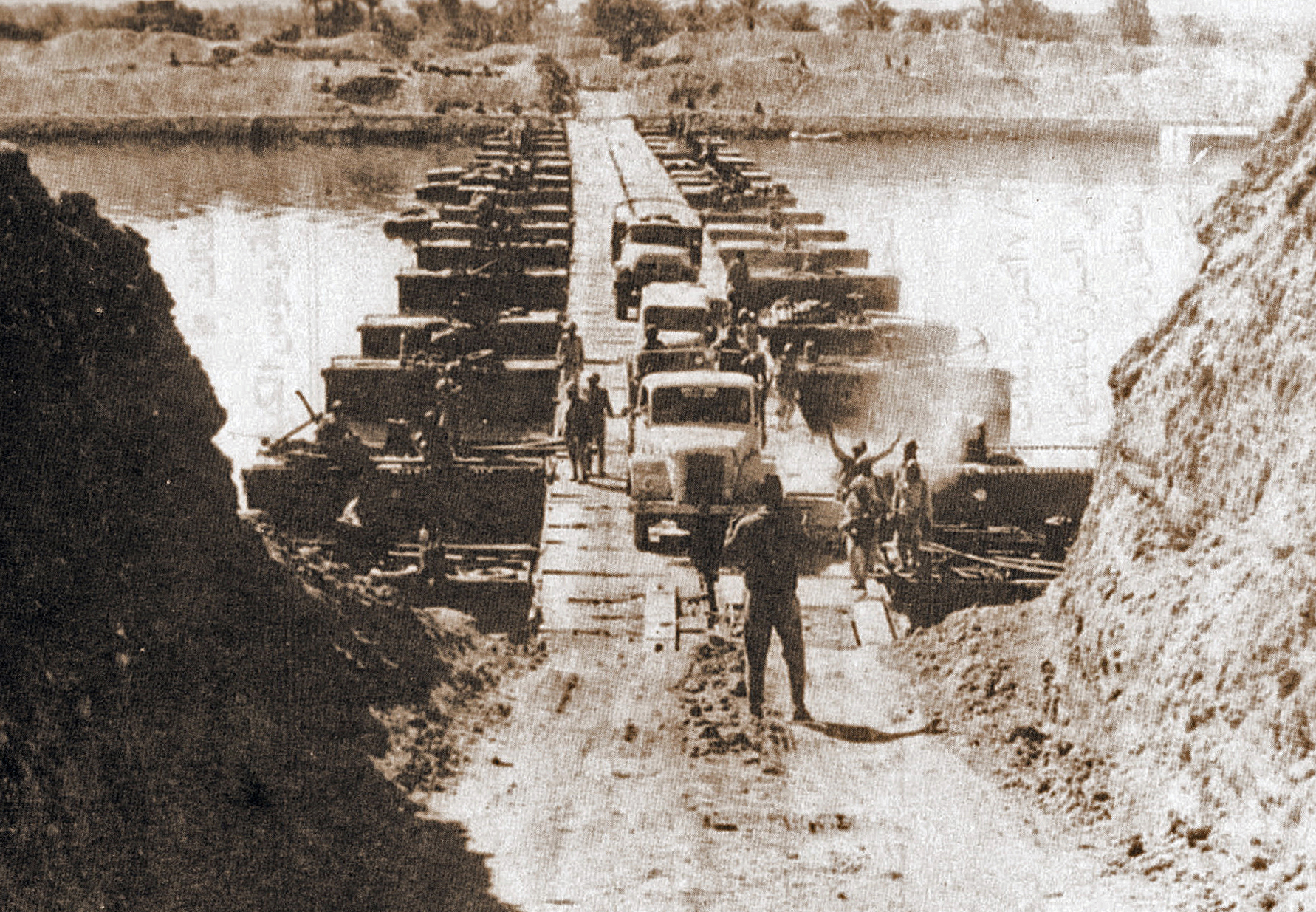
Egyptian forces cross on one of the bridges laid across the Suez Canal, October 7, 1973.   (CIA/Soerfm via Wikipedia). In public domain.

Egyptian forces cross on one of the bridges laid across the Suez Canal, October 7, 1973. (CIA/Soerfm via Wikipedia). In public domain.

I was just a couple of months away from turning four, but I do have vague memories of the week and month from four decades ago. Within a block of where my Mom worked, Mount Vernon Hospital, was a gas station, one that by the end of October had lines wrapped around the block as motorists in their six-miles-to-the-gallon guzzlers desperately waited for some petrol. It was loud and chaotic, from the little bit that I do remember. Fast forward to about a year later, when my Mom took me and my other brother Darren to the old Met grocery store on South Fulton in Mount Vernon. There, she complained about the $2.69 she had to spend on a five-pound bag of Domino’s Sugar ($14.53 in 2013 dollars). I remember her sighing about the high prices and the fact that her paycheck wouldn’t be able to keep up.

It would be years later still before I realized that the last of America’s easiest days as an economic and geopolitical superpower were during my years as a toddler. I did feel secure back then, not knowing about my father’s alcoholism, my mother’s insecurities about being a Black Southern girl living in and around New York City. I had yet to witness the violence embedded in my family, or in my neighborhoods, for that matter. I knew nothing of drug addiction or authentic Blackness, of racism and systemic job discrimination. I had yet to learn that the economic and educational opportunities that had been available to millions of Americans — almost regardless of race and gender — were about to become that much harder to attain and retain as I grew older.

Now, forty years later, as memories of the Reagan and Clinton years have faded, I think of America’s heady days, ones that now seem of lore. I realize that America could have even better days ahead. If we were to acknowledge human involvement in climate change and invest heavily in a green economy. If quality, well-funded universal pre-K to higher education became our reality, without creating one system for elites and another for everyone else. If we as a people finally said it was time to repair $3 trillion worth of infrastructural damage to our bridges and roads, to our sewer and water systems, and to our electrical grid. If we somehow decided to end our expensive wars on drugs and on Black men, on anyone whom we think (but do not know) may do our nation’s interests (if not our people) harm.

Collage of workers placing an F-Series bed onto frame at  Louisville Assembly Plant (Kentucky), 1973. (http://media.ford.com)and a woman carrying a sign past a McDonald's on East 125th Street during a protest by fast food workers and supporters, New York, NY, April 4, 2013. (Stan Honda/AFP/Getty Images via http//:financialpost.com).

Collage of workers placing an F-Series bed onto frame at Louisville Assembly Plant (Kentucky), 1973. (http://media.ford.com); a woman carrying a sign past a McDonald’s on East 125th Street during a protest by fast food workers and supporters, New York, NY, April 4, 2013. (Stan Honda/AFP/Getty Images via http://financialpost.com).

But I know that we won’t have those better days, at least not yet. Not with narcissistic politicians either lining their pockets with money or lining their minds with sugarplum hopes for the Rapture and Armageddon. Not with a media more interested in the political horserace and petty optics than in giving us the full story. And not with an American public more interested in Miley Cyrus than in funding for more psychologists in public schools.

It’s truly depressing to know how far our nation hasn’t come in four decades, virtually my entire lifetime. At least I know, though. For so many born after me — not to mention lacking self-reflection — they may never know what should’ve been.

Earth, Wind & Fire’s “Fantasy,” My Reality

18 Thursday Jul 2013

Posted by decollins1969 in 1, Boy @ The Window, culture, earth, wind & fire, Eclectic, eclectic music, Mount Vernon New York, music, New York City, Politics, Pop Culture, race, Youth

≈ Leave a comment

Tags

"Fantasy" (1978), Anger, Anger Management, Bigotry, Fear, Forgiveness, George Zimmerman, Lyrics, Police Brutality, Racism, Reality, Trayvon Martin, Zimmerman Trial


n  Cover of Earth, Wind & Fire's single "Fantasy" (1978), February 29, 2008. (Columbia Records). Qualifies as fair use due to low resolution and subject matter of this blog post.

Cover of Earth, Wind & Fire’s single “Fantasy” (1978), February 29, 2008. (Columbia Records). Qualifies as fair use due to low resolution and subject matter of this blog post.

Below are two excerpts from Boy @ The Window about how I viewed Mount Vernon, New York and my world between the ages of ten and twelve:

“My only links to the great metropolis to the south were WNBC-TV (Channel 4), Warner Wolf – with his famous “Let’s go to the video tape!” line – doing sports on WCBS-TV (Channel 2), and WABC-AM 77 and WBLS-FM 107.5 on the radio. I found the AM station more fun to listen to, but I also liked listening to the sign-off song WBLS played at the end of the evening, Moody’s Mood for Love, with that, ‘There I go, There I go, The-ere I go…’ start. Music had been an important part of my imagination in ’79, with acts like Earth, Wind & Fire, Christopher Cross, Billy Joel and The Commodores. Not to mention Frank Sinatra, Queen, Donna Summer and Michael Jackson’s Off The Wall album. The music also made me feel like I was as much a part of New York as I was a part of Mount Vernon. It left me thinking of the ozone and burnt rubber smell that I noticed as soon as I would walk down into the Subway system in Manhattan…

“Besides the occasional reminder of life outside of my world, of Mount Vernon, I was the center of my own universe. Mount Vernon was but a stage on which my life played out, a place I hoped would stay this way forever. I was an eleven-year-old who thought that my world was the world. I lived my life like Philip Bailey and Maurice White would’ve wanted me to. I came to see ‘victory in a life called fantasy’ as my own life, living as if my imagination and dreams could be made into reality. All I had to do was wish it so.”

(And yes, I know the actual lyrics are about a land called fantasy, but that’s not how I sang it back then).

There have been so many moments since then where my Earth, Wind & Fire visions have collided with the reality that life for me and people who look like me has hardly been a fantasy. I had to get over my idiot ex-stepfather’s abuse in order to even listen to Earth, Wind & Fire again, because he was a fan as well, and I didn’t want us to both like the same music. But even more than that has been the reality that there are people, places and things who’ve (and that have) come through my life and stood in between me and all the things I wanted out of life. Individuals like Joe Trotter or Ken, policies like racial profiling and redlining, institutions like Columbia University or the former Academy for Educational Development.

The Enchanted Garden of Messer Ansaldo (1889), by Marie Spartali Stillman, March 7, 2006. (Charivari via Wikipedia). In public domain.

The Enchanted Garden of Messer Ansaldo (1889), by Marie Spartali Stillman, March 7, 2006. (Charivari via Wikipedia). In public domain.

While some of these instances have been disappointing in the sense of betrayal that I felt, the disillusionment that came with these incidents of discrimination and harassment pushed me ever closer to the person and writer I wanted to be. I don’t know what to make of how I’ve been feeling about the Zimmerman trial and verdict, the response of so-called White liberals and more obviously racist and gleeful White teabaggers over the past five days. I’ve felt badly for Trayvon Martin’s family, Rachel Jeantel and for so many others who’ve been figuratively beaten down by media coverage and stereotypes over the past months.

But I didn’t think I was angry. Not until I went for a run this morning. It’s was a comparatively pedestrian 3.1-mile run after I’d done a five-miler a day and a half before. Earth, Wind & Fire’s “Fantasy” started playing on my iPod as I was running uphill. All it made me think about was all the challenges that I and so many others have had to face because of individual bigotry and fear and institutional racism and indifference. I know that many things in life aren’t fair. What I realized at that moment, though, was that there really are folks in this world who wish evil and unfairness on people like me. That’s their fantasy!

That made me angry again, but not for too long. For I also knew that I had the power to ask for forgiveness, as well as the power to forgive others. It’s a power that no one can take away from me, that enables me to be honest about where I am, and clear-headed about where I want to go. That power, among others, does truly help bring my “mind to everlasting liberty.” Even in the face of the evil, indifference and ignorance that I see every day.

38.990666 -77.026088

Richard Cohen & Rational Racism

17 Wednesday Jul 2013

Posted by decollins1969 in 1, culture, Eclectic, New York City, Politics, race, Youth

≈ Leave a comment

Tags

Affirmative Action, Derrick Bell, Paternalism, Racial Profiling, Racism, Richard Cohen, Stop and Frisk, Ta-Nehisi Coates, White Liberals, Whiteness


Electron microscope image of a lymphocyte, (a.k.a. cancer cell), September 20, 1976. (Dr. Triche/NCI via Wikipedia). In public domain.

Electron microscope image of a lymphocyte, (a.k.a. cancer cell), September 20, 1976. (Dr. Triche/NCI via Wikipedia). In public domain.

Ta-Nehisi Coates’ response to Richard Cohen’s “Racism vs. reality” column in The Washington Post (July 15, 2013) is so spot on that I had to post something about it. “The Banality of Richard Cohen and Racist Profiling” is a must read for anyone who’s tired of those White “liberals” who remain okay with racism for the sake of perceived safety. Below was my two cents on both Coates’ piece and the sidetracking some whom commented on Coates’ piece tried to do by equating racial profiling with affirmative action:

“Richard Cohen is no different than the racist and race-baiting journalists of not too long ago. You know, the ones who’d put ‘Negro Rapes A White Girl’ on the front page of the Chicago Tribune, Washington Post or New York Times, back in the days when Whites would riot and destroy Black neighborhoods upon seeing such headlines. All to sell newspapers, not to actually start a real and serious dialogue on race, racism and remedies.

And this is precisely what makes Cohen and his ill-conceived logic so dangerous. His is a piece that’s meant to make White ‘liberals’ feel okay about the denial of humanity and rights to Blacks. Especially since White ‘liberals’ must also feel that they’re protected and safe from the Black male boogieman criminal.

Don’t get caught up in a debate about affirmative action as some sort of intellectual counterbalance. It’s a false equivalency, plain and simple. More to the point, it’s a distraction from the real point. Like TNC, the late Derrick Bell wrote about this at length. The idea that we as African Americans, male and female, must embody all of the evils and stereotypes of this nation in order for Whites to feel safe. It’s so insulting, so soul-destroying, so infuriating, this immutable racism of Cohen and the millions of folk who think like him.”

The Walking Danger

12 Friday Jul 2013

Posted by decollins1969 in 1, Boy @ The Window, culture, Eclectic, Hebrew-Israelite, Jimme, Mount Vernon New York, music, My Father, New York City, Pop Culture, race, Upper West Side, Youth

≈ Leave a comment

Tags

Abuse, Black Males, Distrust, Escape, Exploration, Life, Racial Stereotypes, Stigma of Criminality, Value, Walking, Walking While Black


blackbox1-290x160

Justice4Trayvon blackout box, July 12, 2013. (http://jet.com).

Regardless of the verdict in the Florida v. Zimmerman (a.k.a. Justice4Trayvon) trial, there’s one sad and terrifying lesson to take away from the past seventeen months. No Black male past puberty can assume themselves to be safe once they leave their homes to do so much as to cross the street. It doesn’t matter if you’re 6’1″ and 173 pounds, like I was my senior year of high school, or 6’6″ and 300 pounds, like a good- sized high school offensive lineman. We’re not just assumed guilty. We’re assumed to have a value the equivalent of a quart of recycled cooking oil.

It amazes me that with as much walking as I did while growing up in Mount Vernon and in walking all through the city, I only faced a handful of Walking While Black incidents. From the time my Mom and my late idiot ex-stepfather Maurice moved me and my older brother Darren into 616, I was a frequent walker. At seven, my Mom sent us to the store for groceries, for soda, for cigarettes and pork rinds. Yeah, the store was a block and a half away on East Lincoln, but that block and a half led to my first mugging at nine.

By then, my walks to the store went into Pelham and Milk ‘n Things, a three-block walk, as well as stores within three blocks of the Pelham border. That led to the first weird stares from Italian store owners. At the same time, when my father Jimme came back into our lives in ’79, we’d walk to Mount Vernon’s South Side. We’d walk to East Third Street and Wino Park on Fulton and Third, to the rib shack across the street from the park, to Sanford Blvd, even into the Bronx depending on Jimme’s alcohol level. That would lead to confrontations with street folks, and even occasional stares from cops.

Wise Cheez Doodles, one of my favorites to buy as a teenager, July 12, 2013. (http://twitter.com).

Wise Cheez Doodles, one of my favorites to buy as a teenager, July 12, 2013. (http://twitter.com).

By the time I hit puberty in the spring and summer of ’82, in no small part because of the collapse of anything resembling a family at Hebrew-Israelite 616, I began to walk everywhere. Some of my walks were because my Mom’s marriage had given her more mouths to feed and no time to go to the store. So me (mostly) and Darren (on occasion) would walk from 616 to stores like C-Town in Pelham (a mile or so away), Waldbaum’s on East Prospect (a mile and a quarter away) or stores in between for food. This became part of an eventual everyday routine, one that would last until well after I began college at the University of Pittsburgh (at least, when I was home for the holidays or the summer).

We also walked to get my younger brothers and sister Sarai out of the stifling apartment, especially because it was quite literally so during the summer months. We walked from 616 to Pelham, Pelham Manor, the Bronx, Bronxville and New Rochelle in those first couple of summers after puberty. The kids helped us look less suspicious, I suppose, because two teenage Black males had no business being anywhere near the six-figure-income-set’s communities in the mid-80s (or even now) otherwise.

I also began walking to explore, escape and think. It was next to impossible to think at home, with the constant noise, threats of abuse and actual abuse and domestic violence. So by the time I’d reached tenth grade, I needed to walk, by myself and with no agenda other than to make plans for my future while clearing my head. I did get followed by Bronxville PD a couple of times. But mostly, lost Whites from out-of-state would stop and ask for directions to the Bronx River Parkway or I-87.

Hershey's Chocolate Milk (at 17, a 16oz was my favorite store-bought drink), July 12, 2013. (http://www.gifarmer.com).

Hershey’s Chocolate Milk (at 17, a 16oz was my favorite store-bought drink), July 12, 2013. (http://www.gifarmer.com).

It wasn’t until after my seventeenth birthday — when I finally began to put on a little weight (muscle, I guess) — that walking around New York, Mount Vernon and nearby environs began to feel dangerous. Or at least, others began to act as if I was the danger. I’d become a regular weekend strap-hanger on the 2 out of 241st Street headed either to the Upper West Side, Midtown or Downtown, as well as parts of the Bronx. To hunt for the latest tapes, to go to a museum or a library, to just walk around and take the city in. But I also knew to be careful, to be leery of the NYPD, to keep my hands out of my pockets whenever I went to Tower Records or Crazy Eddie’s or even Gray’s Papaya.

Still, there were incidents at Milk-N-Things and Tower Records and a general feeling that folks, older, often White but also frequently Black were genuinely afraid that I — a person who’d been mugged four times before my fourteenth birthday — would hurt them.

Walking was how I learned how different I was from a societal perspective. That though a teenage, I was the dangerous Black male, to be treated as if I just escaped the plantation, as if I hope to find a store to knock over and a White girl to knock up against her will.

I’d hoped to spare my son this lesson. Sadly, because of George Zimmerman killing Trayvon Martin, I can’t. But at least he won’t have to learn this lesson from scratch like I did. And luckily, I knew and did enough to avoid danger — or being seen as the danger — long before I turned seventeen.

“Early Was Late,” at Gettysburg & Elsewhere

03 Wednesday Jul 2013

Posted by decollins1969 in 1, Academia, culture, Eclectic, New York City, Patriotism, Politics, Pop Culture, race

≈ 2 Comments

Tags

American Civil War, Battle of Gettysburg, Civil War, David John Marotta, Democracy, Draft Riots, Equality, Freedom, Jubal Early, Lost Cause, Pickett's Charge, Robert E. Lee, Slavery, States' Rights, Union Army


"A Harvest of Death," Gettysburg, PA, July 5-6, 1863. (Timothy O'Sullivan). In public domain.

“A Harvest of Death,” Gettysburg, PA, July 5-6, 1863. (Timothy O’Sullivan). In public domain.

Google might be celebrating Franz Kafka’s 130th birthday today. But for us Americans, today’s a bit more significant than Kafka’s The Metamorphosis (1915).  No, today’s the 150th anniversary of the height of the Battle of Gettysburg, the three-day battle that involved nearly 165,000 Union and Confederate troops at the beginning of July, 1863. During the battle, almost 8,000 soldiers died, and more than 46,000 were wounded or maimed. Thousands of Confederates were wounded on the third day, the day of Pickett’s Charge, when Gen. Jubal Early’s troops never arrived to reinforce the charge to take the high ground away from the Union Army.

Of course, there are thousands of enthusiasts who are recreating the battle this week, along with the battles at Vicksburg, Petersburg, and other burghs throughout the South and Mason-Dixon borderlands. Let’s not forget why these battles were fought, though. They weren’t fought over high protective tariffs for Northern industrial interests, as David John Marotta ridiculously asserted in his Forbes article a couple of weeks ago. Nor was the Civil War fought simply over the grandiose ideal of states’ rights from a Confederate perspective or the mere preservation of the Union from a Northern perspective.

Ultimately, this was a civil war to settle the question of a democratic nation with slavery as its central economic and social underpinnings. Southerners were fighting for states’ rights, all right — the right of states to keep slavery legal, a “way of life” that had made White men fortunes. Northerners were fighting to preserve the Union, but one that would be free of slavery as an institution. Any other arguments are ones made by people who have no understanding of the centrality of slavery and freedom to the very identity on which the US had been founded in 1776.

Later that month, in part as a result of the Battle of Gettysburg, there were draft riots in New York, with Five Points Irish mobs beating up and lynching Blacks in the process of destroying their homes and businesses. So we know that there was at least one group unhappy about the real-life rationale behind fighting the Civil War.

Jubal Early depiction, circa 1911. (Wikipedia.com). In public domain.

Jubal Early depiction, circa 1911. (Wikipedia.com). In public domain.

What most Americans don’t understand was the incredible distance between believing that slavery was an evil, archaic and hypocritical institution and believing that African slaves were ones worthy of American democracy and equality. Most Whites fighting in the Battle of Gettysburg believed that Blacks had about as many rights to American equality as most of us would believe in a path to American citizenship for Al-Qaeda terrorists today.

Thank God Jubal Early “was late,” or really, had refused a direct order from Gen. Robert E. Lee to be part of some suicidal charge on July 3rd, 1863. Unfortunately, we still have many “Jubal Early” types who are really, really late in recognizing Blacks as equal human beings, American democracy as imperfect, and the South as a supporter of an evil and profit-maximizing institution.

← Older posts
Newer posts →

Boy @ The Window: A Memoir

Boy @ The Window: A Memoir

Places to Buy/Download Boy @ The Window

There's a few ways in which you can read excerpts of, borrow and/or purchase and download Boy @ The Window. There's the trade paperback edition of Boy @ The Window, available for purchase via Amazon.com at http://www.amazon.com/Boy-Window-Donald-Earl-Collins/dp/0989256138/

There's also a Kindle edition on Amazon.com. The enhanced edition can be read only with Kindle Fire, an iPad or a full-color tablet. The links to the enhanced edition through Apple's iBookstore and the Barnes & Noble NOOK edition are below. The link to the Amazon Kindle version is also immediately below:

scr2555-proj697-a-kindle-logo-rgb-lg

Boy @ The Window on Amazon.com: http://www.amazon.com/Boy-The-Window-Memoir-ebook/dp/B00CD95FBU/

iBookstore-logo-300x100

Boy @ The Window on Apple's iBookstore: https://itunes.apple.com/us/book/boy-the-window/id643768275?ls=1

Barnes & Noble (bn.com) logo, June 26, 2013. (http://www.logotypes101.com).

Boy @ The Window on Barnes & Noble: http://www.barnesandnoble.com/w/boy-the-window-donald-earl-collins/1115182183?ean=2940016741567

You can also add, read and review Boy @ The Window on Goodreads.com. Just click on the button below:

Boy @ The Window

Twitter Updates

Tweets by decollins1969
  • RSS - Posts
  • RSS - Comments

Archives

  • June 2025
  • April 2023
  • September 2022
  • August 2022
  • July 2022
  • June 2022
  • May 2022
  • April 2022
  • March 2022
  • January 2022
  • December 2021
  • November 2021
  • October 2021
  • September 2021
  • August 2021
  • July 2021
  • June 2021
  • April 2021
  • March 2021
  • February 2021
  • January 2021
  • December 2020
  • November 2020
  • October 2020
  • September 2020
  • August 2020
  • July 2020
  • May 2020
  • April 2020
  • March 2020
  • January 2020
  • December 2019
  • November 2019
  • August 2019
  • July 2019
  • June 2019
  • May 2019
  • April 2019
  • March 2019
  • February 2019
  • January 2019
  • December 2018
  • November 2018
  • October 2018
  • September 2018
  • August 2018
  • July 2018
  • June 2018
  • May 2018
  • March 2018
  • February 2018
  • January 2018
  • December 2017
  • November 2017
  • October 2017
  • September 2017
  • August 2017
  • July 2017
  • June 2017
  • May 2017
  • April 2017
  • March 2017
  • February 2017
  • January 2017
  • December 2016
  • November 2016
  • October 2016
  • September 2016
  • August 2016
  • July 2016
  • June 2016
  • May 2016
  • April 2016
  • March 2016
  • February 2016
  • January 2016
  • December 2015
  • November 2015
  • October 2015
  • September 2015
  • August 2015
  • July 2015
  • June 2015
  • May 2015
  • April 2015
  • March 2015
  • February 2015
  • January 2015
  • December 2014
  • November 2014
  • October 2014
  • September 2014
  • August 2014
  • July 2014
  • June 2014
  • May 2014
  • April 2014
  • March 2014
  • February 2014
  • January 2014
  • December 2013
  • November 2013
  • October 2013
  • September 2013
  • August 2013
  • July 2013
  • June 2013
  • May 2013
  • April 2013
  • March 2013
  • February 2013
  • January 2013
  • December 2012
  • November 2012
  • October 2012
  • September 2012
  • August 2012
  • July 2012
  • June 2012
  • May 2012
  • April 2012
  • March 2012
  • February 2012
  • January 2012
  • December 2011
  • November 2011
  • October 2011
  • September 2011
  • August 2011
  • July 2011
  • June 2011
  • May 2011
  • April 2011
  • March 2011
  • February 2011
  • January 2011
  • December 2010
  • November 2010
  • October 2010
  • September 2010
  • August 2010
  • July 2010
  • June 2010
  • May 2010
  • April 2010
  • March 2010
  • February 2010
  • January 2010
  • December 2009
  • November 2009
  • October 2009
  • September 2009
  • August 2009
  • July 2009
  • June 2009
  • May 2009
  • April 2009
  • March 2009
  • February 2009
  • January 2009
  • December 2008
  • November 2008
  • October 2008
  • September 2008
  • August 2008
  • July 2008
  • June 2008
  • May 2008
  • April 2008
  • March 2008
  • February 2008
  • January 2008
  • December 2007
  • November 2007
  • October 2007
  • September 2007
  • August 2007
  • July 2007
  • June 2007

Recent Comments

MaryPena's avatarMaryPena on My Day of Atonement/Bitter Hat…
decollins1969's avatardecollins1969 on No Good Teaching Deed Goes…
Mary Rose O’Connell's avatarMary Rose O’Connell on No Good Teaching Deed Goes…

NetworkedBlogs on Facebook

NetworkedBlogs
Blog:
Notes From a Boy @ The Window
Topics:
My Life, Culture & Education, Politics & Goofyness
 
Follow my blog

616 616 East Lincoln Avenue A.B. Davis Middle School Abuse Academia Academy for Educational Development AED Afrocentricity American Narcissism Authenticity Bigotry Blackness Boy @ The Window Carnegie Mellon University Child Abuse Class of 1987 CMU Coping Strategies Crush #1 Crush #2 Death Disillusionment Diversity Domestic Violence Economic Inequality Education Family Friendship Friendships Graduate School Hebrew-Israelites High-Stakes Testing Higher Education History Homelessness Humanities Humanities Program Hypocrisy Internalized Racism Jealousy Joe Trotter Joe William Trotter Jr. K-12 Education Love Manhood Maurice Eugene Washington Maurice Washington Misogyny Mother-Son Relationship Mount Vernon High School Mount Vernon New York Mount Vernon public schools Multiculturalism MVHS Narcissism NFL Pitt Pittsburgh Politics of Education Poverty President Barack Obama Race Racial Stereotypes Racism Relationships Self-Awareness Self-Discovery Self-Reflection Sexism Social Justice Teaching and Learning University of Pittsburgh Violence Whiteness Writing

Top Rated

Blog at WordPress.com.

  • Subscribe Subscribed
    • Notes from a Boy @ The Window
    • Join 103 other subscribers
    • Already have a WordPress.com account? Log in now.
    • Notes from a Boy @ The Window
    • Subscribe Subscribed
    • Sign up
    • Log in
    • Report this content
    • View site in Reader
    • Manage subscriptions
    • Collapse this bar
 

Loading Comments...