• About Me
  • Other Writings
  • Interview Clips
  • All About Me: American Racism, American Narcissism, and the Conversation America Can’t Have
  • Video Clips
  • Boy @ The Window Pictures
  • Boy @ The Window Theme Music

Notes from a Boy @ The Window

~

Notes from a Boy @ The Window

Category Archives: Mount Vernon High School

If Boy @ The Window Were A Movie…

10 Saturday Dec 2011

Posted by decollins1969 in 1, Boy @ The Window, culture, Eclectic, Mount Vernon High School, Mount Vernon New York, Movies, My Father, Pop Culture, Youth

≈ Leave a comment

Tags

Acting, Actors, Alison Arngrim, Boy @ The Window, Brad Dourif, Brian Dennehy, Clarke Peters, Gabrielle Union, Harold Perrineau, Humanities, James Avery, Jesse L. Martin, Khandi Alexander, Mount Vernon New York, Movies, Nathan Fillion, Ray Liotta, Rita Moreno, Rob Brown, Thandie Newton, TV Shows


Not So Young Man @ His Window, December 10, 2011. (Donald Earl Collins).

…who would I hire to play the characters in my memoir? Especially if I could reach across space and time to pick actors with the range necessary to play complicated characters, like yours’ truly, for instance. Hmm. I have a few ideas:

Rob Brown, ala Finding Forrester (2000) – He’d been a perfect character to play me during my high school years, between the blank stare and face, his height, and his ability to show awkwardness around Whites in authority.

Rob Brown as Jamal Wallace in Finding Forrester (2000) Screen Shot. (http://filmdope.com).

Khandi Alexander, ala The Corner (2000) – While she isn’t nearly as tall and is a bit chestier than my mother, her affect as the down-and-out West Baltimore mother on the groundbreaking HBO miniseries fits here.

James Avery – He would be in the role of my idiot ex-stepfather, with his bulging eyes and belly, and with his flashes of rage, yeah, he’d been perfect.

Clarke Peters, ala The Wire, Treme – I thought about someone like Sammy Davis, Jr. playing the role of my father, Jimme, but Davis’ acting range wouldn’t have been enough to capture both my father’s drunken rage and the comedy that often served as an overlay to my encounters with my father growing up.

Clarke Peters at Edinburgh Festival 2010, August 6, 2010. (Ausir). Released to public domain via GNU Free Documentation License.

Jesse L. Martin – The man’s acting range is enormous, and would capture the complexities of playing someone like my older brother Darren, a super-shy kid who himself played the role of someone mentally retarded while also having taught himself to read at the age of three. Only, Darren didn’t know how to stop.
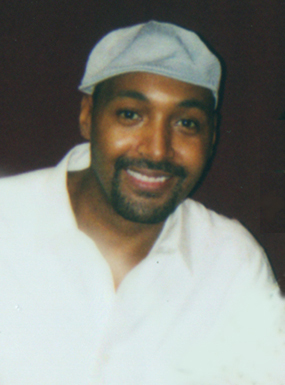
Jesse L. Martin at Annual Flea Market and Grand Auction hosted by Broadway Cares/Equity Fights AIDS, September 26, 2006. (Insomniacpuppy). Released to public domain via Wikipedia.

Harold Perrineau, ala Oz – His face alone captures a lot of emotion, and show does the way he says his lines, something that I’d want from someone playing my best friend from elementary school. Perrineau’s face would also capture duplicity, a necessary ingredient for betraying a friendship. Just like many of the characters in the HBO series Oz.

Thandie Newton – This was a tough one, as I also thought about Rosario Dawson in the role of Crush #1. But Newton has quirkiness as an actor that Dawson lacks at times, and for all of the wonderful traits of the character known as Crush #1, quirkiness is key.

Thandie Newton at the 2007 Toronto International Film Festival, September 2007. (http://www.flickr.com/photos/gdcgraphics/1639139527/in/set-72157602744288487/). Released to public domain via Creative Commons Attribution 2.0.

Ray Liotta – Not nearly as tough, this despite the fact that the real “A” had blondish hair when we were kids. Liotta’s meanness, his laugh, his Italian coldness easily capture what “A” was like as my tormentor in seventh grade.

Nathan Fillion, ala Firefly (2002-03), Serenity(2005) – the near-perfect actor to play the contrarian one, “JD” (see my post “The Contrarian One” from February ’11), his aloofness, his sense of superiority, his maverick affect throughout our years in Humanities together.

Nathan Fillion as Capt. Malcolm Reynolds, Firefly (2002-02). (Wikipedia.org).

Alison Arngrim, ala Little House on the Prairie (1974-82) – She played Nellie Olson on the show, a bratty, well-off girl who only knew how to view the world through her own selfish lens. She could play any number of my former White classmates, especially many of the ones who left Humanities between the end of eighth and the beginning of tenth grade.

Little House on the Prairie's Nellie Olson as played by Alison Arngirm, circa 1977. (http://www.flickr.com/3595/3433153010_b5f3cae12a.jpg).

Gabrielle Union – as this actor has done the affect of pissed off and Black preppie well over the years, she’d be great for the role of Crush #2, the one the main character (me) becomes obsessed with in the six months after graduating high school. Like the character, Union can crush hearts.

Rita Moreno – A fixture in the acting business for more than sixty years, one of a handful to win an Oscar, an Emmy, and a Tony Award, she could easily slip on the role of a guidance counselor like the chain-smoking, stereotyping bigot Sylvia Fasulo. The only other person who’d fit this role is Callie Thorne from the USA show, Necessary Roughness.

Brian Dennehy – There aren’t many actors who could play my late AP US History teacher Harold Meltzer. You see, you’d need to be able to spit, to tell long and strange stories, to have moment of macabre laughter and moments of bitter rage. Dennehy, though, has experience doing all of those things, though not in one role. Plus, he’s tall and rotund enough for the part.

Brad Dourif, ala Dune (1984), Lord of the Rings: The Two Towers (2002) – He’s weird enough to play the role of Regis, one of my older friends from my undergraduate days at the University of Pittsburgh, someone who was there for me the semester I went through homeless and three months without money.

Brad Dourif at the Lord of the Rings-Convention Ring*Con in Bonn, Germany, November 23, 2002. (Diane Krauss). Released to public domain via GNU Free Documentation.

I could go on and on. But that’s unnecessary here. This ensemble cast, with the right script — and a time machine — would make Boy @ The Window come alive, and have me blushing and crying over and over again.

The Visit

18 Tuesday Oct 2011

Posted by decollins1969 in 1, Boy @ The Window, culture, Eclectic, Marriage, Mount Vernon High School, Mount Vernon New York, race, Youth

≈ Leave a comment

Tags

616, 616 East Lincoln Avenue, A.B. Davis Middle School, Boy @ The Window, Crush #1, Emotions, Humanities, Interviews, Memoirs, Memory Lane, Mount Vernon New York, Mount Vernon public schools, Relationships, Youth


Close Encounters Of The Third Kind (1977) Screen Shot, October 18, 2011. (Donald Earl Collins).

Over the course of a decade, between January ’02 and December ’09, I exchanged emails, interviewed by phone and visited nearly thirty former classmates, teachers and administrators from Mount Vernon, New York public schools for my book manuscript Boy @ The Window. Not to mention family members willing to be honest about life in Mount Vernon and 616 East Lincoln Avenue. Not to mention my family intervention nearly ten years ago. The saying “you can’t go home again” is such an understatement.

At times, my walks down memory lane have left me verklempt, or feeling that I’ve entered the Twilight Zone. Meeting with a former tormentor from my Davis Middle School days was strangely pleasant, while talking with my class’ salutatorian was both illuminating and a little weird. I met with some former Humanities classmates who seemed more ornery than former Georgetown coach John Thompson after a sleepless night dealing with idiot refs. I talked on the phone with former classmates and teachers who either couldn’t remember details about our school, or flat-out lied about some of the things they had said to me and about me twenty-five or thirty years ago.

But of all of those meetings and time machine-like encounters, none made me more nervous than my interview with Crush #1 five years ago. I was nervous for any number of reasons. I hadn’t seen her in nearly seventeen years when I went to see her in the Old South in October ’06. My plan was to be up front about my crush, my borderline love for her back in ’82, which would make anyone anxious or feel really silly, I guess.

And I was stuck at this point of my memoir, the part about how my crush on Crush #1 came about, and how abuse and domestic violence at 616 brought it to a crashing end, between March and August ’82. I knew what to write. I just didn’t want to relive all of those emotions, as they led me to seriously consider suicide within a year and half of all of that.

Salvador Dali, The Persistence of Memory (1931), October 18, 2011. (http://www.moma.org). In public domain.

What I walked into on that rainy October ’06 day mirrored my own Silver Spring, Maryland residence. It was a modern-day carpeted flat in an apartment-home townhouse, appearing as lived-in by the scattered toys in the living room and foyer. Crush #1 was making stew peas. If I’d been in another frame of mind, a look of shock would’ve come over me. Crush #1 cooking? Put that above the fold of the New York Times! Yet since I was willing to expect anything from the new Crush #1, I wasn’t all that surprised.

Her husband greeted me warmly, which was a bit of a surprise. I’ve been around enough couples to get a sense of how these kinds of interactions are supposed to work, regardless of sexual orientation. It’s where the husband or the “man of the house” sizes me up, regardless of my intentions. Crush #1 walked out of the kitchen and gave me a hug, the kind friends give each other after seventeen years apart.

Then I met her daughter, this chip off the not-so-old block, a great combination of Crush #1’s and her husband’s facial features. She was an adorable four-year-old wanting to learn about the world around her. We shook hands and made animal noises for about two minutes. I felt at home. It was as if I walked into my apartment and had to chance to see myself, my wife, and my kid in action, with sarcastic banter and silly noises included.

There was so much to discuss and so little time. So I started where the twelve-year-old in me would’ve if he had a voice. I asked about her mother, her family, her growing-up years in New York, her time in school and in Humanities. What came out was so different from what I expected because it was so similar to my experience and because our similar experiences occurred during the same time frame.

It was all so normal, so typical for people from our respective backgrounds, so, well,  human. I liked this real-life version of Crush #1, and not in that twelve-year-old, I-think-I’m-in-love kind of way. That was something else I really didn’t expect. Not only did I enjoy the visit. I enjoyed getting to know one of my ex-classmates for the first time.

Faces At The Top Of The Well

08 Saturday Oct 2011

Posted by decollins1969 in 1, Academia, Boy @ The Window, culture, Eclectic, Mount Vernon High School, Politics, Pop Culture, race, Religion

≈ Leave a comment

Tags

Baby Boomers, Capitalism, Civil Rights, Cultural Eclectic-ness, Cultural Relevance, Derrick Bell, Faces at the Bottom of the Well, Fred Shuttlesworth, Heroes, Leadership, Legacy, Media Coverage, Post-Civil Rights Generation, Professor Derrick Bell, Race, Racial Preference Licensing Act, Racism, Rev. Fred Shuttlesworth, RIP, Social Justice, Steve Jobs, Taking Risks


Signed Copy of Faces at the Bottom of the Well, October 8, 2011. (Donald Earl Collins).

In a twenty-four hour span on Wednesday, three American giants died. The Rev. Fred Shuttlesworth, the ultimate Civil Rights activist, had been reported dead first by mid-afternoon on the fifth. Then, in quick succession the media reported two other deaths. Apple co-founder, two-time CEO and 300+ patents Steve Jobs passed around 7 pm. While Civil Rights activist, law professor, critical race theorist and best-selling author Derrick Bell also passed that evening, very quietly.

The media — social, cable and otherwise — dutifully dedicated itself to rolling out every author and person connected to Jobs the Visionary, Jobs the Thomas Edison of the Information Age, Jobs the Innovative Entrepreneur. By 9:30 pm, even my ambivalence about Jobs the Capitalist (as tweeted @decollins1969)  would’ve been seen as heretical by the folks whom Jobs had fired over the years, or had their jobs outsourced to China in the past ten years.

No doubt that Steve Jobs, my he rest in peace, was a sort-of Wizard of Menlo Park, California (really, Silicon Valley, but taking poetic license here). But, as much as I love my MacBook, iPod, iTunes, iMovie and iPhoto, and other Apple products I’ve used since I wrote an AP English paper on an Apple IIe my senior year at Mount Vernon High School in ’87. I didn’t get this outpouring of love and sorrow two days ago.

Then it occurred to me that I was watching two stories. One story was of a generation that saw Jobs as the man who fused technological innovation with cultural relevancy, the folks who grew up while Jobs was in the midst of his second coming at Apple. As he remade the niche company into the largest corporation (more or less) in the world. The other story is the media story, the Baby Boomer story of a cultural rebel who made good as an Information Age capitalist while maintaining his Zen-ness, an ultimate cultural outsider-corporate insider.

Rev. Fred Shuttlesworth at Ohio Civil Rights Commission Hall of Fall Dinner, October 2009. In public domain.

As much as I think people should admire the late Steve Jobs — and there’s quite a bit to admire about his life — there’s so much more to admire about Shuttlesworth and Bell. Shuttlesworth survived multiple attempts on his life, was threatened too many times to count, co-founded the Southern Christian Leadership Conference in 1957 (along with MLK and others) and helped lead the campaign to integrate Birmingham, Alabama in the early 1960s, among many accomplishments. Rev. Shuttlesworth literally gave his blood, sweat and tears for civil rights and equality, but I didn’t see anyone put a candle on an iPad for him Wednesday night.

Bell, well, I’m a bit more biased about Professor Bell. I met him two years before he published Faces at the Bottom of the Well. Bell gave a talk at the University of Pittsburgh Law School (his JD alma mater) in October ’90 on his essay “The Racial Preference Licensing Act,” one that would end up in the book. The idea that racist businesses could opt out of an integrated America by buying a license and paying a race tax in order to deliberately bar Blacks and others of color from their services and jobs, I thought that was truly radical. The slightly older Pitt Law students, Black and White, were up in arms. One went so far as to suggest that Bell was somehow now working for the other side, those who’d like to turn back the clock to the days of Jim Crow.

Through it all, Professor Bell just smiled and joked, and most of all, explained. His story about this Act was a way of getting ahead of the tide of politicians and judges that had been eroding Black gains since the mid-1970s, of moving beyond the crucible of the Civil Rights era — integration at any cost. Bell wasn’t suggesting self-segregation. He was hoping to provoke a larger discussion of the kind of equality Blacks and progressives should hope to achieve in a post-Civil Rights era. One in which all deny racism and racial inequality, but put it in practice in their words and actions every day.

Derrick Bell by David Shankbone, August 2007. Permission granted via GNU Free Documentation License.

Bell’s ambivalence about the achievements of his generation, about the legacy of the Civil Rights Movement, about desegregation, made him the target of traditional Civil Rights royalty — the “How dare you!” crowd. But it made me and many others from the generation that actually remembers the Steve Jobs as the guy that co-built the world’s first personal computer in his garage big fans of Professor Bell.

To turn your back on three decades’ worth of struggle and success because you foresaw the coming storm around race. To bridge the divide between Baby Boomers/ the Civil Rights generation and us post-Civil Rights folks by turning complex legal theories into allegorical stories. To take a stand that costs you your job at Harvard Law to ensure that the next Asian American female candidate would be given a real chance at a job. Bell’s my hero, and I don’t have a lot of people I’d call a hero.

The media might have put Bell and Shuttlesworth at the bottom of their news cycle well — no doubt, race and the media’s consistent attempt to ignore race was a factor here — but it’s up to all of us that they are winched out of that well to the top. And I think that Jobs would agree with that. May they all RIP.

Apple logo, Think Different, 1997. (Source/TBWA\Chiat\Day). In public domain

A Friendship Changing Lanes

03 Monday Oct 2011

Posted by decollins1969 in 1, Boy @ The Window, Christianity, Eclectic, Mount Vernon High School, Mount Vernon New York, My Father, race, Religion

≈ Leave a comment

Tags

Education, Family, Friendship, Friendships, Humanities, Ideology, Johns Hopkins University, Mount Vernon High School, Mount Vernon New York, MVHS, Politics, Race, Religion, University of Pittsburgh, Valedictorian


Changing Lanes (Movie, 2002) Screen Shot, March 2008. (Source/http://swedenborgiancommunity.org).

Part of the problem of being me is the fact that my close friends change as I change. Meaning that there have been transitional periods throughout my life that my old friends fall away. Oftentimes I make new ones, and sometimes, like during my six years in Humanities, my best friend was my imagination. Ironically, the best friendship I had from my Humanities days came with a classmate that I hadn’t become close to until my last couple of years at Mount Vernon High School. More ironically, that friendship didn’t truly become such until we both went away for college in ’87.

I’ve written about her before, the valedictorian of my class, whom I called “V” in a previous post (see Valedictorian Blues from July ’09). To be honest, I’m not sure how our acquaintanceship ever became a friendship. Somewhere between having circumstances in which our fathers weren’t around consistently, or at least being able to relate to Billy Joel, or both of us scoring “5”s on the AP US History exam.

But really, it might’ve just come down to both of us not belonging, or facing a small degree of ostracism from our Humanities and MVHS classmates overall. I wasn’t Black and cool enough, and V, well, she was a classic White nerd, a grinder who had the gall to finish ahead of our Black male salutatorian, at least from the perspective of some authority figures and the school’s popular crowd.

The fact that we went our respective ways, to Pitt and Johns Hopkins, helped. The fact that we wrote each other about some of our social triumphs and challenges helped more. Most importantly, it helped a lot that we both were more honest about our family troubles. Everything from my mother’s need to divorce my idiot stepfather and the issues with my younger siblings to V’s mother and her health issues and struggling with burnout trying to watch over her family while going to school.

So, by the time I began my second year of grad school, we’d become fairly close. I visited her and her family in the DC area eight times during the ’90s, and went to her mother’s funeral and wake in ’96. V came to my PhD graduation ceremony the following year. By ’97, me and V had been friends for ten years, and known each other more than fifteen. For more than six years, she’d really been the only person from my Humanities and high school days with whom I’d been in regular contact.

Changing lanes, Las Vegas Strip, December 12, 2010. (Source/Bjørn Giesenbauer - http://Flickr.com).

Who knew that within four years of marching for my doctorate that our friendship would become a distant one? I think that our approaches to life was so different that we couldn’t help but become distant friends. I am one who refuses to take life on its own terms. If I had taken V’s approach, I’d still be living in Mount Vernon, New York, only with a nine-dollar-an-hour job sorting mail or flipping carcinogenic burgers. V’s was based on some sort of realism that mixed with a sense of eugenic inevitability. That one’s slot in life should remain such, and if one does make it, one must do so without ruffling any feathers.

Besides that, it was obvious that things about who we had been since the early ’80s had evolved, and was changing even more rapidly as we reached our late twenties. I was no longer the blank-faced, closed-mouthed, socially-awkward kid I was in ’82. V was no longer responsible for watching over her mother and her younger sister. We agreed to disagree on so many things. Our politics diverged. Our views on race and racism were growing further apart, as if I was Michael Eric Dyson and she was Ann Coulter.

But even with all of that, I think the seeds of it began when I started dating my future wife at the end of ’95. Something about being in a serious relationship has changed the dynamics of every friendship I had then and have now. I never thought that my friendship with V would be affected. But of course it was. We live in a world where a man and a woman can’t be close friends without it being made into something more than friendship.

Like the seasons, people change, and even if they change for the better, our change will cause our friendships to change as well. It’s just too bad that V couldn’t adapt to all of the good changes in my life like I adapted to hers.

“Dr. K All the Way…” & Other Fall Classics

28 Wednesday Sep 2011

Posted by decollins1969 in 1, Boy @ The Window, culture, Eclectic, Jimme, Mount Vernon High School, My Father, New York City, Politics, race, Sports, Youth

≈ Leave a comment

Tags

"Dr. K", 1986 World Series, Bryant Gumbel, Child-like Hope, Congress, Darryl Strawberry, Dwight Gooden, HBO, Jobs Bill, Lenny Dykstra, Mets Fans, Mount Vernon High School, Mount Vernon New York, New York City, New York Mets, Obama, President Barack Obama, Real Sports, Sports and Life, WHN-AM


Dwight Gooden, aka, "Dr. K," Shea Stadium, 1986. (Source/http://itsonbroadway.wordpress.com/2011/05/16/dwight-gooden-aka-dr-k/).

While the country waits to see whether Congress and the President will find a way to entertain us with political gridlock and endless compromises and capitulation, I realized this week that I have a twenty-fifth anniversary this month. It’s been a bit more than a quarter century since my New York Mets won the NL East division title (their first since ’73), one more brick in their World Series wall that year.

Those not-so-Amazing Mets were a juggernaut that year, having won 108 games and run away with the division lead by the end of June. Gooden was Dr. K., and, along with Ron Darling, Sid Fernandez, Bob Ojeda, and Jesse Orozco, led the pitching staff. While Darryl Strawberry was the straw that stirred the drink on offense, along with Lenny Dykstra, Gary Carter, Howard Jones and Keith Hernandez. God, I really loved that team!

Darryl Strawberry home run, Shea Stadium, July 2, 1988. (AP Photo/Mark Lennihan).

I really did. I imbued the Mets with all of my hopes and dreams, and saw their wins as a way to see myself as a winner. And whenever they lost a game or a series, I saw myself as having lost as well. I was aware of all of this on some level, that making my life circumstances a parallel story to that of a major league baseball team was, well, a bit childish.

But given my life since the age of eleven, I needed that outlet, that room to be a child, if only for two or three hours a day. In between watching my four younger siblings, washing clothes at the laundromat in Pelham, dealing with my alcohol father and my idiot stepfather, running back and forth to the store, applying to colleges, and facing the hell that was my senior year at Mount Vernon High School. Especially with three AP courses, a touch of senioritis, and a number of classmates at each other’s throats. Including my own.

As the season took forever to wind down (the Mets clinched the NL East division on September 17, more than two weeks before the end of the season), the pre-WFAN station for the Mets (WHN-AM, a country oldies station until the 24-hour group took it over in ’87 and renamed it WFAN) started playing their World Series-or-bust promo, “Dr. K All the Way! — Let’s Go Mets!” So silly, so goofy, so geared toward long-suffering Mets fans. “Is that the best you can do?,” I thought every time I heard the ten-second spot. Apparently it was, and it didn’t matter either way, because fans are usually too fanatic to sweat the goofy stuff.

Let’s Go Mets Go (1986) – New York Mets theme song

Let’s Go Mets Go (1986) – New York Mets theme song

I became even more involved in rooting for my team as they moved into the playoffs. I’d listen to games in class, between classes, even in between questions, it seemed, in my AP Physics class. To say the least, my grades suffered, and more than a few of my non-Mets-fan classmates berated me in the process. But how could I explain to them the psychic bond I felt to this team? A feeling that somehow, if they, the downtrodden Mets, could pull off the ultimate victory and win a World Series, that I, a nobody, could make my life a victorious one as well. My more affluent and too-busy-being-cool classmates wouldn’t have understood that. As it was, I barely understood it myself.

Fast-forward twenty-five years. I’m no longer a baseball fan, and have no intent to fall back in love with a game I find boring, and with an institution that represents culture and race in America that is so pre-Civil Rights Movement and twentieth century. Most of my Mets still have their rings, even if key players on that team have been or are in prison, recovering drug addicts, and have made and lost hundreds of millions of dollars speculating in the snuff and stock markets (see Lenny Dykstra ’09 HBO Real Sports interview excerpt via The Young Turks).

But I still have that child-like sense of hope and yearning. I just don’t place it in anonymous others anymore. I haven’t lived or died with a team since my Knicks came within a missed 3-pointer by John Starks of winning the ’94 NBA Finals in Game Six. But I do place it in myself, because between God and me, and the others I’ve met and befriended in my life, I’ve been able to move mountains.

Which is why it does and doesn’t matter if the job stimulus passes in whole, in part or even not at all. I need to take that same optimism, that same hope, convert it to more hard work, and find a way to infuse it in my son, so that he can run the race, even if and when I can’t. In the process, I hope he find heroes he can look up to in the fall, even if they are fleeting ones.

The Audacity of Low Expectations/Jealousy

19 Monday Sep 2011

Posted by decollins1969 in 1, Academia, Boy @ The Window, culture, Mount Vernon High School, Mount Vernon New York, Politics, race, Work, Youth

≈ 2 Comments

Tags

Boy @ The Window, Envy, Exceeding Expectations, Humanities, Jealousy, Low Expectations, Mount Vernon High School, Mount Vernon New York, Setting Standards, Success


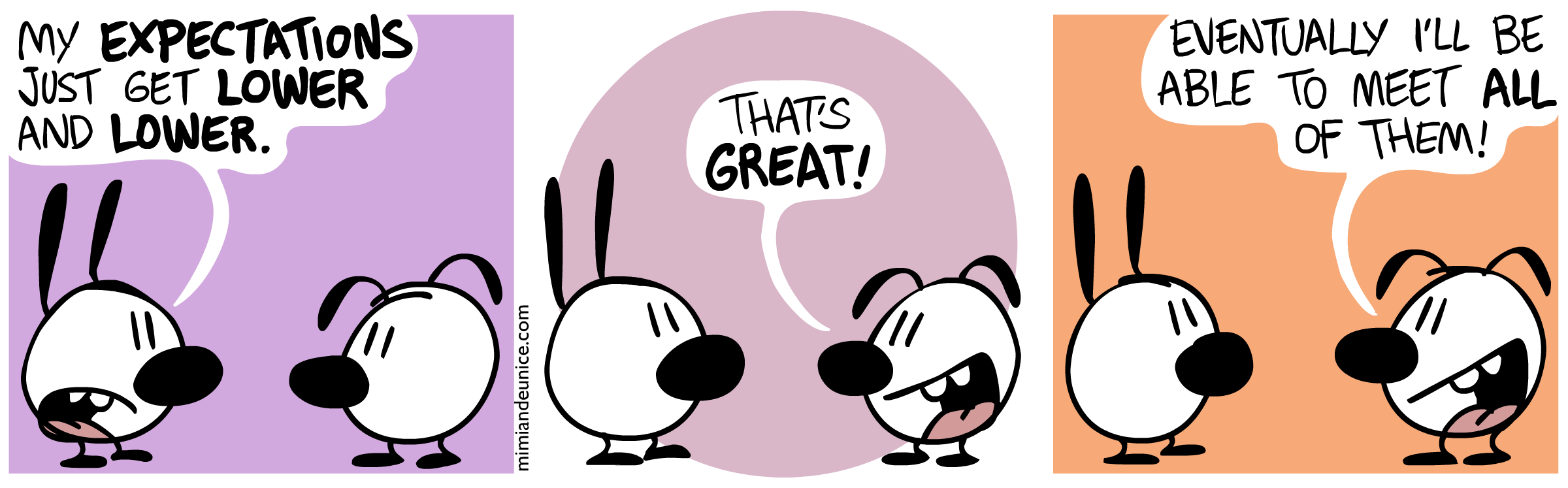
Mimi and Eunice, “Low Expectations,” September 19, 2011. (Source/http://mimiandeunice.com). Qualifies as fair use under US copyright laws because of image’s low resolution and without the intent to reproduce or distribute for profit.

It seems to me that I’ve spent a lot of time over the past three decades overcoming other people’s psychological issues. Regarding race, race and gender, race, gender and class, not to mention performance issues, success, jealousy and envy, and other psychoses that had little or nothing to do with me. It’s something that most folks who aren’t Black, male, grew up in poverty and had some success (however one defines that) really can’t understand unless they have parents who’ve told them every single day that they “weren’t good enough to live.”

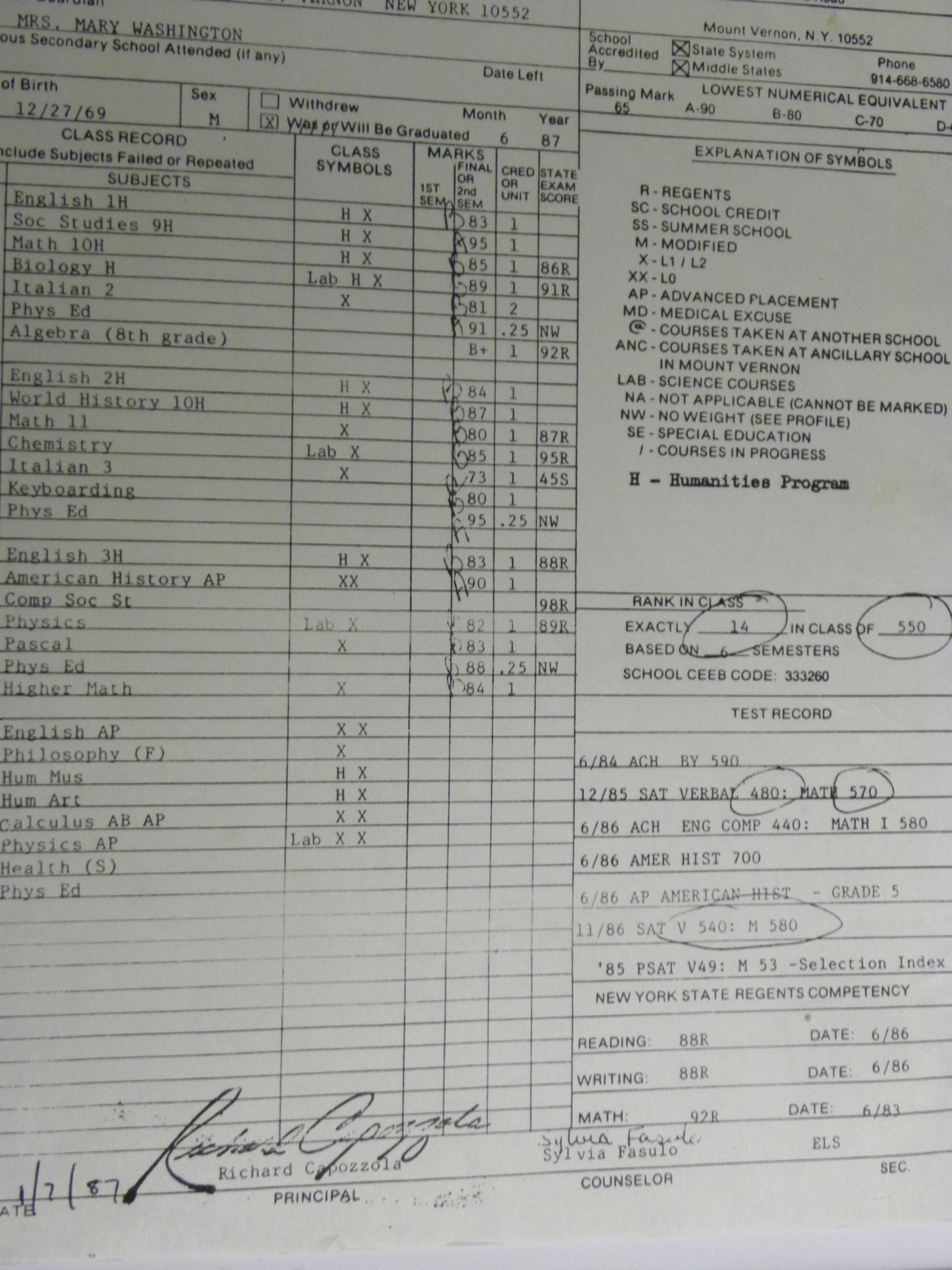
Still, these issues have mostly cropped up for me when I’ve experienced what most people would recognize as success, as if the only role I was ever supposed to play in life was that of a doormat. The first time I went through this process of blowing up other people’s low expectations of me was at the beginning of my senior year at Mount Vernon High School, about this time twenty-five years ago. A couple of weeks into the school year, MVHS released our class rankings. Out of the 545 or so students eligible to graduate as part of the Class of ’87, I was ranked fourteenth with a 3.83 average.

My MVHS trascript, courtesy of University of Pittsburgh Admissions Office, January 7, 1987. (Source/Donald Earl Collins). Note the circles from the admissions officer all over the transcript.

I understood that this was pretty good, but I was also disappointed that I hadn’t cracked the top ten. In fact, the top twelve students in our class all had GPAs above a 4.0, all because of our weighted Level 0 and Level 1 courses. Crush #1 finished just ahead of me, thirteenth in our rankings, something I saw as ironic. Despite this sign of academic success, I hoped and wished for more, and spent several late-night walks over the next few weeks second-guessing my work in tenth grade.

My classmates started to show their darker sides, some for the first time since the days of 7S. One came up to me after my AP Calculus class soon after the rankings were posted. “The only reason you’re in the top twenty’s because of history!,” implying that I was an average student in all of my other subjects. Another, much shorter and much more condescending classmate chimed in a few days later, saying that “the only thing you can do with history is play Jeopardy.” I wasn’t exactly walking around school celebrating my good fortune. I chalked it up to the stress of years of academic competition, the boiling over of senioritis and the rage associated with college preparations. The possibility that jealousy was involved didn’t cross my mind until much later. I didn’t think that anyone could be envious of my standing.

Fast-forward four years to the fall of ’90, as I prepared in earnest for grad school. Not only had I endured a short conversation at the beginning of that year with the great Sylvia Fasulo and her attempts to discourage me from pursuing grad school, law school or a career in law (see my “The Legend of Sylvia Fasulo” from September ’09). I had two professors from Pitt who told me that they weren’t sure about my chances for getting into grad school, and Reid Andrews, who flat-out told me that he didn’t think that I was “graduate school material.”

I have no doubt that if these yahoos were jealous of me at all, it was because of my age, and not my potential. They simply didn’t see how a 3.4 GPA and a 3.82 in my history major would be good enough to get me into a master’s — much less a doctoral — program. The fact that I completed my master’s degree in two semesters within twenty months of essentially being told that I was a fool left Andrews, at least, at a loss for words.

There are so many other instances in which a grad student, a professor, a supervisor, even my siblings, have expressed their low expectations and jealousy over my tiny little crumbs of success that it has left my head spinning on a broom handle. I mean, what did I really do to earn or deserve that kind of attention? I don’t own a house or have a million dollars in gold lying around. I have yet to publish an article in Rolling Stone or in The Atlantic Monthly. I don’t exactly have LeBron James or President Obama on speed dial.

So what is it about me, I’ve asked myself so many times? And then, I’ve reminded myself of something I figured out about twenty-one years ago. That the only expectations that I ultimately need to meet or exceed are my own. That what other people say about me, no matter how distasteful, really doesn’t matter, for those folks were never going to be there for me anyway.

Maybe it’s my refusal to live under someone else’s low expectations, to not allowing myself the luxury of envy, that irks those around me. Or maybe, just maybe, it’s as simple as misery loving company, and not loving mine. Either way, it’s ironic that we live in a time in which we prefer to tear each other down rather than help each other get going in our lives. Which makes my relationship with the rest of humanity so bittersweet. I guess I really am a writer!

A Question of My Blackness, Sexuality and Masculinity

01 Thursday Sep 2011

Posted by decollins1969 in 1, Boy @ The Window, culture, Eclectic, eclectic music, Jimme, Mount Vernon High School, music, Pop Culture, race, Youth

≈ Leave a comment

Tags

"Something About You", 616, 616 East Lincoln Avenue, A Question of Freedom, Blackness, Boyz N The Hood, Coolness, Crush #2, Eclectic Music, Heterosexuality, Level 42, Manhood, Masculinity, Mount Vernon High School, Mount Vernon New York, R. Dwayne Betts, Youth


Boyz N The Hood (1991) Screen Shot, September 1, 2011. (Source/http://freeinfosociety.com). 20 years since this movie, and we still inquisition Black males about their masculinity. By the way, I was NEVER this cool growing up.

About this time a quarter-century ago, I received regular reminders from the people in my life as family and classmates that I didn’t fit their definition of how a heterosexual Black male should behave. At least in Mount Vernon, New York. You see, I didn’t have to be a young Barack Obama or Lenny Kravitz to learn at an early age that I wasn’t Black enough, man enough or heterosexual enough for many folks in my life. The fact that I didn’t run around with the other boys skipping school and sniffing skirts was evidence enough of how different I was.

One of the more subtle forms of interrogation I experienced occurred at the end of eleventh grade, going into the summer of ’86. That day I walked into English class, and Crush #2 asked me about that song of the day, which happened to be Level 42’s “Something About You” Something About You. When I told her who it was, she started snapping her fingers to it. LJ, an on-and-off again classmate since third grade at William H. Holmes Elementary, walked by as we were talked. “Are they Black?,” she asked. When I said “No,” LJ shook her head and walked away. The group was White and from the Isle of Wight, no less, a bunch of off-shore British White guys. Somehow I’d violated some kind of code in LJ’s eyes. It was the last conversation we had before we graduated a year later.

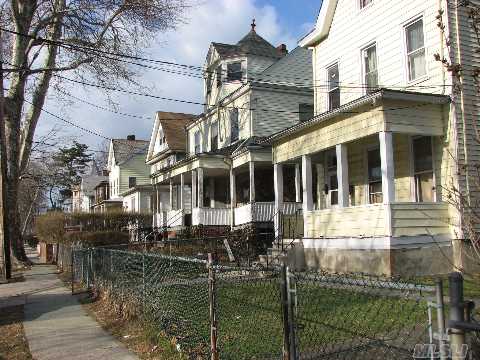
South 10th Avenue, Mount Vernon, New York, November 19, 2006. (Source/http://weichert.com). The egg-shell white house in the center of the photo is where my father Jimme lived in ’86, an attic room. Looks better now than it did then.

I received a far less subtle hint that made LJ’s disgust look like romance by comparison. It was an incident just a week before the start of my senior year at Mount Vernon High School, something I’ve posted about before. By the time I’d gotten a crush on Crush #2, my sexuality was no longer in question, although I’d never seriously questioned it before. My father, though, still had his doubts. I’d hardly seen Jimme most of the summer of ’86, only coming over occasionally to see how he was doing or to bum a few bucks off of him. I found Jimme that last Saturday morning in August, hanging out on the street around the corner from his place, having already drunk his fill.

His mood was especially foul that day, like his body odor. He refused to give me any money. “I don’ give my money to no faggats!” Jimme yelled at me as he came walking and stumbling down his block toward me. He’d seen me come out of the front yard of the house in which he rented a room. I wasn’t in the mood for his crap. “I’m not a faggot and I’m not gay,” I yelled back. When he got closer, I could see that he’d been out too long already. Jimme’s clothes were a mess, and his face was in a twisted rage. He grabbed me by my arm.

“Did you get yo’ dict wet?,” he asked as usual.

“Even if I did, I wouldn’t tell you,” I said.

“YOU’RE A FAGGAT,” he yelled again.  (see my “In the Closet, On the Down Low” from June 1, 2009 for the full conversation and incident)

As I saw it then, I was a year away from college, and I was still in the streets dealing with my drunk ass father, my jealous and institutionalized older brother, a sham of a marriage at 616 and four younger siblings who were high on sugar all of the time. I’d done so much to change my life and yet almost everything in my life was the same. Up to this point the only things that had kept my head from exploding were God and school. As my senior year approached, I wondered how much longer I could maintain emotional control before I finally just lost myself in years of growing pain, like a volcano about to super-erupt.

As I see it now, it remains a shame that we as Black males have to run a gauntlet in our communities in order

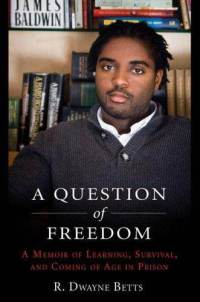
A Question of Freedom (2009) Hardcover Cover, September 1, 2011. (Source/Donald Earl Collins).

to become Black men, at least in the eyes of others. We can talk about the K-12-to-prison system that is public education in many a community of color. Or the drug trade. Or the sheer lack of quality public services and interventions in our communities or lives, other than police forces. Or even the daily images that tell so many of us that aspiring to be a rapper, football or basketball player, or just to be cool is so much better than knowing anything. The latest good memoir on this is R. Dwayne Betts‘ A Question of Freedom (2009).

But we must also admit that the people who attempted to raise us — our families, relatives, neighbors and classmates — are just as often at fault for turning out Black males who aren’t ready to be Black men, human adult males with ideas and aspirations outside of the box. Until we get serious about the fact that those closest to us have put such idiotic notions of masculinity, heterosexuality and Black coolness in many a Black male’s head, we get nowhere in helping to transform the lives of people like me when I was a teenager.

For we can’t depend on people like me becoming homeless, embracing solitude, and leaving my community as the best way to learn how to be a man, an adult, a really serious yet compassionate (and goofy) human being.

← Older posts
Newer posts →

Boy @ The Window: A Memoir

Boy @ The Window: A Memoir

Places to Buy/Download Boy @ The Window

There's a few ways in which you can read excerpts of, borrow and/or purchase and download Boy @ The Window. There's the trade paperback edition of Boy @ The Window, available for purchase via Amazon.com at http://www.amazon.com/Boy-Window-Donald-Earl-Collins/dp/0989256138/

There's also a Kindle edition on Amazon.com. The enhanced edition can be read only with Kindle Fire, an iPad or a full-color tablet. The links to the enhanced edition through Apple's iBookstore and the Barnes & Noble NOOK edition are below. The link to the Amazon Kindle version is also immediately below:

scr2555-proj697-a-kindle-logo-rgb-lg

Boy @ The Window on Amazon.com: http://www.amazon.com/Boy-The-Window-Memoir-ebook/dp/B00CD95FBU/

iBookstore-logo-300x100

Boy @ The Window on Apple's iBookstore: https://itunes.apple.com/us/book/boy-the-window/id643768275?ls=1

Barnes & Noble (bn.com) logo, June 26, 2013. (http://www.logotypes101.com).

Boy @ The Window on Barnes & Noble: http://www.barnesandnoble.com/w/boy-the-window-donald-earl-collins/1115182183?ean=2940016741567

You can also add, read and review Boy @ The Window on Goodreads.com. Just click on the button below:

Boy @ The Window

Twitter Updates

Tweets by decollins1969
  • RSS - Posts
  • RSS - Comments

Archives

  • June 2025
  • April 2023
  • September 2022
  • August 2022
  • July 2022
  • June 2022
  • May 2022
  • April 2022
  • March 2022
  • January 2022
  • December 2021
  • November 2021
  • October 2021
  • September 2021
  • August 2021
  • July 2021
  • June 2021
  • April 2021
  • March 2021
  • February 2021
  • January 2021
  • December 2020
  • November 2020
  • October 2020
  • September 2020
  • August 2020
  • July 2020
  • May 2020
  • April 2020
  • March 2020
  • January 2020
  • December 2019
  • November 2019
  • August 2019
  • July 2019
  • June 2019
  • May 2019
  • April 2019
  • March 2019
  • February 2019
  • January 2019
  • December 2018
  • November 2018
  • October 2018
  • September 2018
  • August 2018
  • July 2018
  • June 2018
  • May 2018
  • March 2018
  • February 2018
  • January 2018
  • December 2017
  • November 2017
  • October 2017
  • September 2017
  • August 2017
  • July 2017
  • June 2017
  • May 2017
  • April 2017
  • March 2017
  • February 2017
  • January 2017
  • December 2016
  • November 2016
  • October 2016
  • September 2016
  • August 2016
  • July 2016
  • June 2016
  • May 2016
  • April 2016
  • March 2016
  • February 2016
  • January 2016
  • December 2015
  • November 2015
  • October 2015
  • September 2015
  • August 2015
  • July 2015
  • June 2015
  • May 2015
  • April 2015
  • March 2015
  • February 2015
  • January 2015
  • December 2014
  • November 2014
  • October 2014
  • September 2014
  • August 2014
  • July 2014
  • June 2014
  • May 2014
  • April 2014
  • March 2014
  • February 2014
  • January 2014
  • December 2013
  • November 2013
  • October 2013
  • September 2013
  • August 2013
  • July 2013
  • June 2013
  • May 2013
  • April 2013
  • March 2013
  • February 2013
  • January 2013
  • December 2012
  • November 2012
  • October 2012
  • September 2012
  • August 2012
  • July 2012
  • June 2012
  • May 2012
  • April 2012
  • March 2012
  • February 2012
  • January 2012
  • December 2011
  • November 2011
  • October 2011
  • September 2011
  • August 2011
  • July 2011
  • June 2011
  • May 2011
  • April 2011
  • March 2011
  • February 2011
  • January 2011
  • December 2010
  • November 2010
  • October 2010
  • September 2010
  • August 2010
  • July 2010
  • June 2010
  • May 2010
  • April 2010
  • March 2010
  • February 2010
  • January 2010
  • December 2009
  • November 2009
  • October 2009
  • September 2009
  • August 2009
  • July 2009
  • June 2009
  • May 2009
  • April 2009
  • March 2009
  • February 2009
  • January 2009
  • December 2008
  • November 2008
  • October 2008
  • September 2008
  • August 2008
  • July 2008
  • June 2008
  • May 2008
  • April 2008
  • March 2008
  • February 2008
  • January 2008
  • December 2007
  • November 2007
  • October 2007
  • September 2007
  • August 2007
  • July 2007
  • June 2007

Recent Comments

decollins1969's avatardecollins1969 on No Good Teaching Deed Goes…
Mary Rose O’Connell's avatarMary Rose O’Connell on No Good Teaching Deed Goes…
Lyndah McCaskill's avatarLyndah McCaskill on The Raunchiest of Them Al…

NetworkedBlogs on Facebook

NetworkedBlogs
Blog:
Notes From a Boy @ The Window
Topics:
My Life, Culture & Education, Politics & Goofyness
 
Follow my blog

616 616 East Lincoln Avenue A.B. Davis Middle School Abuse Academia Academy for Educational Development AED Afrocentricity American Narcissism Authenticity Bigotry Blackness Boy @ The Window Carnegie Mellon University Child Abuse Class of 1987 CMU Coping Strategies Crush #1 Crush #2 Death Disillusionment Diversity Domestic Violence Economic Inequality Education Family Friendship Friendships Graduate School Hebrew-Israelites High-Stakes Testing Higher Education History Homelessness Humanities Humanities Program Hypocrisy Internalized Racism Jealousy Joe Trotter Joe William Trotter Jr. K-12 Education Love Manhood Maurice Eugene Washington Maurice Washington Misogyny Mother-Son Relationship Mount Vernon High School Mount Vernon New York Mount Vernon public schools Multiculturalism MVHS Narcissism NFL Pitt Pittsburgh Politics of Education Poverty President Barack Obama Race Racial Stereotypes Racism Relationships Self-Awareness Self-Discovery Self-Reflection Sexism Social Justice Teaching and Learning University of Pittsburgh Violence Whiteness Writing

Top Rated

Blog at WordPress.com.

  • Subscribe Subscribed
    • Notes from a Boy @ The Window
    • Join 103 other subscribers
    • Already have a WordPress.com account? Log in now.
    • Notes from a Boy @ The Window
    • Subscribe Subscribed
    • Sign up
    • Log in
    • Report this content
    • View site in Reader
    • Manage subscriptions
    • Collapse this bar
 

Loading Comments...