• About Me
  • Other Writings
  • Interview Clips
  • All About Me: American Racism, American Narcissism, and the Conversation America Can’t Have
  • Video Clips
  • Boy @ The Window Pictures
  • Boy @ The Window Theme Music

Notes from a Boy @ The Window

~

Notes from a Boy @ The Window

Category Archives: eclectic music

Psalm 23 and Christian-isms I Don’t Understand

14 Friday Apr 2017

Posted by decollins1969 in 1, Boy @ The Window, Christianity, culture, Eclectic, eclectic music, music, Patriotism, Politics, Pop Culture, race, Religion, Youth

≈ Leave a comment

Tags

American Christians, American Narcissism, Bono, Christianity, God's Politics (2005), Hypocrisy, Jim Wallis, Psalm 23, Social Control, Social Justice, Social Revolution, U2

My iPod w/ U2, November 13, 2010. (Donald Earl Collins)

It’s Easter Week for 2017, and year 33 since I became a follower of Christ. I’ve written at length about my conversion and my evolution as a Christian. I’ve also posted about my problems with Christians and the way many impose — or at least, attempt to impose — their racism, sexism, misogyny, hyper-masculinity, heterosexism, homophobia, transphobia, Islamophobia, and anti-Black respectability politics on the world.

For me, it shows most American Christians to be hypocrites as best, and full of shit at worse, when it comes to following the two most basic rules of Christianity. To have “no other gods but God,” and “to do unto others as you would have others do unto you.” For most American Christians (if not Western Christians in general), money is god, Whiteness is god, and the two go together better than the chocolate and peanut butter in a Reese’s peanut butter cup. Both assert that others are but dirty pieces of gum on one’s shoe, that hatred, violence, and permanent superiority in the name of these gods supersedes following any important teaching or practice of Jesus and his disciples.

But that’s not all. After all these years, I still don’t quite get even some of the more mundane Christian practices and assumptions. The most basic one is Psalm 23. For the life of me, I don’t understand why pastors, priests, and parishioners seem to only read the psalm after a person has died. The psalm reads as:

The Lord is my shepherd; I shall not want.
He maketh me to lie down in green pastures; He leadeth me beside the still waters.
He restoreth my soul; He leadeth me in the paths of righteousness for His name’s sake.
Yea, though I walk through the valley of the shadow of death, I will fear no evil; for Thou art with me; Thy rod and Thy staff, they comfort me.
Thou preparest a table before me in the presence of mine enemies; Thou anointest my head with oil; my cup runneth over.
Surely goodness and mercy shall follow me all the days of my life; and I will dwell in the house of the Lord for ever.

The Bajoran Wormhole screenshot (or the entrance to the Celestial Temple), Star Trek DS9. June 18, 2011. (Donald Earl Collins).

It has always seemed to me that the living have needed the verses around “I shall not want,” lying down “in green pastures,” and walking “through the valley of the shadow of death” far more than the dead. No one has explained what Psalm 23 has to do with wakes and funerals to my satisfaction. The way people use Psalm 23 assumes so much about what occurs after we die — something none of us could ever fully comprehend — and completely neglects the reality that the living need rest, peace, and strength in our walk through a corrupt world. Kind of like the way many American Christians value embryos, cats, and dogs over Black and Brown babies, toddlers, and adults.

In 2005, I picked up evangelical Jim Wallis’ book God’s Politics in an attempt to expand my knowledge of the intersection between social justice activism and Christianity. Wallis’ book was supposed to be a primer on how to fight for the rights of the most vulnerable while also standing for “traditional” American Christian values. The book was a hot mess, as it did little more than insist on the right of those who weren’t Christian or following evangelical values (e.g., openly LGBT, pro-choice, womanist, and anti-racist) to exist and to be tolerated. Wallis wasn’t exactly calling for a revolution in God’s Politics. Certainly not when he insisted that many Black play “the race card” in identifying American racism in its myriad forms.

Where I stopped reading, though, was in Wallis’ description of U2 lead singer Bono’s activism and religiosity. Wallis saw Bono as someone “who has become a serious and well-informed activist,” and as a “spiritual man, though not a churchy person.” That was a back-handed compliment. But then Wallis expressed surprise to learn that Bono would get “on his knees” to pray for guidance, as this image of this rock superstar for Wallis was “humbling and heartening.” That came from pages 198-99 of God’s Politics, and that was where I stopped reading. The self-aggrandizement and name-dropping. The assumption that Bono couldn’t possibly be thinking in both social justice and Christian terms because of his profession. And the most obvious fact of all: Wallis likely had never listened to or read a single verse of a U2 song going back to the October album (1980). There are enough Christian and biblical allusions in U2’s catalog to keep most preachers in sermons for a generation. But yeah, let’s assume that anyone other than a devout evangelical Christian is living in sin or isn’t serious about combating Whiteness or poverty or any host of manmade plagues!

Religion in general isn’t the issue. Christianity at its heart is a belief system based on forgiveness, reconciliation, embracing of diverse peoples and differences, and of course, eternal salvation. What people do with religion is what they do with everything else. It can occasionally become a catalyst for spiritual freedom and social change, even revolution. But, much more often, institutionalized religion is a spiritual yoke, a way to control the way multitudes of millions see themselves and the world around them. Funny, then, that American Christianity represents everything that America is, and very little of the basic tenets of Jesus’ teachings in practice. Promoting blind patriotism, a lover’s embrace of money changers — a.k.a., capitalism, a hatred of vulnerable populations, and a tendency to racially self-segregate. This is the American way.

American Christians have let me down in so many ways. We have let our individual -isms and individualism overwhelm whatever it is that supposedly makes us Christian in the first place. If evangelicals want to look for someone to blame for America’s decline since the 1970s, they need only to stand fully unclothed in front of a full-length mirror. Maybe Bono as quoted by Wallis was right when he said that maybe “God [was] on his knees praying” for us to get it together in eradicating poverty, systemic racism, homophobia, HIV-AIDS, and climate change. Too bad most of us aren’t listening.

Yes, I’m A Sexist Feminist

27 Tuesday Dec 2016

Posted by decollins1969 in 1, Academia, Boy @ The Window, Christianity, culture, Eclectic, eclectic music, Hebrew-Israelite, High Rise Buildings, Jimme, Marriage, Mount Vernon New York, My Father, Politics, Pop Culture, race, Religion, Youth

≈ Leave a comment

Tags

Black Masculinity, Chivalry, Contradictions, Dahlia, Damsel-in-Distress Syndrome, Father-Son Relationship, Feminism, Masculinity, Misogyny, Mother-Son Relationship, Nice Guy, Owning Imperfection, Patriarchy, Phyllis, Sexism, Womanism


Hostile vs. Benevolent Sexism, March 10, 2015. (http://www.dailymail.co.uk).

Hostile vs. Benevolent Sexism, March 10, 2015. (http://www.dailymail.co.uk).

I finished up a chapter in Boy @ The Window with the closest approximation to my contemporaneous thoughts about Phyllis (a.k.a., “Crush #2” at times on this blog) in August 1988:

screen-shot-2016-12-27-at-7-43-51-am

I must’ve rewritten these two paragraphs at least a half-dozen times before putting the book out for limited consumption. The thought process that I went through at eighteen years old bothered me then, and looking at the words even today leaves me wanting. Probably because there is more than a bit of sexism contained within these words.

But I wasn’t wrong, of course, not in ’88, not when I wrote and rewrote these paragraphs between 2007 and 2011, and not now, at least in terms of how I perceived things then. While I believed in reproductive rights, in equal pay for equal work, and in passing the Equal Rights Amendment growing up, I also believed in saving damsels from distress and in distinguishing between “ladies” and “bitches.” Or, as my father put it when he argued with my Mom in front of me when I was four years old, “You’s a black bit’!” Or, my contradiction could’ve fully formed when my father tried to set me up with a prostitute a couple of weeks before my seventeenth birthday, in December 1986.

There was no way in 1988 I could’ve understood the contradictions between the idea of feminism (in any form) and the notion of “being a nice guy.” I hadn’t been exposed, or, rather, exposed myself to Paula Giddings, Elsa Barkley Brown, Evelyn Brooks Higginbotham, bell hooks, Maya Angelou, Angela Davis, and Zora Neale Hurston. I hadn’t yet been engaged in the hundreds of conversations I’d eventually have with women folk I’d become friends with, people with whom I bonded because of their suffering, people from whom I’d hidden my own suffering during those years. Date rape, physical abuse, the more typical abuse of serial cheating, among other issues. With many of these women, I recognized the sexism and misogyny I saw in myself in 1988, and saw them again when I wrote down my contemporaneous thoughts in Boy @ The Window. It didn’t occur to me until the mid-1990s that women could be just as sexist and misogynistic as men, and often could pass down their notions of masculinity and patriarchy to their children. And that thought scared me.

Imprisoned brain (or, maybe, Culture Club and "Church of the Poison Mind" [1983]), December 27, 2016. (http://mdjunction.com).

Imprisoned brain (or, maybe, Culture Club and “Church of the Poison Mind” [1983]), December 27, 2016. (http://mdjunction.com).

It scared me because I realized I may have learned more of my contradictions from my Mom than from my father or idiot ex-stepfather. After all, she was the one constant in my parenting, the one person who engaged me in ideas like chivalry and manliness, who through her acquiescence to Maurice might have made it okay for me to see women, especially Black women (and to a lesser extent, Latina women) as ones in need of help, even when they decide not to take it.

And it may have made it okay for me to see myself as the victim in my incident with Dahlia in June 1987, when I accidentally (the first time), and later deliberately smacked her on her left butt cheek. Maybe I was the victim in a way, at least of my own deluded thought process. And there hasn’t been a time in the past twenty-nine and a half years in which I haven’t regretted that second, deliberate slap, in response to Dahlia accusing of thoughts I didn’t have, because my only obsession in 1987 was Phyllis. I’ve said and written this before, including in Boy @ The Window. To Dahlia, I am so sorry.

Beijing smog alert, Beijing, China, December 6, 2016. (http://ibtimes.com).

Beijing smog alert, Beijing, China, December 6, 2016. (http://ibtimes.com).

I may never be the perfect intersectional womanist feminist I’ve tried to be since I told my Mom to abort my future (and since deceased) sister in 1982. I still believe that professional women’s tennis players should play best-of-five-set matches at the Gram Slam tournaments. I think more women — particularly White women — should stop calling themselves feminists if their feminism stops when dealing with women of color or poor women in general. I think that most men who aren’t feminists are assholes. But I also know that, just like with racism (as now well noted by Ibram Kendi) and with narcissism (my next project, maybe), sexist ideas are as pervasive as smog in L.A. and Beijing. I don’t have to like it or accept it, but I do have to accept that I am a man, and I will make mistakes, including sexist ones. I will have to own up, and keep trying to do better.

Go Greyhound (only when you can’t afford anything else)

17 Saturday Dec 2016

Posted by decollins1969 in 1, Boy @ The Window, Christianity, culture, Eclectic, eclectic music, Marriage, Mount Vernon New York, music, New York City, Pittsburgh, Pop Culture, Religion, University of Pittsburgh, Youth

≈ Leave a comment

Tags

616 East Lincoln Avenue, Abuse, Chance Encounter, Damsel-in-Distress Syndrome, Dating, Friendships, Greyhound, Growing Up, Mother-Son Relationship, Pitt, Poverty, Psychological Scars, Self-Awareness, Winter Weather


Screen shot of December 1988 calendar, December 17, 2016. (http://timeanddate.com).

Screen shot of December 1988 calendar, December 17, 2016. (http://timeanddate.com).

It amazes me sometimes when I look at a date on a calendar and not only know I was doing at that time years and decades ago. It is uncanny sometimes how similar the weather is on a specific date versus the same date and time from another year of my nearly forty-seven.

So it is with today, a cold and freezing wet day, not only here in the DMV, but also in Pittsburgh. It’s not as cold as it was on Saturday, December 17, 1988, when lake-effect snow was pouring down on Eastern Ohio, Western New York, and Western Pennsylvania. But dreary is dreary anyway. Despite the weather, I was grateful after making it through a semester that began in homelessness, continued in foodless-ness, and ended with new friendships and with enough money to hang out for the first time in well over a year. I had aced my courses in spite of it all, faced down my Mom in changing my academic and career course to history, and felt like Pitt, if not Pittsburgh, had become my home for the first time. Thirteen months after the second of two rebuffs from my high school classmate Phyllis, I was finally, finally, self-aware of my emotional and psychological scars enough to want to begin the long, painful, and difficult work of healing.

So why couldn’t I sleep the night before my first Greyhound trip from Pittsburgh to New York?

Greyhound Bus and blizzard, Vancouver, BC, Canada, circa 2015. (http://huffingtonpost.com).

Greyhound Bus and blizzard, Vancouver, BC, Canada, circa 2015. (http://huffingtonpost.com).

There was something different about this, though. I couldn’t go to sleep, even though I was absolutely exhausted. I wasn’t supposed to catch a bus until eight o’clock that morning, but I gave up getting sleep at five-thirty. I went out in a snowstorm to catch a PAT-Transit bus downtown, and walked over from Grant to the Greyhound Bus terminal. I didn’t think we were going anywhere the way the snow was coming down, but we left on time for New York City. Good thing for us that the bus was a non-stopper between Pittsburgh and Philly.

On the bus and across from me was a young Black woman with a Brooklyn accent. She was as pretty as anyone I’d seen in the previous seven years. But I was so tired that I kept to myself. Despite our driver’s attempts to kill us all by going at near ninety an hour on the part of the Pennsylvania Turnpike that crossed the Allegheny Mountains, I slept for a couple of hours, playing Phil Collins, Peter Cetera, Brenda Russell and Kenny G throughout.

I suppose I was antsy about going back to New York, to Mount Vernon, to 616, to the life of constantly looking over my shoulder and looking at myself through the eyes of my former classmates and neighbors. After finally rediscovering the real me, and finally beginning the process of putting away the coping strategy, Boy-@-The-Window-me, I was going back into the third armpit of hell for the next nineteen days. Or, maybe it was my terrible taste in music (except for Phil Collins, of course)!

I also had unfinished business. Now that I realized I could trust myself again, at least in part, what did everything mean? Could I sustain friendships? Would I know how to date? Can I reconcile what kind of Christian I could be in a secular, scholarly world? What would being a history major mean for me by the time I graduated in 1991? Why does this woman across from my seat keep staring at me?

Once I woke up, I looked over at her and struck up a conversation. We talked from central Pennsylvania to Philly and from there to New York. She was a second-year medical student at Wayne State University in Detroit, and was in between boyfriends. We talked about our families and our growing up in and around the big city. She was the first person to tell me, “Anything above 125th Street is upstate, don’t’cha know?,” referencing Mount Vernon. It was a long and wonderful conversation, and if I hadn’t been embarrassed by 616, I would’ve asked her out. She didn’t give me the chance to think about it. She gave me her number and said, ‘You don’t have to call, but I really would like it if you did.’

Rhiannon Griffith-Bowman smokes an e-cigarette, San Rafael, CA, April 16, 2015. (Justin Sullivan/Getty Images; http://washingtonpost.com).

Rhiannon Griffith-Bowman smokes an e-cigarette, San Rafael, CA, April 16, 2015. (Justin Sullivan/Getty Images; http://washingtonpost.com).

I should’ve given her a call, but I didn’t. I was scared, not of her, but of being my better self while at 616. I had no idea how to do the dating thing when I had to be around my idiot stepfather and his size-54, 450-pound, greasy, abusive personage. Or my Mom, who spent every waking moment either singing God’s praises (literally) or hatching plots with my input to find another way to drive my stepfather out of 616 once and for all. Or my siblings, four of which were now between the ages of four and nine, and my older brother Darren, who might as well been a six-foot-five thirteen-year-old. My Mom and Maurice smoked up a storm. There were evenings where they would have farting contests, with legs lifted up in the air, as if they were part of a nasty, stupid comedy routine! There was no way I could handle the psychological code switching I’d have to do just to hang out, not at almost nineteen years old, and with a woman four years older than me.

Looking back, I realized I had deeply over-thought the situation, that I could’ve just had tunnel vision and done what I wanted to do, and not involve myself with any 616 drama that Xmas/New Year’s break. But I couldn’t do that, not yet. My sexist, damsel-in-distress syndrome was still more powerful than any of my other sexist, misogynistic, or even feminist tendencies. Even with all that, the first of my Greyhound bus trips was easily the most important one I went on.

Songs in the Key of Life at 40

18 Friday Nov 2016

Posted by decollins1969 in 1, Boy @ The Window, Christianity, culture, Eclectic, eclectic music, Hebrew-Israelite, Jimme, Marriage, Mount Vernon New York, music, My Father, New York City, Pittsburgh, Politics, Pop Culture, race, Religion, University of Pittsburgh, Work, Youth

≈ Leave a comment

Tags

"As", "I Wish", "Love's in Need of Love Today", "Sir Duke", Black Genius, Blackness, Elaine, Growing Up, Love, Pitt, Prescience, Songs in the Key of Life (1976), Stevie Wonder, Uplift, Wendy


Stevie Wonder's Songs in the Key of Life LP/CD cover and sleeve, 1976, 1999. (http://genius.com).

Stevie Wonder’s Songs in the Key of Life LP/CD cover and sleeve, 1976, 1999. (http://genius.com).

In all the nuclear meltdowns in the last weeks of Election ’16 and in the asteroid impact of Donald Trump becoming the 45th president of the United States, I almost completely forgot about one of the modern era’s greatest milestones. At the end of September, Stevie Wonder’s Songs in the Key of Life double-album turned forty years old!

My wife swears that this was Stevie Wonder’s last great production of genius, that virtually all the music he’s done since has either been merely “that’s nice” or complete schlock. But compared to Songs In The Key Of Life, at least 75 percent of the music produced since 1500 CE would be schlock! I mean, between “I Wish,” “Sir Duke,” “Love’s in Need of Love Today,” “Have a Talk with God,” “Village Ghetto Land,” and my all-time favorite, “As,” who could ask for anything more out of an album or an artist?

My fandom for Songs in the Key of Life has occurred over several stages since its release on September 28, 1976. I was nearly seven when the double-album dropped, and my life couldn’t have been messier. Between my Mom and my father Jimme’s rocky and violent divorce process, my own coping with sexual assault, and my Mom getting kidney sick and ending up at Mount Vernon Hospital as a patient for three months. Add to this having babysitters as primary caregivers during that time, and a second-grade teacher who wasn’t exactly sympathetic to Black kids who couldn’t settle down. It was a rough time, maybe even rougher than my Hebrew-Israelite years.

But songs from the double-LP were there, either thanks to WBLS-107.5 FM, or to people blasting songs off 8-tracks and cassette decks out of their cars in South Side Mount Vernon. Or, in the case of hanging out with my dad, because of his drinking buddies playing Stevie Wonder’s songs over and over again. For those first few years, “I Wish” and “Sir Duke” were my favorite songs from Songs in the Key of Life. That was probably because they were the only songs from the set I’d heard in full prior to 1982.

Then, with the Wendy crush/puppy love/mini-love of the spring and summer of ’82, one of the songs my mind conjured up was “As.” The song’s more than seven minutes long, and I barely knew the words “until the rainbow burns the stars out in the sky,” much less the entirety of the poetry of that song, much less its full meaning. But my heart knew how that song made me feel, and for matter, how Wendy made me feel, at least for a time. Once my stepfather Maurice began beating on me, my Mom lost her job, and we slipped into welfare poverty, though, Stevie Wonder’s greatest works slipped from my mind.

Nine years later, and it was my friend Elaine who reintroduced me to Songs in the Key of Life. It was during the spring and summer of ’91, when I both liked and loathed Elaine at the same time. It was also the summer before graduate school at the University of Pittsburgh, and it was like my mind and heart knew I needed to feed myself more than Phil Collins, Anita Baker, PE, and Salt ‘n Pepa. I borrowed Elaine’s set of cassette recordings from the genius’ 2-LP set, and spent parts of April, May, and June walking the 3.4 miles between my place in S’Liberty and my job at Western Psychiatric in Oakland listening to Stevie Wonder. I played Songs in the Key of Life straight through a half-dozen times. But of all the songs, “Love’s in Need of Love Today” and “Have a Talk with God” became two of my favorites. After the potential for a more serious relationship with Elaine faded, I gave her back her cassettes in August.

It would be another fifteen years before I finally got Songs in the Key of Life on CD. It was 2006, and I’d finally gotten me and my wife into the iPod era. Between that and my work on my memoir Boy @ The Window, I wanted to explore what made me me musically over the years. In remembering my Wendy-love days, I literally had to go through every song on Songs in the Key of Life again before I remembered “As” in full. I was shocked that after thirty years and so many other Stevie Wonder songs, that it had remained a melody in my heart and mind. It was in the summer of ’06 that “As” became my favorite song off this all-time great album(s).

Given what had occurred in the US over the past decade, and what has been happening to people of color in the US for as long as I’ve been alive, Stevie Wonder’s music from Songs in the Key of Life is always relevant, always uplifting, always life-affirming. Trust me, with Trump’s ascendancy to the White House, “the force of evil plans” will try “to make you its possession.” And yes, I did think “that love would be in need of love today,” because it wasn’t as if “hate” wasn’t going around “breaking hearts” and bodies during the Obama years.

But I’ll close with this, perhaps the most important stanza from “As.” This, to remind myself and all of you America’s may be in more trouble than ever before, but know that trouble has been with America longer than we’ve had the privilege of Stevie Wonder’s Songs in the Key of Life as genius. Thanks to Wendy, Elaine, my former Mount Vernon neighbors, and unknown New Yorkers, for playing these songs for me over the years, whether they meant to or not.

We all know sometimes life’s hates and troubles
Can make you wish you were born in another time and space
But you can bet you life times that and twice its double
That God knew exactly where he wanted you to be placed
So make sure when you say you’re in it but not of it
You’re not helping to make this earth a place sometimes called Hell
Change your words into truths and then change that truth into love
And maybe our children’s grandchildren
And their great-great grandchildren will tell
I’ll be loving you

Shut Up and Play

30 Tuesday Aug 2016

Posted by decollins1969 in 1, culture, Eclectic, eclectic music, music, Patriotism, Politics, Pop Culture, race, Sports

≈ Leave a comment

Tags

"Shut Up and Play!", "White Discussion", American Exceptionalism, American Narcissism, Colin Kaepernick, Colorblind Racism, Derrick A. Bell, Freedom, Hyper-Patriotism, Live, NFL, Racism, Rules of Racial Standing, White Male Angst


“Shut up play!” That’s what the average White-bred American wants. Not just from Colin Kaepernick. They want that from all vulnerable Americans, especially those of us Black, Brown, and female. Like the chain-smoking, beer-drinking, and buffalo-wing-eating archetypes many are, these average Joes have been going after Kaepernick since Saturday afternoon, attempting to do to him virtually what their great-grandfathers would’ve done to him in the town square. These folk should know that they know nothing of the flag, the national anthem, or the Constitution they claim to believe in so forthrightly. They have proven beyond any shadow of a doubt that the racism and oppression that motivated Kaepernick to take his stand by sitting is alive and well, both in American institutions and in the hearts and minds of average Joes.

But so are the rules of racial standing, or race rules, for that matter (to quote both Derrick Bell and Michael Eric Dyson). In the past two days, eloquent Black ex-NFL players Hines Ward, Jerry Rice, Rodney Harrison, and Tiki Barber have all weighed in, saying dumb and racist crap in the process. “All lives matter?” “Can’t we just all get along?” Kaepernick “isn’t Black?” Who are these dumb asses? And why is the media searching for anti-Kaepernick perspectives harder than Shell is searching for Arctic oil?

Because Americans demand it. Americans want a society with a permanent underclass, where even the few who somehow “make it” swear their allegiance to the status quo. Americans want to believe that racism is a mere boogieman that can be kept in the closet and will rarely see the light of day. And, most of all, Americans want their Black and Brown athletes, especially in football, to not have brains, mouths, or a conscious. Americans wants to be entertained, not educated.

As a couple of lines from Live’s “White, Discussion” (1994) go,

I talk of freedom
You talk of the flag
I talk of revolution
You’d much rather brag

That is America in a nutshell. Nothing’s wrong with the country, but everything is wrong with those Black and Brown who are willing to say that there is. The flag and the national anthem are sacred, but the lives of those Black, Brown, and female are cheaper than sewer water. Any sweeping changes to policing, foreign and economic policies, or other aspects of American culture are met with “U-S-A! U-S-A! U-S-A!,” as if everyone Black and Brown must prove their patriotism in order to confront oppression.

So I say this. The only people who need to “shut up and play” are the ones with a Bud in one hand and three buffalo wings in the other. Shut up and play ball with America’s reality, and not with America’s symbols. Shut up and play the real game of understanding why Kaepernick is protesting and why the ideals of the flag and the anthem are daggers in the hearts of millions. Otherwise, you’re part of the problem. Period.

America Denies For Others What It Demands For Itself

16 Tuesday Aug 2016

Posted by decollins1969 in 1, culture, Eclectic, eclectic music, music, Patriotism, Politics, Pop Culture, race, Sports, Youth

≈ Leave a comment

Tags

"Crumbs From Your Table" (2004), 2016 Summer Olympics, American Moralisms, American Narcissism, Brazil, Chad Le Clos, Doping, Frank Deford, Gabby Douglas, Lilly King, Michael Phelps, NBC Coverage, Rich vs. Poor, Rio, Rio de Janeiro, Sports Illustrated, U2, Wholesome Images, Winners and Losers, Yuliya Efimova


Screen Shot 2016-08-16 at 7.57.50 AM

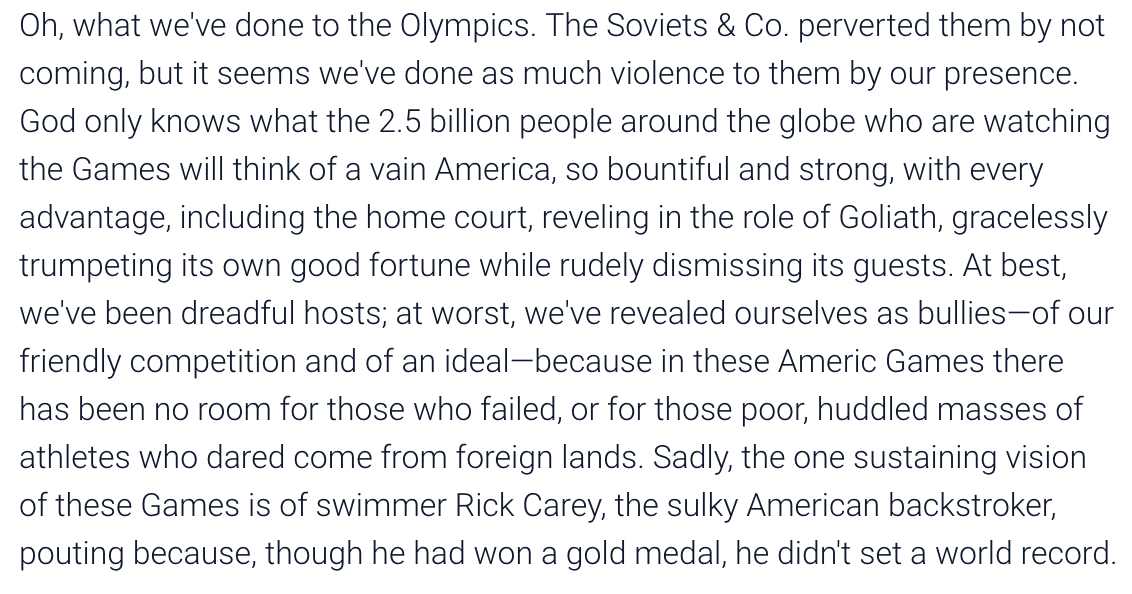
Excerpt from Frank Deford, “Cheer, Cheer, Cheer For The Home Team,” Sports Illustrated, August 13, 1984, p. 38. (http://www.si.com/vault/1984/08/13/620469/cheer-cheer-cheer-for-the-home-team).

The famous and often loopy sports writer Frank Deford wrote this about America’s narcissistic display of celebration in the 1984 Summer Olympics in Los Angeles. Despite the changes in location, the change in networks, and the shifts in coverage over the years, the ability of the US to celebrate its greatness as if the nation was an underdog every four years knows no bounds. Americans moralize, spin stories of wholesome athletes, and frame the games as if the rest of the world is a bunch of losers. Chuck a few words like “The Soviets,” “2.5 billion,” and “Rick Carey,” and substitute “The Chinese,” “5 billion,” and “Lilly King” or “Michael Phelps.” That, and the locale being Rio de Janeiro, are the main differences.

The late Barbara Billingsley as June Cleaver in Leave It To Beaver, October 17, 2010. (http://www.digitaljournal.com/article/299042).

The late Barbara Billingsley as June Cleaver in Leave It To Beaver, October 17, 2010. (http://www.digitaljournal.com/article/299042).

NBC’s coverage has been narcissistic jingoism to the extreme. If you want to see Olympians from other countries who competed but didn’t win gold — or Olympians who won gold but don’t speak English — you can pretty much forget about seeing them on NBC. BBC News has provided more of this global coverage, even in the midst of its British/British Commonwealth bias. NBC can say that it’s giving Americans what they want. Really? Primetime coverage on the mothership and spotty and often tape-delayed coverage on its other channels, with a few clips online? Wow, Americans must only care about America so much that they are willing to miss hours of inspirational stories and exemplary athletic performances. Yet apparently Americans do want the dozens of mentions of Maya DiRado’s recent marriage and new house in Atlanta, where she’ll apparently settle down like June Cleaver after The Games. That, and that most Americans expect to win, like the way L.A. Lakers fans have been at home games assuming twenty-point blowouts night after night for the better part of 60 years.

This isn’t to say that Americans haven’t achieved greatness during the Rio Games. Michael Phelps, Katie Ledecky, Lilly King, Maya DiRado, Simone Biles, Simone Manuel, Laurie Hernandez, Michelle Carter, Ibtihaj Muhammad, Aly Raisman, Gabby Douglas, Corey Cogdell-Unrein, Allyson Felix, among so many others, have had great, even historic, times. Yet Americans celebrated Ledecky’s 11-second win in the 800m final as if it was preordained magic and proof of American imperial superiority at the same time. Swimming is a resources-dependent sport, requiring Olympic-sized pools, investments in coaching, and thousands of hours of training. That Ledecky won by such a huge margin isn’t just an indication of superior athletic talent and training. It’s a reflection of a serious financial commitment by parents and public/private funds from the richest nation in the world to making gold medals in swimming a priority. It’s an example of haves versus have-nots, an unfairness baked into the cake of the Social Darwinist modern Olympics from the time they began in 1896.

Rich vs. Poor cartoon, John Darkow, September 18, 2011. (http://www.columbiatribune.com).

Rich vs. Poor cartoon, John Darkow, September 18, 2011. (http://www.columbiatribune.com).

Lilly King and others have moralized about their achievements being done without the enhancements of PEDs. As if American athletes are always clean. As if American Olympians haven’t been caught doping in the recent past. As if the advantages of living in a wealthy nation committed to winning above all else doesn’t translate into maximizing athletic talents in every Olympic sport. King’s bravado might have been seen as cute or wonderful by some, especially over her Russian competitor Yuliya Efimova. But it’s no different from Donald Trump bragging about how much money he has to a room full of ex-cons who served time for shop lifting or stealing a few dollars.

There’s a racial component to all of this as well. It’s okay for wholesome folks like Phelps to make Chad Le Clos look stupid, or for King to moralize about doping. Not so much in the Black-dominated track and field, or in men’s basketball, or for Blacks in swimming and gymnastics. There, Americans not only expect their Olympians to win. They expect them to know their place, not discuss race, and have their hand over their heart when the National Anthem’s playing.

U2 in “Crumbs From Your Table” (2004) asked the question — in regard to rich countries like the US — “Would you deny for others what you demand for yourself?” In the case of the US, the answer is, “U-S-A! U-S-A! U-S-A!,” or “Y-E-S! Y-E-S! Y-E-S!” Americans already do it to each other, through racism, misogyny, homophobia, xenophobia, and plutocracy. Why would it be different for the US regarding the rest of the world?

When Your Music Turns 30

11 Thursday Aug 2016

Posted by decollins1969 in 1, Boy @ The Window, culture, Eclectic, eclectic music, music, Pop Culture, race, Youth

≈ Leave a comment

Tags

1980s music, Anita Baker, Beyonce, Bruce Hornsby and The Range, Chaka Khan, Chicago, Fountain of Middle Age, Kendrick Lamar, Maverick Sabre, Nneka, Pet Shop Boys, Run-D.M.C., Starship, Steve Winwood


Well, some of my music, anyway. About a third of all the music I own, like, or have access to was produced at least thirty years ago, as of this month. I guess I shouldn’t be bothered with the fact that everything from Johann Sebastian Bach, Blind Willie Johnson, and John Coltrane to Anita Baker, Steve Winwood, and Pet Shop Boys are all ancient in the mind of my teenage son. In a way, though, I am. Not so much that my music collection is an indication that I am no longer physically young. That happens to all of us. But whether this is a sign that my mind is no longer plastic enough to absorb new music, new styles, new ways of delivering a form of entertainment and escapism.

The fact that I’m still catching up with music released between 2011 and 2014 is troubling. I mean, it’s only been a year and a half since I picked up Kendrick Lamar’s Good Kid, MAAD City (2012). I have Nneka and Maverick Sabre on my playlists only because my wife keeps up with music through YouTube, Spotify, and Pandora. I still haven’t heard or seen the video for Beyoncé’s “Lemonade,” have yet to hear a Nicki Minaj or Rihanna song that I truly like, and think that Drake and Meek Mill are pretty weak. Am I getting so old that I don’t understand what is or isn’t good music anymore? Or, did I ever have a handle on what was and is good music when I was sixteen, and am more discerning or snobbish now? Or, am I just a goofball who wouldn’t know good music if it bit me in the ass?

Maybe it’s all of the above. Below is a sample of my list of song that I described as theme music for Boy @ The Window. This is all music that came out in ’86.

Screen Shot 2016-08-10 at 12.17.21 PM

There are some amazing songs on this list. Anita Baker’s “Sweet Love.” Simply Red’s “Holding Back The Years.” Sade’s “Never As Good As The First Time.” Who could argue with these? If anyone does, they just hate the whole genre of ’80 pop and R&B, and refuse to appreciate the music on any level.

Now there are other where I will concede the quality is questionable, but I like anyway. Pet Shop Boys’ “West End Girls,” Michael McDonald’s “Sweet Freedom,” and Falco’s “Rock Me Amadeus” all fit into all kinds of questionable tastes here. But compare “Sweet Freedom” to Prince’s “Raspberry Beret” and its syrupy goofiness. Or, really, Michael McDonald’s super-popular duet with Patti LaBelle in “On My Own.” I hated that song as much as I could hate any music, but I was apparently in a small minority three decades ago. Baby Boomers – gotta love ’em!

There’s also Steve Winwood’s “Higher Love” with Chaka Khan doing background vocals. You take Chaka Khan out of this song, and it’s an ’80s display of synthesizer prowess with pretty decent lyrics. Bruce Hornsby and The Range’s “The Way It Is” was and remains a simplistic “hearts and minds” analysis of American racism, but it was at least a self-consciously effort to address a social issue. Even when folks fall short, I can appreciate their music.

There are plenty of songs from thirty years ago that I either thought were silly, didn’t represent my mood from that time, or were a reflection of my need to escape my life. Anything by Chicago or Starship from ’86 would fit. I heard Starship’s “Nothing’s Going To Stop Us” at the local Trader Joe’s, a few days ago, and my stomach started cramping up. I actually got nauseous over a song! Grace Slick’s voice remains scary, I guess.

The thread between the music I listened to three decades ago and the music I have on my iPod, iPhone, and computers is clear, to me, if no one else. With the exception of country music as Whiteness affirming, I generally don’t care what genre it’s from. The lyrics are more important than the quality of vocals, and the vocals and music are way more important than any video made with the song. That probably makes me a bit old-fashioned. But it’s also why I still have music in my collection that predates my birth.

← Older posts
Newer posts →

Boy @ The Window: A Memoir

Boy @ The Window: A Memoir

Places to Buy/Download Boy @ The Window

There's a few ways in which you can read excerpts of, borrow and/or purchase and download Boy @ The Window. There's the trade paperback edition of Boy @ The Window, available for purchase via Amazon.com at http://www.amazon.com/Boy-Window-Donald-Earl-Collins/dp/0989256138/

There's also a Kindle edition on Amazon.com. The enhanced edition can be read only with Kindle Fire, an iPad or a full-color tablet. The links to the enhanced edition through Apple's iBookstore and the Barnes & Noble NOOK edition are below. The link to the Amazon Kindle version is also immediately below:

scr2555-proj697-a-kindle-logo-rgb-lg

Boy @ The Window on Amazon.com: http://www.amazon.com/Boy-The-Window-Memoir-ebook/dp/B00CD95FBU/

iBookstore-logo-300x100

Boy @ The Window on Apple's iBookstore: https://itunes.apple.com/us/book/boy-the-window/id643768275?ls=1

Barnes & Noble (bn.com) logo, June 26, 2013. (http://www.logotypes101.com).

Boy @ The Window on Barnes & Noble: http://www.barnesandnoble.com/w/boy-the-window-donald-earl-collins/1115182183?ean=2940016741567

You can also add, read and review Boy @ The Window on Goodreads.com. Just click on the button below:

Boy @ The Window

Twitter Updates

Tweets by decollins1969
  • RSS - Posts
  • RSS - Comments

Archives

  • June 2025
  • April 2023
  • September 2022
  • August 2022
  • July 2022
  • June 2022
  • May 2022
  • April 2022
  • March 2022
  • January 2022
  • December 2021
  • November 2021
  • October 2021
  • September 2021
  • August 2021
  • July 2021
  • June 2021
  • April 2021
  • March 2021
  • February 2021
  • January 2021
  • December 2020
  • November 2020
  • October 2020
  • September 2020
  • August 2020
  • July 2020
  • May 2020
  • April 2020
  • March 2020
  • January 2020
  • December 2019
  • November 2019
  • August 2019
  • July 2019
  • June 2019
  • May 2019
  • April 2019
  • March 2019
  • February 2019
  • January 2019
  • December 2018
  • November 2018
  • October 2018
  • September 2018
  • August 2018
  • July 2018
  • June 2018
  • May 2018
  • March 2018
  • February 2018
  • January 2018
  • December 2017
  • November 2017
  • October 2017
  • September 2017
  • August 2017
  • July 2017
  • June 2017
  • May 2017
  • April 2017
  • March 2017
  • February 2017
  • January 2017
  • December 2016
  • November 2016
  • October 2016
  • September 2016
  • August 2016
  • July 2016
  • June 2016
  • May 2016
  • April 2016
  • March 2016
  • February 2016
  • January 2016
  • December 2015
  • November 2015
  • October 2015
  • September 2015
  • August 2015
  • July 2015
  • June 2015
  • May 2015
  • April 2015
  • March 2015
  • February 2015
  • January 2015
  • December 2014
  • November 2014
  • October 2014
  • September 2014
  • August 2014
  • July 2014
  • June 2014
  • May 2014
  • April 2014
  • March 2014
  • February 2014
  • January 2014
  • December 2013
  • November 2013
  • October 2013
  • September 2013
  • August 2013
  • July 2013
  • June 2013
  • May 2013
  • April 2013
  • March 2013
  • February 2013
  • January 2013
  • December 2012
  • November 2012
  • October 2012
  • September 2012
  • August 2012
  • July 2012
  • June 2012
  • May 2012
  • April 2012
  • March 2012
  • February 2012
  • January 2012
  • December 2011
  • November 2011
  • October 2011
  • September 2011
  • August 2011
  • July 2011
  • June 2011
  • May 2011
  • April 2011
  • March 2011
  • February 2011
  • January 2011
  • December 2010
  • November 2010
  • October 2010
  • September 2010
  • August 2010
  • July 2010
  • June 2010
  • May 2010
  • April 2010
  • March 2010
  • February 2010
  • January 2010
  • December 2009
  • November 2009
  • October 2009
  • September 2009
  • August 2009
  • July 2009
  • June 2009
  • May 2009
  • April 2009
  • March 2009
  • February 2009
  • January 2009
  • December 2008
  • November 2008
  • October 2008
  • September 2008
  • August 2008
  • July 2008
  • June 2008
  • May 2008
  • April 2008
  • March 2008
  • February 2008
  • January 2008
  • December 2007
  • November 2007
  • October 2007
  • September 2007
  • August 2007
  • July 2007
  • June 2007

Recent Comments

decollins1969's avatardecollins1969 on No Good Teaching Deed Goes…
Mary Rose O’Connell's avatarMary Rose O’Connell on No Good Teaching Deed Goes…
Lyndah McCaskill's avatarLyndah McCaskill on The Raunchiest of Them Al…

NetworkedBlogs on Facebook

NetworkedBlogs
Blog:
Notes From a Boy @ The Window
Topics:
My Life, Culture & Education, Politics & Goofyness
 
Follow my blog

616 616 East Lincoln Avenue A.B. Davis Middle School Abuse Academia Academy for Educational Development AED Afrocentricity American Narcissism Authenticity Bigotry Blackness Boy @ The Window Carnegie Mellon University Child Abuse Class of 1987 CMU Coping Strategies Crush #1 Crush #2 Death Disillusionment Diversity Domestic Violence Economic Inequality Education Family Friendship Friendships Graduate School Hebrew-Israelites High-Stakes Testing Higher Education History Homelessness Humanities Humanities Program Hypocrisy Internalized Racism Jealousy Joe Trotter Joe William Trotter Jr. K-12 Education Love Manhood Maurice Eugene Washington Maurice Washington Misogyny Mother-Son Relationship Mount Vernon High School Mount Vernon New York Mount Vernon public schools Multiculturalism MVHS Narcissism NFL Pitt Pittsburgh Politics of Education Poverty President Barack Obama Race Racial Stereotypes Racism Relationships Self-Awareness Self-Discovery Self-Reflection Sexism Social Justice Teaching and Learning University of Pittsburgh Violence Whiteness Writing

Top Rated

Blog at WordPress.com.

  • Subscribe Subscribed
    • Notes from a Boy @ The Window
    • Join 103 other subscribers
    • Already have a WordPress.com account? Log in now.
    • Notes from a Boy @ The Window
    • Subscribe Subscribed
    • Sign up
    • Log in
    • Report this content
    • View site in Reader
    • Manage subscriptions
    • Collapse this bar
 

Loading Comments...