• About Me
  • Other Writings
  • Interview Clips
  • All About Me: American Racism, American Narcissism, and the Conversation America Can’t Have
  • Video Clips
  • Boy @ The Window Pictures
  • Boy @ The Window Theme Music

Notes from a Boy @ The Window

~

Notes from a Boy @ The Window

Category Archives: culture

Regis and Donald Earl

12 Thursday Jan 2012

Posted by decollins1969 in 1, Academia, Boy @ The Window, culture, Eclectic, Mount Vernon New York, Movies, Pop Culture, race, Work, Youth

≈ Leave a comment

Tags

Friendship, Pitt, Pittsburgh, Regis, Relationships, University of Pittsburgh, Weird, Weirdness, Youth


Regis & Kathie Lee cover, cropped, People Magazine, September 30, 1991. (http://people.com). Qualifies as fair use under US Copyright laws because picture is cropped and of low resolution.

In a conversation I had with my mother about sixteen years ago, she said, “I always thought that all your friends were weird.” This after having broken up with a girlfriend a few weeks before, my first serious relationship in three years. Thanks, Mom! Of course, a month later, I began dating my wife of nearly twelve years (and yes, my mother thinks that Angelia’s weird, too!).

But she did have a point, albeit a small one. Some nerve, since I’m her son, after all! I had accepted this reality by my second semester at the University of Pittsburgh. This after a semester of attempting to be cool, then to not be cool, then to just close myself off out of picking my old Crush #2 scab.

I began my second semester in January ’88, attempting to meet people more like myself, which often meant meeting people a good five or ten years older than me, students comfortable in their own weirdness. The first friend I made this way was Regis. He was a working-class Western Pennsylvanian through and through, with that guttural Pittsburgh-ese accent. Regis said “jag-off” for “jack-off,” “ruff” for “roof,” “yinz” for “you all” or “y’all,” and “dahntahn” for “downtown.”

Regis had been unemployed for nearly a year, laid-off by Westinghouse, where for the previous five years he guarded a boiler room in one of their plants. He was about five-foot-six, constantly scruffy and disheveled, and sometimes looked like he was a step or two away from insanity. Kind of like a Pitt student’s version of Rasputin.

Richard Dreyfuss in Close Encounters of the Third Kind (1977), screen shot -- closest approximation to Regis, circa 1988 -- January 12, 2012. (http://examiner.com). Qualifies as fair use under US Copyright Laws due to low resolution and limited use for blog post.

But Regis was a quick study and absolutely enjoyed going to college, as he was a deeply critical thinker. Heck, he was the smartest person I knew during my Pitt and Carnegie Mellon years! As a result, we hit it off right away in our discussion sections on Friday mornings in Western Civilization II. Me and Regis would often gang up on the rest of the class in the discussion of all things Western European-related, from the French Revolution  to the connections between the European slave trade, the Industrial Revolution, and European imperialism. It was wonderful not being the only oddball in class for a change.

What made us friends, though, had more to do with the fact that Regis didn’t allow himself to be blinded by my attempts to hide the real truth behind my weirdness. He saw through my coping strategies to mask the battering I’d taken from poverty, abuse and Humanities in Mount Vernon. Regis was there for me my sophomore year at Pitt in a way that any true friend would be.

After my bout with homelessness — which I hadn’t told Regis about — I was broke from Labor Day to Thanksgiving. Despite my pride and my mother’s constant mantra of not asking for “handouts,” I first asked Regis for help in November ’88. This after he noticed that we weren’t even hanging out at the Roy Rogers in the Cathedral of Learning anymore.

“To be honest, I’ve only had $205 to my name since September,” I said.

“How’ve you been making it?,” Regis asked.

“Spaghetti one week, pork neck bones and rice the next, tuna fish after that. I’m now down to peanut butter sandwiches,” I said.

“What’s ‘pork neck bones’?” Regis asked, with this incredulous look on his face.

After explaining the intricacies of my diet and poor people’s cooking — especially since this was the first time I’d eaten any pork in seven and a half years — Regis finally said

“I don’t have much, but I can at least bring you some bread and a potata. We don’t want you out here starvin’,” having patted me on my right shoulder as our conversation ended.

Sure enough, later that week, Regis actually gave me some bread and a small sack of potatoes. It would’ve been enough to make me cry, but I was too hungry and tired to do much more than say a weak “Thank you.” That, and make the most of four days’ worth of Russet potatoes.

Regis was in my circle on other matters that semester. We talked, mostly about his Heidegger course, a scary existential philosophy course for anyone to take. I heard so much from Regis about Heidegger’s Being and Time that I felt like I was in the course. Whenever the subject came up, he was always like, “So you got a hot date tonight, right?” No excuse was good enough for him, whether it was lack of money or lack of confidence.

I stayed in touch with Regis for years after that semester and year. We took a Greek History course together in the fall of ’89. I began introducing him to my other weird and not-so-weird friends. He introduced me to working-class White Pittsburgh, for better and for worse. We stayed in touch during the summers I was back in Mount Vernon, through our master’s degrees and my doctorate at Carnegie Mellon.

The last time I saw Regis was in May ’96, just as my fight over my dissertation with Joe Trotter (see my “Running Interference” post from April ’11) was in high gear. Despite two degrees — both in Philosophy — and a professorial disposition, Regis hadn’t secured regular work and was still living at home in East Pittsburgh with his parents. I encouraged him to get a doctorate. But sensing how unhappy I was with my own process, Regis said, “How’s that workin’ out for ya?”

I wonder how Regis is doing today. Well, I should just look him up. After all, we’re both weird Pitt grads!

Breakdown: The Messiah Complex At Work, Part II

07 Saturday Jan 2012

Posted by decollins1969 in 1, Boy @ The Window, culture, Eclectic, race, Work

≈ 1 Comment

Tags

Academy for Educational Development, AED, Bipolar Disorder, Driving Miss Daisy, Georgetown University Hospital, Ken, Messiah Complex, Nervous Breakdown, New Voices, New Voices Fellowship Program, Race, Sexual Orientation, Workplace Issues


Cosmo, from Nicktoons' Fairly Odd Parents, a reminder of Ken, January 5, 2012. (http://fairlyoddparents.wikia.com).

The saying goes that a lawyer who represents him or herself at trial has a fool as counsel. This is also true of a supervisor who believes that the only ideas worth pursuing are his own, unadulterated ones. Especially one in the midst of a nervous breakdown, who who’d know since the late-1980s that he had bipolar disorder. This was the case of my last days at New Voices in January ’04, as I prepared to move on, and as Ken prepared to flip out (see my “The Messiah Complex At Work, Part I” from November ’11).

The seven weeks between the weird November meeting with Ken and others and his breakdown were tension filled. I worked out a schedule that allowed me to take until the middle of February — three months — to find another position at the Academy for Educational Development or elsewhere. Beyond that, I did my job, and found Ken constantly snooping in my office, monitoring my telephone calls, and double-checking my times in and out of the office in the meantime. It was as bad as it was during my first weeks working for him in December ’00 and January ’01.

I’d long suspected that Ken had some mental illness, either bipolar disorder or paranoid schizophrenia (as I noted in my “Working At AED: Alternate Sources of Fear” post in June ’11). And in the year prior to January ’04, I’d made some of my suspicions known, to superiors like “Driving Miss Daisy” Sandra, my former Center Director Yvonne. I’d even taken two New Voices colleagues out to lunch that summer — a month before the birth of my son — to warn them about the signs I’d seen of Ken become more maniac and paranoid than usual.

Breakdown & Complexes, Part 1

Breakdown & Complexes, Part 1

But I didn’t realize that Ken’s condition knew no bounds. So it was that on the morning of Wednesday, January 7, that Driving Miss Daisy had called us into an impromptu meeting with Ken. We went into the seventh floor conference room, not knowing why we were meeting. Ken came in last, after I’d spent about five minutes updating Driving Miss Daisy about the preparation status for the New Voices gathering at the World Social Forum in Mumbai.

His face was flush, the color of freshly caught and gutted salmon, and sweat ran through his hair like he’d just run his five-foot-two frame a couple of miles in a sprint. He came in, sat down as I continued the update, then started to cry. Ken said, “Sandra, I’ve got to go,” and then left in a rush. By the time we had adjourned, Ken had left the building.

I wouldn’t see the man again for another five weeks. In the meantime, several AED higher-ups brought me up to speed on what had occurred between the time I changed my son’s diapers and disembarked from the Metro at Du Pont Circle that morning. Ken and Driving Miss Daisy had met with AED’s president and CEO that morning about the status of the project. During that meeting, Ken had gone off on the head honcho, accusing him of sabotaging the project, of sabotaging him as the project leader, of being a corrupt, money-grubbing president. Of course, I found a letter in a printer two days before which summarized some of these

Georgetown University Hospital, Washington, DC December 16, 2008. (http://flickr.com).

ideas, but I’d no idea that Ken had printed it or planned to use it.

The next revelation dropped that Saturday, although I wouldn’t learn of it until I came back to work that Monday, January 12. Ken had left me a message Saturday morning, around 8 am, apologizing for the hell that he had put me through the previous couple of months. Then, as his voice started to crack, Ken said, “I love you, Donald!” I heard a sniffle, and then a click on the message. Within that week, I learned from one colleague in human resources that Ken had checked into the psychiatric ward at Georgetown University Hospital, and from another person that it was Driving Miss Daisy who’d driven him there.

There are any number of lessons that I or anyone can draw from this experience. For me, of all of the jobs I’ve held, this one was the most bittersweet experience, and in retrospect, I probably should’ve said no to it when it was offered to me in November ’00. That everyone with some authority who worked with me or Ken should’ve but didn’t notice the signs of his manic-depressive behavior.

That no matter my integrity or proper professional behavior under the circumstances, that I’d end up the bad guy. After all, my staff went to Mumbai without me — Driving Miss Daisy’s decision — while I went on to hold down the fort and found another position at AED. And don’t tell me race wasn’t involved. A tall mentally stable and heterosexual Black male versus a short, bipolar and semi-in-the-closet White male? Only in this world does the latter keep his position another six years after this and several other breakdowns.

Breakdown & Finding Fault, Part 2

Breakdown & Finding Fault, Part 2

That said, one thing stands out above all else. It’s a sad but important lesson about the difference being true to yourself and lying to yourself, about finding the right balance between life and career.

Down The Rabbit Hole

03 Tuesday Jan 2012

Posted by decollins1969 in 1, culture, Eclectic, Politics, Pop Culture, race, Religion, Work

≈ 1 Comment

Tags

1984, Alice in Wonderland, Down The Rabbit Hole, Election 2012, Entitlements, George Orwell, GOP, Iowa Caucuses, Race, Race-Baiting, Racism, Rick Santorum, TPers, Van Halen, Welfare


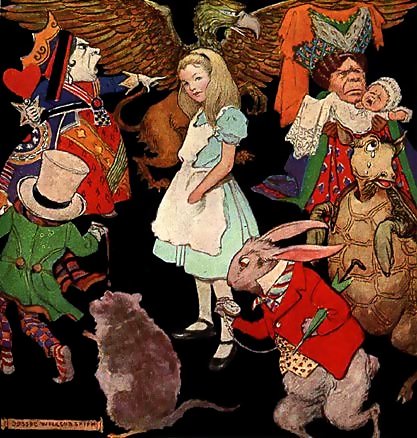
Alice In Wonderland, surrounded by the characters of Wonderland, illustration, by Jessie Wilcox Smith, 1923. In public domain.

Once again, it’s time for the leap year silly season, between the presidential election cycle and the Summer Olympics. Only with a twist. Between the reactionary GOP/TPers, the state of the world in general and over-hyped Mayan predictions, 2012 promises to be a year full of surprises, for better and for worse. Only, as far as I can read a calendar, this year runs on the same day and date lines as 1984. Minus George Orwell’s post-apocalyptic impressions or Van Halen’s first big album (That reminds me — I should download “Panama” from iTunes).

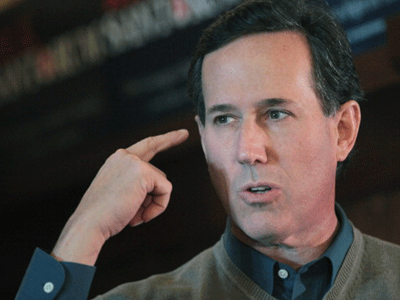
Former U.S. Sen. Rick Santorum (R-PA) speaks about entitlements during a campaign rally at the Hotel Pattee, Perry, Iowa, January 2, 2012. (Scott Olson/Getty Images).

What has been predictable so far includes Rick “Sanitarium” Santorum’s race-baiting via entitlements, calling on Blacks to not take “other people’s money” yesterday on the eve of the Iowa caucuses. What a dumb, racist ass! Especially since the overwhelming number of Americans on welfare are White. Especially because most poor Blacks still feel the lingering effects of a society built on racial preferences that denied them and previous generations the wealth that helped make America the richest country in the history of the world. Especially since Santorum has tried these tactics before, in Pennsylvania, where he showed how crazy he was six and eighteen years ago (Please Pitt, stop using him in your promotional ads!)

Yes, America’s all Alice in Wonderland again, sliding down the rabbit hole into an election cycle that’s more about style than substance, where the spin cycle’s constantly on and character is only defined in the most sanctimonious of terms. Between San”scrotum,” Ron Paul, Mitt Romney, Newt Gingrich, Michelle Bachmann, and Jon Huntsman and their idiotic campaigns, I’d take an ancient Roman approach. Cut each of them on their right butt cheeks, throw them all in a bag with a wild leopard, and drop them in a river full of hippos. Whoever survives should then get to run against President Obama. That would be fairer than the system we have now.

Reaching Level 42

27 Tuesday Dec 2011

Posted by decollins1969 in 1, Boy @ The Window, Cleaning, culture, Eclectic, Marriage, Mount Vernon New York, race, Youth

≈ Leave a comment

Tags

616, 616 East Lincole Avenue, Darren, Hebrew-Israelites, Life Roles, Mount Vernon New York, Responsibility, Role as Eldest Brother, Youth


Reaching Level 42

Reaching Level 42

We all get used to playing certain roles in life, no matter how uncomfortably those roles fit. Privileged, rich, powerful and entitled Americans are accustomed to shitting on the little guy and using all of their resources to maintain their separation from the rest of us. Attractive women — especially White blondes and Black women with music video bodies — tend to act as if the world’s purpose is to serve them. Religious people who somehow believe that it’s their role to tell every person they meet how to deal with all of the issues they face in life, without a real understanding of those people or their lives.

I’ve gotten used to the role of the eldest sibling over the past thirty years. This despite all of the growing pains I went through in the ’80s to take on this role, in spite of the fact that I have an older brother, one two years and eighteen days older than me.

My older brother Darren, as I put it more than twenty-five years ago, “abdicated the throne” of eldest brother by the time I was in the middle of puberty. That happened twenty-nine Decembers ago. Once our family went off the cliffs of the Himalayas and plunged into the hell of Hebrew-Israelites, abuse, abject poverty, responsibility became my motto. Add to that four more mouths to feed between ’79 and ’84, but with only enough food in the house to feed us twenty out of every thirty days, and it became obvious that someone had to do something.

Darren withdrew into the fantasy world that he’d constructed through his psychological imprisonment at The Clear View School in Briarcliff Manor, a school for the mentally retarded (see “About My Brother” post from December ’07). Except that Darren wasn’t mentally retarded. But he played up that role as life at 616 became tougher after the ’81 no-Chanukah, no-Christmas, no-Kwanzaa season. Darren would rock back and forth in his too-small twin bed, as if in a catatonic state. Or he’d spontaneously jump up and down by himself in our bedroom or while in the bathroom, making a high-pitched “Hee-hee-hee-hee-hee” sound while nearly hitting the top of his six-foot frame on the ceiling.

Mostly, my older brother would make himself sound as stupid as he possibly could to get out of anything to do with all of the craziness at 616. His favorite answer to any question from our mom or from our idiot ex-stepfather Maurice was, “I Dunno.” And he’s say it over and over again. For nearly a year, stupid ass Maurice attempted to conduct a version of Torah study with us on Saturdays. Every time Maurice asked Darren what he learned, my brother would say, “In the beginning, God created the Heaven and the Earth…,” regardless of what book we were charged with reading. By August ’82, Darren was permanently excused from Torah study.

Darren did what he did to get out of going to the store, or washing dishes, or helping out with “those kids,” or anything that meant him acting like his IQ was higher than eighty-five. Some neighborhood guys who knew my brother then would ask me, “What’s wrong with yo’ brotha’, man?,” and I’d say, “Nothing.”

How did I know? Because for three years, every time he boarded his 7:40 am school bus to go to Clear View, off came his kufi or yarmulke. Because outside of 616, Darren ate whatever he wanted, whether it was a lard-based Hostess’ Apple Pie or a ham and cheese sandwich. Because Darren was smart enough to realize that perception for most people — most of us undiscerning and self-absorbed Americans, anyway — is reality, and that acting like he was severely mentally retarded would save him from the worst effects of living with a family that had fallen apart.

So everything fell on me. At first, it was going to the store and watching over my younger siblings Maurice and Yiscoc. By the time I began puberty, it was taking punches from Maurice and tracking down my father Jimme for money. By the time of Michael Jackson’s last single release from Thriller in early ’84, it was cooking, cleaning, washing clothes, protecting my four younger siblings, and maintaining some sense of sanity for myself and them. I did it because I had no choice, but I helped grow a jealousy and competition in Darren that he’s yet to give up on.

It’s safe to say that I wouldn’t be who I am today without growing up the way I did. But who in their right mind would want to go through what I went through? At the time, it was so much better to be Darren. Only in the last ten years have I realized how much Darren gave up. His sanity, his piece of mine, his development as a human being, as a Black male. All shredded in his well-practiced Clear View persona.

At forty-two years old today, I’m forever learning and relearning, but my ironic, goofy, sarcastic, contrarian, honest and caring, disdainful and cocky persona is well-marbled. Darren’s, sadly, remains trapped in jealousy and misery, and there’s nothing I can do about it.

Musical ‘Mates and Matters

24 Saturday Dec 2011

Posted by decollins1969 in 1, Boy @ The Window, culture, earth, wind & fire, Eclectic, eclectic music, Mount Vernon High School, Mount Vernon New York, music, New York City, Pop Culture, race, Youth

≈ Leave a comment

Tags

Common Language, Cultural Divide, Cultural Eclectic-ness, Diversity, Eclectic Music, Mount Vernon High School, Mount Vernon New York, Mount Vernon public schools, Music, Musical Tastes, Race


The "A" Note, February 5, 2008. (Pearson Scott Foresman, via Wikipedia). In public domain.

If someone asked me what was the one thing that me and my classmates had in common during my middle school and high school years in Mount Vernon, New York, it would be a love of and for music. I wouldn’t have been able to draw this rather obvious conclusion five years ago. But, in the course of interviewing folks and writing and rewriting my Boy @ The Window manuscript since ’06, music seems to be the one common denominator that connected us all.

Take the fact that so many of my Class of ’87 classmates found their way into the underground or mainstream music scene over the past twenty-four years. At least one was a producer, a bunch rapped, played, sang, and danced their way into the industry, even if they’re not household names. Others did studio work, and at least two are doing music/sound work for the small and big screen.

These folks are Black, White, Afro-Caribbean and Latino, so, no, race doesn’t seem to be a factor. Was it something that was in the water or in Mount Vernon’s lead water pipes? Not likely. It really couldn’t have been instilled in us by Humanities, or going to Davis, Nichols or Mount Vernon High School, right? The official doctrine of the powers that were would’ve made our favorite music somewhere between Sinatra and Tchaikovsky.

It could be as simple and as complicated as the times we grew up in, the fellow travelers to which we were

Culture Club "Club Sandwich Tour" poster, September 27, 2011. (Wikipedia). Qualifies as fair use under US Copyright laws because of low resolution and subject of blog post.

exposed, the constant noise that was Mount Vernon public schools in the 1970s and 1980s. Living in a city in the early stages of decline, within shouting distance of Manhattan and a short walk to the Bronx. Having the level of Black and Brown diversity that we had, with a decent sized White minority in the school system, may be all that was needed to create the conditions for music to be our one common language.

It wasn’t just in my class, as the classes of ’85 and ’86 turned out the late Heavy D and Al B. Sure. Nor was it just in Mount Vernon’s public schools. There was something about Mount Vernon itself, a painful place for some, a cool and pleasureful one for others, that made music both a code for coolness and an escape from reality.

For my specific groups of Humanities nerds, renaissance folks and generally sharp classmates, though, the tastes ranged and even mingled. For the guidos and guidettes whom I labeled “The Italian Club,” the music was decidedly “White.” From “A” serenading 7S with The Police’s “Roxanne” ala Eddie Murphy, to the frequent blaring of Billy Idol, Bruce Springsteen and Foreigner from turbo-charged Camaros and Mustangs.

The Time promotional poster, circa 1990, July 6, 2006. (Mista Tee, via Wikipedia). Qualifies as fair use under US Copyright laws because of low resolution and subject matter for blog post.

Then the was the obviously cool Black and Afro-Caribbean, with a clique for every occasion, whose music was also obviously “Black.” Teena Marie, pre-“Material Girl” Madonna, Phyllis Hyman, Prince, Luther Vandross, Doug E. Fresh, Lisa Lisa & Cult Jam, Run-DMC, if it was Black and cool, they listened to it, and knew the exact date the new album would hit the stores. They drove around in their Nissan Maximas, Audis and old Cadillacs with this mesh of R&B, early rap and hip-hop, and crossover pop pumping out of their tinted windows.

Of course, that left the rest of us, the few who seemed to like a bit of everything. Crush #1 and Depeche Mode. Brandie Weston and her clique’s love of Boy George and Culture Club. V’s commitment to Billy Joel, at least a decade and a half too young to understand the full meaning of what we’d now call adult contemporary. Not to mention The Police, Sting, The Who, Rolling Stones, Thompson Twins, Duran Duran, ABC, Tears for Fears, a-ha, and so many others. But it didn’t stop there. For we, too, liked Luther, and Billy Idol, and John Coltrane, and Lisa Lisa, and Run.

I don’t know if my musical tastes were the most eclectic of all, or if mine remain so. But I can say this. I ran 4.75 miles yesterday, listening to Genesis’ “Tonight, Tonight, Tonight” (album version), Sounds of Blackness’ “Optimistic,” U2’s “Beautiful Day,” Grover Washington Jr’s “Summer Chill,” Stevie Wonder’s “As,” Sting’s “A Thousand Years,” and Enigma’s “Silence Must Be Heard” along the way. It seems that I’ve always had a song in my head and theme music in my heart for every situation and every period of my life. For better and for worse, I have to give Mount Vernon credit for that, if for nothing else.

Reinventing the Writing Wheel

17 Saturday Dec 2011

Posted by decollins1969 in 1, Academia, Boy @ The Window, culture, Eclectic, eclectic music, Hebrew-Israelite, music, Pop Culture, race, Religion, Youth

≈ Leave a comment

Tags

"Children's Crusade", 616, 616 East Lincoln Avenue, Coping Strategies, Historian, Mount Vernon New York, Paul Riggs, Pitt, Re-Discovery, Reinventing the Wheel, Scholar, Self-Discovery, Sting, The Dream of the Blue Turtles, University of Pittsburgh, Western Civilization II, World War I, Writer, Writing


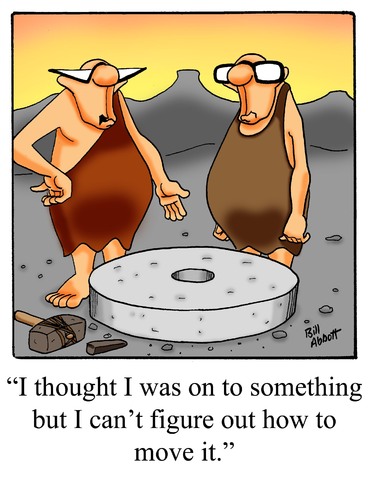
Inventing the Wheel cartoon, October 2, 2009. (Bill Abbott/http://www.toonpool.com/).

One of the side effects of having lived through the hell of my family struggles at 616 in Mount Vernon, New York between ’81 and ’89 was that I’d forgotten about the person I was before we became Hebrew-Israelites. As great as I am at recalling faces, smells, conversations, exact facts and phrases based on images and songs, I’ve been almost equally as good at blocking out whole sections of my personality. All in an effort to cope with the emotional pain and psychological trauma that is betrayal, abuse and neglect.

I have the unfortunate distinction of having seen myself as a writer in ’81 at the age of eleven, only to take nearly twenty years to see myself that way again. There were a few sign posts in the dark forest of confusion about my calling that I found on my way to getting back on the writing road. One of those sign posts was my teaching assistant and friend during my undergraduate years at the University of Pittsburgh in Paul Riggs.

Paul Riggs, Professor and Department Chair, Department of History, Valdosta State University (GA), December 17, 2011. (http://www.valdosta.edu).

Paul was the TA for my section of the Western Civilization II course taught by his advisor in Sy Drescher in the Spring semester of ’88. He was a second-year history grad student, a nice looking White guy for a nerd. Already in his mid-twenties with, his blonde-brown hair and around six-feet, Paul was a rarity on campus. So was his class. Paul found a way to do more than ask us a bunch of questions that were meant to quiz us on the textbook. We debated the significance of things like a richer diet and its impact on population growth and the expansion of European imperialism, the connections between Charles Darwin, evolution, and the advent of scientific racism at the end of the nineteenth century, and so many other things that allowed us to connect the dots.

Paul was also the first teacher I had at Pitt who assumed that I could do the work without acting as if I shouldn’t have been in their classroom. It helped that he occasionally indulged me. When our weekly discussion turned to the killing fields that had been northern France and Belgium for the bulk of the four years of World War I, I allowed my imagination to get the better of me. I made a comment that connected the tragedy of deadly trench warfare to a song by Sting called “Children’s Crusade.” I started quoting lyrics, like “virgins with rifles, a game of charade,” “the flower of England, faced down in the mud, and stained in the blood of a whole generation,” and “corpulent generals safe behind lines.”

I related it all to the documents book and Drescher’s lectures on the war that wiped out a generation of

Sting, The Dream of the Blue Turtle CD Cover (1985), December 17, 2011. (Donald Earl Collins).

young men in Western Europe. It took me two minutes of class time to draw all of the different connections. Paul, shaking his head at the end, got this incredulous smile on his face. All he said was, “um, you know Sting’s overrated?”

But Paul proved to be much more helpful a year and a half later. By then I was in my junior year at Pitt, no longer living in constant worry that I’d have to return to 616 to bury my mother and press charges against my idiot stepfather. By then, Maurice was my ex-stepfather, and thankfully so. For the first time in eight years, I kept a journal, putting together a series of stories based on my worst experiences at 616, on welfare, with my family, and in Mount Vernon.

All of it made me think about writing a book that looked at the sociological and psychological dimensions of the welfare system, for both recipients and for case managers charged with providing benefits. I wanted to make Westchester County Department of Social Services the centerpiece for such a book. I decided to talk to Paul about all of my ideas, not wanting to give away how personal this issue was for me. Paul asked me the questions that it would take another eleven years to answer. “What kind of writer do you want to be?,” and “How is history related to what you want to write about?,” he asked over the course of our conversation.

I really didn’t know the answers to either question. I wasn’t even sure that I wanted to pursue an advanced degree, become a professor, or become a writer. But I knew that I needed to find out.

Still, one thing that I decided to do that would determine most of my career travels over the next decade is to make myself into the semi-dispassionate scholar I knew I needed to become in order to be a better historian, which I presumed would make me a better writer. Only to spend this past decade reconnecting to my emotions and passion, which has made me the writer I once hoped to become.

If Boy @ The Window Were A Movie…

10 Saturday Dec 2011

Posted by decollins1969 in 1, Boy @ The Window, culture, Eclectic, Mount Vernon High School, Mount Vernon New York, Movies, My Father, Pop Culture, Youth

≈ Leave a comment

Tags

Acting, Actors, Alison Arngrim, Boy @ The Window, Brad Dourif, Brian Dennehy, Clarke Peters, Gabrielle Union, Harold Perrineau, Humanities, James Avery, Jesse L. Martin, Khandi Alexander, Mount Vernon New York, Movies, Nathan Fillion, Ray Liotta, Rita Moreno, Rob Brown, Thandie Newton, TV Shows


Not So Young Man @ His Window, December 10, 2011. (Donald Earl Collins).

…who would I hire to play the characters in my memoir? Especially if I could reach across space and time to pick actors with the range necessary to play complicated characters, like yours’ truly, for instance. Hmm. I have a few ideas:

Rob Brown, ala Finding Forrester (2000) – He’d been a perfect character to play me during my high school years, between the blank stare and face, his height, and his ability to show awkwardness around Whites in authority.

Rob Brown as Jamal Wallace in Finding Forrester (2000) Screen Shot. (http://filmdope.com).

Khandi Alexander, ala The Corner (2000) – While she isn’t nearly as tall and is a bit chestier than my mother, her affect as the down-and-out West Baltimore mother on the groundbreaking HBO miniseries fits here.

James Avery – He would be in the role of my idiot ex-stepfather, with his bulging eyes and belly, and with his flashes of rage, yeah, he’d been perfect.

Clarke Peters, ala The Wire, Treme – I thought about someone like Sammy Davis, Jr. playing the role of my father, Jimme, but Davis’ acting range wouldn’t have been enough to capture both my father’s drunken rage and the comedy that often served as an overlay to my encounters with my father growing up.

Clarke Peters at Edinburgh Festival 2010, August 6, 2010. (Ausir). Released to public domain via GNU Free Documentation License.

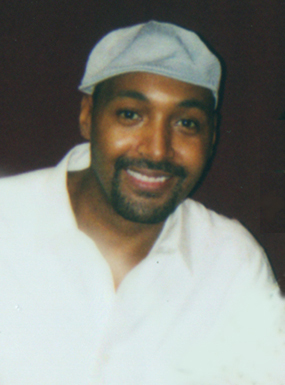
Jesse L. Martin – The man’s acting range is enormous, and would capture the complexities of playing someone like my older brother Darren, a super-shy kid who himself played the role of someone mentally retarded while also having taught himself to read at the age of three. Only, Darren didn’t know how to stop.

Jesse L. Martin at Annual Flea Market and Grand Auction hosted by Broadway Cares/Equity Fights AIDS, September 26, 2006. (Insomniacpuppy). Released to public domain via Wikipedia.

Harold Perrineau, ala Oz – His face alone captures a lot of emotion, and show does the way he says his lines, something that I’d want from someone playing my best friend from elementary school. Perrineau’s face would also capture duplicity, a necessary ingredient for betraying a friendship. Just like many of the characters in the HBO series Oz.

Thandie Newton – This was a tough one, as I also thought about Rosario Dawson in the role of Crush #1. But Newton has quirkiness as an actor that Dawson lacks at times, and for all of the wonderful traits of the character known as Crush #1, quirkiness is key.

Thandie Newton at the 2007 Toronto International Film Festival, September 2007. (http://www.flickr.com/photos/gdcgraphics/1639139527/in/set-72157602744288487/). Released to public domain via Creative Commons Attribution 2.0.

Ray Liotta – Not nearly as tough, this despite the fact that the real “A” had blondish hair when we were kids. Liotta’s meanness, his laugh, his Italian coldness easily capture what “A” was like as my tormentor in seventh grade.

Nathan Fillion, ala Firefly (2002-03), Serenity(2005) – the near-perfect actor to play the contrarian one, “JD” (see my post “The Contrarian One” from February ’11), his aloofness, his sense of superiority, his maverick affect throughout our years in Humanities together.

Nathan Fillion as Capt. Malcolm Reynolds, Firefly (2002-02). (Wikipedia.org).

Alison Arngrim, ala Little House on the Prairie (1974-82) – She played Nellie Olson on the show, a bratty, well-off girl who only knew how to view the world through her own selfish lens. She could play any number of my former White classmates, especially many of the ones who left Humanities between the end of eighth and the beginning of tenth grade.

Little House on the Prairie's Nellie Olson as played by Alison Arngirm, circa 1977. (http://www.flickr.com/3595/3433153010_b5f3cae12a.jpg).

Gabrielle Union – as this actor has done the affect of pissed off and Black preppie well over the years, she’d be great for the role of Crush #2, the one the main character (me) becomes obsessed with in the six months after graduating high school. Like the character, Union can crush hearts.

Rita Moreno – A fixture in the acting business for more than sixty years, one of a handful to win an Oscar, an Emmy, and a Tony Award, she could easily slip on the role of a guidance counselor like the chain-smoking, stereotyping bigot Sylvia Fasulo. The only other person who’d fit this role is Callie Thorne from the USA show, Necessary Roughness.

Brian Dennehy – There aren’t many actors who could play my late AP US History teacher Harold Meltzer. You see, you’d need to be able to spit, to tell long and strange stories, to have moment of macabre laughter and moments of bitter rage. Dennehy, though, has experience doing all of those things, though not in one role. Plus, he’s tall and rotund enough for the part.

Brad Dourif, ala Dune (1984), Lord of the Rings: The Two Towers (2002) – He’s weird enough to play the role of Regis, one of my older friends from my undergraduate days at the University of Pittsburgh, someone who was there for me the semester I went through homeless and three months without money.

Brad Dourif at the Lord of the Rings-Convention Ring*Con in Bonn, Germany, November 23, 2002. (Diane Krauss). Released to public domain via GNU Free Documentation.

I could go on and on. But that’s unnecessary here. This ensemble cast, with the right script — and a time machine — would make Boy @ The Window come alive, and have me blushing and crying over and over again.

← Older posts
Newer posts →

Boy @ The Window: A Memoir

Boy @ The Window: A Memoir

Places to Buy/Download Boy @ The Window

There's a few ways in which you can read excerpts of, borrow and/or purchase and download Boy @ The Window. There's the trade paperback edition of Boy @ The Window, available for purchase via Amazon.com at http://www.amazon.com/Boy-Window-Donald-Earl-Collins/dp/0989256138/

There's also a Kindle edition on Amazon.com. The enhanced edition can be read only with Kindle Fire, an iPad or a full-color tablet. The links to the enhanced edition through Apple's iBookstore and the Barnes & Noble NOOK edition are below. The link to the Amazon Kindle version is also immediately below:

scr2555-proj697-a-kindle-logo-rgb-lg

Boy @ The Window on Amazon.com: http://www.amazon.com/Boy-The-Window-Memoir-ebook/dp/B00CD95FBU/

iBookstore-logo-300x100

Boy @ The Window on Apple's iBookstore: https://itunes.apple.com/us/book/boy-the-window/id643768275?ls=1

Barnes & Noble (bn.com) logo, June 26, 2013. (http://www.logotypes101.com).

Boy @ The Window on Barnes & Noble: http://www.barnesandnoble.com/w/boy-the-window-donald-earl-collins/1115182183?ean=2940016741567

You can also add, read and review Boy @ The Window on Goodreads.com. Just click on the button below:

Boy @ The Window

Twitter Updates

Tweets by decollins1969
  • RSS - Posts
  • RSS - Comments

Archives

  • June 2025
  • April 2023
  • September 2022
  • August 2022
  • July 2022
  • June 2022
  • May 2022
  • April 2022
  • March 2022
  • January 2022
  • December 2021
  • November 2021
  • October 2021
  • September 2021
  • August 2021
  • July 2021
  • June 2021
  • April 2021
  • March 2021
  • February 2021
  • January 2021
  • December 2020
  • November 2020
  • October 2020
  • September 2020
  • August 2020
  • July 2020
  • May 2020
  • April 2020
  • March 2020
  • January 2020
  • December 2019
  • November 2019
  • August 2019
  • July 2019
  • June 2019
  • May 2019
  • April 2019
  • March 2019
  • February 2019
  • January 2019
  • December 2018
  • November 2018
  • October 2018
  • September 2018
  • August 2018
  • July 2018
  • June 2018
  • May 2018
  • March 2018
  • February 2018
  • January 2018
  • December 2017
  • November 2017
  • October 2017
  • September 2017
  • August 2017
  • July 2017
  • June 2017
  • May 2017
  • April 2017
  • March 2017
  • February 2017
  • January 2017
  • December 2016
  • November 2016
  • October 2016
  • September 2016
  • August 2016
  • July 2016
  • June 2016
  • May 2016
  • April 2016
  • March 2016
  • February 2016
  • January 2016
  • December 2015
  • November 2015
  • October 2015
  • September 2015
  • August 2015
  • July 2015
  • June 2015
  • May 2015
  • April 2015
  • March 2015
  • February 2015
  • January 2015
  • December 2014
  • November 2014
  • October 2014
  • September 2014
  • August 2014
  • July 2014
  • June 2014
  • May 2014
  • April 2014
  • March 2014
  • February 2014
  • January 2014
  • December 2013
  • November 2013
  • October 2013
  • September 2013
  • August 2013
  • July 2013
  • June 2013
  • May 2013
  • April 2013
  • March 2013
  • February 2013
  • January 2013
  • December 2012
  • November 2012
  • October 2012
  • September 2012
  • August 2012
  • July 2012
  • June 2012
  • May 2012
  • April 2012
  • March 2012
  • February 2012
  • January 2012
  • December 2011
  • November 2011
  • October 2011
  • September 2011
  • August 2011
  • July 2011
  • June 2011
  • May 2011
  • April 2011
  • March 2011
  • February 2011
  • January 2011
  • December 2010
  • November 2010
  • October 2010
  • September 2010
  • August 2010
  • July 2010
  • June 2010
  • May 2010
  • April 2010
  • March 2010
  • February 2010
  • January 2010
  • December 2009
  • November 2009
  • October 2009
  • September 2009
  • August 2009
  • July 2009
  • June 2009
  • May 2009
  • April 2009
  • March 2009
  • February 2009
  • January 2009
  • December 2008
  • November 2008
  • October 2008
  • September 2008
  • August 2008
  • July 2008
  • June 2008
  • May 2008
  • April 2008
  • March 2008
  • February 2008
  • January 2008
  • December 2007
  • November 2007
  • October 2007
  • September 2007
  • August 2007
  • July 2007
  • June 2007

Recent Comments

MaryPena's avatarMaryPena on My Day of Atonement/Bitter Hat…
decollins1969's avatardecollins1969 on No Good Teaching Deed Goes…
Mary Rose O’Connell's avatarMary Rose O’Connell on No Good Teaching Deed Goes…

NetworkedBlogs on Facebook

NetworkedBlogs
Blog:
Notes From a Boy @ The Window
Topics:
My Life, Culture & Education, Politics & Goofyness
 
Follow my blog

616 616 East Lincoln Avenue A.B. Davis Middle School Abuse Academia Academy for Educational Development AED Afrocentricity American Narcissism Authenticity Bigotry Blackness Boy @ The Window Carnegie Mellon University Child Abuse Class of 1987 CMU Coping Strategies Crush #1 Crush #2 Death Disillusionment Diversity Domestic Violence Economic Inequality Education Family Friendship Friendships Graduate School Hebrew-Israelites High-Stakes Testing Higher Education History Homelessness Humanities Humanities Program Hypocrisy Internalized Racism Jealousy Joe Trotter Joe William Trotter Jr. K-12 Education Love Manhood Maurice Eugene Washington Maurice Washington Misogyny Mother-Son Relationship Mount Vernon High School Mount Vernon New York Mount Vernon public schools Multiculturalism MVHS Narcissism NFL Pitt Pittsburgh Politics of Education Poverty President Barack Obama Race Racial Stereotypes Racism Relationships Self-Awareness Self-Discovery Self-Reflection Sexism Social Justice Teaching and Learning University of Pittsburgh Violence Whiteness Writing

Top Rated

Blog at WordPress.com.

  • Subscribe Subscribed
    • Notes from a Boy @ The Window
    • Join 103 other subscribers
    • Already have a WordPress.com account? Log in now.
    • Notes from a Boy @ The Window
    • Subscribe Subscribed
    • Sign up
    • Log in
    • Report this content
    • View site in Reader
    • Manage subscriptions
    • Collapse this bar
 

Loading Comments...