• About Me
  • Other Writings
  • Interview Clips
  • All About Me: American Racism, American Narcissism, and the Conversation America Can’t Have
  • Video Clips
  • Boy @ The Window Pictures
  • Boy @ The Window Theme Music

Notes from a Boy @ The Window

~

Notes from a Boy @ The Window

Tag Archives: Authentic Blackness

The Road to Boy @ The Window, Part 4: Fear of a “Black” America

26 Thursday Sep 2013

Posted by decollins1969 in 1, Academia, Boy @ The Window, Carnegie Mellon University, culture, Eclectic, eclectic music, music, Patriotism, Pittsburgh, Politics, Pop Culture, race, University of Pittsburgh, Youth

≈ Leave a comment

Tags

Academia, Afrocentricity, Authentic Blackness, Authenticity, Emotion, Estelle Abel, Fear of a "Black" America, Fear Of A Black Planet, Fear of Black Males, Joe Trotter, Multicultural Education, Multiculturalism, PE, Personal Vignettes, Politics of Academia, Politics of Education, Politics of Fear, Public Enemy, Rage, Richard Altenbaugh


FearBookCover3copy

Given that Fear of a “Black” America was my first book, but one based on my doctoral dissertation, and that Boy @ The Window is a memoir, the road from one to the other may not be that obvious with an initial glance. But despite the intellectual, semi-scholarly nature of my book on Blacks and multiculturalism, there are parallel themes that run between Fear of a “Black” America and Boy @ The Window. Perhaps none are more important, though, than the challenge of authenticity, of fitting in, of being able to mesh the complicated onion that I’ve found myself to be over the years.

I think that was why I decided in November ’98 to turn my dissertation “A Substance of Things Hoped For” into a more readable book. Yes, after all that work to write a 505-page thesis, it would’ve been a shame to just let it sit on my then girlfriend’s coffee table, to be used either as a door stop or a base for her doing her nails. Yes, I still had something to prove to academia. That my scholarship as a historian and educator on the issue of multiculturalism was sound. That the conventional academic wisdom around Blacks, people of color and multiculturalism was paternalistic fear-mongering.

Public Enemy, Fear Of A Black Planet (1990) Album Cover

Public Enemy, Fear Of A Black Planet (1990) Album Cover

And in thinking that last part through, I came up with my Public Enemy-inspired title and thread for the first book. It was about fear in many forms. Elite White fears of a majority-people-of-color US within their own lifetimes. Conservative fears of a K-16 education system that included the cultural and historical perspectives of peoples of color, of the poor, of women, of the LGBT, of so many others they’d rather discard. General American skepticism that any Blacks had ever given any thought at all to cultural pluralism, intercultural education, or multiculturalism/multicultural education, at least before White theorists had thought through these ideas first.

Afrocentrists and nationalists who thought of multiculturalism as soft and utterly unrepresentative of the Black experience — or, at least, what they considered an authentic version thereof? That was as difficult a challenge as any I faced in writing both my dissertation and Fear of a “Black” America. So much so that I made a few interesting decisions along the way. I sought out an agent — yes, a literary agent — for the first book, and found one, too (things were so much easier in ’99). I wanted the book to have an impact beyond academia.

In the writing process, I decided to weave the theme of fear, skepticism, willful and inadvertent misunderstandings throughout the 200-page book. All while covering Black intellectual thought about what we now call Afrocentricity and multiculturalism, Black activism and activities around education and Negro History Week, and the so-called Culture Wars of the 1980s and 1990s. All to show that multiculturalism was/is a part of America’s evolution, even if some folks are gnashing their teeth and wearing sackcloth and ashes along the way.

One thing was missing, though, from my six chapters. Me, in a word. Yes, my argument was crystal clear, my evidence was sound, my notes and analysis lined up well enough by the summer of ’00. Yet, as my one-time agent noted, “there’s not enough of you in this manuscript.”  Bottom line: folks weren’t going to buy the book unless I made it more compelling, which meant putting something of me or about me in it.

Fear Book & The Authentic Me

Fear Book & The Authentic Me

So I did. I wrote mostly about my experiences in academia and how they paralleled with some of the critical issues in Fear of a “Black” America. I talked about my Duquesne University students in the College of Education in ’98 and ’99, most of whom were cultural conservatives. I brought up conversations I had with professors skeptical about my scholarship, like Richard Altenbaugh in March ’98 or my former dissertation advisor Joe Trotter in April ’96. I also wrote about my conversation with Estelle Abel over my lack of authenticity as a young Black man in June ’87, having thought about it for the first time in thirteen years. I wasn’t sure if that made Fear of a “Black” America any better, but it made me feel better about my first book.

By the time I’d given my agent the final draft of Fear of a “Black” America in October ’00, I was ready — maybe for the first time in years — to take a look at my life before Pitt, grad school, Spencer Fellowship and becoming Dr. Collins. I wasn’t sure if I wanted to open up the emotional side of that Pandora’s box just yet. But in some ways, I really needed to, precisely because of my experiences with people in grad school at Pitt and Carnegie Mellon. And precisely because of my occasional moments of rage and overreaction, if only because Fear of a Black “America” helped me tap into emotions I didn’t know I had.

Afrocentricity and the Writing Bug

15 Wednesday May 2013

Posted by decollins1969 in 1, Academia, Boy @ The Window, Carnegie Mellon University, Christianity, culture, eclectic music, Hebrew-Israelite, Mount Vernon High School, Mount Vernon New York, music, Pittsburgh, Politics, Pop Culture, race, Religion, University of Pittsburgh, Youth

≈ Leave a comment

Tags

Africana Studies, Afrocentric Education, Afrocentric Idea (1987), Afrocentricity, Authentic Blackness, Authenticity, Black Action Society, Black Issues in Higher Education, Black Studies, Blackness, Cool, Coolness, Litmus Test, Marc Hopkins, Maulana Karenga, Molefi Asante, Pitt, Temple University, Writing, Writing Bug


A ladybug, often a symbol for the writing “bug,” May 15, 2013. (http://flickr.com). In public domain.

This time two decades ago, I was already a bit desperate for work. In transferring from Pitt to Carnegie Mellon, I’d left myself without any financial coverage for the summer of ’93 (see my post “The Arrogance of Youth, Grad School Style” from June ’12). I had applied for several fellowships, summer teaching gigs, even some nonprofit work. But as of the middle of that May, nothing had come through. I’d already spent $200 on a root canal that occurred on the same day as my written PhD comps at CMU (see my post “Facing the Tooth” from May ’12).

Even before my comps and my surprise root canal, I had talked with my friend Marc about writing a joint article about the false litmus test of Blackness that Afrocentricity had come to represent in our minds. Between Molefi Asante’s students at Temple — not to mention the overtly Afrocentric turn of both the Black Action Society and the Black Studies department (which had changed its name to Africana Studies) in the previous eighteen months — both of us felt we needed to provide an alternate perspective.

On that third Saturday in May (and the day after my comps and root canal surgery), we worked for five hours in putting together what amounted to a 1,200-word opinion piece against the belief system and authenticity test that Afrocentricity (and Afrocentric education) had become. By some folks’ definition, we realized that jazz, Miles Davis and John Coltrane would fail the authentically Black test of a Molefi Asante’s wonderful Afrocentric Idea (1987) and of Maulana Karenga as well.

Frances Cress Welsing's The Isis Papers (1991), [about as authentic as auto-tunes], May 15, 2015. (http://amazon.com).

Frances Cress Welsing’s The Isis Papers (1991), [about as authentic as auto-tunes], May 15, 2015. (http://amazon.com).

Now I’m pretty sure why Marc had problems with Afrocentricity. As a Christian and a jazz aficionado, Marc likely saw Afrocentricity as something somewhere between a misguided way of thinking about Blackness and complete and utter bull crap. His goal was to “add to the debate” and “educate” those who weren’t Asante or Karenga apostles and disciples. A laudable — if somewhat naive about the politics of academia and race — goal.

As for me, beyond the academic superficiality of having a litmus test on what is and isn’t Black, I had at least two unconscious reasons for writing my first crossover piece. One had to do with my sense that too many young folks were all too interested in doing the cool thing and not the right thing. Afrocentricity was cool, just like all rap and hip-hop was cool, just like giving libations to ancestors was cool.

Being cool had always meant following a crowd and seldom saying anything that would dig more than a nanometer beyond the surface. Or saying a critical thing about the cool thing that everyone in the same crowd otherwise takes in without a critical thought. I went to a high school full of people like that, and loathed being around people like that when I’d been a part of the Black Action Society at Pitt.

Unconscious reason number two had something to do with my Hebrew-Israelite days. Again, I gave this zero direct thought during my grad school days. But the given the trauma I’d suffered through during my three years of kufi-dom, it had to affect my thinking about Afrocentricity. The Black folk I knew who were part of the Hebrew-Israelite religion were much more obvious about what they did and didn’t consider Black or kosher. Yet, it was so obvious that they constantly contradicted themselves, in terms of food or music, how they treated their wives or children. Most important for me, though, was the fact that they tried to live separate and apart from other Blacks, yet seemed no more different beyond the kufis, veils and kosher meats from other Blacks (or Jews, for that matter).

I saw Afrocentricity as bullshit, and still see the fact that so many folks who get caught up in this sense of authenticity around Blackness as folks falling for bullshit. If I hadn’t lived as a Hebrew-Israelite between the ages of eleven and fifteen, perhaps I wouldn’t see Afrocentricity this way. If I hadn’t been around the “Party All The Time” folks in high school and the “Black Panther Party” posers at Pitt, maybe Afrocentricity would’ve been more appealing to me.

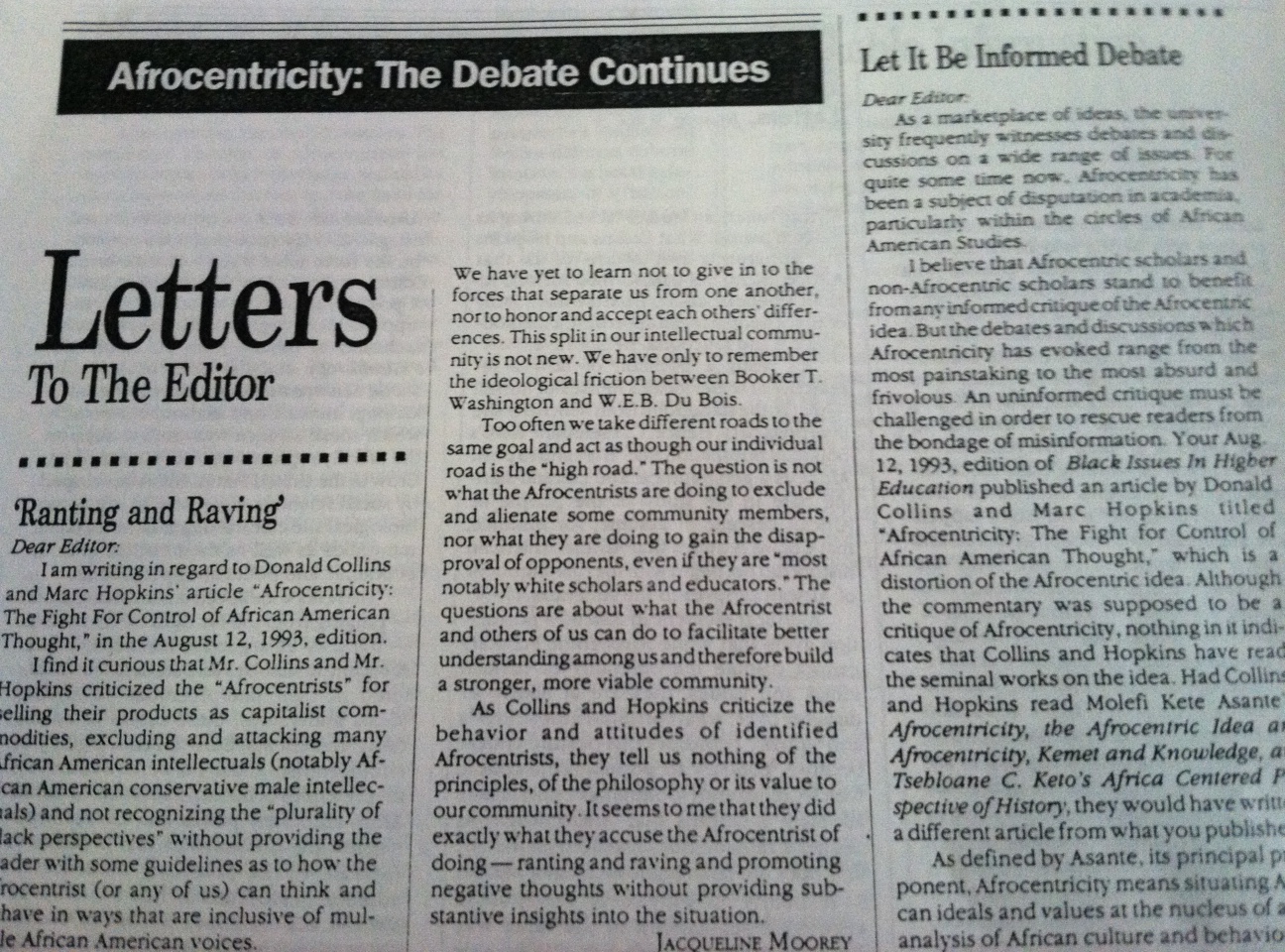
Letters to the Editor, Black Issues in Higher Education, September 9, 1993. (Donald Earl Collins).

Letters to the Editor, Black Issues in Higher Education, September 9, 1993. (Donald Earl Collins).

But at twenty-three years old, I was already tired of the pursuit of coolness and authenticity. That hasn’t changed in the past two decades. I’m sure the letters that called Marc and I “Uncle Toms” after our piece was published in Black Issues in Higher Education were from folks who thought we weren’t cool, and thought they had the answers to life itself.

I wonder how those folks back then would see the academics who believe that hip-hop can explain everything in the social sciences and humanities who are prominent today. Perhaps some of these people today were the Afrocentric followers of twenty years ago. Perhaps not. All I know is, I haven’t stopped writing since that cloudy day in mid-May.

James and the PAGPSA

29 Thursday Nov 2012

Posted by decollins1969 in 1, Academia, Boy @ The Window, culture, Eclectic, eclectic music, Hebrew-Israelite, Politics, Pop Culture, race, Religion, Youth

≈ 1 Comment

Tags

Activism, Afrocentric, Afrocentricity, Authentic Blackness, Black Action Society, Campus Climate, Carnegie Mellon University, Community, Diversity, Friendships, Graduate School, GSPIA, Isolation, PAGPSA, Pan African Graduate and Professional Student Association, Pitt, Pittsburgh, Politics of Graduate School, Retention, Self-Discovery, University of Pittsburgh


James and the Giant Peach photo art (1996), November 29, 2012. (http://disneymania.com.br).

About this time twenty years ago, perhaps for the first time in my life, I found myself around like-minded individuals, folks who seemed to understand me on an intellectual level. The fact that these were fellow graduate students, all at Pitt and all willing to form an association that would enable us to develop real connections across the campus, was inspiring to me. After four years of off-and-on involvement in the Black Action Society, not to mention my first year in the History grad program, I’d almost given up on the idea that I could form good friendships and acquaintance-ships through any formal gatherings.

But this was especially true regarding my thinking about my fellow Black students and other students of color. For the most part, I’d been around two kinds of students of color during my first five years at the University of Pittsburgh. One group was the semi-nerdy set, folks who cared deeply about their academic performance, but were also late-bloomers socially — people like me in more than a few ways. They tended to care little, though, about campus activism around diversity, retention or campus climate issues.

The other group was the Afrocentric set, people who often reminded me of my one-time Hebrew-Israelite brethren, whose views of Blackness were so limiting that I would’ve been a traitor just for listening to Chicago or Phil Collins. Those folks had virtually taken over the Black Action Society by my senior year. Forget mentioning popular folks, like sorors, frat guys, football, basketball and track guys and gals, or those fully invested in Pitt’s Honors College. I mingled with them all, and found little in common with them, intellectually or economically.

Me with Mark James, PAGPSA meeting, GSPH building, University of Pittsburgh, February 26, 1993 (Lois Nembhard).

That changed a bit my first year of grad school. Often in my walking and running across campus, I’d bump into a Black grad student here or there. At Hillman Library, the Cathedral of Learning, William Pitt Union, the SLIS building or other places. We’d recognize each other, we said hello, we even exchanged our names. Two of them in particular — Ed and Hayley — reached out to me at the end of the Spring ’92 semester, because they wanted to put together an organization that would represent our interests as grad students of color.

In mid-August, the emails began to go back and forth in earnest to establish what we’d end up calling the Pan African Graduate and Professional Student Association (PAGPSA) that fall. Through Jack Daniel’s office (see my post “The Miracle of Dr. Jack Daniel” from May ’11), we obtained the start-up funds necessary to make the new association go.

At our founding meeting that September, there were eight of us, all highly motivated to be as inclusive as possible, all feeling suddenly less isolated than we had felt a week, month or semester earlier. We decided on the “Pan African” part of the association’s name because we wanted to welcome as many graduate students of color as possible, particularly African and Afro-Caribbean students. The terms “Black” and “African American,” we agreed, wouldn’t be inclusive enough.

We also decided that despite the political implications of our new name, that this association would primarily be about bringing students together for social gatherings, for additional information and education beyond their course work and dissertations, but not to be campus activists. So many of the Black, African and Afro-Caribbean grad students at Pitt were in fact working on master’s or other professional degrees, and wouldn’t be on campus long enough to make lasting changes through activism, strictly speaking. Plus, there was the risk that activism would be so all-consuming — especially on issues like campus climate, long-term support for research and retention rates — that folks would fail to complete the work they came to Pitt to do in the first place.

CMU-Pitt mug, from joint PAGPSA/BGSO meeting on diversity and grad school, October 1992, November 29, 2012. (Donald Earl Collins).

By the time that first meeting broke up, I was content to have met folks like Mark, Hayley, Lois, Errol, Ed, and a couple of others, to find us all on the same page about something as serious as starting a new association of a significant cross-section of Pitt’s graduate students of color. But in the process, I’d made a new friend that fall through our meetings and our joint gatherings with Carnegie Mellon’s Black Graduate Student Organization (BGSO).

James came along and challenged PAGPSA in October and November regarding our campus activism stance, arguing that being a part of any organization of students of color meant being active. Of course the leadership disagreed, but that’s how I met the man. He was a charismatic Black Iowan preacher’s son, and more politically active than anyone I’d known under the age of thirty. James had ideas about everything, from the future of hip-hop to the implications of my research on multiculturalism and Black Washington, DC.

Though he was a GSPIA (Graduate School of Public and International Affairs) master’s student and ultimately finished his degree in ’94, we would remain friends through the rest of the ’90s. Between him and Matt (see my post “My Friend Matt” from September) and PAGPSA, I remained grounded even as I became buried in the minutia of US, African American and educational policy historiography over the next half-decade. Thankfully, I no longer felt like a lone wolf. Thankfully, I knew that I wasn’t alone in a sea of graduate school and faculty White maleness after that fall.

Touré’s Post-Blackness ≈ I’ma Be Me?

01 Monday Oct 2012

Posted by decollins1969 in 1, Academia, Boy @ The Window, Christianity, culture, Eclectic, eclectic music, Hebrew-Israelite, Mount Vernon New York, Patriotism, Politics, Pop Culture, race, Religion, Youth

≈ Leave a comment

Tags

"Pound Cake" speech, Acting White, American Identity, Authentic Blackness, Authenticity, Bill Cosby, Black Identity, Blackness, Boy @ The Window, I'ma Be Me (2009), Identity Issues, Intrarace Relations, Litmus Test, Post-Blackness, Post-Civil Rights Generation, Post-Racialism, Race, Racism, Reaching Youth, Self-Discovery, Self-Loathing, Self-Reflection, Touré, Wanda Sykes, Who's Afraid of Post-Blackness (2011)


Illustration of red wolf with dinner after a hunt, by Sandra Koch, September 29, 2012. (http://nc-es.fws.gov). In public domain.

I know, I know. Touré’s Who’s Afraid of Post-Blackness (2011) has been out for over a year, and I’ve finally, finally managed to read it in the past couple of weeks. I did not want to like this book. I found — and still find — the title to be pretentious and over the top, a perfect fit for Touré’s Twitter and TV persona. Touré values his ideas like they all are new finds of platinum or a form of safe and sustained nuclear fusion. Sometimes Touré can be cutting-edge, but many times, he goes over the edge (as was the case in August on MSNBC with his “niggerization” of Obama comment).

But in Who’s Afraid of Post-Blackness, Touré puts forward a variety of ideas and insights that I’ll be contemplating in my blogo-neighborhood off and on over the next few months. Touré’s is a very good book. It’s one that is both intellectual and yet revealing about the challenges Blacks face inter- and intraracially in the early twenty-first century.

The premise — once I got past the ridiculous term post-Blackness — is that African Americans and America has advanced just far enough in terms of race for all of our old conceptions of Blackness to have now become meaningless. That Blackness is fully infused in American — maybe even world — culture. That there was never one way to be Black in the first place. Touré himself says, “[t]here is no dogmatically narrow, authentic Blackness because the possibilities for Black identity are infinite. To say something or someone is not Black — or is inauthentically Black — is to sell Blackness short. To limit the potential of Blackness. To be a child of a lesser blackness.” (p. 5).

Litmus paper used in litmus tests, September 29, 2012. (http://chemistry.about.com).

Ironically, though, much of Touré’s book picks apart the notion that the US has become post-racial in the past couple of decades, as best exemplified by the election of President Barack Obama in 2008. Of course, Touré uses notions of Blackness and where it has expanded beyond the authenticity litmus test to show that race/racial bias/racism is still alive and well in America. At the same time, Touré shows how post-Blackness has also provided opportunities for millions of Americans White, Black and Brown to reach beyond their own misconceptions of race and themselves, to enrich our lives in politics, scholarship, the arts, not to mention through hip-hop.

One of my main criticisms of Who’s Afraid of Post-Blackness is that Touré uses a term like post-Blackness (mind you, I hate terms like post-structuralism, post-modernism, and post-racialism too) and doesn’t try in any way to provide a definition that distinguishes it from post-racial. For the purposes of this post, though, the main issue I have revolves around Touré virtually ignoring poor and struggling African Americans in his post-Blackness tour-de-force.

I get it when Touré says that he “never lived a typical Black experience.” (p. 53). At least, I think I do. That despite Touré middle class upbringing, middle-class neighborhood, private school experience, that his is but one representation of Blackness. And that Touré’s experience is as representative of Blackness as my experience of being a Hebrew-Israelite preteen in a working poor family while enrolled in Humanities in Mount Vernon, New York would’ve been thirty years ago (see my post “A Question of My Blackness, Sexuality and Masculinity” from September ’11). Or, for that matter, Wanda Sykes’ comedy special I’ma Be Me (2009) was for her.

That’s great for us, for anyone with enough intellectual power, outsider status, unusual amounts of wisdom, or just plain middle class standing to get the details of Who’s Afraid of Post-Blackness. But when Touré does bring up the twenty-five percent of Blacks who aren’t part of this post-Blackness elite, he talks at them, and not to them. Yes, I completely agree that Blackness isn’t to be defined in terms of poverty, prison, and projects. No, Blackness shouldn’t be defined by how “down” one is with an impoverished community or how “hard” someone is for beating the shit out of another person (see my “Raised on Hip-Hop?” post from April ’10).

Hakeem Olajuwon posting up Patrick Ewing, 1994 NBA Finals, June 1994. (http://rgj.com).

Still, while I stand with almost one hundred percent of what Touré says in Who Afraid of Post-Blackness in ’12, I don’t think that this book would’ve reached me thirty years ago. The way I would’ve seen it in ’82 or even ’87, a middle class Black guy telling me about how my poverty is insignificant to who I was would’ve been excommunicated from my life for eternity. It wouldn’t have helped me at all deal with the pressures I faced socially, academically and in my family (see my “The Silent Treatment” post from June ’10).

Touré wouldn’t have been able to provide for me a roadmap for how to be me and to ignore the crowd of those in my life — White and Black — who regularly told me that I wasn’t authentically Black or that I was “talkin’ White.” If mild-mannered me at twelve wouldn’t have been reached by Touré’s chapter on Black artists taking Blackness and standing it on its head, I imagine that young African Americans growing up in poverty or struggling with identity issues would find Who’s Afraid of Post-Blackness about as easy to embrace as Bill Cosby’s criticism of poor Blacks in ’04.

For me as a writer, the question of how to reach beyond the already converted is always an issue. Touré, as good as he is in his book, merely affirms the path I’ve traveled over the past thirty-one years. He doesn’t really reach those whose path of Blackness has barely begun.

Newer posts →

Boy @ The Window: A Memoir

Boy @ The Window: A Memoir

Places to Buy/Download Boy @ The Window

There's a few ways in which you can read excerpts of, borrow and/or purchase and download Boy @ The Window. There's the trade paperback edition of Boy @ The Window, available for purchase via Amazon.com at http://www.amazon.com/Boy-Window-Donald-Earl-Collins/dp/0989256138/

There's also a Kindle edition on Amazon.com. The enhanced edition can be read only with Kindle Fire, an iPad or a full-color tablet. The links to the enhanced edition through Apple's iBookstore and the Barnes & Noble NOOK edition are below. The link to the Amazon Kindle version is also immediately below:

scr2555-proj697-a-kindle-logo-rgb-lg

Boy @ The Window on Amazon.com: http://www.amazon.com/Boy-The-Window-Memoir-ebook/dp/B00CD95FBU/

iBookstore-logo-300x100

Boy @ The Window on Apple's iBookstore: https://itunes.apple.com/us/book/boy-the-window/id643768275?ls=1

Barnes & Noble (bn.com) logo, June 26, 2013. (http://www.logotypes101.com).

Boy @ The Window on Barnes & Noble: http://www.barnesandnoble.com/w/boy-the-window-donald-earl-collins/1115182183?ean=2940016741567

You can also add, read and review Boy @ The Window on Goodreads.com. Just click on the button below:

Boy @ The Window

Twitter Updates

Tweets by decollins1969
  • RSS - Posts
  • RSS - Comments

Archives

  • June 2025
  • April 2023
  • September 2022
  • August 2022
  • July 2022
  • June 2022
  • May 2022
  • April 2022
  • March 2022
  • January 2022
  • December 2021
  • November 2021
  • October 2021
  • September 2021
  • August 2021
  • July 2021
  • June 2021
  • April 2021
  • March 2021
  • February 2021
  • January 2021
  • December 2020
  • November 2020
  • October 2020
  • September 2020
  • August 2020
  • July 2020
  • May 2020
  • April 2020
  • March 2020
  • January 2020
  • December 2019
  • November 2019
  • August 2019
  • July 2019
  • June 2019
  • May 2019
  • April 2019
  • March 2019
  • February 2019
  • January 2019
  • December 2018
  • November 2018
  • October 2018
  • September 2018
  • August 2018
  • July 2018
  • June 2018
  • May 2018
  • March 2018
  • February 2018
  • January 2018
  • December 2017
  • November 2017
  • October 2017
  • September 2017
  • August 2017
  • July 2017
  • June 2017
  • May 2017
  • April 2017
  • March 2017
  • February 2017
  • January 2017
  • December 2016
  • November 2016
  • October 2016
  • September 2016
  • August 2016
  • July 2016
  • June 2016
  • May 2016
  • April 2016
  • March 2016
  • February 2016
  • January 2016
  • December 2015
  • November 2015
  • October 2015
  • September 2015
  • August 2015
  • July 2015
  • June 2015
  • May 2015
  • April 2015
  • March 2015
  • February 2015
  • January 2015
  • December 2014
  • November 2014
  • October 2014
  • September 2014
  • August 2014
  • July 2014
  • June 2014
  • May 2014
  • April 2014
  • March 2014
  • February 2014
  • January 2014
  • December 2013
  • November 2013
  • October 2013
  • September 2013
  • August 2013
  • July 2013
  • June 2013
  • May 2013
  • April 2013
  • March 2013
  • February 2013
  • January 2013
  • December 2012
  • November 2012
  • October 2012
  • September 2012
  • August 2012
  • July 2012
  • June 2012
  • May 2012
  • April 2012
  • March 2012
  • February 2012
  • January 2012
  • December 2011
  • November 2011
  • October 2011
  • September 2011
  • August 2011
  • July 2011
  • June 2011
  • May 2011
  • April 2011
  • March 2011
  • February 2011
  • January 2011
  • December 2010
  • November 2010
  • October 2010
  • September 2010
  • August 2010
  • July 2010
  • June 2010
  • May 2010
  • April 2010
  • March 2010
  • February 2010
  • January 2010
  • December 2009
  • November 2009
  • October 2009
  • September 2009
  • August 2009
  • July 2009
  • June 2009
  • May 2009
  • April 2009
  • March 2009
  • February 2009
  • January 2009
  • December 2008
  • November 2008
  • October 2008
  • September 2008
  • August 2008
  • July 2008
  • June 2008
  • May 2008
  • April 2008
  • March 2008
  • February 2008
  • January 2008
  • December 2007
  • November 2007
  • October 2007
  • September 2007
  • August 2007
  • July 2007
  • June 2007

Recent Comments

decollins1969's avatardecollins1969 on No Good Teaching Deed Goes…
Mary Rose O’Connell's avatarMary Rose O’Connell on No Good Teaching Deed Goes…
Lyndah McCaskill's avatarLyndah McCaskill on The Raunchiest of Them Al…

NetworkedBlogs on Facebook

NetworkedBlogs
Blog:
Notes From a Boy @ The Window
Topics:
My Life, Culture & Education, Politics & Goofyness
 
Follow my blog

616 616 East Lincoln Avenue A.B. Davis Middle School Abuse Academia Academy for Educational Development AED Afrocentricity American Narcissism Authenticity Bigotry Blackness Boy @ The Window Carnegie Mellon University Child Abuse Class of 1987 CMU Coping Strategies Crush #1 Crush #2 Death Disillusionment Diversity Domestic Violence Economic Inequality Education Family Friendship Friendships Graduate School Hebrew-Israelites High-Stakes Testing Higher Education History Homelessness Humanities Humanities Program Hypocrisy Internalized Racism Jealousy Joe Trotter Joe William Trotter Jr. K-12 Education Love Manhood Maurice Eugene Washington Maurice Washington Misogyny Mother-Son Relationship Mount Vernon High School Mount Vernon New York Mount Vernon public schools Multiculturalism MVHS Narcissism NFL Pitt Pittsburgh Politics of Education Poverty President Barack Obama Race Racial Stereotypes Racism Relationships Self-Awareness Self-Discovery Self-Reflection Sexism Social Justice Teaching and Learning University of Pittsburgh Violence Whiteness Writing

Top Rated

Blog at WordPress.com.

  • Subscribe Subscribed
    • Notes from a Boy @ The Window
    • Join 103 other subscribers
    • Already have a WordPress.com account? Log in now.
    • Notes from a Boy @ The Window
    • Subscribe Subscribed
    • Sign up
    • Log in
    • Report this content
    • View site in Reader
    • Manage subscriptions
    • Collapse this bar
 

Loading Comments...