Lies We Tell Each Other When In College

Tags

, , , , , , , , , ,


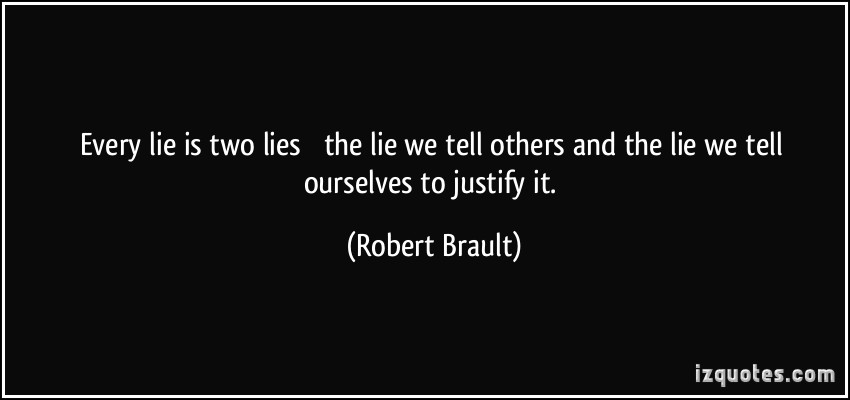
Every lie is two lies quote, Robert Brauilt, January 4, 2014. (http://izquote.com).

Every lie is two lies quote, Robert Brauit, January 4, 2014. (http://izquotes.com).

I thought about posting this at the beginning of this week, but decided against it, figuring that I should end ’13 on a more positive tip. But it must be said that one of the critical issues that we in higher education face in terms of college retention and success is the sheer lack of honesty surrounding student performance, especially in the first year or two of any student’s enrollment. No, I’m not talking about grade inflation — for students doing okay, especially at elite colleges, that’s another rampant issue. It’s about the lies students tell themselves, each other and their loved ones about their performance prior to either being caught in a web of them or, worse still, dropping out altogether.

As a college student and as a professor, I found and find it fascinating and disheartening when I’ve learned of the fantasy life of a student’s alleged good grades being shattered by reality. I fell into this trap myself during my first semester at the University of Pittsburgh. I only tell part of this story in Boy @ The Window. Yeah, I was nowhere near dropping out after a 2.63 GPA first semester (A in Astronomy, B- in Pascal, C in Honors Calc I, and a C in East Asian History), but I relied on an annual GPA of a 3.0 or higher to maintain my academic scholarship.

Yet from about the second week in December ’87 until I received my grades from Pitt on this date twenty-six years ago, I maintained the lie that my GPA was “around a 3.2.” The main difference — I gave myself a C+ in Honors Calc and a B in East Asian History. Mind you, I hardly showed up for either class most of the month of November! I was homesick, heartbroken, and unhealthily horny (and on two occasions hung over) most of the last six weeks of that semester.

The lies we tell ourselves (self-deception), Scientific America, February 4, 2012. (Richard Mia).

The lies we tell ourselves (self-deception), Scientific America, February 4, 2012. (Richard Mia).

So I told my former classmates like Laurell and Erika that my GPA was a 3.2. I told my dorm mates Samir and Chuck the same. It was a mild lie, I realized even at the time, and I knew that if I buckled down, that I could overcome my own lie, especially since I could lose my scholarship if I didn’t. And with a 3.33 second semester in Winter ’88, I did pull my GPA over the 3.0 mark, and in the process, decided not to tell any lies that big ever again.

But over the years, I’ve learned that I was hardly alone in the lying-about-my-college-experience category. The first time I figured this out was at the end of ’88, twenty-five years ago this week. It was a lunch outing with Laurell, her friend Maria and former classmates JD and Joshua at a pizza shop in the Fleetwood section of Mount Vernon. After the previous sixteen months of the Phyllis obsession, rage and grade-raising campaign, homelessness and financial struggles, I was finally fully on track for graduation and potentially, grad school. With this group of former classmates, though, almost all White, all but Laurell with upper middle class resources, I realized too that their struggles, or blues, weren’t exactly like mine.

As I wrote in Boy @ The Window:

There was a lot of “everything’s goin’ well” type of discussion going. Yet I got the sense that things weren’t all that great. Then JD admitted that he was a semester away from academic probation at Berkeley. His engineering classes were kicking his butt. From the looks of things, he was doing much better athletically than anywhere else, having bulked up to 190 with twenty extra pounds of muscle. Josh then admitted that his academic and social life wasn’t exactly going as planned. “I don’t know which one is worse,” he told us. He’d grown four or five inches since MVHS, good enough to put him around five-five or five-six. Laurell, of course, had a killer GPA at Johns Hopkins…and just loved things there. What she didn’t mention, between home and school, was that she was on the verge of burnout, 3.6 average or not…As for me, I talked a bit about some of my new friends and a couple of my classes. Nothing, though, about the drama of the previous year.

Umm, New York style pizza, Vesuvius Pizza, Brooklyn, NY, January 4, 2014. (http://yelp.com).

Umm, New York style pizza, Vesuvius Pizza, Brooklyn, NY, January 4, 2014. (http://yelp.com).

Given how they had reacted to my previous revelations of tiny nuggets from my life while we were in high school, I knew that they would have nothing to say about overcoming homelessness and my Phyllis obsession, much less my now 3.2 GPA overall. At the same time, though, I thought it better to say nothing at all than to tell half-truths and bald-faced lies about my college performance and experiences.

I’ve seen so many students do what I and my former classmates did during our first semesters of college over the years. They lie to me about their issues with my courses, they lie to themselves about their performance and preparation. Mostly, they lie to their friends and family to protect themselves from embarrassment. They lie until the truth of their performance shows up, in their grades, in academic probation, in suspensions and expulsions, in dropping out, in other myriad and dangerous ways.

And we in higher education encourage these lies, as if the money and grade trail won’t expose the reality of struggle and failure for so many. This is where we as educators and administrators need to be much more proactive, to encourage students to seek help, to tell the truth and not bury themselves in a coffin of lies.


Observation and Action, Before and Now

Tags

, , , , , , , , ,


Michael Cerveris as The Observer, code name September, via Fringe (2008-13), January 1, 2014. (http://fringepedia.net/wiki/The_Observer).

Michael Cerveris as The Observer, code name “September,” via Fringe (2008-13), January 1, 2014. (http://fringepedia.net/wiki/The_Observer).

Believe it or not, I’m a naturally shy person. I realize that this sounds like a contradiction, especially since so much of my life is out there for the world to read and see. But shyness doesn’t necessarily mean introverted and scared of people and the world. That came later, my preteen and teenage years. The crush of cliques and ostracism that forced me into becoming a loner helped shape the way I saw people.

On the one hand, I’ve always found our tremendous capacity for love and hate, compassion and coldness, creation and destruction fascinating. On the other, I have a well-developed sense of disdain for the great human capacity for willful ignorance, bigotry and shallow thinking. It means that there are times that I love being around family, friends and people in general, and there are times I could put a good portion of humanity in a sack and drop them over Niagara Falls.

For both sides of my love-disdain relationship with my fellow humans, I developed a coping strategy more than thirty years ago that I’ve come to recognize as my “observation mode.” It was especially helpful to be an observer during my Boy @ The Window years at Davis Middle School and Mount Vernon High School. I saw so many things occur that aren’t in my memoir, but informed my thinking about people and life and myself. Things like young women yanking out hair and earrings and nails over some idiot guy. Or a Class of ’87 student giving birth near the Cosmetology Department. Or teachers driving out of the parking lot at warp factor nine within fifteen seconds of that end-of-the-school-day, 2:50 pm bell.

USS Enterprise at warp screen shot, Star Trek (2009 - alt reality), January 1, 2014. (http://static3.wikia.nocookie.net/).

USS Enterprise at warp screen shot, Star Trek (2009 – alt reality), January 1, 2014. (http://static3.wikia.nocookie.net/).

Most of all, I observed that no matter how hard I tried, no matter how smart I showed myself to be, that I would never be one of them, at home or at school. At 616, I was a brother, the usurper eldest brother who was also a bit of a father, uncle, worker, husband, and resistance leader, but not part of a functioning family. In Humanities — at Davis and MVHS — I was an underachieving smart guy who never said anything and too uncool to be around, even though I said plenty — and attempted to do plenty — while I was there.

I understood back then that my observations and my actions in response to my observations didn’t and couldn’t match up. I had very little control over my life prior to the University of Pittsburgh. I had precious little access to money, time and the physical and mental space necessary to act upon my observations. So much so that I could easily stay in observation mode in my own life for months at a time, turning one of my key coping strategies into a ball and chain, allowing opportunities to change how I saw myself and others go by in the process.

There were a few areas in which I acted beyond observation. My efforts to get into college, my constant resistance to my then idiot stepfather Maurice, taking care of my younger siblings, trying out for football and baseball, and tracking down my father Jimme for money. And though this was hardly enough for a growing young man to live on, it was enough for me to survive Mount Vernon before moving to Pittsburgh.

Artist rendering of supernova SN 2006gy, May 7, 2007. (http://science.nasa.gov).

Artist rendering of SN 2006gy, the brightest supernova observed to date, May 7, 2007. (http://science.nasa.gov).

But it would take my five days as a homeless student before I decided to be the actor I needed to be in my own life, and not just an observer. I found my way because the only other alternative I had was to go back to Mount Vernon and 616 and wait around for something to happen, and I’d long grown tired of waiting, even on God. It was beyond time for me to help myself, to come out of the bleachers and get on the playing field as the quarterback in my own life. That bout with homelessness was the supernova I needed and used to shoot myself forward to three degrees, a career as a historian, educator, nonprofit manager and writer, to dating and marriage and fatherhood.

I still have an observation mode, though. At conferences, particularly academic conferences, and especially ones in which I am not a presenter. At literary festivals and other gatherings in which I feel the brown-nosing bullshit quotient is just too high. But with Boy @ The Window now out in paperback after more than seven years of interviewing, writing and rewriting, with my son more than halfway toward adulthood, and with me within two years of the middle ages, I need to be done with observation for now.

2013 in review


The WordPress.com stats helper monkeys prepared a 2013 annual report for this blog.

Here’s an excerpt:

The concert hall at the Sydney Opera House holds 2,700 people. This blog was viewed about 45,000 times in 2013. If it were a concert at Sydney Opera House, it would take about 17 sold-out performances for that many people to see it.

That’s great, but let’s do better in 2014! Thanks, all,  for reading and commenting and commiserating in 2013!

Click here to see the complete report.

Suicide, or, My Last Day as a Hebrew-Israelite

Tags

, , , , , , , , , , , , ,


A stone bridge over the Hutchinson River Parkway, near Pelham, NY (about a mile from the bridge I stood on), May 3, 2007. (Anthony22 via Wikipedia). Released to public domain via Creative Commons.

A stone bridge over the Hutchinson River Parkway, near Pelham, NY (about a mile from the bridge I stood on), May 3, 2007. (Anthony22 via Wikipedia). Released to public domain via Creative Commons.

Thirty years ago on this date, on my fourteenth birthday, I was one thirteen-foot jump away from taking my own life. I’d felt this way before, quite a bit throughout ’81, ’82 and ’83, but I’d never come close to actually acting on my suicidal thoughts. I knew that despite getting beat by my then stepfather Maurice, neglected by Mom and family, ostracized at school and walking around with a kufi that only held the promise for more poverty, that my life wasn’t that bad. At least, compared to living in Biafra in the late-1960s or in Cambodia under the Khmer Rouge.

But the support of my classmates after my recent mugging reminded me of the reality that I had no friends, and hadn’t had a friend for more than two and a half years. Combined with the silly season of the holidays and no birthday celebration for me for the sixth year in a row, I was so down on by the morning of Tuesday, December 27, ’83. So much so that when I went to the store for my Mom that mid-afternoon, the stone bridge across the Hutchinson River Parkway that connected Mount Vernon to Pelham via East Lincoln called to me. It might as well have said, “This is the way. This is the only way.”

From Boy @ The Window:

I looked down at the cars underneath as I put myself, one leg at a time, atop the short stone wall, meant to keep young kids from falling off the bridge. As I stood there, I kept thinking, “What do I have to live for anyway?” Tears started to well up as I continued to look down at the cars as they zoomed by on both sides of the four-lane parkway.

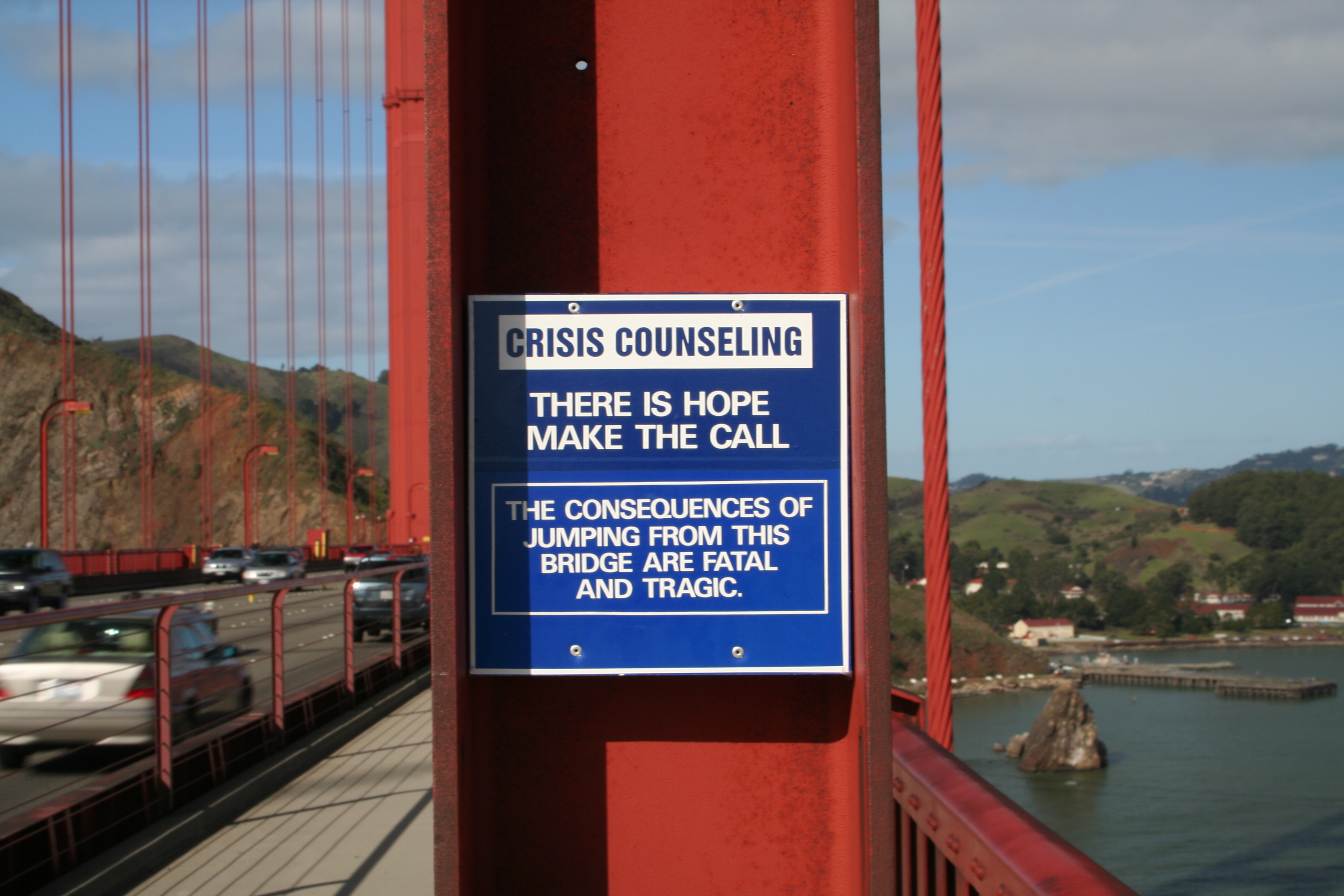
The suicide prevention message on the Golden Gate Bridge (the #1 bridge in the US to jump to one's death), San Francisco CA, February 19, 2006. (David Corby/Miskatonic via Wikipedia). Released to public domain via Creative Commons.

The suicide prevention message on the Golden Gate Bridge (#1 bridge in US to jump to one’s death), San Francisco CA, February 19, 2006. (David Corby/Miskatonic via Wikipedia). Released to public domain via Creative Commons.

Then I had thoughts. And having any thoughts at all, especially thoughts of anything other than suicide, will short-circuit any attempt to kill yourself. One was of the remote possibility that taking my life could actually hurt someone else, Mom, my family, maybe even my classmates or teachers. A second, even more sobering thought was that I could survive the thirteen-foot jump. Only to be run over by a car going at fifty or fifty-five. And I could possibly survive that, too. But I’d end up brain-damaged or paralyzed or a vegetable or in a coma. There were too many risks involved to just jump off the bridge. For a few seconds I stood there, lost and not sure of what to do next. My next thought, my third one, was that maybe, just maybe, this is what hitting bottom really feels like. Maybe something good for me and my life was just around the corner. Maybe if I hold out a little longer, I’d find a reason to live my life and live it well. My fourth thought brought me to Maurice. “Wouldn’t that be the best revenge, that I overcome every situation in my life and become successful? Wouldn’t making the ultimate comeback from the edge of the cliff be better than ending it all now?,” I thought. With that, I got down from the stone wall and went on a long walk through Pelham before going home. I wasn’t relieved, but I wasn’t ready to take my own life yet either.

This was the moment I decided no one else was ever going to make another decision about religion or my eternal spirit for me ever again. That I was no longer a Hebrew-Israelite. But I needed more to believe in, sometime bigger than me, because it was way too early yet for me to simply believe in myself. The only way being an atheist made any sense to me was only if there really was no god or God at all, and the scientific evidence didn’t lean in any direction. Plus, if atheism were a proven fact, and not just a belief born of both science and emotion, then suicide made perfect sense, and after coming off that ledge, it really didn’t seem rational anymore.

Thank God Facebook or Twitter didn’t exist in ’83. Between Alex and Starling and Wendy, my family and their religion, our poverty and my PTSD, all it would’ve taken thirty years ago would’ve been one tweet or post, and the timeline for me that now includes three degrees, three careers, a wife and a son (not to mention two books) wouldn’t exist. But if there really are alternate universes, then I killed myself in at least one of them three decades ago. And to that version of me, I get it, I understand, and I’m sorry that you didn’t make it.

A Private School Future For My Son?

Tags

, , , , , , , , , , , ,


Hogwarts School of Witchcraft and Wizardry, Universal Orlando, January 8, 2011. (Ian Boichat via Flickr.com). In public domain.

Hogwarts School of Witchcraft and Wizardry, Universal Orlando, January 8, 2011. (Ian Boichat via Flickr.com). In public domain.

I’ve written so many times already about the state of education reform and how corporate interests via private philanthropy, government conservatism and the technocratic generation have been hell-bent in deforming public education. I’ve even given some glimpses into my own son’s journey through elementary school in Montgomery County, Maryland over the past five years, as they’ve watered-down their curriculum and grading system while ratcheting up their testing regimen. It’s all led me to one conclusion. We need to do something for my 10-year-old son that neither me nor my wife would’ve ever gone through ourselves, especially with middle school a few months away.

The way I see it, we have four choices going into the 2014-15 school year and beyond:

1. Finding a private school for our son to attend, especially for seventh and eighth grade;

2. Finding an appropriate parochial school for our son to attend, especially for seventh and eighth grade;

3. I become a certified home schooler in time for my son’s sixth, seventh and eighth grade experiences, and educate him myself for a year or two;

4. Somehow find work overseas so that my son can get a proper, non-US public education in say, Canada, the UK, even Hong Kong or Cuba at this point.

Gonzaga College High School, Washington, DC, April 12, 2010. (AgnosticPreachersKid via Wikipedia). Released to public domain via Creative Commons.

Gonzaga College High School, Washington, DC, April 12, 2010. (AgnosticPreachersKid via Wikipedia). Released to public domain via Creative Commons.

There are certain drawbacks to all of these options, of course. A good private school in the DC area is a $15,000 per year prospect or more (as much as $30,000 per year at the upper end). And though my son can and sometimes does excel, he’s just a slightly above-average student (at least, according to MSA, MAP-M, MAP-R and a whole bunch of other tests), meaning scholarship money isn’t likely. The past two years of constant testing have sucked the joy of learning out of my kid’s memory banks. The only reason he reads at home at all is because we make him, not because he’s bought into the idea of reading and the world of imagination that it connects to. Not exactly the way to glide in for a tour of a school in Bethesda, Chevy Chase or DC.

With parochial schools, though definitely within our budget, the question becomes how much constant retraining would we have to do on the religious side. We’re non-denominational Christians, and ones would do not regularly go to church, either. Between the Catholic and Jewish schools, it could get confusing for our school. Yes, I know that they’ve become more secular since my days in K-12, but it does beg the question of whether we’d be trading in one set of endless headaches for another. On the other hand, going to a parochial school’s still likely better than a constant battery of tests for students-turned-lab-rats.

I’ve given homeschooling a lot of thought. It would be a piece of cake for the state to certify me. But it would reduce my income, already up and down since I became an adjunct professor and part-time consultant five years ago. It would curtail my ability to find new and additional work, as my days would be filled with teaching my son myself. Heck, my son might resent not being around kids his own age after a couple of months! But a year of homeschooling from me might be all my son needs. I have the potential to do in one year what my son’s public education couldn’t do in three. Especially if I could resuscitate his joy for learning.

What about finding work that would allow us to escape America’s badly damaged public education system? Sure, but I’d be (and am) competing with folks who already live in Canada, the UK and Hong Kong (among other places). My skills include teaching US, African American and World History and grad courses in Education Foundations, writing articles and books and a decade as a nonprofit manager. Unique, but not so in-demand and so unique that Canadians would beat down my door to hire me just because of my skills. Yet, all it takes is finding one job, one position overseas that could change all of our life trajectories.

A student fast asleep, or the future with Common Core, December 21, 2013. (http://www.medicalxpress.com).

A student fast asleep, or the future with Common Core, December 21, 2013. (http://www.medicalxpress.com).

With all of that, it appears that these are all better choices than sticking with Montgomery County Public Schools for the next seven years. The Common Core — really, the Common Snore of killing students’ imaginations, teachers’ autonomy and the attempt at critical thinking all at once — has arrived. And it is truly a not-so-silent death knell to public education as a vehicle for social change or social justice. So we need to make some life-altering choices, not the kind our federal and state governments and local school boards provide. And we need to make them soon.

On Becoming A Father — 11 Years Later

Tags

, , , , , , ,


Wife and son, August 16, 2003. (Donald Earl Collins).

Wife and son, latter at two weeks and change old, August 16, 2003. (Donald Earl Collins).

This week eleven years ago is when I first learned from my wife that she was pregnant with our one and only child, our son Noah. It was a high that took a few months of post-natal sleep deprivation to come down from, not to mention a fight to keep my job and move on from it courtesy of AED in ’03 and early ’04. But learning that I was soon to become a father didn’t just bring joy and euphoria. It came with baggage and the fear that my baggage would be a handicap to me as a father and to my gestating son.

Luckily I had a bit of time to prepare for becoming a father. I figured out that my wife was pregnant a few weeks before she did. It was on Thanksgiving Day ’02, and I was whisking a cream sauce to go with some chocolate torte dessert I was making. I asked my wife to watch over the cream and to make sure that it didn’t boil over when I went to the bathroom. Sure enough, the sauce was boiling over when I came back. I said sarcastically, “Thanks for messing up the cream!,” which led to my wife going to the bathroom, crying. You have to understand, my wife rarely cries, and never cries over my brand of New York-esque sarcasm. So when she said, “I’m sorry,” I said, “It’s okay, honey,” followed by, “Why are you literally crying over boiling cream? Are you sure you’re not pregnant?”

From that moment until my wife had given herself an EPT test three weeks later, I’d already started the process of psychological preparation. We’d barely begun trying to have a kid. We talked about it in July ’02, changed our diets in August and September, and I started taking herbal supplements by the end of September. Two months of actual trying in total. Really? That’s all it took?

All I knew was that fatherhood would bring back so many memories, some good, most of them bad and ugly. About my father Jimme and his alcoholism and homophobia as directed at me, my ex-stepfather’s physical and psychological abuse, about having to serve in my father-like role with my younger siblings and with Darren. By the time I’d reached grad student, some eleven years earlier, I wasn’t sure if I’d ever fall in love or get married, much less become a father. I mean, who would want to be with me, have little Donalds and Donnas running around that had about half of my features and traits? I wasn’t sure if I’d ever want that.

Fast-forward through grad school at Pitt and Carnegie Mellon, through four and half years of dating and two years of marriage. I was in a different place, not much different, but different enough to be much more sure about what I wanted. As I said to my wife, “There are four days out of the week where I’m sure about having a kid, two where I don’t want a child, and one where I simply don’t know.”

That was still good enough for my wife. And she’s the reason I could be firmly committed to fatherhood. I don’t think that I would’ve become a father otherwise. Have I made mistakes over the past ten years and five months with Noah? Of course! I once left him in a carrier on our table when he was five months over, and it flipped over end-over-end, scaring the crap out of him (literally!). I’ve yelled at him when I shouldn’t have, and I’ve cursed out at least one hundred too many bad DC area drivers with him in the back seat of our Honda Element over the years.

But despite all of the ups and downs in my life, career(s) and even marriage, one of the handful of things I’m sure about is having become a father to my son a good eight and a half months before he was born. I still check on him nearly every night to watch him sleep (and breath).

Beyonce Surprises Fans With New Album (via HuffPost)

Tags

, ,


While I think it’s wonderful in one sense for Beyonce fans that she put out her latest album directly via iTunes, it’s not exactly earth-shattering or a demonstration of independence. Didn’t Prince pave the way here 17 years ago by going around Sony to put an album out directly on the Internet? Not exactly an original idea.

And for those who aren’t Beyonce fans but did get hyped up on her showing of “power,” really? Beyonce was powerless before, a commodity that the music industry bought and sold until 36 hours ago? I call hypocrisy here. Beyonce’s already in a privileged position and caste. She could have walked down Times Square and handed out 100 copies of her album and videos and sold them from her website and would’ve sold out.

That she used a platform within iTunes specifically created for the unknown artist or writer to put out her new material is neither brave nor something that is particularly innovative. In fact, it’s something that actually can have a corrosive effect on the new and unknown folks who do not have the access, privilege or money to put out their own albums and books like Beyonce just did.

I’m not saying that Beyonce should or shouldn’t have used the iTunes publishing platform here. It’s free and easy enough for my 10-year-old son to use. But we shouldn’t praise Beyonce for doing so, especially if it means fledgling artists and writers get crowded out of the marketplace as a result. (via http://huff.to/18rQU6t)