• Spinning Sage’s Gold: Allegories on the Western-Dominated Present and a Possible Post-Western Future (2025)
  • About Me
  • Other Writings
  • Interview Clips
  • Video Clips
  • Boy @ The Window Pictures
  • Boy @ The Window Theme Music

Notes from a Boy @ The Window

~

Notes from a Boy @ The Window

Category Archives: Youth

“Dr. K All the Way…” & Other Fall Classics

28 Wednesday Sep 2011

Posted by decollins1969 in 1, Boy @ The Window, culture, Eclectic, Jimme, Mount Vernon High School, My Father, New York City, Politics, race, Sports, Youth

≈ Leave a comment

Tags

"Dr. K", 1986 World Series, Bryant Gumbel, Child-like Hope, Congress, Darryl Strawberry, Dwight Gooden, HBO, Jobs Bill, Lenny Dykstra, Mets Fans, Mount Vernon High School, Mount Vernon New York, New York City, New York Mets, Obama, President Barack Obama, Real Sports, Sports and Life, WHN-AM


Dwight Gooden, aka, "Dr. K," Shea Stadium, 1986. (Source/http://itsonbroadway.wordpress.com/2011/05/16/dwight-gooden-aka-dr-k/).

While the country waits to see whether Congress and the President will find a way to entertain us with political gridlock and endless compromises and capitulation, I realized this week that I have a twenty-fifth anniversary this month. It’s been a bit more than a quarter century since my New York Mets won the NL East division title (their first since ’73), one more brick in their World Series wall that year.

Those not-so-Amazing Mets were a juggernaut that year, having won 108 games and run away with the division lead by the end of June. Gooden was Dr. K., and, along with Ron Darling, Sid Fernandez, Bob Ojeda, and Jesse Orozco, led the pitching staff. While Darryl Strawberry was the straw that stirred the drink on offense, along with Lenny Dykstra, Gary Carter, Howard Jones and Keith Hernandez. God, I really loved that team!

Darryl Strawberry home run, Shea Stadium, July 2, 1988. (AP Photo/Mark Lennihan).

I really did. I imbued the Mets with all of my hopes and dreams, and saw their wins as a way to see myself as a winner. And whenever they lost a game or a series, I saw myself as having lost as well. I was aware of all of this on some level, that making my life circumstances a parallel story to that of a major league baseball team was, well, a bit childish.

But given my life since the age of eleven, I needed that outlet, that room to be a child, if only for two or three hours a day. In between watching my four younger siblings, washing clothes at the laundromat in Pelham, dealing with my alcohol father and my idiot stepfather, running back and forth to the store, applying to colleges, and facing the hell that was my senior year at Mount Vernon High School. Especially with three AP courses, a touch of senioritis, and a number of classmates at each other’s throats. Including my own.

As the season took forever to wind down (the Mets clinched the NL East division on September 17, more than two weeks before the end of the season), the pre-WFAN station for the Mets (WHN-AM, a country oldies station until the 24-hour group took it over in ’87 and renamed it WFAN) started playing their World Series-or-bust promo, “Dr. K All the Way! — Let’s Go Mets!” So silly, so goofy, so geared toward long-suffering Mets fans. “Is that the best you can do?,” I thought every time I heard the ten-second spot. Apparently it was, and it didn’t matter either way, because fans are usually too fanatic to sweat the goofy stuff.

Let’s Go Mets Go (1986) – New York Mets theme song

Let’s Go Mets Go (1986) – New York Mets theme song

I became even more involved in rooting for my team as they moved into the playoffs. I’d listen to games in class, between classes, even in between questions, it seemed, in my AP Physics class. To say the least, my grades suffered, and more than a few of my non-Mets-fan classmates berated me in the process. But how could I explain to them the psychic bond I felt to this team? A feeling that somehow, if they, the downtrodden Mets, could pull off the ultimate victory and win a World Series, that I, a nobody, could make my life a victorious one as well. My more affluent and too-busy-being-cool classmates wouldn’t have understood that. As it was, I barely understood it myself.

Fast-forward twenty-five years. I’m no longer a baseball fan, and have no intent to fall back in love with a game I find boring, and with an institution that represents culture and race in America that is so pre-Civil Rights Movement and twentieth century. Most of my Mets still have their rings, even if key players on that team have been or are in prison, recovering drug addicts, and have made and lost hundreds of millions of dollars speculating in the snuff and stock markets (see Lenny Dykstra ’09 HBO Real Sports interview excerpt via The Young Turks).

But I still have that child-like sense of hope and yearning. I just don’t place it in anonymous others anymore. I haven’t lived or died with a team since my Knicks came within a missed 3-pointer by John Starks of winning the ’94 NBA Finals in Game Six. But I do place it in myself, because between God and me, and the others I’ve met and befriended in my life, I’ve been able to move mountains.

Which is why it does and doesn’t matter if the job stimulus passes in whole, in part or even not at all. I need to take that same optimism, that same hope, convert it to more hard work, and find a way to infuse it in my son, so that he can run the race, even if and when I can’t. In the process, I hope he find heroes he can look up to in the fall, even if they are fleeting ones.
The Audacity of Low Expectations/Jealousy

19 Monday Sep 2011

Posted by decollins1969 in 1, Academia, Boy @ The Window, culture, Mount Vernon High School, Mount Vernon New York, Politics, race, Work, Youth

≈ 2 Comments

Tags

Boy @ The Window, Envy, Exceeding Expectations, Humanities, Jealousy, Low Expectations, Mount Vernon High School, Mount Vernon New York, Setting Standards, Success


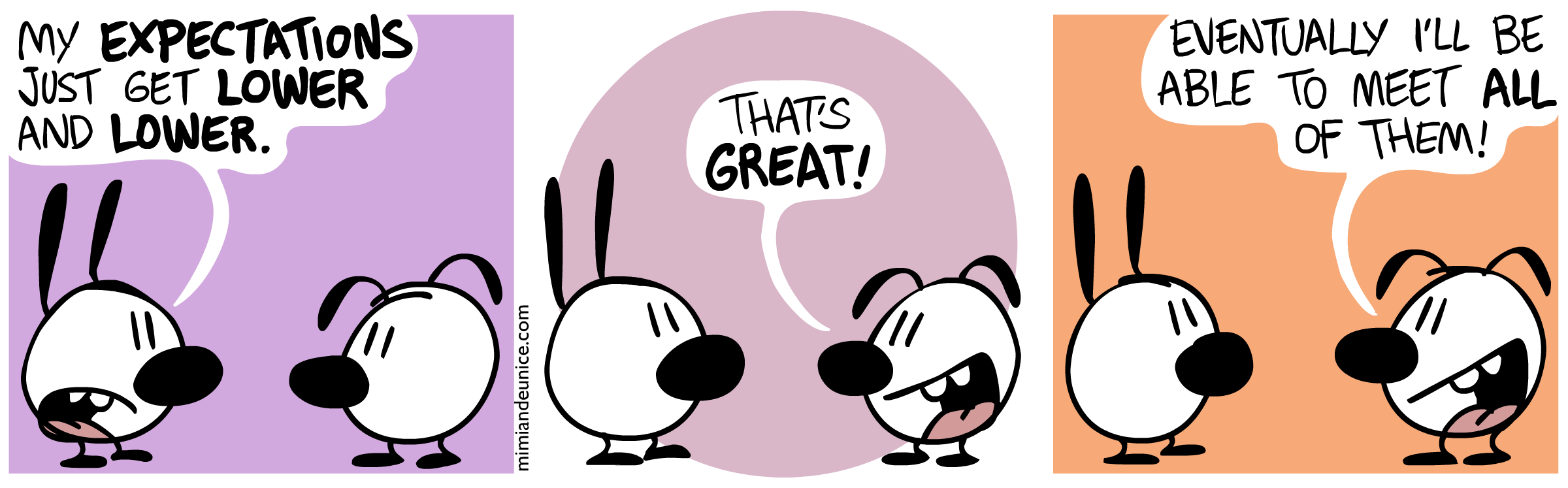
Mimi and Eunice, “Low Expectations,” September 19, 2011. (Source/http://mimiandeunice.com). Qualifies as fair use under US copyright laws because of image’s low resolution and without the intent to reproduce or distribute for profit.

It seems to me that I’ve spent a lot of time over the past three decades overcoming other people’s psychological issues. Regarding race, race and gender, race, gender and class, not to mention performance issues, success, jealousy and envy, and other psychoses that had little or nothing to do with me. It’s something that most folks who aren’t Black, male, grew up in poverty and had some success (however one defines that) really can’t understand unless they have parents who’ve told them every single day that they “weren’t good enough to live.”

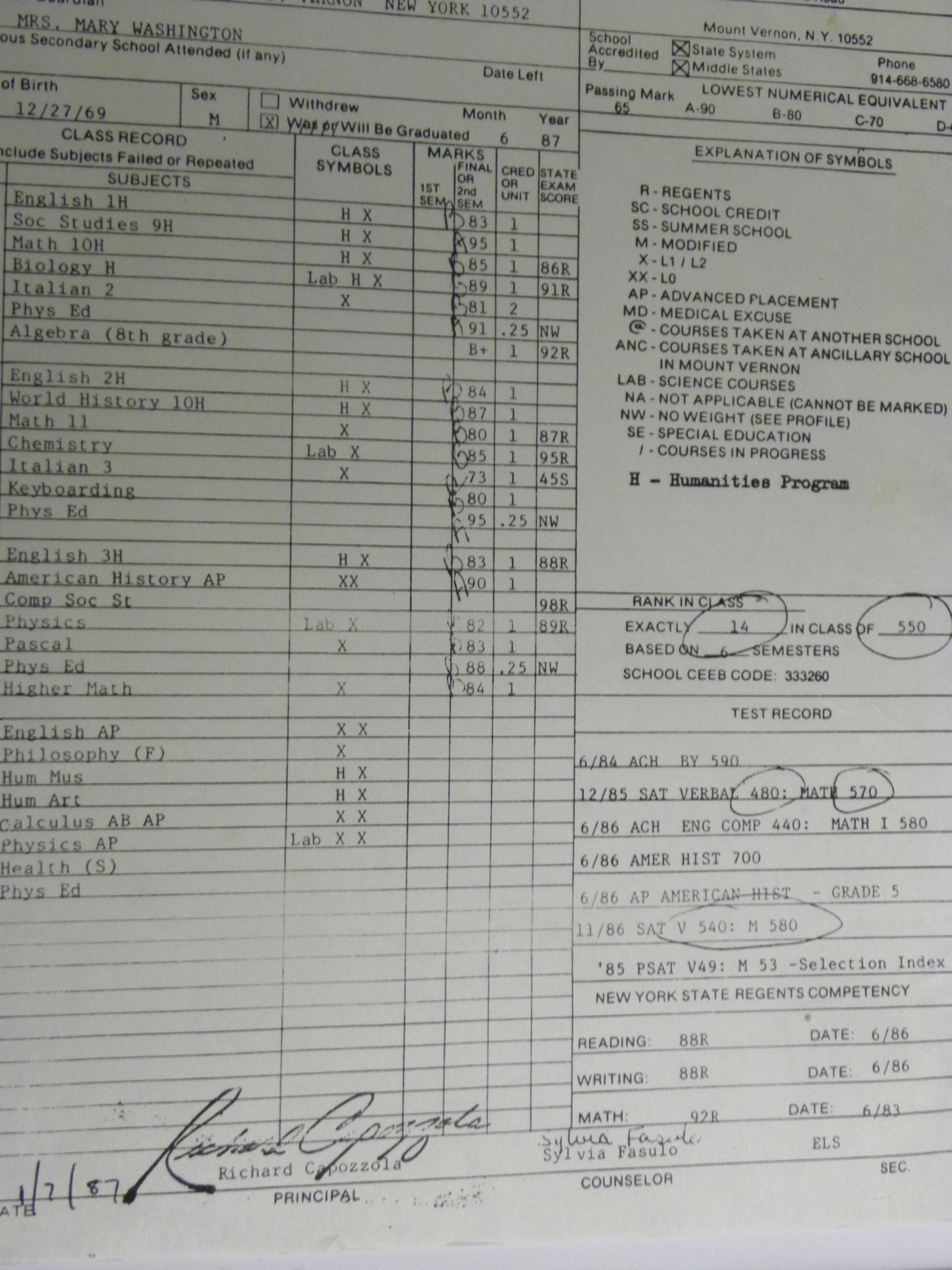
Still, these issues have mostly cropped up for me when I’ve experienced what most people would recognize as success, as if the only role I was ever supposed to play in life was that of a doormat. The first time I went through this process of blowing up other people’s low expectations of me was at the beginning of my senior year at Mount Vernon High School, about this time twenty-five years ago. A couple of weeks into the school year, MVHS released our class rankings. Out of the 545 or so students eligible to graduate as part of the Class of ’87, I was ranked fourteenth with a 3.83 average.

My MVHS trascript, courtesy of University of Pittsburgh Admissions Office, January 7, 1987. (Source/Donald Earl Collins). Note the circles from the admissions officer all over the transcript.

I understood that this was pretty good, but I was also disappointed that I hadn’t cracked the top ten. In fact, the top twelve students in our class all had GPAs above a 4.0, all because of our weighted Level 0 and Level 1 courses. Crush #1 finished just ahead of me, thirteenth in our rankings, something I saw as ironic. Despite this sign of academic success, I hoped and wished for more, and spent several late-night walks over the next few weeks second-guessing my work in tenth grade.

My classmates started to show their darker sides, some for the first time since the days of 7S. One came up to me after my AP Calculus class soon after the rankings were posted. “The only reason you’re in the top twenty’s because of history!,” implying that I was an average student in all of my other subjects. Another, much shorter and much more condescending classmate chimed in a few days later, saying that “the only thing you can do with history is play Jeopardy.” I wasn’t exactly walking around school celebrating my good fortune. I chalked it up to the stress of years of academic competition, the boiling over of senioritis and the rage associated with college preparations. The possibility that jealousy was involved didn’t cross my mind until much later. I didn’t think that anyone could be envious of my standing.

Fast-forward four years to the fall of ’90, as I prepared in earnest for grad school. Not only had I endured a short conversation at the beginning of that year with the great Sylvia Fasulo and her attempts to discourage me from pursuing grad school, law school or a career in law (see my “The Legend of Sylvia Fasulo” from September ’09). I had two professors from Pitt who told me that they weren’t sure about my chances for getting into grad school, and Reid Andrews, who flat-out told me that he didn’t think that I was “graduate school material.”

I have no doubt that if these yahoos were jealous of me at all, it was because of my age, and not my potential. They simply didn’t see how a 3.4 GPA and a 3.82 in my history major would be good enough to get me into a master’s — much less a doctoral — program. The fact that I completed my master’s degree in two semesters within twenty months of essentially being told that I was a fool left Andrews, at least, at a loss for words.

There are so many other instances in which a grad student, a professor, a supervisor, even my siblings, have expressed their low expectations and jealousy over my tiny little crumbs of success that it has left my head spinning on a broom handle. I mean, what did I really do to earn or deserve that kind of attention? I don’t own a house or have a million dollars in gold lying around. I have yet to publish an article in Rolling Stone or in The Atlantic Monthly. I don’t exactly have LeBron James or President Obama on speed dial.

So what is it about me, I’ve asked myself so many times? And then, I’ve reminded myself of something I figured out about twenty-one years ago. That the only expectations that I ultimately need to meet or exceed are my own. That what other people say about me, no matter how distasteful, really doesn’t matter, for those folks were never going to be there for me anyway.

Maybe it’s my refusal to live under someone else’s low expectations, to not allowing myself the luxury of envy, that irks those around me. Or maybe, just maybe, it’s as simple as misery loving company, and not loving mine. Either way, it’s ironic that we live in a time in which we prefer to tear each other down rather than help each other get going in our lives. Which makes my relationship with the rest of humanity so bittersweet. I guess I really am a writer!

Humanities: First Contact, Full Circle

09 Friday Sep 2011

Posted by decollins1969 in 1, Academia, Boy @ The Window, culture, Eclectic, Hebrew-Israelite, Mount Vernon New York, New York City, Patriotism, Politics, Pop Culture, race, Religion, Youth

≈ Leave a comment

Tags

616, 616 East Lincoln Avenue, 7S, 9/11, A.B. Davis Middle School, American Arrogance, Arrogance, Creme de la Creme, Cultural Divide, Diversity, Elistism, First Contact, Gifted Track, Hebrew-Israelite, Humanities, Humanities Program, Hyper-Patriotism, Middle School, Mount Vernon New York, Mount Vernon public schools, Naivete, Patriotism, Preteen, Racial Strife, Racial Undercurrents


Creme Anglaise in a pitcher next to a ladle, the closest thing I could find to represent my foodie image of "creme de la creme," the mantra of Humanities administrators during my six years of travails, September 9, 2011. (Source/http://recipetips.com).

It’s been thirty years exactly since I made the most horrible set of first impressions in my forty-one years of life. My first day of seventh grade at A.B. Davis Middle School in Mount Vernon, New York was also my first day in the Humanities Program, a magnet program for the gifted track (and also the way the powers that were decided to desegregate the school district in ’76).

But it was so much more than that, for better and certainly for worse, at least for me. It was the flip side of a coin that represented the worst six years of my life (the coin’s other side being my life at 616 with what can only be loosely called my family). But it was also the six years of my life that made the past three decades of success, struggle, more success, and more struggles possible.

Humanities: First Contact, Lessons

Humanities: First Contact, Lessons

After putting together Boy @ The Window — in which a large measure of text was devoted to what occurred with and around me during my time in Humanities, one question still remains. Did my time in Humanities, with my classmates, teachers, counselors and principals have to be as difficult as they were — and not just for me? There’s no real way to answer that question, because “of course” is a cold and callous answer, while “of course not” belies the important psychological changes that made me a better thinker, student, writer and person as a result. But if I could, I’d build a time machine, jump into my eleven-year-old version of myself, and make sure to have my dumb ass take my kufi off for my first day of school in 7S. At least then, I would’ve been normal-weird, instead of standoff-ish weird.

My main problem, though, was that I arrogantly believed I was the smartest person in the world. I paid dearly for having that kind of naiveté, to the point where certain classmates still see me as that idiotic preteen, and refuse to see me any other kind of way. Too bad for them, for I know I’ve long since changed.

That day, at least for the past decade, has also reminded me of another beautifully warm, powder-blue sky day that turned tragic. With two days before we reach ten years since 9/11, I think about the way I used to be, and see so many similarities to how we see ourselves as a nation. “We’re #1,” we love to say, even though we’ve long since stopped being #1 in so many respects. We have the largest economy and military, the largest debt, make the largest contribution to climate change and pollution, and complain the most about how the rest of the world isn’t like us.

Like me three decades ago, America is naive and arrogant. And unfortunately, it faces competitors — some as unfeeling as my more entitled or more unscrupulous classmates — who are clobbering us in education, economic growth, health care, social welfare, even in protecting their citizens and their citizen’s freedoms. It’s sad, because there are millions of people now experiencing the severe fall into poverty — and all of the pressures that places on marriages, parenting and children — that I faced, very unsuccessfully at first, thirty years ago.

Humanities: Full Circle, Thoughts

Humanities: Full Circle, Thoughts

I’ve come full circle. Between the struggle to find a home for Boy @ The Window and my struggle to continue to do meaningful work as a writer and educator, I find that even on my worst days, my best days thirty years ago were a thousand times worse.  My first contact with academic competition, Whiteness and diversity, racial strife, religious differences and straight-up elitism is what has given me a greater appreciation for who I’ve become since that sunny day so many years ago. As well as how much I’ve gained.

A Question of My Blackness, Sexuality and Masculinity

01 Thursday Sep 2011

Posted by decollins1969 in 1, Boy @ The Window, culture, Eclectic, eclectic music, Jimme, Mount Vernon High School, music, Pop Culture, race, Youth

≈ Leave a comment

Tags

"Something About You", 616, 616 East Lincoln Avenue, A Question of Freedom, Blackness, Boyz N The Hood, Coolness, Crush #2, Eclectic Music, Heterosexuality, Level 42, Manhood, Masculinity, Mount Vernon High School, Mount Vernon New York, R. Dwayne Betts, Youth


Boyz N The Hood (1991) Screen Shot, September 1, 2011. (Source/http://freeinfosociety.com). 20 years since this movie, and we still inquisition Black males about their masculinity. By the way, I was NEVER this cool growing up.

About this time a quarter-century ago, I received regular reminders from the people in my life as family and classmates that I didn’t fit their definition of how a heterosexual Black male should behave. At least in Mount Vernon, New York. You see, I didn’t have to be a young Barack Obama or Lenny Kravitz to learn at an early age that I wasn’t Black enough, man enough or heterosexual enough for many folks in my life. The fact that I didn’t run around with the other boys skipping school and sniffing skirts was evidence enough of how different I was.

One of the more subtle forms of interrogation I experienced occurred at the end of eleventh grade, going into the summer of ’86. That day I walked into English class, and Crush #2 asked me about that song of the day, which happened to be Level 42’s “Something About You” Something About You. When I told her who it was, she started snapping her fingers to it. LJ, an on-and-off again classmate since third grade at William H. Holmes Elementary, walked by as we were talked. “Are they Black?,” she asked. When I said “No,” LJ shook her head and walked away. The group was White and from the Isle of Wight, no less, a bunch of off-shore British White guys. Somehow I’d violated some kind of code in LJ’s eyes. It was the last conversation we had before we graduated a year later.

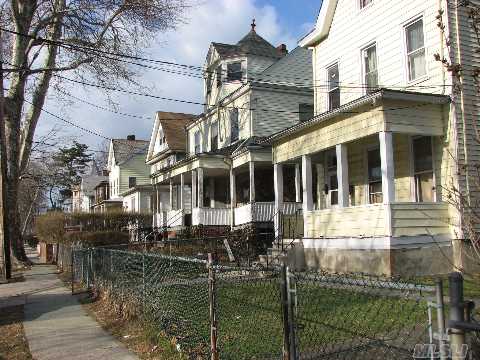
South 10th Avenue, Mount Vernon, New York, November 19, 2006. (Source/http://weichert.com). The egg-shell white house in the center of the photo is where my father Jimme lived in ’86, an attic room. Looks better now than it did then.

I received a far less subtle hint that made LJ’s disgust look like romance by comparison. It was an incident just a week before the start of my senior year at Mount Vernon High School, something I’ve posted about before. By the time I’d gotten a crush on Crush #2, my sexuality was no longer in question, although I’d never seriously questioned it before. My father, though, still had his doubts. I’d hardly seen Jimme most of the summer of ’86, only coming over occasionally to see how he was doing or to bum a few bucks off of him. I found Jimme that last Saturday morning in August, hanging out on the street around the corner from his place, having already drunk his fill.

His mood was especially foul that day, like his body odor. He refused to give me any money. “I don’ give my money to no faggats!” Jimme yelled at me as he came walking and stumbling down his block toward me. He’d seen me come out of the front yard of the house in which he rented a room. I wasn’t in the mood for his crap. “I’m not a faggot and I’m not gay,” I yelled back. When he got closer, I could see that he’d been out too long already. Jimme’s clothes were a mess, and his face was in a twisted rage. He grabbed me by my arm.

“Did you get yo’ dict wet?,” he asked as usual.

“Even if I did, I wouldn’t tell you,” I said.

“YOU’RE A FAGGAT,” he yelled again.  (see my “In the Closet, On the Down Low” from June 1, 2009 for the full conversation and incident)

As I saw it then, I was a year away from college, and I was still in the streets dealing with my drunk ass father, my jealous and institutionalized older brother, a sham of a marriage at 616 and four younger siblings who were high on sugar all of the time. I’d done so much to change my life and yet almost everything in my life was the same. Up to this point the only things that had kept my head from exploding were God and school. As my senior year approached, I wondered how much longer I could maintain emotional control before I finally just lost myself in years of growing pain, like a volcano about to super-erupt.

As I see it now, it remains a shame that we as Black males have to run a gauntlet in our communities in order

A Question of Freedom (2009) Hardcover Cover, September 1, 2011. (Source/Donald Earl Collins).

to become Black men, at least in the eyes of others. We can talk about the K-12-to-prison system that is public education in many a community of color. Or the drug trade. Or the sheer lack of quality public services and interventions in our communities or lives, other than police forces. Or even the daily images that tell so many of us that aspiring to be a rapper, football or basketball player, or just to be cool is so much better than knowing anything. The latest good memoir on this is R. Dwayne Betts‘ A Question of Freedom (2009).

But we must also admit that the people who attempted to raise us — our families, relatives, neighbors and classmates — are just as often at fault for turning out Black males who aren’t ready to be Black men, human adult males with ideas and aspirations outside of the box. Until we get serious about the fact that those closest to us have put such idiotic notions of masculinity, heterosexuality and Black coolness in many a Black male’s head, we get nowhere in helping to transform the lives of people like me when I was a teenager.

For we can’t depend on people like me becoming homeless, embracing solitude, and leaving my community as the best way to learn how to be a man, an adult, a really serious yet compassionate (and goofy) human being.

Crazy

13 Saturday Aug 2011

Posted by decollins1969 in 1, Academia, Boy @ The Window, culture, Eclectic, eclectic music, music, Pop Culture, Youth

≈ Leave a comment

Tags

"Crazy", Aspirations, Eclectic Music, Expectations, Graduate School, Late Bloomer, Lyrics, Seal, University of Pittsburgh, Youth


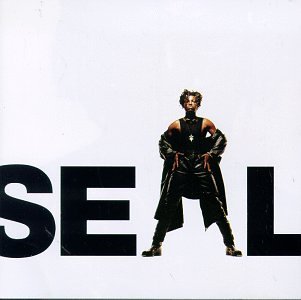
Seal, CD Cover (1991), August 13, 2011. (Source/Donald Earl Collins).

There’s no doubt in my mind that I’m a late bloomer. I came to find myself a teenager in a twenty-one year old’s body twenty years ago, just as I’m a thirty-five year-old in a forty-one-and-a-half year-old’s body now. As the summer of ’91 began to wind down, though, I realized that I needed to go into my first year of grad school at Pitt with some inspiration, with a chip on my shoulder, really.

It didn’t take more than a simple thought to find that inspiration and chip, either. Between working for a bunch of folks at my Western Psych job who still thought that hunting down half-and-half was the extent of my work there on the one hand. And professors like Reid Andrews telling me after I’d received my grad school stipend award letter that I wasn’t “graduate school material” on the other hand. Livid is the minimal word I’d use to describe my mood in the three weeks before the start of my five-and-half-year odyssey. One of doing cartwheels at least three times better than my colleagues to prove that I was as good as anyone.

But I’m jumping ahead of the story here. I found some inspiration from music, as usual, in this case, on one of my daily walks home from work in Oakland to my studio apartment in East Liberty. Still searching for more new music for my ’90s collection, I found a radio station playing Seal’s first big hit, “Crazy.” I’d heard parts of the song before, all during that summer, but never from start to finish. As I reached the end of Ellsworth Avenue, where I’d walk up the steps to a bridge on Highland Avenue, one that went over the train tracks and busway into East Liberty, I heard the lyrics, really for the first time.

“In a sky full of people only some want to fly/Isn’t that crazy
In a world full of people only some want to fly/Isn’t that crazy/Crazy
In a heaven of people there’s only some want to fly/Ain’t that crazy”

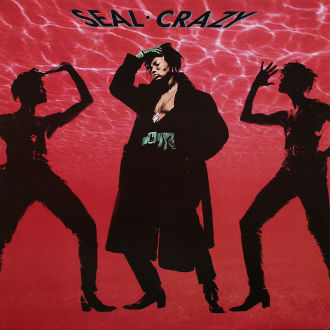
Seal, "Crazy" 45 Single Cover (UK), January 8, 2009. (Source/http://cover6.cduniverse.com/MuzeAudioArt/140/141811.jpg). Qualifies as fair use under US copyright laws, as version is of low resolution for reproduction, and is part of larger commentary.

And yes, I wanted to fly. Besides, as far as most people were concerned, I was crazy anyway. For wearing that godforsaken kufi to school for three years. For becoming a newborn and sanctimonious Christian after that. For trying out for football, and later, baseball instead of basketball. For listening to Mr. Mister and Tears for Fears and Sting instead of bopping to Run-D.M.C. For walking way too fast, and talking a little too slow. For going off to college out-of-state, to a no-name school no less. For taking a grad course my junior year at Pitt. For deciding to go to grad school in history instead of law school or Black studies.

The list is as long as an introspective Eminem rap sequence, airing every negative ever tossed my way. I was crazy, and still am. But, as far as my first year of grad school was concerned, I made two deals with myself about the process. One was to not compare myself, my abilities, my limitations, to anyone else in the program. The other was to put aside all of my preconceptions about my professors, or the difficult courses ahead, or whether I would complete the master’s degree and move on to the doctoral portion of the program.

I didn’t want to limit myself to what others may have expected of me, or to what I could’ve possibly expected of myself at the time. I didn’t even like my friends saying that “the sky’s the limit,” because I didn’t want to limit myself to the sky. I simply wanted to be crazy enough, humble yet arrogant enough to know my limits, but push the envelope as hard as I could in order to make graduate school work for me.

Howard Hughes standing in front of his new Boeing Army Pursuit Plane, Inglewood, California in the 1940s, May 31, 2005. (Source/Library of Congress, LC-USZ62-63333 - In public domain). One of the craziest, yet great, innovators of the 20th century. Guess it works better when you're a rich White male.

That kind of thinking affords a very single-minded intensity — to the point of a near-psychotic passion — that leads to excellence, miracles and the exceeding of what may have been your craziest expectations. I know it was that way for me. It had to be. If I’d bought into all that my most hateful Humanities classmates, my mother and ex-stepfather, my father Jimme, my fellow Mount Vernonites and some of my teachers and professors thought of me, who’s knows? I’d likely become a sexually confused and frustrated Black male, a college dropout, wandering from one minimum wage job to another, living alone in a boarding room, as miserable as a character in Fyodor Dostoyevsky’s Crime and Punishment.

I’d become a psychopath, not just crazy enough to believe in myself and the miracles of God in my life. I need to do be a little crazy now, even at this stage of my life. We all need to be a little crazy, not in a Tea Party sense, but much more in an Arab Spring kind of way. After all, “we’re never gonna survive unless we get a little crazy.”

The Audacity of Youth, Grad School Style

06 Saturday Aug 2011

Posted by decollins1969 in 1, Academia, Boy @ The Window, Eclectic, Youth

≈ Leave a comment

Tags

Audacity, Black Washington, Bruce Anthony Jones, Calling, Career, Career Options, Carnegie Mellon University, Certfication, Dan Resnick, Dissertation, Doctoral Thesis, Experience, Fudging Data, History, Joe Trotter, Joe William Trotter Jr., Multiculturalism, Naivete, Pittsburgh, Proletarianization Thesis, Teacher Education, Thesis, Wisdom, Youth


Me as Naruto, the ultimate hollerer, Noah's 7th birthday, July 30, 2010. (Source/Donald Earl Collins)

This weekend should be of significance to me. Actually it should be of more significance than anything else I’ve done professionally in the fifteen years since. For this was the weekend that I decided I was “Dr. Collins,” three and a half months before actually becoming Dr. Collins.

I was in the middle of a tumultuous time, caught between Joe Trotter and five years of graduate school, the last three of which had been at Carnegie Mellon. I had just finished revising my first draft of my dissertation, adding thirty pages to an already hefty 475-page manuscript. Me and Trotter hadn’t been getting along for four months, and after two months with my first draft, I’d received a response in mid-July that was disheartening.

Most of my dissertation, examining how multiculturalism was lived intellectually, educationally and culturally in Black Washington, DC, received no comment whatsoever. The chapters on the development of

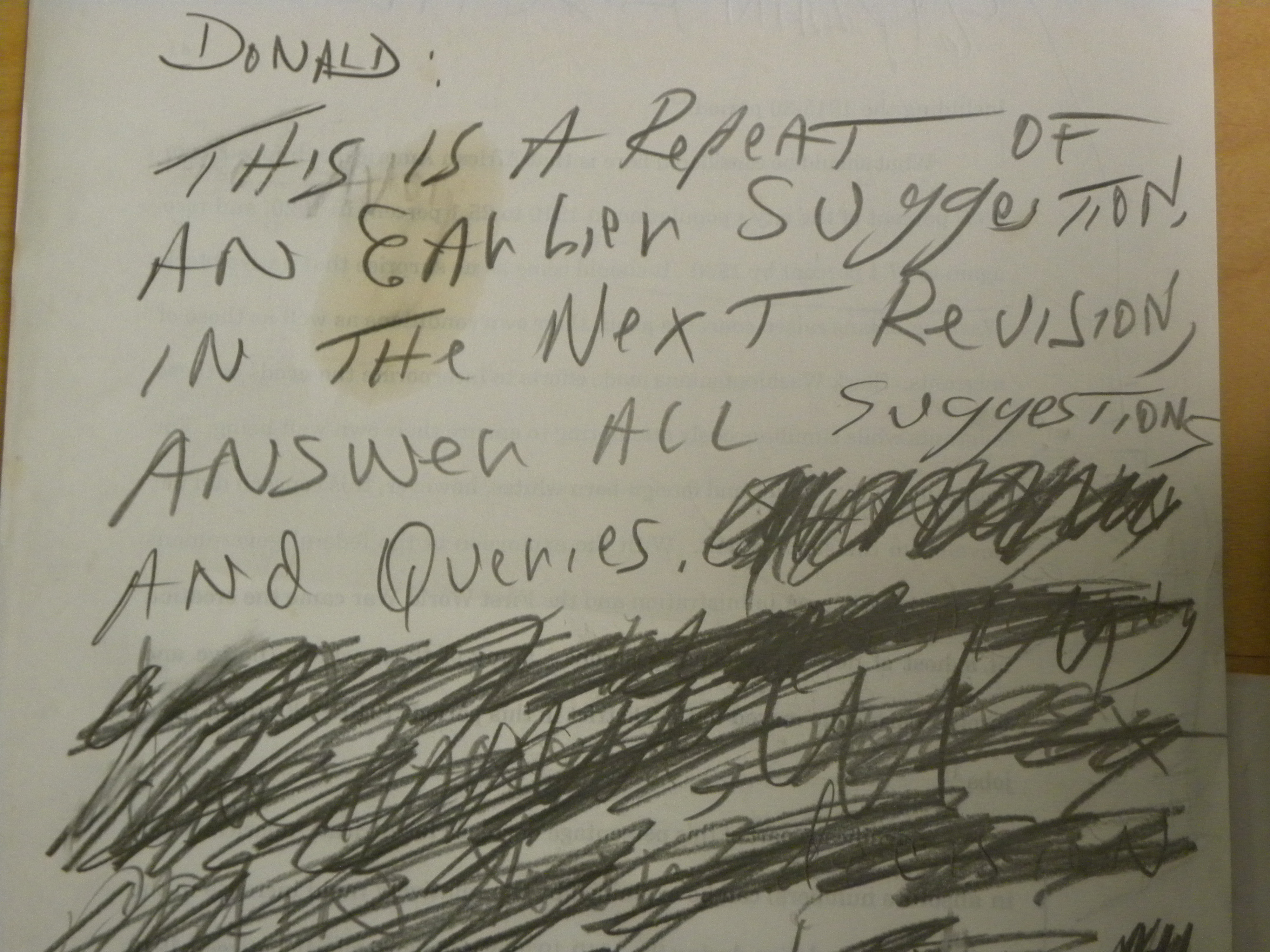
Trotter comments, back of page 43 of first dissertation draft, July 15, 1996. Pic taken August 6, 2011. (Source/Donald Earl Collins)

the Black community in DC, particularly in the period immediately before the 1930-1960 period, had received lots of snarky comments. Like “I told you to change this already,” or “This is the third time I commented on this section,” or “Make these suggested revisions on…already,” handwritten in pencil, big, bold and rushed, as if he wanted to stab me in the neck with the pencil. Comments on writing, evidence, to sharpen analysis of my multiculturalism argument, I expected. What I, naive little me, didn’t expect was a series of comments about data and information that, quite frankly, was irrelevant.

After talking with a couple of professors who weren’t on my dissertation committee — including one whom himself had been Trotter’s advisor back in the ’70s — I finally figured out what had been eating at the man ever since I began handing him chapters. It wasn’t as if Trotter’s comments were transparent in what he wanted me to revise. He wanted me to put together a proletarianization argument for DC. Bottom line was, he was pissed with me because I had written that the Great Migration period (1910-1930) of Blacks leaving the rural South for the industrial, urban North had little effect on DC, a truly Southern city at the time.

I was incensed when I finally figured out why Trotter had been giving me a hard time since last fall and especially since April. It made me think that maybe earning a doctorate in history — especially with him as the head of my committee, along with Dan Resnick and an increasingly distant Bruce Anthony Jones — wasn’t worth it. I thought that if I had to go through another year of this, that I’d drop out of the program.

But I’d only do that after giving the revisions one more shot. I addressed every — and I mean every — comment I had from Trotter by email or written out across a page, and then documented every change in a six-page memo of my revisions. I even went so far as to rhetorically fudge the Great Migration period data, just to see how Trotter would respond. On page 100 of my dissertation, I wrote, “For Washington, a slight acceleration in black migration occurred between 1915 and 1930.” That was an obfuscation, for Blacks migration didn’t “accelerate” until the 1930s, after a twenty-year period of limited migration that only added 20,000 to a Black population of more than a 100,000. Trotter actually praised this revision.

I made a deal with myself to quit after another year if this revision didn’t work out. After receiving a response that only required four minor revisions, Trotter made an attempt to remove the one professor I did have in my corner from my committee in Bruce Jones, using Jones’ recent acceptance of a position at the University of Missouri as an excuse. From that weekend in August ’96 until the week before Thanksgiving, everything about my doctorate became a battle with Trotter.

In a way, I guess I was lucky it did work out. But now, as I did then, I wonder if it was really worth it, to fight as hard as I did for that degree. Would I be a better writer, a better educator, if I had dropped out of the program, gone back to school, and become a high school history or social studies teacher? At least my employment status would’ve been much more stable between ’96 and ’99 if I had, and I’d have an additional career option now.

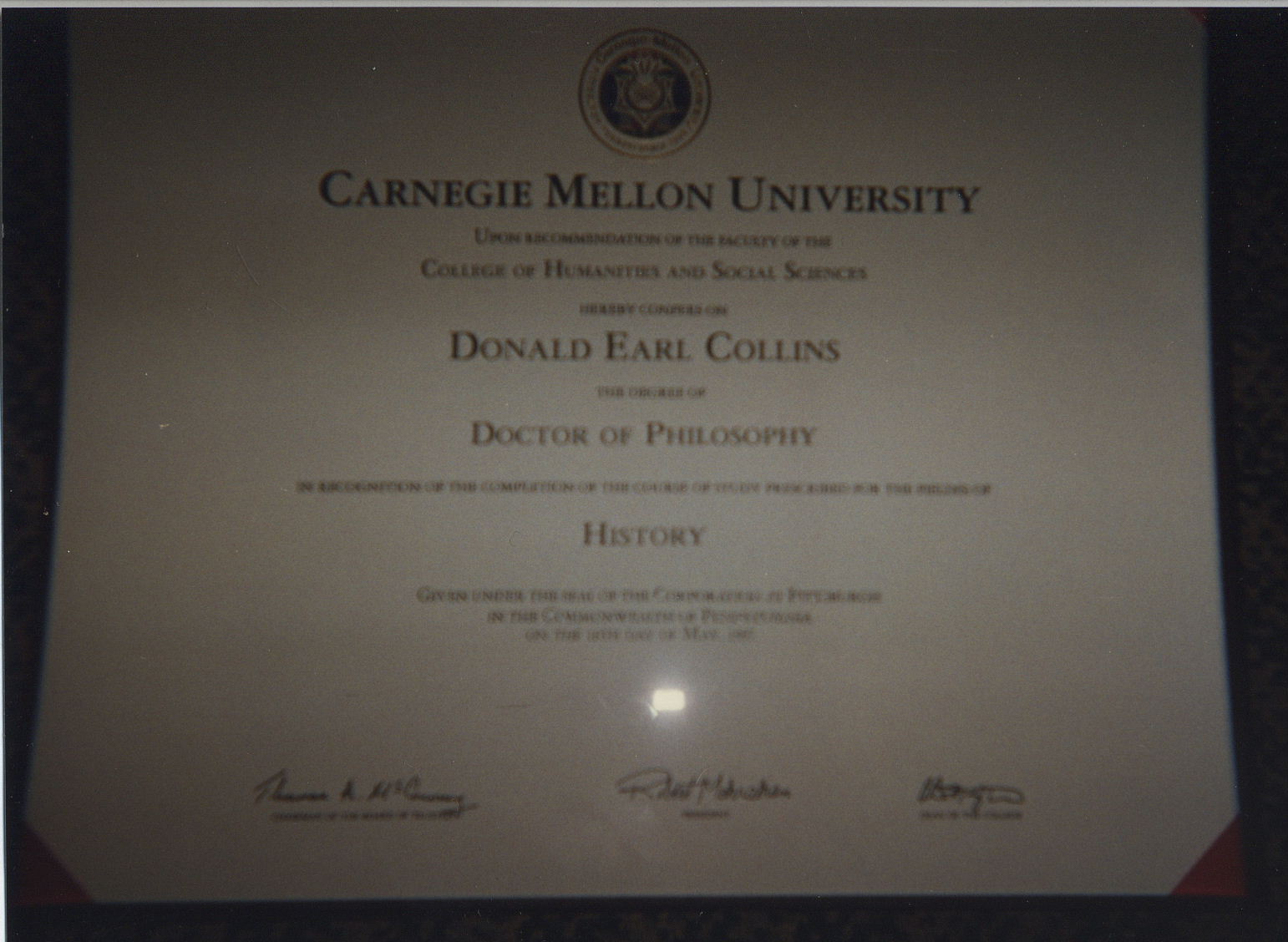
PhD Graduation - CMU Diploma, May 21, 1997. (Source/Donald Earl Collins)

Even now, thinking about what happened a decade and a half ago makes me clench my teeth, not with anger, but more with a sense of dread and latent rage. What I and at least two other male students went through (as I’d learn later on) was patently unfair. Still, I realize that while I’ve long since forgiven Trotter for his misdeeds, I can’t help but think that professionally, he aged me in my last year in graduate school. The sense of security I felt about my professional future back then was gone, and I don’t think I’ve felt that certain, that youthful, since.

I do know this. That that youthful, if somewhat naive, twenty-six year-old still resides in me. But with the mind of a forty-one year-old man, I can use both wisdom and experience to say that I wouldn’t go through that again. I’d either would’ve gone to law school or a school of education, maybe even with a focus on ed foundations and ed policy. As it is, between Boy @ The Window and my recent articles, that’s really what I’m most intellectually passionate about these days anyway.

I may be Dr. Collins or  Professor Collins, maybe for the rest of my life. But really, I’d be happiest as Donald Earl Collins, the author, educator and troublemaker I believe with all my heart I am and I will always be.

A Baseball Bat and a Father’s Absence

19 Tuesday Jul 2011

Posted by decollins1969 in 1, Boy @ The Window, Christianity, Cleaning, Eclectic, Jimme, My Father, New York City, race, Religion, Youth

≈ Leave a comment

Tags

616, 616 East Lincoln Avenue, Black Males, Dad, Darren, Father, Father Figures, Fatherhood, Hebrew-Israelites, Jimme, Louisville Slugger, Mount Vernon Daily Argus, Mount Vernon Hospital, Mount Vernon New York, Preteen, Religion. Male Authority Figures, Starling, Starling Churn, The Clearview School, Wolf-In-Sheep's Clothing


One Louisville Slugger, July 19, 2011. (Source/http://businessweek.com)

Today my father Jimme (his birth certificate name, as he actually goes by Jimmie) turns seventy-one. He’s in better health now than he was ten, twenty, and especially thirty years ago. That’s because this time in ’81, my father had apparently died for a few seconds on the operating table as doctors drilled into his brain to relieve pressure after a man did his best to dispatch him from this world. The incident, operation and time in the hospital meant that Jimme would be out of my life for almost fifteen months. It meant that I’d have a question to answer: what does a preteen boy do when his father is absent, and his best friend has shunned him? For that matter, what does a Black kid do under those circumstances?

But I’m jumping ahead of my story here. For over a week in July ’81, my father lingered in an ICU bed in Mount Vernon Hospital after he’d been reported dead in the Obituary section of the Mount Vernon Daily Argus. Jimme ended up in the hospital because he’d made fun of another, bigger drunk, calling him a “po’

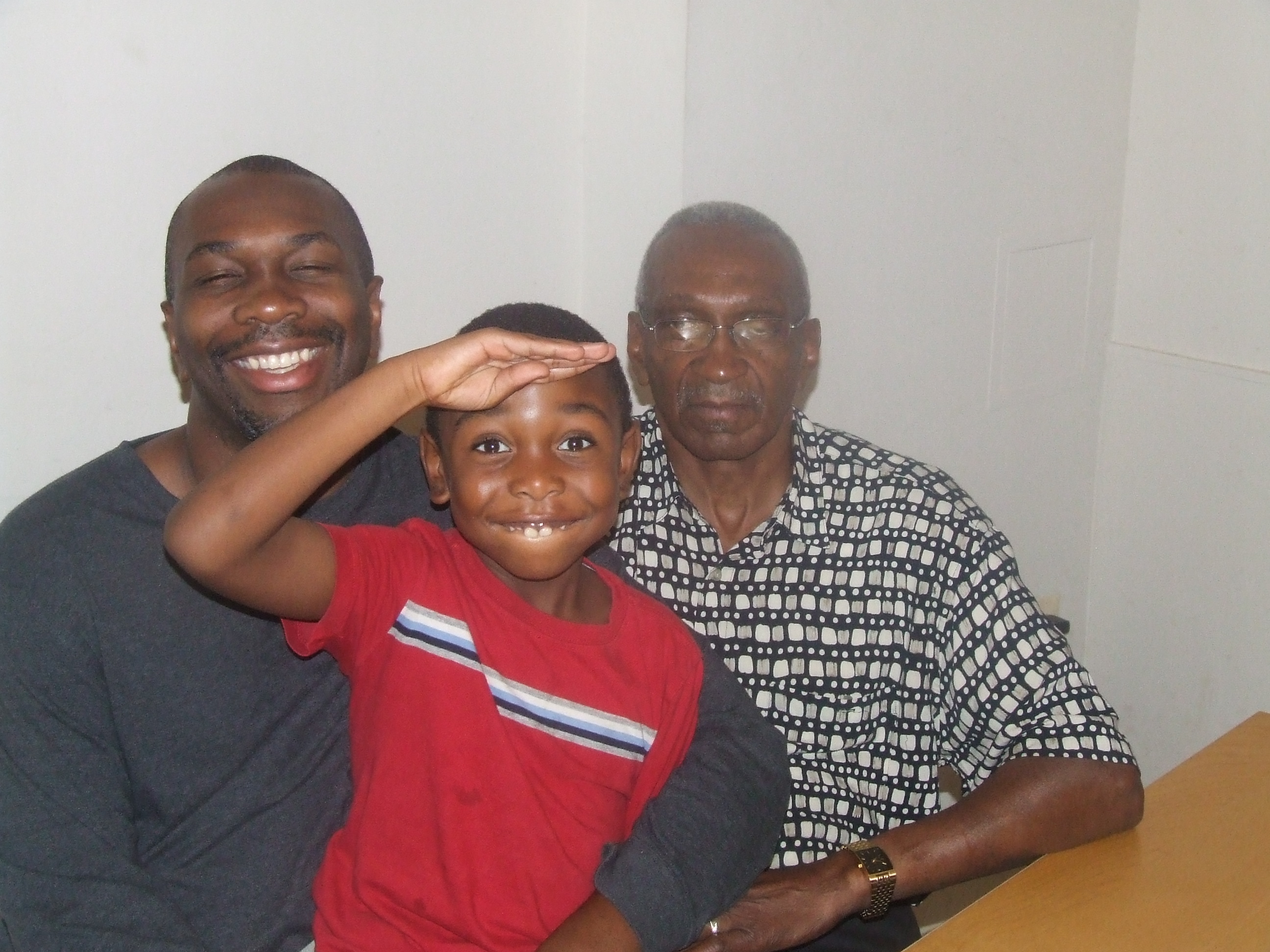
Grandpa, Me, and Noah, September 12, 2010. (Source/Donald Earl Collins)

ass muddafucca” at what we called “Wino Park” on South Fulton and East Third. So much was the humiliation that the man marched home, grabbed a Louisville Slugger, and returned to repeatedly smash my dad in the head until he was unconscious. Luckily, Jimme has a classic Collins head, hard enough to be used as a wrecking ball or 120 mm shell.

His near-death experience was not all that shocking for us, at least not obviously so. My father’s life in the New York City area had turned into a slow motion tragedy of errors long before I was old enough to witness one of his drinking binges and hangovers. And Jimme regularly went on alcohol-laced benders, ones that began on payday Friday and ended on Monday or Tuesday. As he liked to say, he “got to’ up” almost every weekend — “tore up” for those unfamiliar with Jimme-ese. This was going on for years before Mom had filed for divorce in July ’76.

Jimme also had a habit of saying, “O’ bo’, I can’t do dis no mo’. Gotta stop doin’ dis. Nex’ week, nex’ week. I’ll stop drinkin’ nex’ week.” All while shaking his head, his eyes down, ashamed of how he felt and looked once the binge had ended. Jimme never said “now” or “this week.” It was always next week with him. If there was any week where “nex’ week” should’ve been the week, it was that Friday in early July.

With that incident, the next time I’d see my father would be July ’82, being threatened by my stupid stepfather, who chased Jimme out of 616 for trying to see me. Dumb ass Maurice was in the middle of his five-week, abuse-and-break-Donald program, and didn’t want my real father interrupting his efforts to turn me into his prag. Witnessing that incident wasn’t a pleasant experience.

From July ’81 through August ’82, with Jimme absent and Starling no longer my friend, I really had no other Black males in my life with whom I could draw inspiration. My older brother Darren? He was already jealous of me and had withdrawn into the world of The Clear View School, acting out his role as a mentally retarded kid who wasn’t mentally retarded. My uncle Sam (my mother’s brother)? Really? I’ve seen him more in the past ten years, with me living in suburban DC, than I saw him through the ’80s and ’90s.

That left my idiot stepfather, who, at least in the summer of ’81, was there, and had gotten back together with

Wolf in sheep's clothing, a false prophet (a symbol of my ex-stepfather), November 2008. (Source/flickr.com)

my mother, and had converted us into Hebrew-Israelites. This must’ve been why I clung so hard and so long to my kufi identity, even when I knew that something was wrong. With this sudden change in religion, from lethargic and unacknowledged Baptists to Afrocentric Black Jews. With me treating my stepfather as if he really was a parent of mine. With me wanting to prove myself to others in ways I never felt I needed to before.

This wasn’t something I was conscious of, at least in ’81 or in the first half of ’82. I wish I had been. At least, then, I would’ve realized. That, more than anything else, I missed my dad and my best friend. And I was using my stepfather and his religion as a piss-poor substitute for both.

← Older posts
Newer posts →

Boy @ The Window: A Memoir

Boy @ The Window: A Memoir

Places to Buy/Download Boy @ The Window

There's a few ways in which you can read excerpts of, borrow and/or purchase and download Boy @ The Window. There's the trade paperback edition of Boy @ The Window, available for purchase via Amazon.com at http://www.amazon.com/Boy-Window-Donald-Earl-Collins/dp/0989256138/

There's also a Kindle edition on Amazon.com. The enhanced edition can be read only with Kindle Fire, an iPad or a full-color tablet. The links to the enhanced edition through Apple's iBookstore and the Barnes & Noble NOOK edition are below. The link to the Amazon Kindle version is also immediately below:

scr2555-proj697-a-kindle-logo-rgb-lg

Boy @ The Window on Amazon.com: http://www.amazon.com/Boy-The-Window-Memoir-ebook/dp/B00CD95FBU/

iBookstore-logo-300x100

Boy @ The Window on Apple's iBookstore: https://itunes.apple.com/us/book/boy-the-window/id643768275?ls=1

Barnes & Noble (bn.com) logo, June 26, 2013. (http://www.logotypes101.com).

Boy @ The Window on Barnes & Noble: http://www.barnesandnoble.com/w/boy-the-window-donald-earl-collins/1115182183?ean=2940016741567

You can also add, read and review Boy @ The Window on Goodreads.com. Just click on the button below:

Boy @ The Window

Twitter Updates

Tweets by decollins1969
  • RSS - Posts
  • RSS - Comments

Archives

  • June 2025
  • April 2023
  • September 2022
  • August 2022
  • July 2022
  • June 2022
  • May 2022
  • April 2022
  • March 2022
  • January 2022
  • December 2021
  • November 2021
  • October 2021
  • September 2021
  • August 2021
  • July 2021
  • June 2021
  • April 2021
  • March 2021
  • February 2021
  • January 2021
  • December 2020
  • November 2020
  • October 2020
  • September 2020
  • August 2020
  • July 2020
  • May 2020
  • April 2020
  • March 2020
  • January 2020
  • December 2019
  • November 2019
  • August 2019
  • July 2019
  • June 2019
  • May 2019
  • April 2019
  • March 2019
  • February 2019
  • January 2019
  • December 2018
  • November 2018
  • October 2018
  • September 2018
  • August 2018
  • July 2018
  • June 2018
  • May 2018
  • March 2018
  • February 2018
  • January 2018
  • December 2017
  • November 2017
  • October 2017
  • September 2017
  • August 2017
  • July 2017
  • June 2017
  • May 2017
  • April 2017
  • March 2017
  • February 2017
  • January 2017
  • December 2016
  • November 2016
  • October 2016
  • September 2016
  • August 2016
  • July 2016
  • June 2016
  • May 2016
  • April 2016
  • March 2016
  • February 2016
  • January 2016
  • December 2015
  • November 2015
  • October 2015
  • September 2015
  • August 2015
  • July 2015
  • June 2015
  • May 2015
  • April 2015
  • March 2015
  • February 2015
  • January 2015
  • December 2014
  • November 2014
  • October 2014
  • September 2014
  • August 2014
  • July 2014
  • June 2014
  • May 2014
  • April 2014
  • March 2014
  • February 2014
  • January 2014
  • December 2013
  • November 2013
  • October 2013
  • September 2013
  • August 2013
  • July 2013
  • June 2013
  • May 2013
  • April 2013
  • March 2013
  • February 2013
  • January 2013
  • December 2012
  • November 2012
  • October 2012
  • September 2012
  • August 2012
  • July 2012
  • June 2012
  • May 2012
  • April 2012
  • March 2012
  • February 2012
  • January 2012
  • December 2011
  • November 2011
  • October 2011
  • September 2011
  • August 2011
  • July 2011
  • June 2011
  • May 2011
  • April 2011
  • March 2011
  • February 2011
  • January 2011
  • December 2010
  • November 2010
  • October 2010
  • September 2010
  • August 2010
  • July 2010
  • June 2010
  • May 2010
  • April 2010
  • March 2010
  • February 2010
  • January 2010
  • December 2009
  • November 2009
  • October 2009
  • September 2009
  • August 2009
  • July 2009
  • June 2009
  • May 2009
  • April 2009
  • March 2009
  • February 2009
  • January 2009
  • December 2008
  • November 2008
  • October 2008
  • September 2008
  • August 2008
  • July 2008
  • June 2008
  • May 2008
  • April 2008
  • March 2008
  • February 2008
  • January 2008
  • December 2007
  • November 2007
  • October 2007
  • September 2007
  • August 2007
  • July 2007
  • June 2007

Recent Comments

MaryPena's avatarMaryPena on My Day of Atonement/Bitter Hat…
decollins1969's avatardecollins1969 on No Good Teaching Deed Goes…
Mary Rose O’Connell's avatarMary Rose O’Connell on No Good Teaching Deed Goes…

NetworkedBlogs on Facebook

NetworkedBlogs
Blog:
Notes From a Boy @ The Window
Topics:
My Life, Culture & Education, Politics & Goofyness
 
Follow my blog

616 616 East Lincoln Avenue A.B. Davis Middle School Abuse Academia Academy for Educational Development AED Afrocentricity American Narcissism Authenticity Bigotry Blackness Boy @ The Window Carnegie Mellon University Child Abuse Class of 1987 CMU Coping Strategies Crush #1 Crush #2 Death Disillusionment Diversity Domestic Violence Economic Inequality Education Family Friendship Friendships Graduate School Hebrew-Israelites High-Stakes Testing Higher Education History Homelessness Humanities Humanities Program Hypocrisy Internalized Racism Jealousy Joe Trotter Joe William Trotter Jr. K-12 Education Love Manhood Maurice Eugene Washington Maurice Washington Misogyny Mother-Son Relationship Mount Vernon High School Mount Vernon New York Mount Vernon public schools Multiculturalism MVHS Narcissism NFL Pitt Pittsburgh Politics of Education Poverty President Barack Obama Race Racial Stereotypes Racism Relationships Self-Awareness Self-Discovery Self-Reflection Sexism Social Justice Teaching and Learning University of Pittsburgh Violence Whiteness Writing

Top Rated

Blog at WordPress.com.

  • Subscribe Subscribed
    • Notes from a Boy @ The Window
    • Join 103 other subscribers
    • Already have a WordPress.com account? Log in now.
    • Notes from a Boy @ The Window
    • Subscribe Subscribed
    • Sign up
    • Log in
    • Report this content
    • View site in Reader
    • Manage subscriptions
    • Collapse this bar

Loading Comments...