
• About Me
  • Other Writings
  • Interview Clips
  • All About Me: American Racism, American Narcissism, and the Conversation America Can’t Have
  • Video Clips
  • Boy @ The Window Pictures
  • Boy @ The Window Theme Music

Notes from a Boy @ The Window

~

Notes from a Boy @ The Window

Category Archives: Upper East Side

There’s Know Place Like Home…

29 Friday Aug 2014

Posted by decollins1969 in 1, Academia, Boy @ The Window, Carnegie Mellon University, Cleaning, culture, Eclectic, High Rise Buildings, Jimme, Mount Vernon New York, My Father, New York City, Pop Culture, race, Upper East Side, Upper West Side, Work, Youth

≈ Leave a comment

Tags

241st Street Subway, East Side, Father-Son Relationships, Gramercy Park, Home, Levi Brothers, Manhattan, Metro-North, Sense of Direction, Street Knowledge, Subway, The Bronx, Wakefield, West Side


Dorothy's heel-clicking in screen shot from The Wizard of Oz (1939), August 29, 2014. (http://vivandlarry.com). Qualifies as fair use under US copyright laws - low resolution and relevance to subject matter.

Dorothy’s heel-clicking in screen shot from The Wizard of Oz (1939), August 29, 2014. (http://vivandlarry.com). Qualifies as fair use under US copyright laws – low resolution and relevance to subject matter.

Yes, the title’s a deliberate play on words. In no small part because of Facebook and Boy @ The Window, I am reminded every day of where I grew up, Mount Vernon, New York. But all too frequently, those who think they know me either assume that Mount Vernon’s so far from New York City that I seldom spent time there. Or, more recently, some have assumed that my experience of The Big Apple is a recent phenomenon, as if I only started spending time in the five boroughs when I hit my mid-thirties.

Neither is true, of course. In many ways, I’m as much of a child of The Bronx and Manhattan as I am of Mount Vernon. I spent countless hours catching the 2, 3, 5 and 6 trains between 241st, Dyre Avenue, 180th, Pelham Parkway, 149th, 110th, 125th, 72nd, 86th and so many other stops. I used to know where to get the best brownies in the area, in Wakefield, at a bakery near some taxi stands and between the 238th and 241st Street stops. I could tell you which bars my father Jimme frequented, which bars he didn’t, what pizza shops had slices to die for, and what places to avoid near Times Square. I’d been to Mets games, Ice Capades, the Bronx Zoo, a Puerto Rican Day and a Pulaski Day parade, concerts at Van Cortlandt Park, even MOMA before I graduated high school.

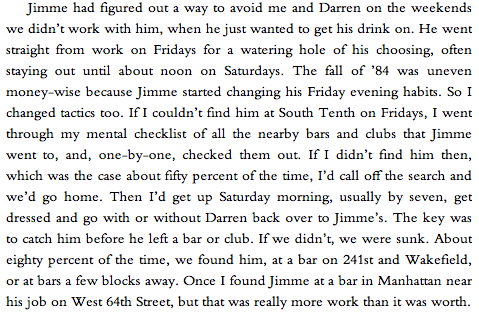
One of the reasons I could do all of this by the time I was fifteen was because of all the times Jimme had taken me and Darren down to the Bronx and Manhattan. Mostly to watch him pick up his paycheck from the Levi brothers at their cleaners on 20 West 64th or on East 59th. But between ’82 and ’85, I learned where nearly all of my father’s watering holes were, and on the most desperate of weekends, could track him to one of them in order to get money for myself and to help out my Mom at 616. While my classmates would occasionally take the Metro-North into the city to take in a Broadway play or go to a Knicks game, I was learning about the city in all of its varying inequalities and nuances by looking for and working for my father.
Screen shot 2014-08-29 at 6.28.50 AM

Fast-forward to the end of August ’93, just a few days before I began the Carnegie Mellon University phase of my grad school and doctoral journey. I had been short on money that whole summer, unemployed for six weeks after transferring from Pitt, working as an “intern” for six dollars and hour, and nearly $600 behind on rent at one point in late June. I’d survived the eviction notice and a summer in which I learned who my truest, closest friends were. I took a few days from my personal drama to visit my Mom and my siblings at 616, and in the process, decided to track down my father for a few extra dollars, as well as to see him for the first time in over a year. It had been that long because Jimme had accused me of faking my master’s degree when I lasted visited him.

Central Park, looking out toward Midtown's West Side, New York, NY, August 5, 2014. (Donald Earl Collins).

Central Park, looking out toward Midtown’s West Side, New York, NY, August 5, 2014. (Donald Earl Collins).

But I wasn’t fifteen anymore. Instead of a long walk and the Subway, I took the Metro-North down from Pelham to Grand Central, took the S (Shuttle) over to Times Square, and the 1 train to 66th, and walked over to the Levi’s cleaners on West 64th. Only to find out Jimme wasn’t in that day. I then remembered that the other Levi brother had a dry cleaner on East 59th. I walked the ten blocks over there and found the other Levi brother in the midst of arguing with clients and barking orders to his Latino and Afro-Caribbean underlings. My father was doing a cleaning job for him at some high-rises down near Gramercy Park.

I rode the 4 train down to 23rd Street, got my east-west bearings, and walked toward a set of high-rises near FDR Drive. Though I’d forgotten the address, I knew somehow that Jimme would be in the most expensive-looking high-rise or set of high-rises in the bunch. I found a guard, who sent me to the floor where Jimme and his co-worker John were working.

As soon as Jimme saw me come off the elevator, he said, “Bo’ watcha doin’ up here? How the hell yo’ find me?”

“You’re not the only one who knows The City, you know” I said.

It’s no wonder I feel a bit insulted when people either tell me I’m from upstate New York or that I’m not a New Yorker. I know the city better than at least a third of the people who live and work there every day.

My and Diane Ravitch’s Path to Reign of Error

11 Tuesday Mar 2014

Posted by decollins1969 in 1, Academia, Boy @ The Window, Carnegie Mellon University, culture, Eclectic, Mount Vernon High School, Mount Vernon New York, New York City, Patriotism, Pittsburgh, Politics, Pop Culture, race, Upper East Side, Youth

≈ Leave a comment

Tags

Bill & Melinda Gates Foundation, Book Review, Corporate Education Reform, Diane Ravitch, Fear of a "Black" America (2004), High-Stakes Testing, Humanities Program, Institutional Racism, Michelle Rhee, Multiculturalism, Neoconservative Movement, Politics of Education, Poverty, Privatization, Racial Segregation, Racism, Reign of Error (2013), Social Injustice, Social Justice, Teach for America, Writing Passion


Reign of Error (2013) by Diane Ravitch, front cover. (http://bn.com).

Reign of Error (2013) by Diane Ravitch, front cover. (http://bn.com).

I first began reading Diane Ravitch in July 1990, the summer before my senior year at the University of Pittsburgh. It was the summer in which I became interested in understanding magnet programs and their relationship with desegregation and diversity efforts, courtesy of my own experience with Mount Vernon, New York public schools and its now defunct Humanities Program. I read both The Great School Wars: New York City, 1805-1973 (1974) and The Troubled Crusade: American Education, 1945-1980 (1985) that summer, with education scholar and Ford Foundation director Jeanne Oakes’ Keeping Track: How Schools Structure Inequality (1985) sandwiched in between.

It was the beginning of a twenty-year period of constantly intellectual disagreement between me and Ravitch. Oakes’ work captured inequality in terms of race and socioeconomics so much better than Ravitch, whose writings back then often treated these inequalities and distinctions as afterthoughts. When I shifted my research area to multicultural education and multiculturalism, though, that was when I found Ravitch’s absolutist defense of so-called traditional American democratic education and all things e pluribus unum unbelievably stifling. With all Ravitch knew about the politics of education, in New York and with the US Department of Education, how could she possibly defend a system that did as much to control and exclude students as it did to provide something akin to an equal opportunity?

I chalked Ravitch up to being another out-of-touch neoconservative, scared to death of race and diversity and multiculturalism. I said as much at conferences like the American Educational Research Association meeting and other conferences. I wrote as much in my dissertation and in my first book, Fear of a “Black” America: Multiculturalism and the African American Experience (2004). Through it all, I always found Ravitch’s writing compelling, but her conclusions wanting, because they lacked perspective and empathy in the context of public schools and diversity.

Then, Ravitch wrote Left Back: A Century of Battles Over School Reform in 2000. Though it contained some of her common themes — overemphasis on the mantra of reform, the need for more testing, support for school choice, denigration of a multicultural curriculum — Ravitch showed growth in this book. She was less hostile to a more progressive curriculum and seemed, for the first time, really, to understand how much race and poverty had shaped the direction and the harshness of school reform going back to 1900. I happily used Ravitch’s Left Back in my History of American Education Reform course at George Washington in 2002. For her book provided a comprehensive and even-handed overview of the politics of K-12 education in a way that any educator of any American ideological perspective could understand.

I’ve finally read Ravitch’s Reign of Error: The Hoax of the Privatization Movement and the Danger to America’s Public Schools (2013). Reign of Error is Ravitch at her most passionate and energized. If I hadn’t read a couple dozen of Ravitch’s articles from the 1980s and 1990s and four of her previous books, I would think that this was her first book, as there is sense of urgency in Reign of Error that can seldom be found outside of epic memoirs and epic fiction novels.

Ravitch’s argument in Reign of Error is a simple one. Corporate education reform, if allowed to continue unfettered, will destroy public education in the US, and in the process, American democracy. Privatizing public schools (i.e., turning them into “public” charter schools), destroying teacher’s unions, constant high-stakes testing, bypassing school boards and forgetting about racial segregation and poverty — that’s corporate education reform’s agenda. As Ravitch said in Chapter 12 on the fallacies of merit pay for teachers, “Merit pay is the idea that never works and never dies (p. 119).” She could have also substituted the words “school choice,” “creationism,” “standardized testing,” “closing schools,” and “privatization” for “merit pay.”

But Ravitch goes further in her 400-page treatise. That though public education in the US has had its share of problems — the need for more teacher training and time for professional development, racial segregation and high levels of poverty while underfunded — that corporate education reform has compounded these problems several times over. That with corporate education reform, teachers, parents and students will have no say in public education, at least the ones without their own personal foundation with which to endow their own public charter school.

From a writer’s standpoint, this wasn’t Ravitch’s best effort. Her argument is repetitive, one where she likely could’ve cut the main chapters by a quarter (about 100 pages) and made the same points. I likely could’ve become inebriated if I had a shot of vodka every time the words “poverty,” “Gates,” “Walton,” “Broad,” “high-stakes testing,” and “corporate education reform” come up. But given my history with reading Ravitch and with this topic, of course Reign of Error was repetitive — it was like reading my own words on this same topic.

Ultimately, Ravitch’s Reign of Error is a primer for anyone interested in averting the social injustice that is the corporate education reform tyranny of wealthy philanthropists, money-grubbing entrepreneurs and politicians across America’s limited ideological spectrum. For those whom up to now this issue has been of limited interest, or for those who’ve felt the change in public education but haven’t quite been able to articulate those feelings, Reign of Error is for you.

For educators, parents and even students already involved in writing about or protesting against corporate education reform, this book is still for you. Ravitch provides so much ammunition that Reign of Error can be applied in numerous ways to numerous situations. At school board meetings. With #AskMichelleRhee hash tags on Twitter. In job interviews with Teach for America and with the Bill & Melinda Gates Foundation. In letters to the editor of the mainstream newspapers and in comments to mainstream TV and radio newscasters. In arguments with neoconservative parents who send their kids to private schools.

“Protecting our public schools against privatization and saving them for generations of American children is the civil rights issue of our time (p. 325).” is how Ravitch ended her Reign of Error. It’s not an exaggeration. But it does beg a question. If we can successfully fend off corporate education reform — and assume that the country will continue to ignore the poverty and racial segregation that Ravitch desperately wants addressed — can she and I then spend five minutes discussing multiculturalism?

Boy @ The Window, Now in Paperback

20 Wednesday Nov 2013

Posted by decollins1969 in 1, Boy @ The Window, Christianity, Eclectic, eclectic music, Hebrew-Israelite, High Rise Buildings, Jimme, Marriage, Mount Vernon High School, Mount Vernon New York, music, My Father, New York City, Pittsburgh, Politics, Pop Culture, race, Religion, Sports, University of Pittsburgh, Upper East Side, Upper West Side, Youth

≈ 2 Comments


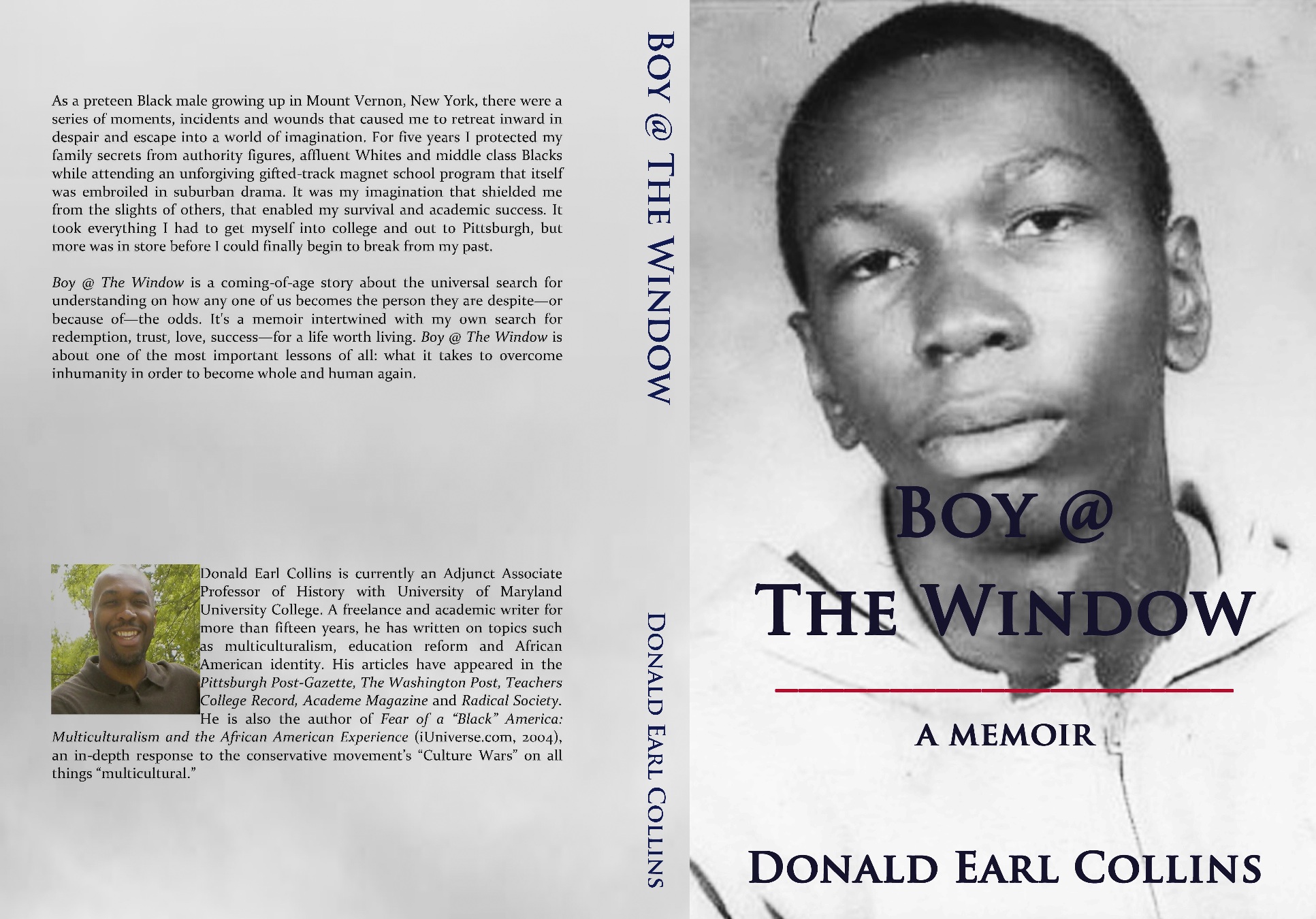
Boy @ The Window, front and back cover, and side, November 11, 2013. (Donald Earl Collins).

Boy @ The Window, front/back cover, and side, November 11, 2013. (Donald Earl Collins).

I have some really good news. My book Boy @ The Window is not just an e-book anymore. I now have a trade paperback edition, out and available through Amazon.com as of yesterday (via http://www.amazon.com/Boy-Window-Donald-Earl-Collins/dp/0989256138/). You can also order and buy Boy @ The Window the old-fashioned way — directly through your local bookstore.

Please take a look, support, buy, read, comment and share. I will post as reviews and opportunities to talk about the book arise. Thanks to all of you who’ve supported my blog and the path to Boy @ The Window over the past six years!

The Third Armpit of Hell

27 Friday Jul 2012

Posted by decollins1969 in 1, Boy @ The Window, culture, Eclectic, High Rise Buildings, Marriage, Mount Vernon New York, My Father, New York City, Politics, Pop Culture, race, Upper East Side, Upper West Side, Work, Youth

≈ 1 Comment

Tags

Coming-of-Age, Dante's Inferno, Economic Inequality, Growing Up, Home, Metro-North, Neighborhoods, New York, New York City, NYC, Poverty, Race, Self-Discovery, Subway Trains, The City


Illustration of Dante’s Inferno, Map of Lower Hell, 16th century. (Giovanni Stradano via Wikipedia). In public domain.

During most of my Pittsburgh years, whenever someone I knew asked me what it was like to live in the New York City area, I often said two things. One, that “New York was a great place to live if you have money.” But, “if you don’t have money, New York could be like the third armpit of hell.”

I didn’t even bother to discuss Mount Vernon until I was well into graduate school. Too unknown, too complicated to explain its proximity to the Bronx and to midtown Manhattan. And from the average Pittsburgher’s perspective, it was a distinction without a difference. As far as some were concerned, Mount Vernon could’ve just as easily been outside of Buffalo as it could’ve been in the heart of Harlem.

But I definitely knew better, that my relationship with Mount Vernon and “The City” was a love-hate one, born from my growing-up experiences during the Reagan years. The lens with which I viewed the New York City area, a trifocal one of race, poverty and “outsider” status, made me ambivalent about my times growing up in Mount Vernon and all of my times in New York.

2 NYC subway train with graffiti (cropped), 1980s, December 20, 2009. (Cope2 via http://www.doobybrain.com/). Qualifies as fair use – low resolution picture.

I have my father Jimme to thank, though. Without him, I would still be afraid of New York, not just ambivalent about it. Drunk or not, working or on his way to a hole-in-the-wall bar. Jimme would take me and my older brother Darren out and down to the city often enough, to ride the Subway, to hang out with him in Harlem, Spanish Harlem, and especially Midtown. Whether it was to help him with his janitorial work on weekends, or just to hang out, we frequented Manhattan and other parts of the five boroughs off and on between ’80 and ’85, ’82 — the year of abuse — excepted.

Because of that year, the longest time I spent outside of the city growing up was between April ’81 and July ’83. After not making it down to Manhattan in all of ’82, we went to Midtown in July, where we learned about two of my father’s watering holes between 43rd and 47th. They were both near Mickey Mantle’s restaurant on 47th. He also had an Irish pub he’d like to go to around East 59th and Third, a drinking bar near his job on 64th and Columbus, and a couple of places near Macy’s on 34th Street. Because of our height and the times, when it was still legal for eighteen-year-olds to drink in public watering holes, me and Darren were allowed into these fine establishments. I learned a lot about vermouth, vodka, Cosmos and Long Island Iced Tea that summer.

Grand Central Terminal Main Concourse in New York City, March 4, 2006. (Janke and Diliff via Wikipedia). Permission granted via cc-Attribution-Share Alike 3.0 license.

I also learned a lot about the not-so-nice side of New York in those years. I recognized this as I’d board the Uptown 2 Subway from West 42nd Street and 7th Avenue in Manhattan at the tail end of rush hour. As I’d board the train, I’d notice the crunch of humanity in all of its oblivion, self-absorption, and diversity. As the doors close, I’d watch as the express train passed 50th, 59th, and 66th Street before it would grind to a halt at 72nd Street. I’d notice that a fair number of the White passengers alighted here. Between 96th and 125th Street, the load of the train would gradually lighten as about half of the passengers who’d crushed me between a tall, stale-breathed smoker and a woman who wasn’t my girlfriend were now at street level.

About three-quarters of the passengers for the rest of my trip would be Latino and Afro-Caribbean. After another hour of endless stops in the Bronx, the 2 would pull me out of my slumber as it would slowly roll into the rickety East 241st stop.

By the time I was a rising senior at Pitt, I certainly didn’t need my father to accompany on my trips into Manhattan. I also avoided the long trek from 616 across Mount Vernon to 241st to take the 2 whenever I could afford to. Metro-North was a luxurious godsend compared to the puddles of piss and infinite amounts of graffiti on the Subway I’d seen throughout the ’80s.

Toph’s “Hairy Pits” from Avatar: The Last Airbender (screenshot), July 26, 2012. (Donald Earl Collins). Qualifies as fair use — low resolution picture.

But it introduced me to other odious issues. Like Grand Central Station, which by the summer of ’90 was in desperate need of renovation. Especially the restrooms, festooned with enough garbage, feces and bodily odors and fluids to make a coroner vomit.

Off a return trip from Pittsburgh that summer, I made the mistake of having no choice but to use the almost  unusable facilities there, which in the end I couldn’t use. Meanwhile, I observed homeless males hanging out in the restroom with carts, along with an individual who looked to have Kaposi’s sarcoma, an obvious sign of full-blown AIDS.

That’s when I coined New York to be “the third armpit of hell,” the place where poverty had meant your dreams were dead on arrival. For once, it made me content that I was from a place where many smug New Yorkers disdainly considered “upstate.” Though the New York City area has changed — and mostly for the better — since ’90, it’s still a place where economic inequality can easily grind the life out of people.

Newer posts →

Boy @ The Window: A Memoir

Boy @ The Window: A Memoir

Places to Buy/Download Boy @ The Window

There's a few ways in which you can read excerpts of, borrow and/or purchase and download Boy @ The Window. There's the trade paperback edition of Boy @ The Window, available for purchase via Amazon.com at http://www.amazon.com/Boy-Window-Donald-Earl-Collins/dp/0989256138/

There's also a Kindle edition on Amazon.com. The enhanced edition can be read only with Kindle Fire, an iPad or a full-color tablet. The links to the enhanced edition through Apple's iBookstore and the Barnes & Noble NOOK edition are below. The link to the Amazon Kindle version is also immediately below:

scr2555-proj697-a-kindle-logo-rgb-lg

Boy @ The Window on Amazon.com: http://www.amazon.com/Boy-The-Window-Memoir-ebook/dp/B00CD95FBU/

iBookstore-logo-300x100

Boy @ The Window on Apple's iBookstore: https://itunes.apple.com/us/book/boy-the-window/id643768275?ls=1

Barnes & Noble (bn.com) logo, June 26, 2013. (http://www.logotypes101.com).

Boy @ The Window on Barnes & Noble: http://www.barnesandnoble.com/w/boy-the-window-donald-earl-collins/1115182183?ean=2940016741567

You can also add, read and review Boy @ The Window on Goodreads.com. Just click on the button below:

Boy @ The Window

Twitter Updates

Tweets by decollins1969
  • RSS - Posts
  • RSS - Comments

Archives

  • June 2025
  • April 2023
  • September 2022
  • August 2022
  • July 2022
  • June 2022
  • May 2022
  • April 2022
  • March 2022
  • January 2022
  • December 2021
  • November 2021
  • October 2021
  • September 2021
  • August 2021
  • July 2021
  • June 2021
  • April 2021
  • March 2021
  • February 2021
  • January 2021
  • December 2020
  • November 2020
  • October 2020
  • September 2020
  • August 2020
  • July 2020
  • May 2020
  • April 2020
  • March 2020
  • January 2020
  • December 2019
  • November 2019
  • August 2019
  • July 2019
  • June 2019
  • May 2019
  • April 2019
  • March 2019
  • February 2019
  • January 2019
  • December 2018
  • November 2018
  • October 2018
  • September 2018
  • August 2018
  • July 2018
  • June 2018
  • May 2018
  • March 2018
  • February 2018
  • January 2018
  • December 2017
  • November 2017
  • October 2017
  • September 2017
  • August 2017
  • July 2017
  • June 2017
  • May 2017
  • April 2017
  • March 2017
  • February 2017
  • January 2017
  • December 2016
  • November 2016
  • October 2016
  • September 2016
  • August 2016
  • July 2016
  • June 2016
  • May 2016
  • April 2016
  • March 2016
  • February 2016
  • January 2016
  • December 2015
  • November 2015
  • October 2015
  • September 2015
  • August 2015
  • July 2015
  • June 2015
  • May 2015
  • April 2015
  • March 2015
  • February 2015
  • January 2015
  • December 2014
  • November 2014
  • October 2014
  • September 2014
  • August 2014
  • July 2014
  • June 2014
  • May 2014
  • April 2014
  • March 2014
  • February 2014
  • January 2014
  • December 2013
  • November 2013
  • October 2013
  • September 2013
  • August 2013
  • July 2013
  • June 2013
  • May 2013
  • April 2013
  • March 2013
  • February 2013
  • January 2013
  • December 2012
  • November 2012
  • October 2012
  • September 2012
  • August 2012
  • July 2012
  • June 2012
  • May 2012
  • April 2012
  • March 2012
  • February 2012
  • January 2012
  • December 2011
  • November 2011
  • October 2011
  • September 2011
  • August 2011
  • July 2011
  • June 2011
  • May 2011
  • April 2011
  • March 2011
  • February 2011
  • January 2011
  • December 2010
  • November 2010
  • October 2010
  • September 2010
  • August 2010
  • July 2010
  • June 2010
  • May 2010
  • April 2010
  • March 2010
  • February 2010
  • January 2010
  • December 2009
  • November 2009
  • October 2009
  • September 2009
  • August 2009
  • July 2009
  • June 2009
  • May 2009
  • April 2009
  • March 2009
  • February 2009
  • January 2009
  • December 2008
  • November 2008
  • October 2008
  • September 2008
  • August 2008
  • July 2008
  • June 2008
  • May 2008
  • April 2008
  • March 2008
  • February 2008
  • January 2008
  • December 2007
  • November 2007
  • October 2007
  • September 2007
  • August 2007
  • July 2007
  • June 2007

Recent Comments

MaryPena's avatarMaryPena on My Day of Atonement/Bitter Hat…
decollins1969's avatardecollins1969 on No Good Teaching Deed Goes…
Mary Rose O’Connell's avatarMary Rose O’Connell on No Good Teaching Deed Goes…

NetworkedBlogs on Facebook

NetworkedBlogs
Blog:
Notes From a Boy @ The Window
Topics:
My Life, Culture & Education, Politics & Goofyness
 
Follow my blog

616 616 East Lincoln Avenue A.B. Davis Middle School Abuse Academia Academy for Educational Development AED Afrocentricity American Narcissism Authenticity Bigotry Blackness Boy @ The Window Carnegie Mellon University Child Abuse Class of 1987 CMU Coping Strategies Crush #1 Crush #2 Death Disillusionment Diversity Domestic Violence Economic Inequality Education Family Friendship Friendships Graduate School Hebrew-Israelites High-Stakes Testing Higher Education History Homelessness Humanities Humanities Program Hypocrisy Internalized Racism Jealousy Joe Trotter Joe William Trotter Jr. K-12 Education Love Manhood Maurice Eugene Washington Maurice Washington Misogyny Mother-Son Relationship Mount Vernon High School Mount Vernon New York Mount Vernon public schools Multiculturalism MVHS Narcissism NFL Pitt Pittsburgh Politics of Education Poverty President Barack Obama Race Racial Stereotypes Racism Relationships Self-Awareness Self-Discovery Self-Reflection Sexism Social Justice Teaching and Learning University of Pittsburgh Violence Whiteness Writing

Top Rated

Blog at WordPress.com.

  • Subscribe Subscribed
    • Notes from a Boy @ The Window
    • Join 103 other subscribers
    • Already have a WordPress.com account? Log in now.
    • Notes from a Boy @ The Window
    • Subscribe Subscribed
    • Sign up
    • Log in
    • Report this content
    • View site in Reader
    • Manage subscriptions
    • Collapse this bar
 

Loading Comments...