• About Me
  • Other Writings
  • Interview Clips
  • All About Me: American Racism, American Narcissism, and the Conversation America Can’t Have
  • Video Clips
  • Boy @ The Window Pictures
  • Boy @ The Window Theme Music

Notes from a Boy @ The Window

~

Notes from a Boy @ The Window

Category Archives: Religion

Down The Rabbit Hole

03 Tuesday Jan 2012

Posted by decollins1969 in 1, culture, Eclectic, Politics, Pop Culture, race, Religion, Work

≈ 1 Comment

Tags

1984, Alice in Wonderland, Down The Rabbit Hole, Election 2012, Entitlements, George Orwell, GOP, Iowa Caucuses, Race, Race-Baiting, Racism, Rick Santorum, TPers, Van Halen, Welfare


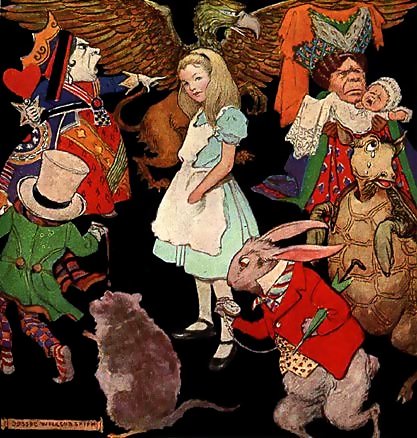
Alice In Wonderland, surrounded by the characters of Wonderland, illustration, by Jessie Wilcox Smith, 1923. In public domain.

Once again, it’s time for the leap year silly season, between the presidential election cycle and the Summer Olympics. Only with a twist. Between the reactionary GOP/TPers, the state of the world in general and over-hyped Mayan predictions, 2012 promises to be a year full of surprises, for better and for worse. Only, as far as I can read a calendar, this year runs on the same day and date lines as 1984. Minus George Orwell’s post-apocalyptic impressions or Van Halen’s first big album (That reminds me — I should download “Panama” from iTunes).

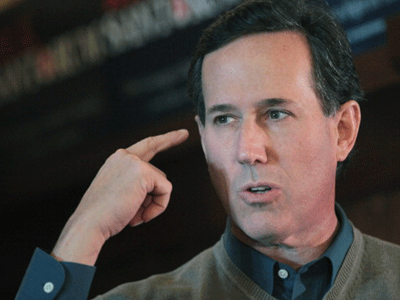
Former U.S. Sen. Rick Santorum (R-PA) speaks about entitlements during a campaign rally at the Hotel Pattee, Perry, Iowa, January 2, 2012. (Scott Olson/Getty Images).

What has been predictable so far includes Rick “Sanitarium” Santorum’s race-baiting via entitlements, calling on Blacks to not take “other people’s money” yesterday on the eve of the Iowa caucuses. What a dumb, racist ass! Especially since the overwhelming number of Americans on welfare are White. Especially because most poor Blacks still feel the lingering effects of a society built on racial preferences that denied them and previous generations the wealth that helped make America the richest country in the history of the world. Especially since Santorum has tried these tactics before, in Pennsylvania, where he showed how crazy he was six and eighteen years ago (Please Pitt, stop using him in your promotional ads!)

Yes, America’s all Alice in Wonderland again, sliding down the rabbit hole into an election cycle that’s more about style than substance, where the spin cycle’s constantly on and character is only defined in the most sanctimonious of terms. Between San”scrotum,” Ron Paul, Mitt Romney, Newt Gingrich, Michelle Bachmann, and Jon Huntsman and their idiotic campaigns, I’d take an ancient Roman approach. Cut each of them on their right butt cheeks, throw them all in a bag with a wild leopard, and drop them in a river full of hippos. Whoever survives should then get to run against President Obama. That would be fairer than the system we have now.

Reinventing the Writing Wheel

17 Saturday Dec 2011

Posted by decollins1969 in 1, Academia, Boy @ The Window, culture, Eclectic, eclectic music, Hebrew-Israelite, music, Pop Culture, race, Religion, Youth

≈ Leave a comment

Tags

"Children's Crusade", 616, 616 East Lincoln Avenue, Coping Strategies, Historian, Mount Vernon New York, Paul Riggs, Pitt, Re-Discovery, Reinventing the Wheel, Scholar, Self-Discovery, Sting, The Dream of the Blue Turtles, University of Pittsburgh, Western Civilization II, World War I, Writer, Writing


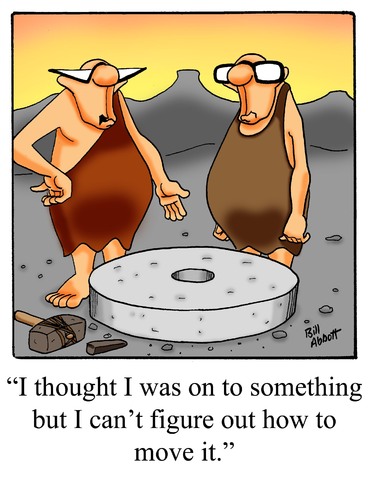
Inventing the Wheel cartoon, October 2, 2009. (Bill Abbott/http://www.toonpool.com/).

One of the side effects of having lived through the hell of my family struggles at 616 in Mount Vernon, New York between ’81 and ’89 was that I’d forgotten about the person I was before we became Hebrew-Israelites. As great as I am at recalling faces, smells, conversations, exact facts and phrases based on images and songs, I’ve been almost equally as good at blocking out whole sections of my personality. All in an effort to cope with the emotional pain and psychological trauma that is betrayal, abuse and neglect.

I have the unfortunate distinction of having seen myself as a writer in ’81 at the age of eleven, only to take nearly twenty years to see myself that way again. There were a few sign posts in the dark forest of confusion about my calling that I found on my way to getting back on the writing road. One of those sign posts was my teaching assistant and friend during my undergraduate years at the University of Pittsburgh in Paul Riggs.

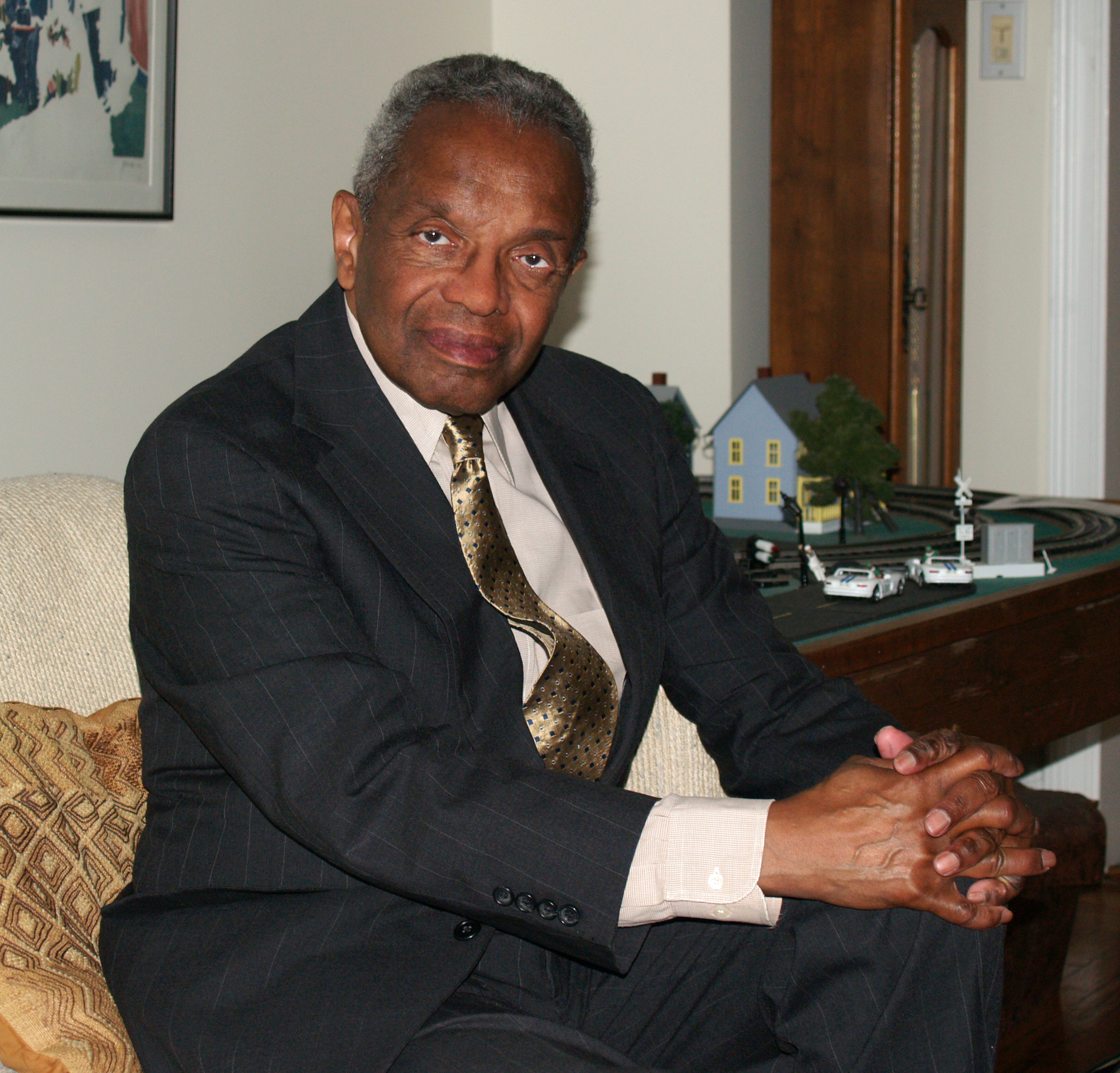
Paul Riggs, Professor and Department Chair, Department of History, Valdosta State University (GA), December 17, 2011. (http://www.valdosta.edu).

Paul was the TA for my section of the Western Civilization II course taught by his advisor in Sy Drescher in the Spring semester of ’88. He was a second-year history grad student, a nice looking White guy for a nerd. Already in his mid-twenties with, his blonde-brown hair and around six-feet, Paul was a rarity on campus. So was his class. Paul found a way to do more than ask us a bunch of questions that were meant to quiz us on the textbook. We debated the significance of things like a richer diet and its impact on population growth and the expansion of European imperialism, the connections between Charles Darwin, evolution, and the advent of scientific racism at the end of the nineteenth century, and so many other things that allowed us to connect the dots.

Paul was also the first teacher I had at Pitt who assumed that I could do the work without acting as if I shouldn’t have been in their classroom. It helped that he occasionally indulged me. When our weekly discussion turned to the killing fields that had been northern France and Belgium for the bulk of the four years of World War I, I allowed my imagination to get the better of me. I made a comment that connected the tragedy of deadly trench warfare to a song by Sting called “Children’s Crusade.” I started quoting lyrics, like “virgins with rifles, a game of charade,” “the flower of England, faced down in the mud, and stained in the blood of a whole generation,” and “corpulent generals safe behind lines.”

I related it all to the documents book and Drescher’s lectures on the war that wiped out a generation of

Sting, The Dream of the Blue Turtle CD Cover (1985), December 17, 2011. (Donald Earl Collins).

young men in Western Europe. It took me two minutes of class time to draw all of the different connections. Paul, shaking his head at the end, got this incredulous smile on his face. All he said was, “um, you know Sting’s overrated?”

But Paul proved to be much more helpful a year and a half later. By then I was in my junior year at Pitt, no longer living in constant worry that I’d have to return to 616 to bury my mother and press charges against my idiot stepfather. By then, Maurice was my ex-stepfather, and thankfully so. For the first time in eight years, I kept a journal, putting together a series of stories based on my worst experiences at 616, on welfare, with my family, and in Mount Vernon.

All of it made me think about writing a book that looked at the sociological and psychological dimensions of the welfare system, for both recipients and for case managers charged with providing benefits. I wanted to make Westchester County Department of Social Services the centerpiece for such a book. I decided to talk to Paul about all of my ideas, not wanting to give away how personal this issue was for me. Paul asked me the questions that it would take another eleven years to answer. “What kind of writer do you want to be?,” and “How is history related to what you want to write about?,” he asked over the course of our conversation.

I really didn’t know the answers to either question. I wasn’t even sure that I wanted to pursue an advanced degree, become a professor, or become a writer. But I knew that I needed to find out.

Still, one thing that I decided to do that would determine most of my career travels over the next decade is to make myself into the semi-dispassionate scholar I knew I needed to become in order to be a better historian, which I presumed would make me a better writer. Only to spend this past decade reconnecting to my emotions and passion, which has made me the writer I once hoped to become.

The Last Mugging

06 Tuesday Dec 2011

Posted by decollins1969 in 1, Boy @ The Window, culture, Hebrew-Israelite, Jimme, Marriage, Mount Vernon New York, Politics, race, Religion, Youth

≈ 1 Comment

Tags

616, 616 East Lincoln Avenue, Acts of Kindness, Arthur Treatcher's Fish & Chips, Disillusionment, Mount Vernon High School, Mount Vernon New York, Mugging, Self-Defense, Self-Discovery, Suicide, Waldbaum's, Welfare


East Prospect, Mount Vernon, New York, where Foodtown (once Waldbaum’s) and Rite Aid (formerly Genovese) are today – about 30m from where I was mugged in ’83. (http://maps.google.com).

Twenty-eight years ago yesterday was the last time I was mugged, the last time I had to fend off wannabe thugs. As important as the challenges I face in my life are now, the ones I faced just before my fourteenth birthday were a thousand times more intense, if for no other reason than I nearly took the path of suicide back then.

For whatever the reason, December ’83 was spent without food at 616, this time in the welfare and food stamps era. My mother hadn’t received her welfare check on time. She went to Maurice for money to buy groceries, a necessarily rare move. I’d rather had gone to A (see “The Legend of ‘Captain Zimbabwe‘” post from May ’09) for grocery money than to my stepfather. He came to me and gave me twenty dollars to go to the store.

“Donald, do not lose this money. I don’t want no excuses. I want all my change back. If you have to, catch the bus,” Maurice said to me. I had already missed the last 7 bus going into Mount Vernon, and I knew that by the time I’d finish shopping that I would miss the last 7 for the return.

After shopping for Great Northern beans and rice and some beef neck bones and spinach at the Waldbaum’s on East Prospect — which cost $6.50 by the way —  I walked out with the intent of cutting down Park Avenue to East Lincoln and avoiding most of the potential for a mugging. But it seemed that Maurice’s God had other plans for me. I barely got to the poorly lit corner of Prospect and Park before I was ambushed by four guys, all around my age and size. Part of it was my fault, as the Arthur Treacher’s Fish & Chips that held that corner had closed the year before, a casualty of the recent recession. I saw other people around, but none came to my aid.

So here it was that I was jumped by a bunch of dumb kids with dumb parents trying to beat me up and take thirteen dollars from me. Apparently I must’ve learned something from my idiot stepfather, because I was able to kick, punch, and bite my way out of the mugging at first. I kicked one dumb ass in the balls, bit another’s arm, punched someone else in the jaw. I kept going until someone was able to hold me long enough to reach into my pocket and take the money. Then they took off, running across one of the bridges into the South Side.

Grocery bag torn to shreds, food on the ground, shirttail hanging out, I took off after them, now thinking only about what I’d face at home if I didn’t come in with Maurice’s money. They went east up First Street, turned right up South Fulton, and then left on East Third. With groceries in tow, I just couldn’t keep up.

It was after 9 by the time I got back from Waldbaum’s and my mugging. Mom was worried, actually worried, while Maurice was just pissed.

My mother was more concerned about what happened during the actual fight. I told her about what happened.

“You see someone you know?”

“I think one of them’s named C,” I said.

C and his older brother lived in the equally impoverished building next door, 630 East Lincoln. C’s older brother was in fourth, fifth, and sixth grade with me at Holmes. I hadn’t seen either of them much since elementary school, but I recognized him immediately as the one who said, “Give me the money, muthafucka!” Those were some ugly kids, inside and out.

In an unbelievable turn, my mother took me the next morning to the Mount Vernon Police Station, its juvenile division, to have me press charges, look at mug shots and ID my attackers. It didn’t take me long to ID C and his henchmen, all of whom had juvenile records. Before I left, they had hauled C into the station for booking. I was glad to see that my fists had done some damage to his face.

I went to school that day with my mother and ended up signing in around sixth period. One of my classmates saw me as I was leaving Vice Principal Carapella’s office, on my way to gym. We talked for several minutes about what had happened. He gave me a high-five. It was maybe the second or third time in three years that anyone cared to ask me about what was going on with me outside of school.

That whole twenty-four-hour period was overwhelming. I spent most of that evening at 616 asleep. I spent the rest of the month until my fourteenth birthday considering how to off myself. I spent part of my birthday standing thirteen feet over the Hutchinson River Parkway, on top of the stone facing looking down at the traffic while tears streamed down my cheeks.

All because I had lost hope, and my life was filled with contradiction. Luckily, I found a reason to live, and a reason to begin to see good in others, at least outside of 616.

The Beatdown

05 Saturday Nov 2011

Posted by decollins1969 in 1, Boy @ The Window, culture, Eclectic, eclectic music, Hebrew-Israelite, Mount Vernon New York, music, Pop Culture, race, Religion, Youth

≈ Leave a comment

Tags

7S, A.B. Davis Middle School, Anti-Bullying, Bullying, Captain Zimbabwe, Hebrew-Israelite, Humanities, Italian Club, Mount Vernon New York, Mount Vernon public schools, Race, Racism, Religion


Ironing out balled up paper, a bullying symbol, November 4, 2011. (Donald Earl Collins)

An anti-bullying video’s been trending in the social media sphere this week, in which a teacher demonstrates to her class the effects of bullying on a student’s psyche. All courtesy of balled up, stomped on and unfolded yet crumpled pieces of paper. It’s a good, though incomplete description, because it doesn’t address the great feeling of superiority that those dispensing the verbal, physical and psychological abuse get from bullying their classmates.

Though I seldom have thought of myself as someone who was bullied, by today’s definition, that’s exactly what happened to me for the better part of five months of seventh grade, from November ’81 through February ’82 and late-May to early June ’82 (see my post “The Legend of Captain Zimbabwe” from May ’09 for much more). I guess I’d been called so many names by so many people in 7S so first few months — and, to be truthful, did the same in response to a fair number of classmates myself — that I didn’t think too much of it as November ’81 began.

About two weeks after my fight with Brandie (see “Adverbs and A-Holes” post from last month), I experienced a serious physical bullying altercation (there were one or two attempts by neighborhood kids while I went to Nathan Hale and Holmes Elementary, and a couple of attempts in high school). The best way to describe it is that I got jumped and then beat-down after the end of the school day on the first Friday in November ’81.

It wasn’t a random jumping or beat-down, and not one that involved Davis’ Black or Latino students, who were always described to us super-nerds as “dangerous.” No, the perps in this case were from what I euphemistically called the “Italian Club,” a full two years before we had an official Italian Club in high school. They’d been on me in 7S homeroom and in Italian class with nearly constant verbal abuse for the two weeks or so since my scuffle with Brandie. Apparently, my decision to ignore them didn’t work well enough.

The leader of this pack of uncouth Italian or White working-class preteen Humanities boys was “A,” who presented himself as between John Travolta’s character on Welcome Back, Kotter and Arthur Fonzerelli from Happy Days. A’s favorite move those Humanities middle school years was to walk into our homeroom and belt out The Police’s “Roxanne” refrain, as if he were Eddie Murphy in 48 Hours. The way his band of Italian or Italian-esque brothers hung around him, you would’ve thought he was a rock star, someone like his fave, Mr. “White Wedding” himself, Billy Idol.

A Christmas Story (1982) screen shot of bunny suit kid, December 11, 2009. (http://myhealthypassion.wordpress.com). Qualifies as fair use under US copyright laws, between low resolution, cropping, and intent of use.

Led by A, about ten 7S classmates attacked me after school as I was on my way out the school’s side door closest to the Humanities wing to walk home. They grabbed, punched, and kicked me, and called me everything but a child of God. A, of course, wasn’t actually involved in any of the dirty work of beating on me. Like a about half a dozen other 7S classmates, A watched as he directed his gang.

That was my third A Christmas Story moment. Except I’d been better off wearing the pink bunny suit over my kufi! Bullying is a funny thing, even when you’re one being bullied.

But unlike the piece of trampled, stomped, balled up paper, I wasn’t scarred in the sense that my self-esteem was shattered. Far from it, my self-absorption and delusions of academic grandeur shielded me, made it possible for me to iron out most of the wrinkles in my psyche from being jumped that day. It took my grades, a crush, and events that played out at home, at 616, to shatter my childhood.

Of course, being called a “dumb ass” as if it were my nickname, or “Captain Zimbabwe,” as a proxy for “Negro” or the N-word, wasn’t exactly besides the point. Nor was the idea that a bunch of White kids could decide that they could gang up on me essentially because I was an enigma to them. Like me being weird, uncool and smart was too much for their pubervescent heads to handle.

The best revenge, though, was going through puberty myself, to find myself growing ten inches in twenty months, between March ’82 and December ’83. That, and taking care of my body, mind and spirit over the past thirty years. Not that I have a dart board of my tormentors or anything, but I think it would be hilarious if any of them attempted to bully the 225-pound me today. Of course, I’d probably laugh so hard that they’d get a couple of licks in, at least before my sense of righteous rage would kick in.

The moral here, I guess, is to have a sense of how to deal with bullying if and when it does occur, to not shrug it off as “boys just being boys” or, for that matter, “cliquish girls being cliquish girls.” By middle school, though, it’s not just about reporting it to teachers or parents. It’s about other students stepping in, and students the subject of bullies’ discontent defending themselves. And that is what I’m instilling in my son. Of course, I’ll step in when necessary, too.

Flexing muscles, as in too bad I didn't have these 30 years ago, November 4, 2011 (Donald Earl Collins).

Trick or Trick

31 Monday Oct 2011

Posted by decollins1969 in 1, Boy @ The Window, culture, Eclectic, Hebrew-Israelite, Mount Vernon New York, race, Religion, Youth

≈ Leave a comment

Tags

616, 616 East Lincoln Avenue, A.B. Davis Middle School, Clear View School, Con Edison, Fasting, Food, Grilled Ham & Cheese Sandwich, Halloween, Hebrew-Israelites, Humanities, Ice Cream Sandwich, Maurice Washington, Mount Vernon New York, Poverty, The Clearview School


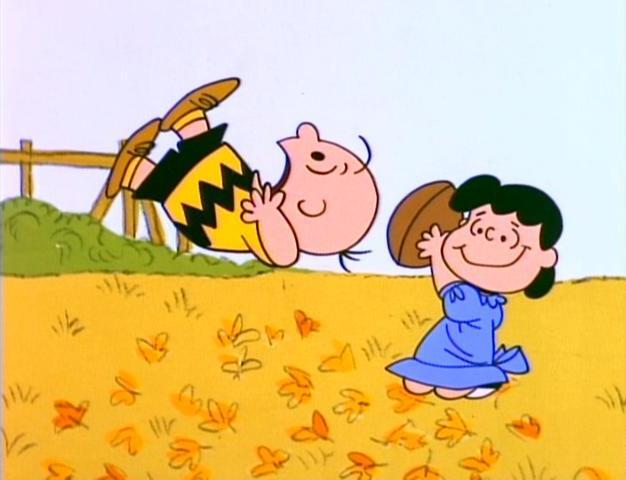
Charlie Brown fooled by Lucy and the football, again, October 30, 2011. (http://www.flickr.com).

I’ve never really liked Halloween. Probably because most of my Octobers growing up in Mount Vernon, New York were pretty horrible ones. The worst of those late Octobers were in the early 80s, starting in ’81.

That year, Halloween was a forbidden holiday in my life anyway. But the trick was on me. On a day just before Halloween, my day’s meal consisted of an ice cream sandwich as hard as a rock. The lunch at A.B. Davis Middle School that Friday — as it was most Fridays back then — was a grilled ham and cheese sandwich with fries, not exactly a Hebrew-Israelite’s diet. It was also about thirty degrees outside and partly cloudy, unusually cold for early fall in New York. So I stood near the steps leading down to the back of Davis, which led to the athletic field below. The field had turned a dirty yellow-green, the color of mid-fall. It matched how I felt about my life on that day.

The only reason I even had a rock-hard ice cream sandwich for lunch was because I’d won one of our seventh grade social studies teacher Mr. Court’s bets. He’d made an incorrect historical assertion in class, and I caught it, collecting a quarter from him that morning. Still, I learned, fully and truly for the first time, how

A Single Vanilla Ice Cream Sandwich, 1994. (Renee Comet/National Cancer Institute). In public domain.

poor me and my family had become, all while bitterly jamming the ice cream sandwich down my throat. So much for discovering my inner Hebrew-Israelite self through fasting and eating kosher foods!

I very quickly grew to hate hearing the words Hebrew-Israelite, especially since I’d never been to a traditional synagogue, much less Israel, Palestine, or even Ethiopia. Our Hebrew-Israelite ways had left us with little to eat when I was at home. There was a benefit to all of this. It made the fasting part of fasting and prayer easier. Not easy, just easier. My first Yom Kippur ceremony was difficult. We fasted on fruit for three days, and I barely made it through school each of those days. I almost passed out from the lack of food.

My older brother Darren, meanwhile, had decided that “the day of atonement” and all things Torah didn’t include his stomach. By the end of October, I would watch him take his kufi off as he boarded his bus for The Clear View School (see “About My Brother” from December ’07). I caught Darren walking near our apartment building with the last of a Hostess’ Apple Pie and its wrapper during Yom Kipper. He had snuck around the building to eat his contraband. What made this transgression worse was that Hostess used lard to create its desserts. And Darren, once caught, just stared at me and smiled.

My Mom was too busy and tired for me to think about complaining to her about this or about the issues I faced during my first days of Humanities. For more than three years, my Mom’s income had dropped so much compared to rising food and energy prices that we didn’t have food in the house for the last ten days of every month. Sometimes we didn’t have heat either, because we were usually two or three weeks behind on

Anthracite coal (like the lump of coal that was my life in '81), March 7, 2007. (United States Geological Survey). In public domain.

the Con Edison bill. I also knew that we were consistently behind on rent. I felt as isolated as a kidnapped tweener chained to a radiator in a walled-off-window basement.

Lack of food and heat at home weren’t the only problems. My Mom had popped out two of my younger brothers in the previous three years. We lived at 616 in a 1,200 square-foot, two bedroom and one bathroom apartment, so overcrowding had become an issue. Me and Darren were sharing a bedroom with our two siblings.

Not only did I start to believe that my then idiot stepfather Maurice Washington — oops, Judah ben Israel — had colluded with his version of God to play a cruel trick on my mother and my family. Not only did it finally dawn on me that we had slid into poverty somewhere between beginning on ’79 and Halloween ’81. But I knew that we were in a family crisis, financial, material and spiritual. And there was nothing, absolutely nothing, I knew to do about it. Not even asking for candy would’ve helped.

Faces At The Top Of The Well

08 Saturday Oct 2011

Posted by decollins1969 in 1, Academia, Boy @ The Window, culture, Eclectic, Mount Vernon High School, Politics, Pop Culture, race, Religion

≈ Leave a comment

Tags

Baby Boomers, Capitalism, Civil Rights, Cultural Eclectic-ness, Cultural Relevance, Derrick Bell, Faces at the Bottom of the Well, Fred Shuttlesworth, Heroes, Leadership, Legacy, Media Coverage, Post-Civil Rights Generation, Professor Derrick Bell, Race, Racial Preference Licensing Act, Racism, Rev. Fred Shuttlesworth, RIP, Social Justice, Steve Jobs, Taking Risks


Signed Copy of Faces at the Bottom of the Well, October 8, 2011. (Donald Earl Collins).

In a twenty-four hour span on Wednesday, three American giants died. The Rev. Fred Shuttlesworth, the ultimate Civil Rights activist, had been reported dead first by mid-afternoon on the fifth. Then, in quick succession the media reported two other deaths. Apple co-founder, two-time CEO and 300+ patents Steve Jobs passed around 7 pm. While Civil Rights activist, law professor, critical race theorist and best-selling author Derrick Bell also passed that evening, very quietly.

The media — social, cable and otherwise — dutifully dedicated itself to rolling out every author and person connected to Jobs the Visionary, Jobs the Thomas Edison of the Information Age, Jobs the Innovative Entrepreneur. By 9:30 pm, even my ambivalence about Jobs the Capitalist (as tweeted @decollins1969)  would’ve been seen as heretical by the folks whom Jobs had fired over the years, or had their jobs outsourced to China in the past ten years.

No doubt that Steve Jobs, my he rest in peace, was a sort-of Wizard of Menlo Park, California (really, Silicon Valley, but taking poetic license here). But, as much as I love my MacBook, iPod, iTunes, iMovie and iPhoto, and other Apple products I’ve used since I wrote an AP English paper on an Apple IIe my senior year at Mount Vernon High School in ’87. I didn’t get this outpouring of love and sorrow two days ago.

Then it occurred to me that I was watching two stories. One story was of a generation that saw Jobs as the man who fused technological innovation with cultural relevancy, the folks who grew up while Jobs was in the midst of his second coming at Apple. As he remade the niche company into the largest corporation (more or less) in the world. The other story is the media story, the Baby Boomer story of a cultural rebel who made good as an Information Age capitalist while maintaining his Zen-ness, an ultimate cultural outsider-corporate insider.

Rev. Fred Shuttlesworth at Ohio Civil Rights Commission Hall of Fall Dinner, October 2009. In public domain.

As much as I think people should admire the late Steve Jobs — and there’s quite a bit to admire about his life — there’s so much more to admire about Shuttlesworth and Bell. Shuttlesworth survived multiple attempts on his life, was threatened too many times to count, co-founded the Southern Christian Leadership Conference in 1957 (along with MLK and others) and helped lead the campaign to integrate Birmingham, Alabama in the early 1960s, among many accomplishments. Rev. Shuttlesworth literally gave his blood, sweat and tears for civil rights and equality, but I didn’t see anyone put a candle on an iPad for him Wednesday night.

Bell, well, I’m a bit more biased about Professor Bell. I met him two years before he published Faces at the Bottom of the Well. Bell gave a talk at the University of Pittsburgh Law School (his JD alma mater) in October ’90 on his essay “The Racial Preference Licensing Act,” one that would end up in the book. The idea that racist businesses could opt out of an integrated America by buying a license and paying a race tax in order to deliberately bar Blacks and others of color from their services and jobs, I thought that was truly radical. The slightly older Pitt Law students, Black and White, were up in arms. One went so far as to suggest that Bell was somehow now working for the other side, those who’d like to turn back the clock to the days of Jim Crow.

Through it all, Professor Bell just smiled and joked, and most of all, explained. His story about this Act was a way of getting ahead of the tide of politicians and judges that had been eroding Black gains since the mid-1970s, of moving beyond the crucible of the Civil Rights era — integration at any cost. Bell wasn’t suggesting self-segregation. He was hoping to provoke a larger discussion of the kind of equality Blacks and progressives should hope to achieve in a post-Civil Rights era. One in which all deny racism and racial inequality, but put it in practice in their words and actions every day.

Derrick Bell by David Shankbone, August 2007. Permission granted via GNU Free Documentation License.

Bell’s ambivalence about the achievements of his generation, about the legacy of the Civil Rights Movement, about desegregation, made him the target of traditional Civil Rights royalty — the “How dare you!” crowd. But it made me and many others from the generation that actually remembers the Steve Jobs as the guy that co-built the world’s first personal computer in his garage big fans of Professor Bell.

To turn your back on three decades’ worth of struggle and success because you foresaw the coming storm around race. To bridge the divide between Baby Boomers/ the Civil Rights generation and us post-Civil Rights folks by turning complex legal theories into allegorical stories. To take a stand that costs you your job at Harvard Law to ensure that the next Asian American female candidate would be given a real chance at a job. Bell’s my hero, and I don’t have a lot of people I’d call a hero.

The media might have put Bell and Shuttlesworth at the bottom of their news cycle well — no doubt, race and the media’s consistent attempt to ignore race was a factor here — but it’s up to all of us that they are winched out of that well to the top. And I think that Jobs would agree with that. May they all RIP.

Apple logo, Think Different, 1997. (Source/TBWA\Chiat\Day). In public domain

A Friendship Changing Lanes

03 Monday Oct 2011

Posted by decollins1969 in 1, Boy @ The Window, Christianity, Eclectic, Mount Vernon High School, Mount Vernon New York, My Father, race, Religion

≈ Leave a comment

Tags

Education, Family, Friendship, Friendships, Humanities, Ideology, Johns Hopkins University, Mount Vernon High School, Mount Vernon New York, MVHS, Politics, Race, Religion, University of Pittsburgh, Valedictorian


Changing Lanes (Movie, 2002) Screen Shot, March 2008. (Source/http://swedenborgiancommunity.org).

Part of the problem of being me is the fact that my close friends change as I change. Meaning that there have been transitional periods throughout my life that my old friends fall away. Oftentimes I make new ones, and sometimes, like during my six years in Humanities, my best friend was my imagination. Ironically, the best friendship I had from my Humanities days came with a classmate that I hadn’t become close to until my last couple of years at Mount Vernon High School. More ironically, that friendship didn’t truly become such until we both went away for college in ’87.

I’ve written about her before, the valedictorian of my class, whom I called “V” in a previous post (see Valedictorian Blues from July ’09). To be honest, I’m not sure how our acquaintanceship ever became a friendship. Somewhere between having circumstances in which our fathers weren’t around consistently, or at least being able to relate to Billy Joel, or both of us scoring “5”s on the AP US History exam.

But really, it might’ve just come down to both of us not belonging, or facing a small degree of ostracism from our Humanities and MVHS classmates overall. I wasn’t Black and cool enough, and V, well, she was a classic White nerd, a grinder who had the gall to finish ahead of our Black male salutatorian, at least from the perspective of some authority figures and the school’s popular crowd.

The fact that we went our respective ways, to Pitt and Johns Hopkins, helped. The fact that we wrote each other about some of our social triumphs and challenges helped more. Most importantly, it helped a lot that we both were more honest about our family troubles. Everything from my mother’s need to divorce my idiot stepfather and the issues with my younger siblings to V’s mother and her health issues and struggling with burnout trying to watch over her family while going to school.

So, by the time I began my second year of grad school, we’d become fairly close. I visited her and her family in the DC area eight times during the ’90s, and went to her mother’s funeral and wake in ’96. V came to my PhD graduation ceremony the following year. By ’97, me and V had been friends for ten years, and known each other more than fifteen. For more than six years, she’d really been the only person from my Humanities and high school days with whom I’d been in regular contact.

Changing lanes, Las Vegas Strip, December 12, 2010. (Source/Bjørn Giesenbauer - http://Flickr.com).

Who knew that within four years of marching for my doctorate that our friendship would become a distant one? I think that our approaches to life was so different that we couldn’t help but become distant friends. I am one who refuses to take life on its own terms. If I had taken V’s approach, I’d still be living in Mount Vernon, New York, only with a nine-dollar-an-hour job sorting mail or flipping carcinogenic burgers. V’s was based on some sort of realism that mixed with a sense of eugenic inevitability. That one’s slot in life should remain such, and if one does make it, one must do so without ruffling any feathers.

Besides that, it was obvious that things about who we had been since the early ’80s had evolved, and was changing even more rapidly as we reached our late twenties. I was no longer the blank-faced, closed-mouthed, socially-awkward kid I was in ’82. V was no longer responsible for watching over her mother and her younger sister. We agreed to disagree on so many things. Our politics diverged. Our views on race and racism were growing further apart, as if I was Michael Eric Dyson and she was Ann Coulter.

But even with all of that, I think the seeds of it began when I started dating my future wife at the end of ’95. Something about being in a serious relationship has changed the dynamics of every friendship I had then and have now. I never thought that my friendship with V would be affected. But of course it was. We live in a world where a man and a woman can’t be close friends without it being made into something more than friendship.

Like the seasons, people change, and even if they change for the better, our change will cause our friendships to change as well. It’s just too bad that V couldn’t adapt to all of the good changes in my life like I adapted to hers.

← Older posts
Newer posts →

Boy @ The Window: A Memoir

Boy @ The Window: A Memoir

Places to Buy/Download Boy @ The Window

There's a few ways in which you can read excerpts of, borrow and/or purchase and download Boy @ The Window. There's the trade paperback edition of Boy @ The Window, available for purchase via Amazon.com at http://www.amazon.com/Boy-Window-Donald-Earl-Collins/dp/0989256138/

There's also a Kindle edition on Amazon.com. The enhanced edition can be read only with Kindle Fire, an iPad or a full-color tablet. The links to the enhanced edition through Apple's iBookstore and the Barnes & Noble NOOK edition are below. The link to the Amazon Kindle version is also immediately below:

scr2555-proj697-a-kindle-logo-rgb-lg

Boy @ The Window on Amazon.com: http://www.amazon.com/Boy-The-Window-Memoir-ebook/dp/B00CD95FBU/

iBookstore-logo-300x100

Boy @ The Window on Apple's iBookstore: https://itunes.apple.com/us/book/boy-the-window/id643768275?ls=1

Barnes & Noble (bn.com) logo, June 26, 2013. (http://www.logotypes101.com).

Boy @ The Window on Barnes & Noble: http://www.barnesandnoble.com/w/boy-the-window-donald-earl-collins/1115182183?ean=2940016741567

You can also add, read and review Boy @ The Window on Goodreads.com. Just click on the button below:

Boy @ The Window

Twitter Updates

Tweets by decollins1969
  • RSS - Posts
  • RSS - Comments

Archives

  • June 2025
  • April 2023
  • September 2022
  • August 2022
  • July 2022
  • June 2022
  • May 2022
  • April 2022
  • March 2022
  • January 2022
  • December 2021
  • November 2021
  • October 2021
  • September 2021
  • August 2021
  • July 2021
  • June 2021
  • April 2021
  • March 2021
  • February 2021
  • January 2021
  • December 2020
  • November 2020
  • October 2020
  • September 2020
  • August 2020
  • July 2020
  • May 2020
  • April 2020
  • March 2020
  • January 2020
  • December 2019
  • November 2019
  • August 2019
  • July 2019
  • June 2019
  • May 2019
  • April 2019
  • March 2019
  • February 2019
  • January 2019
  • December 2018
  • November 2018
  • October 2018
  • September 2018
  • August 2018
  • July 2018
  • June 2018
  • May 2018
  • March 2018
  • February 2018
  • January 2018
  • December 2017
  • November 2017
  • October 2017
  • September 2017
  • August 2017
  • July 2017
  • June 2017
  • May 2017
  • April 2017
  • March 2017
  • February 2017
  • January 2017
  • December 2016
  • November 2016
  • October 2016
  • September 2016
  • August 2016
  • July 2016
  • June 2016
  • May 2016
  • April 2016
  • March 2016
  • February 2016
  • January 2016
  • December 2015
  • November 2015
  • October 2015
  • September 2015
  • August 2015
  • July 2015
  • June 2015
  • May 2015
  • April 2015
  • March 2015
  • February 2015
  • January 2015
  • December 2014
  • November 2014
  • October 2014
  • September 2014
  • August 2014
  • July 2014
  • June 2014
  • May 2014
  • April 2014
  • March 2014
  • February 2014
  • January 2014
  • December 2013
  • November 2013
  • October 2013
  • September 2013
  • August 2013
  • July 2013
  • June 2013
  • May 2013
  • April 2013
  • March 2013
  • February 2013
  • January 2013
  • December 2012
  • November 2012
  • October 2012
  • September 2012
  • August 2012
  • July 2012
  • June 2012
  • May 2012
  • April 2012
  • March 2012
  • February 2012
  • January 2012
  • December 2011
  • November 2011
  • October 2011
  • September 2011
  • August 2011
  • July 2011
  • June 2011
  • May 2011
  • April 2011
  • March 2011
  • February 2011
  • January 2011
  • December 2010
  • November 2010
  • October 2010
  • September 2010
  • August 2010
  • July 2010
  • June 2010
  • May 2010
  • April 2010
  • March 2010
  • February 2010
  • January 2010
  • December 2009
  • November 2009
  • October 2009
  • September 2009
  • August 2009
  • July 2009
  • June 2009
  • May 2009
  • April 2009
  • March 2009
  • February 2009
  • January 2009
  • December 2008
  • November 2008
  • October 2008
  • September 2008
  • August 2008
  • July 2008
  • June 2008
  • May 2008
  • April 2008
  • March 2008
  • February 2008
  • January 2008
  • December 2007
  • November 2007
  • October 2007
  • September 2007
  • August 2007
  • July 2007
  • June 2007

Recent Comments

MaryPena's avatarMaryPena on My Day of Atonement/Bitter Hat…
decollins1969's avatardecollins1969 on No Good Teaching Deed Goes…
Mary Rose O’Connell's avatarMary Rose O’Connell on No Good Teaching Deed Goes…

NetworkedBlogs on Facebook

NetworkedBlogs
Blog:
Notes From a Boy @ The Window
Topics:
My Life, Culture & Education, Politics & Goofyness
 
Follow my blog

616 616 East Lincoln Avenue A.B. Davis Middle School Abuse Academia Academy for Educational Development AED Afrocentricity American Narcissism Authenticity Bigotry Blackness Boy @ The Window Carnegie Mellon University Child Abuse Class of 1987 CMU Coping Strategies Crush #1 Crush #2 Death Disillusionment Diversity Domestic Violence Economic Inequality Education Family Friendship Friendships Graduate School Hebrew-Israelites High-Stakes Testing Higher Education History Homelessness Humanities Humanities Program Hypocrisy Internalized Racism Jealousy Joe Trotter Joe William Trotter Jr. K-12 Education Love Manhood Maurice Eugene Washington Maurice Washington Misogyny Mother-Son Relationship Mount Vernon High School Mount Vernon New York Mount Vernon public schools Multiculturalism MVHS Narcissism NFL Pitt Pittsburgh Politics of Education Poverty President Barack Obama Race Racial Stereotypes Racism Relationships Self-Awareness Self-Discovery Self-Reflection Sexism Social Justice Teaching and Learning University of Pittsburgh Violence Whiteness Writing

Top Rated

Blog at WordPress.com.

  • Subscribe Subscribed
    • Notes from a Boy @ The Window
    • Join 103 other subscribers
    • Already have a WordPress.com account? Log in now.
    • Notes from a Boy @ The Window
    • Subscribe Subscribed
    • Sign up
    • Log in
    • Report this content
    • View site in Reader
    • Manage subscriptions
    • Collapse this bar
 

Loading Comments...