• About Me
  • Other Writings
  • Interview Clips
  • All About Me: American Racism, American Narcissism, and the Conversation America Can’t Have
  • Video Clips
  • Boy @ The Window Pictures
  • Boy @ The Window Theme Music

Notes from a Boy @ The Window

~

Notes from a Boy @ The Window

Category Archives: Politics

K-12 Curriculum as a Mystery Novel

02 Thursday May 2013

Posted by decollins1969 in 1, Academia, culture, Eclectic, Pittsburgh, Politics, Pop Culture, race, Youth

≈ 3 Comments

Tags

4th Grade, Facts of Life, Head of the Class, High-Stakes Testing, History, Homework, Immigration, Jacob Lawrence, K-12 Curriculum, K-12 Education, K-12 Education Reform, MAP-M, MAP-R, Maryland, MCPS, Migration, Montgomery County Public Schools, MSA, Mystery Novels, Parenting, Phillips Collection, Sherlock Holmes, Silver Spring, Social Studies, Student Development, Teacher-Parent Relationship, Teaching and Learning, Textbooks, The Migration Series, Washington DC, Writing


Unsolved Mysteries, December 19, 2011. (http://news.discovery.com).

Unsolved Mysteries, December 19, 2011. (http://news.discovery.com).

This week, my son will complete a fourth-grade project in which he interviewed his Pittsburgh grandmother about her migration experience from rural Arkansas to Pittsburgh, Pennsylvania during the Depression decade. Sounds pretty good — and very advanced — on the surface of things. But the reality of how this school project evolved shows how much has changed — and not for the better — regarding schools and curriculum. For my son’s school in Silver Spring, Maryland, for Montgomery County Public Schools and for schools across the country.

You see, the bulk of testing season is over for MCPS’ elementary schools. So instead of practice tests, formative assessments (otherwise known as “formatives”) and the actual exams (MSA, MAP-M and MAP-R), the teachers now have to focus on lesson plans that aren’t test-driven. For April, the fourth-grade teachers at my son’s school decided to do a social studies project on immigration. They started with a wax museum project at school, as well as a field trip to the Phillips Collection in DC.

This was where things began to get interesting for me as a parent. The permission slip for the field trip presented this unit as immigration. Yet in my son’s trip to the Phillips Collection, him and his classmates would peruse a set of Jacob Lawrence’s paintings on migration. For those of you who don’t know, Lawrence’s most famous paintings were of the Great Migration of African Americans from the rural South to the urban North between roughly 1915 and 1930.

Jacob Lawrence: Migration Series, Phillips Collection, Washington, DC (1993), May 1, 2013. (Elizabeth Hutton Turner; http://ucdavis.libguides.com/).

Jacob Lawrence: Migration Series (Cover Art), Phillips Collection, Washington, DC (1993), May 1, 2013. (Elizabeth Hutton Turner; http://ucdavis.libguides.com/).

I could barely contain the historian side of me when I read such an obvious and unbelievable error. But I decided to not assume that the fourth-grade teachers made the decision to treat immigration the same as migration. So I hand-wrote a note that politely suggested that they make a correction on the permission slip and for the overall assignment, since immigration and migration aren’t the same at all.

This was the response I received by email on April 4:

“We have had this wonderful trip planned for the 4th grade for the past 4 years and we always make sure to front load the students with information about the migration process.”

When teachers go into placating-mode without actually addressing my concerns as a parent (and an educator, for that matter), it’s usually a sign of trouble where there otherwise shouldn’t have been any trouble.

Then, nearly two weeks ago, my son brought home his interview/presentation assignment based on the wax museum project and his Phillips Collection field trip. It was titled “Immigrants in Their Own Words.” The fourth-grade teachers had charged the students — including my son — with the task of finding a family member who had immigrated to the US, interviewing them and asking them questions like “In which year did you come to America?” and “What is the biggest difference between America and your country of origin?”

Flabbergasted is just the beginning of my deep sense of puzzlement over the assignment. It was an assignment straight out of a Facts of Life or Head of the Class episode from the 1980s, culturally and racial insensitive to the core. After all, the height of White immigration to the US ended nearly a century ago. For Blacks, well, if I have to explain it, then it may be worth the while of those of you who do teach to take my History of American Education course (that is, whenever I get to teach it again).

My wife wrote an email about this follow-up assignment, to which my son’s teacher replied, “[e]migration and [i]mmigration are almost splitting hairs.” Really? In what history or ed foundations course? With some prodding, we were given the opportunity to adapt the assignment so that my son could work on migration. Of course, even without that note, I would’ve insisted on him doing migration anyway.

Mysterious...the new Sherlock Holmes, January 17, 2011. (H. Armstrong, Roberts/Corbis; http://www.guardian.co.uk/).

Mysterious…the new Sherlock Holmes, January 17, 2011. (H. Armstrong, Roberts/Corbis; http://www.guardian.co.uk/).

That this process was poorly executed is only part of the story. For nearly five years, my son’s curriculum has been a mystery to me, as it jumped around from pre-algebra to basic addition, from writing letters in which he could write phonetically to having to write about beetles in grammatically correct but short sentences. After five years, my son has never brought a textbook home. The weekly emails from teachers and postings on the neighborhood school website and the MCPS website tell me a lot about nothing.

In sum, I know quite a bit about test dates, subject areas and sometimes subject matter in which the state of Maryland and the school district will test the students. What we don’t know from day one of any school year are the themes for each subject for the year or for any given marking period. Because of the priority of testing above all else, the amount of time in the curriculum on subjects like social studies has narrowed, and with it, a teacher’s ability to be autonomous and to think through curriculum in a critical manner. And without textbooks, I as a parent can’t truly anticipate how to help prepare my son for any new or potentially challenging materials.

It’s difficult, though, to anticipate that your son will come home with an assignment on immigration in the fourth marking period of fourth grade. Especially when I as a history professor know how complicated these processes are for undergraduate and graduate students to wrap their brains around. Especially since my son has yet to write a full-fledged book report on any any book he has read for school. Or spent significant time on history or other, non-test-related subjects. Education should always be a journey, but never a mystery.

All The Media’s Stereotypes

21 Sunday Apr 2013

Posted by decollins1969 in 1, culture, Eclectic, eclectic music, Patriotism, Politics, Pop Culture, race, Religion, Youth

≈ 1 Comment

Tags

"Dirty Laundry" (1982), 9/11. Jingoism, Boston, Boston Marathon Bombing, Branch Davidian Compound, Breaking News, Centrism, Chechnya, CNN, Cultural Stereotypes, Don Henley, Dzhokhar Tsarnaev, FOX News, Immigrants, Immigration, Islam, Jihadists, John King, Jonathan Capehart, Lockdown, Media Bias, New York Post, Oklahoma City Bombing, Police Chase, Racial Stereotypes, Racism, Stereotypes, Tamerlane Tsarnaev, Terrorism, Terrorized, Waco, Washington Post, West Texas Fertilizer Plant Explosion, Xenophobia


Dzhokhar & Tamerlan Tsarnaev in Boston Marathon crowd moments before bomb blasts, April 15, 2013. (http://www.mirror.co.uk)

Dzhokhar & Tamerlan Tsarnaev in Boston Marathon crowd moments before bomb blasts, April 15, 2013. (http://www.mirror.co.uk)

The mainstream American media was just one big, almost unbelievable fail this past week. Between the Boston Marathon bombing and the subsequent hunt for brothers Dzhokhar and Tamerlan Tsarnaev, the ricin letters to Mississippi GOP politicians and President Obama and the fertilizer plant explosion in West, Texas. In the last case, the one that killed and injured more people than two dumb asses in Boston. Yet, somehow, in a world in which the best answer should be “I don’t know” or “We don’t know yet,” media folks and their experts have been tweeting and reporting at the level of gossip for the past five or six days.

Usually a fairly careful journalist/columnist, Jonathan Capehart of The Washington Post tweeting three hours after the Boston Marathon bombing on April 15, “April 19: Anniversary of storming of Branch Davidian compound & the Okla. City bombing.” At that point, we didn’t even know the number of people killed, maimed or injured. Nor did we know the number of bombs that had exploded in Copley Square. Think, man, think!

The more famous comments of the week came out of CNN’s shop, though. John King had breaking news Wednesday afternoon that law enforcement officials had identified a “dark-skinned male” suspect. Being a White guy working in mainstream media means that you never have to say “I’m sorry,” apparently. Especially when all of his “breaking news” reporting turned out to be completely wrong.

Let’s not really analyze the so-called reporting of FOX News or the New York Post. You’d get more truth from a psychic doing a Vulcan mind-meld with Tamerlan Tsarnaev’s brain right now than you could from Murdoch’s news media world in a year.

Let’s also not forget many of the so-called terrorism experts whom guessed wrong about race, immigrant status and so many other details this past week. Not to mention reports whom apparently couldn’t find Chechnya on a map if the republic were blown up to 100x normal map size and they put a floodlight on it.

But the most disturbing — yet not very surprising — thing about the past seven days has been how the US media has engaged in a near-endless campaign of racial stereotypes, immigrant stereotypes, terrorism stereotypes, religious stereotypes, patriotism stereotypes, and hyperbole that attempts to defy history. A simple list should help:

  • Terrorist(s) = Arab Muslims
  • Males from the Caucasus = Caucasians, but not White
  • Muslims who commit a violent act = terrorists
  • Violent criminals = anyone not White (especially Blacks & Latinos)
  • Violent mass-murdering Whites = mentally disturbed (i.e., NOT terrorists)
  • Arab Muslims = immigrants, NOT US citizens
  • Indo-Europeans who are White (phenotypically) & citizens but not born in US = Immigrants
  • Boston = city terrorized like no city ever before

On this last one, I must put on my academic historian hat. As in — are you kidding me? Anyone ever hear of Boston in the years before and during the American Revolution? Or, in more recent times, the Oklahoma City bombing in ’95, 9/11 and Lower Manhattan, the DC sniper rampage in ’02? Or, if the idea here is that terrorism should only be viewed through the prism of those who feel terrorized, what about poor Blacks on the South Side of Chicago, in SE Washington, DC, or poor Latinos in cities like Albuquerque and Phoenix? Or, for that matter, innocent civilians in Yemen and Pakistan attempting to avoid being among the “collateral damage” caused by our drone wars for terrorist scalps?

And then, there was the need for release, for yelps of relief and cheers of joy over the successful capture of Dzhokhar Tsarneav late Friday evening, with chants of “USA! USA! USA!” included. Of course people should feel relief for the end of a tense situation. But let’s not get carried away with the tide here.

Stereotype quote taken from Annie Murphy Paul article (May 1998) in Psychology Today, January 16, 2011. (http://nwso.net/). In public domain.

Stereotype quote taken from Annie Murphy Paul article (May 1998) in Psychology Today, January 16, 2011. (http://nwso.net/). In public domain.

We know nothing of motive, but we do know that the police will return to its regularly scheduled racial and socioeconomic profiling in the coming days. We can’t wrap our collective heads around the idea that two assimilated White American immigrants decided to kill runners at the Boston Marathon. Yet we also somehow decided to culturally and legally un-Americanize them — something we didn’t do with Timothy McVeigh. Chants patriotic might be a way to show solidarity, but we refuse to come to grips with the racial/xenophobic and anti-Muslim psychology that comes with these impromptu outbreaks of so-called unity.

Don Henley’s “Dirty Laundry” remains just as relevant now as his tune about the American news media was three decades ago. Still, the completely centrist and biased, always-concerned-about-the-bottom-line media is a mere reflection of our narcissistic and imperialistic selves.

“They Can Never Kill Enough or Steal Enough…”

18 Thursday Apr 2013

Posted by decollins1969 in 1, culture, Eclectic, Movies, Patriotism, Politics, Pop Culture

≈ 2 Comments

Tags

1, American Narcissism, Boston Marathon Bombing, Congress, Corporations, Doc Holliday, GOP, Gun Regulation, Johnny Ringo, Metaphor, Murderers, Narcissism, Republicans, Senate, Terrorists, Tombstone (1993), Val Kilmer


Tombstone As A Metaphor

Tombstone As A Metaphor

Take Doc Holliday’s (as played by Val Kilmer) insightful line about nemesis Johnny Ringo from Tombstone (1993), and it should also reveal something about our fellow crazy and/or well-off Americans as well. We could easily substitute “Congress,” “Conservatives,” “Corporations,” “The top 1%,” “Republicans,” and “Centrists Democrats” at the beginning of “…got a great empty hole right through the middle of them. They can never kill enough or steal enough or inflict enough pain to ever fill it.” For some, they really do want “revenge” for “bein’ born.” Especially in light of the votes against even a watered-down and nearly useless version of gun regulation through background checks in the Senate yesterday, or the fool(s) responsible for the Boston Marathon bombing on Monday.

So many sad and narcissistic people in this country — they could literally take my breath away. And with their denial of climate change, that could very well happen, and right soon, too.

“The Dying of Black Women’s Children”

27 Wednesday Mar 2013

Posted by decollins1969 in 1, Academia, Boy @ The Window, Carnegie Mellon University, culture, Eclectic, eclectic music, music, Pittsburgh, Politics, Pop Culture, race, University of Pittsburgh, Youth

≈ Leave a comment

Tags

"A Substance of Things Hoped For", "Sittin' on the Dock of the Bay", "The Evidence of Things Not Seen", Black Migrants, Black Migration, C. Matthew Hawkins, Census Data, Child Mortality, Child Mortality Rates, Correlation, Infant Mortality, Infant Mortality Rates, Joe William Trotter Jr., Julie Saville, Larry Glasco, Laurence Glasco, Lotus 1-2-3, Otis Redding, Pitt Honors Convocation 1994, Public Health Records, Quantitative Analysis, Quantitative Methods, SPSS, University of Chicago, Women Studies Program Award


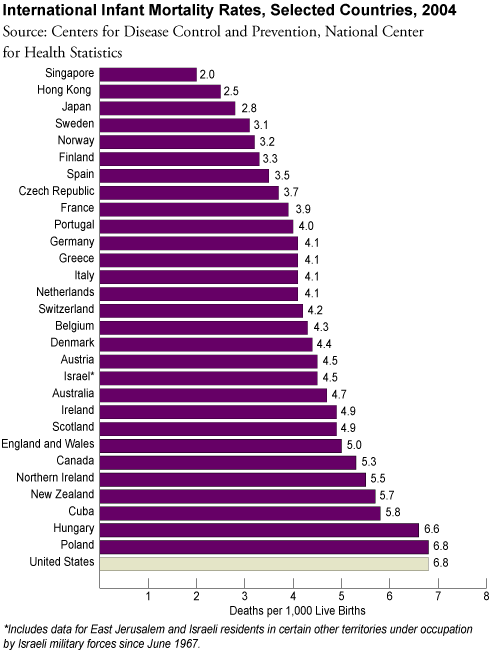
Infant mortality rates by country (2004), March 27, 2013. (http://www.mchb.hrsa.gov/). In public domain.

Infant mortality rates by country (2004), March 27, 2013. (http://www.mchb.hrsa.gov/). In public domain.

That was the title of a research paper I wrote for an independent study course I did with my former Pitt advisor Larry Glasco. It was a paper I wrote during my last semester at the University of Pittsburgh, undergrad and grad school. It was the last paper I would write for any professor at Pitt. But it was a paper that would address a bunch of common themes about me as a historian and scholar knowingly, and a writer unknowingly.

I began this paper without a course and on my own time in the Fall ’92 semester (see my post “December Doctoral Decisions” from last year). I had to fulfill a quantitative methods requirement in order to take my PhD comprehensive examinations at the end of my coursework, which at my pace would’ve meant taking them in the fall of ’93 at Pitt. Why they never included a qualitative methods requirement, I’ll never know. Of course, this digital humanities movement of quantifying the heretofore unquantifiable was but an embryo in the early ’90s.

With my language requirement taken care of the year before, I had no choice but to build on my existing statistical knowledge. Luckily, I’d inadvertently minored in mathematics and had been a computer science major before switching to history. I’d already decided on the topic of comparing infant/child mortality rates among White and Black Pittsburghers between 1900 and 1920, coinciding with the Great Migration period for Blacks. This meant census data from 1900, 1910 and 1920. This meant public health records from the same twenty-year stretch. It meant looking at neighborhoods like the Lower Hill District and Bloomfield, the occupations of the men and (in the case of Blacks) women living in these communities.

And it meant that I had to learn how to use SPSS, the most powerful number-crunching statistical software package on the planet. At least as far as I was concerned. It took me from September ’92 until the end of January ’93 to get comfortable enough with SPSS to plot and correlate different points of data. By then, I could generate reports and make sense of them. I knew that race, poverty/neighborhood and occupation (in that order) correlated best to the 2.5 to 1 ratio between infant/child mortality (death between child birth and the age of five) rates for Black families versus White families.

I used Lotus 1-2-3 to construct the tables, charts and graphs for my statistical correlations and data. Why Lotus 1-2-3? Their charts and graphs looked like “arts and crafts,” to steal a phrase from David Letterman. SPSS’s visuals were boring. Between the numbers crunching, the translation of correlation data into Lotus, and the actual writing of this paper, I completed my work for this independent study and quantitative methods requirement at the end of February ’93.

By then, I had two issues. One, I didn’t know what to title my paper. Most of my titles were inspired by cultural references from music, sports, TV shows, catch commercial jingles. I’d titled one paper “‘Sittin’ On The Dock of The Bay’,” an homage to Otis Redding and in reference to the topic of Black migrants finding permanent economic degradation after leaving the Jim Crow South for places like New York, Chicago and L.A. Another one, which I’d presented at several conferences, was “‘The Evidence of Things Not Seen’,” a prelude to my “‘A Substance of Things Hoped For'” dissertation (thanks to Hebrews 11:1 and James Baldwin).

Pitt Honors Convocation program, (March 1, 1994), March 27, 2013. [Ironic, given that I received this honor when I was at CMU]. (Donald Earl Collins).

Pitt Honors Convocation program, (March 1, 1994), March 27, 2013. [Ironic, given that I received this honor when I was at CMU]. (Donald Earl Collins).

I solved this title problem while simultaneously dealing with the second issue, which was that I knew I was about to transfer to Carnegie Mellon to complete the doctorate. Joe Trotter had invited me to attend the job talks of a young professor who had recently earned tenure at the University of Chicago, I believe. I remember her being fairly attractive and found her work interesting, if not fascinating. While we walked up and down the factory floor, um, second-floor corridors of Baker Hall, I walked by a flyer for an upcoming talk on “The Dying of Young Women’s Children.” I decided that this would be the scaffolding for my paper’s title, right then and there. Only, I’d change “Young” to “Black” and give a footnote of credit to the flyer title.

I submitted my paper to Larry for my independent study, which I was now taking purely as pass/fail (or satisfactory/unsatisfactory), and not for a specific grade. After Larry learned of my departure, he never gave me feedback on the paper. As the end of the semester approached — and I became short on cash — I submitted the paper to the Women’s Studies Program’s Student Research (undergraduate and graduate) contest.

Pitt's Women's Studies Program Annual Prize for Student Research on Women and Gender, June 1993, March 27, 2013. (Donald Earl Collins).

Pitt’s Women’s Studies Program Annual Prize for Student Research on Women and Gender, June 1993, March 27, 2013. (Donald Earl Collins).

Two months later, in June ’93, I learned that I’d finished second in the graduate student category, and earned a check for $75, a week’s worth of groceries! My friend Matt, upon learning of my good fortune, said, “You won that prize because of that title,” adding that I “stole it” from a flyer.

Matt was right, of course. But I also learned something important through “The Dying of Black Women’s Children.” That all writers borrow from others’ words and ideas, and then make them their own.

Transfer Anniversary

21 Thursday Mar 2013

Posted by decollins1969 in 1, Academia, Boy @ The Window, Christianity, culture, Eclectic, Patriotism, Politics, Pop Culture, race, Youth

≈ Leave a comment

Tags

Academic Politics, Carnegie Mellon, Carnegie Mellon University, CMU, Department of HIstory, Dissertation Completion, Dissertation Funding, Doctoral Completion, Elite Universities, Elitism, Funding, History Department, Joe Trotter, Joe William Trotter, John Modell, Jr., Larry Glasco, Laurence Glasco, Pitt, Pittsburgh, Politics of Academia, Transfer, University of Pittsburgh


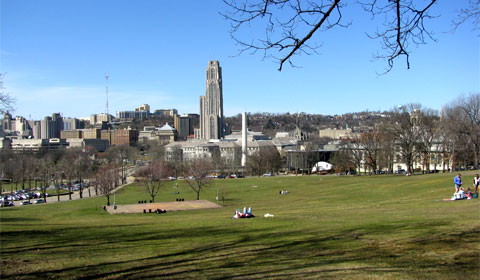
Viewing Pitt's Cathedral of Learning from Carnegie Mellon's mall (with Hamerschlag Hall in foreground), March 29, 2003. (http://post-gazette.com)

Viewing Pitt’s Cathedral of Learning from Carnegie Mellon’s mall (with Hamerschlag Hall in foreground), March 29, 2003. (http://post-gazette.com)

March ’93 was an interesting month for me, to say the least. Just about the biggest thing happening for me that month was my transfer from Pitt to Carnegie Mellon (or CMU) to finish my doctorate. After nearly two years of grad school in the History Department, I knew I needed to leave. Especially with Larry Glasco as my well-meaning but sometimes absentee advisor and with a bunch of professors who never hid their disdain for me as a masters and then a doctoral student. I’d also been at Pitt for six years between undergrad and grad school, most of those focused on history, Black Studies, or education foundations and policy as areas of research.

I knew that Carnegie Mellon wasn’t an ideal situation. I was sure that had I desired, I could’ve applied to and been accepted by doctoral programs as far and wide as NYU, University of Maryland, University of Michigan and other places. All were places where history didn’t simply consist of working-class historians who believed in the supremacy of class and neo-Marxism above all else – race and racism be damned! What I didn’t know, though, was whether those departments would accept my doctoral credits, cutting my coursework time in half. What I couldn’t be sure about was whether I’d be able to move toward PhD comprehensives and my dissertation proposal within a year of enrollment.

See, these were the things that Joe Trotter, my eventual advisor and John Modell, the graduate coordinator for the department, had promised me as part of my deal for transferring across the bridge to CMU. Those promises, along with the idea of working with an enthusiastic professor whose research didn’t seem out-of-date in a department that seemed to fast-track its students toward doctoral completion. That really appealed to me at the time.

Pitt and Carnegie Mellon (with Forbes Quad & Baker Hall included) as seen from Schenley Park, Pittsburgh, PA, March 21, 2013. (http://milliverstravels.com).

Pitt and Carnegie Mellon (with Forbes Quad & Baker Hall included) as seen from Schenley Park, Pittsburgh, PA, March 21, 2013. (http://milliverstravels.com).

When I finally broke it to Larry at the beginning of March that I’d made this decision, he didn’t exactly try to convince me to stay. I think he knew why. An audit of the program in ’98 confirmed officially what I had learned anecdotally over my six years at Pitt. That there were students in the program who’d been ABD (All But Dissertation) since Nixon and Watergate. That fully half of my cohort from ’91 hadn’t even completed their master’s degrees, and only three of us (counting myself) out of twenty-one would ever go on to complete our doctorates. That no Pitt History grad student had obtained substantial research funding from outside the university since my Mom potty-trained me back in ’72-’73. And that politically, the powers that used to be in the department didn’t take my or Larry’s work with me seriously. Even if Larry didn’t see that, I sure did.

Off then, I went. Into the unknown known of CMU, conservative, elite and elitist, not sure if I’d ever be comfortable on the lily-White and honorary-White-as-Asian campus. Still, I reminded myself that Pitt was really only a couple of blocks away at the closest point between the two campuses, that I still had lots of friends and acquaintances there. I also knew, though, that my relationship with Trotter as my advisor would be crucial to my successful navigation of this drab and stuffy world. Too bad I wasn’t clairvoyant!

The Impossible Choice of Driving While Black

18 Monday Mar 2013

Posted by decollins1969 in 1, Boy @ The Window, culture, Eclectic, Politics, Pop Culture, race

≈ Leave a comment

Tags

Colesville Road, Driving While Black, Institutional Racism, Internalized Racism, MCPD, Mistrust, Montgomery County Police Department, Police Intimidation, Police State, Racism, Silver Spring, Traffic Conditions, Walking While Black


Police brutality poster, March 18, 2013. (http://lovethetruth.com).

Police brutality poster, March 18, 2013. (http://lovethetruth.com).

Let me say this right off. I can’t stand cops. I haven’t since I was about five or six years old. That was when a couple of dumb-ass Mount Vernon Police officers idly stood by and laughed as my father was being taken to the hospital with a stab wound in his left thigh, the result of a fight between him and my mother. I’ve been accosted, stopped, frisked and followed by police in Mount Vernon, the Big Apple, DC, Silver Spring, Los Angeles and Virginia since I turned sixteen back in ’85. Mostly for the simple issue of being an over-six-foot tall Black male and man. Walking while Black in Beverly Hills or on my own campus at Carnegie Mellon. Or Driving While Black in Pittsburgh or Maryland (see my post “Why Black Men Carry A Public Anger” from March ’12)..

To me, the issue is not as simple as a White racist cop finding excuses to harass, intimidate or beat up a Black or Brown person. It actually doesn’t matter what race or ethnicity a police officer happens to be, because their uniform, badge and gun are way more important to them than race. By definition, then, they represent our collective psyche of bigotry when it comes to race, class, gender and criminality. So don’t argue with me about the race of any cop in terms of police brutality and intimidation.

Two Bad Driving Choices

For the first time in about a half-decade, a police office pulled me over. This time, it was half my fault, albeit, it depends on how you define fault. Thursday afternoon, March 14, I was driving down Colesville Road past University Blvd East, to do a left turn on Lorain. From there, I’d meander my way back to the Shell station on the opposite side of University Blvd – it’s cheaper than the one on Colesville. Now, there’s a sign on the median next to the left turning lane that prohibits making a U-turn.

No U-Turn sign & left turning lane, Colesville Rd & Lorain Ave, Silver Spring, MD, March 14, 2013 (2:35 pm). (Donald Earl Collins).

No U-Turn sign & left turning lane, Colesville Rd & Lorain Ave, Silver Spring, MD, March 14, 2013 (2:35 pm). (Donald Earl Collins).

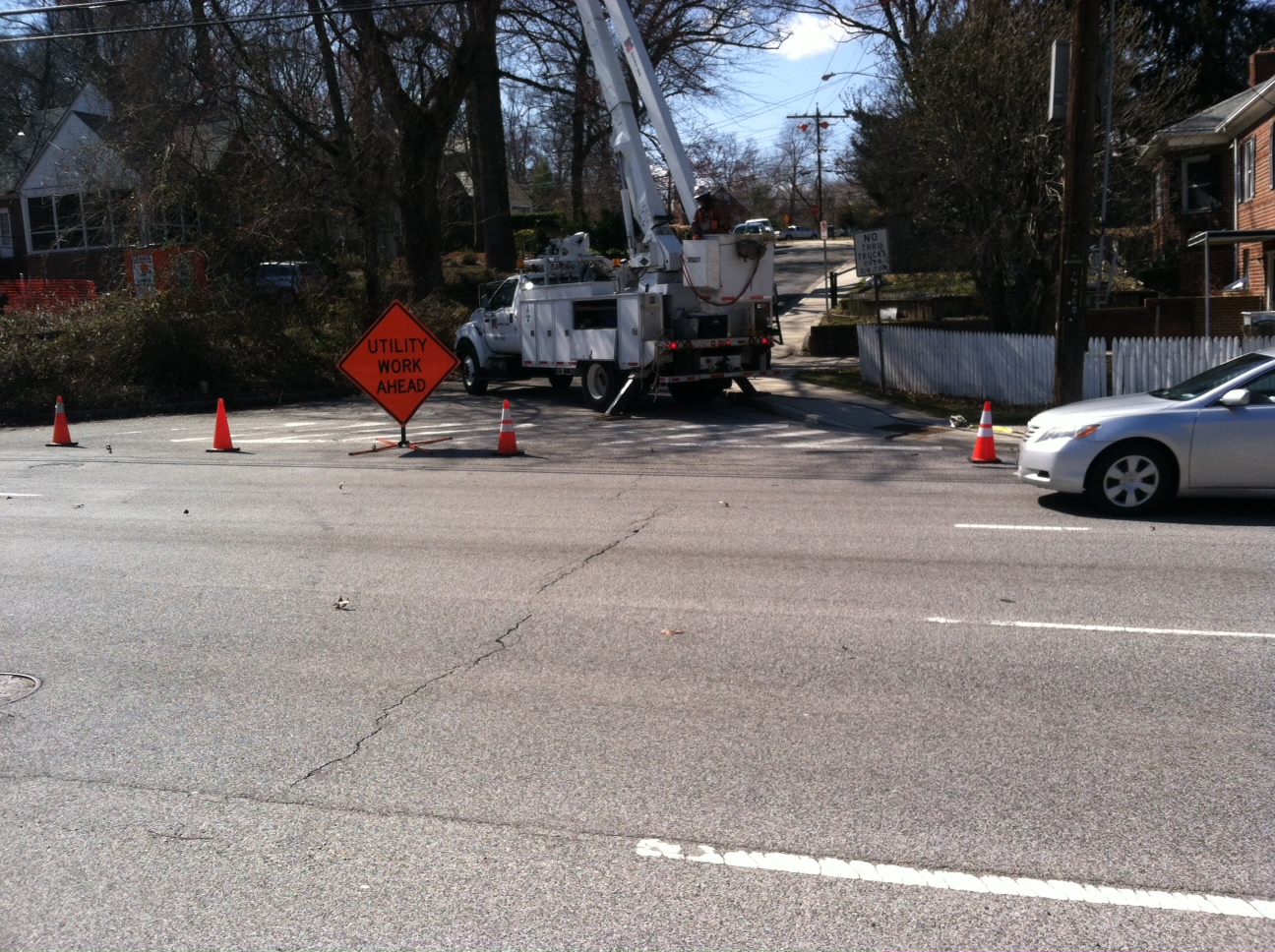
The problem on March 14 was, though, that a utility crew had closed up the street, between their trucks and their cones, making it impossible to make the left turn. I had no warning for this until I reached the front of the left turn lane. By then, I had a blue Toyota Camry behind me, and heavy traffic coming down the adjacent lanes on my side of Colesville.

So I had a choice, and not much time to make one. I couldn’t back up. Cutting across the solid left turning lane line is technically a traffic violation, one which could lead to me being pulled over by police. Not to mention, with so much traffic, I could’ve easily caused a traffic accident.

There wasn’t any traffic coming from the opposing side of Colesville. So I made the U-turn, figuring that this was the only actual choice that made any sense at all. Within three seconds, a siren approached, so I pulled over on the next block, right next to the Colesville Shell gas station. The whole time I’m thinking, “What the heck else was I supposed to do – run over the cones and then jam my car into the back of a utility truck?”

Utility work closing off Lorain Avenue (cones included, Silver Spring, MD, March 14, 2013 (2:37 pm). (Donald Earl Collins).

Utility work closing off Lorain Avenue (cones included, Silver Spring, MD, March 14, 2013 (2:37 pm). (Donald Earl Collins).

Admittedly I was nervous, as I consider police to be about as honest as Mafia bosses and city council members beholden to their local Chambers of Commerce. But I also realized that even if the police officer issued me a ticket, I’d have a crapload of evidence in my favor that would lead to a judge dismissing the citation.

The Not-So-Friendly Neighborhood Cop

So I waited. And waited. Then, after five minutes, a police officer named M. Kane (ID # 1382 for those truly interested) came up to my window, one who must’ve been having the worst day ever. Even for a White or Black police officer, he looked like he was ready to brutalize anyone who said more than “Yes, sir! I’ll suck you dick, sir!” to him. That pissed me off right away. Because a traffic violation, especially under these circumstances, didn’t rise to the level of the threatening nonverbal communication that was coming off of him like heat from an exhaust pipe.

I did get a written warning, and then some directions about what do next. The problem was, the officer issued his directions in a low grind of a growl, and I actually didn’t hear all he said. So I asked, reluctantly

“Officer, can I pull over here into the gas station? That’s where I was on my way to when you pulled me over.”

“You can go wherever the hell you wanna go, just pull out over this other car here!,” he yelled, so close to me I could feel the hot air and spit from his mouth as he was yelling. He looked at me with mean, dead eyes, the kind of look that so many folks who look like me have seen from police all these years.

I pulled out, probably a minute or so away from being arresting for assaulting a police officer, because that’s probably what I would’ve done in a parallel universe.

More Choices

What could I had done, really, to have avoided the situation? Have better hearing? Found my way into a car accident? Not left the house to go get gas and hamburger rolls before going to the Y for a five-mile run? Well, Montgomery County could’ve actually cut off the left turning lane with cones, making folks go elsewhere to make left turns. That is, if they were more interested in safety than in handing out warnings and tickets!

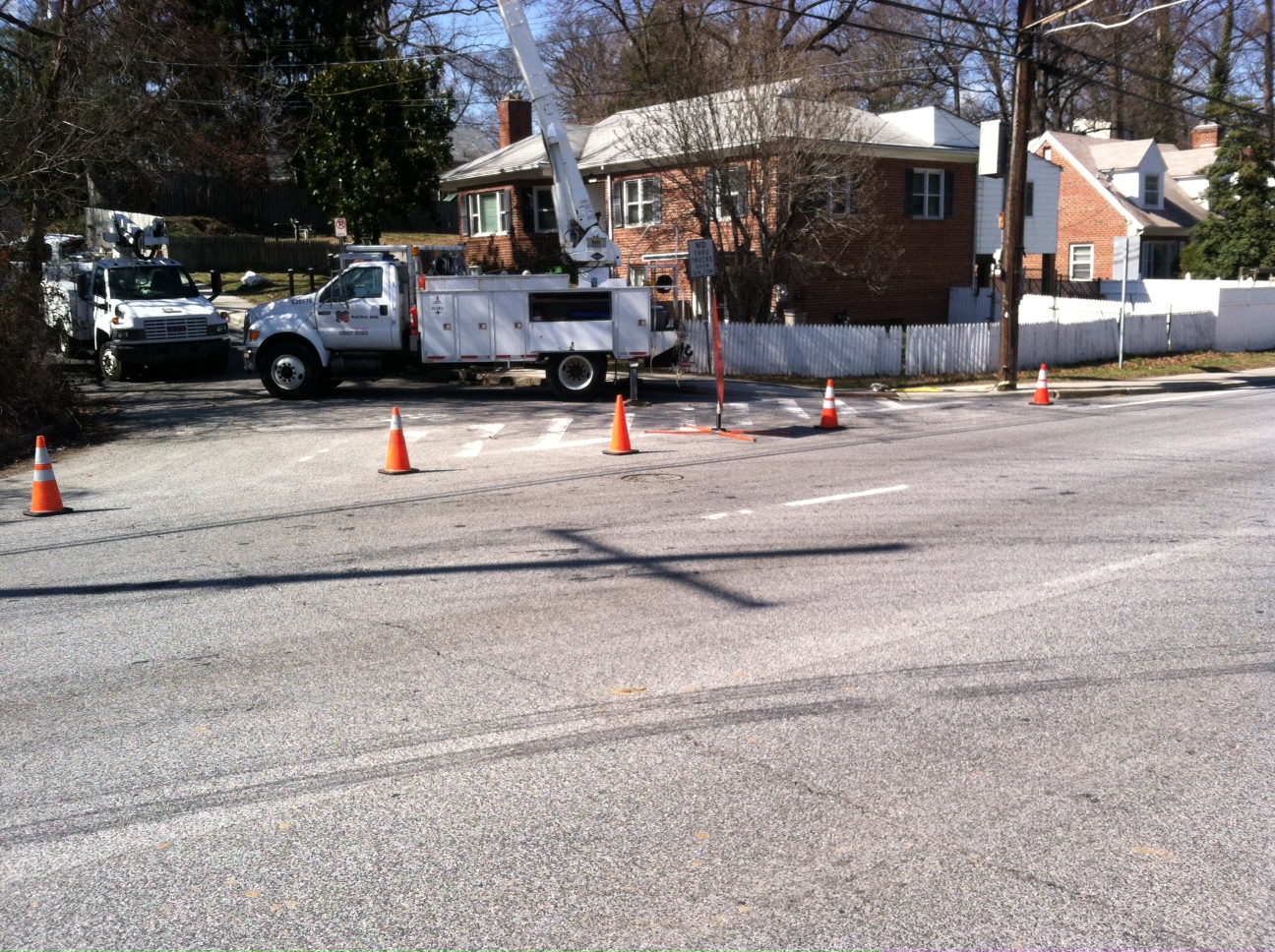
Utility work on Lorain Avenue (slightly different angle - 3rd truck hidden from view), March 14, 2013 (2:38 pm). (Donald Earl Collins).

Utility work on Lorain Avenue (slightly different angle – 3rd truck hidden from view), March 14, 2013 (2:38 pm). (Donald Earl Collins).

Beyond that, I don’t have much choice other than to be me. Despite almost every part of me wanting to smash in this police officer’s head with a twenty-five pound weight, the spirit inside said to forgive, and so, I forgave. But that doesn’t mean condone or not write about my experience. After all, if this officer is like this every day, then he’s a walking time bomb, set to go off on the wrong person of color at the wrong time.

I don’t want to hear about how dangerous it is to be a cop. Right now, it’s dangerous to be a teacher or professor, given mass shootings over the past six years. Last I checked, these officers weren’t conscripted into service. They chose their line of work. I don’t expect cops to ever be nice. But professional would be a pretty good standard to meet.

Colorism and the Enduring Power of School Daze

11 Monday Mar 2013

Posted by decollins1969 in 1, Academia, Boy @ The Window, culture, Eclectic, Jimme, Mount Vernon High School, Mount Vernon New York, Movies, My Father, Politics, Pop Culture, race, Youth

≈ Leave a comment

Tags

Brown Paper Bag Rule, Cafe au Lait, Color Struck, Colorism, Dark-Skinned, Fraternities, Giacarlo Esposito, Hazing, HBCUs, Hedonism, High Yellow, Internalized Racism, Intrarace Relations, Laurence Fishburne, Light-Skinned, Mo' Better Blues (1990), Pitt, Redbone, School Daze (1988), Shunning, Sororities, Spike Lee, Tar Baby, The Silent Treatment, Tisha Campbell, University of Pittsburgh, Wesley Snipes


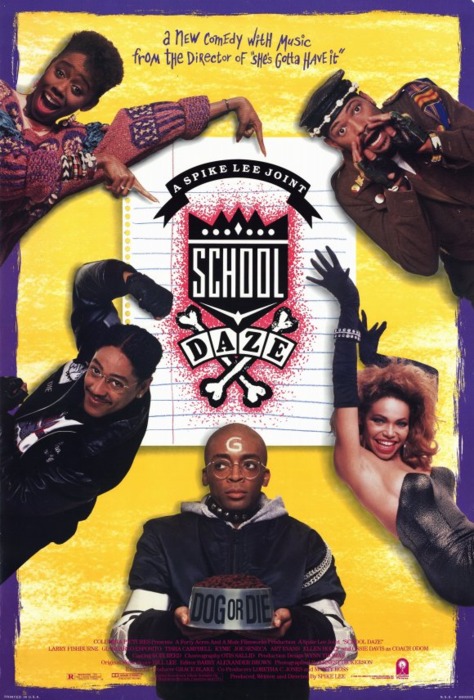
School Daze (1988) movie poster, September 17, 2012. (QuasyBoy via Wikipedia). Qualifies as fair use under US Copyright laws, as depicts subject of blog, is scaled-down and is of low-resolution.

School Daze (1988) movie poster, September 17, 2012. (QuasyBoy via Wikipedia). Qualifies as fair use under US Copyright laws, as depicts subject of blog, is scaled-down and is of low-resolution.

One of the few films I saw soon after it came out in theaters during my Boy @ The Window years was School Daze. It was in fact on this date twenty-five years ago that I went to the old theater in Pittsburgh that once was on Forbes Avenue near the Oakland Primanti Bros. sandwich place to see the film. It gave me some serious food for thought that Spring Break Friday evening, so much so that the lessons of School Daze have stayed with me to this day. Considering that I turned down a date with an upperclassman not interested in seeing the film in the process, School Daze was more than worth it.

The biggest lesson for me was on colorism. Not the macabre hazing of Q-dog frat boys and the cliquish AKA and Delta soros. Not the lack of care for the academic or the step-show battles. Not the hedonist behavior of Black middle class Gen Xers hell-bent on doing everything other than graduating from college. I already knew students like this at Pitt. Really, I already knew former classmates from Mount Vernon High School who attended HBCU’s like Howard, Morehouse, Hampton and Spelman, the kind of people who’d be perfect candidates for this Spike Lee joint. That they would psychologically and physically abuse each other in bed and on campus didn’t surprise me in the least.

"Good and Bad Hair" scene, School Daze (1988), March 10, 2013. (Donald Earl Collins via YouTube). Qualifies as fair use (see previous picture).

“Good and Bad Hair” scene, School Daze (1988), March 10, 2013. (Donald Earl Collins via YouTube). Qualifies as fair use (see previous picture).

No, it was the issue of being color-struck that was truly eye-opening for me. For I think I always knew on a semi-conscious level that colorism was alive and well among Black folks I’d come to know in Mount Vernon and in my first year at Pitt. It was frequently subtle, but also occasionally out in the open. With terms like “café au lait,” “redbone,” “mocha,” “caramel,” light-skinned,” “high yeller,” “dark-skinned,” “tar baby,” “chocolate-brown,” “good hair,” “nappy head,” “paper-bag brown,” and “light, bright and almost White,” among others. With obvious preferences among my male and female counterparts for young Black women and (sometimes) young Black men who passed the brown-paper-bag rule. (For those unfamiliar, if a Black male or female’s skin color was lighter than a brown paper bag, they were light enough to be attractive and acceptable by others. In terms of beauty, sometimes in pledging to a sorority or fraternity, often in terms of being part of a popular and better connected circle of Black folk.)

I certainly saw it with my father Jimme, who threw around the word “redbone” in my last year of high school as if the only young women in my NYC-area universe were light, bright and almost White. But I also saw it in the cliquishness and popularity of some of my classmates and other MVHS attendees and alumni. The most prominent of them at the time was Albert Brown, aka, Al B. Sure. Despite the uni-brow and limited talent, he went a long way in terms of popularity with his Class of ’86 and in the years immediately after high school. But there were others, classmates with bit-role appearances on ABC’s All My Children, folks whose entire circle of so-called close friends met some internalized color line.

It’s safe to say that by the time I left the theater — about 9 pm that Friday — I was actually angry. I wanted to take Giancarlo Esposito behind a building and beat him into another world. But more than that, it put some of the issues I had with high school and my first year at the University of Pittsburgh in perspective. Obvious and subtle forms of bigotry, individual racism and institutional/structural racism are all things I expected to face. This internalized bigotry on the basis of skin color, though, explained some of the shunning that I’d faced in my last couple of years of high school (see my post “The Silent Treatment” from June ’11) especially.

Hazing scene from School Daze (1988), March 10, 2013. (http://tumbler.com). Qualifies as fair use (see previous picture).

Hazing scene from School Daze (1988), March 10, 2013. (http://tumbler.com). Qualifies as fair use (see previous picture).

Yeah, I was weird because I was in a weird place in terms of domestic violence, child abuse and welfare poverty in those years. I didn’t help matters by being down with Tears for Fears and Sting and Mr. Mister and by often walking at Warp Factor Three or higher to cover the twenty-acre school between classes. But being poor and looking poor and a darker shade of brown was the first thing the Rick James-Eddie Murphy “Party All The Time” set saw, even before I turned into a blur walking past them every day.

A few years after School Daze, I went to David Lawrence Hall to watch the Pitt Film Club’s showing of Mo’ Better Blues (1990) with Denzel Washington and Wesley Snipes. A decidedly light-skinned underclassman (who was in my easy-A Intro to Black Studies course – I was a senior at Pitt by this time) – let’s call her ‘R’ – saw me and decided to sit with me to watch the film. Every time Wesley Snipes was on the screen, she commented on how dark he was. Making me uncomfortable, to say the least.

I finally asked, “Well, what about me?,” given her obvious distaste for Snipes. “Oh, you’re fine. Wesley’s just too dark,” R responded. I did a double-take, realizing that her perspective on skin color was just too odd for words. A quarter-century later, and my guess is that there are Black folks (and Whites who love “dark”-skinned Blacks) who still need to “WAAAAKKKKKE UUUUUUPPPPPPP!”

← Older posts
Newer posts →

Boy @ The Window: A Memoir

Boy @ The Window: A Memoir

Places to Buy/Download Boy @ The Window

There's a few ways in which you can read excerpts of, borrow and/or purchase and download Boy @ The Window. There's the trade paperback edition of Boy @ The Window, available for purchase via Amazon.com at http://www.amazon.com/Boy-Window-Donald-Earl-Collins/dp/0989256138/

There's also a Kindle edition on Amazon.com. The enhanced edition can be read only with Kindle Fire, an iPad or a full-color tablet. The links to the enhanced edition through Apple's iBookstore and the Barnes & Noble NOOK edition are below. The link to the Amazon Kindle version is also immediately below:

scr2555-proj697-a-kindle-logo-rgb-lg

Boy @ The Window on Amazon.com: http://www.amazon.com/Boy-The-Window-Memoir-ebook/dp/B00CD95FBU/

iBookstore-logo-300x100

Boy @ The Window on Apple's iBookstore: https://itunes.apple.com/us/book/boy-the-window/id643768275?ls=1

Barnes & Noble (bn.com) logo, June 26, 2013. (http://www.logotypes101.com).

Boy @ The Window on Barnes & Noble: http://www.barnesandnoble.com/w/boy-the-window-donald-earl-collins/1115182183?ean=2940016741567

You can also add, read and review Boy @ The Window on Goodreads.com. Just click on the button below:

Boy @ The Window

Twitter Updates

Tweets by decollins1969
  • RSS - Posts
  • RSS - Comments

Archives

  • June 2025
  • April 2023
  • September 2022
  • August 2022
  • July 2022
  • June 2022
  • May 2022
  • April 2022
  • March 2022
  • January 2022
  • December 2021
  • November 2021
  • October 2021
  • September 2021
  • August 2021
  • July 2021
  • June 2021
  • April 2021
  • March 2021
  • February 2021
  • January 2021
  • December 2020
  • November 2020
  • October 2020
  • September 2020
  • August 2020
  • July 2020
  • May 2020
  • April 2020
  • March 2020
  • January 2020
  • December 2019
  • November 2019
  • August 2019
  • July 2019
  • June 2019
  • May 2019
  • April 2019
  • March 2019
  • February 2019
  • January 2019
  • December 2018
  • November 2018
  • October 2018
  • September 2018
  • August 2018
  • July 2018
  • June 2018
  • May 2018
  • March 2018
  • February 2018
  • January 2018
  • December 2017
  • November 2017
  • October 2017
  • September 2017
  • August 2017
  • July 2017
  • June 2017
  • May 2017
  • April 2017
  • March 2017
  • February 2017
  • January 2017
  • December 2016
  • November 2016
  • October 2016
  • September 2016
  • August 2016
  • July 2016
  • June 2016
  • May 2016
  • April 2016
  • March 2016
  • February 2016
  • January 2016
  • December 2015
  • November 2015
  • October 2015
  • September 2015
  • August 2015
  • July 2015
  • June 2015
  • May 2015
  • April 2015
  • March 2015
  • February 2015
  • January 2015
  • December 2014
  • November 2014
  • October 2014
  • September 2014
  • August 2014
  • July 2014
  • June 2014
  • May 2014
  • April 2014
  • March 2014
  • February 2014
  • January 2014
  • December 2013
  • November 2013
  • October 2013
  • September 2013
  • August 2013
  • July 2013
  • June 2013
  • May 2013
  • April 2013
  • March 2013
  • February 2013
  • January 2013
  • December 2012
  • November 2012
  • October 2012
  • September 2012
  • August 2012
  • July 2012
  • June 2012
  • May 2012
  • April 2012
  • March 2012
  • February 2012
  • January 2012
  • December 2011
  • November 2011
  • October 2011
  • September 2011
  • August 2011
  • July 2011
  • June 2011
  • May 2011
  • April 2011
  • March 2011
  • February 2011
  • January 2011
  • December 2010
  • November 2010
  • October 2010
  • September 2010
  • August 2010
  • July 2010
  • June 2010
  • May 2010
  • April 2010
  • March 2010
  • February 2010
  • January 2010
  • December 2009
  • November 2009
  • October 2009
  • September 2009
  • August 2009
  • July 2009
  • June 2009
  • May 2009
  • April 2009
  • March 2009
  • February 2009
  • January 2009
  • December 2008
  • November 2008
  • October 2008
  • September 2008
  • August 2008
  • July 2008
  • June 2008
  • May 2008
  • April 2008
  • March 2008
  • February 2008
  • January 2008
  • December 2007
  • November 2007
  • October 2007
  • September 2007
  • August 2007
  • July 2007
  • June 2007

Recent Comments

MaryPena's avatarMaryPena on My Day of Atonement/Bitter Hat…
decollins1969's avatardecollins1969 on No Good Teaching Deed Goes…
Mary Rose O’Connell's avatarMary Rose O’Connell on No Good Teaching Deed Goes…

NetworkedBlogs on Facebook

NetworkedBlogs
Blog:
Notes From a Boy @ The Window
Topics:
My Life, Culture & Education, Politics & Goofyness
 
Follow my blog

616 616 East Lincoln Avenue A.B. Davis Middle School Abuse Academia Academy for Educational Development AED Afrocentricity American Narcissism Authenticity Bigotry Blackness Boy @ The Window Carnegie Mellon University Child Abuse Class of 1987 CMU Coping Strategies Crush #1 Crush #2 Death Disillusionment Diversity Domestic Violence Economic Inequality Education Family Friendship Friendships Graduate School Hebrew-Israelites High-Stakes Testing Higher Education History Homelessness Humanities Humanities Program Hypocrisy Internalized Racism Jealousy Joe Trotter Joe William Trotter Jr. K-12 Education Love Manhood Maurice Eugene Washington Maurice Washington Misogyny Mother-Son Relationship Mount Vernon High School Mount Vernon New York Mount Vernon public schools Multiculturalism MVHS Narcissism NFL Pitt Pittsburgh Politics of Education Poverty President Barack Obama Race Racial Stereotypes Racism Relationships Self-Awareness Self-Discovery Self-Reflection Sexism Social Justice Teaching and Learning University of Pittsburgh Violence Whiteness Writing

Top Rated

Blog at WordPress.com.

  • Subscribe Subscribed
    • Notes from a Boy @ The Window
    • Join 103 other subscribers
    • Already have a WordPress.com account? Log in now.
    • Notes from a Boy @ The Window
    • Subscribe Subscribed
    • Sign up
    • Log in
    • Report this content
    • View site in Reader
    • Manage subscriptions
    • Collapse this bar
 

Loading Comments...