• About Me
  • Other Writings
  • Interview Clips
  • All About Me: American Racism, American Narcissism, and the Conversation America Can’t Have
  • Video Clips
  • Boy @ The Window Pictures
  • Boy @ The Window Theme Music

Notes from a Boy @ The Window

~

Notes from a Boy @ The Window

Category Archives: Academia

Transfer Anniversary

21 Thursday Mar 2013

Posted by decollins1969 in 1, Academia, Boy @ The Window, Christianity, culture, Eclectic, Patriotism, Politics, Pop Culture, race, Youth

≈ Leave a comment

Tags

Academic Politics, Carnegie Mellon, Carnegie Mellon University, CMU, Department of HIstory, Dissertation Completion, Dissertation Funding, Doctoral Completion, Elite Universities, Elitism, Funding, History Department, Joe Trotter, Joe William Trotter, John Modell, Jr., Larry Glasco, Laurence Glasco, Pitt, Pittsburgh, Politics of Academia, Transfer, University of Pittsburgh


Viewing Pitt's Cathedral of Learning from Carnegie Mellon's mall (with Hamerschlag Hall in foreground), March 29, 2003. (http://post-gazette.com)

Viewing Pitt’s Cathedral of Learning from Carnegie Mellon’s mall (with Hamerschlag Hall in foreground), March 29, 2003. (http://post-gazette.com)

March ’93 was an interesting month for me, to say the least. Just about the biggest thing happening for me that month was my transfer from Pitt to Carnegie Mellon (or CMU) to finish my doctorate. After nearly two years of grad school in the History Department, I knew I needed to leave. Especially with Larry Glasco as my well-meaning but sometimes absentee advisor and with a bunch of professors who never hid their disdain for me as a masters and then a doctoral student. I’d also been at Pitt for six years between undergrad and grad school, most of those focused on history, Black Studies, or education foundations and policy as areas of research.

I knew that Carnegie Mellon wasn’t an ideal situation. I was sure that had I desired, I could’ve applied to and been accepted by doctoral programs as far and wide as NYU, University of Maryland, University of Michigan and other places. All were places where history didn’t simply consist of working-class historians who believed in the supremacy of class and neo-Marxism above all else – race and racism be damned! What I didn’t know, though, was whether those departments would accept my doctoral credits, cutting my coursework time in half. What I couldn’t be sure about was whether I’d be able to move toward PhD comprehensives and my dissertation proposal within a year of enrollment.

See, these were the things that Joe Trotter, my eventual advisor and John Modell, the graduate coordinator for the department, had promised me as part of my deal for transferring across the bridge to CMU. Those promises, along with the idea of working with an enthusiastic professor whose research didn’t seem out-of-date in a department that seemed to fast-track its students toward doctoral completion. That really appealed to me at the time.
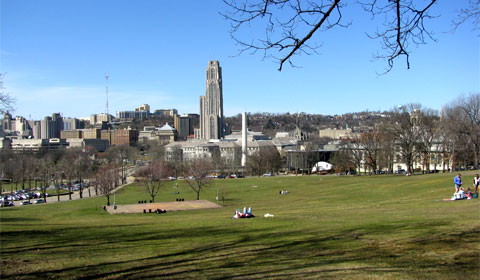
Pitt and Carnegie Mellon (with Forbes Quad & Baker Hall included) as seen from Schenley Park, Pittsburgh, PA, March 21, 2013. (http://milliverstravels.com).

Pitt and Carnegie Mellon (with Forbes Quad & Baker Hall included) as seen from Schenley Park, Pittsburgh, PA, March 21, 2013. (http://milliverstravels.com).

When I finally broke it to Larry at the beginning of March that I’d made this decision, he didn’t exactly try to convince me to stay. I think he knew why. An audit of the program in ’98 confirmed officially what I had learned anecdotally over my six years at Pitt. That there were students in the program who’d been ABD (All But Dissertation) since Nixon and Watergate. That fully half of my cohort from ’91 hadn’t even completed their master’s degrees, and only three of us (counting myself) out of twenty-one would ever go on to complete our doctorates. That no Pitt History grad student had obtained substantial research funding from outside the university since my Mom potty-trained me back in ’72-’73. And that politically, the powers that used to be in the department didn’t take my or Larry’s work with me seriously. Even if Larry didn’t see that, I sure did.

Off then, I went. Into the unknown known of CMU, conservative, elite and elitist, not sure if I’d ever be comfortable on the lily-White and honorary-White-as-Asian campus. Still, I reminded myself that Pitt was really only a couple of blocks away at the closest point between the two campuses, that I still had lots of friends and acquaintances there. I also knew, though, that my relationship with Trotter as my advisor would be crucial to my successful navigation of this drab and stuffy world. Too bad I wasn’t clairvoyant!
Colorism and the Enduring Power of School Daze

11 Monday Mar 2013

Posted by decollins1969 in 1, Academia, Boy @ The Window, culture, Eclectic, Jimme, Mount Vernon High School, Mount Vernon New York, Movies, My Father, Politics, Pop Culture, race, Youth

≈ Leave a comment

Tags

Brown Paper Bag Rule, Cafe au Lait, Color Struck, Colorism, Dark-Skinned, Fraternities, Giacarlo Esposito, Hazing, HBCUs, Hedonism, High Yellow, Internalized Racism, Intrarace Relations, Laurence Fishburne, Light-Skinned, Mo' Better Blues (1990), Pitt, Redbone, School Daze (1988), Shunning, Sororities, Spike Lee, Tar Baby, The Silent Treatment, Tisha Campbell, University of Pittsburgh, Wesley Snipes


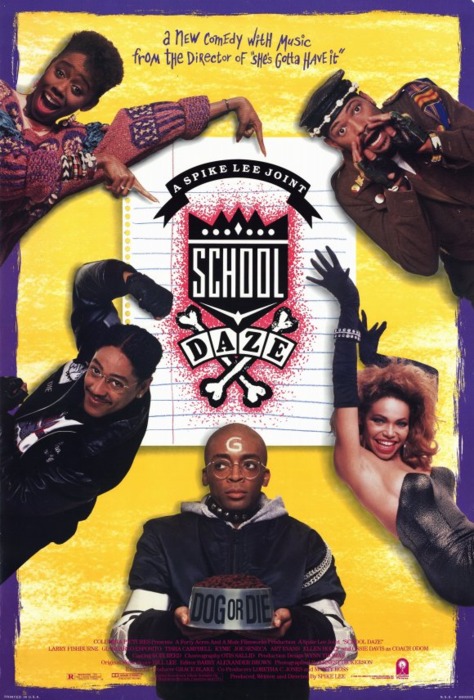
School Daze (1988) movie poster, September 17, 2012. (QuasyBoy via Wikipedia). Qualifies as fair use under US Copyright laws, as depicts subject of blog, is scaled-down and is of low-resolution.

School Daze (1988) movie poster, September 17, 2012. (QuasyBoy via Wikipedia). Qualifies as fair use under US Copyright laws, as depicts subject of blog, is scaled-down and is of low-resolution.

One of the few films I saw soon after it came out in theaters during my Boy @ The Window years was School Daze. It was in fact on this date twenty-five years ago that I went to the old theater in Pittsburgh that once was on Forbes Avenue near the Oakland Primanti Bros. sandwich place to see the film. It gave me some serious food for thought that Spring Break Friday evening, so much so that the lessons of School Daze have stayed with me to this day. Considering that I turned down a date with an upperclassman not interested in seeing the film in the process, School Daze was more than worth it.

The biggest lesson for me was on colorism. Not the macabre hazing of Q-dog frat boys and the cliquish AKA and Delta soros. Not the lack of care for the academic or the step-show battles. Not the hedonist behavior of Black middle class Gen Xers hell-bent on doing everything other than graduating from college. I already knew students like this at Pitt. Really, I already knew former classmates from Mount Vernon High School who attended HBCU’s like Howard, Morehouse, Hampton and Spelman, the kind of people who’d be perfect candidates for this Spike Lee joint. That they would psychologically and physically abuse each other in bed and on campus didn’t surprise me in the least.

"Good and Bad Hair" scene, School Daze (1988), March 10, 2013. (Donald Earl Collins via YouTube). Qualifies as fair use (see previous picture).

“Good and Bad Hair” scene, School Daze (1988), March 10, 2013. (Donald Earl Collins via YouTube). Qualifies as fair use (see previous picture).

No, it was the issue of being color-struck that was truly eye-opening for me. For I think I always knew on a semi-conscious level that colorism was alive and well among Black folks I’d come to know in Mount Vernon and in my first year at Pitt. It was frequently subtle, but also occasionally out in the open. With terms like “café au lait,” “redbone,” “mocha,” “caramel,” light-skinned,” “high yeller,” “dark-skinned,” “tar baby,” “chocolate-brown,” “good hair,” “nappy head,” “paper-bag brown,” and “light, bright and almost White,” among others. With obvious preferences among my male and female counterparts for young Black women and (sometimes) young Black men who passed the brown-paper-bag rule. (For those unfamiliar, if a Black male or female’s skin color was lighter than a brown paper bag, they were light enough to be attractive and acceptable by others. In terms of beauty, sometimes in pledging to a sorority or fraternity, often in terms of being part of a popular and better connected circle of Black folk.)

I certainly saw it with my father Jimme, who threw around the word “redbone” in my last year of high school as if the only young women in my NYC-area universe were light, bright and almost White. But I also saw it in the cliquishness and popularity of some of my classmates and other MVHS attendees and alumni. The most prominent of them at the time was Albert Brown, aka, Al B. Sure. Despite the uni-brow and limited talent, he went a long way in terms of popularity with his Class of ’86 and in the years immediately after high school. But there were others, classmates with bit-role appearances on ABC’s All My Children, folks whose entire circle of so-called close friends met some internalized color line.

It’s safe to say that by the time I left the theater — about 9 pm that Friday — I was actually angry. I wanted to take Giancarlo Esposito behind a building and beat him into another world. But more than that, it put some of the issues I had with high school and my first year at the University of Pittsburgh in perspective. Obvious and subtle forms of bigotry, individual racism and institutional/structural racism are all things I expected to face. This internalized bigotry on the basis of skin color, though, explained some of the shunning that I’d faced in my last couple of years of high school (see my post “The Silent Treatment” from June ’11) especially.

Hazing scene from School Daze (1988), March 10, 2013. (http://tumbler.com). Qualifies as fair use (see previous picture).

Hazing scene from School Daze (1988), March 10, 2013. (http://tumbler.com). Qualifies as fair use (see previous picture).

Yeah, I was weird because I was in a weird place in terms of domestic violence, child abuse and welfare poverty in those years. I didn’t help matters by being down with Tears for Fears and Sting and Mr. Mister and by often walking at Warp Factor Three or higher to cover the twenty-acre school between classes. But being poor and looking poor and a darker shade of brown was the first thing the Rick James-Eddie Murphy “Party All The Time” set saw, even before I turned into a blur walking past them every day.

A few years after School Daze, I went to David Lawrence Hall to watch the Pitt Film Club’s showing of Mo’ Better Blues (1990) with Denzel Washington and Wesley Snipes. A decidedly light-skinned underclassman (who was in my easy-A Intro to Black Studies course – I was a senior at Pitt by this time) – let’s call her ‘R’ – saw me and decided to sit with me to watch the film. Every time Wesley Snipes was on the screen, she commented on how dark he was. Making me uncomfortable, to say the least.

I finally asked, “Well, what about me?,” given her obvious distaste for Snipes. “Oh, you’re fine. Wesley’s just too dark,” R responded. I did a double-take, realizing that her perspective on skin color was just too odd for words. A quarter-century later, and my guess is that there are Black folks (and Whites who love “dark”-skinned Blacks) who still need to “WAAAAKKKKKE UUUUUUPPPPPPP!”

Seasons of Flu

26 Tuesday Feb 2013

Posted by decollins1969 in 1, Academia, Boy @ The Window, culture, Eclectic, Work, Youth

≈ 1 Comment

Tags

Biohazard, Biohazardous, Carnegie Mellon University, Chills, East Liberty, Flu, Hygiene-Challenged College Students, Influenza, Overworked, Pitt, PNC Bank, Poor Hygiene, Rest, Students, Sweats, Symptoms, Teaching, Teaching and Learning, Theraflu, University of Pittsburgh


God Bless You cartoon, January 2013, February 26, 2013. (http://www.cartoonaday.com).

God Bless You cartoon, January 2013, February 26, 2013. (http://www.cartoonaday.com).

I’ve had the flu three times in my life: February ’77, March ’86 and February ’93. I’ve had the stomach flu at least half a dozen times, including the week after I marched for my doctorate in May ’97. But given my IBS (Irritable Bowel Syndrome) issues, the stomach flu’s nothing compared to full-on influenza.

I get my flu shots regularly these days, but twenty years ago, I knew nothing about protecting myself from the illness that has caused the deaths of 36,000 people on average every year. So it was during my second year of graduate school at Pitt. It was a particularly bad flu season in Pittsburgh — in fact, in the whole northeastern US — the winter of 1992-93.

What made that winter particularly terrible for me was the fact that I had four discussion sections of US History to 1877 students to teach that semester, 120 students in all. Not to mention the requirement of showing up for every one of Bill Stanton’s lectures, in which more than 200 students attended twice a week. I was in constant contact with students that semester, with office hours, my first letters of recommendation and students needing makeup exams.

Biohazard symbol (orange), May 29, 2009. (Nandhp via Wikipedia). In public domain.

Biohazard symbol (orange), May 29, 2009. (Nandhp via Wikipedia). In public domain.

I risked exposure to these unkempt, hygienically-challenged students at least four days a week from the beginning of January on. By the third week of February, I had a section in which six out of eighteen students had shown up with the flu or flu-like symptoms. They sneezed, coughed and breathed their way through my Friday morning class, leaving their biohazardous tissues on the conference table or in an overflowing garbage can.

My first symptoms showed up by the end of the day that last Monday in February. At first, I thought that I had caught a cold. I kept working full-tilt on my quantitative methods project to fulfill my last non-class-taking requirement before any potential PhD comprehensive exams next year. It was only a potential prospect, as I was also working with Joe Trotter and then graduate advisor John Modell on a deal to transfer my graduate school credits to Carnegie Mellon, in order to finish my history doctorate there.

So I barely noticed that Tuesday and Wednesday that my lymph nodes had swollen, my teeth started to hurt, and my body temperature seemed off. I attributed it to another cold snap, and had the nerve to even play a game of pick-up basketball up on the hill Tuesday afternoon. By the end of the day on Wednesday, though, I felt it all. I was way too hot one minute, cold and shivering the next, sweating all the while. My nose was red and running like a mucus faucet. And every part of me ached, like I was in the midst of going through three years’ worth of puberty, all at once, and all at the age of twenty-three.

I went home, hoping to be better in time for my discussion sections at 2 pm and 3 pm on Thursday. Even though I felt even worse, I went in to teach that next day, barely able to wait ten minutes for the 71B bus outside of my place on Highland Avenue. The two sections that afternoon were a blur, as my mouth was dry and my mind was a swirling mess.

The only medication I had was two packs of two-year-old Theraflu and some Advil. I’d taken one pack of the Theraflu before my sections that morning, which may have been why I felt like my mind was floating and my kidneys were flooding at the same time. My monthly TA paycheck for teaching was due to me via a direct deposit into my PNC Bank account at 12:01 am that Friday. Only then could I go get some more chicken noodle soup and safer Theraflu to take for my flu-ridden body.

Theraflu Maximum Strength, circa 1998, February 26, 2013. (http://drugstore.com).

Theraflu Maximum Strength, circa 1998, February 26, 2013. (http://drugstore.com).

I stood at the PNC Bank ATM at 12:05 am that Friday, February 26 — the one on the corner of Highland and Penn Avenue in East Liberty — shivering and looking from side to side in case some wannabe thug was on the prowl. I managed to get fresh meds and soup at Giant Eagle, and fell asleep at 1 am. Somehow I woke up six hours later, woozy, somewhat refreshed, and hoarse. I still taught my other two sections at 9 and 10 am.  Then I went home to rest, because I was to be part of some PAGPSA gathering  (see my post “James and the PAGPSA” from November ’12 for more) and presentation on campus at 6 pm that evening.

What did I learn from all of this? To stay away from sickly students, for one. To drink and take lots of vitamin C. That I should take the time off when I was really, truly sick. That flu shots were ninety-five percent effective at preventing people from picking up the flu of a given season. Most of all, that I was truly a part of this world, and that flu could kick ass in my super-strong immune system as well.

The Emotional, The Personal and Black History

01 Friday Feb 2013

Posted by decollins1969 in 1, Academia, Boy @ The Window, culture, Eclectic, Movies, Patriotism, Politics, Pop Culture, race, Youth

≈ 3 Comments

Tags

A Lynching in Marion, African American History, Anger, Black History, Black History Month, Carnegie Mellon University, Comparative Slavery, Emotions, Fear, Fogel and Engerman, Grief, Indiana (1995), Irony, Jim Crow, Larry Glasco, Laurence Glasco, Learning, Lynching, Pitt, Racism, Rage, Roots (1977), Sarcasm, Seymore Drescher, Slavery, Students, Sy Drescher, Teaching and Learning, Time on the Cross (1974), UMUC, University of Pittsburgh


Black History Month 2013 electronic poster, February 1, 2013. (http://dclibrary.org).

Black History Month 2013 electronic poster, February 1, 2013. (http://dclibrary.org).

After all of these years — and thirty-seven years’ worth of Black History Months — I sometimes forget how emotionally charged Black history can be. After all, I’m an academically trained historian, one whose emotional range varies from sarcastic to ironic with most things US, World and African American history. But ever so often, I’m reminded by my students about the sadness and pain involved in learning history. I surprise myself sometimes at how passionate or angry I can become in revisiting a piece of history that I otherwise would show no emotion for on most days.

Black history, though, can bring out both the water works and the daggered eyes. My African American history students at Carnegie Mellon University surprised me one day in October ’96 during a discussion I tried to have about lynching and the KKK. It was based on the Indiana PBS documentary, A Lynching in Marion, Indiana, about the lynching of two Black men and the almost lynching of a young Black male for allegedly killing and robbing a White male and raping a young White female in 1930.

The forty-five minute documentary showed clips of defaced and emasculated Black men hung from trees, beaten beyond recognition and even burned postmortem. It also showed films of KKK rallies in the 1920s and early 1930s Indianapolis and other towns in the state, as well as pictures from the Marion lynching itself. The young Black man in Marion, one James Cameron, was only saved from lynching because a member of White mob actually protected him. It turned out, per usual, that the alleged murder and rape was a false accusation, but Cameron still had to spend four years in jail for a crime he didn’t commit.

Thomas Shipp and Abram Smith, lynched in Marion, IN, August 7, 1930. (Lawrence H. Beitler). Qualifies as fair use under US Copyright laws, as It is the only image known to depict this hanging, and is used here to illustrate the event.

Thomas Shipp and Abram Smith, lynched in Marion, IN, August 7, 1930. (Lawrence H. Beitler via Wikipedia). Qualifies as fair use under US Copyright laws, as It is the only image known to depict this hanging, and is used here to illustrate the event.

My students could barely speak to me or each other after the film, much less be part of a dispassionate discussion of the film. My Black students were tearful and angry, and my White students were pale and scared. I let them express their emotions for about ten minutes, but waited until the next class to draw out a more comprehensive discussion. As this was the first standalone class I’d taught as an adjunct professor, I was a bit unprepared for the how emotional my students became, how personally they took the film and its content.

But I should’ve been better prepared, especially given my own emotions about Black and other histories over the years. I remember the first time I watched Roots, along with millions of other Americans, in February ’77. I cried or was stunned that whole week. Twelve years later, in my undergraduate readings seminar for History majors at Pitt, I found myself angry with my classmates. My eventual first graduate advisor Larry Glasco was leading a discussion on slavery and the Middle Passage. I didn’t know why, but I was angry that whole class. It wasn’t just a knee-jerk anger. It was a low-heat rage, beyond anything my idiotic classmates were saying about slavery in the eventual US not being as brutal as slavery in the Caribbean or Brazil.

The following semester, I took my first graduate course as a Pitt junior, Comparative Slavery with Sy Drescher. We got into a discussion of Fogel and Engerman’s Time on the Cross (1974), a study in which the authors tried to show scientifically that slavery wasn’t as bad for Africans in the US as it was for Africans in the Caribbean and Brazil. Using records from one plantation, Fogel and Engerman tried to show that since few slaves were whipped, that therefore slavery wasn’t brutal for my African ancestors. I was pissed when some of the grad students in my class defended Time on the Cross  idea that 1,800 calories a day was sufficient for the average slave. It pissed me off so much that I had to leave the seminar room for five minutes to make sure I didn’t punch someone.

Me really pissed, at CMU PhD graduation, Pittsburgh, PA, May 18, 1997. (Angelia N. Levy).

Me really pissed, at CMU PhD graduation, Pittsburgh, PA, May 18, 1997. (Angelia N. Levy).

I see some of this in my UMUC students sometimes. Students who turn every issue in US history into a referendum on race. “Immigrants exploited? Well, not compared to African Americans as sharecroppers!” Or “Jim Crow was really a second slavery,” some of my students have said emphatically, as if Blacks did nothing during Reconstruction or Jim Crow to make their lives better. They feel, and rightfully so for the most part, that Blacks have gotten a raw deal throughout American history, and that it is my job to expose the hypocrisy of racism in every lecture and discussion.

It’s emotional and it’s personal. But it’s also historical, which means not so much putting emotions or personal investment aside as much as it does putting these emotions and personal investments in perspective. I’ve never been dispassionate about history – I’ve just learned how to use my New York-style sarcasm to hide my passion pretty well.

All Work and No Play

28 Monday Jan 2013

Posted by decollins1969 in 1, Academia, Boy @ The Window, Christianity, culture, Eclectic, Hebrew-Israelite, Mount Vernon New York, Pop Culture, race, Religion, Work, Youth

≈ Leave a comment

Tags

616, 616 East Lincoln Avenue, Acid, Acting, Atheism, Balance, CIS, Computer and Information System, Evolution, Falcon Crest, Fringe, History Major, Intolerance, John Noble, LSD, Neal Galpern, Pitt, Religion, Robert Foxworth, Sexual Harassment, University of Pittsburgh, Walter Bishop, Yin and Yang


Yin & Yang symbol from Taoism, good symbol for balance in life, January 28, 2013. (http://taoism.about.com).

Yin & Yang symbol from Taoism, good symbol for balance in life, January 28, 2013. (http://taoism.about.com).

As those high schools students I taught through JSA at Princeton in the summers of ’08 and ’09 either have come to realize or are realizing now, finding balance between school, full-time or part-time work, family and some semblance of a social life is just a tad difficult. Sometimes, it’s even impossible. So it was for me the spring of ’89, the last spring before I’d put together what I came to call my “16-week strategy for success and a social life.”

It was the semester where in which I worked 36 hours a week over a seven-week period and faced sexual harassment from a co-worker who was the BFF of my supervisor of Pitt’s Cathedral of Learning labs for Computer and Information Services (CIS) (see my post “On People and Stress” from February ’09). It was the last semester in which I had to worry about my mother and my younger siblings from afar because of the possibility of domestic violence, as my idiot stepfather Maurice still lived with them at 616.

This was my first set of classes as a History major, but I also had some general ed requirements to fulfill (see my post “Major Change” from October ’10). It would’ve been a tough semester even if I hadn’t worked, but with the CIS schedule the way it was, I was in for an interesting ride. For Macro, the chair of the Economics department was our professor. The class was at nine o’clock in the morning on Tuesdays and Thursdays, with a discussion section at 8 am on Tuesday to boot. It was almost as if he wanted folks to fail. With my schedule the way it was, I rarely made it to class on Tuesdays, and I only made it to one discussion section all semester long. To make up for that, I never missed the class on Thursdays, and often participated in the lecture discussions, such as they were.

Actor Robert Foxworth on Broadway in August: Osage County, August 2008. (Joan Marcus/Playbill).

Actor Robert Foxworth on Broadway in August: Osage County, August 2008. (Joan Marcus/Playbill).

Shakespeare was later in the day on Tuesdays and Thursdays, taught by Wion, who looked like the actor Robert Foxworth from the CBS show Falcon Crest, only not quite as handsome. He delivered lines from Taming of The Shrew and Othello like he’d been a wannabe actor in a previous career but realized teaching was more of his shtick. Wion often used Freudian pop psychology to explain the motives of characters in Shakespeare’s plays, and as he did, all of our eyes glazed over. This analysis for us was so ’70s, especially for the second-wave feminists in the class.

My Bio and Philosophy classes seemed to fit under the theme of “questioning God,” as there were students in both who had an ax to grind against “dumb Christians.” Bio in some ways was easier, at least because we had a professor who understood why some of us who were Christian might find evolution difficult to swallow. After several yelps from students during one of his lectures on evolution, mutation and reproduction, he said, “just because there’s evolution doesn’t mean that God doesn’t exist. Who’s to say that evolution isn’t a higher being’s method for the creation of life?” I appreciated that answer very much.

In existentialism class, especially the discussion section, no reconciliation was possible. My discussion section instructor was an Australian man in his late-twenties, with curly hair like the lead singer from Simply Red, except my instructor’s hair was a dirty blonde. He spent discussion after discussion railing on Christians as “people who refuse to believe that God doesn’t exist.” One of our discussions was so anti-anything other than atheism that I found it just as bigoted as anything I’d heard from Hebrew-Israelites or out of a televangelist’s mouth, and said as much. I was ignored.

No class that semester drove me nuts like my History majors writing seminar with Neal Galpern. We met on Monday and Wednesday afternoons for about an hour and a half, and it was the most boring hour and a half on my schedule. Galpern was an aging hippie complete with comb-over who graduated with doctorate in hand from Berkeley in ’75. He sometimes acted like he was still dropping acid. His stuttering starts and stops and numerous “Um”s could stop his lectures and our discussions cold. He wanted each of us to write a research-based paper of no less than twenty papers on any comparative topic in history that we could come up with, as vague as the man himself.

John Noble as Dr. Walter Bishop on Fringe, Season 5, after dropping acid, December 2012. (http://fringetelevision.com).

John Noble as Dr. Walter Bishop on Fringe, Season 5, after dropping acid, December 2012. (http://fringetelevision.com).

I couldn’t stand Galpern and his constant skipping over my hand in class and his snarky comments to all of us as if we were all dense and he was clearer than Antarctic ice melt. I didn’t challenge Galpern in class, at least not directly. I challenged him with my project. I decided to do a paper that compared the main features of the Civil Rights Movement in the US to the Anti-Apartheid Movement in South Africa. Admittedly it was too big a project, but it was Galpern’s job to help me narrow the topic into a doable chunk.

Instead all the advice he gave me consisted of “You need to find another topic, um . . . because, um . . . I’m afraid . . . I don’t, um . . . know much . . . about this.” I refused to budge. I wasn’t about to do a stupid paper on medieval Europe just because that happened to be his area of alleged expertise. After a meeting where Galpern finally gave in to me, I went across the hall to our classroom on the third floor of Forbes Quad and imitated my professor’s halting style of conversation. Galpern walked in, and I just kept going until I finished my, um, sentence. Yeah, it would be safe to say that he didn’t like me too much either!

I finished that semester with two A-‘s in my writing seminar and in existential philosophy, a B+ in Shakespeare, a B in Biology, and even pulled out a C+ in Macro, despite my lack of attendance. It was a difficult time. Yet it was also the start of my growth into early adulthood, and understanding that finding balance would be the key to sustained success.

The Falsehoods of a Civil Rights Movement Legacy

15 Tuesday Jan 2013

Posted by decollins1969 in 1, Academia, Boy @ The Window, culture, Eclectic, Mount Vernon High School, Mount Vernon New York, New York City, Patriotism, Politics, Pop Culture, race, Youth

≈ Leave a comment

Tags

Birthday, Civil Rights, Civil Rights Movement, Class Divide, Educational Aspirations, Estelle Abel, Generation X, Generation Y, Generational Divide, Generational Prejudice, Legacy, Martin Luther King Jr., Mythology, Myths, Police Brutality, Post-Civil Rights Generation, Poverty, Racism, Stop and Frisk


Martin Luther King, Jr. Memorial statue, National Parks Service, Washington, DC, August 2, 2012. (NPS via Wikipedia). Qualifies as fair use under US Copyright laws, as this is a 2D picture of a 3D sculpture.

Martin Luther King, Jr. Memorial statue, National Parks Service, Washington, DC, August 2, 2012. (NPS via Wikipedia). Qualifies as fair use under US Copyright laws, as this is a 2D picture of a 3D sculpture.

Well, it’s not officially Martin Luther King Day yet, but since Dr. King was actually born on January 15, 1929, better for me to talk about him today than next week. Especially with President Obama’s second inaugural going on at the same time. But what a legacy! Yet his generation of civil rights activists and righteous protesters have done as much harm to his legacy as have conservatives invoking his “I Have a Dream” speech every time they’re called out on their bigotry.

Yeah, that’s right, I said it! One of the benefits — if you want to call it that — of being born in ’69 is that I’ve witnessed the devolution of the Civil Rights Movement and its leaders and followers into a gauntlet of gatekeepers who expect everyone from my generation to start every sentence paying homage to their sacrifices. I have no problems with that, at least in theory. But the reality is that most folks from the Civil Rights generation — at least the successful ones — made few if any sacrifices for “the cause.” They were in the right place at the right time with the right education and managed to find jobs, careers and positions of influence while the least fortunate of us all saw few material or psychological benefits from Dr. King’s ultimate sacrifice.

I’ve already talked at length about Estelle Abel, a former Mount Vernon High School Science Department chair (see my posts “My Last Day” from June ’11 and “In-Abel-ed” from June ’12 for much more). Her soliloquy about sacrifice and the Civil Rights Movement was supposed to make me feel bad about letting Black Mount Vernon, New York down because I only graduated fourteenth in my class out of over five hundred students. There are others, former and current teachers, professors, librarians, politicians, writers, producers, editors, pastors, politicians, bosses and charlatans who’ve made a point to discuss their elitist notions of the Civil Rights Movement and generation with me.

Hundreds of thousands descended on Washington, DC's Lincoln Memorial August 28, 1963. (Marines' Photo via Wikipedia). In public domain.

Hundreds of thousands descend on Lincoln Memorial August 28, 1963. (Marines’ Photo via Wikipedia). In public domain.

But most — if not all — of these folks are wrong about their glorified view of the Movement and its legacy four and a half decades later. For college educated, middle class African Americans, life has gotten better, even with bigotry, glass ceilings, DWB, a less stable economy, and the conservative backlash that has gone on unabated since the three years before Dr. King’s assassination. For Blacks not as fortunate, almost nothing has changed, at least not for the better.

Some of it, to be sure (and to cut Bill Cosby some slack), is because of individual choices and poor decision-making. Folks, however, can rarely make decisions outside of their own context and circumstances — think outside of the box, in other words — without a significant amount of help. Poverty in all of its forms is just as grinding now as it was a half-century ago. To expect people from the generations since Dr. King to suddenly forget their poverty, abuse, neglect and exploitation and give praise to a generation where many but far from most made sacrifices for the Movement is ludicrous.

I’m certain that had Dr. King lived over the past forty-five years, he wouldn’t have stood by to allow his generation to constantly criticize the under-forty-five as slackers and immature and unfocused, as folks more concerned with money than equality. King likely would’ve made the point that the post-Civil Rights Generations X and Y are merely a reflection of their upbringing, of their parents and teachers and mentors’ nurturing and training. He would’ve made the same point that others from his generation like the late law professor and scholar-activist Derrick Bell has made over the years. That fighting racism, educational neglect and economic exploitation requires more tools than the moral high-ground, protests, marches, a sympathetic media and obvious redneck tactics. The Movement is itself a shifting terrain that requires new tools and tactics to achieve small victories over a long period of time, longer than most folks from the era are willing to admit.

I actually don’t have a strong ax to grind against the Civil Rights generation. Without folks like Dr. King or Jesse Jackson, Medgar Evers or Ella Baker, I wouldn’t have found myself in a gifted-track program in middle school or high school in the ’80s. But let’s not act as if my life was a walk in the park. The legacy of the Civil Rights era never stopped a fist from being thrown into my face by my now ex-stepfather. It never kept us from going on welfare or kept two of my siblings from bring diagnosed as mentally retarded.

NYPD Stop and Frisk caption (actual details for photo unknown), August 2012. (http://thinkprogress.org).

NYPD Stop and Frisk caption (actual details for photo unknown), August 2012. (http://thinkprogress.org).

Nor did the Civil Rights Movement’s legacy stop teachers and professors from putting up barriers to my success as a student or employers from putting up a glass ceiling in an attempt to slow my career advance. It never stopped me from being followed and frisked by police or harassed by overzealous security guards. It’s never paid one of my bills, kept food on my plate or kept me from experiencing homelessness. It’s never even been a source of pride, because that would mean that the Civil Rights Movement and its legacy would belong to me as much as it does to the people who allegedly marched with Dr. King.

I can’t wait for those who cling almost in desperation to the idyllic legacy of Dr. King and the cause to retire and fade away, for the ’60s to truly be over. Maybe that’s when folks from the post-’60s generation — folks like me who care about economic and educational equity, social justice and spiritual transformation — will be able to make an impact on our nation’s sorry state of consciousness without pouring libations to folks who gave up on Dr. King’s work ages ago.

Remembering Harold Meltzer

09 Wednesday Jan 2013

Posted by decollins1969 in 1, Academia, Boy @ The Window, culture, Eclectic, eclectic music, Mount Vernon High School, Mount Vernon New York, Politics, Pop Culture, race, Youth

≈ 5 Comments

Tags

AP US History, Bitterness, Confirmed Bachelor, Death, Dedication, Egalitarianism, Eulogy, Friendship, Harold I. Meltzer, Harold Meltzer, Homophobia, Humanities, Humanities Program, Learning, Life, Mentoring, Metropolitan Opera House, Morison & Commanger, Perseverance, Politics of Education, Self-Discovery, Teaching


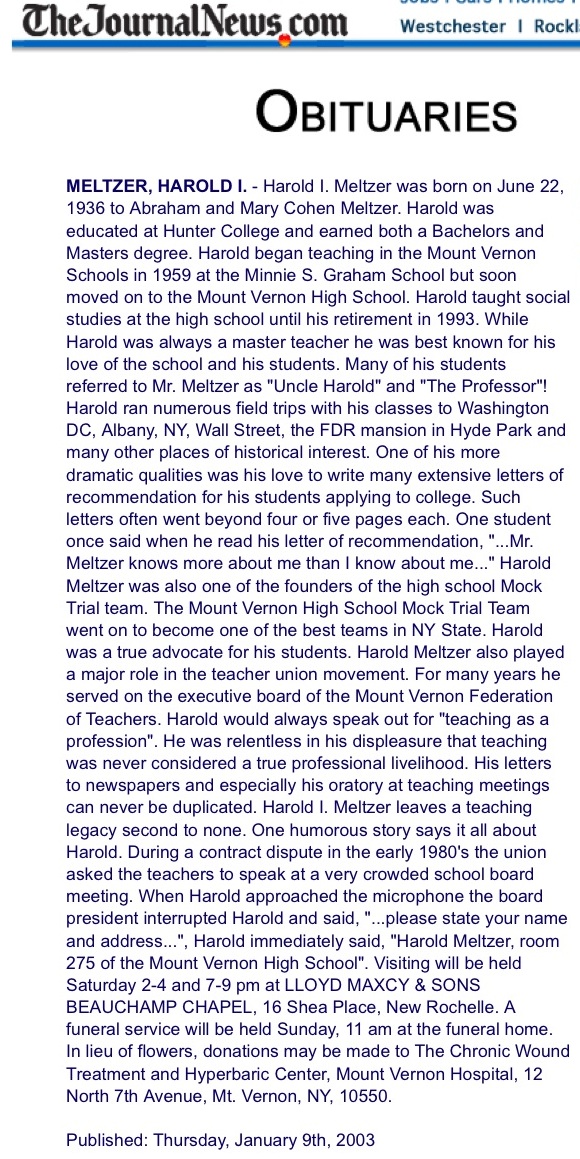
Harold Meltzer obituary (via Frank Pandolfo), January 9, 2003. (Westchester Journal News).

Harold Meltzer obituary (via Frank Pandolfo), January 9, 2003. (The Journal News).

Harold Meltzer, my favorite and best teacher of all, died on January 2, 2003 at the age of sixty-six, ten years ago last week. He was all too young and all too bitter about his years as a history teacher at Mount Vernon High School. But then, dealing with entitled parents and unrepentant administrators in Mount Vernon, New York for thirty-five years would do that to most people. Despite that, Meltzer was a rock, the first teacher since my elementary school years that I genuinely trusted with my family secrets and my inner self. He was the first and maybe only teacher I had in my six years of Humanities who actually seemed like he wanted to teach us (see my post “No Good Teaching Deed Goes Unpunished” from May ’11).

I met Meltzer on our last day of tenth grade, after three days of finals and Regents exams, on June 21, ’85. He had summoned fourteen of us to “Room 275 of Mount Vernon High School,” as the invitation read. We had all registered to take Meltzer’s AP American History class in eleventh grade, our first opportunity to earn college credit while in high school.

Meltzer started off talking to us about Morison and Commager — who I now know as the great consensus historians of the ’50s, until the social history revolution made their textbooks irrelevant by the ’80s — as we sat in this classroom of old history books and even older dust and chalk. Meltzer himself looked to be in his late-fifties (he was actually a day away from his forty-ninth birthday), tall and lanky except for the protruding pouch in the tummy section. His hair was a mutt-like mixture of silver, white and dull gray, and his beard was a long, tangled mess.

Met Logo and A full house, seen from rear of stage, at the Metropolitan Opera House (former bldg, 39th Street), for a concert by pianist Josef Hofmann, November 28, 1937. (National Archives via Wikimedia). In public domain.

Met Logo and A full house, seen from rear of stage, at the Metropolitan Opera House (former bldg, 39th Street), for a concert by pianist Josef Hofmann, November 28, 1937. (National Archives via Wikimedia). In public domain.

The way he spoke, and the way his eyes looked when he spoke made me see him as a yarmulke-wearing preteen on his way to temple. The force with which his words would leave his mouth hit me immediately. As much as I noticed how frequently spit would spew out of Meltzer’s mouth, the rhythm of his speech was slow and sing-song, like an elder or grandfather taking you on a long, winding, roller-coaster-ride of a story. Most of all, I knew that he cared — about history, about teaching, about us learning, about each of us as people. Maybe, just maybe, for some of us, he cared too much.

But for at least for me, Meltzer’s eccentric space in which he told Metropolitan Opera House stories and talked about egalitarianism extended beyond the historical. He was the first teacher I had since before Humanities who’d ask me if things at home were all right, and knew intuitively that things weren’t. He was the first to ask me about how poor my family was and about hunger. And he was the first teacher ever to ask if I had a girlfriend. Needless to say, these questions were unexpected. Yet through these questions, Meltzer had begun to crack my thin, hard wall of separation between school and family.

Because Meltzer cared deeply about reaching students — about reaching me — our student-teacher relationship because a friendship after high school and a mentoring one as well. I wasn’t looking for a mentor, and Meltzer was only being Meltzer. Still, his stories about his battles with MVHS administrators, Board of Education folk, and with upper-crust parents who believed their kids were entitled to A’s just for showing up, were filled with lessons of perseverance, patience, and looking beyond everyday headaches in order to reach people. While this wasn’t a factor in my going to graduate school and spending a significant part of my life as a history professor and educator, these stories have helped me over the years.

1972 Dodge Dart Dark Green (similar to '74 Dodge Dart Meltzer owned when I was at MVHS), December 25, 2009. (http://www.fotosdecarros.com).

1972 Dodge Dart Dark Green (similar to ’74 Dodge Dart Meltzer owned when I was at MVHS), December 25, 2009. (http://www.fotosdecarros.com).

But unfortunately, it was a factor in why Meltzer became embittered and took early retirement in June ’93. The end of the Humanities Program, the intolerance of some administrators toward Meltzer as a “confirmed bachelor,” the lack of decency — forget about gratitude — from many of his most successful students. Those changes, these things, all would take a toll on any teacher who’d stay after school day after day to run Mock Trial, to facilitate study groups, to work on letters of recommendation for students. But no, most of my former classmates who had Meltzer between ’85 and ’87, all they could say was that “Meltzer was weird” or that “I didn’t understand” his lessons.

I’m thankful that I did have Meltzer as a teacher, friend and mentor between ’85 and ’02. I’m thankful that I had a chance to interview him for what is now my Boy @ The Window manuscript in August and November ’02, just a couple of months before he passed (see my post “Mr. Meltzer” from June ’09). I’m glad that despite his physical and psychological pain, Meltzer welcomed me with open arms and answered my questions about his life and his career. I just wish that my former classmates and some of Meltzer’s more cut-throat colleagues had taken the time to really know the man.

← Older posts
Newer posts →

Boy @ The Window: A Memoir

Boy @ The Window: A Memoir

Places to Buy/Download Boy @ The Window

There's a few ways in which you can read excerpts of, borrow and/or purchase and download Boy @ The Window. There's the trade paperback edition of Boy @ The Window, available for purchase via Amazon.com at http://www.amazon.com/Boy-Window-Donald-Earl-Collins/dp/0989256138/

There's also a Kindle edition on Amazon.com. The enhanced edition can be read only with Kindle Fire, an iPad or a full-color tablet. The links to the enhanced edition through Apple's iBookstore and the Barnes & Noble NOOK edition are below. The link to the Amazon Kindle version is also immediately below:

scr2555-proj697-a-kindle-logo-rgb-lg

Boy @ The Window on Amazon.com: http://www.amazon.com/Boy-The-Window-Memoir-ebook/dp/B00CD95FBU/

iBookstore-logo-300x100

Boy @ The Window on Apple's iBookstore: https://itunes.apple.com/us/book/boy-the-window/id643768275?ls=1

Barnes & Noble (bn.com) logo, June 26, 2013. (http://www.logotypes101.com).

Boy @ The Window on Barnes & Noble: http://www.barnesandnoble.com/w/boy-the-window-donald-earl-collins/1115182183?ean=2940016741567

You can also add, read and review Boy @ The Window on Goodreads.com. Just click on the button below:

Boy @ The Window

Twitter Updates

Tweets by decollins1969
  • RSS - Posts
  • RSS - Comments

Archives

  • June 2025
  • April 2023
  • September 2022
  • August 2022
  • July 2022
  • June 2022
  • May 2022
  • April 2022
  • March 2022
  • January 2022
  • December 2021
  • November 2021
  • October 2021
  • September 2021
  • August 2021
  • July 2021
  • June 2021
  • April 2021
  • March 2021
  • February 2021
  • January 2021
  • December 2020
  • November 2020
  • October 2020
  • September 2020
  • August 2020
  • July 2020
  • May 2020
  • April 2020
  • March 2020
  • January 2020
  • December 2019
  • November 2019
  • August 2019
  • July 2019
  • June 2019
  • May 2019
  • April 2019
  • March 2019
  • February 2019
  • January 2019
  • December 2018
  • November 2018
  • October 2018
  • September 2018
  • August 2018
  • July 2018
  • June 2018
  • May 2018
  • March 2018
  • February 2018
  • January 2018
  • December 2017
  • November 2017
  • October 2017
  • September 2017
  • August 2017
  • July 2017
  • June 2017
  • May 2017
  • April 2017
  • March 2017
  • February 2017
  • January 2017
  • December 2016
  • November 2016
  • October 2016
  • September 2016
  • August 2016
  • July 2016
  • June 2016
  • May 2016
  • April 2016
  • March 2016
  • February 2016
  • January 2016
  • December 2015
  • November 2015
  • October 2015
  • September 2015
  • August 2015
  • July 2015
  • June 2015
  • May 2015
  • April 2015
  • March 2015
  • February 2015
  • January 2015
  • December 2014
  • November 2014
  • October 2014
  • September 2014
  • August 2014
  • July 2014
  • June 2014
  • May 2014
  • April 2014
  • March 2014
  • February 2014
  • January 2014
  • December 2013
  • November 2013
  • October 2013
  • September 2013
  • August 2013
  • July 2013
  • June 2013
  • May 2013
  • April 2013
  • March 2013
  • February 2013
  • January 2013
  • December 2012
  • November 2012
  • October 2012
  • September 2012
  • August 2012
  • July 2012
  • June 2012
  • May 2012
  • April 2012
  • March 2012
  • February 2012
  • January 2012
  • December 2011
  • November 2011
  • October 2011
  • September 2011
  • August 2011
  • July 2011
  • June 2011
  • May 2011
  • April 2011
  • March 2011
  • February 2011
  • January 2011
  • December 2010
  • November 2010
  • October 2010
  • September 2010
  • August 2010
  • July 2010
  • June 2010
  • May 2010
  • April 2010
  • March 2010
  • February 2010
  • January 2010
  • December 2009
  • November 2009
  • October 2009
  • September 2009
  • August 2009
  • July 2009
  • June 2009
  • May 2009
  • April 2009
  • March 2009
  • February 2009
  • January 2009
  • December 2008
  • November 2008
  • October 2008
  • September 2008
  • August 2008
  • July 2008
  • June 2008
  • May 2008
  • April 2008
  • March 2008
  • February 2008
  • January 2008
  • December 2007
  • November 2007
  • October 2007
  • September 2007
  • August 2007
  • July 2007
  • June 2007

Recent Comments

MaryPena's avatarMaryPena on My Day of Atonement/Bitter Hat…
decollins1969's avatardecollins1969 on No Good Teaching Deed Goes…
Mary Rose O’Connell's avatarMary Rose O’Connell on No Good Teaching Deed Goes…

NetworkedBlogs on Facebook

NetworkedBlogs
Blog:
Notes From a Boy @ The Window
Topics:
My Life, Culture & Education, Politics & Goofyness
 
Follow my blog

616 616 East Lincoln Avenue A.B. Davis Middle School Abuse Academia Academy for Educational Development AED Afrocentricity American Narcissism Authenticity Bigotry Blackness Boy @ The Window Carnegie Mellon University Child Abuse Class of 1987 CMU Coping Strategies Crush #1 Crush #2 Death Disillusionment Diversity Domestic Violence Economic Inequality Education Family Friendship Friendships Graduate School Hebrew-Israelites High-Stakes Testing Higher Education History Homelessness Humanities Humanities Program Hypocrisy Internalized Racism Jealousy Joe Trotter Joe William Trotter Jr. K-12 Education Love Manhood Maurice Eugene Washington Maurice Washington Misogyny Mother-Son Relationship Mount Vernon High School Mount Vernon New York Mount Vernon public schools Multiculturalism MVHS Narcissism NFL Pitt Pittsburgh Politics of Education Poverty President Barack Obama Race Racial Stereotypes Racism Relationships Self-Awareness Self-Discovery Self-Reflection Sexism Social Justice Teaching and Learning University of Pittsburgh Violence Whiteness Writing

Top Rated

Blog at WordPress.com.

  • Subscribe Subscribed
    • Notes from a Boy @ The Window
    • Join 103 other subscribers
    • Already have a WordPress.com account? Log in now.
    • Notes from a Boy @ The Window
    • Subscribe Subscribed
    • Sign up
    • Log in
    • Report this content
    • View site in Reader
    • Manage subscriptions
    • Collapse this bar
 

Loading Comments...