• About Me
  • Other Writings
  • Interview Clips
  • All About Me: American Racism, American Narcissism, and the Conversation America Can’t Have
  • Video Clips
  • Boy @ The Window Pictures
  • Boy @ The Window Theme Music

Notes from a Boy @ The Window

~

Notes from a Boy @ The Window

Tag Archives: Teaching and Learning

Teaching Teachers – and Learning, Too

05 Wednesday Jun 2013

Posted by decollins1969 in 1, Academia, Carnegie Mellon University, culture, Eclectic, Pittsburgh, Politics, Pop Culture, race, University of Pittsburgh, Youth

≈ Leave a comment

Tags

Academic Arrogance, Academic Expectations, Adjunct Teaching, Aspiring Teachers, Duquesne University College of Education, Education Foundations, History of American Education, Learning How to Teach, Lecturing, MAT Program, Pedagogy, Politics of Education, Teachers, Teaching and Learning


Sad teacher, May 9, 2013. (http://www.guardian.co.uk).

Sad teacher, May 9, 2013. (http://www.guardian.co.uk).

I’ve been in a classroom as a lecturer, teaching assistant, teaching fellow, instructor, or professor off and on since November ’91, and consistently as an adjunct associate professor for the past five and a half years. I’ve taught roughly 2,000 students in that time (not counting the high school students I worked with when I was Director of Curriculum with Presidential Classroom in ’99 and ’00). I’ve probably had about 100 or so difficult to impossible students in that time. But no group of students I’ve taught have been more difficult for me to work with than teachers, actual and aspiring. Yet I’ve learned more about teaching from teachers in my classroom than from any other group of students.

This month marks fifteen years since I taught my first graduate course, History of American Education at Duquesne University in Pittsburgh. It was my first opportunity to teach since I’d graduated from Carnegie Mellon University the spring before. It didn’t necessarily show. I figured out fairly quickly, though, that the students in this required education foundations courses weren’t the wide-eyed grinders I had during my Carnegie Mellon years.

Twenty-two students in all were in my course, and nearly half of them were already in the classroom at suburban schools scattered through Western Pennsylvania. Most of my students had at least five years on me, and the youngest was my age, twenty-eight years old. I had only one Black student, and a classroom full of ready-to-be-bored White women with low expectations for any history course. On top of that, we were supposed to meet for two hours a day, five days a week for six weeks. And all for the wonderful salary of $1,935!

Canevin Hall (where I taught for four semesters, Duquesne University, Pittsburgh, PA, June 5, 2013. (http://w4.campusexplorer.com).

Canevin Hall (where I taught for four semesters, Duquesne University, Pittsburgh, PA, June 5, 2013. (http://w4.campusexplorer.com).

I wasn’t intimidated. But I probably should’ve been. I taught the course as if I was teaching a watered down upper-level undergraduate history course, great if the course was only for history majors or high school history teachers (of which I had two or three). With so many actual teachers in my classroom, though, I realized by the beginning of the second week that they were privately critiquing my teaching style. They noted that I lectured too much, that I didn’t facilitate discussions well when I did have discussions, that my paper assignments were too open-ended for a group of classroom and aspiring teachers.

A student who didn’t like their B+ on the first paper assignment aggravated some of the tensions in this first class. She stood up during my review of their first papers and yelled that her master’s “thesis committee didn’t find as many problems with [her] writing” as I did. I said in response, “Well, I didn’t read your master’s thesis or grade it, for that matter.” Just short of losing control of my classroom, I met with the student in the hallway to settle her down (albeit by threatening to report her actions in my classroom to the dean) after that class meeting.

That first semester resulted in a love-hate relationship with the teachers I taught. Most truly liked the way I related US history to the short and winding history of American education. About a sixth of my students tore me apart in evaluations, criticizing everything from my lecture style to how I pronounced certain words with a “New York” or “Black” accent.

This only grew worse in my fall ’98 graduate course. I truly thought I’d drawn the worst group of students ever. Fourteen in all, and none of them seemed interested in earning an MAT (Master’s in Teaching), much less in an ed foundations course. They never seemed to do the readings, much less understand them.
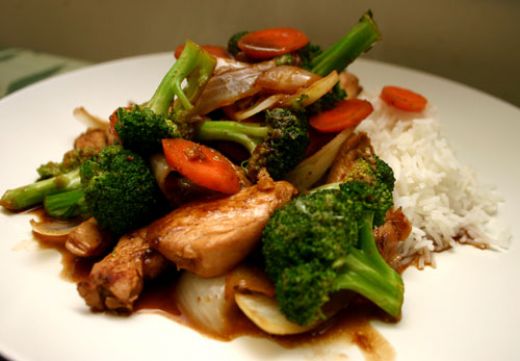
Chicken and broccoli stir-fry over rice, February 2013. (http://slimimzsolutions.com).

Chicken and broccoli stir-fry over rice, February 2013. (http://slimimzsolutions.com).

Two weeks before Thanksgiving, one of my students brought a chicken and broccoli stir-fry dinner to class, which she proceeded to eat during the lecture portion of my class. She continued during the break and into the discussion. No one was prepared. I finally asked, “How many of you have done the readings for this week?” Not a single student raised their hands. I immediately dismissed the class for the week, adding “there’s no need for us to have a discussion this week, then.” I said to the female student intent on eating her way through a three-hour class, “Now you have plenty of time to eat. Don’t bring your dinner to class again.”

I was so frustrated with this group of students. I mean, they were grad students, right? They seemed about as motivated as a group of ninth-graders at a low-performing school, on the verge of dropping out. I decided to do some background checking into my students, and realized that most of them barely met the 2.5 GPA requirement for the MAT program at Duquesne.

That’s when I also realized that some of what my students had said about me during my summer course was correct. I did lecture too much. I didn’t devote enough time to discussion. I never discussed what I wanted to see in their papers. Most importantly, I didn’t meet my students where they were before raising their expectations in their own academic performance. I treated them as if I didn’t care if they learned the material, even though I obviously did care.

I immediately began to apply these minor epiphanies in the last six weeks of this class, with my students more involved as I became more of a facilitator and less of a lecturer. While this group was hard on me in their evaluations, they also noted how their views of history as teachers had changed. Meanwhile, my views on teaching had changed, and for the better.

K-12 Curriculum as a Mystery Novel

02 Thursday May 2013

Posted by decollins1969 in 1, Academia, culture, Eclectic, Pittsburgh, Politics, Pop Culture, race, Youth

≈ 3 Comments

Tags

4th Grade, Facts of Life, Head of the Class, High-Stakes Testing, History, Homework, Immigration, Jacob Lawrence, K-12 Curriculum, K-12 Education, K-12 Education Reform, MAP-M, MAP-R, Maryland, MCPS, Migration, Montgomery County Public Schools, MSA, Mystery Novels, Parenting, Phillips Collection, Sherlock Holmes, Silver Spring, Social Studies, Student Development, Teacher-Parent Relationship, Teaching and Learning, Textbooks, The Migration Series, Washington DC, Writing


Unsolved Mysteries, December 19, 2011. (http://news.discovery.com).

Unsolved Mysteries, December 19, 2011. (http://news.discovery.com).

This week, my son will complete a fourth-grade project in which he interviewed his Pittsburgh grandmother about her migration experience from rural Arkansas to Pittsburgh, Pennsylvania during the Depression decade. Sounds pretty good — and very advanced — on the surface of things. But the reality of how this school project evolved shows how much has changed — and not for the better — regarding schools and curriculum. For my son’s school in Silver Spring, Maryland, for Montgomery County Public Schools and for schools across the country.

You see, the bulk of testing season is over for MCPS’ elementary schools. So instead of practice tests, formative assessments (otherwise known as “formatives”) and the actual exams (MSA, MAP-M and MAP-R), the teachers now have to focus on lesson plans that aren’t test-driven. For April, the fourth-grade teachers at my son’s school decided to do a social studies project on immigration. They started with a wax museum project at school, as well as a field trip to the Phillips Collection in DC.

This was where things began to get interesting for me as a parent. The permission slip for the field trip presented this unit as immigration. Yet in my son’s trip to the Phillips Collection, him and his classmates would peruse a set of Jacob Lawrence’s paintings on migration. For those of you who don’t know, Lawrence’s most famous paintings were of the Great Migration of African Americans from the rural South to the urban North between roughly 1915 and 1930.

Jacob Lawrence: Migration Series, Phillips Collection, Washington, DC (1993), May 1, 2013. (Elizabeth Hutton Turner; http://ucdavis.libguides.com/).

Jacob Lawrence: Migration Series (Cover Art), Phillips Collection, Washington, DC (1993), May 1, 2013. (Elizabeth Hutton Turner; http://ucdavis.libguides.com/).

I could barely contain the historian side of me when I read such an obvious and unbelievable error. But I decided to not assume that the fourth-grade teachers made the decision to treat immigration the same as migration. So I hand-wrote a note that politely suggested that they make a correction on the permission slip and for the overall assignment, since immigration and migration aren’t the same at all.

This was the response I received by email on April 4:

“We have had this wonderful trip planned for the 4th grade for the past 4 years and we always make sure to front load the students with information about the migration process.”

When teachers go into placating-mode without actually addressing my concerns as a parent (and an educator, for that matter), it’s usually a sign of trouble where there otherwise shouldn’t have been any trouble.

Then, nearly two weeks ago, my son brought home his interview/presentation assignment based on the wax museum project and his Phillips Collection field trip. It was titled “Immigrants in Their Own Words.” The fourth-grade teachers had charged the students — including my son — with the task of finding a family member who had immigrated to the US, interviewing them and asking them questions like “In which year did you come to America?” and “What is the biggest difference between America and your country of origin?”

Flabbergasted is just the beginning of my deep sense of puzzlement over the assignment. It was an assignment straight out of a Facts of Life or Head of the Class episode from the 1980s, culturally and racial insensitive to the core. After all, the height of White immigration to the US ended nearly a century ago. For Blacks, well, if I have to explain it, then it may be worth the while of those of you who do teach to take my History of American Education course (that is, whenever I get to teach it again).

My wife wrote an email about this follow-up assignment, to which my son’s teacher replied, “[e]migration and [i]mmigration are almost splitting hairs.” Really? In what history or ed foundations course? With some prodding, we were given the opportunity to adapt the assignment so that my son could work on migration. Of course, even without that note, I would’ve insisted on him doing migration anyway.

Mysterious...the new Sherlock Holmes, January 17, 2011. (H. Armstrong, Roberts/Corbis; http://www.guardian.co.uk/).

Mysterious…the new Sherlock Holmes, January 17, 2011. (H. Armstrong, Roberts/Corbis; http://www.guardian.co.uk/).

That this process was poorly executed is only part of the story. For nearly five years, my son’s curriculum has been a mystery to me, as it jumped around from pre-algebra to basic addition, from writing letters in which he could write phonetically to having to write about beetles in grammatically correct but short sentences. After five years, my son has never brought a textbook home. The weekly emails from teachers and postings on the neighborhood school website and the MCPS website tell me a lot about nothing.

In sum, I know quite a bit about test dates, subject areas and sometimes subject matter in which the state of Maryland and the school district will test the students. What we don’t know from day one of any school year are the themes for each subject for the year or for any given marking period. Because of the priority of testing above all else, the amount of time in the curriculum on subjects like social studies has narrowed, and with it, a teacher’s ability to be autonomous and to think through curriculum in a critical manner. And without textbooks, I as a parent can’t truly anticipate how to help prepare my son for any new or potentially challenging materials.

It’s difficult, though, to anticipate that your son will come home with an assignment on immigration in the fourth marking period of fourth grade. Especially when I as a history professor know how complicated these processes are for undergraduate and graduate students to wrap their brains around. Especially since my son has yet to write a full-fledged book report on any any book he has read for school. Or spent significant time on history or other, non-test-related subjects. Education should always be a journey, but never a mystery.

Seasons of Flu

26 Tuesday Feb 2013

Posted by decollins1969 in 1, Academia, Boy @ The Window, culture, Eclectic, Work, Youth

≈ 1 Comment

Tags

Biohazard, Biohazardous, Carnegie Mellon University, Chills, East Liberty, Flu, Hygiene-Challenged College Students, Influenza, Overworked, Pitt, PNC Bank, Poor Hygiene, Rest, Students, Sweats, Symptoms, Teaching, Teaching and Learning, Theraflu, University of Pittsburgh


God Bless You cartoon, January 2013, February 26, 2013. (http://www.cartoonaday.com).

God Bless You cartoon, January 2013, February 26, 2013. (http://www.cartoonaday.com).

I’ve had the flu three times in my life: February ’77, March ’86 and February ’93. I’ve had the stomach flu at least half a dozen times, including the week after I marched for my doctorate in May ’97. But given my IBS (Irritable Bowel Syndrome) issues, the stomach flu’s nothing compared to full-on influenza.

I get my flu shots regularly these days, but twenty years ago, I knew nothing about protecting myself from the illness that has caused the deaths of 36,000 people on average every year. So it was during my second year of graduate school at Pitt. It was a particularly bad flu season in Pittsburgh — in fact, in the whole northeastern US — the winter of 1992-93.

What made that winter particularly terrible for me was the fact that I had four discussion sections of US History to 1877 students to teach that semester, 120 students in all. Not to mention the requirement of showing up for every one of Bill Stanton’s lectures, in which more than 200 students attended twice a week. I was in constant contact with students that semester, with office hours, my first letters of recommendation and students needing makeup exams.

Biohazard symbol (orange), May 29, 2009. (Nandhp via Wikipedia). In public domain.

Biohazard symbol (orange), May 29, 2009. (Nandhp via Wikipedia). In public domain.

I risked exposure to these unkempt, hygienically-challenged students at least four days a week from the beginning of January on. By the third week of February, I had a section in which six out of eighteen students had shown up with the flu or flu-like symptoms. They sneezed, coughed and breathed their way through my Friday morning class, leaving their biohazardous tissues on the conference table or in an overflowing garbage can.

My first symptoms showed up by the end of the day that last Monday in February. At first, I thought that I had caught a cold. I kept working full-tilt on my quantitative methods project to fulfill my last non-class-taking requirement before any potential PhD comprehensive exams next year. It was only a potential prospect, as I was also working with Joe Trotter and then graduate advisor John Modell on a deal to transfer my graduate school credits to Carnegie Mellon, in order to finish my history doctorate there.

So I barely noticed that Tuesday and Wednesday that my lymph nodes had swollen, my teeth started to hurt, and my body temperature seemed off. I attributed it to another cold snap, and had the nerve to even play a game of pick-up basketball up on the hill Tuesday afternoon. By the end of the day on Wednesday, though, I felt it all. I was way too hot one minute, cold and shivering the next, sweating all the while. My nose was red and running like a mucus faucet. And every part of me ached, like I was in the midst of going through three years’ worth of puberty, all at once, and all at the age of twenty-three.

I went home, hoping to be better in time for my discussion sections at 2 pm and 3 pm on Thursday. Even though I felt even worse, I went in to teach that next day, barely able to wait ten minutes for the 71B bus outside of my place on Highland Avenue. The two sections that afternoon were a blur, as my mouth was dry and my mind was a swirling mess.

The only medication I had was two packs of two-year-old Theraflu and some Advil. I’d taken one pack of the Theraflu before my sections that morning, which may have been why I felt like my mind was floating and my kidneys were flooding at the same time. My monthly TA paycheck for teaching was due to me via a direct deposit into my PNC Bank account at 12:01 am that Friday. Only then could I go get some more chicken noodle soup and safer Theraflu to take for my flu-ridden body.

Theraflu Maximum Strength, circa 1998, February 26, 2013. (http://drugstore.com).

Theraflu Maximum Strength, circa 1998, February 26, 2013. (http://drugstore.com).

I stood at the PNC Bank ATM at 12:05 am that Friday, February 26 — the one on the corner of Highland and Penn Avenue in East Liberty — shivering and looking from side to side in case some wannabe thug was on the prowl. I managed to get fresh meds and soup at Giant Eagle, and fell asleep at 1 am. Somehow I woke up six hours later, woozy, somewhat refreshed, and hoarse. I still taught my other two sections at 9 and 10 am.  Then I went home to rest, because I was to be part of some PAGPSA gathering  (see my post “James and the PAGPSA” from November ’12 for more) and presentation on campus at 6 pm that evening.

What did I learn from all of this? To stay away from sickly students, for one. To drink and take lots of vitamin C. That I should take the time off when I was really, truly sick. That flu shots were ninety-five percent effective at preventing people from picking up the flu of a given season. Most of all, that I was truly a part of this world, and that flu could kick ass in my super-strong immune system as well.

The Emotional, The Personal and Black History

01 Friday Feb 2013

Posted by decollins1969 in 1, Academia, Boy @ The Window, culture, Eclectic, Movies, Patriotism, Politics, Pop Culture, race, Youth

≈ 3 Comments

Tags

A Lynching in Marion, African American History, Anger, Black History, Black History Month, Carnegie Mellon University, Comparative Slavery, Emotions, Fear, Fogel and Engerman, Grief, Indiana (1995), Irony, Jim Crow, Larry Glasco, Laurence Glasco, Learning, Lynching, Pitt, Racism, Rage, Roots (1977), Sarcasm, Seymore Drescher, Slavery, Students, Sy Drescher, Teaching and Learning, Time on the Cross (1974), UMUC, University of Pittsburgh


Black History Month 2013 electronic poster, February 1, 2013. (http://dclibrary.org).

Black History Month 2013 electronic poster, February 1, 2013. (http://dclibrary.org).

After all of these years — and thirty-seven years’ worth of Black History Months — I sometimes forget how emotionally charged Black history can be. After all, I’m an academically trained historian, one whose emotional range varies from sarcastic to ironic with most things US, World and African American history. But ever so often, I’m reminded by my students about the sadness and pain involved in learning history. I surprise myself sometimes at how passionate or angry I can become in revisiting a piece of history that I otherwise would show no emotion for on most days.

Black history, though, can bring out both the water works and the daggered eyes. My African American history students at Carnegie Mellon University surprised me one day in October ’96 during a discussion I tried to have about lynching and the KKK. It was based on the Indiana PBS documentary, A Lynching in Marion, Indiana, about the lynching of two Black men and the almost lynching of a young Black male for allegedly killing and robbing a White male and raping a young White female in 1930.

The forty-five minute documentary showed clips of defaced and emasculated Black men hung from trees, beaten beyond recognition and even burned postmortem. It also showed films of KKK rallies in the 1920s and early 1930s Indianapolis and other towns in the state, as well as pictures from the Marion lynching itself. The young Black man in Marion, one James Cameron, was only saved from lynching because a member of White mob actually protected him. It turned out, per usual, that the alleged murder and rape was a false accusation, but Cameron still had to spend four years in jail for a crime he didn’t commit.

Thomas Shipp and Abram Smith, lynched in Marion, IN, August 7, 1930. (Lawrence H. Beitler). Qualifies as fair use under US Copyright laws, as It is the only image known to depict this hanging, and is used here to illustrate the event.

Thomas Shipp and Abram Smith, lynched in Marion, IN, August 7, 1930. (Lawrence H. Beitler via Wikipedia). Qualifies as fair use under US Copyright laws, as It is the only image known to depict this hanging, and is used here to illustrate the event.

My students could barely speak to me or each other after the film, much less be part of a dispassionate discussion of the film. My Black students were tearful and angry, and my White students were pale and scared. I let them express their emotions for about ten minutes, but waited until the next class to draw out a more comprehensive discussion. As this was the first standalone class I’d taught as an adjunct professor, I was a bit unprepared for the how emotional my students became, how personally they took the film and its content.

But I should’ve been better prepared, especially given my own emotions about Black and other histories over the years. I remember the first time I watched Roots, along with millions of other Americans, in February ’77. I cried or was stunned that whole week. Twelve years later, in my undergraduate readings seminar for History majors at Pitt, I found myself angry with my classmates. My eventual first graduate advisor Larry Glasco was leading a discussion on slavery and the Middle Passage. I didn’t know why, but I was angry that whole class. It wasn’t just a knee-jerk anger. It was a low-heat rage, beyond anything my idiotic classmates were saying about slavery in the eventual US not being as brutal as slavery in the Caribbean or Brazil.

The following semester, I took my first graduate course as a Pitt junior, Comparative Slavery with Sy Drescher. We got into a discussion of Fogel and Engerman’s Time on the Cross (1974), a study in which the authors tried to show scientifically that slavery wasn’t as bad for Africans in the US as it was for Africans in the Caribbean and Brazil. Using records from one plantation, Fogel and Engerman tried to show that since few slaves were whipped, that therefore slavery wasn’t brutal for my African ancestors. I was pissed when some of the grad students in my class defended Time on the Cross  idea that 1,800 calories a day was sufficient for the average slave. It pissed me off so much that I had to leave the seminar room for five minutes to make sure I didn’t punch someone.

Me really pissed, at CMU PhD graduation, Pittsburgh, PA, May 18, 1997. (Angelia N. Levy).

Me really pissed, at CMU PhD graduation, Pittsburgh, PA, May 18, 1997. (Angelia N. Levy).

I see some of this in my UMUC students sometimes. Students who turn every issue in US history into a referendum on race. “Immigrants exploited? Well, not compared to African Americans as sharecroppers!” Or “Jim Crow was really a second slavery,” some of my students have said emphatically, as if Blacks did nothing during Reconstruction or Jim Crow to make their lives better. They feel, and rightfully so for the most part, that Blacks have gotten a raw deal throughout American history, and that it is my job to expose the hypocrisy of racism in every lecture and discussion.

It’s emotional and it’s personal. But it’s also historical, which means not so much putting emotions or personal investment aside as much as it does putting these emotions and personal investments in perspective. I’ve never been dispassionate about history – I’ve just learned how to use my New York-style sarcasm to hide my passion pretty well.

Paula Baker and the 4.0 Aftermath

01 Wednesday Feb 2012

Posted by decollins1969 in 1, Academia, Boy @ The Window, Eclectic, Politics

≈ 2 Comments

Tags

Academia, Department of HIstory, Graduate School, Mentoring, Paula Baker, Scholarship, Smoking, Teaching and Learning, University of Pittsburgh, Writing


Paula Baker speaking (screen shot) in response to Donald Crichlow's book, Phyllis Schlafly and Grassroots Conservatism at The New School, New York City, March 1, 2006. (http://fora.tv/2006/03/01/Women_and_Grassroots_Conservatism).

Of all the professors I worked with in grad school, there wasn’t a tougher one on me than Paula Baker. Or a better one. She wanted and expected more out of me than even my advisors, Larry Glasco and Joe Trotter. If it weren’t for her, I probably would’ve been content with earning all of my degrees at the University of Pittsburgh. But if it wasn’t for her, I wouldn’t have discovered my ambivalence about academia in the first place.

I took an upper level history course in US history since 1945 and an independent study with Paula the semester after earning straight-As, the one that made my master’s program a seven-and-a-half month one instead of two years (see “The 4.0 Of It All” from December 2011). It was her second semester as an assistant professor in our department, and given the demographics of the ol’ White boys club, I thought it a good idea to take a professor whose graduate studies were still going on while I was in high school. That, and learning of Paula rare feat (at least for ’84) of publishing an article in the Journal of American History while still a grad student herself at Rutgers University, appealed to the competitor in me.

Paula Baker, University of Virginia, Miller Center, December 2006. (http://millercenter.org).

I sat down for my first meeting with Paula in her small, windowless office (except for a glass partition that she had covered up so students couldn’t look in), just across from the grad student cubicles on the third floor of Forbes Quad. She said, “What are you doing here?” I didn’t understand her question at first. What I soon realized was that Paula was asking me the kinds of questions I should’ve asked myself two years earlier, when I first started applying to grad schools. She said that there were better options for a doctorate in American and African American history than Pitt, including the University of Michigan and UCLA.

There were two things that made Paula, though. One, she regularly broke the law while anyone was in her office, including pre-asthmatic me. Paula smoked as if her life depended on it. For me, it was the first time I thought that I might end up dead before I turned thirty for second-hand smoke and lung cancer. Mind you, my mother, my father and my idiot ex-stepfather all smoked, but not in a space unfit for a sardine.

Two, and more important in my second semester of grad school, was her uncompromising perfectionism when it came to my research and writing. Obviously my writing was already good. But it wasn’t scholarly, at least not as scholarly as it needed to be. In writing my paper on the influence of Marxist ideology (perceived and actual) on the early Civil Rights Movement, I must’ve done at least seven drafts for Paula.

She probably used up about three ball point pens editing my drafts, crossing out whole paragraphs at a time, demanding that I raise my level of analysis ever higher. And when it was all said and done, Paula assigned me a grade of B+ in my independent study with her, the lowest grade I’d receive in three years of master’s and doctoral work. Still, she turned me on to Adolph Reed, Jr. and Theda Skocpol.

What Paula didn’t know was that by the middle of February ’92, I was mentally exhausted, mostly from the previous semester’s work and the lack of a holiday break. I wasn’t at my best in her class and in her office. Somewhere in the midst of struggling to stay on task, I learned how to read for arguments, how to use book reviews to supplement my lack of historiographical knowledge, and to expand my thinking to include other fields, like philosophy and sociology.

I also learned that I really didn’t like writing in scholarly-speak. It felt fake, as if I had to learn French and German and high English in order to make an argument that would make old White farts stand at attention. I didn’t blame Paula for this. I fully understood what she was doing and why she was doing it. But I also knew that this wasn’t me, the scholarly world wasn’t quite an exact fit for me. C’est la vie!

After April ’92, I took one other independent study with Paula, the following year, to get ready for the comprehensive exams for my doctorate. I took it as a non-graded course, as I knew I was about to transfer to Carnegie Mellon. She eventually left Pitt — not exactly a surprise.

I bumped into her once in ’01 right outside Union Station in DC, while she was a fellow at Woodrow Wilson Center and I was in my assistant director job with the New Voices Fellowship Program. Paula didn’t seem happy to see me, but then again, sarcasm and irony always seemed to be the key to getting her smile. Like the irony of me not using my degree in academia.

Rate My Students Dot Dot Dot

09 Wednesday Nov 2011

Posted by decollins1969 in 1, Academia, culture, Eclectic, Politics, race

≈ 1 Comment

Tags

Academia, Communications, Email Exchange, Racism, Rating Systems, Student Evaluations, Students, Teaching, Teaching and Learning, US History


Thumbs Up, Thumbs Down, April 14, 2010. (http://http://teachingjobsportal.com).

Because there’s a website called RateMyProfessors.com, there also ought to be one called Rate My Students.com. Unfortunately, the only thing we have as faculty that indicates student performance is their grade in a course. But student demeanor, attitudes toward learning and their professors, about their level of commitment to being good students? For that, the only thing we have to go on are our communication exchanges with students and their responses, particularly on an evaluation. Below is one such exchange:

—–Original Message—–
From: Anonymous Student
Sent: Sat 9/10/2011 12:45 AM
Subject: Paper feedback question

I mentioned in my paper that the US feared soviet control of the Middle East and you said that it was never a concern. However, on page 61 of “Present Tense” It mentions the soviets backing a separatist movement in Iran and pressed Turkey to give the Soviet’s joint control over the Dardanelles which make some in the US government nervous that “the soviets would make a sweep across Turkey and Iran, which would give it control over much of the Middle East and its oil reserves.” The book then mentions that Truman sent a Naval task force into the Mediterranean as a warning to the Soviets.

My question is, how was the Soviet presence in the Middle East hardly a concern if it made Truman nervous enough to take military action. Granted it wasn’t a concern for long, and I could have gone more in depth, but I’m still getting conflicting information. Thanks

On Sat, Sep 10, 2011 at 6:28 AM, Donald Collins wrote

Thanks for your email. You didn’t get credit for this point because it was a blanket and general statement, without any detail or nuance. You made it sound as if the Middle East was on the same level of concern as Europe, East Asia and the US itself. Plus, Turkey was and is not considered an oil state, and US concern over Greece and Turkey was much more a European concern than a Middle Eastern one — it helped lead to the first installment of what became the Marshall Plan. Only with Iran do you have a small point, but Iran wasn’t mentioned in your paper. And, more to that point, if the Middle East was such a concern, why didn’t Truman send a naval task force into the Persian Gulf in the late 1940s?

Yes there was fear and concern, but the actual decisions and actions that came out of it were so limited that one cannot simply say that the US feared control of the Middle East because of their tremendous oil reserves — in 1947…

But the real issue here is that you lost sight of the forest on this topic question, concentrating instead on this tree regarding the Middle East. You did not do enough to outline and analyze the factors involved in promoting and escalating the Cold War. You talked about events as examples of the Cold War, with some (like the Middle East) lacking in factual detail or explanation as to what, if any, factor or factors they fit in. Like the Soviet’s desire for a buffer zone in Eastern Europe and with eastern Germany. Or the US policy of aggressive containment of communism, as your example of the Middle East could’ve indicated, if it had been more specific — the Korean War or the Berlin Airlift are much better examples of this factor. Or the nuclear weapons and related systems races, including for long-range bombers, missiles, submarines from 1949 onward — bringing both countries ever closer to a possible hot and nuclear war.

The textbooks are just that, textbooks. They are not the Bible, and they are not even ones that I would choose to use if I could order my own textbooks. They are a guide, but, then again, so are my lecture notes, which would have helped clear up much of your confusion on this issue. I hope that this helps.

Professor Collins

From: Anonymous Student
Sent: Sat 9/10/2011 4:09 PM
Subject: Re: Paper feedback question

I figured the main problem was not going in depth enough, but I was worried about lingering for too long on certain subjects.

Anonymous Student’s response via evaluation (received October 27, 2011):

Donald Collins is very well versed in the events of the civil rights movement and not much else. Several times during the course he marked down assignments that I had completed based on what he incorrectly perceived to be factual errors. The one time I brought this up to him via email he wrote it off as “not important enough in the grand scheme of things” ignoring the fact that he stated that an event had never occurred despite being talked about in more than one of the assigned texts for the class….I still received a low grade on that assignment as well as others because of Collins’ seeming insistence that everything be tied into the civil rights movement regardless of how unrelated what I was writing about may have been to it…

—

This isn’t the first time I’ve received a racist response from a student for doing my job, and I’m certain it won’t be the last. But if I could, I’d recommend that this person learn how to be a good student first before pushing his deficiencies and bigotry onto me and other faculty.

Know Food, Know The World

04 Saturday Jun 2011

Posted by decollins1969 in 1, Academia, culture, Eclectic, Mount Vernon High School, race, Religion

≈ Leave a comment

Tags

Carnegie Mellon University, Commodities, Conflict, Cooperation, Exploitation, Food, Ingredients, Jared Diamond, Peter Stearns, Recipes, Resources, Teaching, Teaching and Learning, University of Maryland University College, World History


Chocolate Cake, Vanilla Icing, 2011. Source: http://www.tastebook.com

I don’t really dedicate much of my blogging to what I do these days, my college teaching work. I guess that I kick up enough dust talking about my Mount Vernon years, my Humanities years, my Carnegie Mellon years, and my former jobs and bosses as it is.

But this is a fairly positive post (mostly, anyway). It about something that I learned recently while teaching one of my World History courses. Something so simple that it’s amazing sometimes how stupid I can be.

I realized one day in discussing the age of exploitation, um, well, exploration that one of the best ways to think about this period — heck, any period in world history, really — begins and ends with one word: food. I’d taught this course a couple of times for University of Maryland University College already. Not to mention having served as a teaching assistant under the great Peter Stearns while a grad student at Carnegie Mellon a decade and a half before (see my “Ego Inflation” post from last month).

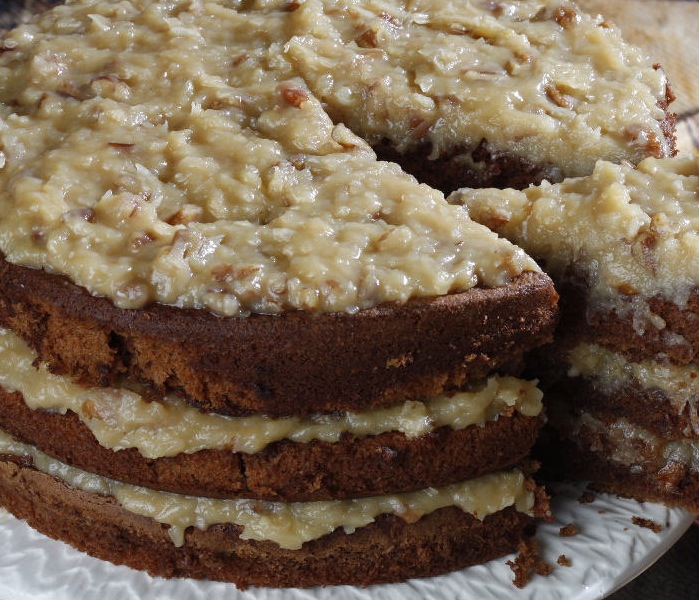
German Chocolate Cake, 2011. Source:http://blogs.courier-journal.com. Meet a cake that was never German, but named by an English guy. And, since when do coconuts grow in Europe or the US?

But on that fall evening in ’09, looking at exploration patterns, commerce patterns and the state of the world circa 1600 CE, it hit me how I could just about reorganize every aspect of the way I’d been teaching World History by just looking at how much food has influenced it. Every bite we take, everything we imbibe, has some history attached to it, and with it, stories of bloody conflict, imperial conquest or rare attempts at true humanity and cooperation.

This is about much more than Jared Diamond’s books on the rise and fall of civilizations because of resources and the lack thereof. Commodities like salt, sugar, black pepper and olive oil have all been written about over the past fifteen years. It’s fairly obvious that these spices and other foodstuffs were fundamental in the histories of the Middle East, ancient Greece and Rome, India, Timbuktu and Western Europe over the past 5,000 years.

Still, I’m not really talking about that kind of history, either. It’s more about something as simple as taking a modern dish and using its ingredients to tell a story. Take something like a chocolate cake with vanilla icing. If the ingredients are natural and not ones cooked up at a chemical plant in northern New Jersey, then they’ve come from all over the world. Cocoa, the main ingredient to mix with the flour, is from the cacao plant, which originally from South America, but is primarily produced in sub-Saharan Africa. Sugar’s needed to sweeten it, and though originally from India, has been grown in Florida, Louisiana and in the Caribbean for centuries. One of the main economic drivers for the enslavement of Africans was the European need to rot out their teeth with the stuff.

Vanilla extract or vanilla beans are originally from Mexico and other parts of Central America. But the largest producers of it are Indonesia and especially Madagascar. There’s history in every gram of devil’s food cake with vanilla icing that we eat.

You could do the same thing with a “traditional” Chinese stir-fry. Especially if ingredients like baby corn or

Sweet-and-sour-chicken, 2011. Source: http://www.foodnetwork.com

sweet and sour sauce are added to the mix. That’s because baby corn and tomatoes (the latter the main ingredient in sweet and sour sauce) are both from the Americas, not Asia or Europe. Both arrived in Ming China nearly 500 years ago.

Every dish, whether invented in 2011 CE or 2011 BCE, has a rich story attached to it. From that story, we can all find important patterns in world history, cultural development, domination and destruction within. It may not be the most profound thing I’ve ever stumbled upon. Still, I didn’t get this from Peter Stearns or Jared Diamond. If anything, I might’ve gotten this from Forrest Gump.

← Older posts
Newer posts →

Boy @ The Window: A Memoir

Boy @ The Window: A Memoir

Places to Buy/Download Boy @ The Window

There's a few ways in which you can read excerpts of, borrow and/or purchase and download Boy @ The Window. There's the trade paperback edition of Boy @ The Window, available for purchase via Amazon.com at http://www.amazon.com/Boy-Window-Donald-Earl-Collins/dp/0989256138/

There's also a Kindle edition on Amazon.com. The enhanced edition can be read only with Kindle Fire, an iPad or a full-color tablet. The links to the enhanced edition through Apple's iBookstore and the Barnes & Noble NOOK edition are below. The link to the Amazon Kindle version is also immediately below:

scr2555-proj697-a-kindle-logo-rgb-lg

Boy @ The Window on Amazon.com: http://www.amazon.com/Boy-The-Window-Memoir-ebook/dp/B00CD95FBU/

iBookstore-logo-300x100

Boy @ The Window on Apple's iBookstore: https://itunes.apple.com/us/book/boy-the-window/id643768275?ls=1

Barnes & Noble (bn.com) logo, June 26, 2013. (http://www.logotypes101.com).

Boy @ The Window on Barnes & Noble: http://www.barnesandnoble.com/w/boy-the-window-donald-earl-collins/1115182183?ean=2940016741567

You can also add, read and review Boy @ The Window on Goodreads.com. Just click on the button below:

Boy @ The Window

Twitter Updates

Tweets by decollins1969
  • RSS - Posts
  • RSS - Comments

Archives

  • June 2025
  • April 2023
  • September 2022
  • August 2022
  • July 2022
  • June 2022
  • May 2022
  • April 2022
  • March 2022
  • January 2022
  • December 2021
  • November 2021
  • October 2021
  • September 2021
  • August 2021
  • July 2021
  • June 2021
  • April 2021
  • March 2021
  • February 2021
  • January 2021
  • December 2020
  • November 2020
  • October 2020
  • September 2020
  • August 2020
  • July 2020
  • May 2020
  • April 2020
  • March 2020
  • January 2020
  • December 2019
  • November 2019
  • August 2019
  • July 2019
  • June 2019
  • May 2019
  • April 2019
  • March 2019
  • February 2019
  • January 2019
  • December 2018
  • November 2018
  • October 2018
  • September 2018
  • August 2018
  • July 2018
  • June 2018
  • May 2018
  • March 2018
  • February 2018
  • January 2018
  • December 2017
  • November 2017
  • October 2017
  • September 2017
  • August 2017
  • July 2017
  • June 2017
  • May 2017
  • April 2017
  • March 2017
  • February 2017
  • January 2017
  • December 2016
  • November 2016
  • October 2016
  • September 2016
  • August 2016
  • July 2016
  • June 2016
  • May 2016
  • April 2016
  • March 2016
  • February 2016
  • January 2016
  • December 2015
  • November 2015
  • October 2015
  • September 2015
  • August 2015
  • July 2015
  • June 2015
  • May 2015
  • April 2015
  • March 2015
  • February 2015
  • January 2015
  • December 2014
  • November 2014
  • October 2014
  • September 2014
  • August 2014
  • July 2014
  • June 2014
  • May 2014
  • April 2014
  • March 2014
  • February 2014
  • January 2014
  • December 2013
  • November 2013
  • October 2013
  • September 2013
  • August 2013
  • July 2013
  • June 2013
  • May 2013
  • April 2013
  • March 2013
  • February 2013
  • January 2013
  • December 2012
  • November 2012
  • October 2012
  • September 2012
  • August 2012
  • July 2012
  • June 2012
  • May 2012
  • April 2012
  • March 2012
  • February 2012
  • January 2012
  • December 2011
  • November 2011
  • October 2011
  • September 2011
  • August 2011
  • July 2011
  • June 2011
  • May 2011
  • April 2011
  • March 2011
  • February 2011
  • January 2011
  • December 2010
  • November 2010
  • October 2010
  • September 2010
  • August 2010
  • July 2010
  • June 2010
  • May 2010
  • April 2010
  • March 2010
  • February 2010
  • January 2010
  • December 2009
  • November 2009
  • October 2009
  • September 2009
  • August 2009
  • July 2009
  • June 2009
  • May 2009
  • April 2009
  • March 2009
  • February 2009
  • January 2009
  • December 2008
  • November 2008
  • October 2008
  • September 2008
  • August 2008
  • July 2008
  • June 2008
  • May 2008
  • April 2008
  • March 2008
  • February 2008
  • January 2008
  • December 2007
  • November 2007
  • October 2007
  • September 2007
  • August 2007
  • July 2007
  • June 2007

Recent Comments

MaryPena's avatarMaryPena on My Day of Atonement/Bitter Hat…
decollins1969's avatardecollins1969 on No Good Teaching Deed Goes…
Mary Rose O’Connell's avatarMary Rose O’Connell on No Good Teaching Deed Goes…

NetworkedBlogs on Facebook

NetworkedBlogs
Blog:
Notes From a Boy @ The Window
Topics:
My Life, Culture & Education, Politics & Goofyness
 
Follow my blog

616 616 East Lincoln Avenue A.B. Davis Middle School Abuse Academia Academy for Educational Development AED Afrocentricity American Narcissism Authenticity Bigotry Blackness Boy @ The Window Carnegie Mellon University Child Abuse Class of 1987 CMU Coping Strategies Crush #1 Crush #2 Death Disillusionment Diversity Domestic Violence Economic Inequality Education Family Friendship Friendships Graduate School Hebrew-Israelites High-Stakes Testing Higher Education History Homelessness Humanities Humanities Program Hypocrisy Internalized Racism Jealousy Joe Trotter Joe William Trotter Jr. K-12 Education Love Manhood Maurice Eugene Washington Maurice Washington Misogyny Mother-Son Relationship Mount Vernon High School Mount Vernon New York Mount Vernon public schools Multiculturalism MVHS Narcissism NFL Pitt Pittsburgh Politics of Education Poverty President Barack Obama Race Racial Stereotypes Racism Relationships Self-Awareness Self-Discovery Self-Reflection Sexism Social Justice Teaching and Learning University of Pittsburgh Violence Whiteness Writing

Top Rated

Blog at WordPress.com.

  • Subscribe Subscribed
    • Notes from a Boy @ The Window
    • Join 103 other subscribers
    • Already have a WordPress.com account? Log in now.
    • Notes from a Boy @ The Window
    • Subscribe Subscribed
    • Sign up
    • Log in
    • Report this content
    • View site in Reader
    • Manage subscriptions
    • Collapse this bar
 

Loading Comments...