• About Me
  • Other Writings
  • Interview Clips
  • All About Me: American Racism, American Narcissism, and the Conversation America Can’t Have
  • Video Clips
  • Boy @ The Window Pictures
  • Boy @ The Window Theme Music

Notes from a Boy @ The Window

~

Notes from a Boy @ The Window

Tag Archives: Mitt Romney

The Human Race Addendum

13 Monday Aug 2012

Posted by decollins1969 in 1, Academia, Boy @ The Window, Christianity, culture, Eclectic, Mount Vernon New York, Politics, Pop Culture, race, Religion, Work, Youth

≈ Leave a comment

Tags

Barry Switzer, Economic Inequality, Hard Work, Human Race, Individual, Leveling Playing Field, Marathon, Mitt Romney, Paul Ryan, Romney-Hood, social mobility, Track & Field, William H. Holmes Elementary


2008 NYC Marathon. Source: http://ingnewyorkcitymarathon.files.wordpress.com

2008 NYC Marathon. Source: http://ingnewyorkcitymarathon.files.wordpress.com

Two years ago, I wrote a post about a curious observation I made about inequality, unfairness and humanity, all courtesy of my fourth grade teacher, Mrs. Pierce (“Hard Work and the Human Race,” September ’10 – see below). In the thirty-four years since this observation, it’s fairly obvious that the great college football coach legend Barry Switzer was right about how people like Romney think about their station in life. “Some people are born on third base and go through life thinking they hit a triple.”

GOP presidential hopeful Mitt Romney’s pick of Paul Ryan as his vice-president is a confirmation of the idea that there are folks in America who truly believe that their success came only as a result of hard work, luck and prayer. But to use a better analogy, it’s easy to be a winner when your born in middle of the fourth lap of a 400m race, while someone like me had to fight just to get in the starting block. Politically, Carter and Reagan was the spark for my understanding of economic inequality. Three and a half decades later, the Romney-Ryan ticket reflects the long and winding road this mythology of “equal opportunity, not equal outcomes” has taken our nation. Only, equal opportunities do not exist for most of us, as the track and field analogy illuminates.

===========================

When I was nine years old, my fourth grade teacher at Holmes, Mrs. Pierce — a grouch of an older White woman, really — talked about the human race and attempted to describe our species’ variations. She tried to do what we’d call a discussion of diversity now. It went over our heads, no doubt because she didn’t quite get the concept of diversity herself.

Holmes Elementary School, Mount Vernon, NY [Top left corner was Mrs. Pierce’s classroom in 1978-79 year], November 22, 2006. (Donald Earl Collins).

Like the fourth-grader I was, I daydreamed about the term, human race. I thought of Whites, Blacks, Asians, Hispanics, young and old, male and female, from all over the world, all on a starting line. It was as if four billion people — that was the world population in ’79 — were lined up to run a race to the top of the world. In my daydream, some were faster than others, or at least appeared to be, while others hobbled along on crutches and in wheelchairs. Still others crawled along, falling farther and farther behind those who were in the lead, the ones that looked like runners in the New York City marathon. Before I could ponder the daydream further, Mrs. Pierce yelled, “Wake up, Donald!.” as if I’d really been asleep.

A high school friend recently gave me some much-needed feedback on my Boy @ The Window manuscript. Her feedback was helpful and insightful, and very much appreciated. But some of it reminded me of the realities of having someone who’s a character in a story actually read that story. Their perceptions will never fully match up with those of the writer, which is what is so groovy and fascinating about writing in the first place.

One of the things that struck me as a thread in her comments — not to mention in so many conversations I’ve had with my students about race and socioeconomics — was the theme of individual hard work trumping all obstacles and circumstances. As if words, slights, and mindsets in the world around us don’t matter. As if poverty is merely a mirage, and bigotry, race and racism merely words on a page. Sure, a story such as the one I have told in this blog for the past three years is about overcoming roadblocks, especially the ones that we set ourselves up for in life, forget about the ones external to our own fears and doubts.

At the same time, I realized what my weird daydream from thirty-one years ago meant. Some people get a head start — or, in NASCAR terms, the pole — before the race even starts. That certainly doesn’t make what that individual accomplishes in life any less meaningful, but knowing that the person had an advantage that most others didn’t possess does provide perspective and illuminates how much distance the disadvantaged need to cover to make up ground. Those who limp and crawl and somehow are able to compete in this human race have also worked hard, likely at least as hard as those with a head start, and more than likely, harder than most human beings should ever have to work.

2009 London Marathon. (http://www.newsoftheworld.co.uk/)

Plus, there are intangibles that go with race, class and other variables that determines how the human race unfolds. “Good luck is where hard work meets opportunity,” at least according to former Pittsburgh Penguins goaltender Tom Barrasso. Most human beings work hard, but all need opportunities that may provide a real sprint to catch up or take a lead in the human race. Family status, political influence, social and community networks, religious memberships, being in the right place at the right time, all matter and are connected to race and class, at least in the US.

The moral of this story is, hard work matters, individual accomplishment matters. Yet a panoramic view of the race in which humans are engaged matters more in putting our individual successes and the distance that remains in some reasonable perspective. Without that, we’re all just pretending that individual hard work is the only thing that matters, when that’s only half the battle, or half of half the battle.


The “Invisible” Poor & The Middle Class Mythology

19 Thursday Jul 2012

Posted by decollins1969 in 1, Academia, Boy @ The Window, Eclectic, Mount Vernon New York, race, Work, Youth

≈ Leave a comment

Tags

American Dream, Aspirations, Chris Hayes, Creflo Dollar, Economic Inequality, Gospel of Prosperity, Journalists, Media, Media Coverage, Middle Class, Mitt Romney, MSNBC, Political Optics, poor, Poverty, President Barack Obama, President Obama, Social Castes, social mobility, Up with Chris Hayes, Uppers, Wealthy


Transparent (or invisible) Woman (cropped), July 19, 2012. (http://cgtrader.com).

This past weekend, I found myself drawn into the discussion of the middle class and middle class aspirations on MSNBC’s Up with Chris Hayes (otherwise known as “Uppers”). It was a good and yet wholly unsatisfying discussion of technical definitions of what middle class is and of the political optics of only discussing the middle class as a socioeconomic category. Chris Hayes and his guests justified this with an all-too-common refrain. “If you’re poor, you’re aspiring to be middle class,” Hayes said on Saturday. With that, Hayes and his guests rendered America’s poor invisible, and failed to see beyond the politics of invisibility in the process.

There are two issues here, and many layers within them, about America’s poor, working, on welfare, or otherwise. One issue is that journalists, commentators, political operatives and most politicians treat the poor as if they are an unknowable group of people. It’s as if they all think the same way, as if there are all Black or of color, and a complete drag on the American economy and the federal budget. And that’s on a day in which the media and politics deem America’s poor as discussable. Most of the time, America’s poor are invisible, shoved into the middle class category by commentators and politicians at every turn.

Yes, America’s middle class is struggling too, fighting tooth and nail to not slip into the class of the invisible working poor, treading water to avoid food banks and food stamps. But they have something to struggle with — and for — at least. Their homes, their cars, a retirement account, their families’ net worth, all accoutrements of being middle class in America. America’s poor don’t possess anything to struggle with or for.

Chris Hayes on a train in Switzerland, November 10, 2008. (Matthew Yglesias via Wikimedia Commons/Flickr.com). Released to public domain via cc-Attribution-Share Alike 2.0 Generic license.

Except, maybe, with their vote, if they care to vote at all. Yet no mainstream commentator nor presidential candidate has truly spoken to their needs, their plight, to how their situation is completely interconnected with the struggles of the American middle class, not their aspirations. Not Chris Hayes, nor his weekend compadre, Melissa Harris-Perry, not President Barack Obama, and definitely not the presumptive GOP nominee, Mitt Romney.

It’s a story I’m all too familiar with, as someone who grew up in poverty in Mount Vernon, New York. Not to mention as someone who had to go to college and graduate school and then struggled for two years at part-time work before finding a job with a Ph.D. in ’99 (see my “The Five Senses of Poverty” post from July ’10). I was thirty years old by the time I earned a middle class income. Yet in all of that time, the only mainstream politician who spent time on the issues of the American poor as if these were real people was President Jimmy Carter, and we know what happened with him. Outside of my degrees and my publications, I was invisible until the fall of ’99.

Otherwise, it’s been four decades of Presidents Nixon, Reagan and Clinton concerned with “welfare queens,” “pink Cadillacs,” and “mend it, don’t end it” welfare policies, and the media following suit. It’s like being kicked hard by someone as one is laying on the ground with broken ribs and internal hemorrhaging, as if they want to poor to die, painfully.

But it’s not just the ones with microphones and word processing programs that kill America’s poor by rendering them invisible. Despite the general notion that the media and politicians nurture — that everyone not rich aspires to be firmly entrenched in the middle class — most Americans middle class and poor aspire to be rich, wealthy, well-off.

Creflo Dollar, pastor, World Changers Church International, November 1, 2010. (Zwicky Institut via Flickr.com). In public domain.

This is the other neglected issue, whether inadvertent like with Chris Hayes and his guests on Uppers, or deliberate on the part of President Obama and Romney. Why so? Because they don’t acknowledge that it’s hard to be truly middle class in America these days. To be in the middle class, one must borrow, borrow, borrow, beg and sometimes steal while struggling to pay student loans, car notes, a mortgage and child care costs.

This wasn’t the case even thirty years ago, before the severe double-dip recession, high interest rates and inflation and Reagan Revolution took full hold. Then, a high school diploma and raw initiative was all most folks needed to find a job at a GM plant or to get an administrative job in government or with a large corporation (although, typing at 90 words per minute enhanced a woman’s chances, at least). Now, two years of college or postsecondary technical training, some experience in a specialized field, and a personal connection is the floor for a living wage — not exactly middle class. Of course, no one wants to be in the basement with nearly one in five Americans, 50 million in all, working just to be poor.

Stacks of money, April 13, 2008. (Allureme via Wikipedia). Released to public domain via cc-Attribution 3.0 License.

America’s poor and fledgling middle class both aspire to be rich (or die tryin’), and not just middle class. The rise of fundamentalist Christianity, mega-churches and the cult of prosperity as these pastors reimagine the New Testament. The endless lines for Powerball and Mega Millions whenever the pot is more than $100 million. The fascination with reality shows about the well-off or about competing to be well-off. All of this is the manifestation of the warping of the American Dream since the early 1970s, where the pursuit of riches has led to debt slavery for millions.

The old American Dream has become myth, and the old American middle class is but the story of Camelot, Timbuktu and Shangri-La. In our new world, “the poor will be with us always” has been made a plain and unyielding truth by those in power, reinforced by those with a media platform.

How Our Politicians See Us

18 Wednesday Apr 2012

Posted by decollins1969 in 1, Academia, culture, Eclectic, Movies, Patriotism, Politics, Pop Culture, race, Religion, Work

≈ Leave a comment

Tags

American People, Antichrist, Apocalypse, Batteries, Carnegie Mellon University, Mitt Romney, Oligarchy, Politicians, President Barack Obama, President Obama, Slaughterhouse, The Matrix, University of Pittsburgh


Uruguay slaughterhouse with hanging cow carcasses, April 2, 2012. (http://www.meattradenewsdaily.co.uk).

A slightly left-of-center friend of mine from my grad school days at the University of Pittsburgh and Carnegie Mellon has gone off the rails in the past couple of years. At least once a week, he posts on Facebook and The Washington Post his views of the “nice guy…to have at a barbecue,” the “dangerous man” he consistently describes President Barack Obama to be.

Every parsed word, every decision, every breath President Obama takes my friend construes as evidence of the president’s link to the Antichrist and the Apocalypse. My friend has become an unlikely crackpot, willing to see everything President Obama does in the most negative light. To the point where he doesn’t give the president credit for decisions in which few could find fault.

But there’s one thing in which my friend from the ’90s is certain and correct. That if we the people only hold the conservative, reactionary and fascist oligarchs — the GOP and their neocon supporters — accountable, the centrist, not-so-progressive and Wall-Street-beholden oligarchs — the Democratic Party — will be able to get away with demolishing what remains of a sense of progression and fairness in American culture and politics. The two-party system has been broken for a while, rusted out from citizen apathy, a military-industrial complex, and the corruption of money, power and religious absolutism mixed with our nation’s other -isms.

It does beg the question, how do our politicians see us? I already discussed this in my post from last August, “When Politicians Say, ‘The American People…'” But I think moving pictures and good old-fashioned pixels might tell us more about the likes of Mitt Romney and the Koch brothers think of us on a collective scale, courtesy of The Matrix and the meatpacking industry.

The Matrix (Human Battery Scene – Low Res)

The Matrix (Human Battery Scene – Low Res)

Ultimately, we are packets of employment and consumerism, meant to be exploited to the fullest extent that capitalism and our politicians will allow. And if we don’t hold those who may well have our best interests at heart accountable, like President Obama, they too could easily fall prey to those who only see us as carcasses, cash cows or batteries to power their oligarchic lives. Even if my grad school days’ friend is a crackpot.

Salutatorian Story

07 Wednesday Mar 2012

Posted by decollins1969 in 1, Academia, Boy @ The Window, culture, Eclectic, eclectic music, Mount Vernon High School, Mount Vernon New York, Politics, race, Youth

≈ Leave a comment

Tags

Black Male Identity, Boy @ The Window, Class of '87, Harold Meltzer, Humanities, Identity, Mitt Romney, Mount Vernon High School, Narcissism, Popularity, Sacramento, Salutatorian, Self-Reflection


Caravaggio’s Narcissus (1594-96) – talk about someone with interpersonal issues – May 15, 2011. (Masur via Wikipedia). In public domain.

As I began to work on Boy @ The Window six years ago, I realized that my story would be far from complete without the words and thoughts of my former classmates, teachers, and family members in my head. Thoughts about themselves. Thoughts about Humanities. Thoughts about me. Thoughts about our world and our times. After all, I hadn’t thought about most of these folks in nearly two decades.

I had already started with my late, wonderful teacher and mentor, Harold Meltzer several years earlier. My first interview with him was in August ’02, but the first time we discussed the possibility of me doing Boy @ The Window goes back to February ’95. I was working on my doctoral thesis, living in DC for a couple of months while hitting the archives and libraries up for dusty information. In need of a writing break, I gave him a call on one cold and boring Saturday afternoon.

Meltzer answered with his usual “H. MMMMMMM. here?,” the M’s strung together like a long string of pearls bouncing slightly as you’d lay them gently on a table. When I said who it was, he said, “DONNIE!! Why, it’s so good of you to call!” in his halting suburban New York accent. Little did I know that this was the start of a three-hour-long conversation.

We spent a lot of time talking about the salutatorian of my class, the Class of ’87. To me, he — let’s call him ‘S’ — was always an enigma. I genuinely felt both in awe of and disheartened by his presence in my life during the Humanities years. I thought it was amazing that he was able to do as much as he did. The high school band. The mock trial team. The school newspaper. Our yearbook. An appearance on Phil Donahue! At least he wasn’t a star basketball player too, especially in Mount Vernon.

I felt the side effects of S’s success. Teachers telling me that I should be more like S, as if I was S’s younger, underachieving brother. I saw how S occasionally cashed in on his built-up academic capital to give himself more time to work on assignments no one else got a second of overtime to do. I don’t think I ever wanted to be S or become close friends with him, though. Something about his need to be well-liked by our peers and teachers bothered me.

I said as much during a three-hour meeting we had during my first work-related trip to Sacramento during the second week of March ’06. When S asked what I thought of him, I said, “I thought that you were…obsequious, ingratiating…no, that’s too strong…I sensed that you needed to be liked by our classmates and teachers.” I don’t know exactly what S thought about my description of him, but then again, he did ask.

Mitt Romney’s proof positive that short of himself, calling someone obsequious is a strong statement. Romney at CPAC 2011, Washington, DC, February 11, 2011. (Gage Skidmore via Wikipedia). In public domain.

S asked during our first meeting and interview in March ’06, “What do you think I thought of you?”

“For the most part, as far as you were concerned, I didn’t exist . . . I mean, I was there, of course, but I wasn’t in any of your circles, so I didn’t really exist for you as a real person,” I said in response.

I based that answer on S’s rare attempts to make conversations with me, ones that were mostly of the shaking-his-head-in-confusion ones. He didn’t get my attraction to the pop/rock band Mr. Mister, an ’80s prelude to Creed, I guess. “They can’t sing,” S said to me in Warns’ English class once as a reference to Mr. Mister’s #1 hit “Broken Wings.” The incident on the school bus on our Albany/FDR trip was another example (see my “An a-ha Moment” post from October ’10).

Meltzer never made me feel like a was a freak. Nor did he ever engage in comparing me to S. But he obviously was concerned about him, and had been so even when we were in eleventh grade. As for me, he said, for probably the one-hundredth time, “I never worried about you, Donnie.”

At the time of my ’95 conversation with Meltzer, I’d recently published an op-ed in my hometown and county newspaper, “Solving African American Identity Crisis,” Somehow our discussion of that piece led to a discussion of S. Meltzer told me that S “had a really hard time at Harvard” and that he’d “graduated with Gentleman’s Ceeeeeeeee’s,” the C’s rolling off his tongue in the process.

Meltzer asked if I knew what S’s problem was when I brought up the whole June ’89 conversation I had with S, the one that showed me his obvious confusion about himself (see my “Strange Days” post from June ’09). After an unusually long pause on the phone — it was long even by Meltzer’s own standards — he said, “You’re exactly right.” We spent the rest of our S discussion talking about him in high school and his need to be liked as a significant part of his identity issue.

I thought of all this as me and S ended our meeting that cloudy Northern California day six years ago. As I explained my plans to track down Crush #1 as part of what would become Boy @ The Window, S warned that she “has some interpersonal issues.” As if she were somehow off her medication when she visited S in ’04. I said, “Don’t we all?” in response. Neither of us had any room to talk about anyone else’s issues.

GOP/TPers’ Theme Music for Election 2012

30 Monday May 2011

Posted by decollins1969 in 1, culture, Eclectic, eclectic music, music, Patriotism, Politics, Pop Culture, race

≈ 3 Comments

Tags

ABC, Al Green, Bruce Springsteen, Climate Change, Conservatives, Creed, Donald Trump, Election 2012, Gay Rights, Genesis, GOP, Grover Washington Jr., Herman Cain, Human Rights, Immigration Reform, James Blunt, John Mellencamp, Lower Taxes, Maxwell, Michelle Bachmann, Mike Huckabee, Mitt Romney, Newt Gingrich, Patriotism, PE, Political Messages, Presidential Candidates, Protest Songs, Public Enemy, Racial Justice, Republicans, Sade, Sarah Palin, Tea Party, Ted Nugent, The Cranberries, Theme Songs, Tim Pawlenty, TPers, U2, unemployment, Usurping Messages


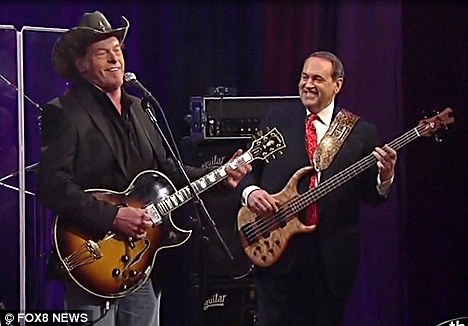
Huckabee with Ted Nugent on guitar, Huckabee Show, FOX News Channel, May 14, 2011. Source: http://dailymail.co.uk

Ever since Mike Huckabee announced that he wasn’t running for POTUS in the Election ’12 cycle (after playing chords with Ted Nugent), I’ve been thinking about an appropriately snarky and sarcastic way to understand the GOP/Tea Party candidacy process. It’s been a bit confusing. Between Trump and Huckabee, Newt Gingrich and Herman Cain, Pawlenty and Romney, Palin and Bachmann, I’d have a hard time finding a candidate I’d vote for even if I were a true American conservative.

But I do know what would help. Theme music to get our juices flowin’, to rile us up about how excited we should be that among these candidates is a challenger worthy of President Barack Obama. Heck, it’s worked before. Ed Meese and Don Regan used Bruce Springsteen’s “Born In The U.S.A.” and John Mellencamp’s “Pink Houses” as theme music in ’84. This despite the fact that these were protests songs of an America anti-common man and pro-war.

GOP/TPers can do the same in ’12. Here’s a list of songs to usurp — oops, I mean use — between now and November 6 of next year.

1. Genesis, “Illegal Alien” (1983), as in, “It’s no fun/being an illegal alien” — especially if the GOP/TPers take over in ’12.

2. James Blunt, “No Bravery” (2005), a truthful description of what it takes to run on the GOP/TP ticket, i.e., no independent thought.

3. ABC, “How To Be A Millionaire” (1985), which should be retitled, “How To Be A Billionaire,” since that’s the ultimate goal of the leaders of the GOP – “a million is not enough” could be the party’s new slogan.

4. U2, “Crumbs From Your Table,” (2004), which, if these folks are elected next year, will be all we’ll have to eat by the ’16 election cycle.

Crumbs on my table, courtesy of Noah's old elephant and a Lipton tea bag wrapped around trunk, May 30, 2011. Donald Earl Collins.

5. Chicago, “Hard Habit To Break,” (1984), especially in the refrain, “I’m addicted to you,” meaning easy money from top 1%, debt and low taxes, and oil, oh, sweet crude oil!

6. The Cranberries, “Zombie,” (1994), the sincerest hope of the GOP/TPers when it comes to what’s left of our voting populace.

Herman Cain, They Think You're Stupid Book Cover (more like We Think You're Stupid), 2009. Source: National Black Republican Association, http://nbra.info

7. Al Green, “One Of These Good Old Days,” (1972), a tribute to the way the Party of Corporations wants things to be for rich – it’s their climax song!

8. Prince, “1999,” (1983), except they would definitely change it to “1899,” the height of affluent largesse, corporate greed and monopoly-building (until the ’00s), and acceptable racism.

9. Creed, “My Own Prison,” (1997), one of the ultimate dreams of the GOP/TPers, that we’d build our own prisons and then put ourselves in them so they don’t have to worry about job creation.

10. Grover Washington, Jr., “Summer Chill,” (1992), what the party hopes their paid-off scientists can “prove” in a new study funded by the John M. Olin Foundation, the Heritage Foundation, and the Scaife Foundations, making “Drill, baby, drill” a reality in ANWR.

11. Public Enemy, “Welcome To The Terrordome,” (1989), most likely would be used by the GOP/TPers to promote gladiator-like games as a way to bring the unemployment rate down for those they can’t get to build their own prisons.

12. Sade, “The Sweetest Taboo,” (1985), a tribute to all of their in the closet and anti-gay party members willing to sacrifice the civil and human rights of LGBT Americans everywhere for a seat in Washington.

13. Maxwell, “…Til The Cops Come Knockin’,” (1996), the general plan for all elected GOP/TPers until they’re caught in illegal activities.

In addition, there’s Alexander O’Neal’s “When The Party’s Over” (1987), another example of what would happen to us, our country and our world if the GOP/TPers reclaimed and remained in charge. They’d suck the bottom ninety-nine percent of us dry until the good times are over, and then blame us for not letting them steal the plumbing, too. Please add to this list. I could’ve created an iPod list of a hundred appropriate songs, but fourteen’s just a start. Eat your heart out, Ted Nugent!

Newer posts →

Boy @ The Window: A Memoir

Boy @ The Window: A Memoir

Places to Buy/Download Boy @ The Window

There's a few ways in which you can read excerpts of, borrow and/or purchase and download Boy @ The Window. There's the trade paperback edition of Boy @ The Window, available for purchase via Amazon.com at http://www.amazon.com/Boy-Window-Donald-Earl-Collins/dp/0989256138/

There's also a Kindle edition on Amazon.com. The enhanced edition can be read only with Kindle Fire, an iPad or a full-color tablet. The links to the enhanced edition through Apple's iBookstore and the Barnes & Noble NOOK edition are below. The link to the Amazon Kindle version is also immediately below:

scr2555-proj697-a-kindle-logo-rgb-lg

Boy @ The Window on Amazon.com: http://www.amazon.com/Boy-The-Window-Memoir-ebook/dp/B00CD95FBU/

iBookstore-logo-300x100

Boy @ The Window on Apple's iBookstore: https://itunes.apple.com/us/book/boy-the-window/id643768275?ls=1

Barnes & Noble (bn.com) logo, June 26, 2013. (http://www.logotypes101.com).

Boy @ The Window on Barnes & Noble: http://www.barnesandnoble.com/w/boy-the-window-donald-earl-collins/1115182183?ean=2940016741567

You can also add, read and review Boy @ The Window on Goodreads.com. Just click on the button below:

Boy @ The Window

Twitter Updates

Tweets by decollins1969
  • RSS - Posts
  • RSS - Comments

Archives

  • June 2025
  • April 2023
  • September 2022
  • August 2022
  • July 2022
  • June 2022
  • May 2022
  • April 2022
  • March 2022
  • January 2022
  • December 2021
  • November 2021
  • October 2021
  • September 2021
  • August 2021
  • July 2021
  • June 2021
  • April 2021
  • March 2021
  • February 2021
  • January 2021
  • December 2020
  • November 2020
  • October 2020
  • September 2020
  • August 2020
  • July 2020
  • May 2020
  • April 2020
  • March 2020
  • January 2020
  • December 2019
  • November 2019
  • August 2019
  • July 2019
  • June 2019
  • May 2019
  • April 2019
  • March 2019
  • February 2019
  • January 2019
  • December 2018
  • November 2018
  • October 2018
  • September 2018
  • August 2018
  • July 2018
  • June 2018
  • May 2018
  • March 2018
  • February 2018
  • January 2018
  • December 2017
  • November 2017
  • October 2017
  • September 2017
  • August 2017
  • July 2017
  • June 2017
  • May 2017
  • April 2017
  • March 2017
  • February 2017
  • January 2017
  • December 2016
  • November 2016
  • October 2016
  • September 2016
  • August 2016
  • July 2016
  • June 2016
  • May 2016
  • April 2016
  • March 2016
  • February 2016
  • January 2016
  • December 2015
  • November 2015
  • October 2015
  • September 2015
  • August 2015
  • July 2015
  • June 2015
  • May 2015
  • April 2015
  • March 2015
  • February 2015
  • January 2015
  • December 2014
  • November 2014
  • October 2014
  • September 2014
  • August 2014
  • July 2014
  • June 2014
  • May 2014
  • April 2014
  • March 2014
  • February 2014
  • January 2014
  • December 2013
  • November 2013
  • October 2013
  • September 2013
  • August 2013
  • July 2013
  • June 2013
  • May 2013
  • April 2013
  • March 2013
  • February 2013
  • January 2013
  • December 2012
  • November 2012
  • October 2012
  • September 2012
  • August 2012
  • July 2012
  • June 2012
  • May 2012
  • April 2012
  • March 2012
  • February 2012
  • January 2012
  • December 2011
  • November 2011
  • October 2011
  • September 2011
  • August 2011
  • July 2011
  • June 2011
  • May 2011
  • April 2011
  • March 2011
  • February 2011
  • January 2011
  • December 2010
  • November 2010
  • October 2010
  • September 2010
  • August 2010
  • July 2010
  • June 2010
  • May 2010
  • April 2010
  • March 2010
  • February 2010
  • January 2010
  • December 2009
  • November 2009
  • October 2009
  • September 2009
  • August 2009
  • July 2009
  • June 2009
  • May 2009
  • April 2009
  • March 2009
  • February 2009
  • January 2009
  • December 2008
  • November 2008
  • October 2008
  • September 2008
  • August 2008
  • July 2008
  • June 2008
  • May 2008
  • April 2008
  • March 2008
  • February 2008
  • January 2008
  • December 2007
  • November 2007
  • October 2007
  • September 2007
  • August 2007
  • July 2007
  • June 2007

Recent Comments

decollins1969's avatardecollins1969 on No Good Teaching Deed Goes…
Mary Rose O’Connell's avatarMary Rose O’Connell on No Good Teaching Deed Goes…
Lyndah McCaskill's avatarLyndah McCaskill on The Raunchiest of Them Al…

NetworkedBlogs on Facebook

NetworkedBlogs
Blog:
Notes From a Boy @ The Window
Topics:
My Life, Culture & Education, Politics & Goofyness
 
Follow my blog

616 616 East Lincoln Avenue A.B. Davis Middle School Abuse Academia Academy for Educational Development AED Afrocentricity American Narcissism Authenticity Bigotry Blackness Boy @ The Window Carnegie Mellon University Child Abuse Class of 1987 CMU Coping Strategies Crush #1 Crush #2 Death Disillusionment Diversity Domestic Violence Economic Inequality Education Family Friendship Friendships Graduate School Hebrew-Israelites High-Stakes Testing Higher Education History Homelessness Humanities Humanities Program Hypocrisy Internalized Racism Jealousy Joe Trotter Joe William Trotter Jr. K-12 Education Love Manhood Maurice Eugene Washington Maurice Washington Misogyny Mother-Son Relationship Mount Vernon High School Mount Vernon New York Mount Vernon public schools Multiculturalism MVHS Narcissism NFL Pitt Pittsburgh Politics of Education Poverty President Barack Obama Race Racial Stereotypes Racism Relationships Self-Awareness Self-Discovery Self-Reflection Sexism Social Justice Teaching and Learning University of Pittsburgh Violence Whiteness Writing

Top Rated

Blog at WordPress.com.

  • Subscribe Subscribed
    • Notes from a Boy @ The Window
    • Join 103 other subscribers
    • Already have a WordPress.com account? Log in now.
    • Notes from a Boy @ The Window
    • Subscribe Subscribed
    • Sign up
    • Log in
    • Report this content
    • View site in Reader
    • Manage subscriptions
    • Collapse this bar
 

Loading Comments...