• About Me
  • Other Writings
  • Interview Clips
  • All About Me: American Racism, American Narcissism, and the Conversation America Can’t Have
  • Video Clips
  • Boy @ The Window Pictures
  • Boy @ The Window Theme Music

Notes from a Boy @ The Window

~

Notes from a Boy @ The Window

Tag Archives: Graduate School

Biting Off Too Much, And Almost Choking On It

03 Wednesday Dec 2014

Posted by decollins1969 in 1, Academia, Boy @ The Window, culture, Eclectic, Pittsburgh, Pop Culture, Sports, University of Pittsburgh, Work, Youth

≈ Leave a comment

Tags

Arrogance, Calculus, Differential Equations, Football Analogies, Grad School, Graduate School, Heimlich Maneuver, History Major, Humanities, Joe Montana, Lifelong Learning, Limitations, Multiple Integrals, Overachievers, Overachieving, Partial Derivaties, Pitt, Pride, Self-Discovery, Warren Moon


"Bush Gag" cartoon, Pat Bagley, Salt Lake Tribune, November 5, 2008. (http://dailykos.com). Qualifies as fair use under copyright laws -- low resolution picture.

“Bush Gag” cartoon, Pat Bagley, Salt Lake Tribune, November 5, 2008. (http://dailykos.com). Qualifies as fair use under copyright laws — low resolution picture.

I’m someone who’s in a state of constant learning, constantly wanting to challenge myself and others to be better, to do more and better. I don’t apologize for this. But I do need to acknowledge that too often, I exert so much pressure on myself to excel that I take on a Thanksgiving feast’s worth of challenges. More times than not, I come through on the other side, but frequently in need of the Heimlich maneuver to keep from suffocating on it all.

For those of you who are still in undergrad or have recently finished, or at least, still remember clearly the details of this part of your academic journey, this story is most poignant for you. After years of relying mostly on my great memory and very good writing skills to be the very good student I’d been over the previous decade, I wanted to do better, to not have to scramble in the last three weeks of a sixteen-week semester and look like a dog with a serious constipation problem trying to void, like almost two-thirds of the sickly, underdressed, raccoon-eyed students I’d seen on campus during my first two years at the University of Pittsburgh.

As I wrote at the end of my coming-of-age memoir Boy @ The Window:

I reasoned that I needed to have balance to my semesters so that I wouldn’t spend the last two or three weeks of them playing catch up. Starting with the fall of ’89, I took all my syllabi from all of my classes, grabbed a calendar, and crafted a table where I knew exactly what to read, when to study, and when to begin my research and writing projects for each class I had in a semester. That way, I could know when to slack off or party, when to buckle down and study, and when to just shift into academic cruise control.

Hall-of-Fame QB Warren Moon with Houston Oilers, throwing from within pocket on his 527-yd passing day against the Kansas City Chiefs, December 16, 1990. (http://spokeo.com).

Hall-of-Fame QB Warren Moon with Houston Oilers, throwing from within pocket on his 527-yd passing day against the Kansas City Chiefs, December 16, 1990. (http://spokeo.com).

Those were literally my words and thoughts from a quarter-century ago. I also decided to become more organized because, thinking back, I knew that I couldn’t be a scrambling student in grad school. At least one who could be consistent and successful, who could sit and step up in the pocket and deliver academic darts for touchdowns — to use one of the many football analogies I would’ve said in ’89 (and probably now, too). All I knew was that after the spring semester — with thirty-six-hour workweeks and five courses — that I wanted more time to hang out with friends, to even maybe date.

Only, I was dumb enough to take third-semester calculus a year and a half after my last math course, and I was now a history major taking writing intensive courses. But at the time, I had my very good reasons. I was only one course shy of a minor in mathematics, which I figured would look good on my academic resume when I did apply to grad schools. I wanted to learn the basics about differential equations, because I was just that kind of guy. I wanted, most of all, to challenge myself, because that part of my Humanities indoctrination had stayed with me well beyond my high school graduation.

That course was a struggle, mostly because my attention was split between writing papers and reading thick history texts, constitutional law books and African American literature on the one hand, and math equations on the other. Fourteen months away from derivates and integrals and volumes was too long for me. I couldn’t really adjust to being in a lecture hall with nearly 400 students, being in memorization mode, no longer with much in common with this huge group of STEM-inclined classmates. By the middle of October, I was miserable whenever it was time to march up that hill to Benedum Hall.

A simple first-order linear differential equation (nothing "simple" about it), December 2, 2014. (http://revisionworld.com/).

A simple first-order linear differential equation (nothing “simple” about it), December 2, 2014. (http://revisionworld.com/).

But it did get worse. About a month before the end of that semester, my friend Terri looped me into unwittingly setting up my friend Marc with our mutual friend Michele. And it worked! All too well, as I realized that I had a bit of a crush on Michele myself, but only after they’d started dating. It was a rocky last three weeks of ’89. I managed a 2.98 GPA that terrible semester, including a D+ in multiple integrals and differential equations. I missed a C- in that class by two-tenths of a point. Terrible by my own standards.

Lessons here, if any? Don’t bite off more than you can chew, maybe? I know that three admissions committees used that D+ against me in either rejecting me outright or in not offering me fellowship money to cover tuition when I applied to grad schools a year later. So, one other lesson could be to not take unnecessary risks, to not challenge myself. That would be the wrong lesson, though.

The real lesson would be to know our limitations, that we can’t be all things to ourselves and others and do well at all things all the time, that we have a finite amount of time and choices, in school and in life. With so much going on in my life these days, it’s still a lesson of which I have to keep reminding myself, practically every single day.


Neoliberals, Neocons, and Other Useless Labels

04 Tuesday Nov 2014

Posted by decollins1969 in 1, Academia, Christianity, culture, Eclectic, Marriage, Patriotism, Politics, Pop Culture, race, Religion, University of Pittsburgh, Work

≈ Leave a comment

Tags

1964 Election, Academic Jargon, Arthur Schlesinger Jr., Barry Goldwater, Classism, Corruption, Cycles of American History (1986), Definitions, Democrats, Election 2014, Fascism, Graduate School, Homophobia, Labels, LBJ, Midterm Elections, Neoconservatism, Neoconservative, Neoliberal, Neoliberalism, President Lyndon Baines Johnson, Racism, Republicans, Richard Nixon, Right-Wingers, Sexism, Silent Majority, Southern Strategy, Time on the Cross (1974)


The Matrix, Path of Neo, November 4, 2014. (http://comic.com).

The Matrix, Path of Neo, November 4, 2014. (http://comicvine.com).

I’ve never really had much patience for technical academic jargon, even in my wide-eyed grad school days twenty years ago. And my patience for terms like post-structuralism, post-modern, neo-Marxist and eschatological has grown government-paper-stock-thin as I’ve approached middle-age. Lately, terms like neoliberal and neoconservative have found their way into my sniper sights, especially with the ’14 midterm elections upon us. These terms may have meant something very separate and distinctive fifty or sixty years ago, but they darn sure don’t now. Except, maybe, to academicians and the elite literati, people who somehow believe that these terms are as useful as food, drink and water.

It wasn’t until grad school at the University of Pittsburgh when I became aware of these terms. Back then, I saw neoliberal or neoliberalism in everything I read about race and economic concerns. Whether it was about Robert Fogel and Stanley Engerman’s ridiculous statistical depiction of slavery in Time on the Cross (1974), or Arthur Schlesinger, Jr.’s work on twentieth-century political shifts in his Cycles of American History (1986), they and the reviewers of their books used the term neoliberal like it was parsley for making pesto.

Neoconservative hasn’t been around as long, a term about a decade younger than it’s post-World War II counterpart. It’s definition has evaded most academicians and the vast majority of lay-folk over the last half-century. Sometimes it’s used interchangeably with conservative or politically conservative, sometimes it’s used in the same sentence as right-wing or the religious right or evangelicals.

Asteroid Eros, a near-Earth object, or NEO, June 16, 2014. (http://jpl.nasa.gov). In public domain.

Asteroid Eros, a near-Earth object, or NEO, June 16, 2014. (http://jpl.nasa.gov). In public domain.

Though it’s definition is elusive, it’s history isn’t. Barry Goldwater’s gigantic loss to President Lyndon Baines Johnson in the ’64 Presidential Election led to a host of disaffected Democrats, old-money Republicans and other political misfits getting together and hatching a plan to dismantle the Democratic Party’s New Deal coalition. They took advantage of the racism and roiling, boiling resentment of Southern Democrats — Dixiecrats, really — toward their party, the federal government and its growing support for Blacks and civil rights. They also took advantage of wealthy Republicans and the ages-old cry of corporations desperate for lower taxes and ever-higher profit margins. All of this came together in Richard Nixon’s ’68 presidential campaign with the Southern Strategy, turning Southern voters from Democrat to Republican. Not to mention with LBJ and Vietnam, the so-called Silent Majority, and their resentment toward rebellious, privileged college students and protestors.

We know it all worked, because fifty years later, to talk of the South as a Democratic bloc today is almost as ludicrous as it was to talk about the South as being ripe for a Republican takeover in ’64. Beyond that, though, with the inclusion of evangelical Christians and other religious and social conservatives came the inclusion of traditional conservatism, neoconservatism, and neoliberalism in the Republican Party, the Democratic Party, and in the US’ cultural mainstream by the late-1980s.

By then, these terms neoliberal and neoconservative had lost their original meaning, if they were really that different in meaning to begin with. The Republicans had married the terms and allowed the coupling to have kids and then grandkids with names like smaller government, deregulation, lower taxes for the wealthy (so-called “job creators”) and for corporations, prison-industrial complex, ending abortion, welfare reform, education reform, and voter disenfranchisement. This combination of war hawks, an unfettered version of free-market capitalism, with low government regulation and taxes on the rich and corporation, combined with high government regulation of nonconformist activities and peoples (people of color, LGBT marriage rights, women’s reproductive rights, everyone who isn’t Christian or Christian-sounding)? I don’t understand why we don’t call it what it really is.

Quote from Henry A. Wallace, Vice-President of the nited States, 1944. (http://meetville.com).

Quote from Henry A. Wallace, Vice-President of the United States, 1944. (http://meetville.com).

Ladies and gentlemen and transgender, what we have in the US today — and have had in increasing measure for more than four decades — is a mild form of fascism, plain and simple. Yes, you can still vote, but the process is rigged from start to finish by greed and corruption and legal barriers to benefit the rich, the greedy and the corrupt. Yes, we have representation, through gerrymandered districts and hundreds of candidates with lined pockets running unopposed. Yes, we still have a Congress, a group who has done nothing to support ordinary Americans without also benefiting the top 1% in more than thirty years. A group who, in recent years, has done next to nothing at all other than raise more money to run for reelection in the past four years. As for the presidency, despite Congress’ control of the purse strings, every president since FDR’s third term has found a way to increase their political power, even as their influence on the legislative branch has decreased.

With all this, I have no use for the terms neoliberal and neoconservative. Not when all roads have led us to oligarchy, plutocracy and fascism.

Killing Joe Trotter

10 Tuesday Jun 2014

Posted by decollins1969 in 1, Academia, Boy @ The Window, Carnegie Mellon University, Christianity, culture, Eclectic, Hebrew-Israelite, Mount Vernon New York, Pittsburgh, Politics, Pop Culture, race, Religion, Youth

≈ Leave a comment

Tags

Advisor-Student Relationships, Burnout, Child Abuse, CMU, Dissertation, Dissertation Committee, Dreams, Emotional Baggage, Father Figures, Forgive and Forget, Forgiveness, Graduate School, Guerilla Warfare, Hatred, Imagination, Joe Trotter, Joe William Trotter Jr., Mental Health, Murder, Paternalism, PhD, Psychological Baggage, PTSD, Self-Awareness, Self-Defense, Un-father Figures


Yeah, I did it. I killed the man who kinged himself mentor over me. I took some piano wire, tightened it around my hands while listening to him yammer on an on about “running interference” to protect “my interests.

As the pointy-headed, smoothly bald and mahogany man gazed at my thesis, myopically gazing into nowhere, I pounced. I quickly jumped out of my seat and took Trotter from behind. He clutched at the wire with his elderly left hand as I pulled and tugged, hoping to prolong the bloody agony for as long as I could. Trotter choked for air, then choked for real, as spit, bile, blood and tongue all became his substitute for oxygen. Then, with one bicep curl and pull, I garroted his throat, and watched as his already dead eyes turned lifeless. All as his burgundy blood poured down his white shirt and gray suit. It collected into a small pond, where his pants crotch and his mahogany office chair met. Trotter’s was a chair that was now fully endowed all right. Thanks to my righteous stand.

=======================

Tired, mentally drained, battery, March 2014. (http://blog.batterysharks.com/).

Tired, mentally drained, battery, March 2014. (http://blog.batterysharks.com/).

First, a disclaimer. I am in no way advocating killing Joe Trotter, or any other professor, whether they’re a great advisor or a terrible one (except perhaps in the case of literal self-defense). This was how I imagined what I could do to Trotter in the spring and summer of ’96, as our battles over my dissertation and my future turned from typical to ugly. By mid-July ’96, after his handwritten all-caps comments telling me to disregard my evidence on Black migration to DC during the Great Migration period (1915-30) — or really, the lack of evidence — I was mentally drained. I went back to our first big arguments over my future, the “you’re not ready” meetings from November ’95 and April ’96, and thought about what I could’ve done if I’d stayed in his office five minutes longer. That’s when I imagined killing my advisor for the first time.

By the time Trotter and my dissertation committee had approved my magnum opus, the week before Thanksgiving in ’96, I’d played that scenario in my head at least a dozen times. That’s when I knew I was burned out from the whole process. I may have become Dr. Collins, but I might as well have been my younger and abused self, the one who had to wade through five years of suffering at 616 and in Mount Vernon just to get to college.

Four months ago, I actually dreamed about killing Joe Trotter, exactly as described above, in his office, on a warm spring day like I imagined eighteen years ago. Keep in mind, I don’t think about Trotter much these days, other than when I write a blog post or am in a discussion of worst dissertation advisors ever. So when I woke up from this old-imagination-turned-dream, I had a Boy @ The Window moment and revelation. Did my struggles with Trotter open up old wounds, unearth my deliberately buried past? Did I see my fight with Trotter over my dissertation in the same light as my guerrilla warfare with my abusive and manipulative ex-stepfather?

I obviously brought baggage into my doctoral process that I’d hidden from everyone, including myself, and hadn’t fully resolved. The fact that Trotter was at times tyrannical, deceitful and paternalistic didn’t help matters. In some ways, then, Trotter must’ve morphed into Maurice Washington during the dissertation process, with me only half-realizing it once I was freshly minted.

Emotional and psychological baggage, January 2014. (http://www.projecteve.com/).

Emotional and psychological baggage, January 2014. (http://www.projecteve.com/).

I actually went to Trotter’s office a few weeks after I graduated, to apologize for how our relationship devolved, and to grant him my forgiveness as well. Arrogant as my act was, I needed to make the gesture, to at least begin my healing process. I knew Trotter was beyond surprised, but he shook my hand anyway. I also knew, as I walked away from his Baker Hall office, that other than a letter of recommendation, Trotter no longer had anything to offer me. At least, anything that would help me resolve some deep, underlying issues.

It’s safe to say that of all the reasons that led to me writing Boy @ The Window, my problems with Trotter in ’95 and ’96 were near the top of the list. Still, I needed to kill the idea that Trotter was an indispensable part of my present and future, if I were to ever resolve the issues from my growing-up past.

Carnegie Mellon Stamp of Approval

17 Monday Mar 2014

Posted by decollins1969 in 1, Academia, Boy @ The Window, Carnegie Mellon University, culture, Eclectic, Pittsburgh, Pop Culture, race, University of Pittsburgh, Work, Youth

≈ Leave a comment

Tags

Advice, Barbara Lazarus, Book Reviews, CMU, Coursework, Doctoral Completion, Graduate School, Hazing, Joe William Trotter Jr., John Modell, Oral Comprehensive Exams, PhD, Pitt, Politics of Academia, Prayer, Stamp of Approval, Steve Schlossman, Sycophants, Torture


Approved rubbed stamp in green, March 17, 2014. (http://depositphotos.com).

Approved rubbed stamp in green, March 17, 2014. (http://depositphotos.com).

Two decades ago on this date, I took my oral PhD comprehensive exam. It was on a cloudy Thursday, a day after a late afternoon shower had left a rainbow over the otherwise dreary campus. Like the day after that rainbow, the exam was anticlimactic, more indicative of what I’d learned in two years as a grad student at Pitt than in my two semesters at Carnegie Mellon.

Getting to this exam was sheer torture. Not because I didn’t understand historiography, or hadn’t read at least 230 books and countless articles since my first day of grad school. No, it was torturous because the powers that were had insisted to make my schedule more like the one of a first-semester grad student the previous fall.

I ended up with two courses that I didn’t want and didn’t need, especially since the History Department at CMU had told me that they had accepted all of my master’s and PhD credits from the University of Pittsburgh. Though I had taken four grad seminars in US history (not to mention CMU Professor Joe Trotter’s grad seminar in African American history the year before), I was taking a first-year student’s grad seminar in US history – again! I also had to take comparative working-class history seminar with a combination of anti-race Marxists and brown-nosing sycophants more interested in an A than in actual evidence-based historical interpretation.

Prostate exam from Family Guy (1999-2003, 2005-present) screen shot, July 17, 2013. (http://chattanoogaradiotv.com).

Prostate exam from Family Guy (1999-2003, 2005-present) screen shot, July 17, 2013. (http://chattanoogaradiotv.com).

That, and being broke for most of the ’93-’94 school year — I took what amounted to a $2,000 stipend cut in my transfer from Pitt to CMU — made me pretty cranky my first six months at the home of elitist lily-Whiteness. There were days in those courses where I wanted to literally strangle some of my fellow grad students for being so dense (in the case of first-years) or for being so obviously fake in their praise of a given professor’s argument (in the case of two sycophants in particular). Only the late Barbara Lazarus and Trotter kept me grounded enough so that I didn’t spend every moment of Fall ’93 making voodoo dolls out of Steve Schlossman and John Modell for putting me through the hazing process.

Somewhere around the beginning of November ’93 — after some much-needed time in prayer — I began to realize a few things. One, that I’d already done so much reading on topics like immigration, industrialization, slavery and the connections between race and class (and race, class and gender). So much so that unless it was an author of major interest, I could skim or skip the reading, or even find a few book reviews and compare them to my extensive library of notes on the other authors in a given subfield or field.

Two, that my time outside of class was still my time. I knew that I wanted to do multiculturalism as a dissertation topic, and that I wanted to do it in the context of Black Washington, DC. So I began ordering microfilm of Black weekly newspapers like the Washington Tribune and Washington Bee (going back as far as 1915) to look at as much material as possible. It calmed me to know that I was working on my dissertation topic nearly a year before Trotter and my committee would official approve it.

Three, I knew by January ’94 that Schlossman, et al. had agreed that the Spring ’94 semester would be my last one in coursework. I still had to take Modell’s goofy Historical Methodologies course, but having to do things like my oral comprehensives made going to class just bearable enough.

Acting a part quotes from actors, March 17, 2014. (http://thepeopleproject.com/actors/quotes).

Acting a part quotes from actors, March 17, 2014. (http://thepeopleproject.com/actors/quotes).

Finally, I took out a loan. I’d only taken out one student loan since finishing undergrad in ’91, but it was obvious I couldn’t live off of a $7,500-per-year stipend. Really, no one could, not without rooming with another student or having a spouse with a real income. The money came in at the beginning of March, making my march to become ABD that year that much easier.

By the time I walked into the second-floor conference room in Baker Hall to take my orals, I knew there wasn’t a question about what I knew and how well I knew it. It was about whether I could show the folks at CMU that I could play along with them in their version of grad school, which wasn’t any different from any other history doctoral program’s version. And I did play along, for two hours, more than long enough to move on to the dissertation proposal round.

When I said years later to my friend Laurell that Humanities and Mount Vernon High School had prepared me more for grad school than it did for undergrad at Pitt, this was what I meant!

Letters of Recommendation (or Wreck-o-mendation) Addendum

24 Tuesday Sep 2013

Posted by decollins1969 in 1, Academia, Boy @ The Window, culture, Eclectic, Pittsburgh, Politics, race, University of Pittsburgh, Youth

≈ Leave a comment

Tags

Admissions Process, George Reid Andrews, Graduate School, Law School, Letters of Recommendation, Pitt, Politics of Academia, Transparency


A car wreck on Jagtvej, a road in Copenhagen, Denmark, May 24, 2005. (Thue via Wikipedia). Released to public domain.

A car wreck on Jagtvej, a road in Copenhagen, Denmark, May 24, 2005. (Thue via Wikipedia). Released to public domain.

Three years ago, I wrote a post about my various not-so-good to horrible experiences in getting my then professors to write letters of recommendation for me for grad school, for fellowships and for the academic job market between ’90 and ’99. Over the course of the past three years, this post has been one of my ten most popular ones, garnering comments, emails and mostly positive feedback about what to do (and not) in seeking letters from the professoriate for graduate and professional education and for a real career.

In June, however, Reid Andrews, one of my former professors at the University of Pittsburgh, sent me a rather terse email about my recollections from the 1990-91 school year. He had served as one of my examples of what not to do in terms of seeking a letter of recommendation (like getting a look at the letter first, putting aside the false notion of academic objectivity in the process) as well as in terms of what may or may not have been in the letter itself. In the email, Andrews wrote that my blog “contains false and defamatory material about [him]” and demanded that I “remove [his] photo and all mention of [him] from [my] blog immediately.” Of course, I didn’t remove the blog, or Andrews from it, which earned me a reply in which he called me a “back-stabber,” referencing something I had said about my letter writers in general.

But I did get something in return. Andrews’ letter of recommendation, allegedly from December 1, ’90. Andrews was right. It was hardly a terrible letter, as he described me as “‘exceptionally talented,’ rank[ed] [me] ‘among the ten best undergraduates that [he] ha[d] taught in [his] ten years at Pitt’ and [gave me his  ‘strongest recommendation.'”

But I am actually more right. For there are any number of indications that Andrews’ letter, while not nearly as loopy or as detrimental as some from my former dissertation committee members at Carnegie Mellon, doesn’t in fact provide a strong recommendation at all. For starters, the letter is one long paragraph and a short one that actually takes away from the strength of Andrews’ recommendation.

He also brought to the class an unusually strong command (for an undergraduate) of US and world history, which was helpful both for the purposes of comparison, and for setting the Latin American revolutions in broader context.

How strong was my command? Why was this unusual? Why throw in the “for an undergraduate” at all as a dampener? Did this mean that I wasn’t ready for graduate school material? The long paragraph is about my performance in his Latin American Revolutions course, common for many a recommendation. The lack of specificity, though, would signal to any professor or administrator on any admissions committee that Andrews really knew very little of me as a student and a person. Despite the part about “the ten best undergraduates,” the first paragraph would read like a form letter.

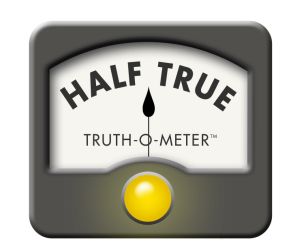
Half True vs. half-hearted, September 24, 2013. (Politifact.com).

Half True vs. half-hearted, September 24, 2013. (http://Politifact.com).

Then there’s Andrews’ shorter second paragraph, the one that made it sound like I was equally interested in going to law school as I was in going into a master’s program in history. I had all of one conversation with Andrews about my forks in the road after undergrad at Pitt. As I told anyone who knew me between May and October ’90, I was “sixty percent in favor of grad school, thirty in favor of law school, and ten in favor of working full-time.” Andrews, however, wrote of me

As of last year his plan was to proceed to law school. However, his talent for history [and]…his enthusiasm for it were so striking that I urged him to consider graduate school in this area, and he has decided to apply both to law schools and to several graduate schools.

I had, in fact, decided by October ’90 not to apply to law schools at all (while applying to six universities for grad school), and communicated that to all of my letter writers at the time. To an admissions committee, this paragraph would make me appear indecisive, and likely to not be as passionate about the prospect of the hard work of academic history as I would be about the law and making money.

In light of everything else I said in my original blog post about letters of recommendation, Andrews’ letter actually proves almost all of my points. That “it’s important to get to know a person, to gain some sense of trust from them, before asking for a letter or a reference.” That “the process of providing a letter of recommendation or a reference ought to be transparent, so that the student or employee can be confident that they’re not being back-stabbed by the same people in which they’re placing significant trust.” Writing a letter of recommendation should always be a serious undertaking, as I’ve learned over the years. Sometimes it’s best to say “No” than to do it in a Freudian-slip fashion.

Freudian "Slip" (2012) by Nathan Davis, September 24, 2013. (http://redbubble.com). Qualifies as fair use - low resolution and subject matter related to post.

Freudian “Slip” (2012) by Nathan Davis, September 24, 2013. (http://redbubble.com). Qualifies as fair use – low resolution and subject matter related to post.

On the “one A in one course does not make for a good recommendation” rule, this has turned out to be inadvertently true. Even if Andrews had intended to write me a glowing letter of recommendation, his feelings about me as a student — ones that he verbalized to me on several occasions between ’90 and ’95 — may well have influenced his rather bland and half-hearted effort at that “good “letter that he supposedly wrote for me in December ’90.

“It was never a question I dared asked — to see my letter of recommendation — before I’d reached the final stages of grad school,” I wrote three years ago. Now that I apparently have Andrews’ letter from twenty-three years ago, my sage advice from three years ago rings as true now as it did then. Maybe even more so.

Grad School & My Most Special Summer Reading List

31 Saturday Aug 2013

Posted by decollins1969 in 1, Academia, Boy @ The Window, culture, Eclectic, Pittsburgh, Politics, Pop Culture, race, University of Pittsburgh, Work, Youth

≈ Leave a comment

Tags

"I Have A Dream" speech, Afrocentricity, Black Culture, Black History, Blackness, Books, Carter G. Woodson, Department of HIstory, Elaine, Graduate School, Higher Education, Joe White, K-12 Education, Malcolm X, March on Washington, Multicultural Education, Pitt, Readings, Self-Discovery, Toni Morrison, W. E. B. Du Bois, Western Psych, Western Psychiatric Institute & Clinic


Just a small sample of the books I read/re-read summer before grad school in 1991, August 31, 2013. (Donald Earl Collins).

Just a small sample of the books I read/re-read summer before grad school in 1991, August 31, 2013. (Donald Earl Collins).

For me, August 28 this week was significant for any number of reasons. It wasn’t just that it was fifty years to the exact day and date that the March on Washington occurred and MLK gave his “I Have A Dream” speech. Or that is was fifty-eight years to the date that White supremacists lynched Emmett Till for allegedly whistling at some flat-butt White girl. This past Wednesday was also twenty-two years to the day and date that I began my first day of graduate school as a master’s student in the University of Pittsburgh’s Department of History.

Of course, I didn’t discuss this earlier this week (it would’ve been incredibly arrogant on my part to bring this up three days ago). My big steps for myself were infinitesimal when in measured comparison to the beginning of the two-year height of the official Civil Rights Movement. But even on an afternoon in which I attended my first course and meeting about teaching/advising assignments for the semester, it did feel like a bit of a triumph. Especially when considering what I had to do that spring and summer to get into the program with funding in the first place.

I didn’t learn that much that day. Except the low contempt Joe White and some of the other professors held toward pedagogy and teaching. “You already know more than your students,” White said as advice to us who’d be TAs that semester. I was lucky to not be among them for my first year. I was a GSA assisting in the advising of history majors, some of whom were my fellow undergrads just a few months before. But even then, I thought two minutes’ worth of advice on viewing students as empty vessels was insufficient training for learning how to lecture and facilitate conversations with upwards of 100 students spread out over several discussion sections each week.

I had other things on my mind at that moment, though, including the relief that I’d survived a summer making $5.20 per hour as a full-time employee with a Western Psychiatric Institute & Clinic project in which the project investigators were far more psychotic than the patients. Aside from that, I thought about how the previous four months had served as my preparation for the White world of grad school.

I’d done a lot of reading that late spring and summer, spurned on by boredom, disappointment in my weirdly evolving friendship with Elaine, and a sense that I needed to read to fortify myself against the neo-Marxists in my eventual field. So I read. I started off with Alex Haley’s The Autobiography of Malcolm X (1965), believe it or not, the first time I’d ever read it. Like so many before me, it made my views of the man less black and white than it had been before. I then picked up W. E. B. Du Bois’ Souls of Black Folk (1903), the first time I’d read that book since I wrote a book report on it for Mrs. O’Daniel’s class in fifth grade. Unsurprisingly, I got much more out of it in May ’91 than I did in May ’80.

I didn’t stop there, as my reading took me on three different tracks in June, July and August. One was the “I didn’t get to read this before” track, as I read Toni Morrison’s Tar Baby, Song of Solomon and Beloved (didn’t understand it then, and still don’t get the big deal about it now). Along with Alice Walker’s The Color Purple, Maya Angelou’s I Know Why The Caged Bird Sings (1969), bell hooks and several others on Black Women’s literature. Then, I decided to go back and reread some James Baldwin and Richard Wright that I’d first read for high school, and added Ralph Ellison’s Invisible Man (1952) to the mix. On the non-literature track, I ended up reading Franz Fanon, Du Bois’ Black Reconstruction (1935) — at least, I put a significant dent in it — Derrick Bell’s And We Are Not Saved (1987), and other writings on Black history and culture (broadly speaking).

But the third track would end up taking me on a path toward my dissertation topic and my first book, Fear of a “Black” America (2004). It started with articles on multicultural education that took me to James Banks’ theoretic constructions of what multicultural education ought to have been, but wasn’t. I also found myself reading books like Jonathan Kozol’s Savage Inequalities (1991), Molefi Asante’s The Afrocentric Idea (1987), Dinesh D’Souza’s Illiberal Education (completely indecipherable in a circular firing squad of a thesis kind of way) and Carter G. Woodson’s The Mis-education of the Negro (1933). I was reading anything that could inform my thinking about K-12 and higher education and how it played the role as both equalizer and oppressor for so many Black folks over the years.

Books, Grad School & Blackness

Books, Grad School & Blackness

It was easily the most reading I’d done on my own since the year before I’d gone into seventh grade, middle school and the Humanities Program. I wanted to read all I wanted to read before spending the next few years drowning my brain in hundreds of books and articles that I’d absolutely need to read as a historian. In the process, I may’ve radicalized myself a bit for the otherwise hum-drum experience of reading mind-numbing accounts of history in which the authors didn’t seem to see their own sense of high-brow White maleness.

And with all of it, I surprised myself. I realized once again that my Black classmates and 616 neighbors were wrong about me not being Black enough. Their “Black” wasn’t my “Black,” of course. But all those books confirmed for me that there were many ways to be Black that folks who didn’t read could barely understand.

The Lazarus Woman

22 Thursday Aug 2013

Posted by decollins1969 in 1, Academia, Boy @ The Window, Carnegie Mellon University, culture, Eclectic, Mount Vernon New York, Pittsburgh, Politics, Pop Culture, race, Religion, Youth

≈ Leave a comment

Tags

Barbara B. Lazarus, Barbara Lazarus, Brandie Weston, Carl Zimring, Death, Friendship, Graduate School, Harold Meltzer, Joe Trotter, John Hinshaw, Life and Death, Maurice Eugene Washington, Maurice Washington, Mentoring, Politics of Academia, Politics of Graduate School, Sarai Washington, Susan McElroy


Barbara B. Lazarus, obituary picture, July 17, 2003. (http://cmu.edu).

Barbara B. Lazarus, obituary picture, July 17, 2003. (http://cmu.edu).

Now that my book’s been out for a couple of months (between two and four months, depending on the e-book platform, actually), I’ve found that my thoughts sometimes drift toward those that are no longer around to read it.

Not so much my family or nemeses, though. Sarai, my only sister, who died in July ’10, would likely have never read a word of Boy @ The Window — it would be too honest an assessment of life at 616 for her. My late idiot ex-stepfather Maurice Washington was already unhappy with my numerous posts about his borderline personality issues and constant psychological and physical abuse of me and family when I picked up the phone one day that same week my sister passed.

As for my former classmate Brandie Weston — to whom I’ve dedicated my memoir (actually, a co-dedication that includes my son) — maybe, if she had been well enough. My favorite teacher, the late Harold Meltzer, though, would’ve begun reading  Boy @ The Window five minutes after it had gone live on Amazon.com!

But of all of those folks who are no longer a part of this corporeal world (or who have gone into some state of seclusion from it), one other person stands out today. My dear friend and mentor from my Carnegie Mellon years (and the six years after I finished), Barbara Lazarus. I’ve discussed her here before, but not lately. Probably because I do tear up sometimes when thinking about her support of me specifically and her work at CMU in general. Barbara helped make my otherwise rough and dehumanizing experience at CMU manageable and even career-affirming.

As I wrote about Barbara for the memorial service at CMU in September ’03:

I want to communicate to you that I am in complete solidarity with everyone who attends the gathering at CMU on October 17.  For me, Barbara’s work was more than about women’s equity in the engineering and science fields.  She was about ensuring that all (regardless of gender or race, and regardless of the degree) who attempted the grand enterprise of competing for a degree actually made it through the process … Barbara was a dear friend and mentor who truly believed in me, even in spite of myself.  I loved her, and I will surely miss her, as I am sure you will also.

That only approximated how much she meant to me during and after my four years of doctoral success and failures at CMU. The months immediately before my advisor Joe Trotter and my committee approved my dissertation were the worst, as is well documented on this blog. Barbara convinced me to not become hot-headed and drop-out of the program with a completed first-draft of my dissertation under my belt. She also managed to keep me from requesting a change of advisors so close to the finish line. She did offer to “step in” as her duties as Associate Provost would’ve allowed, but warned me that this political solution would delay my graduation. My connection with Barbara kept me from meeting Trotter in one of CMU’s parking lots late at night wearing a ski mask and dark leather gloves!

She became my best reference professionally and otherwise after those dark days ended with the end of ’96. She read my articles and my first book before they went to print. We swapped stories about family and life and religion. We stayed in touch even after I moved to Silver Spring, Maryland in ’99. Barbara died on July 14, ’03, just sixteen days before my son Noah was born. It’s been a decade, a month and eight days since she passed, nearly as long as I actually knew Barbara (roughly between October ’92 and July ’03). Boy, I wish I could’ve shared my first photos of my son with her!

There were a few people like Barbara at CMU during those years. Susan McElroy (now at UT-Dallas), John Hinshaw (at least prior to my Spencer Fellowship), Carl Zimring (before the O.J. verdict), the Gants and the other Black doctoral students I’d met there (all fourteen of us) were my CMU lifeline beyond multiculturalism and Trotter tired sense of migration studies.

But Barbara Lazarus and I had a friendship that went well beyond academia and career, and went undamaged by petty jealousies or sudden bursts of outrage from jury verdicts. I’d been to her home, met her husband and her kids, learned something about her as a person, and in the process, managed to be my better self even in the worst of circumstances. That is being a good mentor, friend and person. I just hope that I was the same to her, and that Boy @ The Window proves to be the same to others.

← Older posts
Newer posts →

Boy @ The Window: A Memoir

Boy @ The Window: A Memoir

Places to Buy/Download Boy @ The Window

There's a few ways in which you can read excerpts of, borrow and/or purchase and download Boy @ The Window. There's the trade paperback edition of Boy @ The Window, available for purchase via Amazon.com at http://www.amazon.com/Boy-Window-Donald-Earl-Collins/dp/0989256138/

There's also a Kindle edition on Amazon.com. The enhanced edition can be read only with Kindle Fire, an iPad or a full-color tablet. The links to the enhanced edition through Apple's iBookstore and the Barnes & Noble NOOK edition are below. The link to the Amazon Kindle version is also immediately below:

scr2555-proj697-a-kindle-logo-rgb-lg

Boy @ The Window on Amazon.com: http://www.amazon.com/Boy-The-Window-Memoir-ebook/dp/B00CD95FBU/

iBookstore-logo-300x100

Boy @ The Window on Apple's iBookstore: https://itunes.apple.com/us/book/boy-the-window/id643768275?ls=1

Barnes & Noble (bn.com) logo, June 26, 2013. (http://www.logotypes101.com).

Boy @ The Window on Barnes & Noble: http://www.barnesandnoble.com/w/boy-the-window-donald-earl-collins/1115182183?ean=2940016741567

You can also add, read and review Boy @ The Window on Goodreads.com. Just click on the button below:

Boy @ The Window

Twitter Updates

Tweets by decollins1969
  • RSS - Posts
  • RSS - Comments

Archives

  • June 2025
  • April 2023
  • September 2022
  • August 2022
  • July 2022
  • June 2022
  • May 2022
  • April 2022
  • March 2022
  • January 2022
  • December 2021
  • November 2021
  • October 2021
  • September 2021
  • August 2021
  • July 2021
  • June 2021
  • April 2021
  • March 2021
  • February 2021
  • January 2021
  • December 2020
  • November 2020
  • October 2020
  • September 2020
  • August 2020
  • July 2020
  • May 2020
  • April 2020
  • March 2020
  • January 2020
  • December 2019
  • November 2019
  • August 2019
  • July 2019
  • June 2019
  • May 2019
  • April 2019
  • March 2019
  • February 2019
  • January 2019
  • December 2018
  • November 2018
  • October 2018
  • September 2018
  • August 2018
  • July 2018
  • June 2018
  • May 2018
  • March 2018
  • February 2018
  • January 2018
  • December 2017
  • November 2017
  • October 2017
  • September 2017
  • August 2017
  • July 2017
  • June 2017
  • May 2017
  • April 2017
  • March 2017
  • February 2017
  • January 2017
  • December 2016
  • November 2016
  • October 2016
  • September 2016
  • August 2016
  • July 2016
  • June 2016
  • May 2016
  • April 2016
  • March 2016
  • February 2016
  • January 2016
  • December 2015
  • November 2015
  • October 2015
  • September 2015
  • August 2015
  • July 2015
  • June 2015
  • May 2015
  • April 2015
  • March 2015
  • February 2015
  • January 2015
  • December 2014
  • November 2014
  • October 2014
  • September 2014
  • August 2014
  • July 2014
  • June 2014
  • May 2014
  • April 2014
  • March 2014
  • February 2014
  • January 2014
  • December 2013
  • November 2013
  • October 2013
  • September 2013
  • August 2013
  • July 2013
  • June 2013
  • May 2013
  • April 2013
  • March 2013
  • February 2013
  • January 2013
  • December 2012
  • November 2012
  • October 2012
  • September 2012
  • August 2012
  • July 2012
  • June 2012
  • May 2012
  • April 2012
  • March 2012
  • February 2012
  • January 2012
  • December 2011
  • November 2011
  • October 2011
  • September 2011
  • August 2011
  • July 2011
  • June 2011
  • May 2011
  • April 2011
  • March 2011
  • February 2011
  • January 2011
  • December 2010
  • November 2010
  • October 2010
  • September 2010
  • August 2010
  • July 2010
  • June 2010
  • May 2010
  • April 2010
  • March 2010
  • February 2010
  • January 2010
  • December 2009
  • November 2009
  • October 2009
  • September 2009
  • August 2009
  • July 2009
  • June 2009
  • May 2009
  • April 2009
  • March 2009
  • February 2009
  • January 2009
  • December 2008
  • November 2008
  • October 2008
  • September 2008
  • August 2008
  • July 2008
  • June 2008
  • May 2008
  • April 2008
  • March 2008
  • February 2008
  • January 2008
  • December 2007
  • November 2007
  • October 2007
  • September 2007
  • August 2007
  • July 2007
  • June 2007

Recent Comments

MaryPena's avatarMaryPena on My Day of Atonement/Bitter Hat…
decollins1969's avatardecollins1969 on No Good Teaching Deed Goes…
Mary Rose O’Connell's avatarMary Rose O’Connell on No Good Teaching Deed Goes…

NetworkedBlogs on Facebook

NetworkedBlogs
Blog:
Notes From a Boy @ The Window
Topics:
My Life, Culture & Education, Politics & Goofyness
 
Follow my blog

616 616 East Lincoln Avenue A.B. Davis Middle School Abuse Academia Academy for Educational Development AED Afrocentricity American Narcissism Authenticity Bigotry Blackness Boy @ The Window Carnegie Mellon University Child Abuse Class of 1987 CMU Coping Strategies Crush #1 Crush #2 Death Disillusionment Diversity Domestic Violence Economic Inequality Education Family Friendship Friendships Graduate School Hebrew-Israelites High-Stakes Testing Higher Education History Homelessness Humanities Humanities Program Hypocrisy Internalized Racism Jealousy Joe Trotter Joe William Trotter Jr. K-12 Education Love Manhood Maurice Eugene Washington Maurice Washington Misogyny Mother-Son Relationship Mount Vernon High School Mount Vernon New York Mount Vernon public schools Multiculturalism MVHS Narcissism NFL Pitt Pittsburgh Politics of Education Poverty President Barack Obama Race Racial Stereotypes Racism Relationships Self-Awareness Self-Discovery Self-Reflection Sexism Social Justice Teaching and Learning University of Pittsburgh Violence Whiteness Writing

Top Rated

Blog at WordPress.com.

  • Subscribe Subscribed
    • Notes from a Boy @ The Window
    • Join 103 other subscribers
    • Already have a WordPress.com account? Log in now.
    • Notes from a Boy @ The Window
    • Subscribe Subscribed
    • Sign up
    • Log in
    • Report this content
    • View site in Reader
    • Manage subscriptions
    • Collapse this bar
 

Loading Comments...